

- Market Size (2026)
- USD 615.6 Mn
- Forecast (2036)
- USD 1539.6 Mn
- CAGR (2026 to 2036)
- 9.6%
How big is Probiotic & Postbiotic Bakery Market in 2026?
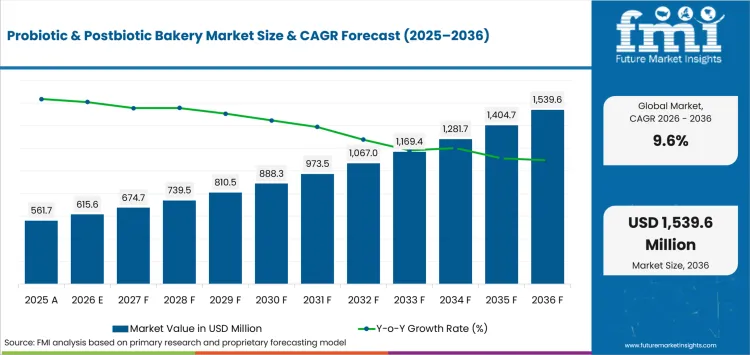
USD 615.6 million in 2026 to USD 1539.6 million by 2036 at 9.6% CAGR
Demand is projected to rise from USD 615.6 million in 2026 to USD 1539.6 million by 2036 at 9.6% CAGR. Functional foods gain a lower-friction route when digestive-health positioning fits bread products consumers already purchase frequently. Shinsegae Food reported in February 2025 that three earlier lactic-acid-bacteria rice breads had surpassed 600,000 cumulative units. The company also reported average monthly sales growth of 12% across those functional bakery products after launch.
Country opportunity separates most clearly at the registration and promotion stage because finished products face different proof standards. Dubai Municipality reported in February 2025 that Montaji+ contained more than 1.7 million registered products, while its Unified Permit System reduced food permit processing time by 75%. The UAE therefore offers faster administrative handling for prepared dossiers while United States and United Kingdom launches face different label and promotion rules. Commercial teams need local claim review before transferring the same functional food ingredients story across these markets.
Key Takeaways of Probiotic & Postbiotic Bakery Market
- Routine bread and snack occasions support demand because microbiome-oriented positioning fits established breakfast and household purchasing patterns.
- Based on product type, classic - original is projected to account for 40.0% in 2026 due to familiar sensory expectations that reduce trial risk.
- By claim - nature, conventional is estimated to hold 54.0% in 2026 owing to broader ingredient flexibility during formulation and cost balancing.
- In 2026, frozen is expected to lead format with 29.0% share because controlled storage extends selling windows for specialty bakery products.
- Baking heat and country-specific claim rules raise validation costs because manufacturers must prove finished-product function without sacrificing taste or shelf life.
- Some of the key players in this market include Shinsegae Food, Puratos, Angel Yeast Co., Ltd., Genius Foods, Flowers Foods, Warburtons, Dr. Schär, and Lallemand Health Solutions.
Analyst Perspective
"Bakery brands should evaluate a probiotic or postbiotic proposition on the finished bread rather than the ingredient specification alone. The strongest commercial offers preserve familiar taste while carrying processing data and claim support that remain valid across the intended shelf life."
- Nandini Roy Choudhury, Principal Consultant, Future Market Insights
How is the Probiotic & Postbiotic Bakery Market segmented?
The probiotic & postbiotic bakery market is segmented by product type, claim - nature, format, packaging format, sales channel, and region.
Product type includes classic - original, whole grain & seeded, flavored & filled, mini & snacking formats, and premium / artisan. Claim - nature covers conventional, clean label, organic, gluten-free, and high-protein / fortified. Format includes frozen, fresh, ambient packaged, chilled, and par-baked / thaw-and-serve. Packaging format covers multipack, single-serve, family / loaf pack, and bulk foodservice. Sales channels include supermarkets & hypermarkets, artisan & specialty bakeries, convenience & forecourt, online & DTC, and foodservice distributors.
Why do supermarkets & hypermarkets lead demand within the sales channel category?
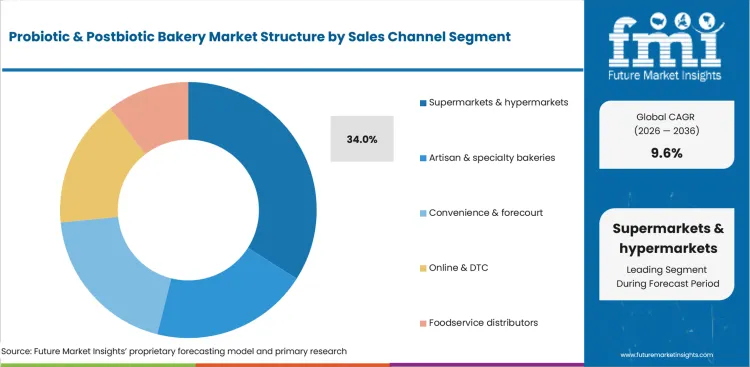
Supermarkets place functional bakery beside conventional products and expose new claims to immediate price and nutrition comparisons during routine food trips. Large grocery chains also support functional fiber bakery products plus frozen merchandising across high-frequency bakery categories.
- By sales channel, supermarkets & hypermarkets are forecast to represent 34.0% in 2026 driven by frequent bakery purchasing and broad category reach.
- Warburtons launched protein pittas and flatbreads alongside its existing protein loaves and bagels through major retailers in 2024, demonstrating how a functional nutrition proposition can scale across familiar bakery formats without requiring specialist distribution.
Why does classic - original lead demand within the product type category?
Classic bakery gives manufacturers a familiar sensory benchmark for testing microbiome-oriented benefits before product complexity rises. The base format also limits extra variables from seeds and fillings during early personalized bakery products trials.
- Based on product type, classic - original is projected to account for 40.0% in 2026 due to familiar texture expectations that reduce trial risk.
- Shinsegae Food reported in September 2025 that its whole-grain rice bread exceeded 15,000 units within three weeks after launch. The bread used rice flour and gluten-degrading lactic acid bacteria which gives developers a direct commercial example of functional bakery adoption.
Why does conventional lead demand within the claim - nature category?
Conventional formulations leave manufacturers more room to adjust cultures and dough systems without extra organic or exclusion-based sourcing limits across gluten-free food development. FDA postponed the effective date of its updated healthy nutrient-content rule in February 2025 and retained measurable food-group plus nutrient criteria.
- By claim - nature, conventional is estimated to hold 54.0% in 2026 owing to broader ingredient flexibility during formulation and cost balancing.
- Product teams can establish microbial identity and finished-product performance before accepting narrower ingredient choices for premium claim architectures. That sequence preserves room to correct dough behavior before sourcing restrictions narrow formulation options during commercial scale-up.
Why does frozen lead demand within the format category?
Frozen distribution extends the selling window for specialty bakery and reduces losses from slower inventory turns. Cold-chain handling also gives manufacturers tighter storage control for frozen bakery products than long ambient distribution.
- In 2026, frozen is expected to lead format with 29.0% share because controlled storage protects specialty-bakery quality across longer selling windows. Flowers Foods announced in May 2026 that Canyon Bakehouse bagels and English muffins entered frozen aisles nationwide in the United States.
- Lower storage temperatures cannot substitute for finished-product validation but they reduce variability during shelf-life testing. That control makes frozen formats practical for ingredients needing tighter handling before routine household use.
What are the drivers, restraints and opportunities in the Probiotic & Postbiotic Bakery Market?
Routine-food delivery supports demand, while baking heat and claim validation constrain commercialization, and postbiotic routes widen the addressable bakery set.
- Driver: Familiar bread occasions convert digestive-health interest into repeated food purchases without requiring a separate supplement routine.
- Restraint: Baking heat and labeling rules raise development costs because finished products need credible function and compliant benefit language.
- Opportunity: Postbiotic preparations and process-tolerant cultures expand the bakery formats that can carry a stable microbiome-oriented proposition.
Routine Food Occasions Support Functional Adoption
Bakery turns digestive-health interest into breakfast and snack occasions that consumers already understand within established functional foods routines. Puratos completed the VLAIO-funded Bioticbread project with Ghent University in October 2025 and reported postbiotic properties in sourdough bread. The project gives bakery developers a direct food route while digestive health supplements companies can evaluate adjacent formulation partnerships.
Process Survival and Claim Review Raise Commercial Friction
Baking heat can change microbial status and storage can reduce viable counts across commercial distribution. FDA updated its general food-labeling compliance program in May 2025 and restated manufacturer responsibility for truthful nutrient declarations and claims. Bakery companies therefore need evidence for the product consumers actually eat as heat-stable probiotics behave differently across production lines.
Postbiotic Routes Widen the Addressable Bakery Set
Postbiotic systems remove the need to preserve living organisms through every baking step while retaining a defined microbial preparation for finished foods. Lallemand Health Solutions and Kirin Holdings announced a May 2025 distribution agreement for IMMUSE covering postbiotic food and beverage applications. Wider ingredient access gives bakery developers another ambient route and expands commercial overlap with postbiotic supplements without assuming identical claim rules.
Which country CAGRs are profiled in the Probiotic & Postbiotic Bakery Market?
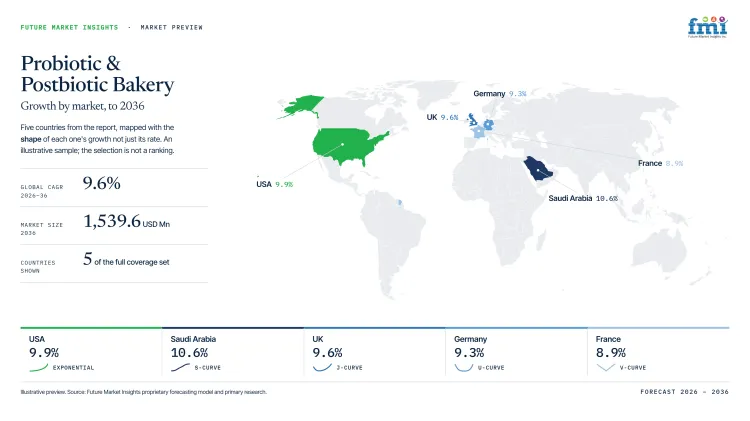
| Country | CAGR |
|---|---|
| UAE | 10.9% |
| Saudi Arabia | 10.6% |
| South Korea | 10.3% |
| USA | 9.9% |
| UK | 9.6% |
How do country-level CAGRs compare in the Probiotic & Postbiotic Bakery Market?
The 1.3-point spread from UAE at 10.9% to UK at 9.6% keeps forecasts tightly grouped around similar commercialization conditions. UAE and Saudi Arabia form the Gulf pair above 10.5%, with South Korea at 10.3%. USA and UK form the lower band, although rankings measure forecast pace rather than current market size.
- UAE digital registration shortens administrative handling for importers with complete product dossiers.
- Saudi Arabia menu rules raise compliance work before functional bakery reaches foodservice accounts.
- South Korea requires early ingredient classification before functional claims reach commercial labels.
- USA grocery scale supports reach but federal labeling review raises microbiome evidence requirements.
- UK retailer reach remains attractive despite HFSS rules that pressure promotional economics.
Launch economics can diverge even when country growth rates remain closely grouped. The full report provides country-level CAGR analysis across North America, Latin America, Europe, East Asia, South Asia, Oceania and the Middle East and Africa.
Country-wise Analysis
- UAE: Imported functional bakery reaches modern grocery shelves fastest when registration files and distributor records are complete before shipments enter Dubai through major trade channels. Probiotic & postbiotic bakery demand in UAE is forecast to rise at 10.9% CAGR through 2036 because digital approval tools support high-volume food trade and retailer onboarding. Dubai Municipality reported in April 2025 that Dubai receives about nine million tonnes of food and related products through its ports each year. Montaji+ gives importers a direct approval route but label dossiers and cold-chain planning remain material frictions for frozen products and favor entrants with experienced local regulatory teams.
- Saudi Arabia: Foodservice operators increasingly need nutrition communication that survives menu review across restaurant and digital ordering channels throughout the Kingdom. The Ministry of Municipalities and Housing reported in September 2025 that its updated food-law violations table with SFDA imposed menu-labeling requirements covering salt content and caffeine alongside physical-activity guidance. Probiotic & postbiotic bakery demand in Saudi Arabia is projected to record 10.6% CAGR during the assessment period as foodservice expands trial beyond grocery shelves. Local distribution supports access to major accounts but registration work and nutrient communication raise launch costs for manufacturers without dedicated compliance support. Early dossier planning therefore gives entrants a commercial advantage during foodservice onboarding across major Saudi restaurant and retail accounts.
- South Korea: Functional-food commercialization starts with ingredient classification because permitted benefit language depends closely on the regulatory status assigned to each formulation. Domestic technical expertise gives bakery developers a strong base for controlled formulation work and evidence planning. Probiotic & postbiotic bakery demand in South Korea is forecast to rise at 10.3% CAGR through 2036 as established functional-food developers work inside formal evidence routes. MFDS listed Regulation number 2026-33 in August 2026 for recognition of functional ingredients and related health functional food standards. Evidence accepted elsewhere does not automatically transfer into Korean claims and entrants should settle classification before final packaging commitments.
- USA: National retailers place functional bakery beside conventional and specialty breads across frequent household shopping occasions with immediate price and nutrition comparisons. FDA extended the comment period in May 2025 for its proposed front-of-package Nutrition Info box covering most packaged foods. Grocery scale gives manufacturers broad national reach and established frozen distribution nationwide without requiring a specialist sales channel. Probiotic & postbiotic bakery demand in USA is estimated to expand at 9.9% CAGR over the forecast period as those retail routes support commercial scale. Benefit language must remain consistent with federal labeling rules before microbiome claims become the main shelf distinction.
- UK: Grocery buyers compare functional bakery against established high-protein and special-diet products across major national chains and frequent household shopping occasions. Probiotic & postbiotic bakery demand in UK is forecast to expand at 9.6% CAGR by 2036 as familiar bread formats carry differentiated nutrition propositions through supermarkets. HFSS classification can weaken volume-promotion economics for products whose nutrient profile crosses the regulated thresholds. The Department of Health and Social Care published its final volume-price restriction impact assessment in October 2025 for affected food promotions and retail channels. Major-retailer reach supports trial but manufacturers should review nutrient composition beside microbiome evidence before national price-led launches.
Who are the notable companies in the Probiotic & Postbiotic Bakery Market?
Shinsegae Food, Puratos, Angel Yeast Co., Ltd., Genius Foods, Flowers Foods, Warburtons, Dr. Schär and Lallemand Health Solutions are the notable companies serving this market.
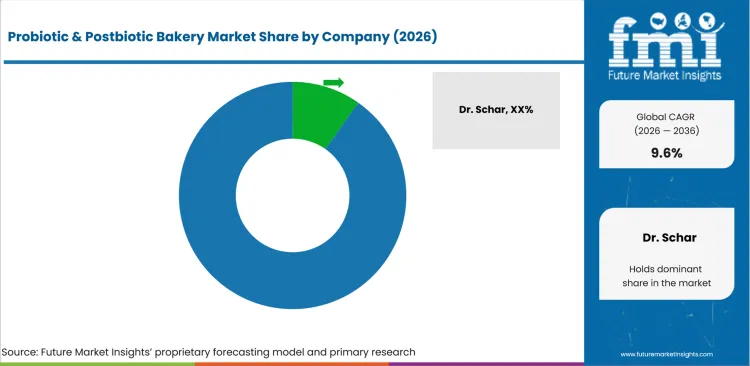
Competition separates companies with direct microbiome-bakery evidence from scaled bakery manufacturers and specialist biotic developers. Entry depends on bakery process control plus claim evidence that remains credible after heat and storage. Companies with both technical validation and a route into routine grocery purchasing have a stronger commercialization position than firms relying on ingredient novelty alone.
- Direct microbiome-bakery developers: Shinsegae Food, Puratos, Angel Yeast Co., Ltd., and Genius Foods provide the clearest current evidence around biotic breads or bakery-specific process work.
- Scaled bakery platforms: Flowers Foods, Warburtons, and Dr. Schär provide established manufacturing or retail routes that can carry functional extensions across familiar bakery formats.
- Biotic ingredient specialist: Lallemand Health Solutions brings probiotic and postbiotic development depth for food applications that can support bakery formulation partners. Its broader microbial portfolio also overlaps with multistrain probiotics demand across adjacent food categories outside finished bakery.
Competitive Benchmarking: Probiotic & Postbiotic Bakery Market
| Company | Bakery Application Evidence | Functional Formulation Depth | Commercial Route Access | Geographic Reach |
|---|---|---|---|---|
| Shinsegae Food | High | High | High | South Korea |
| Puratos | High | High | High | Global |
| Angel Yeast Co., Ltd. | High | High | High | Global |
| Genius Foods | High | Medium | Medium | United Kingdom and selected international markets |
| Flowers Foods | High | Medium | High | United States |
| Warburtons | High | Medium | High | United Kingdom |
| Dr. Schär | High | High | High | Europe and United States |
| Lallemand Health Solutions | Medium | High | High | Global |
Key Developments in the Probiotic & Postbiotic Bakery Market
- In September 2025, Genius Foods reported a significant bakery equipment investment for prescription bread production to improve texture consistency and manufacturing reliability.
- In May 2025, Angel Yeast Co., Ltd. presented a probiotic bread series at Bakery China and signed technical cooperation agreements with 20 baking training institutions.
- In February 2025, Flowers Foods completed its acquisition of Simple Mills and expanded its exposure to better-for-you snacks and baking mixes.
Key Players in the Probiotic & Postbiotic Bakery Market
Microbiome Bakery and Fermentation Developers
- Shinsegae Food
- Puratos
- Angel Yeast Co., Ltd.
Scaled Functional Bakery Platforms
- Genius Foods
- Flowers Foods
- Warburtons
Special-Diet and Biotic Development Platforms
- Dr. Schär
- Lallemand Health Solutions
Probiotic & Postbiotic Bakery Market - Report Scope
| Coverage field | Report scope |
|---|---|
| Market breakdown | By product type, claim - nature, format, packaging format, sales channel and region. |
| Quantitative Units | Revenue in USD million and CAGR in %. |
| Market Definition | Revenue reflects bakery products intentionally positioned around probiotic or postbiotic functionality within the stated segment universe. |
| Regions Covered | North America, Latin America, Western Europe, Eastern Europe, East Asia, South Asia and Pacific and Middle East and Africa. |
| Countries Covered | UAE, Saudi Arabia, South Korea, USA, UK, and 25+ additional countries included in the full report. |
| Key Companies Profiled | Shinsegae Food, Puratos, Angel Yeast Co., Ltd., Genius Foods, Flowers Foods, Warburtons, Dr. Schär, Lallemand Health Solutions. |
| Forecast Period | 2026 to 2036. |
| Approach | Primary and secondary research with market triangulation. |
Probiotic & Postbiotic Bakery Market - Research Methodology
| Method | Approach |
|---|---|
| Primary Research | FMI analysts gathered input from manufacturers, service providers, technology developers, distributors, end users, procurement teams, and subject-matter experts. Interviews examined purchasing decisions, product or service evaluation, adoption barriers, approval requirements, pricing considerations, and expectations for technical or commercial support. Respondents were also asked what evidence is required before a trial, pilot, or initial order develops into regular purchasing. |
| Desk Research | Desk research covered government statistics, regulatory publications, trade data, industry associations, technical literature, standards, company filings, product information, and official corporate announcements. Sources were reviewed for relevance, publication date, geographic coverage, and consistency with the defined market scope. Claims relating to performance, applications, approvals, capacity, investment, and commercial activity were retained only when supported by credible public evidence. |
| Market Sizing and Forecasting | The market model combined the baseline value with historical performance, segment structure, pricing and volume indicators, adoption levels, company participation, and country-level demand conditions. Forecast assumptions considered economic activity, investment trends, regulatory developments, technology adoption, purchasing cycles, supply availability, and barriers to wider market use. Segment and regional estimates were reconciled before the final market total was calculated. |
| Data Validation | Estimates were checked against multiple independent indicators, including public data, company activity, trade patterns, industry developments, and findings from primary interviews. Validation also tested whether products, services, applications, and company revenues fell within the defined market boundaries. Adjacent categories, unsupported claims, overlapping revenues, and activities without direct market relevance were excluded to reduce double counting and maintain consistency across segments and countries. |
Probiotic & Postbiotic Bakery Market by Segments
Probiotic & Postbiotic Bakery Market segmented by Product Type:
- Classic - original
- Whole grain & seeded
- Flavored & filled
- Mini & snacking formats
- Premium / artisan
Probiotic & Postbiotic Bakery Market segmented by Claim - nature:
- Conventional
- Clean label
- Organic
- Gluten-free
- High-protein / fortified
Probiotic & Postbiotic Bakery Market segmented by Format:
- Frozen
- Fresh
- Ambient packaged
- Chilled
- Par-baked / thaw-and-serve
Probiotic & Postbiotic Bakery Market segmented by Packaging Format:
- Multipack
- Single-serve
- Family / loaf pack
- Bulk foodservice
Probiotic & Postbiotic Bakery Market segmented by Sales Channel:
- Supermarkets & hypermarkets
- Artisan & specialty bakeries
- Convenience & forecourt
- Online & DTC
- Foodservice distributors
Probiotic & Postbiotic Bakery Market by Region:
- North America
- United States
- Canada
- Latin America
- Brazil
- Mexico
- Argentina
- Chile
- Western Europe
- Germany
- France
- United Kingdom
- Italy
- Spain
- Benelux
- Nordics
- Eastern Europe
- Poland
- Czech Republic
- Romania
- Hungary
- East Asia
- China
- Japan
- South Korea
- South Asia and Pacific
- India
- ASEAN
- Australia and New Zealand
- Middle East and Africa
- GCC Countries
- South Africa
- Türkiye
- Israel
Research Sources and Bibliography
- Shinsegae Food. (2025, February 19). “식빵도 건강하게”…신세계푸드, ‘유산균 쌀 식빵’ 출시.
- Dubai Municipality. (2025, February 17). Latest digital food safety services showcased at Gulfood 2025.
- Shinsegae Food. (2025, September 15). 마트 베이커리도 '건강빵'이 대세! 신세계푸드, 소비자 조사 통해 마트 건강빵 개발한다.
- USA Food and Drug Administration. (2025, February 24). FDA Finalizes Updated “Healthy” Nutrient Content Claim.
- Flowers Foods. (2026, May 4). Flowers Foods’ Innovations Deliver Fresh Variety to Breakfast, Snacking Categories.
- Warburtons. (2025, January 29). Get Snack-tive Launch | Company News.
- Puratos. (2025, October 27). Postbiotic-enriched sourdough bread: A new step toward gut support.
- USA Food and Drug Administration. (2025, May 9). FDA Updates General Food Labeling Requirements Compliance Program.
- Lallemand Health Solutions. (2025, May 15). Lallemand Health Solutions and Kirin Holdings Announce Distribution Agreement for IMMUSE®.
- Ministry of Municipalities and Housing. (2025, September 1). MOMAH and SFDA Launch Updated Table of Food Law Violations.
- Ministry of Food and Drug Safety, Republic of Korea. (2026, August 13). Regulation on Recognition of Functional Ingredient and of Standard·Specification for Health Functional Foods (No. 2026-33).
- USA Food and Drug Administration. (2025, May 8). Front-of-Package Nutrition Labeling.
- Department of Health and Social Care. (2025, October 1). Restricting volume price promotions of HFSS products.
- Angel Yeast Co., Ltd. (2025, May). Angel Yeast Showcases Innovations at 27th Bakery China Expo.
- Genius Foods. (2025, September 8). Genius breads available on prescription.
- Flowers Foods. (2025, February 21). Flowers Foods, Inc. Completes Acquisition of Simple Mills.
- Dubai Municipality. (2025, April 30). Dubai tops the most prestigious global competitiveness indicators.
- Dr. Schär. (2026, July 22). In Trieste (Italy), a new plant to shape the future of nutrition.
- Lallemand Health Solutions. (2025, December 3). Cerenity™ by Lallemand Obtains New Canadian Health Claims.
- Puratos. (2026, February 9). Sourdough Symposium 2026 in Brussels.
- Angel Yeast Co., Ltd. (2026, May 23). Angel Yeast Concludes Successful Appearance at Bakery China 2026.
- Flowers Foods. (2025, April 16). Flowers Foods Launches New Products and Line Expansions to Meet Consumer Needs.
- Shinsegae Food. (2025, June 2). 신세계푸드, 건강빵 인기에 ‘스펠트밀바게트’ 신제품 출시.
- Warburtons. (2026, March). Packaging Redesign Unveiled.
This Report Answers
- How large is the probiotic & postbiotic bakery market in 2026 and what value is forecast by 2036?
- Which processing and consumer conditions support demand for microbiome-oriented bakery products?
- Why does classic - original hold the leading product type share in 2026?
- How does conventional positioning affect formulation flexibility and commercial qualification?
- Why does frozen account for 29.0% of format demand in 2026?
- How do growth conditions differ across UAE, Saudi Arabia, South Korea, USA, and UK?
- Which companies provide direct microbiome bakery development or scaled functional bakery routes?
- What technical and regulatory factors limit repeatable commercialization across national markets?
Frequently Asked Questions
What is the CAGR of the Probiotic & Postbiotic Bakery Market from 2026 to 2036?
The probiotic & postbiotic bakery market is projected to grow at 9.6% CAGR from 2026 to 2036. Growth depends on repeat purchase alongside credible microbial function and country-specific claim compliance across established commercial bakery channels.
How big is the Probiotic & Postbiotic Bakery Market in 2026?
The global probiotic & postbiotic bakery market is estimated at USD 615.6 million in 2026. It is projected to reach USD 1539.6 million by 2036 as functional positioning moves into familiar bakery occasions.
Which product type leads the Probiotic & Postbiotic Bakery Market?
The classic - original segment is expected to hold 40.0% of the probiotic & postbiotic bakery market in 2026, driven by familiar taste and meal use that reduce trial friction. Manufacturers can validate functional performance on a familiar bread base before introducing complex seeds or fillings.
Which packaging format holds the largest current share in the Probiotic & Postbiotic Bakery Market?
The multipack segment is estimated to hold 33.0% of the probiotic & postbiotic bakery market in 2026, supported by repeated household consumption across several servings. Larger packs also spread functional ingredient costs across more use occasions and support routine stocking behavior.
Which companies are active in the Probiotic & Postbiotic Bakery Market?
Key companies include Shinsegae Food, Puratos, Angel Yeast Co., Ltd., Genius Foods, Flowers Foods, Warburtons, Dr. Schär, and Lallemand Health Solutions. Their roles span direct biotic bread development plus scaled bakery manufacturing and commercialization across established retail channels.
Preview the report firsthand - request a free sample
Get SampleGet the brochure for pricing and purchase details.
Get PDFTable of Content
- Key Takeaways
- Market Size and CAGR
- Top Growth Driver
- Fastest Growing Segment
- Leading Region
- Key Companies
- Emerging Opportunities
- Executive Summary
- Global Market Outlook
- Demand-side Trends
- Supply-side Trends
- Technology Roadmap Analysis
- Analysis and Recommendations
- Analyst Perspective (What is happening? Why now? What should investors know?)
- Key Questions Answered
- How large is the market?
- What is the CAGR?
- What are key trends?
- Which region dominates?
- Who are the leaders?
- Market Overview
- Market Coverage / Taxonomy
- Market Definition / Scope / Limitations
- Research Methodology
- Chapter Orientation
- Analytical Lens and Working Hypotheses
- Market Structure, Signals, and Trend Drivers
- Benchmarking and Cross-market Comparability
- Market Sizing, Forecasting, and Opportunity Mapping
- Research Design and Evidence Framework
- Desk Research Programme (Secondary Evidence)
- Expert Input and Fieldwork (Primary Evidence)
- Tooling, Models, and Reference Databases
- Data Engineering and Model Build
- Quality Assurance and Audit Trail
- Market Background
- Market Dynamics (Drivers, Restraints, Opportunity, Trends)
- Scenario Forecast (Optimistic, Likely, Conservative)
- Impact Analysis
- AI Impact
- Sustainability Impact
- Regulatory Impact
- Technology Impact
- Consumer / Buyer Analysis
- Purchase Drivers
- Adoption Barriers
- Buyer Journey
- Opportunity Map Analysis
- Product Life Cycle Analysis
- Supply Chain Analysis
- Investment Feasibility Matrix
- Value Chain Analysis
- PESTLE and Porter's Analysis
- Regulatory Landscape
- Regional Parent Market Outlook
- Production and Consumption Statistics
- Import and Export Statistics
- Global Market Analysis and Forecast, 2021 to 2036
- Historical Market Size Value (USD Million) Analysis, 2021 to 2025
- Current and Future Market Size Value (USD Million) Projections, 2026 to 2036
- Y-o-Y Growth Trend Analysis
- Absolute $ Opportunity Analysis
- Global Market Pricing Analysis, 2021 to 2036
- Global Market Analysis and Forecast, By Product Type, 2021 to 2036
- Introduction / Key Findings
- Historical Market Size Value (USD Million) Analysis By Product Type, 2021 to 2025
- Current and Future Market Size Value (USD Million) Analysis and Forecast By Product Type, 2026 to 2036
- Classic / original
- Whole grain & seeded
- Flavored & filled
- Mini & snacking formats
- Premium / artisan
- Classic / original
- Y-o-Y Growth Trend Analysis By Product Type, 2021 to 2025
- Absolute $ Opportunity Analysis By Product Type, 2026 to 2036
- Global Market Analysis and Forecast, By Claim / Nature, 2021 to 2036
- Introduction / Key Findings
- Historical Market Size Value (USD Million) Analysis By Claim / Nature, 2021 to 2025
- Current and Future Market Size Value (USD Million) Analysis and Forecast By Claim / Nature, 2026 to 2036
- Conventional
- Clean label
- Organic
- Gluten-free
- High-protein / fortified
- Conventional
- Y-o-Y Growth Trend Analysis By Claim / Nature, 2021 to 2025
- Absolute $ Opportunity Analysis By Claim / Nature, 2026 to 2036
- Global Market Analysis and Forecast, By Format, 2021 to 2036
- Introduction / Key Findings
- Historical Market Size Value (USD Million) Analysis By Format, 2021 to 2025
- Current and Future Market Size Value (USD Million) Analysis and Forecast By Format, 2026 to 2036
- Frozen
- Fresh
- Ambient packaged
- Chilled
- Par-baked / thaw-and-serve
- Frozen
- Y-o-Y Growth Trend Analysis By Format, 2021 to 2025
- Absolute $ Opportunity Analysis By Format, 2026 to 2036
- Global Market Analysis and Forecast, By Packaging Format, 2021 to 2036
- Introduction / Key Findings
- Historical Market Size Value (USD Million) Analysis By Packaging Format, 2021 to 2025
- Current and Future Market Size Value (USD Million) Analysis and Forecast By Packaging Format, 2026 to 2036
- Multipack
- Single-serve
- Family / loaf pack
- Bulk foodservice
- Multipack
- Y-o-Y Growth Trend Analysis By Packaging Format, 2021 to 2025
- Absolute $ Opportunity Analysis By Packaging Format, 2026 to 2036
- Global Market Analysis and Forecast, By Sales Channel, 2021 to 2036
- Introduction / Key Findings
- Historical Market Size Value (USD Million) Analysis By Sales Channel, 2021 to 2025
- Current and Future Market Size Value (USD Million) Analysis and Forecast By Sales Channel, 2026 to 2036
- Supermarkets & hypermarkets
- Artisan & specialty bakeries
- Convenience & forecourt
- Online & DTC
- Foodservice distributors
- Supermarkets & hypermarkets
- Y-o-Y Growth Trend Analysis By Sales Channel, 2021 to 2025
- Absolute $ Opportunity Analysis By Sales Channel, 2026 to 2036
- Global Market Analysis and Forecast, By Region, 2021 to 2036
- Introduction
- Historical Market Size Value (USD Million) Analysis By Region, 2021 to 2025
- Current Market Size Value (USD Million) Analysis and Forecast By Region, 2026 to 2036
- North America
- Latin America
- Western Europe
- Eastern Europe
- East Asia
- South Asia and Pacific
- Middle East & Africa
- Market Attractiveness Analysis By Region
- North America Market Analysis and Forecast, By Country, 2021 to 2036
- Historical Market Size Value (USD Million) Trend Analysis By Market Taxonomy, 2021 to 2025
- Market Size Value (USD Million) Forecast By Market Taxonomy, 2026 to 2036
- By Country
- USA
- Canada
- By Product Type
- By Claim / Nature
- By Format
- By Packaging Format
- By Sales Channel
- By Country
- Market Attractiveness Analysis
- By Country
- By Product Type
- By Claim / Nature
- By Format
- By Packaging Format
- By Sales Channel
- Key Takeaways
- Latin America Market Analysis and Forecast, By Country
- Historical Market Size Value (USD Million) Trend Analysis By Market Taxonomy, 2021 to 2025
- Market Size Value (USD Million) Forecast By Market Taxonomy, 2026 to 2036
- By Country
- Brazil
- Mexico
- Chile
- Rest of Latin America
- By Product Type
- By Claim / Nature
- By Format
- By Packaging Format
- By Sales Channel
- By Country
- Market Attractiveness Analysis
- By Country
- By Product Type
- By Claim / Nature
- By Format
- By Packaging Format
- By Sales Channel
- Key Takeaways
- Western Europe Market Analysis and Forecast, By Country
- Historical Market Size Value (USD Million) Trend Analysis By Market Taxonomy, 2021 to 2025
- Market Size Value (USD Million) Forecast By Market Taxonomy, 2026 to 2036
- By Country
- Germany
- UK
- Italy
- Spain
- France
- Nordic
- BENELUX
- Rest of Western Europe
- By Product Type
- By Claim / Nature
- By Format
- By Packaging Format
- By Sales Channel
- By Country
- Market Attractiveness Analysis
- By Country
- By Product Type
- By Claim / Nature
- By Format
- By Packaging Format
- By Sales Channel
- Key Takeaways
- Eastern Europe Market Analysis and Forecast, By Country
- Historical Market Size Value (USD Million) Trend Analysis By Market Taxonomy, 2021 to 2025
- Market Size Value (USD Million) Forecast By Market Taxonomy, 2026 to 2036
- By Country
- Russia
- Poland
- Hungary
- Balkan & Baltic
- Rest of Eastern Europe
- By Product Type
- By Claim / Nature
- By Format
- By Packaging Format
- By Sales Channel
- By Country
- Market Attractiveness Analysis
- By Country
- By Product Type
- By Claim / Nature
- By Format
- By Packaging Format
- By Sales Channel
- Key Takeaways
- East Asia Market Analysis and Forecast, By Country
- Historical Market Size Value (USD Million) Trend Analysis By Market Taxonomy, 2021 to 2025
- Market Size Value (USD Million) Forecast By Market Taxonomy, 2026 to 2036
- By Country
- China
- Japan
- South Korea
- By Product Type
- By Claim / Nature
- By Format
- By Packaging Format
- By Sales Channel
- By Country
- Market Attractiveness Analysis
- By Country
- By Product Type
- By Claim / Nature
- By Format
- By Packaging Format
- By Sales Channel
- Key Takeaways
- South Asia and Pacific Market Analysis and Forecast, By Country
- Historical Market Size Value (USD Million) Trend Analysis By Market Taxonomy, 2021 to 2025
- Market Size Value (USD Million) Forecast By Market Taxonomy, 2026 to 2036
- By Country
- India
- ASEAN
- Australia & New Zealand
- Rest of South Asia and Pacific
- By Product Type
- By Claim / Nature
- By Format
- By Packaging Format
- By Sales Channel
- By Country
- Market Attractiveness Analysis
- By Country
- By Product Type
- By Claim / Nature
- By Format
- By Packaging Format
- By Sales Channel
- Key Takeaways
- Middle East & Africa Market Analysis and Forecast, By Country
- Historical Market Size Value (USD Million) Trend Analysis By Market Taxonomy, 2021 to 2025
- Market Size Value (USD Million) Forecast By Market Taxonomy, 2026 to 2036
- By Country
- Kingdom of Saudi Arabia
- Other GCC Countries
- Türkiye
- South Africa
- Other African Union
- Rest of Middle East & Africa
- By Product Type
- By Claim / Nature
- By Format
- By Packaging Format
- By Sales Channel
- By Country
- Market Attractiveness Analysis
- By Country
- By Product Type
- By Claim / Nature
- By Format
- By Packaging Format
- By Sales Channel
- Key Takeaways
- Key Countries Market Analysis
- USA
- Pricing Analysis
- Market Share Analysis, 2025
- By Product Type
- By Claim / Nature
- By Format
- By Packaging Format
- By Sales Channel
- Canada
- Pricing Analysis
- Market Share Analysis, 2025
- By Product Type
- By Claim / Nature
- By Format
- By Packaging Format
- By Sales Channel
- Mexico
- Pricing Analysis
- Market Share Analysis, 2025
- By Product Type
- By Claim / Nature
- By Format
- By Packaging Format
- By Sales Channel
- Brazil
- Pricing Analysis
- Market Share Analysis, 2025
- By Product Type
- By Claim / Nature
- By Format
- By Packaging Format
- By Sales Channel
- Chile
- Pricing Analysis
- Market Share Analysis, 2025
- By Product Type
- By Claim / Nature
- By Format
- By Packaging Format
- By Sales Channel
- Germany
- Pricing Analysis
- Market Share Analysis, 2025
- By Product Type
- By Claim / Nature
- By Format
- By Packaging Format
- By Sales Channel
- UK
- Pricing Analysis
- Market Share Analysis, 2025
- By Product Type
- By Claim / Nature
- By Format
- By Packaging Format
- By Sales Channel
- Italy
- Pricing Analysis
- Market Share Analysis, 2025
- By Product Type
- By Claim / Nature
- By Format
- By Packaging Format
- By Sales Channel
- Spain
- Pricing Analysis
- Market Share Analysis, 2025
- By Product Type
- By Claim / Nature
- By Format
- By Packaging Format
- By Sales Channel
- France
- Pricing Analysis
- Market Share Analysis, 2025
- By Product Type
- By Claim / Nature
- By Format
- By Packaging Format
- By Sales Channel
- India
- Pricing Analysis
- Market Share Analysis, 2025
- By Product Type
- By Claim / Nature
- By Format
- By Packaging Format
- By Sales Channel
- ASEAN
- Pricing Analysis
- Market Share Analysis, 2025
- By Product Type
- By Claim / Nature
- By Format
- By Packaging Format
- By Sales Channel
- Australia & New Zealand
- Pricing Analysis
- Market Share Analysis, 2025
- By Product Type
- By Claim / Nature
- By Format
- By Packaging Format
- By Sales Channel
- China
- Pricing Analysis
- Market Share Analysis, 2025
- By Product Type
- By Claim / Nature
- By Format
- By Packaging Format
- By Sales Channel
- Japan
- Pricing Analysis
- Market Share Analysis, 2025
- By Product Type
- By Claim / Nature
- By Format
- By Packaging Format
- By Sales Channel
- South Korea
- Pricing Analysis
- Market Share Analysis, 2025
- By Product Type
- By Claim / Nature
- By Format
- By Packaging Format
- By Sales Channel
- Russia
- Pricing Analysis
- Market Share Analysis, 2025
- By Product Type
- By Claim / Nature
- By Format
- By Packaging Format
- By Sales Channel
- Poland
- Pricing Analysis
- Market Share Analysis, 2025
- By Product Type
- By Claim / Nature
- By Format
- By Packaging Format
- By Sales Channel
- Hungary
- Pricing Analysis
- Market Share Analysis, 2025
- By Product Type
- By Claim / Nature
- By Format
- By Packaging Format
- By Sales Channel
- Kingdom of Saudi Arabia
- Pricing Analysis
- Market Share Analysis, 2025
- By Product Type
- By Claim / Nature
- By Format
- By Packaging Format
- By Sales Channel
- Türkiye
- Pricing Analysis
- Market Share Analysis, 2025
- By Product Type
- By Claim / Nature
- By Format
- By Packaging Format
- By Sales Channel
- South Africa
- Pricing Analysis
- Market Share Analysis, 2025
- By Product Type
- By Claim / Nature
- By Format
- By Packaging Format
- By Sales Channel
- USA
- Market Structure Analysis
- Competition Dashboard
- Competition Benchmarking
- Market Share Analysis of Top Players
- By Regional
- By Product Type
- By Claim / Nature
- By Format
- By Packaging Format
- By Sales Channel
- Emerging Startups
- Innovation Benchmarking
- Competition Analysis
- Competition Deep Dive
- Dr. Schar
- Overview
- Product Portfolio
- Profitability by Market Segments
- Sales Footprint
- Strategy Overview
- Marketing Strategy
- Product Strategy
- Channel Strategy
- Flowers Foods
- BFree Foods
- Katz Gluten Free
- Base Culture
- Hero Group
- Genius Foods
- Warburtons
- Simple Mills
- Siete Foods
- Dr. Schar
- Case Studies
- Success Stories
- Recent Developments
- Competition Deep Dive
- Assumptions & Acronyms Used


