

- Market Size (2026)
- USD 860.7 Mn
- Forecast (2036)
- USD 1570.7 Mn
- CAGR (2026 to 2036)
- 6.2%
How big is Route Tracers Market in 2026?
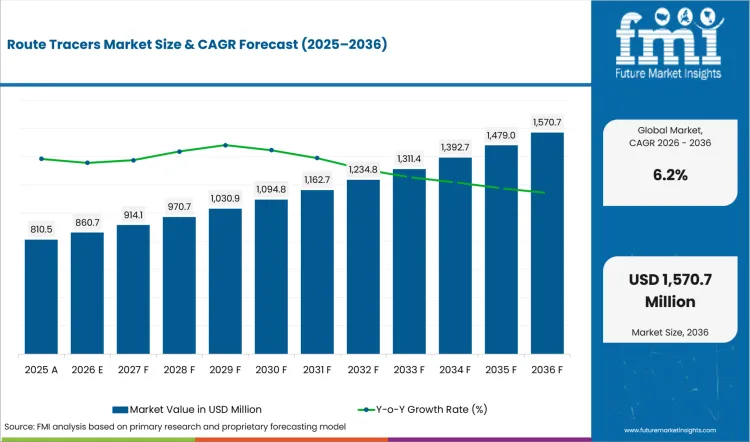
USD 860.7 million in 2026 and USD 1,570.7 million by 2036 at a 6.2% CAGR.
Demand in route tracers market is projected to increase the valuation from USD 860.7 million in 2026 to USD 1570.7 million by 2036 at 6.2% CAGR. While growth remains global, project pipelines, regulatory frameworks and infrastructure investment patterns determine how demand materializes across individual countries. The UK National Underground Asset Register became operational in December 2025 with more than 3 million kilometers of records, expanding visibility of buried assets while preserving the need for field verification.
How these requirements translate into equipment demand varies by the scale and configuration of national infrastructure networks. In July 2026, the CRTC reported 5,973 kilometers of fiber transport infrastructure across Canadian projects. Long-distance rural networks increase locating and maintenance travel requirements, whereas the denser utility corridors common in Germany and Japan place greater emphasis on distinguishing closely spaced underground assets.
Key Takeaways of Route Tracers Market
- Utility owners require route confirmation before excavation, repair or documentation reaches buried cables and pipes.
- Cable route tracers are projected at 31.0% in 2026 because conductive networks require repeated path and depth checks.
- Electromagnetic induction is estimated at 29.0% in 2026 as crews apply signals without exposing conductive assets.
- Utility mapping is anticipated at 34.0% in 2026 because asset owners need reusable field records for later work.
- Crowded corridors and incomplete drawings raise interpretation risk, extending verification time and operator training requirements.
- Radiodetection Ltd., Vivax-Metrotech Corporation, Leica Geosystems AG, Subsite Electronics, RIDGID, C.Scope International Ltd., Company and Hermann Sewerin GmbH serve the market.
Analyst Perspective
"Route-tracer selection should begin with signal confidence across bends and changing depths rather than a headline frequency count. Commercial value rises when calibrated equipment supports trained field routines and reusable mapping records."
- Nikhil Kaitwade, Principal Consultant, Future Market Insights
How is the Route Tracers Market segmented?
The route tracers market is segmented by tracer type, detection mode, application, end use, sales model and region.
The route tracers market is analysed by tracer type, detection mode, application, end use, sales model and region. Tracer types cover cable, pipe, multi-utility, sonde-based and GIS-linked systems. Detection modes include induction, direct connection, clamp induction, sonde or beacon and ground-penetrating support. Applications span mapping, fault identification, pre-excavation survey, maintenance and fiber verification across utility, telecom, municipal, pipeline and construction end uses. Sales models cover equipment, rental and bundled services.
Why do cable route tracers lead demand within the tracer type category?
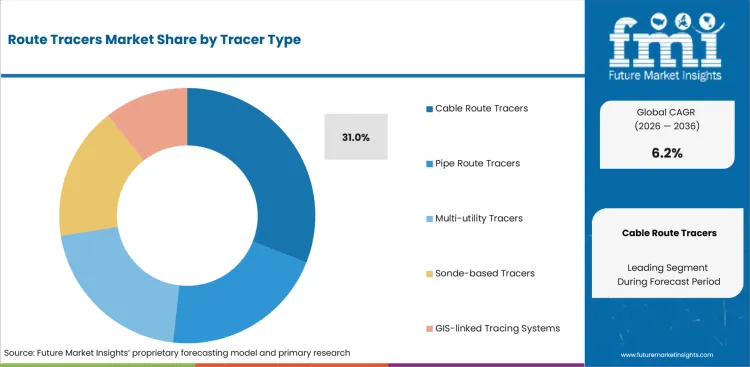
Cable route tracers establish conductive power and telecommunications paths during maintenance and network extensions. Crews use utility locating equipment before digging, while fiber testing equipment checks transmission performance after route confirmation.
- By tracer type, cable route tracers are estimated to hold 31.0% in 2026 owing to recurring checks across conductive networks.
- Utilities favor dedicated cable units because familiar transmitters and clamps shorten setup, while stable direction and depth readings reduce repeated sweeps near active services.
Why does electromagnetic induction lead demand within the detection mode category?
Electromagnetic induction applies signals to conductive cables and pipes without exposure. Direct connection improves selectivity in crowded corridors, while cable fault locators diagnose failures after crews narrow the route.
- In 2026, electromagnetic induction is expected to lead detection mode with 29.0% share because conductive networks remain common across utility and telecom routes.
- Signal confidence depends on transmitter feedback during setup. Leica Geosystems introduced the DT100 and DE100 in December 2024 with real-time current and voltage feedback, helping crews confirm a usable signal before tracing begins.
Why does utility mapping lead demand within the application category?
Utility mapping turns field readings into records for maintenance planning. In April 2025, Radiodetection paired survey-grade locators with PointMan to transfer positions into geospatial mapping platforms and reduce data entry.
- The application category is forecast to be led by utility mapping at 34.0% in 2026 due to recurring record updates across changing networks.
- Mapped readings become reusable when crews preserve coordinates, identify uncertain depth and record the locating method for later repairs, network additions and contractor handovers.
Why do equipment sale models lead demand within the sales model category?
Utilities and contractors need route tracers for maintenance and urgent faults. Ownership standardizes settings and calibration across trained fleets, while rental suits occasional projects requiring compatible locator transmitters.
- Equipment sale is set to lead the sales model category with 47.0% share in 2026 due to immediate fleet access and repeated field use.
- Owned units support common clamp, sonde and mapping procedures across crews, while calibration and local repair coverage reduce downtime during recurring assignments.
What are the drivers, restraints and opportunities in the Route Tracers Market?
Excavation controls sustain route checks, corridor congestion raises verification costs, and connected mapping supports documentation services.
- Driver: Utility owners require route confirmation before excavation or repair reaches buried cables and pipelines.
- Restraint: Congested corridors and incomplete records produce ambiguous signals that require slower verification by trained crews.
- Opportunity: Connected tracing systems combine field readings with mapping records for maintenance and compliance documentation.
Excavation Controls Sustain Recurring Route Checks
Route tracing becomes recurring whenever ground work depends on buried assets that drawings cannot confirm. PHMSA reported in May 2026 that excavation damage led pipeline incidents across 3.3 million regulated miles, reinforcing pipeline integrity programs.
Signal Congestion Raises Verification Costs
Overlapping utilities and incomplete records complicate electromagnetic readings. Ground-penetrating radar systems can separate additional targets, but scanning and specialist interpretation increase survey time and cost.
Connected Mapping Extends Recurring Service
Connected records let utilities reuse verified coordinates across maintenance and contractor handovers. Geographic information systems support service revenue when providers combine tracing with controlled data capture and updates that fit owner records.
Which country CAGRs are profiled in the Route Tracers Market?
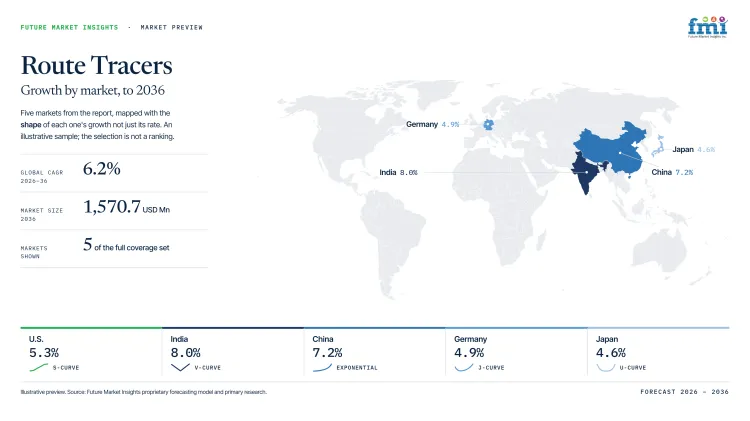
| Country | CAGR |
|---|---|
| Canada | 5.7% |
| United Kingdom | 5.6% |
| United States | 5.3% |
| Germany | 4.9% |
| Japan | 4.6% |
How do country-level CAGRs compare in the Route Tracers Market?
The country forecasts span 1.1 percentage points between Canada and Japan. The narrow range describes similar expected revenue movement, not equal installed bases or present equipment use.
- Canada's rate shows long fiber corridors that increase travel and service coverage for crews maintaining dispersed routes.
- The United Kingdom combines dense streets with shared records that shorten document searches but do not replace field confirmation.
- United States demand follows established one-call practices across extensive networks with varied state operating conditions.
- Germany's outlook reflects active fiber additions within cities that require coordinated excavation and record updates.
- Japan's rate presents precise inspection needs across dense infrastructure and constrained municipal access.
Comparable CAGRs can produce different market entry conditions. The full report provides country-level CAGR analysis across North America, Latin America, Europe, East Asia, South Asia and Pacific, and the Middle East and Africa.
Country-wise Analysis
- Canadian broadband projects extend transport fiber across remote communities, leaving crews to verify buried alignments along long service corridors during seasonal construction and later maintenance. Adoption of route tracers in Canada is estimated to expand at 5.7% CAGR through 2036, supported by rural network additions but constrained by travel time and limited repair coverage across dispersed territories. In July 2026 the CRTC approved a 33-kilometer project serving 246 Rich Lake households and four anchor institutions, increasing documentation needs for contractors that revisit remote routes under severe weather and short construction windows.
- The United Kingdom operates a shared underground-asset service across dense streets, giving authorized contractors faster access to electricity, water and telecommunications records during maintenance and renewal programs. Route tracer sales in the United Kingdom are forecast to expand at 5.6% CAGR by 2036, aided by central records but limited by uncertain depth and differences between drawings and field conditions. An August 2025 government consultation estimated 60,000 accidental strikes annually and information requests exceeding six days, so equipment orders continue to depend on trained onsite verification rather than database access alone.
- United States utilities operate under state one-call procedures across extensive pipeline, power and telecommunications networks that require contractors to mark routes before ground disturbance begins. The United States route tracers sector is projected to record 5.3% CAGR during the assessment period, reinforced by established locating practices but constrained by uneven records and contractor skill across state programs. PHMSA reported in February 2026 that 232 federal staff and 450 state inspectors oversee nearly 3,000 pipeline companies, sustaining compliance attention while fragmented programs complicate training standards and fleet selection.
- German network operators continue fiber construction within cities containing established power, water and telecommunications corridors that require coordinated route checks during municipal renewal and building connections. Germany's route tracers outlook is anticipated to advance at 4.9% CAGR over the assessment period, supported by network additions but restrained by overlapping assets and limited access during urban construction. The Bundesnetzagentur reported in June 2026 that active fiber connections rose from 5.3 million to 6.4 million, expanding documentation workloads while local permit timing and traffic controls slow field deployment.
- Japanese road and sewer authorities manage occupied underground spaces beneath restricted work areas, requiring route checks across metallic and nonmetallic assets with bends and limited access points. Japan is estimated to post 4.6% CAGR over the forecast period, supported by inspection programs but limited by complex geometry and signal gaps across nonconductive infrastructure. MLIT reported in April 2026 that a national sewer survey covered 5,332 kilometers and identified 748 kilometers requiring action, increasing rehabilitation work while constrained access raises survey time and equipment demands.
Who are the notable companies in the Route Tracers Market?
Radiodetection Ltd., Vivax-Metrotech Corporation, Leica Geosystems AG, Subsite Electronics, RIDGID, C.Scope International Ltd., and Hermann Sewerin GmbH are notable companies serving this market.
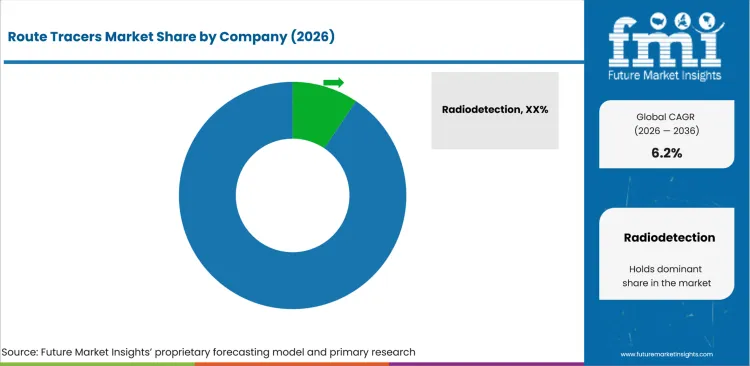
Competition remains fragmented across locator manufacturers, geospatial groups and professional-tool brands. Several portfolios pair tracers with utility markers for identification. Others extend into EMS marker systems, while entry depends on route accuracy and service coverage.
- Radiodetection Ltd., Leica Geosystems AG, Subsite Electronics and RIDGID combine locating instruments with mapping or professional-tool workflows.
- Vivax-Metrotech Corporation, C.Scope International Ltd.and Hermann Sewerin GmbH compete through dedicated ranges and support.
Competitive Benchmarking: Route Tracers Market
| Company | Route-Tracing Breadth | Mapping Integration | Field Support Depth | Geographic Reach |
|---|---|---|---|---|
| Radiodetection Ltd. | High | High | High | Global |
| Vivax-Metrotech Corporation | High | Medium | High | Global distribution |
| Leica Geosystems AG | High | High | High | Global |
| Subsite Electronics | High | High | Medium | North America and selected markets |
| RIDGID | Medium | High | High | Global |
| C.Scope International Ltd. | Medium | Medium | High | Global support network |
| Hermann Sewerin GmbH | Medium | Medium | High | Europe and international |
Key Developments in the Route Tracers Market
- In February 2026, Ditch Witch announced Orange Intel linking Subsite locating equipment with UtiliView and Esri mapping. The platform carries inspection and as-built records between field crews and office teams across underground construction projects.
- In February 2026, Radiodetection launched the Schonstedt u-LOCATE series through its global network. Single-frequency and dual-frequency models provide direction, depth estimates and sonde support for routine utility checks.
- In June 2025, Leica Geosystems launched the DS4000 with claimed detection up to 60% deeper than traditional systems. The portable radar platform addresses smaller or nonconductive assets in congested corridors.
Key Players in the Route Tracers Market
Integrated Locating and Mapping Platforms
- Radiodetection Ltd.
- Leica Geosystems AG
- Subsite Electronics
Specialist Utility Locating Manufacturers
- Vivax-Metrotech Corporation
- C.Scope International Ltd.
- Hermann Sewerin GmbH
Professional and Magnetic Locating Brands
- RIDGID
Route Tracers Market - Report Scope
| Coverage field | Report scope |
|---|---|
| Market breakdown | By tracer type, detection mode, application, end use, sales model and region. |
| Quantitative Units | Revenue in USD million and CAGR in %. |
| Market Definition | Cable, pipe, sonde and connected route-tracing systems used before excavation, repair and mapping. |
| Regions Covered | North America, Latin America, Europe, East Asia, South Asia and Pacific and Middle East and Africa. |
| Countries Covered | Canada, United Kingdom, United States, Germany, Japan and 20+ countries included in the full report. |
| Key Companies Profiled | Radiodetection Ltd., Vivax-Metrotech Corporation, Leica Geosystems AG, Subsite Electronics, RIDGID, C.Scope International Ltd., and Hermann Sewerin GmbH. |
| Forecast Period | 2026 to 2036. |
| Approach | Primary and secondary research with market triangulation. |
Route Tracers Market - Research Methodology
| Method | Approach |
|---|---|
| Primary Research | FMI analysts gathered input from manufacturers, service providers, technology developers, distributors, end users, procurement teams, and subject-matter experts. Interviews examined purchasing decisions, product or service evaluation, adoption barriers, approval requirements, pricing considerations, and expectations for technical or commercial support. Respondents were also asked what evidence is required before a trial, pilot, or initial order develops into regular purchasing. |
| Desk Research | Desk research covered government statistics, regulatory publications, trade data, industry associations, technical literature, standards, company filings, product information, and official corporate announcements. Sources were reviewed for relevance, publication date, geographic coverage, and consistency with the defined market scope. Claims relating to performance, applications, approvals, capacity, investment, and commercial activity were retained only when supported by credible public evidence. |
| Market Sizing and Forecasting | The market model combined the baseline value with historical performance, segment structure, pricing and volume indicators, adoption levels, company participation, and country-level demand conditions. Forecast assumptions considered economic activity, investment trends, regulatory developments, technology adoption, purchasing cycles, supply availability, and barriers to wider market use. Segment and regional estimates were reconciled before the final market total was calculated. |
| Data Validation | Estimates were checked against multiple independent indicators, including public data, company activity, trade patterns, industry developments, and findings from primary interviews. Validation also tested whether products, services, applications, and company revenues fell within the defined market boundaries. Adjacent categories, unsupported claims, overlapping revenues, and activities without direct market relevance were excluded to reduce double counting and maintain consistency across segments and countries. |
Route Tracers Market by Segments
Route Tracers Market segmented by Tracer Type:
- Cable Route Tracers
- Pipe Route Tracers
- Multi-utility Tracers
- Sonde-based Tracers
- GIS-linked Tracing Systems
Route Tracers Market segmented by Detection Mode:
- Electromagnetic Induction
- Direct Connection
- Clamp Induction
- Sonde / Beacon
- Ground Penetrating Support
Route Tracers Market segmented by Application:
- Utility Mapping
- Fault Route Identification
- Pre-excavation Survey
- Maintenance / Repair
- Fiber Route Verification
Route Tracers Market segmented by End Use:
- Utilities
- Telecom Contractors
- Municipalities
- Oil & Gas / Pipelines
- Construction Contractors
Route Tracers Market segmented by Sales Model:
- Equipment Sale
- Rental
- Survey Service Bundled
Route Tracers Market by Region:
- North America
- United States
- Canada
- Mexico
- Latin America
- Brazil
- Chile
- Rest of Latin America
- Western Europe
- Germany
- United Kingdom
- Italy
- Spain
- France
- Nordics
- Benelux
- Rest of Western Europe
- Eastern Europe
- Russia
- Poland
- Hungary
- Balkan and Baltic States
- Rest of Eastern Europe
- East Asia
- China
- Japan
- South Korea
- South Asia and Pacific
- India
- ASEAN
- Australia and New Zealand
- Rest of South Asia and Pacific
- Middle East and Africa
- Kingdom of Saudi Arabia
- Other GCC Countries
- Türkiye
- South Africa
- Other African Union Countries
- Rest of Middle East and Africa
Research Sources and Bibliography
- Department for Science, Innovation and Technology. (2026, April 27). National Underground Asset Register (NUAR).
- Canadian Radio-television and Telecommunications Commission. (2026, July 22). Results of the Broadband Fund: By the numbers.
- Leica Geosystems AG. (2024, December 3). Leica Geosystems presents new utility detection solution.
- Radiodetection Ltd. (2025, April 7). Radiodetection Announces Global Commercial Strategy with ProStar to Deliver Precision Utility Mapping.
- Pipeline and Hazardous Materials Safety Administration. (2026, August 11). August 11th is National 811 Day.
- Canadian Radio-television and Telecommunications Commission. (2026, July 14). Telecom Order CRTC 2026-170.
- Government Digital Service. (2025, August 6). National Underground Asset Register tranche 1: regulations.
- Pipeline and Hazardous Materials Safety Administration. (2026, February 19). Federal Effort.
- Federal Network Agency. (2026, June 5). Telecoms Annual Report 2025.
- Ministry of Land, Infrastructure, Transport and Tourism. (2026, April 21).
- The Toro Company. (2026, February 24). Ditch Witch Showcases Orange Intel at CONEXPO-CON/AGG: Powering the Smart, Connected Jobsite.
- Radiodetection Ltd. (2026, February 2). Simplify Utility Detection: Radiodetection Launches u-LOCATE.
- Leica Geosystems AG. (2025, June 16). Leica DS4000 helps reveal previously undetectable underground utility assets.
This bibliography is provided for reader reference and is not exhaustive. The full report contains the complete reference list and detailed citations
This Report Answers
- How do excavation controls shape purchases?
- Which conditions favor cable tracers?
- How does induction improve confirmation?
- Why does mapping produce reusable records?
- Which conditions separate country outlooks?
- What criteria distinguish breadth and support?
- How are notable companies positioned?
- Which constraints limit wider use?
Frequently Asked Questions
How big is the Route Tracers Market in 2026?
The Route Tracers Market is estimated at USD 860.7 million in 2026 and is forecast to reach USD 1,570.7 million by 2036. Utility crews confirm buried paths before excavation, repair or mapping proceeds beyond uncertain records.
What is the CAGR of the Route Tracers Market from 2026 to 2036?
The Route Tracers Market is projected to expand at a 6.2% CAGR from 2026 to 2036. Utility maintenance sustains purchases, although crowded corridors and incomplete records increase verification effort before crews accept a route.
Which tracer type segment leads the Route Tracers Market?
Cable route tracers are projected to account for 31.0% of the Route Tracers Market in 2026. Utilities and telecom contractors follow conductive paths, confirm depth changes and reduce repeated sweeps near active services.
How much will the Route Tracers Market add between 2026 and 2036?
The Route Tracers Market is expected to add USD 710.0 million between 2026 and 2036. The increase reflects wider verification across maintenance, fiber construction and pre-excavation work requiring confirmation beyond existing drawings.
Which companies are active in the Route Tracers Market?
Key companies are profiled in the Route Tracers Market across locating and mapping routes. Radiodetection Ltd., Vivax-Metrotech Corporation, Leica Geosystems AG, Subsite Electronics, RIDGID, C.Scope International Ltd., Schonstedt Instrument Company and Hermann Sewerin GmbH represent those roles.
Preview the report firsthand - request a free sample
Get SampleGet the brochure for pricing and purchase details.
Get PDFTable of Content
- Key Takeaways
- Market Size and CAGR
- Top Growth Driver
- Fastest Growing Segment
- Leading Region
- Key Companies
- Emerging Opportunities
- Executive Summary
- Global Market Outlook
- Demand-side Trends
- Supply-side Trends
- Technology Roadmap Analysis
- Analysis and Recommendations
- Analyst Perspective (What is happening? Why now? What should investors know?)
- Key Questions Answered
- How large is the market?
- What is the CAGR?
- What are key trends?
- Which region dominates?
- Who are the leaders?
- Market Overview
- Market Coverage / Taxonomy
- Market Definition / Scope / Limitations
- Research Methodology
- Chapter Orientation
- Analytical Lens and Working Hypotheses
- Market Structure, Signals, and Trend Drivers
- Benchmarking and Cross-market Comparability
- Market Sizing, Forecasting, and Opportunity Mapping
- Research Design and Evidence Framework
- Desk Research Programme (Secondary Evidence)
- Expert Input and Fieldwork (Primary Evidence)
- Tooling, Models, and Reference Databases
- Data Engineering and Model Build
- Quality Assurance and Audit Trail
- Market Background
- Market Dynamics (Drivers, Restraints, Opportunity, Trends)
- Scenario Forecast (Optimistic, Likely, Conservative)
- Impact Analysis
- AI Impact
- Sustainability Impact
- Regulatory Impact
- Technology Impact
- Consumer / Buyer Analysis
- Purchase Drivers
- Adoption Barriers
- Buyer Journey
- Opportunity Map Analysis
- Product Life Cycle Analysis
- Supply Chain Analysis
- Investment Feasibility Matrix
- Value Chain Analysis
- PESTLE and Porter's Analysis
- Regulatory Landscape
- Regional Parent Market Outlook
- Production and Consumption Statistics
- Import and Export Statistics
- Global Market Analysis and Forecast, 2021 to 2036
- Historical Market Size Value (USD Million) & Volume (Unit) Analysis, 2021 to 2025
- Current and Future Market Size Value (USD Million) & Volume (Unit) Projections, 2026 to 2036
- Y-o-Y Growth Trend Analysis
- Absolute $ Opportunity Analysis
- Global Market Pricing Analysis, 2021 to 2036
- Global Market Analysis and Forecast, By Tracer Type, 2021 to 2036
- Introduction / Key Findings
- Historical Market Size Value (USD Million) & Volume (Unit) Analysis By Tracer Type, 2021 to 2025
- Current and Future Market Size Value (USD Million) & Volume (Unit) Analysis and Forecast By Tracer Type, 2026 to 2036
- Cable Route Tracers
- Pipe Route Tracers
- Multi-utility Tracers
- Sonde-based Tracers
- GIS-linked Tracing Systems
- Cable Route Tracers
- Y-o-Y Growth Trend Analysis By Tracer Type, 2021 to 2025
- Absolute $ Opportunity Analysis By Tracer Type, 2026 to 2036
- Global Market Analysis and Forecast, By Detection Mode, 2021 to 2036
- Introduction / Key Findings
- Historical Market Size Value (USD Million) & Volume (Unit) Analysis By Detection Mode, 2021 to 2025
- Current and Future Market Size Value (USD Million) & Volume (Unit) Analysis and Forecast By Detection Mode, 2026 to 2036
- Electromagnetic Induction
- Direct Connection
- Clamp Induction
- Sonde / Beacon
- Ground Penetrating Support
- Electromagnetic Induction
- Y-o-Y Growth Trend Analysis By Detection Mode, 2021 to 2025
- Absolute $ Opportunity Analysis By Detection Mode, 2026 to 2036
- Global Market Analysis and Forecast, By Application, 2021 to 2036
- Introduction / Key Findings
- Historical Market Size Value (USD Million) & Volume (Unit) Analysis By Application, 2021 to 2025
- Current and Future Market Size Value (USD Million) & Volume (Unit) Analysis and Forecast By Application, 2026 to 2036
- Utility Mapping
- Fault Route Identification
- Pre-excavation Survey
- Maintenance / Repair
- Fiber Route Verification
- Utility Mapping
- Y-o-Y Growth Trend Analysis By Application, 2021 to 2025
- Absolute $ Opportunity Analysis By Application, 2026 to 2036
- Global Market Analysis and Forecast, By End Use, 2021 to 2036
- Introduction / Key Findings
- Historical Market Size Value (USD Million) & Volume (Unit) Analysis By End Use, 2021 to 2025
- Current and Future Market Size Value (USD Million) & Volume (Unit) Analysis and Forecast By End Use, 2026 to 2036
- Utilities
- Telecom Contractors
- Municipalities
- Oil & Gas / Pipelines
- Construction Contractors
- Utilities
- Y-o-Y Growth Trend Analysis By End Use, 2021 to 2025
- Absolute $ Opportunity Analysis By End Use, 2026 to 2036
- Global Market Analysis and Forecast, By Sales Model, 2021 to 2036
- Introduction / Key Findings
- Historical Market Size Value (USD Million) & Volume (Unit) Analysis By Sales Model, 2021 to 2025
- Current and Future Market Size Value (USD Million) & Volume (Unit) Analysis and Forecast By Sales Model, 2026 to 2036
- Equipment Sale
- Rental
- Survey Service Bundled
- Equipment Sale
- Y-o-Y Growth Trend Analysis By Sales Model, 2021 to 2025
- Absolute $ Opportunity Analysis By Sales Model, 2026 to 2036
- Global Market Analysis and Forecast, By Region, 2021 to 2036
- Introduction
- Historical Market Size Value (USD Million) & Volume (Unit) Analysis By Region, 2021 to 2025
- Current Market Size Value (USD Million) & Volume (Unit) Analysis and Forecast By Region, 2026 to 2036
- North America
- Latin America
- Western Europe
- Eastern Europe
- East Asia
- South Asia and Pacific
- Middle East & Africa
- Market Attractiveness Analysis By Region
- North America Market Analysis and Forecast, By Country, 2021 to 2036
- Historical Market Size Value (USD Million) & Volume (Unit) Trend Analysis By Market Taxonomy, 2021 to 2025
- Market Size Value (USD Million) & Volume (Unit) Forecast By Market Taxonomy, 2026 to 2036
- By Country
- USA
- Canada
- By Tracer Type
- By Detection Mode
- By Application
- By End Use
- By Sales Model
- By Country
- Market Attractiveness Analysis
- By Country
- By Tracer Type
- By Detection Mode
- By Application
- By End Use
- By Sales Model
- Key Takeaways
- Latin America Market Analysis and Forecast, By Country
- Historical Market Size Value (USD Million) & Volume (Unit) Trend Analysis By Market Taxonomy, 2021 to 2025
- Market Size Value (USD Million) & Volume (Unit) Forecast By Market Taxonomy, 2026 to 2036
- By Country
- Brazil
- Mexico
- Chile
- Rest of Latin America
- By Tracer Type
- By Detection Mode
- By Application
- By End Use
- By Sales Model
- By Country
- Market Attractiveness Analysis
- By Country
- By Tracer Type
- By Detection Mode
- By Application
- By End Use
- By Sales Model
- Key Takeaways
- Western Europe Market Analysis and Forecast, By Country
- Historical Market Size Value (USD Million) & Volume (Unit) Trend Analysis By Market Taxonomy, 2021 to 2025
- Market Size Value (USD Million) & Volume (Unit) Forecast By Market Taxonomy, 2026 to 2036
- By Country
- Germany
- UK
- Italy
- Spain
- France
- Nordic
- BENELUX
- Rest of Western Europe
- By Tracer Type
- By Detection Mode
- By Application
- By End Use
- By Sales Model
- By Country
- Market Attractiveness Analysis
- By Country
- By Tracer Type
- By Detection Mode
- By Application
- By End Use
- By Sales Model
- Key Takeaways
- Eastern Europe Market Analysis and Forecast, By Country
- Historical Market Size Value (USD Million) & Volume (Unit) Trend Analysis By Market Taxonomy, 2021 to 2025
- Market Size Value (USD Million) & Volume (Unit) Forecast By Market Taxonomy, 2026 to 2036
- By Country
- Russia
- Poland
- Hungary
- Balkan & Baltic
- Rest of Eastern Europe
- By Tracer Type
- By Detection Mode
- By Application
- By End Use
- By Sales Model
- By Country
- Market Attractiveness Analysis
- By Country
- By Tracer Type
- By Detection Mode
- By Application
- By End Use
- By Sales Model
- Key Takeaways
- East Asia Market Analysis and Forecast, By Country
- Historical Market Size Value (USD Million) & Volume (Unit) Trend Analysis By Market Taxonomy, 2021 to 2025
- Market Size Value (USD Million) & Volume (Unit) Forecast By Market Taxonomy, 2026 to 2036
- By Country
- China
- Japan
- South Korea
- By Tracer Type
- By Detection Mode
- By Application
- By End Use
- By Sales Model
- By Country
- Market Attractiveness Analysis
- By Country
- By Tracer Type
- By Detection Mode
- By Application
- By End Use
- By Sales Model
- Key Takeaways
- South Asia and Pacific Market Analysis and Forecast, By Country
- Historical Market Size Value (USD Million) & Volume (Unit) Trend Analysis By Market Taxonomy, 2021 to 2025
- Market Size Value (USD Million) & Volume (Unit) Forecast By Market Taxonomy, 2026 to 2036
- By Country
- India
- ASEAN
- Australia & New Zealand
- Rest of South Asia and Pacific
- By Tracer Type
- By Detection Mode
- By Application
- By End Use
- By Sales Model
- By Country
- Market Attractiveness Analysis
- By Country
- By Tracer Type
- By Detection Mode
- By Application
- By End Use
- By Sales Model
- Key Takeaways
- Middle East & Africa Market Analysis and Forecast, By Country
- Historical Market Size Value (USD Million) & Volume (Unit) Trend Analysis By Market Taxonomy, 2021 to 2025
- Market Size Value (USD Million) & Volume (Unit) Forecast By Market Taxonomy, 2026 to 2036
- By Country
- Kingdom of Saudi Arabia
- Other GCC Countries
- Türkiye
- South Africa
- Other African Union
- Rest of Middle East & Africa
- By Tracer Type
- By Detection Mode
- By Application
- By End Use
- By Sales Model
- By Country
- Market Attractiveness Analysis
- By Country
- By Tracer Type
- By Detection Mode
- By Application
- By End Use
- By Sales Model
- Key Takeaways
- Key Countries Market Analysis
- USA
- Pricing Analysis
- Market Share Analysis, 2025
- By Tracer Type
- By Detection Mode
- By Application
- By End Use
- By Sales Model
- Canada
- Pricing Analysis
- Market Share Analysis, 2025
- By Tracer Type
- By Detection Mode
- By Application
- By End Use
- By Sales Model
- Mexico
- Pricing Analysis
- Market Share Analysis, 2025
- By Tracer Type
- By Detection Mode
- By Application
- By End Use
- By Sales Model
- Brazil
- Pricing Analysis
- Market Share Analysis, 2025
- By Tracer Type
- By Detection Mode
- By Application
- By End Use
- By Sales Model
- Chile
- Pricing Analysis
- Market Share Analysis, 2025
- By Tracer Type
- By Detection Mode
- By Application
- By End Use
- By Sales Model
- Germany
- Pricing Analysis
- Market Share Analysis, 2025
- By Tracer Type
- By Detection Mode
- By Application
- By End Use
- By Sales Model
- UK
- Pricing Analysis
- Market Share Analysis, 2025
- By Tracer Type
- By Detection Mode
- By Application
- By End Use
- By Sales Model
- Italy
- Pricing Analysis
- Market Share Analysis, 2025
- By Tracer Type
- By Detection Mode
- By Application
- By End Use
- By Sales Model
- Spain
- Pricing Analysis
- Market Share Analysis, 2025
- By Tracer Type
- By Detection Mode
- By Application
- By End Use
- By Sales Model
- France
- Pricing Analysis
- Market Share Analysis, 2025
- By Tracer Type
- By Detection Mode
- By Application
- By End Use
- By Sales Model
- India
- Pricing Analysis
- Market Share Analysis, 2025
- By Tracer Type
- By Detection Mode
- By Application
- By End Use
- By Sales Model
- ASEAN
- Pricing Analysis
- Market Share Analysis, 2025
- By Tracer Type
- By Detection Mode
- By Application
- By End Use
- By Sales Model
- Australia & New Zealand
- Pricing Analysis
- Market Share Analysis, 2025
- By Tracer Type
- By Detection Mode
- By Application
- By End Use
- By Sales Model
- China
- Pricing Analysis
- Market Share Analysis, 2025
- By Tracer Type
- By Detection Mode
- By Application
- By End Use
- By Sales Model
- Japan
- Pricing Analysis
- Market Share Analysis, 2025
- By Tracer Type
- By Detection Mode
- By Application
- By End Use
- By Sales Model
- South Korea
- Pricing Analysis
- Market Share Analysis, 2025
- By Tracer Type
- By Detection Mode
- By Application
- By End Use
- By Sales Model
- Russia
- Pricing Analysis
- Market Share Analysis, 2025
- By Tracer Type
- By Detection Mode
- By Application
- By End Use
- By Sales Model
- Poland
- Pricing Analysis
- Market Share Analysis, 2025
- By Tracer Type
- By Detection Mode
- By Application
- By End Use
- By Sales Model
- Hungary
- Pricing Analysis
- Market Share Analysis, 2025
- By Tracer Type
- By Detection Mode
- By Application
- By End Use
- By Sales Model
- Kingdom of Saudi Arabia
- Pricing Analysis
- Market Share Analysis, 2025
- By Tracer Type
- By Detection Mode
- By Application
- By End Use
- By Sales Model
- Türkiye
- Pricing Analysis
- Market Share Analysis, 2025
- By Tracer Type
- By Detection Mode
- By Application
- By End Use
- By Sales Model
- South Africa
- Pricing Analysis
- Market Share Analysis, 2025
- By Tracer Type
- By Detection Mode
- By Application
- By End Use
- By Sales Model
- USA
- Market Structure Analysis
- Competition Dashboard
- Competition Benchmarking
- Market Share Analysis of Top Players
- By Regional
- By Tracer Type
- By Detection Mode
- By Application
- By End Use
- By Sales Model
- Emerging Startups
- Innovation Benchmarking
- Competition Analysis
- Competition Deep Dive
- Radiodetection
- Overview
- Product Portfolio
- Profitability by Market Segments
- Sales Footprint
- Strategy Overview
- Marketing Strategy
- Product Strategy
- Channel Strategy
- Vivax-Metrotech
- Leica Geosystems
- Subsite Electronics
- RIDGID
- C.Scope
- Schonstedt
- MALA
- GSSI
- Sewerin
- Radiodetection
- Case Studies
- Success Stories
- Recent Developments
- Competition Deep Dive
- Assumptions & Acronyms Used


