

- Industry Size (2026)
- USD 38.0 Mn
- Forecast (2036)
- USD 85.2 Mn
- CAGR (2026 to 2036)
- 8.4%
Sprouted Brown Rice Protein Market Size, Market Forecast and Outlook By FMI
The sprouted brown rice protein market was valued at USD 35.1 million in 2025. Industry valuation is projected to reach USD 38.0 million in 2026 and USD 85.2 million by 2036, expanding at a CAGR of 8.4%. Market expansion is being supported by the growing use of plant-protein systems that disperse more naturally in liquid formulations and reduce dependence on synthetic texturizing support.
Summary of Sprouted Brown Rice Protein Market
- The market is forecast to reach USD 85.2 million by 2036.
- The market is expected to grow at a CAGR of 8.4% from 2026 to 2036.
- The market was estimated at USD 35.1 million in 2025.
- The forecast period represents an incremental opportunity of USD 47.2 million.
- Sprouted brown rice protein remains a niche, premium plant-based protein ingredient centered on digestibility, allergen-friendly positioning, and formulation performance.
- Demand is supported by the expansion of plant-based diets and increasing preference for soy-free, dairy-free, and gluten-aware protein systems.
- Isolates lead the product segment with a 54% share, reflecting demand for higher protein density and cleaner taste profiles.
- Organic variants dominate the nature segment with a 61% share, aligned with clean-label and whole-food positioning trends.
- Sports nutrition accounts for 41% of application demand, driven by protein powders, shakes, and recovery products.
- Powder form dominates with an 82% share, as most commercial products are sold in dry and instant formats.
- B2B ingredient supply leads with a 57% share, as suppliers primarily serve downstream food and nutrition brands.
- India, China, and the United States are the fastest-growing country markets, with India leading at a 9.4% CAGR.
- Axiom Foods, NOW Foods, NutriBiotic, Top Health Ingredients, and Growing Naturals are key participants shaping the competitive landscape.
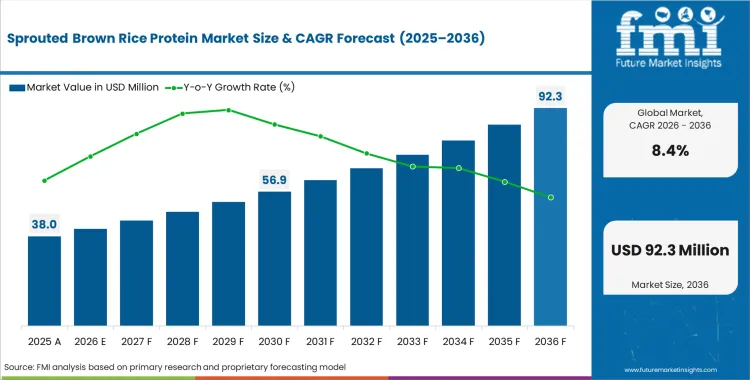
Cost pressure is building around masking systems, flavor adjustment, and texture correction in plant-protein formulations. Sprouted brown rice protein still sits in a smaller, higher-value pocket of plant-based nutrition, where digestibility, allergen-friendly positioning, and easier formulation behavior often matter more than protein percentage on paper. Organic rice protein is usually reviewed in the same buying cycle, yet sprouted variants can hold an advantage when they reduce the need for added flavor work or mouthfeel correction. Buyers focused too narrowly on ingredient cost per kilogram can miss the broader economics, especially when formulation behavior changes the full production cost of a finished vegan protein powder.
Commercial adoption is likely to improve once contract manufacturers adjust mixing and handling lines to suit the particle size and flow profile of sprouted protein formats. Early hesitation usually comes from concerns around equipment performance, hydration consistency, and extrusion behavior. Once trials show that existing systems can process the ingredient reliably, wider use becomes easier across different product formats. At that stage, purchase decisions tend to shift toward specification fit and downstream efficiency rather than straight commodity-style price comparison.
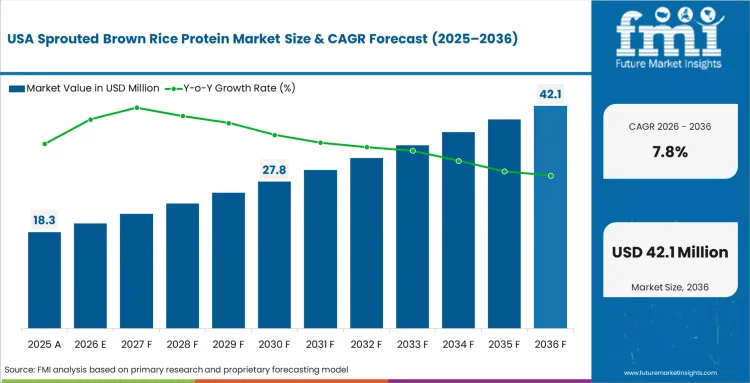
India is projected to lead market expansion, with sprouted brown rice protein expected to rise at a CAGR of 9.4% through 2036 as local nutraceutical manufacturers continue to deepen their use of plant-based nutrition inputs. China is estimated to follow at 8.9%, supported by broader development in dairy-alternative and functional food categories. Demand in the United States is likely to grow at 7.8% during the forecast period, where brands are placing more emphasis on smoother texture and cleaner-label formulation in vegan protein powder applications. The United Kingdom is anticipated to register 7.5%, while Australia is set to post 7.3% as premium wellness and active-nutrition brands maintain interest in allergen-friendly protein systems. Germany is expected to expand at 7.1%, and Japan is projected to record 6.8% through 2036, reflecting measured but steady uptake in higher-specification plant-protein formulations. Growth differences across countries will remain linked to local processing quality, product-development maturity, and the extent to which organic rice protein and sprouted variants are adopted in mainstream nutrition pipelines.
Segmental Analysis
Sprouted Brown Rice Protein Market Analysis by Product Type
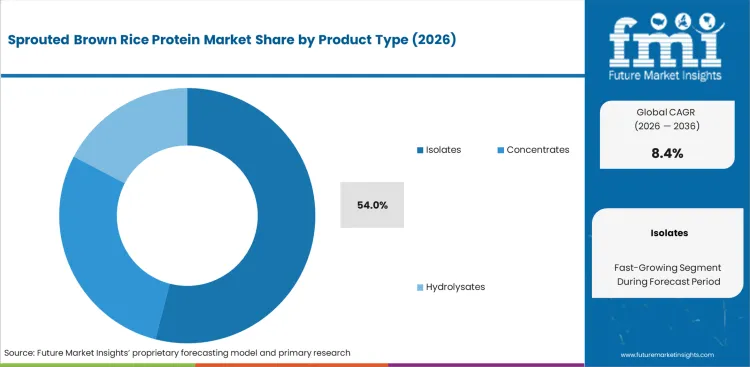
Formulators working on high-protein beverages need concentrated protein systems that do not push viscosity beyond workable processing limits. FMI estimates isolates to account for 54% share in 2026. That lead reflects the market’s preference for higher protein density, cleaner mouthfeel, and better suspension behavior under thermal treatment. Removing more of the residual carbohydrate fraction helps reduce gel formation risk during processing and improves pumpability in commercial lines. Isolates also fit more naturally into protein systems that need smoother sensory performance than older rice-based products typically deliver. Brands that fail to secure a high-solubility isolate supply often run into sedimentation, texture complaints, and weaker repeat purchase performance.
- Initial qualification: Solubility in water remains the first screen before nutritional yield is even considered. Batches that settle too quickly lose relevance regardless of input cost.
- Scale validation: Commercial pasteurization trials determine whether the protein stays suspended under real processing conditions. Stable behavior here is critical for line acceptance.
- Contract expansion: Longer supply agreements depend on neutral taste and batch consistency over time. Weak organoleptic control raises formulation risk for branded products.
Sprouted Brown Rice Protein Market Analysis by Nature
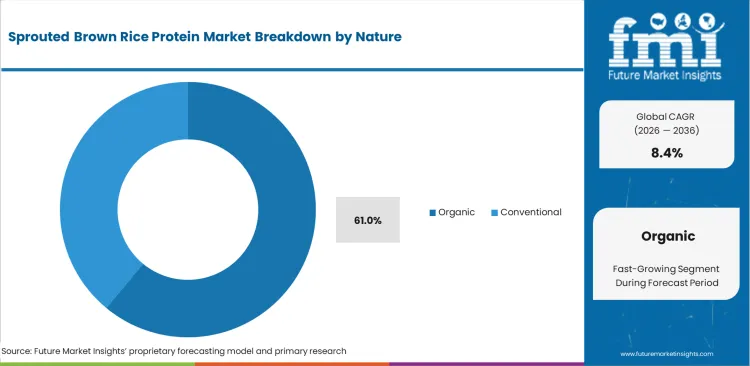
Nature selection is shaped by residue control, compliance pressure, and the premium positioning attached to this ingredient category. Organic formats remain the preferred route in many regulated and higher-value applications because they offer a cleaner sourcing profile and reduce concern around arsenic and agricultural chemical exposure. FMI projects organic to account for 61% share in 2026. This position reflects more than label appeal alone. In practice, clean-label certification often functions as a commercial requirement in sensitive nutrition categories where conventional material faces closer scrutiny. Producers using conventional inputs in stricter end uses can face avoidable compliance setbacks, especially when heavy-metal control is not managed tightly at origin.
- Audit Expenses: Certification and farm-level verification raise early sourcing costs. Those costs can still remain lower than the downstream burden tied to failed compliance or recall exposure.
- Operational Yield: Premium grain quality can improve process consistency and reduce rejected batches. This shifts the real cost equation beyond raw material price alone.
- Lifecycle Comparison: Organic certification often supports better shelf positioning and stronger retention in premium channels. This can help offset the higher acquisition cost over time.
Sprouted Brown Rice Protein Market Analysis by Application
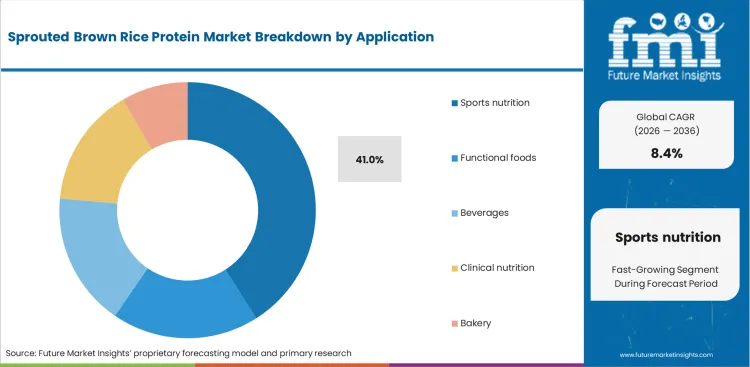
Sports nutrition remains the largest use case because shakes, recovery blends, and active-lifestyle powders still drive product launches and shelf presence across this category. Real volume does not come from elite athletes alone. Everyday users buying protein for routine use shape a much larger part of demand. Germinated protein systems also help brands create smoother vegan formulations with less dependence on texture-correcting additives. FMI expects sports nutrition to represent 41% share in 2026. That lead is tied to strong consumer familiarity and the commercial value of drinkability in products meant for repeat use. Brands that fall short on texture often lose repeat purchases soon after trial.
- Sedimentation prevention: Germinated protein systems usually remain more stable in shaker-cup use than rougher plant alternatives. This improves the mixing experience for end users.
- Flavor interference: Base bitterness still limits how lightly flavored products can be positioned. Strong masking systems are often required when delicate flavor profiles are targeted.
- Matrix optimization: Blending with complementary proteins can improve amino acid balance and finished-product performance. Formulation ratios still need close control to deliver that benefit.
Sprouted Brown Rice Protein Market Analysis by Form
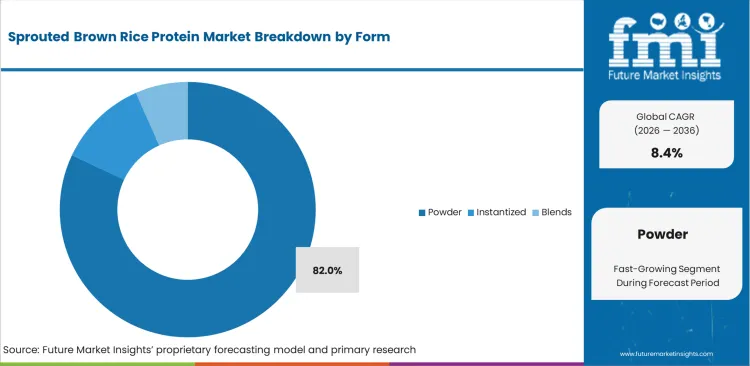
Commercial handling requirements continue to favor dry, free-flowing inputs over hydrated alternatives. Powder remains the dominant format because it fits current filling, blending, storage, and transport systems across sports nutrition and functional food manufacturing. Dry format also gives producers tighter control over shelf life and dosing precision in large-scale operations. Milling quality matters more than many buyers assume, since particle inconsistency can create conveying problems, slow wetting, and texture defects in finished products. FMI estimates powder to represent 82% share in 2026. That position reflects the strong operational fit of dry material in automated production environments.
- Dispersion efficiency: Well-milled powder should wet and disperse quickly once added to liquid. Slow dispersion creates processing inefficiency and weaker product performance.
- Viscosity limitations: Poor particle control can increase thickening at higher use rates. That can restrict throughput in systems with narrow process tolerances.
- Acceptability thresholds: Sensory limits remain strict in consumer-facing protein products. Detectable grittiness can quickly weaken product acceptance.
Sprouted Brown Rice Protein Market Analysis by Sales Channel
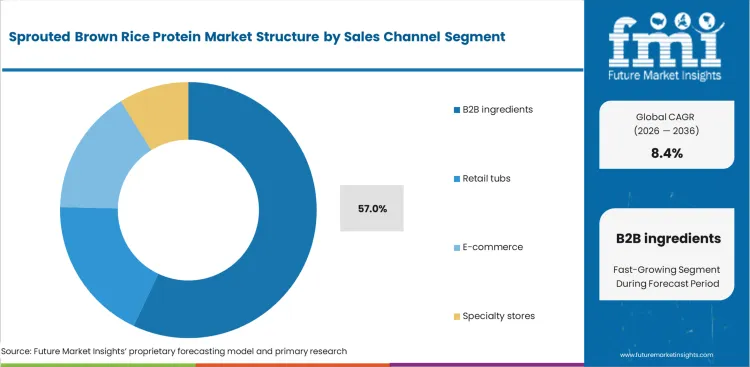
Large brands rely on bulk protein suppliers because sprouting, enzymatic treatment, and drying require specialized processing assets that are difficult to replicate further down the value chain. Dedicated ingredient channels also make volume allocation easier across multiple brands and product platforms. FMI projects B2B ingredients to account for 57% share in 2026. This structure continues to define how industrial supply is organized. Manufacturers without stable B2B sourcing can face stock gaps during launch windows and peak promotional periods.
- Capacity authorization: Production runs are usually prioritized for long-term industrial contracts rather than spot demand. Volume commitment remains important for allocation security.
- Logistical constraints: Moisture control and timing still matter during storage and transit. Weak handling discipline can reduce usable quality before material reaches the plant.
- Consolidation trajectory: Supplier concentration is narrowing the field in some regions. This increases the importance of early relationship building and better sourcing visibility.
Sprouted Brown Rice Protein Market Drivers, Restraints, and Opportunities
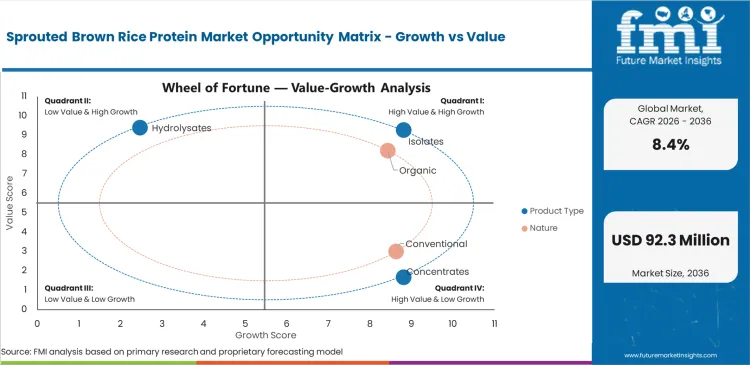
Removal of chemical texturizers and artificial masking agents from ingredient formulations is accelerating as buyers move toward simpler and more natural compositions. Sprouted brown rice protein is benefiting from this shift because controlled germination helps improve digestibility, nutritional quality, and formulation behavior in ways that matter across powder drinks, bars, and allergen-friendly products. Plant-based eating patterns are also expanding across retail channels, which continues to support interest in cleaner protein systems. Sprouted formats can reduce some of the astringent off-notes associated with standard extraction routes, which makes formulation work more manageable in products where taste and texture strongly influence repeat purchase. Brands adjusting recipes around these ingredients can also lower dependence on complex flavor correction systems. Demand is also supported by broader movement toward soy-free, dairy-free, and gluten-aware protein formats, especially in sports nutrition and convenient powder applications.
Adoption still faces practical resistance because many flavor systems remain built around whey-based formulations. Sprouted brown rice protein continues to sit in a narrower category than pea or soy, which keeps formulation costs elevated and mainstream visibility relatively limited. Germinated ingredients usually cannot be inserted into legacy recipes without reworking the surrounding masking and texture system. Reformulation often takes time because sweetness balance, acidulant levels, and overall sensory response need to be reset for a different protein matrix. This qualification cycle can delay launch timing until taste performance is validated across intended use conditions. Baseline flavor neutrality is improving, yet conversion speed remains limited by the formulation effort required to move established products onto a new protein base.
Opportunities in the Sprouted Brown Rice Protein Market
Hybrid base integration: Manufacturers can combine sprouted rice protein with selected legume isolates to improve amino acid balance and broaden appeal among buyers seeking dairy-free protein systems with better nutritional completeness.
Medical formulation substitution: Sprouted fractions can serve as an alternative to soy-based inputs in sensitive nutrition applications where digestibility and gastrointestinal tolerance carry greater weight in ingredient selection.
Extruded snack applications: Germinated powder can support high-protein crisp and snack development where expansion behavior and lighter texture matter for finished-product acceptance.
Regional Analysis
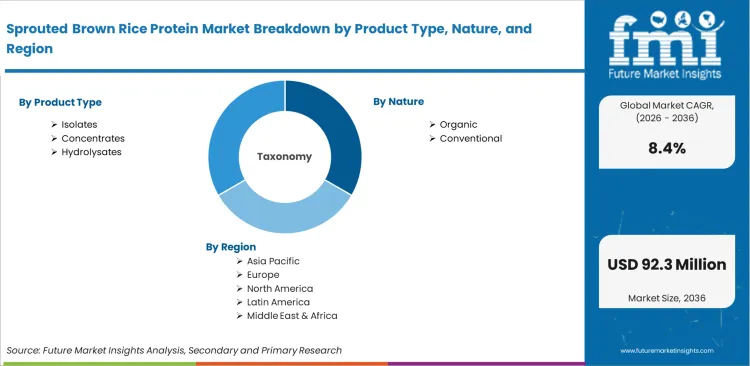
Based on regional analysis, sprouted brown rice protein market is segmented into North America, Latin America, Europe, East Asia, South Asia, Oceania, and Middle East and Africa across 40 plus countries.
.webp "Top Country Growth Comparison Sprouted Brown Rice Protein Market Cagr (2026 2036)")
| Country | CAGR (2026 to 2036) |
|---|---|
| India | 9.4% |
| China | 8.9% |
| United States | 7.8% |
| United Kingdom | 7.5% |
| Australia | 7.3% |
| Germany | 7.1% |
| Japan | 6.8% |
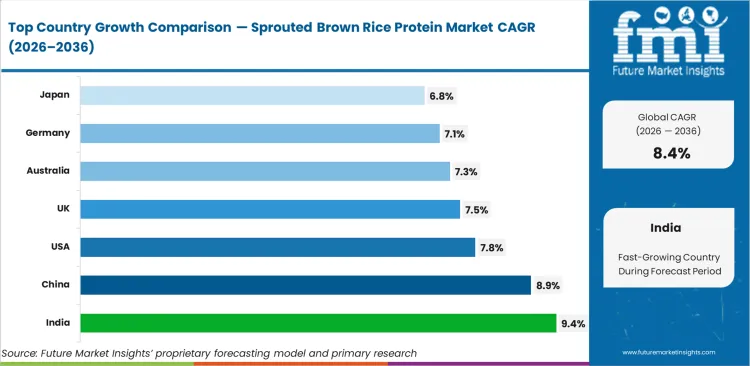
Source: Future Market Insights (FMI) analysis, based on proprietary forecasting model and primary research
South Asia Sprouted Brown Rice Protein Market Analysis
Domestic supply chain restructuring defines commercial dynamics across South Asia. Processing facilities actively upgrade legacy agricultural infrastructure to produce high-value enzymatically treated ingredients. Expanding local capacity allows manufacturers to completely redesign regional nutritional portfolios. Reliance on imported dairy fractions decreases sharply as high-purity germinated grains become widely available at competitive commercial volumes.
- India: Tariff fluctuations on imported whey push domestic nutraceutical manufacturers toward locally milled, export-grade sprouted alternatives to stabilize supply chains. Demand for sprouted brown rice protein in India is anticipated to rise at an estimated CAGR of 9.4% during the forecast period. Rapid modernization of regional processing centers supports this shift. Local brands secure significant margin advantages compared to competitors relying on volatile international dairy markets.
East Asia Sprouted Brown Rice Protein Market Analysis
Industrial extraction scaling dictates trajectory patterns throughout East Asia. Major capital investments in specialized high-shear milling and enzymatic treatment tanks drastically reduce the per-kilogram cost of functional isolates. Advanced processing capabilities allow regional facilities to serve domestic functional food brands alongside large export contracts. East Asia operates as a primary engine for global ingredient volume while simultaneously developing highly specific localized applications.
- China: Rapid scale-up in specialized extraction facilities grants domestic manufacturers unprecedented access to commercial volumes of high-purity isolates. Chinese sprouted brown rice protein sectors are expected to register an estimated CAGR of 8.9% from 2026 to 2036. Processing throughput allows regional facilities to secure major international B2B ingredient supply contracts. Global brand owners increasingly rely on these localized processing hubs to maintain steady supply chain continuity.
- Japan: Japan is projected to witness an estimated 6.8% CAGR in the sprouted brown rice protein segment during the forecast years. Stringent geriatric nutrition standards push manufacturers to formulate highly digestible, completely soluble protein powder applications. Advanced germinated fractions increasingly enter specialized medical foods targeting ageing demographics with compromised digestion. Processing tolerances are continuously refined to achieve the lowest possible grit thresholds for these sensitive consumers.
North America Sprouted Brown Rice Protein Market Analysis
Clean-label consumer mandates force immediate formulation overhauls across North American functional beverage sectors. Brands systematically purge synthetic emulsifiers and artificial flavor masking agents from legacy product lines. Synthetic chemicals are replaced with naturally functional germinated matrices that inherently suspend in solution. Ingredients demonstrating proven operational simplicity are heavily prioritized over those offering marginally cheaper raw nutritional yields.
- United States: Clinical and sports nutrition brands demand exact texture parity with legacy dairy formulations to maintain mainstream retail distribution. Manufacturers actively switch to germinated variants to achieve grit-free mouthfeel without expanding ingredient decks. Sprouted brown rice protein sales in the United States are poised to grow at an estimated CAGR of 7.8% during the assessment period. Mastering this transition captures premium shelf space dominated by conventional whey.
Europe Sprouted Brown Rice Protein Market Analysis
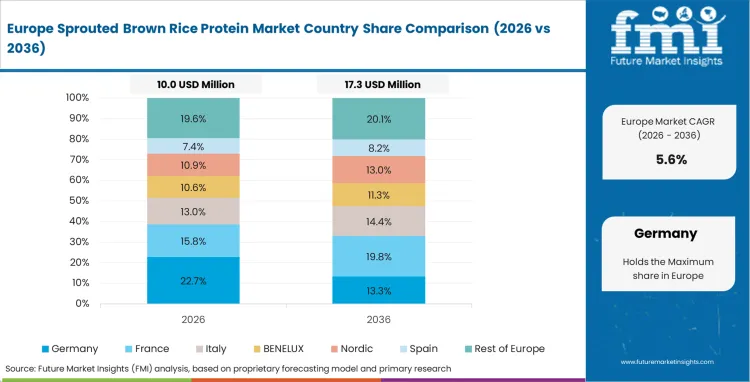
Strict heavy metal compliance limits govern commercial ingredient purchase across Europe. Manufacturers strictly refuse shipments lacking rigorous, certified third-party testing for agricultural residues. Advanced germinated organic fractions are utilized precisely because specialized supply chains inherently bypass conventional contamination vectors. Regulatory survival entirely supersedes basic unit economics during vendor qualification within this highly scrutinized jurisdiction.
- United Kingdom: Allergen-free mandates push mainstream bakery manufacturers to remove legacy soy additives from established recipes. Sprouted brown rice protein demand in the United Kingdom is expected to grow at an estimated CAGR of 7.5% during the study period. Long-term contracts for hypoallergenic germinated rice inputs help maintain uninterrupted production. This decisive shift permanently locks out suppliers unable to meet strict allergen-zero facility certifications.
- Germany: European-certified heavy-metal compliant sourcing remains a strict priority for manufacturers designing premium clinical nutrition formats. Initial price premiums are readily absorbed to avoid costly regulatory product recalls downstream. Germany is anticipated to see sprouted brown rice protein grow at an estimated CAGR of 7.1% over the forecast period. Rigorous compliance environments effectively limit market participation strictly to top-tier, vertically integrated processing organizations.
Oceania Sprouted Brown Rice Protein Market Analysis
Intensive sports nutrition focus shapes specific acquisition patterns visible across Oceania. Manufacturers consistently launch premium lifestyle supplements demanding maximum solubility and high flavor neutrality. Highly purified germinated inputs help differentiate offerings within heavily saturated fitness demographics. Successful local processors compete entirely on particle size consistency rather than engaging in baseline price wars.
- Australia: Lifestyle consumers consistently penalize brands delivering chalky recovery shakes, forcing immediate formulation upgrades across the region. Sprouted brown rice protein adoption in Australia is likely to advance at an estimated CAGR of 7.3% by 2036. Finely milled germinated isolates are integrated to achieve perfect hydration upon mixing. Identifying advanced milling partners secures distinct, defensible advantages for manufacturers in retail texture comparisons.
FMI's report includes extensive coverage of Latin America and the Middle East and Africa. India, China, and the United States represent the fastest-expanding country opportunities globally, while the United Kingdom, Germany, Japan, and Australia remain stable specialty demand bases.
Competitive Aligners for Market Players
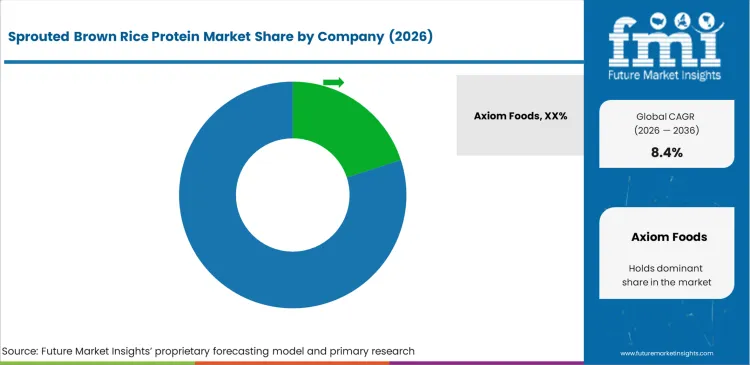
Commercial processing constraints define competition in this ingredient sector, where supplier strength depends more on formulation capability and input control than on scale alone. Market structure remains moderately fragmented, with competition centered on processors and distributors that can handle germination, enzymatic treatment, and drying with consistent output quality. Buyers reviewing suppliers place greater weight on solubility performance, thermal stability, and behavior under processing stress than on broad marketing claims around amino acid positioning. Reliable performance during pasteurization and blending remains a key dividing line, since ingredients that gel too easily or lose dispersion create problems across beverage and powder applications. Competitive standing is therefore shaped by technical consistency as much as by commercial reach.
Established ingredient manufacturers also benefit from broader validation depth across heavy metal control, raw material screening, and process documentation. Access to cleaner rice inputs, especially in organic formats, improves supplier positioning because residue management and traceability remain central in this category. Processors trying to compete on price alone often struggle when qualification standards tighten around arsenic, cadmium, and origin transparency. Building a verifiable farm-to-isolate supply chain takes time, disciplined sourcing, and sustained investment in quality control systems. Manufacturers serving sensitive nutrition applications usually favor suppliers with a documented operating record, since product risk in this category extends well beyond ingredient cost.
Large functional food manufacturers also work to avoid overdependence on a single supplier by keeping formulations flexible enough to absorb sourcing shifts. Hybrid protein blends make this easier because they allow ratio adjustments when raw material availability or input pricing changes. Parallel qualification of more than one processing site is also common where brands need continuity in particle size, hydration behavior, and finished-product performance. Competitive advantage therefore rests on clean-label extraction, sensory neutrality, organic availability, and the ability to perform across powders, bars, and beverage systems without adding heavy taste-masking burdens.
Key Players in Sprouted Brown Rice Protein Market
- Axiom Foods
- NOW Foods
- NutriBiotic
- Top Health Ingredients
- Growing Naturals
Scope of the Report
| Metric | Value |
|---|---|
| Quantitative Units | USD 38.0 million to USD 85.2 million, at a CAGR of 8.4% |
| Market Definition | Functional extraction of amino acids from whole grain rice that undergoes controlled germination prior to milling characterizes this category. Clean-label product developers utilize these specialized isolates specifically to achieve smooth textures in liquid applications without introducing synthetic emulsifiers. |
| Segmentation | Product type, Nature, Application, Form, Sales channel, and Region |
| Regions Covered | North America, Latin America, Europe, East Asia, South Asia, Oceania, and Middle East and Africa |
| Countries Covered | India, China, United States, United Kingdom, Australia, Germany, Japan |
| Key Companies Profiled | Axiom Foods, NOW Foods, NutriBiotic, Top Health Ingredients, Growing Naturals |
| Forecast Period | 2026 to 2036 |
| Approach | Baseline volume anchored to global commercial sprouting facility throughput and B2B ingredient contract shipments, cross-validated against retail launch volumes of clean-label functional beverages. |
Source: Future Market Insights (FMI) analysis, based on proprietary forecasting model and primary research
Sprouted Brown Rice Protein Market Analysis by Segments
Product type
- Isolates
- Concentrates
- Hydrolysates
Nature
- Organic
- Conventional
Application
- Sports nutrition
- Functional foods
- Beverages
- Clinical nutrition
- Bakery
Form
- Powder
- Instantized
- Blends
Sales channel
- B2B ingredients
- Retail tubs
- E-commerce
- Specialty stores
Region:
- North America
- United States
- Canada
- Europe
- Germany
- United Kingdom
- France
- Italy
- Spain
- Asia Pacific
- China
- Japan
- South Korea
- Taiwan
- Singapore
- Latin America
- Brazil
- Mexico
- Argentina
- Middle East & Africa
- GCC Countries
- South Africa
Frequently Asked Questions
What is the Sprouted Brown Rice Protein market value in 2026?
Demand registers at USD 38.0 million in 2026. This initial figure reflects broad integration across premium sports nutrition formats where early adopters gladly absorb higher unit costs to avoid synthetic flavor modulators.
What is the projected value by 2036?
Total valuation reaches USD 85.2 million by 2036. Sustained capacity investments by major milling operations drive down bulk pricing, allowing formulation chemists to push germinated ingredients into mainstream clinical applications.
What drives the 8.4% CAGR?
Clean-label mandates force the systematic elimination of chemical texturizers from ingredient decks. Sprouted variants offer natural suspension in liquid formats without requiring auxiliary stabilizers, solving this specific operational crisis for brand owners.
Why do Isolates dominate the product segment?
High-protein ready-to-drink beverage formulators require maximum amino acid density without permanently breaking liquid viscosity limits. Isolates prevent finished products from turning into unpumpable gels during commercial pasteurization.
How does Nature impact sourcing strategy?
Organic variants dominate because companies actively mitigate agricultural chemical residue liabilities. Verified organic supply chains bypass arsenic contamination risks frequently plaguing conventional sourcing routes originating in specific Asian regions.
What secures B2B ingredient sales channel dominance?
Commercial scale-up requires massive capital expenditure on enzymatic treatment tanks. B2B ingredient distributors control long-term purchasing agreements necessary to fund this capacity, effectively dominating global material flow over spot-market retail channels.
Why does Sports nutrition lead the application segment?
Performance lifestyle consumers demand absolute texture parity with legacy whey formulations when mixing recovery shakes. Sprouted matrices naturally resist falling out of solution, bypassing gritty mouthfeel issues plaguing standard plant alternatives.
What dictates particle size importance in the Powder format?
Physical format dictates exactly how raw material behaves inside commercial blending vats. Particle size consistency directly controls shelf-life stability of final hydrated applications, serving as the hidden qualification metric during vendor selection.
Why does India grow faster than other regions?
Tariff fluctuations on imported dairy alternatives force domestic nutraceutical manufacturers to qualify locally milled, export-grade sprouted options. Supply chains are stabilized by locking in contracts with rapidly modernizing regional processing centers.
How does heavy metal compliance shape European adoption?
Shipments lacking rigorous third-party testing for agricultural residues are categorically rejected. Firms utilize advanced germinated organic fractions precisely because specialized supply chains inherently bypass conventional contamination vectors threatening pediatric product approvals.
What prevents immediate category conversion?
Massive installed bases of flavoring systems calibrated specifically for whey isolates create friction. Flavor chemists must spend months re-balancing sweetness profiles and adjusting acidulants to match new protein matrices.
How do brands resist vendor lock-in?
R&D departments intentionally formulate hybrid blends, combining germinated rice with pea fractions. Two commercial processing facilities are qualified simultaneously, with identical particle size specifications required to maintain leverage during contract negotiations.
Why do clinical brands prefer sprouted variants?
Legacy soy inputs are increasingly substituted with highly digestible sprouted fractions in tube-feeding applications. Advanced formulations are increasingly adopted to reduce gastrointestinal distress among sensitive patient populations.
What role do contract manufacturers play in adoption?
Once contract manufacturers adjust high-shear mixing lines to accommodate specific particle size distributions, processing plants stop resisting input switches. Demonstrated run-time stability on existing infrastructure removes primary technical barriers blocking widespread substitution.
Why are functional food conglomerates acquiring specialty processors?
Large corporate ingredient buyers aggressively acquire smaller operators to secure vertical integration. Organizations navigate increasingly narrow supplier bases to lock in unadulterated raw material streams before global supply tightens.
How does sprouting alter the organoleptic baseline?
Germination activates endogenous enzymes partially pre-digesting complex starches. This biological processing inherently reduces earthy bitterness and physical grit causing standard plant proteins to require heavy synthetic masking agents.
Why do standard protein assays misrepresent commercial value?
Standard assays frequently overstate usable protein if aggressive chemical extraction denatures biological matrices. Formulation chemists prioritize actual functional solubility coefficients over raw amino acid percentages during initial supplier qualification.
How does Australian consumer behavior affect purchase?
Lifestyle consumers severely penalize brands delivering chalky recovery shakes, forcing immediate formulation upgrades. Finely milled germinated isolates are incorporated specifically to deliver optimal hydration performance upon mixing.
What role does thermal stability play in RTD formulation?
High-heat pasteurization applications require isolate matrices to stay fully suspended, prompting the exclusion of suppliers that cannot guarantee consistent batch-to-batch thermal stability.
How do formulation chemists measure dispersion efficiency?
High-quality milled powders flash-disperse upon contact with liquid without requiring mechanical agitation. Quality engineers set strict wetting-time maximums that inferior bulk ingredients consistently fail to meet during factory intake testing.
Why do US clinical brands demand texture parity?
Companies mastering textural transitions capture premium shelf space previously dominated entirely by conventional whey products. Sprouted variants are increasingly used to deliver grit-free mouthfeel without adding complexity to retail ingredient decks.
What forces Chinese processors to dominate B2B supply?
Aggressive scale-up in specialized extraction facilities enables unprecedented access to commercial-scale volumes. High processing throughput is used to lock in international B2B ingredient supply contracts, enabling sustained expansion.
How do Japan's geriatric nutrition standards impact R&D?
Stringent geriatric standards compel clinical R&D teams to formulate highly digestible, completely soluble liquid applications. Formulation chemists continuously push processing tolerances to achieve absolute lowest possible grit thresholds for aging demographics.
Preview the report firsthand - request a free sample
Get SampleGet the brochure for pricing and purchase details.
Get PDFTable of Content
- Executive Summary
- Global Market Outlook
- Demand-side Trends
- Supply-side Trends
- Technology Roadmap Analysis
- Analysis and Recommendations
- Market Overview
- Market Coverage / Taxonomy
- Market Definition / Scope / Limitations
- Research Methodology
- Chapter Orientation
- Analytical Lens and Working Hypotheses
- Market Structure, Signals, and Trend Drivers
- Benchmarking and Cross-market Comparability
- Market Sizing, Forecasting, and Opportunity Mapping
- Research Design and Evidence Framework
- Desk Research Programme (Secondary Evidence)
- Company Annual and Sustainability Reports
- Peer-reviewed Journals and Academic Literature
- Corporate Websites, Product Literature, and Technical Notes
- Earnings Decks and Investor Briefings
- Statutory Filings and Regulatory Disclosures
- Technical White Papers and Standards Notes
- Trade Journals, Industry Magazines, and Analyst Briefs
- Conference Proceedings, Webinars, and Seminar Materials
- Government Statistics Portals and Public Data Releases
- Press Releases and Reputable Media Coverage
- Specialist Newsletters and Curated Briefings
- Sector Databases and Reference Repositories
- FMI Internal Proprietary Databases and Historical Market Datasets
- Subscription Datasets and Paid Sources
- Social Channels, Communities, and Digital Listening Inputs
- Additional Desk Sources
- Expert Input and Fieldwork (Primary Evidence)
- Primary Modes
- Qualitative Interviews and Expert Elicitation
- Quantitative Surveys and Structured Data Capture
- Blended Approach
- Why Primary Evidence is Used
- Field Techniques
- Interviews
- Surveys
- Focus Groups
- Observational and In-context Research
- Social and Community Interactions
- Stakeholder Universe Engaged
- C-suite Leaders
- Board Members
- Presidents and Vice Presidents
- R&D and Innovation Heads
- Technical Specialists
- Domain Subject-matter Experts
- Scientists
- Physicians and Other Healthcare Professionals
- Governance, Ethics, and Data Stewardship
- Research Ethics
- Data Integrity and Handling
- Primary Modes
- Tooling, Models, and Reference Databases
- Desk Research Programme (Secondary Evidence)
- Data Engineering and Model Build
- Data Acquisition and Ingestion
- Cleaning, Normalisation, and Verification
- Synthesis, Triangulation, and Analysis
- Quality Assurance and Audit Trail
- Market Background
- Market Dynamics
- Drivers
- Restraints
- Opportunity
- Trends
- Scenario Forecast
- Demand in Optimistic Scenario
- Demand in Likely Scenario
- Demand in Conservative Scenario
- Opportunity Map Analysis
- Product Life Cycle Analysis
- Supply Chain Analysis
- Investment Feasibility Matrix
- Value Chain Analysis
- PESTLE and Porter’s Analysis
- Regulatory Landscape
- Regional Parent Market Outlook
- Production and Consumption Statistics
- Import and Export Statistics
- Market Dynamics
- Global Market Analysis 2021 to 2025 and Forecast, 2026 to 2036
- Historical Market Size Value (USD Million) Analysis, 2021 to 2025
- Current and Future Market Size Value (USD Million) Projections, 2026 to 2036
- Y-o-Y Growth Trend Analysis
- Absolute $ Opportunity Analysis
- Global Market Pricing Analysis 2021 to 2025 and Forecast 2026 to 2036
- Global Market Analysis 2021 to 2025 and Forecast 2026 to 2036, By Product Type
- Introduction / Key Findings
- Historical Market Size Value (USD Million) Analysis By Product Type , 2021 to 2025
- Current and Future Market Size Value (USD Million) Analysis and Forecast By Product Type , 2026 to 2036
- Isolates
- Concentrates
- Hydrolysates
- Isolates
- Y-o-Y Growth Trend Analysis By Product Type , 2021 to 2025
- Absolute $ Opportunity Analysis By Product Type , 2026 to 2036
- Global Market Analysis 2021 to 2025 and Forecast 2026 to 2036, By Nature
- Introduction / Key Findings
- Historical Market Size Value (USD Million) Analysis By Nature, 2021 to 2025
- Current and Future Market Size Value (USD Million) Analysis and Forecast By Nature, 2026 to 2036
- Organic
- Conventional
- Organic
- Y-o-Y Growth Trend Analysis By Nature, 2021 to 2025
- Absolute $ Opportunity Analysis By Nature, 2026 to 2036
- Global Market Analysis 2021 to 2025 and Forecast 2026 to 2036, By Application
- Introduction / Key Findings
- Historical Market Size Value (USD Million) Analysis By Application, 2021 to 2025
- Current and Future Market Size Value (USD Million) Analysis and Forecast By Application, 2026 to 2036
- Sports nutrition
- Functional foods
- Beverages
- Clinical nutrition
- Bakery
- Sports nutrition
- Y-o-Y Growth Trend Analysis By Application, 2021 to 2025
- Absolute $ Opportunity Analysis By Application, 2026 to 2036
- Global Market Analysis 2021 to 2025 and Forecast 2026 to 2036, By Form
- Introduction / Key Findings
- Historical Market Size Value (USD Million) Analysis By Form, 2021 to 2025
- Current and Future Market Size Value (USD Million) Analysis and Forecast By Form, 2026 to 2036
- Powder
- Instantized
- Blends
- Powder
- Y-o-Y Growth Trend Analysis By Form, 2021 to 2025
- Absolute $ Opportunity Analysis By Form, 2026 to 2036
- Global Market Analysis 2021 to 2025 and Forecast 2026 to 2036, By Sales Channel
- Introduction / Key Findings
- Historical Market Size Value (USD Million) Analysis By Sales Channel, 2021 to 2025
- Current and Future Market Size Value (USD Million) Analysis and Forecast By Sales Channel, 2026 to 2036
- B2B ingredients
- Retail tubs
- E-commerce
- Specialty stores
- B2B ingredients
- Y-o-Y Growth Trend Analysis By Sales Channel, 2021 to 2025
- Absolute $ Opportunity Analysis By Sales Channel, 2026 to 2036
- Global Market Analysis 2021 to 2025 and Forecast 2026 to 2036, By Region
- Introduction
- Historical Market Size Value (USD Million) Analysis By Region, 2021 to 2025
- Current Market Size Value (USD Million) Analysis and Forecast By Region, 2026 to 2036
- North America
- Latin America
- Western Europe
- Eastern Europe
- East Asia
- South Asia and Pacific
- Middle East & Africa
- Market Attractiveness Analysis By Region
- North America Market Analysis 2021 to 2025 and Forecast 2026 to 2036, By Country
- Historical Market Size Value (USD Million) Trend Analysis By Market Taxonomy, 2021 to 2025
- Market Size Value (USD Million) Forecast By Market Taxonomy, 2026 to 2036
- By Country
- USA
- Canada
- Mexico
- By Product Type
- By Nature
- By Application
- By Form
- By Sales Channel
- By Country
- Market Attractiveness Analysis
- By Country
- By Product Type
- By Nature
- By Application
- By Form
- By Sales Channel
- Key Takeaways
- Latin America Market Analysis 2021 to 2025 and Forecast 2026 to 2036, By Country
- Historical Market Size Value (USD Million) Trend Analysis By Market Taxonomy, 2021 to 2025
- Market Size Value (USD Million) Forecast By Market Taxonomy, 2026 to 2036
- By Country
- Brazil
- Chile
- Rest of Latin America
- By Product Type
- By Nature
- By Application
- By Form
- By Sales Channel
- By Country
- Market Attractiveness Analysis
- By Country
- By Product Type
- By Nature
- By Application
- By Form
- By Sales Channel
- Key Takeaways
- Western Europe Market Analysis 2021 to 2025 and Forecast 2026 to 2036, By Country
- Historical Market Size Value (USD Million) Trend Analysis By Market Taxonomy, 2021 to 2025
- Market Size Value (USD Million) Forecast By Market Taxonomy, 2026 to 2036
- By Country
- Germany
- UK
- Italy
- Spain
- France
- Nordic
- BENELUX
- Rest of Western Europe
- By Product Type
- By Nature
- By Application
- By Form
- By Sales Channel
- By Country
- Market Attractiveness Analysis
- By Country
- By Product Type
- By Nature
- By Application
- By Form
- By Sales Channel
- Key Takeaways
- Eastern Europe Market Analysis 2021 to 2025 and Forecast 2026 to 2036, By Country
- Historical Market Size Value (USD Million) Trend Analysis By Market Taxonomy, 2021 to 2025
- Market Size Value (USD Million) Forecast By Market Taxonomy, 2026 to 2036
- By Country
- Russia
- Poland
- Hungary
- Balkan & Baltic
- Rest of Eastern Europe
- By Product Type
- By Nature
- By Application
- By Form
- By Sales Channel
- By Country
- Market Attractiveness Analysis
- By Country
- By Product Type
- By Nature
- By Application
- By Form
- By Sales Channel
- Key Takeaways
- East Asia Market Analysis 2021 to 2025 and Forecast 2026 to 2036, By Country
- Historical Market Size Value (USD Million) Trend Analysis By Market Taxonomy, 2021 to 2025
- Market Size Value (USD Million) Forecast By Market Taxonomy, 2026 to 2036
- By Country
- China
- Japan
- South Korea
- By Product Type
- By Nature
- By Application
- By Form
- By Sales Channel
- By Country
- Market Attractiveness Analysis
- By Country
- By Product Type
- By Nature
- By Application
- By Form
- By Sales Channel
- Key Takeaways
- South Asia and Pacific Market Analysis 2021 to 2025 and Forecast 2026 to 2036, By Country
- Historical Market Size Value (USD Million) Trend Analysis By Market Taxonomy, 2021 to 2025
- Market Size Value (USD Million) Forecast By Market Taxonomy, 2026 to 2036
- By Country
- India
- ASEAN
- Australia & New Zealand
- Rest of South Asia and Pacific
- By Product Type
- By Nature
- By Application
- By Form
- By Sales Channel
- By Country
- Market Attractiveness Analysis
- By Country
- By Product Type
- By Nature
- By Application
- By Form
- By Sales Channel
- Key Takeaways
- Middle East & Africa Market Analysis 2021 to 2025 and Forecast 2026 to 2036, By Country
- Historical Market Size Value (USD Million) Trend Analysis By Market Taxonomy, 2021 to 2025
- Market Size Value (USD Million) Forecast By Market Taxonomy, 2026 to 2036
- By Country
- Kingdom of Saudi Arabia
- Other GCC Countries
- Turkiye
- South Africa
- Other African Union
- Rest of Middle East & Africa
- By Product Type
- By Nature
- By Application
- By Form
- By Sales Channel
- By Country
- Market Attractiveness Analysis
- By Country
- By Product Type
- By Nature
- By Application
- By Form
- By Sales Channel
- Key Takeaways
- Key Countries Market Analysis
- USA
- Pricing Analysis
- Market Share Analysis, 2025
- By Product Type
- By Nature
- By Application
- By Form
- By Sales Channel
- Canada
- Pricing Analysis
- Market Share Analysis, 2025
- By Product Type
- By Nature
- By Application
- By Form
- By Sales Channel
- Mexico
- Pricing Analysis
- Market Share Analysis, 2025
- By Product Type
- By Nature
- By Application
- By Form
- By Sales Channel
- Brazil
- Pricing Analysis
- Market Share Analysis, 2025
- By Product Type
- By Nature
- By Application
- By Form
- By Sales Channel
- Chile
- Pricing Analysis
- Market Share Analysis, 2025
- By Product Type
- By Nature
- By Application
- By Form
- By Sales Channel
- Germany
- Pricing Analysis
- Market Share Analysis, 2025
- By Product Type
- By Nature
- By Application
- By Form
- By Sales Channel
- UK
- Pricing Analysis
- Market Share Analysis, 2025
- By Product Type
- By Nature
- By Application
- By Form
- By Sales Channel
- Italy
- Pricing Analysis
- Market Share Analysis, 2025
- By Product Type
- By Nature
- By Application
- By Form
- By Sales Channel
- Spain
- Pricing Analysis
- Market Share Analysis, 2025
- By Product Type
- By Nature
- By Application
- By Form
- By Sales Channel
- France
- Pricing Analysis
- Market Share Analysis, 2025
- By Product Type
- By Nature
- By Application
- By Form
- By Sales Channel
- India
- Pricing Analysis
- Market Share Analysis, 2025
- By Product Type
- By Nature
- By Application
- By Form
- By Sales Channel
- ASEAN
- Pricing Analysis
- Market Share Analysis, 2025
- By Product Type
- By Nature
- By Application
- By Form
- By Sales Channel
- Australia & New Zealand
- Pricing Analysis
- Market Share Analysis, 2025
- By Product Type
- By Nature
- By Application
- By Form
- By Sales Channel
- China
- Pricing Analysis
- Market Share Analysis, 2025
- By Product Type
- By Nature
- By Application
- By Form
- By Sales Channel
- Japan
- Pricing Analysis
- Market Share Analysis, 2025
- By Product Type
- By Nature
- By Application
- By Form
- By Sales Channel
- South Korea
- Pricing Analysis
- Market Share Analysis, 2025
- By Product Type
- By Nature
- By Application
- By Form
- By Sales Channel
- Russia
- Pricing Analysis
- Market Share Analysis, 2025
- By Product Type
- By Nature
- By Application
- By Form
- By Sales Channel
- Poland
- Pricing Analysis
- Market Share Analysis, 2025
- By Product Type
- By Nature
- By Application
- By Form
- By Sales Channel
- Hungary
- Pricing Analysis
- Market Share Analysis, 2025
- By Product Type
- By Nature
- By Application
- By Form
- By Sales Channel
- Kingdom of Saudi Arabia
- Pricing Analysis
- Market Share Analysis, 2025
- By Product Type
- By Nature
- By Application
- By Form
- By Sales Channel
- Turkiye
- Pricing Analysis
- Market Share Analysis, 2025
- By Product Type
- By Nature
- By Application
- By Form
- By Sales Channel
- South Africa
- Pricing Analysis
- Market Share Analysis, 2025
- By Product Type
- By Nature
- By Application
- By Form
- By Sales Channel
- USA
- Market Structure Analysis
- Competition Dashboard
- Competition Benchmarking
- Market Share Analysis of Top Players
- By Region
- By Product Type
- By Nature
- By Application
- By Form
- By Sales Channel
- Competition Analysis
- Competition Deep Dive
- Axiom Foods
- Overview
- Product Portfolio
- Profitability by Market Segments (Product/Age /Sales Channel/Region)
- Sales Footprint
- Strategy Overview
- Marketing Strategy
- Product Strategy
- Channel Strategy
- NOW Foods
- NutriBiotic
- Top Health Ingredients
- Growing Naturals
- Axiom Foods
- Competition Deep Dive
- Assumptions & Acronyms Used


