

- Market Size (2026)
- USD 7.40 Bn
- Forecast (2036)
- USD 33.90 Bn
- CAGR (2026 to 2036)
- 16.4%
Sales Enablement Platform Market Size, Market Forecast and Outlook By FMI
The sales enablement platform market was valued at USD 6.36 billion in 2025 and is estimated to reach USD 7.40 billion in 2026. It is forecast to reach USD 33.90 billion by 2036 at 16.4% CAGR. Cloud-based deployment is expected to account for 74% share of deployment demand in 2026. Finance is expected to hold 32.3% share by end user in 2026.
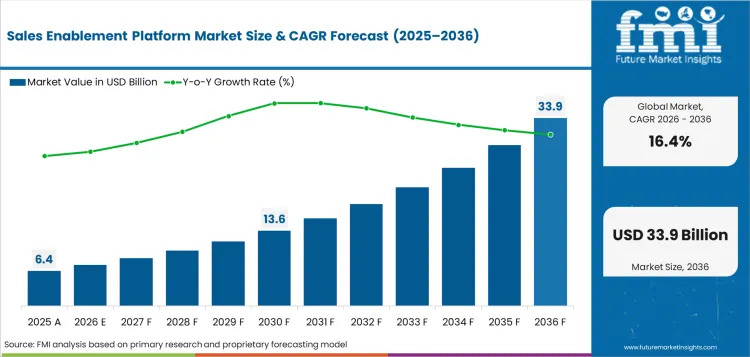
Key Takeaways, Market Size, and Forecast
| Metric | Value |
|---|---|
| Market Size (2025) | USD 6.36 Billion |
| Market Size (2036) | USD 33.90 Billion |
| CAGR (2026–2036) | 16.4% |
| Incremental Opportunity (2026–2036) | USD 26.50 Billion |
| Leading Deployment (2026) | Cloud-Based Deployment |
| Cloud-Based Deployment Share (2026) | 74% |
| Leading End-User (2026) | Finance |
| Finance Share (2026) | 32.3% |
| Fastest-Growing Country | India |
| India CAGR | 17.1% |
Summary of the Sales Enablement Platform Market
- Demand and Growth Drivers
- Revenue operations teams are replacing disconnected file libraries with platforms that connect content use to opportunity movement.
- Remote and hybrid selling is raising demand for buyer rooms that store content, meeting notes and next steps.
- Generative AI for sales coaching is improving role-play and message personalization within daily seller workflows.
- Financial firms are expanding enablement budgets as advisers need approved materials and logged customer interactions.
- Mid-market adoption is rising as subscription pricing lowers the entry barrier for sales organizations with limited IT staff.
- Product and Segment View
- Cloud-based deployment is likely to lead the deployment segment with 74% share in 2026 as sales teams work across locations.
- Content management is projected to lead functionality with 31.0% share in 2026 since approved content remains the first use case.
- Large enterprises are projected to hold 63.0% share by enterprise size in 2026 given their heavier compliance and training needs.
- Direct subscriptions are expected to account for 58.0% share by sales channel in 2026 as vendors control onboarding and renewals.
- Training and coaching modules are expanding as sales leaders link skills practice with deal performance and manager review.
- Geography and Competitive Outlook
- India is projected to record 17.1% CAGR through 2036 as SaaS use expands across business services and technology exporters.
- China is forecast at 16.7% CAGR by 2036 as social selling and enterprise cloud controls shape local platform design.
- France is expected to grow at 15.8% CAGR through 2036 as privacy and data-sovereignty rules influence buyer preference.
- Seismic and Highspot shape enterprise competition through platform depth, while Allego and Mindtickle compete through readiness and coaching.
- Smaller vendors can win where buyers need quick setup, industry templates or regional language support.
- Analyst Opinion
- Rahul Pandita Principal Analyst at FMI says, "I see this market shifting from a tool decision to a behavior decision. Sales leaders are asking whether the platform tells a seller what to use, when to use it and how to follow up after the buyer responds. The pressure is coming from cost of sales and tighter compliance review. Clients should watch whether AI features reduce manager work or just add another screen. The next phase belongs to platforms that make the seller workflow simpler and make the revenue leader more confident in the forecast."
- Sales Enablement Platform Market Value Analysis
- The market has moved from document access into workflow control as sellers need guidance during each deal stage.
- Subscription value is increasing as buyers add buyer rooms and analytics after the first content library rollout.
- Finance and technology accounts lift average contract value as these users need permissions, audit records and CRM-linked reporting.
- Onboarding budgets support market value as companies use platforms to shorten ramp time for new account executives.
- Renewal value depends on measurable use, so vendors are adding dashboards that connect content use with deal outcomes.
Sales teams need tools that reduce manual work and keep selling activity connected with approved data. In August 2024, Salesforce introduced two autonomous AI sales agents for inbound prospect engagement and seller role-play coaching. That shifts sales enablement from a content library into a daily execution layer for pipeline work. Buying models are changing at the same time. In April 2026, HubSpot stated that Breeze Customer Agent resolves 65% of conversations and cuts resolution time by 39%. Its Prospecting Agent moved to 100 credits per recommended lead. That gives buyers a clearer way to compare value through completed tasks. Seller workflow is becoming another selection point. In February 2025, Seismic said Aura Copilot expanded to Slack and Microsoft Teams. Sales enablement vendors that deliver coaching, answers and meeting follow-ups inside daily tools will be better placed for enterprise adoption.
Sales Enablement Platform Market Definition
The sales enablement platform market covers software used to store approved content, guide sellers, train teams and measure buyer engagement. The scope includes content management, sales coaching, buyer rooms, analytics and CRM-connected playbooks. The market excludes general file storage, standalone video meeting tools and customer relationship management databases that do not include enablement workflows.
Sales Enablement Platform Market Inclusions
Market scope includes cloud and on-premises platforms sold to finance, distribution, manufacturing, services, public sector and infrastructure users through direct subscriptions, system integrators and marketplace partners.
Sales Enablement Platform Market Exclusions
Scope excludes generic customer relationship management databases, learning systems without seller workflow links, video meeting tools and content repositories without seller guidance or buyer engagement tracking.
Sales Enablement Platform Market Research Methodology
- Primary Research:FMI analysts reviewed data from revenue operations heads, sales enablement managers, software resellers and customer success leaders. The review focused on buying criteria, contract renewal triggers and the role of integration depth in vendor selection.
- Desk Research: Desk research used government software adoption sources, public technology statistics and company product releases. The work also reviewed adjacent software categories such as sales coaching, sales intelligence and revenue operations platforms.
- Market Sizing and Forecasting:Market sizing estimated from platform seat adoption, average contract value and expansion across functionality modules. Forecast checks reconciled deployment trends, end-user demand and country-level software adoption patterns.
- Data Validation:Forecasts were validated through comparisons with cloud adoption, customer relationship management use and recent vendor product direction. Country estimates were checked against enterprise software use data and sales software maturity indicators.
Why is the Sales Enablement Platform Market Growing?
- Seller content is shifting into guided workflows since revenue teams want approved material inside daily opportunity work.
- Remote selling raises demand for buyer rooms as purchase groups need a shared place for content and follow-up.
- AI-assisted coaching is expanding since managers need faster ways to review practice calls and seller readiness.
- Compliance-heavy sectors use enablement platforms when every message and file version must be controlled.
Revenue teams are replacing static content libraries with sales training and onboarding software features that sit closer to daily seller work. The United States Bureau of Labor Statistics projected about 49,000 sales manager openings each year from 2024 to 2034. This labor churn makes repeatable coaching and approved playbooks important for sales organizations. Platforms gain budget priority when they help managers train sellers faster without adding separate systems.
Cloud access is another reason sales enablement software is expanding. Eurostat reported that 65.57% of European Union enterprises provided employees with remote access to business applications during 2024. This shows why hosted platforms are favored by teams that sell across offices, branches and partner channels. Buyers compare sales intelligence links and enablement analytics together because content usage now has to connect with deal behavior.
Market Segmentation Analysis
- With 74% share in 2026, cloud-based deployment is likely to lead deployment demand as sellers need access across devices.
- Content management is projected to account for 31.0% of functionality demand in 2026 since approved assets remain the core buyer need.
- Large enterprises are projected to hold 63.0% of enterprise size demand in 2026 with heavier training and compliance programs.
- Finance is expected to represent 32.3% of end-user demand in 2026 as adviser communications need stronger approval control.
- Direct subscriptions are forecast to capture 58.0% of sales channel demand in 2026 where vendors own onboarding and renewal work.
The market is divided across deployment, functionality, enterprise size, end user and sales channel. Deployment explains how buyers host the system and receive updates. Functionality separates content control, coaching, buyer engagement and analytics use. Enterprise size shows how contract scope changes between global programs and smaller sales teams. End-user and channel segments connect the platform to buying rules in finance, distribution, manufacturing and services. Adjacent conversation intelligence software often enters the same buying discussion when managers want call review and coaching proof.
Insights into the Cloud-based Deployment Segment
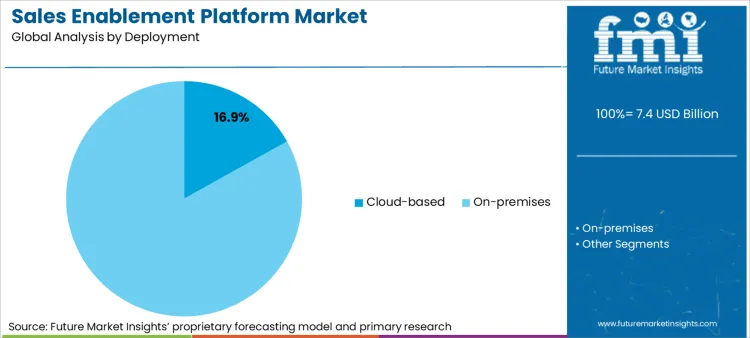
- Cloud-based deployment is likely to account for 74% of deployment demand in 2026 since seller access depends on shared files and updates across teams.
- On-premises deployment remains relevant in banks and government accounts where internal data control matters more than update speed or lower setup effort.
Insights into the Content Management Functionality Segment
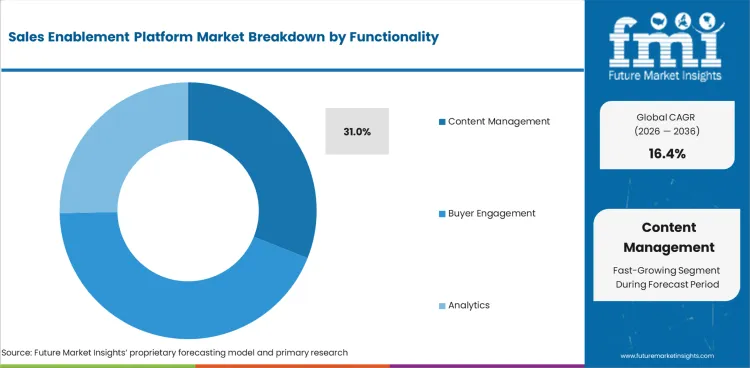
- Content management is estimated to hold 31.0% of functionality demand in 2026 as buyers first need approved pitch decks, case studies and product sheets.
- Training and coaching add-on demand rises after the first rollout as managers need proof that sellers use content in the right deal context.
Insights into the Large Enterprises Enterprise Size Segment
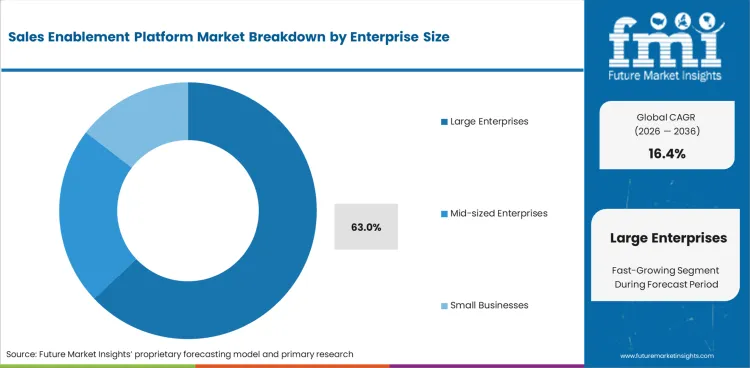
- Large enterprises are expected to account for 63.0% share by enterprise size in 2026 as global teams need role access and regional governance.
- Mid-sized enterprises choose shorter setup cycles, so vendors with lighter implementation packages can win accounts that avoid large consulting-led rollouts.
Insights into the Finance End User Segment
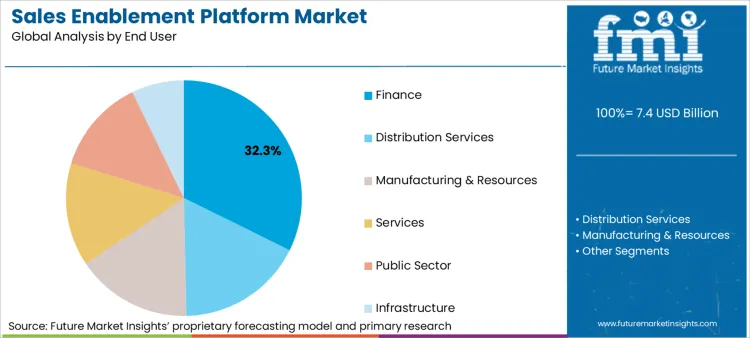
- Finance is projected to hold 32.3% share of end-user demand in 2026 as adviser content needs approval records and version history.
- Distribution services use platforms for dealer enablement. Finance pays more per user as compliance review is part of the sale.
Insights into the Direct Subscriptions Sales Channel Segment
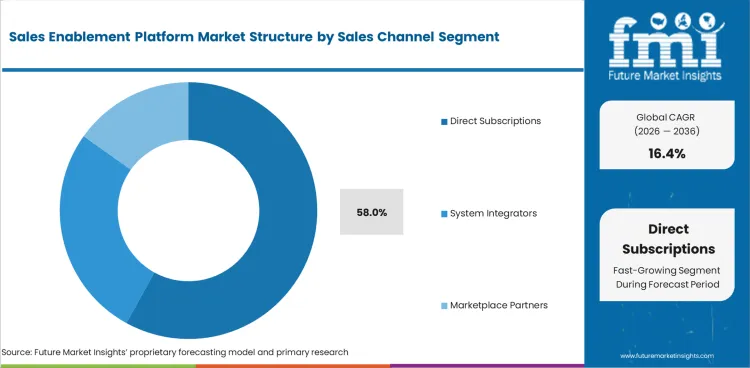
- Direct subscriptions are anticipated to capture 58.0% of sales channel demand in 2026 as vendors keep control of onboarding and usage review.
- System integrators matter in complex customer relationship management environments where enablement must connect with data warehouses and identity controls.
Sales Enablement Platform Market Drivers, Restraints, and Opportunities
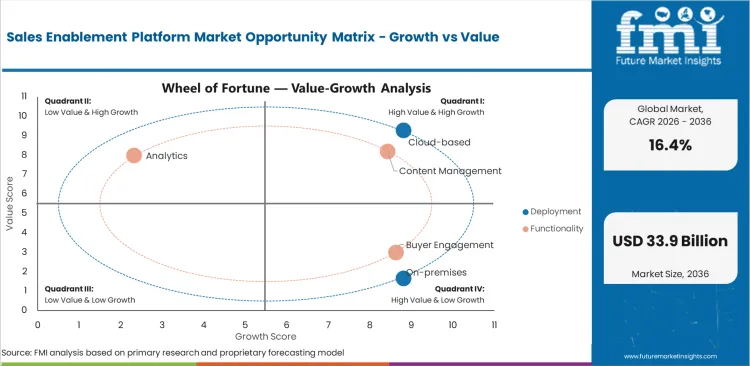
- CRM workflow integration raises platform value as sellers need approved content inside the opportunity record.
- Data control slows some rollouts since regulated buyers require permission settings and clear audit records.
- AI-assisted coaching creates opportunity as managers use role-play scoring and call review to guide behavior.
- Buyer rooms expand use where B2B purchase groups need secure access to proposals and follow-up content.
CRM Workflow Pull
Sales teams want enablement software inside systems they already use. The Bureau of Economic Analysis reported that United States services exports reached USD 1,152.7 billion in 2024. Large service exporters need sales content that moves quickly across regions and product lines. The services export base supports demand for revenue management software links and enablement dashboards that show which content helps move a deal forward. Vendors that reduce tab switching gain an advantage since sellers do not have to leave the opportunity record.
Compliance Content Control
Finance buyers place higher value on permissions and message approval. In 2025, Eurostat reported that 28.51% of European Union enterprises used customer relationship management software. Wider CRM use gives enablement vendors a clearer integration base. Finance teams use quote management software and approved-content controls to lower the risk of outdated claims reaching clients. Setup work remains the restraint since regulated accounts need security review before wider rollout.
Coaching Proof Loop
Training budgets are moving toward tools that show whether sellers can repeat the right pitch. The Organisation for Economic Co-operation and Development said in January 2026 that 20.2% of firms reported using AI in 2025. The figure matters since AI-assisted role play and call review are now part of seller coaching. Demand for sales coaching software is expected to rise as managers link content and deal outcomes in one view.
Analysis of Sales Enablement Platform Market By Key Countries
.webp "Top Country Growth Comparison Sales Enablement Platform Market Cagr (2026 2036)")
| Country | CAGR |
|---|---|
| India | 17.1% |
| China | 16.7% |
| France | 15.8% |
| Germany | 14.9% |
| United Kingdom | 14.4% |
| Japan | 13.9% |
| United States | 13.6% |
Source: FMI analysis based on primary research and proprietary forecasting model.
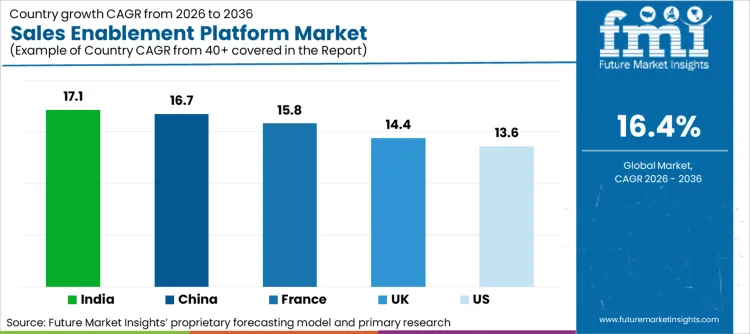
Sales Enablement Platform Market CAGR Analysis By Country
- India is projected to record a 17.1% CAGR through 2036 as SaaS exports and large distributed sales teams widen the buyer pool.
- China is expected to expand at 16.7% CAGR through 2036 since social selling and cloud governance shape platform use.
- France is forecast to grow at 15.8% CAGR through 2036 as data sovereignty and privacy rules guide vendor choice.
- Germany is expected to advance at 14.9% CAGR through 2036 given its industrial account base and structured B2B sales cycles.
- The United Kingdom is projected to rise at 14.4% CAGR through 2036 where finance and professional services need compliant client communication.
- Japan is forecast at 13.9% CAGR through 2036 as conservative enterprise software buying slows platform switching.
- The United States is expected to post 13.6% CAGR through 2036 as maturity shifts spending toward AI workflow depth.
Demand is forecast to rise at 16.4% CAGR from 2026 to 2036. India and China sit above the global average as SaaS adoption changes faster. France also stays above the average because privacy-led platform reviews are increasing. Germany and the United Kingdom remain below the average where enterprise penetration is higher. Japan and the United States evaluate platform replacement more carefully.
Demand Outlook for Sales Enablement Platform Market in India
India has a large services export base and a fast-growing software buyer pool. India is projected to record a 17.1% CAGR through 2036 as SaaS providers and technology service firms train large distributed sales teams. The Ministry of Electronics and Information Technology has referenced a USD 1 trillion software-led economy goal for 2030, which gives enterprise software vendors a wider demand base. This creates room for cloud-first enablement platforms that link playbooks and buyer rooms with coaching into one subscription.
- Bengaluru technology firms create early demand for enablement platforms that train sellers across global client accounts.
- Hyderabad software exporters need content governance that keeps proposal material consistent across delivery and sales teams.
- Gurugram business service firms use cloud sales tools to manage large field and inside-sales teams.
Sales Analysis of Sales Enablement Platform Market in China
Enterprise software suppliers in China must fit local cloud rules and social selling workflows. China is expected to expand at 16.7% CAGR through 2036 since WeCom and domestic cloud hosting needs shape product design. National Bureau of Statistics of China data showed software and information technology services revenue continued to expand in 2025. Localized deployment and Mandarin content workflows matter more than generic global templates. Vendors win where they connect content approval with social buyer communication and domestic data controls.
- Shanghai software buyers favor platforms that connect online sales content with enterprise cloud procurement rules.
- Shenzhen technology exporters use sales rooms to manage buyer files during cross-border product discussions.
- Beijing regulated sectors need local hosting and access controls before wider seller enablement rollout.
Demand Analysis of Sales Enablement Platform Market in France
French buyers treat data hosting and privacy review as core selection steps. France is forecast to grow at 15.8% CAGR through 2036 as sovereignty rules influence platform shortlists and security reviews. The French Tech program continued to track domestic software scale-ups in 2024 and 2025. This favors vendors that can show regional hosting and multilingual content workflows with clear permission controls. Supplier opportunity is strongest where banks, insurers and business services firms need approved sales material with local-language governance.
- Paris financial services firms need approved messaging workflows for advisers and business development teams.
- Lyon industrial suppliers use enablement tools to manage technical brochures and product launch materials.
- France 2030 software policy keeps software modernization visible for larger enterprise accounts.
Opportunity Analysis of Sales Enablement Platform Market in Germany
German industrial selling relies on technical proof and long account cycles. Germany is expected to advance at 14.9% CAGR through 2036 given the need to keep product sheets, engineering claims and partner material aligned. The Federal Statistical Office of Germany reported in February 2026 that manufacturing orders had moved upward in late 2025. That order flow supports sales tools that help teams explain complex offers consistently.
- Munich automation suppliers need approved product claims for multi-stage industrial bids.
- Stuttgart automotive technology accounts use enablement tools to align sales, engineering and dealer messaging.
- North Rhine-Westphalia distributors require partner portals that keep product updates and pricing guidance current.
Future Outlook for Sales Enablement Platform Market in the United Kingdom
The United Kingdom has a large financial and professional services base that sells through regulated client conversations. The United Kingdom is projected to rise at 14.4% CAGR through 2036 where finance and consulting firms need compliant content workflows. The Office for National Statistics reported high adoption of cloud-based systems and applications among United Kingdom firms in its March 2025 technology adoption analysis. This gives hosted enablement platforms a ready operating base. Faster rollout volume depends on buyers proving clear seller productivity gains after rollout.
- London wealth managers need adviser content libraries with version control and approval records.
- Manchester business service firms use platform training to keep sales messages consistent across regional teams.
- Edinburgh financial technology firms need CRM-connected buyer rooms for regulated client communication.
In-depth Analysis of Sales Enablement Platform Market in Japan
Japanese enterprises often buy software through careful risk review and long vendor evaluation. Japan is forecast at 13.9% CAGR through 2036 as large companies add content governance and training tools without rushing platform replacement. The Ministry of Economy, Trade and Industry has continued software modernization policy work for enterprise modernization. This supports demand but slows sudden switching because buyers expect security proof and local implementation support. Vendors with Japanese-language workflows and customer success depth gain a clearer route to renewal.
- Tokyo enterprise software buyers need Japanese-language support and strict permission controls.
- Osaka manufacturing groups use enablement tools for distributor training and technical sales content.
- Nagoya automotive suppliers need controlled product material for dealer networks and export accounts.
Demand Outlook for Sales Enablement Platform Market in the United States
United States buyers already use mature sales technology stacks, so replacement decisions focus on consolidation and AI workflow proof. The United States is expected to post 13.6% CAGR through 2036 as large accounts add coaching and deal intelligence to existing content systems. The United States Bureau of Labor Statistics projected about 1.8 million sales occupation openings each year over 2024 to 2034. This replacement flow creates a steady need for repeatable training. Growth is below India and China because many enterprise accounts already own enablement tools.
- California software firms test AI-assisted coaching to reduce manager review time in high-volume sales teams.
- New York financial firms need approved content tracking for advisers and institutional sales teams.
- Texas technology and energy suppliers use buyer rooms for complex account proposals and partner communication.
Competitive Landscape and Strategic Positioning
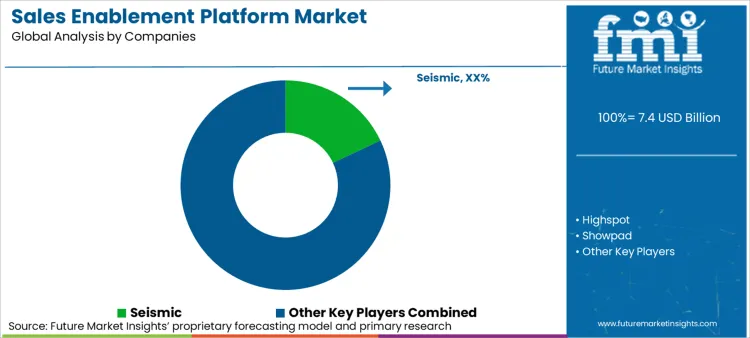
- Top-tier competition centers on enterprise suites that combine content, coaching, engagement and analytics.
- Specialist vendors compete through faster onboarding, sales readiness depth and industry-specific templates.
- Entry barriers include CRM integration and security review. Content permission logic and proof of seller usage add another filter.
- Finance and technology accounts give larger vendors an advantage because these buyers expect global support and audit controls.
Key players such as Seismic and Highspot compete around platform breadth and enterprise workflow depth. Seismic introduced Aura AI Agents in October 2025 to help teams search, generate content and act inside the enablement cloud. Highspot introduced role-based AI agents in July 2025 to guide sellers and enablement teams from buyer signals. Those launches show why RevOps platform links matter to buyers that want content activity and opportunity signals in one place.
Capability depth now decides more deals than basic content storage. Allego unveiled agentic AI capabilities in June 2025 across coaching, learning and online selling. Highspot launched Deal Intelligence in January 2026 to give sellers a deal view and next-action guidance. The launch pattern puts content experience platforms under pressure because sales leaders want content to prove usefulness in active opportunities.
Barriers remain high for new entrants. A sales enablement platform must handle access rights, approved content, analytics and integrations without slowing sellers. Those requirements make partnership depth and implementation support important. Point tools can survive where a buyer needs only coaching or buyer rooms, but suite vendors have more expansion paths.
Key Companies in the Sales Enablement Platform Market
Competition is best understood by role because suite breadth, coaching depth and engagement analytics differ across vendors.
- Suite Platforms: Seismic and Highspot serve large enterprise programs that need content governance, seller guidance and analytics.
- Readiness and Coaching Specialists: Allego, Mindtickle and Showpad compete where sales leaders want practice, training and buyer engagement together.
- Adjacent Sales Workflow Vendors: Outreach, Salesloft and Mediafly compete near the enablement boundary through engagement, revenue workflow and content presentation tools.
Competitive Benchmarking: Sales Enablement Platform Market
| Company | Content Governance Depth | Coaching Workflow Depth | CRM and Analytics Integration | Geographic Footprint |
|---|---|---|---|---|
| Seismic | High | Strong | Strong | Global with enterprise depth |
| Highspot | High | Strong | Strong | Global with North America strength |
| Allego | Medium | High | Strong | North America and Europe |
| Mindtickle | Medium | High | Strong | Global with India engineering base |
| Showpad | Medium | Strong | Medium | Europe and North America |
| Mediafly | Medium | Medium | Medium | North America and Europe |
| Outreach | Low | Medium | Strong | Global sales engagement footprint |
| Salesloft | Low | Medium | Strong | Global sales engagement footprint |
Source: Future Market Insights competitive analysis, 2026. Ratings reflect relative positioning based on content governance depth, coaching workflow depth and CRM and analytics integration.
Key Developments in Sales Enablement Platform Market
- In October 2025, Seismic introduced Aura AI Agents in its Fall 2025 Product Release. The release added chat, presentation and learning support for go-to-market teams.
- In July 2025, Highspot introduced role-based AI agents through its Summer Product Launch. The launch linked buyer conversations and shared content signals.
- In January 2026, Highspot introduced Deal Intelligence powered by Deal Agent. The release gave sellers real-time deal context and next-action guidance.
Key Players in the Sales Enablement Platform Market
Suite Platforms
- Seismic
- Highspot
Readiness and Coaching Specialists
- Allego
- Mindtickle
- Showpad
Adjacent Sales Workflow Vendors
- Mediafly
- Outreach
- Salesloft
Report Scope and Coverage
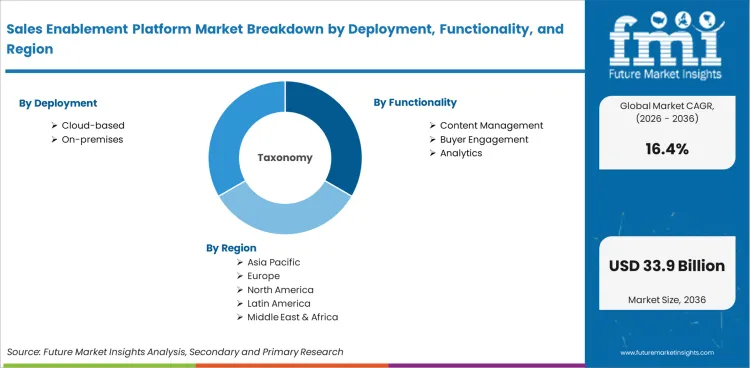
| Parameter | Details |
|---|---|
| Quantitative Units | USD 7.40 billion in 2026 to USD 33.90 billion by 2036, at a CAGR of 16.4% |
| Market Definition | Software used to store approved sales content, guide sellers, train teams and measure buyer engagement. |
| Deployment | Cloud-based, On-premises |
| Functionality | Content management, Training and coaching, Buyer engagement, Analytics |
| Enterprise Size | Large enterprises, Mid-sized enterprises, Small businesses |
| End User | Finance, Distribution services, Manufacturing and resources, Services, Public sector, Infrastructure |
| Sales Channel | Direct subscriptions, System integrators, Marketplace partners |
| Regions Covered | North America, Latin America, Europe, East Asia, South Asia and Pacific, Middle East and Africa |
| Countries Covered | India, China, France, Germany, United Kingdom, Japan, United States, 30+ countries |
| Key Companies Profiled | Seismic, Highspot, Allego, Mindtickle, Showpad, Mediafly, Outreach, Salesloft |
| Forecast Period | 2026 to 2036 |
| Approach | Hybrid bottom-up and top-down methodology using verified digital adoption signals, vendor activity and platform adoption patterns |
Source: Future Market Insights, 2026.
Sales Enablement Platform Market Breakdown By Deployment, Functionality, Enterprise Size, End User, Sales Channel and Region
Sales Enablement Platform Market Segmented by Deployment:
- Cloud-based
- On-premises
Sales Enablement Platform Market Segmented by Functionality:
- Content management
- Training and coaching
- Buyer engagement
- Analytics
Sales Enablement Platform Market Segmented by Enterprise Size:
- Large enterprises
- Mid-sized enterprises
- Small businesses
Sales Enablement Platform Market Segmented by End User:
- Finance
- Distribution services
- Manufacturing and resources
- Services
- Public sector
- Infrastructure
Sales Enablement Platform Market Segmented by Sales Channel:
- Direct subscriptions
- System integrators
- Marketplace partners
Sales Enablement Platform Market Segmented by Region:
- North America
- United States
- Canada
- Mexico
- Latin America
- Brazil
- Chile
- Rest of Latin America
- Western Europe
- Germany
- United Kingdom
- Italy
- Spain
- France
- Nordic
- BENELUX
- Rest of Western Europe
- Eastern Europe
- Russia
- Poland
- Hungary
- Balkan and Baltic
- Rest of Eastern Europe
- East Asia
- China
- Japan
- South Korea
- South Asia and Pacific
- India
- ASEAN
- Australia and New Zealand
- Rest of South Asia and Pacific
- Middle East and Africa
- Kingdom of Saudi Arabia
- Other GCC Countries
- Turkiye
- South Africa
- Other African Union
- Rest of Middle East and Africa
Research Sources and Bibliography
- Eurostat. (2026, January 13). Cloud computing: Statistics on the use by enterprises. European Commission.
- Eurostat. (2026, May 11). E-business integration: Statistics explained. European Commission.
- Eurostat. (2024). Online meetings and remote access to enterprise resources: Statistics. European Commission
- Organisation for Economic Co-operation and Development. (2024, May 14). OECD digital economy outlook 2024, volume 1: Embracing the technology frontier. OECD Publishing.
- Organisation for Economic Co-operation and Development. (2026, January 28). AI use by individuals surges across the OECD as adoption by firms continues to expand. OECD.
- United States Bureau of Labor Statistics. (2025, August 28). Sales managers: Occupational outlook handbook. USA Department of Labor.
- United States Bureau of Labor Statistics. (2025, August 28). Sales occupations: Occupational outlook handbook. USA Department of Labor.
- United States Census Bureau. (2026, April). The microstructure of AI diffusion: Evidence from firms, business functions, and worker tasks. Center for Economic Studies.
- Office for National Statistics. (2025, March 24). Management practices and the adoption of technology and artificial intelligence in UK firms: 2023. Government of the United Kingdom.
- United States International Trade Administration. (2026, February 2). United Kingdom information and communication technology. USA Department of Commerce.
- United States Bureau of Economic Analysis. (2025, December 1). International services expanded detail. USA Department of Commerce.
- Highspot, Inc. (2025, July 9). Highspot launches breakthrough agentic platform for go-to-market teams. Highspot.
- Highspot, Inc. (2026, January 12). Highspot launches new agentic AI to help sales teams execute with precision and win more deals. Highspot.
- Seismic Software, Inc. (2025, October 21). Seismic Fall 2025 Product Release introduces new Aura AI Agents. Seismic.
- Seismic Software, Inc. (2026, February 17). Winter 2026: Seismic expands AI-assisted enablement. Seismic.
- Allego, Inc. (2024, June 5). Allego 8 unveiled at S3 Conference. Allego.
- Allego, Inc. (2025, June 10). Allego unveils agentic AI capabilities at Sales Success Summit 2025. Allego.
- Allego, Inc. (2025, July 23). 2025 AI in revenue enablement report released. Allego.
- Microsoft Corporation. (2025, October 22). Seismic uses AI to expand sales enablement for Microsoft Cloud customers. Microsoft Partner Success Stories.
The bibliography uses primary government, intergovernmental, official company and FMI topic sources relevant to sales enablement software demand signals.
This Report Answers
- What is the current and forecast value of the sales enablement platform market between 2026 and 2036?
- How fast is the sales enablement platform market expected to expand during the forecast period?
- Which deployment model leads sales enablement platform demand in 2026 and why does it lead?
- Which end-user sector accounts for the leading share of sales enablement platform spending in 2026?
- Why are cloud access, CRM integration and content governance changing platform selection?
- Which countries are forecast to record faster demand for sales enablement platforms through 2036?
- How do AI-assisted coaching and buyer rooms affect vendor competition in this market?
- Which companies are active in the sales enablement platform market and what do they compete on?
- What does FMI include and exclude in the sales enablement platform market scope?
- How does FMI estimate and validate the sales enablement platform forecast?
Frequently Asked Questions
What is the global market demand for Sales Enablement Platform in 2026?
In 2026, the global sales enablement platform market is projected to reach USD 7.40 billion as revenue workflows move into cloud tools.
How big will the Sales Enablement Platform Market be in 2036?
By 2036, the sales enablement platform market is forecast to reach USD 33.90 billion as coaching and buyer engagement modules expand.
How much is Sales Enablement Platform demand expected to expand between 2026 and 2036?
Between 2026 and 2036, sales enablement platform demand is projected to expand at 16.4% CAGR across enterprise and mid-market accounts.
Which deployment type is expected to lead the Sales Enablement Platform Market in 2026?
Cloud-based deployment is likely to lead with 74% share in 2026 as distributed sales teams need shared access and faster updates.
Which end user is expected to lead Sales Enablement Platform demand in 2026?
Finance is projected to lead end-user demand with 32.3% share in 2026 as adviser content needs approval records and audit trails.
Which country is forecast to grow fastest in the Sales Enablement Platform Market?
India is expected to post 17.1% CAGR through 2036 as SaaS services and large distributed sales teams expand platform use.
What does the Sales Enablement Platform Market include?
The market includes software for approved content, seller coaching, buyer engagement rooms, playbooks and analytics linked with customer relationship management systems.
How does FMI estimate the Sales Enablement Platform Market forecast?
FMI estimates the forecast through platform adoption checks, end-user demand signals, country software maturity and verified company product activity.
Which sales enablement platform type is best for large enterprises?
Cloud-based platforms are usually best for large enterprises because they support global access, faster updates and central control over approved content across regions.
What is the difference between sales enablement and customer relationship management software?
Customer relationship management software stores account and opportunity records. Sales enablement software gives sellers approved content, coaching guidance and buyer engagement tools around those records.
How does a sales enablement platform work?
A sales enablement platform stores approved content, recommends material for each deal, tracks buyer engagement and helps managers coach sellers from real usage data.
What are the disadvantages of sales enablement platforms?
The main disadvantages are setup effort, user adoption risk and integration work. Value falls when content owners do not keep material current.
Which countries use sales enablement platforms most?
The United States, United Kingdom and Germany have deeper enterprise use today. India and China are forecast to expand faster as cloud selling tools spread.
Preview the report firsthand - request a free sample
Get SampleGet the brochure for pricing and purchase details.
Get PDFTable of Content
- Executive Summary
- Global Market Outlook
- Demand-side Trends
- Supply-side Trends
- Technology Roadmap Analysis
- Analysis and Recommendations
- Market Overview
- Market Coverage / Taxonomy
- Market Definition / Scope / Limitations
- Research Methodology
- Chapter Orientation
- Analytical Lens and Working Hypotheses
- Market Structure, Signals, and Trend Drivers
- Benchmarking and Cross-market Comparability
- Market Sizing, Forecasting, and Opportunity Mapping
- Research Design and Evidence Framework
- Desk Research Programme (Secondary Evidence)
- Company Annual and Sustainability Reports
- Peer-reviewed Journals and Academic Literature
- Corporate Websites, Product Literature, and Technical Notes
- Earnings Decks and Investor Briefings
- Statutory Filings and Regulatory Disclosures
- Technical White Papers and Standards Notes
- Trade Journals, Industry Magazines, and Analyst Briefs
- Conference Proceedings, Webinars, and Seminar Materials
- Government Statistics Portals and Public Data Releases
- Press Releases and Reputable Media Coverage
- Specialist Newsletters and Curated Briefings
- Sector Databases and Reference Repositories
- FMI Internal Proprietary Databases and Historical Market Datasets
- Subscription Datasets and Paid Sources
- Social Channels, Communities, and Digital Listening Inputs
- Additional Desk Sources
- Expert Input and Fieldwork (Primary Evidence)
- Primary Modes
- Qualitative Interviews and Expert Elicitation
- Quantitative Surveys and Structured Data Capture
- Blended Approach
- Why Primary Evidence is Used
- Field Techniques
- Interviews
- Surveys
- Focus Groups
- Observational and In-context Research
- Social and Community Interactions
- Stakeholder Universe Engaged
- C-suite Leaders
- Board Members
- Presidents and Vice Presidents
- R&D and Innovation Heads
- Technical Specialists
- Domain Subject-matter Experts
- Scientists
- Physicians and Other Healthcare Professionals
- Governance, Ethics, and Data Stewardship
- Research Ethics
- Data Integrity and Handling
- Primary Modes
- Restraints
- Opportunity
- Trends
- Desk Research Programme (Secondary Evidence)
- Scenario Forecast
- Demand in Optimistic Scenario
- Demand in Likely Scenario
- Demand in Conservative Scenario
- Opportunity Map Analysis
- Product Life Cycle Analysis
- Supply Chain Analysis
- Investment Feasibility Matrix
- Value Chain Analysis
- PESTLE and Porter’s Analysis
- Regulatory Landscape
- Regional Parent Market Outlook
- Production and Consumption Statistics
- Import and Export Statistics
- Global Market Analysis 2021 to 2025 and Forecast, 2026 to 2036
- Historical Market Size Value (USD Million) Analysis, 2021 to 2025
- Current and Future Market Size Value (USD Million) Projections, 2026 to 2036
- Y-o-Y Growth Trend Analysis
- Absolute $ Opportunity Analysis
- Global Market Pricing Analysis 2021 to 2025 and Forecast 2026 to 2036
- Global Market Analysis 2021 to 2025 and Forecast 2026 to 2036, By Deployment
- Introduction / Key Findings
- Historical Market Size Value (USD Million) Analysis By Deployment , 2021 to 2025
- Current and Future Market Size Value (USD Million) Analysis and Forecast By Deployment , 2026 to 2036
- Cloud-based
- On-premises
- Cloud-based
- Y-o-Y Growth Trend Analysis By Deployment , 2021 to 2025
- Absolute $ Opportunity Analysis By Deployment , 2026 to 2036
- Global Market Analysis 2021 to 2025 and Forecast 2026 to 2036, By Functionality
- Introduction / Key Findings
- Historical Market Size Value (USD Million) Analysis By Functionality, 2021 to 2025
- Current and Future Market Size Value (USD Million) Analysis and Forecast By Functionality, 2026 to 2036
- Content Management
- Buyer Engagement
- Analytics
- Content Management
- Y-o-Y Growth Trend Analysis By Functionality, 2021 to 2025
- Absolute $ Opportunity Analysis By Functionality, 2026 to 2036
- Global Market Analysis 2021 to 2025 and Forecast 2026 to 2036, By Enterprise Size
- Introduction / Key Findings
- Historical Market Size Value (USD Million) Analysis By Enterprise Size, 2021 to 2025
- Current and Future Market Size Value (USD Million) Analysis and Forecast By Enterprise Size, 2026 to 2036
- Large Enterprises
- Mid-sized Enterprises
- Small Businesses
- Large Enterprises
- Y-o-Y Growth Trend Analysis By Enterprise Size, 2021 to 2025
- Absolute $ Opportunity Analysis By Enterprise Size, 2026 to 2036
- Global Market Analysis 2021 to 2025 and Forecast 2026 to 2036, By End User
- Introduction / Key Findings
- Historical Market Size Value (USD Million) Analysis By End User, 2021 to 2025
- Current and Future Market Size Value (USD Million) Analysis and Forecast By End User, 2026 to 2036
- Finance
- Services
- Infrastructure
- Finance
- Y-o-Y Growth Trend Analysis By End User, 2021 to 2025
- Absolute $ Opportunity Analysis By End User, 2026 to 2036
- Global Market Analysis 2021 to 2025 and Forecast 2026 to 2036, By Sales Channel
- Introduction / Key Findings
- Historical Market Size Value (USD Million) Analysis By Sales Channel, 2021 to 2025
- Current and Future Market Size Value (USD Million) Analysis and Forecast By Sales Channel, 2026 to 2036
- Direct Subscriptions
- System Integrators
- Marketplace Partners
- Direct Subscriptions
- Y-o-Y Growth Trend Analysis By Sales Channel, 2021 to 2025
- Absolute $ Opportunity Analysis By Sales Channel, 2026 to 2036
- Global Market Analysis 2021 to 2025 and Forecast 2026 to 2036, By Region
- Introduction
- Historical Market Size Value (USD Million) Analysis By Region, 2021 to 2025
- Current Market Size Value (USD Million) Analysis and Forecast By Region, 2026 to 2036
- North America
- Latin America
- Western Europe
- Eastern Europe
- East Asia
- South Asia and Pacific
- Middle East & Africa
- Market Attractiveness Analysis By Region
- North America Market Analysis 2021 to 2025 and Forecast 2026 to 2036, By Country
- Historical Market Size Value (USD Million) Trend Analysis By Market Taxonomy, 2021 to 2025
- Market Size Value (USD Million) Forecast By Market Taxonomy, 2026 to 2036
- By Country
- USA
- Canada
- Mexico
- By Deployment
- By Functionality
- By Enterprise Size
- By End User
- By Sales Channel
- By Country
- Market Attractiveness Analysis
- By Country
- By Deployment
- By Functionality
- By Enterprise Size
- By End User
- By Sales Channel
- Key Takeaways
- Latin America Market Analysis 2021 to 2025 and Forecast 2026 to 2036, By Country
- Historical Market Size Value (USD Million) Trend Analysis By Market Taxonomy, 2021 to 2025
- Market Size Value (USD Million) Forecast By Market Taxonomy, 2026 to 2036
- By Country
- Brazil
- Chile
- Rest of Latin America
- By Deployment
- By Functionality
- By Enterprise Size
- By End User
- By Sales Channel
- By Country
- Market Attractiveness Analysis
- By Country
- By Deployment
- By Functionality
- By Enterprise Size
- By End User
- By Sales Channel
- Key Takeaways
- Western Europe Market Analysis 2021 to 2025 and Forecast 2026 to 2036, By Country
- Historical Market Size Value (USD Million) Trend Analysis By Market Taxonomy, 2021 to 2025
- Market Size Value (USD Million) Forecast By Market Taxonomy, 2026 to 2036
- By Country
- Germany
- UK
- Italy
- Spain
- France
- Nordic
- BENELUX
- Rest of Western Europe
- By Deployment
- By Functionality
- By Enterprise Size
- By End User
- By Sales Channel
- By Country
- Market Attractiveness Analysis
- By Country
- By Deployment
- By Functionality
- By Enterprise Size
- By End User
- By Sales Channel
- Key Takeaways
- Eastern Europe Market Analysis 2021 to 2025 and Forecast 2026 to 2036, By Country
- Historical Market Size Value (USD Million) Trend Analysis By Market Taxonomy, 2021 to 2025
- Market Size Value (USD Million) Forecast By Market Taxonomy, 2026 to 2036
- By Country
- Russia
- Poland
- Hungary
- Balkan & Baltic
- Rest of Eastern Europe
- By Deployment
- By Functionality
- By Enterprise Size
- By End User
- By Sales Channel
- By Country
- Market Attractiveness Analysis
- By Country
- By Deployment
- By Functionality
- By Enterprise Size
- By End User
- By Sales Channel
- Key Takeaways
- East Asia Market Analysis 2021 to 2025 and Forecast 2026 to 2036, By Country
- Historical Market Size Value (USD Million) Trend Analysis By Market Taxonomy, 2021 to 2025
- Market Size Value (USD Million) Forecast By Market Taxonomy, 2026 to 2036
- By Country
- China
- Japan
- South Korea
- By Deployment
- By Functionality
- By Enterprise Size
- By End User
- By Sales Channel
- By Country
- Market Attractiveness Analysis
- By Country
- By Deployment
- By Functionality
- By Enterprise Size
- By End User
- By Sales Channel
- Key Takeaways
- South Asia and Pacific Market Analysis 2021 to 2025 and Forecast 2026 to 2036, By Country
- Historical Market Size Value (USD Million) Trend Analysis By Market Taxonomy, 2021 to 2025
- Market Size Value (USD Million) Forecast By Market Taxonomy, 2026 to 2036
- By Country
- India
- ASEAN
- Australia & New Zealand
- Rest of South Asia and Pacific
- By Deployment
- By Functionality
- By Enterprise Size
- By End User
- By Sales Channel
- By Country
- Market Attractiveness Analysis
- By Country
- By Deployment
- By Functionality
- By Enterprise Size
- By End User
- By Sales Channel
- Key Takeaways
- Middle East & Africa Market Analysis 2021 to 2025 and Forecast 2026 to 2036, By Country
- Historical Market Size Value (USD Million) Trend Analysis By Market Taxonomy, 2021 to 2025
- Market Size Value (USD Million) Forecast By Market Taxonomy, 2026 to 2036
- By Country
- Kingdom of Saudi Arabia
- Other GCC Countries
- Turkiye
- South Africa
- Other African Union
- Rest of Middle East & Africa
- By Deployment
- By Functionality
- By Enterprise Size
- By End User
- By Sales Channel
- By Country
- Market Attractiveness Analysis
- By Country
- By Deployment
- By Functionality
- By Enterprise Size
- By End User
- By Sales Channel
- Key Takeaways
- Key Countries Market Analysis
- USA
- Pricing Analysis
- Market Share Analysis, 2025
- By Deployment
- By Functionality
- By Enterprise Size
- By End User
- By Sales Channel
- Canada
- Pricing Analysis
- Market Share Analysis, 2025
- By Deployment
- By Functionality
- By Enterprise Size
- By End User
- By Sales Channel
- Mexico
- Pricing Analysis
- Market Share Analysis, 2025
- By Deployment
- By Functionality
- By Enterprise Size
- By End User
- By Sales Channel
- Brazil
- Pricing Analysis
- Market Share Analysis, 2025
- By Deployment
- By Functionality
- By Enterprise Size
- By End User
- By Sales Channel
- Chile
- Pricing Analysis
- Market Share Analysis, 2025
- By Deployment
- By Functionality
- By Enterprise Size
- By End User
- By Sales Channel
- Germany
- Pricing Analysis
- Market Share Analysis, 2025
- By Deployment
- By Functionality
- By Enterprise Size
- By End User
- By Sales Channel
- UK
- Pricing Analysis
- Market Share Analysis, 2025
- By Deployment
- By Functionality
- By Enterprise Size
- By End User
- By Sales Channel
- Italy
- Pricing Analysis
- Market Share Analysis, 2025
- By Deployment
- By Functionality
- By Enterprise Size
- By End User
- By Sales Channel
- Spain
- Pricing Analysis
- Market Share Analysis, 2025
- By Deployment
- By Functionality
- By Enterprise Size
- By End User
- By Sales Channel
- France
- Pricing Analysis
- Market Share Analysis, 2025
- By Deployment
- By Functionality
- By Enterprise Size
- By End User
- By Sales Channel
- India
- Pricing Analysis
- Market Share Analysis, 2025
- By Deployment
- By Functionality
- By Enterprise Size
- By End User
- By Sales Channel
- ASEAN
- Pricing Analysis
- Market Share Analysis, 2025
- By Deployment
- By Functionality
- By Enterprise Size
- By End User
- By Sales Channel
- Australia & New Zealand
- Pricing Analysis
- Market Share Analysis, 2025
- By Deployment
- By Functionality
- By Enterprise Size
- By End User
- By Sales Channel
- China
- Pricing Analysis
- Market Share Analysis, 2025
- By Deployment
- By Functionality
- By Enterprise Size
- By End User
- By Sales Channel
- Japan
- Pricing Analysis
- Market Share Analysis, 2025
- By Deployment
- By Functionality
- By Enterprise Size
- By End User
- By Sales Channel
- South Korea
- Pricing Analysis
- Market Share Analysis, 2025
- By Deployment
- By Functionality
- By Enterprise Size
- By End User
- By Sales Channel
- Russia
- Pricing Analysis
- Market Share Analysis, 2025
- By Deployment
- By Functionality
- By Enterprise Size
- By End User
- By Sales Channel
- Poland
- Pricing Analysis
- Market Share Analysis, 2025
- By Deployment
- By Functionality
- By Enterprise Size
- By End User
- By Sales Channel
- Hungary
- Pricing Analysis
- Market Share Analysis, 2025
- By Deployment
- By Functionality
- By Enterprise Size
- By End User
- By Sales Channel
- Kingdom of Saudi Arabia
- Pricing Analysis
- Market Share Analysis, 2025
- By Deployment
- By Functionality
- By Enterprise Size
- By End User
- By Sales Channel
- Turkiye
- Pricing Analysis
- Market Share Analysis, 2025
- By Deployment
- By Functionality
- By Enterprise Size
- By End User
- By Sales Channel
- South Africa
- Pricing Analysis
- Market Share Analysis, 2025
- By Deployment
- By Functionality
- By Enterprise Size
- By End User
- By Sales Channel
- USA
- Market Structure Analysis
- Competition Dashboard
- Competition Benchmarking
- Market Share Analysis of Top Players
- By Regional
- By Deployment
- By Functionality
- By Enterprise Size
- By End User
- By Sales Channel
- Competition Analysis
- Competition Deep Dive
- Seismic
- Overview
- Product Portfolio
- Profitability by Market Segments (Product/Age /Sales Channel/Region)
- Sales Footprint
- Strategy Overview
- Marketing Strategy
- Product Strategy
- Channel Strategy
- Highspot
- Allego
- Mindtickle
- Showpad
- Seismic
- Competition Deep Dive
- Assumptions & Acronyms Used


