

- Industry Size (2026):
- USD 520.0 Mn
- Forecast (2036):
- USD 1411.3 Mn
- CAGR (2026 to 2036)
- 10.5%
Separator Edge Tapes Market Forecast and Outlook 2026 to 2036
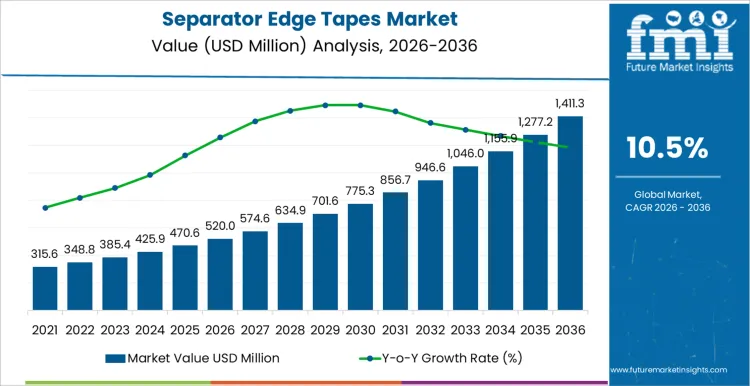
The separator edge tapes market is projected to grow from USD 520.0 million in 2026 to USD 1,411.3 million in 2036, advancing at a 10.5% CAGR over the forecast period. Growth reflects how lithium-ion battery manufacturing is evolving toward higher energy densities and more demanding safety requirements. Separator edge tapes are designed for precise positioning, consistent adhesion, and chemical resistance to prevent separator displacement during cell winding, stacking, and formation processes.
This transforms edge sealing from a basic assembly step into a critical quality control layer, where adhesive chemistry, backing material properties, and application precision influence cell reliability, manufacturing yields, and long-term electrochemical performance.
High-volume battery production is shifting toward automated tape application systems and integrated quality monitoring because they reduce handling variations and support consistent takt time requirements. Tapes that can conform to complex cell geometries, maintain adhesion under thermal cycling, and resist electrolyte degradation without compromising separator integrity are being specified earlier in cell design phases. As pouch cell formats and high-nickel cathode chemistries expand, buyers evaluate tapes not only on initial adhesion strength but also on long-term dimensional stability, outgassing characteristics, and compatibility with emerging separator materials including ceramic-coated and multilayer constructions.
Single-sided adhesive tapes lead where direct separator bonding and simplified application processes are priorities in automated assembly lines. Double-sided configurations dominate where component lamination and structural reinforcement matter most. Non-adhesive edge guards serve applications where mechanical protection without permanent bonding is preferred.
Multi-layer composite constructions are gaining adoption because they enable property customization, combining robust backing materials with specialized adhesive chemistries to reduce edge lifting and electrolyte interaction risks. EV traction cells remain the largest application segment, followed by stationary storage systems, while consumer and industrial cells provide steady demand volume.
Quick Stats for Separator Edge Tapes Market
- Separator Edge Tapes Market Value (2026): USD 520.0 million
- Separator Edge Tapes Market Forecast Value (2036): USD 1,411.3 million
- Separator Edge Tapes Market Forecast CAGR: 10.5%
- Leading Application in Separator Edge Tapes Market: EV Traction Cells (64%)
- Key Growth Countries in Separator Edge Tapes Market: China, Germany, South Korea, USA, Japan, UK
- Key Players in Separator Edge Tapes Market: 3M, Nitto Denko, Tesa SE, Lintec Corporation, Berry Global
Separator Edge Tapes Market Key Takeaways
| Metric | Value |
|---|---|
| Market Value (2026) | USD 520.0 million |
| Market Forecast Value (2036) | USD 1,411.3 million |
| Forecast CAGR 2026 to 2036 | 10.5% |
How Are Battery Safety Standards Reshaping Separator Edge Tape Requirements?
Battery safety regulations are driving fundamental changes in separator edge tape specifications as manufacturers adapt to increasingly stringent thermal runaway prevention requirements. New testing protocols for lithium-ion battery safety mandate comprehensive validation of all cell components under abuse conditions, positioning edge tapes as critical barriers preventing separator displacement during thermal events. International standards now require detailed documentation of tape material composition, outgassing characteristics, and thermal decomposition behavior, forcing suppliers to invest in advanced analytical capabilities and certification processes that can demonstrate compliance across multiple regulatory frameworks.
The implementation of traceability requirements for battery components is creating new quality control expectations for tape manufacturers. Each production lot must now include comprehensive documentation covering raw material sources, manufacturing parameters, and performance validation data that follows components through the entire battery supply chain. This regulatory environment benefits established tape manufacturers who can provide complete material lineage documentation while creating barriers for suppliers unable to meet these enhanced qualification requirements.
How Is the Market Structured Across Cell Configurations?
The separator edge tapes market demonstrates distinct patterns based on cell format requirements and manufacturing process variations. Pouch cell applications dominate with 40.0% market share, reflecting the widespread adoption of flexible packaging formats in electric vehicle and consumer electronics applications. These cells require tapes that can accommodate complex folding operations and maintain adhesion integrity during heat sealing processes without interfering with electrolyte flow patterns or creating localized stress concentrations.
Prismatic cell formats capture 36.0% of the market through their prevalence in automotive applications where dimensional precision and thermal management are critical design considerations. These rigid formats benefit from tapes designed for automated assembly operations that can maintain consistent positioning tolerance while providing reliable barrier properties against electrolyte migration. Battery cell manufacturing processes for prismatic formats typically emphasize tape configurations that support high-speed production while maintaining quality consistency across large production volumes.
Which Tape Configuration Generates the Highest Adoption?
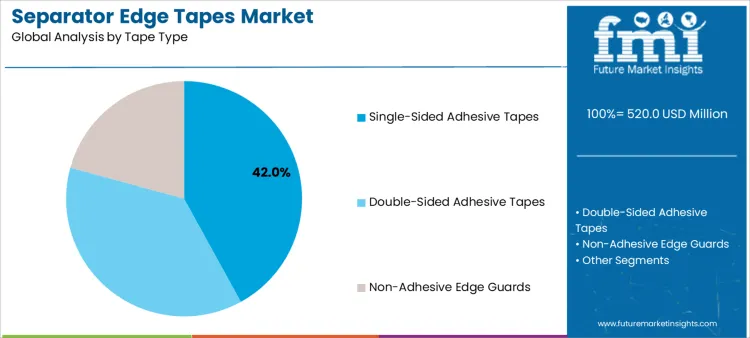
Single-sided adhesive tapes maintain 42.0% market share, establishing their position as the preferred solution for applications prioritizing manufacturing simplicity and cost optimization. These configurations offer superior process flexibility through straightforward application methods while providing adequate adhesion performance for most cell geometries. The molecular design of modern single-sided adhesives incorporates temperature-stable polymer chains that maintain bonding strength throughout cell assembly thermal cycles while demonstrating excellent compatibility with automated winding equipment.
Which Backing Material Leads Performance Requirements?
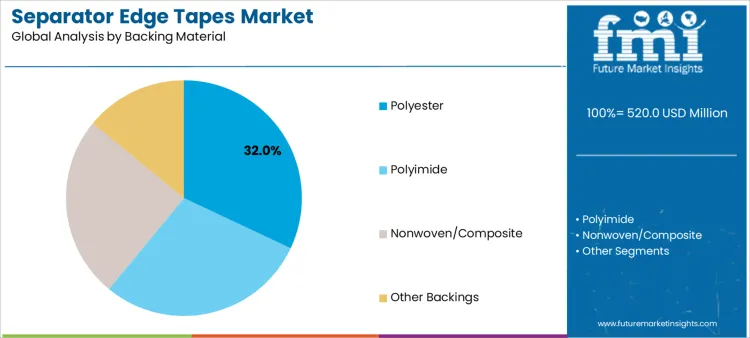
Polyester backing materials achieve 32.0% market preference, reflecting their balanced combination of mechanical strength, dimensional stability, and cost effectiveness for high-volume manufacturing operations. These materials provide excellent tear resistance and processing characteristics while maintaining consistent thickness tolerance essential for automated application systems. The crystalline structure of polyester films offers superior clarity for visual inspection processes while demonstrating minimal moisture absorption that could affect adhesive performance.
Which Cell Format Drives Market Growth?
Pouch cells represent 40.0% of market applications, reflecting the growing preference for flexible packaging formats that enable optimized space utilization and thermal management in battery pack designs. These configurations require specialized tape formulations that can accommodate complex geometry changes during cell swelling and shrinkage cycles while maintaining consistent edge sealing performance. Manufacturing processes for pouch cells emphasize tapes that support high-speed assembly operations without creating wrinkles or air entrapment that could compromise cell performance.
Which End-Use Segment Dominates Market Demand?
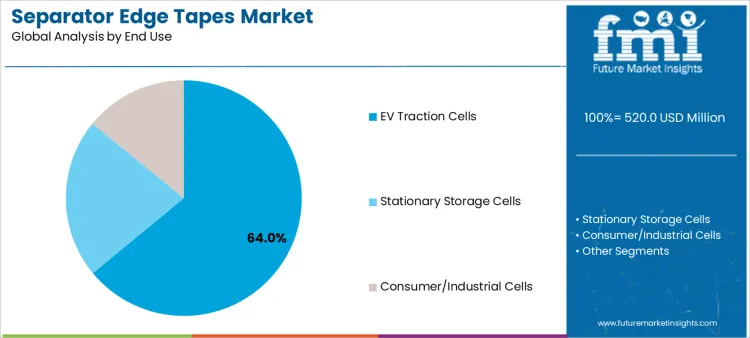
EV traction cells account for 64.0% of market applications, establishing electric vehicle battery production as the primary driver of separator edge tape demand. These applications impose the most stringent performance requirements including extended service life expectations, wide operating temperature ranges, and demanding safety criteria that influence every aspect of tape specification. Manufacturing volumes for automotive applications create opportunities for specialized tape formulations optimized for specific cell chemistries and assembly processes while supporting the quality consistency required for automotive qualification.
Market Dynamics
How Is Battery Technology Evolution Driving Innovation?
The rapid advancement of battery chemistry and cell design is creating unprecedented requirements for separator edge tape performance while simultaneously demanding enhanced cost effectiveness and manufacturing efficiency. Next-generation cathode materials operating at higher voltages require tape formulations with improved electrochemical stability and reduced ionic contamination potential. Silicon-enhanced anode materials introduce additional challenges through their volume expansion characteristics, requiring tapes that can accommodate dimensional changes without losing adhesion or creating mechanical stress points that could damage separator integrity.
The development of solid-state battery technologies presents both opportunities and challenges for tape manufacturers as these systems eliminate liquid electrolytes while introducing new material compatibility requirements. Solid-state battery development emphasizes tape solutions that can provide effective sealing against moisture infiltration while maintaining compatibility with ceramic separator materials and high-temperature processing conditions required for solid electrolyte activation.
What Technical Challenges Constrain Market Expansion?
The primary limitation affecting separator edge tape market growth centers on the increasing complexity of adhesive chemistry optimization required to meet simultaneously demanding performance requirements across multiple application parameters. While advanced polymer adhesives offer superior temperature stability and chemical resistance, their formulation complexity creates challenges in maintaining consistency across large production volumes while controlling costs in price-sensitive applications. This technical complexity requires significant investment in research and development capabilities that may limit market participation for smaller suppliers.
Process integration challenges also constrain adoption in certain applications where existing manufacturing equipment may not accommodate advanced tape configurations without significant modification. The requirement for precise application control and consistent environmental conditions during tape installation creates barriers for manufacturers operating with legacy equipment or limited process control capabilities. These constraints drive demand for tape solutions that can perform reliably under variable application conditions while maintaining quality consistency.
How Do Sustainability Requirements Create Market Opportunities?
Environmental regulations targeting battery lifecycle management are creating significant opportunities for separator edge tape manufacturers who can demonstrate reduced environmental impact through sustainable material sourcing and end-of-life recyclability. Regulations requiring detailed material composition disclosure and recyclability documentation favor suppliers who invest in bio-based adhesive chemistries and sustainable backing materials that maintain necessary performance characteristics while supporting circular economy objectives.
The implementation of carbon footprint reduction targets in battery manufacturing is driving adoption of tape solutions that contribute to overall energy efficiency improvements through enhanced manufacturing processes or extended battery service life. Battery recycling initiatives create demand for tape formulations designed to facilitate separator material recovery during end-of-life processing, opening markets for specialized products that dissolve or debond under controlled conditions.
How Is the Separator Edge Tapes Market Expected to Evolve Across Major Nations?
The global landscape for separator edge tapes reflects regional variations in battery manufacturing capacity, technology adoption patterns, and regulatory frameworks that influence market development across different economic zones. Leading manufacturing regions are investing heavily in advanced production capabilities while emerging markets focus on building domestic supply chains to serve growing local demand and export opportunities.
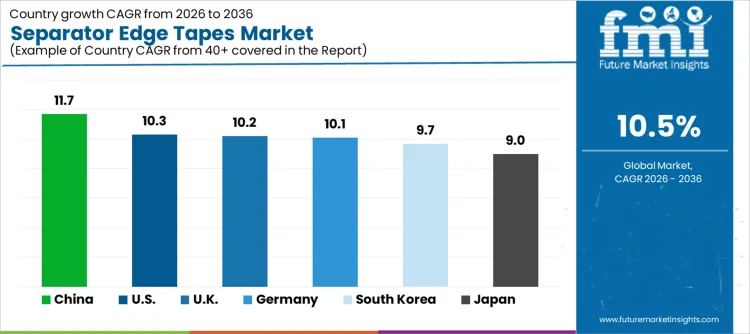
| Country | CAGR (%) |
|---|---|
| China | 11.7% |
| Germany | 10.1% |
| USA | 10.3% |
| Japan | 9.0% |
| South Korea | 9.7% |
| UK | 10.2% |
What Drives China's Market Leadership?
China's separator edge tapes market is projected to achieve the highest growth rate at 11.7% CAGR, driven primarily by the country's massive battery manufacturing capacity and aggressive electric vehicle adoption targets. The concentration of lithium-ion battery production facilities creates enormous demand for specialized tape solutions while fostering rapid innovation in manufacturing processes and quality control systems. Chinese manufacturers are developing cost-effective tape formulations that meet international quality standards while leveraging domestic supply chains to achieve competitive pricing advantages.
The government's support for battery technology advancement through substantial research funding and manufacturing incentives accelerates adoption of advanced tape technologies while encouraging domestic suppliers to invest in production capacity expansion. This combination of policy support and market scale creates favorable conditions for both established international suppliers and emerging domestic manufacturers seeking to capture market share in the world's largest battery production ecosystem.
How Is Germany Advancing Manufacturing Excellence?
Sales of separator edge tapes in Germany are projected to grow at a CAGR of 10.1% growth reflects the country's leadership in automotive engineering and precision manufacturing technologies that demand the highest quality tape solutions. German automotive manufacturers implement rigorous qualification processes that favor suppliers capable of demonstrating exceptional consistency and reliability while meeting stringent automotive safety standards. The emphasis on premium vehicle segments creates opportunities for high-performance tape formulations that justify premium pricing through superior long-term durability and reliability characteristics.
The country's strong industrial automation sector drives adoption of advanced tape application systems that require precisely engineered products capable of reliable performance in high-speed manufacturing environments. Automotive battery manufacturing in Germany typically emphasizes local supplier relationships that can provide responsive technical support and rapid problem resolution capabilities essential for maintaining production efficiency.
Why Is the USA Market Emphasizing Supply Chain Security?
The United States market experiences 10.3% CAGR growth supported by significant federal investment in domestic battery manufacturing capacity and supply chain localization initiatives. Government incentives promoting domestic production create opportunities for tape manufacturers to establish local operations while serving the growing demands of automotive and energy storage applications. The emphasis on supply chain security drives preference for suppliers capable of providing complete traceability and domestic content verification required for federal incentive compliance.
The integration of renewable energy systems with grid-scale storage creates additional demand for tape solutions designed for stationary battery applications that operate under different performance requirements than automotive systems. Energy storage systems typically emphasize long-term reliability and cost optimization rather than the weight and space constraints that dominate automotive applications.
How Is Japanese Innovation Driving Technology Leadership?
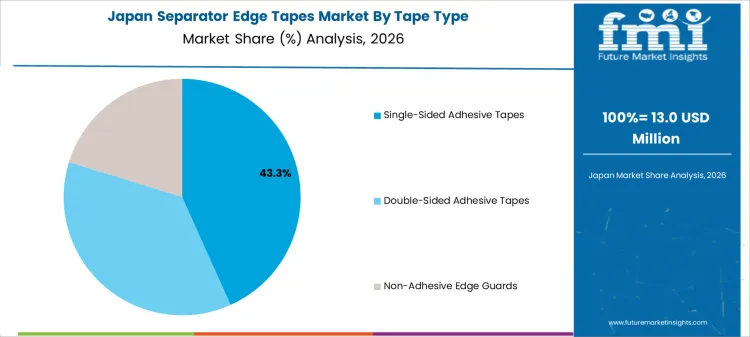
Demand for separator edge tapes in Japan is estimated to expand at a CAGR of Japan's 9.0%, growth is supported by the country's leadership in materials science and precision manufacturing technologies that enable development of next-generation tape solutions with enhanced performance characteristics. Japanese manufacturers focus on developing ultra-thin tape configurations that minimize space requirements while maintaining superior adhesion and barrier properties essential for high-energy-density applications.
The country's expertise in hybrid and electric vehicle technologies creates demand for tape solutions optimized for unique thermal and mechanical stress conditions encountered in automotive applications. Japanese battery technology development emphasizes long-term reliability testing and comprehensive quality validation that influences tape specification requirements throughout the industry.
What Opportunities Exist in South Korea's Technology Ecosystem?
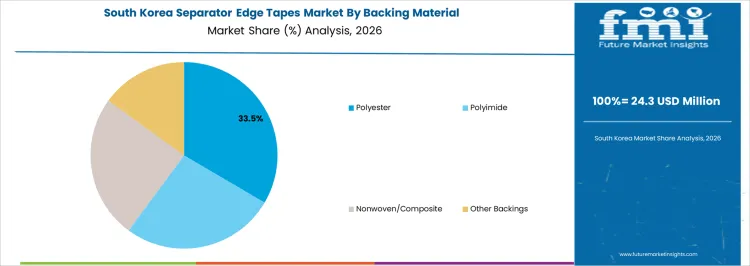
Sales of separator edge tapes in South Korea are likely to increase at a CAGR of 9.7% growth is driven by the country's dominance in consumer electronics and increasing leadership in electric vehicle battery production. Korean manufacturers demand tape solutions that support high-density cell configurations while maintaining exceptional quality consistency required for consumer applications where reliability directly impacts brand reputation.
The country's investment in next-generation battery technologies including solid-state systems creates opportunities for specialized tape formulations designed to support emerging manufacturing processes and material compatibility requirements. Consumer electronics battery applications drive development of ultra-precise tape solutions that enable miniaturization while maintaining safety and performance standards.
What Strategies Help Suppliers Maintain Competitive Position in Separator Edge Tapes?
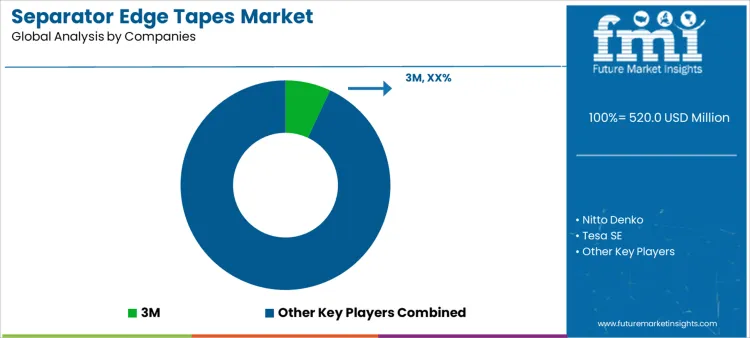
Suppliers maintain market position in separator edge tapes through demonstrated manufacturing consistency and validated performance in real production environments rather than theoretical specifications alone. Customers prioritize suppliers who can demonstrate reliable tape performance during high-speed application processes, consistent adhesion under thermal cycling conditions, and minimal defect rates that support manufacturing yield optimization. Development efforts focus on tape formulations that simplify cell assembly processes while providing enhanced reliability characteristics that reduce quality control requirements and warranty risks for battery manufacturers.
Market leaders establish competitive advantages through early engagement with battery manufacturers during cell design phases, enabling tape specifications to be optimized for specific manufacturing processes and performance requirements before production tooling investments are finalized. This collaborative approach creates switching barriers while ensuring optimal integration between tape properties and manufacturing system capabilities that benefit both suppliers and customers through improved efficiency and quality outcomes.
Successful suppliers invest in comprehensive application engineering capabilities that extend beyond basic product supply to include process optimization support, quality control methodology development, and troubleshooting assistance that helps customers achieve consistent manufacturing results. Advanced materials development requires close collaboration between tape suppliers and battery manufacturers to validate new formulations under actual production conditions while ensuring compatibility with existing quality control systems and regulatory requirements.
Key Players in the Separator Edge Tapes Market
- 3M
- Nitto Denko
- Tesa SE
- Lintec Corporation
- Berry Global (Adhesive Tapes)
- Saint-Gobain Tape Solutions
- Intertape Polymer Group
- Shurtape Technologies
- Scapa Industrial
- Denka Company
Scope of Report
| Items | Values |
|---|---|
| Quantitative Units | USD Million |
| Tape Type Segments | Single-Sided Adhesive Tapes; Double-Sided Adhesive Tapes; Non-Adhesive Edge Guards |
| Backing Material Types | Polyimide; Polyester; Nonwoven/Composite; Other Backings |
| Cell Format Types | Pouch Cells; Prismatic Cells; Cylindrical Cells |
| End Use Types | EV Traction Cells; Stationary Storage Cells; Consumer/Industrial Cells |
| Regions Covered | North America, Europe, Asia Pacific, Latin America, Middle East & Africa |
| Key Countries | USA, Germany, China, Japan, South Korea, UK |
| Key Companies Profiled | 3M, Nitto Denko, Tesa SE, Lintec Corporation, Berry Global, and others |
| Additional Attributes | Dollar sales measured for separator edge tapes used in lithium-ion battery manufacturing, specified by adhesion strength, thermal stability, chemical resistance, dimensional tolerance, outgassing characteristics, application compatibility, and regulatory compliance documentation. |
Separator Edge Tapes Market by Segment
By Tape Type:
- Single-Sided Adhesive Tapes
- Double-Sided Adhesive Tapes
- Non-Adhesive Edge Guards
By Backing Material:
- Polyimide
- Polyester
- Nonwoven/Composite
- Other Backings
By Cell Format:
- Pouch Cells
- Prismatic Cells
- Cylindrical Cells
By End Use:
- EV Traction Cells
- Stationary Storage Cells
- Consumer/Industrial Cells
Bibliography
- International Electrotechnical Commission. (2023). IEC 62660‑2: Secondary lithium‑ion cells for the propulsion of electric road vehicles-Part 2: Reliability and abuse testing (3rd ed.). International Electrotechnical Commission.
- International Organization for Standardization. (2023). ISO 12405‑1: Electrically propelled road vehicles-Test specification for lithium‑ion traction battery packs and systems-Part 1: High‑power applications (2nd ed.). International Organization for Standardization.
- SAE International. (2024). SAE J2929: Electric and hybrid vehicle propulsion battery system safety (Revised ed.). SAE International.
Frequently Asked Questions
How big is the separator edge tapes market in 2026?
The global separator edge tapes market is estimated to be valued at USD 520.0 million in 2026.
What will be the size of separator edge tapes market in 2036?
The market size for the separator edge tapes market is projected to reach USD 1,411.3 million by 2036.
How much will be the separator edge tapes market growth between 2026 and 2036?
The separator edge tapes market is expected to grow at a 10.5% CAGR between 2026 and 2036.
What are the key product types in the separator edge tapes market?
The key product types in separator edge tapes market are single-sided adhesive tapes, double-sided adhesive tapes and non-adhesive edge guards.
Which backing material segment to contribute significant share in the separator edge tapes market in 2026?
In terms of backing material, polyester segment to command 32.0% share in the separator edge tapes market in 2026.
Preview the report firsthand - request a free sample
Get SampleGet the brochure for pricing and purchase details.
Get PDFTable of Content
- Executive Summary
- Global Market Outlook
- Demand-side Trends
- Supply-side Trends
- Technology Roadmap Analysis
- Analysis and Recommendations
- Market Overview
- Market Coverage / Taxonomy
- Market Definition / Scope / Limitations
- Market Background
- Market Dynamics
- Drivers
- Restraints
- Opportunity
- Trends
- Scenario Forecast
- Demand in Optimistic Scenario
- Demand in Likely Scenario
- Demand in Conservative Scenario
- Opportunity Map Analysis
- Product Life Cycle Analysis
- Supply Chain Analysis
- Investment Feasibility Matrix
- Value Chain Analysis
- PESTLE and Porter’s Analysis
- Regulatory Landscape
- Regional Parent Market Outlook
- Production and Consumption Statistics
- Import and Export Statistics
- Market Dynamics
- Global Market Analysis 2021 to 2025 and Forecast, 2026 to 2036
- Historical Market Size Value (USD Million) Analysis, 2021 to 2025
- Current and Future Market Size Value (USD Million) Projections, 2026 to 2036
- Y-o-Y Growth Trend Analysis
- Absolute $ Opportunity Analysis
- Global Market Pricing Analysis 2021 to 2025 and Forecast 2026 to 2036
- Global Market Analysis 2021 to 2025 and Forecast 2026 to 2036, By Tape Type
- Introduction / Key Findings
- Historical Market Size Value (USD Million) Analysis By Tape Type , 2021 to 2025
- Current and Future Market Size Value (USD Million) Analysis and Forecast By Tape Type , 2026 to 2036
- Single-Sided Adhesive Tapes
- Double-Sided Adhesive Tapes
- Non-Adhesive Edge Guards
- Single-Sided Adhesive Tapes
- Y-o-Y Growth Trend Analysis By Tape Type , 2021 to 2025
- Absolute $ Opportunity Analysis By Tape Type , 2026 to 2036
- Global Market Analysis 2021 to 2025 and Forecast 2026 to 2036, By Backing Material
- Introduction / Key Findings
- Historical Market Size Value (USD Million) Analysis By Backing Material, 2021 to 2025
- Current and Future Market Size Value (USD Million) Analysis and Forecast By Backing Material, 2026 to 2036
- Polyester
- Polyimide
- Nonwoven/Composite
- Other Backings
- Polyester
- Y-o-Y Growth Trend Analysis By Backing Material, 2021 to 2025
- Absolute $ Opportunity Analysis By Backing Material, 2026 to 2036
- Global Market Analysis 2021 to 2025 and Forecast 2026 to 2036, By Cell Format
- Introduction / Key Findings
- Historical Market Size Value (USD Million) Analysis By Cell Format, 2021 to 2025
- Current and Future Market Size Value (USD Million) Analysis and Forecast By Cell Format, 2026 to 2036
- Pouch Cells
- Prismatic Cells
- Cylindrical Cells
- Pouch Cells
- Y-o-Y Growth Trend Analysis By Cell Format, 2021 to 2025
- Absolute $ Opportunity Analysis By Cell Format, 2026 to 2036
- Global Market Analysis 2021 to 2025 and Forecast 2026 to 2036, By End Use
- Introduction / Key Findings
- Historical Market Size Value (USD Million) Analysis By End Use, 2021 to 2025
- Current and Future Market Size Value (USD Million) Analysis and Forecast By End Use, 2026 to 2036
- EV Traction Cells
- Stationary Storage Cells
- Consumer/Industrial Cells
- EV Traction Cells
- Y-o-Y Growth Trend Analysis By End Use, 2021 to 2025
- Absolute $ Opportunity Analysis By End Use, 2026 to 2036
- Global Market Analysis 2021 to 2025 and Forecast 2026 to 2036, By Region
- Introduction
- Historical Market Size Value (USD Million) Analysis By Region, 2021 to 2025
- Current Market Size Value (USD Million) Analysis and Forecast By Region, 2026 to 2036
- North America
- Latin America
- Western Europe
- Eastern Europe
- East Asia
- South Asia and Pacific
- Middle East & Africa
- Market Attractiveness Analysis By Region
- North America Market Analysis 2021 to 2025 and Forecast 2026 to 2036, By Country
- Historical Market Size Value (USD Million) Trend Analysis By Market Taxonomy, 2021 to 2025
- Market Size Value (USD Million) Forecast By Market Taxonomy, 2026 to 2036
- By Country
- USA
- Canada
- Mexico
- By Tape Type
- By Backing Material
- By Cell Format
- By End Use
- By Country
- Market Attractiveness Analysis
- By Country
- By Tape Type
- By Backing Material
- By Cell Format
- By End Use
- Key Takeaways
- Latin America Market Analysis 2021 to 2025 and Forecast 2026 to 2036, By Country
- Historical Market Size Value (USD Million) Trend Analysis By Market Taxonomy, 2021 to 2025
- Market Size Value (USD Million) Forecast By Market Taxonomy, 2026 to 2036
- By Country
- Brazil
- Chile
- Rest of Latin America
- By Tape Type
- By Backing Material
- By Cell Format
- By End Use
- By Country
- Market Attractiveness Analysis
- By Country
- By Tape Type
- By Backing Material
- By Cell Format
- By End Use
- Key Takeaways
- Western Europe Market Analysis 2021 to 2025 and Forecast 2026 to 2036, By Country
- Historical Market Size Value (USD Million) Trend Analysis By Market Taxonomy, 2021 to 2025
- Market Size Value (USD Million) Forecast By Market Taxonomy, 2026 to 2036
- By Country
- Germany
- UK
- Italy
- Spain
- France
- Nordic
- BENELUX
- Rest of Western Europe
- By Tape Type
- By Backing Material
- By Cell Format
- By End Use
- By Country
- Market Attractiveness Analysis
- By Country
- By Tape Type
- By Backing Material
- By Cell Format
- By End Use
- Key Takeaways
- Eastern Europe Market Analysis 2021 to 2025 and Forecast 2026 to 2036, By Country
- Historical Market Size Value (USD Million) Trend Analysis By Market Taxonomy, 2021 to 2025
- Market Size Value (USD Million) Forecast By Market Taxonomy, 2026 to 2036
- By Country
- Russia
- Poland
- Hungary
- Balkan & Baltic
- Rest of Eastern Europe
- By Tape Type
- By Backing Material
- By Cell Format
- By End Use
- By Country
- Market Attractiveness Analysis
- By Country
- By Tape Type
- By Backing Material
- By Cell Format
- By End Use
- Key Takeaways
- East Asia Market Analysis 2021 to 2025 and Forecast 2026 to 2036, By Country
- Historical Market Size Value (USD Million) Trend Analysis By Market Taxonomy, 2021 to 2025
- Market Size Value (USD Million) Forecast By Market Taxonomy, 2026 to 2036
- By Country
- China
- Japan
- South Korea
- By Tape Type
- By Backing Material
- By Cell Format
- By End Use
- By Country
- Market Attractiveness Analysis
- By Country
- By Tape Type
- By Backing Material
- By Cell Format
- By End Use
- Key Takeaways
- South Asia and Pacific Market Analysis 2021 to 2025 and Forecast 2026 to 2036, By Country
- Historical Market Size Value (USD Million) Trend Analysis By Market Taxonomy, 2021 to 2025
- Market Size Value (USD Million) Forecast By Market Taxonomy, 2026 to 2036
- By Country
- India
- ASEAN
- Australia & New Zealand
- Rest of South Asia and Pacific
- By Tape Type
- By Backing Material
- By Cell Format
- By End Use
- By Country
- Market Attractiveness Analysis
- By Country
- By Tape Type
- By Backing Material
- By Cell Format
- By End Use
- Key Takeaways
- Middle East & Africa Market Analysis 2021 to 2025 and Forecast 2026 to 2036, By Country
- Historical Market Size Value (USD Million) Trend Analysis By Market Taxonomy, 2021 to 2025
- Market Size Value (USD Million) Forecast By Market Taxonomy, 2026 to 2036
- By Country
- Kingdom of Saudi Arabia
- Other GCC Countries
- Turkiye
- South Africa
- Other African Union
- Rest of Middle East & Africa
- By Tape Type
- By Backing Material
- By Cell Format
- By End Use
- By Country
- Market Attractiveness Analysis
- By Country
- By Tape Type
- By Backing Material
- By Cell Format
- By End Use
- Key Takeaways
- Key Countries Market Analysis
- USA
- Pricing Analysis
- Market Share Analysis, 2025
- By Tape Type
- By Backing Material
- By Cell Format
- By End Use
- Canada
- Pricing Analysis
- Market Share Analysis, 2025
- By Tape Type
- By Backing Material
- By Cell Format
- By End Use
- Mexico
- Pricing Analysis
- Market Share Analysis, 2025
- By Tape Type
- By Backing Material
- By Cell Format
- By End Use
- Brazil
- Pricing Analysis
- Market Share Analysis, 2025
- By Tape Type
- By Backing Material
- By Cell Format
- By End Use
- Chile
- Pricing Analysis
- Market Share Analysis, 2025
- By Tape Type
- By Backing Material
- By Cell Format
- By End Use
- Germany
- Pricing Analysis
- Market Share Analysis, 2025
- By Tape Type
- By Backing Material
- By Cell Format
- By End Use
- UK
- Pricing Analysis
- Market Share Analysis, 2025
- By Tape Type
- By Backing Material
- By Cell Format
- By End Use
- Italy
- Pricing Analysis
- Market Share Analysis, 2025
- By Tape Type
- By Backing Material
- By Cell Format
- By End Use
- Spain
- Pricing Analysis
- Market Share Analysis, 2025
- By Tape Type
- By Backing Material
- By Cell Format
- By End Use
- France
- Pricing Analysis
- Market Share Analysis, 2025
- By Tape Type
- By Backing Material
- By Cell Format
- By End Use
- India
- Pricing Analysis
- Market Share Analysis, 2025
- By Tape Type
- By Backing Material
- By Cell Format
- By End Use
- ASEAN
- Pricing Analysis
- Market Share Analysis, 2025
- By Tape Type
- By Backing Material
- By Cell Format
- By End Use
- Australia & New Zealand
- Pricing Analysis
- Market Share Analysis, 2025
- By Tape Type
- By Backing Material
- By Cell Format
- By End Use
- China
- Pricing Analysis
- Market Share Analysis, 2025
- By Tape Type
- By Backing Material
- By Cell Format
- By End Use
- Japan
- Pricing Analysis
- Market Share Analysis, 2025
- By Tape Type
- By Backing Material
- By Cell Format
- By End Use
- South Korea
- Pricing Analysis
- Market Share Analysis, 2025
- By Tape Type
- By Backing Material
- By Cell Format
- By End Use
- Russia
- Pricing Analysis
- Market Share Analysis, 2025
- By Tape Type
- By Backing Material
- By Cell Format
- By End Use
- Poland
- Pricing Analysis
- Market Share Analysis, 2025
- By Tape Type
- By Backing Material
- By Cell Format
- By End Use
- Hungary
- Pricing Analysis
- Market Share Analysis, 2025
- By Tape Type
- By Backing Material
- By Cell Format
- By End Use
- Kingdom of Saudi Arabia
- Pricing Analysis
- Market Share Analysis, 2025
- By Tape Type
- By Backing Material
- By Cell Format
- By End Use
- Turkiye
- Pricing Analysis
- Market Share Analysis, 2025
- By Tape Type
- By Backing Material
- By Cell Format
- By End Use
- South Africa
- Pricing Analysis
- Market Share Analysis, 2025
- By Tape Type
- By Backing Material
- By Cell Format
- By End Use
- USA
- Market Structure Analysis
- Competition Dashboard
- Competition Benchmarking
- Market Share Analysis of Top Players
- By Regional
- By Tape Type
- By Backing Material
- By Cell Format
- By End Use
- Competition Analysis
- Competition Deep Dive
- 3M
- Overview
- Product Portfolio
- Profitability by Market Segments (Product/Age /Sales Channel/Region)
- Sales Footprint
- Strategy Overview
- Marketing Strategy
- Product Strategy
- Channel Strategy
- Nitto Denko
- Tesa SE
- Lintec Corporation
- Berry Global (Adhesive Tapes)
- Saint-Gobain Tape Solutions
- Intertape Polymer Group
- Shurtape Technologies
- Scapa Industrial
- Denka Companies
- 3M
- Competition Deep Dive
- Assumptions & Acronyms Used
- Research Methodology


