

- Industry Size (2025)
- USD 483.5 Mn
- Forecast (2035)
- USD 846.4 Mn
- CAGR (2025 to 2035)
- 5.8%
Sodium Lauroyl Sarcosinate Market Forecast and Outlook 2025 to 2035
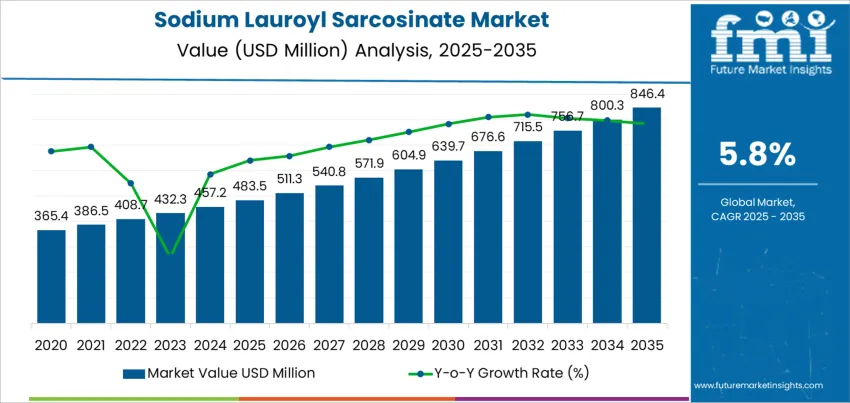
The sodium lauroyl sarcosinate market is valued at USD 483.5 million in 2025 and is expected to reach USD 846.4 million by 2035, growing at a CAGR of 5.8%. Early growth in the sodium lauroyl sarcosinate market comes from its use in sulfate-free shampoos, face washes, and oral care products. It is preferred because it is gentle on skin, creates rich foam, and works well in everyday personal care formulas. From now through 2030, the sodium lauroyl sarcosinate market expands steadily as brands increase its usage in hair care, men grooming, and baby hygiene products. Long-term supply contracts remain common because formulators want ingredient stability. Supply continuity in the sodium lauroyl sarcosinate market depends on fatty-acid availability and sarcosine intermediates.
After 2030, growth in the sodium lauroyl sarcosinate market comes mainly from higher usage levels inside each formulation, not from many new applications. Value increases from about USD 639.7 million in 2030 to USD 846.4 million by 2035 as high-purity grades gain more space in premium facial cleansers, micellar products, and sensitive-skin lines. The sodium lauroyl sarcosinate market continues to benefit from oral care demand in toothpaste and mouthwash, where low irritation and stable foam are important. Industrial use remains limited to a few specialty cleaners. Producers in the sodium lauroyl sarcosinate market work on higher production yields, better odor control, and low residual content to meet stricter cosmetic standards. Distribution in the sodium lauroyl sarcosinate market mainly involves direct supply to large personal care brands, supported by specialty distributors that serve regional manufacturers with regular reorder cycles.
Quick Stats of the Sodium Lauroyl Sarcosinate Market
- Sodium Lauroyl Sarcosinate Market Value (2025): USD 483.5 million
- Sodium Lauroyl Sarcosinate Market Forecast Value (2035): USD 846.4 million
- Sodium Lauroyl Sarcosinate Market Forecast CAGR (2025–2035): 5.8%
- Leading Product Form in Sodium Lauroyl Sarcosinate Market: Powder (14.8%)
- Key Growth Regions in Sodium Lauroyl Sarcosinate Market: Asia Pacific, Europe
- Top Players in Sodium Lauroyl Sarcosinate Market: BASF SE, Croda International, Evonik Industries, Symrise (incl. IFF/Givaudan actives), Dow / Dow Inc., Ashland, Clariant, Seppic / Others
What is the Growth Forecast for the Sodium Lauroyl Sarcosinate Market through 2035?
The global sodium lauroyl sarcosinate market expands from USD 483.5 million in 2025 to USD 604.9 million by 2030, recording an absolute increase of USD 121.4 million in the first half of the forecast period. This phase is shaped by its growing role as a mild, high-foaming anionic surfactant in premium facial cleansers, sulfate-free shampoos, oral care formulations, and dermatology-linked wash systems. Demand strength comes from its ability to deliver effective cleansing at lower irritation thresholds, which positions it as a preferred substitute for harsher sulfates in sensitive-skin and daily-use products. Brand-wide reformulation cycles across mass-premium personal care accelerate baseline demand, while toothpaste and facial wash segments add stable, high-frequency consumption volume.
From 2030 to 2035, the market advances from USD 604.9 million to USD 846.4 million, adding a larger USD 241.5 million in the second half of the decade. This back-weighted expansion reflects broader adoption across solid cleansing bars, refill-based liquid formats, and professional-grade haircare where foam profile, rinse feel, and conditioning compatibility raise formulation loading levels. Demand also strengthens in institutional hygiene and medical cleansing products where skin tolerance is critical. As downstream manufacturers increasingly standardize sarcosinate systems across multi-product platforms, sodium lauroyl sarcosinate shifts from a specialty mild surfactant into a structurally embedded cleansing base, materially lifting global market value through 2035.
Sodium Lauroyl Sarcosinate Industry Key Takeaways
| Metric | Value |
|---|---|
| Industry Value (2025) | USD 483.5 million |
| Forecast Value (2035) | USD 846.4 million |
| Forecast CAGR (2025–2035) | 5.8% |
How Is the Sodium Lauroyl Sarcosinate Market Developing Across Personal Care and Mild Cleansing Applications?
The sodium lauroyl sarcosinate market developed as product makers looked for surfactants that clean well while staying gentle on skin. Sodium lauroyl sarcosinate is made from a fatty acid and an amino acid, which gives it a different performance profile than traditional sulfate surfactants. The sodium lauroyl sarcosinate market first grew in facial cleansers, toothpaste, acne care, and sensitive-skin products, where strong foam, oil removal, and skin comfort all needed to work together. Its ability to perform well at lower usage levels and leave a soft after-feel made it suitable for premium skincare and dermatology-positioned formulas. As sulfate-free products became more common in mass retail, the sodium lauroyl sarcosinate market also expanded into shampoos, micellar waters, and body washes.
Future growth in the sodium lauroyl sarcosinate market will be driven by continued need for mild but effective cleansing, cleaner-label claims, and new reformulations in oral care and facial care. The sodium lauroyl sarcosinate market is expected to expand through sulfate-free shampoos, men grooming, and combined oil-control plus gentle-cleansing treatments. Challenges for the sodium lauroyl sarcosinate market include price pressure in budget personal care products, dependence on specific fatty-acid ingredients, and competition from other gentle surfactants such as amino acid types and alkyl glucosides. In very high oil-removal products, usage can be limited due to performance needs. Long-term growth for the sodium lauroyl sarcosinate market will rely on maintaining a clear balance between skin comfort, formulation flexibility, and cost across global beauty and hygiene applications.
How Are End Use Application and Product Form Structuring the Demand for Sodium Lauroyl Sarcosinate?
The demand for sodium lauroyl sarcosinate is structured by end use application and product form. Skin care accounts for 9.7% of total demand, followed by body care, hair care, sun care, color cosmetics, men grooming, baby and kids care, and dermocosmetic and professional care. By product form, powder represents 14.8% of total consumption, followed by granules and agglomerates, flakes, pellets and prills, liquid solutions, high active concentrates, dispersions and suspensions, emulsions, pastes, gels, wax or solid block formats, and oils. Demand is shaped by sulfate-free cleansing trends, mild anionic surfactant requirements, foam texture control, and compatibility with dermatology-tested formulations.
Why Does Skin Care Lead the Sodium Lauroyl Sarcosinate End Use Demand?
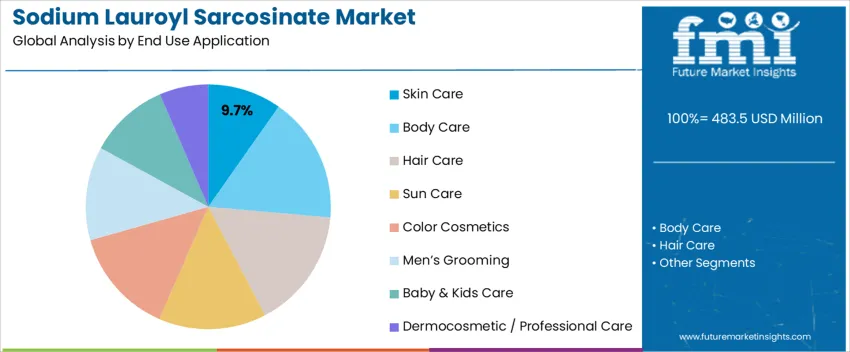
Skin care accounts for 9.7% of total sodium lauroyl sarcosinate demand due to its role as a mild anionic surfactant that combines effective cleansing with low irritation potential. It is widely used in facial cleansers, acne-control washes, exfoliating gels, and daily-use foam cleansers where removal of sebum, sunscreen residues, and airborne debris is required without aggressive lipid stripping. Its ability to generate fine, stable foam at low surfactant concentrations supports gentle sensory performance suited for sensitive and blemish-prone skin.
Skin care formulations also rely on sodium lauroyl sarcosinate for its compatibility with salicylic acid, niacinamide, zinc derivatives, and botanical extracts used in corrective regimens. It performs consistently across low pH systems without foam collapse. The ingredient demonstrates favorable eye tolerance, which enables its use in makeup removers and periocular cleansing products. These cleansing efficiency, formulation stability, and dermal tolerance characteristics sustain skin care as the leading end use segment.
Why Does Powder Lead the Sodium Lauroyl Sarcosinate Product Form Demand?
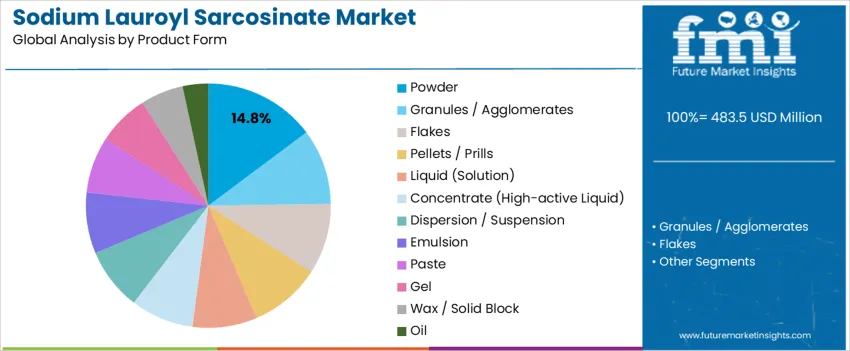
Powder accounts for 14.8% of total sodium lauroyl sarcosinate demand due to its suitability for both liquid dilution systems and solid cleanser manufacturing. Powdered form supports efficient incorporation into syndet bars, pressed facial cleansers, and compact cleansing tablets that require precise surfactant loading and uniform dispersion under compression. Its low moisture content improves thermal stability during processing and reduces the risk of surfactant decomposition under elevated temperatures used in bar extrusion.
Powder form also allows tight control over active concentration during large batch compounding for liquid cleansers and shampoos. Storage stability remains higher than pre-diluted liquid systems due to lower hydrolysis exposure. Free-flowing handling supports automated feeding systems in continuous production lines. The powder format also supports transport efficiency and long shelf life in bulk packaging. These processing, stability, and logistics advantages position powder as the dominant product form.
Why Is Sodium Lauroyl Sarcosinate Used When Cleansers Must Rinse Clean Without Stripping Oil Memory?
Sodium lauroyl sarcosinate is selected when formulators want soil and sebum removal without fully erasing the skin surface lipid memory. It lifts oil and particulate matter efficiently yet leaves behind a soft, lubricated after-feel that avoids the squeaky finish linked to sulfates. This makes it useful in facial cleansers, micellar washes, and acne routines where over-cleansing triggers rebound oil. Its amino-acid-based structure interacts differently with stratum corneum lipids, preserving slip even after rinse-off. Demand grows where balance between purification and surface comfort defines cleanser performance.
How Does Its Amino-Acid Linkage Change Foam Behavior Compared with Sugar and Sulfate Systems?
The sarcosinate linkage creates foam that appears quickly but collapses faster than sulfate foam, which changes user perception of cleansing power. Instead of explosive bubbles, it forms fine, dense foam that spreads evenly under low mechanical force. This improves contact efficiency with less friction. Compared with glucosides, it delivers stronger grease cutting without heavy residue. The foam behavior also remains stable across a wide pH range, which supports use in exfoliating acids, medicated washes, and hybrid treatment cleansers. Demand is tied to how controllable its foam dynamics are inside active-heavy formulations.
What Mildness Versus Makeup Removal Limits Prevent It from Acting Alone in Cleansing Oils and Balms?
Sodium lauroyl sarcosinate struggles with heavy wax, long-wear makeup, and water-resistant sunscreen removal when used as the sole surfactant. Its molecular structure favors emulsifying lighter oils rather than breaking dense hydrophobic films. In oil-to-milk cleansers and balm systems, it often requires support from polyglyceryl esters or stronger anionics to complete detachment. Used alone, it may leave pigment smears or occlusive residue. These performance limits keep it positioned as a supporting high-mildness surfactant rather than a universal removal engine in intensive cleansing categories.
Where Is Demand Expanding as Skin Sensitivity, Shaving, And Oral Care Overlap with Hygiene?
Sodium lauroyl sarcosinate is seeing strong adoption in categories where cleansing intersects with irritation risk. Shaving gels and beard washes use it to reduce razor drag and post-shave tightness. Oral care applies it for controlled foaming without aggressive mucosal disruption. Scalp therapy and anti-dandruff systems favor it to limit barrier damage during frequent washing. These uses involve repeated contact with inflamed or highly sensitive tissue. Demand is shifting away from cosmetic wash basics toward tolerance-critical hygiene systems where biological response matters more than raw detergency.
What Is the Global Growth Outlook for the Sodium Lauroyl Sarcosinate Industry by Country?
| Country | CAGR (%) |
|---|---|
| India | 7.8 |
| China | 7.2 |
| Japan | 6.6 |
| UK | 6.0 |
| Germany | 5.5 |
| USA | 4.9 |
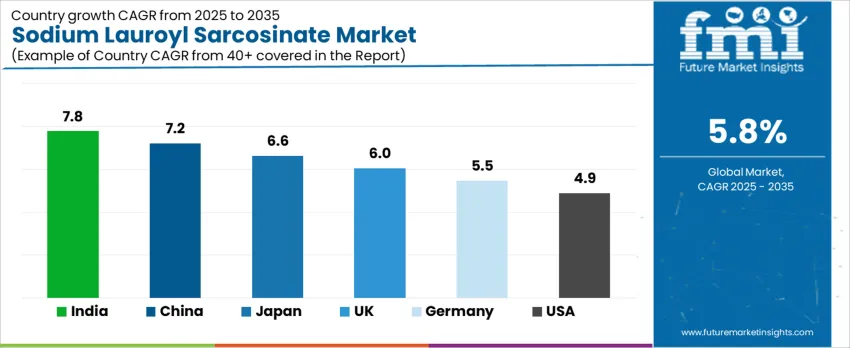
The sodium lauroyl sarcosinate industry is expanding steadily across global personal care and hygiene formulation markets, with India at a 7.8% CAGR. Growth in India is supported by rising demand for mild, sulfate-free surfactants in facial cleansers, shampoos, oral care, and baby care products, along with increasing domestic formulation activity. China follows at 7.2%, driven by large-scale personal care manufacturing, export-oriented production, and strong adoption in premium cleansing formulations. Japan at 6.6% reflects stable use in sensitive skin products and dermatology focused cleansers. The UK and Germany record 6.0% and 5.5% growth, supported by clean label trends and preference for gentle surfactant systems. The USA at 4.9% reflects a mature but steadily advancing market driven by natural and specialty personal care brands.
What Is Expanding the Use of Sodium Lauroyl Sarcosinate in India Cleansing Formulations?
Growth in India is advancing at a CAGR of 7.8% through 2035 for sodium lauroyl sarcosinate demand, driven by rising production of sulfate-free shampoos, facial cleansers, and medicated hygiene products. Personal care brands apply this surfactant for its mild foaming profile and low irritation performance in daily wash formulations. Dermatology grade acne washes and anti dandruff shampoos sustain additional volume. Imports dominate consistent cosmetic grade supply due to limited domestic sarcosinate processing. Demand remains formulation driven and retail aligned, shaped by steady premium shampoo growth, expanding facial cleanser usage, and strong online hygiene product sales.
- Sulfate free shampoos anchor primary formulation demand
- Acne and medicated cleansers support regulated usage
- Mild foaming profile sustains sensitive skin applications
- Import based sourcing dominates cosmetic grade supply
How Is China Scaling High Volume Production of Sarcosinate Based Cleansers?
Expansion in China reflects a CAGR of 7.2% through 2035 for sodium lauroyl sarcosinate utilization, supported by mass production of clean label haircare, facial washes, and private label hygiene products. This surfactant appears in foam cleansers, family shampoos, and body washes targeting daily use segments. Domestic surfactant plants ensure stable high volume supply and cost efficiency. Export oriented personal care manufacturers also sustain steady offtake. Demand remains production driven and volume oriented, aligned with hygiene product consumption growth and continued movement away from harsher sulfate surfactant systems.
- Family shampoos sustain bulk surfactant consumption
- Foam facial cleansers support daily use applications
- Domestic surfactant production stabilizes batch supply
- Export focused brands strengthen continuous demand
Why Does Japan Maintain Consistent Demand for Sarcosinate in Dermatology Aligned Products?
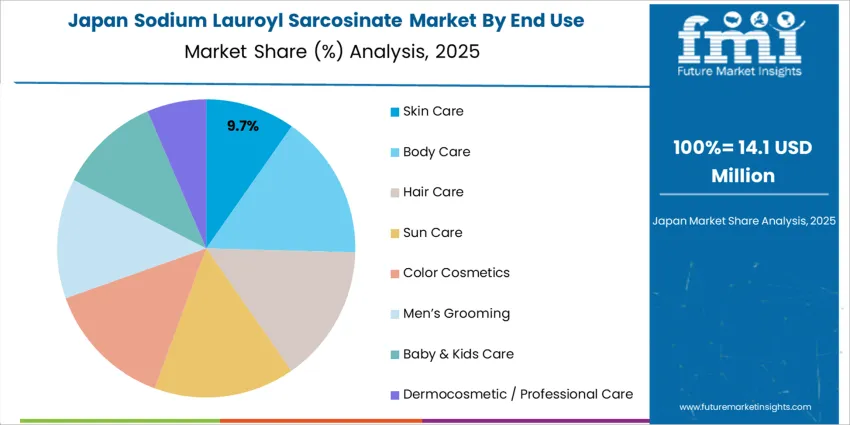
Use in Japan is increasing at a CAGR of 6.6% through 2035 for sodium lauroyl sarcosinate demand, supported by premium facial cleansers, post treatment hygiene products, and low irritation skincare formulations. Sarcosinate surfactants are applied in foam washes, sensitive scalp shampoos, and fragrance free body cleansers. Domestic formulators emphasize skin compatibility and residue control. Pharmacy distributed personal care brands support steady daily usage. Demand stays quality driven and skin safety focused, supported by aging population skincare needs, steady dermatology product refinement, and preference for gentle foaming systems.
- Sensitive scalp shampoos anchor regulated consumption
- Foam face washes support premium daily usage
- Domestic formulation stabilizes skin safety performance
- Pharmacy distribution sustains consistent retail turnover
What Is Supporting Sodium Lauroyl Sarcosinate Market Expansion in the United Kingdom?
Growth in the UK is advancing at a CAGR of 6.0% through 2035 for sodium lauroyl sarcosinate demand, supported by clean beauty products, sulfate free haircare adoption, and expanding facial cleanser ranges. This surfactant appears in micellar cleansers, gentle body washes, baby shampoos, and sensitive skin products. Independent clean beauty brands and contract formulators drive steady product introductions. Imports dominate ingredient sourcing due to limited domestic sarcosinate capacity. Demand remains retail driven and ingredient focused, shaped by ethical beauty preferences, steady family hygiene demand, and strong online personal care distribution.
- Micellar cleansers drive facial hygiene demand
- Baby shampoos support mild surfactant consumption
- Contract formulation activity sustains product diversity
- Imported sourcing dominates national supply structure
How Is Germany Applying Sodium Lauroyl Sarcosinate in Regulated Hygiene Products?
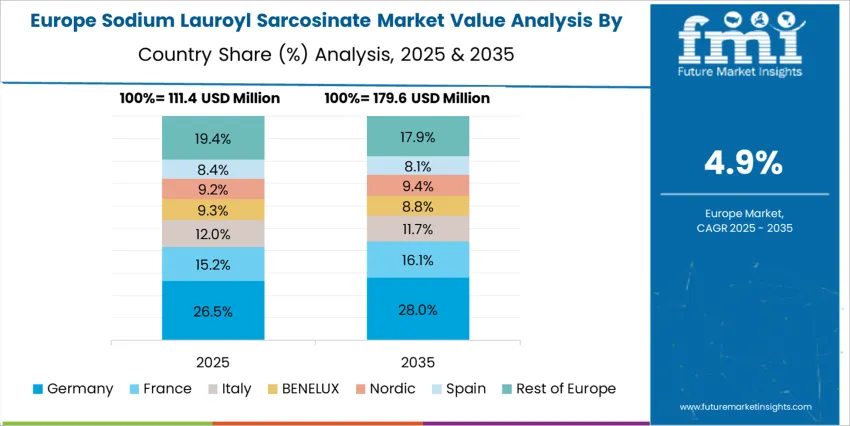
Adoption in Germany is rising at a CAGR of 5.5% through 2035 for sodium lauroyl sarcosinate consumption, driven by pharmacy grade cleansers, certified natural cosmetics, and sensitive skin hygiene products. Sarcosinate surfactants are used in eczema friendly body washes, fragrance free shampoos, and medical grade foam cleansers. Strict ingredient testing, documentation, and eco certification standards govern formulation and supplier approval. Imports remain the main supply route for cosmetic consistency. Demand stays quality focused and regulation aligned, supported by preventive dermatology practices and steady growth of certified natural personal care retail.
- Dermatology cleansers anchor regulated product usage
- Certified natural cosmetics support eco compliant demand
- Testing standards shape ingredient qualification
- Pharmacy retail stabilizes long term sales consistency
What Is Driving Measured Sodium Lauroyl Sarcosinate Growth in the United States?
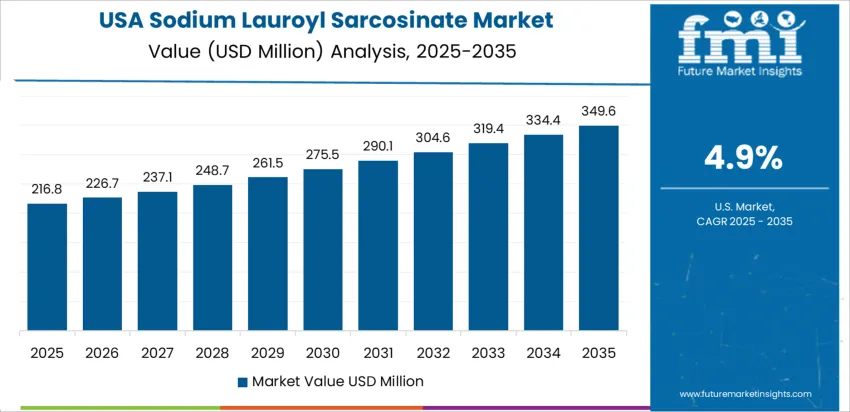
Expansion in the United States is progressing at a CAGR of 4.9% through 2035 for sodium lauroyl sarcosinate demand, supported by sulfate free shampoo development, clean beauty brand expansion, and rising use in acne and sensitive skin cleansers. This surfactant appears in face washes, scalp cleansers, intimate hygiene products, and gentle hand soaps. Mass retail and dermatology aligned brands both contribute to volume usage. Imports supply most cosmetic grade material. Demand remains application driven and formulation diverse, shaped by steady personal care sales and consistent sulfate replacement trends.
- Acne and sensitive skin cleansers drive specialty demand
- Sulfate free shampoos sustain steady volume growth
- Dermatology brands support regulated consumer trust
- Import dependence dominates cosmetic grade sourcing
What Is Driving the Global Demand for Sodium Lauroyl Sarcosinate and Who Are the Key Suppliers Shaping the Market
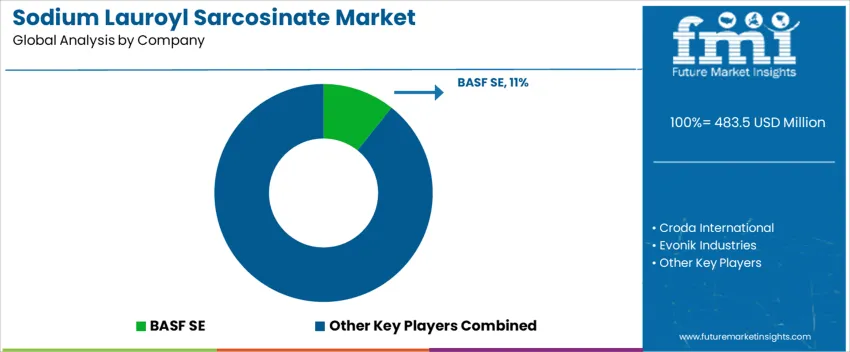
Demand for sodium lauroyl sarcosinate is growing as personal care manufacturers seek surfactants that combine mildness, gentle cleansing, and compatibility with sensitive skin. This ingredient supports sulfate free, soap free shampoos, facial cleansers, and body washes, aligning with consumer preferences for gentle, “clean label” formulations. Rising awareness of skin irritation, demand for natural feel products, and regulatory pressure on harsh surfactants drive its adoption. The growth of skincare, baby care, and sensitive skin segments further supports use of sodium lauroyl sarcosinate. Its compatibility with a variety of formulation types-from foaming cleansers to milder wash products makes it a versatile surfactant for both premium and everyday personal care lines.
Major suppliers active in the global sodium lauroyl sarcosinate market include BASF SE, Croda International, Evonik Industries, Symrise (including IFF/Givaudan actives), Dow Inc., Ashland, Clariant, and specialist ingredient firms such as Seppic, Lubrizol, Lonza, and Inolex. Large manufacturers supply bulk volume surfactant with quality standards suitable for large personal care brands and global distribution. Mid tier and niche suppliers provide specialty grades, eco certified or formulation optimized variants aimed at premium, natural, or sensitive skin focused products. This multi layered supply base ensures flexibility, regulatory compliance, and wide availability enabling sodium lauroyl sarcosinate to meet demand across various geographies and product segments.
Key Players in the Sodium Lauroyl Sarcosinate Market
- BASF SE
- Croda International
- Evonik Industries
- Symrise (incl. IFF/Givaudan actives)
- Dow / Dow Inc.
- Ashland
- Clariant
- Seppic
- Others
Scope of the report
| Items | Values |
|---|---|
| Quantitative Units (2025) | USD million |
| End-Use Applications | Skin Care, Body Care, Hair Care, Sun Care, Color Cosmetics, Men’s Grooming, Baby & Kids Care, Dermocosmetic / Professional Care |
| Product Forms | Powder, Granules/Agglomerates, Flakes, Pellets/Prills, Liquid (Solution), Concentrate (High-active Liquid), Dispersion/Suspension, Emulsion, Paste, Gel, Wax / Solid Block, Oil |
| Regions Covered | Asia Pacific, Europe, North America, Latin America, Middle East & Africa |
| Countries Covered | China, Japan, South Korea, India, Australia & New Zealand, ASEAN, Germany, United Kingdom, France, Italy, Spain, Nordic, BENELUX, USA, Canada, Mexico, Brazil, Chile, Saudi Arabia, Turkey, South Africa, plus 40+ additional countries globally |
| Key Companies Profiled | BASF SE, Croda International, Evonik Industries, Symrise (incl. IFF/Givaudan actives), Dow Inc., Ashland, Clariant, Seppic, Lubrizol, Lonza, Inolex |
| Additional Attributes | Dollar by sales breakdown by region, country, end-use, and product form; global growth projections; multi-sector adoption (cosmetic, nutraceutical, functional food); extract bioactivity profiling; iodine and polyphenol standardization; contract harvesting; vertical integration; supply chain stability; regulatory compliance; sensory and bioavailability performance |
Sodium Lauroyl Sarcosinate Market Segmentation
End Use Application:
- Skin Care
- Body Care
- Hair Care
- Sun Care
- Color Cosmetics
- Men’s Grooming
- Baby & Kids Care
- Dermocosmetic / Professional Care
Product Form:
- Powder
- Granules / Agglomerates
- Flakes
- Pellets / Prills
- Liquid (Solution)
- Concentrate (High-active Liquid)
- Dispersion / Suspension
- Emulsion
- Paste
- Gel
- Wax / Solid Block
- Oil
Region
- Asia Pacific
- China
- Japan
- South Korea
- India
- Australia & New Zealand
- ASEAN
- Rest of Asia Pacific
- Europe
- Germany
- United Kingdom
- France
- Italy
- Spain
- Nordic
- BENELUX
- Rest of Europe
- North America
- United States
- Canada
- Mexico
- Latin America
- Brazil
- Chile
- Rest of Latin America
- Middle East & Africa
- Kingdom of Saudi Arabia
- Other GCC Countries
- Turkey
- South Africa
- Other African Union
- Rest of Middle East & Africa
Frequently Asked Questions
How big is the sodium lauroyl sarcosinate market in 2025?
The global sodium lauroyl sarcosinate market is estimated to be valued at USD 483.5 million in 2025.
What will be the size of sodium lauroyl sarcosinate market in 2035?
The market size for the sodium lauroyl sarcosinate market is projected to reach USD 846.4 million by 2035.
How much will be the sodium lauroyl sarcosinate market growth between 2025 and 2035?
The sodium lauroyl sarcosinate market is expected to grow at a 5.8% CAGR between 2025 and 2035.
What are the key product types in the sodium lauroyl sarcosinate market?
The key product types in sodium lauroyl sarcosinate market are skin care, body care, hair care, sun care, color cosmetics, men’s grooming, baby & kids care and dermocosmetic / professional care.
Which product form segment to contribute significant share in the sodium lauroyl sarcosinate market in 2025?
In terms of product form , powder segment to command 14.8% share in the sodium lauroyl sarcosinate market in 2025.
Preview the report firsthand - request a free sample
Get SampleGet the brochure for pricing and purchase details.
Get PDFTable of Content
- Executive Summary
- Global Market Outlook
- Demand-side Trends
- Supply-side Trends
- Technology Roadmap Analysis
- Analysis and Recommendations
- Market Overview
- Market Coverage / Taxonomy
- Market Definition / Scope / Limitations
- Market Background
- Market Dynamics
- Drivers
- Restraints
- Opportunity
- Trends
- Scenario Forecast
- Demand in Optimistic Scenario
- Demand in Likely Scenario
- Demand in Conservative Scenario
- Opportunity Map Analysis
- Product Life Cycle Analysis
- Supply Chain Analysis
- Investment Feasibility Matrix
- Value Chain Analysis
- PESTLE and Porter’s Analysis
- Regulatory Landscape
- Regional Parent Market Outlook
- Production and Consumption Statistics
- Import and Export Statistics
- Market Dynamics
- Global Market Analysis 2020 to 2024 and Forecast, 2025 to 2035
- Historical Market Size Value (USD Million) Analysis, 2020 to 2024
- Current and Future Market Size Value (USD Million) Projections, 2025 to 2035
- Y-o-Y Growth Trend Analysis
- Absolute $ Opportunity Analysis
- Global Market Pricing Analysis 2020 to 2024 and Forecast 2025 to 2035
- Global Market Analysis 2020 to 2024 and Forecast 2025 to 2035, By End Use Application
- Introduction / Key Findings
- Historical Market Size Value (USD Million) Analysis By End Use Application , 2020 to 2024
- Current and Future Market Size Value (USD Million) Analysis and Forecast By End Use Application , 2025 to 2035
- Skin Care
- Body Care
- Hair Care
- Sun Care
- Color Cosmetics
- Men’s Grooming
- Baby & Kids Care
- Dermocosmetic / Professional Care
- Y-o-Y Growth Trend Analysis By End Use Application , 2020 to 2024
- Absolute $ Opportunity Analysis By End Use Application , 2025 to 2035
- Global Market Analysis 2020 to 2024 and Forecast 2025 to 2035, By Product Form
- Introduction / Key Findings
- Historical Market Size Value (USD Million) Analysis By Product Form, 2020 to 2024
- Current and Future Market Size Value (USD Million) Analysis and Forecast By Product Form, 2025 to 2035
- Powder
- Granules / Agglomerates
- Flakes
- Pellets / Prills
- Liquid (Solution)
- Concentrate (High-active Liquid)
- Dispersion / Suspension
- Emulsion
- Paste
- Gel
- Wax / Solid Block
- Y-o-Y Growth Trend Analysis By Product Form, 2020 to 2024
- Absolute $ Opportunity Analysis By Product Form, 2025 to 2035
- Global Market Analysis 2020 to 2024 and Forecast 2025 to 2035, By Region
- Introduction
- Historical Market Size Value (USD Million) Analysis By Region, 2020 to 2024
- Current Market Size Value (USD Million) Analysis and Forecast By Region, 2025 to 2035
- North America
- Latin America
- Western Europe
- Eastern Europe
- East Asia
- South Asia and Pacific
- Middle East & Africa
- Market Attractiveness Analysis By Region
- North America Market Analysis 2020 to 2024 and Forecast 2025 to 2035, By Country
- Historical Market Size Value (USD Million) Trend Analysis By Market Taxonomy, 2020 to 2024
- Market Size Value (USD Million) Forecast By Market Taxonomy, 2025 to 2035
- By Country
- USA
- Canada
- Mexico
- By End Use Application
- By Product Form
- By Country
- Market Attractiveness Analysis
- By Country
- By End Use Application
- By Product Form
- Key Takeaways
- Latin America Market Analysis 2020 to 2024 and Forecast 2025 to 2035, By Country
- Historical Market Size Value (USD Million) Trend Analysis By Market Taxonomy, 2020 to 2024
- Market Size Value (USD Million) Forecast By Market Taxonomy, 2025 to 2035
- By Country
- Brazil
- Chile
- Rest of Latin America
- By End Use Application
- By Product Form
- By Country
- Market Attractiveness Analysis
- By Country
- By End Use Application
- By Product Form
- Key Takeaways
- Western Europe Market Analysis 2020 to 2024 and Forecast 2025 to 2035, By Country
- Historical Market Size Value (USD Million) Trend Analysis By Market Taxonomy, 2020 to 2024
- Market Size Value (USD Million) Forecast By Market Taxonomy, 2025 to 2035
- By Country
- Germany
- UK
- Italy
- Spain
- France
- Nordic
- BENELUX
- Rest of Western Europe
- By End Use Application
- By Product Form
- By Country
- Market Attractiveness Analysis
- By Country
- By End Use Application
- By Product Form
- Key Takeaways
- Eastern Europe Market Analysis 2020 to 2024 and Forecast 2025 to 2035, By Country
- Historical Market Size Value (USD Million) Trend Analysis By Market Taxonomy, 2020 to 2024
- Market Size Value (USD Million) Forecast By Market Taxonomy, 2025 to 2035
- By Country
- Russia
- Poland
- Hungary
- Balkan & Baltic
- Rest of Eastern Europe
- By End Use Application
- By Product Form
- By Country
- Market Attractiveness Analysis
- By Country
- By End Use Application
- By Product Form
- Key Takeaways
- East Asia Market Analysis 2020 to 2024 and Forecast 2025 to 2035, By Country
- Historical Market Size Value (USD Million) Trend Analysis By Market Taxonomy, 2020 to 2024
- Market Size Value (USD Million) Forecast By Market Taxonomy, 2025 to 2035
- By Country
- China
- Japan
- South Korea
- By End Use Application
- By Product Form
- By Country
- Market Attractiveness Analysis
- By Country
- By End Use Application
- By Product Form
- Key Takeaways
- South Asia and Pacific Market Analysis 2020 to 2024 and Forecast 2025 to 2035, By Country
- Historical Market Size Value (USD Million) Trend Analysis By Market Taxonomy, 2020 to 2024
- Market Size Value (USD Million) Forecast By Market Taxonomy, 2025 to 2035
- By Country
- India
- ASEAN
- Australia & New Zealand
- Rest of South Asia and Pacific
- By End Use Application
- By Product Form
- By Country
- Market Attractiveness Analysis
- By Country
- By End Use Application
- By Product Form
- Key Takeaways
- Middle East & Africa Market Analysis 2020 to 2024 and Forecast 2025 to 2035, By Country
- Historical Market Size Value (USD Million) Trend Analysis By Market Taxonomy, 2020 to 2024
- Market Size Value (USD Million) Forecast By Market Taxonomy, 2025 to 2035
- By Country
- Kingdom of Saudi Arabia
- Other GCC Countries
- Turkiye
- South Africa
- Other African Union
- Rest of Middle East & Africa
- By End Use Application
- By Product Form
- By Country
- Market Attractiveness Analysis
- By Country
- By End Use Application
- By Product Form
- Key Takeaways
- Key Countries Market Analysis
- USA
- Pricing Analysis
- Market Share Analysis, 2024
- By End Use Application
- By Product Form
- Canada
- Pricing Analysis
- Market Share Analysis, 2024
- By End Use Application
- By Product Form
- Mexico
- Pricing Analysis
- Market Share Analysis, 2024
- By End Use Application
- By Product Form
- Brazil
- Pricing Analysis
- Market Share Analysis, 2024
- By End Use Application
- By Product Form
- Chile
- Pricing Analysis
- Market Share Analysis, 2024
- By End Use Application
- By Product Form
- Germany
- Pricing Analysis
- Market Share Analysis, 2024
- By End Use Application
- By Product Form
- UK
- Pricing Analysis
- Market Share Analysis, 2024
- By End Use Application
- By Product Form
- Italy
- Pricing Analysis
- Market Share Analysis, 2024
- By End Use Application
- By Product Form
- Spain
- Pricing Analysis
- Market Share Analysis, 2024
- By End Use Application
- By Product Form
- France
- Pricing Analysis
- Market Share Analysis, 2024
- By End Use Application
- By Product Form
- India
- Pricing Analysis
- Market Share Analysis, 2024
- By End Use Application
- By Product Form
- ASEAN
- Pricing Analysis
- Market Share Analysis, 2024
- By End Use Application
- By Product Form
- Australia & New Zealand
- Pricing Analysis
- Market Share Analysis, 2024
- By End Use Application
- By Product Form
- China
- Pricing Analysis
- Market Share Analysis, 2024
- By End Use Application
- By Product Form
- Japan
- Pricing Analysis
- Market Share Analysis, 2024
- By End Use Application
- By Product Form
- South Korea
- Pricing Analysis
- Market Share Analysis, 2024
- By End Use Application
- By Product Form
- Russia
- Pricing Analysis
- Market Share Analysis, 2024
- By End Use Application
- By Product Form
- Poland
- Pricing Analysis
- Market Share Analysis, 2024
- By End Use Application
- By Product Form
- Hungary
- Pricing Analysis
- Market Share Analysis, 2024
- By End Use Application
- By Product Form
- Kingdom of Saudi Arabia
- Pricing Analysis
- Market Share Analysis, 2024
- By End Use Application
- By Product Form
- Turkiye
- Pricing Analysis
- Market Share Analysis, 2024
- By End Use Application
- By Product Form
- South Africa
- Pricing Analysis
- Market Share Analysis, 2024
- By End Use Application
- By Product Form
- USA
- Market Structure Analysis
- Competition Dashboard
- Competition Benchmarking
- Market Share Analysis of Top Players
- By Regional
- By End Use Application
- By Product Form
- Competition Analysis
- Competition Deep Dive
- BASF SE
- Overview
- Product Portfolio
- Profitability by Market Segments (Product/Age /Sales Channel/Region)
- Sales Footprint
- Strategy Overview
- Marketing Strategy
- Product Strategy
- Channel Strategy
- Croda International
- Evonik Industries
- Symrise (incl. IFF/Givaudan actives)
- Dow / Dow Inc.
- Ashland
- Clariant
- Seppic
- Others
- BASF SE
- Competition Deep Dive
- Assumptions & Acronyms Used
- Research Methodology


