

- Market Size (2026)
- USD 384.4 Mn
- Forecast (2036)
- USD 1014.6 Mn
- CAGR (2026 to 2036)
- 10.2%
How big is Sprouted Flour Market in 2026?
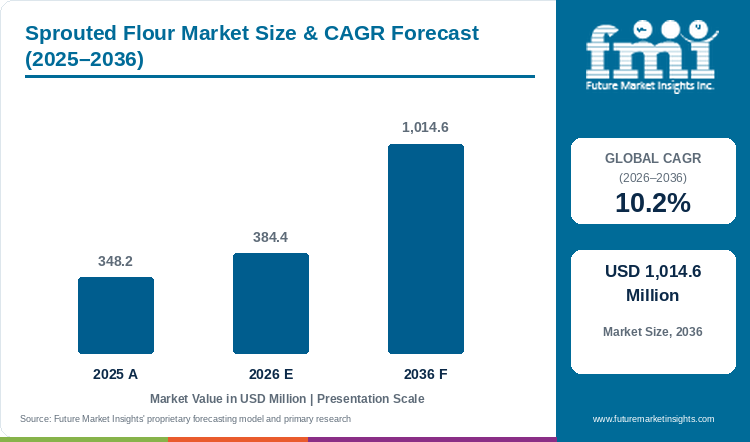
Tracking from USD 348.2 million in 2025 to USD 384.4 million in 2026, the global sprouted flour market valuation is projected to hit USD 1,014.6 million by 2036, backed by a 10.2% CAGR.
Commercial bakeries and snack manufacturers are replacing conventional wholemeal flour with sprouted grain flour because endogenous germination enzymes convert starch into natural maltose and remove bran bitterness without added cane sugar. As proof of this functional sweetness, an October 2025 Food Chemistry study by Tolgahan Kocadağlı and Vural Gökmen at Hacettepe University showed that baking biscuits and crackers with 48-hour sprouted wheat wholemeal raises sweet roasted aroma aldehydes 6-to-23-fold while keeping cracker acrylamide levels unchanged [1]. Owing to this clean-label reformulation shift across packaged bread and snack aisles, global sprouted flour industry valuation advances beyond its 2025 baseline of USD 348.2 million to an estimated USD 384.4 million in 2026 and a projected USD 1,014.6 million by 2036, expanding at a 10.2% CAGR and adding USD 630.2 million in market value. Within this demand expansion, Sprouted Wheat is expected to hold a 44.6% share in 2026 because plant bakers blend germinated wheat directly into whole-wheat bakery flour blends, whereas strict thermal kill-step validation costs still restrain smaller mills from supplying ready-to-eat snack accounts.
Key Market Trends & Insights
- By grain source: Sprouted Wheat is expected to capture 44.6% of the grain source segment in 2026 because intact glutenin networks support reliable gas retention in commercial loaf recipes.
- By milling & stabilization grade: Enzyme-Stabilized Roller-Milled Flour is projected to account for 48.2% of the grade category in 2026 by holding Falling Number specifications within narrow thermal-kilning windows.
- By application: Artisan & Pan Breads & Rolls are estimated to secure 41.8% of the application segment in 2026 because plant bakeries use sprouted grist to soften whole-grain sandwich loaves.
- By certification & claim: Certified Organic is anticipated to command 53.4% of the certification & claim category in 2026 owing to natural-channel demand for residue-free grain lots in warm steeping vats.
- By sales channel: Direct B2B Industrial Bakery Contracts are forecast to generate 49.3% of the sales channel segment in 2026 through multi-plant bulk tote and pneumatic tanker supply agreements.
Regional Highlights
- North America milling leadership: The USA leads country-level expansion at 11.4% annually through 2036, driven by dedicated thermal-stabilization mills and nationwide sprouted sandwich-bread distribution.
- European and Asian bakery progression: Germany follows at 10.8% yearly growth ahead of the UK at 10.4% and South Korea at 9.9%, whereas Saudi Arabia posts an 8.2% annual rate.
Market Size & Forecast
Table 1: Market Size and Forecast for the Sprouted Flour Market (USD million and CAGR percentage), 2025 to 2036
| Metric | Value |
|---|---|
| 2025 Market Size | USD 348.2 million |
| Estimated Market Size in 2026 | USD 384.4 million |
| Projected Market Size by 2036 | USD 1,014.6 million |
| CAGR, 2026 to 2036 | 10.2% |
| Added Revenue, 2026 to 2036 | USD 630.2 million |
Industrial bread plants hesitate to adopt raw germinated grain when unchecked alpha-amylase activity liquefies starch gels and creates sticky dough on high-speed dividers. Because of this line-machining risk, specialty millers pair controlled steam-kilning with industrial food enzymes calibration so commercial bakeries can run sprouted flour at full tunnel-oven speeds without loaf collapse. For example, in August 2025 cereal technologist Darigash Shaimerdenova and co-authors reported in PLOS ONE that germinating wheat for 24 hours at an 8.2% flour blend ratio with 29.8% gluten content holds the Falling Number at 180.4 seconds and raises water absorption to 54.9%, which directly supports higher baked loaf yields per ton of flour [2].
Germination Steep-Kiln Throughput & Milling Sizing
Table 2: Germination Steep-Kiln Throughput and Milling Sizing for the Sprouted Flour Market (USD million and operational ranges), 2025 to 2036
| Metric | 2025 | 2026 | 2036 |
|---|---|---|---|
| Market size (USD million) | 348.2 | 384.4 | 1,014.6 |
| Commercial sprouted flour milled (thousand metric tons) | 138.0 to 154.0 | 151.0 to 168.0 | 375.0 to 418.0 |
| Average B2B contract price per metric ton (USD) | 2,240 to 2,510 | 2,280 to 2,560 | 2,420 to 2,710 |
| Target Falling Number stabilization window (seconds) | 180 to 240 | 185 to 245 | 200 to 260 |
Operational note: Milled tonnage ranges reconcile dedicated North America and European sprouted-grain steeping capacity against 8% to 12% germination respiration and drying weight loss prior to roller or stone milling.
Contract pricing averages between USD 2,280 and USD 2,560 per metric ton in 2026 because millers must absorb an 8% to 12% dry-matter respiration loss during 18-to-36-hour steeping along with thermal kilning fuel costs. Even with this unit price premium over un-sprouted wheat flour, manufacturers of commercial bakery products expand their annual tonnage orders because sprouted flour eliminates separate malt-syrup and dough-softener purchases.
Per Capita & Bakery Plant Procurement Sizing
Table 3: Per Capita and Bakery Plant Valuation Indicators for the Sprouted Flour Market (USD), 2025 to 2036
| Metric | 2025 | 2026 | 2036 |
|---|---|---|---|
| World population (billion) | 8.2 | 8.3 | 9.0 |
| Market value per 1,000 people (USD) | 42.5 | 46.3 | 112.7 |
| Annual sprouted flour procurement per qualified bakery plant (USD thousand) | 78.0 to 94.0 | 84.0 to 102.0 | 165.0 to 205.0 |
| Typical grist substitution rate in pan & hearth breads (%) | 15.0% to 35.0% | 18.0% to 38.0% | 25.0% to 50.0% |
Table 4: Bakery Plant & Organic Custody Indicators for the Sprouted Flour Market (USD and percentages), 2026
| Metric | Value | Institutional Reference Basis |
|---|---|---|
| Market size, 2026 | USD 384.4 million | 2026 global sprouted flour valuation baseline |
| Commercial industrial & artisan bakeries served | 4,100 facilities | Global B2B specialty bakery & snack plant base |
| Sprouted wheat flour share, 2026 | 44.6% (USD 171.4 million allocation) | 44.6% grain source segment allocation |
| Certified organic claim share, 2026 | 53.4% (USD 205.3 million allocation) | 53.4% certification & claim segment allocation |
Per-plant sprouted flour spending grows from USD 84.0-102.0 thousand in 2026 toward USD 165.0-205.0 thousand by 2036 because enzyme stabilization allows bakers to raise grist substitution rates from 18% up to 50% without weakening loaf sidewalls. In addition, snack processors are blending sprouted pulse and ancient-grain flours into extruded savory snack assortments so that front-of-pack protein digestibility and mineral claims justify higher retail shelf prices.
Analyst Perspective
"Converting bakery trial runs into multi-year sprouted flour supply contracts requires tight Falling Number control and validated kill-step pathogen reduction during kilning. Specialty millers that pair identity-preserved organic grain origination with enzyme-stabilized roller milling will capture recurring industrial bread and snack reformulation volume."
- Nandini Roy Choudhury, Principal Consultant, Future Market Insights.
How is the sprouted flour market segmented?
Five core dimensions structure the sprouted flour market: grain source and milling & stabilization grade along with application, certification & claim, and sales channel. Category leaders in 2026 include Sprouted Wheat (44.6%) and Enzyme-Stabilized Roller-Milled Flour (48.2%) as well as Artisan & Pan Breads & Rolls (41.8%), Certified Organic (53.4%), and Direct B2B Industrial Bakery Contracts at 49.3%.
By grain source: Sprouted Wheat, Sprouted Ancient & Hulled Grains, Sprouted Multigrain, Rye, Barley & Oat, and Sprouted Gluten-Free Pseudocereals & Pulses.
By milling & stabilization grade: Enzyme-Stabilized Roller-Milled Flour, Stone-Ground Whole-Grain Sprouted Flour, Diastatic Active Sprouted Malt Flour, and Micro-Milled Fine Pastry Grade.
By application: Artisan & Pan Breads & Rolls, Tortillas, Flatbreads & Pizza Crusts, Crackers, Pretzels & Extruded Snacks, Cakes, Muffins & Sweet Goods, and Fresh Pasta, Noodles & Batter Systems.
By certification & claim: Certified Organic, Non-GMO Project Verified & Identity-Preserved, and Conventional Clean-Label.
By sales channel: Direct B2B Industrial Bakery Contracts, Wholesale Bakery & Foodservice Distributors, Natural & Conventional Grocery Packaging, and Online B2B & Mill-Direct Portals.
Why does Sprouted Wheat lead the grain source category?
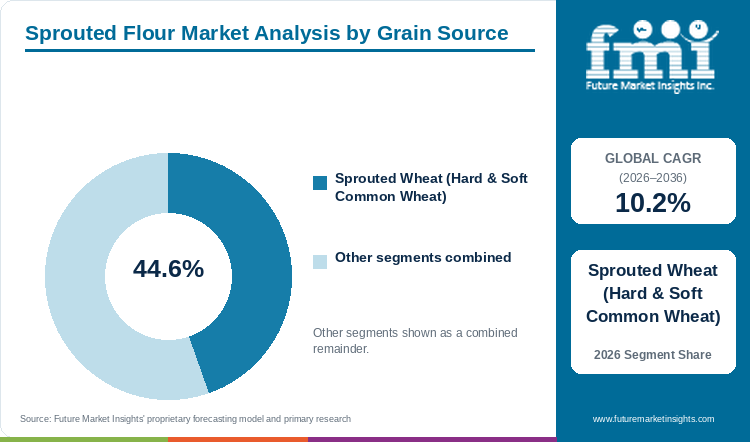
Sprouted Wheat is expected to represent 44.6% of the grain source segment in 2026 because hexaploid gluten elasticity preserves loaf volume during continuous mixing.
Table 5: Grain Source Share for the Sprouted Flour Market (percentage share), 2026
| Grain Source | Share (2026) |
|---|---|
| Sprouted Wheat | 44.6% |
| Other Segments Combined* | 55.4% |
| Total | 100.0% |
*Calculated as the balance remaining after deducting the leading segment's reported share from 100.0%.
Table 6: Grain Source Leadership and Market Growth for the Sprouted Flour Market (segment and CAGR percentage), 2026 to 2036
| Metric | Value |
|---|---|
| Global CAGR (2026 to 2036) | 10.2% |
| Leading Segment | Sprouted Wheat |
Commercial bread manufacturers prioritize sprouted hard red spring and hard white wheat over gluten-free sprouted grains because intact glutenin proteins eliminate the need for expensive xanthan gum or hydrocolloid binders. As a result, plant bakeries can substitute sprouted wheat directly into existing sponge-and-dough lines with industrial cereal flour mixes without slowing proof times. Meanwhile, sprouted ancient wheats such as spelt and Khorasan form the second-largest grain sub-segment as premium boulangeries seek single-grain heritage callouts.
- Sprouted Wheat is expected to hold 44.6% of the grain source category in 2026 by combining natural maltose sweetness with direct sponge-and-dough recipe compatibility.
- To secure upstream supply for this growing wheat and specialty grain segment, in July 2025 Ardent Mills entered an agreement to acquire Stone Mill in Richardton in North Dakota to add identity-preserved cleaning and microbial-reduction capacity for commercial bakery buyers [3].
Why does Enzyme-Stabilized Roller-Milled Flour lead milling & stabilization grade?
To prevent excess alpha-amylase dextrinization on automated slicing lines, industrial bakeries are projected to channel 48.2% of 2026 grade demand into the Enzyme-Stabilized Roller-Milled Flour segment.
High-speed plant bakeries reject unstabilized stone-ground sprouted flours when excess alpha-amylase and protease activity liquefies dough starch and gums up automated bread-slicing blades. Because of this costly line-downtime risk, commercial mills use precision steam-kilning and roller milling to lock the Falling Number between 185 and 245 seconds while keeping particle size below 180 microns. With this enzymatic control locked in, formulators combining sprouted grists with specialty baking ingredients concentrate their bulk orders in enzyme-stabilized roller grades that guarantee uniform water absorption across shifts.
- Because high-speed bread plants require predictable water absorption and clean slicer blades, the Enzyme-Stabilized Roller-Milled Flour segment is projected to secure 48.2% of 2026 grade volume.
- This commercial preference for controlled processing was reinforced in April 2025 when food scientist Giuseppe Perri and colleagues at the University of Bari Aldo Moro showed in Current Research in Food Science that tailored processing of sprouted wheat and barley flours boosts bioactive peptides by 450% to 520% while matching conventional dough rheology [4].
What keeps Artisan & Pan Breads & Rolls ahead by application?
Within the application category, Artisan & Pan Breads & Rolls are estimated to capture a 41.8% share in 2026 owing to high flour inclusion rates in everyday sandwich loaves.
Packaged sandwich loaves and hearth rolls drive the largest volume of sprouted flour consumption because flour makes up 60% to 65% of finished bread weight and shoppers repurchase packaged bread weekly. When enzymatic starch conversion during sprouting releases reducing sugars, industrial bakers achieve golden crust browning and softer crumb resilience while cutting added sucrose costs and pairing loaves with phospholipase baking enzymes.
- Artisan & Pan Breads & Rolls are estimated to command 41.8% of the application category in 2026, driven by recurring grocery demand for low-bitterness whole-grain sandwich loaves.
- To validate this bread-application lead, in August 2025 cereal scientist José Luis Navarro and colleagues at CONICET Córdoba demonstrated in Foods that 20% inclusion of whole-wheat flour sprouted at 20 °C and 25 °C for 24 hours doubles water-extractable arabinoxylans and cuts phytic acid by 10% while increasing loaf specific volume [5].
Why does Certified Organic lead the certification & claim category?
Certified Organic is anticipated to command 53.4% of the certification & claim segment in 2026 through audited residue-free grain sourcing for warm-water germination.
Millers operating warm-water steeping vats cannot use conventional grain treated with pre-harvest glyphosate desiccants because chemical residues inhibit embryo radicle emergence and drop sprout rates below commercial thresholds. Because of this agronomic requirement and strong natural-grocery shelf velocity, commercial sprouted-flour buyers predominantly contract USDA National Organic Program or European Union certified organic grain lots.
- Within the certification & claim segment, Certified Organic is anticipated to account for 53.4% of 2026 volume as clean-label bakeries specify USDA NOP and EU Organic steeping lots.
- To offset audit fees for these organic grain handlers, in July 2026 the U.S. Department of Agriculture Farm Service Agency opened applications for its Organic Certification Cost Share Program, reimbursing organic producers and mills up to 75% of certification costs for the 2025 and 2026 program years [6].
What gives Direct B2B Industrial Bakery Contracts the leading sales channel position?
Direct B2B Industrial Bakery Contracts are forecast to account for 49.3% of sales channel volume in 2026, supported by plant-specific Falling Number and pathogen kill-step tolerances.
Multi-state bread and tortilla manufacturers bypass spot-market distributors because seasonal shifts in wheat protein and sprout alpha-amylase require custom mill-level blending prior to shipment. Through direct mill-to-bakery contracts, procurement teams lock in 2,000-pound super-sack and pneumatic tanker deliveries with guaranteed Falling Number and 5-log pathogen-reduction Certificates of Analysis.
- Direct B2B Industrial Bakery Contracts are forecast to register a 49.3% share of the sales channel segment in 2026, reflecting scheduled multi-load bulk tanker deliveries and joint pilot-bake validation.
- Illustrating this direct technical service model, in June 2026 Puratos opened its new Flour Competence Center in Groot-Bijgaarden to test enzyme activity and water absorption across specialty and regenerative flour harvests for B2B bakery customers [7].
What are the drivers, restraints, and opportunities in the sprouted flour market?
Across the sprouted flour market, phytic-acid degradation and natural malted sweetness propel commercial bread reformulation whereas raw-grain microbial hazards restrain unvalidated adoption and ready-to-eat thermal kill-step flours create high-margin opportunities.
- Driver: Endogenous phytase activation and reduced bitterness in sprouted whole-grain flours help commercial bakers meet whole-grain nutrition targets without adding refined sweeteners.
- Restraint: Warm, humid grain steeping elevates microbiological pathogen risk and batch-to-batch alpha-amylase drift across uncalibrated milling lines.
- Opportunity: Validated 5-log thermal pathogen-reduction kilning and sprouted pulse-wheat composite blending enable sprouted flours to enter high-protein bakery and snack bars.
Growth Analysis and Future Potential: Qualitative Demand Catalysts
Retail and foodservice bakery brands are reformulating standard whole-wheat loaves with germinated grain flours because consumers want whole-grain fiber without bitter tannin aftertastes. During controlled sprouting, endogenous phytase breaks down mineral-binding phytic acid while generating natural maltose that softens crust astringency in portion-controlled healthy snacks. As a result, commercial bakeries command a 20% to 35% retail unit price premium on sprouted sandwich loaves while cutting added cane sugar by 3 to 5 grams per serving. To support standardized labeling for these launches, the Whole Grains Council in its January 2026 program roadmap expanded its Sprouted Grains Working Group and International Whole Grain Initiative partnerships to harmonize sprouted whole-grain definitions for food manufacturers [8].
Risk Assessment of the Sprouted Flour Market: Operational and Formulation Friction
High capital expenditure for microbial kill-step validation and strict allergen cross-contact rules restrain smaller mills from entering the industrial sprouted flour market. In March 2026, updated U.S. Food and Drug Administration Food Allergies compliance guidance reinforced strict 21 CFR Part 117 preventive controls and mandatory wheat allergen declarations across commercial bakery and flour milling facilities [9]. Because grain germination takes place in warm, humid steeping vats between 20 °C and 28 °C, unvalidated sprouting lines face vegetative bacterial growth risks that force food manufacturers to demand 5-log thermal reduction certificates. In addition, over-germinated wheat lots with Falling Numbers below 150 seconds cause dough slackening on high-speed dividers used for par-baked frozen bakery items, which forces QA teams to reject uncalibrated batches.
Commercial Opportunity Analysis: Formulation Differentiation and Value-Add Formats
Specialty millers are building new margin streams by co-milling germinated pulse and pseudocereal flours with sprouted wheat to address protein and antioxidant gaps in commercial baked goods. For instance, in January 2025, food engineer Christine Neagu Dragomir and colleagues at the University of Life Sciences in Timisoara reported in Foods that fortifying wheat flour with sprouted black lentil flour raises protein content by up to 35.2% and total polyphenols by up to 131.4% while improving Mixolab dough stability [10]. Because of this complementary dough strengthening, millers that pair sprouted pulse-wheat composite grists with steam-pasteurized kill steps are capturing high-value supply contracts across ready-to-eat protein snack lines and functional pastries.
Sprouted Flour Market by Country (2026 to 2036)
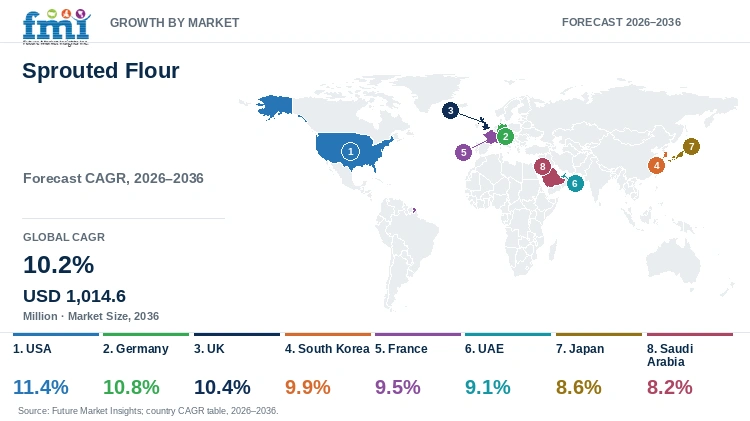
National bakery adoption patterns place the USA at the front of sprouted flour expansion at 11.4% per year through 2036 ahead of Germany at 10.8% and the UK at 10.4%, while Saudi Arabia logs an 8.2% annual rate. Domestic malting-and-milling capacity in North America and European grain sheds paired with premium health-bakery imports across East Asia and the Gulf govern country-level procurement patterns.
Table 7: Country CAGR and Primary Growth Levers for the Sprouted Flour Market (CAGR percentage and operational drivers), 2026 to 2036
| Country | CAGR (2026 to 2036) | Primary Growth Lever |
|---|---|---|
| USA | 11.4% | Scaled domestic sprouted-wheat milling capacity and USDA organic cost-share support |
| Germany | 10.8% | Industrial Keimbackwaren bakery demand and enzymatic wheat-germ dough stabilization |
| UK | 10.4% | Statutory wheat malt flour calcium exemptions and DEFRA wholemeal bread launches |
| South Korea | 9.9% | 38.1 kg per-capita wheat intake and controlled particle-size whole-wheat milling |
| France | 9.5% | Certified Agriculture Biologique millers supplying germinated cereal flours to boulangeries |
| UAE | 9.1% | Regional bread micronutrient standards and five-star hospitality commissary imports |
| Japan | 8.6% | MAFF state-managed food wheat import stability and GABA-enriched shokupan baking trials |
| Saudi Arabia | 8.2% | First Mills whole-wheat extraction capacity and malted-grain Kleija pastry innovation |
Source: Future Market Insights analysis
USA Sprouted Flour Market Outlook (2026 to 2036)
Unlike import-dependent bakery markets, the USA benefits from vertically integrated grain-steeping and thermal kill-step mills that supply national supermarket sandwich-bread and tortilla brands directly. In October 2026, Ardent Mills released its FY26 ESG Report documenting more than 423,000 regenerative agriculture acres and its Stone Mill acquisition in Richardton, North Dakota to expand specialty grain and microbial-reduction processing across North America [11]. Demand across the USA sprouted flour market is projected to expand at a leading 11.4% CAGR through 2036, driven by retail grocery chains converting store-brand whole-wheat loaves to sprouted formulas. However, high capital costs for FSMA 5-log pathogen kill-step validation restrict smaller regional mills from bidding on national contracts.
Key takeaway: In the USA, vertically integrated thermal-stabilization milling capacity and FSMA-validated microbial kill-step processing are projected to drive industrial sprouted bread and snack contracts.
Germany Sprouted Flour Market Outlook (2026 to 2036)
Sprouted flour demand in Germany is expected to rise at a 10.8% annual rate between 2026 and 2036, owing to multi-store branch bakeries (Filialbäckereien) using germinated wheat and spelt flours to cut dough mixing time and boost wholemeal roll volume. Whereas shoppers in other markets treat sprouted bread as a novelty, consumers in Germany already purchase Keimbackwaren regularly across discount and supermarket bakeries. For instance, in July 2026 Hamburg miller GoodMills Innovation launched GOOD NatureRelax as a clean-label baking ingredient made from 100% stabilized finely ground wheat germ monitored across 24 mill sites that shortens industrial dough kneading times by up to 15% [12]. Even so, high kilning energy prices in Germany pressure mill operating margins.
Key takeaway: In Germany, established Keimbackwaren consumption patterns and enzymatic dough-relaxation gains across branch-bakery commissaries are expected to sustain sprouted wheat and spelt flour adoption.
UK Sprouted Flour Market Outlook (2026 to 2036)
Commercial bread formulation in the UK differs from continental Europe because high-speed Chorleywood bakeries navigate separate statutory rules for white versus wholemeal and germinated malt flours. In April 2025, UK regulators updated the Bread and Flour Regulations guidance confirming that wholemeal flour and wheat malt flour milled from steeped and kilned germinated wheat are exempt from mandatory calcium carbonate addition whereas non-wholemeal wheat flour requires 0.250 mg of folic acid per 100 grams [13]. Because germinated malt and wholemeal flours boost loaf softness without synthetic emulsifiers, supermarket seeded loaves are expanding despite tight domestic wheat harvests. Under these rules, UK sprouted flour demand is estimated to expand at a 10.4% annual pace through 2036.
Key takeaway: In the UK, statutory fortification exemptions for germinated wheat malt and wholemeal flours paired with supermarket seeded-loaf launches are estimated to sustain sprouted flour procurement.
South Korea Sprouted Flour Market Outlook (2026 to 2036)
Because domestic wheat self-sufficiency in South Korea sits near 1%, commercial bakeries rely almost entirely on imported North America and European specialty flours that must pass strict particle-size and starch-damage inspections. Commercial sprouted flour demand in South Korea is anticipated to progress on a 9.9% yearly slope through 2036, supported by metropolitan bakery cafés in Seoul and Busan replacing bitter bran loaves with sweet sprouted whole-wheat breads and digestive biscuits. In April 2025, researcher Jeonghan Moon and colleagues at Pusan National University reported in Foods that annual wheat intake in South Korea reached 38.1 kg per person and showed that controlled low-speed milling keeps whole-wheat starch damage between 2.0% and 3.5% [14]. However, cold-chain container freight costs restrain mass-market adoption.
Key takeaway: In South Korea, 38.1 kg per-capita wheat consumption and strict particle-size quality gates across metropolitan bakery cafés are anticipated to boost imports of enzyme-stabilized sprouted flours.
France Sprouted Flour Market Outlook (2026 to 2036)
Strict French bread decrees prohibit diastatic malt and specialty additives in traditional baguettes de tradition, which channels germinated cereal flour demand in France into certified organic pains spéciaux and packaged nutrition biscuits. In June 2026, Agence BIO updated its national organic press dossiers tracking certified Agriculture Biologique cereal millers and specialist organic retail stores that distribute germinated grain products across France [15]. Across France, sprouted flour demand is forecast to rise at a 9.5% annual rate from 2026 to 2036 because artisan boulangeries and biscuit plants in Auvergne-Rhône-Alpes and Pays de la Loire incorporate sprouted wheat and einkorn flours into high-fiber loaves. Even so, grocery price caps on organic packaged foods moderate retail volume.
Key takeaway: In France, Agence BIO certified organic milling networks and high-fiber specialty loaf innovation outside traditional baguette decrees are forecast to support steady sprouted cereal flour uptake.
UAE Sprouted Flour Market Outlook (2026 to 2036)
Public-health bread fortification policies and luxury hotel bakery standards shape specialty flour procurement in the UAE far more than domestic grain farming. Sprouted flour demand across the UAE is projected to increase at 9.1% per year through 2036, fueled by five-star hotel commissaries and premium retail bakeries in Dubai and Abu Dhabi using germinated whole-wheat flours to boost natural iron and zinc bioavailability. In March 2025, nutrition researcher Safa Abdul Majeed and co-authors with the World Health Organization Eastern Mediterranean office reported in Frontiers in Public Health that 11 of 22 Middle Eastern nations enforce mandatory wheat flour micronutrient fortification across commercial bread supply chains [16]. However, high summer port temperatures require refrigerated container imports to prevent enzyme degradation.
Key takeaway: In the UAE, luxury hospitality bakery procurement and regional micronutrient-dense bread formulations are projected to drive imports of climate-stabilized sprouted flours.
Japan Sprouted Flour Market Outlook (2026 to 2036)
Unlike Western markets where sprouted grain is marketed mainly for sugar reduction, consumer demand in Japan builds on decades of household familiarity with hatsuga genmai (sprouted brown rice) valued for gamma-aminobutyric acid (GABA) content. Through its May 2025 annual agricultural assessment, Tokyo's Ministry of Agriculture (MAFF) detailed state-managed food-wheat import stabilization mechanisms and domestic cereal processing standards across commercial flour mills in Japan [17]. While wholesale bakers in Japan use micro-milled sprouted wheat and brown-rice flours to launch functional GABA-enriched buns, ultra-strict shokupan pullman loaf specifications reject any batch with uneven ash or amylograph viscosity. Within these tight quality tolerances, sprouted flour demand in Japan is forecast to expand at an 8.6% yearly rate through 2036.
Key takeaway: In Japan, consumer familiarity with GABA-rich germinated grains and strict shokupan crumb tolerances are forecast to guide selective adoption of micro-milled sprouted flours.
Saudi Arabia Sprouted Flour Market Outlook (2026 to 2036)
Privatization of state flour mills and rapid expansion of domestic biscuit and pastry manufacturing in Riyadh and Jeddah are creating new B2B demand for functional germinated cereal ingredients in Saudi Arabia. For instance, in October 2026, nutritionist Rehab Ali at Qassim University reported in Foods that blending malted-and-fermented sorghum flakes at 2% to 12% into First Mills Co. whole-wheat (12% to 13% protein) and white wheat flours in traditional Kleija biscuits raised total phenolics 2.42-fold and dietary fiber to 7.69% [18]. Within this modernizing bakery sector, sprouted flour demand in Saudi Arabia is likely to rise on an 8.2% yearly curve through 2036 through specialty distributors supplying heat-stabilized germinated flours, although subsidized standard white flour prices limit mass-market bread substitution.
Key takeaway: In Saudi Arabia, modernizing urban bakery cafés and functional whole-wheat Kleija pastry reformulation are likely to support specialty distributor imports of heat-stabilized sprouted flours.
Full report country CAGRs cover: North America; Latin America; Western Europe; Eastern Europe; East Asia; South Asia and Pacific; Middle East and Africa.
Who are the notable companies in the sprouted flour market?
Ardent Mills, Bay State Milling, To Your Health Sprouted Flour Co., King Arthur Baking, GoodMills Group, One Degree Organic Foods, Anita's Organic Mill, Lindley Mills, ADM, and Scoular are the notable companies in the sprouted flour market.
Competitive leadership in the sprouted flour sector hinges on proprietary steeping-and-kilning equipment that stabilizes endogenous enzymes while achieving a validated microbial kill step. Dedicated sprouted-grain specialists led by To Your Health Sprouted Flour Co. and One Degree Organic Foods run certified organic steeping tanks and stone or roller mills serving both retail and B2B accounts. Industrial milling leaders Ardent Mills (through The Annex and Stone Mill) and Bay State Milling (via BeneGrain) supply bulk enzyme-controlled sprouted wheat flours to national plant bakeries, while GoodMills Group develops stabilized wheat-germ and sprouted cereal ingredients in Europe. Meanwhile, King Arthur Baking and regional millers Anita's Organic Mill and Lindley Mills supply Non-GMO and organic sprouted bakery flours while ADM and Scoular provide upstream identity-preserved grain origination.
- Industrial Sprouted & Enzyme-Controlled Flour Millers: Ardent Mills and Bay State Milling as well as GoodMills Group supply bulk enzyme-stabilized sprouted wheat and ancient-grain ingredients for plant bakeries.
- Dedicated Organic & Traceable Sprouted Flour Specialists: To Your Health Sprouted Flour Co. and One Degree Organic Foods along with King Arthur Baking and regional mills Anita's Organic Mill and Lindley Mills produce certified organic and Non-GMO verified sprouted flours.
- Identity-Preserved Grain Origination & B2B Milling Platforms: ADM and Scoular operate segregated specialty grain cleaning and identity-preserved supply chains for multi-facility B2B bakery ingredient distribution.
Competitive Benchmarking: Sprouted Flour Market
Table 8: Competitive Benchmarking for the Sprouted Flour Market (qualitative capability ratings), 2026
| Company | Controlled Germination & Milling Breadth | Enzyme Stabilization & Bakery Support | Organic & Identity-Preserved Custody | Geographic Reach |
|---|---|---|---|---|
| Ardent Mills | High | High | High | North America (USA, Canada, Puerto Rico) |
| Bay State Milling | High | High | High | North America; national industrial bakery network |
| To Your Health Sprouted Flour Co. | High | Medium | High | USA & international organic B2B export |
| King Arthur Baking | High | High | High | USA retail & professional bakery channels |
| GoodMills Group | Medium | High | High | Germany, Austria, Poland & Central Europe |
| One Degree Organic Foods | High | Medium | High | Canada & USA bio-traceable channels |
| Anita's Organic Mill | High | Medium | High | Canada & Pacific Northwest bakery distribution |
| Lindley Mills | Medium | Medium | High | USA specialty artisan & organic milling |
| ADM | Medium | High | Medium | North America, UK & global B2B milling network |
| Scoular | Medium | Medium | High | North America & Asia identity-preserved grain supply |
Scoring basis: Controlled Germination & Milling Breadth evaluates documented sprouted cereal and pulse flour SKUs. Enzyme Stabilization & Bakery Support assesses Falling Number calibration and microbial kill-step validation, while Organic & Identity-Preserved Custody reflects USDA NOP or Non-GMO Project audit certification.
Key Developments in the Sprouted Flour Market
- In March 2025, King Arthur Baking Company expanded its specialty flour collection at Natural Products Expo West 2025 to broaden household and foodservice trial across USA grocery channels [19].
- During August 2025, Bay State Milling strengthened its specialty grain processing leadership following its Montana facility expansion, enhancing segregated chain-of-custody infrastructure supporting its BeneGrain Organic Sprouted Wheat line [20].
- In April 2026, GoodMills Innovation rolled out GOOD NatureRelax stabilized wheat-germ enzymatic dough conditioning technology to stabilize automated dough handling across industrial roll and tray-bake lines [21].
Key Players in the Sprouted Flour Market
Industrial Sprouted & Enzyme-Controlled Flour Millers
- Ardent Mills
- Bay State Milling
- GoodMills Group
Dedicated Organic & Traceable Sprouted Flour Specialists
- To Your Health Sprouted Flour Co.
- One Degree Organic Foods
- King Arthur Baking
- Anita's Organic Mill
- Lindley Mills
Identity-Preserved Grain Origination & B2B Milling Platforms
- ADM
- Scoular
Sprouted Flour Market - Report Scope
Table 9: Report Scope for the Sprouted Flour Market (coverage fields and definitions), 2026 to 2036
| Coverage field | Report scope |
|---|---|
| Market breakdown | Grain Source; Milling & Stabilization Grade; Application; Certification & Claim; Sales Channel; Region |
| Quantitative Units | USD Million |
| Market Definition | Includes commercial supplier revenue from milled flours produced from physiologically germinated (sprouted) and kilned cereal grains, ancient wheats (sprouted spelt, einkorn, emmer, Khorasan), pseudocereals, and pulses. Category Scope & Overlap Note: Sprouted ancient-wheat flours are counted exclusively in this report under Sprouted Ancient & Hulled Grains and excluded from the Heritage & Landrace Wheat Flour Market; un-germinated heritage flours, microbially fermented sourdough/cultured flours, unmilled intact sprouted kernels, and finished retail baked goods are excluded. |
| Regions Covered | North America; Latin America; Western Europe; Eastern Europe; East Asia; South Asia and Pacific; Middle East and Africa |
| Countries Covered | USA, Germany, UK, South Korea, France, UAE, Japan, Saudi Arabia, and additional countries in the full report |
| Key Companies Covered | Ardent Mills, Bay State Milling, To Your Health Sprouted Flour Co., King Arthur Baking, GoodMills Group, One Degree Organic Foods, Anita's Organic Mill, Lindley Mills, ADM, Scoular |
| Forecast Period | 2026 to 2036 |
| Approach | Primary and secondary research with top-down and bottom-up market triangulation. |
Sprouted Flour Market - Research Methodology
Table 10: Research Methodology for the Sprouted Flour Market (research methods and approach), 2026 edition
| Method | Approach |
|---|---|
| Primary Research | Structured interviews with specialty grain-steeping mill directors, industrial bakery R&D cereal chemists, QA microbiologists, and organic grain procurement managers to validate Falling Number tolerances, kill-step costs, and B2B contract pricing. |
| Secondary Research | Analysis of Whole Grains Council 2026 sprouted-grain initiatives, peer-reviewed cereal chemistry journals (Food Chemistry, PLOS ONE, Current Research in Food Science, Foods), USDA FSA organic certification cost-share records, FDA allergen guidance, DEFRA flour composition rules, Agence BIO dossiers, and MAFF Japan filings. |
| Market Sizing and Forecasting | Bottom-up steeping-and-kilning mill tonnage and realized B2B/retail per-ton pricing models reconciled against top-down specialty bakery flour procurement budgets from 2025 to 2036. |
| Country Forecasting Model | Econometric country projections weight domestic sprouted-grain milling capacity, certified organic retail food expenditure, industrial pan-bread reformulation rates, and specialty flour import dependencies across eight national markets. |
| Operational Benchmark Traceability | Germination steep-kiln throughput, Falling Number stabilization windows, and per-plant procurement indicators in Tables 2, 3, and 4 trace to peer-reviewed sprouted-wheat rheology studies, Whole Grains Council standards, and industrial miller specification sheets. |
| Data Triangulation and Validation | Segment and regional estimates are cross-checked against organic grain custody records and miller product releases while enforcing a strict primary-process boundary that excludes un-sprouted heritage wheat flours, microbially cultured mold-inhibitor flours, and intact unmilled sprouted grains. |
Sprouted Flour Market by Segments
Sprouted Flour Market segmented by Grain Source:
- Sprouted Wheat (Hard & Soft Common Wheat)
- Sprouted Ancient & Hulled Grains (Spelt, Einkorn, Emmer & Khorasan)
- Sprouted Multigrain, Rye, Barley & Oat
- Sprouted Gluten-Free Pseudocereals & Pulses (Quinoa, Buckwheat, Amaranth, Chickpea & Lentil)
Sprouted Flour Market segmented by Milling & Stabilization Grade:
- Enzyme-Stabilized Roller-Milled Flour
- Stone-Ground Whole-Grain Sprouted Flour
- Diastatic Active Sprouted Malt Flour
- Micro-Milled Fine Pastry Grade
Sprouted Flour Market segmented by Application:
- Artisan & Pan Breads & Rolls
- Tortillas, Flatbreads & Pizza Crusts
- Crackers, Pretzels & Extruded Snacks
- Cakes, Muffins & Sweet Goods
- Fresh Pasta, Noodles & Batter Systems
Sprouted Flour Market segmented by Certification & Claim:
- Certified Organic
- Non-GMO Project Verified & Identity-Preserved
- Conventional Clean-Label
Sprouted Flour Market segmented by Sales Channel:
- Direct B2B Industrial Bakery Contracts
- Wholesale Bakery & Foodservice Distributors
- Natural & Conventional Grocery Packaging
- Online B2B & Mill-Direct Portals
Sprouted Flour Market by Region
- North America
- United States
- Canada
- Latin America
- Brazil
- Mexico
- Argentina
- Chile
- Western Europe
- Germany
- France
- United Kingdom
- Italy
- Spain
- Benelux
- Nordics
- Eastern Europe
- Poland
- Czech Republic
- Romania
- Hungary
- East Asia
- China
- Japan
- South Korea
- South Asia and Pacific
- India
- ASEAN
- Australia and New Zealand
- Middle East and Africa
- GCC Countries
- South Africa
- Türkiye
- Israel
Research Sources and Bibliography
- [1] Kocadağlı, T., Göncüoğlu Taş, N., Hamzalıoğlu, A., & Gökmen, V. (2025, October 15). Formation of acrylamide and aroma compounds in biscuits and crackers prepared with sprouted wheat wholemeal. Food Chemistry, 489, 145032 (PubMed PMID 40494074).
- [2] Shaimerdenova, D., Omaraliyeva, A., Tarabayev, B., Chakanova, Z., Iskakova, D., Sarbassova, G., Kizatova, M., & Anuarbekova, S. (2025, August 13). The influence of soft wheat grain germination on its technological properties. PLOS ONE, 20(8), e0329975 (PubMed PMID 40802717).
- [3] Ardent Mills. (2025, July 31). Ardent Mills Enters Agreement to Acquire Stone Mill in North Dakota, Expanding Emerging Nutrition Portfolio | Ardent Mills. Ardent Mills Newsroom.
- [4] Perri, G., Difonzo, G., Ciraldo, L., Rametta, F., Gadaleta-Caldarola, G., Ameur, H., Nikoloudaki, O., De Angelis, M., Caponio, F., & Pontonio, E. (2025, April 12). Tailor-made fermentation of sprouted wheat and barley flours and their application in bread making: A comprehensive comparison with conventional approaches in the baking industry. Current Research in Food Science, 10, 101053 (PubMed PMID 40290370).
- [5] Navarro, J. L., López, M. S., Salvucci, E., León, A. E., & Steffolani, M. E. (2025, August 13). Chemical and Nutritional Characterization of Sourdoughs Made with Sprouted and Unsprouted Whole-Wheat Flour and Their Effects on the Technological Quality of Bread. Foods, 14(16), 2805 (PubMed PMID 40870718).
- [6] U.S. Department of Agriculture, Farm Service Agency (USDA FSA). (2026, July 02). USDA Helps Organic Producers with Certification Costs | Farm Service Agency. U.S. Department of Agriculture.
- [7] Puratos Group. (2026, June 15). Puratos Opens Flour Competence Center to Address Flour Variability. Puratos Press Releases.
- [8] Whole Grains Council. (2026, January 15). WGC Plans & Projects for 2026 | The Whole Grains Council. Oldways Whole Grains Council.
- [9] U.S. Food and Drug Administration (FDA). (2026, March 11). Food Allergies | FDA. U.S. Department of Health and Human Services.
- [10] Dragomir, C. N., Dossa, S., Jianu, C., Cocan, I., Radulov, I., Berbecea, A., Radu, F., & Alexa, E. (2025, January 18). Composite Flours Based on Black Lentil Seeds and Sprouts with Nutritional, Phytochemical and Rheological Impact on Bakery/Pastry Products. Foods, 14(2), 319 (PubMed PMID 39856985).
- [11] Ardent Mills. (2026, October 20). Ardent Mills FY26 ESG Report. Ardent Mills Newsroom.
- [12] GoodMills Innovation GmbH. (2026, July 17). GOOD NatureRelax: Groundbreaking ingredient for reliable dough relaxation - GoodMills Innovation. GoodMills Innovation Press.
- [13] UK Department for Environment, Food & Rural Affairs (DEFRA) & Food Standards Agency. (2025, April 23). Bread and flour: labelling and composition - GOV.UK. GOV.UK.
- [14] Moon, J., Moon, Y., & Kweon, M. (2025, April 30). The Effects of Milling Conditions on the Particle Size, Quality, and Noodle-Making Performance of Whole-Wheat Flour: A Mortar Mill Study. Foods, 14(9), 1609 (MDPI).
- [15] Agence BIO. (2026, June 16). Communiqués et dossiers de presse - Agence Bio. Agence Française pour le Développement et la Promotion de l'Agriculture Biologique.
- [16] Abdul Majeed, S., Said, S., Hassan, D. A., Sadiq, F., Alhosani, M., Al-Jawaldeh, A., El-Obeid, T., & Tayyem, R. (2025, March 11). Evaluating the effectiveness and risks of bread fortification programs in the middle eastern region: a comprehensive review. Frontiers in Public Health, 13, 1530380 (PubMed PMID 40135160).
- [17] Ministry of Agriculture, Forestry and Fisheries of Japan (MAFF). (2025, May 30). 第4節 輸入の安定化:農林水産省. MAFF Japan.
- [18] Ali, R. F. M., & El-Anany, A. M. (2026, October 02). Enhancing the Nutritional Value and Sensory Quality of Traditional Saudi Kleija Through Partial Substitution of Wheat Flour with African Hulu-Mur Flakes Powder. Foods, 15(19), 3535 (MDPI).
- [19] King Arthur Baking Company. (2025, March 05). King Arthur Baking Company Expands Flour Line with the Launch of Buttermilk Biscuit Flour Blend | King Arthur Baking. King Arthur Baking Newsroom.
- [20] Bay State Milling Company. (2025, August 20). Bay State Milling Hires New Oat Milling Manager. Bay State Milling Newsroom.
- [21] GoodMills Innovation GmbH. (2026, April 27). Stable processes, relaxed doughs: GOOD NatureRelax - GoodMills Innovation. GoodMills Innovation Press.
- [22] ADM. (2025, October 14). ADM Advances Quality Capabilities with opening of New Central Lab-Milling | ADM. ADM Newsroom.
- [23] The Scoular Company. (2026, September 25). Scoular promotes new leaders in Grain Division. Scoular Newsroom.
This bibliography is provided for reader reference and is not exhaustive. The full report contains the complete reference list and detailed citations.
This Report Answers
- How large is the sprouted flour market in 2026 and what is forecast for 2036?
- Which enzymatic and nutritional factors motivate bakeries to adopt sprouted flour?
- Why does Sprouted Wheat lead the grain source segmentation?
- Why does Enzyme-Stabilized Roller-Milled Flour lead the milling & stabilization grade category?
- How do forecast growth rates differ across the USA, Germany, the UK, and South Korea?
- Which specialty millers offer validated sprouted flour portfolios today?
- What microbiological and amylograph hurdles constrain high-speed bakery adoption?
- What specifications should procurement teams audit before signing a recurring sprouted flour contract?
Frequently Asked Questions
How big is the sprouted flour market in 2026, and what is forecast for 2036?
Commercial bakery demand places the global sprouted flour market size at USD 384.4 million in 2026 up from USD 348.2 million in 2025, climbing to an industry valuation of USD 1,014.6 million by 2036 as plant bakeries expand germinated whole-grain loaf lines.
What is the CAGR for the sprouted flour market from 2026 to 2036?
Global sprouted flour demand is projected to expand at a 10.2% compound annual growth rate between 2026 and 2036, creating USD 630.2 million in added annual market value over the ten-year forecast period.
Which grain source segment leads the sprouted flour market?
Sprouted Wheat is expected to capture 44.6% of the grain source segment in 2026 because intact glutenin elasticity supports direct blending in high-speed sandwich bread lines.
Which milling & stabilization grade segment holds the largest share?
Enzyme-Stabilized Roller-Milled Flour is projected to account for 48.2% of the grade category in 2026, supported by controlled Falling Number kilning that prevents sticky dough during slicing.
Which country shows the fastest growth outlook through 2036?
The USA is projected to lead national growth at an 11.4% CAGR from 2026 to 2036, driven by domestic thermal-stabilization mills and widespread retail sprouted bread distribution.
Which companies are the key players in the sprouted flour market?
Ardent Mills, Bay State Milling, To Your Health Sprouted Flour Co., King Arthur Baking, GoodMills Group, One Degree Organic Foods, Anita's Organic Mill, Lindley Mills, ADM, and Scoular are the notable companies in the sprouted flour market.
Preview the report firsthand - request a free sample
Get SampleGet the brochure for pricing and purchase details.
Get PDFTable of Content
- Key Takeaways
- Market Size and CAGR
- Top Growth Driver
- Fastest Growing Segment
- Leading Region
- Key Companies
- Emerging Opportunities
- Executive Summary
- Global Market Outlook
- Demand-side Trends
- Supply-side Trends
- Technology Roadmap Analysis
- Analysis and Recommendations
- Analyst Perspective (What is happening? Why now? What should investors know?)
- Key Questions Answered
- How large is the market?
- What is the CAGR?
- What are key trends?
- Which region dominates?
- Who are the leaders?
- Market Overview
- Market Coverage / Taxonomy
- Market Definition / Scope / Limitations
- Research Methodology
- Chapter Orientation
- Analytical Lens and Working Hypotheses
- Market Structure, Signals, and Trend Drivers
- Benchmarking and Cross-market Comparability
- Market Sizing, Forecasting, and Opportunity Mapping
- Research Design and Evidence Framework
- Desk Research Programme (Secondary Evidence)
- Expert Input and Fieldwork (Primary Evidence)
- Tooling, Models, and Reference Databases
- Data Engineering and Model Build
- Quality Assurance and Audit Trail
- Market Background
- Market Dynamics (Drivers, Restraints, Opportunity, Trends)
- Scenario Forecast (Optimistic, Likely, Conservative)
- Impact Analysis
- AI Impact
- Sustainability Impact
- Regulatory Impact
- Technology Impact
- Consumer / Buyer Analysis
- Purchase Drivers
- Adoption Barriers
- Buyer Journey
- Opportunity Map Analysis
- Product Life Cycle Analysis
- Supply Chain Analysis
- Investment Feasibility Matrix
- Value Chain Analysis
- PESTLE and Porter's Analysis
- Regulatory Landscape
- Regional Parent Market Outlook
- Production and Consumption Statistics
- Import and Export Statistics
- Global Market Analysis and Forecast, 2021 to 2036
- Historical Market Size Value (USD Million) Analysis, 2021 to 2025
- Current and Future Market Size Value (USD Million) Projections, 2026 to 2036
- Y-o-Y Growth Trend Analysis
- Absolute $ Opportunity Analysis
- Global Market Pricing Analysis, 2021 to 2036
- Global Market Analysis and Forecast, By Grain Source, 2021 to 2036
- Introduction / Key Findings
- Historical Market Size Value (USD Million) Analysis By Grain Source, 2021 to 2025
- Current and Future Market Size Value (USD Million) Analysis and Forecast By Grain Source, 2026 to 2036
- Sprouted Wheat (Hard & Soft Common Wheat)
- Sprouted Ancient & Hulled Grains (Spelt, Einkorn, Emmer & Khorasan)
- Sprouted Multigrain, Rye, Barley & Oat
- Sprouted Gluten-Free Pseudocereals & Pulses (Quinoa, Buckwheat, Amaranth, Chickpea & Lentil)
- Y-o-Y Growth Trend Analysis By Grain Source, 2021 to 2025
- Absolute $ Opportunity Analysis By Grain Source, 2026 to 2036
- Global Market Analysis and Forecast, By Milling & Stabilization Grade, 2021 to 2036
- Introduction / Key Findings
- Historical Market Size Value (USD Million) Analysis By Milling & Stabilization Grade, 2021 to 2025
- Current and Future Market Size Value (USD Million) Analysis and Forecast By Milling & Stabilization Grade, 2026 to 2036
- Enzyme-Stabilized Roller-Milled Flour
- Stone-Ground Whole-Grain Sprouted Flour
- Diastatic Active Sprouted Malt Flour
- Micro-Milled Fine Pastry Grade
- Y-o-Y Growth Trend Analysis By Milling & Stabilization Grade, 2021 to 2025
- Absolute $ Opportunity Analysis By Milling & Stabilization Grade, 2026 to 2036
- Global Market Analysis and Forecast, By Application, 2021 to 2036
- Introduction / Key Findings
- Historical Market Size Value (USD Million) Analysis By Application, 2021 to 2025
- Current and Future Market Size Value (USD Million) Analysis and Forecast By Application, 2026 to 2036
- Artisan & Pan Breads & Rolls
- Tortillas, Flatbreads & Pizza Crusts
- Crackers, Pretzels & Extruded Snacks
- Cakes, Muffins & Sweet Goods
- Fresh Pasta, Noodles & Batter Systems
- Y-o-Y Growth Trend Analysis By Application, 2021 to 2025
- Absolute $ Opportunity Analysis By Application, 2026 to 2036
- Global Market Analysis and Forecast, By Certification & Claim, 2021 to 2036
- Introduction / Key Findings
- Historical Market Size Value (USD Million) Analysis By Certification & Claim, 2021 to 2025
- Current and Future Market Size Value (USD Million) Analysis and Forecast By Certification & Claim, 2026 to 2036
- Certified Organic
- Non-GMO Project Verified & Identity-Preserved
- Conventional Clean-Label
- Y-o-Y Growth Trend Analysis By Certification & Claim, 2021 to 2025
- Absolute $ Opportunity Analysis By Certification & Claim, 2026 to 2036
- Global Market Analysis and Forecast, By Sales Channel, 2021 to 2036
- Introduction / Key Findings
- Historical Market Size Value (USD Million) Analysis By Sales Channel, 2021 to 2025
- Current and Future Market Size Value (USD Million) Analysis and Forecast By Sales Channel, 2026 to 2036
- Direct B2B Industrial Bakery Contracts
- Wholesale Bakery & Foodservice Distributors
- Natural & Conventional Grocery Packaging
- Online B2B & Mill-Direct Portals
- Y-o-Y Growth Trend Analysis By Sales Channel, 2021 to 2025
- Absolute $ Opportunity Analysis By Sales Channel, 2026 to 2036
- Global Market Analysis and Forecast, By Region, 2021 to 2036
- Introduction
- Historical Market Size Value (USD Million) Analysis By Region, 2021 to 2025
- Current Market Size Value (USD Million) Analysis and Forecast By Region, 2026 to 2036
- North America
- Latin America
- Western Europe
- Eastern Europe
- East Asia
- South Asia and Pacific
- Middle East and Africa
- Market Attractiveness Analysis By Region
- North America Market Analysis and Forecast, By Country, 2021 to 2036
- Historical Market Size Value (USD Million) Trend Analysis By Market Taxonomy, 2021 to 2025
- Market Size Value (USD Million) Forecast By Market Taxonomy, 2026 to 2036
- By Country
- United States
- Canada
- By Grain Source
- By Milling & Stabilization Grade
- By Application
- By Certification & Claim
- By Sales Channel
- By Country
- Market Attractiveness Analysis
- By Country
- By Grain Source
- By Milling & Stabilization Grade
- By Application
- By Certification & Claim
- By Sales Channel
- Key Takeaways
- Latin America Market Analysis and Forecast, By Country
- Historical Market Size Value (USD Million) Trend Analysis By Market Taxonomy, 2021 to 2025
- Market Size Value (USD Million) Forecast By Market Taxonomy, 2026 to 2036
- By Country
- Brazil
- Mexico
- Argentina
- Chile
- By Grain Source
- By Milling & Stabilization Grade
- By Application
- By Certification & Claim
- By Sales Channel
- By Country
- Market Attractiveness Analysis
- By Country
- By Grain Source
- By Milling & Stabilization Grade
- By Application
- By Certification & Claim
- By Sales Channel
- Key Takeaways
- Western Europe Market Analysis and Forecast, By Country
- Historical Market Size Value (USD Million) Trend Analysis By Market Taxonomy, 2021 to 2025
- Market Size Value (USD Million) Forecast By Market Taxonomy, 2026 to 2036
- By Country
- Germany
- France
- United Kingdom
- Italy
- Spain
- Benelux
- Nordics
- By Grain Source
- By Milling & Stabilization Grade
- By Application
- By Certification & Claim
- By Sales Channel
- By Country
- Market Attractiveness Analysis
- By Country
- By Grain Source
- By Milling & Stabilization Grade
- By Application
- By Certification & Claim
- By Sales Channel
- Key Takeaways
- Eastern Europe Market Analysis and Forecast, By Country
- Historical Market Size Value (USD Million) Trend Analysis By Market Taxonomy, 2021 to 2025
- Market Size Value (USD Million) Forecast By Market Taxonomy, 2026 to 2036
- By Country
- Poland
- Czech Republic
- Romania
- Hungary
- By Grain Source
- By Milling & Stabilization Grade
- By Application
- By Certification & Claim
- By Sales Channel
- By Country
- Market Attractiveness Analysis
- By Country
- By Grain Source
- By Milling & Stabilization Grade
- By Application
- By Certification & Claim
- By Sales Channel
- Key Takeaways
- East Asia Market Analysis and Forecast, By Country
- Historical Market Size Value (USD Million) Trend Analysis By Market Taxonomy, 2021 to 2025
- Market Size Value (USD Million) Forecast By Market Taxonomy, 2026 to 2036
- By Country
- China
- Japan
- South Korea
- By Grain Source
- By Milling & Stabilization Grade
- By Application
- By Certification & Claim
- By Sales Channel
- By Country
- Market Attractiveness Analysis
- By Country
- By Grain Source
- By Milling & Stabilization Grade
- By Application
- By Certification & Claim
- By Sales Channel
- Key Takeaways
- South Asia and Pacific Market Analysis and Forecast, By Country
- Historical Market Size Value (USD Million) Trend Analysis By Market Taxonomy, 2021 to 2025
- Market Size Value (USD Million) Forecast By Market Taxonomy, 2026 to 2036
- By Country
- India
- ASEAN
- Australia and New Zealand
- By Grain Source
- By Milling & Stabilization Grade
- By Application
- By Certification & Claim
- By Sales Channel
- By Country
- Market Attractiveness Analysis
- By Country
- By Grain Source
- By Milling & Stabilization Grade
- By Application
- By Certification & Claim
- By Sales Channel
- Key Takeaways
- Middle East and Africa Market Analysis and Forecast, By Country
- Historical Market Size Value (USD Million) Trend Analysis By Market Taxonomy, 2021 to 2025
- Market Size Value (USD Million) Forecast By Market Taxonomy, 2026 to 2036
- By Country
- GCC Countries
- South Africa
- Türkiye
- Israel
- By Grain Source
- By Milling & Stabilization Grade
- By Application
- By Certification & Claim
- By Sales Channel
- By Country
- Market Attractiveness Analysis
- By Country
- By Grain Source
- By Milling & Stabilization Grade
- By Application
- By Certification & Claim
- By Sales Channel
- Key Takeaways
- Key Countries Market Analysis
- United States
- Pricing Analysis
- Market Share Analysis, 2025
- By Grain Source
- By Milling & Stabilization Grade
- By Application
- By Certification & Claim
- By Sales Channel
- Canada
- Pricing Analysis
- Market Share Analysis, 2025
- By Grain Source
- By Milling & Stabilization Grade
- By Application
- By Certification & Claim
- By Sales Channel
- Mexico
- Pricing Analysis
- Market Share Analysis, 2025
- By Grain Source
- By Milling & Stabilization Grade
- By Application
- By Certification & Claim
- By Sales Channel
- Brazil
- Pricing Analysis
- Market Share Analysis, 2025
- By Grain Source
- By Milling & Stabilization Grade
- By Application
- By Certification & Claim
- By Sales Channel
- Chile
- Pricing Analysis
- Market Share Analysis, 2025
- By Grain Source
- By Milling & Stabilization Grade
- By Application
- By Certification & Claim
- By Sales Channel
- Germany
- Pricing Analysis
- Market Share Analysis, 2025
- By Grain Source
- By Milling & Stabilization Grade
- By Application
- By Certification & Claim
- By Sales Channel
- United Kingdom
- Pricing Analysis
- Market Share Analysis, 2025
- By Grain Source
- By Milling & Stabilization Grade
- By Application
- By Certification & Claim
- By Sales Channel
- Italy
- Pricing Analysis
- Market Share Analysis, 2025
- By Grain Source
- By Milling & Stabilization Grade
- By Application
- By Certification & Claim
- By Sales Channel
- Spain
- Pricing Analysis
- Market Share Analysis, 2025
- By Grain Source
- By Milling & Stabilization Grade
- By Application
- By Certification & Claim
- By Sales Channel
- France
- Pricing Analysis
- Market Share Analysis, 2025
- By Grain Source
- By Milling & Stabilization Grade
- By Application
- By Certification & Claim
- By Sales Channel
- India
- Pricing Analysis
- Market Share Analysis, 2025
- By Grain Source
- By Milling & Stabilization Grade
- By Application
- By Certification & Claim
- By Sales Channel
- ASEAN
- Pricing Analysis
- Market Share Analysis, 2025
- By Grain Source
- By Milling & Stabilization Grade
- By Application
- By Certification & Claim
- By Sales Channel
- Australia and New Zealand
- Pricing Analysis
- Market Share Analysis, 2025
- By Grain Source
- By Milling & Stabilization Grade
- By Application
- By Certification & Claim
- By Sales Channel
- China
- Pricing Analysis
- Market Share Analysis, 2025
- By Grain Source
- By Milling & Stabilization Grade
- By Application
- By Certification & Claim
- By Sales Channel
- Japan
- Pricing Analysis
- Market Share Analysis, 2025
- By Grain Source
- By Milling & Stabilization Grade
- By Application
- By Certification & Claim
- By Sales Channel
- South Korea
- Pricing Analysis
- Market Share Analysis, 2025
- By Grain Source
- By Milling & Stabilization Grade
- By Application
- By Certification & Claim
- By Sales Channel
- Poland
- Pricing Analysis
- Market Share Analysis, 2025
- By Grain Source
- By Milling & Stabilization Grade
- By Application
- By Certification & Claim
- By Sales Channel
- Hungary
- Pricing Analysis
- Market Share Analysis, 2025
- By Grain Source
- By Milling & Stabilization Grade
- By Application
- By Certification & Claim
- By Sales Channel
- Türkiye
- Pricing Analysis
- Market Share Analysis, 2025
- By Grain Source
- By Milling & Stabilization Grade
- By Application
- By Certification & Claim
- By Sales Channel
- South Africa
- Pricing Analysis
- Market Share Analysis, 2025
- By Grain Source
- By Milling & Stabilization Grade
- By Application
- By Certification & Claim
- By Sales Channel
- UAE
- Pricing Analysis
- Market Share Analysis, 2025
- By Grain Source
- By Milling & Stabilization Grade
- By Application
- By Certification & Claim
- By Sales Channel
- Saudi Arabia
- Pricing Analysis
- Market Share Analysis, 2025
- By Grain Source
- By Milling & Stabilization Grade
- By Application
- By Certification & Claim
- By Sales Channel
- United States
- Market Structure Analysis
- Competition Dashboard
- Competition Benchmarking
- Market Share Analysis of Top Players
- By Regional
- By Grain Source
- By Milling & Stabilization Grade
- By Application
- By Certification & Claim
- By Sales Channel
- Emerging Startups
- Innovation Benchmarking
- Competition Analysis
- Competition Deep Dive
- Ardent Mills
- Overview
- Product Portfolio
- Profitability by Market Segments
- Sales Footprint
- Strategy Overview
- Marketing Strategy
- Product Strategy
- Channel Strategy
- Bay State Milling
- To Your Health Sprouted Flour Co.
- King Arthur Baking
- GoodMills Group
- One Degree Organic Foods
- Anita's Organic Mill
- Lindley Mills
- ADM
- Scoular
- Ardent Mills
- Case Studies
- Success Stories
- Recent Developments
- Competition Deep Dive
- Assumptions & Acronyms Used


