

- Market Size (2026)
- USD 275.7 Mn
- Forecast (2036)
- USD 440.6 Mn
- CAGR (2026 to 2036)
- 4.8%
How big is Talc-Free Body Powders Market in 2026?
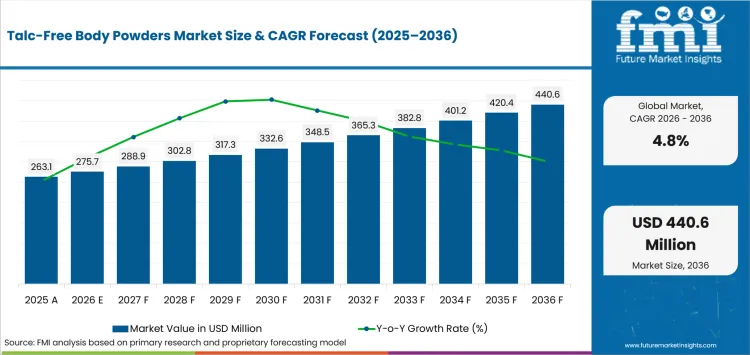
USD 275.7 million in 2026 and USD 440.6 million by 2036 at a 4.8% CAGR.
Sales of talc-free body powders are projected to increase the valuation from USD 275.7 million in 2026 to USD 440.6 million by 2036 at 4.8% CAGR. Ingredient scrutiny is widening review of talc-free powders and aluminium-free deodorants because consumers can change formulas without abandoning familiar dry-feel routines. In May 2025, FDA convened an independent panel to assess talc safety and available consumer-product alternatives. The review keeps formulation choice commercially visible without establishing a universal prohibition on cosmetic talc.
Country conversion depends on local compliance workload and channel readiness instead of one global rule. OPSS recorded 325,496 cosmetic notifications during 2025-2026 and that volume makes notification capacity a practical UK launch condition for wider distribution. Talc-free powders also compete with deodorant sticks in the same dry-feel routine. Documentation and sensory performance therefore determine whether initial trial becomes repeat purchase.
Key Takeaways
- Ingredient scrutiny is directing brands toward talc-free body powders that address safety concerns while retaining familiar moisture-control routines.
- By product type, Core - classic lines are forecast to represent 36.0% in 2026 as familiar routines reduce the explanation needed during routine product comparison.
- The conventional segment is likely to capture 54.0% share in 2026 because common texture choices fit broad mass-retail body-care assortments.
- In 2026, cream & balm is expected to lead the format category with 33.0% share because direct application improves comfort in targeted areas.
- Repeat purchase weakens if talc-free formulas leave visible residue or fail to match the dryness and skin feel consumers already expect.
- Some of the key players in this market include The Procter & Gamble Company, Unilever PLC, Beiersdorf AG, Kao Corporation, Kenvue Inc., L’Oréal S.A., e.l.f. Beauty, Inc., and Amorepacific Corporation.
Analyst Perspective
“Talc-free body powders should be screened for moisture control and visible residue before price comparison because ingredient substitution does not guarantee acceptable skin feel. Brands earn stronger repeat demand by verifying the alternative absorbent system and using a format that fits established body-care routines.”
- Rahul Pandita, Principal Consultant, Future Market Insights
How is the Talc-Free Body Powders Market segmented?
Product Type, Nature, Format, Price Positioning and Sales Channel.
Product type includes Core - classic lines, targeted treatment lines, sensitive & gentle lines, premium & clinical lines and kits & sets. Nature covers conventional, vegan & cruelty-free, natural & organic, dermocosmetic / clinical and fragrance-free & sensitive. Format covers cream & balm, liquid & serum, stick & solid, spray & mist, sheet & patch and powder. Price positioning ranges from mass and masstige to premium and professional offers, while sales channels include e-commerce & DTC, specialty beauty retail, pharmacies & drugstores, supermarkets & hypermarkets and salons & spas.
What makes Core - classic lines central to the Product type category?
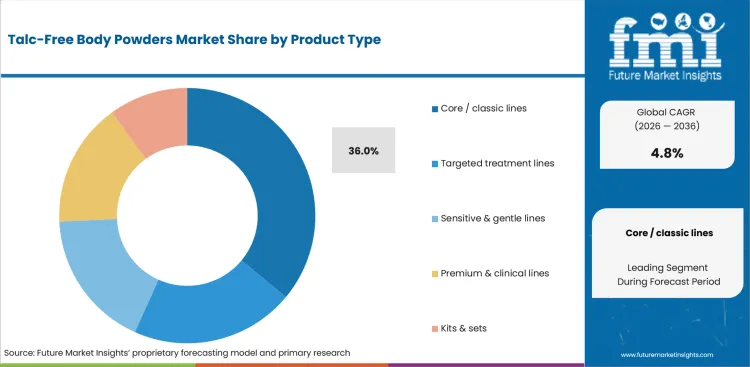
Core - classic lines give consumers a familiar moisture-control reference before targeted propositions enter consideration and compete with deodorant roll-ons for routine body-care spending.
- Based on product type, Core - classic lines are projected to account for 36.0% in 2026 due to familiar use occasions that lower first-purchase education.
- P&G identified Secret Whole Body Deodorant among Circana’s 2025 New Product Pacesetters in June 2026 and cited 72-hour whole-body odor protection. Mainstream recognition confirms that familiar whole-body claims can attract trial without requiring consumers to learn a separate routine.
Why does Conventional lead the Nature category?
Conventional talc-free formulations preserve broad texture and fragrance choice while removing talc from the ingredient proposition. Mass retail therefore tests the formula on daily sensory performance instead of exclusion language alone.
- By nature, conventional is estimated to hold 54.0% in 2026 owing to mainstream formulation options that support familiar price points and routine body-care use.
- Beiersdorf reported positive early reception for NIVEA Derma Control in October 2025 following its September global launch. The rollout provides current evidence that skin-care cues can strengthen mainstream sweat-management propositions without forcing a premium position.
How do Cream & Balm products shape the Format category?
Cream & balm products place friction-control formulas directly on high-contact areas without loose-powder dispersion. Portability also links the format with stick-based body lotions for targeted application.
- Cream & balm is set to lead the format category with 33.0% share in 2026 because direct application improves friction comfort in targeted areas.
- Kao found in February 2025 that 61% of surveyed sunscreen users wiped or dabbed sweat from treated skin during daily wear. Kao’s finding supports application systems that address perspiration discomfort without uncontrolled powder placement during targeted whole-body use.
What drives E-commerce & DTC leadership in the Sales Channel category?
Digital channels give talc-free brands space to explain ingredients and body-use areas during product evaluation. They also place emerging formats beside beauty subscriptions and other repeat-order models that support routine replenishment.
- E-commerce & DTC is projected to hold 25.0% share in 2026 owing to ingredient comparison and convenient replenishment that fit explanation-heavy personal-care products.
- L’Oréal disclosed in February 2026 that e-commerce grew at a double-digit rate during 2025 and passed 30% of group sales. L’Oréal’s e-commerce scale gives differentiated personal-care products room for education during adoption of a new routine.
What are the drivers, restraints and opportunities in the Talc-Free Body Powders Market?
Ingredient scrutiny raises evaluation of talc-free alternatives while performance gaps limit automatic switching and multi-format body care expands the addressable use case.
- Driver: Talc safety scrutiny gives brands a concrete reason to offer non-talc moisture and friction-control products beside established body-care formats.
- Restraint: Consumers can defer talc-free switching if a replacement leaves residue or fails to match the dry feel expected from established body-care products.
- Opportunity: Controlled creams, sticks and mists can extend talc-free positioning into whole-body comfort use cases that loose powders do not serve efficiently.
Ingredient risk perception is increasing evaluation of non-talc absorbent systems because consumers can change formulations without abandoning the moisture-control job expected from body care. IARC’s September 2025 full-volume release classified talc as Group 2A and clarified that the category describes evidence strength instead of exposure-specific risk. Natural cosmetics provide a useful comparison because ingredient changes gain repeat demand once brands preserve credible dry-feel performance and explain the replacement clearly.
Performance parity limits conversion since regulation has not removed compliant talc products from ordinary consumer choice. FDA withdrew its proposed standardized asbestos-testing rule in November 2025 following 49 submitted comments that required additional assessment. Talc-free powders therefore compete with antiperspirants and deodorants on residue plus comfort while higher prices require clear sensory advantages during daily use and repeat purchase decisions.
Controlled formats give talc-free brands access to body zones that make loose powder inconvenient during travel or targeted application. Kao announced Bioré Zero Mist in December 2025 for a March 2026 launch following research that identified widespread sweat-related stickiness. The mist overlaps with deodorant actives and makes quick drying plus controlled placement commercially relevant for adjacent creams and sticks that solve similar comfort problems without loose-powder handling.
Which country CAGRs are profiled in the Talc-Free Body Powders Market?
| Country | CAGR |
|---|---|
| Saudi Arabia | 6.1% |
| USA | 5.1% |
| UK | 4.8% |
| France | 4.5% |
| Germany | 4.2% |
How do country-level CAGRs compare in the Talc-Free Body Powders Market?
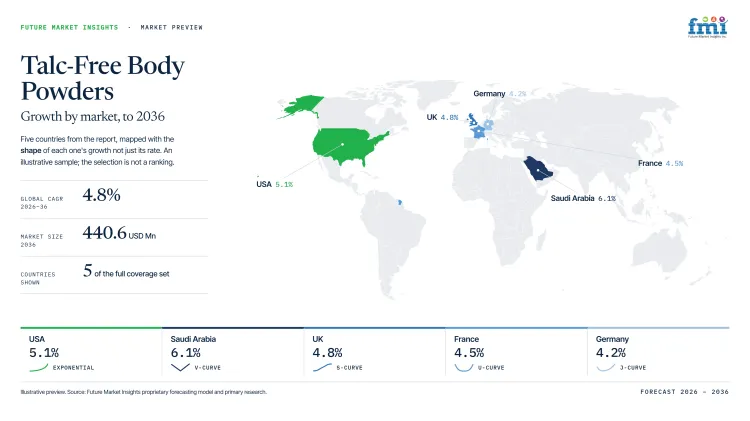
The five markets span 1.9 percentage points, from Saudi Arabia at 6.1% to Germany at 4.2%. Saudi Arabia leads, followed by the USA, UK, France, and Germany. Differences in CAGR, channel access, regulation, and substitute intensity influence market-entry economics.
- Saudi Arabia hot-weather use and expanding e-commerce support frequent replenishment.
- USA broad retail reach supports scale, while deodorant substitutes raise performance expectations.
- UK established pharmacy access supports entry, alongside cosmetic notification requirements.
- France mature beauty channels support distribution, with regulatory compliance shaping entry.
- Germany strong personal-care channels offer scale, but mature competition increases entry requirements.
Comparable rates therefore hide different launch costs and repeat-purchase conditions for competing brands. The full report provides country-level CAGR analysis across North America, Latin America, Europe, East Asia, South Asia, Oceania and the Middle East and Africa.
Country-wise Analysis
- Saudi Arabia combines hot-weather body-care needs with strong pharmacy and e-commerce access. GASTAT reported in January 2026 that cosmetics accounted for 40.2% of purchases among surveyed online shoppers. The talc-free body powders market is projected to grow at 6.1% CAGR through 2036, supported by repeat demand for moisture and friction comfort. Local filing support and Arabic-facing claims remain important for efficient market entry.
- USA offers broad pharmacy, retail, and e-commerce reach, while consumers compare talc-free powders with deodorants and anti-chafe products serving similar needs. The market is forecast to grow at 5.1% CAGR through 2036, supported by established body-care routines. Brands must demonstrate strong moisture control and skin feel to drive repeat purchases.
- UK benefits from established pharmacy and e-commerce channels, although cosmetic notification requirements add entry steps. The market is expected to expand at 4.8% CAGR through 2036, with growth supported by accessible retail channels and demand for body-comfort products. Clear differentiation from deodorant and anti-chafe alternatives remains important.
- France is supported by mature beauty, pharmacy, and personal-care distribution, giving brands access to established consumer channels. The market is projected to grow at 4.5% CAGR through 2036, while regulatory compliance and product positioning remain important for successful entry.
- Germany offers strong pharmacy, retail, and e-commerce infrastructure within a mature personal-care market. Talc-free body powders are forecast to grow at 4.2% CAGR through 2036, with growth shaped by established competition, compliance requirements, and the need for clear product differentiation.
Who are the notable companies in the Talc-Free Body Powders Market?
The Procter & Gamble Company, Unilever PLC, Beiersdorf AG, Kao Corporation, Kenvue Inc., L’Oréal S.A., e.l.f. Beauty, Inc. and Amorepacific Corporation are the notable companies serving this market.
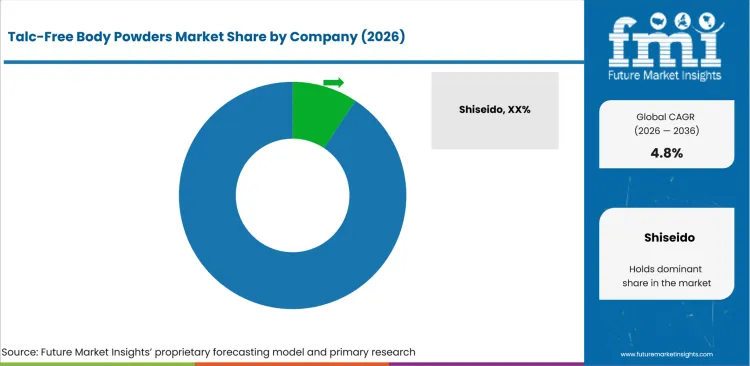
P&G and Unilever cover the broadest verified dry-control formats while Kenvue retains Johnson’s body-powder heritage and current consumer-health testing infrastructure. Beiersdorf and Kao approach the same use case using skin-comfort platforms with international personal-care distribution. L’Oréal and Amorepacific contribute skin-care credibility while e.l.f. Beauty reaches consumers using digital-first beauty channels. Natural deodorant crystals remain adjacent alternatives for ingredient-conscious consumers comparing daily dry-feel routines with mineral-based products. Prebiotic deodorants provide another adjacent route for consumers who prioritize microbiome messaging alongside odor control and skin comfort.
- P&G, Unilever, Beiersdorf and Kao cover multiple dry-control formats using broad personal-care distribution that reaches the same whole-body use occasion.
- Kenvue, L’Oréal, e.l.f. Beauty and Amorepacific approach the category from consumer-health or skin-care platforms whose documented testing and channel access shape initial trial.
Competitive Benchmarking: Talc-Free Body Powders Market
| Company | Whole-Body Format Breadth | Sensitive-Skin Evidence Depth | Consumer Channel Breadth | Geographic Reach |
|---|---|---|---|---|
| The Procter & Gamble Company | High | High | High | Global |
| Unilever PLC | High | High | High | Global |
| Beiersdorf AG | Medium | High | High | Global |
| Kao Corporation | High | Medium | High | Asia, Americas and Europe |
| Kenvue Inc. | Medium | High | High | Global |
| L’Oréal S.A. | Medium | High | High | Global |
| e.l.f. Beauty, Inc. | Low | Medium | High | North America and selected international markets |
| Amorepacific Corporation | Medium | High | Medium | East Asia, North America and Europe |
Scoring basis: High format breadth requires three or more documented body-care formats while Medium requires two and Low identifies one. High skin evidence requires three documented testing or sensitive-skin signals while Medium requires two and Low identifies one. High channel breadth requires mass or drugstore plus specialty retail and online access while Medium requires two routes and Low identifies one.
Key Developments in the Talc-Free Body Powders Market
- In June 2026, The Procter & Gamble Company reformulated Native deodorant and body washes with upgraded odor-protection plus skin-feel performance for mainstream personal care.
- In November 2025, Amorepacific Corporation launched ILLIYOON with Mamonde and Primera at Boots in 47 UK stores plus the retailer’s online channels.
- In April 2025, Unilever PLC confirmed that whole-body deodorant ranges were expanding into Europe and India plus additional markets during the year.
Key Players in the Talc-Free Body Powders Market
Global Personal-Care Platforms
- The Procter & Gamble Company
- Unilever PLC
- Beiersdorf AG
- Kao Corporation
Consumer-Health and Beauty Groups
- Kenvue Inc.
- L’Oréal S.A.
Digital and K-Beauty Specialists
- e.l.f. Beauty, Inc.
- Amorepacific Corporation
Talc-Free Body Powders Market - Report Scope
| Coverage field | Report scope |
|---|---|
| Market breakdown | By product type, nature, format, price positioning, sales channel and region. |
| Quantitative Units | USD million. |
| Market Definition | Consumer body powders and adjacent talc-free dry-feel formats sold for moisture control, friction comfort and whole-body personal care. |
| Regions Covered | North America, Latin America, Europe, East Asia, South Asia and Pacific, and Middle East and Africa. |
| Countries Covered | Saudi Arabia, UAE, South Korea, USA, UK, and 20+ countries included in the full report. |
| Key Companies Profiled | The Procter & Gamble Company, Unilever PLC, Beiersdorf AG, Kao Corporation, Kenvue Inc., L’Oréal S.A., e.l.f. Beauty, Inc., and Amorepacific Corporation. |
| Forecast Period | 2026 to 2036. |
| Approach | Primary and secondary research with market triangulation. |
Talc-Free Body Powders Market - Research Methodology
| Method | Approach |
|---|---|
| Primary Research | FMI analysts gathered input from manufacturers, service providers, technology developers, distributors, end users, procurement teams, and subject-matter experts. Interviews examined purchasing decisions, product or service evaluation, adoption barriers, approval requirements, pricing considerations, and expectations for technical or commercial support. Respondents were also asked what evidence is required before a trial, pilot, or initial order develops into regular purchasing. |
| Desk Research | Desk research covered government statistics, regulatory publications, trade data, industry associations, technical literature, standards, company filings, product information, and official corporate announcements. Sources were reviewed for relevance, publication date, geographic coverage, and consistency with the defined market scope. Claims relating to performance, applications, approvals, capacity, investment, and commercial activity were retained only when supported by credible public evidence. |
| Market Sizing and Forecasting | The market model combined the baseline value with historical performance, segment structure, pricing and volume indicators, adoption levels, company participation, and country-level demand conditions. Forecast assumptions considered economic activity, investment trends, regulatory developments, technology adoption, purchasing cycles, supply availability, and barriers to wider market use. Segment and regional estimates were reconciled before the final market total was calculated. |
| Data Validation | Estimates were checked against multiple independent indicators, including public data, company activity, trade patterns, industry developments, and findings from primary interviews. Validation also tested whether products, services, applications, and company revenues fell within the defined market boundaries. Adjacent categories, unsupported claims, overlapping revenues, and activities without direct market relevance were excluded to reduce double counting and maintain consistency across segments and countries. |
Talc-Free Body Powders Market by Segments
Talc-Free Body Powders Market segmented by Product Type:
- Core - classic lines
- Targeted treatment lines
- Sensitive & gentle lines
- Premium & clinical lines
- Kits & sets
Talc-Free Body Powders Market segmented by Nature:
- Conventional
- Vegan & cruelty-free
- Natural & organic
- Dermocosmetic / clinical
- Fragrance-free & sensitive
Talc-Free Body Powders Market segmented by Format:
- Cream & balm
- Liquid & serum
- Stick & solid
- Spray & mist
- Sheet & patch
- Powder
Talc-Free Body Powders Market segmented by Price Positioning:
- Mass
- Masstige
- Premium
- Professional
Talc-Free Body Powders Market segmented by Sales Channel:
- E-commerce & DTC
- Specialty beauty retail
- Pharmacies & drugstores
- Supermarkets & hypermarkets
- Salons & spas
Talc-Free Body Powders Market by Region:
- North America
- United States
- Canada
- Latin America
- Brazil
- Mexico
- Argentina
- Chile
- Western Europe
- Germany
- France
- United Kingdom
- Italy
- Spain
- Benelux
- Nordics
- Eastern Europe
- Poland
- Czech Republic
- Romania
- Hungary
- East Asia
- China
- Japan
- South Korea
- South Asia and Pacific
- India
- ASEAN
- Australia and New Zealand
- Middle East and Africa
- GCC Countries
- South Africa
- Türkiye
- Israel
Research Sources and Bibliography
- USA Food and Drug Administration. (2025, May 20). Independent Panel Evaluates Safety of Talc in Everyday Products to Protect Public Health.
- Office for Product Safety & Standards. (2026, August 5). OPSS Delivery Report 2025-2026.
- Procter & Gamble. (2026, June 1). P&G Brands Top Circana’s 2025 New Product Pacesetters List.
- Beiersdorf AG. (2025, October 23). Beiersdorf delivers 9M 2025 results in line with expectations.
- Kao Corporation. (2025, February 13). Bioré UV Aqua Rich Airy Hold Cream, Exclusively Available at Selected Outlets.
- L’Oréal. (2026, February 12). 2025 Annual Results.
- International Agency for Research on Cancer. (2025, September 18). IARC Monographs Volume 136: full volume now available.
- USA Food and Drug Administration. (2025, November 28). Testing Methods for Detecting and Identifying Asbestos in Talc-Containing Cosmetic Products; Withdrawal.
- Kao Corporation. (2025, December 10). 「ビオレZero」から、外出先での汗のベタつきをすばやくケアする「秒さらミスト」誕生.
- General Authority for Statistics. (2026, January 6). ICT Access and Usage Statistics by Households and Individuals 2025.
- Ministry of Industry and Advanced Technology. (2026, August 10). Product Conformity Data.
- Ministry of Food and Drug Safety. (2026, July 2). ’26년 상반기 화장품 수출 70억 달러, 역대 상반기 실적 중 최대치 달성.
- USA Food and Drug Administration. (2026, June 30). Registration & Listing of Cosmetic Product Facilities and Products.
- Office for Product Safety & Standards. (2026, July 17). New data on UK cosmetic product safety notifications.
- Kenvue Inc. (2026, February 20). Annual Report on Form 10-K for the fiscal year ended December 28, 2025.
- Procter & Gamble. (2026, June 25). Native Launches Reformulated Deodorant and Body Washes with Enhanced Performance and Improved Formulations.
- Amorepacific Corporation. (2025, November 3). Mamonde, Primera, and ILLIYOON Announce Official Debut at Boots in the United Kingdom.
- Unilever PLC. (2025, April 24). Unilever Q1 2025 Trading Statement - webcast transcript.
- Kenvue Inc. (2025, March 19). Kenvue ribbon-cutting marks official opening of new global headquarters in Summit, New Jersey.
- L’Oréal. (2026, June 18). L’Oréal to acquire a majority stake in Innovist, a leading digital-first Indian personal care house of brands.
- Kao Corporation. (2026, March 19). Kao’s Bioré Accelerates Global Growth with Entry into the South Korean Market and the Launch of a Unified Global Campaign.
- e.l.f. Beauty, Inc. (2025, October 3). Naturium Debuts First-Ever Pop-Up in Los Angeles, Bringing Biocompatible Skincare to Every One, Every Where, Every Day.
- Amorepacific Corporation. (2025, May 2). Amorepacific Holdings Consolidated Q1 2025 Business Performance.
- Procter & Gamble. (2026, June 26). Native Shakes Up the Body Care Category with New Detoxifying Body Scrub Collection.
- Unilever PLC. (2026, April 30). Unilever Trading Statement - First Quarter 2026.
- Beiersdorf AG. (2026, March 2). Full year results 2025: Beiersdorf grows in a slowing market, Derma outperforms.
This bibliography is provided for reader reference and is not exhaustive. The full report contains the complete reference list and detailed citations.
This Report Answers
- What is the talc-free body powders market size in 2026?
- What conditions shape talc-free body powder adoption?
- Why do Core - classic lines lead product type?
- Why do conventional formulations lead nature?
- How do cream & balm formats alter application?
- How do growth conditions differ among the five profiled countries?
- Which eight companies shape competition in this market?
- What restrains switching from talc-containing body-care products?
Frequently Asked Questions
How big is the talc-free body powders market in 2026?
The talc-free body powders market is valued at USD 275.7 million in 2026 and is projected to reach USD 440.6 million by 2036. Ingredient scrutiny increases trial of talc-free formats built around moisture control and friction comfort during regular body-care use.
What is the CAGR of the talc-free body powders market from 2026 to 2036?
The talc-free body powders market is projected to grow at a CAGR of 4.8% between 2026 and 2036. Ingredient reassessment supports expansion because whole-body formats reduce loose-powder handling and fit familiar dry-feel routines.
Which product type leads the talc-free body powders market?
The Core - classic lines segment is expected to hold 36.0% of the talc-free body powders market in 2026, supported by familiar moisture-control routines. Familiar routines reduce the explanation needed to present talc-free alternatives to regular body-powder consumers during routine purchase.
Which countries are projected to record the highest growth in the talc-free body powders market?
Saudi Arabia is projected to grow at 6.1% CAGR, followed by the UAE at 5.8% and South Korea at 5.4% through 2036. Hot-weather comfort needs and digital discovery give the talc-free body powders market faster repeat-purchase paths in these three countries.
Which companies are active in the talc-free body powders market?
The talc-free body powders market includes The Procter & Gamble Company, Unilever PLC, Beiersdorf AG, Kao Corporation, Kenvue Inc., L’Oréal S.A., e.l.f. Beauty, Inc., and Amorepacific Corporation. The companies differ in format breadth, skin-care evidence and access to mass-retail or digital channels.
Preview the report firsthand - request a free sample
Get SampleGet the brochure for pricing and purchase details.
Get PDFTable of Content
- Key Takeaways
- Market Size and CAGR
- Top Growth Driver
- Fastest Growing Segment
- Leading Region
- Key Companies
- Emerging Opportunities
- Executive Summary
- Global Market Outlook
- Demand-side Trends
- Supply-side Trends
- Technology Roadmap Analysis
- Analysis and Recommendations
- Analyst Perspective (What is happening? Why now? What should investors know?)
- Key Questions Answered
- How large is the market?
- What is the CAGR?
- What are key trends?
- Which region dominates?
- Who are the leaders?
- Market Overview
- Market Coverage / Taxonomy
- Market Definition / Scope / Limitations
- Research Methodology
- Chapter Orientation
- Analytical Lens and Working Hypotheses
- Market Structure, Signals, and Trend Drivers
- Benchmarking and Cross-market Comparability
- Market Sizing, Forecasting, and Opportunity Mapping
- Research Design and Evidence Framework
- Desk Research Programme (Secondary Evidence)
- Expert Input and Fieldwork (Primary Evidence)
- Tooling, Models, and Reference Databases
- Data Engineering and Model Build
- Quality Assurance and Audit Trail
- Market Background
- Market Dynamics (Drivers, Restraints, Opportunity, Trends)
- Scenario Forecast (Optimistic, Likely, Conservative)
- Impact Analysis
- AI Impact
- Sustainability Impact
- Regulatory Impact
- Technology Impact
- Consumer / Buyer Analysis
- Purchase Drivers
- Adoption Barriers
- Buyer Journey
- Opportunity Map Analysis
- Product Life Cycle Analysis
- Supply Chain Analysis
- Investment Feasibility Matrix
- Value Chain Analysis
- PESTLE and Porter's Analysis
- Regulatory Landscape
- Regional Parent Market Outlook
- Production and Consumption Statistics
- Import and Export Statistics
- Global Market Analysis and Forecast, 2021 to 2036
- Historical Market Size Value (USD Million) Analysis, 2021 to 2025
- Current and Future Market Size Value (USD Million) Projections, 2026 to 2036
- Y-o-Y Growth Trend Analysis
- Absolute $ Opportunity Analysis
- Global Market Pricing Analysis, 2021 to 2036
- Global Market Analysis and Forecast, By Product Type, 2021 to 2036
- Introduction / Key Findings
- Historical Market Size Value (USD Million) Analysis By Product Type, 2021 to 2025
- Current and Future Market Size Value (USD Million) Analysis and Forecast By Product Type, 2026 to 2036
- Core / classic lines
- Targeted treatment lines
- Sensitive & gentle lines
- Premium & clinical lines
- Kits & sets
- Core / classic lines
- Y-o-Y Growth Trend Analysis By Product Type, 2021 to 2025
- Absolute $ Opportunity Analysis By Product Type, 2026 to 2036
- Global Market Analysis and Forecast, By Nature, 2021 to 2036
- Introduction / Key Findings
- Historical Market Size Value (USD Million) Analysis By Nature, 2021 to 2025
- Current and Future Market Size Value (USD Million) Analysis and Forecast By Nature, 2026 to 2036
- Conventional
- Vegan & cruelty-free
- Natural & organic
- Dermocosmetic / clinical
- Fragrance-free & sensitive
- Conventional
- Y-o-Y Growth Trend Analysis By Nature, 2021 to 2025
- Absolute $ Opportunity Analysis By Nature, 2026 to 2036
- Global Market Analysis and Forecast, By Format, 2021 to 2036
- Introduction / Key Findings
- Historical Market Size Value (USD Million) Analysis By Format, 2021 to 2025
- Current and Future Market Size Value (USD Million) Analysis and Forecast By Format, 2026 to 2036
- Cream & balm
- Liquid & serum
- Stick & solid
- Spray & mist
- Sheet & patch
- Powder
- Cream & balm
- Y-o-Y Growth Trend Analysis By Format, 2021 to 2025
- Absolute $ Opportunity Analysis By Format, 2026 to 2036
- Global Market Analysis and Forecast, By Price Positioning, 2021 to 2036
- Introduction / Key Findings
- Historical Market Size Value (USD Million) Analysis By Price Positioning, 2021 to 2025
- Current and Future Market Size Value (USD Million) Analysis and Forecast By Price Positioning, 2026 to 2036
- Mass
- Masstige
- Premium
- Professional
- Mass
- Y-o-Y Growth Trend Analysis By Price Positioning, 2021 to 2025
- Absolute $ Opportunity Analysis By Price Positioning, 2026 to 2036
- Global Market Analysis and Forecast, By Sales Channel, 2021 to 2036
- Introduction / Key Findings
- Historical Market Size Value (USD Million) Analysis By Sales Channel, 2021 to 2025
- Current and Future Market Size Value (USD Million) Analysis and Forecast By Sales Channel, 2026 to 2036
- E-commerce & DTC
- Specialty beauty retail
- Pharmacies & drugstores
- Supermarkets & hypermarkets
- Salons & spas
- E-commerce & DTC
- Y-o-Y Growth Trend Analysis By Sales Channel, 2021 to 2025
- Absolute $ Opportunity Analysis By Sales Channel, 2026 to 2036
- Global Market Analysis and Forecast, By Region, 2021 to 2036
- Introduction
- Historical Market Size Value (USD Million) Analysis By Region, 2021 to 2025
- Current Market Size Value (USD Million) Analysis and Forecast By Region, 2026 to 2036
- North America
- Latin America
- Western Europe
- Eastern Europe
- East Asia
- South Asia and Pacific
- Middle East & Africa
- Market Attractiveness Analysis By Region
- North America Market Analysis and Forecast, By Country, 2021 to 2036
- Historical Market Size Value (USD Million) Trend Analysis By Market Taxonomy, 2021 to 2025
- Market Size Value (USD Million) Forecast By Market Taxonomy, 2026 to 2036
- By Country
- USA
- Canada
- By Product Type
- By Nature
- By Format
- By Price Positioning
- By Sales Channel
- By Country
- Market Attractiveness Analysis
- By Country
- By Product Type
- By Nature
- By Format
- By Price Positioning
- By Sales Channel
- Key Takeaways
- Latin America Market Analysis and Forecast, By Country
- Historical Market Size Value (USD Million) Trend Analysis By Market Taxonomy, 2021 to 2025
- Market Size Value (USD Million) Forecast By Market Taxonomy, 2026 to 2036
- By Country
- Brazil
- Mexico
- Chile
- Rest of Latin America
- By Product Type
- By Nature
- By Format
- By Price Positioning
- By Sales Channel
- By Country
- Market Attractiveness Analysis
- By Country
- By Product Type
- By Nature
- By Format
- By Price Positioning
- By Sales Channel
- Key Takeaways
- Western Europe Market Analysis and Forecast, By Country
- Historical Market Size Value (USD Million) Trend Analysis By Market Taxonomy, 2021 to 2025
- Market Size Value (USD Million) Forecast By Market Taxonomy, 2026 to 2036
- By Country
- Germany
- UK
- Italy
- Spain
- France
- Nordic
- BENELUX
- Rest of Western Europe
- By Product Type
- By Nature
- By Format
- By Price Positioning
- By Sales Channel
- By Country
- Market Attractiveness Analysis
- By Country
- By Product Type
- By Nature
- By Format
- By Price Positioning
- By Sales Channel
- Key Takeaways
- Eastern Europe Market Analysis and Forecast, By Country
- Historical Market Size Value (USD Million) Trend Analysis By Market Taxonomy, 2021 to 2025
- Market Size Value (USD Million) Forecast By Market Taxonomy, 2026 to 2036
- By Country
- Russia
- Poland
- Hungary
- Balkan & Baltic
- Rest of Eastern Europe
- By Product Type
- By Nature
- By Format
- By Price Positioning
- By Sales Channel
- By Country
- Market Attractiveness Analysis
- By Country
- By Product Type
- By Nature
- By Format
- By Price Positioning
- By Sales Channel
- Key Takeaways
- East Asia Market Analysis and Forecast, By Country
- Historical Market Size Value (USD Million) Trend Analysis By Market Taxonomy, 2021 to 2025
- Market Size Value (USD Million) Forecast By Market Taxonomy, 2026 to 2036
- By Country
- China
- Japan
- South Korea
- By Product Type
- By Nature
- By Format
- By Price Positioning
- By Sales Channel
- By Country
- Market Attractiveness Analysis
- By Country
- By Product Type
- By Nature
- By Format
- By Price Positioning
- By Sales Channel
- Key Takeaways
- South Asia and Pacific Market Analysis and Forecast, By Country
- Historical Market Size Value (USD Million) Trend Analysis By Market Taxonomy, 2021 to 2025
- Market Size Value (USD Million) Forecast By Market Taxonomy, 2026 to 2036
- By Country
- India
- ASEAN
- Australia & New Zealand
- Rest of South Asia and Pacific
- By Product Type
- By Nature
- By Format
- By Price Positioning
- By Sales Channel
- By Country
- Market Attractiveness Analysis
- By Country
- By Product Type
- By Nature
- By Format
- By Price Positioning
- By Sales Channel
- Key Takeaways
- Middle East & Africa Market Analysis and Forecast, By Country
- Historical Market Size Value (USD Million) Trend Analysis By Market Taxonomy, 2021 to 2025
- Market Size Value (USD Million) Forecast By Market Taxonomy, 2026 to 2036
- By Country
- Kingdom of Saudi Arabia
- Other GCC Countries
- Türkiye
- South Africa
- Other African Union
- Rest of Middle East & Africa
- By Product Type
- By Nature
- By Format
- By Price Positioning
- By Sales Channel
- By Country
- Market Attractiveness Analysis
- By Country
- By Product Type
- By Nature
- By Format
- By Price Positioning
- By Sales Channel
- Key Takeaways
- Key Countries Market Analysis
- USA
- Pricing Analysis
- Market Share Analysis, 2025
- By Product Type
- By Nature
- By Format
- By Price Positioning
- By Sales Channel
- Canada
- Pricing Analysis
- Market Share Analysis, 2025
- By Product Type
- By Nature
- By Format
- By Price Positioning
- By Sales Channel
- Mexico
- Pricing Analysis
- Market Share Analysis, 2025
- By Product Type
- By Nature
- By Format
- By Price Positioning
- By Sales Channel
- Brazil
- Pricing Analysis
- Market Share Analysis, 2025
- By Product Type
- By Nature
- By Format
- By Price Positioning
- By Sales Channel
- Chile
- Pricing Analysis
- Market Share Analysis, 2025
- By Product Type
- By Nature
- By Format
- By Price Positioning
- By Sales Channel
- Germany
- Pricing Analysis
- Market Share Analysis, 2025
- By Product Type
- By Nature
- By Format
- By Price Positioning
- By Sales Channel
- UK
- Pricing Analysis
- Market Share Analysis, 2025
- By Product Type
- By Nature
- By Format
- By Price Positioning
- By Sales Channel
- Italy
- Pricing Analysis
- Market Share Analysis, 2025
- By Product Type
- By Nature
- By Format
- By Price Positioning
- By Sales Channel
- Spain
- Pricing Analysis
- Market Share Analysis, 2025
- By Product Type
- By Nature
- By Format
- By Price Positioning
- By Sales Channel
- France
- Pricing Analysis
- Market Share Analysis, 2025
- By Product Type
- By Nature
- By Format
- By Price Positioning
- By Sales Channel
- India
- Pricing Analysis
- Market Share Analysis, 2025
- By Product Type
- By Nature
- By Format
- By Price Positioning
- By Sales Channel
- ASEAN
- Pricing Analysis
- Market Share Analysis, 2025
- By Product Type
- By Nature
- By Format
- By Price Positioning
- By Sales Channel
- Australia & New Zealand
- Pricing Analysis
- Market Share Analysis, 2025
- By Product Type
- By Nature
- By Format
- By Price Positioning
- By Sales Channel
- China
- Pricing Analysis
- Market Share Analysis, 2025
- By Product Type
- By Nature
- By Format
- By Price Positioning
- By Sales Channel
- Japan
- Pricing Analysis
- Market Share Analysis, 2025
- By Product Type
- By Nature
- By Format
- By Price Positioning
- By Sales Channel
- South Korea
- Pricing Analysis
- Market Share Analysis, 2025
- By Product Type
- By Nature
- By Format
- By Price Positioning
- By Sales Channel
- Russia
- Pricing Analysis
- Market Share Analysis, 2025
- By Product Type
- By Nature
- By Format
- By Price Positioning
- By Sales Channel
- Poland
- Pricing Analysis
- Market Share Analysis, 2025
- By Product Type
- By Nature
- By Format
- By Price Positioning
- By Sales Channel
- Hungary
- Pricing Analysis
- Market Share Analysis, 2025
- By Product Type
- By Nature
- By Format
- By Price Positioning
- By Sales Channel
- Kingdom of Saudi Arabia
- Pricing Analysis
- Market Share Analysis, 2025
- By Product Type
- By Nature
- By Format
- By Price Positioning
- By Sales Channel
- Türkiye
- Pricing Analysis
- Market Share Analysis, 2025
- By Product Type
- By Nature
- By Format
- By Price Positioning
- By Sales Channel
- South Africa
- Pricing Analysis
- Market Share Analysis, 2025
- By Product Type
- By Nature
- By Format
- By Price Positioning
- By Sales Channel
- USA
- Market Structure Analysis
- Competition Dashboard
- Competition Benchmarking
- Market Share Analysis of Top Players
- By Regional
- By Product Type
- By Nature
- By Format
- By Price Positioning
- By Sales Channel
- Emerging Startups
- Innovation Benchmarking
- Competition Analysis
- Competition Deep Dive
- Shiseido
- Overview
- Product Portfolio
- Profitability by Market Segments
- Sales Footprint
- Strategy Overview
- Marketing Strategy
- Product Strategy
- Channel Strategy
- Coty
- Estee Lauder Companies
- Beiersdorf
- Kao Corporation
- Procter & Gamble
- L'Oreal
- e.l.f. Beauty
- Amorepacific
- Unilever
- Shiseido
- Case Studies
- Success Stories
- Recent Developments
- Competition Deep Dive
- Assumptions & Acronyms Used


