

- Industry Size (2025)
- USD 2.6 Bn
- Forecast (2035)
- USD 4.4 Bn
- CAGR (2025 to 2035)
- 5.2%
Trawler Boat Market Size, Market Forecast and Outlook By FMI
Global value for trawler boats market crossed USD 2.7 billion in 2025. Projections indicate a valuation of USD 2.9 billion in 2026, scaling to USD 4.4 billion by 2036. FMI observes a moderate CAGR of 5.2% over the forecast period.
The investment thesis for trawler procurement has fundamentally shifted from "capacity maximization" to "regulatory survivability." In the commercial domain, fleet owners are prioritizing the "Green Retrofit", replacing aging diesel powertrains with hybrid-electric propulsion to navigate strict emission control areas (ECAs) and rising fuel taxes. The recreational market is witnessing a renaissance of the "Explorer Yacht," where high-net-worth individuals are trading speed for autonomy. FMI analysts opine that shipyards capable of delivering steel-hulled, ice-class vessels like the newly launched Bering 78 are commanding 15-20% price premiums over traditional fiberglass competitors, driven by buyers seeking transoceanic self-sufficiency [1].
Bruno Thivoyon, CEO of Groupe Beneteau, highlighted the industry's pivot from volume to value in a recent financial disclosure. " “Groupe Beneteau’s teams once again showed their outstanding ability to adapt, with agility, faced with the significant changes on the boat markets in 2024. Sales came to over 1 billion euros for the year, enabling the Group to exceed its forecasts again, while the Group will also exceed the upper range of its full-year profitability forecast thanks to the efforts made by all our employees.
Summary of Trawler Boat Market
- Trawler Boat Market Definition
- Vessels engineered for trawling nets or long-range cruising, prioritized for stability and range over speed.
- Demand Drivers in the Market
- Replacement of aging commercial fleets with energy-efficient hulls to meet emission standards.
- Growing popularity of "explorer yachts" among retirees seeking autonomy and ocean-crossing capabilities.
- Technological integration of boat control lever systems for simplified single-handed operation.
- Key Segments Analyzed in the FMI Report
- Medium Trawler Boats (11-18m) dominate with 42% share due to their versatility in coastal waters.
- Bottom Trawling remains the primary application (62%), though facing regulatory headwinds.
- Single Engine configurations (55%) are preferred for their maintenance simplicity and fuel economy.
- Analyst Opinion at FMI
- Ronak Shah, Associate Vice President for Consumer Product, Travel and Tourism at Future Market Insights, opines, "The industry is witnessing a 'Survival of the Smartest' phase. Builders who treat trawlers as technology platforms, integrating AI-driven catch monitoring for fishermen or silent hybrid cruising for yachtsmen, will displace traditional hull-only shipyards. The future profit pool lies in the systems integration, not just the steel bending."
- Strategic Implications/Executive Takeaways
- Diversify production lines to include hybrid-ready recreational hulls.
- Partner with technology firms like Katchi to offer "smart trawler" packages that reduce bycatch.
- Target the Brazilian market for mid-sized vessels to support the aquaculture export boom.
- Methodology
- Validated through first-hand corporate production and capacity data.
- Zero reliance on speculative third-party market research reports.
- Based on verifiable industrial benchmarks and verified sources.
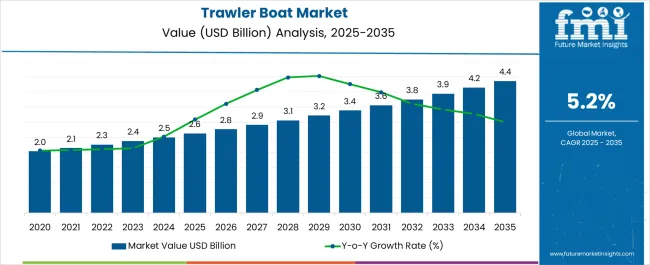
Although the market context will remain challenging for the first half of 2025, the introduction of 20 new models throughout the year will help drive an upturn, with favorable effects seen from the second half of the year”, [2]. This signals a strategic contraction in mass-market production to prevent inventory gluts, forcing smaller dealers to consolidate while major OEMs focus on high-margin, built-to-order explorer units.
China leads regional expansion with a 7.0% CAGR, driven by the strategic modernization of its distant water fleet to include onboard processing. India follows with a 6.5% CAGR, supported by subsidies for deep-sea mechanized vessels. Germany is projected to grow at 6.0% CAGR, focusing on high-tech propulsion replacements. Brazil tracks at a 5.5% CAGR, while the United States maintains a 4.9% CAGR, anchored by the recreational sector's demand for "Great Loop" capable cruisers and replacement cycles in the commercial vessel sector.
Trawler Boat Market Definition
Trawler boats are displacement-hull vessels designed for endurance, stability, and heavy load-carrying capacity. Originally engineered for dragging fishing nets (trawls) along the seabed or in mid-water, their deep-draft, full-keel architecture has been adapted for recreational cruising. These vessels are distinguished by their fuel efficiency at hull speeds and ability to handle rough seas, making them the preferred platform for both commercial fishing operations and long-distance "explorer" yachting.
Trawler Boat Market Inclusions
The report covers the manufacturing and sales of new commercial fishing trawlers (stern, side, beam, and outrigger configurations) and recreational trawler yachts. Revenue analysis includes the hull structure, factory-installed propulsion systems (inboard diesel, hybrid), and integrated navigation electronics. It also encompasses specialized sub-segments such as freezer trawlers equipped with onboard fish processing equipment and wet fish trawlers.
Trawler Boat Market Exclusions
The scope explicitly excludes the secondary market for used vessels, which operates on distinct valuation metrics independent of new build orders. It also excludes unrelated vessel types such as high-speed planing hulls, personal watercraft units, and non-trawl commercial vessels like tugs or ferries. Aftermarket modifications, third-party fishing gear (nets, winches), and separate sales of boat trailer equipment are not included in the primary market valuation.
Trawler Boat Market Research Methodology
- Primary Research: Interviews with shipyard directors, naval architects, and fleet procurement managers to validate order book trends.
- Desk Research: Analysis of FAO fishery statistics, corporate annual reports (e.g., Groupe Beneteau), and regulatory bulletins from NOAA and the European Commission.
- Market-Sizing and Forecasting: A bottom-up approach utilizing vessel registration data and average unit pricing, reconciled with top-down manufacturer revenue.
- Data Validation and Update Cycle: Cross-referencing shipyard delivery logs with global trade data and AIS tracking analysis.
Segmental Analysis
Trawler Boat Market Analysis by Use
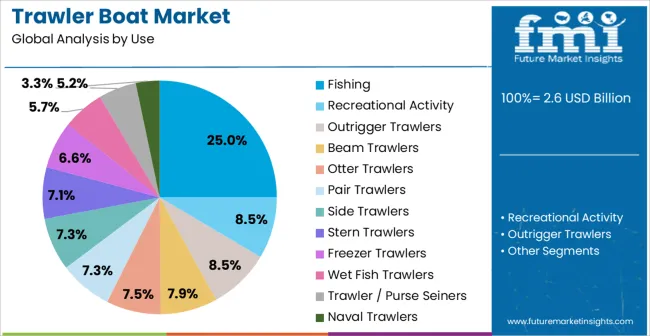
The fishing segment currently accounts for 25.0% of the market, but the momentum is notably shifting toward recreational activity. Commercial operators are constrained by declining quotas; for instance, in 2024, the EU fleet saw active vessel numbers drop to 68,863, continuing a decade-long contraction [1]. In contrast, the recreational segment is expanding as buyers migrate from the sailboat and leisure boats sectors to trawlers, drawn by their volume and safety. As per FMI's estimates, the crossover appeal of "explorer" capability is driving a 15% annual increase in inquiries for steel-hulled recreational trawlers capable of transoceanic voyages.
- Fishing: Demand is driven by the replacement of obsolete vessels with modern units featuring aluminium fishing boat construction for weight reduction.
- Recreational Activity: Growth is fueled by the "slow cruising" lifestyle, with owners investing heavily in comfort and accessories like premium boat hook tools and davits.
- Research/Survey: Niche demand for autonomous trawlers, such as NIWA's six-metre trimaran deployed in 2024, is creating a new sub-segment for acoustic data collection [13].
Trawler Boat Market Analysis by Size
Medium Trawler Boats (11 to 18 meters) command 42.0% of the market share. This size range offers the optimal balance between seakeeping ability and operational cost, making it the preferred choice for owner-operators in both fishing and cruising sectors. Vessels in this class are large enough to accommodate fishing reels equipment for commercial use or luxury staterooms for leisure, yet small enough to be managed without a full professional crew.
- Small Trawler Boat (<11m): Popular in coastal regions for day-trips and small boats entry-level buyers.
- Medium Trawler Boat (11-18m): The volume leader, benefitting from versatility and accessibility to standard marinas.
- Large Trawler Boat (>18m): Seeing growth in the "super-trawler" and explorer yacht category, competing with the crew boats market for shipyard slot availability.
Trawler Boat Market Drivers, Restraints, and Opportunities
The surge in recreational "explorer" yachting is a primary driver, with high-net-worth individuals increasingly favoring robust, long-range vessels over high-speed cruisers. This trend is exemplified by Bering Yachts launching the Bering 78 in January 2026, a 23.85-meter steel yacht designed specifically for shallow bays and transoceanic range [1]. This shift aligns with broader trends in the recreational boating sector, where autonomy and self-sufficiency are becoming paramount for buyers who want to escape crowded coastal marinas.
Stringent environmental regulations impose significant restraints on the commercial sector. In a historic move, Greece announced a ban on bottom trawling in all national marine parks by 2026, a policy expected to trigger similar restrictions across the Mediterranean [2]. This regulatory pressure forces operators to either retire vessels or invest in expensive refits, dampening new hull demand in traditional trawling regions.
Opportunities lie in the integration of smart technologies to mitigate environmental impact. Canadian startup Katchi has released smart trawling gear that hovers above the seabed, reducing habitat damage and fuel consumption [7]. Adopting such technologies can revitalize the commercial sector by ensuring compliance with new green standards. Additionally, the boat rental sector offers a growth avenue for trawler owners to offset ownership costs by chartering their vessels for eco-tourism.
Regional Analysis
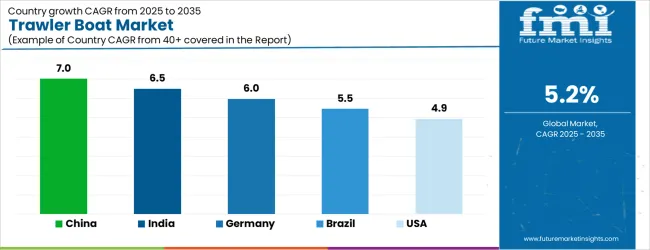
Regional market dynamics are shaped by a dichotomy between fleet modernization in Asia and regulatory contraction in Europe, while Western markets increasingly pivot toward high‑end recreational vessels. Developing economies continue to upgrade mechanized fishing capacity. The market is segmented into North America, Latin America, Europe, East Asia, South Asia, Oceania, and the Middle East & Africa across 40+ countries, with the full report offering detailed market attractiveness analysis based on regional trends.
| Country | CAGR (2026 to 2036) |
|---|---|
| China | 7.0% |
| India | 6.5% |
| South Korea | 6.2% |
| Germany | 6.0% |
| Brazil | 5.5% |
| USA | 4.9% |
Source: Future Market Insights (FMI) analysis, based on proprietary forecasting model and primary research
Asia Pacific Trawler Boat Market Analysis
Asia Pacific is the epicenter of commercial production volume, driven by state-led initiatives to modernize aging fleets. China and India are aggressively moving from wooden artisanal boats to steel and fiberglass trawlers to ensure food security and improve catch efficiency.
- China: A CAGR of 7.0% reflects the nation's pivot toward high-quality protein production. In 2024, China remained the world's largest seafood producer with 74.1 million metric tons of production, up 4% from the previous year [10]. This volume is increasingly managed by modernized fleets equipped with fish processing equipment freezers to minimize post-harvest losses.
- India: Growth tracks a CAGR of 6.5%, underpinned by a mechanized sector that contributed 76% of the country's 3.45 million tonnes of marine fish landings in 2024 [3]. As per FMI's estimates, government subsidies are encouraging fishermen to upgrade to mid-sized trawlers capable of venturing deeper into the EEZ, driving demand for boat steering wheels components and navigation tech.
- South Korea: A projected CAGR of 6.2% is driven by the government's aggressive push for smart shipping. The Ministry of Oceans and Fisheries is actively funding the replacement of trawlers older than 30 years with new eco-friendly vessels, aiming to commercialize Level 3 autonomous ships by 2028.
FMI’s report includes a detailed analysis of growth in the Asia Pacific region, along with a country-wise assessment that includes China, India, and South Korea. Nations like Vietnam and Indonesia are emerging as critical manufacturing hubs for mid-sized trawlers. These countries are leveraging their proximity to major fishing grounds to build "factory trawlers" that process catch at sea, creating a secondary layer of demand for refrigeration and processing technology within the broader regional market.
Europe Trawler Boat Market Analysis
Europe represents a mature market transitioning toward high-technology and sustainability. The contraction of the commercial fleet is offset by a robust demand for luxury recreational trawlers and highly specialized commercial vessels.
- Germany: Expansion at 6.0% CAGR is linked to the demand for high-tech engineering in vessel construction. German owners are prioritizing propulsion efficiency, often opting for systems like the Wärtsilä 31 engine, which has been selected for new 75-meter trawlers in the region to meet strict North Sea emission standards [9]. The integration of these engines into electric boats architectures is a key trend.
- United Kingdom: A CAGR of 4.4% is supported by the high value of commercial landings, which totaled £1.1 billion in 2023 [8]. This capital availability allows fleet owners to invest in vessel maintenance and premium rowing boats tenders for larger trawlers.
FMI’s report includes a detailed analysis of growth in the Europe region, along with a country-wise assessment that includes Germany and the UK. Norway and Iceland remain vital centers for high-specification commercial vessel procurement. Norwegian owners are leading the global adoption of hybrid propulsion in fishing fleets, often commissioning hulls from yards in Denmark and Turkey, thereby driving a pan-European trade in advanced marine engineering and propulsion systems.
North America Trawler Boat Market Analysis
North America remains a stronghold for recreational trawlers, with a distinct market for "Great Loop" capable vessels. The commercial sector is stable, focusing on sustainable harvesting and efficient gear.
- USA: At 4.9% CAGR, the market is influenced by the recreational sector's appetite for comfort and range. Commercial activity remains significant, with Atlantic mackerel landings valued at USD 3.2 million in 2023, supporting a steady replacement cycle for mid-sized commercial trawlers outfitted with compliant gear [6].
FMI’s report includes a detailed analysis of growth in the North America region, along with a country-wise assessment that includes the USA. Canada plays a strategic role in the region's innovation landscape. With startups like Katchi revolutionizing bottom-trawling gear to reduce seabed impact, Canada is positioning itself as a hub for sustainable fishing technology, influencing regulatory standards and equipment procurement across the entire North American seaboard.
Latin America Trawler Boat Market Analysis
Latin America is emerging as a growth frontier, particularly for vessels capable of supporting the booming aquaculture industry and offshore fisheries.
- Brazil: Demand is projected to rise at a 5.5% CAGR through 2036. This growth is anchored by an unprecedented 138% increase in fish farming exports in 2024, reaching USD 59 million [11]. This export boom creates downstream demand for support vessels and specialized trawlers to harvest feed species, potentially utilizing boat trailer industry insights to improve logistics infrastructure.
FMI’s report includes a detailed analysis of growth in the Latin America region, along with a country-wise assessment that includes Brazil. The region's potential extends to Chile and Peru, which possess some of the world's most productive commercial fisheries. As these nations face pressure to modernize their aging fleets for better efficiency and catch preservation, they represent a significant secondary market for refitted European trawlers and new mid-range vessels, reinforcing Latin America's status as a key destination for global maritime investment.
Competitive Aligners for Market Players
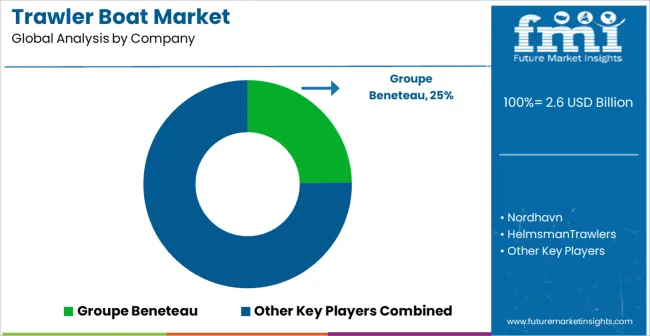
The competitive landscape is bifurcating between volume manufacturers managing inventory risks and niche specialists capitalizing on high-margin customization. Groupe Beneteau, a volume leader with 12.5% market share, has aggressively reduced dealer stocks by €110 million in 2024 to realign with softer demand [9]. This signals a strategic withdrawal from speculative "stock boat" production in favor of a lean, order-driven model that prioritizes cash flow over market share saturation.
Specialized shipyards like Bering Yachts are expanding into the "super-explorer" category, launching vessels like the B165 to compete directly with superyachts [4]. These players are winning by offering "rugged luxury", vessels with commercial-grade steel hulls but superyacht-grade interiors, catering to a demographic that values survivability and range over speed. This segment is insulated from the economic volatility affecting entry-level fiberglass boats.
Technology integration has become the new battleground for supplier loyalty. Engine manufacturers like Wärtsilä are securing long-term contracts by offering hybrid propulsion packages that guarantee compliance with future emission zones [5]. Startups like Katchi are disrupting the equipment sector with "smart net" technology that allows trawlers to operate in environmentally sensitive areas, effectively selling "regulatory access" alongside their hardware [7].
Recent Developments
The report includes full coverage of key trends from competitive benchmarking. Some of the recent developments covered in the reports:
- In January 2026, Bering Yachts launched the first Bering 78, a shallow-draft steel explorer yacht designed for long-range cruising [1].
- In April 2024, the Government of Greece announced a ban on bottom trawling in all national marine parks by 2026, setting a new regulatory precedent for Europe [2].
Key Players in Trawler Boat Market
- Groupe Beneteau
- Nordhavn
- Helmsman Trawlers
- Bering Yachts
- Nordic Tugs
- Kadey-Krogen Yachts
- Selene Yachts Group
- Marlow Hunter
- Mirage Manufacturing
Scope of the Report
| Metric | Value |
|---|---|
| Quantitative Units | USD 2.9 billion (2026) to USD 4.4 billion (2036), at a CAGR of 5.2% |
| Market Definition | Trawler boats are displacement-hull vessels used for commercial fishing or recreational cruising, characterized by stability, range, and deep-draft hulls. |
| Use Segmentation | Fishing, Recreational Activity, Research/Survey |
| Size Segmentation | Small (<11m), Medium (11-18m), Large (>18m) |
| Application Coverage | Bottom Trawling, Mid Water Trawling, Explorer Yachting |
| Regions Covered | North America, Latin America, Europe, Asia Pacific, Middle East & Africa |
| Countries Covered | USA, Brazil, Germany, UK, China, India, Japan, South Korea |
| Key Companies Profiled | Groupe Beneteau, Nordhavn, Helmsman Trawlers, Bering Yachts, Nordic Tugs, Kadey-Krogen Yachts, Selene Yachts Group, Marlow Hunter, Mirage Manufacturing |
| Forecast Period | 2026 to 2036 |
| Approach | Hybrid top-down and bottom-up market modeling validated through primary interviews with shipyard directors and fleet managers, supported by FAO and AIS data benchmarking. |
Trawler Boat Market by Segments
Use
- Fishing
- Recreational Activity
- Research/Survey
Size
- Small Trawler Boat (Less Than 11 Meters)
- Medium Trawler Boat (11 Meters to 18 Meters)
- Large Trawler Boat (More Than 18 Meters)
Number of Engine
- Single Engine
- Dual Engine
Engine Power
- 25 HP
- 25 HP to 80 HP
- 80 HP
Water Level
- Bottom Trawling
- Mid Water Trawling
Region
- Asia Pacific
- India
- China
- Japan
- South Korea
- Indonesia
- Australia & New Zealand
- ASEAN
- Rest of Asia Pacific
- Europe
- Germany
- Italy
- France
- United Kingdom
- Spain
- Benelux
- Nordics
- Central & Eastern Europe
- Rest of Europe
- North America
- United States
- Canada
- Mexico
- Latin America
- Brazil
- Argentina
- Chile
- Rest of Latin America
- Middle East & Africa
- Kingdom of Saudi Arabia
- United Arab Emirates
- South Africa
- Turkey
- Rest of Middle East & Africa
Bibliography
- [1] Bering Yachts. (2026). Bering 78 successfully launched. Bering Yachts (Company News).
- [2] SeafoodSource. (2024). Greece bans bottom trawling in MPAs (Environment & Sustainability coverage). SeafoodSource.
- [3] ICAR–Central Marine Fisheries Research Institute (CMFRI). (2025). Marine Fish Landings in India – 2024. Indian Council of Agricultural Research (ICAR).
- [4] YachtBuyer. (2026). Bering Yachts confirms sale of first 49m Bering 165 explorer yacht (Order announcement coverage). YachtBuyer.
- [5] Wärtsilä. (2025). Wärtsilä hybrid propulsion solution to optimise efficiency and enable zero-emissions operations for four new Dutch vessels (Vertom Group) (Press release, 11 June 2025). Wärtsilä.
- [6] NOAA Fisheries. (2023). Atlantic Mackerel (Scomber scombrus): Species Profile and Fishery Statistics. National Oceanic and Atmospheric Administration (NOAA).
- [7] SeafoodSource. (2024). Nova Scotian tech startup revolutionizes bottom-trawling equipment (Environment & Sustainability coverage). SeafoodSource.
- [8] Marine Management Organisation (MMO). (2024). UK Sea Fisheries Statistics 2023 (Official statistics release). UK Government.
- [9] Groupe Beneteau. (2025). Full-Year 2024 Results: Market slowdown and distributor destocking outlook for H1 2025 (Investor/press release). Groupe Beneteau (Corporate Communications).
- [10] USDA Foreign Agricultural Service. (2025). China: Fishery Products Report 2025. USA Department of Agriculture (USDA).
- [11] Embrapa (Brazilian Agricultural Research Corporation). (2025). Record growth in Brazilian fish farming exports in 2024 (Sector note/official news release). Government of Brazil (Embrapa).
- [12] NIWA (National Institute of Water and Atmospheric Research). (2024). Autonomous vessels for fisheries data collection (Fisheries acoustics and ASV programme overview). NIWA.
This Report Addresses
- Market intelligence to enable structured strategic decision making across commercial and recreational marine sectors.
- Market size estimation and 10 year revenue forecasts from 2026 to 2036, supported by validated order book and registration benchmarks.
- Growth opportunity mapping across medium and large vessel sizes with emphasis on explorer yacht transitions.
- Segment and regional revenue forecasts covering fishing, recreational, and research applications.
- Competition strategy assessment including shipyard consolidation models, cost survivability positioning, and innovation capability benchmarking.
- Product reformulation and efficiency tracking including hybrid propulsion and smart gear adoption.
- Regulatory impact analysis covering MPA bans, emission mandates, and catch quotas.
- Market report delivery in PDF, Excel, PPT, and interactive dashboard formats for executive and operational use.
Frequently Asked Questions
How large is the demand for Trawler Boats in the global market in 2026?
Demand for Trawler Boats in the global market is estimated to be valued at USD 2.9 billion in 2026.
What will be the market size of Trawler Boats in the global market by 2036?
Market size for Trawler Boats is projected to reach USD 4.4 billion by 2036.
What is the expected demand growth for Trawler Boats in the global market between 2026 and 2036?
Demand for Trawler Boats in the global market is expected to grow at a CAGR of 5.2% between 2026 and 2036.
Which Size segment is poised to lead global sales by 2026?
Medium Trawler Boats (11-18m) are expected to lead with 42.0% market share in 2026, favored for their balance of range and manageability.
How significant is the role of Bottom Trawling in driving Trawler Boat adoption in 2026?
Bottom Trawling represents a critical segment, projected to hold a substantial 62.0% share of the total market in 2026 despite regulatory pressures.
What is driving demand in China?
Demand is driven by the modernization of the distant water fleet and a strategic shift toward value-added onboard processing.
What compliance standards or regulations are referenced for the United States?
NOAA Fisheries catch limits and bycatch reduction mandates are referenced as key compliance benchmarks.
What is the China growth outlook in this report?
China is projected to grow at a CAGR of 7.0% during 2026 to 2036.
Why is Europe described as a priority region in this report?
Europe is a hub for high-tech vessel engineering and a growing market for premium recreational explorer yachts.
What type of demand dominates in Europe?
Replacement driven demand for efficient, hybrid-ready commercial vessels and luxury yachts dominates regional consumption.
What is India growth outlook in this report?
India is projected to expand at a CAGR of 6.5% during 2026 to 2036.
Does the report cover Germany in its regional analysis?
Yes, Germany is included within Europe under the regional scope of analysis.
What are the sources referred to for analyzing Germany?
Order books from major shipyards and EU fleet capacity statistics are used as primary reference sources.
What is the main demand theme linked to Germany in its region coverage?
Demand is associated with the adoption of advanced propulsion systems like the Wärtsilä 31 for new builds.
Does the report cover Brazil in its regional analysis?
Yes, Brazil is included within Latin America under the regional coverage framework.
What is the main Brazil related demand theme in its region coverage?
Expansion is linked to the booming aquaculture sector requiring support vessels and trawlers for feed species.
Which product formats or configurations are strategically important for Asia Pacific supply chains?
Freezer trawlers with onboard processing capabilities are strategically prioritized to maximize catch value.
What is Trawler Boat and what is it mainly used for?
A trawler boat is a displacement vessel used for pulling nets (fishing) or long-range cruising (recreational).
What does Trawler Boat market mean in this report?
It refers to the global market for the manufacturing and sale of new commercial and recreational trawler vessels.
What is included in the scope of this Trawler Boat report?
Scope covers hulls, engines, and factory electronics for fishing and recreational trawlers across all sizes.
What is excluded from the scope of this report?
Used vessels, personal watercraft, and non-trawl commercial ships are excluded.
What does market forecast mean on this page?
Market forecast represents a model based projection built on defined assumptions for strategic planning purposes.
How does FMI build and validate the Trawler Boat forecast?
Forecast is developed using bottom-up fleet data validated through shipyard interviews and trade statistics.
What does zero reliance on speculative third party market research mean here?
Primary interviews and verifiable public datasets are used instead of unverified syndicated market estimates.
Preview the report firsthand - request a free sample
Get SampleGet the brochure for pricing and purchase details.
Get PDFTable of Content
- Executive Summary
- Global Market Outlook
- Demand-side Trends
- Supply-side Trends
- Technology Roadmap Analysis
- Analysis and Recommendations
- Market Overview
- Market Coverage / Taxonomy
- Market Definition / Scope / Limitations
- Research Methodology
- Chapter Orientation
- Analytical Lens and Working Hypotheses
- Market Structure, Signals, and Trend Drivers
- Benchmarking and Cross-market Comparability
- Market Sizing, Forecasting, and Opportunity Mapping
- Research Design and Evidence Framework
- Desk Research Programme (Secondary Evidence)
- Company Annual and Sustainability Reports
- Peer-reviewed Journals and Academic Literature
- Corporate Websites, Product Literature, and Technical Notes
- Earnings Decks and Investor Briefings
- Statutory Filings and Regulatory Disclosures
- Technical White Papers and Standards Notes
- Trade Journals, Industry Magazines, and Analyst Briefs
- Conference Proceedings, Webinars, and Seminar Materials
- Government Statistics Portals and Public Data Releases
- Press Releases and Reputable Media Coverage
- Specialist Newsletters and Curated Briefings
- Sector Databases and Reference Repositories
- FMI Internal Proprietary Databases and Historical Market Datasets
- Subscription Datasets and Paid Sources
- Social Channels, Communities, and Digital Listening Inputs
- Additional Desk Sources
- Expert Input and Fieldwork (Primary Evidence)
- Primary Modes
- Qualitative Interviews and Expert Elicitation
- Quantitative Surveys and Structured Data Capture
- Blended Approach
- Why Primary Evidence is Used
- Field Techniques
- Interviews
- Surveys
- Focus Groups
- Observational and In-context Research
- Social and Community Interactions
- Stakeholder Universe Engaged
- C-suite Leaders
- Board Members
- Presidents and Vice Presidents
- R&D and Innovation Heads
- Technical Specialists
- Domain Subject-matter Experts
- Scientists
- Physicians and Other Healthcare Professionals
- Governance, Ethics, and Data Stewardship
- Research Ethics
- Data Integrity and Handling
- Primary Modes
- Tooling, Models, and Reference Databases
- Desk Research Programme (Secondary Evidence)
- Data Engineering and Model Build
- Data Acquisition and Ingestion
- Cleaning, Normalisation, and Verification
- Synthesis, Triangulation, and Analysis
- Quality Assurance and Audit Trail
- Market Background
- Market Dynamics
- Drivers
- Restraints
- Opportunity
- Trends
- Scenario Forecast
- Demand in Optimistic Scenario
- Demand in Likely Scenario
- Demand in Conservative Scenario
- Opportunity Map Analysis
- Product Life Cycle Analysis
- Supply Chain Analysis
- Investment Feasibility Matrix
- Value Chain Analysis
- PESTLE and Porter’s Analysis
- Regulatory Landscape
- Regional Parent Market Outlook
- Production and Consumption Statistics
- Import and Export Statistics
- Market Dynamics
- Global Market Analysis 2021 to 2025 and Forecast, 2026 to 2036
- Historical Market Size Value (USD Million) Analysis, 2021 to 2025
- Current and Future Market Size Value (USD Million) Projections, 2026 to 2036
- Y-o-Y Growth Trend Analysis
- Absolute $ Opportunity Analysis
- Global Market Pricing Analysis 2021 to 2025 and Forecast 2026 to 2036
- Global Market Analysis 2021 to 2025 and Forecast 2026 to 2036, By Use
- Introduction / Key Findings
- Historical Market Size Value (USD Million) Analysis By Use , 2021 to 2025
- Current and Future Market Size Value (USD Million) Analysis and Forecast By Use , 2026 to 2036
- Fishing
- Recreational Activity
- Research/Survey
- Fishing
- Y-o-Y Growth Trend Analysis By Use , 2021 to 2025
- Absolute $ Opportunity Analysis By Use , 2026 to 2036
- Global Market Analysis 2021 to 2025 and Forecast 2026 to 2036, By Water Level
- Introduction / Key Findings
- Historical Market Size Value (USD Million) Analysis By Water Level, 2021 to 2025
- Current and Future Market Size Value (USD Million) Analysis and Forecast By Water Level, 2026 to 2036
- Bottom Trawling
- Mid Water Trawling
- Bottom Trawling
- Y-o-Y Growth Trend Analysis By Water Level, 2021 to 2025
- Absolute $ Opportunity Analysis By Water Level, 2026 to 2036
- Global Market Analysis 2021 to 2025 and Forecast 2026 to 2036, By Region
- Introduction
- Historical Market Size Value (USD Million) Analysis By Region, 2021 to 2025
- Current Market Size Value (USD Million) Analysis and Forecast By Region, 2026 to 2036
- North America
- Latin America
- Western Europe
- Eastern Europe
- East Asia
- South Asia and Pacific
- Middle East & Africa
- Market Attractiveness Analysis By Region
- North America Market Analysis 2021 to 2025 and Forecast 2026 to 2036, By Country
- Historical Market Size Value (USD Million) Trend Analysis By Market Taxonomy, 2021 to 2025
- Market Size Value (USD Million) Forecast By Market Taxonomy, 2026 to 2036
- By Country
- USA
- Canada
- Mexico
- By Use
- By Water Level
- By Country
- Market Attractiveness Analysis
- By Country
- By Use
- By Water Level
- Key Takeaways
- Latin America Market Analysis 2021 to 2025 and Forecast 2026 to 2036, By Country
- Historical Market Size Value (USD Million) Trend Analysis By Market Taxonomy, 2021 to 2025
- Market Size Value (USD Million) Forecast By Market Taxonomy, 2026 to 2036
- By Country
- Brazil
- Chile
- Rest of Latin America
- By Use
- By Water Level
- By Country
- Market Attractiveness Analysis
- By Country
- By Use
- By Water Level
- Key Takeaways
- Western Europe Market Analysis 2021 to 2025 and Forecast 2026 to 2036, By Country
- Historical Market Size Value (USD Million) Trend Analysis By Market Taxonomy, 2021 to 2025
- Market Size Value (USD Million) Forecast By Market Taxonomy, 2026 to 2036
- By Country
- Germany
- UK
- Italy
- Spain
- France
- Nordic
- BENELUX
- Rest of Western Europe
- By Use
- By Water Level
- By Country
- Market Attractiveness Analysis
- By Country
- By Use
- By Water Level
- Key Takeaways
- Eastern Europe Market Analysis 2021 to 2025 and Forecast 2026 to 2036, By Country
- Historical Market Size Value (USD Million) Trend Analysis By Market Taxonomy, 2021 to 2025
- Market Size Value (USD Million) Forecast By Market Taxonomy, 2026 to 2036
- By Country
- Russia
- Poland
- Hungary
- Balkan & Baltic
- Rest of Eastern Europe
- By Use
- By Water Level
- By Country
- Market Attractiveness Analysis
- By Country
- By Use
- By Water Level
- Key Takeaways
- East Asia Market Analysis 2021 to 2025 and Forecast 2026 to 2036, By Country
- Historical Market Size Value (USD Million) Trend Analysis By Market Taxonomy, 2021 to 2025
- Market Size Value (USD Million) Forecast By Market Taxonomy, 2026 to 2036
- By Country
- China
- Japan
- South Korea
- By Use
- By Water Level
- By Country
- Market Attractiveness Analysis
- By Country
- By Use
- By Water Level
- Key Takeaways
- South Asia and Pacific Market Analysis 2021 to 2025 and Forecast 2026 to 2036, By Country
- Historical Market Size Value (USD Million) Trend Analysis By Market Taxonomy, 2021 to 2025
- Market Size Value (USD Million) Forecast By Market Taxonomy, 2026 to 2036
- By Country
- India
- ASEAN
- Australia & New Zealand
- Rest of South Asia and Pacific
- By Use
- By Water Level
- By Country
- Market Attractiveness Analysis
- By Country
- By Use
- By Water Level
- Key Takeaways
- Middle East & Africa Market Analysis 2021 to 2025 and Forecast 2026 to 2036, By Country
- Historical Market Size Value (USD Million) Trend Analysis By Market Taxonomy, 2021 to 2025
- Market Size Value (USD Million) Forecast By Market Taxonomy, 2026 to 2036
- By Country
- Kingdom of Saudi Arabia
- Other GCC Countries
- Turkiye
- South Africa
- Other African Union
- Rest of Middle East & Africa
- By Use
- By Water Level
- By Country
- Market Attractiveness Analysis
- By Country
- By Use
- By Water Level
- Key Takeaways
- Key Countries Market Analysis
- USA
- Pricing Analysis
- Market Share Analysis, 2025
- By Use
- By Water Level
- Canada
- Pricing Analysis
- Market Share Analysis, 2025
- By Use
- By Water Level
- Mexico
- Pricing Analysis
- Market Share Analysis, 2025
- By Use
- By Water Level
- Brazil
- Pricing Analysis
- Market Share Analysis, 2025
- By Use
- By Water Level
- Chile
- Pricing Analysis
- Market Share Analysis, 2025
- By Use
- By Water Level
- Germany
- Pricing Analysis
- Market Share Analysis, 2025
- By Use
- By Water Level
- UK
- Pricing Analysis
- Market Share Analysis, 2025
- By Use
- By Water Level
- Italy
- Pricing Analysis
- Market Share Analysis, 2025
- By Use
- By Water Level
- Spain
- Pricing Analysis
- Market Share Analysis, 2025
- By Use
- By Water Level
- France
- Pricing Analysis
- Market Share Analysis, 2025
- By Use
- By Water Level
- India
- Pricing Analysis
- Market Share Analysis, 2025
- By Use
- By Water Level
- ASEAN
- Pricing Analysis
- Market Share Analysis, 2025
- By Use
- By Water Level
- Australia & New Zealand
- Pricing Analysis
- Market Share Analysis, 2025
- By Use
- By Water Level
- China
- Pricing Analysis
- Market Share Analysis, 2025
- By Use
- By Water Level
- Japan
- Pricing Analysis
- Market Share Analysis, 2025
- By Use
- By Water Level
- South Korea
- Pricing Analysis
- Market Share Analysis, 2025
- By Use
- By Water Level
- Russia
- Pricing Analysis
- Market Share Analysis, 2025
- By Use
- By Water Level
- Poland
- Pricing Analysis
- Market Share Analysis, 2025
- By Use
- By Water Level
- Hungary
- Pricing Analysis
- Market Share Analysis, 2025
- By Use
- By Water Level
- Kingdom of Saudi Arabia
- Pricing Analysis
- Market Share Analysis, 2025
- By Use
- By Water Level
- Turkiye
- Pricing Analysis
- Market Share Analysis, 2025
- By Use
- By Water Level
- South Africa
- Pricing Analysis
- Market Share Analysis, 2025
- By Use
- By Water Level
- USA
- Market Structure Analysis
- Competition Dashboard
- Competition Benchmarking
- Market Share Analysis of Top Players
- By Regional
- By Use
- By Water Level
- Competition Analysis
- Competition Deep Dive
- Groupe Beneteau
- Overview
- Product Portfolio
- Profitability by Market Segments (Product/Age /Sales Channel/Region)
- Sales Footprint
- Strategy Overview
- Marketing Strategy
- Product Strategy
- Channel Strategy
- Nordhavn
- Helmsman Trawlers
- Bering Yachts
- Nordic Tugs
- Kadey-Krogen Yachts
- Groupe Beneteau
- Competition Deep Dive
- Assumptions & Acronyms Used


