

- Industry Size (2026)
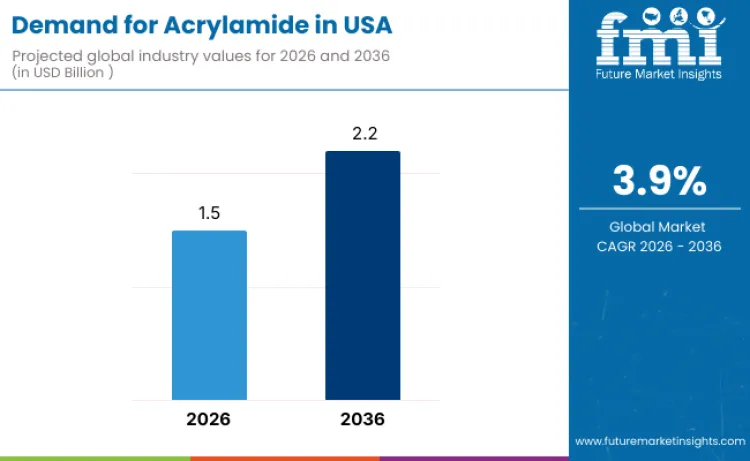
- USD 1.5 Bn
- Forecast (2036)
- USD 2.2 Bn
- CAGR (2026 to 2036)
- 3.9%
Demand for Acrylamide in USA 2026 to 2036
Demand for Acrylamide in USA is valued at USD 1.5 billion in 2026 and is forecasted to reach USD 2.2 billion by 2036, reflecting a CAGR of 3.9%. Demand grows due to sustained consumption in water treatment, oilfield chemicals, paper processing, and mineral beneficiation applications. Municipal wastewater upgrades, shale gas operations, and industrial effluent management programs continue to support steady requirement for acrylamide-based polymers with high flocculation efficiency.
N-methylolacrylamide and other monomer derivatives lead usage because these chemistries enable production of high-performance polyacrylamides used for retention aids, soil stabilization, and enhanced oil recovery. Strong reactivity, controllable crosslinking behavior, and compatibility with downstream polymerization processes strengthen preference among formulators. Improvements in process safety, controlled handling, and derivative purity further reinforce industrial adoption.
Quick Stats for Demand for Acrylamide in USA
- USA Acrylamide Sales Value (2026): USD 1.5 billion
- USA Acrylamide Forecast Value (2036): USD 2.2 billion
- USA Acrylamide Forecast CAGR (2026 to 2036): 3.9%
- Leading Derivative in USA Demand: N-methylolacrylamide and other monomers
- Key Growth Regions in USA Demand: West USA, South USA, Northeast USA, Midwest USA
- Top Players in USA Demand: SNF Holding Company, BASF, Kemira, Mitsubishi Chemical America, Dia-Nitrix Company
West USA, South USA, Northeast USA, and Midwest USA represent key growth regions supported by dense water infrastructure networks, energy production zones, and large paper and mining operations. SNF Holding Company, BASF, Kemira, Mitsubishi Chemical America, and Dia-Nitrix Company shape competitive activity through large-scale monomer capacity, application-specific polymer grades, and supply reliability aligned with regulatory and environmental compliance requirements across major USA end-use sectors.
USA Acrylamide Key Takeaways
| Metric | Value |
|---|---|
| USA Acrylamide Sales Value (2026) | USD 1.5 billion |
| USA Acrylamide Forecast Value (2036) | USD 2.2 billion |
| USA Acrylamide Forecast CAGR (2026-2036) | 3.9% |
How Are the Segments Classified in the Demand for Acrylamide in the USA?
Demand for acrylamide in the USA is shaped by wastewater treatment expansion, polymer processing requirements, and controlled use within regulated industrial applications. Buyers evaluate polymerization performance, ionic behavior, regulatory compliance, and suitability for large-scale continuous processing systems. Adoption patterns reflect strong dependence on acrylamide derivatives for water treatment efficiency, enhanced flocculation performance, and industrial process stabilization across USA facilities.
Which Derivative Accounts for the Largest Share of Demand in the USA?
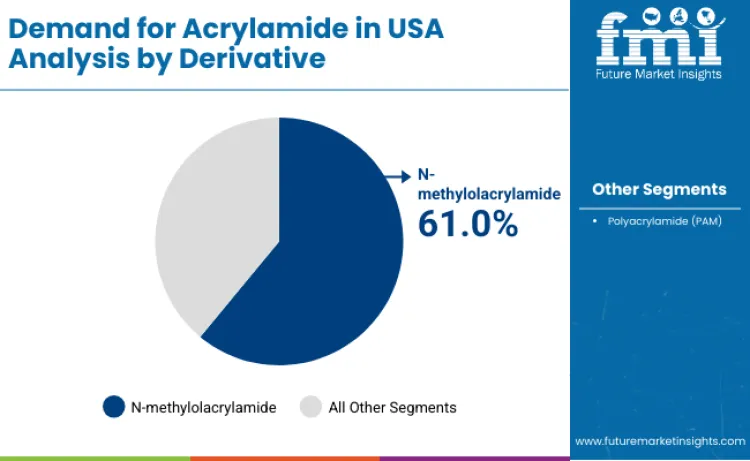
N-methylolacrylamide and other monomers hold 61.0%, making them the leading derivative segment in the USA. These monomers are used extensively as intermediates for polymer synthesis and crosslinking applications. Their reactivity supports tailored polymer structures required in water treatment and specialty chemical formulations. Polyacrylamide serves as a downstream polymer product used in flocculation, viscosity modification, and separation processes. Derivative distribution reflects stronger upstream demand for monomer forms supporting controlled polymer manufacturing within USA chemical production environments.
Key Points:
- Monomer derivatives dominate due to upstream polymer synthesis needs.
- N-methylolacrylamide supports crosslinking and reactivity control.
- Polyacrylamide serves downstream separation and flocculation uses.
Which Ionic Type Accounts for the Largest Share of Demand in the USA?
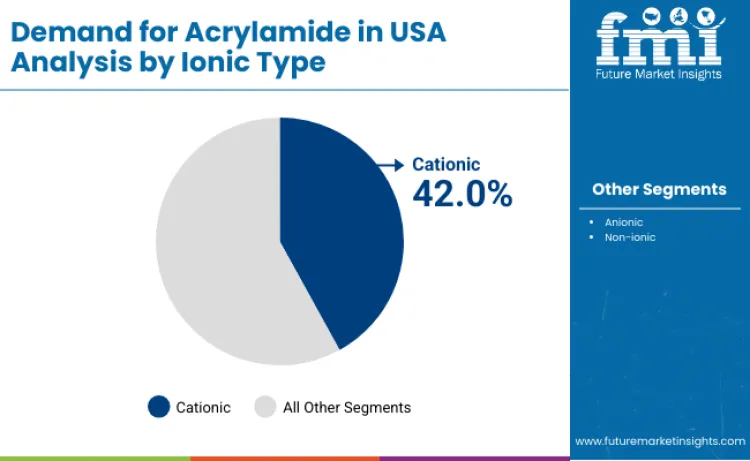
Cationic acrylamide derivatives hold 42.0%, making them the leading ionic-type segment in the USA. Cationic polymers provide strong charge interaction with negatively charged contaminants in wastewater treatment. This property improves flocculation efficiency and solids separation performance. Anionic and non-ionic variants support applications requiring charge balance control or neutral polymer behavior. Ionic-type distribution reflects higher usage of cationic formulations within USA municipal and industrial water treatment systems.
Key Points:
- Cationic variants support efficient contaminant removal.
- Charge interaction improves wastewater flocculation outcomes.
- Other ionic types serve specialized processing conditions.
Which End-Use Industry Accounts for the Largest Share of Demand in the USA?
Water treatment holds 46.0%, making it the leading end-use industry in the USA. Acrylamide derivatives are used to produce flocculants that improve sedimentation, clarification, and sludge dewatering efficiency. Oil and gas operations apply acrylamide-based polymers for enhanced recovery and fluid control. Paper and pulp facilities use polymers for retention and drainage control. Food packaging and cosmetics apply acrylamide derivatives within regulated formulation limits. End-use distribution reflects dominant reliance on water treatment infrastructure across the USA.
Key Points:
- Water treatment drives primary acrylamide consumption.
- Oil and gas uses polymers for flow and recovery control.
- Paper, packaging, and cosmetics support secondary demand.
What are the Key Dynamics in the Acrylamide Industry in USA?
Demand increases across water treatment, paper manufacturing, oil and gas, and mineral processing activities in the USA. Acrylamide serves as a key monomer for polyacrylamide production used in flocculation, thickening, and separation processes. Consumption remains tied to regulated industrial applications rather than consumer use. Municipal infrastructure investment, industrial output stability, and process efficiency requirements sustain usage across established chemical manufacturing and utility networks.
How do water treatment operations and industrial process requirements drive demand in USA?
US municipal and industrial water treatment facilities rely on polyacrylamide derived from acrylamide for sludge dewatering and solids separation. Wastewater plants use flocculants to meet discharge standards under EPA and state regulations. Oil and gas operations apply acrylamide-based polymers in enhanced oil recovery and drilling fluid formulations. Paper and pulp mills use these polymers to improve retention and drainage efficiency. Mining and mineral processing facilities depend on flocculants for tailings management. Large-scale infrastructure spending on water systems supports steady consumption. Demand concentrates in regions with high wastewater treatment capacity and industrial processing density.
How do health regulations, handling risks, and substitution pressure affect demand stability?
Acrylamide classification as a neurotoxic and potential carcinogenic substance imposes strict handling and exposure controls in the USA. OSHA standards and EPA reporting requirements increase compliance costs for manufacturers and users. Facilities require closed systems, monitoring, and specialized training, limiting adoption to regulated industrial settings. Public health scrutiny restricts use in consumer-facing applications. Alternative flocculants and polymer systems gain evaluation when performance requirements allow substitution. Price sensitivity arises from compliance-related operational costs. Demand remains stable within essential industrial uses while expansion faces constraints driven by regulatory oversight, worker safety requirements, and risk management priorities.
How Is Demand for Acrylamide in USA Evolving by Region?
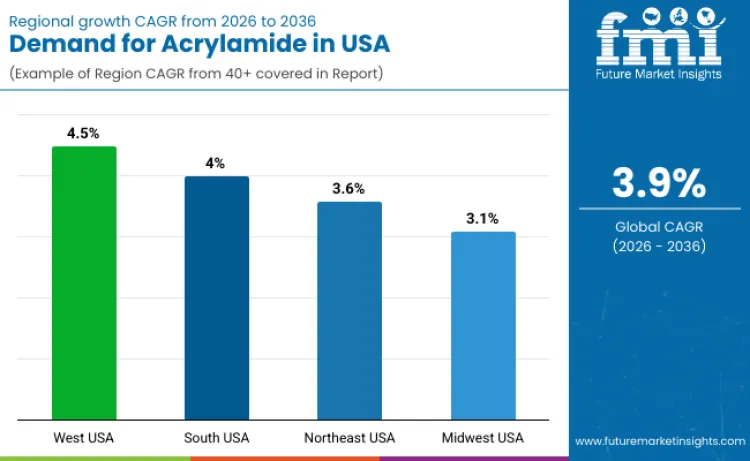
Demand for acrylamide in the USA is expanding gradually due to continued use in water treatment, paper processing, oilfield operations, and mineral processing. West USA leads with a 4.5% CAGR, supported by municipal wastewater upgrades, mining-related water clarification, and advanced industrial treatment needs. South USA follows at 4.0%, driven by oilfield chemicals, enhanced oil recovery operations, and large-scale municipal water infrastructure. Northeast USA records a 3.6% CAGR, shaped by drinking-water compliance requirements, paper recycling, and industrial effluent treatment. Midwest USA posts a 3.1% CAGR, reflecting stable demand from agriculture-related water management, pulp and paper processing, and industrial wastewater applications. Regional variation reflects differences in infrastructure age, industrial concentration, and regulatory pressure across the USA.
| Region | CAGR (2026-2036) |
|---|---|
| West USA | 4.5% |
| South USA | 4.0% |
| Northeast USA | 3.6% |
| Midwest USA | 3.1% |
How is West USA driving demand for Acrylamide?
West USA demand is driven by water scarcity management, stringent discharge regulations, and complex industrial water treatment requirements. The region’s CAGR of 4.5% reflects use of acrylamide-based polymers as flocculants in municipal wastewater reuse, desalination pretreatment, and mining-related water clarification. Mining operations apply polyacrylamide for tailings dewatering and suspended-solids removal under strict environmental oversight. Municipal utilities rely on high-performance flocculants to improve sludge handling efficiency and reduce chemical dosage. Industrial users favor advanced, low-residual acrylamide formulations aligned with environmental compliance. Demand growth is application-driven rather than volume-intensive, with emphasis on performance reliability.
- Municipal wastewater reuse and sludge dewatering
- Mining tailings and process-water clarification
- Desalination and advanced water pretreatment
- Preference for low-residual, high-efficiency formulations
How is South USA driving demand for Acrylamide?
South USA demand is shaped by oil and gas activity, large municipal water systems, and industrial-scale water treatment. The region’s CAGR of 4.0% reflects sustained use of acrylamide-derived polymers in enhanced oil recovery, drilling fluids, and produced-water treatment. Municipal wastewater facilities deploy polyacrylamide for solids separation and sludge conditioning across expanding urban areas. Paper and pulp producers use acrylamide-based additives to improve retention and drainage efficiency. Bulk procurement and long-term supply agreements dominate purchasing behavior, supported by established chemical logistics and storage infrastructure.
- Oilfield chemicals and enhanced oil recovery usage
- Large-scale municipal wastewater treatment
- Paper and pulp retention and drainage additives
- Bulk procurement aligned with continuous operations
How is Northeast USA driving demand for Acrylamide?
Northeast USA demand reflects regulatory compliance, aging infrastructure upgrades, and industrial water treatment modernization. The region’s CAGR of 3.6% is supported by use of acrylamide-based flocculants in drinking-water treatment, industrial effluent polishing, and paper recycling operations. Municipal utilities prioritize formulations supporting turbidity control and sludge volume reduction. Industrial facilities apply polyacrylamide to meet tighter discharge permits. Demand favors certified, low-toxicity products with clear documentation and traceability. Growth remains steady, linked to infrastructure renewal cycles rather than capacity expansion.
- Drinking-water and wastewater compliance applications
- Industrial effluent treatment and polishing
- Paper recycling and process-water management
- Preference for certified, compliance-ready products
How is Midwest USA driving demand for Acrylamide?
Midwest USA demand is stable and process-oriented, driven by agriculture, food processing, and traditional manufacturing. The region’s CAGR of 3.1% reflects use of acrylamide-based polymers in irrigation runoff management, industrial wastewater treatment, and pulp and paper operations. Agricultural processors apply polyacrylamide for erosion control and sediment reduction. Manufacturing facilities rely on flocculants for cost-effective solids separation. Purchasing decisions emphasize reliability, cost efficiency, and compatibility with existing treatment systems. Growth remains moderate, supported primarily by replacement demand and incremental process optimization.
- Agricultural runoff and erosion-control applications
- Food and industrial wastewater treatment
- Pulp and paper processing usage
- Cost-focused, stable procurement patterns
What is the competitive landscape of demand for acrylamide in the USA?
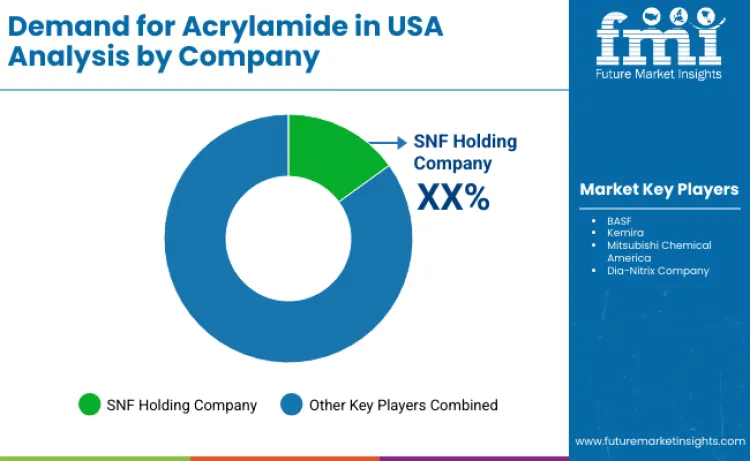
Demand for acrylamide in the USA is driven by consumption across water treatment, oil and gas recovery, pulp and paper processing, mining, and chemical synthesis. Applications require controlled monomer purity, consistent polymerization behavior, and compliance with strict occupational and environmental safety regulations. Buyers evaluate product quality, packaging formats, supply continuity, and technical documentation supporting downstream polymer manufacture. Procurement teams prioritize suppliers with USA-based production or distribution, regulatory compliance expertise, and reliable logistics for hazardous chemical handling. Trend in the USA market reflects steady municipal water treatment demand, continued use in enhanced oil recovery, and stable consumption within industrial flocculant production.
SNF Holding Company maintains a strong presence through USA manufacturing of acrylamide monomer supporting large-scale polyacrylamide production for water and industrial applications. BASF supplies acrylamide and related intermediates through integrated USA chemical operations serving water treatment and specialty polymer customers. Kemira operates USA facilities supporting acrylamide-based polymer production aligned with municipal and industrial water treatment demand. Mitsubishi Chemical America participates through specialty chemical supply supporting polymer and intermediate applications within regulated industrial environments. Dia-Nitrix Company serves niche segments with acrylamide products used in laboratory, specialty synthesis, and controlled industrial applications. Competitive positioning in the USA reflects production reliability, safety compliance, application-specific technical support, and long-term supply relationships with downstream polymer manufacturers.
Key Players in USA Acrylamide Demand
- SNF Holding Company
- BASF
- Kemira
- Mitsubishi Chemical America
- Dia-Nitrix Company
Scope of the Report
| Items | Values |
|---|---|
| Quantitative Units | USD billion |
| Derivative | N-methylolacrylamide and Other Monomers; Polyacrylamide (PAM) |
| Ionic Type | Cationic; Anionic; Non-ionic |
| End-Use Industry | Water Treatment; Oil and Gas Industry; Paper and Pulp Industry; Food Packaging Industry; Cosmetics Industry; Other End-Use Industries |
| Regions Covered | West USA; South USA; Northeast USA; Midwest USA |
| Key Companies Profiled | SNF Holding Company; BASF; Kemira; Mitsubishi Chemical America; Dia-Nitrix Company |
| Additional Attributes | Dollar sales by derivative and ionic type across major USA regions; consumption patterns dominated by polyacrylamide demand in municipal and industrial water treatment facilities; steady usage in enhanced oil recovery, drilling fluids, and hydraulic fracturing operations; application expansion in paper strength additives and retention aids for pulp processing; controlled usage in food-contact packaging and cosmetic formulations under USA regulatory compliance; demand influenced by wastewater infrastructure investment, shale activity cycles, and industrial process optimization; supplier differentiation based on molecular weight control, charge density customization, supply reliability, and regulatory adherence in the United States. |
USA Acrylamide Demand by Segments
By Derivative:
- N-methylolacrylamide and Other Monomers
- Polyacrylamide (PAM)
By Ionic Type:
- Cationic
- Anionic
- Non-ionic
End Use Industry:
- Water Treatment
- Oil and Gas Industry
- Paper and Pulp Industry
- Food Packaging Industry
- Cosmetics Industry
- Other End-Use Industries
Region:
- West USA
- South USA
- Northeast USA
- Midwest USA
Frequently Asked Questions
How big is the demand for acrylamide in USA in 2026?
The demand for acrylamide in USA is estimated to be valued at USD 1.5 billion in 2026.
What will be the size of acrylamide demand in USA in 2036?
The demand size for acrylamide in USA is projected to reach USD 2.2 billion by 2036.
How much will the demand for acrylamide in USA grow between 2026 and 2036?
The demand for acrylamide in USA is expected to grow at a 3.9% CAGR between 2026 and 2036.
What are the key derivative types in the acrylamide demand in USA?
The key derivative types in acrylamide demand in USA include N-methylolacrylamide and other acrylamide-based monomers.
Which ionic-type segment is expected to contribute a significant share in the acrylamide demand in USA in 2026?
In terms of ionic type, cationic acrylamide is expected to command 42.0% share in the acrylamide demand in USA in 2026.
Preview the report firsthand - request a free sample
Get SampleGet the brochure for pricing and purchase details.
Get PDFTable of Content
- Executive Summary
- USA Market Outlook
- Demand-side Trends
- Supply-side Trends
- Technology Roadmap Analysis
- Analysis and Recommendations
- Market Overview
- Market Coverage / Taxonomy
- Market Definition / Scope / Limitations
- Market Background
- Market Dynamics
- Drivers
- Restraints
- Opportunity
- Trends
- Scenario Forecast
- Demand in Optimistic Scenario
- Demand in Likely Scenario
- Demand in Conservative Scenario
- Opportunity Map Analysis
- Product Life Cycle Analysis
- Supply Chain Analysis
- Investment Feasibility Matrix
- Value Chain Analysis
- PESTLE and Porter’s Analysis
- Regulatory Landscape
- Regional Parent Market Outlook
- Production and Consumption Statistics
- Import and Export Statistics
- USA Acrylamide Demand Analysis 2020 to 2024 and Forecast, 2025 to 2035
- Historical Market Size Value (USD Billion) Analysis, 2020 to 2024
- Current and Future Market Size Value (USD Billion) Projections, 2025 to 2035
- Y-o-Y Growth Trend Analysis
- Absolute $ Opportunity Analysis
- USA Acrylamide Demand Pricing Analysis 2020 to 2024 and Forecast 2025 to 2035
- USA Acrylamide Demand Analysis 2020 to 2024 and Forecast 2025 to 2035, By Derivative
- Introduction / Key Findings
- Historical Market Size Value (USD Billion) Analysis By Derivative, 2020 to 2024
- Current and Future Market Size Value (USD Billion) Analysis and Forecast By Derivative, 2025 to 2035
- N-methylolacrylamide and Other Monomers
- Polyacrylamide (PAM)
- Y-o-Y Growth Trend Analysis By Derivative, 2020 to 2024
- Absolute $ Opportunity Analysis By Derivative, 2025 to 2035
- USA Acrylamide Demand Analysis 2020 to 2024 and Forecast 2025 to 2035, By Ionic Type
- Introduction / Key Findings
- Historical Market Size Value (USD Billion) Analysis By Ionic Type, 2020 to 2024
- Current and Future Market Size Value (USD Billion) Analysis and Forecast By Ionic Type, 2025 to 2035
- Cationic
- Anionic
- Non-ionic
- Y-o-Y Growth Trend Analysis By Ionic Type, 2020 to 2024
- Absolute $ Opportunity Analysis By Ionic Type, 2025 to 2035
- USA Acrylamide Demand Analysis 2020 to 2024 and Forecast 2025 to 2035, By End Use Industry
- Introduction / Key Findings
- Historical Market Size Value (USD Billion) Analysis By End Use Industry, 2020 to 2024
- Current and Future Market Size Value (USD Billion) Analysis and Forecast By End Use Industry, 2025 to 2035
- Water Treatment
- Oil and Gas Industry
- Paper and Pulp Industry
- Food Packaging Industry
- Cosmetics Industry
- Other End-Use Industries
- Y-o-Y Growth Trend Analysis By End Use Industry, 2020 to 2024
- Absolute $ Opportunity Analysis By End Use Industry, 2025 to 2035
- Market Structure Analysis
- Competition Dashboard
- Competition Benchmarking
- Market Share Analysis of Top Players
- By Regional
- By Derivative
- By Ionic Type
- By End Use Industry
- Competition Analysis
- Competition Deep Dive
- SNF Holding Company
- Overview
- Product Portfolio
- Profitability by Market Segments (Product / Sales Channel / Region)
- Sales Footprint
- Strategy Overview
- Marketing Strategy
- Product Strategy
- Channel Strategy
- BASF
- Kemira
- Mitsubishi Chemical America
- Dia-Nitrix Company
- SNF Holding Company
- Assumptions & Acronyms Used
- Research Methodology


