

- Industry Size (2026)
- USD 127.14 Mn
- Forecast (2036)
- USD 174.22 Mn
- CAGR (2026 to 2036)
- 3.20%
Demand for Bacterial Amylase in USA Market Size, Market Forecast and Outlook By FMI
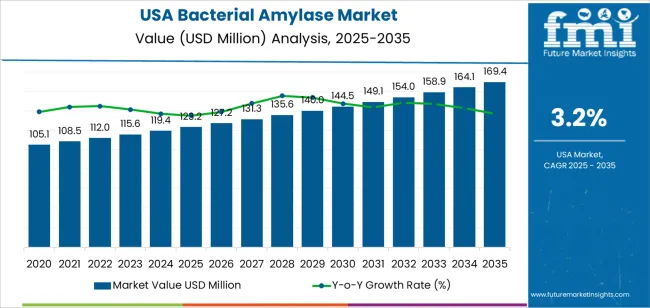
The demand for bacterial amylase in usa market was valued at USD 123.20 million in 2025, projected to reach USD 127.14 million in 2026, and is forecast to expand to USD 174.22 million by 2036 at a 3.20% CAGR. As per FMI, this trajectory creates an incremental opportunity of USD 47.08 million over the forecast period. Bacterial amylase enzymes are increasingly being specified in food processing and industrial starch conversion operations as cost-effective biocatalysts that lower energy input requirements and reduce chemical usage in hydrolysis processes. The shift from acid hydrolysis to enzymatic starch conversion in USA corn wet milling and ethanol production facilities is creating a durable structural demand base.
Summary of Demand for Bacterial Amylase in USA Market
- Market Snapshot
- The demand for bacterial amylase in usa market is valued at USD 123.20 million in 2025 and is projected to reach USD 174.22 million by 2036.
- The industry is expected to grow at a 3.20% CAGR from 2026 to 2036, creating an incremental opportunity of USD 47.08 million.
- The market is a mature, efficiency-driven industrial enzyme category where starch conversion optimization, clean-label baking applications, and biocatalyst cost advantages over chemical hydrolysis define competitive positioning.
- Demand and Growth Drivers
- USA corn wet milling facilities are upgrading enzymatic conversion systems to meet state-level industrial energy efficiency targets, expanding alpha amylase consumption volumes.
- Clean-label baking trends are driving commercial bakeries to adopt bacterial amylase for shelf-life extension and crumb softness improvement without synthetic additives.
- Cost advantages of enzymatic starch hydrolysis over traditional acid hydrolysis are sustaining the structural shift toward biocatalyst adoption in industrial processing.
- Among regions, West leads at 3.7% CAGR, followed by South at 3.3%, Northeast at 3.0%, Midwest at 2.6%.
- Product and Segment View
- The market covers bacterial amylase enzymes in food grade, feed grade, and industrial grade classifications, including alpha amylase and beta amylase types, used across food and beverage, textile, paper, and animal feed industries in the United States.
- Food Grade leads by Grade with 38.0% share in 2026.
- Alpha Amylase leads by Type with 67.0% share in 2026.
- The scope includes bacterial-origin amylase enzymes across all grades and types, excluding fungal amylase, plant-derived amylase, and synthetic starch-degrading chemicals.
- Geography and Competitive Outlook
- West and South USA are the fastest-growing regions due to food processing facility concentration and corn wet milling clusters, while Midwest reflects steady mature demand from established starch processing infrastructure.
- Competition is shaped by enzyme strain portfolio breadth, application-specific technical support, and long-term supply contract reliability for large-scale industrial processors, with key players including Novozymes A/S, DuPont (IFF Nutrition & Biosciences), DSM-Firmenich, Amano Enzyme Inc., AB Enzymes.
- Analyst Opinion at FMI
- Nandini Roy Choudhury, Principal Consultant for Food Ingredients, opines: 'In my analysis, I have observed that the real margin battleground in USA bacterial amylase procurement is not enzyme pricing but application-specific dosage optimization. Corn wet milling facilities that continue operating on legacy enzyme dosing protocols are absorbing avoidable processing costs that compound across millions of bushels annually. Procurement managers who treat enzyme specification as a static commodity input rather than a dynamic process variable will find their cost-per-unit-of-conversion widening against competitors who invest in continuous dosage recalibration. The suppliers capturing long-term contract renewals are those embedding on-site technical optimization services into their supply agreements.'
- Strategic Implications / Executive Takeaways
- Enzyme suppliers must embed on-site technical optimization services into supply agreements to capture long-term contract renewals from major corn wet milling and food processing accounts.
- Food processing R&D directors should evaluate bacterial amylase dosage recalibration programs to reduce per-unit starch conversion costs across high-volume production lines.
- Procurement managers must transition from static enzyme commodity sourcing to dynamic specification partnerships that adjust dosage protocols based on feedstock variability.
Demand for Bacterial Amylase in USA Market Key Takeaways
| Metric | Details |
|---|---|
| Industry Size (2026) | USD 127.14 million |
| Industry Value (2036) | USD 174.22 million |
| CAGR (2026 to 2036) | 3.20% |
Source: Future Market Insights, 2026
Future Market Insights analysis shows the bacterial amylase market in the United States is being shaped by a concurrent push from food processing efficiency mandates and clean-label ingredient formulation trends. The USA corn wet milling sector consumed over 60% of domestic food-grade alpha amylase output in 2024, with facilities in Iowa and Illinois upgrading enzymatic conversion systems to meet tighter energy efficiency targets set by state-level industrial sustainability programs. The American Bakers Association reported a measurable increase in enzyme-assisted baking processes among commercial bakeries during 2024, where bacterial amylase is used to extend shelf life and improve crumb softness without synthetic additives. FMI is of the opinion that the convergence of industrial efficiency requirements and consumer-facing clean-label trends is creating a two-tier growth engine, where bulk industrial demand provides volume stability and specialty food-grade applications deliver margin expansion.
All major regions reflect differentiated adoption trajectories. West sets a 3.7% CAGR pace, South sets a 3.3% CAGR pace, Northeast sets a 3.0% CAGR pace, Midwest sets a 2.6% CAGR pace. West USA leads at 3.7% CAGR, driven by California's concentration of food processing facilities and biotech enzyme R&D infrastructure. South USA follows at 3.3%, supported by corn wet milling and ethanol production clusters in Texas and the Gulf region. Midwest maintains steady demand from its established corn processing base but grows at a more measured 2.6% rate due to facility maturity.
Demand for Bacterial Amylase in USA Market Definition
Demand for bacterial amylase in the USA covers the procurement and industrial consumption of amylase enzymes derived from bacterial fermentation for starch hydrolysis applications. The category includes alpha amylase and beta amylase types supplied in food grade, feed grade, and industrial grade specifications for use across food processing, textile desizing, paper manufacturing, and animal feed production.
Demand for Bacterial Amylase in USA Market Inclusions
Market scope includes bacterial-origin alpha amylase and beta amylase enzymes in food grade, feed grade, and industrial grade formats sold for food and beverage, textile, paper, and animal feed applications in the United States.
Demand for Bacterial Amylase in USA Market Exclusions
Fungal amylase enzymes, plant-derived amylase, synthetic starch-degrading chemicals, and amylase-containing consumer dietary supplements are excluded from the defined scope.
Demand for Bacterial Amylase in USA Market Research Methodology
- Primary Research: Analysts engaged with industrial enzyme procurement managers, corn wet milling facility engineers, and food processing R&D directors to map the volume allocation decisions and specification requirements shaping bacterial amylase demand.
- Desk Research: Data collection aggregated USDA corn processing statistics, EPA industrial efficiency program documentation, and enzyme industry association production reports.
- Market-Sizing and Forecasting: Baseline values derive from a bottom-up aggregation of industrial enzyme supply contracts and food processing facility consumption data, applying end-use-specific adoption curves to project future demand velocity.
- Data Validation and Update Cycle: Projections are tested against publicly reported enzyme division revenues from major suppliers and cross-referenced with USDA corn wet milling throughput statistics.
How Is Demand for Bacterial Amylase Shaping Up in the USA?
Use of bacterial amylase in the USA gained traction as food and beverage manufacturers, bio-processing plants, textile mills, and detergent producers sought efficient, enzyme-based solutions to starch conversion and cleaning operations. Bacterial amylases replaced chemical or plant-derived starch-processing methods because they offer strong catalytic efficiency, thermal stability, and ease of large-scale production. In baking, brewing, and starch-syrup manufacturing, these enzymes support consistent product texture, enhanced sweetness, and controlled hydrolysis. Outside food, they facilitate starch liquefaction for paper, textile desizing, and bio-based chemical feedstock production. As industrial enzyme adoption rose, bacterial amylase became a foundational tool across multiple sectors rather than a niche input.
Looking ahead, growth in bacterial amylase demand in the USA will be driven by expanding processed-food production, rising biofuel and bio-based chemical industries, and increasing interest in enzyme-enabled sustainability. Food manufacturers looking to deliver clean-label, lower-chemical formulations are more likely to adopt enzymatic solutions such as amylase for dough conditioning, sugar conversion, and digestibility enhancement. At the same time, growth of biofuel and starch-derivative chemical production will push demand for high-efficiency starch-degrading enzymes. Barriers include pressure on raw-material costs for enzyme feedstocks, regulatory and quality-control requirements, and competition from alternative technologies or synthetic processes. The pace of market evolution will depend on cost-effectiveness, regulatory clarity, and continued advances in microbial strain engineering and process optimization.
How Are Grade and Enzyme Type Structuring the Demand for Bacterial Amylase in USA?
The demand for bacterial amylase in the USA is structured by grade and enzyme type. Food grade bacterial amylase accounts for 38% of total demand, followed by feed grade and industrial grade products used in diverse processing applications. By enzyme type, alpha amylase represents 67.0% of total consumption, while beta amylase serves more limited conversion requirements. Demand behavior is shaped by substrate specificity, temperature tolerance, pH stability, and regulatory suitability across food, feed, and industrial processing environments. These segments reflect how application sensitivity, reaction efficiency, and compliance requirements guide enzyme selection across starch processing, fermentation, baking, and animal nutrition sectors in the USA.
Why Does Food Grade Lead the Bacterial Amylase Demand in USA?
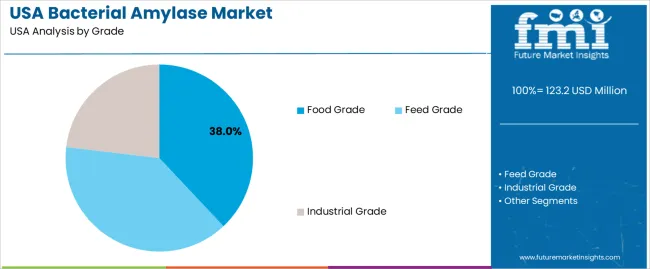
Food grade bacterial amylase accounts for 38% of total demand in the USA due to its widespread use across baking, brewing, distilling, and starch hydrolysis applications. In baking, food grade amylase improves dough handling, crumb softness, and shelf life by enhancing starch breakdown during fermentation and baking. Breweries and distilleries rely on food grade amylase to convert starch into fermentable sugars with controlled reaction kinetics. These applications require strict compliance with food safety regulations, which supports continuous demand for certified food grade enzyme products.
Food grade bacterial amylase also benefits from consistent demand in processed food manufacturing, including syrups, sweeteners, and texture modified foods. Large scale food processors require stable enzymatic performance across long production cycles. Regulatory oversight from food safety authorities reinforces reliance on certified enzyme sources. These compliances driven requirements, combined with high volume food processing activity, sustain food grade bacterial amylase as the leading grade segment in the USA.
Why Does Alpha Amylase Dominate the Bacterial Amylase Type Demand in USA?
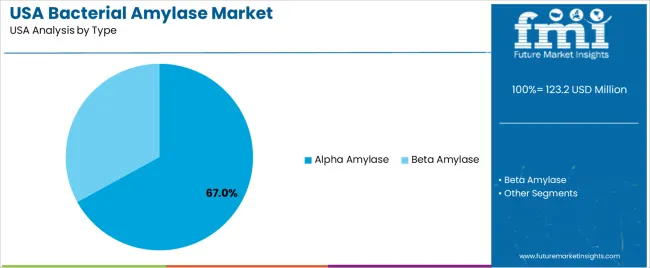
Alpha amylase accounts for 67.0% of total bacterial amylase demand in the USA due to its broad substrate range and efficient endo acting starch hydrolysis mechanism. Alpha amylase rapidly breaks internal alpha one four glycosidic bonds within starch chains, producing dextrins and oligosaccharides suitable for further enzymatic conversion. This functionality makes alpha amylase essential in baking, brewing, fermentation, and sweetener production where rapid viscosity reduction and sugar liberation are required.
Alpha amylase also performs effectively across a wide temperature and pH range, which supports use in both food and industrial starch processing. Its compatibility with liquid starch systems improves process flow and reduces energy consumption in liquefaction stages. Enzyme stability under high shear and thermal conditions further supports large scale adoption. These reaction versatility, process compatibility, and performance efficiency factors position alpha amylase as the dominant enzyme type in the USA bacterial amylase demand structure.
Why Has Bacterial Amylase Become a Backbone Enzyme in USA Industrial Food Processing?
Bacterial amylase demand in the USA is driven by its reliability under high-temperature and continuous-processing conditions common in large-scale food manufacturing. It is central to starch breakdown in baking, brewing, sweetener production, and snack processing where consistency and speed matter more than mild operating conditions. Unlike malt-derived enzymes, bacterial amylase performs under aggressive heat and pH ranges used in USA industrial plants. High-throughput cereal, corn, and grain processing facilities depend on it to maintain uniform sugar conversion rates. This technical dependence makes bacterial amylase a structural processing input rather than a discretionary formulation choice.
How Do Corn Processing, Brewing, and Baking Industries Shape Consumption Volume?
The USA corn economy heavily influences bacterial amylase consumption. Wet milling, ethanol co-products, and glucose syrup production all require controlled starch hydrolysis. Breweries use bacterial amylase for mash efficiency and fermentation consistency, especially in adjunct-heavy beer styles. Industrial bakeries apply it to control dough viscosity, crust color, and softness retention. These sectors operate at national scale with continuous batch flow, which creates stable, predictable enzyme demand. Unlike specialty enzymes with niche use, bacterial amylase is embedded into the daily operating chemistry of core USA food and beverage production.
What Cost Pressure and Processing Tradeoffs Limit Aggressive Market Expansion?
Bacterial amylase demand in the USA is restrained by enzyme optimization practices that reduce per-unit dosage over time. Process engineers continuously fine-tune temperature, retention time, and substrate loading to lower enzyme consumption without sacrificing conversion efficiency. Cost pressure from bulk food manufacturers enforces tight enzyme cost-per-ton thresholds. Some processors substitute fungal amylase in lower-temperature applications to reduce expense. Additionally, enzyme fatigue and batch variability introduce operational risk that discourages overreliance on single suppliers. These efficiency-driven controls moderate volume growth even as overall food output increases.
How Are Biofuel Refinement, Processing Automation, and Enzyme Engineering Reshaping Demand?
Bacterial amylase in the USA is increasingly shaped by advanced enzyme engineering and automated dosing systems. Refined strains now deliver higher thermal tolerance and faster liquefaction under extreme shear conditions used in ethanol and sweetener production. Automated enzyme injection synchronized with real-time viscosity sensors improves starch conversion control while minimizing waste. Co-development between enzyme suppliers and processing equipment manufacturers is tightening process integration. These changes show bacterial amylase shifting from a commodity additive into a digitally managed biochemical control input within automated USA starch-processing infrastructure.
What is the Demand for Bacterial Amylase in USA by Region?
.webp "Top Country Growth Comparison Usa Bacterial Amylase Market Cagr (2026 2036)")
| Region | CAGR (%) |
|---|---|
| West | 3.7% |
| South | 3.3% |
| Northeast | 3.0% |
| Midwest | 2.6% |
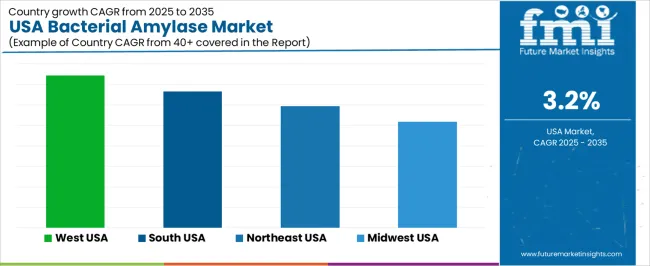
The demand for bacterial amylase in the USA shows steady regional growth, with the West leading at a 3.7% CAGR. Growth in this region is supported by strong activity in food processing, brewing, and biotechnology applications that rely on enzymatic starch conversion. The South follows at 3.3%, driven by expanding packaged food manufacturing, bakery production, and animal feed processing facilities that use amylase for efficiency gains. The Northeast records 3.0% growth, supported by stable demand from pharmaceutical, fermentation, and specialty food processors. The Midwest shows comparatively moderate growth at 2.6%, reflecting its mature starch processing and feed industries with slower incremental adoption of enzyme based processing solutions.
What Is Shaping Bacterial Amylase Demand in the West Region of USA?
Expansion in the West reflects a CAGR of 3.7% through 2036 for bacterial amylase demand, supported by active food processing, starch modification, and specialty fermentation operations across coastal industrial zones. Bakery manufacturers use bacterial amylase to improve dough handling and bread texture. Craft brewing and beverage processing also contribute to steady enzyme USAge. Bio based ingredient startups in California integrate amylase into alternative protein and functional food development. Demand remains formulation driven rather than volume driven, with purchasing aligned to consistent batch processing requirements and controlled production runs.
- Bakery processing supports routine enzyme consumption
- Beverage fermentation adds steady secondary demand
- Functional food startups drive small batch USAge
- Batch consistency governs procurement schedules
How Is the South Supporting Bacterial Amylase Demand in USA?
The South advances at a CAGR of 3.3% through 2036 for bacterial amylase demand, driven by large scale starch processing, animal feed production, and brewing operations. Corn and wheat milling facilities apply amylase for starch conversion and sweetener production. Feed manufacturers rely on bacterial amylase for digestibility improvement in poultry and livestock rations. Regional breweries also contribute modest volume. Demand remains volume oriented and price sensitive, aligned with continuous processing schedules across milling, feed compounding, and beverage production units serving agricultural and food manufacturing corridors.
- Starch processing anchors primary enzyme demand
- Feed manufacturing supports consistent bulk USAge
- Brewing operations add limited secondary volume
- Continuous processing stabilizes purchasing patterns
Why Is Bacterial Amylase Demand Growing Gradually in the Northeast Region of USA?
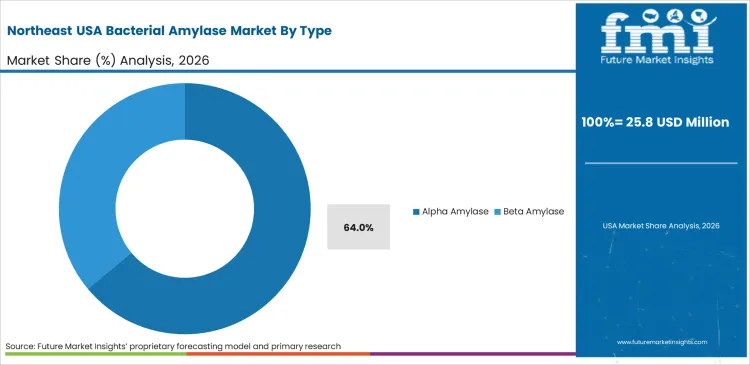
The Northeast records a CAGR of 3.0% through 2036 for bacterial amylase demand, shaped by specialty baking, food ingredient blending, and pharmaceutical excipient production. Artisan bakeries and frozen food plants maintain steady USAge for texture control and process efficiency. Limited large scale starch processing keeps demand moderate compared with other regions. Nutraceutical production also uses amylase for carbohydrate hydrolysis. Demand remains application specific rather than broad based, with steady procurement tied to small and mid sized processing facilities supplying urban foodservice and packaged food markets.
- Specialty baking supports targeted enzyme application
- Frozen foods rely on texture control functions
- Nutraceutical blending adds controlled demand volume
- Urban food plants sustain small batch procurement
What Is Influencing Bacterial Amylase Demand in the Midwest Region of USA?
The Midwest expands at a CAGR of 2.6% through 2036 for bacterial amylase demand, supported by grain milling, ethanol co product processing, and animal feed production. Corn based processing plants apply amylase in starch breakdown and fermentation preparation. Feed mills use the enzyme to improve carbohydrate utilization in livestock diets. Food grade USAge remains secondary to industrial applications. Demand remains production led and cost focused, with purchasing closely aligned to crop output cycles, grain availability, and steady operation of large scale agricultural processing infrastructure.
- Corn milling dominates industrial enzyme utilization
- Feed mills support consistent livestock nutrition demand
- Ethanol co products rely on starch conversion steps
- Crop cycles influence seasonal procurement volumes
What Is Driving the Demand for Bacterial Amylase in USA and Who Are the Key Players Shaping the Market?
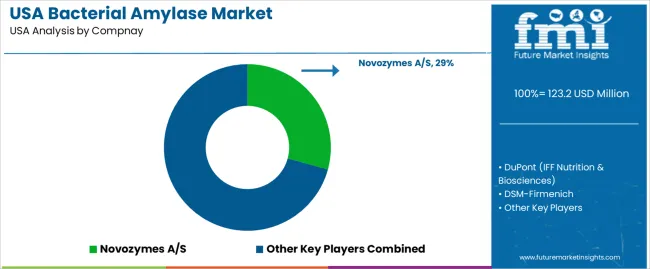
Demand for bacterial amylase in the USA is rising as food manufacturers, beverage producers, and industrial processors prefer enzymatic methods to convert starches into simpler sugars. This enzyme plays a central role in baking (improving dough consistency and extending shelf life), brewing and distilling (converting grain starches to fermentable sugars), production of syrups and sweeteners, and in sectors like detergents, paper, and biofuel where starch breakdown is required. The shift toward cleaner-label, more efficient, and scalable production processes also supports enzyme adoption. Advances in microbial fermentation technology and enzyme engineering make bacterial amylases more thermostable, pH tolerant, and cost effective than chemical alternatives, encouraging broader use across industries.
Major suppliers of bacterial amylase in the USA include Novozymes A/S, DuPont (via IFF Nutrition & Biosciences), DSM Firmenich, Amano Enzyme Inc., and AB Enzymes. These companies supply enzyme preparations optimized for large scale food processing, brewing, biofuels, and industrial starch conversion. Novozymes and DuPont are well established globally and offer a wide range of enzyme grades suited for varying industrial conditions. DSM Firmenich and Amano focus on specialty applications requiring stability under extreme processing conditions, while AB Enzymes offers specialized amylase variants tailored for niche or high efficiency use. Their presence ensures consistent supply and supports continued expansion of bacterial amylase use in the USA across multiple industrial verticals.
Key Players in Bacterial Amylase Industry in USA
- Novozymes A/S
- DuPont (IFF Nutrition & Biosciences)
- DSM-Firmenich
- Amano Enzyme Inc.
- AB Enzymes
Scope of the Report
| Metric | Value |
|---|---|
| Quantitative Units | USD 127.14 million to USD 174.22 million, at a CAGR of 3.20% |
| Market Definition | Demand for bacterial amylase in the USA covers bacterial-origin amylase enzymes for starch hydrolysis, spanning alpha and beta amylase types in food, feed, and industrial grade specifications. |
| Grade Segmentation | Food Grade, Feed Grade, Industrial Grade |
| Type Segmentation | Alpha Amylase, Beta Amylase |
| End-use Application Segmentation | Food & Beverage Industry, Textile Industry, Paper Industry, Animal Feed Industry |
| Regions Covered | West, South, Northeast, Midwest |
| Key Companies Profiled | Novozymes A/S, DuPont (IFF Nutrition & Biosciences), DSM-Firmenich, Amano Enzyme Inc., AB Enzymes |
| Forecast Period | 2026 to 2036 |
| Approach | Forecasting models apply a bottom-up methodology starting with industrial enzyme supply contract volumes and food processing consumption data, projecting the adoption rate across end-use applications in USA regions. |
Bacterial Amylase Industry in USA Segmentation
Grade:
- Food Grade
- Feed Grade
- Industrial Grade
Type:
- Alpha Amylase
- Beta Amylase
End-use Application:
- Food & Beverage Industry
- Textile Industry
- Paper Industry
- Animal Feed Industry
Region:
- Northeast USA
- West USA
- Midwest USA
- South USA
Bibliography
- United States Department of Agriculture. (2025). Corn Wet Milling and Ethanol Production Annual Report. USDA Economic Research Service.
- Environmental Protection Agency. (2024). Industrial Energy Efficiency Program Guidelines. EPA.
- American Bakers Association. (2025). Commercial Baking Industry Trends Report. ABA.
- Enzyme Technical Association. (2024). USA Industrial Enzyme Market Overview. ETA.
- Food and Drug Administration. (2024). GRAS Status Review for Bacterial Amylase Enzymes. FDA.
This bibliography is provided for reader reference. The full Future Market Insights report contains the complete reference list with primary research documentation.
Frequently Asked Questions
How large is the demand for bacterial amylase in USA in 2026?
Demand for bacterial amylase in the USA is estimated to be valued at USD 127.14 million in 2026.
What will be the market size of bacterial amylase in USA by 2036?
Market size for bacterial amylase in the USA is projected to reach USD 174.22 million by 2036.
What is the expected demand growth for bacterial amylase in USA between 2026 and 2036?
Demand for bacterial amylase in the USA is expected to grow at a CAGR of 3.20% between 2026 and 2036.
Which Grade segment leads in 2026?
Food Grade accounts for 38.0% share in 2026, driven by corn wet milling and clean-label food processing applications that require certified food-safe enzyme specifications.
Which Type segment leads?
Alpha Amylase holds 67.0% share in 2026 as starch liquefaction processes in corn wet milling and ethanol production consume the majority of bacterial amylase volumes.
Which region is growing fastest for bacterial amylase in USA?
West USA leads at 3.7% CAGR through 2036, supported by food processing facility concentration and biotech enzyme R&D infrastructure in California.
What is included in this report?
The market covers bacterial-origin alpha and beta amylase enzymes across food, feed, and industrial grades for food and beverage, textile, paper, and animal feed applications.
What is excluded from this report?
Fungal amylase, plant-derived amylase, synthetic starch-degrading chemicals, and amylase dietary supplements are excluded.
Preview the report firsthand - request a free sample
Get SampleGet the brochure for pricing and purchase details.
Get PDFTable of Content
- Executive Summary
- USA Market Outlook
- Demand-side Trends
- Supply-side Trends
- Technology Roadmap Analysis
- Analysis and Recommendations
- Market Overview
- Market Coverage / Taxonomy
- Market Definition / Scope / Limitations
- Research Methodology
- Chapter Orientation
- Analytical Lens and Working Hypotheses
- Market Structure, Signals, and Trend Drivers
- Benchmarking and Cross-market Comparability
- Market Sizing, Forecasting, and Opportunity Mapping
- Research Design and Evidence Framework
- Desk Research Programme (Secondary Evidence)
- Company Annual and Sustainability Reports
- Peer-reviewed Journals and Academic Literature
- Corporate Websites, Product Literature, and Technical Notes
- Earnings Decks and Investor Briefings
- Statutory Filings and Regulatory Disclosures
- Technical White Papers and Standards Notes
- Trade Journals, Industry Magazines, and Analyst Briefs
- Conference Proceedings, Webinars, and Seminar Materials
- Government Statistics Portals and Public Data Releases
- Press Releases and Reputable Media Coverage
- Specialist Newsletters and Curated Briefings
- Sector Databases and Reference Repositories
- FMI Internal Proprietary Databases and Historical Market Datasets
- Subscription Datasets and Paid Sources
- Social Channels, Communities, and Digital Listening Inputs
- Additional Desk Sources
- Expert Input and Fieldwork (Primary Evidence)
- Primary Modes
- Qualitative Interviews and Expert Elicitation
- Quantitative Surveys and Structured Data Capture
- Blended Approach
- Why Primary Evidence is Used
- Field Techniques
- Interviews
- Surveys
- Focus Groups
- Observational and In-context Research
- Social and Community Interactions
- Stakeholder Universe Engaged
- C-suite Leaders
- Board Members
- Presidents and Vice Presidents
- R&D and Innovation Heads
- Technical Specialists
- Domain Subject-matter Experts
- Scientists
- Physicians and Other Healthcare Professionals
- Governance, Ethics, and Data Stewardship
- Research Ethics
- Data Integrity and Handling
- Primary Modes
- Tooling, Models, and Reference Databases
- Desk Research Programme (Secondary Evidence)
- Data Engineering and Model Build
- Data Acquisition and Ingestion
- Cleaning, Normalisation, and Verification
- Synthesis, Triangulation, and Analysis
- Quality Assurance and Audit Trail
- Market Background
- Market Dynamics
- Drivers
- Restraints
- Opportunity
- Trends
- Scenario Forecast
- Demand in Optimistic Scenario
- Demand in Likely Scenario
- Demand in Conservative Scenario
- Opportunity Map Analysis
- Product Life Cycle Analysis
- Supply Chain Analysis
- Investment Feasibility Matrix
- Value Chain Analysis
- PESTLE and Porter’s Analysis
- Regulatory Landscape
- Regional Parent Market Outlook
- Production and Consumption Statistics
- Import and Export Statistics
- Market Dynamics
- USA Market Analysis 2021 to 2025 and Forecast, 2026 to 2036
- Historical Market Size Value (USD Million) Analysis, 2021 to 2025
- Current and Future Market Size Value (USD Million) Projections, 2026 to 2036
- Y-o-Y Growth Trend Analysis
- Absolute $ Opportunity Analysis
- USA Market Pricing Analysis 2021 to 2025 and Forecast 2026 to 2036
- USA Market Analysis 2021 to 2025 and Forecast 2026 to 2036, By Grade
- Introduction / Key Findings
- Historical Market Size Value (USD Million) Analysis By Grade , 2021 to 2025
- Current and Future Market Size Value (USD Million) Analysis and Forecast By Grade , 2026 to 2036
- Food Grade
- Feed Grade
- Industrial Grade
- Food Grade
- Y-o-Y Growth Trend Analysis By Grade , 2021 to 2025
- Absolute $ Opportunity Analysis By Grade , 2026 to 2036
- USA Market Analysis 2021 to 2025 and Forecast 2026 to 2036, By Type
- Introduction / Key Findings
- Historical Market Size Value (USD Million) Analysis By Type, 2021 to 2025
- Current and Future Market Size Value (USD Million) Analysis and Forecast By Type, 2026 to 2036
- Alpha Amylase
- Beta Amylase
- Alpha Amylase
- Y-o-Y Growth Trend Analysis By Type, 2021 to 2025
- Absolute $ Opportunity Analysis By Type, 2026 to 2036
- USA Market Analysis 2021 to 2025 and Forecast 2026 to 2036, By End-use Application
- Introduction / Key Findings
- Historical Market Size Value (USD Million) Analysis By End-use Application, 2021 to 2025
- Current and Future Market Size Value (USD Million) Analysis and Forecast By End-use Application, 2026 to 2036
- Food & Beverage Industry
- Textile Industry
- Paper Industry
- Animal Feed Industry
- Food & Beverage Industry
- Y-o-Y Growth Trend Analysis By End-use Application, 2021 to 2025
- Absolute $ Opportunity Analysis By End-use Application, 2026 to 2036
- USA Market Analysis 2021 to 2025 and Forecast 2026 to 2036, By Region
- Introduction
- Historical Market Size Value (USD Million) Analysis By Region, 2021 to 2025
- Current Market Size Value (USD Million) Analysis and Forecast By Region, 2026 to 2036
- West
- South
- Northeast
- Midwest
- Market Attractiveness Analysis By Region
- West Market Analysis 2021 to 2025 and Forecast 2026 to 2036, By Country
- Historical Market Size Value (USD Million) Trend Analysis By Market Taxonomy, 2021 to 2025
- Market Size Value (USD Million) Forecast By Market Taxonomy, 2026 to 2036
- By Country
- By Grade
- By Type
- By End-use Application
- By Country
- Market Attractiveness Analysis
- By Country
- By Grade
- By Type
- By End-use Application
- Key Takeaways
- South Market Analysis 2021 to 2025 and Forecast 2026 to 2036, By Country
- Historical Market Size Value (USD Million) Trend Analysis By Market Taxonomy, 2021 to 2025
- Market Size Value (USD Million) Forecast By Market Taxonomy, 2026 to 2036
- By Country
- By Grade
- By Type
- By End-use Application
- By Country
- Market Attractiveness Analysis
- By Country
- By Grade
- By Type
- By End-use Application
- Key Takeaways
- Northeast Market Analysis 2021 to 2025 and Forecast 2026 to 2036, By Country
- Historical Market Size Value (USD Million) Trend Analysis By Market Taxonomy, 2021 to 2025
- Market Size Value (USD Million) Forecast By Market Taxonomy, 2026 to 2036
- By Country
- By Grade
- By Type
- By End-use Application
- By Country
- Market Attractiveness Analysis
- By Country
- By Grade
- By Type
- By End-use Application
- Key Takeaways
- Midwest Market Analysis 2021 to 2025 and Forecast 2026 to 2036, By Country
- Historical Market Size Value (USD Million) Trend Analysis By Market Taxonomy, 2021 to 2025
- Market Size Value (USD Million) Forecast By Market Taxonomy, 2026 to 2036
- By Country
- By Grade
- By Type
- By End-use Application
- By Country
- Market Attractiveness Analysis
- By Country
- By Grade
- By Type
- By End-use Application
- Key Takeaways
- Key Countries Market Analysis
- West
- Pricing Analysis
- Market Share Analysis, 2025
- By Grade
- By Type
- By End-use Application
- South
- Pricing Analysis
- Market Share Analysis, 2025
- By Grade
- By Type
- By End-use Application
- Northeast
- Pricing Analysis
- Market Share Analysis, 2025
- By Grade
- By Type
- By End-use Application
- Midwest
- Pricing Analysis
- Market Share Analysis, 2025
- By Grade
- By Type
- By End-use Application
- West
- Market Structure Analysis
- Competition Dashboard
- Competition Benchmarking
- Market Share Analysis of Top Players
- By Regional
- By Grade
- By Type
- By End-use Application
- Competition Analysis
- Competition Deep Dive
- Novozymes A/S
- Overview
- Product Portfolio
- Profitability by Market Segments (Product/Age /Sales Channel/Region)
- Sales Footprint
- Strategy Overview
- Marketing Strategy
- Product Strategy
- Channel Strategy
- DuPont (IFF Nutrition & Biosciences)
- DSM-Firmenich
- Amano Enzyme Inc.
- AB Enzymes
- Novozymes A/S
- Competition Deep Dive
- Assumptions & Acronyms Used


