

- Industry Size (2025)
- USD 64.9 Bn
- Forecast (2035)
- USD 90.9 Bn
- CAGR (2025 to 2035)
- 3.4%
Demand for Displays in USA 2025 to 2035
Demand for displays in the USA is valued at USD 64.9 billion in 2025 and is projected to reach USD 90.9 billion by 2035, reflecting a CAGR of 3.4%. Growth is supported by continuous upgrades in consumer electronics, strong replacement cycles in televisions and smartphones, and rising demand for high-resolution panels in gaming and streaming devices. Broader adoption of advanced entertainment systems and portable screen-based lifestyles continues to sustain volume.
Liquid crystal display (LCD) technology remains the leading segment due to established fabrication infrastructure, cost efficiency, and wide compatibility across consumer devices. Manufacturers enhance brightness, refresh rate, and energy performance while integrating thinner designs suited for premium monitors, laptops, and large-format TVs. Incremental improvements in durability and image clarity maintain LCD competitiveness alongside emerging display formats.
Quick Stats for USA Displays Demand
- USA Displays Sales Value (2025): USD 64.9 billion
- USA Displays Forecast Value (2035): USD 90.9 billion
- USA Displays Forecast CAGR (2025 to 2035): 3.4%
- Leading Technology in USA Displays Demand: Liquid Crystal Display (LCD)
- Leading Vertical in USA Displays Demand: Consumers
- Key Growth Regions in USA Displays Demand: West USA, South USA, Northeast USA
- Top Players in USA Displays Demand: Samsung Display Co., Ltd.; LG Display Co., Ltd.; BOE Technology Group Co., Ltd.; AU Optronics Corp.; Innolux Corporation
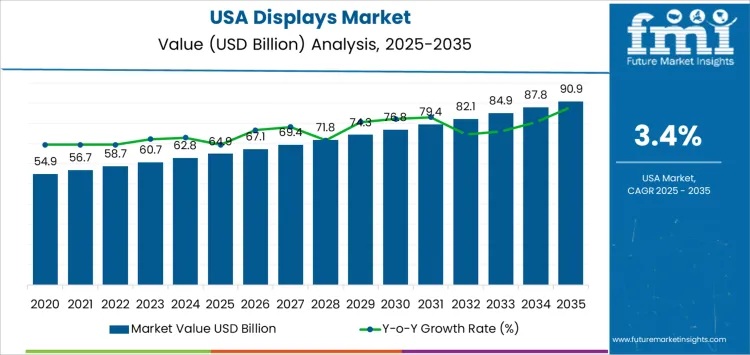
What is the Growth Forecast for Displays Industry in USA through 2035?
The West, South, and Northeast regions record strong consumption based on high disposable income and dense consumer electronics retail networks. Key players include Samsung Display Co., Ltd., LG Display Co., Ltd., BOE Technology Group Co., Ltd., AU Optronics Corp., and Innolux Corporation. Their strategies emphasize capacity optimization, supply chain resilience, and technology refinements toward high-definition displays that reinforce demand in consumer-focused applications.
Demand for displays in the United States is moving toward moderate saturation as penetration in consumer electronics reaches a high base. Households commonly own multiple screens across televisions, monitors, smartphones, tablets, and automotive infotainment systems. Replacement purchases depend on resolution upgrades, screen size preferences, and energy efficiency improvements. Incremental innovation creates motivation, although core needs are broadly fulfilled.
Commercial applications add depth through digital signage, retail interactive displays, healthcare visualization, and industrial control interfaces. These sectors extend the lifecycle of expansion, yet they scale more slowly than consumer electronics. Government and education procurement also support stability, but contribute limited acceleration.
Competition among OLED, Mini-LED, Micro-LED, and LCD technologies shapes replacement cycles. Manufacturing improvements and price normalization push premium features into midrange segments, maintaining turnover without generating rapid spikes in demand. Software ecosystems influence the useful life of software, reducing the urgency of frequent upgrades. The United States displays a mature environment with sustained but measured growth. Supply chains emphasize refresh-driven revenue rather than large-scale new adoption.
USA Displays Key Takeaways
| Metric | Value |
|---|---|
| USA Displays Sales Value (2025) | USD 64.9 billion |
| USA Displays Forecast Value (2035) | USD 90.9 billion |
| USA Displays Forecast CAGR (2025-2035) | 3.4% |
Why is the Demand for Displays in the USA Growing?
Demand for displays in the USA is increasing because businesses, institutions and individual consumers rely on large format screens for commercial, educational and entertainment purposes. Retail stores and shopping malls use digital signage displays to advertise products, promotions and services in high-traffic areas. Corporate offices and co-working spaces adopt interactive displays and video walls for conference rooms, collaboration and virtual meetings.
Education institutions deploy display systems for online learning, virtual classrooms and campus communication. Hospitals and clinics use displays for patient navigation, appointment scheduling and wayfinding, which helps improve administrative efficiency. Sporting venues and entertainment centers install large LED screens to enhance audience engagement and broadcast live events.
Home consumption remains strong. Consumers purchase high-definition TVs, computer monitors and gaming displays as demand grows for remote work, streaming media and immersive gaming experiences. Advances in display technologies such as OLED, 4K/8K resolution and high refresh rate screens encourage upgrades. Constraints include rising production costs for advanced display panels and pressure from supply-chain disruptions affecting component availability. Energy consumption regulations and electronic waste concerns influence purchasing decisions in both commercial and residential industries.
Which Display Technologies and Verticals Lead Demand for Displays in the United States?
Demand for displays in the United States reflects high content consumption, digital transformation across public spaces, and consumer preference for sharper visuals. Screen upgrades support entertainment, mobility, retail media networks, and advanced user interfaces. Strong adoption links with device replacement cycles, digital signage rollouts, and automotive cluster enhancements. Economic scale, resolution innovation, and energy performance guide technology investment across multiple commercial and personal environments.
By Technology, LCD Holds the Largest Share
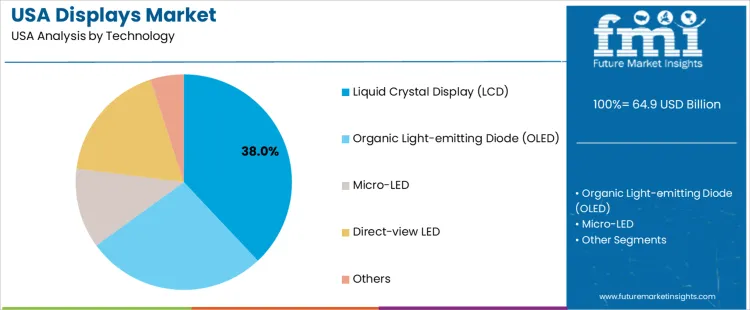
Liquid Crystal Display (LCD) accounts for 38.0%. Its prominence relates to affordability, wide distribution across consumer electronics, and compatibility with mainstream applications including smartphones, monitors, and televisions. Organic Light-Emitting Diode (OLED) holds 27.0%, supported by high contrast levels and strong adoption in flagship phones and premium entertainment screens. Direct-view LED represents 18.0%, used in signage walls and large venues requiring brightness and long-distance visibility.
Micro-LED accounts for 12.0%, driven by durability, peak luminance, and interest in seamless modular displays. Other display formats contribute 5.0%, fulfilling niche operational requirements. Technology allocation reflects screen quality needs, device cost, and physical environment demands within USA consumer and commercial settings.
Key Points:
- LCD adoption relates to budget efficiency and widespread compatibility
- OLED benefits from premium picture requirements in handheld and home displays
- Direct-view and Micro-LED applications advance in signage and large-format upgrades
By Vertical, Consumer Electronics Maintain the Largest Share
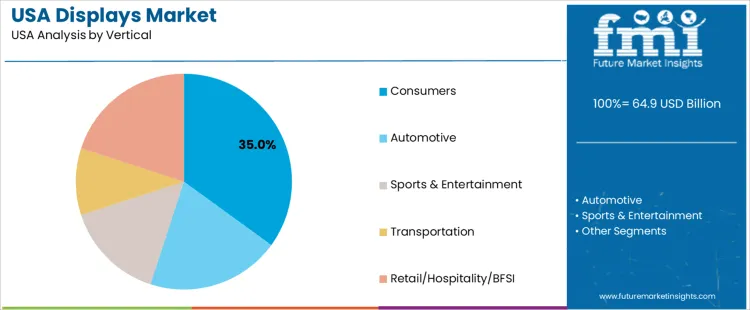
Consumer use holds 35.0%. The preference links with streaming, gaming, and ongoing enhancements in personal electronics. Automotive displays account for 20.0%, associated with infotainment screens, digital dashboards, and safety-support visuals. Retail, hospitality, and BFSI sectors collectively hold 20.0%, reflecting advertising screens, self-service kiosks, and queue-management displays. Sports and entertainment reach 15.0%, where stadiums and venues deploy immersive viewing experiences. Transportation carries 10.0% as information systems and wayfinding upgrades accelerate. Vertical segmentation aligns with rising digital engagement, interactive signage needs, and technology refreshes across operational environments in the United States.
Key Points:
- Consumer devices shape the largest share through frequent replacement cycles
- Automotive interface adoption expands with electrification and cockpit digitization
- Retail hospitality and BFSI deploy displays for public communication and service delivery
What are the Key Dynamics in the Displays Industry?
Growth of consumer electronics upgrades, expansion of commercial signage installations and increased use of advanced display interfaces in vehicles drive demand.
In the United States, consumers frequently replace smartphones, laptops and televisions as new screen technologies improve brightness, resolution and power efficiency. Retailers upgrade digital signage to enhance product visibility and support dynamic advertising across grocery, transportation hubs and entertainment venues. Automakers integrate larger infotainment screens and instrument clusters into passenger vehicles to support navigation, media and safety alerts. Education and corporate sectors add interactive displays to classrooms and meeting spaces to improve collaboration. Streaming and gaming adoption encourages purchase of higher refresh rate displays for home entertainment. These patterns sustain continuous display procurement across residential and commercial environments.
High replacement costs, supply chain fluctuation and variable demand across device categories restrain growth.
Premium televisions, smartphones and large commercial panels require significant investment, which slows purchasing in periods of economic caution. Display manufacturing depends on specialized components that face availability swings and price variation. Some consumer segments extend device lifecycles when recent models already deliver strong performance, reducing the frequency of upgrades. Small businesses may delay signage improvements when foot traffic does not guarantee return on equipment spending. These practical conditions create uneven demand in retail, automotive and consumer electronics markets.
Shift toward OLED and Mini LED technologies, increased demand for energy-efficient commercial signage and rising adoption of curved and large-format home displays define key trends.
Manufacturers expand OLED and Mini LED lines that aim for higher contrast, longer operating life and thinner profiles across premium consumer devices. Public spaces and retail stores seek energy-efficient displays to meet operating cost targets and sustainability goals. Home entertainment setups add ultra-wide or wall-sized displays that support immersive content and multi-device streaming. Touch-capable and glare-reducing surfaces grow in education and workplace applications focused on interactive learning and hybrid meetings. Supply diversification into domestic assembly and regional component sourcing supports stability in commercial display deployment. These developments indicate strong, technology-driven demand for displays across the United States supported by digital engagement in homes, businesses and mobility settings.
Analysis of the Demand for Displays in the USA by Region
Demand for displays in the United States increases as consumers and enterprises upgrade visual interfaces used in televisions, laptops, smartphones, digital signage, medical monitors, and automotive dashboards. Display technology investments improve clarity, power efficiency, and durability. Expanded deployment in retail, hospitality, and transportation strengthens commercial display installation.
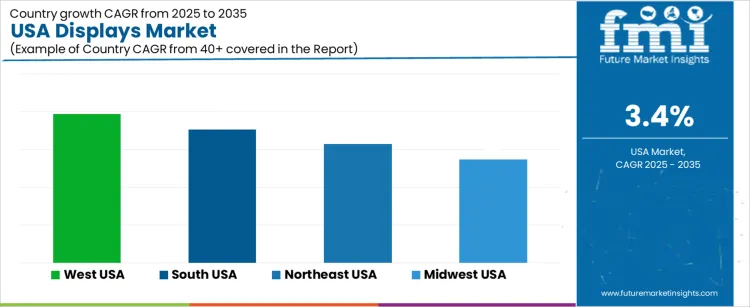
Residential users continue to replace legacy screens with newer models offering higher resolution. West USA leads with 3.9% CAGR, followed by South USA at 3.5%, Northeast USA at 3.1%, and Midwest USA at 2.7%. Growth trends align with electronics manufacturing footprints, retail purchasing habits, screen-based media consumption, and technology refresh cycles across different economic regions.
| Region | CAGR (2025-2035) |
|---|---|
| West USA | 3.9% |
| South USA | 3.5% |
| Northeast USA | 3.1% |
| Midwest USA | 2.7% |
How is the West USA driving demand for displays?
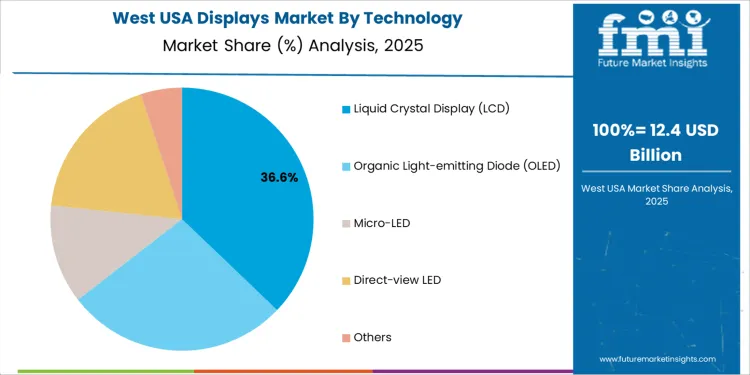
West USA reaches 3.9% CAGR, powered by strong electronics adoption in California, Washington, and nearby digital-economy hubs. Display upgrades support remote-work infrastructure, gaming culture, and streaming media consumption. Commercial facilities increase investments in interactive signage for visitor navigation and promotional communication. Technology companies in Silicon Valley experiment with display enhancements that support developer testing environments.
Households maintain regular replacement cycles tied to entertainment upgrades and smart-home integration. Corporate campuses utilize advanced monitors for visualization of design, engineering, and cybersecurity tasks. Retail buyers evaluate image brightness, refresh performance, and panel longevity to support continuous operation schedules. Distribution channels deliver rapid rollout of new panel categories such as OLED, mini-LED, and quantum-dot displays.
- Streaming adoption sustaining home-display purchases
- Corporate monitoring needs boosting commercial screens
- Smart-home expansion influencing panel upgrades
- Rapid rollout of new screen formats energizing demand
How is the South USA shaping display consumption?
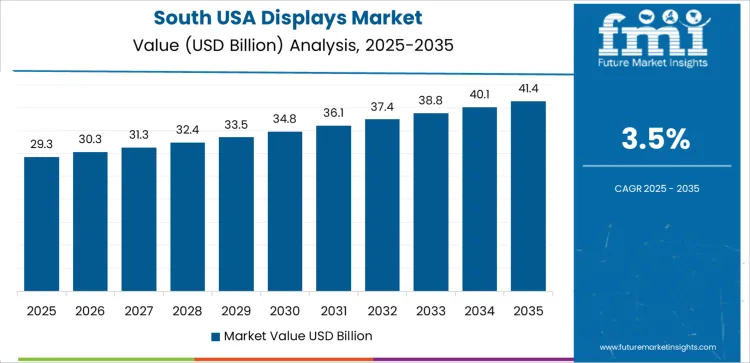
South USA posts 3.5% CAGR, supported by retail expansion, household construction, and strong electronics purchasing in Texas and Florida. Displays remain standard across education environments where digital boards replace traditional chalk and marker boards. Hospitality projects maintain screen installation in hotel rooms, resort venues, and entertainment corridors. Consumers show interest in affordable displays delivering wide-angle viewing for family-room setups. Distribution relies on regional logistics hubs that ensure consistent supply for mass-market electronics retail. Buyers monitor durability and warranty services aligned with high-usage environments. Businesses integrate digital menu boards and signage that improve sales engagement at food chains and convenience outlets.
- Large retail presence shaping mass electronics availability
- Education environments accelerating digital board deployment
- Hospitality investment supporting screen installations
- Suburban consumer spending uplifting home-display sales
How is the Northeast USA influencing adoption levels?
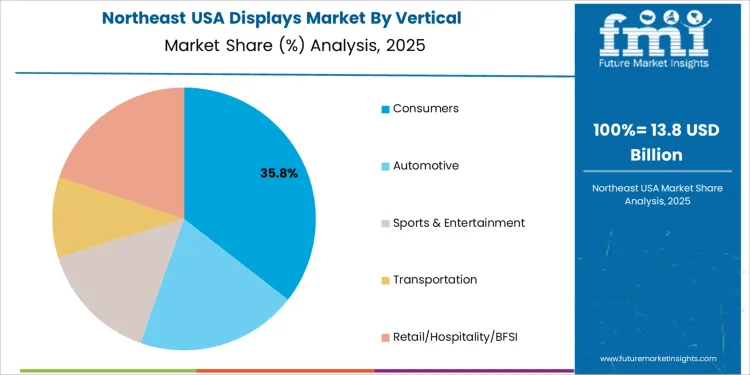
Northeast USA maintains 3.1% CAGR, linked to commercial office demand and high personal-device ownership in New York, New Jersey, and Massachusetts. Urban consumers upgrade portable displays used in commuting routines, desktop setups, and multi-screen workstations. High-resolution medical monitors support healthcare delivery across major hospitals. Universities adopt advanced screen systems for lecture halls and simulation labs. Retailers deploy immersive signage to capture attention in dense shopping districts. Procurement priorities include accurate color reproduction and compact installation that suits limited interior formats. Smart-city transportation systems rely on digital passenger displays that update routing information across major transit lines.
- Healthcare imaging solutions lifting professional-grade demand
- Multi-screen workstations driving workstation display upgrades
- Transit networks installing dynamic passenger displays
- Urban retail adopting high-resolution promotional screens
How is the Midwest USA contributing to national demand?
Midwest USA grows at 2.7% CAGR, supported by institutional spending in manufacturing training, warehousing operations, and government service centers across Illinois, Ohio, and Michigan. Display adoption supports operational dashboards for quality monitoring and production visualization on factory floors. Households prioritize practical display purchases with long lifecycles and stable pricing. Schools integrate reliable presentation screens used in standardized classroom layouts. Public venues operate durable signage systems for events and facility navigation. Buyers emphasize energy efficiency, glare reduction, and straightforward device setup. Distributors ensure stable supply rather than frequent model turnover.
- Manufacturing dashboards maintaining enterprise need
- Education environments reinforcing routine purchases
- Public signage guiding visitor access at civic sites
- Value-focused buying influencing product preferences
What is the competitive landscape of demand for displays in the United States?
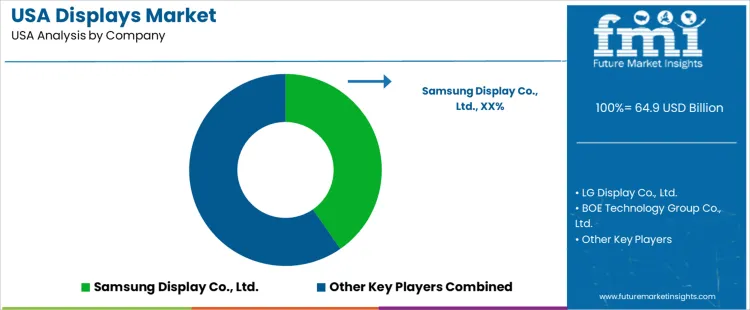
Demand for display panels in the United States depends on manufacturers’ ability to supply high-quality LCD, OLED, and mini-LED panels that meet resolution, color accuracy, and energy-efficiency expectations of TV, monitor, and mobile-device producers. Providers with strong manufacturing capacity, reliable supply chains, and technical support for different panel formats dominate adoption across consumer electronics and commercial displays.
Samsung Display Co., Ltd. leads with an estimated 40.4% share. Its broad portfolio of OLED and high-end LCD panels, plus flexible and large-format solutions, aligns with major USA device brands that require premium display quality and frequent supply replenishment. LG Display Co., Ltd. competes through OLED sheets and high-performance LCD panels used in TVs and monitors emphasizing color accuracy and contrast for entertainment and professional use.
BOE Technology Group Co., Ltd. captures share by offering cost-effective panels at scale, supplying mid-range to entry-level displays that balance performance and price attractive to budget device manufacturers serving broad USA consumer segments. AU Optronics Corp. participates through mid-size and industrial-specification panels used in monitors, point-of-sale systems, and office equipment where durability and steady supply matter. Innolux Corporation supports segments requiring thin-film and high-refresh panels common in portable devices and secondary displays. Panel buyers focus on production consistency, defect rates, compliance with USA environmental and safety standards, and global logistics reliability. Suppliers capable of fulfilling bulk orders while maintaining quality certification remain best positioned in USA display demand.
Key Players in USA Displays Demand
- Samsung Display Co., Ltd.
- LG Display Co., Ltd.
- BOE Technology Group Co., Ltd.
- AU Optronics Corp.
- Innolux Corporation
Scope of the Report
| Items | Values |
|---|---|
| Quantitative Units | USD billion |
| Technology | Liquid Crystal Display (LCD), Organic Light-emitting Diode (OLED), Micro-LED, Direct-view LED, Others |
| Vertical | Consumers, Automotive, Sports & Entertainment, Transportation, Retail/Hospitality/BFSI |
| Panel Size | Large Panels, Small & Medium-sized Panels, Microdisplays |
| Regions Covered | West USA, South USA, Northeast USA, Midwest USA |
| Key Companies Profiled | Samsung Display Co., Ltd., LG Display Co., Ltd., BOE Technology Group Co., Ltd., AU Optronics Corp., Innolux Corporation |
| Additional Attributes | Dollar sales by technology and panel size; regional adoption trends across West, South, Northeast, and Midwest USA; demand growth driven by consumer electronics refresh cycles, automotive cockpit displays, and large-venue LED installations; competitive positioning in high-brightness outdoor displays, flexible OLED integration, and Micro-LED commercialization for premium devices; supply chain dynamics including substrate innovation, energy-efficient backlighting, and integration partnerships with device OEMs. |
USA Displays Demand by Segments
Technology:
- Liquid Crystal Display (LCD)
- Organic Light-emitting Diode (OLED)
- Micro-LED
- Direct-view LED
- Others
Vertical:
- Consumers
- Automotive
- Sports & Entertainment
- Transportation
- Retail/Hospitality/BFSI
Panel Size:
- Large Panels
- Small & Medium-sized Panels
- Microdisplays
Region:
- West USA
- South USA
- Northeast USA
- Midwest USA
Frequently Asked Questions
How big is the demand for displays in USA in 2025?
The demand for displays in USA is estimated to be valued at USD 64.9 billion in 2025.
What will be the size of displays in USA in 2035?
The market size for the displays in USA is projected to reach USD 90.9 billion by 2035.
How much will be the demand for displays in USA growth between 2025 and 2035?
The demand for displays in USA is expected to grow at a 3.4% CAGR between 2025 and 2035.
What are the key product types in the displays in USA?
The key product types in displays in USA are liquid crystal display (lcd), organic light-emitting diode (oled), micro-led, direct-view led and others.
Which vertical segment is expected to contribute significant share in the displays in USA in 2025?
In terms of vertical, consumers segment is expected to command 35.0% share in the displays in USA in 2025.
Preview the report firsthand - request a free sample
Get SampleGet the brochure for pricing and purchase details.
Get PDFTable of Content
- Executive Summary
- USA Market Outlook
- Demand-side Trends
- Supply-side Trends
- Technology Roadmap Analysis
- Analysis and Recommendations
- Market Overview
- Market Coverage / Taxonomy
- Market Definition / Scope / Limitations
- Market Background
- Market Dynamics
- Drivers
- Restraints
- Opportunity
- Trends
- Scenario Forecast
- Demand in Optimistic Scenario
- Demand in Likely Scenario
- Demand in Conservative Scenario
- Opportunity Map Analysis
- Product Life Cycle Analysis
- Supply Chain Analysis
- Investment Feasibility Matrix
- Value Chain Analysis
- PESTLE and Porter’s Analysis
- Regulatory Landscape
- Regional Parent Market Outlook
- Production and Consumption Statistics
- Import and Export Statistics
- Market Dynamics
- USA Market Analysis 2020 to 2024 and Forecast, 2025 to 2035
- Historical Market Size Value (USD Million) Analysis, 2020 to 2024
- Current and Future Market Size Value (USD Million) Projections, 2025 to 2035
- Y-o-Y Growth Trend Analysis
- Absolute $ Opportunity Analysis
- USA Market Pricing Analysis 2020 to 2024 and Forecast 2025 to 2035
- USA Market Analysis 2020 to 2024 and Forecast 2025 to 2035, By Technology
- Introduction / Key Findings
- Historical Market Size Value (USD Million) Analysis By Technology , 2020 to 2024
- Current and Future Market Size Value (USD Million) Analysis and Forecast By Technology , 2025 to 2035
- Liquid Crystal Display (LCD)
- Organic Light-emitting Diode (OLED)
- Micro-LED
- Direct-view LED
- Others
- Y-o-Y Growth Trend Analysis By Technology , 2020 to 2024
- Absolute $ Opportunity Analysis By Technology , 2025 to 2035
- USA Market Analysis 2020 to 2024 and Forecast 2025 to 2035, By Vertical
- Introduction / Key Findings
- Historical Market Size Value (USD Million) Analysis By Vertical, 2020 to 2024
- Current and Future Market Size Value (USD Million) Analysis and Forecast By Vertical, 2025 to 2035
- Consumers
- Automotive
- Sports & Entertainment
- Transportation
- Retail/Hospitality/BFSI
- Y-o-Y Growth Trend Analysis By Vertical, 2020 to 2024
- Absolute $ Opportunity Analysis By Vertical, 2025 to 2035
- USA Market Analysis 2020 to 2024 and Forecast 2025 to 2035, By Panel Size
- Introduction / Key Findings
- Historical Market Size Value (USD Million) Analysis By Panel Size, 2020 to 2024
- Current and Future Market Size Value (USD Million) Analysis and Forecast By Panel Size, 2025 to 2035
- Large Panels
- Small & Medium-sized Panels
- Microdisplays
- Y-o-Y Growth Trend Analysis By Panel Size, 2020 to 2024
- Absolute $ Opportunity Analysis By Panel Size, 2025 to 2035
- Market Structure Analysis
- Competition Dashboard
- Competition Benchmarking
- Market Share Analysis of Top Players
- By Regional
- By Technology
- By Vertical
- By Panel Size
- Competition Analysis
- Competition Deep Dive
- Samsung Display Co., Ltd.
- Overview
- Product Portfolio
- Profitability by Market Segments (Product/Age /Sales Channel/Region)
- Sales Footprint
- Strategy Overview
- Marketing Strategy
- Product Strategy
- Channel Strategy
- LG Display Co., Ltd.
- BOE Technology Group Co., Ltd.
- AU Optronics Corp.
- Innolux Corporation
- Samsung Display Co., Ltd.
- Competition Deep Dive
- Assumptions & Acronyms Used
- Research Methodology


