

- Industry Size (2026)
- USD 4.9 Mn
- Forecast (2036)
- USD 7.3 Mn
- CAGR (2026 to 2036)
- 4.1%
Demand for Food Grade Titanium Dioxide in USA 2026 to 2036
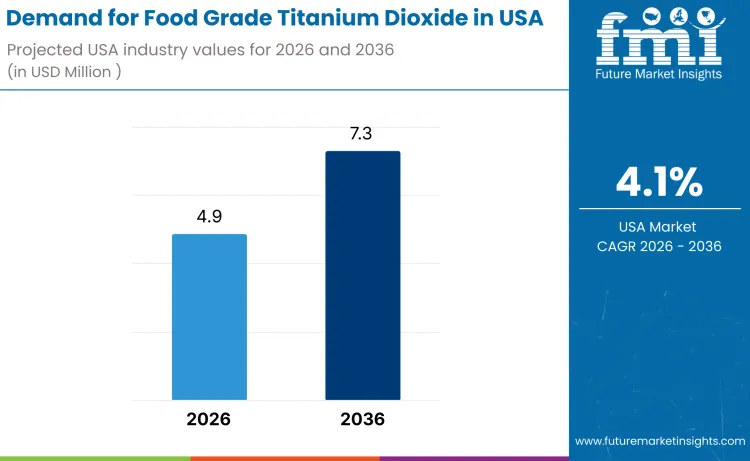
Demand for food grade titanium dioxide in USA is valued at USD 4.9 million in 2026 and is projected to reach USD 7.3 million by 2036, reflecting a CAGR of 4.1%. Demand remains supported by continued use of titanium dioxide as a whitening and opacifying agent in confectionery, bakery decorations, sauces, and processed food coatings. Stable consumption persists despite regulatory scrutiny, as manufacturers focus on controlled usage levels and compliance with food safety standards.
Micro-scale pigments lead form usage because fine particle size delivers uniform brightness, high opacity, and consistent dispersion across dry and liquid food matrices. Food processors rely on micro-scale grades for visual consistency, shelf appeal, and formulation stability without altering taste or texture. Tight control over particle distribution and impurity levels strengthens suitability for regulated food applications.
Quick Stats for Demand for Food Grade Titanium Dioxide in USA
- USA Food Grade Titanium Dioxide Sales Value (2026): USD 4.9 million
- USA Food Grade Titanium Dioxide Forecast Value (2036): USD 7.3 million
- USA Food Grade Titanium Dioxide Forecast CAGR (2026 to 2036): 4.1%
- Leading Form in USA Demand: Micro-scale pigments
- Key Growth Regions in USA Demand: West USA, South USA, Northeast USA, Midwest USA
- Top Players in USA Demand: Chemours, Tronox, Kronos Worldwide, Venator Materials, Ishihara Corporation of America
West USA, South USA, Northeast USA, and Midwest USA represent key growth regions due to concentrated food processing clusters and large-scale packaged food manufacturing. Chemours, Tronox, Kronos Worldwide, Venator Materials, and Ishihara Corporation of America anchor competitive activity through food-grade purification capabilities, regulatory-aligned production processes, and reliable supply networks supporting consistent quality requirements across USA food manufacturing operations.
USA Food Grade Titanium Dioxide Key Takeaways
| Metric | Value |
|---|---|
| USA Food Grade Titanium Dioxide Sales Value (2026) | USD 4.9 million |
| USA Food Grade Titanium Dioxide Forecast Value (2036) | USD 7.3 million |
| USA Food Grade Titanium Dioxide Forecast CAGR (2026 to 2036) | 4.1% |
How Are the Segments Classified in the Demand for Food Grade Titanium Dioxide in the USA?
Demand for food grade titanium dioxide in the USA is shaped by visual appearance requirements, formulation stability needs, and regulatory oversight on food additives. Food manufacturers evaluate particle size, dispersion performance, opacity, and consistency across processed food categories. Adoption patterns reflect continued use in bakery, confectionery, and savoury products where colour uniformity and visual appeal influence consumer acceptance, while manufacturers align sourcing with approved extraction processes and quality specifications.
Which Form Accounts for the Largest Share of Demand in the USA?
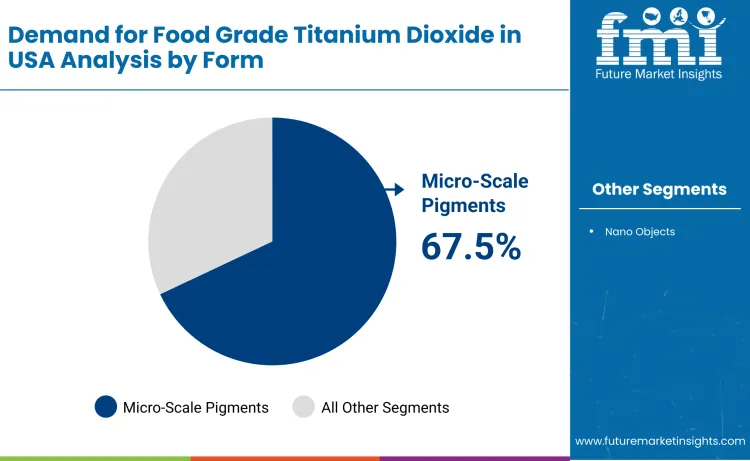
Micro-scale pigments hold 67.5%, making them the leading form segment in the USA. These pigments provide effective whitening, opacity, and colour uniformity across bakery, confectionery, and savoury food formulations. Micro-scale particles are preferred due to established processing behaviour, predictable dispersion, and compatibility with existing manufacturing lines. Nano objects hold 32.5%, serving applications requiring finer particle distribution and enhanced surface coverage. Form distribution reflects stronger reliance on micro-scale pigments due to regulatory familiarity, handling simplicity, and consistent performance across large-scale USA food processing environments.
Key Points:
- Micro-scale pigments dominate due to stable dispersion and opacity.
- Established processing compatibility supports wide adoption.
- Nano objects serve niche formulations requiring finer coverage.
Which Extraction Method Accounts for the Largest Share of Demand in the USA?
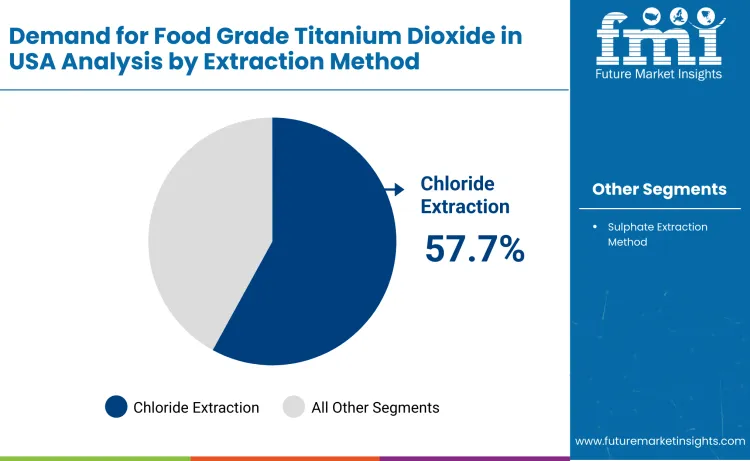
Chloride extraction method holds 57.7%, making it the leading extraction-method segment in the USA. This method produces high-purity titanium dioxide with controlled particle characteristics and lower impurity levels. Manufacturers prefer chloride-based material for consistent quality and alignment with food-grade specifications. Sulphate extraction method holds 42.3%, supporting cost-sensitive applications and diversified sourcing strategies. Extraction-method distribution reflects preference for chloride-derived titanium dioxide due to purity control and consistency required in regulated USA food manufacturing.
Key Points:
- Chloride extraction delivers high-purity food-grade material.
- Consistent particle quality supports regulated applications.
- Sulphate extraction serves secondary and cost-sensitive demand.
Which Application Accounts for the Largest Share of Demand in the USA?
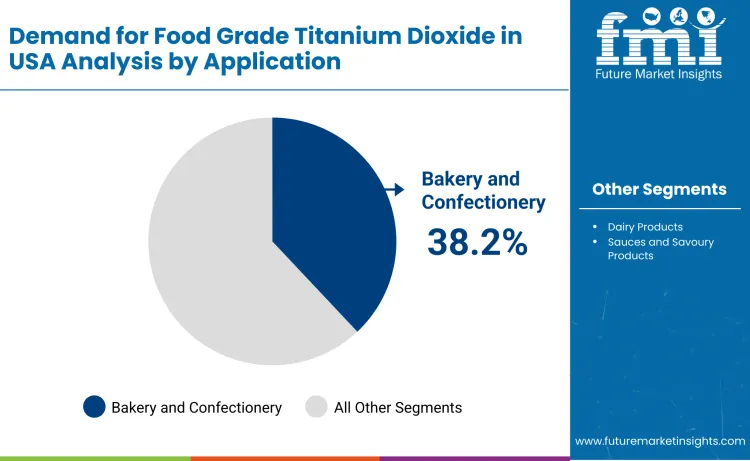
Bakery and confectionery applications hold 38.2%, making them the leading application segment in the USA. Food grade titanium dioxide is used to enhance brightness, coating uniformity, and decorative appearance in icings, fillings, and sugar-based products. Sauces and savoury products hold 29.0%, using titanium dioxide to improve colour consistency and visual opacity. Dairy products account for 12.8%, applying controlled amounts in specific formulations. Other applications hold 20.0%, covering specialty and niche food products. Application distribution reflects strong emphasis on visual quality within bakery and confectionery production.
Key Points:
- Bakery and confectionery drive primary demand due to visual requirements.
- Sauces and savoury foods rely on colour consistency.
- Dairy and niche foods represent controlled secondary usage.
What are the Key Dynamics in the Food Grade Titanium Dioxide Industry in USA?
Demand remains established across food processing, confectionery, bakery, and dairy manufacturing in the USA. Food grade titanium dioxide is used for whitening, opacity, and visual uniformity in processed foods. Usage aligns with FDA approvals and defined purity specifications. Consumption reflects industrial formulation practices, shelf-appeal requirements, and consistency standards within large-scale food manufacturing environments rather than discretionary consumer-driven demand.
How do food appearance standards and large-scale processing requirements drive demand in USA?
US food manufacturers use food grade titanium dioxide to achieve uniform whiteness and brightness in products such as confectionery coatings, chewing gum, bakery icings, sauces, and powdered mixes. Visual consistency remains critical for brand recognition and consumer acceptance across mass-market packaged foods. Titanium dioxide offers high opacity at low inclusion rates, supporting cost-efficient formulation. Stability under heat and light enables use in baked and processed applications. FDA approval under specified conditions supports continued industrial use. Centralised food manufacturing facilities rely on predictable performance to maintain batch-to-batch uniformity across national distribution networks.
How do regulatory scrutiny, consumer perception, and reformulation pressure influence demand stability?
Ongoing scientific review of titanium dioxide safety influences formulation strategies among US food producers. Consumer concern regarding artificial additives encourages selective reformulation in certain product categories. Some manufacturers evaluate alternative whitening agents, which may affect usage volumes. Labelling transparency requirements increase internal compliance oversight. Supply chain dependence on mining and pigment processing introduces cost sensitivity. Reformulation timelines require validation of colour, texture, and shelf stability when alternatives are considered. Demand remains concentrated in applications where performance requirements outweigh substitution risk, while future growth faces constraints linked to regulatory monitoring and evolving clean-label preferences in the USA.
How Is Demand for Food Grade Titanium Dioxide in USA Evolving by Region?
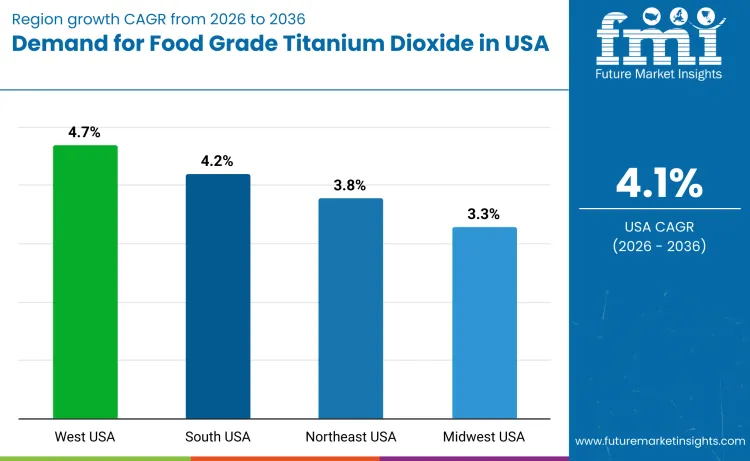
Demand for food grade titanium dioxide in the USA is showing measured growth due to continued use in confectionery, bakery, dairy analogues, and pharmaceutical coatings, despite rising regulatory scrutiny. West USA leads apparent regional growth with a 4.7% CAGR, supported by specialty food manufacturing, nutraceutical production, and formulation-intensive segments. South USA follows at 4.2%, driven by large-scale confectionery, bakery mixes, and pharmaceutical solid-dosage manufacturing. Northeast USA records a 3.8% CAGR, shaped by regulatory compliance costs, reformulation timelines, and controlled-use applications. Midwest USA posts a 3.3% CAGR, reflecting stable demand from packaged foods, coatings, and contract manufacturing. Regional variation reflects food-manufacturing concentration, reformulation pace, and regulatory risk management across the USA.
| Region | CAGR (2026 to 2036) |
|---|---|
| West USA | 4.7% |
| South USA | 4.2% |
| Northeast USA | 3.8% |
| Midwest USA | 3.3% |
How is West USA driving demand for Food Grade Titanium Dioxide?
West USA demand is shaped by formulation-driven food innovation and pharmaceutical-grade processing environments. The region’s CAGR of 4.7% reflects continued use of food grade titanium dioxide as an opacifier and whitening agent in chewing gum, confectionery coatings, dairy alternatives, and nutritional supplements. Manufacturers prioritize consistent particle size distribution and low heavy-metal content to meet internal quality standards. Nutraceutical and supplement producers use titanium dioxide in capsule shells and tablet coatings for visual uniformity. Demand favors tightly controlled, traceable grades supplied in smaller, high-purity packaging formats. Adoption remains selective, focused on products where visual appearance directly influences consumer acceptance.
- Confectionery and chewing gum coating applications
- Nutraceutical capsules and tablet coatings
- Preference for high-purity, traceable grades
- Small-to-mid volume packaging for controlled dosing
How is South USA driving demand for Food Grade Titanium Dioxide?
South USA demand is volume-oriented and linked to large-scale food and pharmaceutical manufacturing. The region’s CAGR of 4.2% reflects use of food grade titanium dioxide in bakery icings, dessert mixes, sauces, and solid oral dosage pharmaceuticals. Large manufacturing facilities continue usage due to process familiarity and cost efficiency. Pharmaceutical plants apply titanium dioxide in film coatings for light protection and product differentiation. Procurement emphasizes supply continuity, batch consistency, and compatibility with automated coating systems. Bulk packaging formats dominate demand, aligned with continuous production schedules and centralized quality control.
- Bakery, icing, and dessert mix usage
- Pharmaceutical tablet and capsule coatings
- Bulk procurement for high-throughput facilities
- Emphasis on consistency and process compatibility
How is Northeast USA driving demand for Food Grade Titanium Dioxide?
Northeast USA demand reflects regulatory sensitivity, reformulation evaluation, and controlled application scope. The region’s CAGR of 3.8% is supported by selective use in pharmaceuticals, specialty foods, and legacy product lines. Food manufacturers increasingly restrict titanium dioxide use to applications where alternatives compromise functionality or stability. Pharmaceutical producers maintain demand for approved coating grades with validated safety documentation. Procurement favors certified suppliers offering detailed toxicological data and traceability. Growth remains cautious, influenced by compliance reviews, labeling considerations, and reformulation lead times.
- Pharmaceutical coating applications
- Specialty food products with appearance requirements
- Demand for certified, documentation-supported grades
- Cautious adoption due to regulatory review processes
How is Midwest USA driving demand for Food Grade Titanium Dioxide?
Midwest USA demand is stable and manufacturing-centric, reflecting established packaged food and contract manufacturing activity. The region’s CAGR of 3.3% reflects use of food grade titanium dioxide in cereals, snack coatings, powdered mixes, and pharmaceutical contract manufacturing. Producers emphasize cost control, supply reliability, and compatibility with existing coating and blending equipment. Limited innovation-driven usage constrains growth, while replacement demand sustains baseline consumption. Packaging formats favor standard bags and drums aligned with predictable production volumes. Demand growth remains modest due to gradual exploration of alternative whitening agents.
- Packaged food and cereal coating usage
- Contract pharmaceutical manufacturing applications
- Cost-sensitive and reliability-focused procurement
- Stable demand tied to existing product portfolios
What is the competitive landscape of demand for food grade titanium dioxide in the USA?
Demand for food grade titanium dioxide in the USA is driven by use as a whitening and opacity agent in confectionery, bakery coatings, dairy analogs, sauces, and pharmaceutical excipients. Applications require controlled particle size, low heavy-metal content, and compliance with FDA food additive specifications. Buyers evaluate brightness, dispersion behavior, moisture sensitivity, and consistency across batches used in high-throughput processing lines. Procurement teams prioritize domestic supply reliability, documentation supporting food-contact compliance, and technical assistance for formulation stability. Trend in the USA market reflects steady consumption in processed foods, continued pharmaceutical use, and heightened scrutiny around purity and manufacturing controls.
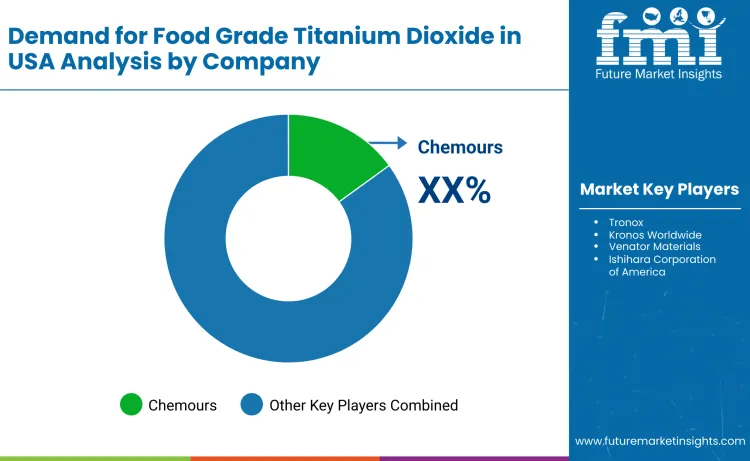
Chemours operates major USA production assets supplying food and pharma grade titanium dioxide with established quality systems and regulatory documentation. Tronox maintains USA manufacturing and distribution supporting food-grade applications requiring consistent optical performance. Kronos Worldwide supplies titanium dioxide grades used in food and pharmaceutical formulations through USA-based operations and distributors. Venator Materials participates via specialty titanium dioxide products supported by technical service teams serving regulated end uses. Ishihara Corporation of America supports niche food-grade and pharmaceutical demand through USA sales and quality-controlled imports aligned with domestic standards. Competitive positioning in the USA reflects manufacturing footprint, regulatory compliance capability, particle engineering expertise, and dependable logistics for regulated food and pharmaceutical customers.
Key Players in USA Food Grade Titanium Dioxide Demand
- Chemours
- Tronox
- Kronos Worldwide
- Venator Materials
- Ishihara Corporation of America
Scope of the Report
| Items | Values |
|---|---|
| Quantitative Units | USD billion |
| Form | Micro-scale Pigments; Nano Objects |
| Extraction Method | Chloride Extraction Method; Sulphate Extraction Method |
| Application | Bakery and Confectionery; Dairy Products; Sauces and Savoury Products; Others |
| Regions Covered | West USA; South USA; Northeast USA; Midwest USA |
| Key Companies Profiled | Chemours; Tronox; Kronos Worldwide; Venator Materials; Ishihara Corporation of America |
| Additional Attributes | Dollar sales by form, extraction method, and application; micro-scale pigments dominate regulated food usage; dairy and confectionery remain primary consumption segments; demand shaped by formulation stability needs and regulatory scrutiny; regional demand aligns with processed food manufacturing density and reformulation activity across major food-producing states. |
USA Food Grade Titanium Dioxide Demand by Segments
Form
- Micro-scale Pigments
- Nano Objects
Extraction Method
- Chloride Extraction Method
- Sulphate Extraction Method
Application
- Bakery and Confectionery
- Dairy Products
- Sauces and Savoury Products
- Others
Region:
- West USA
- South USA
- Northeast USA
- Midwest USA
Frequently Asked Questions
How big is the demand for food grade titanium dioxide in USA in 2026?
The demand for food grade titanium dioxide in USA is estimated to be valued at USD 4.9 million in 2026.
What will be the size of food grade titanium dioxide demand in USA in 2036?
The demand size for food grade titanium dioxide in USA is projected to reach USD 7.3 million by 2036.
How much will the demand for food grade titanium dioxide in USA grow between 2026 and 2036?
The demand for food grade titanium dioxide in USA is expected to grow at a 4.1% CAGR between 2026 and 2036.
What are the key forms in the food grade titanium dioxide demand in USA?
The key forms in food grade titanium dioxide demand in USA include micro-scale pigments and other food-grade pigment formats.
Which extraction-method segment is expected to contribute a significant share in the food grade titanium dioxide demand in USA in 2026?
In terms of extraction method, chloride extraction method is expected to command 57.7% share in the food grade titanium dioxide demand in USA in 2026.
Preview the report firsthand - request a free sample
Get SampleGet the brochure for pricing and purchase details.
Get PDFTable of Content
- Executive Summary
- USA Market Outlook
- Demand Side Trends
- Supply Side Trends
- Technology Roadmap Analysis
- Analysis and Recommendations
- Market Overview
- Market Coverage and Taxonomy
- Market Definition, Scope, and Limitations
- Market Background
- Market Dynamics
- Drivers
- Restraints
- Opportunities
- Trends
- Scenario Forecast
- Demand in Optimistic Scenario
- Demand in Likely Scenario
- Demand in Conservative Scenario
- Opportunity Map Analysis
- Product Life Cycle Analysis
- Supply Chain Analysis
- Investment Feasibility Matrix
- Value Chain Analysis
- PESTLE and Porter Analysis
- Regulatory Landscape
- Regional Parent Market Outlook
- Production and Consumption Statistics
- Import and Export Statistics
- USA Food Grade Titanium Dioxide Demand Analysis 2020 to 2024 and Forecast 2025 to 2035
- Historical Market Size Value (USD Million) Analysis 2020 to 2024
- Current and Future Market Size Value (USD Million) Projections 2025 to 2035
- Year to Year Growth Trend Analysis
- Absolute Dollar Opportunity Analysis
- USA Food Grade Titanium Dioxide Pricing Analysis 2020 to 2024 and Forecast 2025 to 2035
- USA Food Grade Titanium Dioxide Demand Analysis 2020 to 2024 and Forecast 2025 to 2035, By Form
- Introduction and Key Findings
- Historical Market Size Value (USD Million) Analysis By Form 2020 to 2024
- Current and Future Market Size Value (USD Million) Analysis and Forecast By Form 2025 to 2035
- Micro-scale Pigments
- Nano Objects
- Year to Year Growth Trend Analysis By Form 2020 to 2024
- Absolute Dollar Opportunity Analysis By Form 2025 to 2035
- USA Food Grade Titanium Dioxide Demand Analysis 2020 to 2024 and Forecast 2025 to 2035, By Extraction Method
- Introduction and Key Findings
- Historical Market Size Value (USD Million) Analysis By Extraction Method 2020 to 2024
- Current and Future Market Size Value (USD Million) Analysis and Forecast By Extraction Method 2025 to 2035
- Chloride Extraction Method
- Sulphate Extraction Method
- Year to Year Growth Trend Analysis By Extraction Method 2020 to 2024
- Absolute Dollar Opportunity Analysis By Extraction Method 2025 to 2035
- USA Food Grade Titanium Dioxide Demand Analysis 2020 to 2024 and Forecast 2025 to 2035, By Application
- Introduction and Key Findings
- Historical Market Size Value (USD Million) Analysis By Application 2020 to 2024
- Current and Future Market Size Value (USD Million) Analysis and Forecast By Application 2025 to 2035
- Bakery and Confectionery
- Dairy Products
- Sauces and Savoury Products
- Other Applications
- Year to Year Growth Trend Analysis By Application 2020 to 2024
- Absolute Dollar Opportunity Analysis By Application 2025 to 2035
- Market Structure Analysis
- Competition Dashboard
- Competition Benchmarking
- Market Share Analysis of Key Players
- By Form
- By Extraction Method
- By Application
- By Region
- Competition Analysis
- Competition Deep Dive
- Chemours
- Tronox
- Kronos Worldwide
- Venator Materials
- Ishihara Corporation of America
- Assumptions and Acronyms Used
- Research Methodology


