

- Industry Size (2025)
- USD 87.1 Mn
- Forecast (2035)
- USD 212.1 Mn
- CAGR (2025 to 2035)
- 9.30%
Demand for Power-to-X in USA Forecast and Outlook 2025 to 2035
Demand for power-to-X (PtX) in the USA is projected to increase from USD 87.1 million in 2025 to USD 212.1 million by 2035, with a CAGR of 9.3%. Over the first five years, from 2025 to 2030, the demand grows steadily, reaching USD 135.9 million by 2030. This growth is driven by increasing adoption of PtX technologies as part of the USA's push towards decarbonization and energy transition. The growing need for sustainable energy solutions, such as converting renewable electricity into hydrogen or synthetic fuels, is driving this expansion. The rise in investments from both private and public sectors in renewable energy infrastructure, including wind, solar, and hydroelectric power, accelerates the demand for PtX systems during this period.
Quick Stats of the Demand for Power-to-X in USA
- Demand for Power-to-X in USA Value (2025): USD 87.1 million
- Demand for Power-to-X in USA Forecast Value (2035): USD 212.1 million
- Demand for Power-to-X in USA Forecast CAGR (2025-2035): 9.30%
- Demand for Power-to-X in USA Leading Product Type: Power-to-Methanol
- Demand for Power-to-X in USA Leading End-use Application: Transportation
- Demand for Power-to-X in USA Key Growth Regions: West USA, South USA, Northeast USA, Midwest USA
- Demand for Power-to-X in USA Top Players: Siemens Energy, ITM Power, Ørsted A/S, Mitsubishi Heavy Industries, NEL ASA
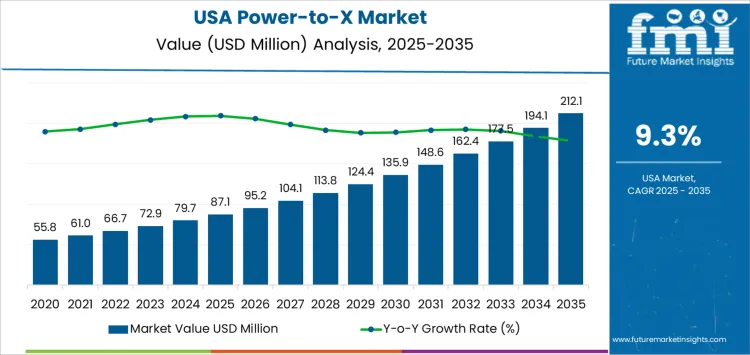
From 2030 to 2035, the demand continues to rise rapidly, reaching USD 212.1 million. The growth rate accelerates as the technology becomes more commercially viable and cost-effective, attracting greater industrial application. Increased regulatory support and technological advancements in energy storage, carbon capture, and hydrogen production contribute to the rapid expansion of PtX systems in sectors like transportation, industrial heating, and power generation. The demand for PtX systems in the USA is further boosted by the increasing urgency to meet climate goals and reduce dependence on fossil fuels. During this period, innovations in PtX applications, alongside growing environmental awareness, lead to higher adoption rates across industries. The comparison shows a clear acceleration in growth towards the end of the decade, fueled by advancements in energy efficiency and scaling of green technologies.
Demand for Power-to-X in USA Key Takeaways
| Metric | Value |
|---|---|
| Demand for Power-to-X in USA Value (2025) | USD 87.1 million |
| Demand for Power-to-X in USA Forecast Value (2035) | USD 212.1 million |
| Demand for Power-to-X in USA Forecast CAGR (2025-2035) | 9.30% |
Why is the Demand for Power-to-X in USA Growing?
The demand for power-to-X (PtX) technologies in the USA is growing due to their potential to play a critical role in decarbonizing industries and transitioning to a more sustainable energy system. PtX refers to processes that convert surplus renewable electricity into various forms of energy carriers, such as hydrogen, synthetic fuels, or chemicals, which can be stored, transported, and used in sectors like transportation, industry, and heating. As the USA seeks to reduce its reliance on fossil fuels and lower carbon emissions, PtX technologies are seen as a key enabler of this transition, especially for sectors that are hard to electrify directly.
Government policies and investments aimed at supporting clean energy technologies are driving the growth of Power-to-X in the USA. Federal incentives, alongside state-level mandates for renewable energy adoption, are encouraging the development and deployment of PtX solutions. The rising focus on energy storage and the need for grid flexibility to accommodate intermittent renewable energy sources like wind and solar power is propelling interest in PtX systems that can store excess energy for later use.
The growing push for energy security, as well as the increasing importance of hydrogen as a clean energy carrier, is also contributing to the demand for PtX technologies. Challenges such as the high capital costs of PtX infrastructure and the complexity of scaling these technologies remain. Despite these barriers, ongoing technological advancements and supportive policy frameworks are expected to drive continued growth in Power-to-X in the USA, making it a vital part of the country's energy future.
What is the Segment-Wise Analysis of Demand for Power-to-X in USA?
Demand for power-to-X in the USA is segmented by product type, end-use, and region. By product type, power-to-methanol leads at 23%, followed by power-to-CO/syngas/formic acid, power-to-NH4, power-to-methane, power-to-H2, and power-to-H2O2. In terms of end-use, transportation accounts for 25.4%, with agriculture, manufacturing, industry, residential, and other sectors also contributing to the demand. Regionally, demand is divided into West USA, South USA, Northeast USA, and Midwest USA.
How Does Power-to-Methanol Lead the Demand for Power-to-X in USA?
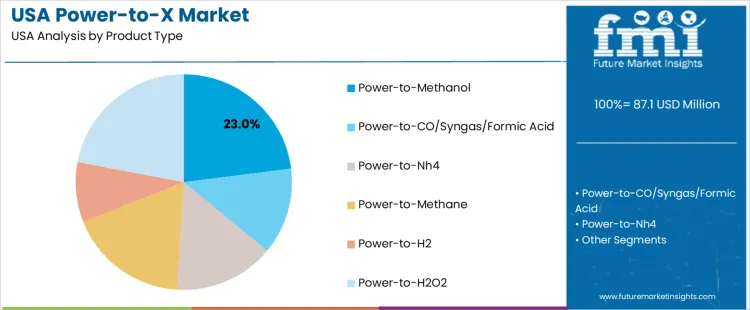
Power-to-methanol accounts for 23% of the demand for Power-to-X in the USA, driven by its potential as a carbon-neutral alternative to fossil fuels. Methanol is versatile-it can be used as a fuel, a chemical feedstock, or as a storage medium for renewable energy. This adaptability makes it an attractive option for various industries, particularly in energy and chemicals. The demand for power-to-methanol has grown as sectors seek cleaner alternatives to traditional fossil fuels and feedstocks. With the USA’s focus on transitioning to renewable energy and cutting carbon emissions, power-to-methanol technologies are gaining traction. The ability to produce methanol from renewable electricity positions it as a sustainable solution for decarbonization. Methanol’s compatibility with existing infrastructure further boosts its adoption. As industries look for scalable, carbon-neutral solutions, power-to-methanol continues to lead the Power-to-X industry, becoming a key component in the energy transition.
Why Does Transportation Lead the Demand for Power-to-X in USA?
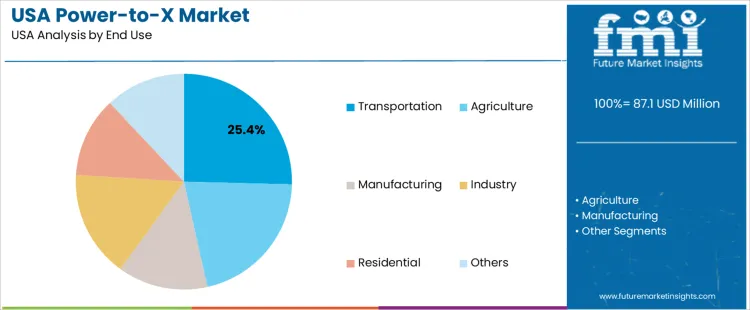
Transportation accounts for 25.4% of the demand for Power-to-X in the USA, driven by the urgent need for sustainable energy solutions in the sector. Power-to-X technologies, such as power-to-methanol and power-to-methane, offer viable alternative fuels that can reduce carbon emissions across various modes of transport. As electric vehicles (EVs) gain popularity, Power-to-X plays a complementary role in decarbonizing sectors that are harder to electrify, including aviation, shipping, and heavy-duty vehicles. The demand for cleaner fuels in these sectors is growing as transportation companies and governments strive to reduce their carbon footprints and improve fuel efficiency. This is especially true in regions like the West and Northeast USA, where clean energy policies are a priority. Power-to-X provides sustainable, scalable fuel solutions for transportation, ensuring that it remains the leading sector driving innovation and adoption in the USA’s energy transformation.
What are the Key Trends, Drivers, and Restraints in Demand for Power-to-X in USA?
Demand for power-to-X (P2X) in the USA is growing due to increasing efforts to decarbonize sectors that are difficult to electrify, such as heavy industry, long-haul transport, aviation, shipping, and chemical production. P2X allows for the conversion of surplus or renewable electricity into energy carriers, including green hydrogen, synthetic fuels, ammonia, or other chemicals, providing flexibility for sectors where direct electrification is not feasible. As renewable power capacity continues to expand, surplus generation needs to be stored or converted, and P2X provides a viable solution. The uptake of P2X is restrained by high capital and production costs, uncertainties around regulatory support, and limited infrastructure for transporting and utilizing P2X-derived fuels.
Why is Demand for Power-to-X Growing in the USA?
The growing demand for Power-to-X in the USA is largely driven by the need to decarbonize sectors that are difficult to electrify, such as heavy-duty transport, aviation, and industrial manufacturing. P2X allows for the conversion of surplus renewable electricity into hydrogen or synthetic fuels, providing an important alternative to traditional fossil fuels in sectors where electrification is not feasible. With USA policies targeting net-zero emissions and the transition to carbon-neutral energy solutions, the demand for green hydrogen and synthetic fuels is increasing. As renewable energy generation, particularly from wind and solar, expands, P2X offers a method for storing or converting excess energy in periods of surplus. This not only helps balance energy supply and demand but also makes renewable energy investments more economically viable.
How are Technological & Industry Innovations Driving Power-to-X Demand in USA?
Technological advancements are playing a significant role in driving the demand for Power-to-X in the USA. Improvements in electrolyzer technology, which is used to produce green hydrogen, and advancements in catalytic processes for synthetic fuels have made P2X technologies more efficient and cost-competitive. Innovations are also taking place in the integration of P2X into existing industrial processes, such as the production of fertilizers and chemicals, as well as the use of synthetic fuels in shipping and heavy transport. As the technology continues to mature, economies of scale are expected to reduce production costs, making P2X more economically viable for widespread adoption. The growing interest in green hydrogen, as well as investments in P2X-related infrastructure, will further support the transition to cleaner energy.
What are the Key Challenges and Risks That Could Limit Power-to-X Demand in USA?
One of the main hurdles is the high capital cost associated with P2X technology, including the expensive infrastructure required for producing, storing, and transporting hydrogen or synthetic fuels. These high costs currently make P2X less competitive compared to traditional fossil fuel-based solutions. The lack of developed infrastructure for the distribution and use of hydrogen and synthetic fuels further hinders large-scale adoption. Regulatory uncertainties and fluctuating policy incentives for clean energy technologies could also discourage long-term investments in P2X. Competition from alternative decarbonization methods, such as battery-electric vehicles, direct electrification, and carbon capture technologies, may reduce reliance on P2X in certain sectors.
What is the Demand Outlook for Power-to-X in the USA?
| Region | CAGR (%) |
|---|---|
| West USA | 10.7% |
| South USA | 9.6% |
| Northeast USA | 8.6% |
| Midwest USA | 7.4% |
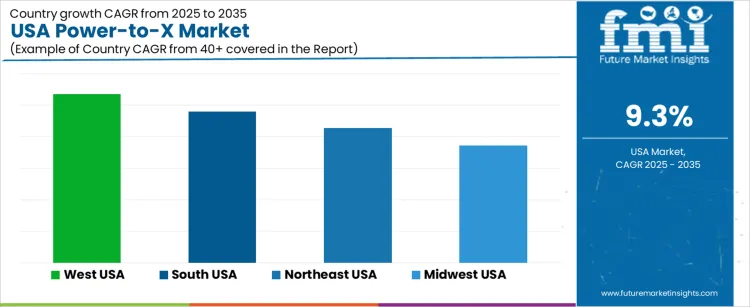
Demand for power-to-X (PtX) in the USA is growing across all regions, with West USA leading at a 10.7% CAGR, driven by the region’s focus on renewable energy innovation and decarbonization. South USA follows closely with a 9.6% CAGR, supported by the increasing adoption of clean energy technologies in sectors like oil and gas, as well as the rise in green hydrogen initiatives. Northeast USA shows an 8.6% CAGR, benefiting from the region’s commitment to sustainability and energy transition. Midwest USA experiences a 7.4% CAGR, with growing interest in industrial decarbonization and renewable energy solutions.
How is Demand for Power-to-X Growing in West USA?
West USA leads the demand for power-to-X, growing at a 10.7% CAGR. The region’s commitment to clean energy innovation, particularly in California, is a key driver of this trend. West USA is home to a thriving renewable energy sector, with a strong focus on green hydrogen, energy storage, and carbon capture technologies. Power-to-X technologies, which convert renewable electricity into fuels or chemicals, are increasingly being adopted in the region to accelerate decarbonization efforts. The growing need for sustainable energy solutions across industries such as transportation, manufacturing, and agriculture supports the demand for PtX solutions. West USA’s focus on reducing emissions and fostering clean energy policies further drives the uptake of these technologies. As renewable energy projects expand and decarbonization goals become more ambitious, demand for Power-to-X in West USA is expected to continue rising, driven by both innovation and policy support.
Why is Demand for Power-to-X Rising in South USA?
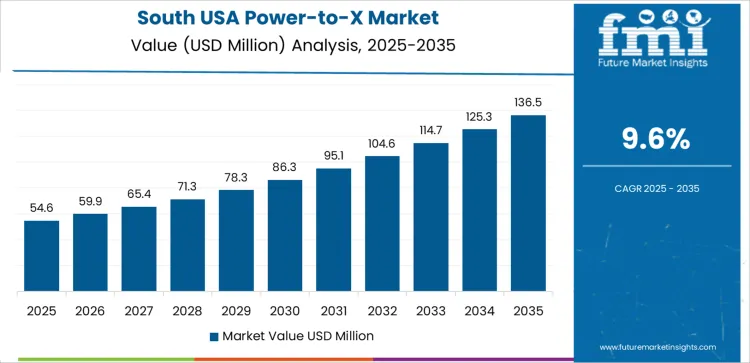
In South USA, demand for power-to-X is rising at a 9.6% CAGR. The region’s increasing adoption of clean energy solutions, particularly in states like Texas and Florida, is contributing to this growth. South USA has seen a surge in renewable energy projects, including solar, wind, and green hydrogen initiatives, all of which align with the principles of Power-to-X. The region’s industrial base, including oil and gas sectors, is also exploring ways to decarbonize through PtX technologies, particularly in green hydrogen production. With the growing need for energy storage and sustainable energy conversion technologies, PtX is seen as a crucial part of South USA’s energy transition. As businesses and governments prioritize reducing carbon footprints, demand for Power-to-X solutions, such as energy storage and renewable fuel production, will continue to rise in South USA. This growth will be supported by both technological advancements and state-level clean energy initiatives.
How is Demand for Power-to-X Expanding in Northeast USA?
Northeast USA shows steady demand for power-to-X, growing at an 8.6% CAGR. The region’s focus on sustainability and reducing carbon emissions is driving the adoption of clean energy technologies, including PtX. Northeast USA, with its strong commitment to environmental protection and climate action, has become a key player in the energy transition. Cities like New York and Boston are at the forefront of decarbonization efforts, pushing for clean energy solutions such as renewable hydrogen production and energy storage, which are central to Power-to-X. The growing interest in carbon capture, utilization, and storage (CCUS) technologies further drives demand for PtX solutions, as industries seek efficient ways to mitigate emissions. As more industries, particularly in transportation and manufacturing, shift toward sustainable energy sources, the adoption of Power-to-X technologies in Northeast USA is expected to expand, supported by robust state policies and federal clean energy incentives.
Why is Demand for Power-to-X Growing in Midwest USA?
Midwest USA is experiencing steady demand for power-to-X, growing at a 7.4% CAGR. The region’s growing interest in industrial decarbonization, coupled with a shift towards renewable energy, is contributing to the rise in demand for PtX technologies. With a strong manufacturing base, particularly in the automotive, steel, and agriculture sectors, Midwest USA is focused on reducing carbon emissions and enhancing energy efficiency. PtX technologies, such as green hydrogen production and renewable energy storage, are seen as key solutions for decarbonizing heavy industries. The region’s investment in clean energy projects, along with a push for sustainable energy solutions, is increasing the adoption of Power-to-X technologies. Midwest USA’s commitment to advancing renewable energy infrastructure and supporting energy transition initiatives will continue to drive growth in PtX demand. As industrial decarbonization efforts accelerate, the adoption of PtX technologies is expected to increase steadily in the Midwest.
What is the Competitive Landscape of USA Power-to-X Demand?
The demand for power-to-X (PtX) technologies in the USA is growing as the country seeks to transition to cleaner and more sustainable energy sources. Power-to-X, which involves converting surplus renewable energy into fuels, chemicals, or heat, offers a promising solution for reducing carbon emissions and integrating renewable energy into various sectors, such as transportation, industry, and heating. As part of the broader push for decarbonization and energy independence, Power-to-X technologies are being seen as critical components for achieving climate goals and enhancing energy security.
Siemens Energy leads the segment with a 26.0% share, owing to its advanced technologies and strong presence in the energy transition space. Other key players, including ITM Power, Ørsted A/S, Mitsubishi Heavy Industries, and NEL ASA, are also contributing to the demand by developing cutting-edge solutions for hydrogen production, carbon capture, and other PtX applications. These companies play a significant role in advancing the commercialization of Power-to-X technologies, with a focus on efficiency, scalability, and integration into existing energy systems.
Advancements in renewable energy generation, storage, and conversion technologies are further driving the adoption of Power-to-X in the USA. The growth of wind, solar, and hydrogen sectors, combined with supportive policies and investments, is expected to accelerate the deployment of PtX technologies. As industries and governments continue to prioritize sustainability, the demand for Power-to-X solutions in the USA is poised to increase, helping the country transition to a cleaner, more resilient energy system.
Key Players in USA Power-to-X Demand
- Siemens Energy
- ITM Power
- Ørsted A/S
- Mitsubishi Heavy Industries
- NEL ASA
Scope of Report
| Items | Values |
|---|---|
| Quantitative Units (2025) | USD million |
| Product Type | Power-to-Methanol, Power-to-CO/Syngas/Formic Acid, Power-to-NH4, Power-to-Methane, Power-to-H2, Power-to-H2O2 |
| End Use | Transportation, Agriculture, Manufacturing, Industry, Residential, Others |
| Regions Covered | West USA, South USA, Northeast USA, Midwest USA |
| Countries Covered | USA |
| Key Companies Profiled | Siemens Energy, ITM Power, Ørsted A/S, Mitsubishi Heavy Industries, NEL ASA |
| Additional Attributes | Dollar sales by product type and end-use; regional CAGR and growth trends; increasing adoption of power-to-x technology across industries; growth in transportation and residential demand. |
USA Power-to-X Demand by Key Segments
Product Type
- Power-to-Methanol
- Power-to-CO/Syngas/Formic Acid
- Power-to-Nh4
- Power-to-Methane
- Power-to-H2
- Power-to-H2O2
End Use
- Transportation
- Agriculture
- Manufacturing
- Industry
- Residential
- Others
Region
- West USA
- South USA
- Northeast USA
- Midwest USA
Frequently Asked Questions
How big is the demand for power-to-x in USA in 2025?
The demand for power-to-x in USA is estimated to be valued at USD 87.1 million in 2025.
What will be the size of power-to-x in USA in 2035?
The market size for the power-to-x in USA is projected to reach USD 212.1 million by 2035.
How much will be the demand for power-to-x in USA growth between 2025 and 2035?
The demand for power-to-x in USA is expected to grow at a 9.3% CAGR between 2025 and 2035.
What are the key product types in the power-to-x in USA?
The key product types in power-to-x in USA are power-to-methanol, power-to-co/syngas/formic acid, power-to-nh4, power-to-methane, power-to-h2 and power-to-h2o2.
Which end use segment is expected to contribute significant share in the power-to-x in USA in 2025?
In terms of end use, transportation segment is expected to command 25.4% share in the power-to-x in USA in 2025.
Preview the report firsthand - request a free sample
Get SampleGet the brochure for pricing and purchase details.
Get PDFTable of Content
- Executive Summary
- USA Market Outlook
- Demand-side Trends
- Supply-side Trends
- Technology Roadmap Analysis
- Analysis and Recommendations
- Market Overview
- Market Coverage / Taxonomy
- Market Definition / Scope / Limitations
- Market Background
- Market Dynamics
- Drivers
- Restraints
- Opportunity
- Trends
- Scenario Forecast
- Demand in Optimistic Scenario
- Demand in Likely Scenario
- Demand in Conservative Scenario
- Opportunity Map Analysis
- Product Life Cycle Analysis
- Supply Chain Analysis
- Investment Feasibility Matrix
- Value Chain Analysis
- PESTLE and Porter’s Analysis
- Regulatory Landscape
- Regional Parent Market Outlook
- Production and Consumption Statistics
- Import and Export Statistics
- Market Dynamics
- USA Market Analysis 2020 to 2024 and Forecast, 2025 to 2035
- Historical Market Size Value (USD Million) Analysis, 2020 to 2024
- Current and Future Market Size Value (USD Million) Projections, 2025 to 2035
- Y-o-Y Growth Trend Analysis
- Absolute $ Opportunity Analysis
- USA Market Pricing Analysis 2020 to 2024 and Forecast 2025 to 2035
- USA Market Analysis 2020 to 2024 and Forecast 2025 to 2035, By Product Type
- Introduction / Key Findings
- Historical Market Size Value (USD Million) Analysis By Product Type , 2020 to 2024
- Current and Future Market Size Value (USD Million) Analysis and Forecast By Product Type , 2025 to 2035
- Power-to-Methanol
- Power-to-CO/Syngas/Formic Acid
- Power-to-Nh4
- Power-to-Methane
- Power-to-H2
- Power-to-H2O2
- Y-o-Y Growth Trend Analysis By Product Type , 2020 to 2024
- Absolute $ Opportunity Analysis By Product Type , 2025 to 2035
- USA Market Analysis 2020 to 2024 and Forecast 2025 to 2035, By End Use
- Introduction / Key Findings
- Historical Market Size Value (USD Million) Analysis By End Use, 2020 to 2024
- Current and Future Market Size Value (USD Million) Analysis and Forecast By End Use, 2025 to 2035
- Transportation
- Agriculture
- Manufacturing
- Industry
- Residential
- Others
- Y-o-Y Growth Trend Analysis By End Use, 2020 to 2024
- Absolute $ Opportunity Analysis By End Use, 2025 to 2035
- Market Structure Analysis
- Competition Dashboard
- Competition Benchmarking
- Market Share Analysis of Top Players
- By Regional
- By Product Type
- By End Use
- Competition Analysis
- Competition Deep Dive
- ITM Power
- Overview
- Product Portfolio
- Profitability by Market Segments (Product/Age /Sales Channel/Region)
- Sales Footprint
- Strategy Overview
- Marketing Strategy
- Product Strategy
- Channel Strategy
- Ørsted A/S
- Mitsubishi Heavy Industries
- NEL ASA
- ITM Power
- Competition Deep Dive
- Assumptions & Acronyms Used
- Research Methodology


