

- Industry Size (2026)
- USD 2.5 Bn
- Forecast (2036)
- USD 8.2 Bn
- CAGR (2026 to 2036)
- 12.6%
Demand for Robocall Mitigation in USA 2026 to 2036
Demand for robocall mitigation in USA is valued at USD 2.5 billion in 2026 and is expected to reach USD 8.2 billion by 2036, reflecting a CAGR of 12.6%. Demand accelerates as fraudulent and nuisance call volumes persist across public and private communication networks. Regulatory mandates, consumer protection priorities, and rising financial fraud incidents drive the rapid deployment of advanced mitigation solutions across telecom and institutional environments.
Robocall analytics lead solution usage as data-driven call pattern analysis enables real-time identification, scoring, and blocking of suspicious traffic. Machine learning models analyze call origin, frequency, behavioral signatures, and spoofing indicators to improve detection accuracy. Integration with STIR/SHAKEN frameworks and carrier networks strengthens call authentication and enforcement effectiveness. Government leads end-use adoption due to high exposure to impersonation scams, public service disruption, and citizen data security risks. Agencies prioritize robust analytics platforms to protect emergency services, benefit programs, and public communication channels.
West USA, South USA, Northeast USA, and Midwest USA represent key growth regions supported by dense telecom infrastructure and regulatory enforcement activity. TNS (Transaction Network Services), First Orion, Hiya, Neustar (TransUnion), and YouMail anchor competitive activity through large-scale analytics engines, carrier-grade integrations, and continuous algorithm refinement aligned with evolving robocall threat vectors across U.S. communication ecosystems.
Quick Stats for Demand for Robocall Mitigation in USA
- USA Robocall Mitigation Sales Value (2026): USD 2.5 billion
- USA Robocall Mitigation Forecast Value (2036): USD 8.2 billion
- USA Robocall Mitigation Forecast CAGR (2026 to 2036): 12.6%
- Leading Solution Segment in USA Demand: Robocall Analytics
- Key Growth Regions in USA Demand: West USA, South USA, Northeast USA, Midwest USA
- Top Players in USA Demand: TNS (Transaction Network Services), First Orion, Hiya, Neustar (TransUnion), YouMail.
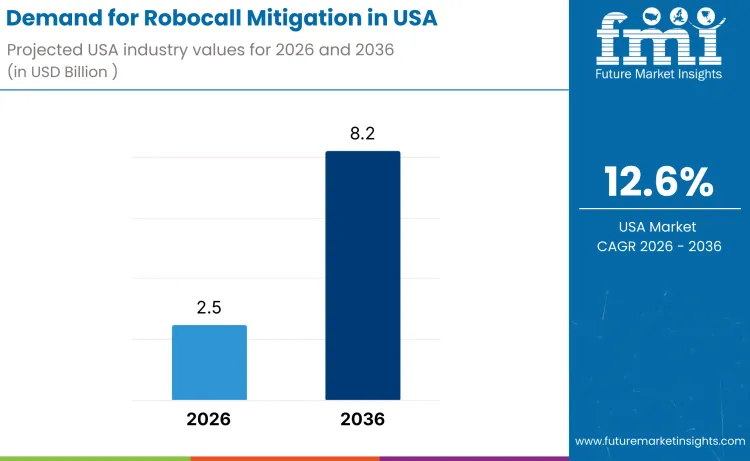
USA Robocall Mitigation Key Takeaways
| Metric | Value |
|---|---|
| USA Robocall Mitigation Sales Value (2026) | USD 2.5 billion |
| USA Robocall Mitigation Forecast Value (2036) | USD 8.2 billion |
| USA Robocall Mitigation Forecast CAGR (2026 to 2036) | 12.6% |
How Are the Segments Classified in the Demand for Robocall Mitigation in the USA?
Demand for robocall mitigation in the USA is shaped by rising fraudulent call volumes, regulatory enforcement, and protection of critical communication infrastructure. Buyers evaluate detection accuracy, real-time response capability, compliance with call authentication standards, and scalability across large call networks. Adoption patterns reflect strong institutional usage, driven by public-sector compliance needs and cross-industry efforts to reduce unwanted and deceptive call traffic within USA telecommunication environments.
Which Solution Accounts for the Largest Share of Demand in the USA?
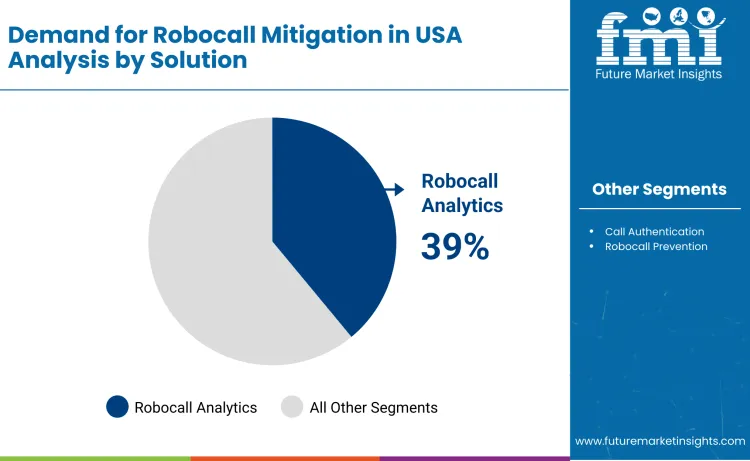
Robocall analytics hold 39.0%, making them the leading solution segment in the USA. Analytics platforms analyze call patterns, traffic behavior, and anomaly indicators to identify robocall activity at scale. These systems support network-level visibility and enable proactive mitigation actions. Call authentication holds 37.2%, focusing on verification protocols that confirm caller identity and reduce spoofing. Robocall prevention solutions hold 23.8%, applying blocking and filtering mechanisms at network or device level. Solution distribution reflects emphasis on intelligence-driven detection before enforcement or blocking actions.
Key Points:
- Robocall analytics lead due to large-scale detection capability.
- Authentication solutions address caller identity verification.
- Prevention tools apply downstream blocking and filtering.
Which End-Use Segment Accounts for the Largest Share of Demand in the USA?
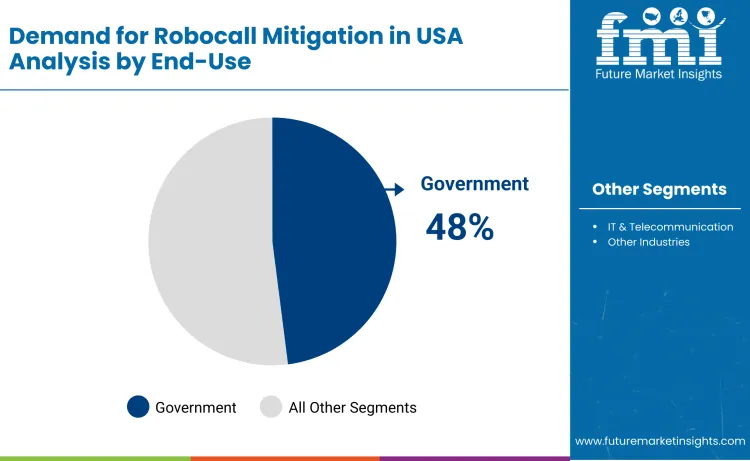
Government end users hold 48.2%, making them the leading end-use segment in the USA. Public agencies require robust robocall mitigation to protect citizen communications, emergency services, and official outreach channels. IT and telecommunication entities hold 13.8%, deploying mitigation tools to manage network integrity and subscriber protection. Other industries hold 38.0%, including finance, healthcare, and enterprises seeking to reduce fraud exposure and communication disruption. End-use distribution reflects strong public-sector responsibility for large-scale communication trust and regulatory compliance.
Key Points:
- Government leads due to public communication protection needs.
- Telecom operators support network-level mitigation.
- Other industries address fraud and disruption risks.
What are the Key Dynamics in the Robocall Mitigation Industry in USA?
Demand increases as telecom operators, enterprises, and consumers seek protection from high-volume illegal robocalls affecting voice networks across USA. Robocall mitigation solutions address call authentication, traffic filtering, and analytics to reduce fraud, nuisance calls, and identity theft risk. Adoption aligns with federal mandates, carrier compliance obligations, and rising consumer complaints. Deployment spans wireless, wireline, and VoIP environments integrated with national call-routing infrastructure.
How do regulatory mandates and network integrity requirements drive demand in USA?
Federal rules require voice service providers to implement call authentication frameworks to curb illegal robocalls. STIR SHAKEN compliance compels carriers to deploy identity verification and attestation systems across IP-based networks. Telecom operators adopt analytics platforms that detect abnormal call patterns and block suspected robocalls in real time. Enterprises use mitigation tools to protect contact centers from spoofed inbound traffic. Government agencies promote coordinated enforcement and data sharing to identify bad actors. Consumer demand for default call blocking increases pressure on carriers to enhance protection. Expansion of VoIP services elevates need for scalable mitigation across interconnected networks.
How do implementation complexity, false-positive risk, and evolving fraud tactics influence demand stability?
Legacy network segments complicate full deployment of authentication protocols, increasing operational burden for some carriers. Risk of blocking legitimate calls requires careful tuning of analytics models. Fraudsters adapt techniques using number rotation and short-duration calling, challenging detection accuracy. Smaller providers face cost constraints when upgrading systems. Inter-carrier coordination affects end-to-end effectiveness. Privacy considerations influence data retention and call analysis practices. Ongoing regulatory updates require continuous system adjustment. Demand remains stable due to mandatory compliance and persistent robocall activity, while effectiveness depends on technology evolution, coordination across providers, and sustained enforcement within USA telecom networks.
How Is Demand for Robocall Mitigation in USA Evolving by Region?
Demand for robocall mitigation in the USA is increasing rapidly due to heightened consumer complaints, stricter regulatory enforcement, and widespread adoption of digital calling platforms. West USA leads with a 14.5% CAGR, supported by technology-led deployment, carrier innovation, and enterprise adoption. South USA follows at 13.0%, driven by high robocall exposure, mobile subscriber growth, and network-level mitigation rollout. Northeast USA records an 11.6% CAGR, shaped by regulatory compliance, enterprise call authentication, and financial services protection. Midwest USA posts a 10.1% CAGR, reflecting steady uptake among carriers, enterprises, and public-sector organizations. Regional variation reflects call volume intensity, regulatory pressure, and technology adoption across the USA.
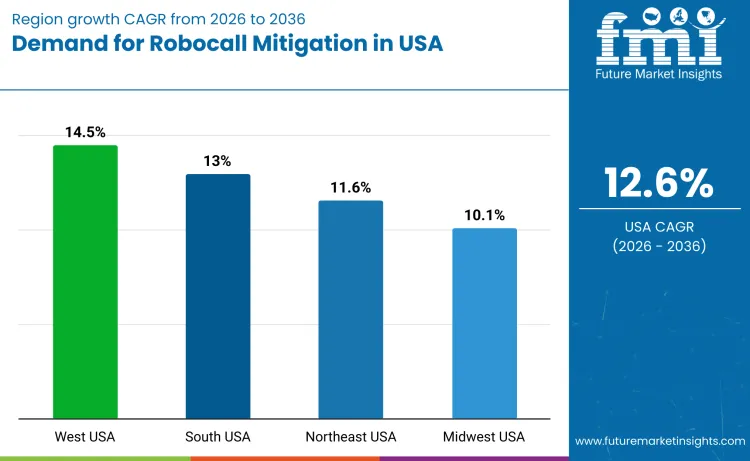
| Region | CAGR (2026 to 2036) |
|---|---|
| West USA | 14.5% |
| South USA | 13.0% |
| Northeast USA | 11.6% |
| Midwest USA | 10.1% |
How is West USA driving demand for Robocall Mitigation?
West USA demand is driven by advanced telecom infrastructure, high smartphone penetration, and early adoption of AI-based call analytics. The region’s CAGR of 14.5% reflects extensive deployment of network-level robocall mitigation tools by mobile carriers and VoIP providers. Technology companies integrate machine learning models for real-time call scoring, voice pattern analysis, and behavioral detection. Enterprises adopt branded calling, call authentication, and reputation management tools to protect outbound communications. Cloud-based mitigation platforms gain traction due to scalability and API integration. Demand favors solutions supporting STIR SHAKEN compliance and continuous algorithm updates.
- Network-level AI-driven call filtering adoption
- Early deployment of STIR SHAKEN frameworks
- Enterprise use of branded and authenticated calling
- Strong cloud and API-based solution preference
How is South USA driving demand for Robocall Mitigation?
South USA demand is influenced by high robocall incidence, large mobile subscriber bases, and carrier-led enforcement initiatives. The region’s CAGR of 13.0% reflects accelerated rollout of call-blocking and analytics platforms across wireless and wireline networks. Consumers and small businesses rely on default carrier-provided protection services. Enterprises adopt robocall mitigation to reduce fraud, spoofing, and customer trust erosion. Cost efficiency and broad coverage influence solution selection. Demand remains volume-driven, supported by large-scale deployment across regional carrier networks.
- High robocall exposure driving consumer demand
- Carrier-provided default call protection services
- Enterprise adoption to reduce fraud and spoofing
- Emphasis on scalable, cost-efficient solutions
How is Northeast USA driving demand for Robocall Mitigation?
Northeast USA demand reflects regulatory enforcement, financial services concentration, and enterprise compliance requirements. The region’s CAGR of 11.6% is supported by adoption of call authentication, verification, and analytics platforms across banks, healthcare providers, and government agencies. Organizations prioritize mitigation to comply with federal regulations and protect customer communication channels. Integration with contact center platforms supports authenticated outbound calling. Procurement emphasizes documentation, auditability, and vendor credibility. Demand growth aligns with compliance deadlines and enterprise security investment cycles.
- Financial services and healthcare call protection needs
- Regulatory and compliance-driven adoption
- Integration with enterprise contact center systems
- Focus on audit-ready and verified solutions
How is Midwest USA driving demand for Robocall Mitigation?
Midwest USA demand is steady and adoption-focused, reflecting balanced exposure to robocall activity and cost-sensitive procurement. The region’s CAGR of 10.1% reflects increasing use of carrier-based blocking services, enterprise call authentication, and public-sector deployment. Small and mid-sized enterprises adopt mitigation tools to maintain customer trust and reduce inbound fraud. Budget considerations influence purchasing, favoring bundled solutions from existing telecom providers. Growth remains incremental, supported by regulatory compliance and expanding awareness of robocall risks.
- SME and public-sector robocall protection adoption
- Reliance on bundled carrier-based solutions
- Cost-conscious procurement behavior
- Gradual growth driven by compliance requirements
What is the competitive landscape of demand for robocall mitigation in the USA?
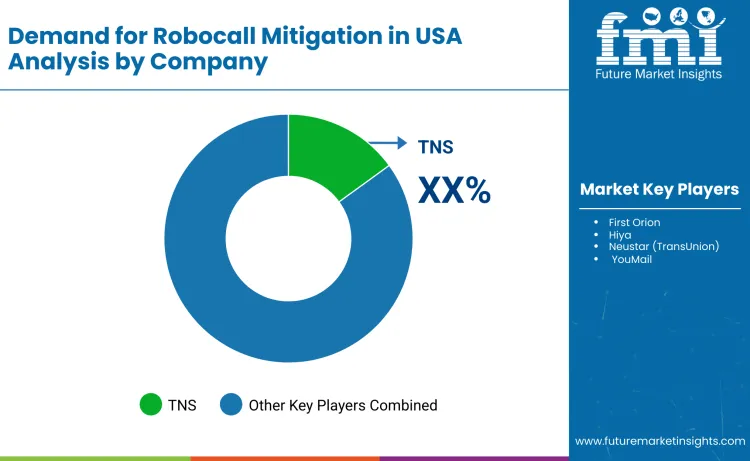
Demand for robocall mitigation in the USA is driven by rising consumer complaints, financial fraud exposure, and regulatory enforcement under the Telephone Consumer Protection Act and FCC-led initiatives. Applications focus on real-time call authentication, network-level traffic analysis, and blocking of spoofed or high-risk calls across mobile and fixed-line networks. Buyers evaluate STIR SHAKEN compliance, analytics accuracy, false-positive control, and scalability across large call volumes. Procurement teams prioritize vendors with direct carrier integrations, proven detection algorithms, and alignment with FCC reporting and compliance requirements. Trend in the USA market reflects tighter enforcement actions, increased enterprise exposure to voice fraud, and broader deployment of network-based mitigation rather than device-only solutions.
TNS, operating as Transaction Network Services, maintains strong positioning through carrier-grade robocall analytics and call authentication services deployed across major USA telecom networks. First Orion supports operators and enterprises with branded calling, call reputation scoring, and advanced spoofing detection platforms. Hiya maintains visibility through mobile network integrations and device-level protection supporting large USA subscriber bases. Neustar, now part of TransUnion, provides call identity, analytics, and trust services aligned with regulatory frameworks and enterprise risk management. YouMail participates through consumer-facing and carrier-supported call blocking solutions addressing nuisance and scam call volumes. Competitive positioning in the USA reflects depth of carrier relationships, regulatory alignment, analytics accuracy, and ability to reduce fraud while preserving legitimate call completion.
Key Players in USA Robocall Mitigation Demand
- TNS (Transaction Network Services)
- First Orion
- Hiya
- Neustar (TransUnion)
- YouMail
Scope of the Report
| Items | Values |
|---|---|
| Quantitative Units | USD billion |
| Solution | Robocall Analytics; Call Authentication; Robocall Prevention |
| End Use | Government; IT & Telecommunication; Other Industries |
| Regions Covered | West USA; South USA; Northeast USA; Midwest USA |
| Key Companies Profiled | TNS (Transaction Network Services); First Orion; Hiya; Neustar (TransUnion); YouMail |
| Additional Attributes | Dollar sales by solution category and end-use sector; regional adoption trends across telecom-heavy and government-regulated regions; growth driven by STIR/SHAKEN compliance and enterprise call protection needs; increasing integration with carrier networks and cloud-based analytics platforms; emphasis on real-time detection accuracy and caller reputation databases. |
USA Robocall Mitigation Demand by Segments
By Solution:
- Robocall Analytics
- Call Authentication
- Robocall Prevention
By End Use:
- Government
- IT & Telecommunication
- Other Industries
By Region:
- West USA
- South USA
- Northeast USA
- Midwest USA
Frequently Asked Questions
How big is the demand for robocall mitigation in USA in 2026?
The demand for robocall mitigation in USA is estimated to be valued at USD 2.5 billion in 2026.
What will be the size of robocall mitigation demand in USA in 2036?
The demand size for robocall mitigation in USA is projected to reach USD 8.2 billion by 2036.
How much will the demand for robocall mitigation in USA grow between 2026 and 2036?
The demand for robocall mitigation in USA is expected to grow at a 12.6% CAGR between 2026 and 2036.
What are the key solution types in the robocall mitigation demand in USA?
The key solution types in robocall mitigation demand in USA include robocall analytics, call authentication, real-time call blocking, and network-level filtering systems.
Which end-use segment is expected to contribute a significant share in the robocall mitigation demand in USA in 2026?
In terms of end use, government segment is expected to command 48.2% share in the robocall mitigation demand in USA in 2026.
Preview the report firsthand - request a free sample
Get SampleGet the brochure for pricing and purchase details.
Get PDFTable of Content
- Executive Summary
- USA Market Outlook
- Demand Side Trends
- Supply Side Trends
- Regulatory and Call Authentication Landscape
- Analysis and Recommendations
- Market Overview
- Market Coverage and Taxonomy
- Market Definition Scope and Limitations
- Market Background
- Market Dynamics
- Drivers
- Restraints
- Opportunities
- Trends
- Scenario Forecast
- Demand in Optimistic Scenario
- Demand in Likely Scenario
- Demand in Conservative Scenario
- Opportunity Map Analysis
- Technology and Solution Life Cycle Analysis
- Telecom Infrastructure and Network Integration Analysis
- Investment Feasibility Matrix
- Value Chain Analysis
- PESTLE and Porter Analysis
- STIR SHAKEN and Compliance Framework Analysis
- Regional Parent Market Outlook
- Carrier and Enterprise Deployment Ecosystem
- USA Robocall Mitigation Demand Analysis 2021 to 2025 and Forecast 2026 to 2036
- Historical Demand Value USD Billion Analysis 2021 to 2025
- Current and Future Demand Value USD Billion Projections 2026 to 2036
- Year on Year Growth Trend Analysis
- Absolute Dollar Opportunity Analysis
- USA Robocall Mitigation Pricing Analysis 2021 to 2025 and Forecast 2026 to 2036
- USA Robocall Mitigation Demand Analysis 2021 to 2025 and Forecast 2026 to 2036 By Solution
- Introduction and Key Findings
- Historical Demand Value USD Billion Analysis by Solution 2021 to 2025
- Current and Future Demand Value USD Billion Analysis and Forecast by Solution 2026 to 2036
- Robocall Analytics
- Call Authentication
- Robocall Prevention
- Year on Year Growth Trend Analysis by Solution
- Absolute Dollar Opportunity Analysis by Solution
- USA Robocall Mitigation Demand Analysis 2021 to 2025 and Forecast 2026 to 2036 By End Use
- Introduction and Key Findings
- Historical Demand Value USD Billion Analysis by End Use 2021 to 2025
- Current and Future Demand Value USD Billion Analysis and Forecast by End Use 2026 to 2036
- Government
- IT and Telecommunication
- Other Industries
- Year on Year Growth Trend Analysis by End Use
- Absolute Dollar Opportunity Analysis by End Use
- USA Robocall Mitigation Demand Analysis 2021 to 2025 and Forecast 2026 to 2036 By Region
- West USA
- South USA
- Northeast USA
- Midwest USA
- Market Structure Analysis
- Competition Dashboard
- Competition Benchmarking
- Market Share Analysis of Key Players
- By Solution
- By End Use
- By Region
- Competition Analysis
- Competition Deep Dive
- TNS Transaction Network Services
- First Orion
- Hiya
- Neustar TransUnion
- YouMail
- Assumptions and Acronyms Used
- Research Methodology


