

- Industry Size (2025)
- USD 111.7 Mn
- Forecast (2035)
- USD 198.1 Mn
- CAGR (2025 to 2035)
- 5.9%
Wear Grade PEEK Polymer Market Forecast and Outlook 2025 to 2035
The global wear grade PEEK polymer market is projected to grow from USD 111.7 million in 2025 to approximately USD 198.1 million by 2035, recording an absolute increase of USD 86.4 million over the forecast period. This translates into a total growth of 77.4%, with the market forecast to expand at a CAGR of 5.9% between 2025 and 2035. The overall market size is expected to grow by nearly 1.8X during the same period, supported by increasing demand for high-performance engineering polymers in friction-critical applications, growing adoption of lightweight materials with superior wear resistance in automotive and aerospace systems, and rising requirements for biocompatible polymers driving advanced material procurement across medical device manufacturing operations.
The market exhibits distinct regional dynamics with Asia Pacific emerging as the fastest-growing region, led by China's expanding automotive production capabilities and India's aerospace manufacturing development. Europe maintains substantial market presence through established specialty polymer processing infrastructure and advanced engineering applications. North America demonstrates growing adoption driven by medical device innovation and aerospace component manufacturing.
Quick Stats for Wear Grade PEEK Polymer Market
| Market | Values |
|---|---|
| Wear Grade PEEK Polymer Market Value (2025) | USD 111.7 million |
| Wear Grade PEEK Polymer Market Forecast Value (2035) | USD 198.1 million |
| Wear Grade PEEK Polymer Market CAGR | 5.9% |
| Leading Segment by Reinforcement Type (2025) | Glass Fiber Filled (48.3%) |
| Leading Segment by Application (2025) | Automobile (51.6%) |
| Key Growth Regions | Asia Pacific, Europe, North America |
| Top Companies by Market Share | Victrex, Syensqo, Evonik |
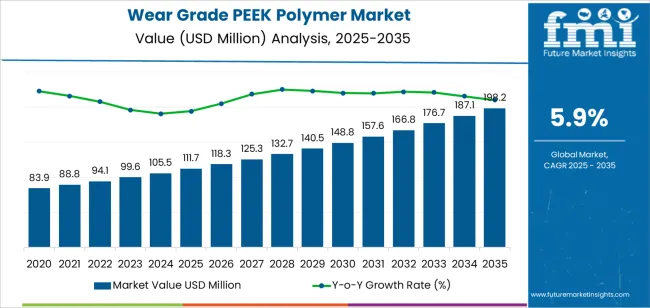
The wear grade PEEK polymer segment demonstrates particular strength in applications requiring exceptional tribological performance, including bearing components, seal systems, wear plates, and sliding elements where metal replacement opportunities continue expanding. Technology evolution continues toward reinforced formulations incorporating glass fiber and carbon fiber additives that enhance mechanical properties while maintaining PEEK's inherent chemical resistance and thermal stability. Market participants increasingly focus on application-specific compound development, establishing technical partnerships with end-users, and expanding regional compounding capabilities to support growing demand across automotive powertrains, aircraft interior systems, and surgical instrument applications.
Wear Grade PEEK Polymer Market Key Takeaways
| Metric | Value |
|---|---|
| Market Value (2025) | USD 111.7 million |
| Market Forecast Value (2035) | USD 198.1 million |
| Forecast CAGR (2025-2035) | 5.9% |
Why is the Wear Grade PEEK Polymer Market Growing?
| ENGINEERING PERFORMANCE REQUIREMENTS | LIGHTWEIGHTING & EFFICIENCY DRIVERS | REGULATORY & SUSTAINABILITY FACTORS |
|---|---|---|
| Tribological Performance Demands Engineering applications requiring polymers delivering low friction coefficients, high wear resistance, and dimensional stability under mechanical stress conditions. Extreme Environment Compatibility Systems operating at elevated temperatures, aggressive chemical exposures, and high mechanical loads necessitating advanced polymer solutions. Metal Replacement Opportunities Performance characteristics enabling substitution of bronze, steel, and other metal components reducing system weight while maintaining functional requirements. | Automotive Efficiency Mandates Fuel economy regulations and electric vehicle optimization driving weight reduction initiatives across powertrain and chassis systems. Aerospace Weight Optimization Aircraft manufacturers pursuing aggressive lightweighting programs to improve fuel efficiency and increase payload capacity. Performance-to-Weight Advantages Superior strength-to-weight ratios enabling component downsizing while maintaining or enhancing mechanical performance specifications. | Biocompatibility Standards Medical device regulations requiring polymers demonstrating tissue compatibility, sterilization resistance, and long-term biological inertness. Environmental Compliance Restriction of hazardous substances regulations eliminating metal alloys containing lead, cadmium, and other regulated materials. Circular Economy Initiatives Durability and longevity characteristics supporting extended component life and reduced material consumption over product lifecycles. Sustainability Positioning Reduced lubrication requirements and extended maintenance intervals lowering environmental impact compared to conventional material alternatives. |
Wear Grade PEEK Polymer Market Segmentation
| Category | Segments Covered |
|---|---|
| By Reinforcement Type | Glass Fiber Filled, Carbon Fiber Filled |
| By Application | Automobile, Aerospace, Medical, Other |
| By Region | North America, Europe, Asia Pacific, Latin America, Middle East & Africa |
Wear Grade PEEK Polymer Market Analysis by Reinforcement Type
| Segment | 2025 to 2035 Outlook |
|---|---|
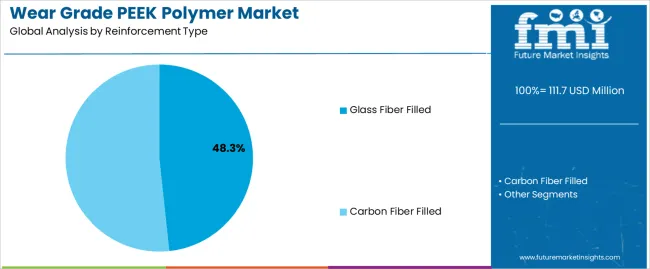
| Glass Fiber Filled | Leader in 2025 with 48.3% market share; maintains leadership through 2035. Balanced performance characteristics combining enhanced stiffness, improved dimensional stability, cost-effectiveness relative to carbon fiber alternatives. Broadest application scope across automotive bearings, industrial wear components, aerospace interior fittings. Established compounding processes, predictable mechanical properties, favorable processing economics. Momentum: steady growth driven by automotive adoption expansion and industrial equipment applications. Cost advantage over carbon fiber supporting volume applications where ultimate performance not required. Watchouts: fiber orientation effects on mechanical properties, processing parameter sensitivity affecting consistency. |
| Carbon Fiber Filled | Premium performance segment offering superior strength-to-weight ratios, enhanced thermal conductivity, reduced thermal expansion compared to glass fiber formulations. Aerospace structural applications, high-performance automotive components, medical device applications requiring maximum strength and minimal weight. Higher material costs limiting adoption to applications where performance justifies premium pricing. Momentum: strong growth in aerospace and medical segments driven by performance requirements and value-over-cost procurement approaches. Technology advancement reducing cost differentials versus glass fiber alternatives. Watchouts: processing complexity requiring specialized compounding expertise, limited supplier base affecting availability, electrical conductivity considerations in some applications. |
Wear Grade PEEK Polymer Market Analysis by Application
| Segment | 2025 to 2035 Outlook |
|---|---|
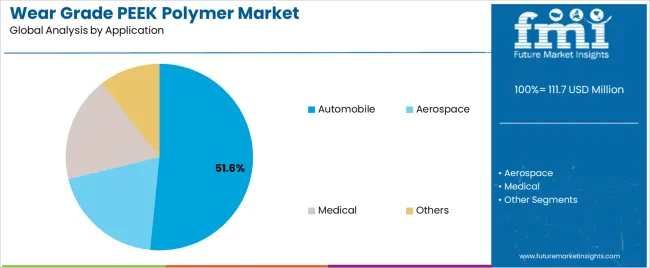
| Automobile | At 51.6%, largest application segment in 2025 with established adoption in powertrain systems, transmission components, suspension elements requiring wear resistance. Bearings, bushings, thrust washers, seals, and sliding components in engines, gearboxes, steering systems. Metal replacement initiatives driven by weight reduction targets and efficiency improvements. Established qualification processes, proven performance track records, cost-competitiveness in high-volume applications. Momentum: moderate to strong growth driven by electric vehicle adoption requiring specialized bearing solutions for high-speed motors and reduction gears. Thermal management requirements and lubricant compatibility in EV drivetrains creating new application opportunities. Watchouts: automotive cost pressure requiring continuous material cost optimization, qualification cycle complexity for new applications, competition from alternative high-performance polymers. |
| Aerospace | High-value segment focused on aircraft interior components, actuation systems, bearing assemblies, and structural elements. Stringent qualification requirements, extensive testing protocols, long certification timelines but stable long-term demand once qualified. Weight reduction imperatives driving metal replacement in brackets, fasteners, wear plates, and sliding mechanisms. Momentum: strong growth through 2030 driven by commercial aircraft production recovery and next-generation platform development incorporating advanced materials. Business aviation and rotorcraft segments providing additional demand. Watchouts: cyclical aircraft production affecting demand stability, extended qualification timelines delaying new application adoption, regulatory scrutiny on material performance and flammability characteristics. |
| Medical | Premium segment requiring biocompatibility certification, sterilization resistance, and long-term biological inertness. Surgical instruments, spinal implants, dental applications, and medical device components. Small volumes but highest material pricing supporting specialized product development. Regulatory compliance essential with FDA and international medical device standards. Momentum: robust growth driven by minimally invasive surgical instrument development, orthopedic implant innovation, and dental restoration applications. Aging demographics supporting medical device market expansion. Watchouts: stringent regulatory approval processes, extensive biocompatibility testing requirements, material traceability and documentation demands, product liability considerations affecting supplier participation. |
| Other | Diverse industrial applications including oil and gas equipment, semiconductor manufacturing components, chemical processing equipment, and industrial machinery. Specialized performance requirements varying by application, custom compound development common, technical support intensive. Momentum: selective growth in high-value industrial applications requiring PEEK's unique combination of chemical resistance, thermal stability, and wear performance. Semiconductor equipment applications growing with fab expansion. Watchouts: fragmented demand across diverse applications limiting economies of scale, custom formulation requirements increasing development costs, competition from application-specific alternative materials. |
What are the Key Trends, Drivers, and Restraints in the Wear Grade PEEK Polymer Market?
| DRIVERS | RESTRAINTS | KEY TRENDS |
|---|---|---|
| Metal Replacement Initiatives Engineering programs systematically substituting metal components with high-performance polymers achieving weight reduction while maintaining functional performance across automotive and aerospace applications. Electric Vehicle Adoption Acceleration Battery electric vehicle platforms creating new bearing and seal applications requiring materials compatible with high-speed motor operation, elevated temperatures, and specialized lubricants. Medical Device Innovation Minimally invasive surgical techniques and advanced implantable devices driving demand for biocompatible polymers offering superior mechanical properties and sterilization compatibility. | Material Cost Premium PEEK polymer pricing significantly exceeding conventional engineering plastics and many metal alternatives limiting adoption in cost-sensitive applications and high-volume commodity components. Processing Complexity High melting temperature and narrow processing window requiring specialized injection molding equipment and technical expertise affecting manufacturing accessibility and production economics. Limited Supplier Base Concentrated raw material production among few global suppliers creating supply chain vulnerability and limiting competitive pricing dynamics in polymer supply market. | Reinforced Formulation Development Advanced compound development incorporating optimized fiber loading, specialized sizing agents, and processing aids enhancing mechanical properties while improving moldability and surface finish characteristics. Application-Specific Grades Customized formulations tailored to specific end-use requirements including enhanced wear resistance, improved chemical compatibility, optimized friction coefficients for targeted applications. Additive Manufacturing Expansion Development of PEEK filaments and powders for 3D printing enabling rapid prototyping, low-volume production, and complex geometries impractical with conventional injection molding. Recycling Technology Development Emerging processes for PEEK reclamation and reprocessing supporting circular economy initiatives and potentially reducing material costs through recovered content utilization. |
How is the Wear Grade PEEK Polymer Market Performing in Key Countries?
| Country | CAGR (2025-2035) |
|---|---|
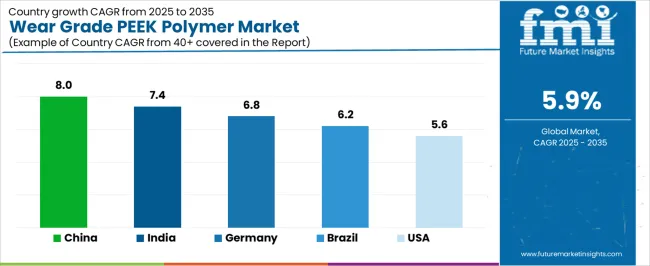
| China | 8.0% |
| India | 7.4% |
| Germany | 6.8% |
| Brazil | 6.2% |
| United States | 5.6% |
How is China Leading Global Market Growth with Automotive Manufacturing Expansion?
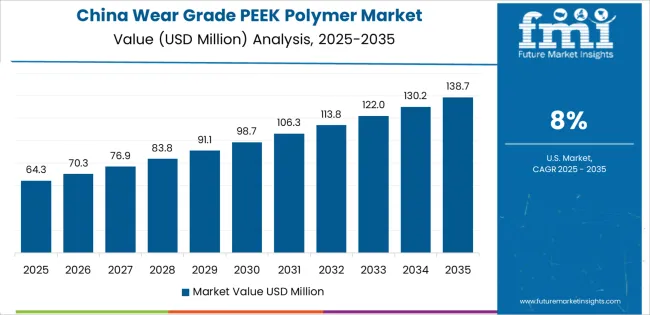
Wear grade PEEK polymer market in China is projected to grow at a CAGR of 8.0% from 2025 to 2035. Revenue from wear grade PEEK polymers in China is expected to exhibit exceptional growth, with market value reaching significant levels by 2035, driven by extensive automotive production capacity expansion and comprehensive electric vehicle development programs creating substantial opportunities for high-performance polymer suppliers across powertrain component manufacturing, chassis system production, and electric drive assembly operations. The country's established automotive component manufacturing ecosystem and expanding aerospace supply chain participation are creating significant demand for both standard and reinforced wear grade formulations. Major automotive component manufacturers and emerging aerospace suppliers are establishing technical partnerships with international polymer producers to support application development and meet growing demand for advanced material solutions.
Electric vehicle production acceleration and automotive lightweighting programs are supporting widespread adoption of PEEK polymers across bearing applications, transmission components, and sliding elements, driving demand for technical-grade materials with proven performance characteristics. Automotive component export expansion and domestic aerospace manufacturing development are creating substantial opportunities for polymer suppliers offering comprehensive technical support and application engineering capabilities. New energy vehicle development and advanced manufacturing modernization are facilitating adoption of high-performance polymer solutions throughout major automotive production regions.
What Demonstrates India's Strong Market Potential with Aerospace Manufacturing Development?
Wear grade PEEK polymer market in India is set to grow significantly at a CAGR of 7.4% from 2025 to 2035. Revenue from wear grade PEEK polymers in India is expanding substantially by 2035, supported by aerospace manufacturing localization initiatives and comprehensive automotive component production expansion creating sustained demand for advanced engineering polymers across aircraft interior manufacturing, automotive powertrain production, and emerging medical device fabrication segments. The country's growing engineering capabilities and expanding technical expertise are driving demand for wear grade polymers that provide performance reliability while supporting cost-competitive manufacturing requirements.
International polymer suppliers and domestic compounding operations are investing in technical service capabilities to support application development and component qualification processes. Aerospace supply chain participation programs and automotive component manufacturing growth are creating opportunities for wear grade PEEK polymers across diverse applications requiring superior wear resistance and thermal stability. Defense aircraft maintenance, repair, and overhaul operations and commercial aerospace component production are driving investments in high-performance polymer adoption supporting mechanical performance requirements throughout aerospace manufacturing facilities. Automotive export competitiveness initiatives and engineering capability advancement are enhancing demand for advanced polymer solutions throughout primary manufacturing regions.
How Does Germany Maintain Leadership with Automotive Engineering Excellence?
Wear grade PEEK polymer market in Germany is anticipated to see substantial growth at a CAGR of 6.8% from 2025 to 2035. Demand for wear grade PEEK polymers in Germany is expected to reach significant levels by 2035, supported by the country's leadership in automotive engineering and advanced aerospace manufacturing requiring sophisticated polymer solutions for premium vehicle systems, aircraft structural applications, and precision medical device components. German component manufacturers are implementing high-performance wear grade polymers that support advanced engineering specifications, operational durability requirements, and comprehensive quality protocols.
The market is characterized by focus on performance optimization, application engineering sophistication, and compliance with stringent automotive and aerospace material standards. Premium automotive system development programs are prioritizing advanced polymer technologies that demonstrate superior tribological performance and reliability while meeting German engineering and quality standards. Electric vehicle platform development and automotive efficiency optimization initiatives are driving adoption of lightweight wear-resistant polymers that support advanced powertrain systems and weight reduction targets. Research and development programs for material performance enhancement are facilitating adoption of specialized reinforced formulations throughout major automotive and aerospace manufacturing centers.
How is the United States Expanding the Market with Medical Device Innovation Leadership?
Wear grade PEEK polymer market in the United States is expected to witness steady growth at a CAGR of 5.6% from 2025 to 2035. Revenue from wear grade PEEK polymers in the United States is increasing to reach substantial levels by 2035, driven by medical device innovation programs and aerospace component manufacturing expansion creating sustained opportunities for high-performance polymer suppliers serving both implantable device manufacturers and aircraft systems producers. The country's extensive medical technology expertise and established aerospace engineering capabilities are creating demand for wear grade polymers that support biocompatibility requirements, regulatory compliance standards, and advanced mechanical performance specifications.
Polymer producers and specialty compounders are developing application-specific formulations to support medical device innovation and aerospace qualification requirements. Spinal implant development programs and surgical instrument manufacturing are facilitating adoption of biocompatible wear grade PEEK polymers capable of supporting stringent regulatory requirements and long-term biological performance standards. Aerospace bearing applications and aircraft interior component production are enhancing demand for lightweight, wear-resistant polymers that support operational efficiency and maintenance reduction objectives. Medical device regulatory compliance and aerospace qualification processes are creating opportunities for established polymer suppliers with comprehensive technical documentation and application engineering support capabilities across American manufacturing facilities.
What is Driving Brazil's Focus on Automotive Component Manufacturing Development?
Wear grade PEEK polymer market in Brazil is projected to witness gradual growth at a CAGR of 6.2% from 2025 to 2035. Demand for wear grade PEEK polymers in Brazil is expected to reach meaningful levels by 2035, driven by automotive component production expansion and manufacturing capability advancement supporting gradual high-performance polymer adoption in bearing applications, transmission components, and specialized automotive systems. The country's established automotive manufacturing presence and emerging advanced engineering capabilities are creating demand for wear grade polymer solutions that support performance requirements while maintaining cost competitiveness.
International polymer suppliers and regional distributors are maintaining technical service capabilities to support application development and component qualification processes. Automotive component manufacturing and export production programs are supporting gradual demand for wear grade PEEK polymers that meet international performance and quality standards. Manufacturing technology advancement and engineering capability development are creating opportunities for high-performance polymers that provide operational reliability and performance consistency. Industrial equipment applications and specialized machinery production are facilitating selective adoption of advanced polymer solutions throughout manufacturing regions.
Europe Market Split by Country
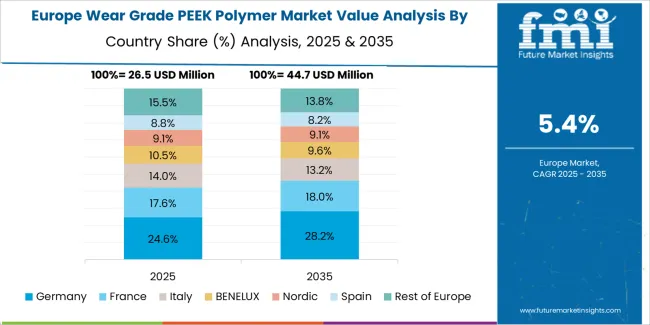
The wear grade PEEK polymer market in Europe is projected to grow from USD 39.0 million in 2025 to USD 53.5 million by 2035, registering a CAGR of 3.2% over the forecast period. Germany is expected to maintain its leadership position with a 38.6% market share in 2025, declining slightly to 37.2% by 2035, supported by its advanced automotive engineering capabilities and comprehensive aerospace component manufacturing infrastructure serving premium vehicle and aircraft applications.
France follows with a 22.3% share in 2025, projected to reach 23.1% by 2035, driven by aerospace manufacturing concentration including Airbus component production and automotive supplier base development. The United Kingdom holds a 16.7% share in 2025, expected to maintain 16.4% by 2035 with aerospace engineering focus and medical device manufacturing presence. Italy commands a 12.9% share, while Spain accounts for 6.8% in 2025. The Rest of Europe region is anticipated to gain momentum, expanding its collective share from 2.7% to 3.6% by 2035, attributed to increasing high-performance polymer adoption in Nordic automotive component manufacturing and emerging Eastern European aerospace supply chain participation implementing advanced material specifications.
Quality Standards Define Japanese Market Leadership
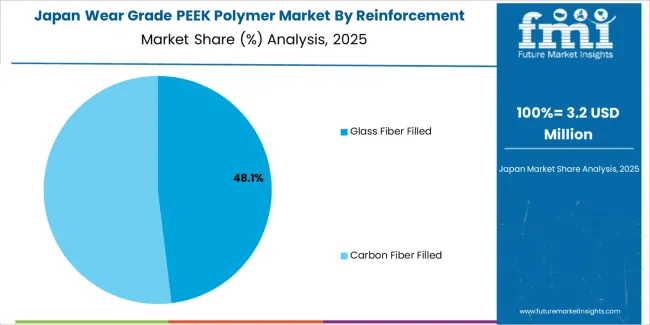
Japanese wear grade PEEK polymer operations reflect the country's precision engineering standards and sophisticated automotive manufacturing requirements. Major automotive component manufacturers including Denso, Aisin, and NSK maintain rigorous material qualification processes emphasizing dimensional stability, consistent tribological performance, and comprehensive quality documentation. This creates structured market conditions favoring established polymer suppliers with proven track records and extensive technical support capabilities.
The Japanese market demonstrates advanced application engineering, with significant collaboration between polymer producers and end-users developing optimized formulations for specific bearing designs, seal configurations, and sliding element applications. Companies require detailed material characterization data and processing parameter optimization that align with Japanese manufacturing precision standards, driving demand for sophisticated technical service capabilities.
Regulatory oversight emphasizes comprehensive material safety documentation and environmental compliance, with automotive industry standards requiring extensive validation testing and long-term performance verification. The quality management framework creates advantages for polymer suppliers with established ISO certifications and comprehensive traceability systems.
Supply chain relationships focus on long-term technical partnerships rather than transactional procurement approaches. Japanese manufacturers typically maintain multi-year supplier agreements with polymer producers, emphasizing collaborative development, continuous improvement initiatives, and joint problem-solving rather than competitive bidding cycles. This stability supports application-specific compound development and process optimization investments tailored to Japanese manufacturing requirements and performance expectations.
Innovation Focus Drives South Korean Market Development
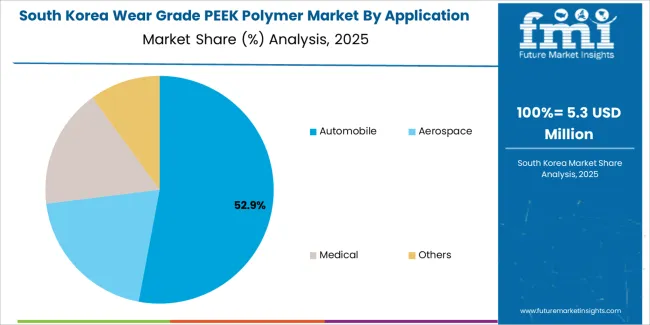
South Korean wear grade PEEK polymer operations reflect the country's advanced automotive and electronics manufacturing sectors. Major automotive component suppliers including Hyundai Mobis, Mando Corporation, and automotive bearing manufacturers drive sophisticated material procurement strategies, establishing technical partnerships with global polymer producers to secure performance-validated materials for domestic vehicle production and component export operations targeting international automotive platforms.
The Korean market demonstrates particular strength in applying wear grade PEEK polymers to electric vehicle drivetrain components, with companies integrating high-performance polymers into reduction gear bearings, motor shaft bushings, and thermal management system components. This electrification focus creates demand for formulations optimized for high-speed operation, elevated temperature exposure, and compatibility with specialized electric vehicle lubricants and cooling fluids.
Regulatory frameworks emphasize automotive safety standards and environmental compliance, with emission regulations and efficiency mandates driving lightweighting initiatives that favor advanced polymer adoption. Material qualification processes require comprehensive performance validation and durability testing, creating structured evaluation protocols that favor established polymer suppliers with technical expertise.
Engineering collaboration between Korean automotive manufacturers and polymer suppliers focuses on application-specific compound development, with joint projects targeting performance optimization for specific bearing designs and operating conditions. Korean companies invest in advanced testing capabilities and simulation tools supporting material selection and component design optimization, positioning the market for continued growth as electric vehicle production accelerates and engineering sophistication advances.
What is the Competitive Landscape of the Wear Grade PEEK Polymer Market?
Profit pools consolidate around producers demonstrating polymer synthesis expertise and application engineering capabilities supporting customer technical requirements. Value migrates from commodity unreinforced grades toward specialized reinforced formulations where mechanical property optimization, processing parameter development, and application-specific compound design command premiums. Several operational models define competitive positioning: vertically integrated polymer producers controlling PEEK polymerization and compound development; specialty compounders purchasing base resin and developing reinforced formulations; distributors providing technical service and regional inventory; and application development specialists offering engineering support and material qualification assistance.
Switching costs remain substantial due to extensive material qualification requirements, particularly in automotive and aerospace applications where testing protocols span 12-24 months and medical device applications requiring biocompatibility validation extending 24-36 months. These barriers stabilize incumbent supplier relationships once established while creating significant hurdles for new market entrants. Competitive advantages accrue to producers maintaining vertical integration across polymer synthesis and compound development, enabling formulation optimization and intellectual property protection while supporting rapid customer response and technical problem-solving.
Market structure remains concentrated with three global producers accounting for substantial market share, supported by established reputations, comprehensive technical resources, and proven performance track records. Regional compounders capture shares in cost-sensitive applications and geographies where technical service requirements allow competitive participation. Technology differentiation focuses on reinforcement optimization, processing characteristic enhancement, and surface finish improvement supporting moldability and component performance. Strategic partnerships between polymer producers and key automotive component manufacturers create preferred supplier relationships and collaborative development programs accelerating application adoption and market penetration.
Key Players in the Wear Grade PEEK Polymer Market
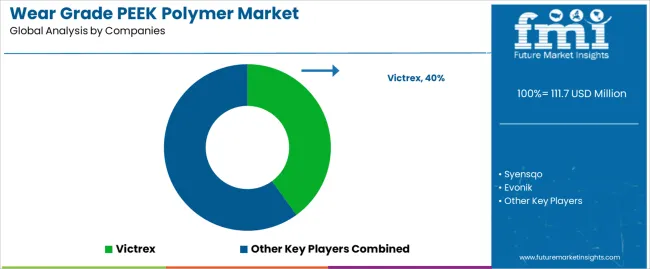
- Victrex
- Syensqo
- Evonik
- ZYPEEK
Scope of the Report
| Items | Values |
|---|---|
| Quantitative Units | USD 111.7 million |
| Reinforcement Type | Glass Fiber Filled, Carbon Fiber Filled |
| Application | Automobile, Aerospace, Medical, Other |
| Regions Covered | North America, Latin America, Europe, Asia Pacific, Middle East & Africa |
| Key Countries Covered | United States, Germany, China, India, Brazil, Japan, South Korea, and other countries |
| Key Companies Profiled | Victrex, Syensqo, Evonik, ZYPEEK |
| Additional Attributes | Revenue analysis by reinforcement type and application segment, regional market dynamics, competitive landscape assessment, material performance characteristics, application engineering trends, and compound development innovations driving tribological performance enhancement, weight reduction achievement, and biocompatibility advancement |
Wear Grade PEEK Polymer Market Segmentation
By Reinforcement Type
- Glass Fiber Filled
- Carbon Fiber Filled
By Application
- Automobile
- Aerospace
- Medical
- Other
By Region
- North America
- Europe
- Asia Pacific
- Latin America
- Middle East & Africa
Frequently Asked Questions
How big is the wear grade peek polymer market in 2025?
The global wear grade peek polymer market is estimated to be valued at USD 111.7 million in 2025.
What will be the size of wear grade peek polymer market in 2035?
The market size for the wear grade peek polymer market is projected to reach USD 198.2 million by 2035.
How much will be the wear grade peek polymer market growth between 2025 and 2035?
The wear grade peek polymer market is expected to grow at a 5.9% CAGR between 2025 and 2035.
What are the key product types in the wear grade peek polymer market?
The key product types in wear grade peek polymer market are glass fiber filled and carbon fiber filled.
Which application segment to contribute significant share in the wear grade peek polymer market in 2025?
In terms of application, automobile segment to command 51.6% share in the wear grade peek polymer market in 2025.
Preview the report firsthand - request a free sample
Get SampleGet the brochure for pricing and purchase details.
Get PDFTable of Content
- Executive Summary
- Global Market Outlook
- Demand-side Trends
- Supply-side Trends
- Technology Roadmap Analysis
- Analysis and Recommendations
- Market Overview
- Market Coverage / Taxonomy
- Market Definition / Scope / Limitations
- Market Background
- Market Dynamics
- Drivers
- Restraints
- Opportunity
- Trends
- Scenario Forecast
- Demand in Optimistic Scenario
- Demand in Likely Scenario
- Demand in Conservative Scenario
- Opportunity Map Analysis
- Product Life Cycle Analysis
- Supply Chain Analysis
- Investment Feasibility Matrix
- Value Chain Analysis
- PESTLE and Porter’s Analysis
- Regulatory Landscape
- Regional Parent Market Outlook
- Production and Consumption Statistics
- Import and Export Statistics
- Market Dynamics
- Global Market Analysis 2020 to 2024 and Forecast, 2025 to 2035
- Historical Market Size Value (USD Million) Analysis, 2020 to 2024
- Current and Future Market Size Value (USD Million) Projections, 2025 to 2035
- Y-o-Y Growth Trend Analysis
- Absolute $ Opportunity Analysis
- Global Market Pricing Analysis 2020 to 2024 and Forecast 2025 to 2035
- Global Market Analysis 2020 to 2024 and Forecast 2025 to 2035, By Reinforcement Type
- Introduction / Key Findings
- Historical Market Size Value (USD Million) Analysis By Reinforcement Type , 2020 to 2024
- Current and Future Market Size Value (USD Million) Analysis and Forecast By Reinforcement Type , 2025 to 2035
- Glass Fiber Filled
- Carbon Fiber Filled
- Y-o-Y Growth Trend Analysis By Reinforcement Type , 2020 to 2024
- Absolute $ Opportunity Analysis By Reinforcement Type , 2025 to 2035
- Global Market Analysis 2020 to 2024 and Forecast 2025 to 2035, By Application
- Introduction / Key Findings
- Historical Market Size Value (USD Million) Analysis By Application, 2020 to 2024
- Current and Future Market Size Value (USD Million) Analysis and Forecast By Application, 2025 to 2035
- Automobile
- Aerospace
- Medical
- Others
- Y-o-Y Growth Trend Analysis By Application, 2020 to 2024
- Absolute $ Opportunity Analysis By Application, 2025 to 2035
- Global Market Analysis 2020 to 2024 and Forecast 2025 to 2035, By Region
- Introduction
- Historical Market Size Value (USD Million) Analysis By Region, 2020 to 2024
- Current Market Size Value (USD Million) Analysis and Forecast By Region, 2025 to 2035
- North America
- Latin America
- Western Europe
- Eastern Europe
- East Asia
- South Asia and Pacific
- Middle East & Africa
- Market Attractiveness Analysis By Region
- North America Market Analysis 2020 to 2024 and Forecast 2025 to 2035, By Country
- Historical Market Size Value (USD Million) Trend Analysis By Market Taxonomy, 2020 to 2024
- Market Size Value (USD Million) Forecast By Market Taxonomy, 2025 to 2035
- By Country
- USA
- Canada
- Mexico
- By Reinforcement Type
- By Application
- By Country
- Market Attractiveness Analysis
- By Country
- By Reinforcement Type
- By Application
- Key Takeaways
- Latin America Market Analysis 2020 to 2024 and Forecast 2025 to 2035, By Country
- Historical Market Size Value (USD Million) Trend Analysis By Market Taxonomy, 2020 to 2024
- Market Size Value (USD Million) Forecast By Market Taxonomy, 2025 to 2035
- By Country
- Brazil
- Chile
- Rest of Latin America
- By Reinforcement Type
- By Application
- By Country
- Market Attractiveness Analysis
- By Country
- By Reinforcement Type
- By Application
- Key Takeaways
- Western Europe Market Analysis 2020 to 2024 and Forecast 2025 to 2035, By Country
- Historical Market Size Value (USD Million) Trend Analysis By Market Taxonomy, 2020 to 2024
- Market Size Value (USD Million) Forecast By Market Taxonomy, 2025 to 2035
- By Country
- Germany
- UK
- Italy
- Spain
- France
- Nordic
- BENELUX
- Rest of Western Europe
- By Reinforcement Type
- By Application
- By Country
- Market Attractiveness Analysis
- By Country
- By Reinforcement Type
- By Application
- Key Takeaways
- Eastern Europe Market Analysis 2020 to 2024 and Forecast 2025 to 2035, By Country
- Historical Market Size Value (USD Million) Trend Analysis By Market Taxonomy, 2020 to 2024
- Market Size Value (USD Million) Forecast By Market Taxonomy, 2025 to 2035
- By Country
- Russia
- Poland
- Hungary
- Balkan & Baltic
- Rest of Eastern Europe
- By Reinforcement Type
- By Application
- By Country
- Market Attractiveness Analysis
- By Country
- By Reinforcement Type
- By Application
- Key Takeaways
- East Asia Market Analysis 2020 to 2024 and Forecast 2025 to 2035, By Country
- Historical Market Size Value (USD Million) Trend Analysis By Market Taxonomy, 2020 to 2024
- Market Size Value (USD Million) Forecast By Market Taxonomy, 2025 to 2035
- By Country
- China
- Japan
- South Korea
- By Reinforcement Type
- By Application
- By Country
- Market Attractiveness Analysis
- By Country
- By Reinforcement Type
- By Application
- Key Takeaways
- South Asia and Pacific Market Analysis 2020 to 2024 and Forecast 2025 to 2035, By Country
- Historical Market Size Value (USD Million) Trend Analysis By Market Taxonomy, 2020 to 2024
- Market Size Value (USD Million) Forecast By Market Taxonomy, 2025 to 2035
- By Country
- India
- ASEAN
- Australia & New Zealand
- Rest of South Asia and Pacific
- By Reinforcement Type
- By Application
- By Country
- Market Attractiveness Analysis
- By Country
- By Reinforcement Type
- By Application
- Key Takeaways
- Middle East & Africa Market Analysis 2020 to 2024 and Forecast 2025 to 2035, By Country
- Historical Market Size Value (USD Million) Trend Analysis By Market Taxonomy, 2020 to 2024
- Market Size Value (USD Million) Forecast By Market Taxonomy, 2025 to 2035
- By Country
- Kingdom of Saudi Arabia
- Other GCC Countries
- Turkiye
- South Africa
- Other African Union
- Rest of Middle East & Africa
- By Reinforcement Type
- By Application
- By Country
- Market Attractiveness Analysis
- By Country
- By Reinforcement Type
- By Application
- Key Takeaways
- Key Countries Market Analysis
- USA
- Pricing Analysis
- Market Share Analysis, 2024
- By Reinforcement Type
- By Application
- Canada
- Pricing Analysis
- Market Share Analysis, 2024
- By Reinforcement Type
- By Application
- Mexico
- Pricing Analysis
- Market Share Analysis, 2024
- By Reinforcement Type
- By Application
- Brazil
- Pricing Analysis
- Market Share Analysis, 2024
- By Reinforcement Type
- By Application
- Chile
- Pricing Analysis
- Market Share Analysis, 2024
- By Reinforcement Type
- By Application
- Germany
- Pricing Analysis
- Market Share Analysis, 2024
- By Reinforcement Type
- By Application
- UK
- Pricing Analysis
- Market Share Analysis, 2024
- By Reinforcement Type
- By Application
- Italy
- Pricing Analysis
- Market Share Analysis, 2024
- By Reinforcement Type
- By Application
- Spain
- Pricing Analysis
- Market Share Analysis, 2024
- By Reinforcement Type
- By Application
- France
- Pricing Analysis
- Market Share Analysis, 2024
- By Reinforcement Type
- By Application
- India
- Pricing Analysis
- Market Share Analysis, 2024
- By Reinforcement Type
- By Application
- ASEAN
- Pricing Analysis
- Market Share Analysis, 2024
- By Reinforcement Type
- By Application
- Australia & New Zealand
- Pricing Analysis
- Market Share Analysis, 2024
- By Reinforcement Type
- By Application
- China
- Pricing Analysis
- Market Share Analysis, 2024
- By Reinforcement Type
- By Application
- Japan
- Pricing Analysis
- Market Share Analysis, 2024
- By Reinforcement Type
- By Application
- South Korea
- Pricing Analysis
- Market Share Analysis, 2024
- By Reinforcement Type
- By Application
- Russia
- Pricing Analysis
- Market Share Analysis, 2024
- By Reinforcement Type
- By Application
- Poland
- Pricing Analysis
- Market Share Analysis, 2024
- By Reinforcement Type
- By Application
- Hungary
- Pricing Analysis
- Market Share Analysis, 2024
- By Reinforcement Type
- By Application
- Kingdom of Saudi Arabia
- Pricing Analysis
- Market Share Analysis, 2024
- By Reinforcement Type
- By Application
- Turkiye
- Pricing Analysis
- Market Share Analysis, 2024
- By Reinforcement Type
- By Application
- South Africa
- Pricing Analysis
- Market Share Analysis, 2024
- By Reinforcement Type
- By Application
- USA
- Market Structure Analysis
- Competition Dashboard
- Competition Benchmarking
- Market Share Analysis of Top Players
- By Regional
- By Reinforcement Type
- By Application
- Competition Analysis
- Competition Deep Dive
- Victrex
- Overview
- Product Portfolio
- Profitability by Market Segments (Product/Age /Sales Channel/Region)
- Sales Footprint
- Strategy Overview
- Marketing Strategy
- Product Strategy
- Channel Strategy
- Syensqo
- Evonik
- ZYPEEK
- Victrex
- Competition Deep Dive
- Assumptions & Acronyms Used
- Research Methodology


