

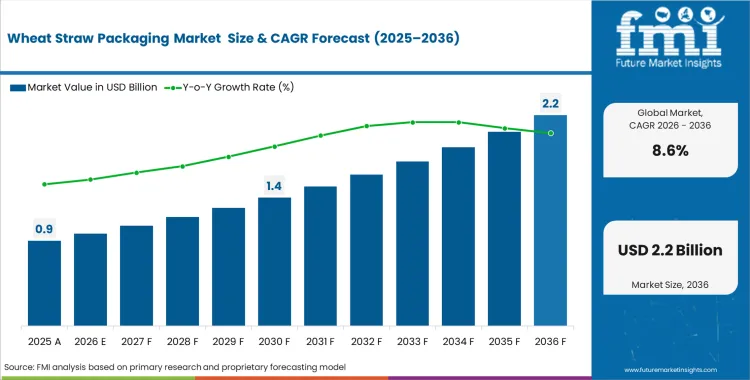
- Industry Size (2026)
- USD 0.9 Bn
- Forecast (2036)
- USD 2.1 Bn
- CAGR (2026 to 2036)
- 8.6%
Wheat Straw Packaging Market Size, Market Forecast and Outlook By FMI
The wheat straw packaging market was valued at USD 0.8 billion in 2025. The market is projected to reach USD 0.9 billion in 2026 and USD 2.1 billion by 2036, expanding at a CAGR of 8.6% during the forecast period. Molded pulp products are expected to lead product type demand with a 37.2% share in 2026. Foodservice is projected to remain the leading end-use industry with a 43.5% share in 2026. North America and Western Europe are expected to represent the largest regional markets through 2036.
Summary of Wheat Straw Packaging market
- Key Drivers
- Agricultural residue utilization logic: Wheat straw is generated in large volumes as a crop byproduct and represents a low-cost, non-food-competing cellulose feedstock that aligns with circular packaging procurement targets in major grain-producing regions.
- Plastic substitution in foodservice: Foodservice operators are transitioning from polystyrene and single-use plastic trays toward compostable alternatives, and wheat straw molded pulp competes on both cost and biodegradability credentials against bagasse and bamboo formats.
- Regional feedstock availability: In North America, Europe, and South Asia, wheat straw supply is abundant and regionally accessible without major logistics overhead, improving the business case for local packaging production close to both supply and demand.
- Key Segments Analyzed in the Report
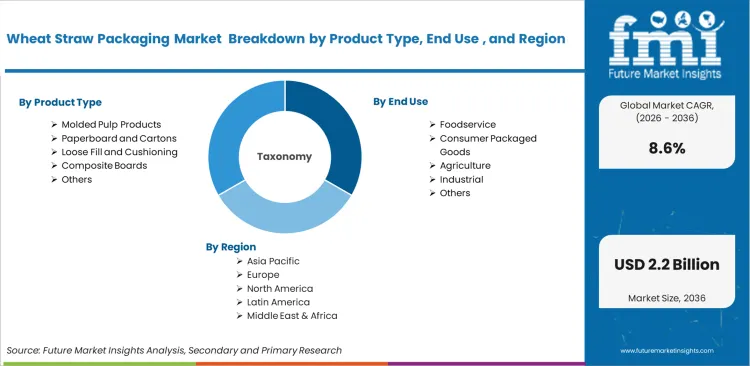
- Product type: molded pulp products, paperboard and cartons, loose fill and cushioning, composite boards, and others
- End use industry: foodservice, consumer packaged goods, agriculture, industrial, and others
- Region: North America, Latin America, Western Europe, Eastern Europe, East Asia, South Asia and Pacific, and Middle East and Africa
- Analyst Opinion
- Ismail Sutaria, Sr. Consultant at FMI says, "Wheat straw packaging is a pragmatic, regionally anchored opportunity that the market has underdeveloped relative to its feedstock availability. The commercial case is strongest where grain agriculture and packaging demand overlap in the same geography. Producers who solve the silica processing challenge and build consistent straw procurement programs will own a durable cost advantage in this category."
Wheat Straw Packaging Market Definition
The wheat straw packaging market includes packaging materials produced using cellulose fiber derived from wheat straw, an agricultural residue generated during wheat harvesting. The market covers molded pulp trays, plates, and protective inserts, paperboard and carton substrates incorporating straw pulp, composite boards for structural packaging, and loose fill cushioning made from straw biomass. These formats are used in foodservice, consumer packaged goods transit, agricultural produce distribution, and industrial packaging where compostability, biodegradability, or recycled agricultural fiber content is valued.
Wheat Straw Packaging market Inclusions
- Sales of packaging products manufactured using wheat straw pulp or wheat straw fiber as the primary or a significant constituent cellulose material.
- Revenue from molded pulp articles, paperboard substrates, composite boards, and loose fill formats produced from wheat straw fiber in foodservice, consumer goods, and industrial packaging applications.
- All commercial demand across global production networks where wheat straw is the distinguishing feedstock in the packaging material.
Wheat Straw Packaging market Exclusions
- Packaging materials using bagasse, bamboo, rice straw, or other agricultural residue fibers that are not derived from wheat straw.
- Wood pulp paperboard and corrugated packaging that does not incorporate wheat straw fiber as a meaningful component of the fiber furnish.
- Synthetic polymer packaging and bioplastic formats not based on wheat straw cellulose.
Wheat Straw Packaging market Research Methodology
This study evaluates the wheat straw packaging market by product type and end use industry using 2025 as the base year and 2026 to 2036 as the forecast period in value terms. Evidence inputs include European packaging regulation, agricultural residue fiber trade association guidance, company product disclosures from wheat straw packaging producers, food-contact regulatory documentation, and peer-reviewed literature on straw pulp properties and processing economics. Market estimates are built through triangulation of wheat straw supply availability by region, pulping capacity for non-wood fibers, foodservice plastic substitution rates, and the pace of food-contact certification expansion for agricultural residue fiber packaging.
Key Drivers, Restraints, and Trends in Wheat Straw Packaging market
Drivers
Wheat straw packaging demand is growing because it offers a regionally available, low-cost cellulose feedstock that directly addresses the plastic substitution needs of foodservice and consumer packaged goods sectors without competing with food supply chains. The format benefits from the structural overlap between major wheat-producing geographies and high packaging consumption regions in Europe, North America, and South Asia, which reduces logistics complexity and builds a natural local supply advantage. Compostability credentials and the circular narrative of turning crop waste into packaging are also adding procurement appeal as brands and retailers seek measurable alternatives to fossil-based packaging with credible end-of-life stories.
Restraints
Wheat straw processing presents technical challenges that add cost and complexity relative to established wood pulp or bagasse alternatives. Higher silica content in wheat straw accelerates equipment wear during pulping and increases chemical consumption in bleaching and fiber preparation, adding to total processing cost. Seasonal feedstock availability concentrates straw supply around harvest periods, requiring storage infrastructure and supply chain buffering that raises overhead for year-round packaging production. Surface finish quality on wheat straw molded pulp is also typically lower than virgin wood pulp alternatives, which restricts the format from premium consumer-facing packaging applications where aesthetics influence purchase decisions.
Trends
Converters are increasingly blending wheat straw pulp with wood pulp at controlled ratios to balance cost, surface quality, and fiber strength for specific packaging end uses, which is broadening the addressable application range. Food-contact certification for agricultural residue fiber is maturing in the European Union and the United States, unlocking direct food packaging opportunities that were previously unavailable due to regulatory uncertainty. Packaging producers in India, China, and Central Europe are actively building localized straw collection and processing networks that improve feedstock consistency and reduce cost for year-round converting operations.
Segmental Analysis
Wheat Straw Packaging market Analysis by Product Type
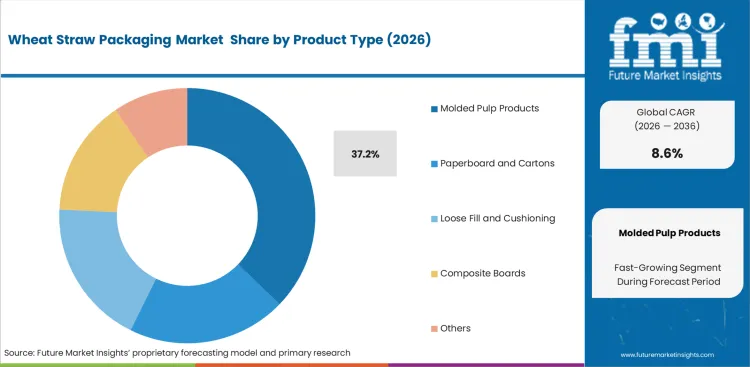
Molded pulp products are projected to hold 37.2% of market value in 2026. They represent the most commercially mature wheat straw packaging format, used in egg trays, produce cartons, foodservice tableware, and protective shipping inserts. The format benefits from established molded pulp tooling infrastructure and broad operator familiarity. Unit economics improve as straw pulp substitutes a portion of more expensive wood pulp in the fiber furnish without requiring fundamental changes to forming or drying equipment. Recurring procurement cycles in foodservice and egg packaging provide reliable demand that supports converter investment in straw pulp integration.
Wheat Straw Packaging market Analysis by End Use Industry
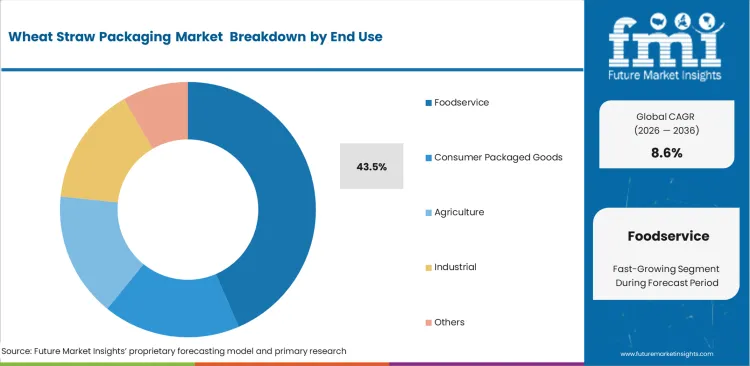
Foodservice accounts for 43.5% of demand in 2026, anchored by high-volume recurring demand for plates, bowls, clamshells, and trays at quick-service restaurants, institutional catering, and events. Operators favor compostable formats that simplify post-consumer waste handling and support sustainability commitments without adding significant cost over incumbent plastic or foam formats. Wheat straw packaging is positioned competitively against bagasse and bamboo alternatives on feedstock cost in grain-producing regions, and the format benefits from increasing food-contact approvals that allow direct food contact use across a wider range of foodservice applications.
Competitive Aligners for Market Players
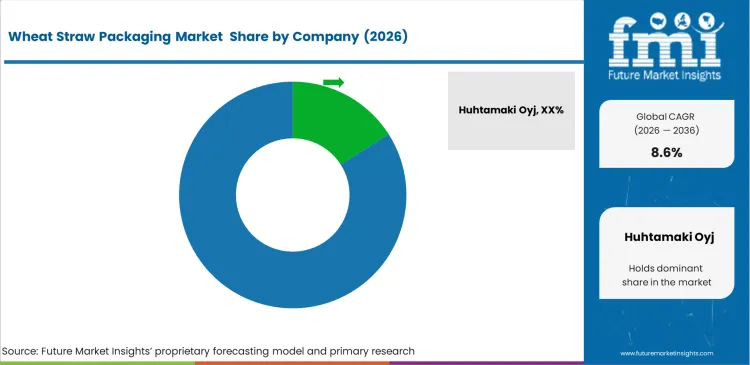
Competitive advantage in wheat straw packaging is being built around consistent fiber sourcing, silica management in pulping, and regional supply networks that reduce logistics cost and improve feedstock reliability. Buyers need food-contact documentation, dimensional consistency in molded parts, and converter supply resilience that can support year-round procurement programs. Producers who invest in dedicated straw collection and processing infrastructure close to wheat-growing regions will hold the most durable cost position. As food-contact certification expands, early movers with validated compliance documentation will accelerate customer qualification and reduce the switching friction that slows adoption from pilot to program scale.
Key Players in Wheat Straw Packaging market
- Huhtamaki Oyj
- Vegware
- World Centric
- Eco-Products
- CKF Inc.
- Novamont
- Fabri-Kal
- EnviroPAK Corporation
- Zhejiang Zhonghe Pulp and Paper
- Biopak
Strategic Outlook by FMI on Wheat Straw Packaging market
FMI sees wheat straw packaging as a commercially practical and regionally differentiated opportunity within the broader agricultural residue fiber market. Growth through 2036 will be driven by foodservice plastic substitution, expanding food-contact certification, and the development of local straw supply networks in high-opportunity regions. Producers who can solve silica processing cost, secure year-round feedstock supply, and build converter programs around validated food-contact formats will lead this market's commercial expansion.
Scope of the Report
| Metric | Value |
|---|---|
| Market Value | USD 0.8 billion in 2025 to USD 2.1 billion by 2036 |
| CAGR | 8.6% from 2026 to 2036 |
| Base Year | 2025 |
| Forecast Period | 2026 to 2036 |
| Product Type Segmentation | Molded Pulp Products, Paperboard and Cartons, Loose Fill and Cushioning, Composite Boards, Others |
| End Use Industry Segmentation | Foodservice, Consumer Packaged Goods, Agriculture, Industrial, Others |
| Regions Covered | North America, Latin America, Western Europe, Eastern Europe, East Asia, South Asia and Pacific, Middle East and Africa |
Bibliography
- European Commission. 2025. Packaging and Packaging Waste Regulation.
- International Molded Fiber Association. 2025. Molded Fiber Masterclass.
- USA Environmental Protection Agency. 2025. Paper and Paperboard: Material-Specific Data.
- Food and Agriculture Organization of the United Nations. 2022. Agricultural Residue Fiber Utilization.
- TAPPI. 2024. Non-Wood Fiber Pulping: Wheat Straw Processing Guidance.
- Semple, K. E. et al. 2022. Moulded Pulp Fibers for Disposable Food Packaging.
- European Food Safety Authority. 2023. Safety Assessment of Agricultural Fibers for Food Contact.
Frequently Asked Questions
What is the current size and forecast for the wheat straw packaging market?
The market was valued at USD 0.8 billion in 2025 and is projected to reach USD 2.1 billion by 2036, growing at a CAGR of 8.6%, driven by plastic replacement in foodservice and the utilization logic of agricultural residue feedstocks.
How does wheat straw compare to bagasse as a non-wood packaging fiber?
Both are agricultural residue fibers, but wheat straw has wider geographic availability in temperate grain-growing regions. Bagasse tends to offer marginally better fiber consistency for premium applications, while wheat straw holds a cost advantage where local grain agriculture reduces feedstock logistics.
What processing challenges make wheat straw more difficult to use than wood pulp?
Higher silica content in wheat straw accelerates equipment wear during pulping and increases chemical consumption, adding cost that converters manage through blend optimization or investment in specialized pulping equipment designed for non-wood fibers.
Which region has the strongest near-term growth potential?
South Asia and Western Europe represent the strongest near-term opportunities, combining high wheat production volumes, strong local packaging demand, and regulatory incentives for bio-based and compostable packaging adoption.
Can wheat straw packaging meet food contact regulatory requirements?
Increasingly yes. Regulatory guidance on agricultural residue fiber for food contact is maturing in both the European Union and the United States, and an expanding range of wheat straw packaging formats now carry relevant food-contact certifications that allow direct food contact use.
Preview the report firsthand - request a free sample
Get SampleGet the brochure for pricing and purchase details.
Get PDFTable of Content
- Executive Summary
- Global Market Outlook
- Demand-side Trends
- Supply-side Trends
- Technology Roadmap Analysis
- Analysis and Recommendations
- Market Overview
- Market Coverage / Taxonomy
- Market Definition / Scope / Limitations
- Research Methodology
- Chapter Orientation
- Analytical Lens and Working Hypotheses
- Market Structure, Signals, and Trend Drivers
- Benchmarking and Cross-market Comparability
- Market Sizing, Forecasting, and Opportunity Mapping
- Research Design and Evidence Framework
- Desk Research Programme (Secondary Evidence)
- Company Annual and Sustainability Reports
- Peer-reviewed Journals and Academic Literature
- Corporate Websites, Product Literature, and Technical Notes
- Earnings Decks and Investor Briefings
- Statutory Filings and Regulatory Disclosures
- Technical White Papers and Standards Notes
- Trade Journals, Industry Magazines, and Analyst Briefs
- Conference Proceedings, Webinars, and Seminar Materials
- Government Statistics Portals and Public Data Releases
- Press Releases and Reputable Media Coverage
- Specialist Newsletters and Curated Briefings
- Sector Databases and Reference Repositories
- FMI Internal Proprietary Databases and Historical Market Datasets
- Subscription Datasets and Paid Sources
- Social Channels, Communities, and Digital Listening Inputs
- Additional Desk Sources
- Expert Input and Fieldwork (Primary Evidence)
- Primary Modes
- Qualitative Interviews and Expert Elicitation
- Quantitative Surveys and Structured Data Capture
- Blended Approach
- Why Primary Evidence is Used
- Field Techniques
- Interviews
- Surveys
- Focus Groups
- Observational and In-context Research
- Social and Community Interactions
- Stakeholder Universe Engaged
- C-suite Leaders
- Board Members
- Presidents and Vice Presidents
- R&D and Innovation Heads
- Technical Specialists
- Domain Subject-matter Experts
- Scientists
- Physicians and Other Healthcare Professionals
- Governance, Ethics, and Data Stewardship
- Research Ethics
- Data Integrity and Handling
- Primary Modes
- Tooling, Models, and Reference Databases
- Desk Research Programme (Secondary Evidence)
- Data Engineering and Model Build
- Data Acquisition and Ingestion
- Cleaning, Normalisation, and Verification
- Synthesis, Triangulation, and Analysis
- Quality Assurance and Audit Trail
- Market Background
- Market Dynamics
- Drivers
- Restraints
- Opportunity
- Trends
- Scenario Forecast
- Demand in Optimistic Scenario
- Demand in Likely Scenario
- Demand in Conservative Scenario
- Opportunity Map Analysis
- Product Life Cycle Analysis
- Supply Chain Analysis
- Investment Feasibility Matrix
- Value Chain Analysis
- PESTLE and Porter’s Analysis
- Regulatory Landscape
- Regional Parent Market Outlook
- Production and Consumption Statistics
- Import and Export Statistics
- Market Dynamics
- Global Market Analysis 2021 to 2025 and Forecast, 2026 to 2036
- Historical Market Size Value (USD Million) Analysis, 2021 to 2025
- Current and Future Market Size Value (USD Million) Projections, 2026 to 2036
- Y-o-Y Growth Trend Analysis
- Absolute $ Opportunity Analysis
- Global Market Pricing Analysis 2021 to 2025 and Forecast 2026 to 2036
- Global Market Analysis 2021 to 2025 and Forecast 2026 to 2036, By Product Type
- Introduction / Key Findings
- Historical Market Size Value (USD Million) Analysis By Product Type , 2021 to 2025
- Current and Future Market Size Value (USD Million) Analysis and Forecast By Product Type , 2026 to 2036
- Molded Pulp Products
- Paperboard and Cartons
- Loose Fill and Cushioning
- Composite Boards
- Others
- Molded Pulp Products
- Y-o-Y Growth Trend Analysis By Product Type , 2021 to 2025
- Absolute $ Opportunity Analysis By Product Type , 2026 to 2036
- Global Market Analysis 2021 to 2025 and Forecast 2026 to 2036, By End Use
- Introduction / Key Findings
- Historical Market Size Value (USD Million) Analysis By End Use, 2021 to 2025
- Current and Future Market Size Value (USD Million) Analysis and Forecast By End Use, 2026 to 2036
- Foodservice
- Consumer Packaged Goods
- Agriculture
- Industrial
- Others
- Foodservice
- Y-o-Y Growth Trend Analysis By End Use, 2021 to 2025
- Absolute $ Opportunity Analysis By End Use, 2026 to 2036
- Global Market Analysis 2021 to 2025 and Forecast 2026 to 2036, By Region
- Introduction
- Historical Market Size Value (USD Million) Analysis By Region, 2021 to 2025
- Current Market Size Value (USD Million) Analysis and Forecast By Region, 2026 to 2036
- North America
- Latin America
- Western Europe
- Eastern Europe
- East Asia
- South Asia and Pacific
- Middle East & Africa
- Market Attractiveness Analysis By Region
- North America Market Analysis 2021 to 2025 and Forecast 2026 to 2036, By Country
- Historical Market Size Value (USD Million) Trend Analysis By Market Taxonomy, 2021 to 2025
- Market Size Value (USD Million) Forecast By Market Taxonomy, 2026 to 2036
- By Country
- USA
- Canada
- Mexico
- By Product Type
- By End Use
- By Country
- Market Attractiveness Analysis
- By Country
- By Product Type
- By End Use
- Key Takeaways
- Latin America Market Analysis 2021 to 2025 and Forecast 2026 to 2036, By Country
- Historical Market Size Value (USD Million) Trend Analysis By Market Taxonomy, 2021 to 2025
- Market Size Value (USD Million) Forecast By Market Taxonomy, 2026 to 2036
- By Country
- Brazil
- Chile
- Rest of Latin America
- By Product Type
- By End Use
- By Country
- Market Attractiveness Analysis
- By Country
- By Product Type
- By End Use
- Key Takeaways
- Western Europe Market Analysis 2021 to 2025 and Forecast 2026 to 2036, By Country
- Historical Market Size Value (USD Million) Trend Analysis By Market Taxonomy, 2021 to 2025
- Market Size Value (USD Million) Forecast By Market Taxonomy, 2026 to 2036
- By Country
- Germany
- UK
- Italy
- Spain
- France
- Nordic
- BENELUX
- Rest of Western Europe
- By Product Type
- By End Use
- By Country
- Market Attractiveness Analysis
- By Country
- By Product Type
- By End Use
- Key Takeaways
- Eastern Europe Market Analysis 2021 to 2025 and Forecast 2026 to 2036, By Country
- Historical Market Size Value (USD Million) Trend Analysis By Market Taxonomy, 2021 to 2025
- Market Size Value (USD Million) Forecast By Market Taxonomy, 2026 to 2036
- By Country
- Russia
- Poland
- Hungary
- Balkan & Baltic
- Rest of Eastern Europe
- By Product Type
- By End Use
- By Country
- Market Attractiveness Analysis
- By Country
- By Product Type
- By End Use
- Key Takeaways
- East Asia Market Analysis 2021 to 2025 and Forecast 2026 to 2036, By Country
- Historical Market Size Value (USD Million) Trend Analysis By Market Taxonomy, 2021 to 2025
- Market Size Value (USD Million) Forecast By Market Taxonomy, 2026 to 2036
- By Country
- China
- Japan
- South Korea
- By Product Type
- By End Use
- By Country
- Market Attractiveness Analysis
- By Country
- By Product Type
- By End Use
- Key Takeaways
- South Asia and Pacific Market Analysis 2021 to 2025 and Forecast 2026 to 2036, By Country
- Historical Market Size Value (USD Million) Trend Analysis By Market Taxonomy, 2021 to 2025
- Market Size Value (USD Million) Forecast By Market Taxonomy, 2026 to 2036
- By Country
- India
- ASEAN
- Australia & New Zealand
- Rest of South Asia and Pacific
- By Product Type
- By End Use
- By Country
- Market Attractiveness Analysis
- By Country
- By Product Type
- By End Use
- Key Takeaways
- Middle East & Africa Market Analysis 2021 to 2025 and Forecast 2026 to 2036, By Country
- Historical Market Size Value (USD Million) Trend Analysis By Market Taxonomy, 2021 to 2025
- Market Size Value (USD Million) Forecast By Market Taxonomy, 2026 to 2036
- By Country
- Kingdom of Saudi Arabia
- Other GCC Countries
- Turkiye
- South Africa
- Other African Union
- Rest of Middle East & Africa
- By Product Type
- By End Use
- By Country
- Market Attractiveness Analysis
- By Country
- By Product Type
- By End Use
- Key Takeaways
- Key Countries Market Analysis
- USA
- Pricing Analysis
- Market Share Analysis, 2025
- By Product Type
- By End Use
- Canada
- Pricing Analysis
- Market Share Analysis, 2025
- By Product Type
- By End Use
- Mexico
- Pricing Analysis
- Market Share Analysis, 2025
- By Product Type
- By End Use
- Brazil
- Pricing Analysis
- Market Share Analysis, 2025
- By Product Type
- By End Use
- Chile
- Pricing Analysis
- Market Share Analysis, 2025
- By Product Type
- By End Use
- Germany
- Pricing Analysis
- Market Share Analysis, 2025
- By Product Type
- By End Use
- UK
- Pricing Analysis
- Market Share Analysis, 2025
- By Product Type
- By End Use
- Italy
- Pricing Analysis
- Market Share Analysis, 2025
- By Product Type
- By End Use
- Spain
- Pricing Analysis
- Market Share Analysis, 2025
- By Product Type
- By End Use
- France
- Pricing Analysis
- Market Share Analysis, 2025
- By Product Type
- By End Use
- India
- Pricing Analysis
- Market Share Analysis, 2025
- By Product Type
- By End Use
- ASEAN
- Pricing Analysis
- Market Share Analysis, 2025
- By Product Type
- By End Use
- Australia & New Zealand
- Pricing Analysis
- Market Share Analysis, 2025
- By Product Type
- By End Use
- China
- Pricing Analysis
- Market Share Analysis, 2025
- By Product Type
- By End Use
- Japan
- Pricing Analysis
- Market Share Analysis, 2025
- By Product Type
- By End Use
- South Korea
- Pricing Analysis
- Market Share Analysis, 2025
- By Product Type
- By End Use
- Russia
- Pricing Analysis
- Market Share Analysis, 2025
- By Product Type
- By End Use
- Poland
- Pricing Analysis
- Market Share Analysis, 2025
- By Product Type
- By End Use
- Hungary
- Pricing Analysis
- Market Share Analysis, 2025
- By Product Type
- By End Use
- Kingdom of Saudi Arabia
- Pricing Analysis
- Market Share Analysis, 2025
- By Product Type
- By End Use
- Turkiye
- Pricing Analysis
- Market Share Analysis, 2025
- By Product Type
- By End Use
- South Africa
- Pricing Analysis
- Market Share Analysis, 2025
- By Product Type
- By End Use
- USA
- Market Structure Analysis
- Competition Dashboard
- Competition Benchmarking
- Market Share Analysis of Top Players
- By Region
- By Product Type
- By End Use
- Competition Analysis
- Competition Deep Dive
- Huhtamaki Oyj
- Overview
- Product Portfolio
- Profitability by Market Segments (Product/Age /Sales Channel/Region)
- Sales Footprint
- Strategy Overview
- Marketing Strategy
- Product Strategy
- Channel Strategy
- Vegware
- World Centric
- Eco-Products
- CKF Inc.
- Novamont
- Fabri-Kal
- EnviroPAK Corporation
- Zhejiang Zhonghe Pulp and Paper
- Biopak
- Huhtamaki Oyj
- Competition Deep Dive
- Assumptions & Acronyms Used


