

- Market Size (2026)
- USD 62.7 Bn
- Forecast (2036)
- USD 165.6 Bn
- CAGR (2026 to 2036)
- 10.2%
Heat Pump Market Size, Market Forecast and Outlook By FMI
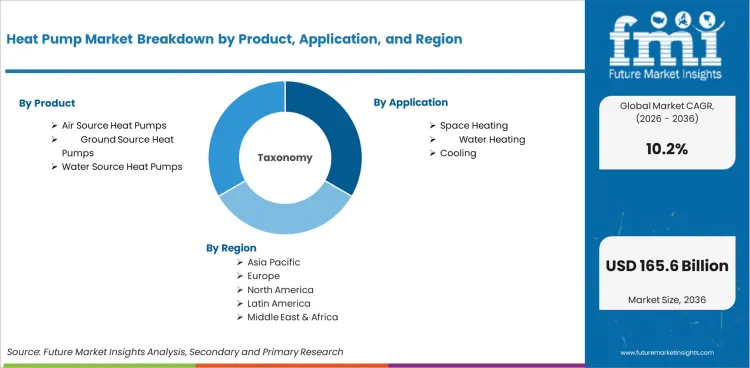
The heat pump market size was valued at USD 56.9 billion in 2025. Industry revenue is anticipated to cross USD 62.7 billion in 2026 and rise to USD 165.6 billion by 2036 at 10.2% CAGR. Residential is expected to hold 60.0% share of end use segment in 2026. Direct sales are projected to account for 60.0% share in 2026.
Summary of the Heat Pump Market
- Demand and Growth Drivers
- Space heating electrification is raising heat pump purchases by 2036 as homes and buildings shift away from boilers.
- Air source equipment continues to lead demand since outdoor units need less site work than ground loop designs.
- Low-carbon building rules support higher adoption as manufacturers align product lines with refrigerant and efficiency changes.
- Product and Segment View
- Air source heat pumps are projected to account for 55.0% share in 2026 through easier retrofit placement.
- Space heating is expected to lead with 50.0% share in 2026 as room and water systems replace fuel-fired units.
- Direct sales are anticipated to represent 60.0% share in 2026 due to large accounts needing factory checks.
- Geography and Competitive Outlook
- Japan is projected to record 11.2% CAGR by 2036, reflecting electrified heating policy and replacement demand across residential buildings.
- China is expected to expand at 10.7% CAGR by 2036 due to urban heating upgrades and wider use of air source heat pumps.
- Daikin Industries and Carrier Corporation hold established positions as product design shifts toward air source heat pumps.
- Analyst Opinion
- Nikhil Kaitwade, Principal Analyst for Industry Automation or Equipment at FMI, says, "Heat pump buyers are no longer comparing only the equipment price across residential and commercial projects. Homeowners need proof of comfort during cold days before moving from gas boilers to electric heating. Builders need refrigerant-compliant products without forcing major changes inside mechanical rooms and design files. Suppliers with installer training and low-GWP refrigerant files should win better project access over the next two years."
- Heat Pump Market Value Analysis
- Heat pumps are moving from optional heating equipment into a core replacement choice for buildings shifting away from fossil fuel systems.
- Residential users are expected to raise adoption as space heating and cooling needs move toward electric systems with lower running emissions.
- Air source heat pumps are gaining preference as buyers need easier installation compared with ground source and water source systems.
- Direct sales are supported by large building projects in which buyers need system sizing support and long-term service coordination.
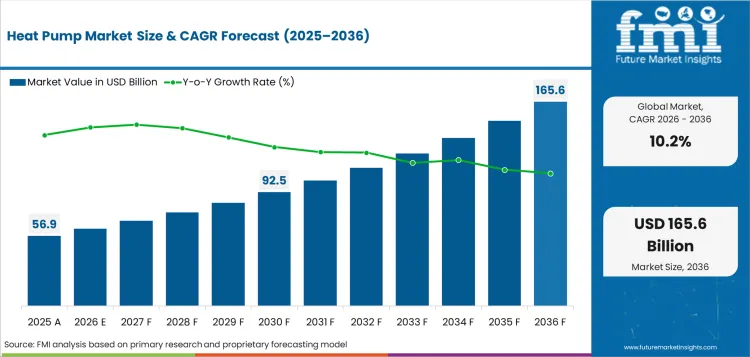
Key Takeaways, Market Size, and Forecast
| Metric | Value |
|---|---|
| Market Size (2025) | USD 56.9 Billion |
| Market Size (2036) | USD 165.6 Billion |
| CAGR (2026–2036) | 10.2% |
| Incremental Opportunity (2026–2036) | USD 102.9 Billion |
| Leading Application (2026) | Residential |
| Residential Share (2026) | 60.0% |
| Leading Distribution Channel (2026) | Direct Sales |
| Direct Sales Share (2026) | 60.0% |
| Fastest-Growing Country | Japan |
| Japan CAGR | 11.2% |
| 2nd Fastest-Growing Country | China |
| China CAGR | 10.7% |
Homeowners are delaying heat pump purchases when equipment/retrofit cost and installer availability feel uncertain. The International Energy Agency’s February 2025 review notes that global demand weakened in early 2024. That makes financing and policy clarity important for conversion. The United Kingdom’s £7,500 grant for air source and ground source heat pumps gives installers a direct affordability tool during sales discussions. Installation capacity still limits the market. The United Kingdom government’s August 2024 Heat Training Grant update states that thousands more heating engineers need heat pump installation and maintenance skills. Manufacturers benefit when trained installers can support commissioning and aftersales work. Supply-side policy is also forming. The United Kingdom’s Heat Pump Investment Accelerator offers up to £90 million with up to £30 million per project. Daikin’s EUR 300 million Poland factory plan shows how OEMs are preparing for demand recovery. Market leaders are anticipated to combine product supply and subsidy navigation.
Heat Pump Market Definition
Sector scope covers electrically driven equipment transferring heat from air and ground into indoor spaces and water systems. Included products cover air source and ground source heat pumps sold for space heating and hot water. Water source systems are included for cooling and heating uses across commercial buildings. Study scope includes residential and commercial uses with selected industrial heating applications. Fuel-fired boilers without heat pump operation sit outside the revenue scope.
Heat Pump Market Inclusions
Market scope covers all commercially traded heat pump systems categorized by product type, including air source heat pumps; ground source heat pumps; and water source heat pumps. Application scope includes space heating; water heating; and cooling across residential; commercial; and industrial users. Distribution scope covers direct sales; distributors; and online platforms while refrigerant scope covers hydrofluorocarbon refrigerants; low global warming potential refrigerants; and natural refrigerants. Revenue scope covers 2026 to 2036 with sales counted at system and equipment supplier level. Stakeholders include heat pump manufacturers; compressor and component suppliers; heating, ventilation, and air conditioning contractors; building developers; energy service firms; distributors; utilities; housing authorities; commercial facility owners; industrial users; and regulatory bodies.
Heat Pump Market Exclusions
Study scope excludes standalone gas boilers and electric resistance heaters sold without heat pump operation. Absorption chillers without vapor compression are excluded from revenue scope. Cooling-only room air conditioners and industrial refrigeration systems are excluded unless heating use is part of the sale.
Heat Pump Market Research Methodology
- Primary Research: FMI analysts reviewed heat pump manufacturers and HVAC contractors serving residential projects across major heating countries. Commercial building consultants were included to check retrofit barriers and cold-weather comfort needs.
- Desk Research: Desk review used energy agency data, public installation statistics and company announcements after January 2024. Product scope was checked against air source and hydronic systems with natural refrigerant formats reviewed separately.
- Market Sizing and Forecasting: Forecast work combined supplied market values with product mix and country-level heating replacement activity. Segment shares were tested against retrofit fit and direct sales reliance among large accounts.
- Data Validation: Country CAGRs were checked against policy support, building stock and manufacturer activity before final review. Company lists were checked for active heat pump portfolios and public product work after January 2024.
Why is the Heat Pump Market Growing?
- Building electrification is turning heat pumps into a planned replacement choice across homes and light commercial facilities.
- Cold-climate product testing is reducing buyer concern over winter comfort in northern heating regions.
- Refrigerant change is moving purchases toward suppliers with low-GWP product lines and installer training.
Policy direction is moving heat pump projects into formal energy plans across countries with active building electrification goals. International Energy Agency analysis recorded a 1.0% decline in global heat pump sales in 2024. United States purchases exceeded gas furnace purchases. Buyer decisions are uneven by country as incentives and fuel costs differ across heating markets. Manufacturers must prove running cost savings and comfort performance before interest turns into confirmed orders.
Cold weather performance is a second buying trigger for residential heat pump systems in northern regions with long heating seasons. Pacific Northwest National Laboratory reported that four of eight participating manufacturers had announced commercialization plans for cold-climate challenge units as of December 2024. Field evidence carries weight with buyers who fear backup heat use during winter peak conditions. Verified prototypes may reduce hesitation in Canada and the northern United States as contractors explain cold-weather output.
Refrigerant transition is reshaping specification work across residential and light commercial heat pump products. United States Environmental Protection Agency rules set a 700 GWP limit for most residential and light commercial air conditioning and heat pump systems from January 1, 2025. R-454B and R-32 are relevant replacement choices under use conditions for new equipment. Product design must connect refrigerant choice with safety rules and installer handling across each equipment family. Suppliers with clear refrigerant roadmaps should shorten buyer approval time for contractors and building owners.
Market Segmentation Analysis
- Air source heat pumps are projected to account for 55.0% share in 2026 as outdoor units fit into retrofit homes with limited site work.
- Space heating is expected to hold 50.0% share in 2026 with replacement demand centered on boiler and furnace alternatives.
- Residential is anticipated to represent 60.0% share in 2026 as single-family homes and multi-family buildings support equipment volume.
- Direct sales are projected to lead with 60.0% share in 2026 since contractors and builders need factory pricing support.
- Low global warming potential refrigerants are estimated to hold 45.0% share in 2026 as R-32 and R-454B adoption rises.
Market segmentation covers product; application; end use; distribution channel; and refrigerant type. Product segmentation includes air source heat pumps; ground source heat pumps; and water source heat pumps with air source heat pumps leading due to easier installation and broad residential use. Application scope covers space heating; water heating; and cooling with space heating leading as heating replacement work drives system choice in colder and mixed climates. End use includes residential; commercial; and industrial users with residential holding the strongest use case through home heating replacement and cooling integration. Distribution channel segmentation covers direct sales; distributors; and online platforms with direct sales leading as buyers need sizing support and service coordination. Refrigerant type covers hydrofluorocarbon refrigerants; low global warming potential refrigerants; and natural refrigerants with low global warming potential refrigerants leading as R-32 and R-454B adoption rises.
Insights into the Air Source Heat Pumps Product Segment
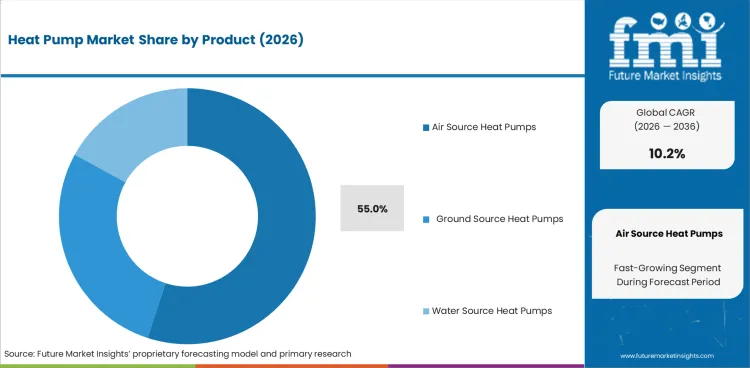
- Air source heat pumps are projected to account for 55.0% share in 2026, led by outdoor units suiting faster home retrofits without drilling work.
- Ground source units give steadier output in cold regions as loop drilling raises upfront cost and limits use in dense housing.
Insights into the Space Heating Application Segment
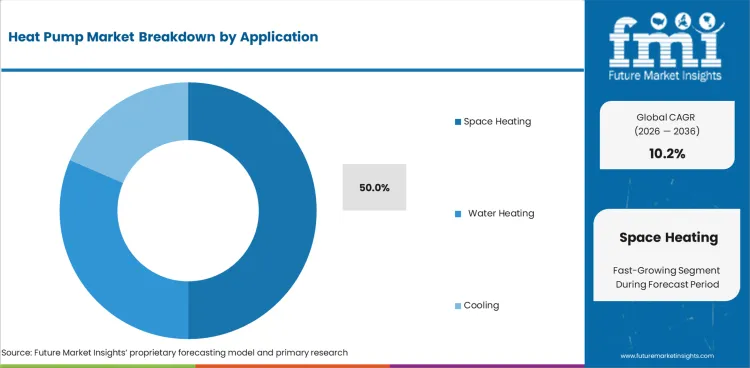
- Space heating is expected to account for 50.0% share in 2026 as boiler replacement gives buyers a clear switch point.
- Water heating demand expands through residential water heaters as tank space and plumbing changes slow use in smaller homes.
Insights into the Residential End Use Segment
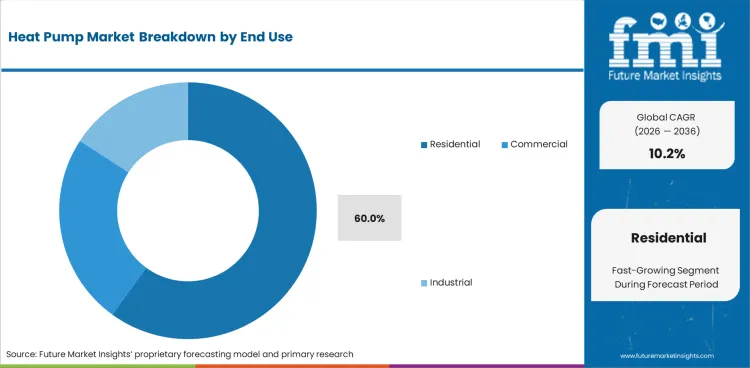
- Residential is anticipated to account for 60.0% share in 2026 reflecting single-family upgrades creating repeatable installation demand.
- Commercial projects depend on longer design reviews since buyers must confirm load size and building controls before approval.
Insights into the Direct Sales Distribution Channel Segment
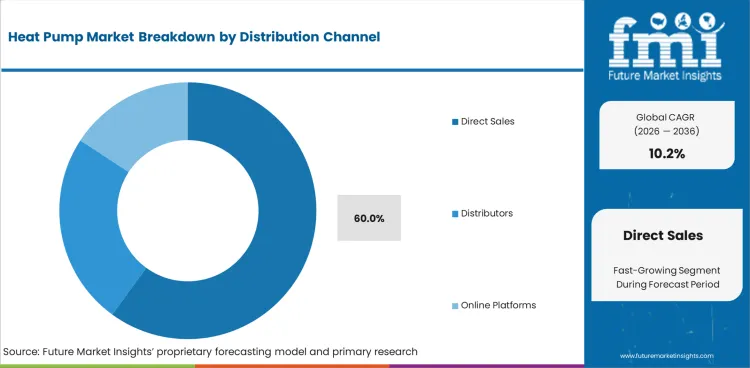
- Direct sales are projected to account for 60.0% share in 2026 as builders and utilities require confirmed supply windows.
- Distributor sales continue for replacement units led by project accounts needing factory support for refrigerant files and sizing checks.
Insights into the Low Global Warming Potential Refrigerants Segment
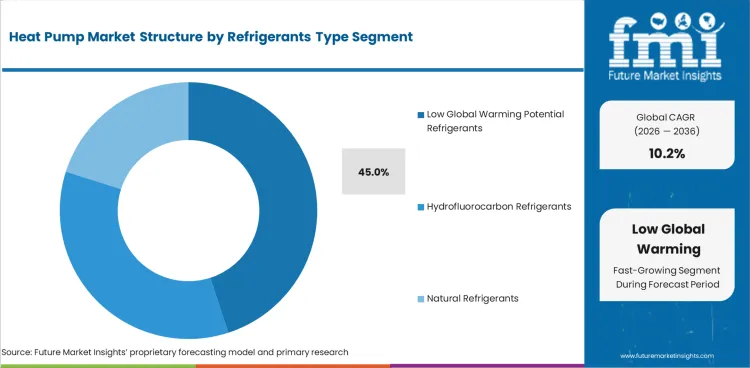
- Low global warming potential refrigerants are estimated to account for 45.0% share in 2026, influenced by R-32 and R-454B replacing older blends.
- Natural refrigerant options suit larger units as training and safety rules adding planning steps before installation.
Heat Pump Market Drivers, Restraints, and Opportunities
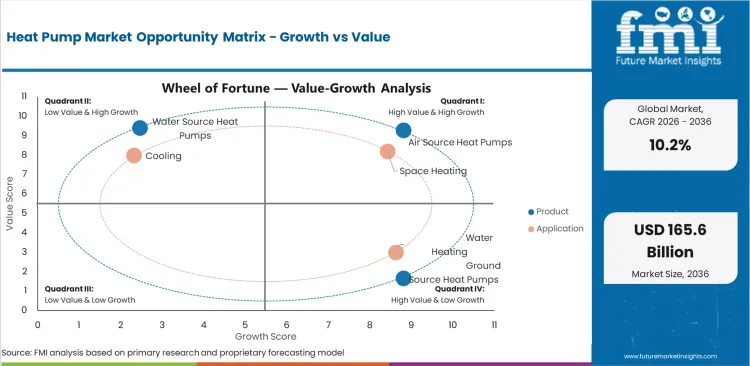
- Boiler replacement is expected to raise equipment buying as households compare fuel cost risk with electric heating options.
- Installer scarcity remains a restraint as correct sizing and commissioning decide comfort during low-temperature operation.
- Low-GWP refrigerants create an opportunity for suppliers aligning product redesign with training for field teams.
- Hydronic retrofits are expected to widen the addressable pool for hydronic heat pump installations in older buildings.
Electrified heating is expected to convert more boiler replacement decisions into heat pump projects as homes and facilities review fuel cost risk. European Heat Pump Association data show total heat pump stock across 19 European countries reached around 25.5 million units in 2024, giving suppliers a larger service and replacement pool. Installer availability will remain a restraint since poor sizing can raise backup heat use and weaken winter comfort. Cold-climate proof should improve buyer trust after Trane reported 15% energy savings during two heating and cooling seasons in Boise. Refrigerant change will create a second product shift as Johnson Controls introduced a water-to-water screw heat pump using R-1234ze with GWP of 1. Heat pump equipment suppliers should gain from boiler replacement only when product performance and installer training are handled together.
Supply Risk and Refrigerant Dependence Analysis
Heat pump supply risk is moving toward compressor readiness as buyers look for shorter lead times and better retrofit performance. Mitsubishi Electric announced a USD 143.5 million investment in December 2024 to retrofit its Maysville Kentucky factory for variable-speed compressors used in high-efficiency heat pumps. The company expects production to start in October 2027 with initial annual capacity of 1,000,000 compressors. Local compressor output should reduce supply risk for North American buyers as retrofit cycles raise demand for higher-efficiency residential systems.
Production Capacity and Utilization Analysis
Production capacity planning is becoming more cautious as heat pump sales show uneven movement across major heating markets. International Energy Agency data show global heat pump sales fell by about 2.0% in 2025 after a 1.0% decline in 2024. Short-term weakness does not remove the long replacement cycle for heating equipment across homes and commercial buildings. Manufacturers are expected to favor flexible production lines and shared compressor platforms that avoid heavy reliance on one country or one product category.
Regional Analysis
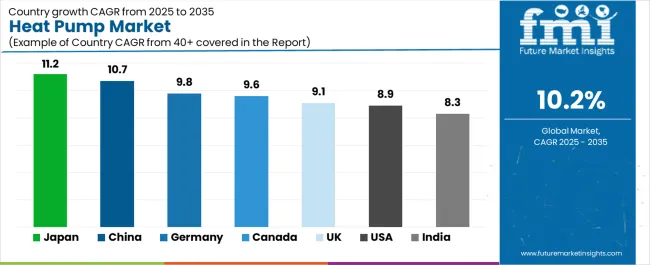
.webp "Top Country Growth Comparison Heat Pump Market Cagr (2026 2036)")
| Country | CAGR 2026 to 2036 |
|---|---|
| Japan | 11.2% |
| China | 10.7% |
| Germany | 9.8% |
| Canada | 9.6% |
| UK | 9.1% |
| USA | 8.9% |
| India | 8.3% |
Source: Future Market Insights analysis based on heat pump adoption review in 2026.
Analysis of Heat Pump Market by Key Countries
- Japan is projected to record 11.2% CAGR by 2036 as CO2 water heating and inverter systems support replacement buying.
- China is expected to expand at 10.7% CAGR by 2036 as local manufacturing scale supports air source equipment access.
- Germany is forecast to grow at 9.8% CAGR by 2036 as heating rules and district projects support low-carbon upgrades.
- Canada is expected to advance at 9.6% CAGR by 2036 as cold-climate equipment and rebate activity support adoption.
- UK is projected to rise at 9.1% CAGR by 2036 as certified installations expand from a low heating replacement level.
- USA is forecast at 8.9% CAGR by 2036 as cold-climate validation and refrigerant change shape product replacement.
- India is expected to post 8.3% CAGR by 2036 as water heating standards and hotel projects widen early demand.
Country performance differs by heating fuel mix and installer readiness across mature and developing markets. Japan leads through inverter equipment and CO2 hot water systems used in homes. China follows through domestic manufacturing strength and policy interest in building electrification. Germany and Canada gain from cold-climate needs and higher attention to building heat replacement. United Kingdom and United States advance through rebate support and testing programs. India starts smaller, but standards work and commercial water heating create a route into higher use.
Demand Outlook for Heat Pump Market in Japan
Industry in Japan is expected to record 11.2% CAGR by 2036 as inverter air conditioners and CO2 hot water units support replacement demand. Japanese heat pump industry groups reported EcoCute cumulative domestic shipments above 10 million units by March 2025. Large water storage and night-time operation suit Japanese bathing patterns and household electricity tariffs. Suppliers should focus on quiet operation and cold-region heating performance to protect homeowner acceptance.
- CO2 hot water systems create a practical route for natural refrigerant chillers and related heating designs.
- Cold northern regions need defrost control protecting comfort during below-freezing outdoor conditions and long heating cycles.
- Local brands gain trust through service networks familiar with water quality and storage tank needs.
Sales Analysis for Heat Pump Market in China
Heat pump sales in China are projected to expand at 10.7% CAGR by 2036, led by air source systems scaling through local supply. Heat Pumping Technologies reported that the China Heat Pump Alliance had grown beyond 600 members by 2024. Local manufacturing lowers equipment access barriers and shortens service channels for Chinese contractors. Building electrification should support both residential heating and industrial hot water use during the forecast period.
- Air source units fit northern coal replacement work and southern comfort cooling needs without deep building changes.
- Domestic brands can scale faster through compressor supply and project pricing across provincial markets in China.
- Industrial users create demand for heavy-duty heat pumps in process water and waste heat recovery.
Future Outlook for Heat Pump Market in Germany
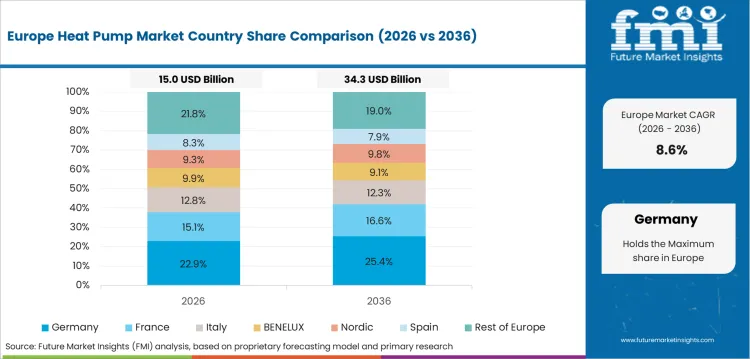
German industry is forecast to grow at 9.8% CAGR by 2036 as heat transition policies maintain buyer attention on low-carbon heating. Johnson Controls said its Neustadt seawater heat pump will use Baltic Sea water and provide up to 700 kW of heating output. District heating examples can build trust in larger heat pump systems for German municipal buyers. Buyers will judge payback against gas prices and renovation complexity before approving full replacement.
- Multi-family buildings require hydronic design work before heat pumps can replace centralized boiler rooms.
- Municipal heat networks can use seawater and waste heat projects as proof points for larger conversion plans.
- Installer training remains important as old radiator systems need lower flow temperatures and careful balancing.
Demand Analysis of Heat Pump Market in Canada
Heat pump demand in Canada is expected to advance at 9.6% CAGR by 2036 as cold-climate performance receives more buyer attention. Natural Resources Canada reported 9,674 new heat pumps installed under a grant update in October 2024. Grant activity points to active homeowner interest in provinces with oil heating and high winter bills. Northern projects require correct sizing and backup planning for winter extremes across rural and suburban homes.
- Cold-climate air source systems gain preference if rated output holds during long heating seasons.
- Commercial buildings need products certified for Canadian pressure equipment rules and local voltage requirements before approval.
- Johnson Controls launched a 575 Volt air-to-water unit for Canada to address project fit and HVAC design needs.
Opportunity Analysis of Heat Pump Market in UK
United Kingdom heat pump demand is projected to rise at 9.1% CAGR by 2036 as certified installations continue to grow from a smaller starting level. Microgeneration Certification Scheme data recorded over 60,000 certified heat pump installations in 2025 across the United Kingdom. A low installed stock creates room for expansion as boiler replacement cycles continue across existing homes. Supplier success should depend on installer availability and simple consumer offers reducing purchase friction.
- Boiler replacement grants reduce upfront cost. Homes often need radiator or cylinder changes before installation.
- Air-to-air products gain interest as planning rules and air conditioning systems needs overlap.
- Certified installer networks shape buyer confidence because poor sizing can weaken comfort and raise running cost.
Sales Analysis of Heat Pump Market in USA
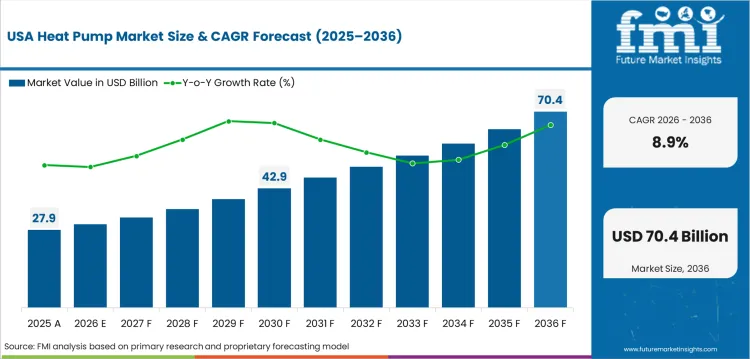
United States is forecast at 8.9% CAGR by 2036, influenced by cold-climate testing and refrigerant change guiding buyer decisions. Pacific Northwest National Laboratory reported Carrier and Trane made commercialization announcements for challenge units by early 2025. Lennox and Bosch were named in the same public field validation work by early 2025. Public field validation reduces concern over winter backup heat among homeowners and installing contractors in northern states. Dealers with tested products can improve conversion in these regions after showing low-temperature output evidence.
- Compressor investments support heat pump compressors as variable-speed systems become more common in higher-efficiency homes.
- Heat pump purchases exceeded gas furnace purchases in 2024 according to the International Energy Agency review.
- Low-GWP refrigerant rules push contractors toward new handling practices and product documentation during replacement work.
Demand Outlook for Heat Pump Market in India
The market in India is expected to post 8.3% CAGR by 2036 as early heat pump water heater demand moves into standards review. Early demand is small compared with China or Japan. Water heating standards could improve buyer confidence. Hotels and urban apartments are expected to provide initial order flow before mass household adoption expands across cities.
- Water heating creates stronger prospects for adoption than space heating because many Indian regions have limited winter load.
- Imports from China shape price availability and local standards support more organized product approval.
- Commercial kitchens and hospitality sites adopt commercial water heaters faster than scattered households during early market formation.
Competitive Positioning and Strategic Supplier Strength
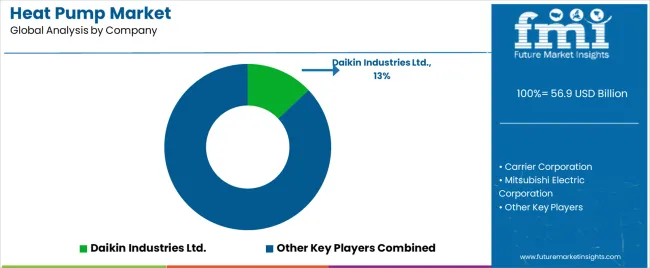
- Daikin Industries is expected to protect scale through air source breadth and refrigerant transition work across Europe and Asia.
- Carrier Corporation is expected to gain from cold-climate and rooftop testing across residential and commercial equipment.
- Mitsubishi Electric Corporation holds strength in variable-speed compressors and higher-specification inverter product lines across residential systems.
- Johnson Controls gains project access through water-to-water systems and district heating references in Europe and North America.
Global heat pump manufacturers compete across residential and commercial projects on product range and proven heating performance. Supplier selection is shaped by cold-weather output alongside refrigerant readiness and contractor reach. Buyers compare seasonal efficiency and installation support before approving a brand for new projects or replacement work. Daikin and Mitsubishi Electric benefit from broad ranges across air-to-air systems and hydronic applications. Carrier and Trane gain from United States field testing tied to colder climates. Johnson Controls holds a stronger position in commercial water-loop and district heating projects.
Supplier strength is expected to depend on how well each company matches product design with the building and its heat distribution system. Residential buyers need easy outdoor placement and clear running cost guidance. Commercial buyers need project documents and setup support before service coverage is reviewed. Water source heat pumps and hydronic systems need deeper engineering support than ductless units. Regional players can gain price-sensitive jobs. Large projects are more likely to favor suppliers with tested products and clear warranty backing.
Key Companies in Heat Pump Market
Competition spans global HVAC manufacturers and specialists in compressors, hydronic systems and commercial building equipment. Role-based grouping is more useful than size grouping because suppliers compete through product fit, installer support and engineering depth.
- Residential and light commercial leaders: Daikin Industries, Carrier Corporation and Mitsubishi Electric Corporation compete through split systems and installer reach.
- Commercial equipment specialists: Johnson Controls and Trane Technologies compete through rooftop units, hydronic systems and commissioning support.
- Component and platform groups: Copeland and Panasonic serve heat pump adoption through compressors, controls and related HVAC parts.
Competitive Benchmarking: Heat Pump Market
| Company | Cold-Climate Range | Refrigerant Readiness | Installer Support | Footprint |
|---|---|---|---|---|
| Daikin Industries | High | High | High | Global |
| Carrier Corporation | High | High | High | Global |
| Mitsubishi Electric Corporation | High | Large | Large | Global |
| Johnson Controls | Large | High | Large | Global |
| Trane Technologies | High | Large | High | Global |
| Panasonic | Moderate | Large | Moderate | Asia-led global |
| Copeland | Compressor-led | Large | Moderate | Global |
Source: Future Market Insights competitive analysis based on public product portfolios and company activity in 2026.
Key Developments in the Heat Pump Market
- In November 2024, Daikin and Copeland announced a joint venture to bring inverter swing rotary compressor technology to the United States residential heat pump segment.
- In December 2024, Mitsubishi Electric announced a USD 143.5 million retrofit of its Kentucky factory for variable-speed compressors used in high-efficiency heat pumps.
- In March 2026, Carrier passed United States Department of Energy lab testing for commercial rooftop heat pump units in the 10 to 14 ton and 15 to 25 ton categories.
Key Players in the Heat Pump Market
Global HVAC manufacturers
- Daikin Industries Ltd.
- Carrier Corporation
- Mitsubishi Electric Corporation
- Johnson Controls
- Trane Technologies
- Panasonic Holdings Corporation
Component and platform suppliers
- Copeland
- Danfoss
- LG Electronics
- Midea Group
- Bosch Thermotechnology
Regional and applied system suppliers
- NIBE Group
- Vaillant Group
- Viessmann Climate Solutions
- A. O. Smith Corporation
Report Scope and Coverage
| Item | Value |
|---|---|
| Market value in 2025 | USD 56.9 billion |
| Market value in 2026 | USD 62.7 billion |
| Market value in 2036 | USD 165.6 billion |
| CAGR from 2026 to 2036 | 10.2% |
| Quantitative units | USD billion |
| Market definition | Electrically driven heat transfer equipment for space heating, cooling and water heating |
| By product | Air source heat pumps, ground source heat pumps, water source heat pumps |
| By application | Space heating, water heating, cooling |
| By end use | Residential, commercial, industrial |
| By distribution channel | Direct sales, distributors, online platforms |
| By refrigerant type | Hydrofluorocarbon refrigerants, low global warming potential refrigerants, natural refrigerants, hydrocarbon refrigerants |
| Regions covered | North America, Latin America, Western Europe, Eastern Europe, East Asia, South Asia and Pacific, Middle East and Africa |
| Countries covered | Japan, China, Germany, Canada, UK, USA, India |
| Key companies profiled | Daikin Industries, Carrier Corporation, Mitsubishi Electric Corporation, Johnson Controls, Trane Technologies |
| Forecast period | 2026 to 2036 |
| Approach | Bottom-up equipment reviews with installation and policy cross-checks |
Source: Future Market Insights analysis, 2026.
Heat Pump Market Breakdown by Product, Application, End Use, Distribution Channel, Refrigerant Type, and Region
Heat Pump Market Segmented by Product
- Air Source Heat Pumps
- Air To Air Heat Pumps
- Air To Water Heat Pumps
- Ground Source Heat Pumps
- Closed Loop Systems
- Open Loop Systems
- Water Source Heat Pumps
- o Closed Circuit Systems
- o Open Circuit Systems
Heat Pump Market Segmented by Application
- Space Heating
- o Residential Heating
- o Commercial Heating
- Water Heating
- o Domestic Hot Water
- o Industrial Water Heating
- Cooling
- o Residential Cooling
- o Commercial Cooling
Heat Pump Market Segmented by End Use
- Residential
- o Single Family Homes
- o Multi-Family Housing
- Commercial
- o Office Buildings
- o Retail And Hospitality
- Industrial
- o Manufacturing Facilities
- o Energy And Utilities
Heat Pump Market Segmented by Distribution Channel
- Direct Sales
- o Original Equipment Manufacturers
- o Factory Direct Sales
- o Project Based Sales
- o System Integrators
- Distributors
- o HVAC Distributors
- Online Platforms
Heat Pump Market Segmented by Refrigerant Type
- Hydrofluorocarbon Refrigerants
- o Common Refrigerants
- Low Global Warming Potential Refrigerants
- o R32
- o R454B
- Natural Refrigerants
- o Carbon Dioxide
- o Hydrocarbon Refrigerants
- o Propane
Heat Pump Market Segmented by Region
- North America
- Latin America
- Western Europe
- Eastern Europe
- East Asia
- South Asia and Pacific
- Middle East and Africa
Research Sources and Bibliography
- Carrier. (2026, March 10). Carrier passes DOE commercial building HVAC challenge lab evaluation in 10-14-ton and 15-25-ton capacity ranges.
- CLASP. (2026, April). Development of standard and labeling program for heat pump based water heaters [Request for proposals].
- Daikin Europe. (2025, March 7). New modular air-to-water heat pump with propane.
- European Heat Pump Association. (2025, July). European heat pump market report 2025: Executive summary.
- International Energy Agency. (2025, October 7). Renewable heat. In Renewables 2025: Analysis and forecasts to 2030.
- International Energy Agency. (2026, April 15). Heat pump sales for selected regions, 2021-2025 [Chart].
- Johnson Controls. (2024, January 15). YORK introduces industry-first screw heat pump using ultra-low GWP R-1234ze refrigerant while achieving up to 4X greater efficiency.
- Johnson Controls. (2024, April 29). YORK launches 575 volt, high-efficiency air-to-water heat pump.
- Johnson Controls. (2024, October 24). Johnson Controls delivers Germany’s first seawater heat pump.
- Mendon, V. V., Keene, K. M., Rosenberg, S. I., Rotondo, J. A., Nwe, K., Young, J., Wind, W., & Goetzler, B. (2025, January). Performance results from DOE cold climate heat pump challenge field validation (PNNL-37127). Pacific Northwest National Laboratory.
- Mitsubishi Electric Corporation. (2024, December 13). Mitsubishi Electric to establish heat pump compressor factory in the USA
- Trane Technologies. (2024, June 25). Trane Technologies completes the USA Department of Energy’s residential cold climate heat pump challenge with exceptional performance.
- Zhao, H., Gao, F., & Schmitz, H. (2024, September 25). China Heat Pump Forum brought together industry leaders for a green future. IEA Heat Pumping Technologies.
Bibliography is provided for reader reference and uses primary government sources. Regulatory sources and official company publications complete the source pool.
This Report Answers
- What is the current and future value of the heat pump market from 2026 to 2036?
- What CAGR is expected for the heat pump market during the forecast period?
- Which product segment is projected to lead heat pump demand in 2026?
- Which end use segment is expected to hold the highest heat pump share?
- What factors are driving heat pump use in residential heating replacement?
- How does cold-climate testing affect supplier selection for heat pumps?
- Which countries are expected to grow fastest in heat pumps?
- Which companies are positioned across residential and commercial heat pumps?
- How does FMI define the heat pump revenue scope?
- What forecasting approach was used to estimate heat pump demand from 2026 to 2036?
Frequently Asked Questions
How large is the heat pump market in 2026?
Heat pump market value is projected at USD 62.7 billion in 2026 as equipment replacement and electrified heating projects expand.
What is the heat pump market forecast for 2036?
The heat pump industry revenue is forecast to reach USD 165.6 billion by 2036 as residential and commercial replacement work widens.
What is the expected CAGR for the heat pump market?
Sector is expected to expand at 10.2% CAGR from 2026 to 2036 across global heating and cooling applications.
Which product leads the heat pump market?
Air source heat pumps are projected to lead with 55.0% share in 2026 due to easier retrofit installation.
Which country grows fastest in the heat pump market?
Japan is projected to record 11.2% CAGR by 2036 as inverter systems and CO2 water heaters support adoption.
Which distribution channel leads the heat pump market?
Direct sales are expected to hold 60.0% share in 2026 as large buyers need factory pricing and technical support.
Preview the report firsthand - request a free sample
Get SampleGet the brochure for pricing and purchase details.
Get PDFTable of Content
- Key Takeaways
- Market Size and CAGR
- Top Growth Driver
- Fastest Growing Segment
- Leading Region
- Key Companies
- Emerging Opportunities
- Executive Summary
- Global Market Outlook
- Demand-side Trends
- Supply-side Trends
- Technology Roadmap Analysis
- Analysis and Recommendations
- Analyst Perspective (What is happening? Why now? What should investors know?)
- Key Questions Answered
- How large is the market?
- What is the CAGR?
- What are key trends?
- Which region dominates?
- Who are the leaders?
- Market Overview
- Market Coverage / Taxonomy
- Market Definition / Scope / Limitations
- Research Methodology
- Chapter Orientation
- Analytical Lens and Working Hypotheses
- Market Structure, Signals, and Trend Drivers
- Benchmarking and Cross-market Comparability
- Market Sizing, Forecasting, and Opportunity Mapping
- Research Design and Evidence Framework
- Desk Research Programme (Secondary Evidence)
- Expert Input and Fieldwork (Primary Evidence)
- Tooling, Models, and Reference Databases
- Data Engineering and Model Build
- Quality Assurance and Audit Trail
- Market Background
- Market Dynamics (Drivers, Restraints, Opportunity, Trends)
- Scenario Forecast (Optimistic, Likely, Conservative)
- Impact Analysis
- AI Impact
- Sustainability Impact
- Regulatory Impact
- Technology Impact
- Consumer / Buyer Analysis
- Purchase Drivers
- Adoption Barriers
- Buyer Journey
- Opportunity Map Analysis
- Product Life Cycle Analysis
- Supply Chain Analysis
- Investment Feasibility Matrix
- Value Chain Analysis
- PESTLE and Porter's Analysis
- Regulatory Landscape
- Regional Parent Market Outlook
- Production and Consumption Statistics
- Import and Export Statistics
- Global Market Analysis and Forecast, 2021 to 2036
- Historical Market Size Value (USD Billion) Analysis, 2021 to 2025
- Current and Future Market Size Value (USD Billion) Projections, 2026 to 2036
- Y-o-Y Growth Trend Analysis
- Absolute $ Opportunity Analysis
- Global Market Pricing Analysis, 2021 to 2036
- Global Market Analysis and Forecast, By Product, 2021 to 2036
- Introduction / Key Findings
- Historical Market Size Value (USD Billion) Analysis By Product, 2021 to 2025
- Current and Future Market Size Value (USD Billion) Analysis and Forecast By Product, 2026 to 2036
- Air Source Heat Pumps
- Air To Air Heat Pumps
- Air To Water Heat Pumps
- Ground Source Heat Pumps
- Closed Loop Systems
- Open Loop Systems
- Water Source Heat Pumps
- Closed Circuit Systems
- Open Circuit Systems
- Air Source Heat Pumps
- Y-o-Y Growth Trend Analysis By Product, 2021 to 2025
- Absolute $ Opportunity Analysis By Product, 2026 to 2036
- Global Market Analysis and Forecast, By Application, 2021 to 2036
- Introduction / Key Findings
- Historical Market Size Value (USD Billion) Analysis By Application, 2021 to 2025
- Current and Future Market Size Value (USD Billion) Analysis and Forecast By Application, 2026 to 2036
- Space Heating
- Residential Heating
- Commercial Heating
- Water Heating
- Domestic Hot Water
- Industrial Water Heating
- Cooling
- Residential Cooling
- Commercial Cooling
- Space Heating
- Y-o-Y Growth Trend Analysis By Application, 2021 to 2025
- Absolute $ Opportunity Analysis By Application, 2026 to 2036
- Global Market Analysis and Forecast, By End Use, 2021 to 2036
- Introduction / Key Findings
- Historical Market Size Value (USD Billion) Analysis By End Use, 2021 to 2025
- Current and Future Market Size Value (USD Billion) Analysis and Forecast By End Use, 2026 to 2036
- Residential
- Single Family Homes
- Multi-Family Housing
- Commercial
- Office Buildings
- Retail And Hospitality
- Industrial
- Manufacturing Facilities
- Energy And Utilities
- Residential
- Y-o-Y Growth Trend Analysis By End Use, 2021 to 2025
- Absolute $ Opportunity Analysis By End Use, 2026 to 2036
- Global Market Analysis and Forecast, By Distribution Channel, 2021 to 2036
- Introduction / Key Findings
- Historical Market Size Value (USD Billion) Analysis By Distribution Channel, 2021 to 2025
- Current and Future Market Size Value (USD Billion) Analysis and Forecast By Distribution Channel, 2026 to 2036
- Direct Sales
- Original Equipment Manufacturers
- Factory Direct Sales
- Project Based Sales
- System Integrators
- Distributors
- HVAC Distributors
- Online Platforms
- Direct Sales
- Y-o-Y Growth Trend Analysis By Distribution Channel, 2021 to 2025
- Absolute $ Opportunity Analysis By Distribution Channel, 2026 to 2036
- Global Market Analysis and Forecast, By Refrigerant Type, 2021 to 2036
- Introduction / Key Findings
- Historical Market Size Value (USD Billion) Analysis By Refrigerant Type, 2021 to 2025
- Current and Future Market Size Value (USD Billion) Analysis and Forecast By Refrigerant Type, 2026 to 2036
- Low Global Warming Potential Refrigerants
- R32
- R454B
- Hydrofluorocarbon Refrigerants
- Common Refrigerants
- Natural Refrigerants
- Carbon Dioxide
- Hydrocarbon Refrigerants
- Propane
- Low Global Warming Potential Refrigerants
- Y-o-Y Growth Trend Analysis By Refrigerant Type, 2021 to 2025
- Absolute $ Opportunity Analysis By Refrigerant Type, 2026 to 2036
- Global Market Analysis and Forecast, By Region, 2021 to 2036
- Introduction
- Historical Market Size Value (USD Billion) Analysis By Region, 2021 to 2025
- Current Market Size Value (USD Billion) Analysis and Forecast By Region, 2026 to 2036
- North America
- Latin America
- Western Europe
- Eastern Europe
- East Asia
- South Asia and Pacific
- Middle East & Africa
- Market Attractiveness Analysis By Region
- North America Market Analysis and Forecast, By Country, 2021 to 2036
- Historical Market Size Value (USD Billion) Trend Analysis By Market Taxonomy, 2021 to 2025
- Market Size Value (USD Billion) Forecast By Market Taxonomy, 2026 to 2036
- By Country
- USA
- Canada
- By Product
- By Application
- By End Use
- By Distribution Channel
- By Refrigerant Type
- By Country
- Market Attractiveness Analysis
- By Country
- By Product
- By Application
- By End Use
- By Distribution Channel
- By Refrigerant Type
- Key Takeaways
- Latin America Market Analysis and Forecast, By Country
- Historical Market Size Value (USD Billion) Trend Analysis By Market Taxonomy, 2021 to 2025
- Market Size Value (USD Billion) Forecast By Market Taxonomy, 2026 to 2036
- By Country
- Brazil
- Mexico
- Chile
- Rest of Latin America
- By Product
- By Application
- By End Use
- By Distribution Channel
- By Refrigerant Type
- By Country
- Market Attractiveness Analysis
- By Country
- By Product
- By Application
- By End Use
- By Distribution Channel
- By Refrigerant Type
- Key Takeaways
- Western Europe Market Analysis and Forecast, By Country
- Historical Market Size Value (USD Billion) Trend Analysis By Market Taxonomy, 2021 to 2025
- Market Size Value (USD Billion) Forecast By Market Taxonomy, 2026 to 2036
- By Country
- Germany
- UK
- Italy
- Spain
- France
- Nordic
- BENELUX
- Rest of Western Europe
- By Product
- By Application
- By End Use
- By Distribution Channel
- By Refrigerant Type
- By Country
- Market Attractiveness Analysis
- By Country
- By Product
- By Application
- By End Use
- By Distribution Channel
- By Refrigerant Type
- Key Takeaways
- Eastern Europe Market Analysis and Forecast, By Country
- Historical Market Size Value (USD Billion) Trend Analysis By Market Taxonomy, 2021 to 2025
- Market Size Value (USD Billion) Forecast By Market Taxonomy, 2026 to 2036
- By Country
- Russia
- Poland
- Hungary
- Balkan & Baltic
- Rest of Eastern Europe
- By Product
- By Application
- By End Use
- By Distribution Channel
- By Refrigerant Type
- By Country
- Market Attractiveness Analysis
- By Country
- By Product
- By Application
- By End Use
- By Distribution Channel
- By Refrigerant Type
- Key Takeaways
- East Asia Market Analysis and Forecast, By Country
- Historical Market Size Value (USD Billion) Trend Analysis By Market Taxonomy, 2021 to 2025
- Market Size Value (USD Billion) Forecast By Market Taxonomy, 2026 to 2036
- By Country
- China
- Japan
- South Korea
- By Product
- By Application
- By End Use
- By Distribution Channel
- By Refrigerant Type
- By Country
- Market Attractiveness Analysis
- By Country
- By Product
- By Application
- By End Use
- By Distribution Channel
- By Refrigerant Type
- Key Takeaways
- South Asia and Pacific Market Analysis and Forecast, By Country
- Historical Market Size Value (USD Billion) Trend Analysis By Market Taxonomy, 2021 to 2025
- Market Size Value (USD Billion) Forecast By Market Taxonomy, 2026 to 2036
- By Country
- India
- ASEAN
- Australia & New Zealand
- Rest of South Asia and Pacific
- By Product
- By Application
- By End Use
- By Distribution Channel
- By Refrigerant Type
- By Country
- Market Attractiveness Analysis
- By Country
- By Product
- By Application
- By End Use
- By Distribution Channel
- By Refrigerant Type
- Key Takeaways
- Middle East & Africa Market Analysis and Forecast, By Country
- Historical Market Size Value (USD Billion) Trend Analysis By Market Taxonomy, 2021 to 2025
- Market Size Value (USD Billion) Forecast By Market Taxonomy, 2026 to 2036
- By Country
- Kingdom of Saudi Arabia
- Other GCC Countries
- Türkiye
- South Africa
- Other African Union
- Rest of Middle East & Africa
- By Product
- By Application
- By End Use
- By Distribution Channel
- By Refrigerant Type
- By Country
- Market Attractiveness Analysis
- By Country
- By Product
- By Application
- By End Use
- By Distribution Channel
- By Refrigerant Type
- Key Takeaways
- Key Countries Market Analysis
- USA
- Pricing Analysis
- Market Share Analysis, 2025
- By Product
- By Application
- By End Use
- By Distribution Channel
- By Refrigerant Type
- Canada
- Pricing Analysis
- Market Share Analysis, 2025
- By Product
- By Application
- By End Use
- By Distribution Channel
- By Refrigerant Type
- Mexico
- Pricing Analysis
- Market Share Analysis, 2025
- By Product
- By Application
- By End Use
- By Distribution Channel
- By Refrigerant Type
- Brazil
- Pricing Analysis
- Market Share Analysis, 2025
- By Product
- By Application
- By End Use
- By Distribution Channel
- By Refrigerant Type
- Chile
- Pricing Analysis
- Market Share Analysis, 2025
- By Product
- By Application
- By End Use
- By Distribution Channel
- By Refrigerant Type
- Germany
- Pricing Analysis
- Market Share Analysis, 2025
- By Product
- By Application
- By End Use
- By Distribution Channel
- By Refrigerant Type
- UK
- Pricing Analysis
- Market Share Analysis, 2025
- By Product
- By Application
- By End Use
- By Distribution Channel
- By Refrigerant Type
- Italy
- Pricing Analysis
- Market Share Analysis, 2025
- By Product
- By Application
- By End Use
- By Distribution Channel
- By Refrigerant Type
- Spain
- Pricing Analysis
- Market Share Analysis, 2025
- By Product
- By Application
- By End Use
- By Distribution Channel
- By Refrigerant Type
- France
- Pricing Analysis
- Market Share Analysis, 2025
- By Product
- By Application
- By End Use
- By Distribution Channel
- By Refrigerant Type
- India
- Pricing Analysis
- Market Share Analysis, 2025
- By Product
- By Application
- By End Use
- By Distribution Channel
- By Refrigerant Type
- ASEAN
- Pricing Analysis
- Market Share Analysis, 2025
- By Product
- By Application
- By End Use
- By Distribution Channel
- By Refrigerant Type
- Australia & New Zealand
- Pricing Analysis
- Market Share Analysis, 2025
- By Product
- By Application
- By End Use
- By Distribution Channel
- By Refrigerant Type
- China
- Pricing Analysis
- Market Share Analysis, 2025
- By Product
- By Application
- By End Use
- By Distribution Channel
- By Refrigerant Type
- Japan
- Pricing Analysis
- Market Share Analysis, 2025
- By Product
- By Application
- By End Use
- By Distribution Channel
- By Refrigerant Type
- South Korea
- Pricing Analysis
- Market Share Analysis, 2025
- By Product
- By Application
- By End Use
- By Distribution Channel
- By Refrigerant Type
- Russia
- Pricing Analysis
- Market Share Analysis, 2025
- By Product
- By Application
- By End Use
- By Distribution Channel
- By Refrigerant Type
- Poland
- Pricing Analysis
- Market Share Analysis, 2025
- By Product
- By Application
- By End Use
- By Distribution Channel
- By Refrigerant Type
- Hungary
- Pricing Analysis
- Market Share Analysis, 2025
- By Product
- By Application
- By End Use
- By Distribution Channel
- By Refrigerant Type
- Kingdom of Saudi Arabia
- Pricing Analysis
- Market Share Analysis, 2025
- By Product
- By Application
- By End Use
- By Distribution Channel
- By Refrigerant Type
- Türkiye
- Pricing Analysis
- Market Share Analysis, 2025
- By Product
- By Application
- By End Use
- By Distribution Channel
- By Refrigerant Type
- South Africa
- Pricing Analysis
- Market Share Analysis, 2025
- By Product
- By Application
- By End Use
- By Distribution Channel
- By Refrigerant Type
- USA
- Market Structure Analysis
- Competition Dashboard
- Competition Benchmarking
- Market Share Analysis of Top Players
- By Regional
- By Product
- By Application
- By End Use
- By Distribution Channel
- By Refrigerant Type
- Emerging Startups
- Innovation Benchmarking
- Competition Analysis
- Competition Deep Dive
- Copeland
- Overview
- Product Portfolio
- Profitability by Market Segments
- Sales Footprint
- Strategy Overview
- Marketing Strategy
- Product Strategy
- Channel Strategy
- Danfoss
- LG Electronics
- Midea Group
- Bosch Thermotechnology
- Copeland
- Case Studies
- Success Stories
- Recent Developments
- Competition Deep Dive
- Assumptions & Acronyms Used


