

- Market Size (2026)
- USD 1.6 Bn
- Forecast (2036)
- USD 2.8 Bn
- CAGR (2026 to 2036)
- 5.9%
Lung Cancer Surgery Market Size, Market Forecast and Outlook By FMI
Summary of the Lung Cancer Surgery Market
- Demand and Growth Drivers
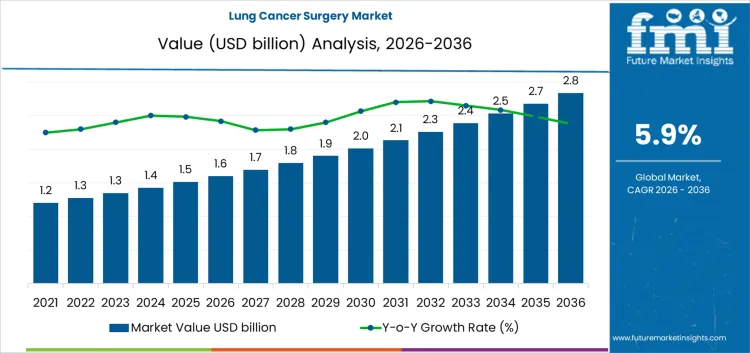
- The lung cancer surgery market is expected to rise from USD 1.6 billion in 2026 to USD 2.8 billion by 2036.
- The 5.9% CAGR reflects wider use of minimally invasive surgery and stronger early-stage case finding.
- The sector is projected to add USD 1.2 billion in new value between 2026 and 2036.
- Hospitals are expected to hold 65% share in 2026 as thoracic surgery needs specialist staff and critical care support.
- Product and Segment View
- Surgical staplers and energy systems support operating room efficiency with consistent sealing and controlled tissue handling.
- Lobectomy is projected to lead application demand with 42% share in 2026 as surgeons use it for standard curative resection.
- Hospitals are expected to lead end-user demand with 65% share in 2026 because they have access to oncology boards and thoracic surgery teams.
- Minimally invasive surgery is projected to account for 48% approach share in 2026 as VATS access expands in cancer centers.
- Non-small cell lung cancer is expected to represent 80% cancer-type share in 2026 as most resectable cases fall within this category.
- Geography and Competitive Outlook
- India is projected to record 7.1% CAGR through 2036 with private hospital investment and screening access improving surgical flow.
- China is expected to expand at 6.8% CAGR through 2036 as oncology infrastructure scales across large urban hospital groups.
- The United States is projected at 5.6% CAGR through 2036 with robotic surgery access and lung screening pathways.
- Intuitive Surgical leads robotic-assisted thoracic surgery access. Johnson & Johnson competes strongly in stapling systems.
- Analyst Opinion
- Anurag Sharma, Principal Consultant at FMI says, “I see lung cancer surgery demand shifting from late intervention toward earlier resection decisions. Screening is improving the surgical case pool. Hospital boards place greater weight on stage and lung function. Suppliers with staplers and robotic systems gain an advantage only when products help teams shorten operating time and reduce post-surgical complications.”
- Lung Cancer Surgery Market Value Analysis
- Industry value is expected to rise from USD 1.6 billion in 2026 to USD 2.8 billion by 2036.
- Lobectomy is projected to lead applications with 42% share as hospitals use it for eligible curative NSCLC resections.
- Hospitals are expected to account for 65% share with better access to ICU beds and multidisciplinary cancer boards.
- Minimally invasive surgery is projected to account for 48% share as VATS and robotic platforms support faster recovery.
- Price pressure is highest in staplers and surgical energy systems as hospitals compare reload cost against procedural savings.
Key Takeaways, Market Size, and Forecast
| Metric | Value |
|---|---|
| Market Size (2025) | USD 1.51 Billion |
| Market Size (2036) | USD 2.8 Billion |
| Fastest-Growing Segment | Demand |
| Demand CAGR | 5.9% |
| Incremental Opportunity (2026–2036) | USD 1.2 Billion |
| Leading End User (2026) | Hospitals |
| Hospitals Share (2026) | 65% |
| Leading Application (2026) | Lobectomy |
| Lobectomy Share (2026) | 42% |
| Fastest-Growing Markets | India is projected to record the fastest country CAGR at 7.1% through 2036 as oncology capacity expands across metro hospitals |
Lung Cancer Surgery Market Definition
The lung cancer surgery market includes devices and systems used to remove malignant lung tissue through curative thoracic surgery. Scope includes segmentectomy and lobectomy with wedge resection and pneumonectomy. Scope also covers thoracoscopes and bronchoscopes with surgical staplers and robotic-assisted thoracic systems. The scope excludes chemotherapy drugs and radiation therapy equipment used outside surgical removal.
Lung Cancer Surgery Market Inclusions
The scope includes thoracic resection instruments and surgical staplers across hospitals and ambulatory surgical centers. Coverage includes bronchoscopes and thoracoscopes used in surgical planning and operative support. Coverage also includes robotic-assisted systems and surgical energy instruments used across major regional cancer care centers.
Lung Cancer Surgery Market Exclusions
The scope excludes lung cancer drugs and radiation oncology systems used outside surgical resection. It excludes standalone imaging scanners and diagnostic-only assays without direct surgical use. It excludes pulmonary rehabilitation products and respiratory care devices without a thoracic surgery role.
Lung Cancer Surgery Market Research Methodology
- FMI analysts reviewed inputs from thoracic surgeons and hospital device buyers across cancer surgery settings. Inputs covered procedure selection and stapler use with robotic access and operating room workflow.
- Desk research reviewed cancer treatment guidance and national lung cancer audit findings. The addressable pool was tested against company product information and thoracic resection workflows.
- Market sizing combined procedure volumes and device replacement rates across country-level surgery access. Forecasting assessed product mix and hospital capacity across lung cancer diagnostics pathways.
- Forecasts were checked across hospitals and ambulatory surgical centers before finalisation. Company portfolios were cross-checked against active products in robotic surgery and thoracic visualization.
Why is the Lung Cancer Surgery Market Growing?
- Early-stage diagnosis supports surgery volumes as resectable NSCLC cases enter treatment boards sooner.
- VATS adoption raises demand for thoracoscopes and staplers with better access in complex chest procedures.
- Robotic-assisted thoracic surgery increases capital-linked demand in hospitals because they have high oncology case loads.
- Stapler reliability stays central as pulmonary resections depend on air leak control and vessel sealing.
Screening and diagnostic pathways are moving lung cancer care closer to operable stages. In England, the National Lung Cancer Audit noted 40% of people were diagnosed at stage 1 to 2 in 2024. Earlier diagnosis increases surgical review for patients who previously arrived after curative options were limited. Hospitals with thoracic surgery teams can convert earlier diagnosis into resection volumes only with faster referral pathways. The practical effect is higher demand for staplers and scopes across cancer centers.
Surgery stays a core option for selected non-small cell lung cancer patients. The National Cancer Institute lists surgery among NSCLC treatment options with chemotherapy and radiation therapy. This treatment position keeps surgery inside multidisciplinary planning. Drug options are expanding. Device suppliers gain when products reduce tissue trauma and support safer margins for smaller tumors. Buyers assess device performance through operating time and complication rates before purchase price alone.
Market Segmentation Analysis
- Lobectomy is projected to lead application demand with 42% share in 2026 as it stays central in curative thoracic resections.
- Hospitals are expected to lead end-user demand with 65% share in 2026 with ICU access and cancer board coordination.
- Surgical staplers are projected to hold 31% product share in 2026 as pulmonary resections need controlled tissue closure.
- Minimally invasive surgery is expected to lead surgical approach demand with 48% share in 2026 as VATS capacity widens.
- Non-small cell lung cancer is anticipated to represent 80% cancer-type share in 2026 as most surgical cases fall here.
Segmentation in this market follows clinical decision points inside the hospital. Surgeons select segmentectomy or lobectomy based on tumor size and lung reserve. Hospitals lead demand because thoracic surgery requires anesthesia depth and post-operative monitoring. Products divide across visualization tools and stapling systems because each tool supports a different operating room task. The robotic surgery segment shapes spending in high-volume cancer hospitals. Resection tools and recovery-focused procedures guide supplier positioning.
Insights into the Lobectomy Application Segment
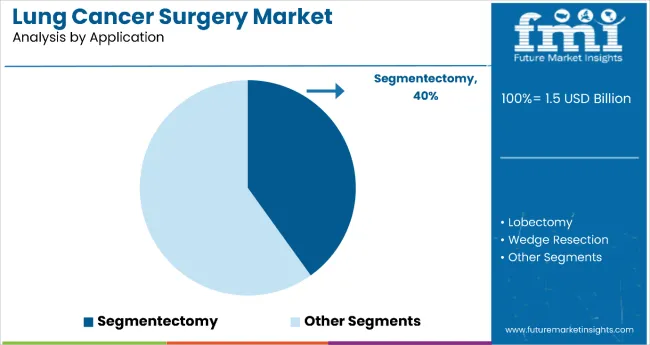
- Lobectomy is projected to account for 42% of application demand in 2026 as surgeons use full-lobe removal for many operable NSCLC cases.
- Segmentectomy gains use in small peripheral tumors as surgeons balance cancer control with lung preservation for selected early-stage patients.
Insights into the Hospitals End User Segment
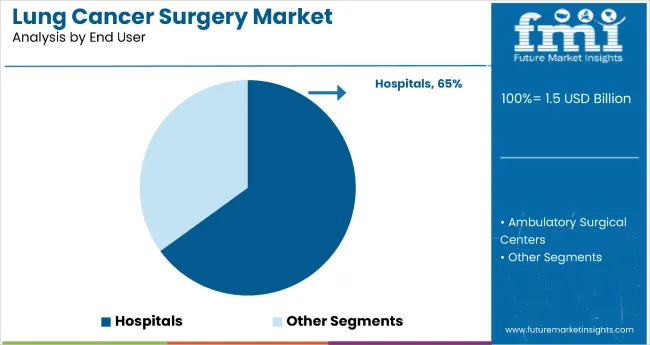
- Hospitals are expected to represent 65% of end-user demand in 2026 as complex resections need ICU support and thoracic anesthesia depth.
- Ambulatory surgical centers participate mainly in lower-risk diagnostic steps and major resections stay concentrated in hospital operating rooms.
Insights into the Surgical Staplers Product Segment
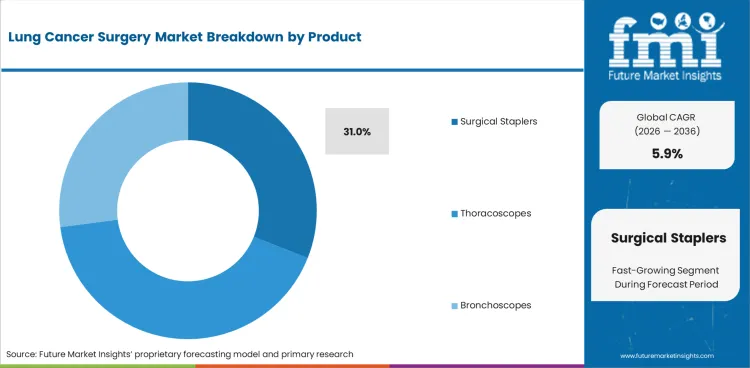
- Surgical staplers are anticipated to hold 31% product share in 2026 with repeated use across vessel closure and lung tissue division.
- Powered staplers gain preference in high-volume centers as consistent compression helps reduce variation during pulmonary tissue sealing.
Insights into the Minimally Invasive Surgery Surgical Approach Segment
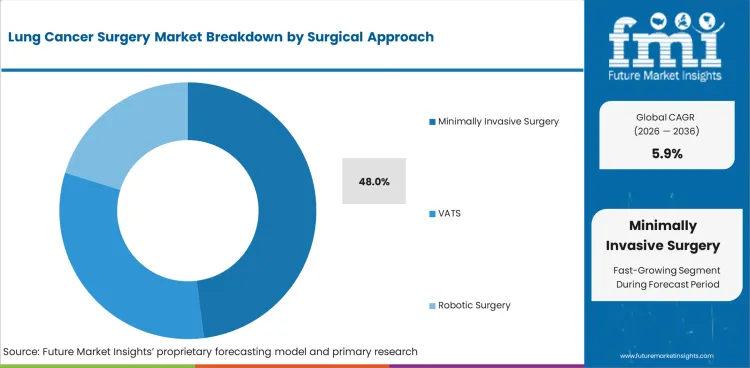
- Minimally invasive surgery is projected to account for 48% approach share in 2026 as VATS reduces chest wall trauma and recovery burden.
- Robotic-assisted surgery raises demand for training and service support as capital equipment decisions rely on procedure volume.
Insights into the Non-Small Cell Lung Cancer Type Segment
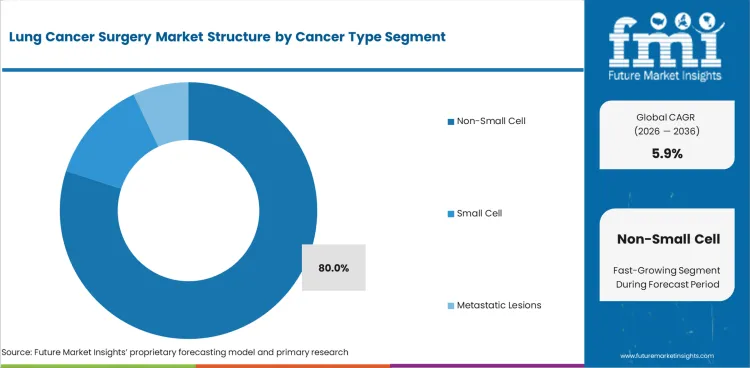
- Non-small cell lung cancer is estimated to represent 80% cancer-type demand in 2026 as most operable lung cancer cases fall within this group.
- Small cell lung cancer contributes less to surgical demand as treatment pathways often rely on systemic therapy and radiation.
Lung Cancer Surgery Market Drivers, Restraints, and Opportunities
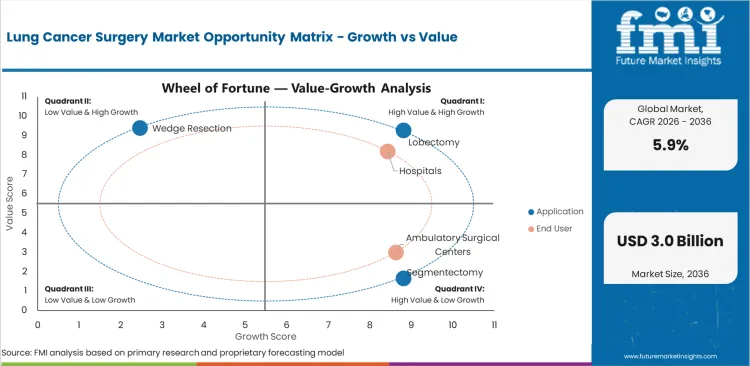
- Screening-driven stage shift increases resection review as more patients enter care before late-stage spread.
- Robotic thoracic surgery supports hospital differentiation with better visualization and controlled instrument movement.
- Stapler cost pressure limits product switching as hospitals test reload price against clinical benefit.
- Bronchoscopy and staging tools create opportunity by improving surgical selection before operating room scheduling.
Earlier diagnosis changes the market by raising the share of patients eligible for surgery. The National Lung Cancer Audit found over 39,000 people diagnosed with lung cancer in England during 2024. The audit base gives hospitals a clearer view of surgery access and stage distribution. The practical market effect is higher demand for resection tools once screening programs find smaller tumors. Device makers benefit when hospitals can convert diagnosis into timely surgery. Delays in staging or pre-operative assessment can reduce this benefit.
Robotic-assisted thoracic surgery is drawing buyer attention in centers with high surgical throughput. Intuitive received FDA 510(k) clearance for da Vinci 5 in March 2024. This development supports platform renewal in hospitals already using robotic systems across specialties. For lung cancer surgery, the value lies in instrument control and surgeon visibility inside narrow chest spaces. Capital cost limits wider use in lower-volume centers. Suppliers need training depth and service coverage to support procedure consistency.
Staple line reliability is a practical factor in pulmonary resection. Johnson & Johnson launched the ETHICON 4000 Stapler in the United States in June 2025. This product focus speaks directly to thoracic surgery risk as leaks and bleeding can extend hospital stay. Medtronic unveiled the Signia Circular stapler with real-time tissue feedback in November 2025. Hospitals will compare these systems through clinical usability and reload economics. Premium products must prove fewer complications or faster workflow.
Compliance Burden Is Rising with Surgical Case Complexity
For the Lung Cancer Surgery Market, regulatory and operating discipline is becoming commercially important because the addressable patient burden remains older and clinically high-risk. The American Cancer Society’s page, last revised in January 2026, estimates about 229,410 new lung cancer cases in the United States in 2026. It includes 110,910 cases in men and 118,500 cases in women. The same page estimates about 124,990 lung cancer deaths. It also states that most people diagnosed are 65 or older, with an average diagnosis age of about 70. Perioperative compliance matters commercially because hospitals need standardized surgical assessment, anesthesia safety, infection control, ICU readiness, and post-surgery monitoring protocols for elderly lung cancer patients. [1]
Coding Controls Are Becoming Reimbursement Safeguards
For the Lung Cancer Surgery Market, operating compliance also depends on accurate respiratory-surgery coding and billing discipline. CMS’ 2025 Medicare NCCI Coding Policy Manual places Chapter V under Surgery: Respiratory, Cardiovascular, Hemic and Lymphatic Systems. Chapter V covers CPT Codes 30000 to 39999 and states that correct-coding principles apply to CPT codes in that range. This matters for thoracic surgery providers because lung cancer procedures often involve bundled clinical work and anesthesia-related services. Imaging, pathology, and post-operative care can add further billing complexity. Hospitals and surgical groups should strengthen operative-note templates, coder training, and audit trails before expanding robotic or minimally invasive lung surgery programs. [2]
Analysis of Lung Cancer Surgery Market By Key Countries
.webp "Top Country Growth Comparison Lung Cancer Surgery Market Cagr (2026 2036)")
- India is projected to record 7.1% CAGR through 2036 as private cancer hospitals add thoracic surgery capacity.
- China is expected to expand at 6.8% CAGR through 2036 as urban hospitals increase minimally invasive surgery access.
- Brazil is forecast to grow at 5.8% CAGR through 2036 as oncology referral networks improve in large cities.
- The United States is expected to advance at 5.6% CAGR through 2036 as robotic systems support complex thoracic resections.
- The United Kingdom is projected to rise at 5.4% CAGR through 2036 as screening finds more early-stage cases.
- Germany is forecast at 5.2% CAGR through 2036 with mature surgical infrastructure and disciplined device assessment.
- Japan is expected to post 4.9% CAGR through 2036 as aging patients increase demand for lung-sparing procedures.
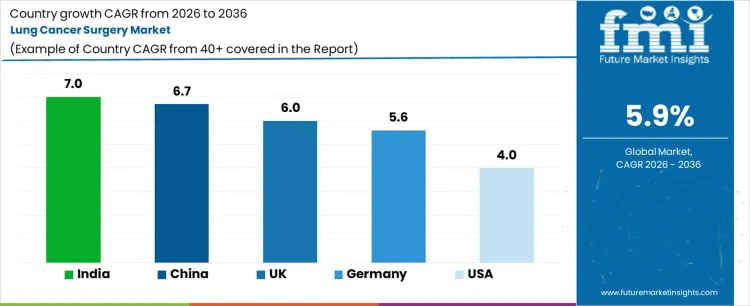
Country spread reflects differences in screening reach and hospital capital budgets. India and China track above the global average because cancer infrastructure is expanding faster in large urban systems. Japan and Germany fall below the global average because procedure access is mature and volume acceleration is slower. This difference shapes product planning for staplers and robotic-assisted systems across each region.
Demand Outlook for Lung Cancer Surgery Market in India
India’s surgical demand is shaped by private hospital growth and uneven access to early diagnosis across states. India is projected to record 7.1% CAGR through 2036 as oncology surgery capacity rises in large hospital networks. This rate points to faster expansion in metro centers with thoracic surgeons and robotic platforms. Installed surgical robots support premium surgery programs in private hospitals. Smaller cities need referral networks and financing support before resection volumes broaden. Supplier strategy should focus on training and stapler availability across high-volume cancer centers.
- Delhi NCR and Mumbai cancer hospitals support premium thoracic surgery programs with better access to surgical oncology teams.
- Ayushman Bharat improves affordability for eligible patients in public hospitals and can widen access to surgical cancer care.
- Tata Memorial Centre influences oncology practice through cancer care protocols and surgeon training across India.
Sales Analysis of Lung Cancer Surgery Market in China
China’s demand base is shaped by large urban hospitals and broad lung cancer incidence. China is expected to expand at 6.8% CAGR through 2036 as tertiary hospitals add minimally invasive surgery programs. The national cancer care focus increases surgery referral quality in large provincial centers. The thoracic surgery devices base supports hospitals testing advanced resection tools across higher-volume departments. Local buying rules can pressure imported systems and premium consumables. Suppliers need balanced pricing and physician education in Tier 1 cities.
- Beijing and Shanghai hospitals act as early users for robotic thoracic procedures and high-end stapling systems.
- National Health Commission cancer control programs support screening and referral quality across provincial hospital networks.
- Guangdong hospital clusters support faster uptake of minimally invasive thoracic surgery due to stronger equipment budgets.
Demand Analysis of Lung Cancer Surgery Market in Brazil
Brazil’s market expands through large urban oncology centers and private insurance coverage. Brazil is forecast to grow at 5.8% CAGR through 2036 as São Paulo and Rio de Janeiro concentrate advanced thoracic surgery services. Public hospital access varies by state and this shapes device volume across regions. Tertiary chest-procedure volumes can support wider familiarity with thoracic instruments. Import costs and currency pressure can slow product upgrades. Suppliers should build local training and distributor depth to reduce adoption friction.
- São Paulo concentrates advanced cancer hospitals and creates higher demand for thoracic stapling systems.
- Brazil’s SUS network supports cancer care access and waiting time affects timely surgery in some states.
- INCA cancer policy references guide national oncology priorities and influence public hospital capacity planning.
Opportunity Analysis of Lung Cancer Surgery Market in the United States
The United States has mature thoracic surgery access and high use of advanced surgical platforms. The country is expected to advance at 5.6% CAGR through 2036 as robotic surgery and lung screening support earlier intervention. The American Cancer Society estimated 234,580 new lung cancer cases in the United States in 2024. This case base sustains procedure demand across cancer centers and community hospitals. Powered surgical staplers benefit from hospital focus on consistency and leak reduction. Supplier competition will center on clinical evidence and total procedure economics.
- National Lung Screening Trial influence continues through USPSTF-backed screening pathways and hospital screening programs.
- Texas Medical Center supports advanced thoracic surgery access through high-volume cancer care institutions.
- Medicare reimbursement rules shape hospital adoption of robotic surgery and higher-cost surgical consumables.
Future Outlook for Lung Cancer Surgery Market in the United Kingdom
The United Kingdom market is shaped by NHS screening expansion and thoracic surgery capacity planning. The United Kingdom is projected to rise at 5.4% CAGR through 2036 as early diagnosis improves surgical review. The Royal College of Surgeons reported 40% stage 1 to 2 diagnosis in England for 2024. This number supports more surgical assessment but capacity remains a key constraint. The endobronchial ultrasound biopsy pathway supports staging before resection. Device suppliers need NHS evidence packages and service reliability to compete.
- NHS England’s Targeted Lung Health Check program supports earlier case finding across selected high-risk communities.
- Manchester and Liverpool screening activity improves referral quality through regional lung health check pathways.
- Royal College of Surgeons audit findings increase pressure on thoracic surgery capacity and resection access.
Demand Outlook for Lung Cancer Surgery Market in Germany
Germany’s market has a large hospital base and a disciplined device evaluation culture. Germany is forecast at 5.2% CAGR through 2036 with stable thoracic surgery access and high clinical standards. University hospitals in Munich and Heidelberg influence procedure evidence and surgeon training. Product uptake often depends on clinical evaluation and purchasing committees. Suppliers need strong data on operative time and post-operative outcomes. The implication is a slower but steadier path for premium staplers and robotic tools.
- German Cancer Aid supports cancer care research and public awareness across major oncology networks.
- Bavaria and Baden-Württemberg have strong university hospital systems with advanced thoracic surgery departments.
- DRG-based hospital payment places pressure on device cost and post-operative length of stay.
In-depth Analysis of Lung Cancer Surgery Market in Japan
Japan’s market reflects high cancer care quality and a large elderly patient base. Japan is expected to post 4.9% CAGR through 2036 as lung-sparing approaches gain importance for older patients. Hospitals in Tokyo and Osaka use advanced thoracic surgery techniques across specialist centers. The bronchoscopes base supports diagnostic and staging work before surgery. Procedure expansion is steadier due to mature access and careful cost review. Suppliers can gain through compact instruments and training support for complex segmentectomy.
- Tokyo cancer centers support robotic and VATS thoracic surgery through specialist surgical teams.
- Japan’s aging population increases preference for lung-sparing procedures in selected early-stage patients.
- National Cancer Center Japan influences clinical practice through research and oncology care guidance.
Competitive Landscape and Strategic Positioning
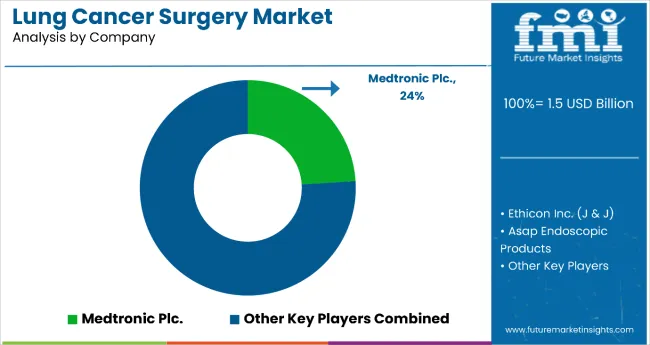
- The sector is moderately concentrated as robotic platforms and stapling systems require capital depth and clinical trust.
- Established suppliers compete through product breadth and surgeon training with service coverage and hospital contracting strength.
- Specialist firms compete in scopes and instruments with focused portfolios for thoracic visualization.
- Entry barriers include regulatory clearance and surgeon familiarity with operating room support and clinical evidence.
Competition in lung cancer surgery starts with reliability inside the operating room. Hospitals assess staplers and robotic systems through surgeon comfort and complication risk. Intuitive’s March 2024 FDA clearance for da Vinci 5 strengthens its robotic-assisted surgery position in hospitals seeking platform upgrades. Software-supported surgical robots raise buyer interest in data-supported surgical systems. Capital cost limits the pace of replacement. Suppliers with training programs and uptime support gain stronger access to thoracic surgery departments.
Stapling competition is shaped by tissue control and reload economics. Johnson & Johnson’s June 2025 launch of ETHICON 4000 Stapler points to staple line integrity across varied tissue thickness. Medtronic’s Signia Circular stapler with Tri-Staple technology adds real-time tissue feedback for surgical teams. Surgical stapling devices benefit from repeated use across thoracic resections. Hospitals compare premium staplers with standard reloads through air leak risk and workflow efficiency. Price discipline keeps proof of clinical value central.
Visualization suppliers hold a distinct position in the surgical pathway. Olympus launched two EVIS X1-compatible bronchoscopes in May 2024. The launch supports diagnostic and therapeutic bronchoscopy before surgical planning. Karl Storz and Richard Wolf compete through thoracic scopes and surgical visualization depth. Smaller suppliers can win hospital tenders only if they meet service and sterilization needs. Buyer trust depends on image quality and instrument durability across repeated cases.
Entry remains difficult as hospitals avoid device changes during complex thoracic surgery without clinical and training support. Regulatory clearance is only the first step because surgeons need hands-on familiarity before adopting new tools. Surgical robotics performance validation reflects rising scrutiny around robotic safety and performance claims. New entrants must prove procedure fit and after-sales reliability. Distributor reach can help regional firms. Large contracts favor suppliers with multi-product portfolios.
Key Companies in the Lung Cancer Surgery Market
Competition is divided between robotic platform suppliers and stapling system makers with thoracic visualization specialists forming a third supplier group.
- Robotic and platform leaders include Intuitive Surgical, Medtronic, and Johnson & Johnson. Intuitive Surgical leads robotic-assisted thoracic surgery through da Vinci systems and surgeon training depth. Medtronic competes across thoracic stapling and surgical energy with lung health tools. Johnson & Johnson competes through Ethicon staplers and surgical technologies used across open and minimally invasive procedures.
- Visualization and scope specialists include Olympus, Karl Storz, Richard Wolf, and FUJIFILM. These companies compete through bronchoscopes and thoracoscopes with imaging systems used in diagnosis and surgical access. Their products help clinicians view airway and thoracic anatomy during planning and procedures. Hospitals assess them through image quality and sterilization durability.
- Instrument and regional suppliers include Teleflex, B. Braun, Germed USA, and Asap Endoscopic Products. These firms compete through surgical instruments and access tools with hospital supply relationships. Their position is often strongest in regional hospital networks with price-sensitive purchasing and established distributor access.
Competitive Benchmarking: Lung Cancer Surgery Market
| Company | Thoracic Resection Portfolio | Robotic Surgery Depth | Staging and Visualization Support | Geographic Footprint |
|---|---|---|---|---|
| Intuitive Surgical | Medium | High | Medium | Global |
| Johnson & Johnson | High | Medium | Medium | Global |
| Medtronic | High | Medium | Strong | Global |
| Olympus | Medium | Low | High | Global |
| Karl Storz | Strong | Low | High | Global |
| Richard Wolf | Medium | Low | Strong | Europe and Asia |
| FUJIFILM | Medium | Low | Strong | Global |
| PENTAX Medical | Medium | Low | Strong | Global |
| Teleflex | Medium | Low | Medium | Global |
| B. Braun | Medium | Low | Medium | Global |
Source: Future Market Insights competitive analysis, 2026. Ratings reflect relative positioning based on thoracic resection portfolio, robotic surgery depth, and staging support.
Key Developments in Lung Cancer Surgery Market
- In March 2024, Intuitive received FDA 510(k) clearance for da Vinci 5. The clearance supports robotic-assisted thoracic surgery access in high-volume hospitals.
- In May 2024, Olympus launched two bronchoscopes compatible with EVIS X1. The launch supports bronchoscopy and staging workflows before surgery.
- In June 2025, Johnson & Johnson launched ETHICON 4000 Stapler in the United States. The product targets staple line integrity across tissue thickness.
- In November 2025, Medtronic unveiled the Signia Circular stapler with Tri-Staple technology. The system adds real-time tissue feedback for surgical performance.
- In April 2026, Johnson & Johnson received CE Mark approval for ETHICON 4000 Stapler. The approval supports European access across open and laparoscopic surgery.
Key Players in the Lung Cancer Surgery Market
Robotic and Platform Leaders
- Intuitive Surgical Inc.
- Johnson & Johnson
- Medtronic plc
Visualization and Scope Specialists
- Olympus Corporation
- Karl Storz SE & Co. KG
- Richard Wolf GmbH
- FUJIFILM Holdings Corporation
- PENTAX Medical
Instrument and Regional Suppliers
- Teleflex Incorporated
- B. Braun Melsungen AG
- Germed USA Inc.
- Asap Endoscopic Products
Report Scope and Coverage
| Parameter | Details |
|---|---|
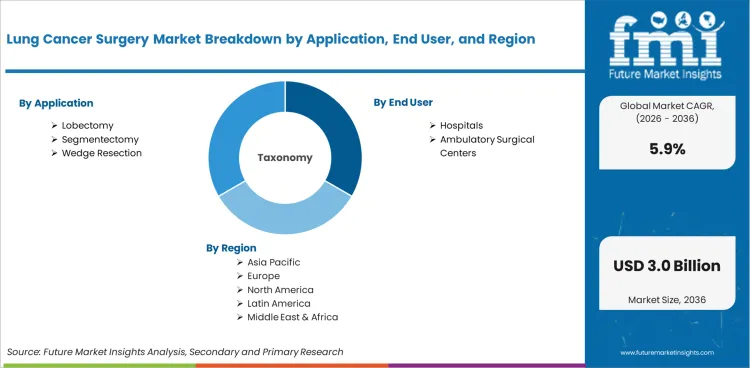
| Quantitative Units | USD 1.6 billion in 2026 to USD 2.8 billion by 2036 at 5.9% CAGR |
| Market Definition | Devices and systems used to remove malignant lung tissue through curative or cytoreductive thoracic surgery. |
| Regions Covered | North America, Latin America, Europe, East Asia, South Asia and Pacific, and Middle East and Africa |
| Countries Covered | India, China, Brazil, United States, United Kingdom, Germany, Japan, and more than 30 countries |
| Main Companies Profiled | Intuitive Surgical, Johnson & Johnson, Medtronic, Olympus, Karl Storz, Richard Wolf, FUJIFILM, PENTAX Medical, Teleflex, B. Braun |
| Forecast Period | 2026 to 2036 |
| Approach | Hybrid bottom-up and top-down methodology using procedure volumes, device mix, hospital capacity, and clinical pathway analysis |
Lung Cancer Surgery Market by Segments
Lung Cancer Surgery Market Segmented by Application:
- Segmentectomy
- Lobectomy
- Wedge Resection
- Pneumonectomy
Lung Cancer Surgery Market Segmented by End User:
- Hospitals
- Ambulatory Surgical Centers
Lung Cancer Surgery Market Segmented by Product:
- Thoracoscopes
- Mediastinoscopes
- Bronchoscopes
- Robotic Systems
- Surgical Staplers
- Surgical Energy
Lung Cancer Surgery Market Segmented by Surgical Approach:
- Minimally Invasive Surgery
- VATS
- Robotic Surgery
- Open Thoracotomy
- Hybrid Surgery
Lung Cancer Surgery Market Segmented by Cancer Type:
- Non-Small Cell
- Small Cell
- Metastatic Lesions
- Thoracic Malignancies
Lung Cancer Surgery Market by Region:
- North America
- United States
- Canada
- Latin America
- Brazil
- Chile
- Western Europe
- Germany
- United Kingdom
- Eastern Europe
- Russia
- Poland
- East Asia
- China
- Japan
- South Asia Pacific
- India
- ASEAN
- Middle East Africa
- Saudi Arabia
- South Africa
Research Sources and Bibliography
- American Cancer Society medical and editorial content team. (2026, January 13). Lung cancer statistics: How common is lung cancer? American Cancer Society.
- Centers for Medicare & Medicaid Services. (2025, February 28). Medicare NCCI coding policy manual.
- American Cancer Society. (2024). Cancer facts & figures 2024
- National Cancer Institute. (2025). Non-small cell lung cancer treatment (PDQ®): Health professional version.
- Royal College of Surgeons of England. (2026, February 12). Response to National Lung Cancer Audit.
- Intuitive Surgical. (2024, March 14). Intuitive announces FDA clearance of fifth-generation robotic system da Vinci 5.
- Olympus America. (2024, May 13). Olympus announces launch of bronchoscopes compatible with EVIS X1 endoscopy system.
- Johnson & Johnson. (2025, June 10). Johnson & Johnson launches the ETHICON 4000 Stapler for elevated surgical experience and the most secure staple line yet.
- Medtronic. (2025, November 25). Medtronic unveils Signia Circular stapler with Tri-Staple technology.
- Johnson & Johnson. (2026, April 22). Johnson & Johnson announces CE Mark approval for the new ETHICON 4000 Stapler.
This Report Answers
- What is the expected value of the lung cancer surgery market in 2026 and 2036?
- What CAGR is projected for the lung cancer surgery market during 2026 to 2036?
- Which application segment is expected to lead lung cancer surgery demand in 2026?
- Which end-user group is expected to account for the largest share of lung cancer surgery spending?
- What role do screening programs play in expanding surgical review for early-stage lung cancer?
- Which countries are expected to record the highest CAGR through 2036?
- Which companies compete across robotic systems and surgical staplers?
- Which products and procedures are included within the lung cancer surgery market definition?
- What method supports market sizing across procedure volumes and hospital capacity?
Frequently Asked Questions
What is the global value of the Lung Cancer Surgery Market in 2026?
In 2026, the global lung cancer surgery market is expected to be worth USD 1.6 billion with hospital demand leading.
What will the Lung Cancer Surgery Market value be by 2036?
By 2036, the lung cancer surgery market is projected to reach USD 2.8 billion as early-stage diagnosis improves.
What CAGR is projected for the Lung Cancer Surgery Market?
The lung cancer surgery market is forecast to expand at 5.9% CAGR from 2026 to 2036.
Which application segment leads the Lung Cancer Surgery Market?
Lobectomy is projected to lead application demand with 42% share in 2026 due to curative NSCLC resection use.
Which end-user segment leads the Lung Cancer Surgery Market?
Hospitals are expected to account for 65% share in 2026 as complex thoracic surgery needs ICU support.
Which country is expected to expand fastest in the Lung Cancer Surgery Market?
India is projected to record 7.1% CAGR through 2036 as private cancer hospitals expand thoracic surgery capacity.
What is included in the Lung Cancer Surgery Market?
The market includes resection procedures and thoracic scopes with staplers and robotic systems used in lung cancer surgery.
How was the Lung Cancer Surgery Market forecast prepared?
The forecast combines procedure volumes and device mix with hospital capacity and country access across surgical pathways.
Preview the report firsthand - request a free sample
Get SampleGet the brochure for pricing and purchase details.
Get PDFTable of Content
- Executive Summary
- Global Market Outlook
- Demand-side Trends
- Supply-side Trends
- Technology Roadmap Analysis
- Analysis and Recommendations
- Market Overview
- Market Coverage / Taxonomy
- Market Definition / Scope / Limitations
- Research Methodology
- Chapter Orientation
- Analytical Lens and Working Hypotheses
- Market Structure, Signals, and Trend Drivers
- Benchmarking and Cross-market Comparability
- Market Sizing, Forecasting, and Opportunity Mapping
- Research Design and Evidence Framework
- Desk Research Programme (Secondary Evidence)
- Company Annual and Sustainability Reports
- Peer-reviewed Journals and Academic Literature
- Corporate Websites, Product Literature, and Technical Notes
- Earnings Decks and Investor Briefings
- Statutory Filings and Regulatory Disclosures
- Technical White Papers and Standards Notes
- Trade Journals, Industry Magazines, and Analyst Briefs
- Conference Proceedings, Webinars, and Seminar Materials
- Government Statistics Portals and Public Data Releases
- Press Releases and Reputable Media Coverage
- Specialist Newsletters and Curated Briefings
- Sector Databases and Reference Repositories
- FMI Internal Proprietary Databases and Historical Market Datasets
- Subscription Datasets and Paid Sources
- Social Channels, Communities, and Digital Listening Inputs
- Additional Desk Sources
- Expert Input and Fieldwork (Primary Evidence)
- Primary Modes
- Qualitative Interviews and Expert Elicitation
- Quantitative Surveys and Structured Data Capture
- Blended Approach
- Why Primary Evidence is Used
- Field Techniques
- Interviews
- Surveys
- Focus Groups
- Observational and In-context Research
- Social and Community Interactions
- Stakeholder Universe Engaged
- C-suite Leaders
- Board Members
- Presidents and Vice Presidents
- R&D and Innovation Heads
- Technical Specialists
- Domain Subject-matter Experts
- Scientists
- Physicians and Other Healthcare Professionals
- Governance, Ethics, and Data Stewardship
- Research Ethics
- Data Integrity and Handling
- Primary Modes
- Tooling, Models, and Reference Databases
- Desk Research Programme (Secondary Evidence)
- Data Engineering and Model Build
- Data Acquisition and Ingestion
- Cleaning, Normalisation, and Verification
- Synthesis, Triangulation, and Analysis
- Quality Assurance and Audit Trail
- Market Background
- Market Dynamics
- Drivers
- Restraints
- Opportunity
- Trends
- Scenario Forecast
- Demand in Optimistic Scenario
- Demand in Likely Scenario
- Demand in Conservative Scenario
- Opportunity Map Analysis
- Product Life Cycle Analysis
- Supply Chain Analysis
- Investment Feasibility Matrix
- Value Chain Analysis
- PESTLE and Porter’s Analysis
- Regulatory Landscape
- Regional Parent Market Outlook
- Production and Consumption Statistics
- Import and Export Statistics
- Market Dynamics
- Global Market Analysis 2021 to 2025 and Forecast, 2026 to 2036
- Historical Market Size Value (USD Million) Analysis, 2021 to 2025
- Current and Future Market Size Value (USD Million) Projections, 2026 to 2036
- Y-o-Y Growth Trend Analysis
- Absolute $ Opportunity Analysis
- Global Market Pricing Analysis 2021 to 2025 and Forecast 2026 to 2036
- Global Market Analysis 2021 to 2025 and Forecast 2026 to 2036, By Application
- Introduction / Key Findings
- Historical Market Size Value (USD Million) Analysis By Application , 2021 to 2025
- Current and Future Market Size Value (USD Million) Analysis and Forecast By Application , 2026 to 2036
- Lobectomy
- Segmentectomy
- Wedge Resection
- Lobectomy
- Y-o-Y Growth Trend Analysis By Application , 2021 to 2025
- Absolute $ Opportunity Analysis By Application , 2026 to 2036
- Global Market Analysis 2021 to 2025 and Forecast 2026 to 2036, By End User
- Introduction / Key Findings
- Historical Market Size Value (USD Million) Analysis By End User, 2021 to 2025
- Current and Future Market Size Value (USD Million) Analysis and Forecast By End User, 2026 to 2036
- Hospitals
- Ambulatory Surgical Centers
- Hospitals
- Y-o-Y Growth Trend Analysis By End User, 2021 to 2025
- Absolute $ Opportunity Analysis By End User, 2026 to 2036
- Global Market Analysis 2021 to 2025 and Forecast 2026 to 2036, By Product
- Introduction / Key Findings
- Historical Market Size Value (USD Million) Analysis By Product, 2021 to 2025
- Current and Future Market Size Value (USD Million) Analysis and Forecast By Product, 2026 to 2036
- Surgical Staplers
- Thoracoscopes
- Bronchoscopes
- Surgical Staplers
- Y-o-Y Growth Trend Analysis By Product, 2021 to 2025
- Absolute $ Opportunity Analysis By Product, 2026 to 2036
- Global Market Analysis 2021 to 2025 and Forecast 2026 to 2036, By Surgical Approach
- Introduction / Key Findings
- Historical Market Size Value (USD Million) Analysis By Surgical Approach, 2021 to 2025
- Current and Future Market Size Value (USD Million) Analysis and Forecast By Surgical Approach, 2026 to 2036
- Minimally Invasive Surgery
- VATS
- Robotic Surgery
- Minimally Invasive Surgery
- Y-o-Y Growth Trend Analysis By Surgical Approach, 2021 to 2025
- Absolute $ Opportunity Analysis By Surgical Approach, 2026 to 2036
- Global Market Analysis 2021 to 2025 and Forecast 2026 to 2036, By Cancer Type
- Introduction / Key Findings
- Historical Market Size Value (USD Million) Analysis By Cancer Type, 2021 to 2025
- Current and Future Market Size Value (USD Million) Analysis and Forecast By Cancer Type, 2026 to 2036
- Non-Small Cell
- Small Cell
- Metastatic Lesions
- Non-Small Cell
- Y-o-Y Growth Trend Analysis By Cancer Type, 2021 to 2025
- Absolute $ Opportunity Analysis By Cancer Type, 2026 to 2036
- Global Market Analysis 2021 to 2025 and Forecast 2026 to 2036, By Region
- Introduction
- Historical Market Size Value (USD Million) Analysis By Region, 2021 to 2025
- Current Market Size Value (USD Million) Analysis and Forecast By Region, 2026 to 2036
- North America
- Latin America
- Western Europe
- Eastern Europe
- East Asia
- South Asia and Pacific
- Middle East & Africa
- Market Attractiveness Analysis By Region
- North America Market Analysis 2021 to 2025 and Forecast 2026 to 2036, By Country
- Historical Market Size Value (USD Million) Trend Analysis By Market Taxonomy, 2021 to 2025
- Market Size Value (USD Million) Forecast By Market Taxonomy, 2026 to 2036
- By Country
- USA
- Canada
- Mexico
- By Application
- By End User
- By Product
- By Surgical Approach
- By Cancer Type
- By Country
- Market Attractiveness Analysis
- By Country
- By Application
- By End User
- By Product
- By Surgical Approach
- By Cancer Type
- Key Takeaways
- Latin America Market Analysis 2021 to 2025 and Forecast 2026 to 2036, By Country
- Historical Market Size Value (USD Million) Trend Analysis By Market Taxonomy, 2021 to 2025
- Market Size Value (USD Million) Forecast By Market Taxonomy, 2026 to 2036
- By Country
- Brazil
- Chile
- Rest of Latin America
- By Application
- By End User
- By Product
- By Surgical Approach
- By Cancer Type
- By Country
- Market Attractiveness Analysis
- By Country
- By Application
- By End User
- By Product
- By Surgical Approach
- By Cancer Type
- Key Takeaways
- Western Europe Market Analysis 2021 to 2025 and Forecast 2026 to 2036, By Country
- Historical Market Size Value (USD Million) Trend Analysis By Market Taxonomy, 2021 to 2025
- Market Size Value (USD Million) Forecast By Market Taxonomy, 2026 to 2036
- By Country
- Germany
- UK
- Italy
- Spain
- France
- Nordic
- BENELUX
- Rest of Western Europe
- By Application
- By End User
- By Product
- By Surgical Approach
- By Cancer Type
- By Country
- Market Attractiveness Analysis
- By Country
- By Application
- By End User
- By Product
- By Surgical Approach
- By Cancer Type
- Key Takeaways
- Eastern Europe Market Analysis 2021 to 2025 and Forecast 2026 to 2036, By Country
- Historical Market Size Value (USD Million) Trend Analysis By Market Taxonomy, 2021 to 2025
- Market Size Value (USD Million) Forecast By Market Taxonomy, 2026 to 2036
- By Country
- Russia
- Poland
- Hungary
- Balkan & Baltic
- Rest of Eastern Europe
- By Application
- By End User
- By Product
- By Surgical Approach
- By Cancer Type
- By Country
- Market Attractiveness Analysis
- By Country
- By Application
- By End User
- By Product
- By Surgical Approach
- By Cancer Type
- Key Takeaways
- East Asia Market Analysis 2021 to 2025 and Forecast 2026 to 2036, By Country
- Historical Market Size Value (USD Million) Trend Analysis By Market Taxonomy, 2021 to 2025
- Market Size Value (USD Million) Forecast By Market Taxonomy, 2026 to 2036
- By Country
- China
- Japan
- South Korea
- By Application
- By End User
- By Product
- By Surgical Approach
- By Cancer Type
- By Country
- Market Attractiveness Analysis
- By Country
- By Application
- By End User
- By Product
- By Surgical Approach
- By Cancer Type
- Key Takeaways
- South Asia and Pacific Market Analysis 2021 to 2025 and Forecast 2026 to 2036, By Country
- Historical Market Size Value (USD Million) Trend Analysis By Market Taxonomy, 2021 to 2025
- Market Size Value (USD Million) Forecast By Market Taxonomy, 2026 to 2036
- By Country
- India
- ASEAN
- Australia & New Zealand
- Rest of South Asia and Pacific
- By Application
- By End User
- By Product
- By Surgical Approach
- By Cancer Type
- By Country
- Market Attractiveness Analysis
- By Country
- By Application
- By End User
- By Product
- By Surgical Approach
- By Cancer Type
- Key Takeaways
- Middle East & Africa Market Analysis 2021 to 2025 and Forecast 2026 to 2036, By Country
- Historical Market Size Value (USD Million) Trend Analysis By Market Taxonomy, 2021 to 2025
- Market Size Value (USD Million) Forecast By Market Taxonomy, 2026 to 2036
- By Country
- Kingdom of Saudi Arabia
- Other GCC Countries
- Turkiye
- South Africa
- Other African Union
- Rest of Middle East & Africa
- By Application
- By End User
- By Product
- By Surgical Approach
- By Cancer Type
- By Country
- Market Attractiveness Analysis
- By Country
- By Application
- By End User
- By Product
- By Surgical Approach
- By Cancer Type
- Key Takeaways
- Key Countries Market Analysis
- USA
- Pricing Analysis
- Market Share Analysis, 2025
- By Application
- By End User
- By Product
- By Surgical Approach
- By Cancer Type
- Canada
- Pricing Analysis
- Market Share Analysis, 2025
- By Application
- By End User
- By Product
- By Surgical Approach
- By Cancer Type
- Mexico
- Pricing Analysis
- Market Share Analysis, 2025
- By Application
- By End User
- By Product
- By Surgical Approach
- By Cancer Type
- Brazil
- Pricing Analysis
- Market Share Analysis, 2025
- By Application
- By End User
- By Product
- By Surgical Approach
- By Cancer Type
- Chile
- Pricing Analysis
- Market Share Analysis, 2025
- By Application
- By End User
- By Product
- By Surgical Approach
- By Cancer Type
- Germany
- Pricing Analysis
- Market Share Analysis, 2025
- By Application
- By End User
- By Product
- By Surgical Approach
- By Cancer Type
- UK
- Pricing Analysis
- Market Share Analysis, 2025
- By Application
- By End User
- By Product
- By Surgical Approach
- By Cancer Type
- Italy
- Pricing Analysis
- Market Share Analysis, 2025
- By Application
- By End User
- By Product
- By Surgical Approach
- By Cancer Type
- Spain
- Pricing Analysis
- Market Share Analysis, 2025
- By Application
- By End User
- By Product
- By Surgical Approach
- By Cancer Type
- France
- Pricing Analysis
- Market Share Analysis, 2025
- By Application
- By End User
- By Product
- By Surgical Approach
- By Cancer Type
- India
- Pricing Analysis
- Market Share Analysis, 2025
- By Application
- By End User
- By Product
- By Surgical Approach
- By Cancer Type
- ASEAN
- Pricing Analysis
- Market Share Analysis, 2025
- By Application
- By End User
- By Product
- By Surgical Approach
- By Cancer Type
- Australia & New Zealand
- Pricing Analysis
- Market Share Analysis, 2025
- By Application
- By End User
- By Product
- By Surgical Approach
- By Cancer Type
- China
- Pricing Analysis
- Market Share Analysis, 2025
- By Application
- By End User
- By Product
- By Surgical Approach
- By Cancer Type
- Japan
- Pricing Analysis
- Market Share Analysis, 2025
- By Application
- By End User
- By Product
- By Surgical Approach
- By Cancer Type
- South Korea
- Pricing Analysis
- Market Share Analysis, 2025
- By Application
- By End User
- By Product
- By Surgical Approach
- By Cancer Type
- Russia
- Pricing Analysis
- Market Share Analysis, 2025
- By Application
- By End User
- By Product
- By Surgical Approach
- By Cancer Type
- Poland
- Pricing Analysis
- Market Share Analysis, 2025
- By Application
- By End User
- By Product
- By Surgical Approach
- By Cancer Type
- Hungary
- Pricing Analysis
- Market Share Analysis, 2025
- By Application
- By End User
- By Product
- By Surgical Approach
- By Cancer Type
- Kingdom of Saudi Arabia
- Pricing Analysis
- Market Share Analysis, 2025
- By Application
- By End User
- By Product
- By Surgical Approach
- By Cancer Type
- Turkiye
- Pricing Analysis
- Market Share Analysis, 2025
- By Application
- By End User
- By Product
- By Surgical Approach
- By Cancer Type
- South Africa
- Pricing Analysis
- Market Share Analysis, 2025
- By Application
- By End User
- By Product
- By Surgical Approach
- By Cancer Type
- USA
- Market Structure Analysis
- Competition Dashboard
- Competition Benchmarking
- Market Share Analysis of Top Players
- By Regional
- By Application
- By End User
- By Product
- By Surgical Approach
- By Cancer Type
- Competition Analysis
- Competition Deep Dive
- Intuitive Surgical Inc.
- Overview
- Product Portfolio
- Profitability by Market Segments (Product/Age /Sales Channel/Region)
- Sales Footprint
- Strategy Overview
- Marketing Strategy
- Product Strategy
- Channel Strategy
- Johnson & Johnson
- Medtronic plc
- Olympus Corporation
- Karl Storz SE & Co. KG
- Intuitive Surgical Inc.
- Competition Deep Dive
- Assumptions & Acronyms Used


