


CDN Security Market
CDN Security Market Forecast and Outlook 2026 to 2036
Historical Data Covered: 2016 to 2024 | Base Year: 2025 | Estimated Year: 2026 | Forecast Period: 2027 to 2036
CDN Security Market Forecast and Outlook 2026 to 2036
The global CDN security market is on track to achieve a valuation of USD 72.9 Billion by 2036, accelerating from USD 12.1 Billion in 2026 at a CAGR of 19.8%. As per Future Market Insights, expansion is structurally underpinned by the accelerating volume of AI-generated web traffic that increases both the content delivery workload and the attack surface that must be protected at the edge. Akamai Technologies reported in its 2025 earnings that its security segment now accounts for 52% of total revenue, confirming the structural shift from pure content delivery to security-first edge platforms.
This compels CDN providers to invest in AI-native threat detection and bot management capabilities that operate at line speed without degrading content delivery performance. Simultaneously the regulatory environment is shifting toward stricter data sovereignty mandates that require security processing to occur within defined geographic boundaries.
Dr. Ferri Abolhassan, CEO of T-Systems, stated: 'The platform automates many background processes, already delivers 80 percent of the familiar core hyperscaler features and significantly reduces IT administration effort.' FMI opines that this reflects a broader structural shift where enterprises are demanding sovereign, security-integrated CDN services that keep data processing within jurisdictional boundaries while matching the feature set of global hyperscalers.
The operational reality for CDN security providers is defined by the convergence of content acceleration and threat mitigation into unified edge platforms that must operate under growing data sovereignty constraints. Akamai Technologies reported a 5% year-over-year revenue increase to USD 1.05 billion in January 2026, driven primarily by its security segment, and is pivoting its strategy to focus on AI-native infrastructure for enterprise web asset protection. Cloudflare expanded its Zero Trust SASE platform in 2025, integrating CDN delivery with identity-aware access controls for enterprise applications.
T-Systems expanded its sovereign cloud offering in 2025 to include edge security services that comply with EU data residency requirements. As per FMI, these moves confirm that the CDN security sector is entering a phase of platform convergence where content delivery, application security, and data sovereignty compliance are sold as a single managed service rather than separate procurement items.
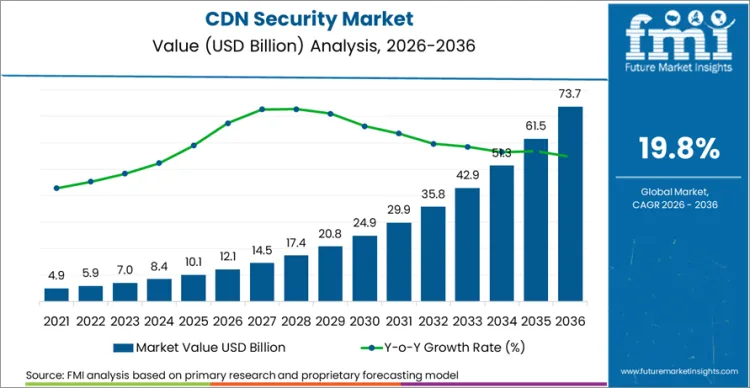
Summary of CDN Security Market
What Is Growth Outlook for CDN Security Market as per Future Market Insights Projection?
Future Market Insights projects the cdn security market to expand at a CAGR of 19.8% from 2026 to 2036, increasing from USD 12.1 Billion in 2026 to USD 72.9 Billion by 2036.
FMI Research Approach: FMI proprietary forecasting model based on enterprise web traffic volume and edge security attach-rate analysis.
How Do FMI Analysts Perceive CDN Security Market to Evolve?
FMI analysts perceive the market evolving toward unified edge platforms where content delivery, web application security, bot management, and DDoS protection converge into a single procurement decision, with data sovereignty compliance becoming a standard feature.
FMI Research Approach: Edge platform revenue mix analysis and enterprise security procurement pattern tracking.
Which Country Holds Largest Share in Global CDN Security Market?
The United States holds a significant share of the global CDN security market by value, supported by the highest concentration of hyperscale data centers and enterprise web application deployments globally.
FMI Research Approach: FMI country-level revenue modelling by enterprise web application volume and edge node deployment density.
How Large Will CDN Security Market Be by 2036?
The global cdn security market is projected to reach USD 72.9 Billion by 2036.
FMI Research Approach: FMI long-term revenue forecast derived from web application growth projections and DDoS threat volume escalation curves.
What Is Definition of CDN Security Market?
The CDN security market includes revenue generated from the sale of security-integrated content delivery network services that combine web application firewalls, DDoS mitigation, bot management, and API protection with content acceleration at the network edge.
FMI Research Approach: FMI market taxonomy and inclusion-exclusion framework.
What Are Globally Unique Trends Shaping CDN Security Market?
Globally unique trends include the shift of CDN providers from content-first to security-first revenue models, the integration of AI-native bot detection at CDN edge nodes, and the emergence of sovereign CDN security platforms that comply with EU and APAC data residency mandates.
FMI Research Approach: CDN provider earnings analysis and SASE market evolution tracking.
CDN Security Market Key Takeaways
| Metric | Details |
|---|---|
| Industry Size (2026) | USD 12.1 Billion |
| Industry Value (2036) | USD 72.9 Billion |
| CAGR (2026 to 2036) | 19.8% |
Source: Future Market Insights (FMI) analysis, based on proprietary forecasting model and primary research
Segment-wise Analysis
By Application
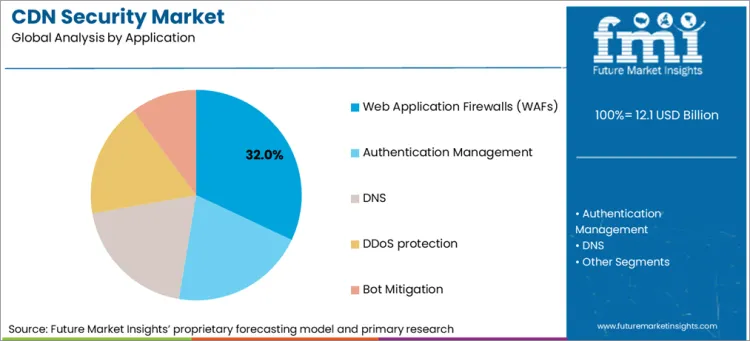
Web Application Firewalls (WAFs) have emerged as a crucial element of CDN security, providing protection against cyber threats like SQL injection, cross-site scripting (XSS), and distributed denial-of-service (DDoS) attacks. Enterprises are eyeing real-time threat detection as the definitive security measure.
WAFs integrated with the CDN can filter malicious traffic without much latency, therefore providing high-performance security. For example, Cloudflare’s WAF leverages machine learning for pattern recognition to improve adaptive protection.
Modern WAFs use AI to detect threats in an automated fashion, allowing them to handle zero day attacks, minimizing false positives in the process. As organizations move towards zero-trust security models, WAFs are incorporating strict access controls along with real-time analytics.
Regulatory requirements like GDPR (Europe), CCPA (California) and PCI-DSS (financial sector) drive the need for more robust security solutions. For instance, Akamai’s Kona Site Defender assists companies in complying with financial data protection laws while diminishing threats.
By End User
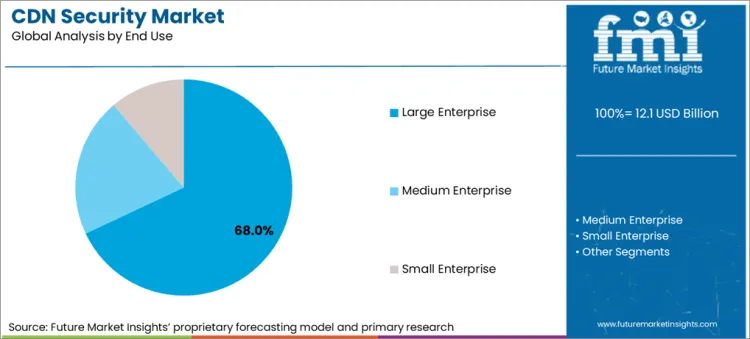
Large enterprises are the largest consumers of these solutions because of their widespread online existence which makes them overly exposed to DDoS, credential stuffing and exploits aimed to APIs. These need multi-layered security models that integrate CDN protection, Web Application Firewalls (WAFs), and threat intelligence, with millions of user interactions daily.
For instance, AWS utilizes AWS CloudFront which offers DDoS protection by default to protect the global data from being compromised and the service from an outage. For added protection, large enterprises have also adopted zero-trust security frameworks, which require continuous monitoring and authentication.
By Industries
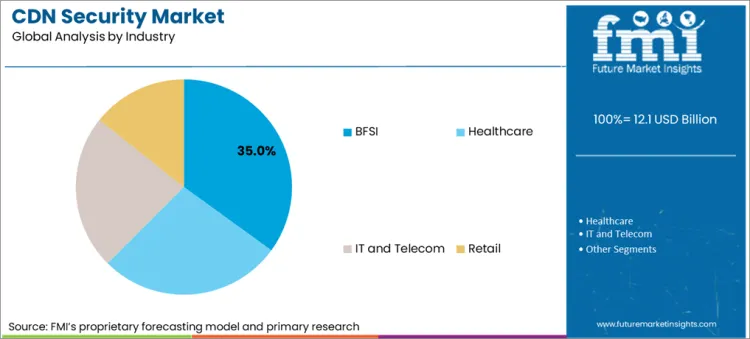
The BFSI (Banking, Financial Services, and Insurance) sector is the largest end user of these solutions because of its paramount requirement for data protection, regulatory compliance, and real-time threat prevention. Banks process huge volumes of sensitive customer data, such as banking transactions, credit card information, and personal identification information, making them ideal targets for cyberattacks.
DDoS attacks, phishing attacks, and ransomware threats are critical threats to financial platforms, and strong solutions are needed to provide seamless services, secure data transfer, and fraud protection.
Adoption Criteria for Different End Users
Key criteria for CDN security are compared in this table across the four stakeholder groups of enterprise IT, small and medium businesses, digital media companies, and cloud service providers. DDoS mitigation, performance optimization and global reach are key components to robust, reliable networks for enterprise IT and cloud service providers.
In contrast, SMBs attach average importance to these factors as they have less resources to work, and digital media companies rate them important - integration, and ease of use to support the content delivery. Enterprise IT and cloud providers place a greater emphasis on scalability and flexibility, while SMBs and digital consistently prioritize them less.
SMBs rate cost efficiency as the highest priority while other groups weigh cost against performance. On the whole, the table reflects priorities that vary according to organizational size and operational needs.
Shifts in the Industry from 2020 to 2024 and Future Trends 2025 to 2035
From 2020 to 2024, the CDN (Content Delivery Network) security industry grew at a fast rate due to increased cyberattacks, increased cloud adoption, and growing reliance on digital content. The ongoing threats of DDoS attacks, API vulnerabilities, and bot traffic stimulated the need for advanced security solutions within the CDN architecture.
Business drove content delivery with real-time threat detection, artificial intelligence-enabled security, and zero-trust architectures to safeguard their content. As more people are working from their homes, and there is an increase in streaming services, this fueled growth in the industry, and regulatory needs put pressure on companies to improve the quality of their data protection facilities.
The industry will continue to grow over the period 2025 to 2035, with artificial intelligence-powered threat intelligence, automated response systems, and blockchain-based content security. Quantum encryption, in combination with edge security, will also strengthen CDN protection against advanced cyber threats.
Low-latency, secure content delivery will be in greater demand with 5G and IoT. The more advanced the cyberattack becomes, companies will remain increasingly reliant on adaptive security systems, thereby making the industry an essential part of the strength of digital infrastructure.
Comparative Industry Shift Analysis (2020 to 2024 vs. 2025 to 2035)
| 2020 to 2024 | 2025 to 2035 |
|---|---|
| Stricter data privacy regulations like GDPR and CCPA led enterprises to enhance compliance measures for data breaches and content manipulation risks. | Governments enforce sovereign cloud frameworks, requiring region-specific infrastructure and compliance. AI-driven content moderation becomes mandatory. |
| Rising DDoS attacks, bot traffic, and credential stuffing drove adoption of web application firewalls and AI-based anomaly detection. | AI-generated cyber threats fuel demand for fully autonomous, self-healing security. Deepfake detection and AI-content manipulation protection become critical. |
| Zero trust principles gained traction, incorporating multi-factor authentication (MFA) and identity verification for network protection. | Zero Trust models become standard, using AI behavioral analysis and blockchain-based identity verification to block unauthorized access. |
| Edge computing growth pushed solution providers to enhance threat detection at edge nodes, reducing response time. | AI-driven, self-learning edge security solutions dynamically adapt to new threats, securing real-time data flow across global nodes. |
| API traffic exploits within CDNs led vendors to develop API security tools with rate limiting and token-based authentication. | API security becomes a top priority with AI-powered risk scoring, runtime security, and secure API gateways embedded in CDN infrastructures. |
| AI-assisted bot detection protected against scraping, automated attacks, and web content fraud. | Next-gen bot mitigation uses deep learning to identify human-like bots with fewer false positives and improved automation. |
| Enterprises shifted from on-premises solutions to cloud-based WAF and AI-driven DDoS protection. | Multi-cloud and hybrid models require adaptive security policies across cloud vendors with automated enforcement. |
| Security vendors integrated real-time threat intelligence feeds to detect and block malware traffic. | AI-driven predictive threat intelligence anticipates attack patterns, enabling proactive countermeasures. |
| The shift from TLS 1.2 to TLS 1.3 improved encryption efficiency and reduced latency for secure content delivery. | Post-quantum cryptography adoption secures CDN infrastructure against quantum threats, with lightweight encryption ensuring speed and security. |
Risk Assessment for CDN Security Providers
Protection against web attacks like DDoS, web application, and bot abuse are a major role of CDN security services. Cyber threats are growing in scale and complexity, and providers want to keep their defenses continuously updated. Not being able to stop large-scale attacks can hurt a provider’s reputation and push customers toward competitors.
New threats, such as attacks targeting APIs and zero-day vulnerabilities, heighten the risks even more. Security vendors need to keep investing in R&D and infrastructure to remain ahead of adversaries because any failure in protection translates into client breaches and a loss of trust.
In turn, CDN security means that your traffic will be inspected, which can lead to privacy issues with some regulations (e.g., GDPR). Failure to handle personal data appropriately, for instance, user IPs, can trigger non-compliance penalties. BFSI and political clients, which need local data traffic filtration, have to invest in regional infrastructure.
Governments audit CDN providers for validation compliance and may impose certifications or encryption standards upon them, and if a content provider is a potential target for a government it needs to be able to reassure it that the CDN it is using meets privacy guidelines. Similar to regulatory changes, telecom licensing for security services in countries around the world could impact operations and be costly to adjust to.
Pricing Strategy for CDN Security Providers
The CDN security services are generally delivered via a SaaS model with tiered pricing. Providers have free or low-cost entry plans with basic protection, and advanced security features can be unlocked at higher subscription tiers. Cloudflare offers free DDoS protection but premiums for advanced features (like WAF and bot mitigation). This freemium model builds a likely giant base of users, a percentage of which convert to paid plans, also the money has all the time to grow.
Certain CDN security services have usage-based aspects, for example billing per traffic amount or security events that pass through. On the enterprise side, there are also set-fee structures - like AWS Shield Advanced, which offers full-on DDoS mitigation for USD 3,000/month. Creating end-user pricing that only charges for what they use and charges additional fees for overages on traffic or request volumes to align prices to actual usage and ensure customers with heavy traffic pay their fair share.
This includes security features such as advanced bot mitigation and zero-trust security, which is usually priced according to the value of the business it protects. SLA guarantees, enhanced security, and dedicated customer support - enterprises pay more for that sort of thing. Well, when Cloudflare and Akamai charge extra for premium WAF rules and real-time analytics, they do so because value-based pricing allows them to maximize revenue from security conscious customers.
AWS and Google Cloud include security as part of their broader cloud services, applying pricing pressure to standalone CDN security vendors. In order to stay competitive, most CDN providers either package security with their CDN or group multiple security features for less than they cost if bought individually. Enterprise clients routinely have custom pricing arrangements, either based on volume discounts or bundled services agreements to keep security costs down.
Regional Industry Trends
North America
North America leads the industry, with the USA spearheading innovation as a result of stringent data privacy laws, fast cloud migration, and heightened cyber threats. The region's robust digital foundation and regulatory ecosystem, such as CCPA and NIST recommendations, compel businesses to invest more in security. Industry leaders like Akamai Technologies, Cloudflare, and Fastly are also pushing forward with their DDoS protection, WAF (Web Application Firewall), and AI-based security analytics to fight the new threats.
Europe
The European industry is growing swiftly, with the thrust coming from GDPR compliance, mounting cyber-attacks, and digital service growth. Countries such as Germany, the UK, and France are seeing heavy investments in cloud security, Web Application Firewalls (WAFs), and bot management solutions. The European Commission’s initiatives to combat online fraud, data breaches, and misinformation have further strengthened cybersecurity adoption.
Asia Pacific
Asia Pacific is the most rapidly growing industry, fueled by accelerating digital transformation, e-commerce growth, and growing cyber threats. China, India, and Japan are making significant investments in cybersecurity infrastructure, cloud security solutions, and AI-powered threat detection.
However, challenges such as cybersecurity awareness gaps, regulatory fragmentation, and infrastructure limitations hinder seamless adoption. Despite these challenges, Asia-Pacific’s booming digital economy and government-backed cybersecurity initiatives will continue to fuel adoption, making it a critical region for global providers in the coming years.
Country-Wise Outlook
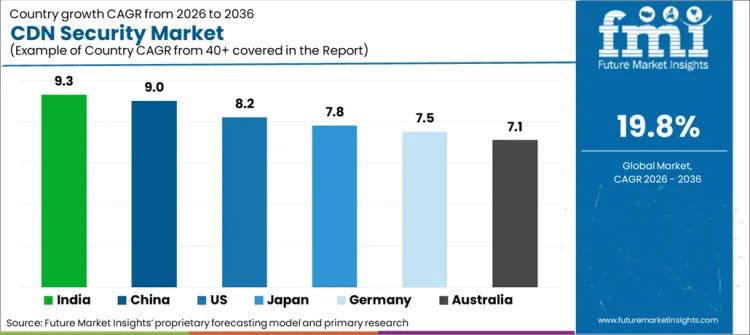
| Countries | CAGR (2025 to 2035) |
|---|---|
| USA | 8.2% |
| China | 9% |
| Germany | 7.5% |
| Japan | 7.8% |
| India | 9.3% |
| Australia | 7.1% |
USA
The USA industry is expanding at a phenomenal rate, driven by mounting cyber threats, robust government measures, and aggressive cloud adoption. The country has numerous largest cloud service providers in the world, including AWS, Microsoft Azure, and Google Cloud, which are driving the demand for secure Content Delivery Networks (CDNs).
The government of the USA, through agencies like the Department of Homeland Security (DHS) and the Cybersecurity & Infrastructure Security Agency (CISA), is implementing stronger security measures to shield national infrastructure against cyber threats. FMI is of the opinion that the USA CDN security market is set to witness 8.2% CAGR during the study period.
Market Growth Drivers
| Key Drivers | Details |
|---|---|
| Cybersecurity Defense Programs | The USA government alone spent USD 15 billion on cybersecurity in 2024, leaving business organizations with no option but to use secure solutions. |
| Cloud Services | The USA has excellent cloud providers in AWS, Azure, and Google Cloud, so secure CDNs are also a necessity. |
China
Chinese industry is growing quickly on the basis of government policy, increasing cyberattacks, and the sheer amount of internet traffic in the nation. China has over 1 billion internet users that generate a huge amount of internet traffic that must be protected for transit.
China has imposed measures like the Great Firewall to control and govern access to the internet, forcing organizations to pay for compliant and secure CDN solutions. FMI states that the Chinese industry is expected to observe 9% CAGR during the study period.
Market Growth Drivers
| Key Drivers | Details |
|---|---|
| Cybersecurity Legislation | The Data Security Law (DSL) and Personal Information Protection Law (PIPL) regulate internet usage and require safe CDNs to be implemented. |
| Cyberattack Surge | More than 250 million malware incidents hit China in 2024, and cybersecurity infrastructure becomes essential. |
Germany
German industry is expanding with the regulation of the General Data Protection Regulation (GDPR), growing adoption of cloud technologies, and the rising number of cyberattacks conducted on firms. As the largest economy in Europe, Germany has the strongest data protection regulations that force firms to invest considerable resources into securing data using safe CDN solutions. FMI cites that the German industry is poised to observe 7.5% CAGR during the study period.
Market Growth Drivers
| Key Drivers | Details |
|---|---|
| GDPR Compliance | Germany’s stringent data protection laws force businesses to spend money on safe CDN services. |
| Cybersecurity Investment | Germany spent heavily in 2024 on the improvement of national cybersecurity. |
Japan
Japan's CDN security market is growing with increased cyberattacks, expansion in 5G networks, and more online payment transactions. Japan's government Digital Agency demands more cybersecurity law, which fosters the culture of which CDN security is a requirement. Japan's high-performance video gaming and content media companies also require secure and reliable content delivery to keep latency minimal. FMI states that the Japanese industry is anticipated to register 7.8% CAGR during the forecast period.
Market Growth Drivers
| Key Drivers | Details |
|---|---|
| 5G Investment | Japan's USD 50 billion investment in 5G will create demand for secure content delivery. |
| Finance Cybersecurity Threats | Japan banks lost USD 3 billion to fraudulent attacks in 2024, and improved CDN security is necessary. |
India
Indian industry is expanding rapidly with the increase in digital transactions, online video watching, and the government's transition towards cybersecurity. India with over 700 million internet users has seen a massive rise in cyberattacks, and this has encouraged business houses to lay greater stress on secure CDN solutions. FMI is of the opinion that the Indian industry is set to register 9.3% CAGR during the study period.
Market Growth Drivers
| Key Drivers | Details |
|---|---|
| Digital Payment Growth | UPI transactions reached more than USD 1.8 trillion in 2024, and more cybersecurity was required. |
| Government Cybersecurity Initiative | The Indian government invested ₹5,000 crore in strengthening the country's cybersecurity infrastructure. |
Australia
Australian CDN security market continues to expand with rising cybercrime, digitization policies at the government level, and growing usage of cloud computing. Cyber threats to Australian businesses in 2025 increased by a record 35%, according to the Australian Cyber Security Centre (ACSC), and thus saw enhanced demand for secure CDNs. FMI states that the Australian industry is anticipated to obtain 7.1% CAGR during the forecast period.
Market Growth Drivers
| Key Drivers | Details |
|---|---|
| Government Cybersecurity Spending | The government expended AUD 9.9 billion in 2025 on improving cybersecurity resilience to industries. |
| Cloud and Edge Computing Expansion | Australia's rapid expansion of its AUD 15 billion cloud market creates the need for secure CDNs. |
Competitive Outlook
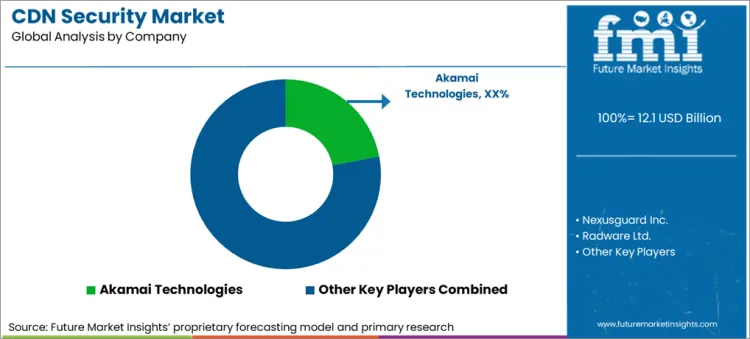
The industry is highly competitive, with tier 1 players like Akamai Technologies, Nexusguard Inc., and Radware Ltd., which all have advanced security solutions, AI-driven threat mitigation, and Zero Trust architectures. These majors leverage their extensive global infrastructure, real-time monitoring capabilities, and robust DDoS protection to address the ever-increasing complexity of cyber threats.
While their current offerings allow them to provide scalable, adaptive frameworks for security, they can maintain and continue that position in the industry in the terms of protecting digital assets and optimizing performance when it comes to content delivery.
Tier 2 players that are building up their brands in integrated security solutions for business and emerging markets are Verizon Digital Media Services, StackPath LLC, and Tencent Cloud. These businesses focus on cost-effective, scalable security models to gain competitive advantages in special sections.
The emerging trends in the marketplace have been enhanced by the popularity of edge computing and increased investments in AI-powered risk assessment, which compel providers to ensure best practices on real-time threat intelligence and automated mitigation strategies. Those who specialize in innovative predictive security analytics and compliance-driven architectures will enjoy the benefits of long-term market relevance in this period of increased cyber risks.
Recent Developments:
- In January 2026, Akamai Technologies reported a 5% year-over-year revenue increase to USD 1.05 billion driven by its security segment, which now accounts for 52% of total revenue, and announced a pivot toward AI-native infrastructure for enterprise web asset protection.
- In 2025, Cloudflare expanded its Zero Trust SASE platform, integrating CDN delivery with identity-aware access controls for enterprise applications across global edge nodes.
- In 2025, T-Systems expanded its sovereign cloud offering to include edge security services compliant with EU data residency requirements, targeting enterprises that need both content acceleration and jurisdictional data control.
Industry Share Analysis by Company
| Company Name | Estimated Industry Share (%) |
|---|---|
| Akamai Technologies | 18-23% |
| Nexusguard Inc. | 10-15% |
| Radware Ltd. | 8-12% |
| Verizon Digital Media Services | 5-10% |
| StackPath LLC | 4-8% |
| Tencent Cloud | 3-7% |
| Other Companies (combined) | 37-45% |
Key Company Offerings and Activities
| Company Name | Key Offerings/Activities |
|---|---|
| Akamai Technologies | Advanced edge security, DDoS mitigation, Zero Trust framework, bot protection. |
| Nexusguard Inc. | Specializes in cloud-based DDoS mitigation and AI-driven threat intelligence. |
| Radware Ltd. | Multi-layered security solutions with behavioral analytics and attack prevention. |
| Verizon Digital Media Services | CDN-integrated web application firewall (WAF) and enterprise-grade security. |
| StackPath LLC | Edge computing with integrated threat detection and automated security policies. |
| Tencent Cloud | AI-driven security solutions tailored for APAC enterprises, focusing on large-scale cyber threat mitigation. |
Key Company Insights
Akamai Technologies (18-23%)
Akamai remains a leader in the CDN security industry with its cutting-edge edge computing and Zero Trust security solutions. It is always updating its DDoS mitigation and bot management technologies, making it an attractive option for enterprises that require protection against large-scale cyber threats.
Nexusguard Inc. (10-15%)
Nexusguard is a well-known name in cloud-based DDoS mitigation and AI-backed threat intelligence. The company has made a co-resident security portfolio through the introduction of machine-learning-based anomaly detection, thus positioning itself as a key player with ISPs and enterprises or government entities.
Radware Ltd. (8-12%)
Radware is the pioneer in behavioral analytics and multi-layered protection solutions in cybersecurity. The company aims its products at APT (Advanced Persistent Threats) and volumetric DDoS attacks, with its latest partnerships with operators in telecom enhancing the provider's network security features.
Verizon Digital Media Services (5-10%)
Verizon combines CDN security with other enterprise offerings, including its robust WAF and network protection. The carrier recently unveiled a new edge security solution intended to boost content protection and lower latency while unaffiliated with its typical enterprise offerings.
StackPath LLC (4-8%)
StackPath Across the edge, real-time threat detection and automated enforcement of security threats are the two most essential prerogatives. Startup and small and medium-sized enterprises are conveniently reached through the affordable pricing on their security solutions, while the new AI-enhanced firewall upgrades improve its breach prevention capabilities.
Tencent Cloud (3-7%)
Tencent Cloud also has a fast-growing footprint in the APAC region through AI-driven security frameworks. The newly introduced adaptive security framework has for the first time enabled real-time cyber threat attenuation for large enterprises.
Other Key Players (20-30% Combined)
- Cloudflare
- Imperva
- Fastly
- Limelight Networks
- AWS CloudFront Security
Market Definition
The CDN security market represents revenue generated from the sale of security-integrated content delivery network services that protect and accelerate web applications, APIs, and digital content at the network edge. The market measures the value of managed CDN security platforms, web application firewalls, DDoS mitigation, bot management, and API protection services sold to enterprises, government agencies, and digital content providers.
Inclusions cover cloud-delivered WAF, DDoS protection, bot management, API security, and content acceleration services sold as integrated edge platform subscriptions. It includes both standalone CDN security services and security features bundled within broader SASE or Zero Trust platforms. Sovereign edge security services that comply with data residency mandates are also included.
Exclusions include on-premises WAF appliances not delivered via CDN infrastructure, standalone endpoint protection platforms, network firewalls deployed outside CDN edge nodes, and general cloud infrastructure services (IaaS, PaaS). Content licensing fees and media streaming platform subscriptions are outside the scope.
Key Industry Players
- Akamai Technologies
- Cloudflare Inc.
- Amazon Web Services
- Microsoft Corporation
- Radware Ltd.
- Verizon Digital Media Services
- StackPath LLC
- Fastly Inc.
- Tata Communications Limited
- International Business Machines Corporation (IBM)
- Google LLC
- ChinaCache
- Distil Networks
- Arbor Networks
- Limelight Networks
- Nexusguard Inc.
Segmentation
By Application:
With respect to application, the industry is divided into web application firewall, authentication management, DNS, DDoS protection, and bot mitigation.
By End User:
With respect to end user, the industry is divided into large enterprise, medium enterprise, and small enterprise.
By Industry:
With respect to industry, the industry is split into BFSI, healthcare, IT & telecom, retail, media & entertainment, and manufacturing.
By Region:
Key countries of North America, Latin America, Europe, Asia Pacific, and the Middle East & Africa (MEA) have been covered in the report.
Bibliography
- Akamai Technologies. (2026, January). 2025 earnings and security segment revenue. Akamai investor relations.
- T-Systems. (2025). Sovereign cloud platform expansion with edge security. Deutsche Telekom corporate disclosure.
- Cloudflare. (2025). Zero Trust SASE platform expansion. Cloudflare corporate disclosure.
Frequently Asked Questions
What is the current global market size for the CDN Security Market?
The market is valued at USD 12.1 Billion in 2026, driven by the convergence of content delivery and threat mitigation into unified edge platforms driven by rising AI-generated traffic and DDoS attack volumes.
What is the projected Compound Annual Growth Rate (CAGR) for the market over the next 10 years?
The market is projected to grow at a CAGR of 19.8% from 2026 to 2036.
Which regions are experiencing the fastest expansion?
North America leads with the largest market share, followed by Europe driven by data sovereignty mandates, and Asia Pacific with the fastest growth rate.
What are the primary market drivers?
The accelerating volume of AI-generated web traffic, the shift of CDN providers to security-first revenue models, and data sovereignty mandates requiring edge-localized security processing are the primary drivers.
Who are the leading companies in the industry?
Akamai, Cloudflare, Fastly, and T-Systems are key players, differentiating through AI-native edge security, Zero Trust SASE integration, and sovereign CDN compliance capabilities.
Table of Content
- Executive Summary
- Global Market Outlook
- Demand to side Trends
- Supply to side Trends
- Technology Roadmap Analysis
- Analysis and Recommendations
- Market Overview
- Market Coverage / Taxonomy
- Market Definition / Scope / Limitations
- Research Methodology
- Chapter Orientation
- Analytical Lens and Working Hypotheses
- Market Structure, Signals, and Trend Drivers
- Benchmarking and Cross-market Comparability
- Market Sizing, Forecasting, and Opportunity Mapping
- Research Design and Evidence Framework
- Desk Research Programme (Secondary Evidence)
- Company Annual and Sustainability Reports
- Peer-reviewed Journals and Academic Literature
- Corporate Websites, Product Literature, and Technical Notes
- Earnings Decks and Investor Briefings
- Statutory Filings and Regulatory Disclosures
- Technical White Papers and Standards Notes
- Trade Journals, Industry Magazines, and Analyst Briefs
- Conference Proceedings, Webinars, and Seminar Materials
- Government Statistics Portals and Public Data Releases
- Press Releases and Reputable Media Coverage
- Specialist Newsletters and Curated Briefings
- Sector Databases and Reference Repositories
- FMI Internal Proprietary Databases and Historical Market Datasets
- Subscription Datasets and Paid Sources
- Social Channels, Communities, and Digital Listening Inputs
- Additional Desk Sources
- Expert Input and Fieldwork (Primary Evidence)
- Primary Modes
- Qualitative Interviews and Expert Elicitation
- Quantitative Surveys and Structured Data Capture
- Blended Approach
- Why Primary Evidence is Used
- Field Techniques
- Interviews
- Surveys
- Focus Groups
- Observational and In-context Research
- Social and Community Interactions
- Stakeholder Universe Engaged
- C-suite Leaders
- Board Members
- Presidents and Vice Presidents
- R&D and Innovation Heads
- Technical Specialists
- Domain Subject-matter Experts
- Scientists
- Physicians and Other Healthcare Professionals
- Governance, Ethics, and Data Stewardship
- Research Ethics
- Data Integrity and Handling
- Primary Modes
- Tooling, Models, and Reference Databases
- Desk Research Programme (Secondary Evidence)
- Data Engineering and Model Build
- Data Acquisition and Ingestion
- Cleaning, Normalisation, and Verification
- Synthesis, Triangulation, and Analysis
- Quality Assurance and Audit Trail
- Market Background
- Market Dynamics
- Drivers
- Restraints
- Opportunity
- Trends
- Scenario Forecast
- Demand in Optimistic Scenario
- Demand in Likely Scenario
- Demand in Conservative Scenario
- Opportunity Map Analysis
- Product Life Cycle Analysis
- Supply Chain Analysis
- Investment Feasibility Matrix
- Value Chain Analysis
- PESTLE and Porter’s Analysis
- Regulatory Landscape
- Regional Parent Market Outlook
- Production and Consumption Statistics
- Import and Export Statistics
- Market Dynamics
- Global Market Analysis 2021 to 2025 and Forecast, 2026 to 2036
- Historical Market Size Value (USD Million) Analysis, 2021 to 2025
- Current and Future Market Size Value (USD Million) Projections, 2026 to 2036
- Y to o to Y Growth Trend Analysis
- Absolute $ Opportunity Analysis
- Global Market Pricing Analysis 2021 to 2025 and Forecast 2026 to 2036
- Global Market Analysis 2021 to 2025 and Forecast 2026 to 2036, By Application
- Introduction / Key Findings
- Historical Market Size Value (USD Million) Analysis By Application , 2021 to 2025
- Current and Future Market Size Value (USD Million) Analysis and Forecast By Application , 2026 to 2036
- Web Application Firewalls (WAFs)
- Authentication Management
- DNS
- DDoS protection
- Bot Mitigation
- Web Application Firewalls (WAFs)
- Y to o to Y Growth Trend Analysis By Application , 2021 to 2025
- Absolute $ Opportunity Analysis By Application , 2026 to 2036
- Global Market Analysis 2021 to 2025 and Forecast 2026 to 2036, By End Use
- Introduction / Key Findings
- Historical Market Size Value (USD Million) Analysis By End Use, 2021 to 2025
- Current and Future Market Size Value (USD Million) Analysis and Forecast By End Use, 2026 to 2036
- Large Enterprise
- Medium Enterprise
- Small Enterprise
- Large Enterprise
- Y to o to Y Growth Trend Analysis By End Use, 2021 to 2025
- Absolute $ Opportunity Analysis By End Use, 2026 to 2036
- Global Market Analysis 2021 to 2025 and Forecast 2026 to 2036, By Industry
- Introduction / Key Findings
- Historical Market Size Value (USD Million) Analysis By Industry, 2021 to 2025
- Current and Future Market Size Value (USD Million) Analysis and Forecast By Industry, 2026 to 2036
- BFSI
- Healthcare
- IT and Telecom
- Retail
- BFSI
- Y to o to Y Growth Trend Analysis By Industry, 2021 to 2025
- Absolute $ Opportunity Analysis By Industry, 2026 to 2036
- Global Market Analysis 2021 to 2025 and Forecast 2026 to 2036, By Region
- Introduction
- Historical Market Size Value (USD Million) Analysis By Region, 2021 to 2025
- Current Market Size Value (USD Million) Analysis and Forecast By Region, 2026 to 2036
- North America
- Latin America
- Western Europe
- Eastern Europe
- East Asia
- South Asia and Pacific
- Middle East & Africa
- Market Attractiveness Analysis By Region
- North America Market Analysis 2021 to 2025 and Forecast 2026 to 2036, By Country
- Historical Market Size Value (USD Million) Trend Analysis By Market Taxonomy, 2021 to 2025
- Market Size Value (USD Million) Forecast By Market Taxonomy, 2026 to 2036
- By Country
- USA
- Canada
- Mexico
- By Application
- By End Use
- By Industry
- By Country
- Market Attractiveness Analysis
- By Country
- By Application
- By End Use
- By Industry
- Key Takeaways
- Latin America Market Analysis 2021 to 2025 and Forecast 2026 to 2036, By Country
- Historical Market Size Value (USD Million) Trend Analysis By Market Taxonomy, 2021 to 2025
- Market Size Value (USD Million) Forecast By Market Taxonomy, 2026 to 2036
- By Country
- Brazil
- Chile
- Rest of Latin America
- By Application
- By End Use
- By Industry
- By Country
- Market Attractiveness Analysis
- By Country
- By Application
- By End Use
- By Industry
- Key Takeaways
- Western Europe Market Analysis 2021 to 2025 and Forecast 2026 to 2036, By Country
- Historical Market Size Value (USD Million) Trend Analysis By Market Taxonomy, 2021 to 2025
- Market Size Value (USD Million) Forecast By Market Taxonomy, 2026 to 2036
- By Country
- Germany
- UK
- Italy
- Spain
- France
- Nordic
- BENELUX
- Rest of Western Europe
- By Application
- By End Use
- By Industry
- By Country
- Market Attractiveness Analysis
- By Country
- By Application
- By End Use
- By Industry
- Key Takeaways
- Eastern Europe Market Analysis 2021 to 2025 and Forecast 2026 to 2036, By Country
- Historical Market Size Value (USD Million) Trend Analysis By Market Taxonomy, 2021 to 2025
- Market Size Value (USD Million) Forecast By Market Taxonomy, 2026 to 2036
- By Country
- Russia
- Poland
- Hungary
- Balkan & Baltic
- Rest of Eastern Europe
- By Application
- By End Use
- By Industry
- By Country
- Market Attractiveness Analysis
- By Country
- By Application
- By End Use
- By Industry
- Key Takeaways
- East Asia Market Analysis 2021 to 2025 and Forecast 2026 to 2036, By Country
- Historical Market Size Value (USD Million) Trend Analysis By Market Taxonomy, 2021 to 2025
- Market Size Value (USD Million) Forecast By Market Taxonomy, 2026 to 2036
- By Country
- China
- Japan
- South Korea
- By Application
- By End Use
- By Industry
- By Country
- Market Attractiveness Analysis
- By Country
- By Application
- By End Use
- By Industry
- Key Takeaways
- South Asia and Pacific Market Analysis 2021 to 2025 and Forecast 2026 to 2036, By Country
- Historical Market Size Value (USD Million) Trend Analysis By Market Taxonomy, 2021 to 2025
- Market Size Value (USD Million) Forecast By Market Taxonomy, 2026 to 2036
- By Country
- India
- ASEAN
- Australia & New Zealand
- Rest of South Asia and Pacific
- By Application
- By End Use
- By Industry
- By Country
- Market Attractiveness Analysis
- By Country
- By Application
- By End Use
- By Industry
- Key Takeaways
- Middle East & Africa Market Analysis 2021 to 2025 and Forecast 2026 to 2036, By Country
- Historical Market Size Value (USD Million) Trend Analysis By Market Taxonomy, 2021 to 2025
- Market Size Value (USD Million) Forecast By Market Taxonomy, 2026 to 2036
- By Country
- Kingdom of Saudi Arabia
- Other GCC Countries
- Turkiye
- South Africa
- Other African Union
- Rest of Middle East & Africa
- By Application
- By End Use
- By Industry
- By Country
- Market Attractiveness Analysis
- By Country
- By Application
- By End Use
- By Industry
- Key Takeaways
- Key Countries Market Analysis
- USA
- Pricing Analysis
- Market Share Analysis, 2025
- By Application
- By End Use
- By Industry
- Canada
- Pricing Analysis
- Market Share Analysis, 2025
- By Application
- By End Use
- By Industry
- Mexico
- Pricing Analysis
- Market Share Analysis, 2025
- By Application
- By End Use
- By Industry
- Brazil
- Pricing Analysis
- Market Share Analysis, 2025
- By Application
- By End Use
- By Industry
- Chile
- Pricing Analysis
- Market Share Analysis, 2025
- By Application
- By End Use
- By Industry
- Germany
- Pricing Analysis
- Market Share Analysis, 2025
- By Application
- By End Use
- By Industry
- UK
- Pricing Analysis
- Market Share Analysis, 2025
- By Application
- By End Use
- By Industry
- Italy
- Pricing Analysis
- Market Share Analysis, 2025
- By Application
- By End Use
- By Industry
- Spain
- Pricing Analysis
- Market Share Analysis, 2025
- By Application
- By End Use
- By Industry
- France
- Pricing Analysis
- Market Share Analysis, 2025
- By Application
- By End Use
- By Industry
- India
- Pricing Analysis
- Market Share Analysis, 2025
- By Application
- By End Use
- By Industry
- ASEAN
- Pricing Analysis
- Market Share Analysis, 2025
- By Application
- By End Use
- By Industry
- Australia & New Zealand
- Pricing Analysis
- Market Share Analysis, 2025
- By Application
- By End Use
- By Industry
- China
- Pricing Analysis
- Market Share Analysis, 2025
- By Application
- By End Use
- By Industry
- Japan
- Pricing Analysis
- Market Share Analysis, 2025
- By Application
- By End Use
- By Industry
- South Korea
- Pricing Analysis
- Market Share Analysis, 2025
- By Application
- By End Use
- By Industry
- Russia
- Pricing Analysis
- Market Share Analysis, 2025
- By Application
- By End Use
- By Industry
- Poland
- Pricing Analysis
- Market Share Analysis, 2025
- By Application
- By End Use
- By Industry
- Hungary
- Pricing Analysis
- Market Share Analysis, 2025
- By Application
- By End Use
- By Industry
- Kingdom of Saudi Arabia
- Pricing Analysis
- Market Share Analysis, 2025
- By Application
- By End Use
- By Industry
- Turkiye
- Pricing Analysis
- Market Share Analysis, 2025
- By Application
- By End Use
- By Industry
- South Africa
- Pricing Analysis
- Market Share Analysis, 2025
- By Application
- By End Use
- By Industry
- USA
- Market Structure Analysis
- Competition Dashboard
- Competition Benchmarking
- Market Share Analysis of Top Players
- By Regional
- By Application
- By End Use
- By Industry
- Competition Analysis
- Competition Deep Dive
- Akamai Technologies
- Overview
- Product Portfolio
- Profitability by Market Segments (Product/Age /Sales Channel/Region)
- Sales Footprint
- Strategy Overview
- Marketing Strategy
- Product Strategy
- Channel Strategy
- Nexusguard Inc.
- Radware Ltd.
- Verizon Digital Media Services
- StackPath LLC
- Tencent Cloud
- Akamai Technologies
- Competition Deep Dive
- Assumptions & Acronyms Used
List of Tables
- Table 1: Global Market Value (USD Million) Forecast by Region, 2021 to 2036
- Table 2: Global Market Value (USD Million) Forecast by Application , 2021 to 2036
- Table 3: Global Market Value (USD Million) Forecast by End Use, 2021 to 2036
- Table 4: Global Market Value (USD Million) Forecast by Industry, 2021 to 2036
- Table 5: North America Market Value (USD Million) Forecast by Country, 2021 to 2036
- Table 6: North America Market Value (USD Million) Forecast by Application , 2021 to 2036
- Table 7: North America Market Value (USD Million) Forecast by End Use, 2021 to 2036
- Table 8: North America Market Value (USD Million) Forecast by Industry, 2021 to 2036
- Table 9: Latin America Market Value (USD Million) Forecast by Country, 2021 to 2036
- Table 10: Latin America Market Value (USD Million) Forecast by Application , 2021 to 2036
- Table 11: Latin America Market Value (USD Million) Forecast by End Use, 2021 to 2036
- Table 12: Latin America Market Value (USD Million) Forecast by Industry, 2021 to 2036
- Table 13: Western Europe Market Value (USD Million) Forecast by Country, 2021 to 2036
- Table 14: Western Europe Market Value (USD Million) Forecast by Application , 2021 to 2036
- Table 15: Western Europe Market Value (USD Million) Forecast by End Use, 2021 to 2036
- Table 16: Western Europe Market Value (USD Million) Forecast by Industry, 2021 to 2036
- Table 17: Eastern Europe Market Value (USD Million) Forecast by Country, 2021 to 2036
- Table 18: Eastern Europe Market Value (USD Million) Forecast by Application , 2021 to 2036
- Table 19: Eastern Europe Market Value (USD Million) Forecast by End Use, 2021 to 2036
- Table 20: Eastern Europe Market Value (USD Million) Forecast by Industry, 2021 to 2036
- Table 21: East Asia Market Value (USD Million) Forecast by Country, 2021 to 2036
- Table 22: East Asia Market Value (USD Million) Forecast by Application , 2021 to 2036
- Table 23: East Asia Market Value (USD Million) Forecast by End Use, 2021 to 2036
- Table 24: East Asia Market Value (USD Million) Forecast by Industry, 2021 to 2036
- Table 25: South Asia and Pacific Market Value (USD Million) Forecast by Country, 2021 to 2036
- Table 26: South Asia and Pacific Market Value (USD Million) Forecast by Application , 2021 to 2036
- Table 27: South Asia and Pacific Market Value (USD Million) Forecast by End Use, 2021 to 2036
- Table 28: South Asia and Pacific Market Value (USD Million) Forecast by Industry, 2021 to 2036
- Table 29: Middle East & Africa Market Value (USD Million) Forecast by Country, 2021 to 2036
- Table 30: Middle East & Africa Market Value (USD Million) Forecast by Application , 2021 to 2036
- Table 31: Middle East & Africa Market Value (USD Million) Forecast by End Use, 2021 to 2036
- Table 32: Middle East & Africa Market Value (USD Million) Forecast by Industry, 2021 to 2036
List of Figures
- Figure 1: Global Market Pricing Analysis
- Figure 2: Global Market Value (USD Million) Forecast 2021-2036
- Figure 3: Global Market Value Share and BPS Analysis by Application , 2026 and 2036
- Figure 4: Global Market Y-o-Y Growth Comparison by Application , 2026-2036
- Figure 5: Global Market Attractiveness Analysis by Application
- Figure 6: Global Market Value Share and BPS Analysis by End Use, 2026 and 2036
- Figure 7: Global Market Y-o-Y Growth Comparison by End Use, 2026-2036
- Figure 8: Global Market Attractiveness Analysis by End Use
- Figure 9: Global Market Value Share and BPS Analysis by Industry, 2026 and 2036
- Figure 10: Global Market Y-o-Y Growth Comparison by Industry, 2026-2036
- Figure 11: Global Market Attractiveness Analysis by Industry
- Figure 12: Global Market Value (USD Million) Share and BPS Analysis by Region, 2026 and 2036
- Figure 13: Global Market Y-o-Y Growth Comparison by Region, 2026-2036
- Figure 14: Global Market Attractiveness Analysis by Region
- Figure 15: North America Market Incremental Dollar Opportunity, 2026-2036
- Figure 16: Latin America Market Incremental Dollar Opportunity, 2026-2036
- Figure 17: Western Europe Market Incremental Dollar Opportunity, 2026-2036
- Figure 18: Eastern Europe Market Incremental Dollar Opportunity, 2026-2036
- Figure 19: East Asia Market Incremental Dollar Opportunity, 2026-2036
- Figure 20: South Asia and Pacific Market Incremental Dollar Opportunity, 2026-2036
- Figure 21: Middle East & Africa Market Incremental Dollar Opportunity, 2026-2036
- Figure 22: North America Market Value Share and BPS Analysis by Country, 2026 and 2036
- Figure 23: North America Market Value Share and BPS Analysis by Application , 2026 and 2036
- Figure 24: North America Market Y-o-Y Growth Comparison by Application , 2026-2036
- Figure 25: North America Market Attractiveness Analysis by Application
- Figure 26: North America Market Value Share and BPS Analysis by End Use, 2026 and 2036
- Figure 27: North America Market Y-o-Y Growth Comparison by End Use, 2026-2036
- Figure 28: North America Market Attractiveness Analysis by End Use
- Figure 29: North America Market Value Share and BPS Analysis by Industry, 2026 and 2036
- Figure 30: North America Market Y-o-Y Growth Comparison by Industry, 2026-2036
- Figure 31: North America Market Attractiveness Analysis by Industry
- Figure 32: Latin America Market Value Share and BPS Analysis by Country, 2026 and 2036
- Figure 33: Latin America Market Value Share and BPS Analysis by Application , 2026 and 2036
- Figure 34: Latin America Market Y-o-Y Growth Comparison by Application , 2026-2036
- Figure 35: Latin America Market Attractiveness Analysis by Application
- Figure 36: Latin America Market Value Share and BPS Analysis by End Use, 2026 and 2036
- Figure 37: Latin America Market Y-o-Y Growth Comparison by End Use, 2026-2036
- Figure 38: Latin America Market Attractiveness Analysis by End Use
- Figure 39: Latin America Market Value Share and BPS Analysis by Industry, 2026 and 2036
- Figure 40: Latin America Market Y-o-Y Growth Comparison by Industry, 2026-2036
- Figure 41: Latin America Market Attractiveness Analysis by Industry
- Figure 42: Western Europe Market Value Share and BPS Analysis by Country, 2026 and 2036
- Figure 43: Western Europe Market Value Share and BPS Analysis by Application , 2026 and 2036
- Figure 44: Western Europe Market Y-o-Y Growth Comparison by Application , 2026-2036
- Figure 45: Western Europe Market Attractiveness Analysis by Application
- Figure 46: Western Europe Market Value Share and BPS Analysis by End Use, 2026 and 2036
- Figure 47: Western Europe Market Y-o-Y Growth Comparison by End Use, 2026-2036
- Figure 48: Western Europe Market Attractiveness Analysis by End Use
- Figure 49: Western Europe Market Value Share and BPS Analysis by Industry, 2026 and 2036
- Figure 50: Western Europe Market Y-o-Y Growth Comparison by Industry, 2026-2036
- Figure 51: Western Europe Market Attractiveness Analysis by Industry
- Figure 52: Eastern Europe Market Value Share and BPS Analysis by Country, 2026 and 2036
- Figure 53: Eastern Europe Market Value Share and BPS Analysis by Application , 2026 and 2036
- Figure 54: Eastern Europe Market Y-o-Y Growth Comparison by Application , 2026-2036
- Figure 55: Eastern Europe Market Attractiveness Analysis by Application
- Figure 56: Eastern Europe Market Value Share and BPS Analysis by End Use, 2026 and 2036
- Figure 57: Eastern Europe Market Y-o-Y Growth Comparison by End Use, 2026-2036
- Figure 58: Eastern Europe Market Attractiveness Analysis by End Use
- Figure 59: Eastern Europe Market Value Share and BPS Analysis by Industry, 2026 and 2036
- Figure 60: Eastern Europe Market Y-o-Y Growth Comparison by Industry, 2026-2036
- Figure 61: Eastern Europe Market Attractiveness Analysis by Industry
- Figure 62: East Asia Market Value Share and BPS Analysis by Country, 2026 and 2036
- Figure 63: East Asia Market Value Share and BPS Analysis by Application , 2026 and 2036
- Figure 64: East Asia Market Y-o-Y Growth Comparison by Application , 2026-2036
- Figure 65: East Asia Market Attractiveness Analysis by Application
- Figure 66: East Asia Market Value Share and BPS Analysis by End Use, 2026 and 2036
- Figure 67: East Asia Market Y-o-Y Growth Comparison by End Use, 2026-2036
- Figure 68: East Asia Market Attractiveness Analysis by End Use
- Figure 69: East Asia Market Value Share and BPS Analysis by Industry, 2026 and 2036
- Figure 70: East Asia Market Y-o-Y Growth Comparison by Industry, 2026-2036
- Figure 71: East Asia Market Attractiveness Analysis by Industry
- Figure 72: South Asia and Pacific Market Value Share and BPS Analysis by Country, 2026 and 2036
- Figure 73: South Asia and Pacific Market Value Share and BPS Analysis by Application , 2026 and 2036
- Figure 74: South Asia and Pacific Market Y-o-Y Growth Comparison by Application , 2026-2036
- Figure 75: South Asia and Pacific Market Attractiveness Analysis by Application
- Figure 76: South Asia and Pacific Market Value Share and BPS Analysis by End Use, 2026 and 2036
- Figure 77: South Asia and Pacific Market Y-o-Y Growth Comparison by End Use, 2026-2036
- Figure 78: South Asia and Pacific Market Attractiveness Analysis by End Use
- Figure 79: South Asia and Pacific Market Value Share and BPS Analysis by Industry, 2026 and 2036
- Figure 80: South Asia and Pacific Market Y-o-Y Growth Comparison by Industry, 2026-2036
- Figure 81: South Asia and Pacific Market Attractiveness Analysis by Industry
- Figure 82: Middle East & Africa Market Value Share and BPS Analysis by Country, 2026 and 2036
- Figure 83: Middle East & Africa Market Value Share and BPS Analysis by Application , 2026 and 2036
- Figure 84: Middle East & Africa Market Y-o-Y Growth Comparison by Application , 2026-2036
- Figure 85: Middle East & Africa Market Attractiveness Analysis by Application
- Figure 86: Middle East & Africa Market Value Share and BPS Analysis by End Use, 2026 and 2036
- Figure 87: Middle East & Africa Market Y-o-Y Growth Comparison by End Use, 2026-2036
- Figure 88: Middle East & Africa Market Attractiveness Analysis by End Use
- Figure 89: Middle East & Africa Market Value Share and BPS Analysis by Industry, 2026 and 2036
- Figure 90: Middle East & Africa Market Y-o-Y Growth Comparison by Industry, 2026-2036
- Figure 91: Middle East & Africa Market Attractiveness Analysis by Industry
- Figure 92: Global Market - Tier Structure Analysis
- Figure 93: Global Market - Company Share Analysis
Full Research Suite comprises of:

Market outlook & trends analysis
Interviews & case studies
Strategic recommendations
Vendor profiles & capabilities analysis
5-year forecasts
8 regions and 60+ country-level data splits
Market segment data splits
12 months of continuous data updates
DELIVERED AS:
PDF EXCEL ONLINE


