


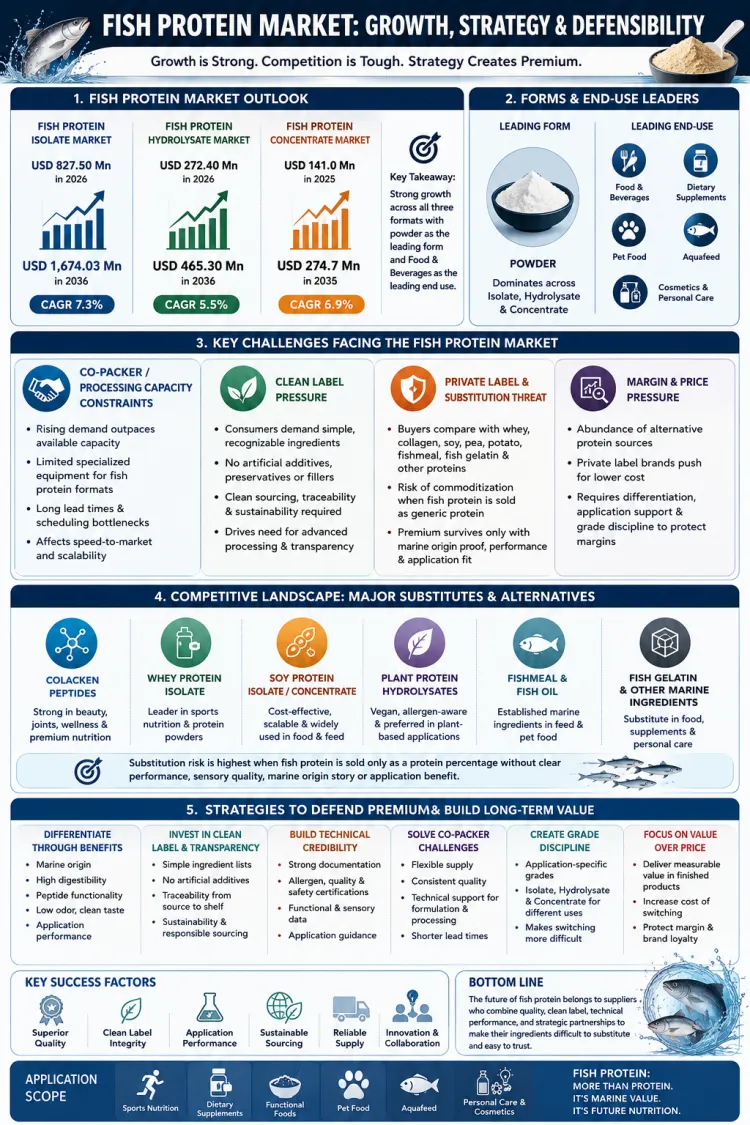
- Fish protein is exposed to private label and ingredient substitution pressure because many buyers compare it against whey, collagen, soy, pea, potato, fishmeal, fish gelatin, and generic marine protein alternatives.
- The strongest substitution risk appears where fish protein is sold only as a protein percentage, without clear proof of marine origin, digestibility, peptide functionality, odor control, or application performance.
- Fish protein isolate, hydrolysate, and concentrate can defend premium pricing only when suppliers link the ingredient to a specific use case such as sports nutrition, pet food, aquafeed, functional food, dietary supplements, or personal care.
- Private label brands can pressure margins by switching between fish protein formats or replacing fish protein with cheaper protein systems if the final product claim does not require a differentiated marine protein story.
- The biggest risk is commoditization. In fish protein, the premium is not protected by the word "marine" alone; it is protected by traceability, sensory quality, processing control, grade discipline, and proven finished-product value.
Fish protein is entering a more competitive phase of growth. The market is no longer shaped only by rising demand for marine-origin ingredients. It is also being shaped by a tougher question: when will buyers pay more for fish protein, and when will they substitute it with another protein ingredient?
This is the key issue behind the private label and ingredient substitution threat in the fish protein market. Fish protein isolate, fish protein hydrolysate, and fish protein concentrate offer strong value when they deliver marine origin, digestibility, peptide functionality, sustainability, and clean-label differentiation. However, they can become vulnerable when they are sold as generic protein powders without a clear performance or claim advantage.
FMI’s Fish Protein Isolate Market shows that the category is moving toward higher-value applications, with the market projected to expand from USD 827.50 million in 2026 to USD 1,674.03 million by 2036. FMI also identifies powder as the leading form and food and beverages as the leading end-use industry. This creates a clear premium opportunity, but it also creates a substitution risk. Food and beverage buyers have many protein choices. If fish protein isolate does not offer superior formulation value or a defensible marine-origin claim, buyers may compare it directly with whey, soy, pea, potato, egg, collagen, or blended protein systems.
The same risk applies to fish protein hydrolysate. FMI’s Fish Protein Hydrolysate Market is projected to grow from USD 272.40 million in 2026 to USD 465.30 million by 2036. FMI identifies enzymatic hydrolysis as the leading technology and powder as the leading form. Hydrolysate can command a stronger premium when it provides controlled peptides, digestibility, palatability, solubility, and functional performance. But if the hydrolysate is positioned only as a protein input, it becomes easier for buyers to replace it with casein hydrolysate, plant protein hydrolysate, collagen peptides, fishmeal derivatives, or other animal protein hydrolysates.
Fish protein concentrate also faces substitution pressure. FMI’s Fish Protein Concentrate Market is projected to grow from USD 141.0 million in 2025 to USD 274.7 million by 2035, with powder leading the form segment. Concentrate can serve food, feed, supplement, cosmetic, and personal care applications, but it sits in a highly competitive middle ground. It may be less refined than isolate and less peptide-specific than hydrolysate. This makes it important for suppliers to clearly define why the concentrate is being used. If the only reason is protein enrichment, cheaper alternatives may win.
The private label threat is important because private label brands often compete on value, margin, speed, and claim parity. A private label supplement, pet food, protein powder, or functional food brand may want a marine-origin claim, but it may not want to pay a high premium unless the claim directly improves consumer appeal or product performance. If a private label brand can achieve a similar label using collagen, fish gelatin, marine collagen peptide, or a blended protein system, it may reduce or remove fish protein from the formulation.
This does not mean fish protein will lose relevance. It means fish protein must defend its role more clearly. The market needs to move away from generic ingredient selling and toward application-specific positioning.
In sports nutrition, the substitution threat is strongest from whey protein isolate, collagen peptides, plant proteins, and blended protein powders. Whey has strong consumer familiarity and established performance credibility. Collagen has strong beauty, joint health, and active lifestyle associations. Plant proteins have vegan, allergen-aware, and sustainability positioning. Fish protein must therefore avoid being positioned as just another protein powder. Its stronger route is marine-origin differentiation, digestibility, amino acid value, and clean-label protein enrichment for brands that want something beyond standard whey or plant protein.
In dietary supplements, fish protein hydrolysate and isolate can support marine wellness positioning, but they compete against collagen peptide, native collagen, fish gelatin, amino acid blends, and protein hydrolysates from dairy or plant sources. The risk is especially high when consumers cannot easily understand the difference between fish protein hydrolysate and marine collagen peptide. If the finished product is positioned around skin, joints, beauty, or aging, collagen may be a stronger consumer-recognized claim. Fish protein suppliers must therefore clarify whether the product is being used for protein nutrition, peptide functionality, digestibility, marine sourcing, or another specific benefit.
In pet food, fish protein has strong potential, but substitution pressure is also high. Pet food formulators can use fishmeal, fish oil, poultry meal, hydrolyzed poultry protein, egg protein, animal digest, insect protein, or plant proteins depending on cost, palatability, digestibility, and label strategy. Fish protein hydrolysate can defend its premium when it supports sensitive diets, palatability, digestibility, or premium animal protein positioning. But if the formulation does not require those benefits, a lower-cost animal protein input may replace it.
In aquafeed, the substitution logic is even more performance-driven. Fish protein hydrolysate can support palatability, amino acid availability, and feed performance. However, aquafeed buyers are cost-sensitive and technically disciplined. They may compare fish hydrolysate with fishmeal, krill meal, soy protein concentrate, poultry by-product meal, single-cell protein, insect meal, or other functional additives. The premium is defensible only when the ingredient delivers measurable value in feed intake, growth performance, digestibility, or formulation efficiency.
In food and beverages, the substitution threat comes from nearly every major protein category. Whey, casein, soy, pea, rice, potato, egg, collagen, and blended proteins are all available options. Fish protein isolate or concentrate can win where marine origin, high protein content, clean-label sourcing, and sustainability create a differentiated product story. But if taste, odor, solubility, or consumer perception become barriers, food processors may shift to more familiar proteins.
In cosmetics and personal care, fish protein competes with collagen peptides, fish gelatin, marine collagen, amino acid complexes, algae-derived ingredients, and other marine bioactives. This category can support premium pricing, but the ingredient story must be precise. Beauty brands often prefer ingredients with clear consumer language. "Marine collagen" may be easier to communicate than "fish protein concentrate" unless the supplier provides a strong technical and marketing bridge.
The broader protein ingredients market increases the pressure. FMI’s Protein Ingredients Market covers a wide set of animal, plant, and alternative protein sources. This broader ecosystem matters because fish protein is not competing in isolation. Buyers are constantly comparing protein source, cost, functionality, claim fit, taste, solubility, availability, and documentation. In this environment, fish protein must prove why it deserves a place in the formula.
Collagen peptides are one of the strongest substitution threats in premium nutrition. FMI’s Collagen Peptide Market is projected to expand strongly through 2036, supported by beauty, joint health, sports nutrition, and wellness applications. Collagen has one major advantage: consumer understanding. Many consumers already associate collagen with beauty, skin, joints, and healthy aging. Fish protein suppliers must therefore avoid being blurred into the collagen category unless the product is intentionally positioned as a marine peptide or collagen-adjacent ingredient.
Whey protein isolate is another major threat, especially in sports nutrition. FMI’s Whey Protein Isolate Market is significantly larger than fish protein isolate, which reflects whey’s established role in protein powders and performance nutrition. Fish protein isolate can differentiate, but it cannot easily outcompete whey on familiarity, scale, or mainstream sports nutrition credibility. Its premium opportunity is more specialized: marine-origin protein, alternative animal protein, clean-label differentiation, and products targeting consumers looking beyond dairy.
Soy protein isolate and soy protein concentrate create a different substitution threat. They are large, scalable, and cost-efficient protein systems. FMI’s Soy Protein Isolate Market and Soy Protein Concentrate Market show that soy remains an important baseline in food and protein formulation. Fish protein will not replace soy in cost-sensitive applications. Instead, fish protein must target applications where animal origin, marine sourcing, digestibility, or specialized functionality justify a higher cost.
Plant protein hydrolysates create another competitive pressure. FMI’s Plant Protein Hydrolysate Market shows demand for hydrolyzed plant proteins in applications where solubility, digestibility, and functional properties matter. For buyers that want vegan or plant-based claims, plant protein hydrolysates may be preferred over fish protein hydrolysate. Fish protein hydrolysate must therefore focus on applications where marine peptides, palatability, animal-derived nutrition, or feed performance create a stronger value proposition.
Fishmeal and fish oil also remain important reference points. FMI’s Fishmeal and Fish Oil Market represents the established marine ingredient base. Fish protein isolate, hydrolysate, and concentrate are more specialized and value-added, but some buyers may still benchmark them against conventional marine ingredients. This is especially relevant in feed and pet food. If fish protein is priced too far above fishmeal without a clear functional benefit, substitution pressure will rise.
Private label makes this pressure more intense because private label often looks for "good enough" performance at a lower cost. A private label pet food brand may not need the highest-grade fish protein hydrolysate if a lower-cost fishmeal or hydrolyzed poultry protein supports a similar label. A private label supplement brand may replace fish protein with collagen if collagen is easier to market. A private label sports nutrition brand may use whey or plant protein if fish protein creates sensory or pricing challenges. This is why premium fish protein suppliers must clearly separate their value from generic protein claims.
The substitution threat should be measured through three lenses: claim substitution, function substitution, and cost substitution. Claim substitution happens when another ingredient can deliver a similar front-of-pack or marketing claim. For example, collagen may replace fish protein in beauty supplements. Function substitution happens when another ingredient delivers similar formulation performance. For example, whey or pea protein may replace fish protein isolate in a protein powder. Cost substitution happens when the buyer selects the cheapest protein that meets minimum requirements. This is common in feed, pet food, and mass-market food applications.
Fish protein can defend against substitution when it performs strongly across all three lenses. It needs a claim that competitors cannot easily copy, functionality that competitors cannot fully match, and enough product value to justify the cost. The strongest defense is not one single advantage. It is the combination of marine origin, traceability, digestibility, sensory control, application performance, and sustainability.
This is why product grading becomes important. A supplier should not sell one generic fish protein into every channel. Fish protein isolate for sports nutrition should have different specifications from isolate for food processing. Fish protein hydrolysate for premium pet food should differ from hydrolysate for aquafeed. Fish protein concentrate for cosmetics should differ from concentrate for animal nutrition. Grade clarity makes it harder for buyers to treat fish protein as a commodity.
Documentation also protects the premium. Private label buyers often need cost efficiency, but they also need risk reduction. Suppliers that provide traceability, source documentation, allergen statements, sensory data, protein specifications, solubility guidance, shelf-life support, and application testing can become preferred partners. This makes switching harder because the buyer is not only buying an ingredient. The buyer is buying confidence.
Sensory quality is another major defense. Fish protein that is low-odor, low-bitterness, stable, and easy to formulate is harder to replace in premium applications. If a brand has already built a successful product around a specific fish protein grade, switching to a cheaper substitute may create taste, texture, solubility, or stability problems. This gives technically strong suppliers more pricing power.
Sustainability can also reduce substitution risk, but only when it is proven. Fish protein made from responsibly sourced seafood streams or by-product valorization can support a circular-economy story. This is valuable for premium brands. However, sustainability claims must be traceable and credible. If the claim is vague, private label buyers may choose cheaper alternatives that provide similar marketing language.
For brands, the key strategy is to decide whether fish protein is central to the product identity or only a supporting ingredient. If fish protein is central, the brand should invest in the story: marine origin, source traceability, digestibility, peptide functionality, and sustainability. If fish protein is only a supporting protein input, the formulation is more vulnerable to substitution. This distinction is important for pricing, positioning, and supplier selection.
For suppliers, the opportunity is to move away from selling "fish protein" as a broad category. The stronger approach is to sell specific solutions: low-odor fish protein isolate for protein foods, controlled fish protein hydrolysate for premium pet diets, marine peptide hydrolysate for supplements, food-grade fish protein concentrate for clean-label nutrition, or cosmetic-grade marine protein for personal care. The more specific the solution, the harder it is for private label buyers to replace it with a generic alternative.
For co-packers, substitution risk creates a practical challenge. If a brand asks for fish protein but then switches to collagen, whey, soy, or pea protein, the manufacturing process may change. Solubility, flavor masking, allergen controls, blending behavior, and processing conditions may all shift. Co-packers with experience across multiple protein systems can benefit from this flexibility. Fish protein suppliers should therefore work closely with co-packers to make fish protein easier to use than substitute ingredients.
The regional picture also matters. In markets where marine ingredients are familiar and seafood has strong consumer trust, fish protein may face lower perception barriers. In markets where dairy or plant proteins dominate protein nutrition, fish protein may need stronger education and positioning. In pet food and aquafeed, regional seafood supply and feed formulation practices will influence substitution risk. In supplements and cosmetics, consumer familiarity with collagen may create a stronger substitution threat.
The misconception to avoid is that private label automatically weakens fish protein demand. Private label can also expand the category if fish protein becomes part of affordable marine nutrition, pet food, or supplement products. The issue is margin. Private label buyers may increase volume but pressure price. Fish protein suppliers must decide whether to support private label through standardized grades or protect premium channels through differentiated, application-specific ingredients.
Another misconception is that fish protein can defend itself only through price reduction. That is risky. Competing only on price pulls fish protein closer to commodity marine ingredients. A better defense is to increase the cost of switching. Suppliers can do this through better documentation, formulation support, sensory performance, traceability, technical claims, and grade-specific solutions.
Bottom line: the private label and ingredient substitution threat in fish protein is real, but it is not fatal. The threat is strongest where fish protein is generic, poorly documented, sensory-challenged, or sold only by protein percentage. The threat is weaker where fish protein is traceable, low-odor, soluble, application-tested, and linked to a clear marine-origin benefit.
The market’s next winners will be suppliers that make fish protein difficult to replace. They will not rely only on the word "marine." They will build defensible value around sourcing, processing, performance, documentation, and use-case fit. In fish protein, premium pricing will survive only where the ingredient does something that substitutes cannot easily match.
Fish protein must therefore move from ingredient availability to ingredient defensibility. The future is not simply about selling more fish protein. It is about proving why fish protein belongs in the formula and why replacing it would weaken the finished product.

