

- Market Size (2026)
- USD 322.9 Mn
- Forecast (2036)
- USD 959.0 Mn
- CAGR (2026 to 2036)
- 11.5%
How big is Acrylamide Mitigation Systems Market in 2026?
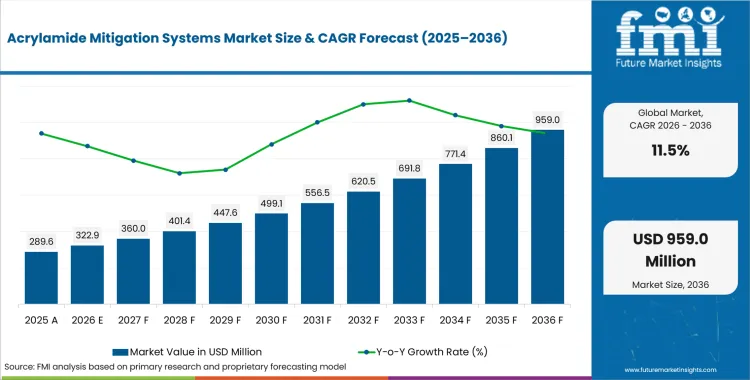
USD 322.9 million in 2026 and USD 959.0 million by 2036 at 11.5% CAGR.
Demand for acrylamide mitigation systems is projected to increase from USD 322.9 million in 2026 to USD 959.0 million by 2036 at 11.5% CAGR. Changes in flour chemistry and baking profiles force industrial bakeries to repeat mitigation trials since one dose does not perform identically in every recipe. EFSA's July 2025 assessment documents ARY-2 asparaginase for reducing acrylamide during high-temperature low-moisture processing by hydrolyzing asparagine. Commercial conversion depends on enzyme performance that survives plant-scale validation without altering finished-product quality.
Country growth differs between mature food-control systems and markets still expanding formal oversight. Germany's federal health portal stated in February 2026 that acrylamide formation begins near 120 degrees Celsius and rises sharply at 170 to 180 degrees Celsius. Thermal sensitivity keeps mitigation tied to recipe and oven conditions in mature bakery operations. The modelled gap between Germany at 11.5% CAGR and UAE at 12.8% therefore describes adoption speed instead of current market size.
Key Takeaways of Acrylamide Mitigation Systems Market
- Industrial bakery demand rises as raw-material shifts, recipe changes and heat profiles force repeated acrylamide-reduction work during routine production.
- By product type, standard grade is estimated to hold 40.0% in 2026 owing to broad compatibility with conventional industrial bakery recipes.
- Based on form, powder - dry is projected to account for 42.0% in 2026 due to compatibility with common dry-dosing and premix workflows.
- By application, bread & rolls is forecast to represent 37.0% in 2026 driven by frequent production runs and measurable thermal exposure.
- Recipe-specific efficacy, sensory performance and occupational handling can slow switching until each bakery line confirms the system under its own operating conditions.
- Some of the key players in this market include Novonesis, Kerry Group, dsm-firmenich, IFF, AB Enzymes, Palsgaard, Corbion, and Puratos.
Analyst Perspective
"Industrial bakeries should qualify acrylamide mitigation on the flour lots and oven profiles that produce their highest readings since nominal enzyme activity does not establish line performance. A system earns repeat orders after the bakery reproduces the reduction on several SKUs without changing texture, color or throughput targets."
- Nandini Roy Choudhury, Principal Consultant, Future Market Insights
How is the Acrylamide Mitigation Systems Market segmented?
The market is assessed by product type, form, application, claim and sales channel.
Product type covers standard grade, premium / specialty grade, organic certified and clean label grade. Form includes powder - dry, liquid, paste / semi-solid and granules / pieces. Application includes bread & rolls, cakes & muffins, biscuits & cookies, viennoiserie & pastry and other bakery & snacks. Claim includes conventional, clean label, organic and non-GMO / identity preserved. Sales channel includes direct to industrial bakeries, ingredient distributors, foodservice & artisan supply and online B2B.
How does Direct to industrial bakeries lead the Sales channel category?
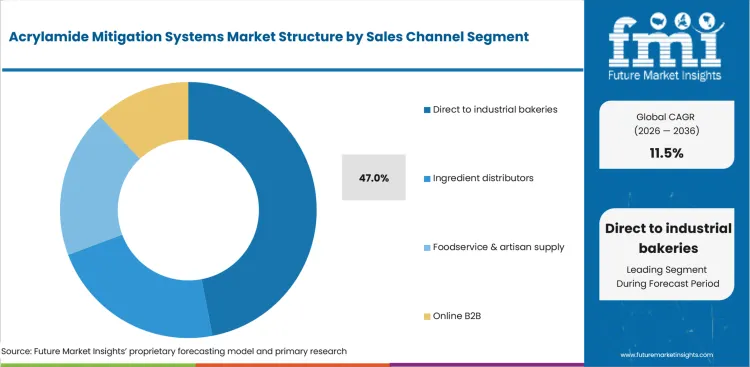
Direct accounts let enzyme specialists adjust dose and contact time against the customer’s own flour until purchasing moves beyond a trial. This service intensity is higher than ordinary distribution of food additives since mitigation performance must be documented under the line conditions that release the finished product.
- The direct to industrial bakeries segment is likely to capture 47.0% share in 2026 attributable to plant-level validation and troubleshooting requirements.
- dsm-firmenich opened its Princeton Baking Innovation Center in May 2025 with equipment for breads, rolls, pastries, cookies and snacks. The center gives industrial accounts a direct route from formulation screening to production-oriented testing.
What makes Standard grade central to the Product type category?
Standard grade systems are qualified first in industrial bakery accounts needing repeatable acrylamide reduction without changing sourcing or adding a specialty claim. Their role overlaps with food enzymes since operators can tune dosage to flour composition and baking conditions then expand the program to other SKUs.
- By product type, standard grade is estimated to hold 40.0% in 2026 owing to broad compatibility with conventional industrial bakery recipes.
- EFSA's July 2025 ARY-1 opinion documents asparaginase intended to hydrolyze asparagine before acrylamide forms. It also records commercial batches produced by controlled fermentation and drying for food use.
Why does Powder - dry lead the Form category?
Dry formats fit flour pre-blending and controlled batching used in bakery mixes without requiring a dedicated liquid loop at many industrial plants. Powder systems can therefore be tested beside existing bakery ingredients during routine recipe trials at plant scale.
- Based on form, powder - dry is projected to account for 42.0% in 2026 due to compatibility with common dry-dosing and premix workflows.
- AB Enzymes opened a Curitiba office and baking laboratory in June 2026 to give regional bakery customers direct access to hands-on enzyme trials. The facility provides a local route from laboratory work to dry-system qualification on the path to routine production.
What supports Bread & Rolls in the Application category?
Bread and roll lines run frequently enough for acrylamide control to become a recurring quality task instead of a one-time formulation exercise. The same plants already use bread improvers to manage dough strength and consistency so mitigation must preserve current performance targets.
- By application, bread & rolls is forecast to represent 37.0% in 2026 driven by frequent production runs and measurable thermal exposure.
- IFF launched POWERFRESH ACE 2000 for US industrial bread producers in August 2025 with stated gains in softness, resilience and production efficiency. The launch illustrates why industrial bakeries test texture performance during enzyme-led reformulation on active production lines.
What are the drivers, restraints and opportunities in the Acrylamide Mitigation Systems Market?
Regulatory evidence keeps mitigation active, recipe-specific qualification slows switching and local application support can reduce the work needed for specialty bakery programs.
- Driver: Food-safety authorities continue collecting occurrence data and mitigation evidence so bakery operators must maintain documented acrylamide-control practices.
- Restraint: Acrylamide formation changes with ingredient chemistry and heat exposure so a supplier result cannot replace recipe-level analytical confirmation.
- Opportunity: Local pilot facilities can shorten qualification for clean-label and specialty programs by testing mitigation beside finished-product requirements.
Regulatory evidence keeps mitigation on bakery QA agendas
Regulatory review keeps mitigation tied to measured performance instead of general reformulation claims. The UK Food Standards Agency opened a July 2025 call for acrylamide occurrence data and requested evidence on reduction strategies and implementation challenges. Companies selling baking enzymes need reduction data that quality teams can use in process review as new occurrence evidence changes trial priorities.
Recipe-specific validation slows switching
Acrylamide concentration changes with ingredients and manufacturing conditions so industrial trials remain the main switching friction. Japan's Ministry of Agriculture updated its national occurrence program on March 31, 2026 and states that acrylamide concentrations vary with raw materials and manufacturing methods. Mitigation companies must test enzyme systems against each important recipe for one specification to gain acceptance on multiple bakery lines.
Application centers can shorten specialty qualification
Specialty claims leave less room for ingredient substitution so local pilot support can shorten the path from concept to plant trial. Palsgaard inaugurated its Navi Mumbai application centre in June 2025 with industrial-scale bakery pilot facilities and clean-label reformulation support. An industrial-scale trial centre lets formulators test clean-label additives beside processing requirements without committing production capacity to an unproven recipe.
Which country CAGRs are profiled in the Acrylamide Mitigation Systems Market?
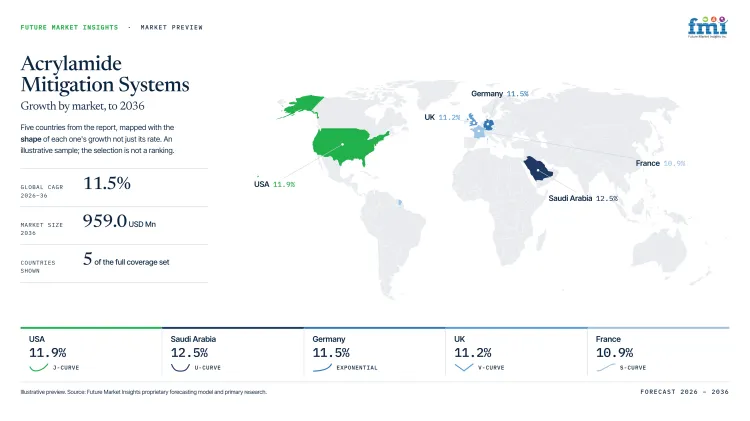
| Country | CAGR |
|---|---|
| Saudi Arabia | 12.5% |
| USA | 11.9% |
| Germany | 11.5% |
| UK | 11.2% |
| France | 10.9% |
How do country-level CAGRs compare in the Acrylamide Mitigation Systems Market?
The five forecasts form a narrow band from 10.9% to 12.5%, with Saudi Arabia and USA forming the upper group and Germany occupying the middle position. UK and France form the lower pair as the 1.6 percentage-point spread points to different qualification speeds instead of major differences in current market scale.
- Saudi seasonal food-service peaks compress trial calendars for new processing aids.
- USA national bakery groups need technical programs that transfer between production sites.
- Germany mature bakery processors value documented technical performance and regulatory consistency.
- UK private-label programs demand documentation that survives customer approval.
- France established bakery channels place greater weight on localized technical service.
Similar growth rates still produce different selling conditions as qualification work varies by country. The full report provides country-level CAGR analysis across North America, Latin America, Europe, East Asia, South Asia, Oceania and the Middle East and Africa.
Country-wise Analysis
- Saudi bakery plants serving Makkah and Al Madinah face concentrated production schedules before Hajj, which shortens the time available for troubleshooting unfamiliar processing aids. The SFDA documented more than 300 factory inspection visits in those regions during May 2025 and found technical violations requiring corrective action. Adoption of acrylamide mitigation systems in Saudi Arabia is estimated to expand at 12.5% CAGR through 2036, tied to tighter process-control needs. Complete technical files ease peak-season review for large plants, while imported technical support and short trial windows can leave smaller bakeries with slower qualification cycles. Peak-season schedules favor mitigation programs already tested on the bakery's highest-volume recipes ahead of full production.
- US industrial bakeries qualify mitigation against a large flour base where quarterly input changes can alter asparagine exposure and force dosage confirmation. The USA acrylamide mitigation systems sector is projected to record 11.9% CAGR during the assessment period, attributable to repeated validation in high-volume plants. USDA's August 2025 Flour Milling Products report placed second-quarter flour production at 103 million hundredweight and documented the scale exposed to changing inputs. Large multi-plant accounts offer repeat volume, yet nonbinding federal acrylamide guidance leaves each bakery responsible for proving reduction under its own flour sources. Portable trial protocols therefore become valuable when national bakery groups must transfer one mitigation program between several plants.
- German industrial bakeries operate within established food-safety and quality-management frameworks, making documented process performance important when qualifying acrylamide mitigation systems. Germany is estimated to register 11.5% CAGR over the forecast period as manufacturers strengthen process controls and validate mitigation across bread, biscuits, and other baked products. Large bakery groups can support structured trials across multiple production lines, while established recipes make uncontrolled formulation changes less attractive. Detailed technical files, repeatable dosage protocols, and local application support can therefore shorten qualification cycles. Manufacturers that demonstrate consistent acrylamide reduction without compromising texture, color, or throughput are better positioned to secure repeat industrial bakery accounts.
- UK bakery programs retain benchmark-based process controls during renewed national evidence gathering on acrylamide exposure and mitigation performance. GOV.UK updated its acrylamide guidance on February 5, 2025 and states that starchy foods form acrylamide above 120 degrees Celsius during baking and similar heating. Laboratory capacity supports reformulation work, but private-label specifications can force manufacturers to refresh technical files for separate customer approval. The UK acrylamide mitigation systems outlook is anticipated to advance at 11.2% CAGR over the assessment period aided by continued evidence review. Future policy changes are more likely to alter qualification evidence than the basic ingredient choices used by industrial bakeries.
- French bakeries increasingly emphasize controlled processing, product consistency, and documented food-safety practices when evaluating acrylamide mitigation solutions. France is forecast to record 10.9% CAGR through the assessment period as manufacturers continue refining baking conditions and mitigation approaches. Large industrial producers can conduct structured trials across bread, biscuits, and specialty baked products, although established recipes can make reformulation cautious. Local technical service remains important for validating enzyme or process-based solutions without affecting taste, texture, or appearance. Suppliers that provide concise documentation, recipe-specific guidance, and repeatable dosage recommendations can improve qualification efficiency across established bakery production environments.
Who are the notable companies in the Acrylamide Mitigation Systems Market?
Novonesis, Kerry Group, dsm-firmenich, IFF, AB Enzymes, Palsgaard, Corbion, and Puratos are the notable companies serving this market.
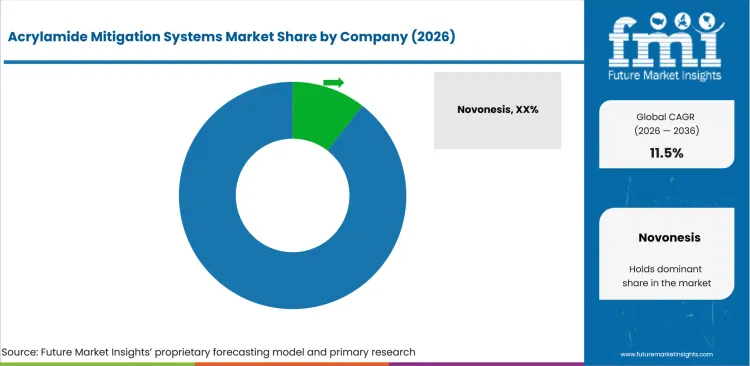
Competition is fragmented between enzyme developers and broader bakery formulation groups as industrial bakery teams compare acrylamide reduction beside texture and trial support. Entry barriers come from application evidence and technical-service coverage instead of company scale alone. Firms already selling bakery improvers can reach the same bakery accounts, but acrylamide programs still require separate proof under the target recipe and heat profile.
- Novonesis, Kerry Group and AB Enzymes pair enzyme science with technical support that can be translated into bakery process trials.
- dsm-firmenich and IFF operate broader food-bioscience portfolios with bakery application centers that support texture and reformulation work beside mitigation.
- Palsgaard, Corbion and Puratos concentrate on formulation support and bakery ingredients that protect finished-product requirements during mitigation changes.
Competitive Benchmarking: Acrylamide Mitigation Systems Market
| Company | Bakery Application Validation | Enzyme / Formulation Breadth | Localisation Investment | Geographic Reach |
|---|---|---|---|---|
| Novonesis | Medium | High | Low | Global |
| Kerry Group | Medium | High | High | Global |
| dsm-firmenich | High | High | High | Global |
| IFF | Medium | High | High | Global |
| AB Enzymes | High | Medium | High | Europe, Americas and Asia |
| Palsgaard | High | Medium | High | Europe, Americas and Asia |
| Corbion | Medium | High | Low | North America and Europe |
| Puratos | High | High | High | Global |
Scoring basis: High bakery application validation requires a current dedicated bakery pilot or application facility with line-oriented testing. Medium requires a current bakery launch or technical program and Low indicates only adjacent formulation evidence. High breadth requires three or more relevant enzyme or formulation routes, Medium requires two and Low requires one documented route. High localisation investment requires a 2025-or-later facility or manufacturing expansion, Medium requires a recent distribution or support expansion and Low identifies a current launch without a new operating footprint.
Key Developments in the Acrylamide Mitigation Systems Market
- In May 2026, Kerry Group announced that the European Food Safety Authority (EFSA) had published a positive scientific opinion on Acrylerase, its amidase food enzyme designed to reduce acrylamide in instant coffee and coffee substitutes.
- In May 2026, Kerry Group announced a positive EFSA scientific opinion on Acrylerase for direct acrylamide reduction in instant coffee and coffee substitutes.
- In 2024, research continued to demonstrate the application of asparaginase for acrylamide mitigation in bakery products, including wheat and rye cookies.
Key Players in the Acrylamide Mitigation Systems Market
Enzyme and Bioscience Platforms
- Novonesis
- Kerry Group
- dsm-firmenich
- IFF
Bakery Application and Formulation Platforms
- AB Enzymes
- Palsgaard
- Corbion
- Puratos
Acrylamide Mitigation Systems Market - Report Scope
| Coverage field | Report scope |
|---|---|
| Market breakdown | By product type, form, application, claim, sales channel and region. |
| Quantitative Units | USD Million. |
| Market Definition | Revenue includes acrylamide mitigation enzymes and processing-aid systems sold for bakery and snack applications within the defined scope. Downstream finished-product revenue and adjacent ingredients without a mitigation role are excluded. |
| Regions Covered | North America, Latin America, Europe, East Asia, South Asia and Pacific, and Middle East and Africa. |
| Countries Covered | UAE, Saudi Arabia, USA, UK, Japan, and 20+ countries included in the full report. |
| Key Companies Profiled | Novonesis, Kerry Group, dsm-firmenich, IFF, AB Enzymes, Palsgaard, Corbion, and Puratos. |
| Forecast Period | 2026 to 2036. |
| Approach | Primary and secondary research with market triangulation. |
Acrylamide Mitigation Systems Market - Research Methodology
| Method | Approach |
|---|---|
| Primary Research | FMI analysts gathered input from manufacturers, service providers, technology developers, distributors, end users, procurement teams, and subject-matter experts. Interviews examined purchasing decisions, product or service evaluation, adoption barriers, approval requirements, pricing considerations, and expectations for technical or commercial support. Respondents were also asked what evidence is required before a trial, pilot, or initial order develops into regular purchasing. |
| Desk Research | Desk research covered government statistics, regulatory publications, trade data, industry associations, technical literature, standards, company filings, product information, and official corporate announcements. Sources were reviewed for relevance, publication date, geographic coverage, and consistency with the defined market scope. Claims relating to performance, applications, approvals, capacity, investment, and commercial activity were retained only when supported by credible public evidence. |
| Market Sizing and Forecasting | The market model combined the baseline value with historical performance, segment structure, pricing and volume indicators, adoption levels, company participation, and country-level demand conditions. Forecast assumptions considered economic activity, investment trends, regulatory developments, technology adoption, purchasing cycles, supply availability, and barriers to wider market use. Segment and regional estimates were reconciled before the final market total was calculated. |
| Data Validation | Estimates were checked against multiple independent indicators, including public data, company activity, trade patterns, industry developments, and findings from primary interviews. Validation also tested whether products, services, applications, and company revenues fell within the defined market boundaries. Adjacent categories, unsupported claims, overlapping revenues, and activities without direct market relevance were excluded to reduce double counting and maintain consistency across segments and countries. |
Acrylamide Mitigation Systems Market by Segments
By product type
- Standard grade
- Premium / specialty grade
- Organic certified
- Clean label grade
By form
- Powder - dry
- Liquid
- Paste / semi-solid
- Granules / pieces
By application
- Bread & rolls
- Cakes & muffins
- Biscuits & cookies
- Viennoiserie & pastry
- Other bakery & snacks
By claim
- Conventional
- Clean label
- Organic
- Non-GMO / identity preserved
By sales channel
- Direct to industrial bakeries
- Ingredient distributors
- Foodservice & artisan supply
- Online B2B
Acrylamide Mitigation Systems Market by Region:
- North America
- United States
- Canada
- Latin America
- Brazil
- Mexico
- Chile
- Rest of Latin America
- Western Europe
- Germany
- United Kingdom
- Italy
- Spain
- France
- Nordics
- Benelux
- Rest of Western Europe
- Eastern Europe
- Russia
- Poland
- Hungary
- Balkan and Baltic States
- Rest of Eastern Europe
- East Asia
- China
- Japan
- South Korea
- South Asia and Pacific
- India
- ASEAN
- Australia and New Zealand
- Rest of South Asia and Pacific
- Middle East and Africa
- Kingdom of Saudi Arabia
- Other GCC Countries
- Türkiye
- South Africa
- Other African Union Countries
- Rest of Middle East and Africa
Research Sources and Bibliography
- EFSA Panel on Food Enzymes (2025, July 30). Safety evaluation of the food enzyme asparaginase from the non-genetically modified Saccharomyces cerevisiae strain ARY-2
- Bundesministerium für Gesundheit (2026, February 3). Unerwünschte Inhaltsstoffe in Lebensmitteln
- EFSA Panel on Food Enzymes (2025, July 14). Safety evaluation of the food enzyme asparaginase from the non-genetically modified Saccharomyces cerevisiae strain ARY-1
- AB Enzymes (2026, June 1). AB Enzymes Opens New Office and Baking Lab in Curitiba, Brazil
- IFF (2025, August 13). IFF Launches POWERFRESH® ACE 2000, a Bread Fresh-Keeping Solution That ‘Aces’ the Shelf-Life Test
- dsm-firmenich (2025, May 20). On the rise: dsm-firmenich opens state-of-the-art Princeton Baking Innovation Center in Princeton, NJ
- Food Standards Agency (2025, July 30). Call for data: Acrylamide in food
- Ministry of Agriculture, Forestry and Fisheries of Japan. (2026, March 31).
- Palsgaard (2025, July 8). Palsgaard Inaugurates State-of-the-Art Application Centre in Navi Mumbai to Strengthen Regional Customer Support
- Dubai Municipality (2025, July 30). Over 34,000 food inspections conducted in first half of 2025
- Saudi Food and Drug Authority (2025, May 10). The SFDA Implements Expanded Inspection Campaigns on Food Factories Ahead of Hajj Season
- USDA National Agricultural Statistics Service (2025, August 1). Flour Milling Products
- UK Health Security Agency. (2025, February 5). Acrylamide: general information
- Ministry of Agriculture, Forestry and Fisheries of Japan (2025, November 28).
- Corbion. (2026, June 15). Corbion launches LUMI™ Set to help bakers reformulate away from titanium dioxide without sacrificing visual appeal
- Kerry Group. (2026, May 18). EFSA publishes positive scientific opinion on Kerry’s Acrylerase, a first-of-its-kind enzyme to reduce acrylamide in instant coffee and coffee substitutes
- Puratos. (2026, January 21). Puratos acquires Vör Foods, accelerating USA nut-based innovation
- Novonesis. (2025, June 11). Novonesis launches Optiva® LS Prime, helping bakers cut up to 50% added sugar and create more cost-effective baked goods
- dsm-firmenich. (2025, October 2). dsm-firmenich opens global food innovation center in Delft, the Netherlands to accelerate diet transformation
- AB Enzymes. (2026, May 12). AB Enzymes Strengthens Presence in Mexico, Central America & the Caribbean
- Palsgaard. (2025, October 8). Palsgaard Brazil begins producing Emulpals® cake mix emulsifiers
- Puratos. (2026, June 15). Puratos Opens Flour Competence Center to Address Flour Variability
- Kerry Group. (2026, April 20). Kerry Opens Expanded Biotechnology Manufacturing Hub in Ireland to Meet Growing Global Demand for Lactase Enzymes
- IFF. (2025, July 10). IFF Expands Innovation Center in Singapore with New Immersive Experience Hub
- Corbion. (2025, April 21). Corbion Unveils Verdad® Essence WH100: Redefining Natural Mold Inhibition for Bakers
This bibliography is provided for reader reference and is not exhaustive. The full report contains the complete reference list and detailed citations
This Report Answers
- What is the Acrylamide Mitigation Systems Market size in 2026 and what value is forecast for 2036?
- Which bakery operating conditions are increasing repeat demand for acrylamide mitigation systems?
- Why does standard grade hold the largest product type share in 2026?
- Why does powder - dry hold the largest form share in 2026?
- How does direct sales to industrial bakeries influence qualification and troubleshooting?
- Which five countries show the strongest differences in forecast growth and local operating conditions?
- Which companies provide enzyme, bioscience or bakery formulation support relevant to mitigation programs?
- What technical qualification factors slow switching between acrylamide mitigation systems?
- Which recent company investments are changing bakery application support and regional service capacity?
Frequently Asked Questions
How big is the Acrylamide Mitigation Systems Market in 2026?
The acrylamide mitigation systems market is valued at USD 322.9 million in 2026 and is projected to reach USD 959.0 million by 2036. Growth comes from repeated bakery reformulation as flour chemistry and thermal profiles change.
What is the CAGR of the Acrylamide Mitigation Systems Market from 2026 to 2036?
The acrylamide mitigation systems market is projected to grow at a CAGR of 11.5% between 2026 and 2036. Expansion is supported by recurring validation needs under changing flour chemistry and thermal processing conditions.
Which product type leads the Acrylamide Mitigation Systems Market?
The standard grade segment is expected to hold 40.0% of the acrylamide mitigation systems market in 2026, attributable to broad compatibility with conventional industrial bakery recipes. Bakeries can tune dosage inside current process windows then qualify narrower specialty specifications.
Which form leads the Acrylamide Mitigation Systems Market?
The powder - dry segment is expected to hold 42.0% of the acrylamide mitigation systems market in 2026, supported by flour pre-blending and dry dosing that reduce plant-integration work. The format also suits industrial facilities that lack dedicated liquid dosing infrastructure for routine production trials.
How much incremental opportunity will the Acrylamide Mitigation Systems Market create between 2026 and 2036?
The market is expected to add USD 636.1 million in value between 2026 and 2036. Incremental demand comes from repeated mitigation programs and bakery application work needed to preserve sensory and processing performance.
Which countries are projected to record the highest growth in the Acrylamide Mitigation Systems Market?
UAE is projected to grow at 12.8% CAGR followed by Saudi Arabia at 12.5% and USA at 11.9% through 2036. Growth rates differ because food-sector oversight and bakery qualification conditions vary by country.
Which companies are active in the Acrylamide Mitigation Systems Market?
Key companies operating in the market include Novonesis, Kerry Group, dsm-firmenich, IFF, AB Enzymes, Palsgaard, Corbion, and Puratos. These companies compete on enzyme development, bakery application testing, formulation breadth and regional technical support.
Preview the report firsthand - request a free sample
Get SampleGet the brochure for pricing and purchase details.
Get PDFTable of Content
- Key Takeaways
- Market Size and CAGR
- Top Growth Driver
- Fastest Growing Segment
- Leading Region
- Key Companies
- Emerging Opportunities
- Executive Summary
- Global Market Outlook
- Demand-side Trends
- Supply-side Trends
- Technology Roadmap Analysis
- Analysis and Recommendations
- Analyst Perspective (What is happening? Why now? What should investors know?)
- Key Questions Answered
- How large is the market?
- What is the CAGR?
- What are key trends?
- Which region dominates?
- Who are the leaders?
- Market Overview
- Market Coverage / Taxonomy
- Market Definition / Scope / Limitations
- Research Methodology
- Chapter Orientation
- Analytical Lens and Working Hypotheses
- Market Structure, Signals, and Trend Drivers
- Benchmarking and Cross-market Comparability
- Market Sizing, Forecasting, and Opportunity Mapping
- Research Design and Evidence Framework
- Desk Research Programme (Secondary Evidence)
- Expert Input and Fieldwork (Primary Evidence)
- Tooling, Models, and Reference Databases
- Data Engineering and Model Build
- Quality Assurance and Audit Trail
- Market Background
- Market Dynamics (Drivers, Restraints, Opportunity, Trends)
- Scenario Forecast (Optimistic, Likely, Conservative)
- Impact Analysis
- AI Impact
- Sustainability Impact
- Regulatory Impact
- Technology Impact
- Consumer / Buyer Analysis
- Purchase Drivers
- Adoption Barriers
- Buyer Journey
- Opportunity Map Analysis
- Product Life Cycle Analysis
- Supply Chain Analysis
- Investment Feasibility Matrix
- Value Chain Analysis
- PESTLE and Porter's Analysis
- Regulatory Landscape
- Regional Parent Market Outlook
- Production and Consumption Statistics
- Import and Export Statistics
- Global Market Analysis and Forecast, 2021 to 2036
- Historical Market Size Value (USD Million) Analysis, 2021 to 2025
- Current and Future Market Size Value (USD Million) Projections, 2026 to 2036
- Y-o-Y Growth Trend Analysis
- Absolute $ Opportunity Analysis
- Global Market Pricing Analysis, 2021 to 2036
- Global Market Analysis and Forecast, By Product Type, 2021 to 2036
- Introduction / Key Findings
- Historical Market Size Value (USD Million) Analysis By Product Type, 2021 to 2025
- Current and Future Market Size Value (USD Million) Analysis and Forecast By Product Type, 2026 to 2036
- Standard grade
- Premium / specialty grade
- Organic certified
- Clean label grade
- Standard grade
- Y-o-Y Growth Trend Analysis By Product Type, 2021 to 2025
- Absolute $ Opportunity Analysis By Product Type, 2026 to 2036
- Global Market Analysis and Forecast, By Form, 2021 to 2036
- Introduction / Key Findings
- Historical Market Size Value (USD Million) Analysis By Form, 2021 to 2025
- Current and Future Market Size Value (USD Million) Analysis and Forecast By Form, 2026 to 2036
- Powder / dry
- Liquid
- Paste / semi-solid
- Granules / pieces
- Powder / dry
- Y-o-Y Growth Trend Analysis By Form, 2021 to 2025
- Absolute $ Opportunity Analysis By Form, 2026 to 2036
- Global Market Analysis and Forecast, By Application, 2021 to 2036
- Introduction / Key Findings
- Historical Market Size Value (USD Million) Analysis By Application, 2021 to 2025
- Current and Future Market Size Value (USD Million) Analysis and Forecast By Application, 2026 to 2036
- Bread & rolls
- Cakes & muffins
- Biscuits & cookies
- Viennoiserie & pastry
- Other bakery & snacks
- Bread & rolls
- Y-o-Y Growth Trend Analysis By Application, 2021 to 2025
- Absolute $ Opportunity Analysis By Application, 2026 to 2036
- Global Market Analysis and Forecast, By Claim, 2021 to 2036
- Introduction / Key Findings
- Historical Market Size Value (USD Million) Analysis By Claim, 2021 to 2025
- Current and Future Market Size Value (USD Million) Analysis and Forecast By Claim, 2026 to 2036
- Conventional
- Clean label
- Organic
- Non-GMO / identity preserved
- Conventional
- Y-o-Y Growth Trend Analysis By Claim, 2021 to 2025
- Absolute $ Opportunity Analysis By Claim, 2026 to 2036
- Global Market Analysis and Forecast, By Sales Channel, 2021 to 2036
- Introduction / Key Findings
- Historical Market Size Value (USD Million) Analysis By Sales Channel, 2021 to 2025
- Current and Future Market Size Value (USD Million) Analysis and Forecast By Sales Channel, 2026 to 2036
- Direct to industrial bakeries
- Ingredient distributors
- Foodservice & artisan supply
- Online B2B
- Direct to industrial bakeries
- Y-o-Y Growth Trend Analysis By Sales Channel, 2021 to 2025
- Absolute $ Opportunity Analysis By Sales Channel, 2026 to 2036
- Global Market Analysis and Forecast, By Region, 2021 to 2036
- Introduction
- Historical Market Size Value (USD Million) Analysis By Region, 2021 to 2025
- Current Market Size Value (USD Million) Analysis and Forecast By Region, 2026 to 2036
- North America
- Latin America
- Western Europe
- Eastern Europe
- East Asia
- South Asia and Pacific
- Middle East & Africa
- Market Attractiveness Analysis By Region
- North America Market Analysis and Forecast, By Country, 2021 to 2036
- Historical Market Size Value (USD Million) Trend Analysis By Market Taxonomy, 2021 to 2025
- Market Size Value (USD Million) Forecast By Market Taxonomy, 2026 to 2036
- By Country
- USA
- Canada
- By Product Type
- By Form
- By Application
- By Claim
- By Sales Channel
- By Country
- Market Attractiveness Analysis
- By Country
- By Product Type
- By Form
- By Application
- By Claim
- By Sales Channel
- Key Takeaways
- Latin America Market Analysis and Forecast, By Country
- Historical Market Size Value (USD Million) Trend Analysis By Market Taxonomy, 2021 to 2025
- Market Size Value (USD Million) Forecast By Market Taxonomy, 2026 to 2036
- By Country
- Brazil
- Mexico
- Chile
- Rest of Latin America
- By Product Type
- By Form
- By Application
- By Claim
- By Sales Channel
- By Country
- Market Attractiveness Analysis
- By Country
- By Product Type
- By Form
- By Application
- By Claim
- By Sales Channel
- Key Takeaways
- Western Europe Market Analysis and Forecast, By Country
- Historical Market Size Value (USD Million) Trend Analysis By Market Taxonomy, 2021 to 2025
- Market Size Value (USD Million) Forecast By Market Taxonomy, 2026 to 2036
- By Country
- Germany
- UK
- Italy
- Spain
- France
- Nordic
- BENELUX
- Rest of Western Europe
- By Product Type
- By Form
- By Application
- By Claim
- By Sales Channel
- By Country
- Market Attractiveness Analysis
- By Country
- By Product Type
- By Form
- By Application
- By Claim
- By Sales Channel
- Key Takeaways
- Eastern Europe Market Analysis and Forecast, By Country
- Historical Market Size Value (USD Million) Trend Analysis By Market Taxonomy, 2021 to 2025
- Market Size Value (USD Million) Forecast By Market Taxonomy, 2026 to 2036
- By Country
- Russia
- Poland
- Hungary
- Balkan & Baltic
- Rest of Eastern Europe
- By Product Type
- By Form
- By Application
- By Claim
- By Sales Channel
- By Country
- Market Attractiveness Analysis
- By Country
- By Product Type
- By Form
- By Application
- By Claim
- By Sales Channel
- Key Takeaways
- East Asia Market Analysis and Forecast, By Country
- Historical Market Size Value (USD Million) Trend Analysis By Market Taxonomy, 2021 to 2025
- Market Size Value (USD Million) Forecast By Market Taxonomy, 2026 to 2036
- By Country
- China
- Japan
- South Korea
- By Product Type
- By Form
- By Application
- By Claim
- By Sales Channel
- By Country
- Market Attractiveness Analysis
- By Country
- By Product Type
- By Form
- By Application
- By Claim
- By Sales Channel
- Key Takeaways
- South Asia and Pacific Market Analysis and Forecast, By Country
- Historical Market Size Value (USD Million) Trend Analysis By Market Taxonomy, 2021 to 2025
- Market Size Value (USD Million) Forecast By Market Taxonomy, 2026 to 2036
- By Country
- India
- ASEAN
- Australia & New Zealand
- Rest of South Asia and Pacific
- By Product Type
- By Form
- By Application
- By Claim
- By Sales Channel
- By Country
- Market Attractiveness Analysis
- By Country
- By Product Type
- By Form
- By Application
- By Claim
- By Sales Channel
- Key Takeaways
- Middle East & Africa Market Analysis and Forecast, By Country
- Historical Market Size Value (USD Million) Trend Analysis By Market Taxonomy, 2021 to 2025
- Market Size Value (USD Million) Forecast By Market Taxonomy, 2026 to 2036
- By Country
- Kingdom of Saudi Arabia
- Other GCC Countries
- Türkiye
- South Africa
- Other African Union
- Rest of Middle East & Africa
- By Product Type
- By Form
- By Application
- By Claim
- By Sales Channel
- By Country
- Market Attractiveness Analysis
- By Country
- By Product Type
- By Form
- By Application
- By Claim
- By Sales Channel
- Key Takeaways
- Key Countries Market Analysis
- USA
- Pricing Analysis
- Market Share Analysis, 2025
- By Product Type
- By Form
- By Application
- By Claim
- By Sales Channel
- Canada
- Pricing Analysis
- Market Share Analysis, 2025
- By Product Type
- By Form
- By Application
- By Claim
- By Sales Channel
- Mexico
- Pricing Analysis
- Market Share Analysis, 2025
- By Product Type
- By Form
- By Application
- By Claim
- By Sales Channel
- Brazil
- Pricing Analysis
- Market Share Analysis, 2025
- By Product Type
- By Form
- By Application
- By Claim
- By Sales Channel
- Chile
- Pricing Analysis
- Market Share Analysis, 2025
- By Product Type
- By Form
- By Application
- By Claim
- By Sales Channel
- Germany
- Pricing Analysis
- Market Share Analysis, 2025
- By Product Type
- By Form
- By Application
- By Claim
- By Sales Channel
- UK
- Pricing Analysis
- Market Share Analysis, 2025
- By Product Type
- By Form
- By Application
- By Claim
- By Sales Channel
- Italy
- Pricing Analysis
- Market Share Analysis, 2025
- By Product Type
- By Form
- By Application
- By Claim
- By Sales Channel
- Spain
- Pricing Analysis
- Market Share Analysis, 2025
- By Product Type
- By Form
- By Application
- By Claim
- By Sales Channel
- France
- Pricing Analysis
- Market Share Analysis, 2025
- By Product Type
- By Form
- By Application
- By Claim
- By Sales Channel
- India
- Pricing Analysis
- Market Share Analysis, 2025
- By Product Type
- By Form
- By Application
- By Claim
- By Sales Channel
- ASEAN
- Pricing Analysis
- Market Share Analysis, 2025
- By Product Type
- By Form
- By Application
- By Claim
- By Sales Channel
- Australia & New Zealand
- Pricing Analysis
- Market Share Analysis, 2025
- By Product Type
- By Form
- By Application
- By Claim
- By Sales Channel
- China
- Pricing Analysis
- Market Share Analysis, 2025
- By Product Type
- By Form
- By Application
- By Claim
- By Sales Channel
- Japan
- Pricing Analysis
- Market Share Analysis, 2025
- By Product Type
- By Form
- By Application
- By Claim
- By Sales Channel
- South Korea
- Pricing Analysis
- Market Share Analysis, 2025
- By Product Type
- By Form
- By Application
- By Claim
- By Sales Channel
- Russia
- Pricing Analysis
- Market Share Analysis, 2025
- By Product Type
- By Form
- By Application
- By Claim
- By Sales Channel
- Poland
- Pricing Analysis
- Market Share Analysis, 2025
- By Product Type
- By Form
- By Application
- By Claim
- By Sales Channel
- Hungary
- Pricing Analysis
- Market Share Analysis, 2025
- By Product Type
- By Form
- By Application
- By Claim
- By Sales Channel
- Kingdom of Saudi Arabia
- Pricing Analysis
- Market Share Analysis, 2025
- By Product Type
- By Form
- By Application
- By Claim
- By Sales Channel
- Türkiye
- Pricing Analysis
- Market Share Analysis, 2025
- By Product Type
- By Form
- By Application
- By Claim
- By Sales Channel
- South Africa
- Pricing Analysis
- Market Share Analysis, 2025
- By Product Type
- By Form
- By Application
- By Claim
- By Sales Channel
- USA
- Market Structure Analysis
- Competition Dashboard
- Competition Benchmarking
- Market Share Analysis of Top Players
- By Regional
- By Product Type
- By Form
- By Application
- By Claim
- By Sales Channel
- Emerging Startups
- Innovation Benchmarking
- Competition Analysis
- Competition Deep Dive
- Novonesis
- Overview
- Product Portfolio
- Profitability by Market Segments
- Sales Footprint
- Strategy Overview
- Marketing Strategy
- Product Strategy
- Channel Strategy
- IFF
- Kerry Group
- AB Enzymes
- Amano Enzyme
- Palsgaard
- Corbion
- BASF
- Puratos
- DSM-Firmenich
- Novonesis
- Case Studies
- Success Stories
- Recent Developments
- Competition Deep Dive
- Assumptions & Acronyms Used


