

- Industry Size (2025)
- USD 13.6 Bn
- Forecast (2035)
- USD 43.3 Bn
- CAGR (2025 to 2035)
- 12.3%
Agricultural Lighting Market Size and Share Forecast Outlook 2025 to 2035
The Agricultural Lighting Market is estimated to be valued at USD 13.6 billion in 2025 and is projected to reach USD 43.3 billion by 2035, registering a compound annual growth rate (CAGR) of 12.3% over the forecast period.
The agricultural lighting market is expanding rapidly, supported by the global transition toward controlled-environment agriculture and vertical farming. Rising demand for year-round crop production and efficient light management systems has fueled investment in energy-optimized solutions.
Technological progress in LED efficiency, spectrum control, and smart automation has transformed crop yield optimization, enabling higher productivity with reduced energy consumption. Government incentives promoting sustainable agriculture and the need to reduce dependency on climatic conditions are further accelerating adoption.
The market’s growth is also strengthened by expanding indoor farming infrastructure and the integration of IoT-based lighting control systems. As population growth intensifies food security concerns, agricultural lighting is emerging as a key enabler of high-efficiency cultivation systems across both developed and emerging economies.
Quick Stats for Agricultural Lighting Market
- Agricultural Lighting Market Industry Value (2025): USD 13.6 billion
- Agricultural Lighting Market Forecast Value (2035): USD 43.3 billion
- Agricultural Lighting Market Forecast CAGR: 12.3%
- Leading Segment in Agricultural Lighting Market in 2025: New (56.2%)
- Key Growth Region in Agricultural Lighting Market: North America, Asia-Pacific, Europe
- Top Key Players in Agricultural Lighting Market: Signify (formerly Philips Lighting), Osram Licht AG, Heliospectra AB, Fluence by OSRAM, Agrolux, Valoya, LumiGrow, California LightWorks, Illumitex, Everlight Electronics Co., Ltd., Bridgelux, Inc., Sunlight Supply, Inc., Gavita International B.V., Hortilux Schréder
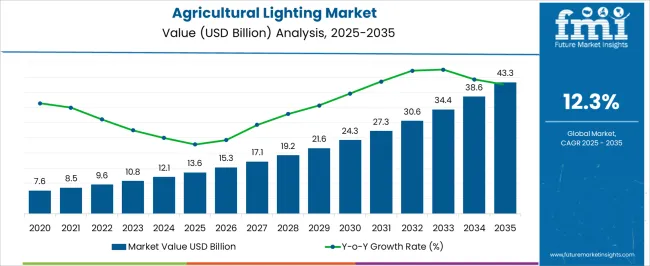
| Metric | Value |
|---|---|
| Agricultural Lighting Market Estimated Value in (2025 E) | USD 13.6 billion |
| Agricultural Lighting Market Forecast Value in (2035 F) | USD 43.3 billion |
| Forecast CAGR (2025 to 2035) | 12.3% |
Segmental Analysis
The market is segmented by Installation, Light Source, Wattage Type, Sales Channel, Offering, and Application and region. By Installation, the market is divided into New and Retrofit. In terms of Light Source, the market is classified into LED, Fluorescent, HID, and Others. Based on Wattage Type, the market is segmented into Below 50W, 50 To 150W, and Above 150W. By Sales Channel, the market is divided into Online/E-Commerce, Retail/Wholesale, Direct Sales, and Others. By Offering, the market is segmented into Hardware, Software, and Services. By Application, the market is segmented into Horticulture, Livestock, and Aquaculture. Regionally, the market is classified into North America, Latin America, Western Europe, Eastern Europe, Balkan & Baltic Countries, Russia & Belarus, Central Asia, East Asia, South Asia & Pacific, and the Middle East & Africa.
Insights into the New Installation Segment:
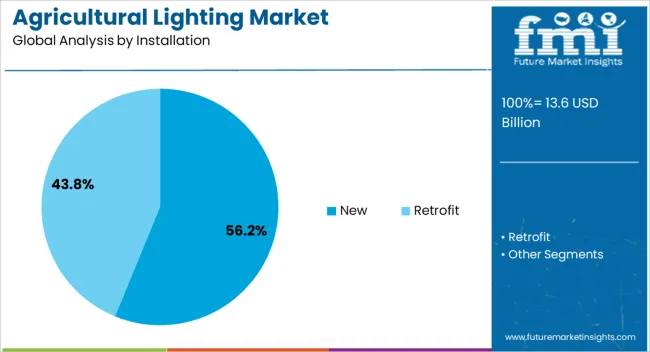
The new installation segment leads the installation category with approximately 56.20% share, reflecting increasing adoption of modern lighting systems in newly established greenhouses and vertical farms. Rising capital investment in sustainable agriculture projects has driven demand for tailored lighting setups that optimize plant growth cycles.
The segment benefits from government funding and technological advancements that reduce installation costs while improving performance. New installations are typically designed for automation compatibility and spectral tuning, allowing precise control over photosynthetic efficiency.
With expanding commercial-scale horticulture operations, the segment is expected to maintain its leadership as growers increasingly transition toward high-tech cultivation environments.
Insights into the LED Segment:
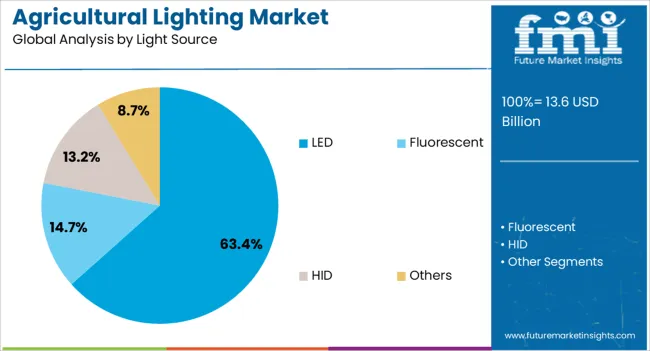
The LED segment dominates the light source category with approximately 63.40% share, owing to its superior energy efficiency, longevity, and spectral flexibility. LEDs enable precise control of light wavelength and intensity, optimizing plant growth for different crop types.
Their low heat emission reduces cooling requirements, further enhancing energy savings. Continuous advancements in tunable-spectrum and full-spectrum technologies have strengthened adoption across horticultural applications.
The declining cost of LED fixtures has made them economically viable for both small and large-scale growers. With ongoing innovation in smart lighting integration and improved photon efficacy, the LED segment is expected to remain the technological benchmark in agricultural lighting.
Insights into the Below 50W Segment:
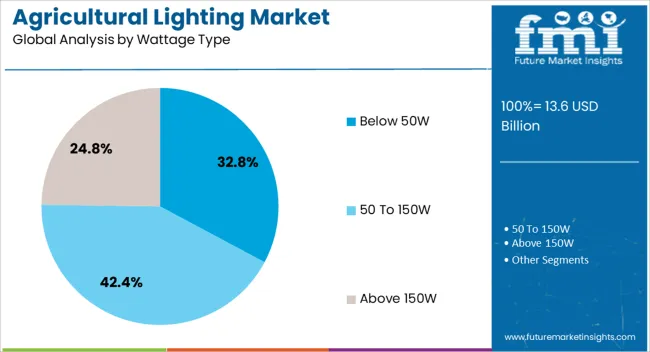
The below 50W segment holds approximately 32.80% share of the wattage type category, primarily due to its suitability for small to medium-scale horticultural setups. These systems offer optimized light output with lower energy consumption, aligning with sustainability goals and operational cost control.
Compact wattage designs are favored in seedling propagation, leafy green cultivation, and research applications requiring controlled environments. Manufacturers are focusing on developing efficient low-wattage fixtures that deliver uniform illumination without compromising plant performance.
The segment’s growth is reinforced by increasing use in modular and space-constrained agricultural facilities. With ongoing miniaturization and efficiency improvements, the below 50W category is poised to retain its relevance in the evolving agricultural lighting landscape.
Sales Trend Analysis and Consumption Patterns in the Agricultural Lighting Market
- The market is experiencing increasing demand from large-scale commercial growers and farmers who deploy lighting solutions to enhance crop growth, extend growing seasons, and improve overall yield and quality
- The adoption of agriculture lighting is also widespread among horticulture and floriculture farmers. These entities employ agricultural lighting to cultivate specific plants for ornamental or decorative purposes
- Agricultural lighting is increasingly adopted in agricultural research institutions, universities, and laboratories to study plant biology, optimize growth parameters, and develop new varieties with improved traits.
- The use of agricultural lighting is also growing among individuals and businesses involved in aquaponics and hydroponics, which are soilless cultivation methods that utilize agricultural lighting to provide the necessary light spectrum for plant growth.
- The growing adoption of agricultural lighting is also observed in urban and home gardeners who practice agriculture in limited outdoor spaces for growing herbs, vegetables, and other plants for personal consumption.
- The demand for agricultural lighting is also touching the skies in greenhouses. These entities leverage agricultural lighting to supplement natural sunlight and create an optimized environment for plant growth.
Key Restraints Impacting the Growth of the Agricultural Lighting Industry
The market for agricultural lighting is anticipated to surpass a valuation of USD 43.3 billion by the year 2035, with a growth rate of 12.3%. While the market is expected to experience remarkable growth, several restraining factors could adversely affect its development:
- The initial costs associated with implementing agricultural lighting technologies, especially those based on LED and other energy-efficient solutions, require a significant initial investment. This deters smaller farmers or businesses with limited capital from adopting agricultural lighting.
- In addition to the initial upfront costs, farmers must also invest substantial capital in maintenance and operations. This creates hesitancy among small farmers, especially in countries with scarce government incentives.
- Lack of awareness and education about the benefits of agricultural lighting, especially among small-scale farmers or those in less developed regions, impedes market growth.
- Implementing agricultural lighting systems can be complex, especially when integrating them with other agricultural technologies and control systems. The complexity of system integration may pose challenges for farmers, leading to slower adoption rates.
Agricultural Lighting Industry Analysis by Top Investment Segments
New Agricultural Lighting to Dominate the Global Agriculture Sector
Depending on the installation, the agricultural lighting market is bifurcated into new and retrofit agriculture lighting. The former is anticipated to grow at a remarkable rate of 12.1% CAGR through 2035.
- Advanced agricultural lighting is gaining a lot of impetus in the agriculture sector as farmers and agricultural enterprises recognize their significance in optimizing crop growth and overall productivity.
- The need for enhanced efficiency, precision, and sustainability in farming operations also drives a significant demand for new and advanced agriculture lighting.
- The growing significance of new agriculture lighting is also because of its impact on crop quality, yield, and the ability to overcome traditional limitations associated with natural light cycles.
| Attributes | Details |
|---|---|
| Installation | New |
| CAGR | 12.1% |
LED Lights Take the Lion’s Share in the Agricultural Lighting Market
The industry is categorized by light source into LED, fluorescent, HID, etc. The LED segment dominates the market and is anticipated to grow at a remarkable rate of 12.00%.
- LED lights have achieved widespread adoption in agricultural lighting due to their versatility and efficacy in meeting the diverse needs of modern farming practices.
- The demand for agricultural lighting is also increasing due to the agricultural sector's recognition of the unique benefits offered by LED lighting solutions.
- LED lights also enjoy widespread preference among farmers and agricultural stakeholders due to the energy efficiency, durability, and customizable features that LED technology offers
| Attributes | Details |
|---|---|
| Light Source | LED |
| CAGR | 12.00% |
Analysis of Top Countries Manufacturing, Certifying, and Operating Agricultural Lighting Technologies
The section provides an analysis of the agricultural lighting industry by country, including Japan, China, the United States, the United Kingdom, and South Korea. The table presents the CAGR for each country, indicating the expected market growth in that country through 2035.
| Countries | CAGR |
|---|---|
| Japan | 13.80% |
| South Korea | 13.60% |
| The United Kingdom | 13.20% |
| China | 12.90% |
| The United States | 13.50% |
Growing Demand for Vertical Farming Uplifting the Market of Agricultural Lighting in Japan
Japan is one of the leading countries in this market. The Japan agricultural lighting market is anticipated to retain its dominance by progressing at an annual growth rate of 13.80% till 2035.
- The Japanese agriculture sector has a growing preference for controlled environment agriculture (CEA). This has pushed the demand for agriculture lighting as it provides optimal growing conditions regardless of external factors such as weather and season.
- Japan is among the densely populated countries, necessitating the use of urban agricultural practices facilitated by advanced lighting systems to maximize space utilization.
Indoor Farming and Demand for High-value Crops Advancing the Market in South Korea
South Korea is another country that is focusing on horticulture LED lighting to optimize plant growth in the Asian region. The South Korea agricultural lighting market is anticipated to retain its dominance by progressing at an annual growth rate of 13.60% till 2035.
- The country's demand for high-quality agricultural produce has pushed the implementation of modern farming practices that rely on advanced lighting technologies.
- Besides this, the widespread adoption of agricultural lighting in the country’s vertical farming sector is due to government initiatives to modernize the agriculture sector. Subsidies, grants, and programs supporting the promotion of agricultural lighting encourage farmers to invest in these solutions.
Demand for Energy-Efficient Technology Encouraging the Market in the United Kingdom
The United Kingdom dominates the market in Europe due to its advanced agricultural practices. The United Kingdom agricultural lighting market is anticipated to exhibit an annual growth rate of 13.20% till 2035.
- In the United Kingdom, the agriculture sector strongly prefers sustainable farming practices. Agriculture lighting, especially energy-efficient LED solutions, generates significant demand among farmers seeking to enhance productivity while minimizing environmental impact.
- The growing popularity of indoor farming, due to a desire for local and year-round produce, significantly contributes to the adoption of agricultural lighting in the United Kingdom.
High-tech Cultivation to Improve Fruits Quality Fueling the Agricultural Lighting Market in China
Smart farm business model for year-round crop production is revitalizing the market of agricultural lighting in China, which is anticipated to register a CAGR of 12.90% through 2035.
- Significant government investments in agricultural technology in China have played a pivotal role in driving the adoption of advanced farming practices. Subsidies and funds have inspired farmers to adopt these modern methodologies.
- Apart from this, China's rapid urbanization and limited arable land contribute to the demand for agricultural lighting. As urban areas expand, there is a preference for vertical farming and CEA, where advanced lighting systems become crucial for year-round crop production.
Circular Agriculture and Sustainability Tailoring the Market in the United States
The United States leads the agricultural lighting market in North America. Over the next ten years, demand for agricultural lighting in the United States is projected to rise at a 5.50% CAGR.
- The United States agriculture sector's focus on technological innovation and research has pushed the adoption of advanced lighting systems due to the increasing demand for precision farming and sustainable agricultural practices.
- Besides this, the United States has always been at the forefront of accepting new and modern ways of agricultural practices as farmers seek to optimize crop growth, enhance yields, and meet the market's evolving needs.
Competitive Landscape of the Agricultural Lighting Market
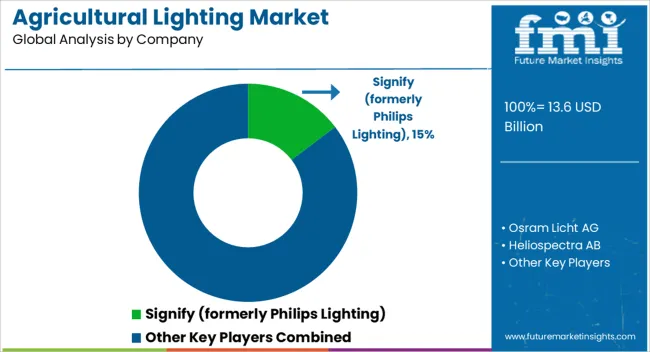
The market for agricultural lighting is filled with companies like Signify (formerly Philips Lighting), Osram Licht AG, Heliospectra AB, Fluence by OSRAM, Current, powered by GE, Agrolux, Valoya, etc.
These companies develop horticultural lighting systems specifically engineered for plant cultivation to stay in the competitive landscape of the global market. Companies are also investing in research and development to innovate and improve existing lighting technologies.
Recent Developments:
- In November 2025, Acuity Brands, Inc. (NYSE: AYI) successfully acquired the Arize family of horticulture lighting products from Current Lighting Solutions, LLC. Simultaneously, Acuity Brands entered an exclusive distribution agreement with Hort Americas, LLC, expanding its controlled environment agricultural market presence with greenhouse-focused luminaires.
- In October 2025, the new two-acre HORTECA Research and Development Facility at JEM Farms highlighted Sollum Technologies' Smart LED solution among advanced greenhouse technologies. The facility, in partnership with ecoation and the University of Windsor, showcased innovations from integrated pest management to robotics and AI.
- In November 2025, RED Horticulture secured USD 17 million in Series A funding for its dynamic greenhouse lighting solution. The Netherlands and France-based company's dynamic spectrum LED lights, controlled by the AI-powered platform MyRED, enhance plant growth, delivering higher yields and improved crop quality while conserving energy resources.
- In September 2025, Sollum Technologies, a pioneer in dynamic LED grow lights, initiated a groundbreaking research program, S.E.A.R.C.H (Sollum Empowering Academic Researchers in CEA and Horticulture). The program aimed to collaborate with United States research centers and universities, fostering breakthroughs in horticultural lighting knowledge using Sollum's advanced LED solution.
Leading Companies Profiled in the Agricultural Lighting Market Report
- Signify (formerly Philips Lighting)
- Osram Licht AG
- Heliospectra AB
- Fluence by OSRAM
- Agrolux
- Valoya
- LumiGrow
- California LightWorks
- Illumitex
- Everlight Electronics Co., Ltd.
- Bridgelux, Inc.
- Sunlight Supply, Inc.
- Gavita International B.V.
- Hortilux Schréder
- VividGro
- Apogee Instruments, Inc.
- Black Dog LED
- Illumitex
- PARsource Lighting Solutions
Top Segments Studied in the Agricultural Lighting Market Report
By Installation:
- New
- Retrofit
By Light Source:
- LED
- Fluorescent
- HID
- Others
By Wattage Type:
- Below 50W
- 50 to 150W
- Above 150W
By Sales Channel:
- Retail/Wholesale
- Direct Sales
- Online/E-commerce
By Offering:
- Hardware
- Software
- Services
By Application:
- Livestock
- Horticulture
- Aquaculture
By Region:
- North America
- Latin America
- Asia Pacific
- The Middle East and Africa (MEA)
- Europe
Frequently Asked Questions
How big is the agricultural lighting market in 2025?
The global agricultural lighting market is estimated to be valued at USD 13.6 billion in 2025.
What will be the size of agricultural lighting market in 2035?
The market size for the agricultural lighting market is projected to reach USD 43.3 billion by 2035.
How much will be the agricultural lighting market growth between 2025 and 2035?
The agricultural lighting market is expected to grow at a 12.3% CAGR between 2025 and 2035.
What are the key product types in the agricultural lighting market?
The key product types in agricultural lighting market are new and retrofit.
Which light source segment to contribute significant share in the agricultural lighting market in 2025?
In terms of light source, led segment to command 63.4% share in the agricultural lighting market in 2025.
Preview the report firsthand - request a free sample
Get SampleGet the brochure for pricing and purchase details.
Get PDFTable of Content
- Executive Summary
- Global Market Outlook
- Demand-side Trends
- Supply-side Trends
- Technology Roadmap Analysis
- Analysis and Recommendations
- Market Overview
- Market Coverage / Taxonomy
- Market Definition / Scope / Limitations
- Market Background
- Market Dynamics
- Drivers
- Restraints
- Opportunity
- Trends
- Scenario Forecast
- Demand in Optimistic Scenario
- Demand in Likely Scenario
- Demand in Conservative Scenario
- Opportunity Map Analysis
- Product Life Cycle Analysis
- Supply Chain Analysis
- Investment Feasibility Matrix
- Value Chain Analysis
- PESTLE and Porter’s Analysis
- Regulatory Landscape
- Regional Parent Market Outlook
- Production and Consumption Statistics
- Import and Export Statistics
- Market Dynamics
- Global Market Analysis 2020 to 2024 and Forecast, 2025 to 2035
- Historical Market Size Value (USD Million) Analysis, 2020 to 2024
- Current and Future Market Size Value (USD Million) Projections, 2025 to 2035
- Y-o-Y Growth Trend Analysis
- Absolute $ Opportunity Analysis
- Global Market Pricing Analysis 2020 to 2024 and Forecast 2025 to 2035
- Global Market Analysis 2020 to 2024 and Forecast 2025 to 2035, By Installation
- Introduction / Key Findings
- Historical Market Size Value (USD Million) Analysis By Installation , 2020 to 2024
- Current and Future Market Size Value (USD Million) Analysis and Forecast By Installation , 2025 to 2035
- New
- Retrofit
- Y-o-Y Growth Trend Analysis By Installation , 2020 to 2024
- Absolute $ Opportunity Analysis By Installation , 2025 to 2035
- Global Market Analysis 2020 to 2024 and Forecast 2025 to 2035, By Light Source
- Introduction / Key Findings
- Historical Market Size Value (USD Million) Analysis By Light Source, 2020 to 2024
- Current and Future Market Size Value (USD Million) Analysis and Forecast By Light Source, 2025 to 2035
- LED
- Fluorescent
- HID
- Others
- Y-o-Y Growth Trend Analysis By Light Source, 2020 to 2024
- Absolute $ Opportunity Analysis By Light Source, 2025 to 2035
- Global Market Analysis 2020 to 2024 and Forecast 2025 to 2035, By Wattage Type
- Introduction / Key Findings
- Historical Market Size Value (USD Million) Analysis By Wattage Type, 2020 to 2024
- Current and Future Market Size Value (USD Million) Analysis and Forecast By Wattage Type, 2025 to 2035
- Below 50W
- 50 To 150W
- Above 150W
- Y-o-Y Growth Trend Analysis By Wattage Type, 2020 to 2024
- Absolute $ Opportunity Analysis By Wattage Type, 2025 to 2035
- Global Market Analysis 2020 to 2024 and Forecast 2025 to 2035, By Sales Channel
- Introduction / Key Findings
- Historical Market Size Value (USD Million) Analysis By Sales Channel, 2020 to 2024
- Current and Future Market Size Value (USD Million) Analysis and Forecast By Sales Channel, 2025 to 2035
- Online/E-Commerce
- Retail/Wholesale
- Direct Sales
- Others
- Y-o-Y Growth Trend Analysis By Sales Channel, 2020 to 2024
- Absolute $ Opportunity Analysis By Sales Channel, 2025 to 2035
- Global Market Analysis 2020 to 2024 and Forecast 2025 to 2035, By Offering
- Introduction / Key Findings
- Historical Market Size Value (USD Million) Analysis By Offering, 2020 to 2024
- Current and Future Market Size Value (USD Million) Analysis and Forecast By Offering, 2025 to 2035
- Hardware
- Software
- Services
- Y-o-Y Growth Trend Analysis By Offering, 2020 to 2024
- Absolute $ Opportunity Analysis By Offering, 2025 to 2035
- Global Market Analysis 2020 to 2024 and Forecast 2025 to 2035, By Application
- Introduction / Key Findings
- Historical Market Size Value (USD Million) Analysis By Application, 2020 to 2024
- Current and Future Market Size Value (USD Million) Analysis and Forecast By Application, 2025 to 2035
- Horticulture
- Livestock
- Aquaculture
- Y-o-Y Growth Trend Analysis By Application, 2020 to 2024
- Absolute $ Opportunity Analysis By Application, 2025 to 2035
- Global Market Analysis 2020 to 2024 and Forecast 2025 to 2035, By Region
- Introduction
- Historical Market Size Value (USD Million) Analysis By Region, 2020 to 2024
- Current Market Size Value (USD Million) Analysis and Forecast By Region, 2025 to 2035
- North America
- Latin America
- Western Europe
- Eastern Europe
- East Asia
- South Asia and Pacific
- Middle East & Africa
- Market Attractiveness Analysis By Region
- North America Market Analysis 2020 to 2024 and Forecast 2025 to 2035, By Country
- Historical Market Size Value (USD Million) Trend Analysis By Market Taxonomy, 2020 to 2024
- Market Size Value (USD Million) Forecast By Market Taxonomy, 2025 to 2035
- By Country
- USA
- Canada
- Mexico
- By Installation
- By Light Source
- By Wattage Type
- By Sales Channel
- By Offering
- By Application
- By Country
- Market Attractiveness Analysis
- By Country
- By Installation
- By Light Source
- By Wattage Type
- By Sales Channel
- By Offering
- By Application
- Key Takeaways
- Latin America Market Analysis 2020 to 2024 and Forecast 2025 to 2035, By Country
- Historical Market Size Value (USD Million) Trend Analysis By Market Taxonomy, 2020 to 2024
- Market Size Value (USD Million) Forecast By Market Taxonomy, 2025 to 2035
- By Country
- Brazil
- Chile
- Rest of Latin America
- By Installation
- By Light Source
- By Wattage Type
- By Sales Channel
- By Offering
- By Application
- By Country
- Market Attractiveness Analysis
- By Country
- By Installation
- By Light Source
- By Wattage Type
- By Sales Channel
- By Offering
- By Application
- Key Takeaways
- Western Europe Market Analysis 2020 to 2024 and Forecast 2025 to 2035, By Country
- Historical Market Size Value (USD Million) Trend Analysis By Market Taxonomy, 2020 to 2024
- Market Size Value (USD Million) Forecast By Market Taxonomy, 2025 to 2035
- By Country
- Germany
- UK
- Italy
- Spain
- France
- Nordic
- BENELUX
- Rest of Western Europe
- By Installation
- By Light Source
- By Wattage Type
- By Sales Channel
- By Offering
- By Application
- By Country
- Market Attractiveness Analysis
- By Country
- By Installation
- By Light Source
- By Wattage Type
- By Sales Channel
- By Offering
- By Application
- Key Takeaways
- Eastern Europe Market Analysis 2020 to 2024 and Forecast 2025 to 2035, By Country
- Historical Market Size Value (USD Million) Trend Analysis By Market Taxonomy, 2020 to 2024
- Market Size Value (USD Million) Forecast By Market Taxonomy, 2025 to 2035
- By Country
- Russia
- Poland
- Hungary
- Balkan & Baltic
- Rest of Eastern Europe
- By Installation
- By Light Source
- By Wattage Type
- By Sales Channel
- By Offering
- By Application
- By Country
- Market Attractiveness Analysis
- By Country
- By Installation
- By Light Source
- By Wattage Type
- By Sales Channel
- By Offering
- By Application
- Key Takeaways
- East Asia Market Analysis 2020 to 2024 and Forecast 2025 to 2035, By Country
- Historical Market Size Value (USD Million) Trend Analysis By Market Taxonomy, 2020 to 2024
- Market Size Value (USD Million) Forecast By Market Taxonomy, 2025 to 2035
- By Country
- China
- Japan
- South Korea
- By Installation
- By Light Source
- By Wattage Type
- By Sales Channel
- By Offering
- By Application
- By Country
- Market Attractiveness Analysis
- By Country
- By Installation
- By Light Source
- By Wattage Type
- By Sales Channel
- By Offering
- By Application
- Key Takeaways
- South Asia and Pacific Market Analysis 2020 to 2024 and Forecast 2025 to 2035, By Country
- Historical Market Size Value (USD Million) Trend Analysis By Market Taxonomy, 2020 to 2024
- Market Size Value (USD Million) Forecast By Market Taxonomy, 2025 to 2035
- By Country
- India
- ASEAN
- Australia & New Zealand
- Rest of South Asia and Pacific
- By Installation
- By Light Source
- By Wattage Type
- By Sales Channel
- By Offering
- By Application
- By Country
- Market Attractiveness Analysis
- By Country
- By Installation
- By Light Source
- By Wattage Type
- By Sales Channel
- By Offering
- By Application
- Key Takeaways
- Middle East & Africa Market Analysis 2020 to 2024 and Forecast 2025 to 2035, By Country
- Historical Market Size Value (USD Million) Trend Analysis By Market Taxonomy, 2020 to 2024
- Market Size Value (USD Million) Forecast By Market Taxonomy, 2025 to 2035
- By Country
- Kingdom of Saudi Arabia
- Other GCC Countries
- Turkiye
- South Africa
- Other African Union
- Rest of Middle East & Africa
- By Installation
- By Light Source
- By Wattage Type
- By Sales Channel
- By Offering
- By Application
- By Country
- Market Attractiveness Analysis
- By Country
- By Installation
- By Light Source
- By Wattage Type
- By Sales Channel
- By Offering
- By Application
- Key Takeaways
- Key Countries Market Analysis
- USA
- Pricing Analysis
- Market Share Analysis, 2024
- By Installation
- By Light Source
- By Wattage Type
- By Sales Channel
- By Offering
- By Application
- Canada
- Pricing Analysis
- Market Share Analysis, 2024
- By Installation
- By Light Source
- By Wattage Type
- By Sales Channel
- By Offering
- By Application
- Mexico
- Pricing Analysis
- Market Share Analysis, 2024
- By Installation
- By Light Source
- By Wattage Type
- By Sales Channel
- By Offering
- By Application
- Brazil
- Pricing Analysis
- Market Share Analysis, 2024
- By Installation
- By Light Source
- By Wattage Type
- By Sales Channel
- By Offering
- By Application
- Chile
- Pricing Analysis
- Market Share Analysis, 2024
- By Installation
- By Light Source
- By Wattage Type
- By Sales Channel
- By Offering
- By Application
- Germany
- Pricing Analysis
- Market Share Analysis, 2024
- By Installation
- By Light Source
- By Wattage Type
- By Sales Channel
- By Offering
- By Application
- UK
- Pricing Analysis
- Market Share Analysis, 2024
- By Installation
- By Light Source
- By Wattage Type
- By Sales Channel
- By Offering
- By Application
- Italy
- Pricing Analysis
- Market Share Analysis, 2024
- By Installation
- By Light Source
- By Wattage Type
- By Sales Channel
- By Offering
- By Application
- Spain
- Pricing Analysis
- Market Share Analysis, 2024
- By Installation
- By Light Source
- By Wattage Type
- By Sales Channel
- By Offering
- By Application
- France
- Pricing Analysis
- Market Share Analysis, 2024
- By Installation
- By Light Source
- By Wattage Type
- By Sales Channel
- By Offering
- By Application
- India
- Pricing Analysis
- Market Share Analysis, 2024
- By Installation
- By Light Source
- By Wattage Type
- By Sales Channel
- By Offering
- By Application
- ASEAN
- Pricing Analysis
- Market Share Analysis, 2024
- By Installation
- By Light Source
- By Wattage Type
- By Sales Channel
- By Offering
- By Application
- Australia & New Zealand
- Pricing Analysis
- Market Share Analysis, 2024
- By Installation
- By Light Source
- By Wattage Type
- By Sales Channel
- By Offering
- By Application
- China
- Pricing Analysis
- Market Share Analysis, 2024
- By Installation
- By Light Source
- By Wattage Type
- By Sales Channel
- By Offering
- By Application
- Japan
- Pricing Analysis
- Market Share Analysis, 2024
- By Installation
- By Light Source
- By Wattage Type
- By Sales Channel
- By Offering
- By Application
- South Korea
- Pricing Analysis
- Market Share Analysis, 2024
- By Installation
- By Light Source
- By Wattage Type
- By Sales Channel
- By Offering
- By Application
- Russia
- Pricing Analysis
- Market Share Analysis, 2024
- By Installation
- By Light Source
- By Wattage Type
- By Sales Channel
- By Offering
- By Application
- Poland
- Pricing Analysis
- Market Share Analysis, 2024
- By Installation
- By Light Source
- By Wattage Type
- By Sales Channel
- By Offering
- By Application
- Hungary
- Pricing Analysis
- Market Share Analysis, 2024
- By Installation
- By Light Source
- By Wattage Type
- By Sales Channel
- By Offering
- By Application
- Kingdom of Saudi Arabia
- Pricing Analysis
- Market Share Analysis, 2024
- By Installation
- By Light Source
- By Wattage Type
- By Sales Channel
- By Offering
- By Application
- Turkiye
- Pricing Analysis
- Market Share Analysis, 2024
- By Installation
- By Light Source
- By Wattage Type
- By Sales Channel
- By Offering
- By Application
- South Africa
- Pricing Analysis
- Market Share Analysis, 2024
- By Installation
- By Light Source
- By Wattage Type
- By Sales Channel
- By Offering
- By Application
- USA
- Market Structure Analysis
- Competition Dashboard
- Competition Benchmarking
- Market Share Analysis of Top Players
- By Regional
- By Installation
- By Light Source
- By Wattage Type
- By Sales Channel
- By Offering
- By Application
- Competition Analysis
- Competition Deep Dive
- Signify (formerly Philips Lighting)
- Overview
- Product Portfolio
- Profitability by Market Segments (Product/Age /Sales Channel/Region)
- Sales Footprint
- Strategy Overview
- Marketing Strategy
- Product Strategy
- Channel Strategy
- Osram Licht AG
- Heliospectra AB
- Fluence by OSRAM
- Agrolux
- Valoya
- LumiGrow
- California LightWorks
- Illumitex
- Everlight Electronics Co., Ltd.
- Bridgelux, Inc.
- Sunlight Supply, Inc.
- Gavita International B.V.
- Hortilux Schréder
- Signify (formerly Philips Lighting)
- Competition Deep Dive
- Assumptions & Acronyms Used
- Research Methodology


