
- Market Size (2026)
- USD 161.0 Mn
- Forecast (2036)
- USD 773.9 Mn
- CAGR (2026 to 2036)
- 17.0%
How Big Is the Airless Tires Market in 2026?
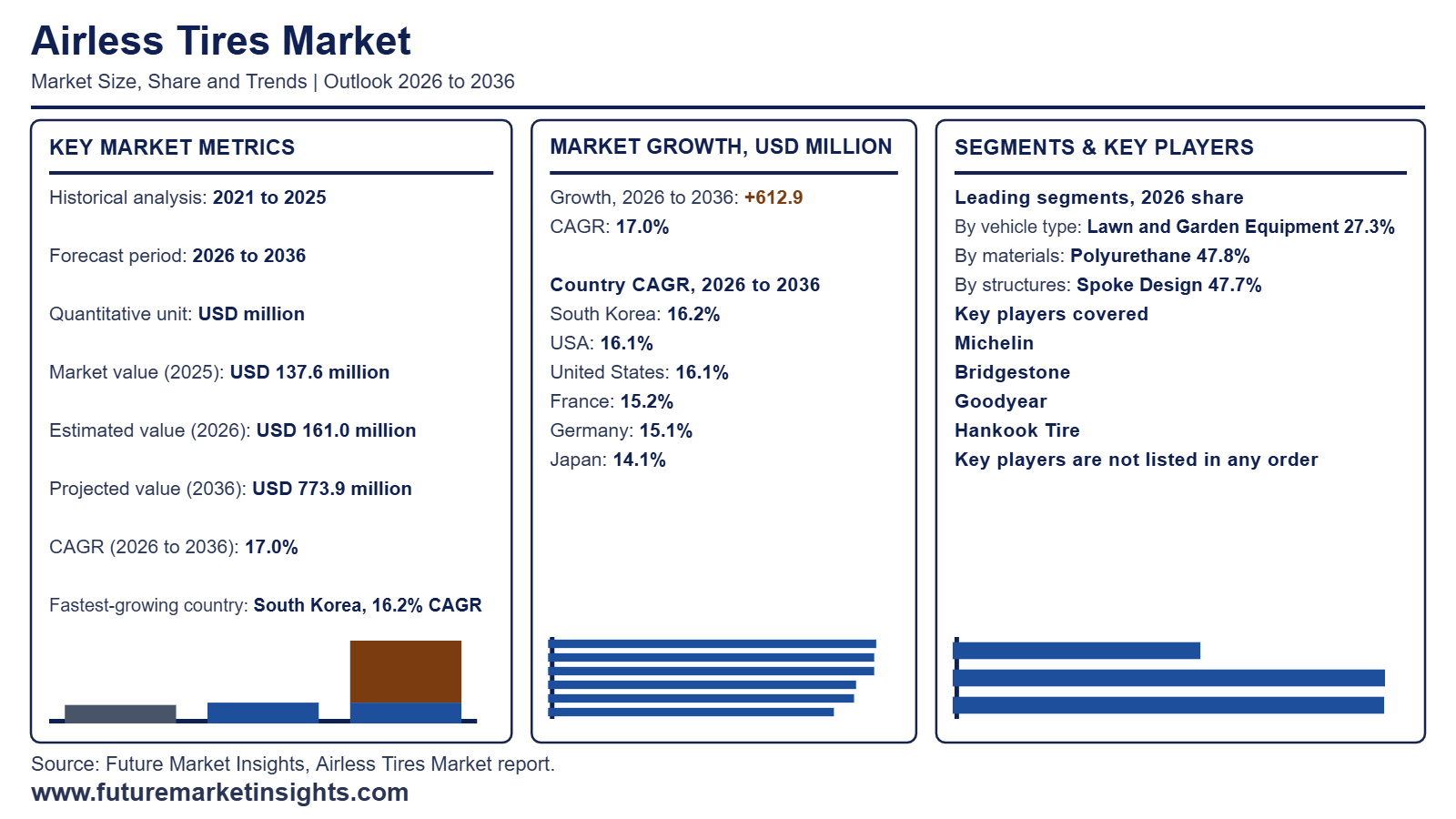
The global airless tires market is valued at USD 161.0 million in 2026, up from USD 137.6 million in 2025, and is projected by Future Market Insights (FMI) to reach USD 773.9 million by 2036, expanding at a 17.0% CAGR to generate USD 612.9 million in incremental revenue over the forecast decade.
| Market Metric | Valuation / Share / Forecast Benchmark |
|---|---|
| 2025 Market Size (Historical) | USD 137.6 million |
| 2026 Market Size (Estimated) | USD 161.0 million |
| 2036 Market Size (Projected) | USD 773.9 million |
| Compound Annual Growth Rate (2026 to 2036) | 17.0% CAGR |
| Incremental Dollar Opportunity (2026 to 2036) | USD 612.9 million |
| Dominant Vehicle Type (2026 to 2036 Share) | Lawn and Garden Equipment (27.3% in 2026, easing to 24.6% by 2036) |
| Leading & Fastest-Growing Materials | Polyurethane (47.8% share in 2026; 15.8% CAGR) | Thermoplastic Elastomer (19.5% CAGR) |
| Leading & Fastest-Growing Structures | Spoke Design (47.7% share in 2026; 15.4% CAGR) | Lattice and 3D-printed Design (20.6% CAGR) |
| Largest Country Markets (2026 Global Share) | USA (32.0%), Japan (11.0%), France (9.0%) |
| Fastest-Growing Country Markets (2026 to 2036) | South Korea (16.2% CAGR), USA (16.1% CAGR), France (15.2% CAGR) |
| Leading Tier-1 Companies | Michelin, Bridgestone, Goodyear, Hankook Tire |
Source: Future Market Insights analysis of the airless tires market, 2026.
Executive Market Overview
Global demand for airless tires rests on one commercial argument: where a puncture stops a machine, avoided downtime is worth more than the tire premium, so landscaping fleets and equipment makers specify airless wheels against route completion, not invoice price. North America leads because commercial mowing and compact construction fleets are concentrated there, while Europe and Asia-Pacific are emerging as robots and light mobility adopt non-pneumatic wheels. The USA is the largest country market at a 32.0% share, followed by Japan at 11.0% and France at 9.0%. South Korea grows fastest at a 16.2% CAGR, followed by the USA at 16.1% as OEMs add airless options to robotic lawn mowers and skid steer loaders.
The main restraint is performance at the edges of the duty cycle: airless designs carry a price premium and face fatigue, heat and rolling-resistance limits at higher speeds and loads, which confines them to low-speed, puncture-prone niches. Suppliers are responding by securing factory-fit approvals with equipment and mobile robots makers, using polyurethane foam and 3D-printed lattice structures to cut tooling cost, and selling fleet buyers on total cost of ownership. FMI projects Robots and Autonomous Vehicles at a 21.4% CAGR and Lattice and 3D-printed Design at a 20.6% CAGR, against 17.0% for the market. Market sizing covers non-pneumatic tires and wheels sold factory fit and through aftermarket channels, while excluding pneumatic tires, foam-filled and solid-rubber tires, and tire inserts.
Analyst Perspective
“Airless tire suppliers will grow revenue faster than volume, because fleet operators, construction and utility vehicle makers pay a premium for puncture-free uptime that cuts downtime and spare-tire costs. The commercial risk is passenger car adoption, where speed, load and heat limits of non-pneumatic designs, plus slow OEM validation, can keep volumes confined to niche applications for years.”
- Nikhil Kaitwade, Principal Consultant, Future Market Insights (FMI)
Major Market Trends and Insights
- Spoke-Design Polyurethane Tires Stay Anchored in Downtime-Sensitive Lawn Equipment: Commercial mowers lose revenue hours to punctures, and a single-piece airless assembly turns that downtime into a purchasable feature, which suits low-speed, low-load duty cycles where polyurethane spokes perform reliably. FMI places lawn and garden equipment at 27.3% of 2026 demand, spoke design at 47.7% and polyurethane at 47.8%, growing at 15.4% and 15.8% CAGR respectively. Tyre News (May 2026) reported that Chandlers Farm Equipment, sole UK distributor of Grasshopper mowers, added the Michelin X Tweel Turf, a single assembly replacing the existing tire and wheel, for contractors facing repeated punctures, with Henley-on-Thames Council a recent adopter. Fleet buyers evaluate uptime rather than sticker price, which sustains premium pricing for airless units.
- US Federal Tire Rulemaking Opens a Compliance Path for Non-Pneumatic Designs: Existing federal tire standards verify pneumatic tires through plunger energy, bead unseating and endurance procedures, so airless products need a defined compliance route before passenger car volumes can scale. The National Highway Traffic Safety Administration filed a Federal Register notice in October 2026, under docket NHTSA-2026-1717, to establish a negotiated rulemaking committee on tire safety, listing the "incorporation of nonpneumatic tires" among its topics. The link to rulemaking RIN 2127-AL96, first listed in 2018, shows how slowly this path has moved. FMI projects the USA at 16.1% CAGR with a 32.0% global share in 2026. Clear criteria would benefit tier-1 players such as Goodyear and Michelin, which have the testing capacity to certify designs.
- Korean Robot Deployments and 3D Printing Push Airless Designs Into Niche Platforms: Robots and autonomous platforms need tires that cannot lose pressure, and 3D printing lets engineers tune stiffness by zone, which suits low-volume, high-value platforms. FMI projects lattice and 3D-printed designs at 20.6% CAGR and South Korea at 16.2%. The Korea Times (July 2026) reported that Hankook Tire is supplying its i-Flex airless tire for Hyundai Rotem's unmanned firefighting robot after about five years of joint development, with units stationed at four fire services. In a June 2026 Q&A, Hankook described a layer-by-layer printed non-pneumatic concept and positioned printing as a complementary technology for specific use cases, not high-volume production. It expects the greatest near-term readiness in Asia. Niche platforms therefore fund the learning curve first.
What Are the Main Drivers, Restraints, and Opportunities?
Puncture-driven downtime and labor-constrained operations favor airless fitments in debris-prone equipment, while fitment validation, fatigue behavior, regulatory eligibility and first-cost sensitivity restrict conversion, which leaves purpose-built robotic, connected-fleet and low-speed mobility programs as the clearest route for new designs.
Driver: Puncture Downtime Costs on Debris-Prone and Labor-Constrained Equipment
Fleet operators pay twice for a tire failure: they replace a component and lose machine hours, a cost pattern that runs through lawn and garden equipment fleets. Michelin (April 2024) reported that Millstream Estate Services regularly suffered up to three punctures a week before fitting Tweel on its mowers. This is one fleet's experience, not a market-wide failure rate, but it shows a measurable buying trigger: interventions per machine-hour. The International Federation of Robotics (September 2026) reported transportation and logistics as the top professional service-robot application, with 117,500 units sold in 2025. More mobile platforms mean more candidates for low-intervention tires.
Restraint: Fitment Approval, Fatigue Validation, Regulatory Eligibility and First-Cost Sensitivity
Tire substitution is not a direct material swap, and every advanced tires variant faces the same qualification burden. Suppliers must prove load support, traction and wear alongside vibration response and thermomechanical fatigue for each machine. A 2025 International Journal of Fatigue study built ten finite-element models of non-pneumatic tires with different spoke structures and analyzed heat build-up and thermomechanical coupling in two 3D-printed designs. On roads, US standard 49 CFR 571.129 applies to new temporary spare non-pneumatic tires for passenger cars, so a prototype road trial is not retail-road approval. These requirements lengthen qualification and make per-application economics matter more than the absence of air.
Opportunity: Purpose-Built Tires for Unmanned, Connected and Low-Speed Mobility
Original-equipment programs offer the clearest route because the tire is designed around a defined machine, a pattern that extends to service robotics platforms. Hankook Tire (July 2026) said it will supply its i-Flex airless tire as original equipment for an unmanned firefighting robot built with Hyundai Rotem. Bridgestone (July 2026) began operating AirFree tires on an autonomous community shuttle in Higashiomi, Japan. FMI projects lattice and 3D-printed designs at a 20.6% CAGR and thermoplastic elastomer at 19.5% through 2036. Repeat orders follow only after field reliability meets the buyer's operating targets.
How Is the Airless Tires Market Segmented?
The global airless tires market is segmented by vehicle type, material, structure, sales channel, and region, with each axis measuring a different characteristic of the same tire revenue rather than a separate market total.
| Segmentation Axis | Sub-Segments Covered | 2026 Leading Segment & Share | Main Growth Benchmark (2026 to 2036) |
|---|---|---|---|
| Vehicle Type | Lawn and Garden Equipment, Construction and Skid Steer Machines, Robots and Autonomous Vehicles, Bicycles, E-Scooters and Light Mobility, Military and Defense Vehicles | Lawn and Garden Equipment (27.3% revenue share) | Share eases to 24.6% by 2036; Robots and Autonomous Vehicles lead growth at 22.0% CAGR |
| Material | Polyurethane, Rubber Composite, Thermoplastic Elastomer | Polyurethane (47.8% revenue share) | Thermoplastic Elastomer (19.5% CAGR) vs. Polyurethane (15.8% CAGR) |
| Structure | Spoke Design, Honeycomb Design, Lattice and 3D-printed Design | Spoke Design (47.7% revenue share) | Lattice and 3D-printed Design (20.6% CAGR) vs. Spoke Design (15.4% CAGR) |
| Sales Channel | Factory Fit by Equipment Makers, Aftermarket Retail, Dealer and Rental Fleets, Online | Factory Fit by Equipment Makers (46.0% revenue share) | Online leads growth at 18.5% CAGR |
| Region | USA, Japan, France, South Korea, and other countries | USA (32.0% global share), followed by Japan (11.0%) and France (9.0%) | South Korea leads national growth at 16.2% CAGR |
Source: Future Market Insights analysis of the airless tires market, 2026.
Why Do Lawn and Garden Machines Account for the Biggest Slice of Vehicle Type Demand?
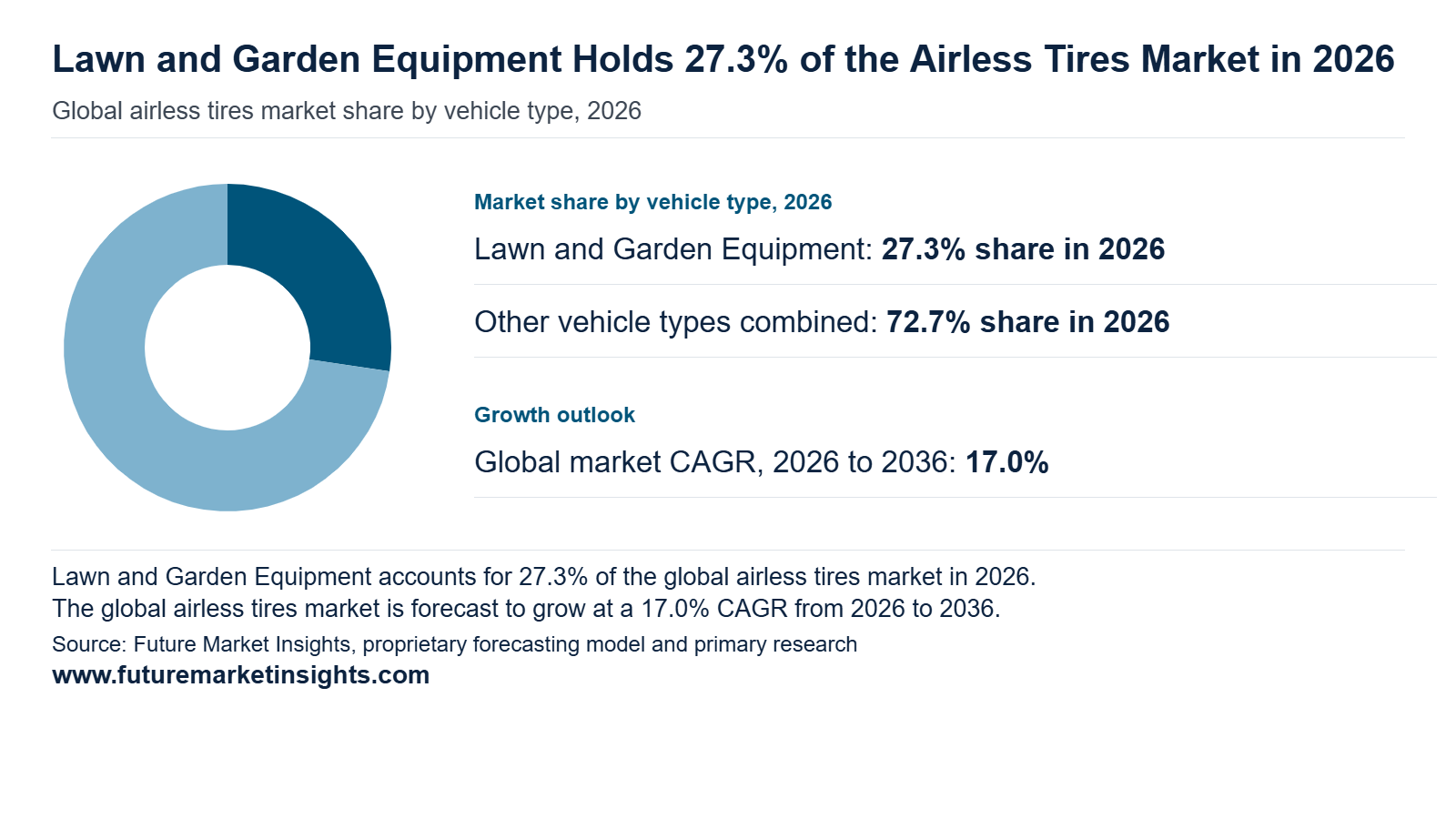
Up to three punctures a week was what one grounds contractor tolerated before switching: Michelin (April 2024) described Millstream Estate Services moving five of six Kubota zero-turn mowers to X Tweel Turf. For a fleet on daily routes a flat is a missed job, not just a replacement invoice, which explains why Lawn and Garden Equipment leads with 27.3% of 2026 revenue. Its share eases to 24.6% by 2036 (15.8% CAGR) as Robots and Autonomous Vehicles surge at 22.0% CAGR. Construction fitments face harsher abrasion tests, military buyers qualify mission by mission, and the logic carries to any ride-on mower fleet.
What Makes Polyurethane the Preferred Airless Material?
Designers pick polyurethane when they want stiffness and damping set by formulation instead of belts and cord, which is why it takes 47.8% of 2026 material revenue and still sits at 43.1% in 2036 (15.8% CAGR). Foam and elastomer grades suit garden gear and slow carts, where puncture immunity matters more than rolling speed. Rubber Composite survives where tread wear dominates, while Thermoplastic Elastomer, the quickest at 19.5% CAGR, must still prove fatigue and heat behavior. Materials (November 2024) reviewed processing methods and materials for non-pneumatic tires, a reminder that each compound must be tested inside its own architecture, as in plastic-rubber composite work.
Why Do Buyers Still Trust Spoke Designs Most?
Spokes are the easiest geometry to read: load runs down visible flexible members, so a machine engineer can predict and tune deflection, and Spoke Design keeps 47.7% of structure revenue in 2026 before sliding to 41.6% in 2036 (15.4% CAGR). Fatigue still demands qualification. Lattice and 3D-printed Design is the sprinter at 20.6% CAGR, though geometric freedom is not proven cost. Hankook Tire (January 2022) paired its i-Flex concept, built on interlocking multi-layer spokes, with Hyundai’s Plug & Drive module, while Polymers (2024) tested a 3D-printed carbon-fiber honeycomb support, so 3D printing is a design route, not yet a volume one.
Who Decides the Wheel, and Why Does Factory Fit Win the Sales Channel?
Ask who chooses the wheel and the answer is usually the machine builder. Factory Fit by Equipment Makers captures 46.0% of 2026 sales channel revenue because hub dimensions, clearances, load ratings and warranty are settled before the owner ever buys. The share falls to 42.2% by 2036 (16.0% CAGR) as Online, at 18.5% CAGR, widens. Michelin North America (October 2023) offered the Ferris ISX 3300 an X Tweel Turf airless tire as an option or replacement, a clear case of approval at equipment level. Aftermarket Retail serves known wheel specifications, and rental fleets weigh service coverage, as in off-highway tires.
Airless Tires Market by Region and Country (2026 to 2036)
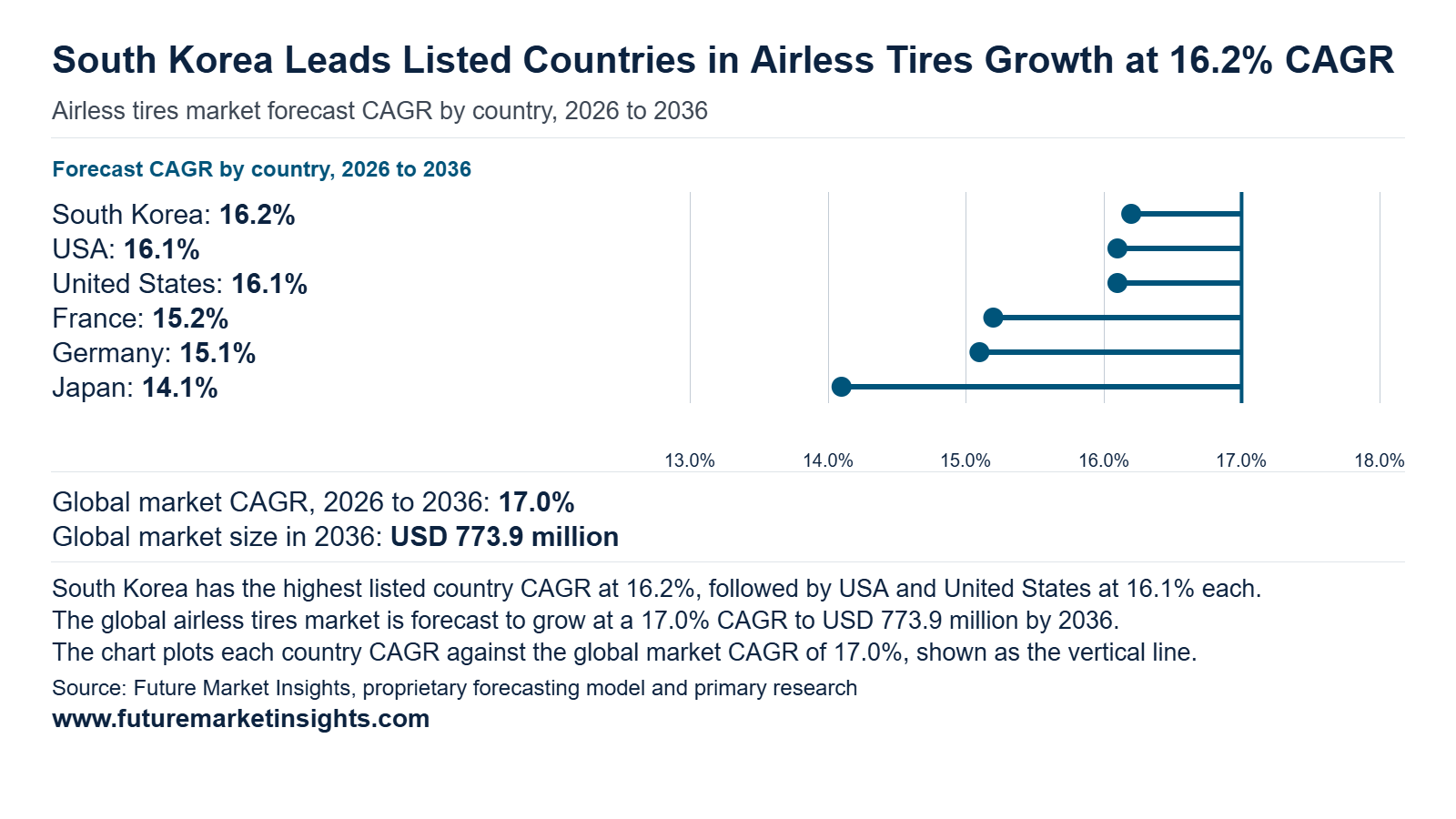
The five tracked countries hold 63.0% of global airless tire revenue in 2026, so the market is majority concentrated in them, and that concentration eases only slightly to 62.7% by 2036. The United States leads, lifting its share from 32.0% to 33.4% while adding USD 552 million. Japan loses ground, falling from 11.0% to 9.7%. The South Korea and Germany cluster grows from USD 55 million to USD 233 million, an addition of USD 178 million.
| Country | 2026 Revenue | 2036 Revenue | 10-Year Addition | 2026 to 2036 CAGR | Global Share (2026 → 2036) |
|---|---|---|---|---|---|
| South Korea | USD 20 million | USD 90 million | USD 70 million | 16.2% | 4.0% → 4.2% |
| United States | USD 160 million | USD 712 million | USD 552 million | 16.1% | 32.0% → 33.4% |
| France | USD 45 million | USD 185 million | USD 140 million | 15.2% | 9.0% → 8.7% |
| Germany | USD 35 million | USD 143 million | USD 108 million | 15.1% | 7.0% → 6.7% |
| Japan | USD 55 million | USD 206 million | USD 151 million | 14.1% | 11.0% → 9.7% |
Source: Future Market Insights analysis of the airless tires market, 2026.
United States
The United States is projected to rise from USD 160 million in 2026 to USD 712 million in 2036, a 16.1% CAGR that adds USD 552 million, a 4.45-fold expansion. Its global share grows from 32.0% to 33.4%, and it remains the largest country market by a wide margin. Demand rests on fleet operators and OEMs that want puncture-proof tires, but adoption on public roads depends on certification. The National Highway Traffic Safety Administration is using negotiated rulemaking to modernize federal tire standards, with up to 18 appointed stakeholders, and plans to set safety rules for new designs such as airless tires (NHTSA, October 2026). A defined rule path reduces regulatory uncertainty for manufacturers, so capital commitments to airless lines should follow once the standard is settled.
Japan
Japan grows from USD 55 million in 2026 to USD 206 million in 2036, a 14.1% CAGR with USD 151 million of addition, a 3.75-fold gain. Its share slips from 11.0% to 9.7%, though it keeps the second-largest position among the tracked countries. Bridgestone drives local development. The company has positioned its AirFree tire as an exploratory business in its Mid-Term Business Plan for 2024 to 2026, built on thermoplastic resin spokes and co-creation with external partners (Bridgestone, 2026), and it has begun public road testing (Bridgestone, 2026). Exploratory status means near-term revenue stays small and tied to slow-mobility and community transport trials. Those pilots generate durability data that will inform later pricing, but Japan records the lowest CAGR of the five tracked countries.
France
France rises from USD 45 million in 2026 to USD 185 million in 2036, a 15.2% CAGR and USD 140 million of addition, a 4.11-fold increase. Its share eases from 9.0% to 8.7%. French tire maker Michelin anchors the national ecosystem with two airless lines: Uptis for passenger cars, developed under a joint research agreement with General Motors, and Tweel for off-road vehicles (Michelin, 2026). Its September 2026 fitment guide lists Tweel airless radials for ATVs, UTVs and truck-mounted forklifts (Michelin, September 2026). Michelin also applies airless know-how to a lunar rover wheel for NASA's Artemis program (Michelin, 2026). Commercial volume therefore sits in utility and industrial vehicles, and passenger car growth depends on Uptis reaching series fitment.
Germany
Germany grows from USD 35 million in 2026 to USD 143 million in 2036, a 15.1% CAGR and USD 108 million of addition, a 4.09-fold expansion. Its share eases from 7.0% to 6.7%. German industry buys air-free tires first where downtime costs are highest, namely material handling. Continental sells super-elastic tires and press-on bands for forklifts, and states that, because they contain no air, they avoid the air loss that often triggers replacement (Continental Tires, 2026). Intralogistics and port equipment therefore form the earliest outlet, while passenger car airless tires remain at concept stage. Fleet managers value predictable uptime over ride refinement, so suppliers that move from solid to engineered airless structures will capture margin, but road-legal approvals constrain the pace.
South Korea
South Korea posts the fastest CAGR at 16.2%, rising from USD 20 million in 2026 to USD 90 million in 2036, an addition of USD 70 million and a 4.5-fold expansion. Its share grows from 4.0% to 4.2%. Hankook Tire leads local development. Its i-Flex Gen 2 airless concept, aimed at electric and autonomous vehicles, won Best of the Best in the Red Dot Design Concept category (Hankook Tire, August 2026). The design has been refined since the first-generation i-Flex appeared in 2015 and uses what the company calls an industry-first circumferential spoke structure for low noise and stability. It remains at prototype stage, so revenue today comes from demonstrations and pilot programs, and growth hinges on a production decision tied to autonomous mobility platforms.
Competitive Environment and Notable Companies
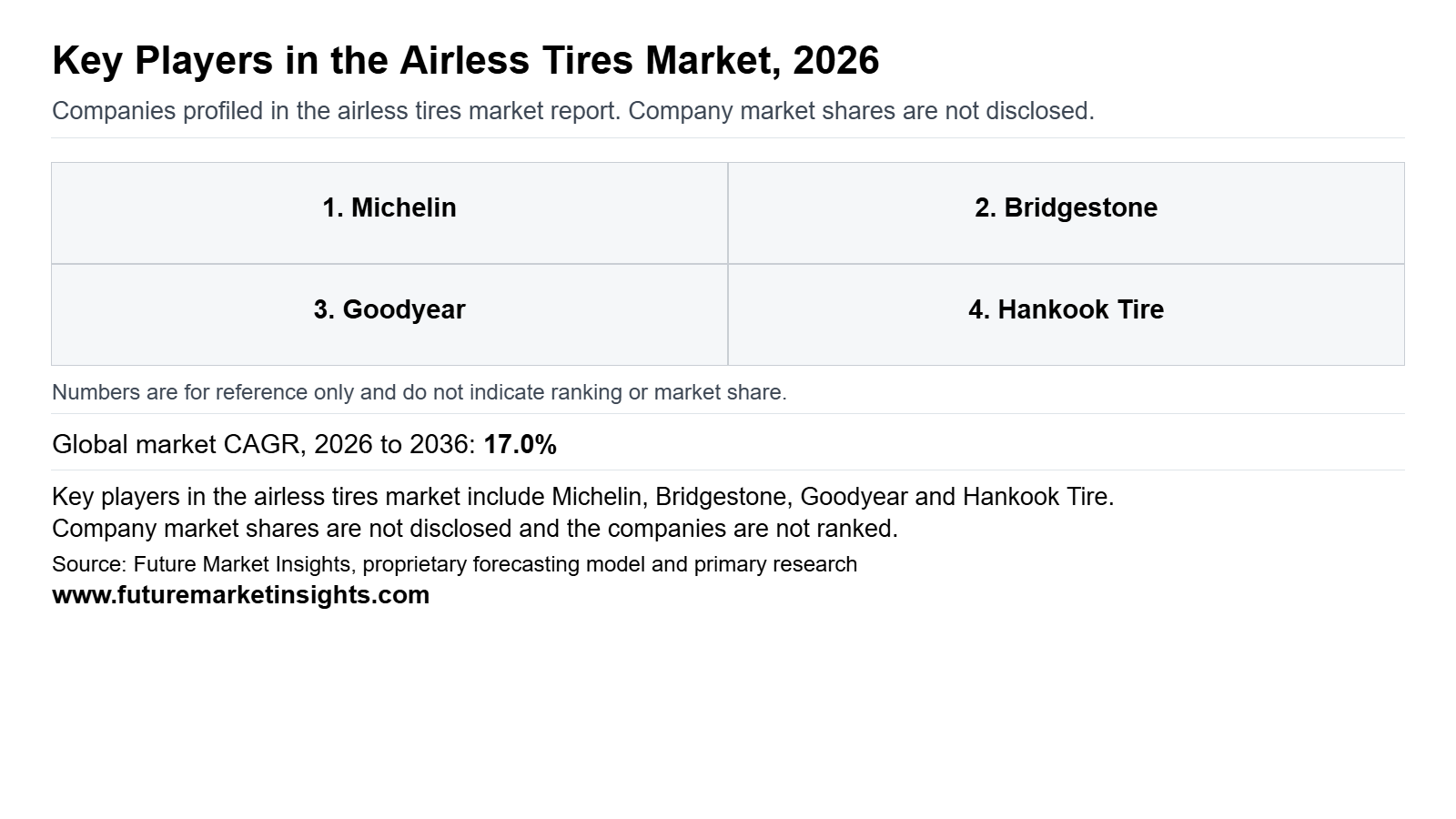
Notable companies operating in the global airless tires market include Michelin, Bridgestone, Goodyear, Hankook Tire, Tannus, Amerityre and SMART Tire Company. The field separates into equipment-integrated suppliers, spoke-platform developers running application trials, and focused makers of airless replacement and low-speed polymer products. Companies compete for machine integration and field evidence rather than a common passenger-car replacement channel. Buyers judge suppliers on fitment proof, documented structure design and channel readiness, so standing depends on where a tire has actually been installed and supported, not only on the underlying technology.
How Are Companies Positioned in the Airless Tires Market?
Companies sit in three positions. Michelin and Hankook Tire lead with equipment-integrated and fleet-validated systems, where named machines or emergency-service fleets provide field evidence. Bridgestone, Goodyear and SMART Tire Company act as spoke-platform and application-trial developers, advancing structures through community mobility, lunar and pre-commercial programs. Tannus and Amerityre serve focused replacement needs in bicycle and low-speed utility uses with polymer products. These groups seldom meet in one purchase decision, because each sells to a different buyer with a different proof requirement.
What Matters When a Buyer Selects an Airless Tires Supplier?
A buyer selecting an airless tires supplier starts with proof that matches the application. A landscaping distributor needs stock availability and wheel compatibility, so a tire that bolts onto a named machine carries weight. A robot or vehicle maker needs repeatable performance data and integration assistance during design. Load rating, speed limits and service life evidence follow. Because most airless tires replace a whole tire and wheel assembly, buyers also weigh the cost of changing hubs, and they favor suppliers who publish clear fitment guidance.
Which Capabilities Distinguish Product Offers?
Product offers are distinguished by structure and evidence. Michelin and Hankook Tire document engineered architectures, such as radial Tweel units and a double-arch design, tied to named machines. Bridgestone uses spoke construction in community mobility service. Tannus relies on a patented foam-like polymer, Amerityre on polyurethane, and SMART Tire Company on a nickel-titanium alloy casing. Channel readiness separates sellers with stock and distributors from developers still running trials. Documentation of load, speed and compatibility often decides whether a product can be ordered or only evaluated.
How Does Geographic Reach Affect Competition?
Geographic reach is shaped by where buyers run airless applications. Michelin, Tannus, Amerityre and SMART Tire Company center on the USA, through off-highway products, direct retail, distributors and development activity. Bridgestone concentrates on Japan, where a municipal shuttle service now runs on its tires. Hankook Tire is anchored in South Korea, with robots deployed in several fire units. Goodyear works through US programs, including lunar vehicle tires planned from 2028. Because evidence is local and support is hands-on, suppliers expand region by region rather than through a single global channel.
| Verified Company Evidence (2026) | Commercial Effect | Buyer Action |
|---|---|---|
| 21 July 2026: Hankook Tire announced it is supplying its i-Flex airless tires for an unmanned firefighting robot built with Hyundai Rotem on the HR-Sherpa vehicle. One robot each is stationed with the Seoul metropolitan special rescue unit, the Yeongnam special rescue unit, the Hwaseong fire station and the South Chungcheong fire headquarters [The Korea Times (July 2026)] | Moves a double-arch airless design from concept into emergency-service use, although no unit volumes, contract value or pricing were disclosed | Request duty-cycle and terrain data before specifying airless tires for heavy unmanned vehicles |
| 8 July 2026: Bridgestone's AirFree tires entered service on the Okunagamine Keiryu Car, an autonomous green slow mobility service run by Higashiomi City in Shiga Prefecture, from 8 July 2026. The city and Bridgestone signed a partnership agreement on 15 January 2025, and trials with other municipalities preceded this deployment [Bridgestone (July 2026)] | Gives AirFree a defined operating setting in regular service, not mass availability across passenger-car models | Treat low-speed community shuttles as the proof point and ask for maintenance data from the service |
| 21 September 2026: Michelin issued an X Tweel airless radial tire fitment guide dated 21 September 2026, updating the 20 April 2026 edition [Michelin (September 2026)] | Keeps a published, orderable fitment reference in the market for commercial and turf equipment | Check the current guide for the exact machine model and size before ordering Tweel units |
Source: Verified corporate disclosures and Future Market Insights analysis, 2026.
| Company | Core Positioning | Verified Activity & Source Attribution |
|---|---|---|
| Michelin | Tweel airless radial units for turf, skid steer, UTV and similar off-highway machines | Fitment guide updated 21 September 2026 [Michelin (September 2026)] |
| Bridgestone | AirFree airless tire for low-speed community mobility | In service on a Higashiomi City autonomous shuttle from 8 July 2026 [Bridgestone (July 2026)] |
| Goodyear | Non-pneumatic architectures for robots, shuttles and lunar vehicles | Will supply lunar tires for Lunar Outpost's Pegasus Lunar Terrain Vehicle, expected to support astronaut missions from 2028 [Goodyear via Autosphere (July 2026)] |
| Hankook Tire | i-Flex airless tire for unmanned and robotic vehicles | Original-equipment supply for Hyundai Rotem firefighting robots, 21 July 2026 [The Korea Times (July 2026)] |
| Tannus | Airless bicycle and scooter tires in a patented polymer, sold direct | Positioning only: tires are made of a patented material called Aither and fit clincher rims but not tubular or hookless rims [Tannus]. |
| Amerityre | Polyurethane flat-free tires for lawn and garden, bicycles and industrial uses | Positioning only: makes closed-cell polyurethane foam tire lines sold to OEMs, distributors and retail stores [OEM Off-Highway]. |
| SMART Tire Company | NiTinol metal airless tire, first product for bicycles | Positioning only: first commercial product is the METL airless bicycle tire [SMART Tire Company]. |
Source: Verified corporate disclosures and Future Market Insights analysis, 2026.
Airless Tires Market Report Scope and Research Methodology
FMI sizes the global airless tires market from the revenue earned on non-pneumatic tires and tire-wheel assemblies sold into lawn and garden equipment, construction and skid steer machines, robots and autonomous vehicles, bicycles, e-scooters and light mobility, and military and defense vehicles, cross-checked against wider national specialty tire and off-highway tire industry totals. Factory-fit sales to equipment makers anchor the model because they represent the majority of global revenue, supported by aftermarket retail, dealer and rental fleet, and online sales. Revenue is counted at the tire or wheel product level where sold, with complete machines, downstream vehicles, pneumatic tires, air-filled tire inserts, services, and unshipped prototype or pre-order value excluded. Primary interviews with tire makers, equipment manufacturers, fleet operators, and procurement teams are combined with desk research on trade data, regulatory publications, standards, and company filings. Material, structure, and channel estimates are reconciled so that segment and national figures sum to the global market total in every year. Company disclosures are used strictly to verify product positioning, trials, and launches rather than to estimate proprietary company revenues.
| Coverage Field | Report Scope |
|---|---|
| Market definition | Revenue from sold non-pneumatic tires and tire-wheel assemblies used in the named vehicle type segments, counted at the tire or wheel product level where sold. |
| Vehicle types | Lawn and garden equipment, construction and skid steer machines, robots and autonomous vehicles, bicycles, e-scooters and light mobility, and military and defense vehicles. |
| Materials | Polyurethane, rubber composite, and thermoplastic elastomer. |
| Structures | Spoke design, honeycomb design, and lattice and 3D-printed design. |
| Sales channels | Factory fit by equipment makers, aftermarket retail, dealer and rental fleets, and online. |
| Exclusions | Complete machines and downstream vehicles, pneumatic tires, air-filled tire inserts, unrelated components, services, and unshipped prototype or pre-order value. |
| Quantitative units | USD million for value. |
| Value basis | Revenue from sales of airless tires and tire-wheel assemblies to buyers in each country, with integrated assemblies counted at the tire or wheel product level. |
| Regions covered | North America, Latin America, Western Europe, Eastern Europe, East Asia, South Asia and Pacific, and Middle East and Africa. |
| National coverage | USA, China, Germany, Japan, France, India, and South Korea. |
| Companies covered | Michelin, Bridgestone, Goodyear, Hankook Tire, Tannus, Amerityre, and SMART Tire Company. |
| Forecast period | 2026 to 2036. |
| Approach | Primary and secondary research with market triangulation, followed by data validation against independent indicators to avoid double counting. |
Source: Future Market Insights analysis of the airless tires market, 2026.
Research Sources and Bibliography
- Bridgestone (July 2026). AirFree first social implementation in Higashiomi City (press release). https://digitalpr.jp/r/138501
- Bridgestone (2026). Bridgestone’s Non-Pneumatic Tire Technology “Air Free Concept.” https://www.bridgestone.com/technology_innovation/air_free/
- Bridgestone (2026). Innovative Airless Tire Technology. https://tires.bridgestone.com/en-us/learn/automotive/tire-technology/airless-concept-tires
- Continental Tires (2026). Continental Solid Tires. https://www.continental-tires.com/products/material-handling/solid-tires/
- Goodyear via Autosphere (July 2026). Ready For Launch City: Goodyear Heads Back To The Moon. https://autosphere.ca/tires/2026/07/20/ready-for-launch-city-goodyear-heads-back-to-the-moon/
- Hankook Tire (January 2022). Hankook Tire Exhibits Futuristic Airless Concept Tire i-Flex at CES 2022. https://www.hankooktire.com/global/en/company/media-list/media-detail.70736.html
- Hankook Tire (July 2026). Hankook Tire supplies airless tire i-Flex for Hyundai Rotem’s unmanned firefighting robot (Korean-language release). https://www.hankooktire.com/global/ko/company/media-list/media-detail.633600.html
- Hankook Tire (August 2026). Hankook Tire Wins Six Awards in the Design Concept Category at the 2026 Red Dot Design Award. https://www.hankooktire.com/us/en/company/media-center/media-detail.633807.html
- Hankook Tire (June 2026). Q&A - Concept tyres, 3D printing, non-pneumatic tyres & the future of mobility. https://www.hankooktire-mediacenter.com/press-kits/rtx-northern-ireland-2026/press-release-1/qa-concept-tyres-3d-printing-non-pneumatic-tyres-the-future-of-mobility
- International Federation of Robotics (September 2026). Global Sales of Professional Service Robots Surge 24% (World Robotics 2026, Service Robots). https://ifr.org/ifr-press-releases/news/robot-installations-reach-record-high
- Korea Times (July 2026). Hankook Tire equips Hyundai Rotem’s firefighting robot with airless tires. https://www.koreatimes.co.kr/business/companies/20260721/hankook-tire-equips-hyundai-rotems-firefighting-robot-with-airless-tires
- Liu, T., Gu, B., Lin, X., Lu, Y., Zhang, L. and Li, F. (2025). Fatigue damage investigation and performance comparison analysis of non-pneumatic tires with different spoke structures. International Journal of Fatigue, vol. 201. https://scholar.xjtu.edu.cn/en/publications/fatigue-damage-investigation-and-performance-comparison-analysis-/
- Michelin (October 2023). Michelin North America, Inc. Helps Ferris Mowers Drive Productivity with New Zero-Turn Mower Fitment. https://michelinmedia.com/pages/blog/detail/article/c0/a1314
- Michelin (2026). MICHELIN UPTIS tyre prototype, an airless tyre. https://africa.michelin.com/en/why-michelin/sustainability/michelin-uptis
- Michelin (April 2026). Michelin X Tweel Airless Radial Tire Fitment Guide, April 20, 2026. https://tweel.michelinman.com/wp-content/uploads/2026/04/MICHELIN_TWEEL_Full_Line_Fitment_Guide_04-20-26_EN.pdf
- Michelin (September 2026). Michelin X Tweel Airless Radial Tire Fitment Guide, September 21, 2026. https://tweel.michelinman.com/wp-content/uploads/2026/09/MICHELIN_TWEEL_Full_Line_Fitment_Guide_09-21-26_EN.pdf
- Michelin (April 2024). Michelin X Tweel Eliminates Punctures Across Millstream’s Mower Fleet. https://gk.news/michelin-beyond-road/press-release/michelin-x-tweel-eliminates-punctures-across-millstreams-mower-fleet
- Michelin (2026). Space Exploration. https://www.michelinman.com/why-michelin/innovation/innovate-for-a-better-life-in-motion/space-exploration
- Michelin (2026). Tweel: An Airless Tire. https://business.michelinman.com/by-technology/michelin-airless-tires?state=redir:fr/
- National Highway Traffic Safety Administration (n.d.). 49 CFR 571.129, Standard No. 129; New non-pneumatic tires for passenger cars. https://www.law.cornell.edu/cfr/text/49/571.129
- National Highway Traffic Safety Administration (October 2026). Notice of Intent to Establish a Negotiated Rulemaking Advisory Committee for Tire Safety. Federal Register. https://public-inspection.federalregister.gov/2026-21889.pdf
- National Highway Traffic Safety Administration (October 2026). Trump’s Transportation Department Moves to Modernize Tire Safety Standards, Deliver Safer American Roads. https://www.nhtsa.gov/press-releases/move-to-modernize-tire-safety-standards
- OEM Off-Highway (n.d.). The End of Tire Inflation? https://www.oemoffhighway.com/drivetrains/article/10166626/amerityres-solid-tire
- SMART Tire Company (n.d.). Company website. https://smarttirecompany.com
- Sun, M., Zhong, H., Qin, K., Xu, T., Yang, W., Zhang, Y. and Lu, L. (November 2024). The Development of Processing Methods and Materials Used for Non-Pneumatic Tires: A Review. Materials, 17(22), 5660. https://doi.org/10.3390/ma17225660
- Tannus (n.d.). Airless Support. https://tannus.com/pages/supporto-airless
- Tyre News Media (May 2026). Chandlers Adds Michelin X Tweel Turf to Grasshopper Mowers. https://www.tyrenews.co.uk/news/chandlers-adds-michelin-x-tweel-turf-to-grasshopper-mowers
- Wang, S., He, P., Geng, Q., Huang, H., Sang, L. and Yao, Z. (2024). Investigation of Additive-Manufactured Carbon Fiber-Reinforced Polyethylene Terephthalate Honeycomb for Application as Non-Pneumatic Tire Support Structure. Polymers, 16(8), 1091. https://mdpi.com/2073-4360/16/8/1091
Table of Content
- Key Takeaways
- Market Size and CAGR
- Top Growth Driver
- Fastest Growing Segment
- Leading Country
- Key Companies
- Emerging Opportunities
- Executive Summary
- Global Market Outlook
- Demand-side Trends
- Supply-side Trends
- Technology Roadmap Analysis
- Analysis and Recommendations
- Analyst Perspective (What is happening? Why now? What should investors know?)
- Key Questions Answered
- How large is the market?
- What is the CAGR?
- What are key trends?
- Which country dominates?
- Who are the leaders?
Read More...
- Market Overview
- Market Coverage / Taxonomy
- Market Definition / Scope / Limitations
- Research Methodology
- Chapter Orientation
- Analytical Lens and Working Hypotheses
- Market Structure, Signals, and Trend Drivers
- Benchmarking and Cross-market Comparability
- Market Sizing, Forecasting, and Opportunity Mapping
- Research Design and Evidence Framework
- Desk Research Programme (Secondary Evidence)
- Expert Input and Fieldwork (Primary Evidence)
- Tooling, Models, and Reference Databases
- Data Engineering and Model Build
- Quality Assurance and Audit Trail
- Market Background
- Market Dynamics (Drivers, Restraints, Opportunity, Trends)
- Scenario Forecast (Optimistic, Likely, Conservative)
- Impact Analysis
- AI Impact
- Sustainability Impact
- Regulatory Impact
- Technology Impact
- Consumer / Buyer Analysis
- Purchase Drivers
- Adoption Barriers
- Buyer Journey
- Opportunity Map Analysis
- Product Life Cycle Analysis
- Supply Chain Analysis
- Investment Feasibility Matrix
- Value Chain Analysis
- PESTLE and Porter's Analysis
- Regulatory Landscape
- Regional Parent Market Outlook
- Production and Consumption Statistics
- Import and Export Statistics
- Global Market Analysis and Forecast, 2021 to 2036
- Historical Market Size Value (USD Million) Analysis, 2021 to 2025
- Current and Future Market Size Value (USD Million) Projections, 2026 to 2036
- Y-o-Y Growth Trend Analysis
- Absolute $ Opportunity Analysis
- Global Market Pricing Analysis, 2021 to 2036
- Global Market Analysis and Forecast, By Vehicle Type, 2021 to 2036
- Introduction / Key Findings
- Historical Market Size Value (USD Million) Analysis By Vehicle Type, 2021 to 2025
- Current and Future Market Size Value (USD Million) Analysis and Forecast By Vehicle Type, 2026 to 2036
- Lawn and Garden Equipment
- Construction and Skid Steer Machines
- Robots and Autonomous Vehicles
- Bicycles, E-Scooters and Light Mobility
- Military and Defense Vehicles
- Y-o-Y Growth Trend Analysis By Vehicle Type, 2021 to 2025
- Absolute $ Opportunity Analysis By Vehicle Type, 2026 to 2036
- Global Market Analysis and Forecast, By Material, 2021 to 2036
- Introduction / Key Findings
- Historical Market Size Value (USD Million) Analysis By Material, 2021 to 2025
- Current and Future Market Size Value (USD Million) Analysis and Forecast By Material, 2026 to 2036
- Polyurethane
- Rubber Composite
- Thermoplastic Elastomer
- Y-o-Y Growth Trend Analysis By Material, 2021 to 2025
- Absolute $ Opportunity Analysis By Material, 2026 to 2036
- Global Market Analysis and Forecast, By Structure, 2021 to 2036
- Introduction / Key Findings
- Historical Market Size Value (USD Million) Analysis By Structure, 2021 to 2025
- Current and Future Market Size Value (USD Million) Analysis and Forecast By Structure, 2026 to 2036
- Spoke Design
- Honeycomb Design
- Lattice and 3D-printed Design
- Y-o-Y Growth Trend Analysis By Structure, 2021 to 2025
- Absolute $ Opportunity Analysis By Structure, 2026 to 2036
- Global Market Analysis and Forecast, By Sales Channel, 2021 to 2036
- Introduction / Key Findings
- Historical Market Size Value (USD Million) Analysis By Sales Channel, 2021 to 2025
- Current and Future Market Size Value (USD Million) Analysis and Forecast By Sales Channel, 2026 to 2036
- Factory Fit by Equipment Makers
- Aftermarket Retail
- Dealer and Rental Fleets
- Online
- Y-o-Y Growth Trend Analysis By Sales Channel, 2021 to 2025
- Absolute $ Opportunity Analysis By Sales Channel, 2026 to 2036
- Global Market Analysis and Forecast, By Region, 2021 to 2036
- Introduction
- Historical Market Size Value (USD Million) Analysis By Region, 2021 to 2025
- Current Market Size Value (USD Million) Analysis and Forecast By Region, 2026 to 2036
- USA
- Japan
- France
- South Korea
- Other Countries
- Market Attractiveness Analysis By Region
- USA Market Analysis and Forecast, 2021 to 2036
- Historical Market Size Value (USD Million) Trend Analysis By Market Taxonomy, 2021 to 2025
- Market Size Value (USD Million) Forecast By Market Taxonomy, 2026 to 2036
- By Vehicle Type
- By Material
- By Structure
- By Sales Channel
- Market Attractiveness Analysis
- By Vehicle Type
- By Material
- By Structure
- By Sales Channel
- Key Takeaways
- Japan Market Analysis and Forecast, 2021 to 2036
- Historical Market Size Value (USD Million) Trend Analysis By Market Taxonomy, 2021 to 2025
- Market Size Value (USD Million) Forecast By Market Taxonomy, 2026 to 2036
- By Vehicle Type
- By Material
- By Structure
- By Sales Channel
- Market Attractiveness Analysis
- By Vehicle Type
- By Material
- By Structure
- By Sales Channel
- Key Takeaways
- France Market Analysis and Forecast, 2021 to 2036
- Historical Market Size Value (USD Million) Trend Analysis By Market Taxonomy, 2021 to 2025
- Market Size Value (USD Million) Forecast By Market Taxonomy, 2026 to 2036
- By Vehicle Type
- By Material
- By Structure
- By Sales Channel
- Market Attractiveness Analysis
- By Vehicle Type
- By Material
- By Structure
- By Sales Channel
- Key Takeaways
- South Korea Market Analysis and Forecast, 2021 to 2036
- Historical Market Size Value (USD Million) Trend Analysis By Market Taxonomy, 2021 to 2025
- Market Size Value (USD Million) Forecast By Market Taxonomy, 2026 to 2036
- By Vehicle Type
- By Material
- By Structure
- By Sales Channel
- Market Attractiveness Analysis
- By Vehicle Type
- By Material
- By Structure
- By Sales Channel
- Key Takeaways
- Key Countries Market Analysis
- USA
- Pricing Analysis
- Market Share Analysis, 2025
- By Vehicle Type
- By Material
- By Structure
- By Sales Channel
- Japan
- Pricing Analysis
- Market Share Analysis, 2025
- By Vehicle Type
- By Material
- By Structure
- By Sales Channel
- France
- Pricing Analysis
- Market Share Analysis, 2025
- By Vehicle Type
- By Material
- By Structure
- By Sales Channel
- South Korea
- Pricing Analysis
- Market Share Analysis, 2025
- By Vehicle Type
- By Material
- By Structure
- By Sales Channel
- USA
- Market Structure Analysis
- Competition Dashboard
- Competition Benchmarking
- Market Share Analysis of Top Players
- By Region
- By Vehicle Type
- By Material
- By Structure
- By Sales Channel
- Emerging Startups
- Innovation Benchmarking
- Competition Analysis
- Competition Deep Dive
- Michelin
- Overview
- Product Portfolio
- Profitability by Market Segments
- Sales Footprint
- Strategy Overview
- Marketing Strategy
- Product Strategy
- Channel Strategy
- Bridgestone
- Goodyear
- Hankook Tire
- Tannus
- Amerityre
- SMART Tire Company
- Michelin
- Case Studies
- Success Stories
- Recent Developments
- Competition Deep Dive
- Assumptions & Acronyms Used
List of Tables
- Table 1: Global Market Value (USD Million) Forecast by Region, 2021 to 2036
- Table 2: Global Market Value (USD Million) Forecast by Vehicle Type, 2021 to 2036
- Table 3: Global Market Value (USD Million) Forecast by Material, 2021 to 2036
- Table 4: Global Market Value (USD Million) Forecast by Structure, 2021 to 2036
- Table 5: Global Market Value (USD Million) Forecast by Sales Channel, 2021 to 2036
- Table 6: USA Market Value (USD Million) Forecast by Vehicle Type, 2021 to 2036
- Table 7: USA Market Value (USD Million) Forecast by Material, 2021 to 2036
- Table 8: USA Market Value (USD Million) Forecast by Structure, 2021 to 2036
- Table 9: USA Market Value (USD Million) Forecast by Sales Channel, 2021 to 2036
- Table 10: Japan Market Value (USD Million) Forecast by Vehicle Type, 2021 to 2036
- Table 11: Japan Market Value (USD Million) Forecast by Material, 2021 to 2036
- Table 12: Japan Market Value (USD Million) Forecast by Structure, 2021 to 2036
- Table 13: Japan Market Value (USD Million) Forecast by Sales Channel, 2021 to 2036
- Table 14: France Market Value (USD Million) Forecast by Vehicle Type, 2021 to 2036
- Table 15: France Market Value (USD Million) Forecast by Material, 2021 to 2036
- Table 16: France Market Value (USD Million) Forecast by Structure, 2021 to 2036
- Table 17: France Market Value (USD Million) Forecast by Sales Channel, 2021 to 2036
- Table 18: South Korea Market Value (USD Million) Forecast by Vehicle Type, 2021 to 2036
- Table 19: South Korea Market Value (USD Million) Forecast by Material, 2021 to 2036
- Table 20: South Korea Market Value (USD Million) Forecast by Structure, 2021 to 2036
- Table 21: South Korea Market Value (USD Million) Forecast by Sales Channel, 2021 to 2036
List of Figures
- Figure 1: Global Market Pricing Analysis
- Figure 2: Global Market Value (USD Million) Forecast 2021-2036
- Figure 3: Global Market Value Share and BPS Analysis by Vehicle Type, 2026 and 2036
- Figure 4: Global Market Y-o-Y Growth Comparison by Vehicle Type, 2026-2036
- Figure 5: Global Market Attractiveness Analysis by Vehicle Type
- Figure 6: Global Market Value Share and BPS Analysis by Material, 2026 and 2036
- Figure 7: Global Market Y-o-Y Growth Comparison by Material, 2026-2036
- Figure 8: Global Market Attractiveness Analysis by Material
- Figure 9: Global Market Value Share and BPS Analysis by Structure, 2026 and 2036
- Figure 10: Global Market Y-o-Y Growth Comparison by Structure, 2026-2036
- Figure 11: Global Market Attractiveness Analysis by Structure
- Figure 12: Global Market Value Share and BPS Analysis by Sales Channel, 2026 and 2036
- Figure 13: Global Market Y-o-Y Growth Comparison by Sales Channel, 2026-2036
- Figure 14: Global Market Attractiveness Analysis by Sales Channel
- Figure 15: Global Market Value (USD Million) Share and BPS Analysis by Region, 2026 and 2036
- Figure 16: Global Market Y-o-Y Growth Comparison by Region, 2026-2036
- Figure 17: Global Market Attractiveness Analysis by Region
- Figure 18: USA Market Incremental Dollar Opportunity, 2026-2036
- Figure 19: Japan Market Incremental Dollar Opportunity, 2026-2036
- Figure 20: France Market Incremental Dollar Opportunity, 2026-2036
- Figure 21: South Korea Market Incremental Dollar Opportunity, 2026-2036
- Figure 22: USA Market Value Share and BPS Analysis by Vehicle Type, 2026 and 2036
- Figure 23: USA Market Y-o-Y Growth Comparison by Vehicle Type, 2026-2036
- Figure 24: USA Market Attractiveness Analysis by Vehicle Type
- Figure 25: USA Market Value Share and BPS Analysis by Material, 2026 and 2036
- Figure 26: USA Market Y-o-Y Growth Comparison by Material, 2026-2036
- Figure 27: USA Market Attractiveness Analysis by Material
- Figure 28: USA Market Value Share and BPS Analysis by Structure, 2026 and 2036
- Figure 29: USA Market Y-o-Y Growth Comparison by Structure, 2026-2036
- Figure 30: USA Market Attractiveness Analysis by Structure
- Figure 31: USA Market Value Share and BPS Analysis by Sales Channel, 2026 and 2036
- Figure 32: USA Market Y-o-Y Growth Comparison by Sales Channel, 2026-2036
- Figure 33: USA Market Attractiveness Analysis by Sales Channel
- Figure 34: Japan Market Value Share and BPS Analysis by Vehicle Type, 2026 and 2036
- Figure 35: Japan Market Y-o-Y Growth Comparison by Vehicle Type, 2026-2036
- Figure 36: Japan Market Attractiveness Analysis by Vehicle Type
- Figure 37: Japan Market Value Share and BPS Analysis by Material, 2026 and 2036
- Figure 38: Japan Market Y-o-Y Growth Comparison by Material, 2026-2036
- Figure 39: Japan Market Attractiveness Analysis by Material
- Figure 40: Japan Market Value Share and BPS Analysis by Structure, 2026 and 2036
- Figure 41: Japan Market Y-o-Y Growth Comparison by Structure, 2026-2036
- Figure 42: Japan Market Attractiveness Analysis by Structure
- Figure 43: Japan Market Value Share and BPS Analysis by Sales Channel, 2026 and 2036
- Figure 44: Japan Market Y-o-Y Growth Comparison by Sales Channel, 2026-2036
- Figure 45: Japan Market Attractiveness Analysis by Sales Channel
- Figure 46: France Market Value Share and BPS Analysis by Vehicle Type, 2026 and 2036
- Figure 47: France Market Y-o-Y Growth Comparison by Vehicle Type, 2026-2036
- Figure 48: France Market Attractiveness Analysis by Vehicle Type
- Figure 49: France Market Value Share and BPS Analysis by Material, 2026 and 2036
- Figure 50: France Market Y-o-Y Growth Comparison by Material, 2026-2036
- Figure 51: France Market Attractiveness Analysis by Material
- Figure 52: France Market Value Share and BPS Analysis by Structure, 2026 and 2036
- Figure 53: France Market Y-o-Y Growth Comparison by Structure, 2026-2036
- Figure 54: France Market Attractiveness Analysis by Structure
- Figure 55: France Market Value Share and BPS Analysis by Sales Channel, 2026 and 2036
- Figure 56: France Market Y-o-Y Growth Comparison by Sales Channel, 2026-2036
- Figure 57: France Market Attractiveness Analysis by Sales Channel
- Figure 58: South Korea Market Value Share and BPS Analysis by Vehicle Type, 2026 and 2036
- Figure 59: South Korea Market Y-o-Y Growth Comparison by Vehicle Type, 2026-2036
- Figure 60: South Korea Market Attractiveness Analysis by Vehicle Type
- Figure 61: South Korea Market Value Share and BPS Analysis by Material, 2026 and 2036
- Figure 62: South Korea Market Y-o-Y Growth Comparison by Material, 2026-2036
- Figure 63: South Korea Market Attractiveness Analysis by Material
- Figure 64: South Korea Market Value Share and BPS Analysis by Structure, 2026 and 2036
- Figure 65: South Korea Market Y-o-Y Growth Comparison by Structure, 2026-2036
- Figure 66: South Korea Market Attractiveness Analysis by Structure
- Figure 67: South Korea Market Value Share and BPS Analysis by Sales Channel, 2026 and 2036
- Figure 68: South Korea Market Y-o-Y Growth Comparison by Sales Channel, 2026-2036
- Figure 69: South Korea Market Attractiveness Analysis by Sales Channel
- Figure 70: Global Market - Tier Structure Analysis
- Figure 71: Global Market - Company Share Analysis
Frequently Asked Questions
How big is the Airless Tires Market in 2026?
Future Market Insights estimates the global airless tires market at USD 161.0 million in 2026, projected to reach USD 773.9 million by 2036.
How fast is the Airless Tires Market expected to grow through 2036?
FMI projects a 17.0% CAGR from 2026 to 2036, taking the global market from USD 161.0 million in 2026 to USD 773.9 million by 2036.
Which vehicle type leads the Airless Tires Market?
Lawn and garden equipment leads the vehicle type segment with a 27.3% share in 2026, supported by service-intensive operating conditions where puncture prevention can reduce maintenance requirements and equipment downtime.
Which material leads the Airless Tires Market?
Polyurethane leads the material segment with a 47.8% share in 2026, driven by its foam and elastomer properties that allow manufacturers to customize stiffness and structural support for different equipment applications.
Which countries are expected to grow fastest in the Airless Tires Market?
South Korea is projected to record the fastest growth at a 16.2% CAGR from 2026 to 2036, followed by United States at 16.1% over the same period.
Which companies are profiled in the Airless Tires Market?
The key companies profiled in the airless tires market include Michelin, Bridgestone, Goodyear, Hankook Tire, Tannus, Amerityre, and SMART Tire Company. Their market activities span commercial equipment fitments, specialized prototypes, and replacement solutions for consumer bicycles.
Preview the report firsthand - request a free sample
Get SampleGet the brochure for pricing and purchase details.
Get PDF
