

- Industry Size (2026)
- USD 588.0 Mn
- Forecast (2036)
- USD 1650.0 Mn
- CAGR (2026 to 2036)
- 10.4%
Boswellia serrata Extract Market Size, Market Forecast and Outlook By FMI
In 2025, global Boswellia serrata extract market surpassed a value of USD 545.0 million. Projections indicate an advance to USD 588.0 million in 2026 and USD 1,650.0 million by 2036, reflecting a 10.4% CAGR.
Demand for Boswellia serrata extract is rising due to increasing adoption of plant-based anti-inflammatory ingredients in nutraceutical, functional food, and herbal pharmaceutical formulations. Expanding joint health awareness supports growth, while raw material supply variability, regulatory restrictions on claims, quality standardization requirements, and competition from alternative botanical extracts shape industry performance.
Summary of Boswellia serrata Extract
- Boswellia serrata Extract Market Definition
- Refined oleo-gum resin derivatives standardized for bioactive consistency and utilized in therapeutic formulations.
- Demand Drivers in the Market
- Aging populations expand the baseline joint-pain demographic globally.
- Clinical validation replaces legacy symptom management protocols.
- Supply chain professionalization stabilizes raw material pricing structures.
- Key Segments Analyzed in the FMI Report
- Product Form: Dominant standardized extract powder (48%) versus liquid extract and solid resin.
- Application: Dietary supplements (52% of total volume) versus pharmaceuticals and personal care.
- Geography: High-growth Asia-Pacific (India 12.0%) versus mature North America and Europe.
- Analyst Opinion at FMI
- Nandini Roy Choudhury, Principal Consultant for Food & Beverage at Future Market Insights, opines, "Our latest findings indicate that sustainability and ethical wild-harvesting practices are emerging as structural risk factors in this category. Overharvesting and resin adulteration threaten long-term supply stability. Companies investing in controlled cultivation models and transparent sourcing frameworks will mitigate regulatory friction while strengthening global nutraceutical partnerships."
- Strategic Implications/Executive Takeaways
- Prioritize clinical trial investments to secure premium pricing margins.
- Expand extraction facilities in primary source regions to control supply risk.
- Develop combination concepts to penetrate crowded functional food spaces.
- Methodology
- Validated through first-hand corporate production and capacity data.
- Zero reliance on speculative third-party market research reports.
- Based on verifiable industrial benchmarks and verified sources.
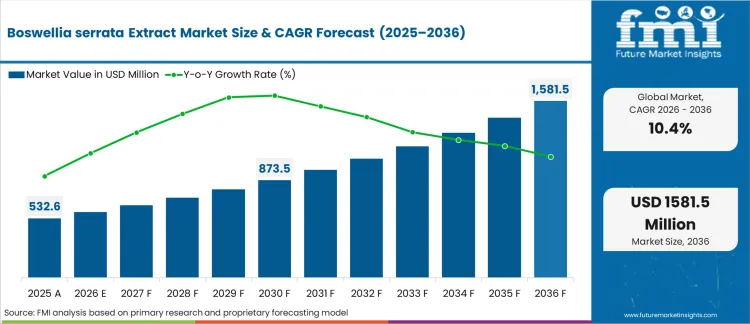
Boswellia serrata Extract Market Key Takeaways
| Metric | Details |
|---|---|
| Industry Size (2026) | USD 588.0 million |
| Industry Value (2036) | USD 1,650.0 million |
| CAGR (2026-2036) | 10.4% |
According to Seth Flowerman, President & CEO of PLT Health Solutions "AprèsFlex is the best studied Boswellia serrata extract on the market today, with four double-blind, placebo-controlled clinical trials. These studies demonstrate joint comfort efficacy starting at just 5 days with a very low 100 mg/day dose, along with improvements in mobility and cartilage preservation and protection not found in any other Boswellia ingredient. It's a lineup of benefits that is unmatched in the space," [8]
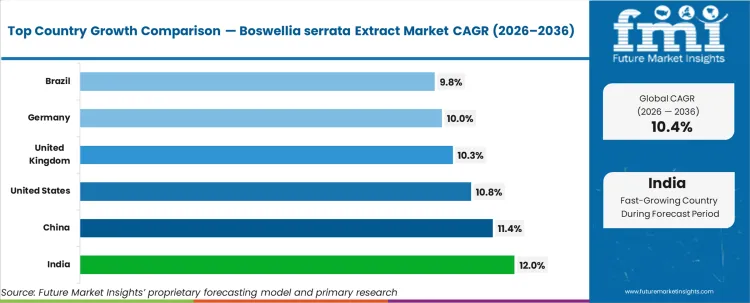
Country dispersion heavily mirrors regulatory compliance frameworks, with India, China, United States, United Kingdom, Germany, and Brazil capturing major volumetric gains. Across these zones, growth concentrates where aging demographics and high-impact sports recovery demands align with stringent quality standardization policies.
Boswellia serrata Extract Market Definition
Boswellia serrata extract constitutes a plant-derived bioactive compound heavily concentrated in boswellic acids, primarily utilized for inflammation suppression. Sales activity captures raw resin processing, purification, and trade of standardized powders. Buyers integrate these components into complex health formulations. Commercial value strictly tracks industrial-grade shipments destined for specialized therapeutic and preventive applications.
Boswellia serrata Extract Market Inclusions
The Boswellia serrata Extract category includes standardized extract powders manufactured for clinical-grade use with defined boswellic acid profiles. It also covers specialized functional blends developed for adult joint health formulations and supplied at the ingredient level. Industrial-scale volumes distributed through verified wholesale networks and structured online business channels are included within scope.
Boswellia serrata Extract Market Exclusions
The scope excludes raw, unprocessed resin traded outside certified extraction and quality-controlled supply chains. Cosmetic applications that do not specify measurable boswellic acid concentrations are not considered. Alternative botanicals such as curcumin are excluded unless incorporated within clearly defined hybrid Boswellia-based formulations.
Boswellia serrata Extract Market Research Methodology
- Primary Research: Direct interviews with botanical extraction facility managers yield granular yield metrics.
- Desk Research: Ministry publications and APEDA trade statistics anchor baseline capacity modelling.
- Market-Sizing and Forecasting: Bottom-up purification analysis pairs with top-down demographic illness rates.
- Data Validation and Update Cycle: Peer review against quarterly company disclosures ensures structural integrity.
Segmental Analysis
Boswellia serrata Extract Market Analysis by Product Form
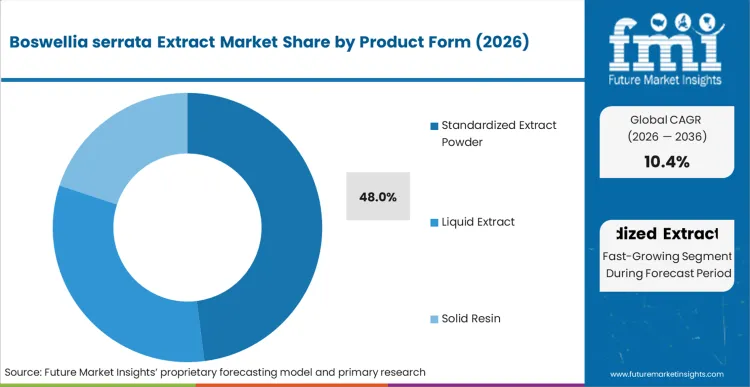
Standardized Extract Powder commands 48% of global volume in 2026. High-density active compound concentration solves critical dosage challenges for manufacturers building bone and joint health supplement lines. Formulators depend on these powders to achieve precise physiological efficacy thresholds. In September 2025, Arjuna Natural published specific positioning guidelines detailing advanced integration techniques for powder formats [12]. Powder stability reduces logistics costs and extends shelf life across international shipping lanes.
- Procurement trigger: Buyers demand standardized powder to guarantee exact active concentrations. Precision allows consistent labeling claims and protects corporate brand equity.
- Technology shift: Advanced water-soluble extractions expand formulation flexibility beyond traditional capsules. Product developers embed these specialized powders into functional beverages.
- Supply-side move: Extraction houses allocate capital toward advanced purification technologies. Yield optimization directly improves unit economics and offsets volatile botanical sourcing costs.
Boswellia serrata Extract Market Analysis by Application
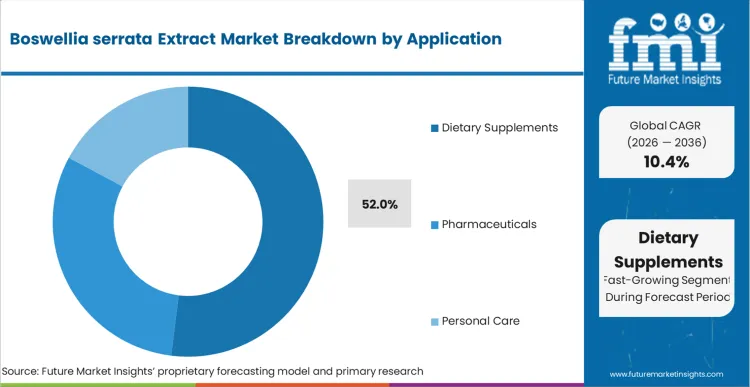
Consumers are increasing usage of botanical joint-health supplements as part of routine wellness purchases, supporting dietary supplement demand for standardized Boswellia extracts. Ayurvedic and herbal formulations are increasingly incorporated into structured supplement regimens, particularly for mobility and joint health. Consumers now view such capsules as essential components of everyday health maintenance rather than occasional remedies. As this behavior strengthens across demographics, dietary supplements account for 52% of total market share in 2026.
- Clinical signal: Robust human trials justify premium product price points. Verifiable efficacy metrics build consumer trust and support repeat purchasing through retail and practitioner channels.
- Buyer priority: Users prefer formulations positioned for joint comfort and mobility support, which increases demand for standardized, clinically referenced extracts. Faster onset times differentiate items in crowded aisles and capture dominant retail shelf space.
- Formulation shift: Multi-ingredient joint-support formulations commonly combine Boswellia with other actives, increasing the need for consistent extract specifications and label compliance.
Boswellia serrata Extract Market Drivers, Restraints, and Opportunities
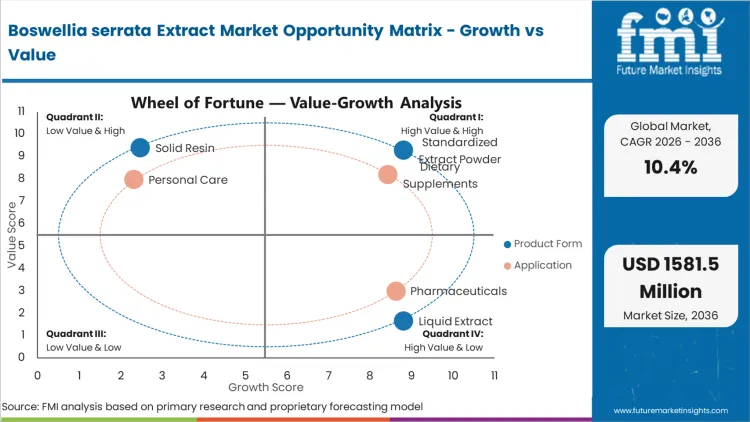
Regulatory adoption curves dictate procurement momentum across the herbal supplements sector. Governments formally recognize native supply chains, injecting capital into essential extraction infrastructure. Institutional backing legitimizes raw material sourcing and standardizes quality controls across cultivation zones. Procurement managers respond by shifting enterprise budgets toward certified providers.
Integration complexity acts as a primary operational restraint. Inconsistent raw resin quality creates unpredictable boswellic acid yields during extraction processes, forcing manufacturers to recalibrate purification equipment continuously. Extraction facilities combat variance via localized supply integration, yet capacity bottlenecks remain prevalent. Brands deploying highly soluble extracts like Dynagenix, promoted heavily in February 2026, bypass traditional formulation hurdles [15]. Until local infrastructure fully matures, batch inconsistency will challenge aggressive margin targets.
- Clinical Differentiation: Patented delivery technologies overcome poor bioavailability constraints. Evonik presented a specialized omega-3 and Boswellia combination concept in May 2024 to unlock new functional application pathways [7].
- Supply Chain Consolidation: Platform acquisitions build end-to-end operational capabilities. OmniActive acquired ENovate Biolife in November 2024 to rapidly expand its clinically backed portfolio [9].
- Export Expansion: Penetrating non-traditional markets secures diversified revenue streams. Trade data documented USD 2,143.77 million in aggregate medicinal plant exports from primary sourcing hubs during the 2023-2024 cycle [3].
Regional Analysis
Based on the regional analysis, the Boswellia serrata Extract market is segmented into North America, Latin America, Europe, East Asia, South Asia, Oceania and Middle East & Africa across 40+ countries. The full report also offers market attractiveness analysis based on regional trends.
.webp "Top Country Growth Comparison Boswellia Serrata Extract Market Cagr (2026 2036)")
| Country | CAGR (2026 to 2036) |
|---|---|
| India | 12.0% |
| China | 11.4% |
| United States | 10.8% |
| United Kingdom | 10.3% |
| Germany | 10.0% |
| Brazil | 9.8% |
Source: Future Market Insights (FMI) analysis, based on proprietary forecasting model and primary research
South Asia Boswellia serrata Extract Market Analysis
South Asia dominates raw material cultivation and primary extraction processing. Heavy government subsidies and established herbal ecosystems promote massive industrial capacity expansion. Export mandates compel manufacturers to achieve rigorous international quality certifications. According to FMI's estimates, this dynamic guarantees consistent high-grade supply for Western formulation houses.
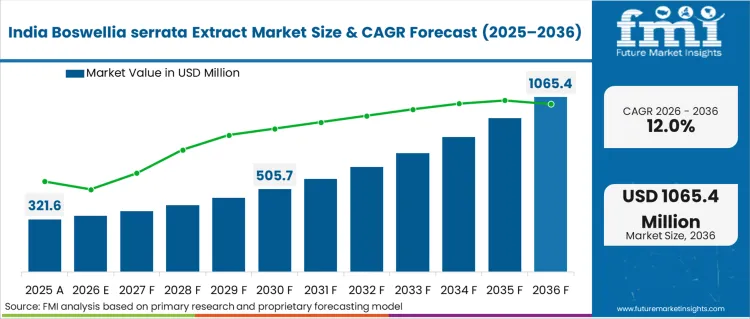
- India: Demand for Boswellia serrata extract in India is set to grow at 12.0% CAGR through 2036, supported by deep institutional investments before procurement cycles translate into higher deployment volumes. Tracking identified 92,653 related MSMEs operating in September 2025, showcasing extensive local manufacturing depth [2]. Domestic suppliers capture immense value by upgrading raw botanical resin.
FMI's report includes an extensive evaluation of the South Asia landscape. Bangladesh and Sri Lanka offer distinct cultivation advantages for specific botanical variants. Emerging harvest protocols in these territories stabilize long-term yield projections, requiring integration of purified nutraceutical ingredients.
East Asia Boswellia serrata Extract Market Analysis
East Asia translates traditional herbal knowledge into high-throughput manufacturing operations. Massive domestic consumer bases demand preventive joint-care solutions. Local manufacturers rapidly adopt sophisticated extraction techniques to compete with Western imports. Evolving regulatory frameworks streamline approval processes for clinically verified botanical options.
- China: In China, rising aging demographics are placing additional pressure on healthcare systems, encouraging greater interest in preventive joint-care solutions. Companies are responding with targeted formulations, as seen in November 2024 when Sabinsa promoted specialized joint-health offerings for the expanding Asian adult population, underscoring growing regional competition [16]. Verified extraction facilities are increasingly favored by national pharmacy chains seeking reliable, compliant suppliers. As these structural drivers strengthen procurement momentum, Boswellia serrata extract sales in China are projected to grow at an 11.4% CAGR from 2026 to 2036.
FMI's report includes comprehensive metrics regarding East Asia. Japan and South Korea represent critical high-value consumption zones for premium imported anti-inflammatory botanicals. Stringent functional food regulations in these nations heavily favor highly standardized formulations.
North America Boswellia serrata Extract Market Analysis
North America sets global benchmarks for clinical substantiation requirements. Widespread preventive usage provides a massive foundation for specialized joint-health add-ons. Strict FDA oversight ensures only verifiable claims survive intense retail scrutiny. Brands leverage established trust to introduce premium-priced botanical complexes.
- United States: United States Boswellia serrata extract sector is poised to expand at 10.8% CAGR during 2026 to 2036 because an aging population seeks non-pharmaceutical pain management, which lifts utilization rates and justifies technology refresh decisions. Brands use standardized, clinically referenced extracts to support differentiation in competitive supplement retail environments.
FMI's report includes detailed assessments across North America. Canada and Mexico maintain distinct regulatory pathways for natural health products. Trade data documented USD 8.60 million in medicinal and aromatic plant exports from India to Mexico during the 2024 to 2025 cycle [18].
Europe Boswellia serrata Extract Market Analysis
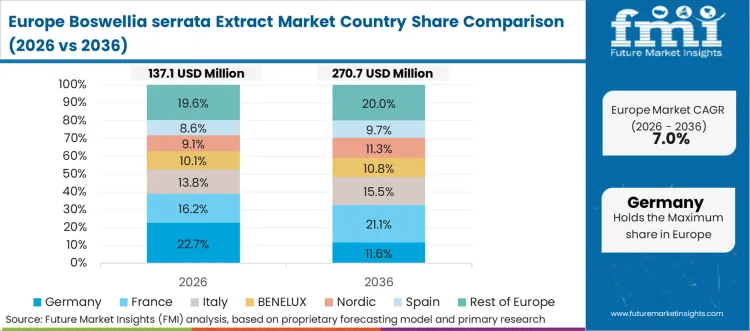
Europe maintains rigorous compliance gates for botanical imports. Stringent novel food regulations mandate extensive safety dossiers before commercialization. Manufacturers circumvent barriers by acquiring established domestic extraction facilities or forming strategic alliances. Joint ventures accelerate market penetration despite heavy regulatory friction.
- United Kingdom: In the United Kingdom, strict retail gatekeeping standards are raising the bar for efficacy documentation and product transparency, pushing suppliers to invest more heavily in validated formulations. Within this environment, Boswellia serrata extract demand is projected to grow at a 10.3% CAGR between 2026 and 2036, as operational compliance increasingly shapes procurement decisions. Local brands are prioritizing verified extracts and sustainable sourcing practices to meet elevated consumer and retailer expectations.
- Germany: In Germany, Boswellia serrata extract market is forecast to advance at 10.0% CAGR through 2036, with growth anchored in an established herbal medicine tradition that converts into measurable budget allocation. Apothecary channels dominate premium botanical distribution, securing long-term loyalty through pharmacist recommendations.
FMI's report includes a deep dive into the European structure. France and Italy dictate significant innovation in extraction technology and phytosome delivery systems. In May 2024, prominent European ingredient suppliers debuted pioneering biotic and botanical combination concepts to address local preferences [6]. Indian medicinal plant exports to Poland reached USD 2.32 million in 2025, highlighting expanding Eastern European demand corridors [17].
Latin America Boswellia serrata Extract Market Analysis
Latin America exhibits rapid adoption of imported dietary capsules. Rising disposable incomes allow consumers to upgrade from generic pain relief to specialized botanical formulas. Regional distributors actively seek partnerships with established global extraction houses. Expanding pharmacy chains provide critical retail infrastructure for mass-market penetration.
- Brazil: In Brazil, a growing middle-class population is increasingly turning toward preventive health solutions, strengthening demand for botanical extracts positioned around mobility and joint support. Retailers are responding by promoting multi-ingredient mobility bundles designed to increase basket value and encourage repeat purchases. As consumer awareness expands and distribution channels mature, Boswellia serrata extract uptake in Brazil is projected to grow at a 9.8% CAGR over the forecast period.
FMI's report includes extensive coverage of the Latin American footprint. Argentina and Colombia represent emerging frontiers for imported herbal extract supplements. Regulatory harmonization efforts across borders simplify distribution logistics for multinational brands.
Competitive Aligners for Market Players
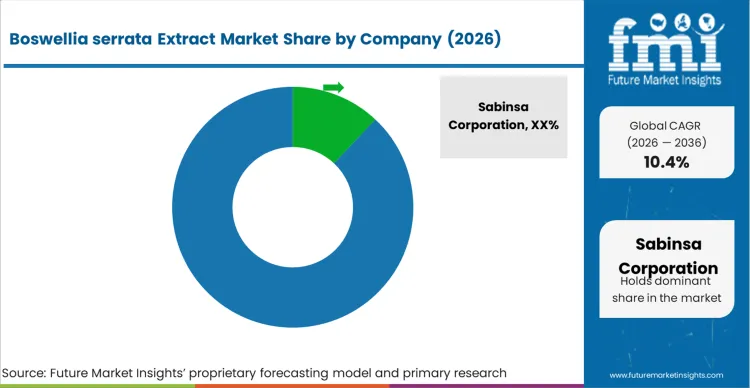
Clinical validation definitively separates premium suppliers from commodity resin traders. Extraction houses must allocate capital toward human trials to secure lucrative contracts with tier-one supplement brands. In October 2025, an industry exhibition hosted 18,000 professionals, validating the intense competition within the nutraceutical ingredient space [5]. Brands utilize specific, patented extracts to legally defend marketing claims against regulatory scrutiny.
Vertical integration insulates manufacturers from raw material price shocks. Firms acquiring domestic herbal brands capture entire margin chains from forest collection to retail shelves. In February 2025, Sabinsa acquired Nature's Formulary to expand consumer division capabilities and distribution footprints directly [11]. Direct consumer access provides invaluable formulation feedback, bypassing traditional distributor information lags.
Consolidation reshapes global ingredient landscapes continuously. Corporate entities aggressively acquire specialized botanical extraction firms to instantly broaden operational portfolios. Mergers eliminate redundant research expenditures and instantly grant access to new geographic distribution networks.
Recent Developments
The report includes full coverage of key trends from competitive benchmarking. Some of the recent developments covered in the reports:
- In January 2026, Sami-Sabinsa Group opened Hassan Unit-2 to expand herbal ingredient production capabilities. [14]
- In December 2025, Carbyne Equity Partners acquired SuanNutra to consolidate European nutraceutical ingredient assets. [13]
Key Players in Boswellia serrata Extract Market
- Sabinsa Corporation
- PLT Health Solutions
- Arjuna Natural
- OmniActive Health Technologies
- dsm-firmenich
- Indena S.p.A.
- Evonik Industries
- Groupe Berkem
Scope of the Report
| Metric | Value |
|---|---|
| Quantitative Units | USD 588.0 million (2026) to USD 1,650.0 million (2036), at a CAGR of 10.4% |
| Market Definition | Boswellia serrata extract constitutes a plant-derived bioactive compound heavily concentrated in boswellic acids, primarily utilized for joint inflammation suppression, tracking industrial-grade shipments destined for therapeutic applications. |
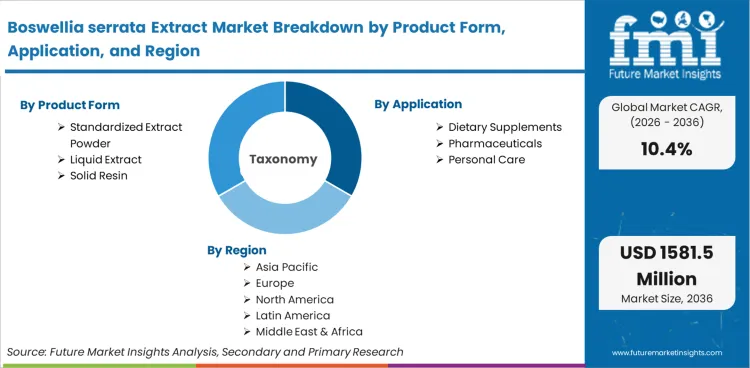
| Product Form Segmentation | Standardized Extract Powder, Liquid Extract, and Solid Resin |
| Application Segmentation | Dietary Supplements, Pharmaceuticals, and Personal Care |
| Regions Covered | North America, Latin America, Europe, East Asia, South Asia, Oceania, Middle East and Africa |
| Countries Covered | United States, United Kingdom, Germany, Brazil, China, India, and 40 plus countries |
| Key Companies Profiled | Sabinsa Corporation, PLT Health Solutions, Arjuna Natural, OmniActive Health Technologies, dsm-firmenich, Indena S.p.A., Evonik Industries, Groupe Berkem |
| Forecast Period | 2026 to 2036 |
| Approach | Hybrid top-down and bottom-up market modeling validated through primary interviews with extraction facility managers, supported by trade data benchmarking. |
Boswellia serrata Extract Market Analysis by Segments
Product Form:
- Standardized Extract Powder
- Liquid Extract
- Solid Resin
Application:
- Dietary Supplements
- Pharmaceuticals
- Personal Care
Region:
- Asia Pacific
- India
- China
- Japan
- South Korea
- Indonesia
- Australia & New Zealand
- ASEAN
- Rest of Asia Pacific
- Europe
- Germany
- Italy
- France
- United Kingdom
- Spain
- Benelux
- Nordics
- Central & Eastern Europe
- Rest of Europe
- North America
- United States
- Canada
- Mexico
- Latin America
- Brazil
- Argentina
- Chile
- Rest of Latin America
- Middle East & Africa
- Kingdom of Saudi Arabia
- United Arab Emirates
- South Africa
- Turkey
- Rest of Middle East & Africa
Bibliography
- [1] Ministry of AYUSH. (2025, September). 11-Years AYUSH report.
- [2] Ministry of AYUSH. (2025, September). AYUSH market valuation report.
- [3] Ministry of Commerce & Industry. (2024). Export products division table.
- [4] Council for Responsible Nutrition. (2024, October). Survey on supplement usage.
- [5] International Trade Centre. (2025, October). SupplySide Global trade fair.
- [6] dsm-firmenich. (2024, May). Vitafoods Europe combinations.
- [7] Evonik. (2024, May). AvailOm omega-3 and Boswellia.
- [8] PR Newswire. (2024). New publication on Boswellia serrata ingredients finds that AprèsFlex® 5-day joint support is most efficacious.
- [9] OmniActive. (2024, November). Acquisition of ENovate Biolife.
- [10] Osteo Bi-Flex. (2025, January). Clinical trial emphasizes joint health.
- [11] Sabinsa. (2025, February). Acquisition of Nature’s Formulary.
- [12] Arjuna Natural. (2025, September). AKBAMAX / BOSPURE brochure.
- [13] Carbyne Equity Partners. (2025, December). Acquisition of SuanNutra.
- [14] Sami-Sabinsa Group. (2026, January). Hassan Unit-2 production facility.
- [15] PLT Health Solutions. (2026, February). Dynagenix low-dose extract.
- [16] Sabinsa. (2024, November). Vietnam Boswellin joint health.
- [17] Agricultural and Processed Food Products Export Development Authority (APEDA). (2025). Exports from India: Poland.
- [18] Agricultural and Processed Food Products Export Development Authority (APEDA). (2025). Exports from India: Mexico.
This bibliography is provided for reader reference and is not exhaustive. The full report contains the complete reference list and detailed citations.
This Report Addresses
- Market intelligence to enable structured strategic decision making across mature and emerging resin economies.
- Market size estimation and 10 year revenue forecasts from 2026 to 2036, supported by validated capacity and trade benchmarks.
- Growth opportunity mapping across extract forms with emphasis on standardized grade transitions.
- Segment and regional revenue forecasts covering specialized dietary supplement applications.
- Competition strategy assessment including integration models, cost survivability positioning, and compliance capability benchmarking.
- Product reformulation and emission compliance tracking including strict botanical safety guidelines.
- Regulatory impact analysis covering extraction standardization mandates, clinical efficacy thresholds, and export driven specification upgrades.
- Market report delivery in PDF, Excel, PPT, and interactive dashboard formats for executive and operational use.
Frequently Asked Questions
How large is the demand for Boswellia serrata extract in the global market in 2026?
Demand for Boswellia serrata extract in the global market is estimated to be valued at USD 588.0 million in 2026.
What will be the market size of Boswellia serrata extract in the global market by 2036?
Market size for Boswellia serrata extract is projected to reach USD 1,650.0 million by 2036.
What is the expected demand growth for Boswellia serrata extract in the global market between 2026 and 2036?
Demand for Boswellia serrata extract in the global market is expected to grow at a CAGR of 10.4% between 2026 and 2036.
Which Product Form is poised to lead global sales by 2026?
Standardized Extract Powder is expected to be the dominant form, capturing approximately 48% of global market share in 2026 due to precise active concentration thresholds.
How significant is the role of Dietary Supplements in driving Boswellia serrata extract adoption in 2026?
Dietary Supplements represent a critical segment, projected to hold a substantial 52% share of the total market in 2026 as consumers prioritize daily preventive joint care routines.
What is driving demand in India?
Massive institutional investments in AYUSH MSMEs and domestic extraction upgrades are driving growth.
What compliance standards or regulations are referenced for India?
Ministry of AYUSH guidelines and export quality mandates are referenced as key compliance benchmarks.
What is the India growth outlook in this report?
India is projected to grow at a CAGR of 12.0% during 2026 to 2036.
Why is North America described as a priority region in this report?
Growth is sustained by extensive multivitamin usage and strict clinical substantiation demands for premium pricing.
What type of demand dominates in North America?
Clinically verified, preventive mobility supplement demand dominates regional consumption.
What is China growth outlook in this report?
China is projected to expand at a CAGR of 11.4% during 2026 to 2036.
Does the report cover United States in its regional analysis?
United States is included within North America under the regional scope of analysis.
What are the sources referred to for analyzing United States?
Clinical trial press releases and dietary supplement usage surveys are cited as primary reference sources.
What is the main demand theme linked to United States in its region coverage?
Demand is associated with demographic aging forcing a transition toward non-pharmaceutical pain management.
Does the report cover United Kingdom in its regional analysis?
United Kingdom is included within Europe under the regional coverage framework.
What is the main United Kingdom related demand theme in its region coverage?
Strict retail gatekeeping demanding transparent supply chain documentation is emphasized.
Which product formats or configurations are strategically important for South Asia supply chains?
Standardized extract powders are prioritized due to improved unit economics and export stability.
What is Boswellia serrata extract and what is it mainly used for?
Boswellia serrata extract is a bioactive compound rich in boswellic acids primarily utilized for suppressing joint inflammation.
What does Boswellia serrata extract mean in this report?
Boswellia serrata extract market refers to the processing and commercialization of standardized boswellic acids for therapeutic integration.
What is included in the scope of this Boswellia serrata extract report?
Scope covers standardized extract powders, adult consumer applications, and online retail distribution volumes.
What is excluded from the scope of this report?
Non-active cosmetic applications and unrelated botanical extracts are excluded.
What does market forecast mean on this page?
Market forecast represents a model-based projection built on defined demographic and supply assumptions for strategic planning purposes.
How does FMI build and validate the Boswellia serrata extract forecast?
Forecast is developed using hybrid top-down and bottom-up modeling validated through extraction facility interviews and trade data.
What does zero reliance on speculative third party market research mean here?
Primary interviews and verifiable corporate disclosures are used instead of unverified syndicated market estimates.
Preview the report firsthand - request a free sample
Get SampleGet the brochure for pricing and purchase details.
Get PDFTable of Content
- Executive Summary
- Global Market Outlook
- Demand-side Trends
- Supply-side Trends
- Technology Roadmap Analysis
- Analysis and Recommendations
- Market Overview
- Market Coverage / Taxonomy
- Market Definition / Scope / Limitations
- Research Methodology
- Chapter Orientation
- Analytical Lens and Working Hypotheses
- Market Structure, Signals, and Trend Drivers
- Benchmarking and Cross-market Comparability
- Market Sizing, Forecasting, and Opportunity Mapping
- Research Design and Evidence Framework
- Desk Research Programme (Secondary Evidence)
- Company Annual and Sustainability Reports
- Peer-reviewed Journals and Academic Literature
- Corporate Websites, Product Literature, and Technical Notes
- Earnings Decks and Investor Briefings
- Statutory Filings and Regulatory Disclosures
- Technical White Papers and Standards Notes
- Trade Journals, Industry Magazines, and Analyst Briefs
- Conference Proceedings, Webinars, and Seminar Materials
- Government Statistics Portals and Public Data Releases
- Press Releases and Reputable Media Coverage
- Specialist Newsletters and Curated Briefings
- Sector Databases and Reference Repositories
- FMI Internal Proprietary Databases and Historical Market Datasets
- Subscription Datasets and Paid Sources
- Social Channels, Communities, and Digital Listening Inputs
- Additional Desk Sources
- Expert Input and Fieldwork (Primary Evidence)
- Primary Modes
- Qualitative Interviews and Expert Elicitation
- Quantitative Surveys and Structured Data Capture
- Blended Approach
- Why Primary Evidence is Used
- Field Techniques
- Interviews
- Surveys
- Focus Groups
- Observational and In-context Research
- Social and Community Interactions
- Stakeholder Universe Engaged
- C-suite Leaders
- Board Members
- Presidents and Vice Presidents
- R&D and Innovation Heads
- Technical Specialists
- Domain Subject-matter Experts
- Scientists
- Physicians and Other Healthcare Professionals
- Governance, Ethics, and Data Stewardship
- Research Ethics
- Data Integrity and Handling
- Primary Modes
- Tooling, Models, and Reference Databases
- Desk Research Programme (Secondary Evidence)
- Data Engineering and Model Build
- Data Acquisition and Ingestion
- Cleaning, Normalisation, and Verification
- Synthesis, Triangulation, and Analysis
- Quality Assurance and Audit Trail
- Market Background
- Market Dynamics
- Drivers
- Restraints
- Opportunity
- Trends
- Scenario Forecast
- Demand in Optimistic Scenario
- Demand in Likely Scenario
- Demand in Conservative Scenario
- Opportunity Map Analysis
- Product Life Cycle Analysis
- Supply Chain Analysis
- Investment Feasibility Matrix
- Value Chain Analysis
- PESTLE and Porter’s Analysis
- Regulatory Landscape
- Regional Parent Market Outlook
- Production and Consumption Statistics
- Import and Export Statistics
- Market Dynamics
- Global Market Analysis 2021 to 2025 and Forecast, 2026 to 2036
- Historical Market Size Value (USD Million) Analysis, 2021 to 2025
- Current and Future Market Size Value (USD Million) Projections, 2026 to 2036
- Y-o-Y Growth Trend Analysis
- Absolute $ Opportunity Analysis
- Global Market Pricing Analysis 2021 to 2025 and Forecast 2026 to 2036
- Global Market Analysis 2021 to 2025 and Forecast 2026 to 2036, By Product Form
- Introduction / Key Findings
- Historical Market Size Value (USD Million) Analysis By Product Form , 2021 to 2025
- Current and Future Market Size Value (USD Million) Analysis and Forecast By Product Form , 2026 to 2036
- Standardized Extract Powder
- Liquid Extract
- Solid Resin
- Standardized Extract Powder
- Y-o-Y Growth Trend Analysis By Product Form , 2021 to 2025
- Absolute $ Opportunity Analysis By Product Form , 2026 to 2036
- Global Market Analysis 2021 to 2025 and Forecast 2026 to 2036, By Application
- Introduction / Key Findings
- Historical Market Size Value (USD Million) Analysis By Application, 2021 to 2025
- Current and Future Market Size Value (USD Million) Analysis and Forecast By Application, 2026 to 2036
- Dietary Supplements
- Pharmaceuticals
- Personal Care
- Dietary Supplements
- Y-o-Y Growth Trend Analysis By Application, 2021 to 2025
- Absolute $ Opportunity Analysis By Application, 2026 to 2036
- Global Market Analysis 2021 to 2025 and Forecast 2026 to 2036, By Region
- Introduction
- Historical Market Size Value (USD Million) Analysis By Region, 2021 to 2025
- Current Market Size Value (USD Million) Analysis and Forecast By Region, 2026 to 2036
- North America
- Latin America
- Western Europe
- Eastern Europe
- East Asia
- South Asia and Pacific
- Middle East & Africa
- Market Attractiveness Analysis By Region
- North America Market Analysis 2021 to 2025 and Forecast 2026 to 2036, By Country
- Historical Market Size Value (USD Million) Trend Analysis By Market Taxonomy, 2021 to 2025
- Market Size Value (USD Million) Forecast By Market Taxonomy, 2026 to 2036
- By Country
- USA
- Canada
- Mexico
- By Product Form
- By Application
- By Country
- Market Attractiveness Analysis
- By Country
- By Product Form
- By Application
- Key Takeaways
- Latin America Market Analysis 2021 to 2025 and Forecast 2026 to 2036, By Country
- Historical Market Size Value (USD Million) Trend Analysis By Market Taxonomy, 2021 to 2025
- Market Size Value (USD Million) Forecast By Market Taxonomy, 2026 to 2036
- By Country
- Brazil
- Chile
- Rest of Latin America
- By Product Form
- By Application
- By Country
- Market Attractiveness Analysis
- By Country
- By Product Form
- By Application
- Key Takeaways
- Western Europe Market Analysis 2021 to 2025 and Forecast 2026 to 2036, By Country
- Historical Market Size Value (USD Million) Trend Analysis By Market Taxonomy, 2021 to 2025
- Market Size Value (USD Million) Forecast By Market Taxonomy, 2026 to 2036
- By Country
- Germany
- UK
- Italy
- Spain
- France
- Nordic
- BENELUX
- Rest of Western Europe
- By Product Form
- By Application
- By Country
- Market Attractiveness Analysis
- By Country
- By Product Form
- By Application
- Key Takeaways
- Eastern Europe Market Analysis 2021 to 2025 and Forecast 2026 to 2036, By Country
- Historical Market Size Value (USD Million) Trend Analysis By Market Taxonomy, 2021 to 2025
- Market Size Value (USD Million) Forecast By Market Taxonomy, 2026 to 2036
- By Country
- Russia
- Poland
- Hungary
- Balkan & Baltic
- Rest of Eastern Europe
- By Product Form
- By Application
- By Country
- Market Attractiveness Analysis
- By Country
- By Product Form
- By Application
- Key Takeaways
- East Asia Market Analysis 2021 to 2025 and Forecast 2026 to 2036, By Country
- Historical Market Size Value (USD Million) Trend Analysis By Market Taxonomy, 2021 to 2025
- Market Size Value (USD Million) Forecast By Market Taxonomy, 2026 to 2036
- By Country
- China
- Japan
- South Korea
- By Product Form
- By Application
- By Country
- Market Attractiveness Analysis
- By Country
- By Product Form
- By Application
- Key Takeaways
- South Asia and Pacific Market Analysis 2021 to 2025 and Forecast 2026 to 2036, By Country
- Historical Market Size Value (USD Million) Trend Analysis By Market Taxonomy, 2021 to 2025
- Market Size Value (USD Million) Forecast By Market Taxonomy, 2026 to 2036
- By Country
- India
- ASEAN
- Australia & New Zealand
- Rest of South Asia and Pacific
- By Product Form
- By Application
- By Country
- Market Attractiveness Analysis
- By Country
- By Product Form
- By Application
- Key Takeaways
- Middle East & Africa Market Analysis 2021 to 2025 and Forecast 2026 to 2036, By Country
- Historical Market Size Value (USD Million) Trend Analysis By Market Taxonomy, 2021 to 2025
- Market Size Value (USD Million) Forecast By Market Taxonomy, 2026 to 2036
- By Country
- Kingdom of Saudi Arabia
- Other GCC Countries
- Turkiye
- South Africa
- Other African Union
- Rest of Middle East & Africa
- By Product Form
- By Application
- By Country
- Market Attractiveness Analysis
- By Country
- By Product Form
- By Application
- Key Takeaways
- Key Countries Market Analysis
- USA
- Pricing Analysis
- Market Share Analysis, 2025
- By Product Form
- By Application
- Canada
- Pricing Analysis
- Market Share Analysis, 2025
- By Product Form
- By Application
- Mexico
- Pricing Analysis
- Market Share Analysis, 2025
- By Product Form
- By Application
- Brazil
- Pricing Analysis
- Market Share Analysis, 2025
- By Product Form
- By Application
- Chile
- Pricing Analysis
- Market Share Analysis, 2025
- By Product Form
- By Application
- Germany
- Pricing Analysis
- Market Share Analysis, 2025
- By Product Form
- By Application
- UK
- Pricing Analysis
- Market Share Analysis, 2025
- By Product Form
- By Application
- Italy
- Pricing Analysis
- Market Share Analysis, 2025
- By Product Form
- By Application
- Spain
- Pricing Analysis
- Market Share Analysis, 2025
- By Product Form
- By Application
- France
- Pricing Analysis
- Market Share Analysis, 2025
- By Product Form
- By Application
- India
- Pricing Analysis
- Market Share Analysis, 2025
- By Product Form
- By Application
- ASEAN
- Pricing Analysis
- Market Share Analysis, 2025
- By Product Form
- By Application
- Australia & New Zealand
- Pricing Analysis
- Market Share Analysis, 2025
- By Product Form
- By Application
- China
- Pricing Analysis
- Market Share Analysis, 2025
- By Product Form
- By Application
- Japan
- Pricing Analysis
- Market Share Analysis, 2025
- By Product Form
- By Application
- South Korea
- Pricing Analysis
- Market Share Analysis, 2025
- By Product Form
- By Application
- Russia
- Pricing Analysis
- Market Share Analysis, 2025
- By Product Form
- By Application
- Poland
- Pricing Analysis
- Market Share Analysis, 2025
- By Product Form
- By Application
- Hungary
- Pricing Analysis
- Market Share Analysis, 2025
- By Product Form
- By Application
- Kingdom of Saudi Arabia
- Pricing Analysis
- Market Share Analysis, 2025
- By Product Form
- By Application
- Turkiye
- Pricing Analysis
- Market Share Analysis, 2025
- By Product Form
- By Application
- South Africa
- Pricing Analysis
- Market Share Analysis, 2025
- By Product Form
- By Application
- USA
- Market Structure Analysis
- Competition Dashboard
- Competition Benchmarking
- Market Share Analysis of Top Players
- By Regional
- By Product Form
- By Application
- Competition Analysis
- Competition Deep Dive
- Sabinsa Corporation
- Overview
- Product Portfolio
- Profitability by Market Segments (Product/Age /Sales Channel/Region)
- Sales Footprint
- Strategy Overview
- Marketing Strategy
- Product Strategy
- Channel Strategy
- PLT Health Solutions
- Arjuna Natural
- OmniActive Health Technologies
- dsm-firmenich
- Indena S.p.A.
- Evonik Industries
- Groupe Berkem
- Sabinsa Corporation
- Competition Deep Dive
- Assumptions & Acronyms Used


