

- Industry Size (2026)
- USD 40.2 Bn
- Forecast (2036)
- USD 83.2 Bn
- CAGR (2026 to 2036)
- 7.4%
Call Center Market Forecast and Outlook for 2026 to 2036
The global call center market is valued at USD 40.2 billion in 2026 and is projected to reach USD 83.2 billion by 2036, expanding at a 7.4% CAGR. As per Future Market Insights, market expansion is being shaped by rising enterprise reliance on outsourced customer support, growing demand for omnichannel service delivery, and increasing use of analytics-driven customer engagement across BFSI, retail, telecom, and healthcare. Call center platforms address structural limitations associated with fragmented customer service operations, including long response times, limited service scalability, and inconsistent service quality across channels.
Service activity between 2025 and 2026 reflects a pronounced shift toward cloud-based contact centers, AI-enabled chat and voice automation, workforce optimization tools, and integration of CRM platforms to support unified customer interaction management. This strategic emphasis on experience-led engagement reflects how enterprises are reframing customer service as a core value driver. As stated by Jeff Bezos, executive chairman of Amazon, “We see our customers as invited guests to a party, and we are the hosts. It’s our job every day to make every important aspect of the customer experience a little bit better,” highlighting why enterprises are investing in more responsive, technology-enabled contact center operations.
The shift toward experience-led customer service and real-time engagement is contributing to stronger uptake of advanced call center solutions across inbound, outbound, and blended service models. These platforms align with enterprise priorities around customer retention, service personalization, and operational cost optimization, strengthening their appeal across e-commerce, digital banking, and subscription-based service ecosystems. Omnichannel engagement narratives are increasingly shaping how providers position new service offerings. Future Market Insights notes that partner ecosystems and cloud marketplaces continue to play a central role in solution visibility, as enterprises increasingly adopt CCaaS models to modernize customer service infrastructure. Growing acceptance of AI-assisted, cloud-native contact centers is expected to support sustained value growth and broader service provider participation through 2036.

Summary of the Call Center Market
- The call center market includes outsourced and in-house customer contact center services covering inbound and outbound voice support, technical assistance, customer service, sales, telemarketing, and multi-channel engagement across phone, email, chat, and social platforms.
- The defined scope follows FMI taxonomy by service type, delivery model, industry vertical, and deployment mode, covering onshore, nearshore, and offshore call center operations while excluding pure software platform revenues and non-voice digital-only customer support tools.
- The global call center market is projected to grow at a 7.4% CAGR from 2026 to 2036, expanding from USD 40.2 billion in 2026 to USD 83.2 billion by 2036 based on FMI bottom-up revenue modeling.
- The sector is shifting from voice-centric support toward omnichannel customer experience platforms, with rising adoption of AI-assisted agents, conversational analytics, workforce optimization tools, and integration of call centers into broader customer experience management frameworks across BFSI, telecom, e-commerce, and healthcare.
- Competition is led by Teleperformance, Concentrix, Foundever (Sitel Group), Alorica, and TTEC, with global delivery networks, multilingual support capabilities, and long-term CX outsourcing contracts reinforcing competitive positioning.
- Asia Pacific holds the largest share driven by large-scale offshore delivery hubs and cost-efficient talent pools, while North America shows faster growth supported by CX modernization investments, AI-enabled contact center adoption, and rising demand for premium customer experience management services.
Call Center Market Key Takeaways
| Metric | Details |
|---|---|
| Industry Size (2026) | USD 40.2 Billion |
| Industry Value (2036) | USD 83.2 Billion |
| CAGR (2026-2036) | 7.4% |
Source: Future Market Insights (FMI) analysis, based on proprietary forecasting model and primary research.
What Is Driving Rising Demand for Call Center Services Across Enterprise CX Programs?
Expectations around customer service delivery are evolving as call centers move beyond basic issue resolution toward continuous customer experience management embedded within everyday brand interactions. According to Future Market Insights, enterprises increasingly value always-on availability, faster resolution times, and consistent service quality across voice and digital channels. Earlier call center models were often viewed as cost centers focused on handling complaints or transactional queries, which limited their strategic role in customer engagement. That perception is shifting as call centers gain visibility as frontline CX infrastructure supporting sales support, retention, and service recovery across customer journeys. Integration with CRM platforms and analytics tools is also elevating call centers from reactive support functions to proactive engagement hubs.
Service delivery strategies illustrate this shift toward CX-centric positioning. Teleperformance has expanded beyond traditional voice support into omnichannel customer experience services, analytics-driven performance management, and AI-assisted agent workflows, positioning call center operations as part of broader CX transformation programs for global enterprises. These service models are designed to integrate naturally into existing customer engagement workflows rather than operate as standalone support units. FMI notes that enterprises embedding call center services within core CX strategies, supported by technology-enabled performance optimization and multi-channel integration, are more likely to drive repeat engagement, improve customer satisfaction, and sustain long-term outsourcing partnerships as call center demand evolves beyond transactional support.
How Is the Call Center Market Segmented?
The call center market is segmented by deployment mode, vertical, component, and service type, reflecting how customer experience operations are structured and delivered across industries. By deployment mode, the market includes cloud-based, on-premises, and hybrid contact center platforms, capturing different levels of scalability, security, and integration with enterprise IT environments. By vertical, demand spans BFSI and government, healthcare, IT and telecom, media and entertainment, and retail and consumer goods, reflecting varying service complexity and compliance requirements. By component, the market includes software platforms and services such as managed operations and workforce optimization. By service type, demand is segmented into inbound services, outbound services, blended services, and other specialized CX offerings, reflecting diverse interaction models across customer journeys.
Why Do Cloud-Based Platforms Dominate Deployment Modes?
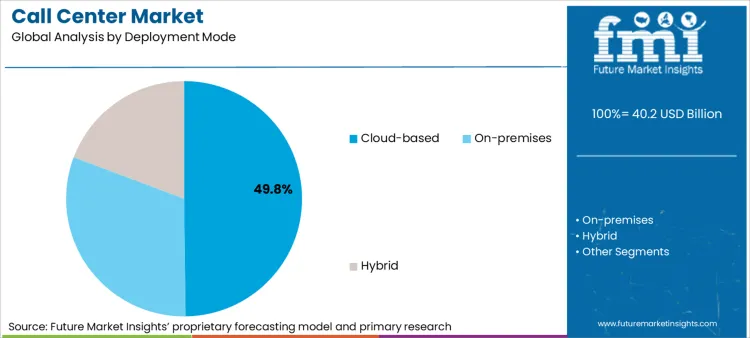
Cloud-based contact center platforms account for 49.8% of call center deployments, driven by scalability, rapid deployment, and lower upfront infrastructure costs. Enterprises increasingly favor cloud architectures to support remote agent models, seasonal demand spikes, and omnichannel integration across voice, chat, and social channels. Cloud platforms also enable faster adoption of AI tools such as speech analytics and virtual assistants without heavy on-premise upgrades. FMI notes that cloud-based deployments reduce operational friction and support continuous CX innovation, making them the preferred model for both new implementations and legacy migrations. This structural shift positions cloud as the default deployment choice for enterprises modernizing customer engagement operations.
Why Does BFSI and Government Lead Call Center Demand by Vertical?

BFSI and government together account for 31.4% of call center demand, reflecting high service intensity, regulatory-driven customer communication, and reliance on contact centers for service continuity. Financial institutions manage high volumes of account inquiries, fraud alerts, and service requests that require secure, compliant interaction handling. Public sector agencies use call centers for citizen services, benefit administration, and crisis communication, sustaining baseline demand. TTEC’s long-term CX partnerships with global BFSI clients illustrate how regulated sectors anchor large-scale contact center programs through multi-year outsourcing contracts. FMI observes that compliance complexity and service-critical interactions sustain higher outsourcing intensity within BFSI and government relative to other verticals.
Why Do Services Lead the Component Mix?
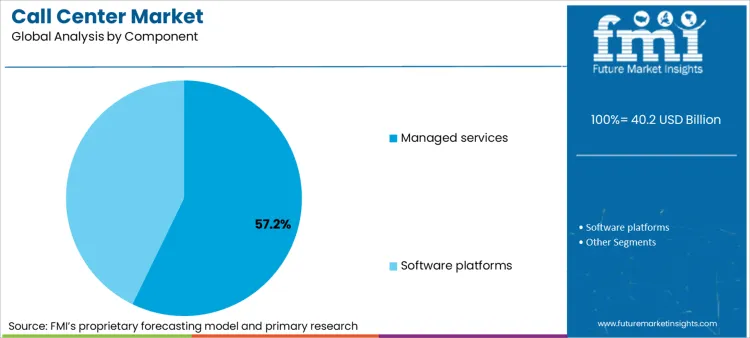
Services represent 57.2% of call center market value, reflecting the operational complexity of running 24/7 customer support across multiple channels and geographies. Enterprises increasingly outsource workforce management, training, quality assurance, and analytics to specialized providers rather than building in-house capabilities. Managed services also support rapid scaling during peak demand periods and market expansions. FMI notes that service-led contracts enable enterprises to focus on core operations while transferring CX delivery risk to specialized vendors. This dynamic sustains services as the dominant component, with software platforms increasingly bundled into long-term service agreements rather than procured as standalone tools.
Why Do Inbound Services Anchor Call Center Demand?

Inbound services account for 46.5% of call center interactions, reflecting persistent demand for customer support, technical assistance, billing inquiries, and service recovery. As brands expand digital channels, inbound contact volumes remain high for complex issue resolution that requires human intervention. Enterprises prioritize first-contact resolution and customer satisfaction metrics, sustaining investment in skilled inbound agent teams. FMI highlights that inbound services anchor customer trust and retention, positioning them as the core function of call centers even as outbound and blended services grow for sales and proactive engagement use cases.
What Trends Are Steering the Evolution of Call Center Service Models?
Call center operations are evolving as enterprises prioritize omnichannel engagement, faster response times, and consistent service quality across voice and digital touchpoints. Customer interactions increasingly span calls, chat, messaging apps, and social platforms, pushing service providers to integrate channels into unified CX workflows. Agent enablement tools such as real-time guidance, sentiment analytics, and AI-assisted routing are improving first-contact resolution and handling efficiency. As per Future Market Insights, call centers are shifting from reactive support functions toward proactive customer engagement hubs that support retention, cross-sell, and service recovery. Remote and hybrid workforce models are also reshaping delivery structures, enabling access to wider talent pools and improving operational resilience during demand spikes and business disruptions.
How Is Service Portfolio Expansion Strengthening Contact Center Platforms?
Service portfolio expansion is reinforcing competitive positioning as providers bundle inbound support, outbound sales, analytics, and workforce optimization into integrated CX delivery platforms. Large CX service firms are building end-to-end offerings that span customer acquisition, servicing, and lifecycle management, improving continuity across customer journeys. Teleperformance’s expansion into analytics-led CX management and digital customer engagement illustrates how service providers extend beyond traditional voice support to deliver integrated experience platforms. This portfolio breadth improves client stickiness, supports multi-year outsourcing contracts, and aligns service delivery with enterprise-wide CX transformation agendas. FMI observes that integrated service portfolios accelerate adoption by simplifying vendor management and enabling consistent service standards across regions and channels.
Why Is Delivery Model Optimization Driving Operational Innovation?
Cost discipline and rising performance benchmarks are pushing call center providers to refine delivery models while maintaining service quality and compliance. Enterprises demand predictable service levels, outcome-based pricing, and continuous productivity improvements from outsourcing partners. Providers are standardizing operating playbooks, investing in automation for routine interactions, and deploying advanced workforce management to optimize staffing across fluctuating volumes. Minor changes in routing logic, agent training, or quality assurance frameworks can materially affect customer satisfaction and resolution rates. FMI notes that intensifying competition is placing greater emphasis on operational rigor, data-driven performance management, and continuous improvement cycles, positioning modern call centers as scalable CX infrastructure rather than labor-intensive support units.
What Is the Country-wise Outlook for the Global Call Center Market?
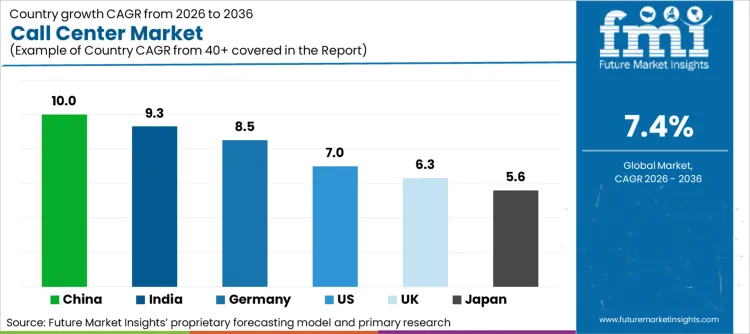
Country-level growth across the call center market shows clear variation across regions and operating environments, with China leading at a 10.0% CAGR, followed by India at 9.3%, reflecting strong expansion momentum across large-scale service delivery markets, while Germany records 8.5% growth as enterprises continue to scale structured customer engagement operations; the United States posts 7.0%, indicating steady expansion within a mature contact center landscape, the United Kingdom reaches 6.3% with continued market development across outsourced and in-house models, and Japan trails at 5.6%, reflecting a more measured pace of market progression within established service frameworks.
| Country | CAGR (2026-2036) |
|---|---|
| China | 10.0% |
| India | 9.3% |
| Germany | 8.5% |
| United States | 7.0% |
| United Kingdom | 6.3% |
| Japan | 5.6% |
Source: FMI historical analysis and forecast data.
Why Is China Setting the Pace in Call Center Market Expansion?
China’s 10.0% CAGR reflects the scale and depth of contact center capacity growth across domestic service industries and large enterprise support networks. The country’s call center market benefits from strong penetration across retail, telecom, travel, and digital services, where customer support functions are increasingly embedded into platform-based business models. Large service providers operate extensive delivery centers supporting both local and regional language requirements. Service standardization and process digitization are shaping operational models, with contact centers positioned as core service infrastructure rather than auxiliary support functions. Expansion is also supported by continued investment in centralized customer engagement hubs serving high-volume consumer-facing sectors. The market trajectory reflects structural capacity build-out and deeper integration of call center operations into enterprise customer service frameworks across multiple industries.
What Is Enabling India’s Rapid Scale-Up in the Call Center Market?
India’s 9.3% CAGR reflects its entrenched role within global customer service delivery ecosystems and the continued expansion of export-oriented service operations. The country hosts large, multi-city contact center networks serving banking, insurance, technology, travel, and e-commerce sectors. India’s operating model emphasizes standardized service processes and multi-client delivery centers that support high-volume customer interactions across international markets. Tata Consultancy Services has expanded its business process services footprint to support global customer experience operations for multinational clients, reflecting India’s role in large-scale contact center delivery. Market expansion is anchored in the continued scaling of delivery capacity across metro and tier-two cities, with service providers extending coverage across voice, chat, and digital engagement formats within integrated customer service environments.
Why Is Germany Demonstrating Consistent Call Center Market Progression?
Germany’s 8.5% CAGR reflects structured expansion within regulated service environments where customer engagement operations are closely aligned with enterprise compliance frameworks. The call center market remains closely linked to financial services, utilities, automotive aftersales, and public sector service delivery, where customer support functions are embedded within standardized operating models. Growth is marked by gradual scaling of domestic contact centers rather than aggressive offshore expansion, with enterprises prioritizing operational stability and service continuity. The market structure favors multi-channel contact center models that integrate voice, digital support, and back-office functions within unified service platforms. Germany’s growth profile reflects steady capacity expansion across established enterprise support functions, with call centers positioned as long-term service infrastructure rather than short-term outsourcing solutions.
How Is the United States Sustaining Momentum in the Call Center Market?
The United States posts a 7.0% CAGR, reflecting steady market progression within a mature contact center ecosystem that spans in-house enterprise operations and outsourced service providers. Large corporations maintain extensive domestic contact center footprints to support customer engagement across telecom, healthcare, financial services, and retail sectors. Market development is characterized by ongoing platform modernization and consolidation of service operations across multi-location networks. Call centers in the U.S. function as core components of enterprise service delivery frameworks, with structured operational models supporting consistent service quality across large customer bases. Growth reflects continued investment in operational capacity and service platform upgrades across existing contact center networks, supporting sustained market progression without major structural shifts in delivery models.
What Is Shaping the Measured Growth Profile of Japan’s Call Center Market?
Japan’s 5.6% CAGR reflects a stable and methodical expansion pattern within established enterprise service ecosystems. Call centers in Japan are closely integrated into corporate service operations, particularly across banking, consumer electronics, telecom, and public services. Market development emphasizes continuity of service quality and long-term customer relationship management rather than rapid scaling of outsourced delivery capacity. Enterprises maintain strong internal customer support frameworks, with call centers positioned as core operational assets embedded within broader service organizations. The market trajectory reflects incremental expansion of service capacity across domestic delivery centers, with growth driven by gradual extension of service operations across digital and voice-based customer engagement channels within structured corporate support environments.
What Is the Competitive Outlook for the Call Center Market?

The competitive landscape for the call center market is led by large global customer experience (CX) service providers that are extending beyond traditional voice-based support. Players such as Teleperformance, Concentrix, Foundever, TTEC, and Alorica benefit from global delivery footprints and long-standing enterprise relationships across BFSI, telecom, technology, and retail sectors. Teleperformance holds an estimated leading share of the global CX outsourcing market, reflecting its ability to scale omnichannel delivery, AI-enabled CX solutions, and industry-specific service models across developed and emerging regions. Competitive positioning in this market is shaped less by short-term seat expansion and more by the ability to embed call center services within broader digital CX transformation programs.
Future Market Insights observes that competition is increasingly centered on analytics-led performance management, omnichannel integration, and vertical specialization rather than pure cost-based competition. Companies such as Concentrix and TTEC emphasize data-driven CX optimization, customer journey analytics, and AI-assisted service orchestration to improve outcomes across sales, service, and retention programs. At the same time, providers including Foundever, Atento, HGS (Hinduja Global Solutions), and Startek strengthen positioning through nearshore and offshore delivery, multilingual support, and scalable workforce models. FMI notes that long-term competitive advantage will depend on how effectively CX providers integrate automation, human-in-the-loop service design, and industry-aligned delivery frameworks into enterprise customer engagement strategies rather than treating call centers as standalone support operations.
Recent Developments:
- In December 2025, Genesys reported strong Q3 Fiscal Year 2026 results, driven by a surge in "Agentic AI" adoption. The company announced that its Genesys Cloud platform had reached nearly $2.4 billion in Annual Recurring Revenue (ARR), growing over 30% year-over-year. A key driver was the "Genesys Cloud Agent Copilot," which saw a 5X increase in usage, signaling a massive market shift where enterprises are moving from simple chatbots to AI that actively assists human agents in real-time.
- In November 2025, NICE formed a strategic alliance with Tata Communications to deploy the "CXone Mpower" platform globally. This partnership integrates NICE’s AI-powered CX platform with Tata’s global network reach, specifically targeting large multinational enterprises that need to standardize their contact center operations across fragmented regions. The move highlights the trend of carriers and CCaaS (Contact Center as a Service) providers bundling connectivity with advanced AI applications.
Key Players in Call Center Market
- Teleperformance
- Concentrix
- TTEC
- Foundever
- Alorica
- Sykes Enterprises
- Atento
- HGS (Hinduja Global Solutions)
- Majorel
- Webhelp
What Is the Market Definition?
The call center market encompasses software applications, hardware infrastructure, and professional services that enable organizations to manage customer communications across multiple channels including voice, email, chat, social media, and video interactions through centralized operations. This includes both inbound customer service operations and outbound sales and marketing activities that require systematic contact management and performance monitoring capabilities.
Inclusions within the market scope are cloud-based contact center as a service platforms, on-premises software licensing and maintenance, hybrid deployment models, workforce management tools, quality monitoring systems, analytics and reporting platforms, integration services, training and consulting services, and hardware components specifically designed for call center operations including headsets, telephony equipment, and specialized server infrastructure.
Exclusions from market calculations include general-purpose communication tools not specifically designed for call center operations, standalone telephony services without contact center functionality, basic email and chat applications that lack call center-specific features like queue management and reporting, hardware components that serve multiple purposes beyond call center operations, and telecommunication carrier services that provide underlying connectivity but not contact center-specific capabilities.
Scope of Report
| Items | Values |
|---|---|
| Quantitative Units (2026) | USD 40.2 Billion |
| Deployment Mode | Cloud-based; On-premises; Hybrid |
| Service Type | Inbound services; Outbound services; Blended services; Others |
| Component | Software platforms; Managed services |
| Verticals Covered | BFSI & Government; Healthcare; IT & Telecom; Media & Entertainment; Retail & Consumer Goods |
| Regions Covered | North America, Europe, Asia Pacific, Latin America, Middle East & Africa |
| Countries Covered | United States, Germany, United Kingdom, India, China, Japan, and 40+ countries |
| Key Companies Profiled | Teleperformance; Concentrix; TTEC; Foundever; Alorica; Atento; HGS (Hinduja Global Solutions); Majorel; Webhelp; Sykes Enterprises |
| Additional Attributes | Dollar sales by deployment mode and service type; country-wise growth analysis; adoption trends for cloud and hybrid contact centers; AI-enabled agent assist penetration; omnichannel CX integration patterns; outsourcing intensity across BFSI, telecom, retail, and healthcare verticals |
Source: FMI historical analysis and forecast data
Call Center Market by Segments
By Deployment Mode:
- Cloud-based
- On-premises
- Hybrid
By Service Type:
- Inbound services
- Outbound services
- Blended services
- Others
By Component:
- Software platforms
- Managed services
By Verticals Covered:
- BFSI & Government
- Healthcare
- IT & Telecom
- Media & Entertainment
- Retail & Consumer Goods
Bibliography
- Bureau of Labor Statistics. (2025). Occupational outlook handbook: Customer service representatives (2024-2034 projections). U.S. Department of Labor.
- Ministry of Electronics and Information Technology (MeitY). (2025). Annual report 2024-25: Strengthening India's digital ecosystem. Government of India.
- National Institute of Standards and Technology (NIST). (2025). NIST privacy framework 1.1: Managing risks in the age of AI (Draft). U.S. Department of Commerce.
Frequently Asked Questions
How big is the call center market in 2026?
The global call center market is estimated to be valued at USD 40.2 billion in 2026.
What will be the size of call center market in 2036?
The market size for the call center market is projected to reach USD 82.1 billion by 2036.
How much will be the call center market growth between 2026 and 2036?
The call center market is expected to grow at a 7.4% CAGR between 2026 and 2036.
What are the key product types in the call center market?
The key product types in call center market are cloud-based, on-premises and hybrid.
Which verticals covered segment to contribute significant share in the call center market in 2026?
In terms of verticals covered, bfsi & government segment to command 31.4% share in the call center market in 2026.
Preview the report firsthand - request a free sample
Get SampleGet the brochure for pricing and purchase details.
Get PDFTable of Content
- Executive Summary
- Global Market Outlook
- Demand-side Trends
- Supply-side Trends
- Technology Roadmap Analysis
- Analysis and Recommendations
- Market Overview
- Market Coverage / Taxonomy
- Market Definition / Scope / Limitations
- Research Methodology
- Chapter Orientation
- Analytical Lens and Working Hypotheses
- Market Structure, Signals, and Trend Drivers
- Benchmarking and Cross-market Comparability
- Market Sizing, Forecasting, and Opportunity Mapping
- Research Design and Evidence Framework
- Desk Research Programme (Secondary Evidence)
- Company Annual and Sustainability Reports
- Peer-reviewed Journals and Academic Literature
- Corporate Websites, Product Literature, and Technical Notes
- Earnings Decks and Investor Briefings
- Statutory Filings and Regulatory Disclosures
- Technical White Papers and Standards Notes
- Trade Journals, Industry Magazines, and Analyst Briefs
- Conference Proceedings, Webinars, and Seminar Materials
- Government Statistics Portals and Public Data Releases
- Press Releases and Reputable Media Coverage
- Specialist Newsletters and Curated Briefings
- Sector Databases and Reference Repositories
- FMI Internal Proprietary Databases and Historical Market Datasets
- Subscription Datasets and Paid Sources
- Social Channels, Communities, and Digital Listening Inputs
- Additional Desk Sources
- Expert Input and Fieldwork (Primary Evidence)
- Primary Modes
- Qualitative Interviews and Expert Elicitation
- Quantitative Surveys and Structured Data Capture
- Blended Approach
- Why Primary Evidence is Used
- Field Techniques
- Interviews
- Surveys
- Focus Groups
- Observational and In-context Research
- Social and Community Interactions
- Stakeholder Universe Engaged
- C-suite Leaders
- Board Members
- Presidents and Vice Presidents
- R&D and Innovation Heads
- Technical Specialists
- Domain Subject-matter Experts
- Scientists
- Physicians and Other Healthcare Professionals
- Governance, Ethics, and Data Stewardship
- Research Ethics
- Data Integrity and Handling
- Primary Modes
- Tooling, Models, and Reference Databases
- Desk Research Programme (Secondary Evidence)
- Data Engineering and Model Build
- Data Acquisition and Ingestion
- Cleaning, Normalisation, and Verification
- Synthesis, Triangulation, and Analysis
- Quality Assurance and Audit Trail
- Market Background
- Market Dynamics
- Drivers
- Restraints
- Opportunity
- Trends
- Scenario Forecast
- Demand in Optimistic Scenario
- Demand in Likely Scenario
- Demand in Conservative Scenario
- Opportunity Map Analysis
- Product Life Cycle Analysis
- Supply Chain Analysis
- Investment Feasibility Matrix
- Value Chain Analysis
- PESTLE and Porter’s Analysis
- Regulatory Landscape
- Regional Parent Market Outlook
- Production and Consumption Statistics
- Import and Export Statistics
- Market Dynamics
- Global Market Analysis 2021 to 2025 and Forecast, 2026 to 2036
- Historical Market Size Value (USD Million) Analysis, 2021 to 2025
- Current and Future Market Size Value (USD Million) Projections, 2026 to 2036
- Y-o-Y Growth Trend Analysis
- Absolute $ Opportunity Analysis
- Global Market Pricing Analysis 2021 to 2025 and Forecast 2026 to 2036
- Global Market Analysis 2021 to 2025 and Forecast 2026 to 2036, By Deployment Mode
- Introduction / Key Findings
- Historical Market Size Value (USD Million) Analysis By Deployment Mode , 2021 to 2025
- Current and Future Market Size Value (USD Million) Analysis and Forecast By Deployment Mode , 2026 to 2036
- Cloud-based
- On-premises
- Hybrid
- Cloud-based
- Y-o-Y Growth Trend Analysis By Deployment Mode , 2021 to 2025
- Absolute $ Opportunity Analysis By Deployment Mode , 2026 to 2036
- Global Market Analysis 2021 to 2025 and Forecast 2026 to 2036, By Verticals Covered
- Introduction / Key Findings
- Historical Market Size Value (USD Million) Analysis By Verticals Covered, 2021 to 2025
- Current and Future Market Size Value (USD Million) Analysis and Forecast By Verticals Covered, 2026 to 2036
- BFSI & Government
- Healthcare
- IT & Telecom
- Media & Entertainment
- Retail & Consumer Goods
- BFSI & Government
- Y-o-Y Growth Trend Analysis By Verticals Covered, 2021 to 2025
- Absolute $ Opportunity Analysis By Verticals Covered, 2026 to 2036
- Global Market Analysis 2021 to 2025 and Forecast 2026 to 2036, By Component
- Introduction / Key Findings
- Historical Market Size Value (USD Million) Analysis By Component, 2021 to 2025
- Current and Future Market Size Value (USD Million) Analysis and Forecast By Component, 2026 to 2036
- Managed services
- Software platforms
- Managed services
- Y-o-Y Growth Trend Analysis By Component, 2021 to 2025
- Absolute $ Opportunity Analysis By Component, 2026 to 2036
- Global Market Analysis 2021 to 2025 and Forecast 2026 to 2036, By Service Type
- Introduction / Key Findings
- Historical Market Size Value (USD Million) Analysis By Service Type, 2021 to 2025
- Current and Future Market Size Value (USD Million) Analysis and Forecast By Service Type, 2026 to 2036
- Inbound services
- Outbound services
- Blended services
- Inbound services
- Y-o-Y Growth Trend Analysis By Service Type, 2021 to 2025
- Absolute $ Opportunity Analysis By Service Type, 2026 to 2036
- Global Market Analysis 2021 to 2025 and Forecast 2026 to 2036, By Region
- Introduction
- Historical Market Size Value (USD Million) Analysis By Region, 2021 to 2025
- Current Market Size Value (USD Million) Analysis and Forecast By Region, 2026 to 2036
- North America
- Latin America
- Western Europe
- Eastern Europe
- East Asia
- South Asia and Pacific
- Middle East & Africa
- Market Attractiveness Analysis By Region
- North America Market Analysis 2021 to 2025 and Forecast 2026 to 2036, By Country
- Historical Market Size Value (USD Million) Trend Analysis By Market Taxonomy, 2021 to 2025
- Market Size Value (USD Million) Forecast By Market Taxonomy, 2026 to 2036
- By Country
- USA
- Canada
- Mexico
- By Deployment Mode
- By Verticals Covered
- By Component
- By Service Type
- By Country
- Market Attractiveness Analysis
- By Country
- By Deployment Mode
- By Verticals Covered
- By Component
- By Service Type
- Key Takeaways
- Latin America Market Analysis 2021 to 2025 and Forecast 2026 to 2036, By Country
- Historical Market Size Value (USD Million) Trend Analysis By Market Taxonomy, 2021 to 2025
- Market Size Value (USD Million) Forecast By Market Taxonomy, 2026 to 2036
- By Country
- Brazil
- Chile
- Rest of Latin America
- By Deployment Mode
- By Verticals Covered
- By Component
- By Service Type
- By Country
- Market Attractiveness Analysis
- By Country
- By Deployment Mode
- By Verticals Covered
- By Component
- By Service Type
- Key Takeaways
- Western Europe Market Analysis 2021 to 2025 and Forecast 2026 to 2036, By Country
- Historical Market Size Value (USD Million) Trend Analysis By Market Taxonomy, 2021 to 2025
- Market Size Value (USD Million) Forecast By Market Taxonomy, 2026 to 2036
- By Country
- Germany
- UK
- Italy
- Spain
- France
- Nordic
- BENELUX
- Rest of Western Europe
- By Deployment Mode
- By Verticals Covered
- By Component
- By Service Type
- By Country
- Market Attractiveness Analysis
- By Country
- By Deployment Mode
- By Verticals Covered
- By Component
- By Service Type
- Key Takeaways
- Eastern Europe Market Analysis 2021 to 2025 and Forecast 2026 to 2036, By Country
- Historical Market Size Value (USD Million) Trend Analysis By Market Taxonomy, 2021 to 2025
- Market Size Value (USD Million) Forecast By Market Taxonomy, 2026 to 2036
- By Country
- Russia
- Poland
- Hungary
- Balkan & Baltic
- Rest of Eastern Europe
- By Deployment Mode
- By Verticals Covered
- By Component
- By Service Type
- By Country
- Market Attractiveness Analysis
- By Country
- By Deployment Mode
- By Verticals Covered
- By Component
- By Service Type
- Key Takeaways
- East Asia Market Analysis 2021 to 2025 and Forecast 2026 to 2036, By Country
- Historical Market Size Value (USD Million) Trend Analysis By Market Taxonomy, 2021 to 2025
- Market Size Value (USD Million) Forecast By Market Taxonomy, 2026 to 2036
- By Country
- China
- Japan
- South Korea
- By Deployment Mode
- By Verticals Covered
- By Component
- By Service Type
- By Country
- Market Attractiveness Analysis
- By Country
- By Deployment Mode
- By Verticals Covered
- By Component
- By Service Type
- Key Takeaways
- South Asia and Pacific Market Analysis 2021 to 2025 and Forecast 2026 to 2036, By Country
- Historical Market Size Value (USD Million) Trend Analysis By Market Taxonomy, 2021 to 2025
- Market Size Value (USD Million) Forecast By Market Taxonomy, 2026 to 2036
- By Country
- India
- ASEAN
- Australia & New Zealand
- Rest of South Asia and Pacific
- By Deployment Mode
- By Verticals Covered
- By Component
- By Service Type
- By Country
- Market Attractiveness Analysis
- By Country
- By Deployment Mode
- By Verticals Covered
- By Component
- By Service Type
- Key Takeaways
- Middle East & Africa Market Analysis 2021 to 2025 and Forecast 2026 to 2036, By Country
- Historical Market Size Value (USD Million) Trend Analysis By Market Taxonomy, 2021 to 2025
- Market Size Value (USD Million) Forecast By Market Taxonomy, 2026 to 2036
- By Country
- Kingdom of Saudi Arabia
- Other GCC Countries
- Turkiye
- South Africa
- Other African Union
- Rest of Middle East & Africa
- By Deployment Mode
- By Verticals Covered
- By Component
- By Service Type
- By Country
- Market Attractiveness Analysis
- By Country
- By Deployment Mode
- By Verticals Covered
- By Component
- By Service Type
- Key Takeaways
- Key Countries Market Analysis
- USA
- Pricing Analysis
- Market Share Analysis, 2025
- By Deployment Mode
- By Verticals Covered
- By Component
- By Service Type
- Canada
- Pricing Analysis
- Market Share Analysis, 2025
- By Deployment Mode
- By Verticals Covered
- By Component
- By Service Type
- Mexico
- Pricing Analysis
- Market Share Analysis, 2025
- By Deployment Mode
- By Verticals Covered
- By Component
- By Service Type
- Brazil
- Pricing Analysis
- Market Share Analysis, 2025
- By Deployment Mode
- By Verticals Covered
- By Component
- By Service Type
- Chile
- Pricing Analysis
- Market Share Analysis, 2025
- By Deployment Mode
- By Verticals Covered
- By Component
- By Service Type
- Germany
- Pricing Analysis
- Market Share Analysis, 2025
- By Deployment Mode
- By Verticals Covered
- By Component
- By Service Type
- UK
- Pricing Analysis
- Market Share Analysis, 2025
- By Deployment Mode
- By Verticals Covered
- By Component
- By Service Type
- Italy
- Pricing Analysis
- Market Share Analysis, 2025
- By Deployment Mode
- By Verticals Covered
- By Component
- By Service Type
- Spain
- Pricing Analysis
- Market Share Analysis, 2025
- By Deployment Mode
- By Verticals Covered
- By Component
- By Service Type
- France
- Pricing Analysis
- Market Share Analysis, 2025
- By Deployment Mode
- By Verticals Covered
- By Component
- By Service Type
- India
- Pricing Analysis
- Market Share Analysis, 2025
- By Deployment Mode
- By Verticals Covered
- By Component
- By Service Type
- ASEAN
- Pricing Analysis
- Market Share Analysis, 2025
- By Deployment Mode
- By Verticals Covered
- By Component
- By Service Type
- Australia & New Zealand
- Pricing Analysis
- Market Share Analysis, 2025
- By Deployment Mode
- By Verticals Covered
- By Component
- By Service Type
- China
- Pricing Analysis
- Market Share Analysis, 2025
- By Deployment Mode
- By Verticals Covered
- By Component
- By Service Type
- Japan
- Pricing Analysis
- Market Share Analysis, 2025
- By Deployment Mode
- By Verticals Covered
- By Component
- By Service Type
- South Korea
- Pricing Analysis
- Market Share Analysis, 2025
- By Deployment Mode
- By Verticals Covered
- By Component
- By Service Type
- Russia
- Pricing Analysis
- Market Share Analysis, 2025
- By Deployment Mode
- By Verticals Covered
- By Component
- By Service Type
- Poland
- Pricing Analysis
- Market Share Analysis, 2025
- By Deployment Mode
- By Verticals Covered
- By Component
- By Service Type
- Hungary
- Pricing Analysis
- Market Share Analysis, 2025
- By Deployment Mode
- By Verticals Covered
- By Component
- By Service Type
- Kingdom of Saudi Arabia
- Pricing Analysis
- Market Share Analysis, 2025
- By Deployment Mode
- By Verticals Covered
- By Component
- By Service Type
- Turkiye
- Pricing Analysis
- Market Share Analysis, 2025
- By Deployment Mode
- By Verticals Covered
- By Component
- By Service Type
- South Africa
- Pricing Analysis
- Market Share Analysis, 2025
- By Deployment Mode
- By Verticals Covered
- By Component
- By Service Type
- USA
- Market Structure Analysis
- Competition Dashboard
- Competition Benchmarking
- Market Share Analysis of Top Players
- By Regional
- By Deployment Mode
- By Verticals Covered
- By Component
- By Service Type
- Competition Analysis
- Competition Deep Dive
- Teleperformance
- Overview
- Product Portfolio
- Profitability by Market Segments (Product/Age /Sales Channel/Region)
- Sales Footprint
- Strategy Overview
- Marketing Strategy
- Product Strategy
- Channel Strategy
- Concentrix
- TTEC
- Foundever
- Alorica
- Sykes Enterprises
- Teleperformance
- Competition Deep Dive
- Assumptions & Acronyms Used


