

- Industry Size (2022)
- USD 1.8 Bn
- Forecast (2032)
- USD 3.3 Bn
- CAGR (2026 to 2036)
- 6.2%
Summary of the Caraway Seeds Market
- Demand and Growth Drivers
- Premium bakery and ethnic cuisine expansion is likely to support demand for caraway seeds, particularly in rye bread, crackers, and traditional European food preparations.
- Pharmaceutical and nutraceutical applications are expected to remain a key growth driver as caraway seed oil gains relevance for digestive health and herbal formulations.
- Organic and fair-trade sourcing trends are likely to support adoption, with consumers increasingly preferring traceable and sustainably sourced spice ingredients.
- Product and Segment View
- Whole seed is likely to remain the leading form segment, supported by demand from food processors, spice blenders, and bakery applications.
- Savory dishes are expected to lead the application segment, driven by widespread use in seasoning blends, meat preparations, and traditional cuisines.
- Processed formats such as ground seeds and oil extracts are likely to remain important high-value segments for pharmaceutical and nutraceutical use.
- Geography and Competitive Outlook
- China is likely to remain a key growth market owing to expanding spice processing industries and increasing adoption in packaged food manufacturing.
- India is expected to sustain demand on account of strong domestic consumption and export-oriented spice production.
- Companies that can ensure consistent quality, certification compliance, and supply chain traceability are likely to gain traction during the forecast period.
- Analyst Opinion
- Nandini Roy Choudhury, Principal Consultant at FMI says, “Producers that can balance quality consistency with certified sourcing standards are likely to strengthen their position in both culinary and pharmaceutical application segments.”
- The caraway seeds market is evolving from a traditional spice category into a more value-added ingredient segment.
- Adoption is being driven by increased use in premium bakery and ethnic cuisine applications.
- The market is also benefiting from growing demand for plant-based digestive health ingredients in nutraceutical formulations.
- Demand is further supported by the need for traceable, organic, and sustainably sourced spice supply chains.
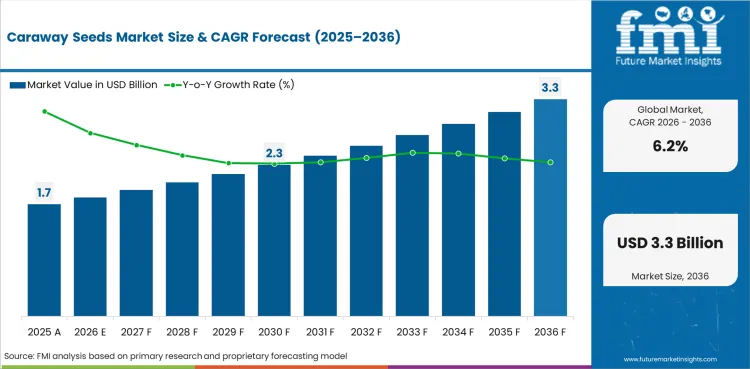
Key Takeaways, Market Size, and Forecast
- The caraway seeds market was valued at USD 1.7 billion in 2025.
- The market is set to reach USD 1.8 billion by the end of 2026.
- The market is projected to grow at a CAGR of 6.2% between 2026–2036.
- By 2036, the market is expected to reach USD 3.3 billion.
- Whole Seed will dominate with a 62.5% share.
- Savory Dishes will lead with a 33.8% share.
Caraway Seeds Market Definition
The caraway seeds market encompasses commercially traded caraway seed products in whole seed, ground powder, and oil formats, supplied to food manufacturers, pharmaceutical companies, personal care companies, and retail consumers across savory, bakery, and functional applications.
Caraway Seeds Market Inclusions
Market scope includes all commercially traded caraway seed products segmented by form (whole seed, powder), application (savory dishes, soups, mouthwash, pickles, salads, sauerkraut), sales channel (offline, online), product (whole caraway seeds, ground caraway seeds, caraway seed oil), end use (food manufacturers, pharmaceutical companies, personal care companies, retail consumers), distribution channel (direct sales, indirect sales, online retailing), and pricing tier (premium, mid-range, economy). Revenue sizing spans the 2026 to 2036 forecast period.
Caraway Seeds Market Exclusions
The scope excludes raw agricultural caraway seed output sold as commodity with no trade grading, non-food-grade caraway derivatives, and home-cultivated caraway for personal consumption.
Caraway Seeds Market Research Methodology
- Primary Research: FMI analysts conducted interviews with spice procurement managers at food manufacturers, pharmaceutical ingredient buyers, personal care formulators, and caraway seed exporters across Europe, the Middle East, and Asia.
- Desk Research: To set verifiable baseline parameters, data collection combined spice trade statistics from IOSTA and FAO, publications from spice industry associations, company annual reports, and European pharmacopoeia documents.
- Market Sizing and Forecasting: We get baseline values by adding up the volumes of caraway seed transactions from the bottom up. We then use region-specific culinary penetration and pharmaceutical application curves to predict demand through 2036.
- Data validation and update cycle: Projections are tested against spice import statistics, food manufacturer procurement disclosures, and pharmaceutical formulation registrations on a quarterly refresh schedule.
Why is the Caraway Seeds Market Growing?
- Premium bakery and ethnic cuisine expansion is driving caraway inclusion in rye bread, crackers, charcuterie, and cheese applications across Western retail.
- Caraway seed oil for pharmaceutical and nutraceutical uses in the digestive and respiratory systems costs more per kilogram than culinary-grade seed.
- Organic and fair-trade certified caraway costs 20 to 40 percent more, which helps investors in the origin and converters to make more money.
The market for caraway seeds is growing steadily because of the growth of premium bakeries, the use of caraway seeds in pharmaceuticals and nutraceuticals, and the demand for certified-origin sourcing. Caraway is a key spice in Central and Eastern European cooking. It is still used in rye bread, sauerkraut, charcuterie, and cheese in Germany, Austria, the Netherlands, and Scandinavia, where it is a stable and large base demand.
There is a new layer of specifications for pharmaceutical and nutraceutical uses. Caraway seed oil, which is used to help with digestion, relieve bloating, and help with breathing, is more expensive per kilogram than culinary-grade seed. This is leading to more investment in controlled distillation and extraction capacity. Caraway extracts that meet pharmacopoeia standards cost more in Germany, France, and the UK.
Sourcing from organic and fair-trade certified sources is both a way to grow and a way to increase margins. Certified organic caraway from Finland, the Netherlands, Egypt, and Morocco costs 20 to 40 percent more than regular volumes. This supports investments in seed grading, traceability, and food safety certification.
Market Segmental Analysis
- In 2026, whole seed will have the largest share of the form segment, with 62.5%. This is because whole seed form is preferred for aroma and visual effect in retail and industrial bakery applications.
- Savory dishes make up 33.8% of the application segment, and offline channels make up 71.4% of sales. This shows the cultural and culinary roots of caraway in Central and Eastern European markets.
- Online retail and premium pricing tiers are the fastest-growing sub-segments, driven by gourmet spice specialist brands and direct-to-consumer organic origin positioning.
The caraway seeds market is segmented by form, application, sales channel, product, and geographic regions. Segment shares in 2026 reflect the dominant use cases, format preferences, and channel structures that characterise the category across mature and emerging geographies.
Insights into the Whole Seed Segment
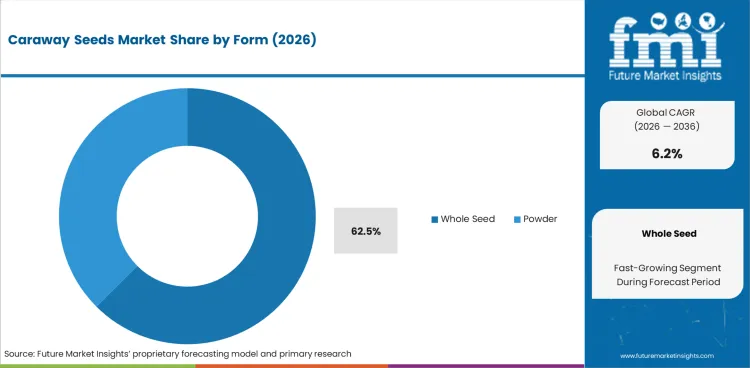
In 2026, Whole Seed is expected to have the largest share of the form segment, with 62.5%. This leadership is based on a well-established manufacturing and supply chain, competitive unit economics, and the ability to meet core customer needs better than anyone else across the main application channels.
In this category, nearby sub-segments are gaining market share as customers react to changes in reformulation, regulations, and consumer preferences. Converters and suppliers that can handle a wide range of formats and work in different regions are best able to take advantage of this subsegment rotation.
Insights into the Savory Dishes Segment
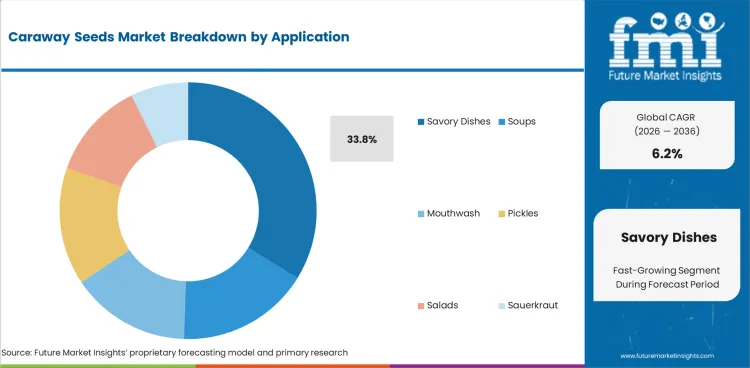
Savory Dishes is expected to have the largest share of the application segment in 2026, with 33.8%. This leadership is based on a well-established manufacturing and supply chain, competitive unit economics, and the ability to meet core customer needs better than anyone else across the main application channels.
Insights into the Offline Segment
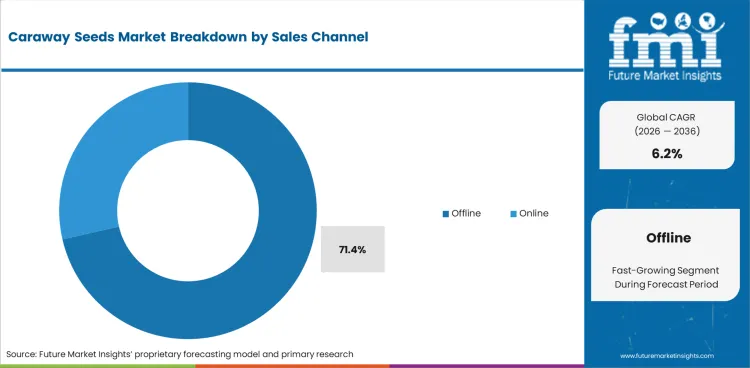
In 2026, offline is expected to have the largest share of the sales channel segment, at 71.4%. This leadership is based on a well-established manufacturing and supply chain, competitive unit economics, and the ability to meet the core needs of customers better than anyone else in the most popular application channels.
Caraway Seeds Market Drivers, Restraints, and Opportunities
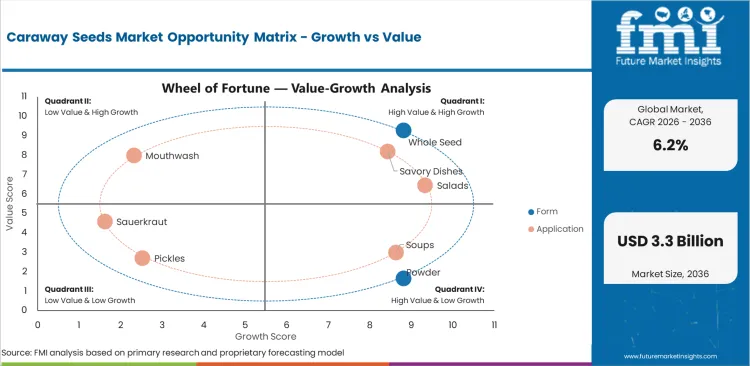
- Premium bakery and ethnic cuisine expansion in North America and Asia-Pacific adds per-SKU caraway inclusion across specialty retail.
- Pharmaceutical and nutraceutical caraway seed oil applications command higher per-kg pricing and margin expansion opportunity.
- Organic and fair-trade certification captures 20 to 40 percent premiums and supports origin investment in traceability.
The caraway seeds market is shaped by three concurrent dynamics: category expansion pulling baseline demand, regulatory and reformulation pressure reshaping specification, and advanced method or format innovation expanding premium pricing bands. Manufacturers and suppliers are responding by investing in reformulation, capacity expansion, and retailer or regulatory certification partnerships.
Premium Bakery and Ethnic Cuisine Expansion
Demand is shaped by premium bakery, artisan charcuterie, and ethnic cuisine expansion in North American and Asian urban markets. Rye bread, seeded crackers, and traditional Central European dishes are driving retail-shelf adoption beyond the Central European baseline, creating new export opportunities for Eastern European and Dutch caraway exporters.
Pharmaceutical and Nutraceutical Caraway Oil
Growth reflects expanding pharmaceutical and nutraceutical application of caraway seed oil, with registrations for digestive, bloating, and respiratory applications across European Pharmacopoeia, Ayurvedic, and herbal monograph frameworks. Pharmacopoeia-grade caraway oil carries 3 to 5x the per-kg pricing of commodity seed, supporting converter investment in extraction capacity.
Organic and Fair-Trade Origin Premium
Adoption of certified organic and fair-trade caraway is accelerating in premium retail and branded ingredient supply. Certified origin volumes from Finland, Netherlands, Egypt, and Morocco command 20 to 40 percent premiums over conventional, supporting origin investment in traceability and food-safety certification.
Emerging-Market Spice Category Growth
Substantial opportunity exists in Asian and Middle Eastern urban retail where spice category expansion is pulling premium international spices, including caraway, into modern retail and e-commerce. Supply aggregators capable of delivering certified, consistent quality capture the largest share of this growing import demand.
Analysis of Caraway Seeds Market By Key Countries
.webp "Top Country Growth Comparison Caraway Seeds Market Cagr (2026 2036)")
| Country | CAGR |
|---|---|
| China | 18.37% |
| India | 17.01% |
| Germany | 15.65% |
| Brazil | 14.29% |
| United States | 12.93% |
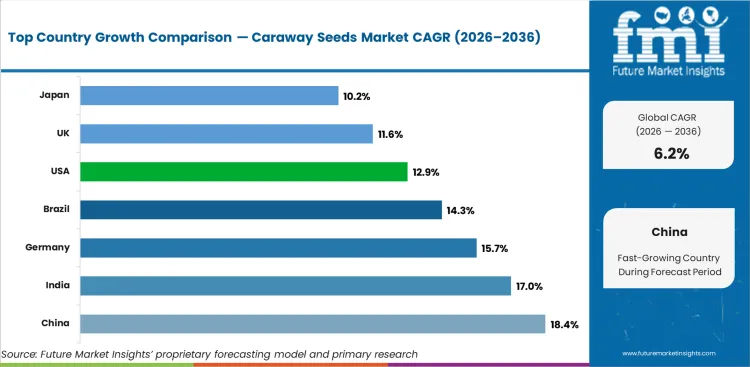
- Europe remains the largest consumption region led by Germany and Central European cuisine, while Asia-Pacific and North America deliver the highest growth through bakery premiumisation and pharmaceutical application expansion.
- China leads at 18.37 percent CAGR, driven by premium spice category growth, pharmaceutical caraway oil adoption, and e-commerce spice retail expansion.
- India follows at 17.01 percent with organised spice retail growth, pharmaceutical nutraceutical formulation, and rising premium bakery penetration.
- Middle East and Africa remain early-stage, with GCC gourmet retail and Morocco's role as an origin exporter creating cross-border trade momentum.
The caraway seeds market is projected to grow globally at a CAGR of 6.2% from 2026 to 2036. The analysis spans over 30 countries, with the leading markets detailed below.
Demand Outlook for Caraway Seeds Market in United States
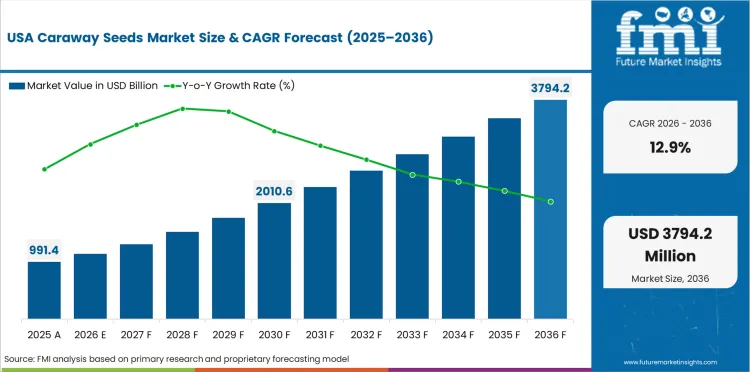
The US is expected to grow at a CAGR of 12.93% through 2036. This growth will be driven by the expansion of premium bakeries, the rise of gourmet spice stores, and the use of caraway seed oil in pharmaceuticals and nutraceuticals. McCormick & Company is the main company that distributes spices across the country. Specialist importers supply customers in the artisan bakery and charcuterie industries.
- Caraway is included in specialty retail because there is a high demand for premium bakery and charcuterie.
- The growth of gourmet spice stores helps organic and fair-trade prices stay high.
- Adopting nutraceutical caraway seed oil increases demand for higher-margin specifications.
Future Outlook for Caraway Seeds Market in United Kingdom
The UK is expected to grow at an 11.56% CAGR through 2036. This growth will be driven by the growth of the premium bakery category, organic retail, and the increasing use of caraway seed oil in herbal supplements and pharmaceuticals, all of which are guided by UK herbal monograph.
- The growth of premium bakeries and organic stores is driving up demand for whole seeds.
- Herbal monograph registrations help caraway oil become more popular in supplements.
- Private-label gourmet spice ranges bring together relationships with larger suppliers.
Opportunity Analysis for Caraway Seeds Market in Germany
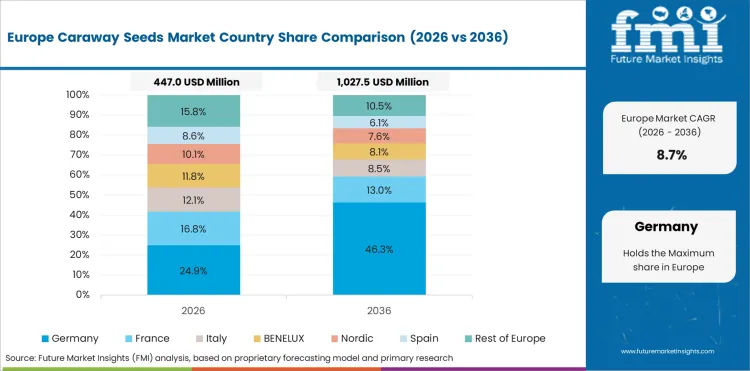
Germany has one of the highest per-capita consumption markets in the world. Caraway is a key ingredient in rye bread, sauerkraut, and Central European food. Pharmacopoeia-grade caraway oil requirements, organic retail penetration, and integrated seed-to-oil converter capacity are all things that make up German demand.
- Core culinary baseline keeps whole-seed consumption per person high.
- Pharmacopoeia-grade caraway oil drives demand for pharmaceutical use.
- Integrated converter capacity makes it possible to send goods to bakery customers all over the world.
- A Detailed Look at the Caraway Seeds Market in Japan.
In-depth Analysis for Caraway Seeds Market in Japan
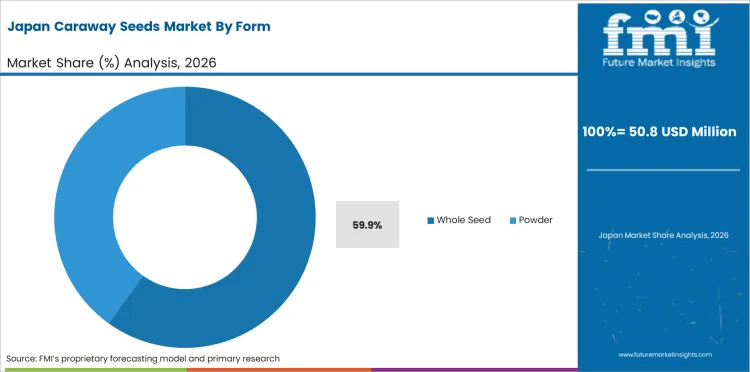
Japan is projected to grow at a 10.20 percent CAGR through 2036, reflecting a specialty spice market with premium bakery and international-cuisine positioning. Japanese consumer preference for origin-certified and organic spices supports premium pricing across specialty retail and hospitality channels.
- Premium international-cuisine retail drives specialty caraway adoption.
- Origin certification and organic positioning command premium pricing.
- Specialty bakery and charcuterie applications add seed-form demand.
Sales Analysis for Caraway Seeds Market in China
China is expected to demonstrate strong growth through 2036, propelled by premium spice category expansion, e-commerce specialty retail, and rising pharmaceutical and nutraceutical application of caraway oil. Chinese urban consumers are adopting international spice formats through premium retail and digital channels.
- Premium spice category expansion drives caraway retail adoption.
- E-commerce spice retail accelerates international-format availability.
- Pharmaceutical and nutraceutical caraway oil adoption scales with wellness retail.
In-depth Analysis for Caraway Seeds Market in India
India demonstrates strong growth through 2036, supported by organised spice retail expansion, Ayurvedic and herbal supplement formulation, and premium bakery penetration in urban centres. Indian buyers are transitioning from loose unbranded spice to branded and certified caraway through modern trade channels.
- Organised spice retail expansion drives branded caraway adoption.
- Ayurvedic and herbal supplement formulation supports premium oil demand.
- Urban premium bakery growth accelerates whole-seed retail demand.
Competitive Landscape and Strategic Positioning
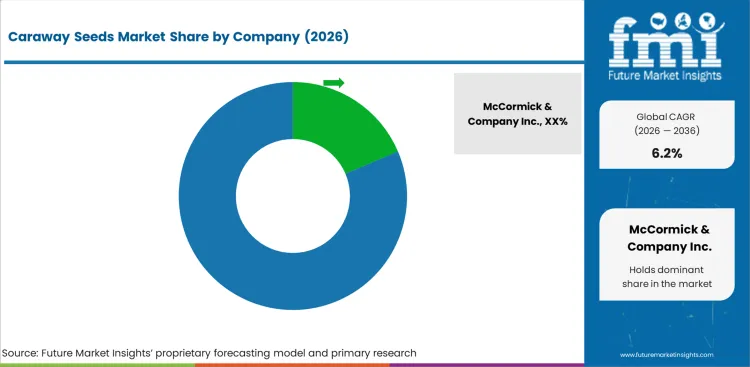
- The top converters collectively hold material share, with competitive differentiation shifting from unit cost to reformulation capability, certification depth, and customer-relationship tenure.
- Regional specialists are gaining share where local regulatory mandates and customer preference favour certified or specialised product and service offerings.
- Start-ups and SMEs are carving niche positions in climate, clean-label, and digital-channel categories targeting premium customer segments.
The caraway seeds market is shaped by global spice majors and specialist caraway exporters. McCormick & Company Inc. leads the integrated spice category with global distribution reach and branded retail positions. SLEAFORD QUALITY FOODS LTD. and Great American Spice Company serve scaled specialty retail and industrial bakery customers across Europe and North America.
SMJ EXPORTS PVT. LTD. and Canadian Exotic Grains Ltd. anchor the origin exporter segment, supplying caraway to European and North American importers with certified grading, traceability, and origin documentation. Bishnoi Trading Corporation operates in the Indian domestic and export channel with focus on bulk commodity caraway supply.
Lionel Hitchen Essential Oils and GIZA SEEDS & HERBS represent the specialist caraway oil and extract segment, supplying pharmaceutical and nutraceutical customers under European Pharmacopoeia and regulatory frameworks. This niche commands the highest per-kg pricing tier in the caraway value chain.
Barriers to entry include origin-sourcing relationships built over decades, food-safety and pharmacopoeia certification requirements, and cold-chain logistics for maintaining oil and whole-seed quality. Strategic priorities across leading converters include certified organic and fair-trade supply expansion, pharmaceutical caraway oil capacity investment, and e-commerce direct-to-consumer retail positioning.
Key Companies in the Caraway Seeds Market
Key global companies leading the caraway seeds market include:
- McCormick & Company Inc. (USA), SLEAFORD QUALITY FOODS LTD. (UK), Great American Spice Company (USA), and SMJ EXPORTS PVT. LTD. (India) were identified as leading players in the caraway seeds market, given their scaled distribution reach, branded retail positions, and origin-sourcing relationships across major producing countries.
- Bishnoi Trading Corporation (India), Canadian Exotic Grains Ltd. (Canada), and Lionel Hitchen Essential Oils (UK) operate as regional and specialist players in bulk supply, export aggregation, and essential oil extraction respectively.
- GIZA SEEDS & HERBS (Egypt) and origin specialists in Morocco, Finland, and Netherlands have established strong positions in certified organic, fair-trade, and pharmacopoeia-grade caraway supply to premium European and North American customers.
Competitive Benchmarking: Caraway Seeds Market:
| Company | Product Breadth | Origin Certification | Pharmaceutical Capability | Geographic Footprint |
|---|---|---|---|---|
| McCormick & Company Inc. | High | Medium | Medium | Global |
| SLEAFORD QUALITY FOODS LTD. | Medium | High | Low | Europe |
| Great American Spice Company | Medium | Medium | Low | North America |
| SMJ EXPORTS PVT. LTD. | Medium | High | Low | India, Global |
| Bishnoi Trading Corporation | Low | Medium | Low | India |
| Lionel Hitchen Essential Oils | Low | Medium | High | Europe |
| Canadian Exotic Grains Ltd. | Medium | Medium | Low | North America |
| GIZA SEEDS & HERBS | Medium | High | Low | Middle East, Africa |
Source: Future Market Insights competitive analysis, 2026.
Key Developments in Caraway Seeds Market
-
In 2025, McCormick & Company Inc. continued offering caraway seeds within its broad spice portfolio, supporting demand from retail and foodservice segments across North America.
- In 2025, SMJ EXPORTS PVT. LTD. remained engaged in exporting caraway seeds to international markets, including Europe and North America, reflecting steady global trade flows in specialty spices.
Key Players in the Caraway Seeds Market:
Major Global Players:
- McCormick & Company Inc.
- SLEAFORD QUALITY FOODS LTD.
- Great American Spice Company
- Bishnoi trading corporation
- SMJ EXPORTS PVT. LTD.
- Lionel Hitchen Essential Oils
- Canadian Exotic Grains Ltd.
Emerging Players/Startups:
- GIZA SEEDS & HERBS
- Organic Origin Cooperative A
- Specialty Caraway Oil Distiller B
Report Scope and Coverage
| Metric | Value |
|---|---|
| Quantitative Units | USD 1.82 billion to USD 3.31 billion, at a CAGR of 6.2% |
| Market Definition | The caraway seeds market encompasses commercially traded caraway seed products in whole seed, ground powder, and oil formats, supplied to food manufacturers, pharmaceutical companies, personal care companies, and retail consumers across savory, bakery, and functional applications. |
| Regions Covered | North America, Latin America, Europe, East Asia, South Asia and Pacific, Middle East and Africa |
| Countries Covered | India, China, USA, UK, Germany, Japan, South Korea, Brazil, 30 plus countries |
| Key Companies Profiled | McCormick & Company Inc., SLEAFORD QUALITY FOODS LTD., Great American Spice Company, Bishnoi trading corporation, SMJ EXPORTS PVT. LTD., Lionel Hitchen Essential Oils, Canadian Exotic Grains Ltd., GIZA SEEDS & HERBS |
| Forecast Period | 2026 to 2036 |
| Approach | Hybrid bottom-up and top-down methodology starting with verified caraway seeds market transaction data, projecting adoption velocity across segments and regions. |
Market Segmentation Analysis
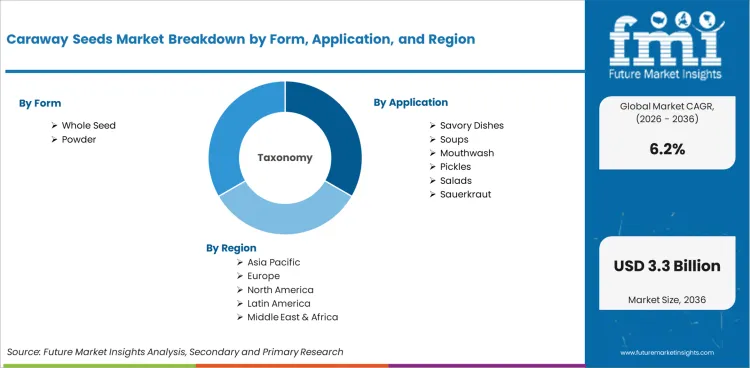
Caraway Seeds Market Market Segmented by Form:
- Whole Seed
- Powder
Caraway Seeds Market Market Segmented by Application:
- Savory Dishes
- Soups
- Mouthwash
- Pickles
- Salads
- Sauerkraut
Caraway Seeds Market Market Segmented by Sales Channel:
- Offline
- Online
Caraway Seeds Market Market Segmented by Product:
- Whole Caraway Seeds
- Ground Caraway Seeds
- Caraway Seed Oil
Caraway Seeds Market Market Segmented by End Use:
- Food Manufacturers
- Pharmaceutical Companies
- Personal Care Companies
- Retail Consumers
Caraway Seeds Market Market Segmented by Distribution Channel:
- Direct Sales
- Indirect Sales
- Online Retailing
Caraway Seeds Market Market Segmented by Pricing Tier:
- Premium Pricing
- Mid Range Pricing
- Economy Pricing
Caraway Seeds Market Market by Region:
- North America
- USA
- Canada
- Mexico
- Latin America
- Brazil
- Chile
- Rest of Latin America
- Western Europe
- Germany
- UK
- Italy
- Spain
- France
- Nordic
- BENELUX
- Rest of Western Europe
- Eastern Europe
- Russia
- Poland
- Hungary
- Balkan & Baltic
- Rest of Eastern Europe
- East Asia
- China
- Japan
- South Korea
- South Asia and Pacific
- India
- ASEAN
- Australia & New Zealand
- Rest of South Asia and Pacific
- Middle East & Africa
- Kingdom of Saudi Arabia
- Other GCC Countries
- Turkiye
- South Africa
- Other African Union
- Rest of Middle East & Africa
Research Sources and Bibliography
- 1. Food and Agriculture Organization of the United Nations. (2025). FAOSTAT Spice Crop Production Statistics. FAO.
- 2. European Pharmacopoeia Commission. (2024). European Pharmacopoeia Monograph on Caraway Oil. EDQM.
- 3. International Organization of the Spice Trade Associations. (2024). World Spice Market Statistics. IOSTA.
- 4. U.S. Department of Agriculture. (2025). Foreign Agricultural Service Spice Trade Data. USDA FAS.
- 5. Codex Alimentarius Commission. (2024). Code of Hygienic Practice for Spices and Dried Aromatic Herbs. FAO/WHO.
This bibliography is provided for reader reference.
This Report Addresses
- Market sizing and revenue forecasting for caraway seeds market from 2026 to 2036.
- Segmentation analysis across the primary axes and regional geographies.
- Regional and country-level insights covering over 30 markets with comparative growth analysis.
- Regulatory and compliance analysis covering key multilateral, national, and industry frameworks.
- Competitive landscape assessment covering market structure, vendor positioning, and recent developments.
- Investment opportunity mapping across growth verticals and geographic regions.
- Supply chain tracking from input sourcing to finished product distribution.
- Data delivery in PDF and Excel formats with quarterly refresh access.
Frequently Asked Questions
How large is the demand for Caraway Seeds Market in the global market in 2026?
Demand for caraway seeds market in the global market is estimated to be valued at USD 1.82 billion in 2026.
What will be the market size of Caraway Seeds Market by 2036?
Market size for caraway seeds market is projected to reach USD 3.31 billion by 2036.
What is the expected demand growth for Caraway Seeds Market between 2026 and 2036?
Demand for caraway seeds market is expected to grow at a CAGR of 6.2% between 2026 and 2036.
Which Form is poised to lead global sales by 2026?
Whole Seed accounts for 62.5% in 2026, reflecting established manufacturing infrastructure and functional performance advantages.
How is the Whole Caraway Seeds segment driving Caraway Seeds Market adoption?
Whole Caraway Seeds anchors the product demand as leading operators drive procurement volumes.
What is driving demand in the United States?
The United States registers a 12.93% CAGR through 2036, propelled by sustained category consumption, regulatory shifts, and customer reformulation or outsourcing mandates.
What does Caraway Seeds Market definition mean in this report?
The caraway seeds market encompasses commercially traded caraway seed products in whole seed, ground powder, and oil formats, supplied to food manufacturers, pharmaceutical companies, personal care companies, and retail consumers across savory, bakery, and functional applications.
How does FMI build and validate the Caraway Seeds Market forecast?
Forecasting models apply a hybrid bottom-up methodology starting with verified transaction data, cross-validated against industry sales statistics and manufacturer financial disclosures.
Preview the report firsthand - request a free sample
Get SampleGet the brochure for pricing and purchase details.
Get PDFTable of Content
- Executive Summary
- Global Market Outlook
- Demand-side Trends
- Supply-side Trends
- Technology Roadmap Analysis
- Analysis and Recommendations
- Market Overview
- Market Coverage / Taxonomy
- Market Definition / Scope / Limitations
- Research Methodology
- Chapter Orientation
- Analytical Lens and Working Hypotheses
- Market Structure, Signals, and Trend Drivers
- Benchmarking and Cross-market Comparability
- Market Sizing, Forecasting, and Opportunity Mapping
- Research Design and Evidence Framework
- Desk Research Programme (Secondary Evidence)
- Company Annual and Sustainability Reports
- Peer-reviewed Journals and Academic Literature
- Corporate Websites, Product Literature, and Technical Notes
- Earnings Decks and Investor Briefings
- Statutory Filings and Regulatory Disclosures
- Technical White Papers and Standards Notes
- Trade Journals, Industry Magazines, and Analyst Briefs
- Conference Proceedings, Webinars, and Seminar Materials
- Government Statistics Portals and Public Data Releases
- Press Releases and Reputable Media Coverage
- Specialist Newsletters and Curated Briefings
- Sector Databases and Reference Repositories
- FMI Internal Proprietary Databases and Historical Market Datasets
- Subscription Datasets and Paid Sources
- Social Channels, Communities, and Digital Listening Inputs
- Additional Desk Sources
- Expert Input and Fieldwork (Primary Evidence)
- Primary Modes
- Qualitative Interviews and Expert Elicitation
- Quantitative Surveys and Structured Data Capture
- Blended Approach
- Why Primary Evidence is Used
- Field Techniques
- Interviews
- Surveys
- Focus Groups
- Observational and In-context Research
- Social and Community Interactions
- Stakeholder Universe Engaged
- C-suite Leaders
- Board Members
- Presidents and Vice Presidents
- R&D and Innovation Heads
- Technical Specialists
- Domain Subject-matter Experts
- Scientists
- Physicians and Other Healthcare Professionals
- Governance, Ethics, and Data Stewardship
- Research Ethics
- Data Integrity and Handling
- Primary Modes
- Tooling, Models, and Reference Databases
- Desk Research Programme (Secondary Evidence)
- Data Engineering and Model Build
- Data Acquisition and Ingestion
- Cleaning, Normalisation, and Verification
- Synthesis, Triangulation, and Analysis
- Quality Assurance and Audit Trail
- Market Background
- Market Dynamics
- Drivers
- Restraints
- Opportunity
- Trends
- Scenario Forecast
- Demand in Optimistic Scenario
- Demand in Likely Scenario
- Demand in Conservative Scenario
- Opportunity Map Analysis
- Product Life Cycle Analysis
- Supply Chain Analysis
- Investment Feasibility Matrix
- Value Chain Analysis
- PESTLE and Porter’s Analysis
- Regulatory Landscape
- Regional Parent Market Outlook
- Production and Consumption Statistics
- Import and Export Statistics
- Market Dynamics
- Global Market Analysis 2021 to 2025 and Forecast, 2026 to 2036
- Historical Market Size Value (USD Million) Analysis, 2021 to 2025
- Current and Future Market Size Value (USD Million) Projections, 2026 to 2036
- Y-o-Y Growth Trend Analysis
- Absolute $ Opportunity Analysis
- Global Market Pricing Analysis 2021 to 2025 and Forecast 2026 to 2036
- Global Market Analysis 2021 to 2025 and Forecast 2026 to 2036, By Form
- Introduction / Key Findings
- Historical Market Size Value (USD Million) Analysis By Form , 2021 to 2025
- Current and Future Market Size Value (USD Million) Analysis and Forecast By Form , 2026 to 2036
- Whole Seed
- Powder
- Whole Seed
- Y-o-Y Growth Trend Analysis By Form , 2021 to 2025
- Absolute $ Opportunity Analysis By Form , 2026 to 2036
- Global Market Analysis 2021 to 2025 and Forecast 2026 to 2036, By Application
- Introduction / Key Findings
- Historical Market Size Value (USD Million) Analysis By Application, 2021 to 2025
- Current and Future Market Size Value (USD Million) Analysis and Forecast By Application, 2026 to 2036
- Savory Dishes
- Soups
- Mouthwash
- Pickles
- Salads
- Sauerkraut
- Savory Dishes
- Y-o-Y Growth Trend Analysis By Application, 2021 to 2025
- Absolute $ Opportunity Analysis By Application, 2026 to 2036
- Global Market Analysis 2021 to 2025 and Forecast 2026 to 2036, By Sales Channel
- Introduction / Key Findings
- Historical Market Size Value (USD Million) Analysis By Sales Channel, 2021 to 2025
- Current and Future Market Size Value (USD Million) Analysis and Forecast By Sales Channel, 2026 to 2036
- Offline
- Online
- Offline
- Y-o-Y Growth Trend Analysis By Sales Channel, 2021 to 2025
- Absolute $ Opportunity Analysis By Sales Channel, 2026 to 2036
- Global Market Analysis 2021 to 2025 and Forecast 2026 to 2036, By Product
- Introduction / Key Findings
- Historical Market Size Value (USD Million) Analysis By Product, 2021 to 2025
- Current and Future Market Size Value (USD Million) Analysis and Forecast By Product, 2026 to 2036
- Whole Caraway Seeds
- Ground Caraway Seeds
- Caraway Seed Oil
- Whole Caraway Seeds
- Y-o-Y Growth Trend Analysis By Product, 2021 to 2025
- Absolute $ Opportunity Analysis By Product, 2026 to 2036
- Global Market Analysis 2021 to 2025 and Forecast 2026 to 2036, By End Use
- Introduction / Key Findings
- Historical Market Size Value (USD Million) Analysis By End Use, 2021 to 2025
- Current and Future Market Size Value (USD Million) Analysis and Forecast By End Use, 2026 to 2036
- Food Manufacturers
- Pharmaceutical Companies
- Personal Care Companies
- Retail Consumers
- Food Manufacturers
- Y-o-Y Growth Trend Analysis By End Use, 2021 to 2025
- Absolute $ Opportunity Analysis By End Use, 2026 to 2036
- Global Market Analysis 2021 to 2025 and Forecast 2026 to 2036, By Distribution Channel
- Introduction / Key Findings
- Historical Market Size Value (USD Million) Analysis By Distribution Channel, 2021 to 2025
- Current and Future Market Size Value (USD Million) Analysis and Forecast By Distribution Channel, 2026 to 2036
- Direct Sales
- Indirect Sales
- Online Retailing
- Direct Sales
- Y-o-Y Growth Trend Analysis By Distribution Channel, 2021 to 2025
- Absolute $ Opportunity Analysis By Distribution Channel, 2026 to 2036
- Global Market Analysis 2021 to 2025 and Forecast 2026 to 2036, By Pricing Tier
- Introduction / Key Findings
- Historical Market Size Value (USD Million) Analysis By Pricing Tier, 2021 to 2025
- Current and Future Market Size Value (USD Million) Analysis and Forecast By Pricing Tier, 2026 to 2036
- Premium Pricing
- Mid Range Pricing
- Economy Pricing
- Premium Pricing
- Y-o-Y Growth Trend Analysis By Pricing Tier, 2021 to 2025
- Absolute $ Opportunity Analysis By Pricing Tier, 2026 to 2036
- Global Market Analysis 2021 to 2025 and Forecast 2026 to 2036, By Region
- Introduction
- Historical Market Size Value (USD Million) Analysis By Region, 2021 to 2025
- Current Market Size Value (USD Million) Analysis and Forecast By Region, 2026 to 2036
- North America
- Latin America
- Western Europe
- Eastern Europe
- East Asia
- South Asia and Pacific
- Middle East & Africa
- Market Attractiveness Analysis By Region
- North America Market Analysis 2021 to 2025 and Forecast 2026 to 2036, By Country
- Historical Market Size Value (USD Million) Trend Analysis By Market Taxonomy, 2021 to 2025
- Market Size Value (USD Million) Forecast By Market Taxonomy, 2026 to 2036
- By Country
- USA
- Canada
- Mexico
- By Form
- By Application
- By Sales Channel
- By Product
- By End Use
- By Distribution Channel
- By Pricing Tier
- By Country
- Market Attractiveness Analysis
- By Country
- By Form
- By Application
- By Sales Channel
- By Product
- By End Use
- By Distribution Channel
- By Pricing Tier
- Key Takeaways
- Latin America Market Analysis 2021 to 2025 and Forecast 2026 to 2036, By Country
- Historical Market Size Value (USD Million) Trend Analysis By Market Taxonomy, 2021 to 2025
- Market Size Value (USD Million) Forecast By Market Taxonomy, 2026 to 2036
- By Country
- Brazil
- Chile
- Rest of Latin America
- By Form
- By Application
- By Sales Channel
- By Product
- By End Use
- By Distribution Channel
- By Pricing Tier
- By Country
- Market Attractiveness Analysis
- By Country
- By Form
- By Application
- By Sales Channel
- By Product
- By End Use
- By Distribution Channel
- By Pricing Tier
- Key Takeaways
- Western Europe Market Analysis 2021 to 2025 and Forecast 2026 to 2036, By Country
- Historical Market Size Value (USD Million) Trend Analysis By Market Taxonomy, 2021 to 2025
- Market Size Value (USD Million) Forecast By Market Taxonomy, 2026 to 2036
- By Country
- Germany
- UK
- Italy
- Spain
- France
- Nordic
- BENELUX
- Rest of Western Europe
- By Form
- By Application
- By Sales Channel
- By Product
- By End Use
- By Distribution Channel
- By Pricing Tier
- By Country
- Market Attractiveness Analysis
- By Country
- By Form
- By Application
- By Sales Channel
- By Product
- By End Use
- By Distribution Channel
- By Pricing Tier
- Key Takeaways
- Eastern Europe Market Analysis 2021 to 2025 and Forecast 2026 to 2036, By Country
- Historical Market Size Value (USD Million) Trend Analysis By Market Taxonomy, 2021 to 2025
- Market Size Value (USD Million) Forecast By Market Taxonomy, 2026 to 2036
- By Country
- Russia
- Poland
- Hungary
- Balkan & Baltic
- Rest of Eastern Europe
- By Form
- By Application
- By Sales Channel
- By Product
- By End Use
- By Distribution Channel
- By Pricing Tier
- By Country
- Market Attractiveness Analysis
- By Country
- By Form
- By Application
- By Sales Channel
- By Product
- By End Use
- By Distribution Channel
- By Pricing Tier
- Key Takeaways
- East Asia Market Analysis 2021 to 2025 and Forecast 2026 to 2036, By Country
- Historical Market Size Value (USD Million) Trend Analysis By Market Taxonomy, 2021 to 2025
- Market Size Value (USD Million) Forecast By Market Taxonomy, 2026 to 2036
- By Country
- China
- Japan
- South Korea
- By Form
- By Application
- By Sales Channel
- By Product
- By End Use
- By Distribution Channel
- By Pricing Tier
- By Country
- Market Attractiveness Analysis
- By Country
- By Form
- By Application
- By Sales Channel
- By Product
- By End Use
- By Distribution Channel
- By Pricing Tier
- Key Takeaways
- South Asia and Pacific Market Analysis 2021 to 2025 and Forecast 2026 to 2036, By Country
- Historical Market Size Value (USD Million) Trend Analysis By Market Taxonomy, 2021 to 2025
- Market Size Value (USD Million) Forecast By Market Taxonomy, 2026 to 2036
- By Country
- India
- ASEAN
- Australia & New Zealand
- Rest of South Asia and Pacific
- By Form
- By Application
- By Sales Channel
- By Product
- By End Use
- By Distribution Channel
- By Pricing Tier
- By Country
- Market Attractiveness Analysis
- By Country
- By Form
- By Application
- By Sales Channel
- By Product
- By End Use
- By Distribution Channel
- By Pricing Tier
- Key Takeaways
- Middle East & Africa Market Analysis 2021 to 2025 and Forecast 2026 to 2036, By Country
- Historical Market Size Value (USD Million) Trend Analysis By Market Taxonomy, 2021 to 2025
- Market Size Value (USD Million) Forecast By Market Taxonomy, 2026 to 2036
- By Country
- Kingdom of Saudi Arabia
- Other GCC Countries
- Turkiye
- South Africa
- Other African Union
- Rest of Middle East & Africa
- By Form
- By Application
- By Sales Channel
- By Product
- By End Use
- By Distribution Channel
- By Pricing Tier
- By Country
- Market Attractiveness Analysis
- By Country
- By Form
- By Application
- By Sales Channel
- By Product
- By End Use
- By Distribution Channel
- By Pricing Tier
- Key Takeaways
- Key Countries Market Analysis
- USA
- Pricing Analysis
- Market Share Analysis, 2025
- By Form
- By Application
- By Sales Channel
- By Product
- By End Use
- By Distribution Channel
- By Pricing Tier
- Canada
- Pricing Analysis
- Market Share Analysis, 2025
- By Form
- By Application
- By Sales Channel
- By Product
- By End Use
- By Distribution Channel
- By Pricing Tier
- Mexico
- Pricing Analysis
- Market Share Analysis, 2025
- By Form
- By Application
- By Sales Channel
- By Product
- By End Use
- By Distribution Channel
- By Pricing Tier
- Brazil
- Pricing Analysis
- Market Share Analysis, 2025
- By Form
- By Application
- By Sales Channel
- By Product
- By End Use
- By Distribution Channel
- By Pricing Tier
- Chile
- Pricing Analysis
- Market Share Analysis, 2025
- By Form
- By Application
- By Sales Channel
- By Product
- By End Use
- By Distribution Channel
- By Pricing Tier
- Germany
- Pricing Analysis
- Market Share Analysis, 2025
- By Form
- By Application
- By Sales Channel
- By Product
- By End Use
- By Distribution Channel
- By Pricing Tier
- UK
- Pricing Analysis
- Market Share Analysis, 2025
- By Form
- By Application
- By Sales Channel
- By Product
- By End Use
- By Distribution Channel
- By Pricing Tier
- Italy
- Pricing Analysis
- Market Share Analysis, 2025
- By Form
- By Application
- By Sales Channel
- By Product
- By End Use
- By Distribution Channel
- By Pricing Tier
- Spain
- Pricing Analysis
- Market Share Analysis, 2025
- By Form
- By Application
- By Sales Channel
- By Product
- By End Use
- By Distribution Channel
- By Pricing Tier
- France
- Pricing Analysis
- Market Share Analysis, 2025
- By Form
- By Application
- By Sales Channel
- By Product
- By End Use
- By Distribution Channel
- By Pricing Tier
- India
- Pricing Analysis
- Market Share Analysis, 2025
- By Form
- By Application
- By Sales Channel
- By Product
- By End Use
- By Distribution Channel
- By Pricing Tier
- ASEAN
- Pricing Analysis
- Market Share Analysis, 2025
- By Form
- By Application
- By Sales Channel
- By Product
- By End Use
- By Distribution Channel
- By Pricing Tier
- Australia & New Zealand
- Pricing Analysis
- Market Share Analysis, 2025
- By Form
- By Application
- By Sales Channel
- By Product
- By End Use
- By Distribution Channel
- By Pricing Tier
- China
- Pricing Analysis
- Market Share Analysis, 2025
- By Form
- By Application
- By Sales Channel
- By Product
- By End Use
- By Distribution Channel
- By Pricing Tier
- Japan
- Pricing Analysis
- Market Share Analysis, 2025
- By Form
- By Application
- By Sales Channel
- By Product
- By End Use
- By Distribution Channel
- By Pricing Tier
- South Korea
- Pricing Analysis
- Market Share Analysis, 2025
- By Form
- By Application
- By Sales Channel
- By Product
- By End Use
- By Distribution Channel
- By Pricing Tier
- Russia
- Pricing Analysis
- Market Share Analysis, 2025
- By Form
- By Application
- By Sales Channel
- By Product
- By End Use
- By Distribution Channel
- By Pricing Tier
- Poland
- Pricing Analysis
- Market Share Analysis, 2025
- By Form
- By Application
- By Sales Channel
- By Product
- By End Use
- By Distribution Channel
- By Pricing Tier
- Hungary
- Pricing Analysis
- Market Share Analysis, 2025
- By Form
- By Application
- By Sales Channel
- By Product
- By End Use
- By Distribution Channel
- By Pricing Tier
- Kingdom of Saudi Arabia
- Pricing Analysis
- Market Share Analysis, 2025
- By Form
- By Application
- By Sales Channel
- By Product
- By End Use
- By Distribution Channel
- By Pricing Tier
- Turkiye
- Pricing Analysis
- Market Share Analysis, 2025
- By Form
- By Application
- By Sales Channel
- By Product
- By End Use
- By Distribution Channel
- By Pricing Tier
- South Africa
- Pricing Analysis
- Market Share Analysis, 2025
- By Form
- By Application
- By Sales Channel
- By Product
- By End Use
- By Distribution Channel
- By Pricing Tier
- USA
- Market Structure Analysis
- Competition Dashboard
- Competition Benchmarking
- Market Share Analysis of Top Players
- By Regional
- By Form
- By Application
- By Sales Channel
- By Product
- By End Use
- By Distribution Channel
- By Pricing Tier
- Competition Analysis
- Competition Deep Dive
- McCormick & Company Inc.
- Overview
- Product Portfolio
- Profitability by Market Segments (Product/Age /Sales Channel/Region)
- Sales Footprint
- Strategy Overview
- Marketing Strategy
- Product Strategy
- Channel Strategy
- SLEAFORD QUALITY FOODS LTD.
- Great American Spice Company
- Bishnoi trading corporation
- SMJ EXPORTS PVT. LTD.
- Lionel Hitchen Essential Oils
- Canadian Exotic Grains Ltd.
- GIZA SEEDS & HERBS
- McCormick & Company Inc.
- Competition Deep Dive
- Assumptions & Acronyms Used


