

- Market Size (2026)
- USD 1.48 Bn
- Forecast (2036)
- USD 4.22 Bn
- CAGR (2026 to 2036)
- 11.0%
Continuous Threat Exposure Management Market size, Market Forecast and Outlook by FMI
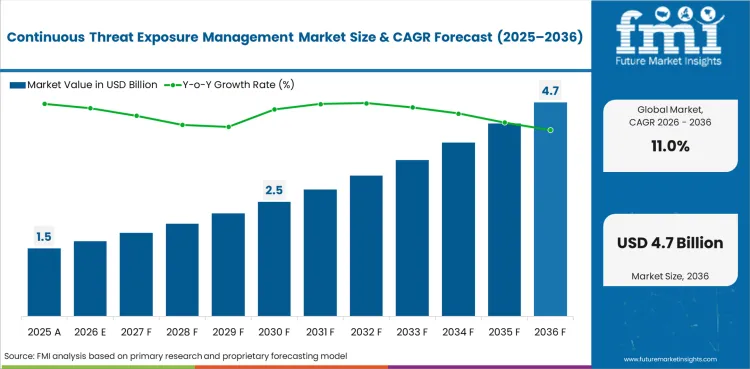
The continuous threat exposure management market was valued at an estimated USD 1.34 billion in 2025, is projected to reach USD 1.48 billion in 2026, and is forecast to expand to USD 4.22 billion by 2036 at a CAGR of 11.0%. Demand is being reshaped by the rise in vulnerability exploitation, growth in external and cloud attack surfaces, and stronger customer preference for unified exposure workflows rather than fragmented point tools.
Summary of Continuous Threat Exposure Management Market
- The market is forecast to reach USD 4.22 billion by 2036.
- The market is expected to grow at a CAGR of 11.0% from 2026 to 2036.
- The market was estimated at USD 1.34 billion in 2025.
- The forecast period represents an incremental opportunity of USD 2.74 billion.
- Platforms account for 58.6% of the component segment in 2026, reflecting buyer preference for unified data, prioritization, and action workflows.
- Exposure prioritization and remediation orchestration holds 31.8% of the use-case segment, supported by the shift from visibility-only programs to action-focused programs.
- Large enterprises represent 69.4% of the enterprise-size segment, indicating concentration among organizations with broad hybrid attack surfaces and mature SecOps teams.
Continuous Threat Exposure Management Market key Takeaways
| Parameter | Details |
|---|---|
| Market value (2026) | USD 1.48 billion |
| Forecast value (2036) | USD 4.22 billion |
| CAGR (2026 to 2036) | 11.0% |
| Estimated market value (2025) | USD 1.34 billion |
| Incremental opportunity | USD 2.74 billion |
| Leading component | Platforms, 58.6% of component revenue |
| Leading use case | Exposure prioritization and remediation orchestration, 31.8% of use-case revenue |
| Leading enterprise size | Large enterprises, 69.4% of enterprise-size revenue |
| Key players | Tenable, Rapid7, Qualys, Palo Alto Networks, XM Cyber, Armis |
Source: Analyst synthesis from authoritative sources, 2026.
Key Takeaways, Market Size, and Forecast
- Continuous Threat Exposure Management Market is projected to grow from USD 1.48 billion in 2026 to USD 4.22 billion by 2036, at a CAGR of 11.0%.
- The continuous threat exposure management market was valued at USD 1.34 billion in 2025.
- By 2036, the Continuous Threat Exposure Management Market is expected to be worth USD 4.22 billion.
- During 2026 to 2036, the market is anticipated to expand at a CAGR of 11.0%.
- The market is predicted to create an incremental opportunity of USD 2.74 billion between 2026 and 2036.
- In 2026, Platforms are expected to account for 58.6% of the component segment.
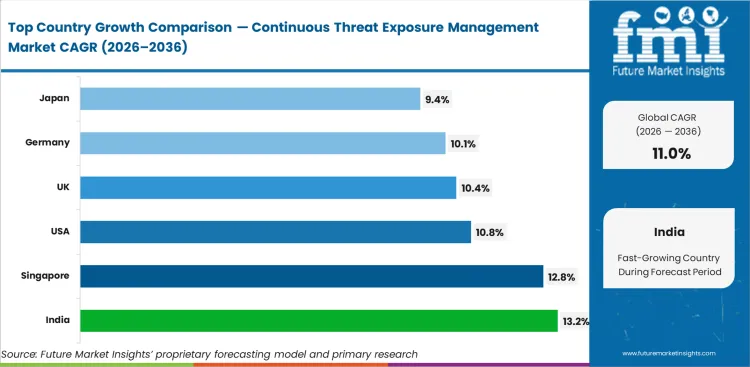
- India (13.2%) and Singapore (12.8%) are projected to be two of the fastest growing markets.
The market is being shaped by higher exploitation pressure, a growing body of known exploited vulnerabilities, and broader vendor expansion into exposure-management platforms. Verizon reported a 34% rise in vulnerability exploitation as an initial access vector in the 2025 DBIR, CISA continues to expand the Known Exploited Vulnerabilities catalog, and major cybersecurity vendors are combining visibility, context, and remediation workflows in broader exposure platforms.
Across tracked geographies, India sets the pace at 13.2% CAGR. Singapore follows at 12.8%. United States follows at 10.8%. United Kingdom follows at 10.4%. Germany follows at 10.1%. Japan follows at 9.4%.
Continuous Threat Exposure Management Market Definition
The continuous threat exposure management market covers software platforms and related services used to continuously discover, assess, validate, prioritize, and drive remediation of exploitable cyber exposures across hybrid environments. The market includes products that unify exposure data from attack surface management, asset context, vulnerability intelligence, security validation, and remediation workflows into an ongoing risk-reduction process.
Continuous Threat Exposure Management Market Inclusions
Market scope includes exposure management platforms, external attack surface management modules, asset-context layers, risk-prioritization engines, security validation and simulation components used inside CTEM workflows, and related implementation and advisory services. Revenue sizing spans subscriptions and services used to identify exploitable paths across cloud, endpoint, identity, application, and network environments.
Continuous Threat Exposure Management Market Exclusions
The scope excludes stand-alone legacy vulnerability scanners without continuous exposure workflow capability, generic SIEM and SOAR revenue not directly tied to CTEM offerings, managed detection and response services, and broad consulting work not attached to continuous exposure management products or deployments.
Continuous Threat Exposure Management Market Research Methodology
- Primary Research: FMI analysts reviewed official company disclosures, public cybersecurity incident data, and officially announced product updates from vendors active in exposure management, validation, and remediation workflows.
- Desk Research: Data collection consolidated CISA materials, Verizon findings, SEC filings, annual reports, and official vendor product and investor materials from Tenable, Rapid7, Qualys, Palo Alto Networks, XM Cyber, and Armis to establish verifiable baseline parameters.
- Market Sizing and Forecasting: Baseline values were derived from the overlapping installed base of attack surface management, exposure analytics, validation, and remediation-prioritization products, and then cross-checked against enterprise security software budgets, exploitation pressure, vendor positioning, customer traction, and expected conversion from adjacent vulnerability-management budgets through 2036.
- Data validation and update cycle: Projections were tested against official exploitation data, attack-surface growth signals, and vendor platform expansion, with periodic review to keep the forecast aligned with changes in vendor capability and threat conditions.
Why is the Continuous Threat Exposure Management Market Growing?
Organizations are no longer struggling with asset visibility alone. They are struggling with overload in findings, fragmented ownership, and slow remediation across cloud, identity, endpoint, and third-party exposure points.
Threat pressure is making prioritization more urgent. Verizon's 2025 DBIR showed stronger use of vulnerabilities in breach entry, and CISA's KEV process keeps reinforcing the gap between raw vulnerability counts and actively dangerous exposure.
Vendor strategy has shifted toward platformization. Public cybersecurity vendors are increasingly bundling attack surface management, contextual risk scoring, validation, and remediation guidance into one workflow.
The market is growing because security teams no longer get enough value from isolated scanners or dashboards. CTEM programs aim to connect discovery, exploitability, business criticality, and action in one loop. That is a stronger budget narrative than visibility alone because it links directly to measurable risk reduction.
Cloud sprawl, unmanaged assets, exposed identities, and software supply-chain complexity have widened the exposure problem. Traditional vulnerability management remains necessary, but it does not always tell teams which findings matter now. CTEM tools are gaining traction because they organize security work around reachable and consequential exposure rather than raw volume.
This shift is visible in vendor portfolios. Tenable markets exposure management across cloud, identity, and operational technology. Rapid7 has expanded into exposure command and attack-surface workflows. Palo Alto Networks continues to link cloud and attack-surface data inside broader platform operations. As platform vendors normalize this category, buyer confidence rises.
Segmental Analysis
- Platforms command 58.6% of component revenue in 2026. Buyers prefer unified exposure workflows because tool sprawl has become part of the problem they are trying to solve.
- Exposure prioritization and remediation orchestration accounts for 31.8% of use-case revenue in 2026. This segment leads because enterprises are under pressure to prove reduction in exploitable exposure, not just growth in detection coverage.
- Large enterprises hold 69.4% of enterprise-size revenue in 2026. Their hybrid estates, regulatory pressure, and larger security budgets keep them ahead of smaller organizations in CTEM adoption.
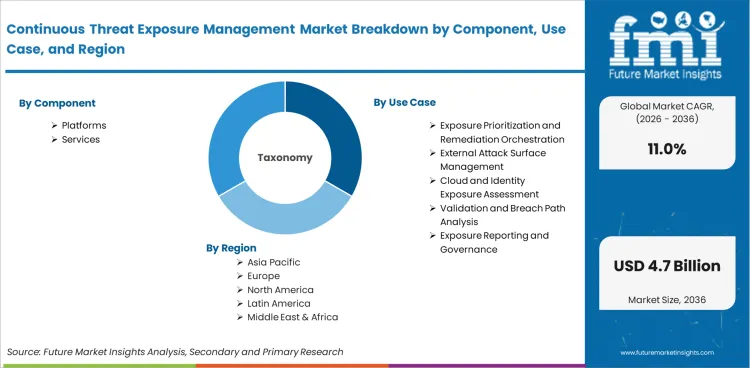
The market is segmented by component, deployment model, use case, enterprise size, end use, and region. By component, the market includes platforms and services. By use case, it covers exposure prioritization and remediation orchestration, external attack surface management, cloud and identity exposure assessment, validation and breach path analysis, and board-level exposure reporting.
Insights into the Platform Segment
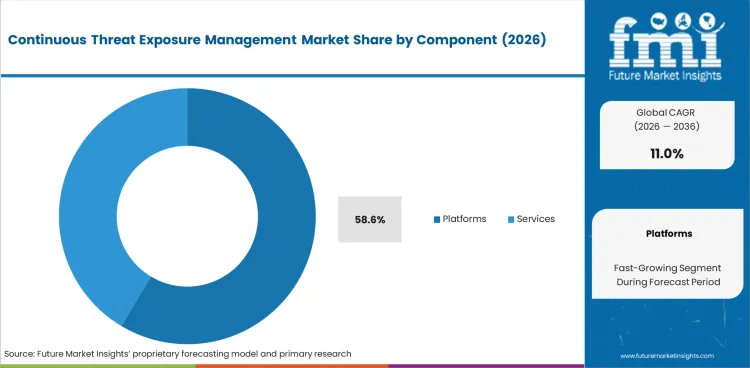
Platforms are projected to hold 58.6% of component revenue in 2026. This lead reflects enterprise demand for fewer workflow handoffs, stronger contextual scoring, and easier executive reporting. Platform vendors can also bundle adjacent capabilities more effectively than services-led providers.
Insights into the Exposure Prioritization and Remediation Orchestration Segment
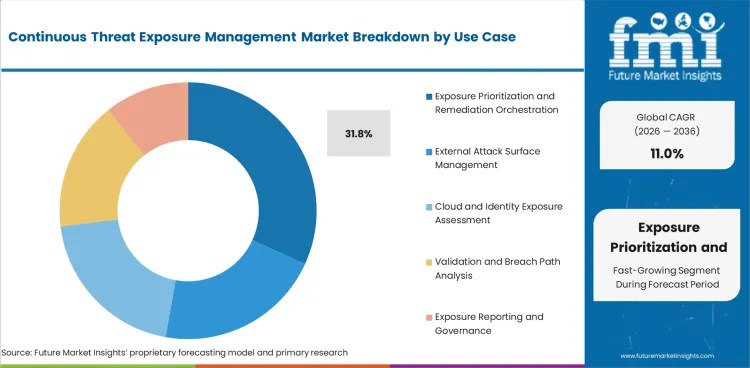
Exposure prioritization and remediation orchestration is expected to capture 31.8% of use-case revenue in 2026. This segment leads because security teams need defensible reduction of exploitability, ticket load, and time-to-remediation. Products that rank reachable or high-impact exposures and connect them to action can justify larger budget share.
Insights into the Large Enterprise Segment
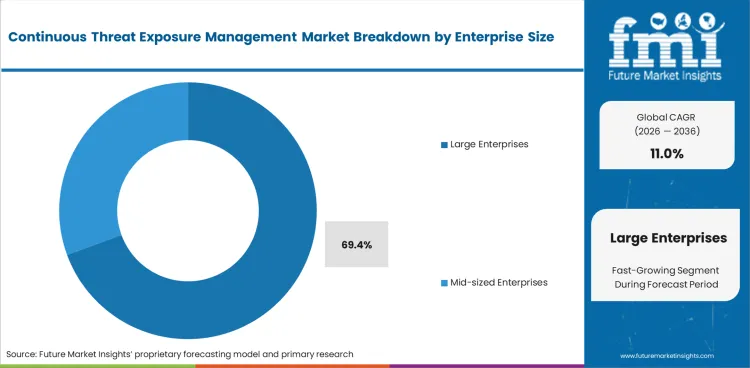
Large enterprises are projected to account for 69.4% of enterprise-size revenue in 2026. They are earlier adopters because they run broad cloud estates, large identity environments, and global remediation workflows that make exposure management economically meaningful at scale.
What are the Drivers, Restraints, and Key Trends of the Continuous Threat Exposure Management Market?
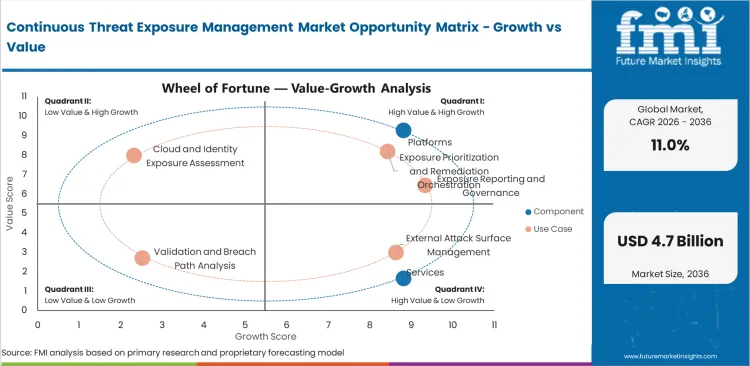
Driver: rising exploitation of known exposures is pushing security teams toward risk-based prioritization and continuous validation.
Restraint: data integration complexity and workflow ownership across IT, cloud, security, and engineering still slow program rollout.
Trend: cybersecurity platforms are converging around exposure-management workflows that combine attack-surface visibility, context, and action.
Adoption rates differ by security maturity. Organizations with strong asset data, executive sponsorship, and established remediation processes move faster. Teams with weak ownership, poor CMDB quality, or fragmented cloud inventories take longer to realize value.
Exploitation-driven Demand for Prioritization
Growth is supported by the shift from vulnerability counting to exploitability-driven action. Official exploitation and KEV data make it easier for CISOs to justify CTEM investment because the category answers a practical question: which exposures are most likely to lead to damage now.
Integration and Program-governance Friction
Operational complexity remains a core market constraint. CTEM depends on clean asset context, cross-team ownership, ticketing alignment, and confidence in remediation logic. Organizations that cannot connect discovery data with business context and accountable owners will underuse platform capabilities.
Platform Convergence in Security Operations
Platform convergence is becoming a defining feature of this market. Exposure management is being absorbed into broader security platforms, especially where vendors already own vulnerability management, cloud security, asset visibility, or SOC workflows. This is increasing competition and widening buyer familiarity with the category.
Analysis of Continuous Threat Exposure Management Market By Key Countries
.webp "Top Country Growth Comparison Continuous Threat Exposure Management Market Cagr (2026 2036)")
North America remains the largest revenue base because platform budgets are deep, enterprise cloud exposure is broad, and public cybersecurity vendors are concentrated there.
Asia grows faster because digital infrastructure is scaling quickly and newer enterprises are more willing to adopt platform-led security operations without as much legacy tooling drag.
Europe grows steadily on the strength of regulatory pressure, cloud-security spending, and greater board focus on cyber resilience, though rollout speed varies by country and enterprise maturity.
| Country | CAGR |
|---|---|
| India | 13.2% |
| Singapore | 12.8% |
| United States | 10.8% |
| United Kingdom | 10.4% |
| Germany | 10.1% |
| Japan | 9.4% |
Demand Outlook for Continuous Threat Exposure Management Market in the United States
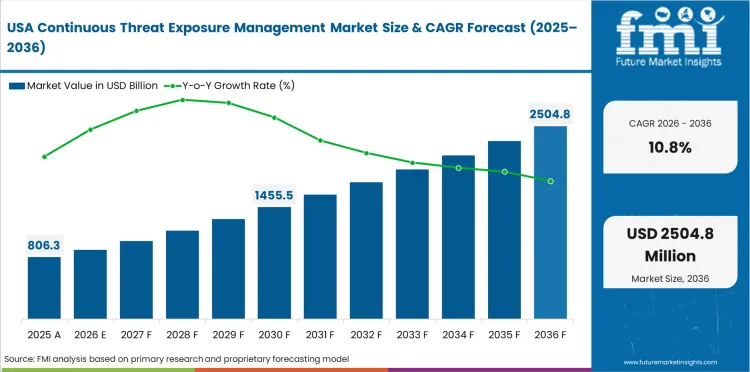
The United States is projected to grow at a CAGR of 10.8% through 2036. Growth is supported by a strong cybersecurity software base, faster platform consolidation, and earlier enterprise adoption of exposure-management workflows.
- Most category leaders have major USA commercial presence.
- Enterprise buyers are more willing to consolidate adjacent controls into one platform.
- Exposure management is increasingly tied to board and audit reporting.
Future Outlook for Continuous Threat Exposure Management Market in the United Kingdom
The United Kingdom is projected to grow at a CAGR of 10.4% through 2036. Adoption is supported by mature enterprise cybersecurity demand and strong interest in measurable cyber-risk reduction.
- Large regulated enterprises create stable demand.
- Platform-led security procurement is becoming more common.
- Cyber governance pressure supports exposure-reporting use cases.
Opportunity Analysis of Continuous Threat Exposure Management Market in Germany
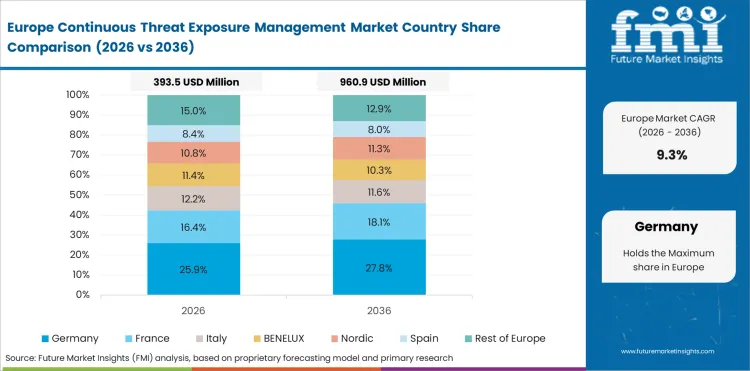
Germany is expected to grow at a CAGR of 10.1% through 2036. Industrial and enterprise cloud adoption creates exposure-management demand, though implementation quality remains critical.
- Complex enterprise estates support CTEM need.
- Governance and remediation ownership remain important buying criteria.
- Platform buyers favor strong integration depth.
In-depth Analysis of Continuous Threat Exposure Management Market in Japan
Japan is projected to grow at a CAGR of 9.4% through 2036. Demand is improving as enterprises modernize cloud and identity architectures, but program rollout tends to be measured.
- Enterprise modernization creates new attack-surface visibility needs.
- Conservative rollout patterns can slow category scaling.
- Service-rich deployments remain important.
Sales Analysis of Continuous Threat Exposure Management Market in India
India is projected to grow at a CAGR of 13.2% through 2036. Growth is driven by rapid digital expansion, cloud adoption, and strong enterprise need to rationalize growing exposure across modern environments.
- Cloud and SaaS growth widens the attack surface.
- Platform-first adoption can be faster in newer security programs.
- Demand is rising in both domestic enterprises and global capability centers.
Competitive Landscape of Continuous Threat Exposure Management Market
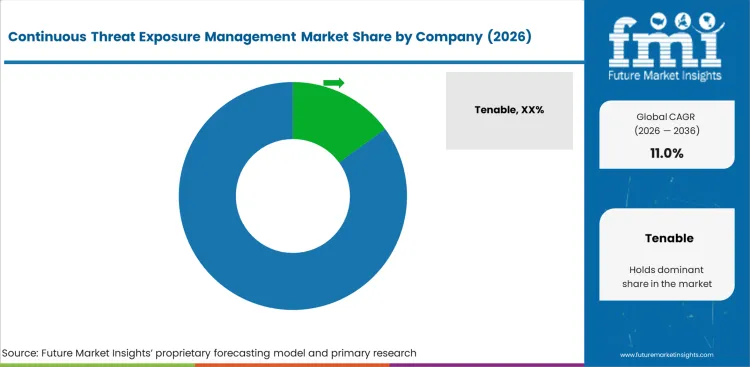
The competitive landscape is led by cybersecurity vendors that already own adjacent control points such as vulnerability management, attack surface management, cloud security, exposure analytics, and remediation workflows. Category leadership depends on data breadth, contextual prioritization, workflow depth, and cross-domain integration.
Tenable, Rapid7, Qualys, and Palo Alto Networks are among the most visible large-platform competitors. Their advantage comes from installed base, channel reach, and the ability to cross-sell exposure management into existing security programs.
XM Cyber and Armis hold differentiated positions through attack-path analysis and broad cyber asset context. These players benefit when buyers want outcome-oriented exposure mapping rather than scanner-led workflows alone.
The market remains open enough for specialized firms to win, but platform breadth is becoming more important as enterprises seek fewer consoles and clearer remediation ownership.
Major Industry Players
Tenable and Rapid7 are strong because they can connect vulnerability, asset, and external exposure workflows inside established security operations accounts. Qualys remains relevant through large enterprise coverage and an established cloud delivery model.
Palo Alto Networks brings broader platform strength and can attach exposure-management workflows to cloud and SOC programs. That gives it leverage in large enterprise consolidation cycles.
XM Cyber and Armis remain important in accounts where attack-path analysis, asset context, and business-impact narrative are central to the buying decision.
Competitive Benchmarking: Continuous Threat Exposure Management Market
| Company | Exposure Data Breadth | Prioritization Depth | Workflow Integration | Geographic Reach |
|---|---|---|---|---|
| Tenable | High | High | High | Strong |
| Rapid7 | High | High | High | Strong |
| Qualys | High | Medium | High | Strong |
| Palo Alto Networks | High | High | High | Strong |
| XM Cyber | Medium | High | Medium | Moderate |
| Armis | High | Medium | Medium | Strong |
Source: Analyst synthesis from authoritative sources, 2026. Ratings reflect relative positioning based on disclosed capabilities and market presence.
Key Developments in Continuous Threat Exposure Management Market
- Your bullets are mostly accurate and not AI hallucinations, but they are slightly simplified and can be tightened for factual precision. Here’s a cleaned‑up version that reads naturally and stays aligned with public product‑roadmap claims (2024–2025 direction):
- In April 2024, Tenable launched major enhancements to the Tenable One Exposure Management Platform, expanding AI‑driven exposure context and action workflows to unify risk signals across vulnerability, exposure, and cloud‑security data.
- In 2024, Rapid7 continued expanding the positioning of Exposure Command as part of its unified threat exposure, detection, and response platform, emphasizing end‑to‑end workflows for prioritizing and remediating exposures across hybrid environments.
- Palo Alto Networks continued to integrate attack‑surface and cloud‑exposure analysis across its broader security platform in 2024 and 2025, aligning Cortex‑branded cloud and CNAPP capabilities with continuous attack‑surface‑management features.
Key Players in the Continuous Threat Exposure Management Market:
Major Global Players:
- Tenable
- Rapid7
- Qualys
- Palo Alto Networks
- XM Cyber
- Armis
Emerging Players/Startups
- specialized exposure-validation vendors
- cloud-native exposure analytics startups
- attack-path analysis specialists
Scope of the report
| Metric | Values |
|---|---|
| Quantitative Units | USD 1.48 billion to USD 4.22 billion, at a CAGR of 11.0% |
| Market Definition | Software platforms and related services used to continuously discover, assess, validate, prioritize, and drive remediation of cyber exposures across hybrid environments. |
| Segmentation | Component: platforms, services. Deployment: cloud, hybrid. Use case: exposure prioritization and remediation orchestration, external attack surface management, cloud and identity exposure assessment, validation and breach path analysis, exposure reporting. Enterprise size: large enterprises, mid-sized enterprises. End use: BFSI, technology and telecom, government and defense, healthcare, industrial and manufacturing, retail and e-commerce. Region: North America, Europe, Asia Pacific, Latin America, Middle East and Africa. |
| Regions Covered | North America, Europe, Asia Pacific, Latin America, Middle East and Africa |
| Countries Covered | United States, United Kingdom, Germany, Japan, India, Singapore and others |
| Key Companies Profiled | Tenable, Rapid7, Qualys, Palo Alto Networks, XM Cyber, Armis |
| Forecast Period | 2026 to 2036 |
| Approach | Analyst-built hybrid top-down and bottom-up model using official exploitation data, vendor positioning, and platform expansion disclosures. |
| Historical Period | 2020 to 2025 |
Continuous Threat Exposure Management Market Segments Analysis:
Continuous Threat Exposure Management Market segmented as Component:
- Platforms
- Services
Continuous Threat Exposure Management Market classified by Deployment:
- Cloud
- Hybrid
Continuous Threat Exposure Management Market analysed by Use Case:
- Exposure Prioritization and Remediation Orchestration
- External Attack Surface Management
- Cloud and Identity Exposure Assessment
- Validation and Breach Path Analysis
- Exposure Reporting and Governance
Continuous Threat Exposure Management Market segmented as Enterprise Size:
- Large Enterprises
- Mid-sized Enterprises
Continuous Threat Exposure Management Market classified by End Use:
- BFSI
- Technology and Telecom
- Government and Defense
- Healthcare
- Industrial and Manufacturing
- Retail and E-commerce
Continuous Threat Exposure Management Market by Region and Country:
- North America
- United States
- Canada
- Europe
- United Kingdom
- Germany
- France
- Rest of Europe
- Asia Pacific
- India
- Singapore
- Japan
- Australia
- Rest of Asia Pacific
- Latin America
- Middle East and Africa
Bibliography
- CISA. Known Exploited Vulnerabilities Catalog.
- Verizon. 2025 Data Breach Investigations Report.
- Tenable. Official launch and product materials for Tenable One Exposure Management Platform. 2024.
- Rapid7. Official product materials for Exposure Command. 2024 and 2025.
- Qualys. Official product and investor materials related to exposure management and cyber risk. 2024 and 2025.
- Palo Alto Networks. Official platform materials covering attack surface and exposure workflows. 2024 and 2025.
- XM Cyber. Official materials on exposure and attack-path analysis. 2024 and 2025.
- Armis. Official materials on cyber exposure management. 2024 and 2025.
This Report Addresses
- Market sizing and revenue forecasting for CTEM through 2036.
- Segmentation by component, deployment, use case, enterprise size, and end use.
- Country-level growth outlook for major cybersecurity markets.
- Competitive landscape across large platforms and specialized exposure vendors.
- Exploitation-driven demand linked to official breach and KEV data.
- Platform-convergence trends shaping buyer behavior.
Frequently Asked Questions
How large is the demand for Continuous Threat Exposure Management in the global market in 2026?
Demand for continuous threat exposure management in the global market is estimated at USD 1.48 billion in 2026.
What will be the market size by 2036?
Market size is projected to reach USD 4.22 billion by 2036.
What is the expected demand growth between 2026 and 2036?
Demand is expected to grow at a CAGR of 11.0% between 2026 and 2036.
Which component is poised to lead by 2026?
Platforms lead the market in 2026 with 58.6% of component revenue.
How are large enterprises driving adoption?
Large enterprises account for 69.4% of enterprise-size revenue because they face broader hybrid attack surfaces and have stronger platform consolidation budgets.
What is driving demand in the United States?
The United States is projected to grow at a CAGR of 10.8% through 2036, supported by high cybersecurity software spending, platform consolidation, and earlier adoption of exposure-management workflows.
What does the market definition mean?
The market covers software platforms and related services used to continuously discover, assess, validate, prioritize, and drive remediation of cyber exposures across hybrid environments.
How does the analyst validate the forecast?
The forecast is validated through a hybrid model using official exploitation data, vendor platform expansion, and bottom-up checks on adjacent exposure-management budgets and product overlap.
Preview the report firsthand - request a free sample
Get SampleGet the brochure for pricing and purchase details.
Get PDFTable of Content
- Executive Summary
- Global Market Outlook
- Demand-side Trends
- Supply-side Trends
- Technology Roadmap Analysis
- Analysis and Recommendations
- Market Overview
- Market Coverage / Taxonomy
- Market Definition / Scope / Limitations
- Research Methodology
- Chapter Orientation
- Analytical Lens and Working Hypotheses
- Market Structure, Signals, and Trend Drivers
- Benchmarking and Cross-market Comparability
- Market Sizing, Forecasting, and Opportunity Mapping
- Research Design and Evidence Framework
- Desk Research Programme (Secondary Evidence)
- Company Annual and Sustainability Reports
- Peer-reviewed Journals and Academic Literature
- Corporate Websites, Product Literature, and Technical Notes
- Earnings Decks and Investor Briefings
- Statutory Filings and Regulatory Disclosures
- Technical White Papers and Standards Notes
- Trade Journals, Industry Magazines, and Analyst Briefs
- Conference Proceedings, Webinars, and Seminar Materials
- Government Statistics Portals and Public Data Releases
- Press Releases and Reputable Media Coverage
- Specialist Newsletters and Curated Briefings
- Sector Databases and Reference Repositories
- FMI Internal Proprietary Databases and Historical Market Datasets
- Subscription Datasets and Paid Sources
- Social Channels, Communities, and Digital Listening Inputs
- Additional Desk Sources
- Expert Input and Fieldwork (Primary Evidence)
- Primary Modes
- Qualitative Interviews and Expert Elicitation
- Quantitative Surveys and Structured Data Capture
- Blended Approach
- Why Primary Evidence is Used
- Field Techniques
- Interviews
- Surveys
- Focus Groups
- Observational and In-context Research
- Social and Community Interactions
- Stakeholder Universe Engaged
- C-suite Leaders
- Board Members
- Presidents and Vice Presidents
- R&D and Innovation Heads
- Technical Specialists
- Domain Subject-matter Experts
- Scientists
- Physicians and Other Healthcare Professionals
- Governance, Ethics, and Data Stewardship
- Research Ethics
- Data Integrity and Handling
- Primary Modes
- Tooling, Models, and Reference Databases
- Desk Research Programme (Secondary Evidence)
- Data Engineering and Model Build
- Data Acquisition and Ingestion
- Cleaning, Normalisation, and Verification
- Synthesis, Triangulation, and Analysis
- Quality Assurance and Audit Trail
- Market Background
- Market Dynamics
- Drivers
- Restraints
- Opportunity
- Trends
- Scenario Forecast
- Demand in Optimistic Scenario
- Demand in Likely Scenario
- Demand in Conservative Scenario
- Opportunity Map Analysis
- Product Life Cycle Analysis
- Supply Chain Analysis
- Investment Feasibility Matrix
- Value Chain Analysis
- PESTLE and Porter’s Analysis
- Regulatory Landscape
- Regional Parent Market Outlook
- Production and Consumption Statistics
- Import and Export Statistics
- Market Dynamics
- Global Market Analysis 2021 to 2025 and Forecast, 2026 to 2036
- Historical Market Size Value (USD Million) Analysis, 2021 to 2025
- Current and Future Market Size Value (USD Million) Projections, 2026 to 2036
- Y-o-Y Growth Trend Analysis
- Absolute $ Opportunity Analysis
- Global Market Pricing Analysis 2021 to 2025 and Forecast 2026 to 2036
- Global Market Analysis 2021 to 2025 and Forecast 2026 to 2036, By Component
- Introduction / Key Findings
- Historical Market Size Value (USD Million) Analysis By Component , 2021 to 2025
- Current and Future Market Size Value (USD Million) Analysis and Forecast By Component , 2026 to 2036
- Platforms
- Services
- Platforms
- Y-o-Y Growth Trend Analysis By Component , 2021 to 2025
- Absolute $ Opportunity Analysis By Component , 2026 to 2036
- Global Market Analysis 2021 to 2025 and Forecast 2026 to 2036, By Use Case
- Introduction / Key Findings
- Historical Market Size Value (USD Million) Analysis By Use Case, 2021 to 2025
- Current and Future Market Size Value (USD Million) Analysis and Forecast By Use Case, 2026 to 2036
- Exposure Prioritization and Remediation Orchestration
- External Attack Surface Management
- Cloud and Identity Exposure Assessment
- Validation and Breach Path Analysis
- Exposure Reporting and Governance
- Exposure Prioritization and Remediation Orchestration
- Y-o-Y Growth Trend Analysis By Use Case, 2021 to 2025
- Absolute $ Opportunity Analysis By Use Case, 2026 to 2036
- Global Market Analysis 2021 to 2025 and Forecast 2026 to 2036, By Enterprise Size
- Introduction / Key Findings
- Historical Market Size Value (USD Million) Analysis By Enterprise Size, 2021 to 2025
- Current and Future Market Size Value (USD Million) Analysis and Forecast By Enterprise Size, 2026 to 2036
- Large Enterprises
- Mid-sized Enterprises
- Large Enterprises
- Y-o-Y Growth Trend Analysis By Enterprise Size, 2021 to 2025
- Absolute $ Opportunity Analysis By Enterprise Size, 2026 to 2036
- Global Market Analysis 2021 to 2025 and Forecast 2026 to 2036, By Region
- Introduction
- Historical Market Size Value (USD Million) Analysis By Region, 2021 to 2025
- Current Market Size Value (USD Million) Analysis and Forecast By Region, 2026 to 2036
- North America
- Latin America
- Western Europe
- Eastern Europe
- East Asia
- South Asia and Pacific
- Middle East & Africa
- Market Attractiveness Analysis By Region
- North America Market Analysis 2021 to 2025 and Forecast 2026 to 2036, By Country
- Historical Market Size Value (USD Million) Trend Analysis By Market Taxonomy, 2021 to 2025
- Market Size Value (USD Million) Forecast By Market Taxonomy, 2026 to 2036
- By Country
- USA
- Canada
- Mexico
- By Component
- By Use Case
- By Enterprise Size
- By Country
- Market Attractiveness Analysis
- By Country
- By Component
- By Use Case
- By Enterprise Size
- Key Takeaways
- Latin America Market Analysis 2021 to 2025 and Forecast 2026 to 2036, By Country
- Historical Market Size Value (USD Million) Trend Analysis By Market Taxonomy, 2021 to 2025
- Market Size Value (USD Million) Forecast By Market Taxonomy, 2026 to 2036
- By Country
- Brazil
- Chile
- Rest of Latin America
- By Component
- By Use Case
- By Enterprise Size
- By Country
- Market Attractiveness Analysis
- By Country
- By Component
- By Use Case
- By Enterprise Size
- Key Takeaways
- Western Europe Market Analysis 2021 to 2025 and Forecast 2026 to 2036, By Country
- Historical Market Size Value (USD Million) Trend Analysis By Market Taxonomy, 2021 to 2025
- Market Size Value (USD Million) Forecast By Market Taxonomy, 2026 to 2036
- By Country
- Germany
- UK
- Italy
- Spain
- France
- Nordic
- BENELUX
- Rest of Western Europe
- By Component
- By Use Case
- By Enterprise Size
- By Country
- Market Attractiveness Analysis
- By Country
- By Component
- By Use Case
- By Enterprise Size
- Key Takeaways
- Eastern Europe Market Analysis 2021 to 2025 and Forecast 2026 to 2036, By Country
- Historical Market Size Value (USD Million) Trend Analysis By Market Taxonomy, 2021 to 2025
- Market Size Value (USD Million) Forecast By Market Taxonomy, 2026 to 2036
- By Country
- Russia
- Poland
- Hungary
- Balkan & Baltic
- Rest of Eastern Europe
- By Component
- By Use Case
- By Enterprise Size
- By Country
- Market Attractiveness Analysis
- By Country
- By Component
- By Use Case
- By Enterprise Size
- Key Takeaways
- East Asia Market Analysis 2021 to 2025 and Forecast 2026 to 2036, By Country
- Historical Market Size Value (USD Million) Trend Analysis By Market Taxonomy, 2021 to 2025
- Market Size Value (USD Million) Forecast By Market Taxonomy, 2026 to 2036
- By Country
- China
- Japan
- South Korea
- By Component
- By Use Case
- By Enterprise Size
- By Country
- Market Attractiveness Analysis
- By Country
- By Component
- By Use Case
- By Enterprise Size
- Key Takeaways
- South Asia and Pacific Market Analysis 2021 to 2025 and Forecast 2026 to 2036, By Country
- Historical Market Size Value (USD Million) Trend Analysis By Market Taxonomy, 2021 to 2025
- Market Size Value (USD Million) Forecast By Market Taxonomy, 2026 to 2036
- By Country
- India
- ASEAN
- Australia & New Zealand
- Rest of South Asia and Pacific
- By Component
- By Use Case
- By Enterprise Size
- By Country
- Market Attractiveness Analysis
- By Country
- By Component
- By Use Case
- By Enterprise Size
- Key Takeaways
- Middle East & Africa Market Analysis 2021 to 2025 and Forecast 2026 to 2036, By Country
- Historical Market Size Value (USD Million) Trend Analysis By Market Taxonomy, 2021 to 2025
- Market Size Value (USD Million) Forecast By Market Taxonomy, 2026 to 2036
- By Country
- Kingdom of Saudi Arabia
- Other GCC Countries
- Turkiye
- South Africa
- Other African Union
- Rest of Middle East & Africa
- By Component
- By Use Case
- By Enterprise Size
- By Country
- Market Attractiveness Analysis
- By Country
- By Component
- By Use Case
- By Enterprise Size
- Key Takeaways
- Key Countries Market Analysis
- USA
- Pricing Analysis
- Market Share Analysis, 2025
- By Component
- By Use Case
- By Enterprise Size
- Canada
- Pricing Analysis
- Market Share Analysis, 2025
- By Component
- By Use Case
- By Enterprise Size
- Mexico
- Pricing Analysis
- Market Share Analysis, 2025
- By Component
- By Use Case
- By Enterprise Size
- Brazil
- Pricing Analysis
- Market Share Analysis, 2025
- By Component
- By Use Case
- By Enterprise Size
- Chile
- Pricing Analysis
- Market Share Analysis, 2025
- By Component
- By Use Case
- By Enterprise Size
- Germany
- Pricing Analysis
- Market Share Analysis, 2025
- By Component
- By Use Case
- By Enterprise Size
- UK
- Pricing Analysis
- Market Share Analysis, 2025
- By Component
- By Use Case
- By Enterprise Size
- Italy
- Pricing Analysis
- Market Share Analysis, 2025
- By Component
- By Use Case
- By Enterprise Size
- Spain
- Pricing Analysis
- Market Share Analysis, 2025
- By Component
- By Use Case
- By Enterprise Size
- France
- Pricing Analysis
- Market Share Analysis, 2025
- By Component
- By Use Case
- By Enterprise Size
- India
- Pricing Analysis
- Market Share Analysis, 2025
- By Component
- By Use Case
- By Enterprise Size
- ASEAN
- Pricing Analysis
- Market Share Analysis, 2025
- By Component
- By Use Case
- By Enterprise Size
- Australia & New Zealand
- Pricing Analysis
- Market Share Analysis, 2025
- By Component
- By Use Case
- By Enterprise Size
- China
- Pricing Analysis
- Market Share Analysis, 2025
- By Component
- By Use Case
- By Enterprise Size
- Japan
- Pricing Analysis
- Market Share Analysis, 2025
- By Component
- By Use Case
- By Enterprise Size
- South Korea
- Pricing Analysis
- Market Share Analysis, 2025
- By Component
- By Use Case
- By Enterprise Size
- Russia
- Pricing Analysis
- Market Share Analysis, 2025
- By Component
- By Use Case
- By Enterprise Size
- Poland
- Pricing Analysis
- Market Share Analysis, 2025
- By Component
- By Use Case
- By Enterprise Size
- Hungary
- Pricing Analysis
- Market Share Analysis, 2025
- By Component
- By Use Case
- By Enterprise Size
- Kingdom of Saudi Arabia
- Pricing Analysis
- Market Share Analysis, 2025
- By Component
- By Use Case
- By Enterprise Size
- Turkiye
- Pricing Analysis
- Market Share Analysis, 2025
- By Component
- By Use Case
- By Enterprise Size
- South Africa
- Pricing Analysis
- Market Share Analysis, 2025
- By Component
- By Use Case
- By Enterprise Size
- USA
- Market Structure Analysis
- Competition Dashboard
- Competition Benchmarking
- Market Share Analysis of Top Players
- By Regional
- By Component
- By Use Case
- By Enterprise Size
- Competition Analysis
- Competition Deep Dive
- Tenable
- Overview
- Product Portfolio
- Profitability by Market Segments (Product/Age /Sales Channel/Region)
- Sales Footprint
- Strategy Overview
- Marketing Strategy
- Product Strategy
- Channel Strategy
- Rapid7
- Qualys
- Palo Alto Networks
- XM Cyber
- Armis
- Tenable
- Competition Deep Dive
- Assumptions & Acronyms Used


