

- Market Size (2026)
- USD 0.70 Bn
- Forecast (2036)
- USD 2.39 Bn
- CAGR (2026 to 2036)
- 13.0%
Cybersecure Fuel Injection Control Unit Systems Market Size, Market Forecast and Outlook By FMI
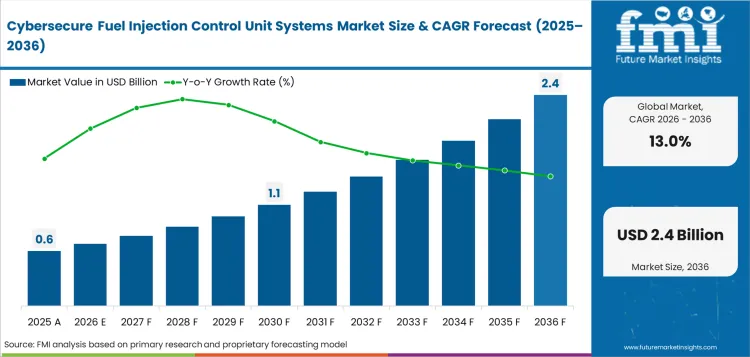
Cybersecure fuel injection control unit systems market was valued at USD 0.62 billion in 2025 and is projected to reach USD 0.70 billion in 2026. Revenue is forecast to reach USD 2.39 billion by 2036 at 13.0% CAGR. Dedicated engine ECUs are projected to account for 49.0% share in 2026. OEM fitment is expected to hold 78.0% share of sales channel demand in 2026.
Summary of the Cybersecure Fuel Injection Control Unit Systems Market
- Demand and Growth Drivers
- Strict regulation pushes vehicle makers to prove cybersecurity controls across electronic control units.
- Connected diagnostics create need for secure calibration files and protected flash memory.
- Flex fuel and compressed natural gas platforms raise software complexity in fuel control systems.
- Automotive OTA work makes authenticated fuel map updates more valuable for powertrain suppliers.
- Product and Segment View
- Dedicated engine ECUs are projected to account for 49.0% share in 2026 as injector timing stays safety critical.
- Gasoline platforms are expected to hold 42.0% share in 2026 because port and direct injection remain high-volume.
- Passenger cars are forecast to account for 58.0% share of vehicle type demand in 2026.
- OEM fitment is projected to hold 78.0% share as cybersecurity evidence is locked before vehicle launch.
- Geography and Competitive Outlook
- China is projected to record 14.8% CAGR through 2036 as vehicle production scale supports electronics localization.
- India is expected to expand at 14.2% CAGR through 2036 as stricter emission and software needs reach high-volume vehicles.
- Major players such as Bosch, Marelli and Continental influence the system layer through engine control and vehicle architecture depth.
- Infineon and NXP influence the silicon layer through secure automotive microcontrollers. Renesas and STMicroelectronics support the same secure controller layer.
- Analyst Opinion
- Nikhil Kaitwade, Principal Consultant at FMI says, "I see this market shifting from powertrain cost control to security proof. Fuel injection control was once judged mainly on timing accuracy and emission calibration. Vehicle makers now ask whether the same unit can protect software and resist tuning misuse. Suppliers that combine injector control know how with cybersecurity evidence will gain the strongest nomination path."
- Cybersecure Fuel Injection Control Unit Systems Market Value Analysis
- Secure injector control raises value because software protection now sits beside timing accuracy and emissions calibration.
- Dedicated engine ECUs increase value as injector control remains central to powertrain safety.
- Hardware security modules support pricing gains by protecting keys and update routes.
- OEM fitment lifts revenue quality because cyber validation is handled before production release.
Key Takeaways
- The cybersecure fuel injection control unit systems market was valued at USD 0.62 billion in 2025.
- By 2036, the cybersecure fuel injection control unit systems market is expected to be worth USD 2.39 billion.
- From 2026 to 2036, the market is projected to expand at 13.0% CAGR.
- The market is projected to create an incremental opportunity of USD 1.69 billion between 2026 and 2036.
- Dedicated engine ECUs are projected to account for 49.0% share of control architecture demand in 2026.
- OEM fitment is expected to account for 78.0% share of sales channel demand in 2026.
- China at 14.8% CAGR and India at 14.2% CAGR are the faster expanding country markets.
Secure injector control is moving from a hidden engineering item into a supplier selection screen for fuel injection system suppliers. The change comes as fuel maps, diagnostic routines and software updates become part of vehicle approval files. The United Kingdom Vehicle Certification Agency states that UN Regulation No. 155 uses audit review and risk review for vehicle cybersecurity. The same agency lists 7 July 2024 as the date for existing vehicle type approval coverage in major vehicle classes. Approval timing changes how engine control modules are specified. Approval timing pushes suppliers to show secure boot, authenticated calibration and vulnerability handling before nomination.
Cybersecure Fuel Injection Control Unit Systems Market Definition
The cybersecure fuel injection control unit systems market covers electronic control units and software stacks that manage fuel injector actuation with built-in cybersecurity controls. Scope includes secure boot and hardware security modules. It covers protected diagnostics and authenticated calibration storage. The market includes port injection and gasoline direct injection. It covers diesel common rail and multi-fuel control units. It excludes standalone injectors, pumps and mechanical rails when the secure controller is not supplied with them.
Cybersecure Fuel Injection Control Unit Systems Market Inclusions
Market scope includes secure engine ECUs, software modules and validated hardware used in electronic control unit in automotive systems applications. It covers units supplied to passenger cars and commercial vehicles. It includes two-wheelers and off-highway platforms. Included security layers are secure boot and hardware security module functions. Intrusion logging and secure diagnostics are included. Revenue covers new OEM fitment, authorized service replacement and validated ECU software security modules.
Cybersecure Fuel Injection Control Unit Systems Market Exclusions
Scope excludes plain fuel injectors, fuel pumps and pressure sensors when no secure control unit is supplied. It excludes infotainment gateways and body control units unless they directly manage fuel injection signals. Generic cybersecurity consulting is outside the market unless it is bundled with a control unit. Tuning tools sold for unauthorized remapping are excluded because they do not qualify as secure fuel control systems.
Cybersecure Fuel Injection Control Unit Systems Market Research Methodology
- Primary Research: FMI analysts reviewed powertrain supplier portfolios and ECU nomination needs. Security validation steps and engine calibration buyer inputs were compared.
- Desk Research: The study used public data from vehicle regulators and automotive trade bodies. Company releases and standards bodies were used for supplier checks.
- Market Sizing and Forecasting: The model combined vehicle production and fuel system fitment. Secure ECU content and country level electronics readiness adjusted the forecast.
- Data Validation: Forecast checks compared fuel injection value and automotive cybersecurity value. ECU shipment signals and supplier launches tested the sizing range.
Why is the Cybersecure Fuel Injection Control Unit Systems Market Growing?
- Cybersecurity approval rules are forcing automakers to document how powertrain ECUs handle threats.
- Remote diagnostics are increasing the need for authenticated access to fuel maps and flash memory.
- Multi-fuel platforms need stricter ECU security as calibration files differ by region and fuel blend.
The shift is connected to wider automotive cybersecurity compliance and beyond a single fuel system upgrade. The International Organization of Motor Vehicle Manufacturers reported that global vehicle production rose from 92.7 million units in 2024 to 96.4 million units in 2025. That volume gives secure ECU suppliers a large fitment pool. Fuel injection control units are exposed through diagnostics and service tools. Secure access control becomes a direct requirement for warranty and emission control.
The second growth driver is calibration protection. Marelli stated in March 2026 that its new port fuel injection ECUs can include up to eight gasoline injector drivers and four compressed natural gas injector drivers. That channel count raises the value of protected software because one controller can manage several fuel strategies. Tamper resistance becomes important for regions with flex fuel and compressed natural gas use. Suppliers that prove secure calibration can win beyond low-cost hardware.
Market Segmentation Analysis
- Dedicated engine ECUs are projected to account for 49.0% share in 2026 as injector timing and diagnostics remain tightly coupled.
- Gasoline platforms are expected to represent 42.0% share in 2026 as direct and port injection stay common in hybrid vehicles.
- Passenger cars are forecast to account for 58.0% share in 2026 because personal mobility platforms carry the widest ECU volume.
- Hardware security modules are projected to account for 36.0% share in 2026 as suppliers build protection into silicon.
- OEM fitment is expected to account for 78.0% share in 2026 as vehicle approval files are prepared before launch.
The market is divided into five primary segment groups by control architecture and fuel type. Vehicle type, security layer and sales channel complete the structure. The segmentation follows how automakers specify automotive microcontrollers and powertrain electronics. Control architecture explains whether the unit is dedicated or part of a domain platform. Fuel type shows how calibration complexity affects security depth. Sales channel explains why factory fitment carries most revenue.
Insights into the Dedicated Engine ECUs Control Architecture Segment
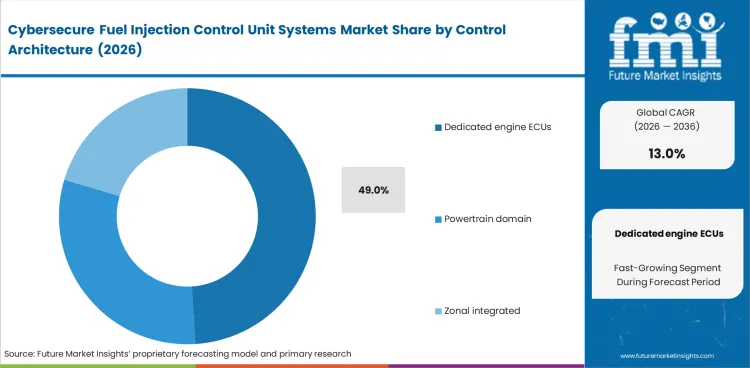
- Dedicated engine ECUs are projected to account for 49.0% share in 2026.
- Engine programs keep injector actuation close to the control unit as timing accuracy and emission diagnostics need tight validation.
Insights into the Gasoline Fuel Type Segment
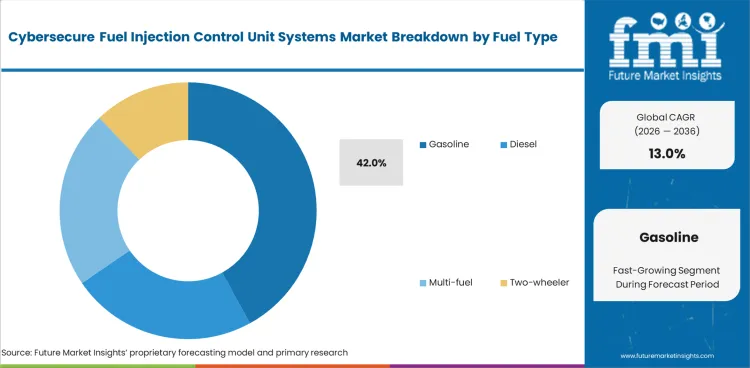
- Gasoline platforms are expected to represent 42.0% share of fuel type demand in 2026.
- Hybrid gasoline vehicles keep fuel injection electronics relevant as engines start and stop often during urban driving cycles.
Insights into the Passenger Cars Vehicle Type Segment
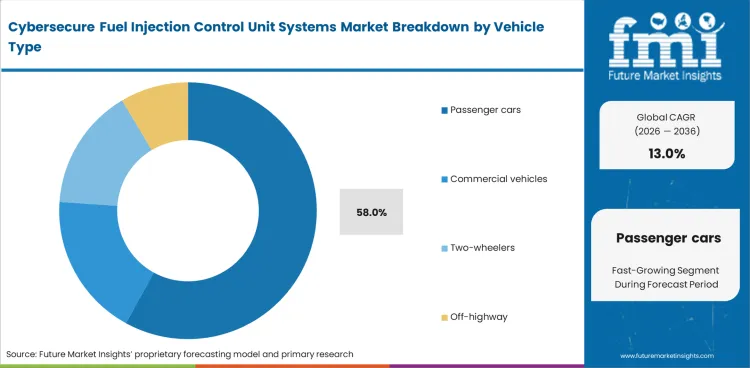
- Passenger cars are forecast to account for 58.0% share by vehicle type in 2026.
- High model refresh volume gives passenger platforms more chances to add secure diagnostics and protected calibration storage.
Insights into the Hardware Security Module Security Layer Segment
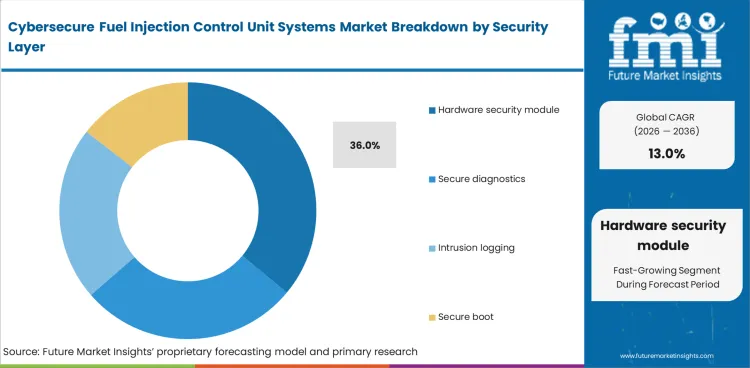
- Hardware security modules are projected to account for 36.0% share of security layer segment in 2026.
- Silicon-rooted key storage is preferred for fuel maps needing protection against cloning and unauthorized service access.
Insights into the OEM Fitment Sales Channel Segment
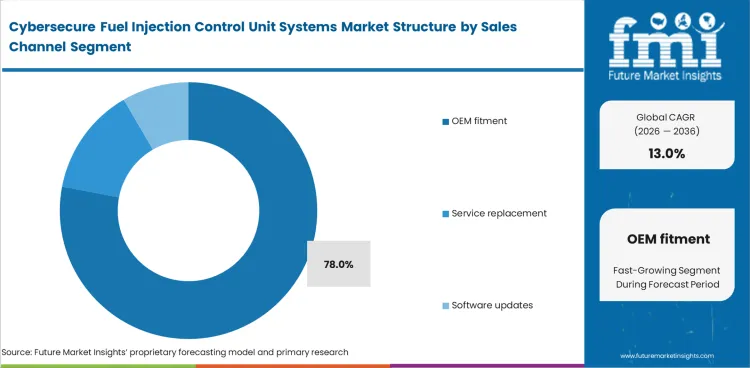
- By sales channel, OEM fitment is expected to account for 78.0% share in 2026.
- Vehicle makers prefer factory validation since cybersecurity evidence must be aligned with type approval and warranty files.
Cybersecure Fuel Injection Control Unit Systems Market Drivers, Restraints, and Opportunities
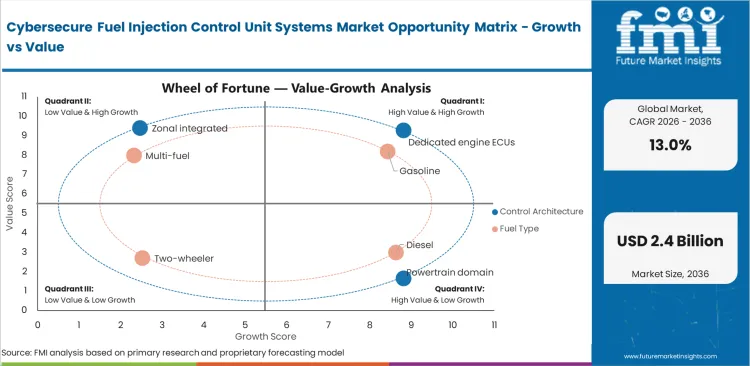
- Type approval security audits are creating fresh specification pressure on fuel injection ECUs.
- Controller cost slows adoption in older low-cost vehicle platforms that use simpler service tools.
- Secure OTA calibration opens a new premium layer for suppliers serving connected powertrain programs.
Cybersecurity rules are moving into the powertrain supply chain as vehicle approval becomes more software driven. The United Kingdom Vehicle Certification Agency says UN Regulation No. 155 requires manufacturers to manage supply chain risk and cascade security requirements to suppliers. That turns the fuel injection controller into a documented security item. The effect is not limited to premium cars. It affects every program that uses connected diagnostics or updateable calibration. The result is a larger role for secure fuel control units inside powertrain domain control unit platforms.
Controller Cost Is Slowing Low Price Adoption
The main restraint is the added cost of certified silicon and validation work. Secure boot, hardware key storage and penetration testing add cost before the vehicle is sold. Low price vehicle programs may delay deeper protection if service access stays mostly local. The risk is that delayed security becomes expensive once a platform needs over-the-air updates. Suppliers must offer modular security so buyers can match cost to exposure.
Secure Calibration Is Creating Service Value
The main opportunity lies in protected software updates for engine maps and injector control. Related over-the-air engine control module activity shows how remote calibration is moving into powertrain planning. Secure updates let vehicle makers fix emission or drivability issues without uncontrolled service tool access. Fuel injection control suppliers can use this need to sell software maintenance and validated update packages. Security becomes a revenue layer instead of a compliance cost only.
Analysis of Cybersecure Fuel Injection Control Unit Systems Market by Key Countries
.webp "Top Country Growth Comparison Cybersecure Fuel Injection Control Unit Systems Market Cagr (2026 2036)")
| Country | CAGR |
|---|---|
| United States | 12.5% |
| China | 14.8% |
| India | 14.2% |
| Germany | 12.1% |
| Japan | 11.4% |
| South Korea | 13.3% |
| Brazil | 12.8% |
Source: Future Market Insights, 2026.
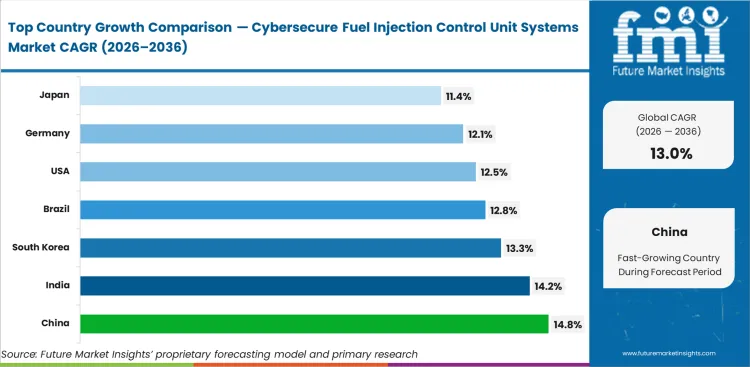
Cybersecure Fuel Injection Control Unit Systems Market CAGR Analysis by Country
- China is projected to record a 14.8% CAGR through 2036 as local vehicle output and ECU localization stay high.
- India is expected to expand at 14.2% CAGR through 2036 as high-volume vehicle platforms adopt stricter controls.
- South Korea is forecast to grow at 13.3% CAGR through 2036 as electronics depth supports secure ECU design.
- Brazil is expected to advance at 12.8% CAGR through 2036 as flex fuel needs sustain fuel control complexity.
- The United States is projected to rise at 12.5% CAGR through 2036 as connected diagnostics widen secure service needs.
- Germany is forecast at 12.1% CAGR through 2036 as approval rules and supplier depth influence ECU security.
- Japan is expected to post 11.4% CAGR through 2036 as mature powertrain supply keeps growth steadier.
Country-level analysis covers seven markets with vehicle production, fuel system demand and cybersecurity rules supporting secure fuel injection control unit adoption.
Demand Outlook for Cybersecure Fuel Injection Control Unit Systems in the United States
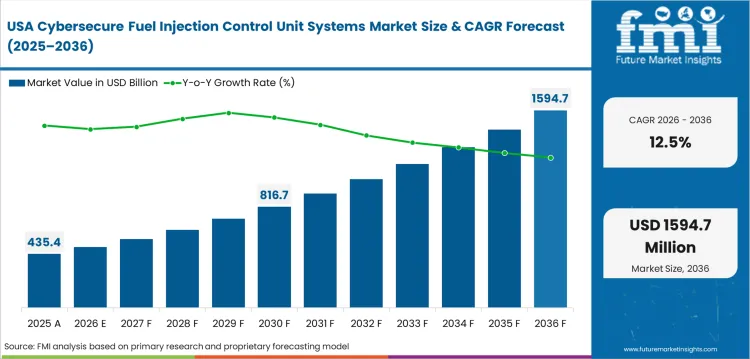
The United States remains a core market for secure fuel control as connected diagnostics reach light-duty and fleet vehicles. OICA data show the country remains among the major vehicle production hubs for 2025. That scale gives suppliers a broad path for secure controller fitment. Michigan, Ohio and Tennessee remain main customer locations for powertrain electronics programs. The practical result is a steady market that favors proven cybersecurity evidence over experimental controller designs.
- Michigan vehicle programs create demand for secure flash routines around engine calibration changes.
- Ohio component plants need ECU suppliers that can support warranty diagnostics and controlled service access.
- Tennessee assembly lines support secure controller fitment as connected service tools reach more vehicles.
Sales Analysis of Cybersecure Fuel Injection Control Unit Systems in China
China is the faster expanding market because vehicle scale and electronics localization are moving together. The China Association of Automobile Manufacturers reported 34.531 million vehicles produced in 2025. China's output gives local ECU makers a large testing ground for secure injector control. Shanghai, Chongqing and Guangdong are central to vehicle electronics sourcing. Suppliers that localize secure microcontroller support can reduce qualification time for domestic platforms.
- Shanghai vehicle programs create a route for secure ECU software and compliance documentation.
- Chongqing engine and commercial vehicle clusters sustain demand for injector control validation.
- Guangdong electronics suppliers can support hardware security module sourcing for local platforms.
Demand Outlook for Cybersecure Fuel Injection Control Unit Systems in India
India is forecast to grow quickly as high-volume vehicles add stricter emission and diagnostic controls. The Society of Indian Automobile Manufacturers reported 46.43 lakh passenger vehicle domestic sales in fiscal year 2025 to 2026. Sales volume supports gradual adoption of secure engine ECUs beyond premium vehicles. Pune, Chennai and Gurugram remain important for powertrain electronics. The forecast reflects both domestic scale and export model validation needs.
- Pune suppliers can serve fuel injection ECU programs tied to local passenger vehicle production.
- Chennai export plants need secure diagnostic routines that suit multiple regulatory regions.
- Gurugram engineering centers can validate calibration access rules before wider platform release.
Opportunity Analysis of Cybersecure Fuel Injection Control Unit Systems in Germany
Germany holds an established supplier position as automakers align powertrain controls with type approval security. The Verband der Automobilindustrie reported that German battery electric passenger car production reached 1.22 million units in 2025. Hybrid platforms and combustion export programs continue to need secure fuel control. Stuttgart and Bavaria provide supplier access to engine electronics expertise. Lower country CAGR reflects mature production and not weak adoption.
- Stuttgart engineering teams can embed secure calibration rules into hybrid powertrain programs.
- Bavaria suppliers support controller testing for premium platforms that carry global approval files.
- Lower Saxony vehicle plants need service tool controls that work across engine and diagnostic systems.
Future Outlook for Cybersecure Fuel Injection Control Unit Systems in Japan
Japan is a mature market with deep powertrain control knowledge and careful validation cycles. The Japan Automobile Manufacturers Association reported 8.23 million motor vehicles produced in 2024. Production base supports secure ECU upgrades where emission rules and reliability standards are strict. Aichi, Shizuoka and Kanagawa remain important powertrain engineering centers. Growth stays below China and India as replacement cycles are steadier.
- Aichi vehicle makers can apply secure fuel control to hybrid models and export programs.
- Shizuoka component suppliers support injector control validation for compact powertrain platforms.
- Kanagawa engineering teams can test ECU tamper resistance through structured service routines.
Sales Analysis of Cybersecure Fuel Injection Control Unit Systems in South Korea
South Korea benefits from established electronics supply and export-focused vehicle programs. The Korea Automobile and Mobility Association reported first quarter production at 1.025 million vehicles in 2026. That output supports secure ECU procurement for global platforms. Ulsan, Gyeonggi and Asan remain important locations for controller sourcing and vehicle assembly. The market is forecast above the global pace as local semiconductor links support cybersecurity hardware adoption.
- Ulsan assembly programs create volume opportunities for secure fuel control units.
- Gyeonggi electronics firms can support hardware security modules and validation tools.
- Asan vehicle production supports controlled service access for export models.
Future Outlook for Cybersecure Fuel Injection Control Unit Systems in Brazil
Brazil has strategic value because flex fuel platforms need complex fuel control and calibration rules. For example, a key player in the sector, Marelli, named Brazil as one target region for its new port fuel injection ECU range in March 2026. That product route suits ethanol, gasoline and compressed natural gas applications. Sao Paulo, Minas Gerais and Parana remain important for vehicle assembly and supplier engagement. Secure calibration is especially important when fuel blends vary by region.
- Sao Paulo vehicle programs need ECU maps that can protect flex fuel calibration files.
- Minas Gerais suppliers can support controller testing for passenger and light commercial platforms.
- Parana assembly operations create demand for validated service access on multi-fuel vehicles.
Competitive Landscape and Strategic Positioning
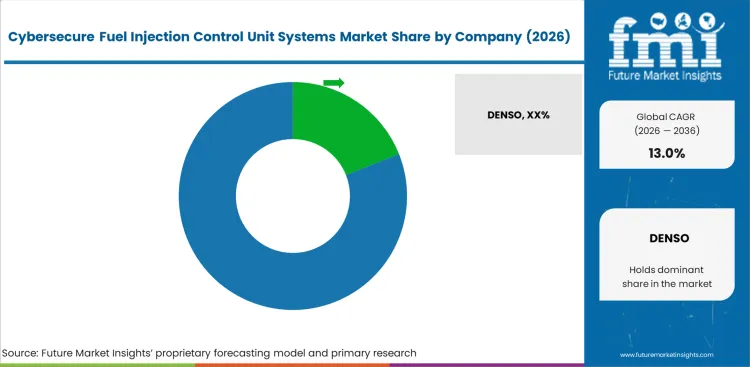
- Competition depends on injector control accuracy, cybersecurity proof and vehicle platform access.
- Tier-one suppliers win by combining fuel system knowledge with secure ECU software.
- Semiconductor companies influence the market through hardware security engines and automotive MCU roadmaps.
- Entry barriers include ISO 26262 evidence, ISO SAE 21434 alignment and service tool control.
Competitive positioning in the industry is influenced by how control units interact with automotive communication technology and secure update routes. Continental stated in April 2024 that zone control units support cybersecurity and update capability within server-centered vehicle architecture. That signal affects fuel control because engine ECUs must communicate safely with higher level computers. Suppliers with tested interfaces can fit centralized architectures more easily. Smaller firms lose ground when security evidence is incomplete.
Marelli has the closest direct fit in the market through its March 2026 port fuel injection ECU range. The company stated that the units include anti-tuning protection and can manage injectors, valves and actuators. Bosch and Continental bring wider vehicle computing and architecture strengths. Infineon and NXP support the silicon layer. Renesas and STMicroelectronics add controller depth. Their automotive microcontrollers decide how much security can be built into the controller itself.
Secure ECU suppliers face influence from automotive cyber security buyer requirements in connected vehicles. Automakers now ask for evidence that vulnerability handling and software update controls are built into supplier processes. Buyer requirements favor companies that can document product security across development and field support. The same pattern favors controller platforms that can reuse validated software across engine variants. Software reuse reduces approval work for new fuel systems.
Key Companies in the Cybersecure Fuel Injection Control Unit Systems Market
Competition is best read by role because fuel control design, secure silicon and vehicle architecture support differ sharply.
Powertrain Control Specialists:
Bosch and Marelli hold established positions through fuel injection control. DENSO adds engine management and vehicle program access. Astemo adds powertrain and motorcycle systems depth. These firms influence controller packaging, calibration support and service tool handling for secure fuel injection systems.
Vehicle Architecture Suppliers:
Continental and Aptiv are positioned around secure vehicle networks and centralized control architecture. Their value comes from domain communication, update routes and integration support. Vehicle architecture support becomes important as fuel injection ECUs communicate with zonal controllers and central computers.
Secure MCU Suppliers:
Infineon and NXP support the market through automotive-grade microcontrollers. Renesas and STMicroelectronics add safety and cybersecurity features. MCU roadmaps affect secure boot, cryptography and hardware isolation inside the control unit.
Competitive Benchmarking: Cybersecure Fuel Injection Control Unit Systems Market
| Company | Fuel Control Depth | Secure MCU Integration | Cybersecurity Evidence Support | Geographic Footprint |
|---|---|---|---|---|
| Bosch | High | Strong | Strong | Global with strong Europe and Asia powertrain programs |
| Marelli | High | Strong | Medium | Global with Brazil, India and EMEA fuel ECU focus |
| DENSO | High | Medium | Strong | Japan centered with global vehicle platform access |
| Continental | Medium | Strong | Strong | Europe centered with vehicle architecture depth |
| Astemo | Medium | Medium | Medium | Japan centered with China and global mobility operations |
| Infineon | Low | High | Strong | Europe centered with global automotive MCU reach |
| NXP Semiconductors | Low | High | Strong | Global with strong vehicle compute roadmap |
| Renesas | Low | High | Strong | Japan centered with broad automotive MCU supply |
| STMicroelectronics | Low | High | Medium | Europe centered with growing automotive MCU portfolio |
| Aptiv | Medium | Medium | Strong | Global with vehicle network and software depth |
Source: Future Market Insights competitive analysis, 2026. Ratings reflect relative positioning using fuel control depth, secure MCU integration and cybersecurity evidence support.
Key Developments in Cybersecure Fuel Injection Control Unit Systems Market
- In March 2026, Renesas expanded its automotive MCU portfolio with the 28 nm RH850 U2C for vehicle control and automotive safety applications.
- In January 2026, Bosch presented Vehicle Motion Management software for brakes and steering. The software controls powertrain and chassis functions in the same vehicle layer.
- In April 2025, Astemo presented electric powertrain systems and advanced chassis systems at Auto Shanghai.
Key Players in the Cybersecure Fuel Injection Control Unit Systems Market
Powertrain Control Specialists:
- Bosch
- Marelli
- DENSO
- Astemo
Vehicle Architecture Suppliers:
- Continental
- Aptiv
Secure MCU Suppliers:
- Infineon
- NXP Semiconductors
- Renesas
- STMicroelectronics
Report Scope and Coverage
| Parameter | Details |
|---|---|
| Quantitative Units | USD 0.70 billion to USD 2.39 billion, at 13.0% CAGR |
| Market Definition | Secure electronic control units and software used to manage fuel injector actuation in vehicle powertrains |
| Control Architecture | Dedicated engine ECUs, Powertrain domain, Zonal integrated |
| Fuel Type | Gasoline, Diesel, Multi-fuel, Two-wheeler |
| Vehicle Type | Passenger cars, Commercial vehicles, Two-wheelers, Off-highway |
| Security Layer | Secure boot, Hardware security module, Secure diagnostics, Intrusion logging |
| Sales Channel | OEM fitment, Service replacement, Software updates |
| Regions Covered | North America, Latin America, Western Europe, Eastern Europe, East Asia, South Asia and Pacific, Middle East and Africa |
| Countries Covered | United States, China, India, Germany, Japan, South Korea, Brazil, and 30+ countries |
| Key Companies Profiled | Bosch and Marelli. DENSO and Continental. Astemo, Infineon and NXP Semiconductors. Renesas, STMicroelectronics and Aptiv |
| Forecast Period | 2026 to 2036 |
| Approach | Hybrid bottom up and top down methodology using vehicle output, ECU content, fuel system fitment and cybersecurity compliance signals |
Source: Future Market Insights, 2026.
Cybersecure Fuel Injection Control Unit Systems Market Breakdown By Control Architecture, Fuel Type, Vehicle Type, Security Layer, Sales Channel, and Region
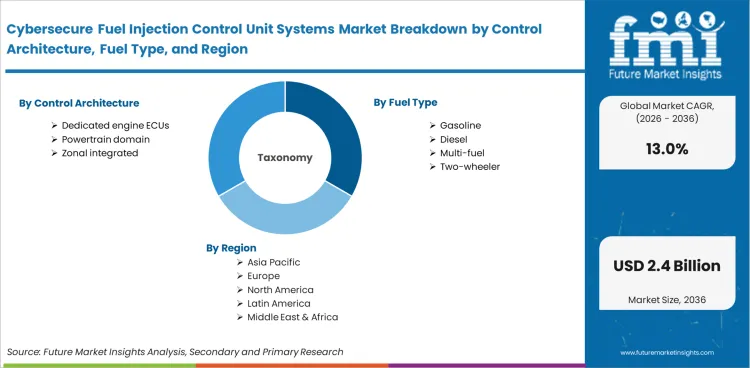
Cybersecure Fuel Injection Control Unit Systems Market Segmented by Control Architecture:
- Dedicated engine ECUs
- Powertrain domain
- Zonal integrated
Cybersecure Fuel Injection Control Unit Systems Market Segmented by Fuel Type:
- Gasoline
- Diesel
- Multi-fuel
- Two-wheeler
Cybersecure Fuel Injection Control Unit Systems Market Segmented by Vehicle Type:
- Passenger cars
- Commercial vehicles
- Two-wheelers
- Off-highway
Cybersecure Fuel Injection Control Unit Systems Market Segmented by Security Layer:
- Secure boot
- Hardware security module
- Secure diagnostics
- Intrusion logging
Cybersecure Fuel Injection Control Unit Systems Market Segmented by Sales Channel:
- OEM fitment
- Service replacement
- Software updates
Cybersecure Fuel Injection Control Unit Systems Market by Region:
- North America
- United States
- Canada
- Mexico
- Latin America
- Brazil
- Chile
- Rest of Latin America
- Western Europe
- Germany
- United Kingdom
- Italy
- Spain
- France
- Nordic
- BENELUX
- Rest of Western Europe
- Eastern Europe
- Russia
- Poland
- Hungary
- Balkan and Baltic
- Rest of Eastern Europe
- East Asia
- China
- Japan
- South Korea
- South Asia and Pacific
- India
- ASEAN
- Australia and New Zealand
- Rest of South Asia and Pacific
- Middle East and Africa
- Kingdom of Saudi Arabia
- Other GCC Countries
- Turkiye
- South Africa
- Other African Union
- Rest of Middle East and Africa
Research Sources and Bibliography
- International Organization of Motor Vehicle Manufacturers. (2026, April 23). Auto industry growth shifted east in 2025 amid global repositioning.
- Vehicle Certification Agency. (2026). Cyber security and software updating. Government of the United Kingdom.
- European Commission. (2025, December 3). Cyber Resilience Act.
- China Association of Automobile Manufacturers. (2026). 2025 year automotive statistics.
- Society of Indian Automobile Manufacturers. (2026, April). Auto industry performance of Q4 and FY 2025 to 2026.
- Verband der Automobilindustrie. (2026, February 3). Car production in Germany in January 2026.
- Japan Automobile Manufacturers Association. (2025, September 26). The motor industry of Japan 2025.
- Korea Automobile and Mobility Association. (2026). Production statistics.
- Marelli. (2026, March 10). Marelli launches new range of engine control units for gasoline and flex fuels. The launch covers CNG in Brazil, India and EMEA.
- STMicroelectronics. (2026, February 10). STMicroelectronics introduces the first automotive microcontroller with AI acceleration for edge intelligence.
- Renesas Electronics Corporation. (2026, March 4). Renesas expands auto MCU portfolio with 28 nm RH850/U2C for vehicle control and automotive safety applications.
- Bosch. (2026, January 5). CES 2026: Bosch is shaping the future of mobility, manufacturing and technology in everyday life.
- DENSO Corporation. (2025, October 30). DENSO hosted a press briefing at Japan Mobility Show 2025.
- Astemo, Ltd. (2025, April 15). Astemo to showcase intelligent and electrified advanced mobility solutions at Auto Shanghai 2025.
- Infineon Technologies AG. (2024, November 6). New high-performance microcontroller: Infineon launches AURIX TC4Dx.
- NXP Semiconductors. (2024, April 9). NXP pioneers real-time super-integration for central vehicle control with S32N55 processor.
- Continental AG. (2024, April 18). Continental is advancing server-centered vehicle architectures with zone control units.
- Qualcomm Technologies, Inc. (2024, January 9). Qualcomm and Bosch showcase new central vehicle computer for digital cockpit and driver assistance functions at CES 2024.
The bibliography is provided for reader reference and uses government and trade body sources. Company and official technical sources relevant to fuel injection control units and automotive cybersecurity demand signals.
This Report Answers
- What is the current and future size of the cybersecure fuel injection control unit systems market?
- How fast is the cybersecure fuel injection control unit systems market expected to expand between 2026 and 2036?
- Which control architecture is expected to lead cybersecure fuel injection control unit systems demand by 2026?
- Which sales channel is projected to account for the leading cybersecure fuel injection control unit systems share in 2026?
- Why are hardware security modules important for secure fuel injection control units?
- How do UN Regulation No. 155 and secure software updates affect supplier selection?
- Which countries are projected to record faster expansion during the forecast period?
- Who are the main companies active in secure fuel injection control and related ECU supply?
- How does FMI define the cybersecure fuel injection control unit systems market scope?
- How does FMI estimate and validate the cybersecure fuel injection control unit systems forecast?
Frequently Asked Questions
What is the global market demand for Cybersecure Fuel Injection Control Unit Systems in 2026?
In 2026, the global cybersecure fuel injection control unit systems market is expected to be worth USD 0.70 billion as secure engine ECUs gain use.
How big will the Cybersecure Fuel Injection Control Unit Systems Market be in 2036?
By 2036, the cybersecure fuel injection control unit systems market is expected to be worth USD 2.39 billion as secure calibration grows.
How much is demand for Cybersecure Fuel Injection Control Unit Systems expected to expand between 2026 and 2036?
Between 2026 and 2036, demand is expected to expand at 13.0% CAGR as fuel control ECUs move into security approval workflows.
Which control architecture is expected to lead the Cybersecure Fuel Injection Control Unit Systems Market by 2026?
Dedicated engine ECUs are projected to account for 49.0% share in 2026 as injector timing stays tightly validated.
Which sales channel is expected to lead Cybersecure Fuel Injection Control Unit Systems demand in 2026?
OEM fitment is expected to lead sales channel demand with 78.0% share in 2026 as security evidence is prepared before vehicle launch.
Which country is forecast to grow fastest in the Cybersecure Fuel Injection Control Unit Systems Market?
China is projected to record 14.8% CAGR through 2036 as vehicle production scale supports localized secure powertrain electronics.
What does the Cybersecure Fuel Injection Control Unit Systems Market include?
The market includes secure fuel injection ECUs and protected software modules. Secure diagnostics and authenticated calibration storage are used in vehicle powertrains.
Preview the report firsthand - request a free sample
Get SampleGet the brochure for pricing and purchase details.
Get PDFTable of Content
- Executive Summary
- Global Market Outlook
- Demand-side Trends
- Supply-side Trends
- Technology Roadmap Analysis
- Analysis and Recommendations
- Market Overview
- Market Coverage / Taxonomy
- Market Definition / Scope / Limitations
- Research Methodology
- Chapter Orientation
- Analytical Lens and Working Hypotheses
- Market Structure, Signals, and Trend Drivers
- Benchmarking and Cross-market Comparability
- Market Sizing, Forecasting, and Opportunity Mapping
- Research Design and Evidence Framework
- Desk Research Programme (Secondary Evidence)
- Company Annual and Sustainability Reports
- Peer-reviewed Journals and Academic Literature
- Corporate Websites, Product Literature, and Technical Notes
- Earnings Decks and Investor Briefings
- Statutory Filings and Regulatory Disclosures
- Technical White Papers and Standards Notes
- Trade Journals, Industry Magazines, and Analyst Briefs
- Conference Proceedings, Webinars, and Seminar Materials
- Government Statistics Portals and Public Data Releases
- Press Releases and Reputable Media Coverage
- Specialist Newsletters and Curated Briefings
- Sector Databases and Reference Repositories
- FMI Internal Proprietary Databases and Historical Market Datasets
- Subscription Datasets and Paid Sources
- Social Channels, Communities, and Digital Listening Inputs
- Additional Desk Sources
- Expert Input and Fieldwork (Primary Evidence)
- Primary Modes
- Qualitative Interviews and Expert Elicitation
- Quantitative Surveys and Structured Data Capture
- Blended Approach
- Why Primary Evidence is Used
- Field Techniques
- Interviews
- Surveys
- Focus Groups
- Observational and In-context Research
- Social and Community Interactions
- Stakeholder Universe Engaged
- C-suite Leaders
- Board Members
- Presidents and Vice Presidents
- R&D and Innovation Heads
- Technical Specialists
- Domain Subject-matter Experts
- Scientists
- Physicians and Other Healthcare Professionals
- Governance, Ethics, and Data Stewardship
- Research Ethics
- Data Integrity and Handling
- Primary Modes
- Tooling, Models, and Reference Databases
- Desk Research Programme (Secondary Evidence)
- Data Engineering and Model Build
- Data Acquisition and Ingestion
- Cleaning, Normalisation, and Verification
- Synthesis, Triangulation, and Analysis
- Quality Assurance and Audit Trail
- Market Background
- Market Dynamics
- Drivers
- Restraints
- Opportunity
- Trends
- Scenario Forecast
- Demand in Optimistic Scenario
- Demand in Likely Scenario
- Demand in Conservative Scenario
- Opportunity Map Analysis
- Product Life Cycle Analysis
- Supply Chain Analysis
- Investment Feasibility Matrix
- Value Chain Analysis
- PESTLE and Porter’s Analysis
- Regulatory Landscape
- Regional Parent Market Outlook
- Production and Consumption Statistics
- Import and Export Statistics
- Market Dynamics
- Global Market Analysis 2021 to 2025 and Forecast, 2026 to 2036
- Historical Market Size Value (USD Million) Analysis, 2021 to 2025
- Current and Future Market Size Value (USD Million) Projections, 2026 to 2036
- Y-o-Y Growth Trend Analysis
- Absolute $ Opportunity Analysis
- Global Market Pricing Analysis 2021 to 2025 and Forecast 2026 to 2036
- Global Market Analysis 2021 to 2025 and Forecast 2026 to 2036, By Control Architecture
- Introduction / Key Findings
- Historical Market Size Value (USD Million) Analysis By Control Architecture , 2021 to 2025
- Current and Future Market Size Value (USD Million) Analysis and Forecast By Control Architecture , 2026 to 2036
- Dedicated engine ECUs
- Powertrain domain
- Zonal integrated
- Dedicated engine ECUs
- Y-o-Y Growth Trend Analysis By Control Architecture , 2021 to 2025
- Absolute $ Opportunity Analysis By Control Architecture , 2026 to 2036
- Global Market Analysis 2021 to 2025 and Forecast 2026 to 2036, By Fuel Type
- Introduction / Key Findings
- Historical Market Size Value (USD Million) Analysis By Fuel Type, 2021 to 2025
- Current and Future Market Size Value (USD Million) Analysis and Forecast By Fuel Type, 2026 to 2036
- Gasoline
- Diesel
- Multi-fuel
- Two-wheeler
- Gasoline
- Y-o-Y Growth Trend Analysis By Fuel Type, 2021 to 2025
- Absolute $ Opportunity Analysis By Fuel Type, 2026 to 2036
- Global Market Analysis 2021 to 2025 and Forecast 2026 to 2036, By Vehicle Type
- Introduction / Key Findings
- Historical Market Size Value (USD Million) Analysis By Vehicle Type, 2021 to 2025
- Current and Future Market Size Value (USD Million) Analysis and Forecast By Vehicle Type, 2026 to 2036
- Passenger cars
- Commercial vehicles
- Two-wheelers
- Off-highway
- Passenger cars
- Y-o-Y Growth Trend Analysis By Vehicle Type, 2021 to 2025
- Absolute $ Opportunity Analysis By Vehicle Type, 2026 to 2036
- Global Market Analysis 2021 to 2025 and Forecast 2026 to 2036, By Security Layer
- Introduction / Key Findings
- Historical Market Size Value (USD Million) Analysis By Security Layer, 2021 to 2025
- Current and Future Market Size Value (USD Million) Analysis and Forecast By Security Layer, 2026 to 2036
- Hardware security module
- Secure diagnostics
- Intrusion logging
- Secure boot
- Hardware security module
- Y-o-Y Growth Trend Analysis By Security Layer, 2021 to 2025
- Absolute $ Opportunity Analysis By Security Layer, 2026 to 2036
- Global Market Analysis 2021 to 2025 and Forecast 2026 to 2036, By Sales Channel
- Introduction / Key Findings
- Historical Market Size Value (USD Million) Analysis By Sales Channel, 2021 to 2025
- Current and Future Market Size Value (USD Million) Analysis and Forecast By Sales Channel, 2026 to 2036
- OEM fitment
- Service replacement
- Software updates
- OEM fitment
- Y-o-Y Growth Trend Analysis By Sales Channel, 2021 to 2025
- Absolute $ Opportunity Analysis By Sales Channel, 2026 to 2036
- Global Market Analysis 2021 to 2025 and Forecast 2026 to 2036, By Region
- Introduction
- Historical Market Size Value (USD Million) Analysis By Region, 2021 to 2025
- Current Market Size Value (USD Million) Analysis and Forecast By Region, 2026 to 2036
- North America
- Latin America
- Western Europe
- Eastern Europe
- East Asia
- South Asia and Pacific
- Middle East & Africa
- Market Attractiveness Analysis By Region
- North America Market Analysis 2021 to 2025 and Forecast 2026 to 2036, By Country
- Historical Market Size Value (USD Million) Trend Analysis By Market Taxonomy, 2021 to 2025
- Market Size Value (USD Million) Forecast By Market Taxonomy, 2026 to 2036
- By Country
- USA
- Canada
- Mexico
- By Control Architecture
- By Fuel Type
- By Vehicle Type
- By Security Layer
- By Sales Channel
- By Country
- Market Attractiveness Analysis
- By Country
- By Control Architecture
- By Fuel Type
- By Vehicle Type
- By Security Layer
- By Sales Channel
- Key Takeaways
- Latin America Market Analysis 2021 to 2025 and Forecast 2026 to 2036, By Country
- Historical Market Size Value (USD Million) Trend Analysis By Market Taxonomy, 2021 to 2025
- Market Size Value (USD Million) Forecast By Market Taxonomy, 2026 to 2036
- By Country
- Brazil
- Chile
- Rest of Latin America
- By Control Architecture
- By Fuel Type
- By Vehicle Type
- By Security Layer
- By Sales Channel
- By Country
- Market Attractiveness Analysis
- By Country
- By Control Architecture
- By Fuel Type
- By Vehicle Type
- By Security Layer
- By Sales Channel
- Key Takeaways
- Western Europe Market Analysis 2021 to 2025 and Forecast 2026 to 2036, By Country
- Historical Market Size Value (USD Million) Trend Analysis By Market Taxonomy, 2021 to 2025
- Market Size Value (USD Million) Forecast By Market Taxonomy, 2026 to 2036
- By Country
- Germany
- UK
- Italy
- Spain
- France
- Nordic
- BENELUX
- Rest of Western Europe
- By Control Architecture
- By Fuel Type
- By Vehicle Type
- By Security Layer
- By Sales Channel
- By Country
- Market Attractiveness Analysis
- By Country
- By Control Architecture
- By Fuel Type
- By Vehicle Type
- By Security Layer
- By Sales Channel
- Key Takeaways
- Eastern Europe Market Analysis 2021 to 2025 and Forecast 2026 to 2036, By Country
- Historical Market Size Value (USD Million) Trend Analysis By Market Taxonomy, 2021 to 2025
- Market Size Value (USD Million) Forecast By Market Taxonomy, 2026 to 2036
- By Country
- Russia
- Poland
- Hungary
- Balkan & Baltic
- Rest of Eastern Europe
- By Control Architecture
- By Fuel Type
- By Vehicle Type
- By Security Layer
- By Sales Channel
- By Country
- Market Attractiveness Analysis
- By Country
- By Control Architecture
- By Fuel Type
- By Vehicle Type
- By Security Layer
- By Sales Channel
- Key Takeaways
- East Asia Market Analysis 2021 to 2025 and Forecast 2026 to 2036, By Country
- Historical Market Size Value (USD Million) Trend Analysis By Market Taxonomy, 2021 to 2025
- Market Size Value (USD Million) Forecast By Market Taxonomy, 2026 to 2036
- By Country
- China
- Japan
- South Korea
- By Control Architecture
- By Fuel Type
- By Vehicle Type
- By Security Layer
- By Sales Channel
- By Country
- Market Attractiveness Analysis
- By Country
- By Control Architecture
- By Fuel Type
- By Vehicle Type
- By Security Layer
- By Sales Channel
- Key Takeaways
- South Asia and Pacific Market Analysis 2021 to 2025 and Forecast 2026 to 2036, By Country
- Historical Market Size Value (USD Million) Trend Analysis By Market Taxonomy, 2021 to 2025
- Market Size Value (USD Million) Forecast By Market Taxonomy, 2026 to 2036
- By Country
- India
- ASEAN
- Australia & New Zealand
- Rest of South Asia and Pacific
- By Control Architecture
- By Fuel Type
- By Vehicle Type
- By Security Layer
- By Sales Channel
- By Country
- Market Attractiveness Analysis
- By Country
- By Control Architecture
- By Fuel Type
- By Vehicle Type
- By Security Layer
- By Sales Channel
- Key Takeaways
- Middle East & Africa Market Analysis 2021 to 2025 and Forecast 2026 to 2036, By Country
- Historical Market Size Value (USD Million) Trend Analysis By Market Taxonomy, 2021 to 2025
- Market Size Value (USD Million) Forecast By Market Taxonomy, 2026 to 2036
- By Country
- Kingdom of Saudi Arabia
- Other GCC Countries
- Turkiye
- South Africa
- Other African Union
- Rest of Middle East & Africa
- By Control Architecture
- By Fuel Type
- By Vehicle Type
- By Security Layer
- By Sales Channel
- By Country
- Market Attractiveness Analysis
- By Country
- By Control Architecture
- By Fuel Type
- By Vehicle Type
- By Security Layer
- By Sales Channel
- Key Takeaways
- Key Countries Market Analysis
- USA
- Pricing Analysis
- Market Share Analysis, 2025
- By Control Architecture
- By Fuel Type
- By Vehicle Type
- By Security Layer
- By Sales Channel
- Canada
- Pricing Analysis
- Market Share Analysis, 2025
- By Control Architecture
- By Fuel Type
- By Vehicle Type
- By Security Layer
- By Sales Channel
- Mexico
- Pricing Analysis
- Market Share Analysis, 2025
- By Control Architecture
- By Fuel Type
- By Vehicle Type
- By Security Layer
- By Sales Channel
- Brazil
- Pricing Analysis
- Market Share Analysis, 2025
- By Control Architecture
- By Fuel Type
- By Vehicle Type
- By Security Layer
- By Sales Channel
- Chile
- Pricing Analysis
- Market Share Analysis, 2025
- By Control Architecture
- By Fuel Type
- By Vehicle Type
- By Security Layer
- By Sales Channel
- Germany
- Pricing Analysis
- Market Share Analysis, 2025
- By Control Architecture
- By Fuel Type
- By Vehicle Type
- By Security Layer
- By Sales Channel
- UK
- Pricing Analysis
- Market Share Analysis, 2025
- By Control Architecture
- By Fuel Type
- By Vehicle Type
- By Security Layer
- By Sales Channel
- Italy
- Pricing Analysis
- Market Share Analysis, 2025
- By Control Architecture
- By Fuel Type
- By Vehicle Type
- By Security Layer
- By Sales Channel
- Spain
- Pricing Analysis
- Market Share Analysis, 2025
- By Control Architecture
- By Fuel Type
- By Vehicle Type
- By Security Layer
- By Sales Channel
- France
- Pricing Analysis
- Market Share Analysis, 2025
- By Control Architecture
- By Fuel Type
- By Vehicle Type
- By Security Layer
- By Sales Channel
- India
- Pricing Analysis
- Market Share Analysis, 2025
- By Control Architecture
- By Fuel Type
- By Vehicle Type
- By Security Layer
- By Sales Channel
- ASEAN
- Pricing Analysis
- Market Share Analysis, 2025
- By Control Architecture
- By Fuel Type
- By Vehicle Type
- By Security Layer
- By Sales Channel
- Australia & New Zealand
- Pricing Analysis
- Market Share Analysis, 2025
- By Control Architecture
- By Fuel Type
- By Vehicle Type
- By Security Layer
- By Sales Channel
- China
- Pricing Analysis
- Market Share Analysis, 2025
- By Control Architecture
- By Fuel Type
- By Vehicle Type
- By Security Layer
- By Sales Channel
- Japan
- Pricing Analysis
- Market Share Analysis, 2025
- By Control Architecture
- By Fuel Type
- By Vehicle Type
- By Security Layer
- By Sales Channel
- South Korea
- Pricing Analysis
- Market Share Analysis, 2025
- By Control Architecture
- By Fuel Type
- By Vehicle Type
- By Security Layer
- By Sales Channel
- Russia
- Pricing Analysis
- Market Share Analysis, 2025
- By Control Architecture
- By Fuel Type
- By Vehicle Type
- By Security Layer
- By Sales Channel
- Poland
- Pricing Analysis
- Market Share Analysis, 2025
- By Control Architecture
- By Fuel Type
- By Vehicle Type
- By Security Layer
- By Sales Channel
- Hungary
- Pricing Analysis
- Market Share Analysis, 2025
- By Control Architecture
- By Fuel Type
- By Vehicle Type
- By Security Layer
- By Sales Channel
- Kingdom of Saudi Arabia
- Pricing Analysis
- Market Share Analysis, 2025
- By Control Architecture
- By Fuel Type
- By Vehicle Type
- By Security Layer
- By Sales Channel
- Turkiye
- Pricing Analysis
- Market Share Analysis, 2025
- By Control Architecture
- By Fuel Type
- By Vehicle Type
- By Security Layer
- By Sales Channel
- South Africa
- Pricing Analysis
- Market Share Analysis, 2025
- By Control Architecture
- By Fuel Type
- By Vehicle Type
- By Security Layer
- By Sales Channel
- USA
- Market Structure Analysis
- Competition Dashboard
- Competition Benchmarking
- Market Share Analysis of Top Players
- By Regional
- By Control Architecture
- By Fuel Type
- By Vehicle Type
- By Security Layer
- By Sales Channel
- Competition Analysis
- Competition Deep Dive
- DENSO
- Overview
- Product Portfolio
- Profitability by Market Segments (Product/Age /Sales Channel/Region)
- Sales Footprint
- Strategy Overview
- Marketing Strategy
- Product Strategy
- Channel Strategy
- Continental
- Astemo
- Infineon
- NXP Semiconductors
- Renesas
- STMicroelectronics
- Aptiv
- DENSO
- Competition Deep Dive
- Assumptions & Acronyms Used


