

- Industry Size (2026)
- USD 1.4 Bn
- Forecast (2036)
- USD 2.95 Bn
- CAGR (2026 to 2036)
- 7.8%
Demand for Multistrain Probiotics in EU Size, Market Forecast and Outlook By FMI
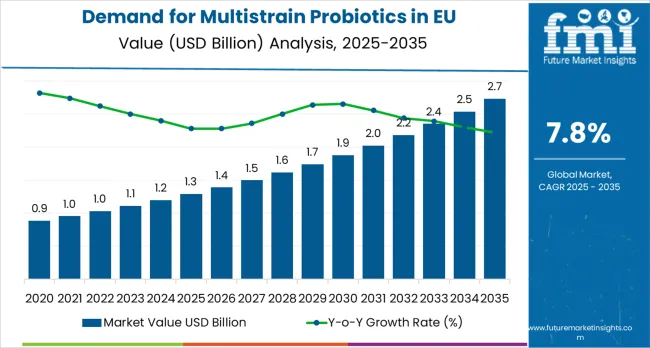
The Demand for Multistrain Probiotics in EU was valued at USD 1.29 billion in 2025, projected to reach USD 1.4 billion in 2026, and is forecast to expand to USD 2.95 billion by 2036 at a 7.8% CAGR. Expanding clinical evidence for multi-strain probiotic efficacy and rising consumer demand for gut health products are accelerating EU market growth. Regulatory pathways for probiotic health claims under EFSA assessment frameworks, combined with food manufacturer integration of probiotic cultures into dairy, beverage, and supplement formulations, are creating sustained procurement momentum across B2B and consumer-facing channels.
Summary of Demand for Multistrain Probiotics in EU
- Market Snapshot
- The market is valued at USD 1.29 billion in 2025 and is projected to reach USD 2.95 billion by 2036.
- The industry is expected to grow at a 7.8% CAGR from 2026 to 2036, creating an incremental opportunity of USD 1.56 billion.
- The market is a science-driven, clinical-evidence-dependent category where strain portfolio breadth, EFSA health claim positioning, and food manufacturer integration define competitive positioning.
- Demand and Growth Drivers
- Consumer gut-health awareness sustained by clinical research communication and retail marketing is the primary demand driver.
- Food manufacturer integration of multi-strain cultures into functional dairy, fermented beverages, and supplement lines creates B2B procurement volumes.
- Online and direct-to-consumer supplement channels are expanding accessibility beyond traditional pharmacy distribution.
- Among key countries, Spain is at 8.1% CAGR, Netherlands is at 8% CAGR, Italy is at 7.9% CAGR, France is at 7.6% CAGR, Germany is at 5.8% CAGR.
- Product and Segment View
- The market covers multi-strain probiotic formulations combining Lactobacillus, Bifidobacterium, and other bacterial and yeast strain species for food, beverage, and supplement applications.
- Applications span food and beverages (functional dairy, fermented drinks), dietary supplements (capsules, powders, sachets), and pharmaceutical-adjacent formulations.
- Bacterial Strains leads the Strain Type segment with 76.1% share in 2026.
- Food & Beverages leads the Application segment with 40% share in 2026.
- Geography and Competitive Outlook
- Spain leads growth at 8.1% CAGR, while Germany tracks at 5.8% reflecting a more mature demand base.
- Spain and the Netherlands lead growth rates, while France and Germany anchor high-value mature demand bases.
- Competition is shaped by Chr. Hansen A/S, Probi AB, IFF Inc., Lallemand Inc., DSM, Yakult, Danone.
Demand for Multistrain Probiotics in EU Key Takeaways
| Metric | Details |
|---|---|
| Industry Size (2026) | USD 1.4 billion |
| Industry Value (2036) | USD 2.95 billion |
| CAGR (2026 to 2036) | 7.8% |
Source: Future Market Insights, 2026
The EU Demand for Multistrain Probiotics in EU is governed by Regulation (EC) No 1924/2006 on nutrition and health claims, with EFSA maintaining a stringent assessment standard for probiotic health claim authorization. Bacterial strains at 76.1% market share dominate the strain type category, reflecting the commercial maturity and clinical evidence base of Lactobacillus and Bifidobacterium species in food and supplement applications. FMI analysts note that the structural growth driver for this market is the convergence of consumer gut-health awareness, food manufacturer reformulation toward functional dairy and beverage products, and the expanding clinical research pipeline validating multi-strain combinations for specific health outcomes. The distribution shift from pharmacy-exclusive placement toward supermarket and online channels is broadening the addressable consumer base.
All major markets reflect differentiated growth trajectories through 2036. Spain is projected at a 8.1% CAGR, Netherlands is projected at a 8% CAGR, Italy is projected at a 7.9% CAGR, France is projected at a 7.6% CAGR, Germany is projected at a 5.8% CAGR. Spain leads at 8.1% CAGR, driven by rapid adoption of probiotic dairy and supplement products in its expanding health-conscious consumer segment. Germany tracks at 5.8%, reflecting a more mature probiotic market where growth derives from premium multi-strain formulations rather than base-level adoption.
Demand for Multistrain Probiotics in EU Definition
The Demand for Multistrain Probiotics in EU encompasses probiotic formulations containing two or more defined microbial strain species, designed to deliver targeted gastrointestinal, immune, or metabolic health benefits. Product categories include bacterial strain combinations (Lactobacillus, Bifidobacterium, Streptococcus) and yeast strains (Saccharomyces), supplied as live cultures for food and beverage manufacturing, dietary supplement production, and pharmaceutical applications across the EU.
Demand for Multistrain Probiotics in EU Inclusions
Market scope includes bacterial and yeast multi-strain probiotic formulations distributed through specialty stores, pharmacies, supermarkets, and online retail. Coverage extends across food and beverage, dietary supplement, and pharmaceutical applications with EU-level and country-level sizing for 2026 to 2036.
Demand for Multistrain Probiotics in EU Exclusions
The scope excludes single-strain probiotic products, finished consumer yogurt and kefir products where the probiotic is not the primary functional ingredient, and fecal microbiota transplant preparations classified as pharmaceutical interventions.
Demand for Multistrain Probiotics in EU Research Methodology
- Primary Research: Analysts engaged with procurement directors, production managers, and supply chain leads across relevant manufacturing and distribution companies to map purchasing specifications and volume trends.
- Desk Research: Data collection aggregated regulatory filings, trade association publications, statistical agency databases, and company annual reports to establish baseline market parameters.
- Market-Sizing and Forecasting: Baseline values derive from a bottom-up aggregation of production volumes and trade flow data, applying country-specific consumption curves to project adoption velocity through 2036.
- Data Validation and Update Cycle: Projections are tested against publicly reported industry data and verified through cross-referencing with official statistical databases. Models are updated on a quarterly cycle.
Why is the Demand for Multistrain Probiotics Growing in EU?
Market expansion is being supported by the fundamental shift in consumer attitudes toward microbiome health and personalized wellness across European societies, with multistrain probiotics increasingly regarded as superior health supplements deserving premium scientific validation, evidence-based formulation methods, and therapeutic efficacy comparable to pharmaceutical-grade wellness products while providing unique microbiome diversity advantages.
Modern European consumers and healthcare professionals consistently prioritize strain diversity, clinical evidence, bioavailability, and regulatory compliance when selecting probiotic supplements, driving demand for specialty multistrain formulations that deliver superior health outcomes, scientifically validated strain combinations, exceptional microbiome support, and clinical certifications compared to single-strain alternatives.
Even minor concerns about digestive health, immune function, or microbiome balance can drive comprehensive adoption of specialized premium multistrain probiotics designed to maintain optimal gut health, support specific wellness applications, and enhance health satisfaction throughout all wellness categories.
The growing complexity of microbiome science and increasing awareness of strain-specific benefits are driving demand for professionally formulated multistrain probiotic products from certified European manufacturers with appropriate health supplement certifications, clinical research capabilities, technical expertise, and compliance with stringent EU health supplement regulations.
Regulatory authorities across European Union member states are increasingly establishing comprehensive guidelines for probiotic supplement manufacturing, health claim accuracy, strain identification standards, and supplement safety requirements to ensure product effectiveness and consumer safety.
Scientific research studies and clinical trials conducted at European microbiome research institutions are providing evidence supporting multistrain probiotic interventions for common health challenges including digestive disorders, immune system enhancement, metabolic health support, and wellness maintenance, requiring specialized fermentation expertise and clinically controlled production processes that meet EU health supplement standards.
Segmental Analysis
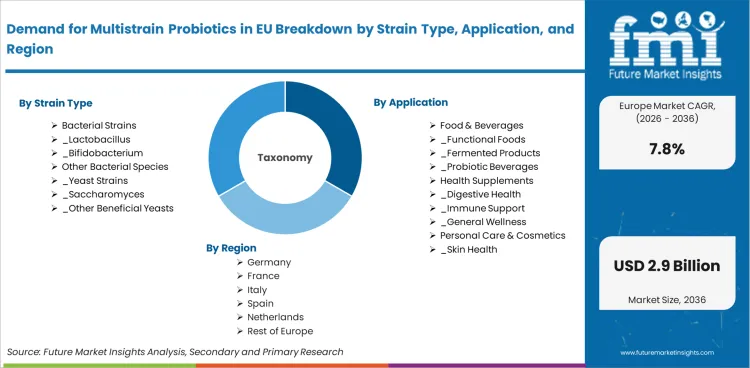
The market is segmented by strain type, application, distribution channel, and sales region. By strain type, the market is divided into bacterial strains (including Lactobacillus, Bifidobacterium, and other bacterial species) and yeast strains (including Saccharomyces and other beneficial yeasts).
Based on application, the market is categorized into health supplements (including digestive health, immune support, and general wellness subsegments), food & beverages (including functional foods, fermented products, and probiotic beverages), personal care & cosmetics (including skin health and topical applications), animal feed & pet food, and agriculture & aquaculture applications.
By distribution channel, the market spans specialty stores (health food retailers, pharmacies), supermarkets/hypermarkets, and online retail (e-commerce platforms, direct-to-consumer websites). Regionally, the market covers Germany, France, Italy, Spain, Netherlands, and Rest of Europe.
By Strain Type, Bacterial Strains Segment Accounts for 76.1% Market Share
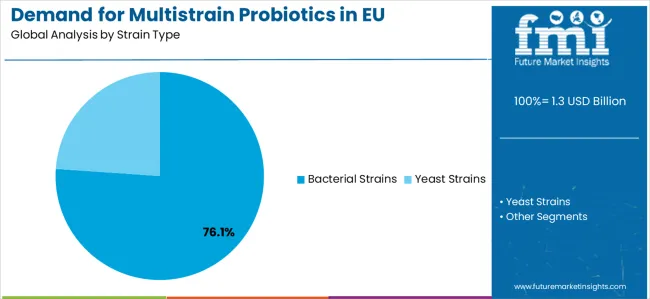
Bacterial strains segment is projected to account for 76.1% of the demand for multistrain probiotics in EU in 2026, establishing itself as the dominant product category across European health supplement and functional food facilities. This commanding market position is fundamentally supported by the widespread adoption of beneficial bacteria for comprehensive digestive health support, established clinical research validation, and diverse therapeutic applications that deliver exceptional microbiome diversity, superior health outcomes, and unparalleled wellness benefits throughout large-scale commercial operations across EU member states.
Bacterial strain products provide European health manufacturers with unparalleled formulation flexibility, precise strain control during production processes, enhanced health efficacy, and seamless integration with evidence-based wellness approaches that comply with stringent EU health supplement safety directives. This product sophistication enables European probiotic manufacturers to achieve optimal production economics while maintaining rigorous quality protocols mandated by European Food Safety Authority (EFSA) regulations, comprehensive traceability systems required under EU law, and consistent therapeutic performance across millions of individual wellness applications produced annually.
The segment derives substantial competitive advantages from established European bacterial fermentation infrastructure offering specialized cultivation solutions, comprehensive clinical support services, and continuous product innovation that incorporates advanced strain selection technologies, improved viability characteristics, and enhanced therapeutic capabilities aligned with microbiome research standards. The bacterial strain systems deliver superior therapeutic positioning particularly important in evidence-based health markets, enhanced clinical profiles, improved consumer acceptance, and superior regulatory compliance with EU health supplement manufacturing standards.
- Manufacturing efficiency advantages include established bacterial fermentation infrastructure, optimized cultivation systems, and comprehensive strain testing protocols
- Clinical effectiveness benefits through standardized strain selection methods, consistent therapeutic potency, and extensive stability characteristics
- Economic advantages from premium positioning opportunities, enhanced health outcomes, and improved market differentiation across diverse wellness applications
By Application, Food & Beverages Segment Accounts for 40.0% Market Share
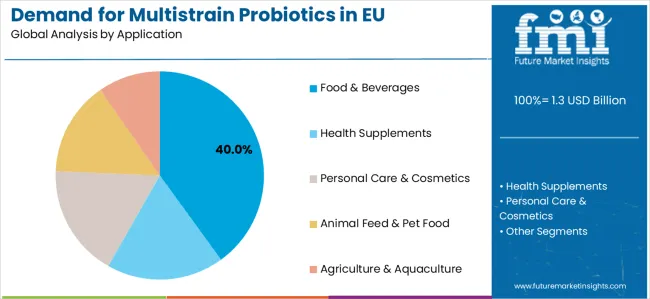
Food & beverages applications are positioned to represent 40.0% of total European multistrain probiotic demand in 2026, reflecting the segment's dominant position within the market ecosystem and the substantially larger consumer accessibility patterns compared to other application categories across most European countries. This substantial market share directly demonstrates the exceptionally high adoption rates of functional foods among European consumers and the continuously expanding population of health-conscious food manufacturers across both Western and Eastern European markets.
Modern European food & beverage multistrain probiotic applications are increasingly featuring sophisticated formulations that deliver enhanced digestive benefits, improved shelf stability, and specialized functional properties specifically designed to address common consumer health challenges including gut health optimization, immune system support, digestive comfort, and wellness enhancement.
European food manufacturers consistently demonstrate willingness to invest substantially in premium multistrain probiotics that deliver visible health benefits, support optimal product outcomes, comply with EU food safety standards, and provide consistent results for both large-scale food production and artisanal manufacturing operations. Within the food & beverages segment, functional foods applications command 25% share, fermented products represent 10%, and probiotic beverages account for 5%, reflecting comprehensive application segmentation strategies tailored to European consumer market preferences.
- Product innovation opportunities through functional food technologies, bioavailability enhancement ingredients, and consumer-friendly delivery formats
- Premium positioning strategies leveraging European wellness traditions and probiotic messaging emphasizing scientific validation and health benefits
- Distribution advantages through established food manufacturer relationships across EU markets and expanding functional food presence
What are the Drivers, Restraints, and Key Trends?
The demand for multistrain probiotics in EU is advancing steadily due to intensifying gut health awareness trends and growing recognition of microbiome diversity benefits across EU member states. The market faces challenges including complex regulatory requirements for health claims across diverse European jurisdictions, varying clinical evidence standards for different strain combinations, cold chain logistics requirements for maintaining product viability, competition from single-strain probiotics and other gut health solutions, and varying consumer awareness levels regarding strain diversity benefits despite growing microbiome education efforts. Innovation initiatives, clinical validation programs, personalized nutrition solutions, and microbiome testing platforms continue to influence product development strategies and market evolution patterns across European health markets.
Rapid Growth of Microbiome Science and Personalized Nutrition
The rapidly accelerating advancement of microbiome science and personalized nutrition approaches is fundamentally enabling broader market acceptance across European countries, enhanced therapeutic precision among consumers particularly regarding individual microbiome needs, and significantly improved health outcomes through personalized probiotic interventions.
Advanced microbiome testing platforms operated by specialized health organizations, professional healthcare providers, and major wellness companies equipped with comprehensive microbiome analysis in multiple European languages, personalized recommendations, strain selection guides, and health optimization protocols provide extensive scientific resources while dramatically expanding product credibility across diverse health-conscious segments and geographic markets throughout the European Union.
These personalized nutrition trends prove particularly valuable for multistrain probiotics that require detailed microbiome assessment, individual strain matching, and targeted therapeutic approaches to effectively demonstrate health benefits and justify premium pricing positions across sophisticated European wellness-conscious segments.
Personalized nutrition adoption also enables sophisticated health analytics, customized probiotic recommendations based on individual microbiome profiles and health goals, direct consumer feedback collection that informs product development, and precision wellness models that ensure optimal health outcomes while reducing trial-and-error approaches across fragmented European health markets.
Integration of Clinical Research and Evidence-Based Validation
Progressive European multistrain probiotic manufacturers are systematically incorporating innovative clinical research including randomized controlled trials, biomarker analysis, therapeutic efficacy studies, and safety validation that address growing European consumer demands for scientific evidence, clinical proof, and documented health outcomes in probiotic products.
Strategic integration of these clinical approaches, combined with rigorous efficacy testing and validation protocols conducted at European clinical research institutions, enables manufacturers to develop differentiated therapeutic propositions that appeal to evidence-based European consumers while maintaining essential safety profiles and regulatory compliance.
These clinical initiatives also support development of specialized formulations for specific health conditions increasingly recognized across European healthcare systems, enhanced therapeutic options for targeted wellness applications recommended by European healthcare professionals, and clinically-proven products that resonate with science-driven consumer segments particularly prevalent in Nordic and Western European countries.
Investment in clinical research facilities established in Netherlands and Germany, precision therapeutic capabilities, and advanced probiotic validation technologies enable European manufacturers to explore next-generation microbiome interventions while maintaining competitive positioning in premium and clinical-grade market segments.
Emphasis on Sustainable Production and Environmental Responsibility
European consumers and probiotic manufacturers are increasingly prioritizing sustainable production methods and environmental responsibility when selecting multistrain probiotics, driving fundamental changes in manufacturing strategies across the European probiotic industry.
Companies are implementing comprehensive sustainable fermentation systems using renewable energy sources, reducing environmental impact through efficient production technologies, and developing environmentally responsible supply chains that align with EU sustainability directives and corporate environmental responsibility regulations.
This trend is particularly pronounced across Nordic countries, Germany, Netherlands, and France where consumers demonstrate exceptional environmental consciousness and willingness to pay premiums for products with verified sustainability credentials and environmental compliance documentation.
Manufacturers are responding by developing partnerships with sustainable ingredient suppliers, implementing green manufacturing programs, obtaining multiple environmental certifications including carbon-neutral production and sustainable manufacturing standards, and providing comprehensive environmental impact information that differentiates their products in increasingly competitive European markets emphasizing environmental responsibility and sustainable consumption commitments.
Demand Analysis of Multistrain Probiotics in EU by Key Countries
The demand for multistrain probiotics in EU is projected to grow from USD 1.3 billion in 2026 to USD 2.7 billion by 2036, registering a CAGR of 7.8% over the forecast period. Germany is expected to maintain its leadership with a 27.2% share in 2026, supported by its expansive health supplement infrastructure and strong tradition of evidence-based wellness product consumption.
France follows with an 18.4% market share, attributed to growing demand for functional foods and premium wellness solutions. Italy contributes 13.7% of the market, driven by increasing adoption in digestive health and wellness applications. Spain accounts for 9.8% of the market, while Netherlands represents 4.9%. The Rest of Europe region holds the remaining market share, encompassing Nordic countries, Eastern Europe, and other EU member states with emerging demand for multistrain probiotic products.
Demand Analysis of Multistrain Probiotics in EU by Key Countries
.webp "Top Country Growth Comparison Demand For Multistrain Probiotics In Eu Cagr (2026 2036)")
| Country | CAGR |
|---|---|
| Spain | 8.1 |
| Netherlands | 8.0 |
| Italy | 7.9 |
| France | 7.6 |
| Germany | 5.8 |
Source: FMI analysis based on primary research and proprietary forecasting model
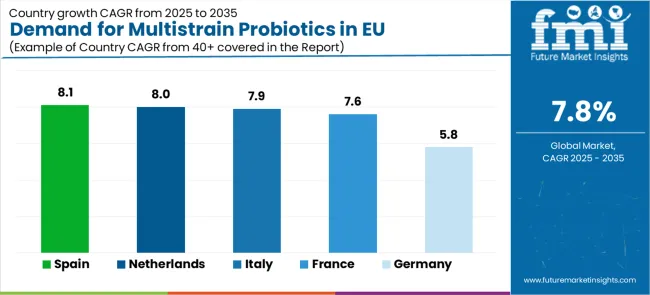
The demand for multistrain probiotics in EU demonstrates strong growth across major economies, with Spain leading at an 8.1% CAGR through 2036, driven by expanding wellness culture and growing microbiome awareness. Netherlands follows at 8.0%, supported by advanced health consciousness and innovative wellness practices. Italy grows at 7.9%, integrating probiotics into traditional wellness approaches and functional foods.
France maintains 7.6% growth, focusing on premium wellness and functional nutrition applications. Germany shows moderate growth at 5.8%, leveraging its established health supplement infrastructure. Rest of Europe shows a decline at -3.0% CAGR, reflecting market consolidation.
Germany Leads European Market with Established Health Supplement Infrastructure
The multistrain probiotics industry in Germany is projected to exhibit steady growth with a CAGR of 5.8% through 2036, driven by exceptionally strong consumer tradition in evidence-based health supplements and wellness products, comprehensively well-established distribution networks for clinical-grade nutritional products, and sophisticated regulatory frameworks supporting health supplement quality standards throughout the country.
Germany's advanced health supplement regulations and internationally recognized clinical standards through organizations including German Nutrition Society are creating substantial demand for certified clinical-grade multistrain probiotics across diverse healthcare and consumer segments.
Major health supplement companies including German pharmaceutical firms, specialized probiotic manufacturers including research-focused companies, and professional distribution networks are systematically establishing extensive product portfolios serving both healthcare professionals and health-conscious consumers throughout German wellness centers, pharmacies, and research communities.
The German market benefits from exceptionally high consumer demand for scientifically validated health supplements, substantial clinical research infrastructure presence, strong healthcare professional endorsement programs delivering credibility at premium pricing, and consumer emphasis on evidence-based wellness approaches that naturally support clinical-grade multistrain probiotic adoption.
- Regulatory environment emphasizing comprehensive clinical standards and transparent health supplement validation requirements
- Strong healthcare professional networks capturing substantial market share through clinical support and scientific validation
- Consumer sophistication driving demand for evidence-based products and detailed clinical efficacy information
France Demonstrates Strong Growth with Functional Food Integration
The multistrain probiotics industry in France is expanding at a robust CAGR of 7.6%, substantially supported by increasing French consumer interest in functional foods and premium wellness solutions, rapidly growing awareness of microbiome health benefits, and sophisticated appreciation for therapeutic nutrition reflecting French health culture. France's exceptionally well-established culinary tradition and premium positioning strategies across wellness sectors are systematically driving demand for high-quality multistrain probiotics across diverse functional food and health-focused segments.
Specialized wellness suppliers including French nutraceutical companies, traditional health food retailers, major hypermarket chains (Carrefour, Auchan, Leclerc), and professional wellness practitioners are establishing comprehensive product ranges featuring premium imported and French-produced multistrain probiotics emphasizing clinical validation and functional benefits.
The French market particularly benefits from strong cultural emphasis on health quality traditions, functional food integration techniques, and therapeutic nutrition methods that align perfectly with multistrain probiotics positioning as essential wellness components for superior health results.
- Functional food development programs creating opportunities for professional multistrain probiotic knowledge advancement and health integration
- Professional nutritionist and wellness specialist training and expert recommendations enhancing multistrain probiotic expertise and market penetration
- Cultural emphasis on health excellence supporting higher-value multistrain probiotic positioning strategies
Italy Maintains Strong Growth with Traditional Wellness Integration
The multistrain probiotics industry in Italy is growing at a strong CAGR of 7.9%, fundamentally driven by increasing integration of probiotics into traditional Italian wellness patterns, growing recognition of digestive health benefits, and strong Italian cultural appreciation for natural health solutions and traditional wellness values. Italy's deeply established wellness culture is gradually incorporating multistrain probiotics to enhance traditional health approaches, improve digestive wellness, and modernize classic Italian wellness methods while maintaining authentic regional health characteristics.
Health food stores, specialized wellness retailers including Italian suppliers, leading pharmacy chains (major Italian health groups), and traditional wellness suppliers are strategically investing in education programs and health demonstrations addressing growing Italian interest in microbiome health solutions.
The Italian market particularly benefits from strong cultural appreciation for natural wellness solutions, traditional family-oriented health approaches reflecting close cultural wellness traditions, and growing health consciousness particularly in Northern Italian regions supporting premium wellness product adoption.
- Wellness industry innovation programs facilitating multistrain probiotic integration in traditional Italian health practices
- Professional wellness training programs enhancing technical knowledge among health providers and wellness specialists
- Regional wellness development incorporating Mediterranean health ingredients and traditional Italian wellness methods
Spain Focuses on Innovation and Health-Conscious Growth
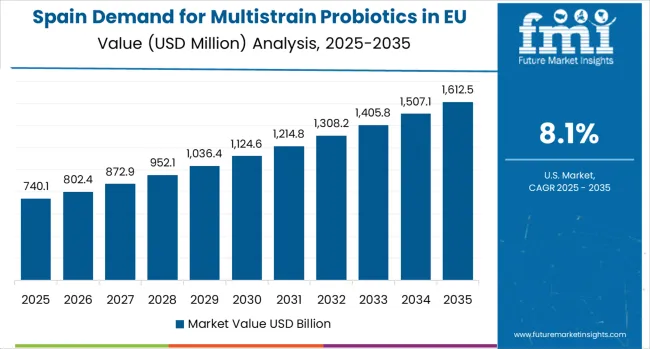
demand for multistrain probiotics in Spain is projected to grow at a strong CAGR of 8.1%, substantially supported by rapidly expanding wellness sector that actively promotes microbiome health applications, increasing Spanish consumer awareness of gut health benefits, and growing health consciousness particularly in major metropolitan areas including Madrid, Barcelona, Valencia, and Seville.
Spanish wellness sector is experiencing significant modernization with expansion of health food retailers, premium wellness suppliers, and major pharmacy distributors systematically increasing probiotic category investments and introducing advanced microbiome wellness capabilities.
The Spanish market is increasingly characterized by wellness trends reflecting broader European patterns, growing interest in multistrain probiotic formulations addressing specific health applications, and increasing acceptance of premium pricing for quality wellness products delivering visible health benefits.
Spain's substantial health and wellness focus, strong cultural appreciation for natural health solutions reflecting Mediterranean values, and expanding wellness infrastructure create favorable conditions for multistrain probiotic market expansion.
- Health and wellness industry investments prioritizing microbiome health applications for wellness-conscious consumers and health innovation
- Professional wellness certification programs ensuring technical expertise among health providers and wellness specialists
- Export market development leveraging Spain's position in Mediterranean and Latin American wellness relationships
Netherlands Emphasizes Innovation and Scientific Leadership
Demand for multistrain probiotics in the Netherlands is expanding at a robust CAGR of 8.0%, fundamentally driven by exceptionally strong Dutch commitment to health innovation, premium wellness solutions, and scientific consciousness that positions Netherlands among European health research leaders. Dutch consumers and wellness professionals are increasingly selecting multistrain probiotics based on comprehensive scientific credentials, verified clinical efficacy through European standards, and complete research documentation demonstrating health benefits and safety profiles throughout development processes.
The Netherlands market significantly benefits from exceptionally well-developed health research infrastructure including major wellness innovation companies, specialized probiotic suppliers, and professional health distributors, combined with demonstrated willingness to invest substantial resources in probiotics with verified clinical certifications and scientific validation standards. Dutch regulatory environment actively supports health innovation, probiotic research development, transparent health claim requirements, and evidence-based validation initiatives that enhance consumer confidence and market development.
- Scientific leadership driving consumer demand for clinically validated premium multistrain probiotic products
- Research infrastructure supporting comprehensive clinical product development and professional health access
- Evidence-based emphasis encouraging development of clinical validation and health advancement practices
Competitive Landscape
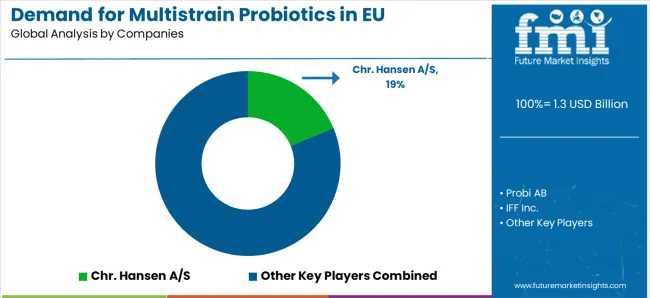
The demand for multistrain probiotics in EU is defined by intense competition among multinational nutraceutical corporations, regional European manufacturers, specialized probiotic producers, and clinical research companies from major health supplement suppliers.
Companies are investing in European research capacity expansion, advanced strain development technologies, clinical validation programs through European research centers, evidence-based solutions aligned with EU health regulations, and direct-to-consumer distribution platforms serving diverse European health-conscious markets. Strategic acquisitions, product portfolio expansion, geographic market penetration across Eastern European growth markets, healthcare professional partnership programs, and clinical certifications are central to strengthening market position and capturing share in this dynamic European category.
Major market participants include Chr. Hansen A/S with significant European market presence through probiotic research leadership and comprehensive strain development solutions distributed through European health channels. Probi AB maintains substantial European market leadership through clinical focus and evidence-based probiotic applications across health supplement sectors including professional and consumer markets.
IFF Inc. emphasizes precision wellness technologies and technical support services for professional health manufacturers across European markets. Lallemand Inc. represents significant European strain quality focus with specialized fermentation capabilities and comprehensive probiotic technologies.
Regional European producers and specialized clinical brands are establishing significant market presence through premium positioning, clinical validation certifications, specialty multistrain probiotic formulations including targeted health alternatives and therapeutic options, and direct-to-consumer business models. Clinical research programs from major European microbiome initiatives including established probiotic research centers provide scientifically validated alternatives supporting market development, capturing meaningful market share particularly in evidence-driven health markets.
European co-manufacturing specialists including specialized fermentation processors operate comprehensive production facilities serving both branded manufacturers and health customers, representing critical infrastructure enabling market expansion and product innovation across European health supplement markets.
Key Players in the Demand for Multistrain Probiotics in EU
- Chr. Hansen A/S
- Probi AB
- IFF Inc.
- Lallemand Inc.
- DSM
- Yakult
- Danone
- Nestle Health Science
- Kerry Group
- European Regional Producers
Scope of the Report
| Metric | Value |
|---|---|
| Quantitative Units | USD 1.4 billion to USD 2.95 billion, at a CAGR of 7.8% |
| Market Definition | The Demand for Multistrain Probiotics in EU encompasses probiotic formulations containing two or more defined microbial strain species, designed to deliver targeted gastrointestinal, immune, or metabolic health... |
| Segmentation | Strain Type: Bacterial Strains, Other Bacterial Species; Application: Food & Beverages, Health Supplements, Personal Care & Cosmetics, Animal Feed & Pet Food, Agriculture & Aquaculture; Distribution Channel: Specialty Stores, Supermarkets/Hypermarkets, Online Retail |
| Regions Covered | EU (Western Europe, Southern Europe, Central Europe) |
| Countries Covered | Spain, Netherlands, Italy, France, Germany |
| Key Companies Profiled | Chr. Hansen A/S, Probi AB, IFF Inc., Lallemand Inc., DSM, Yakult, Danone, Nestle Health Science |
| Forecast Period | 2026 to 2036 |
| Approach | Hybrid bottom-up modeling using production volume data, trade flow analysis, and primary research validation |
Key Segments
Strain Type:
- Bacterial Strains
- Lactobacillus
- Bifidobacterium
- Other Bacterial Species
- Yeast Strains
- Saccharomyces
- Other Beneficial Yeasts
Application:
- Health Supplements
- Digestive Health
- Immune Support
- General Wellness
- Food & Beverages
- Functional Foods
- Fermented Products
- Probiotic Beverages
- Personal Care & Cosmetics
- Skin Health
- Topical Applications
- Animal Feed & Pet Food
- Agriculture & Aquaculture
Distribution Channel:
- Specialty Stores
- Health Food Retailers
- Pharmacies
- Supermarkets/Hypermarkets
- Online Retail
- E-commerce Platforms
- Direct-to-Consumer Websites
Countries:
- Germany
- France
- Italy
- Spain
- Netherlands
- Rest of Europe
Bibliography
- 1. European Food Safety Authority. (2025). Scientific opinions on probiotic health claim applications. EFSA Journal.
- 2. European Commission. (2024). Regulation (EC) No 1924/2006 on nutrition and health claims, consolidated text. EUR-Lex.
- 3. World Gastroenterology Organisation. (2024). WGO Global Guidelines: Probiotics and prebiotics. WGO.
- 4. Chr. Hansen A/S. (2024). Annual Report 2024: Health and nutrition segment review. Chr. Hansen Holding A/S.
- 5. International Scientific Association for Probiotics and Prebiotics. (2024). Consensus statement on the scope and appropriate use of the term probiotic. ISAPP.
This bibliography is provided for reader reference. The full Future Market Insights report contains the complete reference list with primary research documentation.
Frequently Asked Questions
How large is the demand for Multistrain Probiotics in the market in 2026?
Demand for multistrain probiotics is estimated to be valued at USD 1.39 billion in 2026.
What will be the market size of Multistrain Probiotics by 2036?
Market size for multistrain probiotics is projected to reach USD 2.95 billion by 2036.
What is the expected demand growth for Multistrain Probiotics between 2026 and 2036?
Demand for multistrain probiotics is expected to grow at a CAGR of 7.8% between 2026 and 2036.
Which Strain Type is poised to lead sales by 2026?
Bacterial Strains accounts for 76.1% share in 2026, making it the leading sub-segment within the Strain Type category.
How is the role of Food & Beverages in driving multistrain probiotics adoption in 2026?
Food & Beverages holds 40% of the Application segment share in 2026.
Which country is the fastest-growing market for multistrain probiotics?
Spain is projected to grow at a CAGR of 8.1% during 2026 to 2036, the fastest rate among markets covered.
What is Multistrain Probiotics and what is it mainly used for?
The Demand for Multistrain Probiotics in EU encompasses probiotic formulations containing two or more defined microbial strain species, designed to deliver targeted gastrointestinal, immune, or metabolic health benefits. Product categories include bacterial strain combinations (Lactobacillus, Bifidobacterium, Streptococcus) and yeast strains (Saccharomyces), supplied as live cultures for food and beverage manufacturing, dietary supplement production, and pharmaceutical applications across the EU.
How does FMI build and validate the multistrain probiotics forecast?
Forecasting models apply a bottom-up methodology starting with production volume data and cross-validate projections against publicly reported industry statistics and primary research inputs.
Preview the report firsthand - request a free sample
Get SampleGet the brochure for pricing and purchase details.
Get PDFTable of Content
- Executive Summary
- Global Market Outlook
- Demand-side Trends
- Supply-side Trends
- Technology Roadmap Analysis
- Analysis and Recommendations
- Market Overview
- Market Definition / Scope / Limitations
- Research Methodology
- Chapter Orientation
- Analytical Lens and Working Hypotheses
- Market Structure, Signals, and Trend Drivers
- Benchmarking and Cross-market Comparability
- Market Sizing, Forecasting, and Opportunity Mapping
- Research Design and Evidence Framework
- Desk Research Programme (Secondary Evidence)
- Company Annual and Sustainability Reports
- Peer-reviewed Journals and Academic Literature
- Corporate Websites, Product Literature, and Technical Notes
- Earnings Decks and Investor Briefings
- Statutory Filings and Regulatory Disclosures
- Technical White Papers and Standards Notes
- Trade Journals, Industry Magazines, and Analyst Briefs
- Conference Proceedings, Webinars, and Seminar Materials
- Government Statistics Portals and Public Data Releases
- Press Releases and Reputable Media Coverage
- Specialist Newsletters and Curated Briefings
- Additional Desk Sources
- Expert Input and Fieldwork (Primary Evidence)
- Primary Modes
- Qualitative Interviews and Expert Elicitation
- Quantitative Surveys and Structured Data Capture
- Blended Approach
- Why Primary Evidence is Used
- Field Techniques
- Interviews
- Surveys
- Focus Groups
- Observational and In-context Research
- Social and Community Interactions
- Stakeholder Universe Engaged
- C-suite Leaders
- Board Members
- Presidents and Vice Presidents
- R&D and Innovation Heads
- Technical Specialists
- Domain Subject-matter Experts
- Scientists
- Physicians and Other Healthcare Professionals
- Governance, Ethics, and Data Stewardship
- Research Ethics
- Data Integrity and Handling
- Primary Modes
- Tooling, Models, and Reference Databases
- Desk Research Programme (Secondary Evidence)
- Data Engineering and Model Build
- Data Acquisition and Ingestion
- Cleaning, Normalisation, and Verification
- Synthesis, Triangulation, and Analysis
- Quality Assurance and Audit Trail
- Market Background
- Market Dynamics
- Drivers
- Restraints
- Opportunity
- Trends
- Scenario Forecast
- Demand in Optimistic Scenario
- Demand in Likely Scenario
- Demand in Conservative Scenario
- Opportunity Map Analysis
- Product Life Cycle Analysis
- Supply Chain Analysis
- Investment Feasibility Matrix
- Value Chain Analysis
- PESTLE and Porter’s Analysis
- Regulatory Landscape
- Regional Parent Market Outlook
- Production and Consumption Statistics
- Import and Export Statistics
- Market Dynamics
- Global Market Analysis 2021 to 2025 and Forecast, 2026 to 2036
- Historical Market Size Value (USD Billion) Analysis, 2021 to 2025
- Current and Future Market Size Value (USD Billion) Projections, 2026 to 2036
- Y-o-Y Growth Trend Analysis
- Absolute $ Opportunity Analysis
- Global Market Pricing Analysis 2021 to 2025 and Forecast 2026 to 2036
- Global Market Analysis 2021 to 2025 and Forecast 2026 to 2036, By Strain Type
- Introduction / Key Findings
- Historical Market Size Value (USD Billion) Analysis By Strain Type , 2021 to 2025
- Current and Future Market Size Value (USD Billion) Analysis and Forecast By Strain Type , 2026 to 2036
- Bacterial Strains
- Lactobacillus
- Bifidobacterium
- Other Bacterial Species
- Yeast Strains
- Saccharomyces
- Other Beneficial Yeasts
- Bacterial Strains
- Y-o-Y Growth Trend Analysis By Strain Type , 2021 to 2025
- Absolute $ Opportunity Analysis By Strain Type , 2026 to 2036
- Global Market Analysis 2021 to 2025 and Forecast 2026 to 2036, By Application
- Introduction / Key Findings
- Historical Market Size Value (USD Billion) Analysis By Application, 2021 to 2025
- Current and Future Market Size Value (USD Billion) Analysis and Forecast By Application, 2026 to 2036
- Food & Beverages
- Functional Foods
- Fermented Products
- Probiotic Beverages
- Health Supplements
- Digestive Health
- Immune Support
- General Wellness
- Personal Care & Cosmetics
- Skin Health
- Topical Applications
- Animal Feed & Pet Food
- Agriculture & Aquaculture
- Food & Beverages
- Y-o-Y Growth Trend Analysis By Application, 2021 to 2025
- Absolute $ Opportunity Analysis By Application, 2026 to 2036
- Global Market Analysis 2021 to 2025 and Forecast 2026 to 2036, By Distribution Channel
- Introduction / Key Findings
- Historical Market Size Value (USD Billion) Analysis By Distribution Channel, 2021 to 2025
- Current and Future Market Size Value (USD Billion) Analysis and Forecast By Distribution Channel, 2026 to 2036
- Specialty Stores
- Health Food Retailers
- Pharmacies
- Supermarkets/Hypermarkets
- Online Retail
- E-commerce Platforms
- Direct-to-Consumer Websites
- Specialty Stores
- Y-o-Y Growth Trend Analysis By Distribution Channel, 2021 to 2025
- Absolute $ Opportunity Analysis By Distribution Channel, 2026 to 2036
- Global Market Analysis 2021 to 2025 and Forecast 2026 to 2036, By Region
- Introduction
- Historical Market Size Value (USD Billion) Analysis By Region, 2021 to 2025
- Current Market Size Value (USD Billion) Analysis and Forecast By Region, 2026 to 2036
- North America
- Latin America
- Western Europe
- Eastern Europe
- East Asia
- South Asia and Pacific
- Middle East & Africa
- Market Attractiveness Analysis By Region
- North America Market Analysis 2021 to 2025 and Forecast 2026 to 2036, By Country
- Historical Market Size Value (USD Billion) Trend Analysis By Market Taxonomy, 2021 to 2025
- Market Size Value (USD Billion) Forecast By Market Taxonomy, 2026 to 2036
- By Country
- USA
- Canada
- Mexico
- By Strain Type
- By Application
- By Distribution Channel
- By Country
- Market Attractiveness Analysis
- By Country
- By Strain Type
- By Application
- By Distribution Channel
- Key Takeaways
- Latin America Market Analysis 2021 to 2025 and Forecast 2026 to 2036, By Country
- Historical Market Size Value (USD Billion) Trend Analysis By Market Taxonomy, 2021 to 2025
- Market Size Value (USD Billion) Forecast By Market Taxonomy, 2026 to 2036
- By Country
- Brazil
- Chile
- Rest of Latin America
- By Strain Type
- By Application
- By Distribution Channel
- By Country
- Market Attractiveness Analysis
- By Country
- By Strain Type
- By Application
- By Distribution Channel
- Key Takeaways
- Western Europe Market Analysis 2021 to 2025 and Forecast 2026 to 2036, By Country
- Historical Market Size Value (USD Billion) Trend Analysis By Market Taxonomy, 2021 to 2025
- Market Size Value (USD Billion) Forecast By Market Taxonomy, 2026 to 2036
- By Country
- Germany
- UK
- Italy
- Spain
- France
- Nordic
- BENELUX
- Rest of Western Europe
- By Strain Type
- By Application
- By Distribution Channel
- By Country
- Market Attractiveness Analysis
- By Country
- By Strain Type
- By Application
- By Distribution Channel
- Key Takeaways
- Eastern Europe Market Analysis 2021 to 2025 and Forecast 2026 to 2036, By Country
- Historical Market Size Value (USD Billion) Trend Analysis By Market Taxonomy, 2021 to 2025
- Market Size Value (USD Billion) Forecast By Market Taxonomy, 2026 to 2036
- By Country
- Russia
- Poland
- Hungary
- Balkan & Baltic
- Rest of Eastern Europe
- By Strain Type
- By Application
- By Distribution Channel
- By Country
- Market Attractiveness Analysis
- By Country
- By Strain Type
- By Application
- By Distribution Channel
- Key Takeaways
- East Asia Market Analysis 2021 to 2025 and Forecast 2026 to 2036, By Country
- Historical Market Size Value (USD Billion) Trend Analysis By Market Taxonomy, 2021 to 2025
- Market Size Value (USD Billion) Forecast By Market Taxonomy, 2026 to 2036
- By Country
- China
- Japan
- South Korea
- By Strain Type
- By Application
- By Distribution Channel
- By Country
- Market Attractiveness Analysis
- By Country
- By Strain Type
- By Application
- By Distribution Channel
- Key Takeaways
- South Asia and Pacific Market Analysis 2021 to 2025 and Forecast 2026 to 2036, By Country
- Historical Market Size Value (USD Billion) Trend Analysis By Market Taxonomy, 2021 to 2025
- Market Size Value (USD Billion) Forecast By Market Taxonomy, 2026 to 2036
- By Country
- India
- ASEAN
- Australia & New Zealand
- Rest of South Asia and Pacific
- By Strain Type
- By Application
- By Distribution Channel
- By Country
- Market Attractiveness Analysis
- By Country
- By Strain Type
- By Application
- By Distribution Channel
- Key Takeaways
- Middle East & Africa Market Analysis 2021 to 2025 and Forecast 2026 to 2036, By Country
- Historical Market Size Value (USD Billion) Trend Analysis By Market Taxonomy, 2021 to 2025
- Market Size Value (USD Billion) Forecast By Market Taxonomy, 2026 to 2036
- By Country
- Kingdom of Saudi Arabia
- Other GCC Countries
- Turkiye
- South Africa
- Other African Union
- Rest of Middle East & Africa
- By Strain Type
- By Application
- By Distribution Channel
- By Country
- Market Attractiveness Analysis
- By Country
- By Strain Type
- By Application
- By Distribution Channel
- Key Takeaways
- Key Countries Market Analysis
- USA
- Pricing Analysis
- Market Share Analysis, 2025
- By Strain Type
- By Application
- By Distribution Channel
- Canada
- Pricing Analysis
- Market Share Analysis, 2025
- By Strain Type
- By Application
- By Distribution Channel
- Mexico
- Pricing Analysis
- Market Share Analysis, 2025
- By Strain Type
- By Application
- By Distribution Channel
- Brazil
- Pricing Analysis
- Market Share Analysis, 2025
- By Strain Type
- By Application
- By Distribution Channel
- Chile
- Pricing Analysis
- Market Share Analysis, 2025
- By Strain Type
- By Application
- By Distribution Channel
- Germany
- Pricing Analysis
- Market Share Analysis, 2025
- By Strain Type
- By Application
- By Distribution Channel
- UK
- Pricing Analysis
- Market Share Analysis, 2025
- By Strain Type
- By Application
- By Distribution Channel
- Italy
- Pricing Analysis
- Market Share Analysis, 2025
- By Strain Type
- By Application
- By Distribution Channel
- Spain
- Pricing Analysis
- Market Share Analysis, 2025
- By Strain Type
- By Application
- By Distribution Channel
- France
- Pricing Analysis
- Market Share Analysis, 2025
- By Strain Type
- By Application
- By Distribution Channel
- India
- Pricing Analysis
- Market Share Analysis, 2025
- By Strain Type
- By Application
- By Distribution Channel
- ASEAN
- Pricing Analysis
- Market Share Analysis, 2025
- By Strain Type
- By Application
- By Distribution Channel
- Australia & New Zealand
- Pricing Analysis
- Market Share Analysis, 2025
- By Strain Type
- By Application
- By Distribution Channel
- China
- Pricing Analysis
- Market Share Analysis, 2025
- By Strain Type
- By Application
- By Distribution Channel
- Japan
- Pricing Analysis
- Market Share Analysis, 2025
- By Strain Type
- By Application
- By Distribution Channel
- South Korea
- Pricing Analysis
- Market Share Analysis, 2025
- By Strain Type
- By Application
- By Distribution Channel
- Russia
- Pricing Analysis
- Market Share Analysis, 2025
- By Strain Type
- By Application
- By Distribution Channel
- Poland
- Pricing Analysis
- Market Share Analysis, 2025
- By Strain Type
- By Application
- By Distribution Channel
- Hungary
- Pricing Analysis
- Market Share Analysis, 2025
- By Strain Type
- By Application
- By Distribution Channel
- Kingdom of Saudi Arabia
- Pricing Analysis
- Market Share Analysis, 2025
- By Strain Type
- By Application
- By Distribution Channel
- Turkiye
- Pricing Analysis
- Market Share Analysis, 2025
- By Strain Type
- By Application
- By Distribution Channel
- South Africa
- Pricing Analysis
- Market Share Analysis, 2025
- By Strain Type
- By Application
- By Distribution Channel
- USA
- Market Structure Analysis
- Competition Dashboard
- Competition Benchmarking
- Market Share Analysis of Top Players
- By Regional
- By Strain Type
- By Application
- By Distribution Channel
- Competition Analysis
- Competition Deep Dive
- Chr. Hansen A/S
- Overview
- Product Portfolio
- Profitability by Market Segments (Product/Age /Sales Channel/Region)
- Sales Footprint
- Strategy Overview
- Marketing Strategy
- Product Strategy
- Channel Strategy
- Probi AB
- IFF Inc.
- Lallemand Inc.
- DSM
- Yakult
- Danone
- Nestle Health Science
- Kerry Group
- European Regional Producers
- Chr. Hansen A/S
- Competition Deep Dive
- Assumptions & Acronyms Used


