

- Industry Size (2026)
- USD 14.61 Bn
- Forecast (2036)
- USD 25.93 Bn
- CAGR (2026 to 2036)
- 5.9%
Demand for Wheatgrass Products in EU Size, Market Forecast and Outlook By FMI
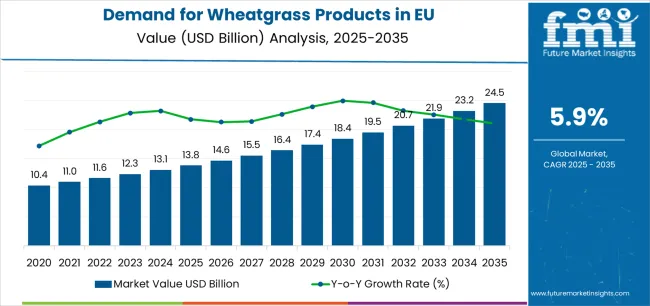
The Demand for Wheatgrass Products in EU was valued at USD 13.80 billion in 2025, projected to reach USD 14.61 billion in 2026, and is forecast to expand to USD 25.93 billion by 2036 at a 5.9% CAGR. Growing consumer awareness of plant-based nutrition and rising demand for functional food ingredients across the EU are fueling steady expansion of wheatgrass product sales. Regulatory clarity under Novel Food frameworks and broader integration into nutraceutical supply chains are supporting market maturation across Western European economies.
Summary of Demand for Wheatgrass Products in EU
- Market Snapshot
- The market is valued at USD 13.80 billion in 2025 and is projected to reach USD 25.93 billion by 2036.
- The industry is expected to grow at a 5.9% CAGR from 2026 to 2036, creating an incremental opportunity of USD 11.31 billion.
- The market is a health-oriented, certification-driven category where organic compliance and mainstream retail placement define competitive positioning.
- Demand and Growth Drivers
- Consumer demand for plant-based functional nutrition is the primary driver, with wheatgrass positioned as a chlorophyll-rich supplement ingredient.
- Organic certification requirements under EU Regulation 2018/848 are creating a quality floor that favors established producers with certified supply chains.
- Nutraceutical sector expansion across Germany, France, and the Netherlands is pulling wheatgrass into formalized supplement manufacturing workflows.
- Among key countries, Germany is at 6.3% CAGR, Spain is at 6.2% CAGR, Netherlands is at 6.1% CAGR, Italy is at 5.7% CAGR, France is at 5.5% CAGR, Rest of Europe is at 5.5% CAGR.
- Product and Segment View
- The market includes wheatgrass products in powder and juice formats, sourced from Triticum aestivum for nutritional and cosmetic applications.
- Applications span household supplements, nutraceuticals, personal care, pharmaceuticals, pet food, and food/beverage formulations.
- Powder leads the Product Type segment with 80% share in 2026.
- Organic leads the Nature segment with 90% share in 2026.
- Household leads the Application segment with 35% share in 2026.
- Hypermarkets/Supermarkets leads the Distribution Channel segment with 40% share in 2026.
- Geography and Competitive Outlook
- Germany leads EU growth at 6.3% CAGR, while Rest of Europe tracks at 5.5% reflecting a more mature demand base.
- Germany and the Netherlands lead in retail shelf penetration for organic wheatgrass products.
- Competition is shaped by Now Foods, Myprotein, Navitas Organics, Girmes Wheatgrass, Amazing Grass, Pukka Herbs, Naturya.
Demand for Wheatgrass Products in EU Key Takeaways
| Metric | Details |
|---|---|
| Industry Size (2026) | USD 14.61 billion |
| Industry Value (2036) | USD 25.93 billion |
| CAGR (2026 to 2036) | 5.9% |
Source: Future Market Insights, 2026
The EU Demand for Wheatgrass Products in EU is shaped by the regulatory pathway established under Regulation (EU) 2015/2283 on Novel Foods, which governs the authorization process for newer functional ingredients entering European retail. Organic certification under EU Regulation 2018/848 is a baseline procurement requirement for most retailers stocking wheatgrass in health food and supplement aisles. As per FMI, the transition from niche health store distribution to mainstream supermarket shelf placement is the structural shift defining the current growth phase of this market.
All major EU markets reflect differentiated growth trajectories through 2036. Germany is projected at a 6.3% CAGR, Spain is projected at a 6.2% CAGR, Netherlands is projected at a 6.1% CAGR, Italy is projected at a 5.7% CAGR, France is projected at a 5.5% CAGR, Rest of Europe is projected at a 5.5% CAGR. Germany leads EU wheatgrass adoption, supported by its large organic retail footprint and consumer willingness to pay a premium for certified organic supplements. Spain and the Netherlands are closing the gap as retailer assortment decisions increasingly include wheatgrass in mainstream health food sections.
Demand for Wheatgrass Products in EU Definition
The Demand for Wheatgrass Products in EU covers processed Triticum aestivum grass in powder and juice forms, used as a concentrated source of chlorophyll, vitamins, and antioxidants. Applications span household dietary supplementation, nutraceutical formulations, personal care and cosmetic ingredients, pharmaceutical intermediates, pet food supplements, and food/beverage fortification within EU retail and wholesale channels.
Demand for Wheatgrass Products in EU Inclusions
Market scope includes wheatgrass powder and juice products distributed through hypermarkets, specialty stores, convenience stores, and online retailers. Coverage extends to organic and natural product lines across household, nutraceutical, personal care, pharmaceutical, pet food, and food/beverage applications with EU-level and country-level sizing for 2026 to 2036.
Demand for Wheatgrass Products in EU Exclusions
The scope excludes fresh-cut wheatgrass sold as raw produce, wheatgrass seeds for agricultural planting, and unprocessed grass not intended for human consumption. Downstream finished supplement capsules are excluded unless the wheatgrass powder is the primary active ingredient.
Demand for Wheatgrass Products in EU Research Methodology
- Primary Research: Analysts engaged with procurement directors, production managers, and supply chain leads across EU food processing and distribution companies to map purchasing specifications and volume trends.
- Desk Research: Data collection aggregated EU regulatory filings, trade association publications, statistical agency databases, and company annual reports to establish baseline market parameters.
- Market-Sizing and Forecasting: Baseline values derive from a bottom-up aggregation of production volumes and trade flow data, applying country-specific consumption curves to project adoption velocity through 2036.
- Data Validation and Update Cycle: Projections are tested against publicly reported industry production data and verified through cross-referencing with EU statistical databases. Models are updated on a quarterly cycle.
Why is the Demand for Wheatgrass Products in EU Growing?
Industry expansion is being supported by the rapid increase in health-conscious consumers across European countries and the corresponding demand for nutrient-dense, convenient, and scientifically validated superfood supplements with proven functionality in daily wellness routines. Modern consumers rely on wheatgrass products as concentrated sources of vitamins, minerals, chlorophyll, and antioxidants, driving demand for products that deliver measurable health benefits, including energy enhancement, detoxification support, and immune system strengthening. Even minor health concerns, such as nutrient deficiencies, low energy levels, or digestive issues, can drive comprehensive adoption of wheatgrass supplementation to maintain optimal wellness and support natural body functions.
The growing awareness of preventive healthcare and increasing recognition of wheatgrass's therapeutic properties are driving demand for premium organic products from certified producers with appropriate quality credentials and transparent sourcing. Regulatory authorities are increasingly establishing clear guidelines for superfood labeling, nutritional claims standards, and quality requirements to maintain consumer safety and ensure product consistency. Scientific research studies and clinical trials are providing evidence supporting wheatgrass's health benefits and functional advantages, requiring specialized processing methods and standardized production protocols for optimal nutrient preservation, bioavailability enhancement, and appropriate product stability throughout shelf life, including vitamin retention and chlorophyll preservation.
Segmental Analysis
Sales are segmented by product type, nature, application (end-use), distribution channel, and country. By product type, demand is divided into powder and juice formats. Based on nature, sales are categorized into organic and natural varieties. In terms of application, demand is segmented into food & beverages, nutraceuticals, personal care & cosmetics, pharmaceuticals, pet food, and household uses. By distribution channel, sales are classified into hypermarkets/supermarkets, specialty stores, convenience stores, online retailers, and others. Regionally, demand is focused on Germany, France, Italy, Spain, the Netherlands, and the Rest of Europe.
By Product Type, Powder Segment Accounts for 80.0% Share
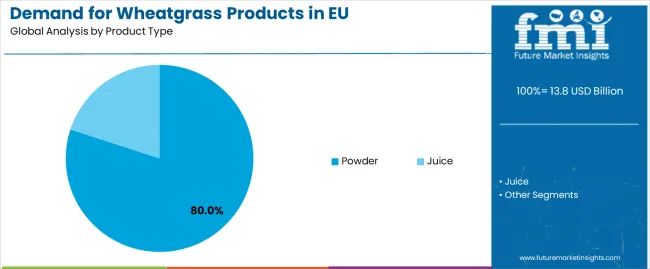
The powder segment is projected to account for 80.0% of EU wheatgrass sales in 2026, declining slightly to 78.0% by 2036, establishing itself as the dominant format across European consumers. This commanding position is fundamentally supported by powder's superior convenience, extended shelf life compared to juice formats, and versatility enabling incorporation into smoothies, shakes, and various food preparations. The powder format delivers exceptional consumer appeal, providing retailers with a product category that facilitates household adoption, convenient storage, and flexible consumption essential for category growth.
This segment benefits from mature processing technology, well-established distribution networks, and extensive variety from multiple brands who maintain rigorous quality standards and continuous innovation. Additionally, wheatgrass powder offers superior value proposition through concentrated nutrition, cost-effectiveness per serving, and minimal storage requirements, supported by proven freeze-drying and spray-drying technologies that preserve maximum nutritional content while ensuring product stability.
The powder segment's slight share decline from 80.0% to 78.0% through 2036 reflects growing juice format adoption, though powder maintains overwhelming dominance as the preferred consumption format throughout the forecast period.
Key advantages:
- Superior convenience enabling easy incorporation into daily routines
- Extended shelf stability supporting retail distribution and household storage
- Concentrated nutrition delivering maximum value per serving
By Nature, Organic Segment Accounts for 90.0% Share
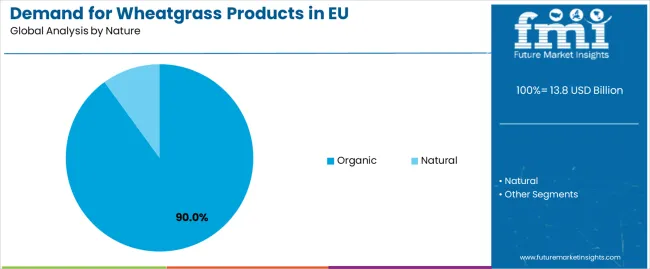
Organic varieties are positioned to represent 90.0% of total wheatgrass demand across European operations in 2026, expanding to 92.0% by 2036, reflecting the segment's growth as the overwhelmingly preferred quality standard within the category. This considerable share directly demonstrates that organic certification represents the baseline expectation, with consumers demanding pesticide-free, non-GMO wheatgrass products cultivated through sustainable agricultural practices for maximum purity and environmental responsibility.
Modern consumers increasingly view organic wheatgrass as essential for avoiding chemical residues, ensuring product safety, and supporting sustainable farming practices, driving demand for products certified by recognized organic standards with complete traceability from farm to finished product. The segment benefits from premium positioning that justifies higher price points, strong alignment with European sustainability values, and consumer trust in organic certification as quality assurance.
The segment's growing share reflects continued premiumization, with organic formats driving category value growth through superior margins and brand differentiation throughout the forecast period.
Key drivers:
- Consumer demand for chemical-free superfood products ensuring maximum purity
- Premium positioning supporting value growth and brand differentiation
- Sustainability alignment resonating with environmentally conscious European consumers
By Application, Household Segment Accounts for 35.0% Share
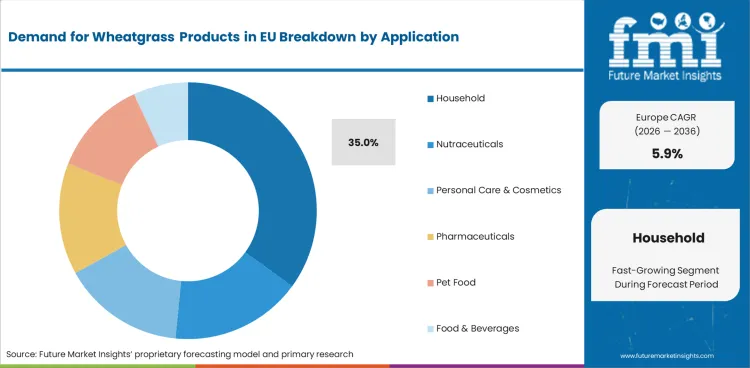
Household applications are strategically estimated to control 35.0% of total European wheatgrass sales in 2026, declining to 30.0% by 2036, reflecting strong home consumption patterns for daily wellness supplementation. European households consistently demonstrate growing adoption of wheatgrass products for family health maintenance, morning nutrition routines, and preventive wellness practices across all demographic segments.
The segment provides essential consumption occasions through daily supplementation rituals, family wellness programs, and home-based health optimization supporting consistent product usage. The household segment particularly benefits from bulk purchasing patterns, subscription service adoption, and loyalty-driven repeat purchases that establish wheatgrass as essential household staples for health-conscious families.
The segment's declining share through 2036 reflects diversification into commercial applications, though household consumption maintains the largest single segment position throughout the forecast period.
Success factors:
- Daily ritual integration establishing consistent consumption patterns
- Family wellness adoption driving household penetration and volume growth
- Subscription models supporting predictable demand and customer retention
By Distribution Channel, Online Retailers Account for 40.0% Share
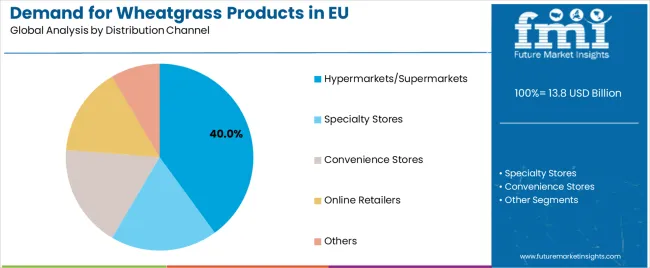
Online retail channels are strategically positioned to contribute 40.0% of total European sales in 2026, expanding dramatically to 50.0% by 2036, representing the critical importance of e-commerce for driving category accessibility and consumer education. European consumers consistently demonstrate growing preference for online purchasing that delivers convenience, price comparison capabilities, and access to premium international brands across specialized health platforms and mainstream e-commerce sites.
The segment provides essential advantages through comprehensive product selection, detailed nutritional information, customer reviews supporting purchase decisions, and subscription services enabling automatic replenishment. Major European e-commerce platforms, including Amazon, specialized health retailers, and direct-to-consumer brand websites, systematically expand wheatgrass selections, often featuring exclusive products, bulk purchasing options, and educational content that drives informed consumption.
The segment's expanding share from 40.0% to 50.0% reflects fundamental channel shift toward digital commerce, with online becoming the dominant channel as younger demographics drive category growth throughout the forecast period.
Digital advantages:
- Comprehensive selection enabling access to global premium brands
- Information availability supporting educated purchase decisions
- Subscription convenience driving customer lifetime value
What are the Drivers, Restraints, and Key Trends?
EU wheatgrass sales are advancing steadily due to increasing health consciousness, growing superfood awareness, and rising demand for preventive wellness solutions. The industry faces challenges, including taste barriers for new consumers unfamiliar with wheatgrass's distinctive grassy flavor, premium pricing that limits mass market adoption, and quality variability concerns regarding nutritional consistency across different brands and production batches. Continued innovation in taste masking technologies and processing standardization remains central to industry development.
Expansion of Functional Food Integration
The rapidly accelerating integration of wheatgrass into functional food products is fundamentally transforming consumption from standalone supplementation to incorporated nutrition, enabling mainstream adoption through familiar food formats previously limited to traditional powder consumption. Advanced formulation platforms featuring wheatgrass in energy bars, breakfast cereals, smoothie mixes, and ready-to-drink beverages allow manufacturers to deliver superfood nutrition without taste compromise, creating accessible entry points for consumers hesitant about pure wheatgrass consumption. These product innovations prove particularly transformative for convenience-seeking consumers, including busy professionals, active families, and younger demographics, where familiar formats prove essential for category trial.
Major food manufacturers invest heavily in wheatgrass ingredient partnerships, taste optimization research, and product development for functional formulations, recognizing that integrated products represent breakthrough solutions for adoption barriers limiting category expansion. Manufacturers collaborate with flavor houses, food technologists, and nutritionists to develop scalable formulations that incorporate meaningful wheatgrass content while maintaining product appeal and sensory acceptability supporting mainstream positioning.
Growth of Premium Organic Certification
Modern wheatgrass producers systematically pursue premium organic certifications, including EU Organic, Demeter biodynamic standards, and specialized quality verifications that deliver transparency, traceability, and quality assurance exceeding basic organic requirements. Strategic certification positioning enables manufacturers to command premium pricing where certification directly determines purchasing behavior among discerning European consumers. These certification improvements prove essential for premium retail positioning, as quality-focused consumers demand verification beyond basic organic standards, including soil quality testing, heavy metal screening, and microbiological purity validation.
Companies implement extensive quality management systems, third-party certification programs, and blockchain traceability initiatives targeting supply chain transparency, including farm-level documentation, processing verification, and batch-specific testing results. Manufacturers leverage certification positioning in marketing communications, on-pack quality indicators featuring multiple certification logos, and educational messaging positioning certified wheatgrass as superior nutritional investments.
Innovation in Delivery Formats and Convenience Solutions
European consumers increasingly demand innovative wheatgrass delivery formats featuring convenient single-serve sachets, effervescent tablets, and liquid concentrates that eliminate preparation requirements while maintaining nutritional integrity. This format innovation trend enables manufacturers to expand consumption occasions through on-the-go convenience, travel-friendly packaging, and instant preparation supporting busy lifestyle integration. Format innovation proves particularly important for younger demographics where convenience determines category engagement and usage frequency.
The development of sophisticated processing technologies, including microencapsulation, freeze-drying optimization, and liquid standardization expands manufacturers' abilities to create shelf-stable products delivering consistent dosing without refrigeration requirements. Brands collaborate with packaging specialists, preservation experts, and consumer researchers to develop formats balancing convenience with efficacy, supporting premium positioning and usage compliance while maintaining nutritional potency across extended shelf life.
Analyzing Demand for Wheatgrass Products in EU by Key Countries
.webp "Top Country Growth Comparison Demand For Wheatgrass Products In Eu Cagr (2026 2036)")
| Country | CAGR% (2026-2036) |
|---|---|
| Germany | 6.3% |
| France | 5.5% |
| Italy | 5.7% |
| Spain | 6.2% |
| Netherlands | 6.1% |
| Rest of Europe (EU) | 5.5% |
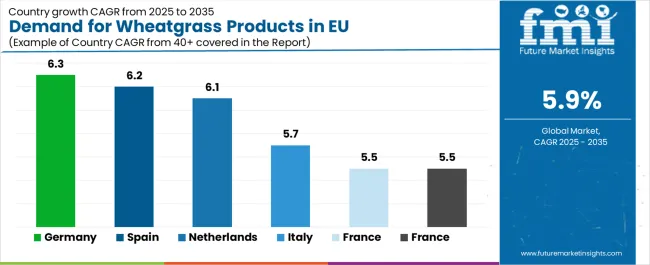
EU wheatgrass sales demonstrate synchronized growth across major European economies, with all markets expanding at 5.9% CAGR through 2036, driven by unified health consciousness trends and harmonized regulatory frameworks. Germany leads with USD 4,149.6 million in 2026, growing to USD 7,345.8 million by 2036. France maintains USD 2,766.4 million expanding to USD 4,897.2 million. Italy shows USD 1,936.5 million reaching USD 3,428.0 million. Spain records USD 1,383.2 million growing to USD 2,448.6 million. Netherlands demonstrates USD 829.9 million expanding to USD 1,469.2 million. Rest of Europe maintains USD 2,766.4 million reaching USD 4,897.2 million. Overall, sales show coordinated regional development reflecting EU-wide wellness trends toward superfood adoption and wheatgrass supplementation.
Germany Leads European Sales with Established Wellness Culture
Germany remains the largest European market for wheatgrass products, projected to reach USD 7,345.8 million by 2036, sustaining a dominant 30% share across the EU. The market expands at a 6.3% CAGR over 2026–2036, driven by an exceptionally strong wellness culture, naturopathic traditions, and widespread consumer commitment to preventive health. Germany’s premium organic retail infrastructure — with major players such as DM, Rossmann, Reformhaus, Alnatura, and Bio Company — dedicates substantial shelf space to wheatgrass and superfood supplements. High disposable income, trust in organic quality, and consumer familiarity with supplementation underpin consistent growth and adoption across all demographics.
Major retailers, including DM, Rossmann, Reformhaus, and specialized organic chains such as Alnatura and Bio Company, systematically expand wheatgrass selections, often dedicating significant shelf space to superfood supplements and positioning them prominently to encourage trial. German demand benefits from high disposable income supporting premium organic products, established naturopathic traditions embracing natural supplementation, and sophisticated consumer understanding of nutritional supplements that naturally supports wheatgrass adoption across mainstream demographics.
Growth drivers:
- Established wellness culture normalizing daily supplementation practices
- Strong organic retail presence with specialized chains driving premium availability
- Health-conscious consumers prioritizing preventive nutrition and superfood benefits
France Demonstrates Strong Growth with Premium Positioning
France demonstrates steady expansion, reaching USD 4,897.2 million by 2036 at a 5.5% CAGR. The market is shaped by premium positioning, where consumers value purity, authenticity, and organic certification. National retailers such as Carrefour Bio, Naturalia, Biocoop, and La Vie Claire strengthen availability, while pharmacy distribution channels add credibility through healthcare professional endorsements. Urban consumers, especially younger demographics, are increasingly adopting global wellness trends, blending them with French expectations for quality and trust. France’s wheatgrass demand reflects its broader preference for premium, certified organic wellness solutions that align with lifestyle and dietary sophistication.
Major retailers, including Carrefour Bio, Naturalia, Biocoop, and La Vie Claire, establish comprehensive wheatgrass ranges serving continuously growing demand for superfood nutrition. French sales particularly benefit from pharmacy distribution channels where wheatgrass gains credibility through healthcare professional recommendations, supporting premium positioning and consumer trust. The market shows strong growth potential as younger urban demographics embrace global wellness trends while maintaining French quality expectations.
Success factors:
- Premium quality focus aligning with French consumer expectations
- Pharmacy channel credibility supporting professional recommendation
- Urban wellness adoption driving superfood category growth
Europe Market Split by Country
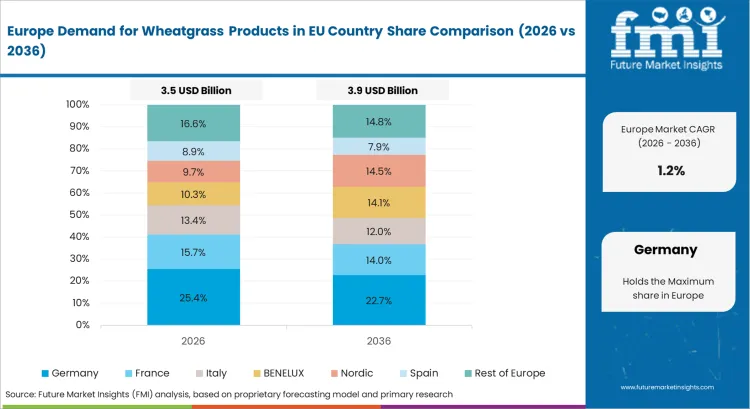
EU wheatgrass sales are projected to grow from USD 13.8 billion in 2026 to USD 24.5 billion by 2036, registering a CAGR of 5.9% over the forecast period. All major markets demonstrate uniform growth at 5.9% CAGR, reflecting synchronized category development across European economies supported by common health trends, regulatory harmonization, and cross-border distribution networks.
Germany maintains the largest share at 30.0% in 2026, driven by established health supplement culture and strong organic market development. France follows with 20.0% share, while Italy represents 14.0%, Spain accounts for 10.0%, Netherlands holds 6.0%, and Rest of Europe comprises 20.0% of total EU demand.
Italy Maintains Above-Average Growth with Urban Health Focus
Revenue from wheatgrass products in Italy is growing at a robust CAGR of 5.7% to reach USD 3.4 billion by 2036, fundamentally driven by increasing health consciousness, progressive urban consumer segments, and rapid modernization of Italian dietary patterns incorporating superfood supplements. Italy's traditionally Mediterranean diet is increasingly accommodating functional supplements as consumers recognize concentrated nutrition benefits beyond traditional food sources.
Major retailers, including Esselunga, NaturaSì, Conad, and Carrefour Italia, strategically invest in wheatgrass category expansion with dedicated health supplement sections addressing growing wellness interest. Italian sales particularly benefit from younger demographic adoption in Milan, Rome, and Turin, where urban professionals drive premium organic demand. The market demonstrates above-average growth potential as wellness trends accelerate across broader population segments.
Development factors:
- Urban wellness acceleration driving faster category adoption
- Younger demographics embracing international superfood trends
- Premium organic positioning supporting value growth
Spain Shows Strong Expansion with Rapid Market Development
Demand for wheatgrass products in Spain is projected to grow at an impressive CAGR of 6.2%, reaching USD 2,548.6 million by 2036, substantially supported by rapidly evolving health consciousness among Spanish consumers and accelerating adoption of functional nutrition. Spanish consumer transformation toward preventive health positions wheatgrass as aligned with dietary modernization and wellness lifestyle adoption.
Major retailers, including Mercadona, Carrefour España, and specialized health stores like Herbolario Navarro, systematically expand wheatgrass offerings with growing shelf prominence. Spain's dynamic growth reflects catching-up effects as the market transitions from early adoption to mainstream acceptance. The pharmacy channel shows particular promise, with increasing parafarmacias offering premium superfood supplements to health-conscious consumers.
Growth accelerators:
- Rapid health consciousness evolution driving category discovery
- Retail expansion supporting improved product accessibility
- Catching-up growth from lower penetration base
Netherlands Leads Growth with Innovation Excellence
Demand for wheatgrass products in the Netherlands is expanding at a leading CAGR of 6.1% to reach USD 1,569.2 million by 2036, fundamentally driven by exceptionally progressive wellness culture, leadership in sustainable nutrition adoption, and sophisticated consumer base embracing nutritional innovation. Dutch consumers demonstrate particularly high receptivity to scientific health messaging and willingness to invest in premium wellness products.
Netherlands sales significantly benefit from advanced retail sophistication, with Albert Heijn's extensive wellness sections, specialized stores like Holland & Barrett, and innovative startups testing cutting-edge superfood formats. The country serves as European innovation hub where successful product launches expand across broader markets. Small market size enables rapid penetration growth, while high per-capita spending supports premium positioning.
Innovation catalysts:
- Innovation leadership positioning Netherlands as trend-setting market
- Sophisticated consumers driving premium product adoption
- High wellness investment supporting category value growth
Competitive Landscape
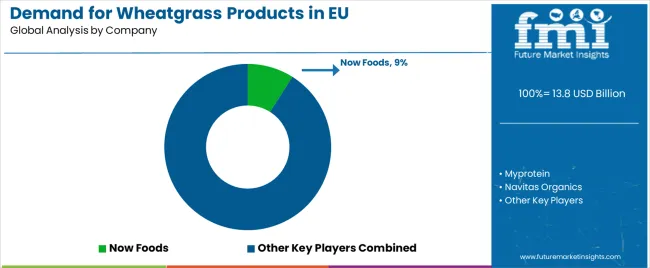
EU wheatgrass sales are defined by competition among specialized superfood brands, health supplement companies, and organic food producers. Companies are investing in organic certification, processing technology optimization, quality standardization, and supply chain integration to deliver premium, consistent, and traceable wheatgrass solutions. Strategic partnerships with organic farms, distribution expansion initiatives, and marketing campaigns emphasizing scientific validation and quality superiority are central to strengthening competitive position.
Major participants include Now Foods with an estimated 9.0% share, leveraging its broad European distribution network, extensive supplement expertise, and established retail presence across health stores and pharmacies. Now Foods benefits from comprehensive product portfolio enabling cross-selling, technical quality capabilities, and ability to deliver consistent supply supporting retail confidence and consumer trust.
Myprotein holds approximately 6.0% share, emphasizing sports nutrition positioning, e-commerce distribution strength, and younger demographic appeal through digital marketing. Myprotein's success in positioning wheatgrass as sports recovery and performance nutrition creates differentiated positioning and consumer loyalty, supported by influencer partnerships and subscription models.
Navitas Organics accounts for roughly 5.0% share through its premium organic positioning, superfood specialization, and strong e-commerce presence across European markets. The company benefits from authenticity credentials, sustainable sourcing stories, and comprehensive organic portfolio helping consumers discover wheatgrass within broader superfood adoption.
Girmes Wheatgrass represents approximately 3.5% share, supporting growth through German production capabilities, local cultivation advantages, and quality positioning as European-grown wheatgrass. Girmes leverages proximity benefits, freshness claims, and reduced carbon footprint, attracting environmentally conscious consumers seeking locally sourced superfoods.
Amazing Grass holds roughly 3.0% share through direct-to-consumer strength, retail partnerships, and brand recognition from North American success expanding into Europe. The company emphasizes taste innovation, convenient formats, and lifestyle marketing resonating with mainstream consumers seeking accessible superfood nutrition.
Other companies collectively hold 73.5% share, reflecting the fragmented nature of European wheatgrass sales, where numerous specialized brands, regional producers, private-label suppliers, and emerging startups serve specific consumer preferences, local markets, and niche applications. This competitive environment provides opportunities for differentiation through cultivation methods, processing innovations, certification standards, and targeted positioning resonating with diverse European consumer segments.
Key Players
- Now Foods
- Myprotein
- Navitas Organics
- Girmes Wheatgrass
- Amazing Grass
- Pukka Herbs
- Naturya
- Starwest Botanicals
- Green Foods Corporation
- Terrasoul Superfoods
- Others
Scope of the Report
| Metric | Value |
|---|---|
| Quantitative Units | USD 14.61 billion to USD 25.93 billion, at a CAGR of 5.9% |
| Market Definition | The Demand for Wheatgrass Products in EU covers processed Triticum aestivum grass in powder and juice forms, used as a concentrated source of chlorophyll, vitamins, and antioxidants. Applications span household... |
| Segmentation | Product Type: Powder, Juice; Nature: Organic, Natural; Application: Household, Nutraceuticals, Personal Care & Cosmetics, Pharmaceuticals, Pet Food, Food & Beverages; Distribution Channel: Hypermarkets/Supermarkets, Specialty Stores, Convenience Stores, Online Retailers, Others |
| Regions Covered | EU (Western Europe, Southern Europe, Central Europe) |
| Countries Covered | Germany, France, Italy, Spain, Netherlands, Rest of Europe |
| Key Companies Profiled | Now Foods, Myprotein, Navitas Organics, Girmes Wheatgrass, Amazing Grass, Pukka Herbs, Naturya, Starwest Botanicals |
| Forecast Period | 2026 to 2036 |
| Approach | Hybrid bottom-up modeling using production volume data, trade flow analysis, and primary research validation |
Key Segments
Product Type
- Powder
- Juice
Nature
- Organic
- Natural
Application (End-Use)
- Food & Beverages
- Nutraceuticals
- Personal Care & Cosmetics
- Pharmaceuticals
- Pet Food
- Household
Distribution Channel
- Hypermarkets/Supermarkets
- Specialty Stores
- Convenience Stores
- Online Retailers
- Others
Countries
- Germany
- France
- Italy
- Spain
- Netherlands
- Rest of Europe
Bibliography
- 1. European Commission. (2024). Regulation (EU) 2015/2283 on Novel Foods, consolidated implementation guidance. EUR-Lex.
- 2. European Commission. (2024). Regulation (EU) 2018/848 on organic production and labelling. EUR-Lex.
- 3. Eurostat. (2025). Organic retail sales statistics, EU-27. European Commission Statistical Office.
- 4. World Health Organization. (2024). Dietary guidelines and micronutrient supplementation recommendations, European region. WHO Regional Office for Europe.
- 5. European Food Safety Authority. (2024). Scientific opinion on wheatgrass as a food ingredient. EFSA Journal.
This bibliography is provided for reader reference. The full Future Market Insights report contains the complete reference list with primary research documentation.
Frequently Asked Questions
How large is the demand for Wheatgrass Products in the EU market in 2026?
Demand for wheatgrass products in the EU market is estimated to be valued at USD 14.61 billion in 2026.
What will be the market size of Wheatgrass Products in the EU by 2036?
Market size for wheatgrass products is projected to reach USD 25.93 billion by 2036.
What is the expected demand growth for Wheatgrass Products in the EU between 2026 and 2036?
Demand for wheatgrass products is expected to grow at a CAGR of 5.9% between 2026 and 2036.
Which Product Type is poised to lead EU sales by 2026?
Powder accounts for 80% share in 2026, making it the leading sub-segment within the Product Type category.
How is the role of Organic in driving wheatgrass products adoption in 2026?
Organic holds 90% of the Nature segment share in 2026.
Which country is the fastest-growing market for wheatgrass products in the EU?
Germany is projected to grow at a CAGR of 6.3% during 2026 to 2036, the fastest rate among EU markets covered.
What is Wheatgrass Products and what is it mainly used for?
The Demand for Wheatgrass Products in EU covers processed Triticum aestivum grass in powder and juice forms, used as a concentrated source of chlorophyll, vitamins, and antioxidants. Applications span household dietary supplementation, nutraceutical formulations, personal care and cosmetic ingredients, pharmaceutical intermediates, pet food supplements, and food/beverage fortification within EU retail and wholesale channels.
How does FMI build and validate the wheatgrass products forecast?
Forecasting models apply a bottom-up methodology starting with EU production volume data and cross-validate projections against publicly reported industry statistics and primary research inputs.
Preview the report firsthand - request a free sample
Get SampleGet the brochure for pricing and purchase details.
Get PDFTable of Content
- Executive Summary
- Global Market Outlook
- Demand-side Trends
- Supply-side Trends
- Technology Roadmap Analysis
- Analysis and Recommendations
- Market Overview
- Market Coverage / Taxonomy
- Market Definition / Scope / Limitations
- Research Methodology
- Chapter Orientation
- Analytical Lens and Working Hypotheses
- Market Structure, Signals, and Trend Drivers
- Benchmarking and Cross-market Comparability
- Market Sizing, Forecasting, and Opportunity Mapping
- Research Design and Evidence Framework
- Desk Research Programme (Secondary Evidence)
- Company Annual and Sustainability Reports
- Peer-reviewed Journals and Academic Literature
- Corporate Websites, Product Literature, and Technical Notes
- Earnings Decks and Investor Briefings
- Statutory Filings and Regulatory Disclosures
- Technical White Papers and Standards Notes
- Trade Journals, Industry Magazines, and Analyst Briefs
- Conference Proceedings, Webinars, and Seminar Materials
- Government Statistics Portals and Public Data Releases
- Press Releases and Reputable Media Coverage
- Specialist Newsletters and Curated Briefings
- Sector Databases and Reference Repositories
- FMI Internal Proprietary Databases and Historical Market Datasets
- Subscription Datasets and Paid Sources
- Social Channels, Communities, and Digital Listening Inputs
- Additional Desk Sources
- Expert Input and Fieldwork (Primary Evidence)
- Primary Modes
- Qualitative Interviews and Expert Elicitation
- Quantitative Surveys and Structured Data Capture
- Blended Approach
- Why Primary Evidence is Used
- Field Techniques
- Interviews
- Surveys
- Focus Groups
- Observational and In-context Research
- Social and Community Interactions
- Stakeholder Universe Engaged
- C-suite Leaders
- Board Members
- Presidents and Vice Presidents
- R&D and Innovation Heads
- Technical Specialists
- Domain Subject-matter Experts
- Scientists
- Physicians and Other Healthcare Professionals
- Governance, Ethics, and Data Stewardship
- Research Ethics
- Data Integrity and Handling
- Primary Modes
- Tooling, Models, and Reference Databases
- Desk Research Programme (Secondary Evidence)
- Data Engineering and Model Build
- Data Acquisition and Ingestion
- Cleaning, Normalisation, and Verification
- Synthesis, Triangulation, and Analysis
- Quality Assurance and Audit Trail
- Market Background
- Market Dynamics
- Drivers
- Restraints
- Opportunity
- Trends
- Scenario Forecast
- Demand in Optimistic Scenario
- Demand in Likely Scenario
- Demand in Conservative Scenario
- Opportunity Map Analysis
- Product Life Cycle Analysis
- Supply Chain Analysis
- Investment Feasibility Matrix
- Value Chain Analysis
- PESTLE and Porter’s Analysis
- Regulatory Landscape
- Regional Parent Market Outlook
- Production and Consumption Statistics
- Import and Export Statistics
- Market Dynamics
- Global Market Analysis 2021 to 2025 and Forecast, 2026 to 2036
- Historical Market Size Value (USD Million) Analysis, 2021 to 2025
- Current and Future Market Size Value (USD Million) Projections, 2026 to 2036
- Y-o-Y Growth Trend Analysis
- Absolute $ Opportunity Analysis
- Global Market Pricing Analysis 2021 to 2025 and Forecast 2026 to 2036
- Global Market Analysis 2021 to 2025 and Forecast 2026 to 2036, By Product Type
- Introduction / Key Findings
- Historical Market Size Value (USD Million) Analysis By Product Type , 2021 to 2025
- Current and Future Market Size Value (USD Million) Analysis and Forecast By Product Type , 2026 to 2036
- Powder
- Juice
- Powder
- Y-o-Y Growth Trend Analysis By Product Type , 2021 to 2025
- Absolute $ Opportunity Analysis By Product Type , 2026 to 2036
- Global Market Analysis 2021 to 2025 and Forecast 2026 to 2036, By Nature
- Introduction / Key Findings
- Historical Market Size Value (USD Million) Analysis By Nature, 2021 to 2025
- Current and Future Market Size Value (USD Million) Analysis and Forecast By Nature, 2026 to 2036
- Organic
- Natural
- Organic
- Y-o-Y Growth Trend Analysis By Nature, 2021 to 2025
- Absolute $ Opportunity Analysis By Nature, 2026 to 2036
- Global Market Analysis 2021 to 2025 and Forecast 2026 to 2036, By Application
- Introduction / Key Findings
- Historical Market Size Value (USD Million) Analysis By Application, 2021 to 2025
- Current and Future Market Size Value (USD Million) Analysis and Forecast By Application, 2026 to 2036
- Household
- Nutraceuticals
- Personal Care & Cosmetics
- Pharmaceuticals
- Pet Food
- Food & Beverages
- Household
- Y-o-Y Growth Trend Analysis By Application, 2021 to 2025
- Absolute $ Opportunity Analysis By Application, 2026 to 2036
- Global Market Analysis 2021 to 2025 and Forecast 2026 to 2036, By Distribution Channel
- Introduction / Key Findings
- Historical Market Size Value (USD Million) Analysis By Distribution Channel, 2021 to 2025
- Current and Future Market Size Value (USD Million) Analysis and Forecast By Distribution Channel, 2026 to 2036
- Hypermarkets/Supermarkets
- Specialty Stores
- Convenience Stores
- Online Retailers
- Others
- Hypermarkets/Supermarkets
- Y-o-Y Growth Trend Analysis By Distribution Channel, 2021 to 2025
- Absolute $ Opportunity Analysis By Distribution Channel, 2026 to 2036
- Global Market Analysis 2021 to 2025 and Forecast 2026 to 2036, By Region
- Introduction
- Historical Market Size Value (USD Million) Analysis By Region, 2021 to 2025
- Current Market Size Value (USD Million) Analysis and Forecast By Region, 2026 to 2036
- North America
- Latin America
- Western Europe
- Eastern Europe
- East Asia
- South Asia and Pacific
- Middle East & Africa
- Market Attractiveness Analysis By Region
- North America Market Analysis 2021 to 2025 and Forecast 2026 to 2036, By Country
- Historical Market Size Value (USD Million) Trend Analysis By Market Taxonomy, 2021 to 2025
- Market Size Value (USD Million) Forecast By Market Taxonomy, 2026 to 2036
- By Country
- USA
- Canada
- Mexico
- By Product Type
- By Nature
- By Application
- By Distribution Channel
- By Country
- Market Attractiveness Analysis
- By Country
- By Product Type
- By Nature
- By Application
- By Distribution Channel
- Key Takeaways
- Latin America Market Analysis 2021 to 2025 and Forecast 2026 to 2036, By Country
- Historical Market Size Value (USD Million) Trend Analysis By Market Taxonomy, 2021 to 2025
- Market Size Value (USD Million) Forecast By Market Taxonomy, 2026 to 2036
- By Country
- Brazil
- Chile
- Rest of Latin America
- By Product Type
- By Nature
- By Application
- By Distribution Channel
- By Country
- Market Attractiveness Analysis
- By Country
- By Product Type
- By Nature
- By Application
- By Distribution Channel
- Key Takeaways
- Western Europe Market Analysis 2021 to 2025 and Forecast 2026 to 2036, By Country
- Historical Market Size Value (USD Million) Trend Analysis By Market Taxonomy, 2021 to 2025
- Market Size Value (USD Million) Forecast By Market Taxonomy, 2026 to 2036
- By Country
- Germany
- UK
- Italy
- Spain
- France
- Nordic
- BENELUX
- Rest of Western Europe
- By Product Type
- By Nature
- By Application
- By Distribution Channel
- By Country
- Market Attractiveness Analysis
- By Country
- By Product Type
- By Nature
- By Application
- By Distribution Channel
- Key Takeaways
- Eastern Europe Market Analysis 2021 to 2025 and Forecast 2026 to 2036, By Country
- Historical Market Size Value (USD Million) Trend Analysis By Market Taxonomy, 2021 to 2025
- Market Size Value (USD Million) Forecast By Market Taxonomy, 2026 to 2036
- By Country
- Russia
- Poland
- Hungary
- Balkan & Baltic
- Rest of Eastern Europe
- By Product Type
- By Nature
- By Application
- By Distribution Channel
- By Country
- Market Attractiveness Analysis
- By Country
- By Product Type
- By Nature
- By Application
- By Distribution Channel
- Key Takeaways
- East Asia Market Analysis 2021 to 2025 and Forecast 2026 to 2036, By Country
- Historical Market Size Value (USD Million) Trend Analysis By Market Taxonomy, 2021 to 2025
- Market Size Value (USD Million) Forecast By Market Taxonomy, 2026 to 2036
- By Country
- China
- Japan
- South Korea
- By Product Type
- By Nature
- By Application
- By Distribution Channel
- By Country
- Market Attractiveness Analysis
- By Country
- By Product Type
- By Nature
- By Application
- By Distribution Channel
- Key Takeaways
- South Asia and Pacific Market Analysis 2021 to 2025 and Forecast 2026 to 2036, By Country
- Historical Market Size Value (USD Million) Trend Analysis By Market Taxonomy, 2021 to 2025
- Market Size Value (USD Million) Forecast By Market Taxonomy, 2026 to 2036
- By Country
- India
- ASEAN
- Australia & New Zealand
- Rest of South Asia and Pacific
- By Product Type
- By Nature
- By Application
- By Distribution Channel
- By Country
- Market Attractiveness Analysis
- By Country
- By Product Type
- By Nature
- By Application
- By Distribution Channel
- Key Takeaways
- Middle East & Africa Market Analysis 2021 to 2025 and Forecast 2026 to 2036, By Country
- Historical Market Size Value (USD Million) Trend Analysis By Market Taxonomy, 2021 to 2025
- Market Size Value (USD Million) Forecast By Market Taxonomy, 2026 to 2036
- By Country
- Kingdom of Saudi Arabia
- Other GCC Countries
- Turkiye
- South Africa
- Other African Union
- Rest of Middle East & Africa
- By Product Type
- By Nature
- By Application
- By Distribution Channel
- By Country
- Market Attractiveness Analysis
- By Country
- By Product Type
- By Nature
- By Application
- By Distribution Channel
- Key Takeaways
- Key Countries Market Analysis
- USA
- Pricing Analysis
- Market Share Analysis, 2025
- By Product Type
- By Nature
- By Application
- By Distribution Channel
- Canada
- Pricing Analysis
- Market Share Analysis, 2025
- By Product Type
- By Nature
- By Application
- By Distribution Channel
- Mexico
- Pricing Analysis
- Market Share Analysis, 2025
- By Product Type
- By Nature
- By Application
- By Distribution Channel
- Brazil
- Pricing Analysis
- Market Share Analysis, 2025
- By Product Type
- By Nature
- By Application
- By Distribution Channel
- Chile
- Pricing Analysis
- Market Share Analysis, 2025
- By Product Type
- By Nature
- By Application
- By Distribution Channel
- Germany
- Pricing Analysis
- Market Share Analysis, 2025
- By Product Type
- By Nature
- By Application
- By Distribution Channel
- UK
- Pricing Analysis
- Market Share Analysis, 2025
- By Product Type
- By Nature
- By Application
- By Distribution Channel
- Italy
- Pricing Analysis
- Market Share Analysis, 2025
- By Product Type
- By Nature
- By Application
- By Distribution Channel
- Spain
- Pricing Analysis
- Market Share Analysis, 2025
- By Product Type
- By Nature
- By Application
- By Distribution Channel
- France
- Pricing Analysis
- Market Share Analysis, 2025
- By Product Type
- By Nature
- By Application
- By Distribution Channel
- India
- Pricing Analysis
- Market Share Analysis, 2025
- By Product Type
- By Nature
- By Application
- By Distribution Channel
- ASEAN
- Pricing Analysis
- Market Share Analysis, 2025
- By Product Type
- By Nature
- By Application
- By Distribution Channel
- Australia & New Zealand
- Pricing Analysis
- Market Share Analysis, 2025
- By Product Type
- By Nature
- By Application
- By Distribution Channel
- China
- Pricing Analysis
- Market Share Analysis, 2025
- By Product Type
- By Nature
- By Application
- By Distribution Channel
- Japan
- Pricing Analysis
- Market Share Analysis, 2025
- By Product Type
- By Nature
- By Application
- By Distribution Channel
- South Korea
- Pricing Analysis
- Market Share Analysis, 2025
- By Product Type
- By Nature
- By Application
- By Distribution Channel
- Russia
- Pricing Analysis
- Market Share Analysis, 2025
- By Product Type
- By Nature
- By Application
- By Distribution Channel
- Poland
- Pricing Analysis
- Market Share Analysis, 2025
- By Product Type
- By Nature
- By Application
- By Distribution Channel
- Hungary
- Pricing Analysis
- Market Share Analysis, 2025
- By Product Type
- By Nature
- By Application
- By Distribution Channel
- Kingdom of Saudi Arabia
- Pricing Analysis
- Market Share Analysis, 2025
- By Product Type
- By Nature
- By Application
- By Distribution Channel
- Turkiye
- Pricing Analysis
- Market Share Analysis, 2025
- By Product Type
- By Nature
- By Application
- By Distribution Channel
- South Africa
- Pricing Analysis
- Market Share Analysis, 2025
- By Product Type
- By Nature
- By Application
- By Distribution Channel
- USA
- Market Structure Analysis
- Competition Dashboard
- Competition Benchmarking
- Market Share Analysis of Top Players
- By Regional
- By Product Type
- By Nature
- By Application
- By Distribution Channel
- Competition Analysis
- Competition Deep Dive
- Now Foods
- Overview
- Product Portfolio
- Profitability by Market Segments (Product/Age /Sales Channel/Region)
- Sales Footprint
- Strategy Overview
- Marketing Strategy
- Product Strategy
- Channel Strategy
- Myprotein
- Navitas Organics
- Girmes Wheatgrass
- Amazing Grass
- Pukka Herbs
- Naturya
- Starwest Botanicals
- Green Foods Corporation
- Terrasoul Superfoods
- Others
- Now Foods
- Competition Deep Dive
- Assumptions & Acronyms Used


