

- Market Size (2026)
- USD 484.4 Mn
- Forecast (2036)
- USD 1615.5 Mn
- CAGR (2026 to 2036)
- 12.8%
How big is Direct-to-Chip Cooling Loop Degassing Systems Market in 2026?
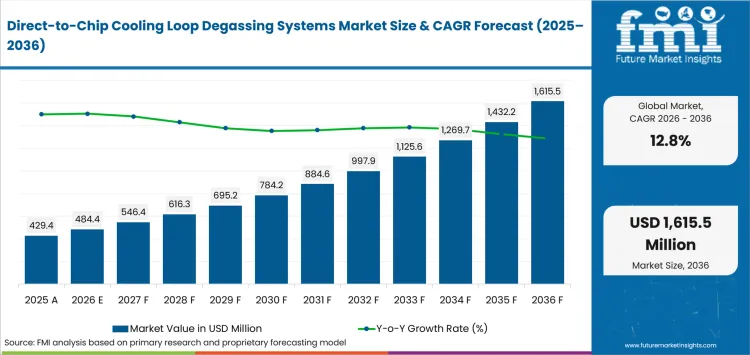
USD 484.4 million in 2026 and USD 1,615.5 million by 2036 at a 12.8% CAGR.
Demand for direct-to-chip cooling loop degassing systems are projected to expand at 12.8% CAGR from 2026 through 2036, rising from USD 484.4 million to USD 1,615.5 million. Growth in AI and high-density computing is increasing deployment of liquid-cooled data-center infrastructure that operates beyond the practical limits of conventional air cooling. The USA Energy Information Administration reported in March 2026 that data centers drove much of the 1.7% annual USA electricity-demand growth from 2020 to 2025. AI liquid cooling introduces secondary circuits that require controlled air removal before rack acceptance and commissioning.
European projects face a different constraint because efficiency and water performance are moving into formal reporting. The European Commission stated in November 2025 that EU data centers used an estimated 70 TWh of electricity in 2024 and reporting covers energy and water performance. The reporting rule raises the value of fluid-condition and commissioning records without directly generating degassing demand. Liquid-cooled edge data centers face the same fluid-control requirement at smaller facility and rack scales.
Key Takeaways
- AI compute density is increasing secondary coolant circuits whose air removal, filtration, and chemistry must be controlled before rack acceptance.
- By fluid - treatment type, water-glycol fluids are estimated to hold 38.0% in 2026 owing to familiar inhibitor and concentration practices in water-based loops.
- In 2026, direct-to-chip loops are expected to lead cooling architecture with 45.0% share because cold-plate circuits place fluid quality directly inside the rack cooling path.
- Initial fill - deployment is set to lead the service / replacement cycle category with 33.0% share in 2026 due to concentrated gas-removal work during filling, flushing, and acceptance.
- Coolant qualification, wetted-material compatibility, and allowable pressure loss can delay specification despite a recognized need for better fluid control.
- Some of the key players in this market include Ecolab Nalco Water, Spirotech, IMI Climate Control, Reflex Winkelmann, Aalberts hydronic flow control, Parker Hannifin, Boyd Thermal, and Vertiv.
Analyst Perspective
"Degassing equipment should be judged on dissolved-gas removal, pressure loss, and coolant compatibility under the rack loop's real operating envelope. The stronger commercial offer pairs that commissioning proof with fluid-health records that show service need after a repair or coolant change."
- Sudip saha, Principal Consultant, Future Market Insights
How is the direct-to-chip cooling loop degassing systems market segmented?
The direct-to-chip cooling loop degassing systems market is segmented by fluid - treatment type, cooling architecture, service / replacement cycle, data center type, route to market, and region.
The market is segmented by fluid - treatment type, cooling architecture, service / replacement cycle, data center type, route to market, and region. Fluid categories cover water-glycol, treated water, dielectric fluids, and specialty treatment. Cooling architectures include direct-to-chip, immersion, rear-door, and hybrid loops. Service cycles cover initial deployment, annual maintenance, condition-triggered replacement, and emergency remediation. Data center types include hyperscale AI, colocation AI, enterprise / private AI, and HPC & research. Routes to market include fluid manufacturer direct, cooling OEM / integrator, water-treatment service provider, and distributor / aftermarket.
Why do water-glycol fluids lead the fluid - treatment type category?
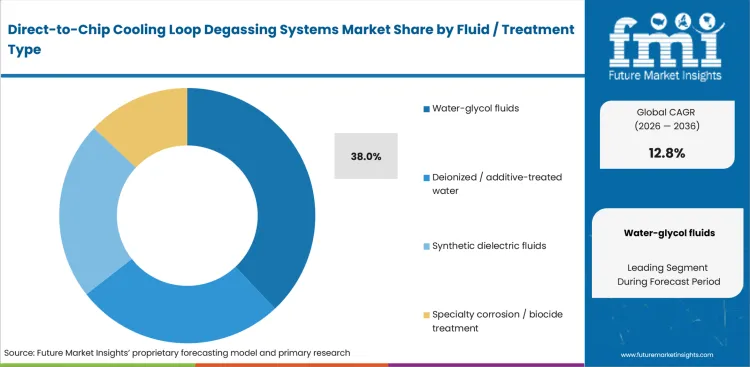
Water-glycol fluids fit closed secondary loops that need corrosion protection and predictable handling. Qualification depends on coolant chemistry staying compatible with seals, hoses, treatment equipment, and the degassing device under the approved pressure envelope.
- By fluid - treatment type, water-glycol fluids are estimated to hold 38.0% in 2026 owing to familiar inhibitor and concentration practices in water-based loops.
- Open Compute Project's July 2025 Project Deschutes specification tests CDU components with PG25 and water-based fluids, linking coolant choice to pressure and material validation. Water-treatment chemicals stay relevant only if inhibitors remain compatible with CDU wetted materials.
Why do direct-to-chip loops lead the cooling architecture category?
Direct-to-chip loops place secondary fluid beside processors through cold plates, manifolds, and CDUs. Narrow cold-plate channels and many rack connections make flow sensitive to particles, entrained gas, and service-induced air entry.
- In 2026, direct-to-chip loops are expected to lead cooling architecture with 45.0% share because cold plates remove heat close to processors without full-server immersion handling.
- In October 2025, Open Compute Project and ASHRAE formed an alliance covering facility and technology loops, direct-to-chip systems, CDUs, and interoperability. The work raises the value of documented loop boundaries as high-performance computing platforms move toward denser liquid-cooled racks.
Why does initial fill - deployment lead the service / replacement cycle category?
Commissioning concentrates gas-removal work because each new branch must be cleaned, filled, and accepted for flow, chemistry, and pressure before compute loading. Repairs reopen those checks at later intervention points.
- Initial fill - deployment is set to lead the service / replacement cycle category with 33.0% share in 2026 due to concentrated fluid preparation before sustained compute workloads begin.
- Open Compute Project's January 2025 pre-commission guidance requires cleaning and flushing technology cooling system piping before rack connection. Industrial filtration and air removal therefore belong in the same acceptance sequence for small cold-plate passages.
Why does hyperscale AI lead the data center type category?
Hyperscale AI operators repeat rack and coolant procedures within large fleets, making undocumented manual venting difficult to audit. One commissioning rule can govern thousands of fluid connections.
- By data center type, hyperscale AI is forecast to represent 46.0% in 2026 driven by fleet-scale coolant acceptance and repeatable service routines.
- Meta documented in September 2025 that a 72-GPU GB200 pod required four air-assisted liquid-cooling racks in facilities without facility water loops. At fleet scale, coolant acceptance becomes part of data-center power management because one procedure must hold through repeated rack installations.
What are the drivers, restraints and opportunities in the Direct-to-Chip Cooling Loop Degassing Systems Market?
AI rack density increases the number of liquid loops that need controlled fluid condition, while qualification slows specification and condition-based service expands lifecycle revenue.
- Driver: More direct-to-chip circuits require repeatable filling, air removal, filtration, and coolant acceptance before rack commissioning.
- Restraint: Material compatibility and pressure-drop limits can keep a technically effective degassing device outside an approved cooling bill of materials.
- Opportunity: Diagnostics tied to degassing and filtration can turn a commissioning purchase into condition-triggered maintenance and fluid-health service.
Direct-liquid-cooling deployment enlarges the loop base because every new circuit must be filled and accepted before high-value compute enters service. Open Compute Project's October 2025 Global Summit formalized liquid-cooling workstreams covering CDUs, manifolds, and facility interfaces. OCP standardization makes industrial water treatment relevant at commissioning because fluid cleanliness and gas control require documented proof at defined loop boundaries during commissioning.
Qualification slows specification because separators, membranes, seals, sensors, and coolant must operate inside one materials envelope. Open Compute Project updated its propylene-glycol heat-transfer-fluid guidance in November 2025 for direct-to-chip cold-plate environments. The guidance makes compatibility with heat-exchanger platforms and CDU wetted materials a purchasing condition, so an efficient separator can be rejected if pressure loss or materials evidence is incomplete.
Condition-based service offers the clearest route beyond the initial commissioning sale because operators need evidence that coolant quality stayed inside limits after maintenance. Ecolab launched 3D TRASAR Technology for Direct-to-Chip Liquid Cooling in May 2025 to monitor fluid health and support maintenance decisions. Linking degassing records with water treatment data can shift service from fixed intervals toward documented condition changes.
Which country CAGRs are profiled in the Direct-to-Chip Cooling Loop Degassing Systems Market?
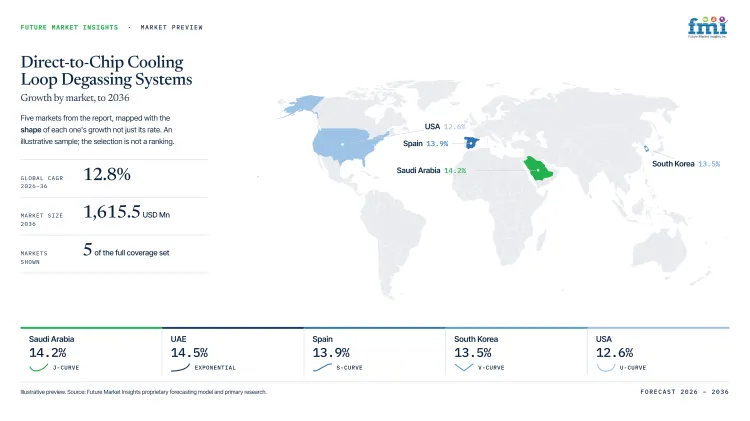
| Country | CAGR |
|---|---|
| UAE | 14.5% |
| Saudi Arabia | 14.2% |
| Spain | 13.9% |
| South Korea | 13.5% |
| France | 13.2% |
| Japan | 12.9% |
| USA | 12.6% |
How do country-level CAGRs compare in the Direct-to-Chip Cooling Loop Degassing Systems Market?
The profiled countries span 1.9 percentage points, with UAE and Saudi Arabia forming a greenfield-heavy upper band. Spain, South Korea, and France occupy the middle as AI capacity enters existing HPC, grid, or national-compute programs. Japan and USA start from more mature technical bases, so retrofit qualification and local service carry more weight in order timing.
- UAE clusters procurement in master-planned AI campuses.
- Saudi Arabia phases handover as new halls open.
- Spain retrofits accelerator cooling into research-computing facilities.
- South Korea pairs compute rollout with utility-ready sites.
- France activates contracted capacity in staged load tranches.
- Japan uses conservative facility approval for cooling changes.
- USA carries mixed OEM coolant specifications and legacy loops.
Similar CAGRs hide different service timing and qualification costs. The full report provides country-level CAGR analysis across North America, Latin America, Western Europe, Eastern Europe, East Asia, South Asia and Pacific, and Middle East and Africa.
Country-wise Analysis
- Abu Dhabi is concentrating AI infrastructure in large campuses where cooling-tower systems and rack loops must be commissioned in repeatable blocks. The Abu Dhabi Media Office confirmed in May 2025 that Stargate UAE's first 200-megawatt AI cluster is expected to go live in 2026. UAE demand is forecast to rise at 14.5% CAGR through 2036, tied to greenfield campus scale and standardized rack rollout. Early fluid-conditioning specifications give integrators a clear entry point before rack and CDU acceptance begins. Compressed schedules expose coolant-to-rack interface gaps, so modular equipment with local commissioning support has an advantage during final site acceptance.
- Saudi data-center projects are adding halls quickly, so fluid procedures must scale without being rewritten for each commissioning team. Saudi Arabia is estimated to post 14.2% CAGR over the forecast period because greenfield capacity favors packaged loop preparation and documented acceptance. Saudi Arabia's National Platform documented in February 2025 that SDAIA launched data-center projects with electrical capacity up to 65 kilowatts per cabin for higher-density racks. Regional service coverage can reduce startup delays and repeat visits during phased hall commissioning programs. Multi-vendor projects can blur coolant-quality responsibility, making a repeatable fill, degassing, sampling, and handover procedure important during site acceptance.
- Spain's strongest near-term demand comes from HPC upgrades where accelerator cooling must fit existing buildings and public procurement controls. Existing plant rooms and tendered maintenance routes give equipment makers an implementation path, but documentation narrows equipment choice. Direct-to-chip cooling loop degassing systems sales in Spain are forecast to expand at 13.9% CAGR by 2036, attributable to AI-factory investment and cooling retrofits. EuroHPC JU signed the MareNostrum 5 AI-upgrade contract in January 2026 and specified energy-efficient cooling technologies with installation starting in early 2026. Compact modules with traceable materials compatibility suit sites that cannot absorb major pipework changes during accelerator upgrades.
- South Korea is aligning compute procurement with facility siting and power supply, so cooling readiness must track the GPU delivery schedule. MSIT announced in February 2025 that the government would secure 18,000 high-performance GPUs by mid-2026 and pursue land and power reforms. Domestic integrators offer a practical installation route, but facility readiness can lag equipment procurement and increase pre-commissioning support needs. The South Korean market is projected to record 13.5% CAGR during the assessment period, helped by synchronized public and private AI infrastructure. Providers supporting Korean and international coolant specifications can shorten final site acceptance on mixed-vendor projects.
- French data-center projects can access substantial transmission capacity, but operators often ramp electrical load below contracted connection size for several years. RTE's 2025 review put transmission-connected data-center capacity at 770 MW at the end of December 2025, concentrated mainly in Île-de-France. Adoption of direct-to-chip cooling loop degassing systems in France is estimated to expand at 13.2% CAGR through 2036, given strong AI investment and grid availability. Staged utilization can delay full cooling commissioning even after electrical capacity has already been reserved. Service contracts tied to each load tranche align fluid-conditioning work with rack activation and reduce premature site visits.
- Japanese data-center expansion depends on coordinated power and telecommunications planning before facilities can add dense AI capacity. Project teams need cooling packages that fit infrastructure timing and conservative change-control procedures, which can lengthen equipment approval at established sites. In June 2025, METI and MIC published the Watt-Bit Collaboration report to coordinate electricity, network, and data-center development. In Japan, direct-to-chip cooling loop degassing systems demand is predicted to advance at 12.9% CAGR through 2036, supported by disciplined facility planning and high reliability requirements. Compact retrofit designs fit facilities where formal operating controls make major cooling changes harder to approve onsite.
- USA demand spans hyperscale campuses, colocation, research computing, and several generations of installed liquid-cooling equipment. OEM and coolant specifications differ by site, raising the cost of transferring one commissioning procedure nationally. The USA Energy Information Administration estimated in May 2026 that cooling in data-center floorspace can be 2.9 times as energy-intensive as non-data-center floorspace. Direct-to-chip cooling loop degassing systems demand in USA is forecast to rise at 12.6% CAGR over the forecast period, reflecting broad liquid-cooling conversion instead of one national program. Wide field-service coverage and documented compatibility reduce qualification work for mixed cooling fleets operating nationwide.
Who are the notable companies in the Direct-to-Chip Cooling Loop Degassing Systems Market?
Ecolab Nalco Water, Spirotech, IMI Climate Control, Reflex Winkelmann, Aalberts hydronic flow control, Parker Hannifin, Boyd Thermal, and Vertiv are the notable companies profiled in this market.
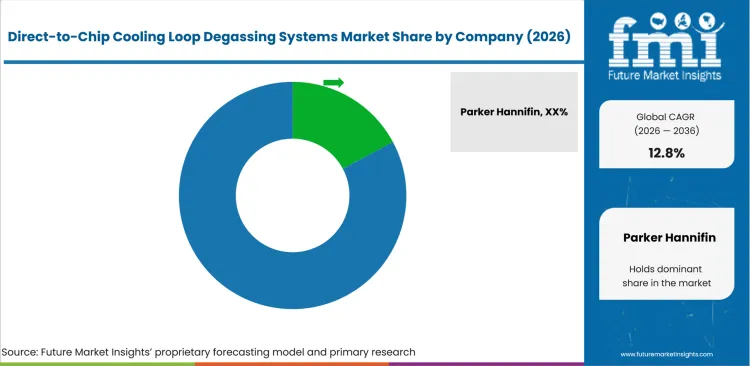
Competition is fragmented because coolant chemistry, air removal, hydronic control, rack connections, CDU integration, and field service require different evidence. Ecolab Nalco Water and Spirotech hold the broadest fluid-control positions, while Boyd Thermal and Vertiv extend into rack-level cooling integration and lifecycle service.
- Ecolab Nalco Water, Spirotech, and IMI Climate Control emphasize coolant condition, gas control, and validated hydronic materials.
- Reflex Winkelmann and Aalberts hydronic flow control focus on preassembled hydronic functions used in data-center cooling systems.
- Parker Hannifin, Boyd Thermal, and Vertiv provide rack connections, CDU integration, testing, or lifecycle service.
Competitive Benchmarking: Direct-to-Chip Cooling Loop Degassing Systems Market
| Company | Loop Fluid-Control Breadth | Condition Monitoring & Cleanliness | Direct-to-Chip Integration & Commissioning | Geographic Reach |
|---|---|---|---|---|
| Ecolab Nalco Water | High | High | High | Global water-service and direct-liquid-cooling coverage |
| Spirotech | High | High | High | Europe with international data-center channel partners |
| IMI Climate Control | High | Medium | Medium | Europe, Americas, Asia-Pacific and Middle East |
| Reflex Winkelmann | High | High | Medium | Europe with international project coverage |
| Aalberts hydronic flow control | High | Medium | Medium | Europe, North America and international building markets |
| Parker Hannifin | Low | Medium | Medium | Global manufacturing and technical-service network |
| Boyd Thermal | High | High | High | North America, Europe and Asia manufacturing/service |
| Vertiv | High | High | High | Global data-center sales and service network |
Scoring basis: Loop fluid-control breadth is High for three or more verified functions, Medium for two, and Low for one. Condition monitoring and cleanliness is High for active sensing plus documented cleanliness or chemistry control, Medium for one verified route, and Low for passive protection. Direct-to-chip integration is High for rack or CDU hardware plus validation or commissioning evidence, Medium for one liquid-loop role, and Low for an adjacent component.
Key Developments in the Direct-to-Chip Cooling Loop Degassing Systems Market
- In July 2026, Ecolab closed its CoolIT Systems acquisition and extended its data-center cooling platform with CDUs and cold plates alongside coolant-health monitoring.
- In March 2026, Eaton completed its acquisition of Boyd Thermal, which became part of Eaton's Electrical Global segment.
- In February 2025, Vertiv launched Liquid Cooling Services globally for installation, fluid management, maintenance, and digital service of liquid-cooled systems.
Key Players in the Direct-to-Chip Cooling Loop Degassing Systems Market
Coolant Condition and Degassing Specialists
- Ecolab Nalco Water
- Spirotech
- IMI Climate Control
Hydronic Fluid-Management Platforms
- Reflex Winkelmann
- Aalberts hydronic flow control
Direct-Liquid-Cooling Integration and Service
- Parker Hannifin
- Boyd Thermal
- Vertiv
Direct-to-Chip Cooling Loop Degassing Systems Market - Report Scope
| Coverage field | Report scope |
|---|---|
| Market breakdown | By fluid - treatment type, cooling architecture, service / replacement cycle, data center type, route to market, and region. |
| Quantitative Units | USD million. |
| Market Definition | Revenue from degassing, air-removal, fluid-conditioning, and associated service packages sold for direct-to-chip or related liquid-cooling loops within the defined segmentation. |
| Regions Covered | North America, Latin America, Western Europe, Eastern Europe, East Asia, South Asia and Pacific, and Middle East and Africa. |
| Countries Covered | UAE, Saudi Arabia, Spain, South Korea, France, Japan, USA, and 20+ countries included in the full report. |
| Key Companies Profiled | Ecolab Nalco Water, Spirotech, IMI Climate Control, Reflex Winkelmann, Aalberts hydronic flow control, Parker Hannifin, Boyd Thermal, and Vertiv. |
| Forecast Period | 2026 to 2036. |
| Approach | Primary and secondary research with market triangulation. |
Direct-to-Chip Cooling Loop Degassing Systems Market - Research Methodology
| Method | Approach |
|---|---|
| Primary Research | FMI analysts gathered input from manufacturers, service providers, technology developers, distributors, end users, procurement teams, and subject-matter experts. Interviews examined purchasing decisions, product or service evaluation, adoption barriers, approval requirements, pricing considerations, and expectations for technical or commercial support. Respondents were also asked what evidence is required before a trial, pilot, or initial order develops into regular purchasing. |
| Desk Research | Desk research covered government statistics, regulatory publications, trade data, industry associations, technical literature, standards, company filings, product information, and official corporate announcements. Sources were reviewed for relevance, publication date, geographic coverage, and consistency with the defined market scope. Claims relating to performance, applications, approvals, capacity, investment, and commercial activity were retained only when supported by credible public evidence. |
| Market Sizing and Forecasting | The market model combined the baseline value with historical performance, segment structure, pricing and volume indicators, adoption levels, company participation, and country-level demand conditions. Forecast assumptions considered economic activity, investment trends, regulatory developments, technology adoption, purchasing cycles, supply availability, and barriers to wider market use. Segment and regional estimates were reconciled before the final market total was calculated. |
| Data Validation | Estimates were checked against multiple independent indicators, including public data, company activity, trade patterns, industry developments, and findings from primary interviews. Validation also tested whether products, services, applications, and company revenues fell within the defined market boundaries. Adjacent categories, unsupported claims, overlapping revenues, and activities without direct market relevance were excluded to reduce double counting and maintain consistency across segments and countries. |
Direct-to-Chip Cooling Loop Degassing Systems Market by Segments
Direct-to-Chip Cooling Loop Degassing Systems Market segmented by Fluid - treatment Type:
- Water-glycol fluids
- Deionized / additive-treated water
- Synthetic dielectric fluids
- Specialty corrosion / biocide treatment
Direct-to-Chip Cooling Loop Degassing Systems Market segmented by Cooling Architecture:
- Direct-to-chip loops
- Immersion systems
- Rear-door heat exchangers
- Hybrid liquid loops
Direct-to-Chip Cooling Loop Degassing Systems Market segmented by Service / Replacement Cycle:
- Initial fill - deployment
- Annual maintenance
- Condition-triggered replacement
- Emergency remediation
Direct-to-Chip Cooling Loop Degassing Systems Market segmented by Data Center Type:
- Hyperscale AI
- Colocation AI
- Enterprise / private AI
- HPC & research
Direct-to-Chip Cooling Loop Degassing Systems Market segmented by Route to Market:
- Fluid manufacturer direct
- Cooling OEM / integrator
- Water-treatment service provider
- Distributor / aftermarket
Direct-to-Chip Cooling Loop Degassing Systems Market by Region:
- North America
- United States
- Canada
- Latin America
- Brazil
- Mexico
- Chile
- Rest of Latin America
- Western Europe
- Germany
- United Kingdom
- Italy
- Spain
- France
- Nordics
- Benelux
- Rest of Western Europe
- Eastern Europe
- Russia
- Poland
- Hungary
- Balkan and Baltic States
- Rest of Eastern Europe
- East Asia
- China
- Japan
- South Korea
- South Asia and Pacific
- India
- ASEAN
- Australia and New Zealand
- Rest of South Asia and Pacific
- Middle East and Africa
- Kingdom of Saudi Arabia
- Other GCC Countries
- Türkiye
- South Africa
- Other African Union Countries
- Rest of Middle East and Africa
Research Sources and Bibliography
- USA Energy Information Administration. (2026, March 12). Fossil generation could rise with faster-than-expected growth in data center power demand.
- European Commission, Directorate-General for Energy. (2025, November 17). In focus: Data centres - an energy-hungry challenge.
- Open Compute Project Foundation. (2025, July 1). Project Deschutes: Data Center Facilities.
- Open Compute Project Foundation and ASHRAE. (2025, October 13). Open Compute Project Foundation and ASHRAE Form New Alliance.
- Open Compute Project Foundation. (2025, January 27). Guidelines for Pre-Commission Preparation of Technology Cooling System (TCS) Row Manifolds.
- Meta. (2025, September 29). Meta’s Infrastructure Evolution and the Advent of AI.
- Open Compute Project Foundation. (2025, October 13). 2025 OCP Global Summit.
- Open Compute Project Foundation. (2025, November). Cooling Environments / Cold Plate: Propylene Glycol-Based Heat Transfer Fluid Guidance.
- Ecolab. (2025, May 29). Ecolab Launches New Cooling Management Technology To Revolutionize Performance and Efficiency for Data Centers.
- Abu Dhabi Media Office. (2025, May 22). Global tech alliance launches Stargate UAE.
- National Platform, Saudi Arabia. (2025, February 12). SDAIA President Launches High-Capacity Technical Projects and Data Centers.
- European High-Performance Computing Joint Undertaking. (2026, January 26). Contract Signed to Boost MareNostrum 5’s AI Capabilities.
- Ministry of Science and ICT, Republic of Korea. (2025, February 20). Korea to Expand AI Computing Infrastructure to Strengthen National AI Capabilities and Achieve Global Leadership.
- RTE. (2026, April). 2025 Review - Consumption.
- Ministry of Economy, Trade and Industry, Japan. (2025, June 12). Report 1.0 of the Public-Private Advisory Council on Watt-Bit Collaboration Published.
- USA Energy Information Administration. (2026, May 19). Data center server energy use grows across the commercial building stock.
- Ecolab. (2026, July 2). Ecolab Closes CoolIT Acquisition and Expands AI Cooling Platform as Global High Tech Business Targets $4 Billion by 2030.
- Eaton. (2026, March 12). Eaton completes acquisition of leading liquid-cooling solutions provider Boyd Thermal, creating an industry-leading grid-to-chip solution for data centers.
- Vertiv. (2025, February 11). Vertiv announces global launch of liquid cooling services portfolio to support systems for AI and high-density compute applications.
- Danfoss. (2025, December 12). Danfoss Power Solutions launches MQD and MQDB quick-disconnect couplings for electronics and data center liquid cooling applications.
- Stäubli. (2025, November 5). Stäubli Drives Next-Generation Liquid Cooling Standards for AI Data Centers at OCP Global Summit.
- Alfa Laval. (2026, March 4). Alfa Laval launches FreeWaterLoop to support efficient data center cooling.
- nVent Electric plc. (2025, November 17). nVent Unveils New Liquid Cooling and Power Portfolio at SC25.
- Schneider Electric. (2026, February 18). Schneider Electric launches Motivair liquid cooling solutions factory, to accelerate India’s high-density AI infrastructure.
- Ecolab. (2025, November 14). Ecolab Strengthens Integrated Cooling Program for Data Centers.
- SCHÄFER IT-Systems. (2026, April 22). SCHÄFER IT-Systems and Spirotech bv launch joint system for safe liquid cooling in data centres.
- IMI Climate Control. (2025, June 20). Beyond Stainless Steel: Proven Reliability for Data Centre Liquid Cooling.
- Reflex Winkelmann. (2025, August 19). Data Center Solutions.
- Aalberts. (2025, July 17). Aalberts enhances hydronic flow control position in North America.
- Parker Hannifin. (2025, September). Launch: Parker’s Universal Quick Disconnect (UQD) Couplings for Data Center Liquid Cooling.
- Eaton. (2025, November 3). Eaton signs agreement to acquire Boyd Thermal, expanding solutions for data center customers to include critical liquid cooling technology.
- Vertiv. (2026, May 26). Vertiv expands liquid cooling portfolio in EMEA to accelerate AI-ready data centre deployments.
This bibliography is provided for reader reference and is not exhaustive. The full report contains the complete reference list and detailed citations
This Report Answers
- How large is the direct-to-chip cooling loop degassing systems market in 2026 and 2036?
- What turns liquid-cooling expansion into degassing demand?
- Why do water-glycol fluids lead fluid - treatment type?
- Why do direct-to-chip loops lead cooling architecture?
- Why does initial fill - deployment lead service demand?
- How do growth rates differ among seven profiled countries?
- Which companies cover fluid control and direct-to-chip systems?
- Which constraints can delay degassing specification?
Frequently Asked Questions
How big is the Direct-to-Chip Cooling Loop Degassing Systems Market in 2026?
The direct-to-chip cooling loop degassing systems market is valued at USD 484.4 million in 2026 and is projected to reach USD 1,615.5 million by 2036. Expansion follows liquid-cooled rack circuits requiring controlled filling, air removal, and documented coolant acceptance before service.
What is the CAGR of the Direct-to-Chip Cooling Loop Degassing Systems Market from 2026 to 2036?
The direct-to-chip cooling loop degassing systems market is projected to grow at a CAGR of 12.8% between 2026 and 2036. Growth follows denser AI racks, more closed secondary loops, and repeated commissioning or service work after coolant changes and branch repairs.
Which fluid - treatment type leads the Direct-to-Chip Cooling Loop Degassing Systems Market?
The water-glycol fluids segment is expected to hold 38.0% of the direct-to-chip cooling loop degassing systems market in 2026, attributable to familiar inhibitor and concentration practices. Qualification still depends on compatibility among the coolant, seals, hoses, CDU materials, and degassing equipment.
Which cooling architecture leads the Direct-to-Chip Cooling Loop Degassing Systems Market?
The direct-to-chip loops segment is projected to hold 45.0% of the direct-to-chip cooling loop degassing systems market in 2026, driven by cold-plate deployment. Narrow passages and repeated rack connections raise the value of controlled gas removal, filtration, and documented fluid acceptance.
Which companies are active in the Direct-to-Chip Cooling Loop Degassing Systems Market?
Key companies in the market include Ecolab Nalco Water, Spirotech, IMI Climate Control, Reflex Winkelmann, Aalberts hydronic flow control, Parker Hannifin, Boyd Thermal, and Vertiv. Their positions span coolant health, degassing, hydronic control, rack connections, CDU integration, testing, and field service.
Preview the report firsthand - request a free sample
Get SampleGet the brochure for pricing and purchase details.
Get PDFTable of Content
- Key Takeaways
- Market Size and CAGR
- Top Growth Driver
- Fastest Growing Segment
- Leading Region
- Key Companies
- Emerging Opportunities
- Executive Summary
- Global Market Outlook
- Demand-side Trends
- Supply-side Trends
- Technology Roadmap Analysis
- Analysis and Recommendations
- Analyst Perspective (What is happening? Why now? What should investors know?)
- Key Questions Answered
- How large is the market?
- What is the CAGR?
- What are key trends?
- Which region dominates?
- Who are the leaders?
- Market Overview
- Market Coverage / Taxonomy
- Market Definition / Scope / Limitations
- Research Methodology
- Chapter Orientation
- Analytical Lens and Working Hypotheses
- Market Structure, Signals, and Trend Drivers
- Benchmarking and Cross-market Comparability
- Market Sizing, Forecasting, and Opportunity Mapping
- Research Design and Evidence Framework
- Desk Research Programme (Secondary Evidence)
- Expert Input and Fieldwork (Primary Evidence)
- Tooling, Models, and Reference Databases
- Data Engineering and Model Build
- Quality Assurance and Audit Trail
- Market Background
- Market Dynamics (Drivers, Restraints, Opportunity, Trends)
- Scenario Forecast (Optimistic, Likely, Conservative)
- Impact Analysis
- AI Impact
- Sustainability Impact
- Regulatory Impact
- Technology Impact
- Consumer / Buyer Analysis
- Purchase Drivers
- Adoption Barriers
- Buyer Journey
- Opportunity Map Analysis
- Product Life Cycle Analysis
- Supply Chain Analysis
- Investment Feasibility Matrix
- Value Chain Analysis
- PESTLE and Porter's Analysis
- Regulatory Landscape
- Regional Parent Market Outlook
- Production and Consumption Statistics
- Import and Export Statistics
- Global Market Analysis and Forecast, 2021 to 2036
- Historical Market Size Value (USD Million) Analysis, 2021 to 2025
- Current and Future Market Size Value (USD Million) Projections, 2026 to 2036
- Y-o-Y Growth Trend Analysis
- Absolute $ Opportunity Analysis
- Global Market Pricing Analysis, 2021 to 2036
- Global Market Analysis and Forecast, By Fluid / Treatment Type, 2021 to 2036
- Introduction / Key Findings
- Historical Market Size Value (USD Million) Analysis By Fluid / Treatment Type, 2021 to 2025
- Current and Future Market Size Value (USD Million) Analysis and Forecast By Fluid / Treatment Type, 2026 to 2036
- Water-glycol fluids
- Deionized / additive-treated water
- Synthetic dielectric fluids
- Specialty corrosion / biocide treatment
- Water-glycol fluids
- Y-o-Y Growth Trend Analysis By Fluid / Treatment Type, 2021 to 2025
- Absolute $ Opportunity Analysis By Fluid / Treatment Type, 2026 to 2036
- Global Market Analysis and Forecast, By Cooling Architecture, 2021 to 2036
- Introduction / Key Findings
- Historical Market Size Value (USD Million) Analysis By Cooling Architecture, 2021 to 2025
- Current and Future Market Size Value (USD Million) Analysis and Forecast By Cooling Architecture, 2026 to 2036
- Direct-to-chip loops
- Immersion systems
- Rear-door heat exchangers
- Hybrid liquid loops
- Direct-to-chip loops
- Y-o-Y Growth Trend Analysis By Cooling Architecture, 2021 to 2025
- Absolute $ Opportunity Analysis By Cooling Architecture, 2026 to 2036
- Global Market Analysis and Forecast, By Service / Replacement Cycle, 2021 to 2036
- Introduction / Key Findings
- Historical Market Size Value (USD Million) Analysis By Service / Replacement Cycle, 2021 to 2025
- Current and Future Market Size Value (USD Million) Analysis and Forecast By Service / Replacement Cycle, 2026 to 2036
- Initial fill / deployment
- Annual maintenance
- Condition-triggered replacement
- Emergency remediation
- Initial fill / deployment
- Y-o-Y Growth Trend Analysis By Service / Replacement Cycle, 2021 to 2025
- Absolute $ Opportunity Analysis By Service / Replacement Cycle, 2026 to 2036
- Global Market Analysis and Forecast, By Data Center Type, 2021 to 2036
- Introduction / Key Findings
- Historical Market Size Value (USD Million) Analysis By Data Center Type, 2021 to 2025
- Current and Future Market Size Value (USD Million) Analysis and Forecast By Data Center Type, 2026 to 2036
- Hyperscale AI
- Colocation AI
- Enterprise / private AI
- HPC & research
- Hyperscale AI
- Y-o-Y Growth Trend Analysis By Data Center Type, 2021 to 2025
- Absolute $ Opportunity Analysis By Data Center Type, 2026 to 2036
- Global Market Analysis and Forecast, By Route to Market, 2021 to 2036
- Introduction / Key Findings
- Historical Market Size Value (USD Million) Analysis By Route to Market, 2021 to 2025
- Current and Future Market Size Value (USD Million) Analysis and Forecast By Route to Market, 2026 to 2036
- Fluid manufacturer direct
- Cooling OEM / integrator
- Water-treatment service provider
- Distributor / aftermarket
- Fluid manufacturer direct
- Y-o-Y Growth Trend Analysis By Route to Market, 2021 to 2025
- Absolute $ Opportunity Analysis By Route to Market, 2026 to 2036
- Global Market Analysis and Forecast, By Region, 2021 to 2036
- Introduction
- Historical Market Size Value (USD Million) Analysis By Region, 2021 to 2025
- Current Market Size Value (USD Million) Analysis and Forecast By Region, 2026 to 2036
- North America
- Latin America
- Western Europe
- Eastern Europe
- East Asia
- South Asia and Pacific
- Middle East & Africa
- Market Attractiveness Analysis By Region
- North America Market Analysis and Forecast, By Country, 2021 to 2036
- Historical Market Size Value (USD Million) Trend Analysis By Market Taxonomy, 2021 to 2025
- Market Size Value (USD Million) Forecast By Market Taxonomy, 2026 to 2036
- By Country
- USA
- Canada
- By Fluid / Treatment Type
- By Cooling Architecture
- By Service / Replacement Cycle
- By Data Center Type
- By Route to Market
- By Country
- Market Attractiveness Analysis
- By Country
- By Fluid / Treatment Type
- By Cooling Architecture
- By Service / Replacement Cycle
- By Data Center Type
- By Route to Market
- Key Takeaways
- Latin America Market Analysis and Forecast, By Country
- Historical Market Size Value (USD Million) Trend Analysis By Market Taxonomy, 2021 to 2025
- Market Size Value (USD Million) Forecast By Market Taxonomy, 2026 to 2036
- By Country
- Brazil
- Mexico
- Chile
- Rest of Latin America
- By Fluid / Treatment Type
- By Cooling Architecture
- By Service / Replacement Cycle
- By Data Center Type
- By Route to Market
- By Country
- Market Attractiveness Analysis
- By Country
- By Fluid / Treatment Type
- By Cooling Architecture
- By Service / Replacement Cycle
- By Data Center Type
- By Route to Market
- Key Takeaways
- Western Europe Market Analysis and Forecast, By Country
- Historical Market Size Value (USD Million) Trend Analysis By Market Taxonomy, 2021 to 2025
- Market Size Value (USD Million) Forecast By Market Taxonomy, 2026 to 2036
- By Country
- Germany
- UK
- Italy
- Spain
- France
- Nordic
- BENELUX
- Rest of Western Europe
- By Fluid / Treatment Type
- By Cooling Architecture
- By Service / Replacement Cycle
- By Data Center Type
- By Route to Market
- By Country
- Market Attractiveness Analysis
- By Country
- By Fluid / Treatment Type
- By Cooling Architecture
- By Service / Replacement Cycle
- By Data Center Type
- By Route to Market
- Key Takeaways
- Eastern Europe Market Analysis and Forecast, By Country
- Historical Market Size Value (USD Million) Trend Analysis By Market Taxonomy, 2021 to 2025
- Market Size Value (USD Million) Forecast By Market Taxonomy, 2026 to 2036
- By Country
- Russia
- Poland
- Hungary
- Balkan & Baltic
- Rest of Eastern Europe
- By Fluid / Treatment Type
- By Cooling Architecture
- By Service / Replacement Cycle
- By Data Center Type
- By Route to Market
- By Country
- Market Attractiveness Analysis
- By Country
- By Fluid / Treatment Type
- By Cooling Architecture
- By Service / Replacement Cycle
- By Data Center Type
- By Route to Market
- Key Takeaways
- East Asia Market Analysis and Forecast, By Country
- Historical Market Size Value (USD Million) Trend Analysis By Market Taxonomy, 2021 to 2025
- Market Size Value (USD Million) Forecast By Market Taxonomy, 2026 to 2036
- By Country
- China
- Japan
- South Korea
- By Fluid / Treatment Type
- By Cooling Architecture
- By Service / Replacement Cycle
- By Data Center Type
- By Route to Market
- By Country
- Market Attractiveness Analysis
- By Country
- By Fluid / Treatment Type
- By Cooling Architecture
- By Service / Replacement Cycle
- By Data Center Type
- By Route to Market
- Key Takeaways
- South Asia and Pacific Market Analysis and Forecast, By Country
- Historical Market Size Value (USD Million) Trend Analysis By Market Taxonomy, 2021 to 2025
- Market Size Value (USD Million) Forecast By Market Taxonomy, 2026 to 2036
- By Country
- India
- ASEAN
- Australia & New Zealand
- Rest of South Asia and Pacific
- By Fluid / Treatment Type
- By Cooling Architecture
- By Service / Replacement Cycle
- By Data Center Type
- By Route to Market
- By Country
- Market Attractiveness Analysis
- By Country
- By Fluid / Treatment Type
- By Cooling Architecture
- By Service / Replacement Cycle
- By Data Center Type
- By Route to Market
- Key Takeaways
- Middle East & Africa Market Analysis and Forecast, By Country
- Historical Market Size Value (USD Million) Trend Analysis By Market Taxonomy, 2021 to 2025
- Market Size Value (USD Million) Forecast By Market Taxonomy, 2026 to 2036
- By Country
- Kingdom of Saudi Arabia
- Other GCC Countries
- Türkiye
- South Africa
- Other African Union
- Rest of Middle East & Africa
- By Fluid / Treatment Type
- By Cooling Architecture
- By Service / Replacement Cycle
- By Data Center Type
- By Route to Market
- By Country
- Market Attractiveness Analysis
- By Country
- By Fluid / Treatment Type
- By Cooling Architecture
- By Service / Replacement Cycle
- By Data Center Type
- By Route to Market
- Key Takeaways
- Key Countries Market Analysis
- USA
- Pricing Analysis
- Market Share Analysis, 2025
- By Fluid / Treatment Type
- By Cooling Architecture
- By Service / Replacement Cycle
- By Data Center Type
- By Route to Market
- Canada
- Pricing Analysis
- Market Share Analysis, 2025
- By Fluid / Treatment Type
- By Cooling Architecture
- By Service / Replacement Cycle
- By Data Center Type
- By Route to Market
- Mexico
- Pricing Analysis
- Market Share Analysis, 2025
- By Fluid / Treatment Type
- By Cooling Architecture
- By Service / Replacement Cycle
- By Data Center Type
- By Route to Market
- Brazil
- Pricing Analysis
- Market Share Analysis, 2025
- By Fluid / Treatment Type
- By Cooling Architecture
- By Service / Replacement Cycle
- By Data Center Type
- By Route to Market
- Chile
- Pricing Analysis
- Market Share Analysis, 2025
- By Fluid / Treatment Type
- By Cooling Architecture
- By Service / Replacement Cycle
- By Data Center Type
- By Route to Market
- Germany
- Pricing Analysis
- Market Share Analysis, 2025
- By Fluid / Treatment Type
- By Cooling Architecture
- By Service / Replacement Cycle
- By Data Center Type
- By Route to Market
- UK
- Pricing Analysis
- Market Share Analysis, 2025
- By Fluid / Treatment Type
- By Cooling Architecture
- By Service / Replacement Cycle
- By Data Center Type
- By Route to Market
- Italy
- Pricing Analysis
- Market Share Analysis, 2025
- By Fluid / Treatment Type
- By Cooling Architecture
- By Service / Replacement Cycle
- By Data Center Type
- By Route to Market
- Spain
- Pricing Analysis
- Market Share Analysis, 2025
- By Fluid / Treatment Type
- By Cooling Architecture
- By Service / Replacement Cycle
- By Data Center Type
- By Route to Market
- France
- Pricing Analysis
- Market Share Analysis, 2025
- By Fluid / Treatment Type
- By Cooling Architecture
- By Service / Replacement Cycle
- By Data Center Type
- By Route to Market
- India
- Pricing Analysis
- Market Share Analysis, 2025
- By Fluid / Treatment Type
- By Cooling Architecture
- By Service / Replacement Cycle
- By Data Center Type
- By Route to Market
- ASEAN
- Pricing Analysis
- Market Share Analysis, 2025
- By Fluid / Treatment Type
- By Cooling Architecture
- By Service / Replacement Cycle
- By Data Center Type
- By Route to Market
- Australia & New Zealand
- Pricing Analysis
- Market Share Analysis, 2025
- By Fluid / Treatment Type
- By Cooling Architecture
- By Service / Replacement Cycle
- By Data Center Type
- By Route to Market
- China
- Pricing Analysis
- Market Share Analysis, 2025
- By Fluid / Treatment Type
- By Cooling Architecture
- By Service / Replacement Cycle
- By Data Center Type
- By Route to Market
- Japan
- Pricing Analysis
- Market Share Analysis, 2025
- By Fluid / Treatment Type
- By Cooling Architecture
- By Service / Replacement Cycle
- By Data Center Type
- By Route to Market
- South Korea
- Pricing Analysis
- Market Share Analysis, 2025
- By Fluid / Treatment Type
- By Cooling Architecture
- By Service / Replacement Cycle
- By Data Center Type
- By Route to Market
- Russia
- Pricing Analysis
- Market Share Analysis, 2025
- By Fluid / Treatment Type
- By Cooling Architecture
- By Service / Replacement Cycle
- By Data Center Type
- By Route to Market
- Poland
- Pricing Analysis
- Market Share Analysis, 2025
- By Fluid / Treatment Type
- By Cooling Architecture
- By Service / Replacement Cycle
- By Data Center Type
- By Route to Market
- Hungary
- Pricing Analysis
- Market Share Analysis, 2025
- By Fluid / Treatment Type
- By Cooling Architecture
- By Service / Replacement Cycle
- By Data Center Type
- By Route to Market
- Kingdom of Saudi Arabia
- Pricing Analysis
- Market Share Analysis, 2025
- By Fluid / Treatment Type
- By Cooling Architecture
- By Service / Replacement Cycle
- By Data Center Type
- By Route to Market
- Türkiye
- Pricing Analysis
- Market Share Analysis, 2025
- By Fluid / Treatment Type
- By Cooling Architecture
- By Service / Replacement Cycle
- By Data Center Type
- By Route to Market
- South Africa
- Pricing Analysis
- Market Share Analysis, 2025
- By Fluid / Treatment Type
- By Cooling Architecture
- By Service / Replacement Cycle
- By Data Center Type
- By Route to Market
- USA
- Market Structure Analysis
- Competition Dashboard
- Competition Benchmarking
- Market Share Analysis of Top Players
- By Regional
- By Fluid / Treatment Type
- By Cooling Architecture
- By Service / Replacement Cycle
- By Data Center Type
- By Route to Market
- Emerging Startups
- Innovation Benchmarking
- Competition Analysis
- Competition Deep Dive
- Parker Hannifin
- Overview
- Product Portfolio
- Profitability by Market Segments
- Sales Footprint
- Strategy Overview
- Marketing Strategy
- Product Strategy
- Channel Strategy
- Pall Corporation
- Kurita
- Ecolab Nalco Water
- Parker Hannifin
- Case Studies
- Success Stories
- Recent Developments
- Competition Deep Dive
- Assumptions & Acronyms Used


