

- Industry Size (2026)
- USD 3.59 Bn
- Forecast (2036)
- USD 6.26 Bn
- CAGR (2026 to 2036)
- 5.7%
Envelope Paper Market Size, Market Forecast and Outlook By FMI
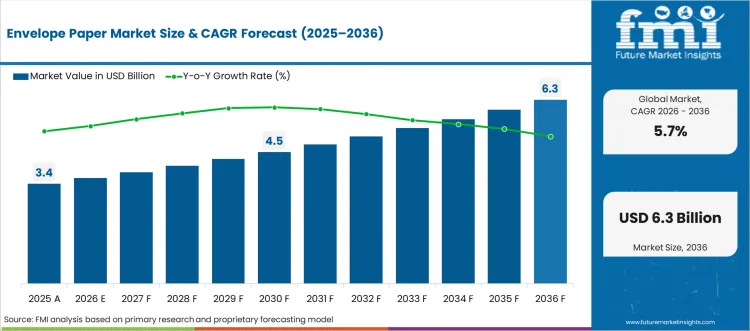
The envelope paper market was valued at USD 3.40 billion in 2025, projected to reach USD 3.59 billion in 2026, and is forecast to expand to USD 6.26 billion by 2036 at a 5.7% CAGR. FMI projects that sustained demand from government mailing operations, direct mail marketing campaigns, and legal document distribution maintains a procurement floor for envelope paper substrates despite the broader digital communication transition.
Summary of Envelope Paper Market
- Market Snapshot
- The envelope paper market is valued at USD 3.40 billion in 2025 and is projected to reach USD 6.26 billion by 2036.
- The industry is expected to grow at a 5.7% CAGR from 2026 to 2036, creating an incremental opportunity of USD 2.67 billion.
- The market operates as an institutional and specialty substrate category where government mailing requirements, e-commerce return packaging, and premium correspondence sustain demand.
- Demand and Growth Drivers
- Demand is sustained by institutional mailing requirements from government agencies, legal practices, healthcare providers, and financial institutions.
- E-commerce return packaging is creating new demand for high-performance kraft paper substrates.
- Luxury and branded correspondence programs are driving premiumization toward cotton-fiber and textured envelope paper grades.
- Among key countries, China leads at 7.7% CAGR, followed by India at 7.1%, Germany at 6.6%, the United States at 5.4%, and Japan at 4.3%.
- Product and Segment View
- The market includes kraft paper, wood pulp, cotton fiber, paperboard, and synthetic substrates for envelope conversion.
- Kraft Paper leads by material type with 45.0% share in 2026.
- 75 to 100 GSM leads by thickness with 25.0% share in 2026.
- The scope excludes finished retail envelopes, general-purpose printing paper, and corrugated packaging substrates.
- Geography and Competitive Outlook
- China and India are the fastest-growing markets, while Germany serves as a major European envelope conversion hub.
- Competition is shaped by substrate performance specifications, recycled content capability, and postal automation compatibility, with key producers including Cenveo Corporation, LA Envelope Inc., and Rama Pulp and Papers Limited.
- Market dynamics favor mills transitioning from commodity to specialty envelope grades.
- Analyst Opinion at FMI
- Ismail Sutaria, Principal Consultant at Future Market Insights, opines: 'In my analysis, I have observed that the envelope paper market is undergoing a quiet but consequential premiumization shift. While commodity mailing volumes decline predictably, the growth in e-commerce return mailers, tamper-evident security envelopes, and branded luxury correspondence is creating a value-per-ton trajectory that offsets volume contraction. Paper mills that successfully reallocate production capacity from standard commodity grades to these specialty substrates will capture structurally higher margins. Mills that remain focused on commodity production face a compressing margin environment driven by excess capacity and declining transactional mail volumes.'
- Strategic Implications / Executive Takeaways
- Paper mill production planners should evaluate the capital requirements for converting commodity envelope paper lines to specialty substrate production, including tear-resistant kraft grades for e-commerce return mailers and premium cotton-blend finishing for luxury correspondence.
- Envelope converters must secure long-term substrate supply agreements with mills transitioning to specialty grades, as the shift from commodity to premium production concentrates supply among fewer qualified producers.
- Direct mail campaign operators should transition from standard weight envelopes to branded, textured substrates that improve open rates and recipient engagement, justifying the higher per-unit substrate cost through measurably improved campaign performance.
Envelope Paper Market Key Takeaways
| Metric | Details |
|---|---|
| Industry Size (2026) | USD 3.59 billion |
| Industry Value (2036) | USD 6.26 billion |
| CAGR (2026-2036) | 5.7% |
Source: Future Market Insights, 2026
The envelope paper substrate market is navigating a dual-track demand environment. Commercial mailing volumes for transactional correspondence continue to contract as digital alternatives absorb billing and notification functions, but specialty envelope applications, including e-commerce return mailers, tamper-evident document envelopes, and branded premium correspondence, are expanding. This product mix shift favors higher-value substrates that command premium pricing, partially offsetting declining commodity envelope paper volumes.
China leads global expansion at a 7.7% CAGR through 2036, driven by domestic e-commerce return packaging demand and government document distribution volumes. India follows at 7.1%, fueled by growing direct mail marketing adoption and government correspondence programs. Germany registers 6.6% growth anchored by its position as a major European envelope converter. Brazil expands at 6.0% as postal reform programs modernize document distribution. The United States maintains a 5.4% trajectory, the United Kingdom at 4.9%, and Japan at 4.3%.
Envelope Paper Market Definition
Envelope paper encompasses the specialized paper and paperboard substrates manufactured specifically for conversion into envelopes used in commercial mailing, document packaging, and specialty correspondence applications. These substrates span kraft paper, wood pulp sheets, cotton fiber blends, paperboard grades, and synthetic alternatives engineered to meet postal service weight and size specifications.
Envelope Paper Market Inclusions
Market scope covers kraft paper for envelope conversion, wood pulp envelope grades, cotton fiber envelope substrates, paperboard envelope stock, and synthetic envelope materials. Coverage spans global and regional market sizes for the 2026 to 2036 forecast period, segmented by material type, thickness, envelope type, and geography.
Envelope Paper Market Exclusions
The scope excludes finished envelope products at retail level, general-purpose printing and writing paper not designated for envelope conversion, and packaging paper grades used for corrugated or folding carton applications.
Envelope Paper Market Research Methodology
- Primary Research: Analysts conducted structured interviews with envelope converters, paper mill production managers, and postal service procurement officers to map substrate specification requirements and purchasing cycles.
- Desk Research: Publicly available postal service volume reports, paper industry association production data, and trade statistics on paper substrate imports and exports provided foundational benchmarks.
- Market-Sizing and Forecasting: Baseline values derive from a bottom-up aggregation of envelope paper substrate production volumes and trade values, applying regional conversion rates to project demand.
- Data Validation and Update Cycle: Projections are tested against annual production statistics from major pulp and paper industry associations and cross-referenced with postal volume trend data.
Key Challenges
Shift Toward Sustainability and Digital Communication Block Growth of Envelope Paper
Envelope paper sales are challenged by global sustainability initiatives promoting paperless practices. The growth of digital communication tools like emails and e-documents has reduced reliance on physical correspondence. For instance, corporate sectors are switching towards e-signature and cloud storage which hampers the demand for paper-based solutions.
The increasing environmental pressures are making companies raise production costs using recyclable and eco-friendly materials. The adoption of sustainable packaging alternatives and the rise of digital communication platforms pose barriers to market growth.
Key Trends- Innovation
Automation and Efficiency in Paper Production
Technological advancements have modernized envelope paper manufacturing toward automation efficiency improvement. Prominent companies like International Paper (USA) use IoT and AI-based applications to automate various paper manufacturing processes. Automated manufacturing reduces waste upgrading the production speed and minimizing errors.
This process notably lowers operational costs and benefits overall production. These innovations help meet the rising demand for high-quality papers while maintaining competitive pricing for bulk buyers like corporate and e-commerce sectors.
Sustainability through Advanced Pulping Techniques
Integrating sustainable pulping techniques has addressed growing environmental concerns within the envelope paper industry. Stora Enso (Finland) employs a “deep eutectic solvent” pulping method, using biodegradable chemicals to produce eco-friendly paper. These advancements reduce water and energy consumption, aligning with consumer demand for recyclable and biodegradable envelope products.
Renewable energy integration, as seen with Nippon Paper (Japan), lowers carbon footprints and operational expenses. This integration enhances the manufacturer's appeal to eco-conscious buyers in a competitive market.
Enhanced Product Value with Coating and Customization Technologies
Innovative coating and digital cutting technologies has boosted envelope paper's aesthetic and functional appeal. High-tech equipment such as Heidelberg’s folding and glue application machines ensure accuracy in the production process.
Companies like UPM Specialty Papers (Finland) offer coated papers for excellent ink retention, while Neenah Paper (USA) offers luxury envelopes with embossed finishes for high-end branding (wedding invitations or legal documents). Such advancements allow manufacturers to reach niche markets, thus increasing profitability due to premium pricing for custom-branded or event-specific envelopes.
Key Trends- Focus on Sustainable Production
The market has focused on sustainability, with companies like International Paper, Stora Enso, and Nippon Paper leading the way. Their innovative practices include reducing emissions, utilizing recycled materials, and developing biodegradable products to meet eco-conscious demands.
International Paper (USA) Scale Production with Sustainability at the Core
International Paper's efforts in sustainability reflect the concern for meeting the demands of eco-conscious consumers worldwide. In 2026, International Paper has committed to reducing its greenhouse gas emissions by 35% by 2030, focusing on recycled and certified fibers.
Currently, 35% of its envelope paper production utilizes recycled materials, up from 25% in 2020. Producing 13 million tons of uncoated paper annually supplies major corporations like USPS and Amazon, reducing energy consumption by 10% and saving 500,000 MWh annually. These efforts ensure environmental compliance boosting profitability.
Stora Enso (Finland) Innovating with Renewable Materials and Technology
Stora Enso’s focus on sustainable envelope papers aligns with strict European packaging regulations. In 2026, the company launched 100% biodegradable envelope paper made from straw pulp and lignin. Producing 250,000 tons annually for envelope use, it exports 60% to eco-conscious markets like Germany and France.
Innovations like Lignode Technology reduce carbon emissions by 300,000 tons yearly and cut water consumption by 40%. These measures position Stora Enso as a leader in meeting growing global sustainability demands.
Nippon Paper’s (Japan) Renewable Energy and Eco-friendly Product Development
Nippon Paper integrates renewable energy and recycled materials to meet Japan’s eco-friendly packaging trends. Its Green Coat Paper, a 100% recyclable product, supports premium envelope applications for e-commerce and government services. In 2026, 45% of its envelope production came from recycled fibers, while transitioning to biomass energy cut costs by 12% and reduced CO2 emissions by 500,000 tons. This focus on innovation and efficiency ensures Nippon Paper remains competitive and sustainable in a growing global market.
Category-wise Insights
Kraft paper is Preferred Due to its Strength, Eco-Friendliness, and Versatile Applications
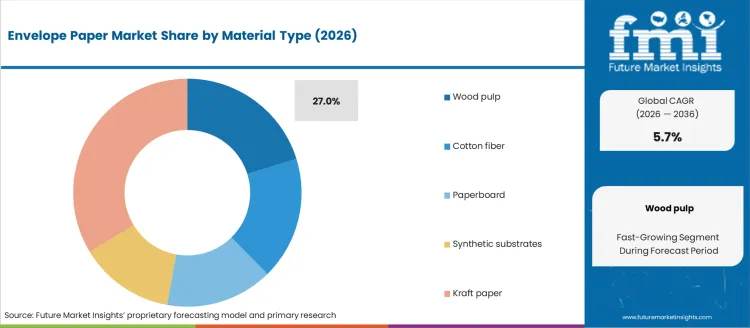
The envelope paper market spans various material types, catering to diverse applications worldwide. Wood pulp, cotton fiber, paperboard, synthetic substrates, and kraft paper are material types found in envelope papers.
Kraft paper is estimated to hold a share value of 45% for 2026. Commonly used in e-commerce, it supports global shipping for packaging small items. Its recyclable and biodegradable properties align with increasing sustainability goals worldwide.
Kraft paper’s affordability reduces production costs, benefiting manufacturers and businesses alike. The material’s durability upgrades product reliability for heavy-duty envelope uses. For companies, kraft paper supports branding initiatives by meeting consumer preferences for sustainable solutions.
75 - 100 GSM Segment Leads due to its Cost-efficiency and Wide Usability
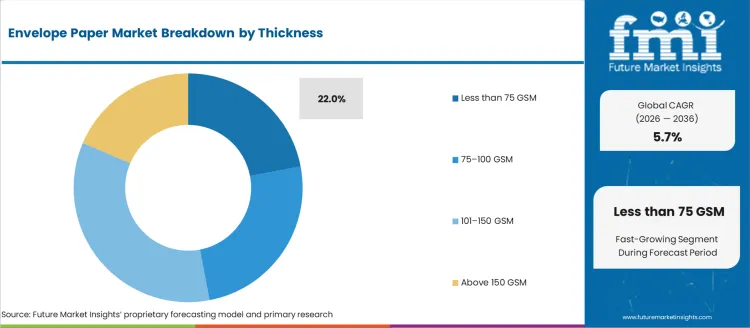
Envelope paper comes in different categories of thickness, depending on the needs of the application. Namely, less than 75 GSM, 75 to 100 GSM, 101 to 150, and more than 150 GSM
75 - 100 GSM thickness leads due to its durability and cost, making it suitable for bulk production requirements across the globe. It is majorly used in business correspondence, postal services, and marketing campaigns.
The thickness gives manufacturers the scope to produce mass products with minimal material expenses and quality uniformity. Companies get benefits from the compatibility of the product with pricing and achieve effective branding and custom designs. This segment goes along with the high-demand markets, creating sustained growth and profitability amounting to 25% share value in 2026.
By Envelope Type
Open-side envelopes have a flap on the longer side, ideal for documents, letters, and business correspondence. Open-end envelopes cater to secure bulk mailing, supporting e-commerce and logistics. Both types provide manufacturers flexibility in production and customization, boosting profitability.
Country-wise Insights
.webp "Top Country Growth Comparison Envelope Paper Market Cagr (2026 2036)")
United States Stands as a Hub for E-commerce and Direct Mail Demand
The United States is one of the leading markets for envelope paper, and holds nearly 19% share of the market as per FMI analysis. Over 70 billion direct mail pieces are sent annually propelling envelope demand.
Corporate correspondence remains vital, and it is supported by USPS operations nationwide. Additionally, e-commerce players like Amazon and eBay extensively utilize envelopes for shipping. The United States investments focus on advanced envelope production, helping companies scale profitability and meet evolving consumer needs efficiently.
Growth Driven by E-commerce and Sustainability Fuel Sales of Envelope Paper in China
China’s booming e-commerce sector led by Alibaba and JD.com boosts envelope usage. The vast postal network supports businesses and personal correspondence needs accounting to reach a CAGR of 5.9% from 2026 to 2036. Additionally, the adoption of eco-friendly papers aligns with strict government environmental policies. This market presents strong financial returns as regulations encourage eco-conscious product manufacturing.
India’s Reliance on Physical Correspondence and Growing E-commerce Sector Fuels Demand
Platforms like Flipkart and Snapdeal drive envelope consumption for packaging purposes. This envelope paper provides an eco-friendly solution for shipping documents, promotional materials, and small items and ensure safe transit minimizing environmental impact.
In addition, government initiatives has reduced single-use plastics encouraging paper alternatives in various applications. By 2036, India is projected to register a CAGR of 6.1% in sales of envelope paper.
Germany Leads the European Market in Quality
Germany’s demand for envelope paper stems from corporate correspondence, advertising, and financial sector needs. Strong environmental regulations boost demand for recycled and biodegradable papers. Germany is a key European market, estimated to account for nearly 5.5% market share. Companies targeting this region has gained benefit from high-quality and sustainable paper demand.
United Kingdom - A Direct Mail and Premium Paper Powerhouse
The United Kingdom relies on direct mail. For instance, 4.7 billion pieces of direct mail were sent in 2026. E-commerce transactions and premium envelope demand for invitations have also fueled the growth in this sector. The United Kingdom is likely to record a CAGR of 3.5% from 2026 to 2036 in the market, offering opportunities for premium and sustainable envelope makers.
Japan’s Traditional and Luxury Envelope Market Thrives
Japan emphasizes physical correspondence for formal occasions like weddings and business introductions. Advanced e-commerce and efficient postal systems drive premium envelope demand. Luxury paper usage caters to niche markets and formal events. Japan holds a 4.8% share of the market as per FMI estimates.
Australia’s High Consumption of Envelope Paper Ink Growth
Australia’s sales of envelope paper have soared due to the strong direct mail advertising industry. Both government and corporate sectors heavily rely on physical correspondence for effective communication. Additionally, the rising demand for sustainable packaging aligns with increasing environmental awareness among consumers.
Emerging Markets
In Brazil, the envelope paper market is witnessing increased usage in corporate and government sectors. South Africa’s Growing e-commerce and postal sector further drives demand for envelope paper. Meanwhile, Southeast Asian countries like Indonesia and Vietnam benefit from rising disposable incomes and expanding e-commerce activities.
Competitive Landscape
With such huge demand, the market is likely to be a competition hub with players trying to take advantage of every opportunity to be one of the top players globally. Currently, the envelop paper market comprises of large MNCs and regional manufacturers. International Paper Company is one of the leading companies in packaging products.
It offers a wide range of envelope papers for a vast array of industries, and in recent years the company has been performing well and ranks among the top players. Meanwhile, Mondi Group from South Africa holds a strong position in the Africa region. From North America, Glatfelter specializes in engineered materials including specialty papers used in envelope production.
Companies are not afraid to make challenging decisions to evolve with the trends. As the world moves toward a sustainable approach, companies are understanding the need to sail in that direction. Major emphasis on sustainable production processes has become a common trend that is appealing to both companies as well as the end-user. Geographical expansion is one other aspect companies are working towards to tap into new customer bases and increase the overall market share.
Some real-life examples of companies using the above tactics to strengthen their market share are demonstrated below.
| Company | Key Development |
|---|---|
| International Paper | Introduced Earth Choice, an eco-friendly product certified by the Forest Stewardship Council. |
| Stora Enso | Developing premium textured papers targeting wedding invitations. |
| Mondi Group | Offering high-gloss and printable papers for branded envelopes. |
| Neenah Inc. | Launched Neenah Environment, suitable for luxury envelopes. |
| JK Paper | Introduced envelope papers made from agricultural waste and renewable pulp. |
| Moorim Paper | Developing recyclable lightweight envelopes with water-resistant properties. |
Scope of the Report
| Metric | Value |
|---|---|
| Quantitative Units | USD 3.59 billion to USD 6.26 billion, at a CAGR of 5.7% |
| Market Definition | Envelope paper encompasses the specialized paper and paperboard substrates manufactured specifically for conversion into envelopes used in commercial mailing, document packaging, and specialty correspondence applications. These substrates span kraft paper, wood pulp sheets, cotton fiber blends, paperboard grades, and synthetic alternatives engineered to meet postal service weight and size specifications. |
| Material Type Segmentation | Kraft Paper, Wood Pulp, Cotton Fiber, Paperboard, Synthetic Substrates |
| Thickness Segmentation | Less than 75 GSM, 75 to 100 GSM, 101 to 150 GSM, Above 150 GSM |
| Envelope Type Segmentation | Open-side, Open-end |
| Regions Covered | North America, Latin America, Europe, East Asia, South Asia, Oceania, Middle East & Africa |
| Countries Covered | China, India, Germany, Brazil, United States, United Kingdom, Japan, and 40 plus countries |
| Key Companies Profiled | Vatvruksh, Pranita Enterprises, Multi M Enterprises, Cenveo Corporation, LA Envelope Inc., Om Express Print Pack Private Limited, Ravi Exports, Arora Gifts Private Limited, Rama Pulp and Papers Limited |
| Forecast Period | 2026 to 2036 |
| Approach | Baseline values derive from a bottom-up aggregation of envelope paper substrate production volumes and trade values, applying regional conversion rates to project demand. |
Segmentation
By Material Type:
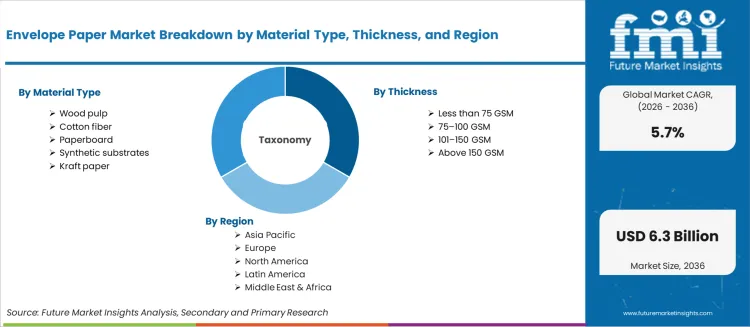
Wood pulp, cotton fiber, paperboard, synthetic substrates, and kraft paper are categorized material types of envelope papers.
By Thickness:
The segment includes less than 75 GSM, 75 to 100 GSM, 101 to 150 GSM, and above 150 GSM thickness scale.
By Envelope Type:
Open-side and open-end are two types of envelope paper.
By Region:
Information about the leading countries of North America, Latin America, Western Europe, South Asia and Pacific, East Asia, and the Middle East and Africa is given.
Bibliography
- Universal Postal Union. (2024). Postal Statistics: Global Mail Volume Trends and Forecasts. UPU.
- Food and Agriculture Organization of the United Nations. (2024). FAO Yearbook of Forest Products: Pulp and Paper Production Statistics. FAO.
- European Commission. (2024). Packaging and Packaging Waste Regulation (PPWR) Implementation Framework. EC.
- Confederation of European Paper Industries (CEPI). (2025). Key Statistics: European Pulp and Paper Industry. CEPI.
- India Post, Department of Posts. (2025). Annual Report: Mail Volume and Operational Statistics. India Post.
- United States Postal Service. (2025). USPS Annual Report to Congress: Mail Volume and Revenue. USPS.
This bibliography is provided for reader reference. The full Future Market Insights report contains the complete reference list with primary research documentation.
Frequently Asked Questions
How large is the demand for Envelope Paper in the global market in 2026?
Demand is estimated at USD 3.59 billion in 2026.
What will be the market size by 2036?
Market size is projected to reach USD 6.26 billion by 2036.
What is the expected CAGR between 2026 and 2036?
The market is expected to grow at a CAGR of 5.7%.
Which Material Type leads by 2026?
Kraft Paper accounts for 45.0% share in 2026.
How significant is 75 to 100 GSM thickness?
75 to 100 GSM holds 25.0% share in 2026 as the standard commercial mailing specification.
What is driving demand in China?
E-commerce return packaging and government document distribution volumes fuel a 7.7% CAGR through 2036.
What is India's growth outlook?
India is projected to grow at 7.1% CAGR through 2036.
Preview the report firsthand - request a free sample
Get SampleGet the brochure for pricing and purchase details.
Get PDFTable of Content
- Executive Summary
- Global Market Outlook
- Demand-side Trends
- Supply-side Trends
- Technology Roadmap Analysis
- Analysis and Recommendations
- Market Overview
- Market Coverage / Taxonomy
- Market Definition / Scope / Limitations
- Research Methodology
- Chapter Orientation
- Analytical Lens and Working Hypotheses
- Market Structure, Signals, and Trend Drivers
- Benchmarking and Cross-market Comparability
- Market Sizing, Forecasting, and Opportunity Mapping
- Research Design and Evidence Framework
- Desk Research Programme (Secondary Evidence)
- Company Annual and Sustainability Reports
- Peer-reviewed Journals and Academic Literature
- Corporate Websites, Product Literature, and Technical Notes
- Earnings Decks and Investor Briefings
- Statutory Filings and Regulatory Disclosures
- Technical White Papers and Standards Notes
- Trade Journals, Industry Magazines, and Analyst Briefs
- Conference Proceedings, Webinars, and Seminar Materials
- Government Statistics Portals and Public Data Releases
- Press Releases and Reputable Media Coverage
- Specialist Newsletters and Curated Briefings
- Sector Databases and Reference Repositories
- FMI Internal Proprietary Databases and Historical Market Datasets
- Subscription Datasets and Paid Sources
- Social Channels, Communities, and Digital Listening Inputs
- Additional Desk Sources
- Expert Input and Fieldwork (Primary Evidence)
- Primary Modes
- Qualitative Interviews and Expert Elicitation
- Quantitative Surveys and Structured Data Capture
- Blended Approach
- Why Primary Evidence is Used
- Field Techniques
- Interviews
- Surveys
- Focus Groups
- Observational and In-context Research
- Social and Community Interactions
- Stakeholder Universe Engaged
- C-suite Leaders
- Board Members
- Presidents and Vice Presidents
- R&D and Innovation Heads
- Technical Specialists
- Domain Subject-matter Experts
- Scientists
- Physicians and Other Healthcare Professionals
- Governance, Ethics, and Data Stewardship
- Research Ethics
- Data Integrity and Handling
- Primary Modes
- Tooling, Models, and Reference Databases
- Desk Research Programme (Secondary Evidence)
- Data Engineering and Model Build
- Data Acquisition and Ingestion
- Cleaning, Normalisation, and Verification
- Synthesis, Triangulation, and Analysis
- Quality Assurance and Audit Trail
- Market Background
- Market Dynamics
- Drivers
- Restraints
- Opportunity
- Trends
- Scenario Forecast
- Demand in Optimistic Scenario
- Demand in Likely Scenario
- Demand in Conservative Scenario
- Opportunity Map Analysis
- Product Life Cycle Analysis
- Supply Chain Analysis
- Investment Feasibility Matrix
- Value Chain Analysis
- PESTLE and Porter’s Analysis
- Regulatory Landscape
- Regional Parent Market Outlook
- Production and Consumption Statistics
- Import and Export Statistics
- Market Dynamics
- Global Market Analysis 2021 to 2025 and Forecast, 2026 to 2036
- Historical Market Size Value (USD Million) Analysis, 2021 to 2025
- Current and Future Market Size Value (USD Million) Projections, 2026 to 2036
- Y-o-Y Growth Trend Analysis
- Absolute $ Opportunity Analysis
- Global Market Pricing Analysis 2021 to 2025 and Forecast 2026 to 2036
- Global Market Analysis 2021 to 2025 and Forecast 2026 to 2036, By Material Type
- Introduction / Key Findings
- Historical Market Size Value (USD Million) Analysis By Material Type , 2021 to 2025
- Current and Future Market Size Value (USD Million) Analysis and Forecast By Material Type , 2026 to 2036
- Wood pulp
- Cotton fiber
- Paperboard
- Synthetic substrates
- Kraft paper
- Wood pulp
- Y-o-Y Growth Trend Analysis By Material Type , 2021 to 2025
- Absolute $ Opportunity Analysis By Material Type , 2026 to 2036
- Global Market Analysis 2021 to 2025 and Forecast 2026 to 2036, By Thickness
- Introduction / Key Findings
- Historical Market Size Value (USD Million) Analysis By Thickness, 2021 to 2025
- Current and Future Market Size Value (USD Million) Analysis and Forecast By Thickness, 2026 to 2036
- Less than 75 GSM
- 75-100 GSM
- 101-150 GSM
- Above 150 GSM
- Less than 75 GSM
- Y-o-Y Growth Trend Analysis By Thickness, 2021 to 2025
- Absolute $ Opportunity Analysis By Thickness, 2026 to 2036
- Global Market Analysis 2021 to 2025 and Forecast 2026 to 2036, By Envelope Type
- Introduction / Key Findings
- Historical Market Size Value (USD Million) Analysis By Envelope Type, 2021 to 2025
- Current and Future Market Size Value (USD Million) Analysis and Forecast By Envelope Type, 2026 to 2036
- Open-side
- Open-end
- Open-side
- Y-o-Y Growth Trend Analysis By Envelope Type, 2021 to 2025
- Absolute $ Opportunity Analysis By Envelope Type, 2026 to 2036
- Global Market Analysis 2021 to 2025 and Forecast 2026 to 2036, By Region
- Introduction
- Historical Market Size Value (USD Million) Analysis By Region, 2021 to 2025
- Current Market Size Value (USD Million) Analysis and Forecast By Region, 2026 to 2036
- North America
- Latin America
- Western Europe
- Eastern Europe
- East Asia
- South Asia and Pacific
- Middle East & Africa
- Market Attractiveness Analysis By Region
- North America Market Analysis 2021 to 2025 and Forecast 2026 to 2036, By Country
- Historical Market Size Value (USD Million) Trend Analysis By Market Taxonomy, 2021 to 2025
- Market Size Value (USD Million) Forecast By Market Taxonomy, 2026 to 2036
- By Country
- USA
- Canada
- Mexico
- By Material Type
- By Thickness
- By Envelope Type
- By Country
- Market Attractiveness Analysis
- By Country
- By Material Type
- By Thickness
- By Envelope Type
- Key Takeaways
- Latin America Market Analysis 2021 to 2025 and Forecast 2026 to 2036, By Country
- Historical Market Size Value (USD Million) Trend Analysis By Market Taxonomy, 2021 to 2025
- Market Size Value (USD Million) Forecast By Market Taxonomy, 2026 to 2036
- By Country
- Brazil
- Chile
- Rest of Latin America
- By Material Type
- By Thickness
- By Envelope Type
- By Country
- Market Attractiveness Analysis
- By Country
- By Material Type
- By Thickness
- By Envelope Type
- Key Takeaways
- Western Europe Market Analysis 2021 to 2025 and Forecast 2026 to 2036, By Country
- Historical Market Size Value (USD Million) Trend Analysis By Market Taxonomy, 2021 to 2025
- Market Size Value (USD Million) Forecast By Market Taxonomy, 2026 to 2036
- By Country
- Germany
- UK
- Italy
- Spain
- France
- Nordic
- BENELUX
- Rest of Western Europe
- By Material Type
- By Thickness
- By Envelope Type
- By Country
- Market Attractiveness Analysis
- By Country
- By Material Type
- By Thickness
- By Envelope Type
- Key Takeaways
- Eastern Europe Market Analysis 2021 to 2025 and Forecast 2026 to 2036, By Country
- Historical Market Size Value (USD Million) Trend Analysis By Market Taxonomy, 2021 to 2025
- Market Size Value (USD Million) Forecast By Market Taxonomy, 2026 to 2036
- By Country
- Russia
- Poland
- Hungary
- Balkan & Baltic
- Rest of Eastern Europe
- By Material Type
- By Thickness
- By Envelope Type
- By Country
- Market Attractiveness Analysis
- By Country
- By Material Type
- By Thickness
- By Envelope Type
- Key Takeaways
- East Asia Market Analysis 2021 to 2025 and Forecast 2026 to 2036, By Country
- Historical Market Size Value (USD Million) Trend Analysis By Market Taxonomy, 2021 to 2025
- Market Size Value (USD Million) Forecast By Market Taxonomy, 2026 to 2036
- By Country
- China
- Japan
- South Korea
- By Material Type
- By Thickness
- By Envelope Type
- By Country
- Market Attractiveness Analysis
- By Country
- By Material Type
- By Thickness
- By Envelope Type
- Key Takeaways
- South Asia and Pacific Market Analysis 2021 to 2025 and Forecast 2026 to 2036, By Country
- Historical Market Size Value (USD Million) Trend Analysis By Market Taxonomy, 2021 to 2025
- Market Size Value (USD Million) Forecast By Market Taxonomy, 2026 to 2036
- By Country
- India
- ASEAN
- Australia & New Zealand
- Rest of South Asia and Pacific
- By Material Type
- By Thickness
- By Envelope Type
- By Country
- Market Attractiveness Analysis
- By Country
- By Material Type
- By Thickness
- By Envelope Type
- Key Takeaways
- Middle East & Africa Market Analysis 2021 to 2025 and Forecast 2026 to 2036, By Country
- Historical Market Size Value (USD Million) Trend Analysis By Market Taxonomy, 2021 to 2025
- Market Size Value (USD Million) Forecast By Market Taxonomy, 2026 to 2036
- By Country
- Kingdom of Saudi Arabia
- Other GCC Countries
- Turkiye
- South Africa
- Other African Union
- Rest of Middle East & Africa
- By Material Type
- By Thickness
- By Envelope Type
- By Country
- Market Attractiveness Analysis
- By Country
- By Material Type
- By Thickness
- By Envelope Type
- Key Takeaways
- Key Countries Market Analysis
- USA
- Pricing Analysis
- Market Share Analysis, 2025
- By Material Type
- By Thickness
- By Envelope Type
- Canada
- Pricing Analysis
- Market Share Analysis, 2025
- By Material Type
- By Thickness
- By Envelope Type
- Mexico
- Pricing Analysis
- Market Share Analysis, 2025
- By Material Type
- By Thickness
- By Envelope Type
- Brazil
- Pricing Analysis
- Market Share Analysis, 2025
- By Material Type
- By Thickness
- By Envelope Type
- Chile
- Pricing Analysis
- Market Share Analysis, 2025
- By Material Type
- By Thickness
- By Envelope Type
- Germany
- Pricing Analysis
- Market Share Analysis, 2025
- By Material Type
- By Thickness
- By Envelope Type
- UK
- Pricing Analysis
- Market Share Analysis, 2025
- By Material Type
- By Thickness
- By Envelope Type
- Italy
- Pricing Analysis
- Market Share Analysis, 2025
- By Material Type
- By Thickness
- By Envelope Type
- Spain
- Pricing Analysis
- Market Share Analysis, 2025
- By Material Type
- By Thickness
- By Envelope Type
- France
- Pricing Analysis
- Market Share Analysis, 2025
- By Material Type
- By Thickness
- By Envelope Type
- India
- Pricing Analysis
- Market Share Analysis, 2025
- By Material Type
- By Thickness
- By Envelope Type
- ASEAN
- Pricing Analysis
- Market Share Analysis, 2025
- By Material Type
- By Thickness
- By Envelope Type
- Australia & New Zealand
- Pricing Analysis
- Market Share Analysis, 2025
- By Material Type
- By Thickness
- By Envelope Type
- China
- Pricing Analysis
- Market Share Analysis, 2025
- By Material Type
- By Thickness
- By Envelope Type
- Japan
- Pricing Analysis
- Market Share Analysis, 2025
- By Material Type
- By Thickness
- By Envelope Type
- South Korea
- Pricing Analysis
- Market Share Analysis, 2025
- By Material Type
- By Thickness
- By Envelope Type
- Russia
- Pricing Analysis
- Market Share Analysis, 2025
- By Material Type
- By Thickness
- By Envelope Type
- Poland
- Pricing Analysis
- Market Share Analysis, 2025
- By Material Type
- By Thickness
- By Envelope Type
- Hungary
- Pricing Analysis
- Market Share Analysis, 2025
- By Material Type
- By Thickness
- By Envelope Type
- Kingdom of Saudi Arabia
- Pricing Analysis
- Market Share Analysis, 2025
- By Material Type
- By Thickness
- By Envelope Type
- Turkiye
- Pricing Analysis
- Market Share Analysis, 2025
- By Material Type
- By Thickness
- By Envelope Type
- South Africa
- Pricing Analysis
- Market Share Analysis, 2025
- By Material Type
- By Thickness
- By Envelope Type
- USA
- Market Structure Analysis
- Competition Dashboard
- Competition Benchmarking
- Market Share Analysis of Top Players
- By Regional
- By Material Type
- By Thickness
- By Envelope Type
- Competition Analysis
- Competition Deep Dive
- Vatvruksh, Pranita Enterprises
- Overview
- Product Portfolio
- Profitability by Market Segments (Product/Age /Sales Channel/Region)
- Sales Footprint
- Strategy Overview
- Marketing Strategy
- Product Strategy
- Channel Strategy
- Multi M Enterprises
- Cenveo Corporation
- LA Envelope Inc.
- Om Express Print Pack Private Limited
- Ravi Exports
- Arora Gifts Private Limited
- Rama Pulp and Papers Limited
- Vatvruksh, Pranita Enterprises
- Competition Deep Dive
- Assumptions & Acronyms Used


