

- Market Size (2026)
- USD 395.3 Mn
- Forecast (2036)
- USD 953.1 Mn
- CAGR (2026 to 2036)
- 9.2%
How big is Fermentates for Food Preservation Market in 2026?
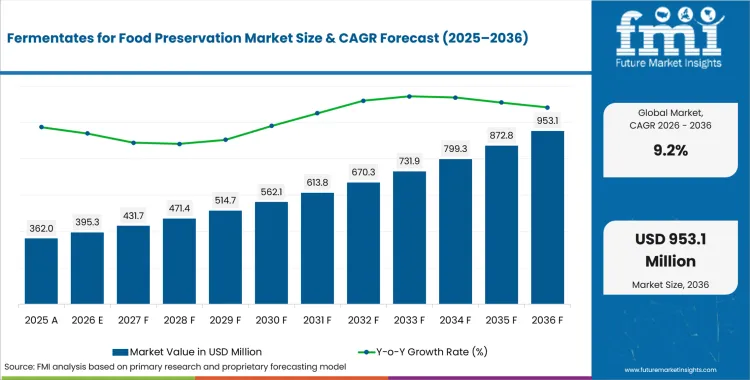
USD 395.3 million in 2026 and USD 953.1 million by 2036 at a 9.2% CAGR.
The fermentates for food preservation market is projected to rise from USD 395.3 million in 2026 to USD 953.1 million by 2036 at a 9.2% CAGR. The increase equals USD 557.8 million as industrial bakeries qualify mold control through shelf-life tests. USA Census Bureau County Business Patterns data released in June 2025 record 2,842 commercial bakery establishments before retail bakeries are counted. That base gives bakery ingredients companies repeat technical opportunities because each approved formula ties orders to regular bread and roll production.
Preservation spending is part of broader bakery reformulation, not a stand-alone clean-label purchase. Kerry Group stated in February 2026 that APMEA bakery growth came from food protection and preservation systems, enzymes and reformulation activity. That mix places fermentates beside food preservatives competing for the same formulation budget. Faster mold studies and dose economics can move a program from laboratory approval to scheduled orders.
Key Takeaways
- Industrial bakeries buy fermentate preservation after challenge testing proves the required mold-free period at a dosage that preserves taste, dough behavior and label fit.
- By product type, standard grade is estimated to hold 38.0% in 2026 because broad formulation compatibility keeps the cost-performance test straightforward for high-volume bakery lines.
- Powder / dry is projected to account for 41.0% of form demand in 2026 owing to shelf stability and compatibility with plants that batch flour and improvers as dry inputs.
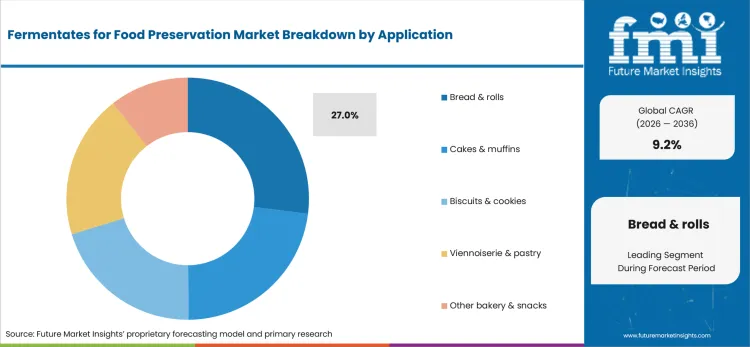
- Bread & rolls are forecast to represent 27.0% of application demand in 2026 since packaged yeast-raised products expose mold-control performance directly to distribution time and retail returns.
- Matrix-specific efficacy, sensory effects and wheat-allergen declarations can lengthen qualification and reduce the economic case for a fermentate change at higher use levels.
- Some of the key players in this market include Corbion, IFF, Kerry Group, Puratos, Kemin Industries, J&K Ingredients, Lallemand, and Lesaffre.
Analyst Perspective
"Fermentate economics are decided in the customer formula because a cleaner declaration has little value if a bakery must raise dosage or repeat challenge studies. Stronger offers pair mold-control performance with application work that protects sensory quality and gives industrial plants a specification they can reorder."
- Nandini Roy Choudhury, Principal Consultant, Future Market Insights
How is the fermentates for food preservation market segmented?
The fermentates for food preservation market is segmented by product type, form, application, claim, sales channel and region.
The analysis covers standard grade, premium / specialty grade, organic certified and clean label grade by product type. Form includes powder / dry, liquid, paste / semi-solid and granules / pieces. Applications include bread & rolls, cakes & muffins, biscuits & cookies, viennoiserie & pastry and other bakery & snacks. Claim covers conventional, clean label, organic and non-GMO / identity preserved. Sales channels include direct to industrial bakeries, ingredient distributors, foodservice & artisan supply and online B2B.
How do bread & rolls shape application demand?
Packaged bread exposes preservation performance directly to selling time because visible mold can turn an acceptable loaf into a return or write-off. Bread lines also provide a familiar benchmark for comparing fermentates with conventional mold inhibitors and adjacent food enzymes used for freshness and texture.
- By application, bread & rolls are forecast to represent 27.0% in 2026 due to frequent mold-control testing and clear shelf-life targets in packaged yeast-raised products.
- IFF launched POWERFRESH ACE 2000 in August 2025 for USA bread fresh keeping, confirming that industrial bakeries continue to fund shelf-life technologies even though the active mechanism is enzymatic.
What supports standard grade within the product type category?
Standard grade gives industrial bakeries the broadest starting point for mold control because teams can test efficacy before adding organic or identity-preserved sourcing constraints. Adjacent natural food preservatives programs face the same test: performance must hold in the finished food, not a generic specification.
- By product type, standard grade is estimated to hold 38.0% in 2026 attributable to broad recipe compatibility and a direct cost-performance test for routine bakery production.
- Corbion launched Verdad Essence WH100 in April 2025 as a cultured-wheat mold-inhibition system for breads, buns, tortillas and flatbreads, giving bakery teams current operating evidence for fermentation-derived preservation.
Why does powder / dry lead the form category?
Powder fermentates fit plants that meter flour, improvers and other industrial bakery ingredients without dedicated liquid tanks. The format travels well through distributor inventory, which lowers handling friction in import-led markets and plants without automated liquid dosing equipment.
- In 2026, powder / dry is expected to lead the form category with 41.0% share because shelf stability and dry-batch handling fit a wider installed base.
- Puratos documented liquid and powder fermented flour options in February 2026, describing powder as shelf stable and flexible. The same source positioned liquid systems for automated industrial dosing.
What makes direct sales important in the sales channel category?
Industrial bakery accounts rarely approve a preservation change from a specification sheet alone. The sale usually follows formulation work, challenge testing and plant-scale adjustments, which favors direct technical contact for complex clean-label ingredients even in plants that reorder through distributors.
- Direct to industrial bakeries is set to lead the sales channel category with 52.0% share in 2026 owing to high-volume qualification and account-specific technical work.
- Kemin Industries wrote in June 2025 that its SHIELD Pure cultured dextrose protects baked goods and tortillas from mold spoilage and paired the offer with formulation support from technical experts.
What are the drivers, restraints and opportunities in the Fermentates for Food Preservation Market?
Clean-label mold control and waste reduction increase demand, formula-specific validation slows conversion, and fermentation R&D with stronger application support can shorten the path to repeat industrial orders.
- Driver: Longer mold-free distribution gives bakeries a direct economic reason to test fermentate preservation once label requirements restrict conventional preservative choices.
- Restraint: Dose, pH, spoilage organism, sensory effects and allergen declarations can force separate validation for each commercial formula before procurement approval.
- Opportunity: Fermentation R&D paired with bakery pilot work can reduce repeated trials and give manufacturers a faster route to claim-compatible preservation specifications.
Food waste economics raise the value of shelf-life control
Food waste gives bakery preservation a measurable cost problem before any clean-label claim is considered. The USA Environmental Protection Agency stated in April 2025 that more than one-third of food in the United States is never eaten. Fermentates cannot solve all waste, but mold control can protect packaged bakery selling windows where spoilage is the direct loss route. Natural preservation ingredients become easier to justify after challenge tests confirm the required shelf life.
Allergen and formula effects slow substitution
Cultured-wheat systems introduce a labeling question beside the microbiology, so preservation approval must include ingredient-source review. FDA guidance issued in January 2025 says foods containing a major allergen must declare the allergen food source required by federal law. A bakery pursuing a wheat-sensitive or gluten-free position therefore needs another substrate or a different fermented ingredients route. The constraint lengthens qualification because the formula must satisfy mold, sensory and label requirements together.
Fermentation R&D can improve the input pipeline
New fermentation work can widen the options available to preservation developers without proving a finished preservative on its own. Lesaffre and MicroBioGen signed a worldwide exclusive yeast-technology partnership in June 2025 covering baking, food and biochemicals. The agreement expands a research base for future fermented ingredients and sourdough programs. Each preservation use still needs bakery-specific efficacy and sensory testing before it becomes a repeat ingredient order.
Which country CAGRs are profiled in the Fermentates for Food Preservation Market?
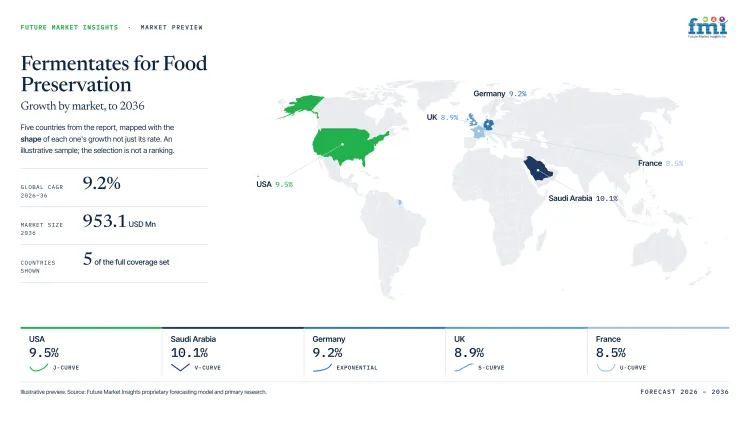
| Country | CAGR |
|---|---|
| United Arab Emirates | 10.4% |
| Saudi Arabia | 10.1% |
| South Korea | 9.8% |
| Germany | 9.2% |
| United Kingdom | 8.8% |
How do country-level CAGRs compare in the Fermentates for Food Preservation Market?
The five profiled forecasts span 1.6 percentage points and split into three practical groups. The United Arab Emirates and Saudi Arabia set the upper Gulf band, South Korea follows as an import-led processor market, Germany tracks the global rate, and the United Kingdom closes the set. That spacing describes conversion speed, not current revenue scale.
- United Arab Emirates: long import lanes make local distributor stock and shelf-stable inputs more important than headline growth alone.
- Saudi Arabia: processing capacity favors technical partners that can pair clean-label mold control with Gulf documentation.
- South Korea: import reliance raises the premium on Korean-language records and fast clarification during customs review.
- Germany: retail price pressure makes replacement of conventional preservatives harder despite strong quality expectations.
- United Kingdom: concentrated grocery specifications can move reformulation work quickly once shelf-life economics are proven.
CAGR should therefore be treated as a pacing signal instead of a standalone opportunity score. A faster country can still carry import friction or high service cost. The full report provides country-level CAGR analysis in North America, Latin America, Western Europe, Eastern Europe, East Asia, South Asia and Pacific, and Middle East and Africa.
Country-wise Analysis
- More than 570 predominantly small and medium-sized food and beverage processors operate in the United Arab Emirates, according to USDA FAS data published in June 2025. The United Arab Emirates is projected to grow at 10.4% CAGR through 2036 because processors rely heavily on imported inputs and regional distributors can stock shelf-stable preservation ingredients near bakery plants. Long shipping times and restrictive shelf-life rules make consistency valuable, yet fragmented account sizes can raise the cost of direct technical coverage. Companies that train local distributors to run structured bakery trials can reach smaller processors without weakening the challenge-testing discipline needed for approval.
- Saudi food manufacturing is concentrated enough to support large industrial accounts, although ingredient sourcing still depends heavily on imports. USDA FAS documented 1,300 registered food companies in June 2025 and noted that imports meet 70% of national food demand. Fermentates for food preservation are forecast to grow at 10.1% CAGR over the assessment period, given bakery expansion and the need for ingredients that tolerate long inbound supply chains. Import procedures and Gulf documentation can lengthen conversion. Regional inventory and technically trained partners matter most for companies serving processors that want clean-label mold control without carrying excessive safety stock locally.
- South Korean food processors operate under detailed food-safety and labeling rules and depend on imported agricultural inputs for a large part of production. Adoption of fermentates for food preservation is estimated to expand at 9.8% CAGR through 2036, tied to demand for differentiated bakery ingredients and local reformulation support. USDA FAS confirmed in May 2025 that the country relies heavily on imported agricultural products to meet processing needs. Korean-language documentation and responsive distributor support lower the practical burden of imported ingredient approval. The growth case weakens for companies that cannot keep technical records aligned with local labeling and customs requirements.
- German bakery and food manufacturing operate inside a mature retail system where price pressure and ingredient scrutiny run together. USDA FAS reported in March 2026 that food-industry output declined 0.6% in 2024, so formulation changes must defend cost as well as label position. Germany is estimated to post 9.2% CAGR over the forecast period, aided by continued sales potential for organic and highly processed ingredients. The harder test is proving that a fermentate can replace a lower-cost conventional preservative without increasing waste, dough variation or sensory complaints. Strong application data carry more weight than a broad clean-label claim in this market.
- Large United Kingdom retailers and food manufacturers impose tight ingredient specifications, and inflation keeps formula cost under close review. Fermentates for food preservation sales in the United Kingdom are forecast to expand at 8.8% CAGR by 2036, propelled by shelf-life work that can defend both ingredient declarations and distribution economics. USDA FAS documented about 486,500 food and drink manufacturing jobs in its March 2026 report, confirming the scale of the local processing base. Volatile supply chains and margin pressure limit tolerance for repeated trials. Dosage cost must be quantified against spoilage reduction before retailer-sensitive accounts approve any commercial change.
Who are the notable companies in the Fermentates for Food Preservation Market?
Corbion, IFF, Kerry Group, Puratos, Kemin Industries, J&K Ingredients, Lallemand, and Lesaffre are the notable companies serving this market.
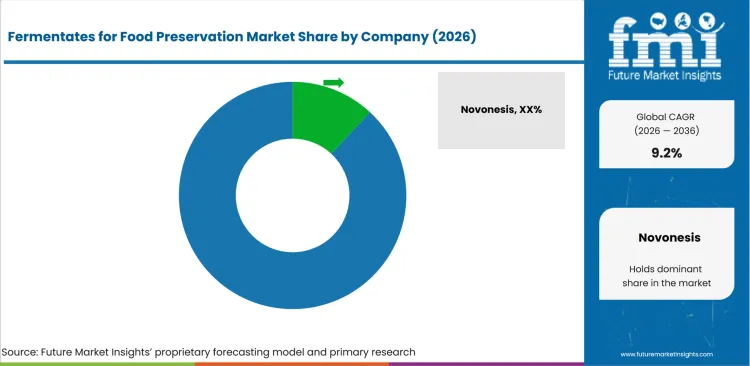
Competition centers on companies that can prove mold control in bakery formulas and support industrial trials. Corbion, IFF, Kerry Group and Puratos operate broad technical platforms. Kemin Industries and J&K Ingredients publish direct clean-label shelf-life offers. Lallemand and Lesaffre bring fermentation expertise into bakery preservation through yeast, enzymes and adjacent sourdough ingredients. flour improvers can enter the same reformulation work if dough behavior changes.
- Broad food-protection platforms: Corbion, IFF, Kerry Group and Puratos pair preservation technologies with bakery application support.
- Clean-label mold-control specialists: Kemin Industries and J&K Ingredients offer cultured or fermentation-led preservation routes for bakery products.
- Fermentation and bakery input developers: Lallemand and Lesaffre serve bakery plants through yeast, enzymes and adjacent technical development support.
Competitive Benchmarking: Fermentates for Food Preservation Market
| Company | Fermentate Preservation Breadth | Bakery Validation & Support | Claim & Format Flexibility | Geographic Reach |
|---|---|---|---|---|
| Corbion | High | High | High | Global |
| IFF | Medium | High | Medium | Global |
| Kerry Group | High | High | High | Global |
| Puratos | High | High | High | Global |
| Kemin Industries | High | Medium | Medium | North America and EMEA |
| J&K Ingredients | High | Medium | Medium | North America |
| Lallemand | Medium | High | Medium | Global baking network |
| Lesaffre | Medium | High | Medium | Global fermentation and baking network |
Scoring basis: High preservation breadth requires several documented fermentation-derived or natural mold-control routes. Medium identifies one direct route or adjacent fermentation base. High bakery validation requires pilot capability or customer-development support. High claim and format flexibility requires several documented forms or label options. Medium indicates a smaller verified set. Geographic reach is descriptive and is not scored.
Key Developments in the Fermentates for Food Preservation Market
- In January 2026, J&K Ingredients joined Pallas Biotech to advance clean-label food ingredients that extend freshness through bio-fermentation and microbial strain work. The partnership targets a direct preservation problem for bakery brands that want longer shelf life without synthetic preservatives.
- In July 2025, Lallemand acquired AIT Ingredients and integrated the business into Lallemand Baking Solutions. The deal strengthened its clean-label baking ingredient base and widened its route into preservation-adjacent reformulation programs.
- In September 2025, Kerry Group established a biotechnology centre in Leipzig with more than 100 scientists and technical specialists. The site expanded fermentation and enzyme development that can feed future food-protection and bakery shelf-life work.
Key Players in the Fermentates for Food Preservation Market
Direct Fermentate Preservation Platforms
- Corbion
- Kerry Group
- Puratos
- J&K Ingredients
Clean-Label Mold-Control Specialists
- Kemin Industries
- IFF
Fermentation and Bakery Input Developers
- Lallemand
- Lesaffre
Fermentates for Food Preservation Market - Report Scope
| Coverage field | Report scope |
|---|---|
| Market breakdown | By product type, form, application, claim, sales channel and region. |
| Quantitative Units | USD million. |
| Market Definition | Commercial fermentate preservative ingredients and fermentate-containing bakery preservation systems sold for mold control and shelf-life extension. Downstream bakery revenue and standalone conventional preservatives are excluded. |
| Regions Covered | North America, Latin America, Western Europe, Eastern Europe, East Asia, South Asia and Pacific, and Middle East and Africa. |
| Countries Covered | United Arab Emirates, Saudi Arabia, South Korea, Germany, United Kingdom, and 20+ countries included in the full report. |
| Key Companies Profiled | Corbion, IFF, Kerry Group, Puratos, Kemin Industries, J&K Ingredients, Lallemand, and Lesaffre. |
| Forecast Period | 2026 to 2036. |
| Approach | Primary and secondary research with market triangulation. |
Fermentates for Food Preservation Market - Research Methodology
| Method | Approach |
|---|---|
| Primary Research | FMI analysts gathered input from manufacturers, service providers, technology developers, distributors, end users, procurement teams, and subject-matter experts. Interviews examined purchasing decisions, product or service evaluation, adoption barriers, approval requirements, pricing considerations, and expectations for technical or commercial support. Respondents were also asked what evidence is required before a trial, pilot, or initial order develops into regular purchasing. |
| Desk Research | Desk research covered government statistics, regulatory publications, trade data, industry associations, technical literature, standards, company filings, product information, and official corporate announcements. Sources were reviewed for relevance, publication date, geographic coverage, and consistency with the defined market scope. Claims relating to performance, applications, approvals, capacity, investment, and commercial activity were retained only when supported by credible public evidence. |
| Market Sizing and Forecasting | The market model combined the baseline value with historical performance, segment structure, pricing and volume indicators, adoption levels, company participation, and country-level demand conditions. Forecast assumptions considered economic activity, investment trends, regulatory developments, technology adoption, purchasing cycles, supply availability, and barriers to wider market use. Segment and regional estimates were reconciled before the final market total was calculated. |
| Data Validation | Estimates were checked against multiple independent indicators, including public data, company activity, trade patterns, industry developments, and findings from primary interviews. Validation also tested whether products, services, applications, and company revenues fell within the defined market boundaries. Adjacent categories, unsupported claims, overlapping revenues, and activities without direct market relevance were excluded to reduce double counting and maintain consistency across segments and countries. |
Fermentates for Food Preservation Market by Segments
Fermentates for Food Preservation Market segmented by Product Type:
- Standard grade
- Premium / specialty grade
- Organic certified
- Clean label grade
Fermentates for Food Preservation Market segmented by Form:
- Powder / dry
- Liquid
- Paste / semi-solid
- Granules / pieces
Fermentates for Food Preservation Market segmented by Application:
- Bread & rolls
- Cakes & muffins
- Biscuits & cookies
- Viennoiserie & pastry
- Other bakery & snacks
Fermentates for Food Preservation Market segmented by Claim:
- Conventional
- Clean label
- Organic
- Non-GMO / identity preserved
Fermentates for Food Preservation Market segmented by Sales Channel:
- Direct to industrial bakeries
- Ingredient distributors
- Foodservice & artisan supply
- Online B2B
Fermentates for Food Preservation Market by Region:
- North America
- United States
- Canada
- Latin America
- Brazil
- Mexico
- Chile
- Rest of Latin America
- Western Europe
- Germany
- United Kingdom
- Italy
- Spain
- France
- Nordics
- Benelux
- Rest of Western Europe
- Eastern Europe
- Russia
- Poland
- Hungary
- Balkan and Baltic States
- Rest of Eastern Europe
- East Asia
- China
- Japan
- South Korea
- South Asia and Pacific
- India
- ASEAN
- Australia and New Zealand
- Rest of South Asia and Pacific
- Middle East and Africa
- Kingdom of Saudi Arabia
- Other GCC Countries
- Türkiye
- South Africa
- Other African Union Countries
- Rest of Middle East and Africa
Research Sources and Bibliography
- USA Census Bureau. (2025, June 26). All Sectors: County Business Patterns, including ZIP Code Business Patterns, by Legal Form of Organization and Employment Size Class for the USA, States, and Selected Geographies: 2023.
- Kerry Group. (2026, February 17). Kerry Group preliminary statement of results for the year ended 31 December 2025.
- Corbion. (2025, April 21). Corbion Unveils Verdad® Essence WH100: Redefining Natural Mold Inhibition for Bakers.
- Puratos. (2026, February 9). Clean(er) Label in Industrial Baking: Behind the Trend.
- International Flavors & Fragrances Inc. (2025, August 13). IFF Launches POWERFRESH® ACE 2000, a Bread Fresh-Keeping Solution That Aces the Shelf-Life Test.
- Kemin Industries. (2025, June 6). Emerging Regulatory Pressures Prompt USA Food Brands to Transition Away from Synthetic Ingredients.
- USA Environmental Protection Agency. (2025, April 4). Estimating the Cost of Food Waste to American Consumers.
- USA Food and Drug Administration. (2025, January). Guidance for Industry: Questions and Answers Regarding Food Allergen Labeling (Edition 5).
- Lesaffre. (2025, June 12). MicroBioGen and Lesaffre establish exclusive global partnership to provide innovative yeast solutions for the global Baking, Food, and Biochemicals markets.
- USA Department of Agriculture, Foreign Agricultural Service. (2025, June 9). Food Processing Ingredients Annual: United Arab Emirates.
- USA Department of Agriculture, Foreign Agricultural Service. (2025, June 11). Exporter Guide Annual: Saudi Arabia.
- USA Department of Agriculture, Foreign Agricultural Service. (2025, May 5). Food Processing Ingredients Annual: Korea - Republic of.
- USA Department of Agriculture, Foreign Agricultural Service. (2026, March 30). Food Processing Ingredients Annual: Germany.
- USA Department of Agriculture, Foreign Agricultural Service. (2026, March 24). Food Processing Ingredients Annual: United Kingdom.
- J&K Ingredients. (2026, January 29). J&K Ingredients and Pallas Biotech Join Forces to Advance Clean-Label Food Ingredients that Extend Freshness.
- Lallemand. (2025, July 4). Lallemand Acquires AIT Ingredients.
- Kerry Group. (2025, September 24). Kerry Establishes New Biotechnology Centre in Leipzig.
- Puratos. (2026, June 15). Puratos opens new research center to tackle flour variability.
- Kerry Group. (2025, December 10). Kerry Signs Strategic Agreement with Expo City Dubai to Establish New Regional Customer Co-Creation Centre to Drive Food & Beverage Innovation.
- Corbion. (2026, June 15). Corbion launches LUMI™ Set, a clean-label icing stabilizer for commercial bakers.
- Lallemand. (2025, July 17). Lallemand acquires enzyme specialist Solyve.
- International Flavors & Fragrances Inc. (2026, February 27). Annual Report on Form 10-K for the year ended December 31, 2025.
- Kerry Group. (2026, March 19). Kerry publishes 2025 Annual Report: A year defined by impact, innovation and purpose.
- Puratos. (2025, August 25). Puratos Announces Two New Hubs for Food Innovation: Montreal and Costa Rica.
- Kemin Industries. (2025, September 10). Kemin Food Technologies - EMEA Launches Next Generation of OLESSENCE Natural Solutions to Deliver Freshness and Enhance Flavour.
- Lesaffre. (2025, June 2). Lesaffre and Zilor enter a joint venture.
This bibliography is provided for reader reference and is not exhaustive. The full report contains the complete reference list and detailed citations
This Report Answers
- What are the 2026 and 2036 values for the fermentates for food preservation market?
- Which preservation and qualification conditions support the 9.2% CAGR?
- Why does standard grade lead product type?
- Why does powder / dry lead form?
- Why do bread & rolls lead application?
- How do CAGRs differ for the five profiled countries?
- Which companies supply fermentate preservation and bakery application support?
- Which formula, allergen and sensory limits slow adoption?
Frequently Asked Questions
How big is the fermentates for food preservation market in 2026?
The fermentates for food preservation market is valued at USD 395.3 million in 2026 and is projected to reach USD 953.1 million by 2036. Growth follows bakery reformulation that pairs mold control with cleaner ingredient declarations and longer selling windows.
What is the CAGR of the fermentates for food preservation market from 2026 to 2036?
The fermentates for food preservation market is projected to grow at a CAGR of 9.2% between 2026 and 2036. Expansion is supported by industrial bakery shelf-life work and repeat preservation purchases after formulas pass challenge testing.
Which product type leads the fermentates for food preservation market?
The standard grade segment is expected to hold 38.0% of the fermentates for food preservation market in 2026, attributable to broad recipe compatibility and straightforward cost-performance qualification. Industrial bakeries can test efficacy without taking on specialty sourcing requirements.
Which form leads the fermentates for food preservation market?
The powder / dry segment is expected to hold 41.0% of the fermentates for food preservation market in 2026, driven by shelf stability and dry-batch handling. The format fits plants that meter flour and improvers through existing dry systems.
Which application leads the fermentates for food preservation market?
The bread & rolls segment is expected to hold 27.0% of the fermentates for food preservation market in 2026, supported by frequent mold-control requirements. Packaged yeast-raised products give manufacturers a clear benchmark for shelf-life testing.
Which countries are projected to record the highest growth in the fermentates for food preservation market?
The United Arab Emirates is projected to grow at 10.4% CAGR, followed by Saudi Arabia at 10.1% and South Korea at 9.8% through 2036. Their outlooks are tied to imported ingredient demand, processing growth and local technical support.
Which companies are active in the fermentates for food preservation market?
Key companies operating in the market include Corbion, IFF, Kerry Group, Puratos, Kemin Industries, J&K Ingredients, Lallemand, and Lesaffre. These companies compete through preservation depth, bakery application support, claim flexibility and industrial-account access.
Preview the report firsthand - request a free sample
Get SampleGet the brochure for pricing and purchase details.
Get PDFTable of Content
- Key Takeaways
- Market Size and CAGR
- Top Growth Driver
- Fastest Growing Segment
- Leading Region
- Key Companies
- Emerging Opportunities
- Executive Summary
- Global Market Outlook
- Demand-side Trends
- Supply-side Trends
- Technology Roadmap Analysis
- Analysis and Recommendations
- Analyst Perspective (What is happening? Why now? What should investors know?)
- Key Questions Answered
- How large is the market?
- What is the CAGR?
- What are key trends?
- Which region dominates?
- Who are the leaders?
- Market Overview
- Market Coverage / Taxonomy
- Market Definition / Scope / Limitations
- Research Methodology
- Chapter Orientation
- Analytical Lens and Working Hypotheses
- Market Structure, Signals, and Trend Drivers
- Benchmarking and Cross-market Comparability
- Market Sizing, Forecasting, and Opportunity Mapping
- Research Design and Evidence Framework
- Desk Research Programme (Secondary Evidence)
- Expert Input and Fieldwork (Primary Evidence)
- Tooling, Models, and Reference Databases
- Data Engineering and Model Build
- Quality Assurance and Audit Trail
- Market Background
- Market Dynamics (Drivers, Restraints, Opportunity, Trends)
- Scenario Forecast (Optimistic, Likely, Conservative)
- Impact Analysis
- AI Impact
- Sustainability Impact
- Regulatory Impact
- Technology Impact
- Consumer / Buyer Analysis
- Purchase Drivers
- Adoption Barriers
- Buyer Journey
- Opportunity Map Analysis
- Product Life Cycle Analysis
- Supply Chain Analysis
- Investment Feasibility Matrix
- Value Chain Analysis
- PESTLE and Porter's Analysis
- Regulatory Landscape
- Regional Parent Market Outlook
- Production and Consumption Statistics
- Import and Export Statistics
- Global Market Analysis and Forecast, 2021 to 2036
- Historical Market Size Value (USD Million) Analysis, 2021 to 2025
- Current and Future Market Size Value (USD Million) Projections, 2026 to 2036
- Y-o-Y Growth Trend Analysis
- Absolute $ Opportunity Analysis
- Global Market Pricing Analysis, 2021 to 2036
- Global Market Analysis and Forecast, By Product Type, 2021 to 2036
- Introduction / Key Findings
- Historical Market Size Value (USD Million) Analysis By Product Type, 2021 to 2025
- Current and Future Market Size Value (USD Million) Analysis and Forecast By Product Type, 2026 to 2036
- Standard grade
- Premium / specialty grade
- Organic certified
- Clean label grade
- Standard grade
- Y-o-Y Growth Trend Analysis By Product Type, 2021 to 2025
- Absolute $ Opportunity Analysis By Product Type, 2026 to 2036
- Global Market Analysis and Forecast, By Form, 2021 to 2036
- Introduction / Key Findings
- Historical Market Size Value (USD Million) Analysis By Form, 2021 to 2025
- Current and Future Market Size Value (USD Million) Analysis and Forecast By Form, 2026 to 2036
- Powder / dry
- Liquid
- Paste / semi-solid
- Granules / pieces
- Powder / dry
- Y-o-Y Growth Trend Analysis By Form, 2021 to 2025
- Absolute $ Opportunity Analysis By Form, 2026 to 2036
- Global Market Analysis and Forecast, By Application, 2021 to 2036
- Introduction / Key Findings
- Historical Market Size Value (USD Million) Analysis By Application, 2021 to 2025
- Current and Future Market Size Value (USD Million) Analysis and Forecast By Application, 2026 to 2036
- Bread & rolls
- Cakes & muffins
- Biscuits & cookies
- Viennoiserie & pastry
- Other bakery & snacks
- Bread & rolls
- Y-o-Y Growth Trend Analysis By Application, 2021 to 2025
- Absolute $ Opportunity Analysis By Application, 2026 to 2036
- Global Market Analysis and Forecast, By Claim, 2021 to 2036
- Introduction / Key Findings
- Historical Market Size Value (USD Million) Analysis By Claim, 2021 to 2025
- Current and Future Market Size Value (USD Million) Analysis and Forecast By Claim, 2026 to 2036
- Conventional
- Clean label
- Organic
- Non-GMO / identity preserved
- Conventional
- Y-o-Y Growth Trend Analysis By Claim, 2021 to 2025
- Absolute $ Opportunity Analysis By Claim, 2026 to 2036
- Global Market Analysis and Forecast, By Sales Channel, 2021 to 2036
- Introduction / Key Findings
- Historical Market Size Value (USD Million) Analysis By Sales Channel, 2021 to 2025
- Current and Future Market Size Value (USD Million) Analysis and Forecast By Sales Channel, 2026 to 2036
- Direct to industrial bakeries
- Ingredient distributors
- Foodservice & artisan supply
- Online B2B
- Direct to industrial bakeries
- Y-o-Y Growth Trend Analysis By Sales Channel, 2021 to 2025
- Absolute $ Opportunity Analysis By Sales Channel, 2026 to 2036
- Global Market Analysis and Forecast, By Region, 2021 to 2036
- Introduction
- Historical Market Size Value (USD Million) Analysis By Region, 2021 to 2025
- Current Market Size Value (USD Million) Analysis and Forecast By Region, 2026 to 2036
- North America
- Latin America
- Western Europe
- Eastern Europe
- East Asia
- South Asia and Pacific
- Middle East & Africa
- Market Attractiveness Analysis By Region
- North America Market Analysis and Forecast, By Country, 2021 to 2036
- Historical Market Size Value (USD Million) Trend Analysis By Market Taxonomy, 2021 to 2025
- Market Size Value (USD Million) Forecast By Market Taxonomy, 2026 to 2036
- By Country
- USA
- Canada
- By Product Type
- By Form
- By Application
- By Claim
- By Sales Channel
- By Country
- Market Attractiveness Analysis
- By Country
- By Product Type
- By Form
- By Application
- By Claim
- By Sales Channel
- Key Takeaways
- Latin America Market Analysis and Forecast, By Country
- Historical Market Size Value (USD Million) Trend Analysis By Market Taxonomy, 2021 to 2025
- Market Size Value (USD Million) Forecast By Market Taxonomy, 2026 to 2036
- By Country
- Brazil
- Mexico
- Chile
- Rest of Latin America
- By Product Type
- By Form
- By Application
- By Claim
- By Sales Channel
- By Country
- Market Attractiveness Analysis
- By Country
- By Product Type
- By Form
- By Application
- By Claim
- By Sales Channel
- Key Takeaways
- Western Europe Market Analysis and Forecast, By Country
- Historical Market Size Value (USD Million) Trend Analysis By Market Taxonomy, 2021 to 2025
- Market Size Value (USD Million) Forecast By Market Taxonomy, 2026 to 2036
- By Country
- Germany
- UK
- Italy
- Spain
- France
- Nordic
- BENELUX
- Rest of Western Europe
- By Product Type
- By Form
- By Application
- By Claim
- By Sales Channel
- By Country
- Market Attractiveness Analysis
- By Country
- By Product Type
- By Form
- By Application
- By Claim
- By Sales Channel
- Key Takeaways
- Eastern Europe Market Analysis and Forecast, By Country
- Historical Market Size Value (USD Million) Trend Analysis By Market Taxonomy, 2021 to 2025
- Market Size Value (USD Million) Forecast By Market Taxonomy, 2026 to 2036
- By Country
- Russia
- Poland
- Hungary
- Balkan & Baltic
- Rest of Eastern Europe
- By Product Type
- By Form
- By Application
- By Claim
- By Sales Channel
- By Country
- Market Attractiveness Analysis
- By Country
- By Product Type
- By Form
- By Application
- By Claim
- By Sales Channel
- Key Takeaways
- East Asia Market Analysis and Forecast, By Country
- Historical Market Size Value (USD Million) Trend Analysis By Market Taxonomy, 2021 to 2025
- Market Size Value (USD Million) Forecast By Market Taxonomy, 2026 to 2036
- By Country
- China
- Japan
- South Korea
- By Product Type
- By Form
- By Application
- By Claim
- By Sales Channel
- By Country
- Market Attractiveness Analysis
- By Country
- By Product Type
- By Form
- By Application
- By Claim
- By Sales Channel
- Key Takeaways
- South Asia and Pacific Market Analysis and Forecast, By Country
- Historical Market Size Value (USD Million) Trend Analysis By Market Taxonomy, 2021 to 2025
- Market Size Value (USD Million) Forecast By Market Taxonomy, 2026 to 2036
- By Country
- India
- ASEAN
- Australia & New Zealand
- Rest of South Asia and Pacific
- By Product Type
- By Form
- By Application
- By Claim
- By Sales Channel
- By Country
- Market Attractiveness Analysis
- By Country
- By Product Type
- By Form
- By Application
- By Claim
- By Sales Channel
- Key Takeaways
- Middle East & Africa Market Analysis and Forecast, By Country
- Historical Market Size Value (USD Million) Trend Analysis By Market Taxonomy, 2021 to 2025
- Market Size Value (USD Million) Forecast By Market Taxonomy, 2026 to 2036
- By Country
- Kingdom of Saudi Arabia
- Other GCC Countries
- Türkiye
- South Africa
- Other African Union
- Rest of Middle East & Africa
- By Product Type
- By Form
- By Application
- By Claim
- By Sales Channel
- By Country
- Market Attractiveness Analysis
- By Country
- By Product Type
- By Form
- By Application
- By Claim
- By Sales Channel
- Key Takeaways
- Key Countries Market Analysis
- USA
- Pricing Analysis
- Market Share Analysis, 2025
- By Product Type
- By Form
- By Application
- By Claim
- By Sales Channel
- Canada
- Pricing Analysis
- Market Share Analysis, 2025
- By Product Type
- By Form
- By Application
- By Claim
- By Sales Channel
- Mexico
- Pricing Analysis
- Market Share Analysis, 2025
- By Product Type
- By Form
- By Application
- By Claim
- By Sales Channel
- Brazil
- Pricing Analysis
- Market Share Analysis, 2025
- By Product Type
- By Form
- By Application
- By Claim
- By Sales Channel
- Chile
- Pricing Analysis
- Market Share Analysis, 2025
- By Product Type
- By Form
- By Application
- By Claim
- By Sales Channel
- Germany
- Pricing Analysis
- Market Share Analysis, 2025
- By Product Type
- By Form
- By Application
- By Claim
- By Sales Channel
- UK
- Pricing Analysis
- Market Share Analysis, 2025
- By Product Type
- By Form
- By Application
- By Claim
- By Sales Channel
- Italy
- Pricing Analysis
- Market Share Analysis, 2025
- By Product Type
- By Form
- By Application
- By Claim
- By Sales Channel
- Spain
- Pricing Analysis
- Market Share Analysis, 2025
- By Product Type
- By Form
- By Application
- By Claim
- By Sales Channel
- France
- Pricing Analysis
- Market Share Analysis, 2025
- By Product Type
- By Form
- By Application
- By Claim
- By Sales Channel
- India
- Pricing Analysis
- Market Share Analysis, 2025
- By Product Type
- By Form
- By Application
- By Claim
- By Sales Channel
- ASEAN
- Pricing Analysis
- Market Share Analysis, 2025
- By Product Type
- By Form
- By Application
- By Claim
- By Sales Channel
- Australia & New Zealand
- Pricing Analysis
- Market Share Analysis, 2025
- By Product Type
- By Form
- By Application
- By Claim
- By Sales Channel
- China
- Pricing Analysis
- Market Share Analysis, 2025
- By Product Type
- By Form
- By Application
- By Claim
- By Sales Channel
- Japan
- Pricing Analysis
- Market Share Analysis, 2025
- By Product Type
- By Form
- By Application
- By Claim
- By Sales Channel
- South Korea
- Pricing Analysis
- Market Share Analysis, 2025
- By Product Type
- By Form
- By Application
- By Claim
- By Sales Channel
- Russia
- Pricing Analysis
- Market Share Analysis, 2025
- By Product Type
- By Form
- By Application
- By Claim
- By Sales Channel
- Poland
- Pricing Analysis
- Market Share Analysis, 2025
- By Product Type
- By Form
- By Application
- By Claim
- By Sales Channel
- Hungary
- Pricing Analysis
- Market Share Analysis, 2025
- By Product Type
- By Form
- By Application
- By Claim
- By Sales Channel
- Kingdom of Saudi Arabia
- Pricing Analysis
- Market Share Analysis, 2025
- By Product Type
- By Form
- By Application
- By Claim
- By Sales Channel
- Türkiye
- Pricing Analysis
- Market Share Analysis, 2025
- By Product Type
- By Form
- By Application
- By Claim
- By Sales Channel
- South Africa
- Pricing Analysis
- Market Share Analysis, 2025
- By Product Type
- By Form
- By Application
- By Claim
- By Sales Channel
- USA
- Market Structure Analysis
- Competition Dashboard
- Competition Benchmarking
- Market Share Analysis of Top Players
- By Regional
- By Product Type
- By Form
- By Application
- By Claim
- By Sales Channel
- Emerging Startups
- Innovation Benchmarking
- Competition Analysis
- Competition Deep Dive
- Novonesis
- Overview
- Product Portfolio
- Profitability by Market Segments
- Sales Footprint
- Strategy Overview
- Marketing Strategy
- Product Strategy
- Channel Strategy
- IFF
- Kerry Group
- AB Enzymes
- Amano Enzyme
- Palsgaard
- Corbion
- BASF
- Puratos
- DSM-Firmenich
- Novonesis
- Case Studies
- Success Stories
- Recent Developments
- Competition Deep Dive
- Assumptions & Acronyms Used


