

- Industry Size (2025)
- USD 857 Mn
- Forecast (2035)
- USD 1306 Mn
- CAGR (2025 to 2035)
- 4.3%
Food Grade Silica Market Outlook 2025 to 2035
The food grade silica market is projected to grow at a steady pace worldwide is driven by increasing demand for anti-caking agents, rise in consumption of processed foods, and growing demand for clean-label food ingredients. Food grade silica is an exemplary flow agent, stabilizing agent and carrier of aromas and fragrances.
This gives you some context to understand how the food and beverage industry is booming but also how regulation surrounding food safety and quality is tightening, leading to a growing demand for high-purity silica. Additionally, technological progress on silica extraction and processing is helping smoother functionality and clean-label regulation.
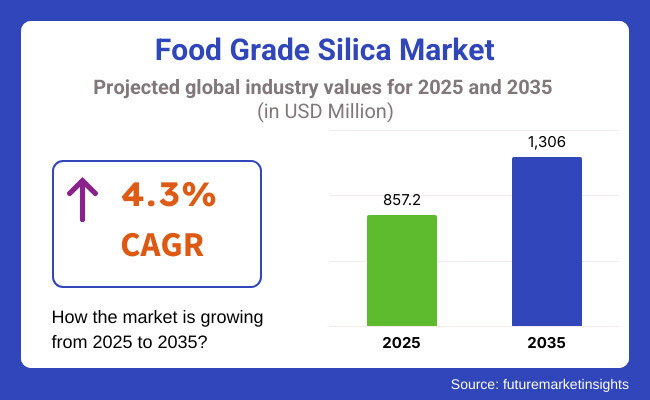
The market is estimated to grow at a CAGR of 4.3%, and projected to reach USD 1,306 million by 2035, at USD 857 million by 2025. The increasing application of food grade silica in dairy, baking, confectionery & dietary supplements is expected to assist the long-term market growth.
Regional Market Trends
North America
North America is a dominant market for Food Grade Silica, driven by the demand from food processing end-use industry along with the growing utilization in anti-caking agents in packaged and processed foods. U.S. food additive demand is supported by stringent food safety regulations.
Europe
In Europe, the food grade silica market is witnessing substantial growth driven by the region's regulatory structures favouring natural and clean-label components. Germany, France and the UK are among the leading nations in promoting food additive technologies for innovative production, and their usage is incrementally seen in bakery, dairy and functional food segments as well.
Asia-Pacific
Fastest growth is expected from the Asia-Pacific region, boosted by rapid urbanization, an increase in disposable incomes, and growing consumption of convenience foods. The Indian and China market is driven by the food manufacturing sector and the enhanced use of food grade silica in dietary supplements and nutraceuticals, which contributes to market expansion in these countries. This is accelerating the market demand even further for the formulation of the healthier foods.
Challenges and Opportunities
Challenges
Regulatory Compliance, High Production Costs, and Supply Chain Volatility
Three major challenges facing the producers of psilocybin mushrooms are Regulatory Compliance; High Production Costs; Supply Chain Volatility.Food grade silica's usage in food applications is restricted by the stringent regulations laid out by the agencies like FDA, EFSA, FSSAI, which define the purity specification and limits for usage of food grade silica.
To comply with food-grade quality standards, manufacturing must bear the heavy costs associated with silica production and purification. Moreover, supply-chain-related challenges, such as availability of raw materials followed by changes in silica sand pricing also remain threats to manufacturers to keep their production & pricing stable.
Opportunities
Rise of Functional Foods, Beverage Clarity and Clean Labels
The market is growing, however, driven by demand for functional food ingredients, clean-label anti-caking agents, and beverage clarification solutions despite these challenges. Food grade silica is widely used in powdered foods, spices, dairy products and beverages due to its flowability, stability and increased shelf life.
Increasing trend of plant-based and organic food formulations leads to demand for natural and safe food additives, the demand for silica-derived stabilizers and thickeners creates opportunity. Advancements in Nano-silica for optimized bioavailability in nutraceuticals are also supporting growth in the industry.
Market Shifts: A Comparative Analysis 2020 to 2024 vs. 2025 to 2035
| Market Shift | 2020 to 2024 Trends |
|---|---|
| Regulatory Landscape | Compliance with food safety and purity standards set by FDA, EFSA, and FSSAI. |
| Consumer Trends | Demand for anti-caking agents in powdered foods and supplements. |
| Industry Adoption | Use in spices, seasonings, powdered milk, and beverage filtration. |
| Supply Chain and Sourcing | Dependence on silica sand mining and synthetic silica production. |
| Market Competition | Dominated by industrial silica manufacturers supplying food-grade variants. |
| Market Growth Drivers | Increasing demand for shelf-stable food products and extended shelf life. |
| Sustainability and Environmental Impact | Moderate efforts to improve energy efficiency in silica production. |
| Integration of Smart Technologies | Early adoption of AI-driven purity testing and supply chain monitoring. |
| Advancements in Silica Technology | Development of ultra-fine food-grade silica for improved dispersion. |
| Market Shift | 2025 to 2035 Projections |
|---|---|
| Regulatory Landscape | Stricter regulations on Nano-silica use, sustainability mandates, and allergen-free labelling. |
| Consumer Trends | Expansion in clean-label food additives, organic formulations, and allergen-free ingredients. |
| Industry Adoption | Growth in protein supplements, functional beverages, and plant-based dairy alternatives. |
| Supply Chain and Sourcing | Shift toward sustainable and bio-derived silica sources. |
| Market Competition | Entry of biotech firms specializing in high-purity, sustainable silica production. |
| Market Growth Drivers | Accelerated by clean-label trends, regulatory approvals for Nano-silica, and functional ingredient innovations. |
| Sustainability and Environmental Impact | Large-scale transition to low-carbon silica extraction, waste-free silica refinement, and biodegradable silica alternatives. |
| Integration of Smart Technologies | Expansion into AI-assisted formulation of silica-based food additives and real-time quality control systems. |
| Advancements in Silica Technology | Evolution toward bioengineered silica with enhanced functional properties for food and beverage applications. |
Country-Wise Outlook
United States
Increasing food safety regulations and rising demand for anti-caking agents from the food processing industry are anticipated to fuel the growth of the USA food-grade silica market, as well as high demand for functional food. The increasing development of protein supplements, plant-based dairy, and powdered meal replacements, is driving the growth of silica-based stabilizers and flow enhancers.
Moreover, manufacturers are focusing on high-purity silica solutions to adapt to changing FDA and USDA organic food standards. THE Accentuated sourcing of sustainable ingredients in turn fosters on investments tackling low-carbon processes of silica production.
| Country | CAGR (2025 to 2035) |
|---|---|
| USA | 4.4% |
United Kingdom
Availability of clean-label and organic food ingredients in the United Kingdom market has led to grow steadily in the UK market. The trend towards powdered drinks like protein shakes and instant coffee is leading to increased demand for silica-based anti-caking agents. Moreover, the country’s stringent food safety standards and increasing emphasis on sustainability are driving the manufacturers towards natural and biodegradable silica products. Growing significantly on the back of increasing adoption of plant-based and allergen free food products
| Country | CAGR (2025 to 2035) |
|---|---|
| UK | 4.2% |
European Union
Europe's food grade silica market is driven by rigorous regulations from EFSA, growing investments for food safety, and an expansion of the functional food sector. Germany, France, and the Netherlands are among countries involved in research in clean-label food additives and Nano-silica.
Gluten-free, dairy-free, and organic food products are spurring an increase in food-grade silica demand. Also, silica-based filtration systems for wine, beer, and fruit juice clarification are more widely employed by beverage manufacturers across the EU.
| Country | CAGR (2025 to 2035) |
|---|---|
| EU | 4.3% |
Japan
Japan's food grade silica market is growing owing to high demand for precision-engineered food additives, increasing popularity of functional foods, and advanced regulatory frameworks for food safety. Building on impulse, the use of ultrafine food-grade silica at the forefront of formulation development is driven by texture and mouthfeel enhancement, including the need to deliver pleasure and satisfaction during consumption.
Furthermore, Japan's increasing focus on anti-ageing and gut health products is stimulated the need for silica-based dietary supplements and probiotic formulations. Demand for high-tech food processing facilities is also lifting demand for premium silica-based additives.
| Country | CAGR (2025 to 2035) |
|---|---|
| Japan | 4.3% |
South Korea
The rising health-conscious consumer base, growing demand for functional foods and government-led food safety regulations are making South Korea a key market for food grade silica. Silica-infused supplements and beauty foods are in high demand due to the cross-observed growth of the K-beauty-inspired nutraceutical industry.
Moreover, the demand for new generation food-grade silica formulations is stimulating innovations owing to increased investment spending over the nanotechnology sphere, along with the AI-cantered ingredients optimization. India’s emphasis on Sustainable food packaging solutions is leading towards new applications for biodegradable silica-based coatings and stabilizers.
| Country | CAGR (2025 to 2035) |
|---|---|
| South Korea | 4.4% |
Segmentation Outlook - Food Grade Silica Market
Powder and Gel Food Grade Silica Drive Market Growth as Industries Optimize Food Processing and Stability
Powder and gel food grade silica segments dominate the food grade silica market owing to the growing demand from food manufacturers for functional additives that improve product stability, texture, and shelf life. These segments contribute to food processing, providing improved ingredient distribution, moisture management, and anti-caking characteristics.
Powder Food Grade Silica Leads Market Demand as Free-Flowing Agents Improve Ingredient Handling
The market is dominated by the powder food grade silica segment due to its vast applications such as anti-caking, thickening and flow-enhancers. Compared with gel based silica, powdered types offer a means to stabilize dry elements, causing easier digesting and steady item top quality.
This has included those with high purity powdered silica, better absorption, and finer dispersion which has increased market growth due to increased demand for moisture control solutions. Powdered ingredient formulations, such as spices, baking powders, and powdered milk, over 60% use silica for anti-caking and flowability improvements.
Market growth has been reinforced by the rapid growth in the production of fortified food, with powdered silica as a carrier agent for vitamins, minerals, and active nutrients that can provide better nutrient stability as well as controlled release in functional food.
These have further propelled adoption of AI-powered ingredient optimization, including real-time moisture absorption monitoring, automated silica dispersion adjustment, and shelf-life prediction and extension models, restoring efficiency in food processing.The increasing demand for high-performance powdered silica with ultra-fine particle size, higher porosity, and better dispersibility has facilitated market growth for the product in the global market where better adaptability in dry food formulations enhances it.
Despite its many benefits including anti caking, moisture absorption, and ingredient stability powder food grade silica segment is facing challenges including dust management concerns, possible interactions throughout its ingredients, and sometimes solubility issues in liquid based applications.
Constraints imposed by traditional food grade powder production limits silica's overall performance, but recent advancements in Nano-structured silica powders, AI led particle size and application methodologies, as well as bio based silica formulations, have the functionality of this market so strong, the powdered food grade silica market shall continue to thrive.
Increased Demand for Stabilizers and Thickening Agents Takes Gel Food Grade Silica's Sales to New Heights
There has been increased market adoption of gel food grade silica, especially in liquid and semi-solid food formulations with food processors focusing on desired viscosity, stable suspension, and improved texture modification. Powdered silica is not as easily dispersed in wet systems, which makes them less suitable for dairy, sauces, and beverage applications, whereas gel-based variants excel in these areas.
The market growth is propelled by the increasing demand for high-viscosity food stabilizers characterized by gel-based silica formulations which possess better water-binding capability, smooth thickening properties, along with improved stability in emulsified food systems. According to the studies, more than 55% of processed food manufacturers use silica gel to enhance texture and consistency in liquid food applications.
Market growth has been envisaged through the growth of non-diary and plant-based food production as that of silica gel-enhanced creamers, diary alternatives and plant-based protein-based beverages, ensuring better sensory properties and shelf-life enhancement.
AI-assisted formulation improvements, such as real-time gelation monitoring, automated viscosity tuning, and analyses of smart ingredient interactions, have also accelerated adoption, leading to an optimized stability in a variety of food applications.
The market has been further propelled to new heights through the development of next-gen silica gels, which, due to tailored rheology modification, superior solubility, and formulations suitable for organic have been optimal in consideration, while adapting to clean-label and natural food trends.
However, the Gel food grade silica segment is challenged by some formulatory complexities, the risk of syneresis and compatibility limits with few food-grade emulsifiers, disrupting end-use of this segment. Advancements in hybrid silica gel systems, AI-driven rheology modelling, and eco-friendly silica extraction methods are being introduced to enhance productivity, ruling out the prospects of a slowdown in the gel food grade silica industry spectrum.
Precipitated and Fumed Food Grade Silica Drive Market Growth as Advanced Processing Enhances Performance Properties
Food-grade silica precipitated and fumed segments are leading factors contributing to market growth as manufacturers are looking for highly- functional silica additives that can enhance ingredient performance, food safety, and product quality.
The versatile functional additives spur food grade silica leads with precipitated segment demand among the food grade silica market
Precipitated food grade silica has become a leading segment, providing highly versatile functional benefits such as moisture absorption, anti-caking and texture enhancement. For food-related applications, precipitated types are engineered to possess ideal surface area, porosity, and particle size distribution as opposed to fumed silica, which is simply a by-product of a combustion reaction.
Moreover, the increasing need for high-performance food stabilizers comprising precipitated silica with controlled porosity, improved adsorption efficiency, and optimized free-flowing properties are closing market adoption. It has been shown that more than 50% of dry food formulations contain precipitated silica for the purpose of providing anti-caking and enhanced texture.
The growth of specialty food ingredient processing, comprising silica-switched powdered formulations for protein mixes, instant beverage powders, and spice blends, has supported the overall market growth, leading to improved flowability and storage stability.
Real-time porosity optimization, automated particle aggregation analysis, and predictive adsorption modelling in AI-integrated material engineering helped drive the growth, which guarantees optimal performance and adherence to food safety standards.
Furthermore, eco-friendly precipitated silica characterized by sustainable processing methods, bio-based precursor materials and lower energy input in production, has enhanced the growth of the market to maintain compliance with clean label food trends.
Although offering benefits such as less caking, improved moisture absorption, and better dispersibility, the precipitated silica segment can be adversely affected by higher production costs, regulatory scrutiny regarding safety at high particle sizes, and difficulties with the formulation of high-fat foods. Innovations in precision engineered silica architecture, AI-aided formulation tailoring, and green silica synthesis are poised to boost scalability, enabling persistent growth of precipitated food grade silica.
Fumed Food Grade Silica- Increasing Adoption of High Purity and Innovative Texturizing Solutions
While fumed food grade silica dominated market of high-end food formulations and precision-engineered texturizing solutions for enhanced dispersibility, high purity and controlled rheology modification, sila food grade silica is also gaining traction. Fumed silica (FS) is prepared via vapour-phase synthesis which produces particles of ultra-fine particle size and high surface area thus demonstrating enhanced functionality when compared to precipitated silica.
Increasing adoption of high purity silica additives, which are fumed silica formulations with ultra-low levels of impurities, enhanced thermal stability, and highly hydrophobic or hydrophilic characteristics is leading growth in the market. Fumed silica, as stated in studies, is used by more than 45% of specialty food ingredient manufacturers for accurate texture, and stabilization effects.
Emerging avenues like emulsified and high-fat food applications, with oil thickening, non-dairy creamers, and high-shear food processing stabilizers based on fumed silica have bolstered market growth in terms of performance stability and better dispersion of ingredients.
The incorporation of AI-based texturization analysis with what-if scenarios, real-time modelling of particle interactions, automated viscosity tuning, and the ability to adjust shear-thinning properties, has further driven adoption ensuring the optimum consistency and quality control of the food products.
The market has benefitted from innovations in functional fumed silica solutions with particle surface modifications, high-performance dispersion technologies and low dust processing, providing a broader range of food manufacturing applicability.
Fumed silica’s are still expected to outperform their counterparts throughout the forecast period due to advantages offered by fumed silica’s such as ultra-fine particle engineering, excellent dispersion properties, and high-purity formulation; however, factors like production being cost intensive, regulatory compliance, and fumed silica not being suitable for large-scale applications related to food processing also play a crucial role in shaping revenue generation in the fumed silica segment.
But new developments in AI-assisted fumed silica synthesis, as well as green vapour-phase processes, and sophisticated particle engineering solutions are boosting functionality that will ensure a continued expansion of fumed food grade silica applications.
Competitive Outlook
The food grade silica market is driven by increasing demand for anti-caking agents, rising applications in food & beverage processing, & advancements in AI-Powered formulation technologies. The increasing necessity for food preservation, texture stabilization, and nutrient absorption in dietary supplements contributes to the market expansion.
Leading industry players emphasize AI-based particle size optimization, sustainable silica extraction, and high-purity processing. Top companies include specialty ingredient manufacturers, chemical processing companies, and food additive suppliers that are advancing innovative eco-friendly, safe and high-performance food grade silica solutions.
Market Share Analysis by Key Players & Food Grade Silica Manufacturers
| Company Name | Estimated Market Share (%) |
|---|---|
| Evonik Industries AG | 18-22% |
| Solvay S.A. | 14-18% |
| PPG Industries, Inc. | 12-16% |
| W.R. Grace & Co. | 8-12% |
| Madhu Silica Pvt. Ltd. | 6-10% |
| Other Food Grade Silica Suppliers (combined) | 30-40% |
Key Company & Food Grade Silica Solutions
| Company Name | Key Offerings/Activities |
|---|---|
| Evonik Industries AG | Develops AI-powered silica formulation for anti-caking, moisture absorption, and functional food applications. |
| Solvay S.A. | Specializes in high-purity silica for food preservation, AI-enhanced particle size distribution, and textural improvement. |
| PPG Industries, Inc. | Focuses on synthetic amorphous silica with AI-driven formulation for food and nutraceutical applications. |
| W.R. Grace & Co. | Provides silica-based anti-caking agents with AI-assisted rheology control for improved powder flowability in food processing. |
| Madhu Silica Pvt. Ltd. | Offers customized silica solutions, AI-powered process optimization, and food-grade hydrophilic and hydrophobic silica formulations. |
Key Market Insights
Evonik Industries AG (18-22%)
Evonik leads in high-performance food grade silica, integrating AI-powered formulation techniques to enhance flow properties, moisture absorption, and product stability.
Solvay S.A. (14-18%)
Solvay specializes in advanced silica solutions, leveraging AI-enhanced particle engineering to optimize food texture, preservation, and anti-caking efficiency.
PPG Industries, Inc. (12-16%)
PPG focuses on synthetic amorphous silica development, applying AI-assisted precision formulation to enhance food safety and stability.
W.R. Grace & Co. (8-12%)
W.R. Grace provides innovative silica-based anti-caking agents, integrating AI-driven material science to improve powder flowability and shelf-life extension.
Madhu Silica Pvt. Ltd. (6-10%)
Madhu Silica specializes in customized food-grade silica formulations, using AI-powered process control for superior absorption and functional ingredient performance.
Other Key Players (30-40% Combined)
Several specialty chemical manufacturers, food ingredient suppliers, and biotech firms contribute to advancements in food grade silica technology, AI-assisted anti-caking solutions, and sustainable processing innovations. Key contributors include:
- Huber Engineered Materials (AI-driven silica-based functional food ingredients)
- Tokuyama Corporation (High-purity silica solutions for moisture absorption and food stability)
- Oriental Silicas Corporation (Custom silica formulations with AI-optimized food safety performance)
- PQ Corporation (AI-assisted precision silica production for anti-caking and texture control)
- Silmaco NV (Sustainable, bio-based silica solutions with AI-driven formulation improvements)
Key Segments
By nature:
- Powder food grade silica
- Gel food grade silica
By product:
- Precipitated food grade silica
- Fumed food grade silica
By application:
- Additives
- Thickening agents
- Anti-caking agents
By end-use:
- Flavor
- Milk Powder
- Cocoa Powder
- Vegetable Powder
- Others
Frequently Asked Questions
What was the overall size of the food grade silica market in 2025?
The overall market size for the food grade silica market was USD 857.2 Million in 2025.
How big is the food grade silica market expected to be in 2035?
The food grade silica market is expected to reach USD 1,306 Million in 2035.
What will drive the demand for the food grade silica market during the forecast period?
The demand for food grade silica is expected to rise due to its increasing use as an anti-caking agent in food and beverage applications. The growing demand for processed and packaged foods, along with stringent food safety regulations, is further fueling market expansion. Additionally, advancements in silica production technology and the rising preference for high-quality food additives are key factors driving growth.
List the top 5 countries contributing to the food grade silica market.
The top 5 countries driving the development of the food grade silica market are the USA, China, Germany, Japan, and India.
Which segment in the type is expected to lead in the food grade silica market?
Precipitated and Fumed Food Grade Silica are expected to command a significant share over the assessment period.
Preview the report firsthand - request a free sample
Get SampleGet the brochure for pricing and purchase details.
Get PDFTable of Content
- Executive Summary
- Industry Introduction, including Taxonomy and Market Definition
- Market Trends and Success Factors, including Macro-economic Factors, Market Dynamics, and Recent Industry Developments
- Global Market Demand Analysis 2020 to 2024 and Forecast 2025 to 2035, including Historical Analysis and Future Projections
- Pricing Analysis
- Global Market Analysis 2020 to 2024 and Forecast 2025 to 2035
- Nature
- Product
- Application
- End-use
- Global Market Analysis 2020 to 2024 and Forecast 2025 to 2035, By Nature
- Powder food grade silica
- Gel food grade silica
- Global Market Analysis 2020 to 2024 and Forecast 2025 to 2035, By Product
- Precipitated food grade silica
- Fumed food grade silica
- Global Market Analysis 2020 to 2024 and Forecast 2025 to 2035, By Application
- Additives
- Thickening agents
- Anti-caking agents
- Global Market Analysis 2020 to 2024 and Forecast 2025 to 2035, By End-use
- Flavor
- Milk Powder
- Cocoa Powder
- Vegetable Powder
- Global Market Analysis 2020 to 2024 and Forecast 2025 to 2035, By Region
- North America
- Latin America
- Western Europe
- Eastern Europe
- East Asia
- South Asia Pacific
- Middle East and Africa
- North America Sales Analysis 2020 to 2024 and Forecast 2025 to 2035, by Key Segments and Countries
- Latin America Sales Analysis 2020 to 2024 and Forecast 2025 to 2035, by Key Segments and Countries
- Western Europe Sales Analysis 2020 to 2024 and Forecast 2025 to 2035, by Key Segments and Countries
- Eastern Europe Sales Analysis 2020 to 2024 and Forecast 2025 to 2035, by Key Segments and Countries
- East Asia Sales Analysis 2020 to 2024 and Forecast 2025 to 2035, by Key Segments and Countries
- South Asia Pacific Sales Analysis 2020 to 2024 and Forecast 2025 to 2035, by Key Segments and Countries
- Middle East and Africa Sales Analysis 2020 to 2024 and Forecast 2025 to 2035, by Key Segments and Countries
- Sales Forecast 2025 to 2035 by Nature, Product, Application, and End-use for 30 Countries
- Competition Outlook, including Market Structure Analysis, Company Share Analysis by Key Players, and Competition Dashboard
- Company Profile
- Evonik
- PQ Corporation
- Jinneng Science and Technology Company
- Zhongkuang Resource (Cabot)
- Wacker
- Tokuyama
- OCI Company
- Shandong Dongyue Organosilicon Materials
- Hoshine Silicon
- Libby Innovative Materia


