

- Industry Size (2026)
- USD 1.7 Bn
- Forecast (2036)
- USD 4.7 Bn
- CAGR (2026 to 2036)
- 11.0%
Fox Nuts Market Size and Share Forecast Outlook 2026 to 2036
The global fox nuts sector is on track to achieve a valuation of USD 4.7 billion by 2036, accelerating from USD 1.7 billion in 2026 at a CAGR of 11.0%. As per Future Market Insights, expansion is structurally underpinned by the global consumer shift toward plant-based, high-protein, low-calorie snack alternatives and the formalisation of India's makhana supply chain through government infrastructure investment. The Indian Ministry of Agriculture reported in its 2024 Horticulture Statistics that Bihar accounts for over 80% of global makhana production, validating the geographic concentration of supply that both drives investment and creates supply chain vulnerability. This production concentration compels the Government of India to invest in mechanised popping clusters, cold storage hubs, and quality standardisation to reduce post-harvest losses and stabilise farm-gate price volatility. Simultaneously the international demand landscape is expanding as North American and European consumers discover makhana as a clean-label superfood alternative to popcorn and chips.
In February 2025, the Union Budget 2025 to 2026 officially sanctioned the establishment of a National Makhana Board in Bihar with an INR 100-crore allocation, aiming to streamline the fragmented supply chain by establishing mechanised popping clusters and cold storage hubs. FMI opines that the National Makhana Board will reduce post-harvest losses from the current estimated 25%+ to below 10% by 2030, effectively increasing marketable supply by 15 to 20% without requiring additional cultivation acreage.
The competitive landscape in 2025 and 2026 is defined by venture capital-funded scaling and international market entry. Farmley secured USD 40 million in Series C funding in May 2025 to expand distribution across India and enhance export operations to North America. Bonvie Snacks expanded its 2026 health-focused portfolio by launching globally inspired fox nut flavours including Coffee Caramel and Wasabi targeting urban Millennial and Gen-Z consumers via D2C channels. Lotus Makhana launched Makhana Pops in Mumbai in February 2025 featuring fox nut flour roasted in olive oil with a DIY seasoning range. NFP Sampoorna Foods acquired Yashvardhan Food Industries in June 2025 via share swap to enhance operational reach. Indulge Foods introduced a new range of ready-to-eat flavoured and functional fox nut products. Himalaya Foods launched a strategic initiative in South Africa in April 2024 targeting high-protein, low-calorie fox nut variants for the sub-Saharan African market. As per FMI, this convergence of government supply chain formalisation, VC-funded D2C scaling, and international superfood positioning confirms that the fox nuts market is transitioning from a regional Indian snack commodity into a globally traded healthy snacking platform.
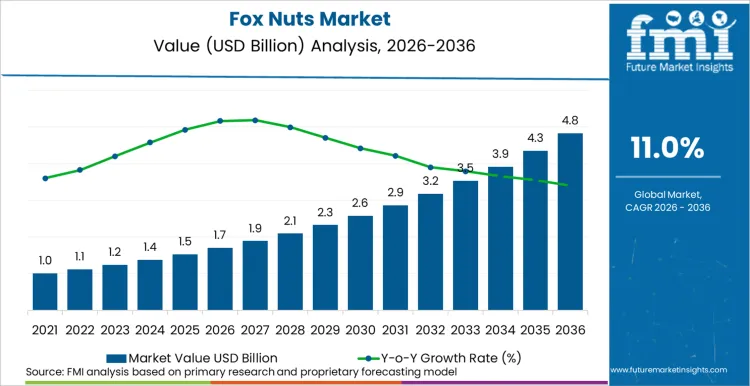
Summary of Fox Nuts Market
What Is Growth Outlook for Fox Nuts Market as per Future Market Insights Projection?
Future Market Insights projects the fox nuts industry to expand at a CAGR of 11.0% from 2026 to 2036, increasing from USD 1.7 Billion in 2026 to USD 4.7 Billion by 2036.
FMI Research Approach: FMI proprietary forecasting model based on Indian Ministry of Agriculture horticulture data, makhana export volume tracking, and healthy snacking retail scan analysis.
How Do FMI Analysts Perceive Fox Nuts Market to Evolve?
FMI analysts perceive the market evolving toward branded, value-added makhana products distributed through D2C and e-commerce channels globally, with supply chain formalisation through the National Makhana Board reducing price volatility and post-harvest losses.
FMI Research Approach: Union Budget 2025-26 Makhana Board allocation analysis and Farmley Series C funding tracking.
Which Country Holds Largest Share in Global Fox Nuts Market?
India holds the dominant share of the global fox nuts market by both production and value, accounting for over 80% of global makhana production concentrated in Bihar state.
FMI Research Approach: FMI country-level revenue modeling by Indian horticulture production data and makhana export statistics.
How Large Will Fox Nuts Market Be by 2036?
The global fox nuts market is projected to reach USD 4.7 Billion by 2036.
FMI Research Approach: FMI long-term revenue forecast derived from global healthy snacking growth projections and makhana export volume analysis.
What Is Definition of Fox Nuts Market?
The fox nuts (makhana) market includes raw popped makhana, roasted and flavoured makhana snacks, makhana flour, makhana-based ready-to-eat products, and makhana ingredients used in food manufacturing, sold through retail, D2C, e-commerce, and food service channels.
FMI Research Approach: FMI market taxonomy aligned with Indian FSSAI makhana product classification and global superfood snack categorisation.
What Are Globally Unique Trends Shaping Fox Nuts Market?
Globally unique trends include the National Makhana Board establishment with INR 100-crore allocation, VC-funded D2C scaling to international markets (Farmley USD 40 million Series C), and globally inspired flavour innovation targeting Gen-Z consumers (Bonvie Coffee Caramel, Wasabi).
FMI Research Approach: Union Budget 2025-26 analysis and Farmley funding round tracking.
Fox Nuts Market Key Takeaways
| Metric | Details |
|---|---|
| Industry Size (2026) | USD 1.7 Billion |
| Industry Value (2036) | USD 4.7 Billion |
| CAGR (2026 to 2036) | 11.0% |
Source: Future Market Insights (FMI) analysis, based on proprietary forecasting model and primary research
Implications for Stakeholders in Fox Nuts Market
The fox nuts market is a blueprint for success in the healthy snacking space. Whether you’re a seasoned player or an emerging entrant, this market has room for everyone - with plenty of whitespace for innovation and differentiation.
Notable Fox Nuts Brands by Country
| Countries | Notable Brands |
|---|---|
| United States |
|
| United Kingdom |
|
| Germany |
|
| France |
|
| Japan |
|
| South Korea |
|
| Canada |
|
How Tier 2 Players Are Owning the Fox Nuts Market
The revenue split across Tier 1, Tier 2, and Tier 3 players tells a story that every brand should pay attention to:
Tier 2 players are the MVPs, grabbing 45% of the market share. These mid-sized brands are succeeding by balancing affordability with innovation. They know their audience, they’re nimble, and they’re bringing products to market faster than the big guys can react.
Tier 1 brands, sitting at 35% of the market, are also innovating. These are the heavy hitters with big budgets, global supply chains, and top-tier R&D. They dominate urban and international markets because they’ve built trust over time. But here’s the kicker: consumers are starting to lean towards smaller, more localized options that feel personal, which is where Tier 2 is eating their lunch.
Tier 3 players might have the smallest share at 20%, but don’t sleep on them. These niche, regional brands are creating buzz with organic, artisanal, and health-focused products. They’re winning over consumers who want snacks that align with their values - and this trend isn’t going anywhere.
Stakeholder Insights and Market Impact for Fox Nuts Brands
The Fox Nuts Market is wide open for growth, but the rules are shifting:
- Tier 1 brands: Time to get more local and personal. Your size is an advantage, but consumers want authenticity.
- Tier 2 players: Keep doing what you’re doing. Your agility and ability to innovate are paying off big time.
- Tier 3 brands: You’re small but mighty. Double down on what makes you different - sustainability, health focus, and storytelling.
The numbers don’t lie. This market is growing fast, and there’s room for everyone to win - if you’re paying attention to what today’s consumers care about.
Key Drivers Fueling Fox Nuts Market Growth
| Key Drivers | Details |
|---|---|
| Health Consciousness | Growing demand for healthy snacks due to rising awareness of nutritional benefits. |
| Nutritional Benefits | High protein, low fat, gluten-free, and rich in antioxidants, appealing to health enthusiasts. |
| Rising Disposable Income | Increased purchasing power, especially in developing countries, boosting demand for premium snacks. |
| Snacking Trend | Shift towards light and nutritious snacking options in both urban and rural markets. |
| Product Innovation | Introduction of diverse flavors, packaging sizes, and ready-to-eat options driving demand. |
| E-commerce Expansion | Online platforms making fox nuts accessible to global consumers, enhancing market reach. |
| Cultural Relevance | Traditional use in Asian cuisine and festivals increasing its consumption. |
| Globalization of Asian Cuisine | Rising popularity of Asian food globally, encouraging interest in regional snacks like fox nuts. |
| Sustainability Trends | Eco-conscious consumers favoring sustainable sourcing of fox nuts. |
| Fasting and Religious Observances | Popularity as a fasting food during religious observances boosting sales in certain markets. |
Challenges Affecting Fox Nuts Market Expansion
| Key Challenges | Details |
|---|---|
| Limited Raw Material Availability | Dependence on specific regions for cultivation, leading to supply constraints. |
| Seasonal Dependency | Fox nut cultivation is seasonal, creating supply chain gaps during off-seasons. |
| High Production Costs | Labor-intensive harvesting and processing increase production costs, impacting pricing. |
| Lack of Awareness | Limited awareness about fox nuts in non-Asian markets restricts consumer base expansion. |
| Short Shelf Life | Fox nuts are prone to spoilage if not properly stored, leading to logistical challenges. |
| Market Fragmentation | Presence of numerous small and regional players makes the market highly fragmented. |
| Price Sensitivity | Higher price compared to traditional snacks deters cost-conscious consumers. |
| Competition from Alternatives | Competition from other healthy snacks like quinoa, chia seeds, and almonds affects demand. |
| Quality Standardization | Variation in quality across regions and brands affects consumer trust and repeat purchases. |
| Regulatory Hurdles | Meeting export regulations and food safety standards in different countries adds complexity. |
Top Fox Nuts Market Dynamics and Industry Trends
Premiumization is Gaining Ground
Snack customers are leveling up: no more plain and boring; today's buyer wants truffle, peri-peri, or caramel fox nuts. It is no longer just about taste but also about lifestyle. Here, brands are targeting upper-middle-class consumers who want the gourmet flavors at a price they could pay for. Fox nuts are officially leaving the "everyday snacking category" to be moved into the sophisticated, go-to-of-the-health-conscious elite treat category.
Sustainability is a Non-Negotiable
This isn’t just a buzzword anymore - it’s the standard. In markets like Europe and North America, eco-conscious consumers are demanding ethical sourcing and biodegradable packaging. The brands that are getting it right - partnering with ethical farmers and going green - are winning over loyal, long-term buyers. If you’re not aligning with these values, you’re already behind.
E-Commerce is the Real MVP
Let's talk distribution. E-commerce is creating a big splash, particularly in non-traditional markets such as the USA, UK, and Canada. Online sites like Amazon and niche health-food sites are now giving smaller brands the opportunity to compete head-on with the majors. And subscription models? Genius. Monthly deliveries of fox nuts in assorted flavors? Consumers love it, and it's locking in that repeat business.
The Fitness Crowd is All In
Fox nuts are blowing up in the fitness and wellness community. Nutritionists, influencers, and even fitness trainers are singing their praises. High protein, low calorie, super versatile - it's the perfect snack for people chasing a healthy lifestyle. Western markets, where fox nuts were basically unknown, are now embracing them as the next big thing in the superfood world.
Key Takeaways for Fox Nuts Market Stakeholders
Fox nuts are the epitome of tradition embracing innovation. Premium flavors, sustainable practices, smart e-commerce strategies, and a growing wellness push all make this market fire on all cylinders. The ones to listen to their audience and stay ahead of the trends will certainly win big.
Top Segments Studied in the Fox Nuts Market Report
Raw fox nuts are also more cost-effective, and therefore more widely available to consumers, especially in Asia-Pacific regions where traditional cooking often requires raw ingredients. This cost-effectiveness and accessibility place the raw segment as the biggest growth contributor in the fox nuts market.
By Type
Raw Fox Nuts Dominate the Market
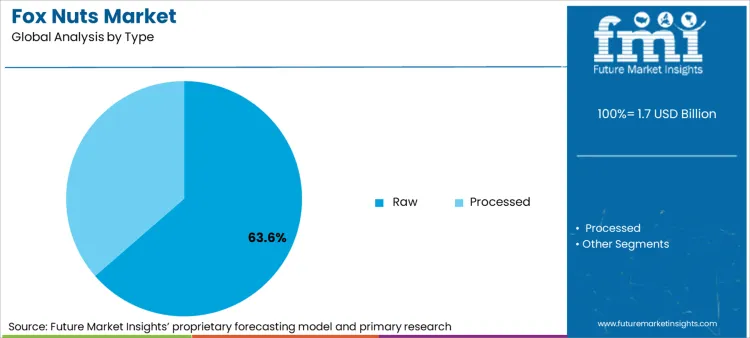
| Attributes | Details |
|---|---|
| Top Type | Raw |
| Market Share in 2026 | 63.6% |
Based on type, the market is segmented into raw and processed fox nuts. The raw category is anticipated to hold a share of 63.6% in the year 2026. Consumers tend to like the raw variant more because the products can be roasted, flavored, or included in dishes according to requirement. They also come across as being fresher and healthier as compared to their processed counterpart.
Raw fox nuts are also more affordable, which would reach a broader consumer base, particularly in the Asia-Pacific region where most traditional methods of cooking still involve raw ingredients. This accessibility and availability put the raw segment at the forefront of growth in the fox nuts market.
By Application
Household Use Drives Growth
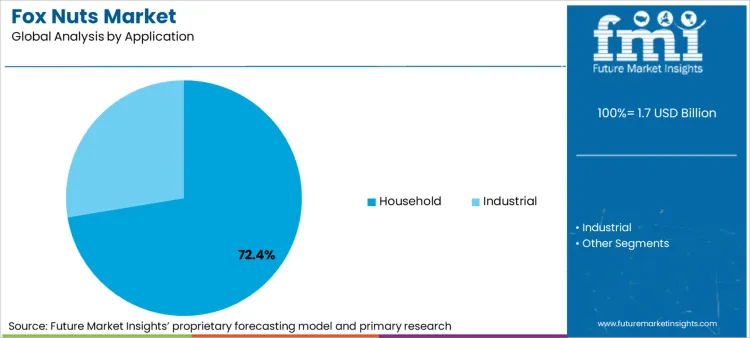
| Attributes | Details |
|---|---|
| Top Application | Household |
| Market Share in 2026 | 72.4% |
Based on application, the market is segmented into household and commercial uses. Household applications are expected to dominate the market, accounting for 72.4% of the market share in 2026. Fox nuts have become a staple in homes due to their rising popularity as a healthy, everyday snack. Their lightweight nature and ease of preparation make them suitable for both urban and rural households.
Furthermore, fox nuts are increasingly used in homemade recipes for fasting foods and as a healthier substitute for conventional snacks. This growing adoption in households is bolstered by their affordability and widespread availability in local and online markets.
By Region
Asia-Pacific Leads with Strong Growth
| Attributes | Details |
|---|---|
| Top Region | Asia-Pacific |
| Key Markets | India, China, Japan |
| Regional CAGR (2026 to 2036) | 7.6% |
Asia-Pacific is the largest market for fox nuts, driven by the significant demand in countries like India, China, and Japan. India remains the leading producer and consumer, owing to its traditional use in cuisine and as a fasting food. China and Japan are witnessing increased demand due to growing awareness of fox nuts' nutritional benefits.
The region’s CAGR of 7.6% from 2026 to 2036 highlights its robust growth potential, fuelled by an expanding middle class and rising health consciousness. Additionally, local manufacturers and distributors in Asia-Pacific ensure affordability and accessibility, further solidifying its dominance.
Country-wise Analysis of Fox Nuts Market Growth and Consumption
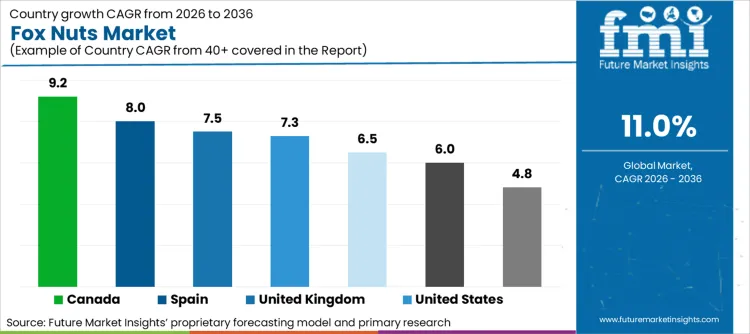
North America
United States
| Attributes | Details |
|---|---|
| CAGR (2026 to 2036) | 7.3% |
| Market Characteristics | High demand for packaged snacks and health-conscious consumers drive the growth of fox nuts in the USA The country has a robust e-commerce network, enabling widespread availability. |
Canada
| Attributes | Details |
|---|---|
| CAGR (2026 to 2036) | 9.2% |
| Market Characteristics | Fox nuts are gaining popularity in Canada as a healthy snack alternative. Awareness campaigns and the preference for sustainable, plant-based foods support this growth. |
Europe
Germany
| Attributes | Details |
|---|---|
| CAGR (2026 to 2036) | 6.0% |
| Market Characteristics | Germany is a leader in Europe for organic and health-focused foods. The growing vegan population has contributed to the adoption of fox nuts as a nutritious and plant-based snack. |
United Kingdom
| Attributes | Details |
|---|---|
| CAGR (2026 to 2036) | 7.5% |
| Market Characteristics | The UK market is driven by increasing consumer interest in "superfoods" and healthy eating trends. Fox nuts are also marketed as a gluten-free and guilt-free snack. |
France
| Attributes | Details |
|---|---|
| CAGR (2026 to 2036) | 4.8% |
| Market Characteristics | In France, fox nuts are gaining traction among health-conscious urban populations. Packaged flavored varieties are particularly popular in metropolitan areas. |
Spain
| Attributes | Details |
|---|---|
| CAGR (2026 to 2036) | 8.0% |
| Market Characteristics | Spain's snack market is diversifying with healthy options like fox nuts. They are increasingly seen as a convenient snack for on-the-go consumers. |
Italy
| Attributes | Details |
|---|---|
| CAGR (2026 to 2036) | 5.2% |
| Market Characteristics | Italian consumers are adopting fox nuts as part of the growing wellness trend. The snack’s low-calorie and high-nutrition profile appeals to the fitness community. |
Asia-Pacific
China
| Attributes | Details |
|---|---|
| CAGR (2026 to 2036) | 7.6% |
| Market Characteristics | Fox nuts are well-known in traditional Chinese medicine and are increasingly integrated into modern snack foods. The growing middle class is driving demand for premium options. |
India
| Attributes | Details |
|---|---|
| CAGR (2026 to 2036) | 6.5% |
| Market Characteristics | India is the largest producer and consumer of fox nuts globally. The growing packaged snacks market, fueled by urbanization, is a major driver for growth. |
Japan
| Attributes | Details |
|---|---|
| CAGR (2026 to 2036) | 7.2% |
| Market Characteristics | The Japanese market values innovation in snacks. Fox nuts, marketed as a “healthy indulgence,” align with the country’s focus on health and nutrition. |
Australia
| Attributes | Details |
|---|---|
| CAGR (2026 to 2036) | 6.1% |
| Market Characteristics | In Australia, fox nuts are a growing trend in the health food sector. Their gluten-free and vegan properties make them a popular choice among health-conscious consumers. |
Thailand
| Attributes | Details |
|---|---|
| CAGR (2026 to 2036) | 6.9% |
| Market Characteristics | Thailand’s demand for plant-based snacks is growing. Fox nuts are seen as a traditional yet modern snack with both health and taste appeal. |
Impact of Regulations on Fox Nuts Market Growth
Regulatory factor plays a vital role in the market of fox nuts. For instance, food safety regulations are quite strict in North America and guarantee the quality but become a challenge for smaller players. Organic and non-GMO certification is becoming an essential prerequisite for premium pricing and market access. Regulatory compliance becomes a complex but an investment in building consumer trust that has to be undertaken by the players in the market.
Emergence of Startups Disrupting the Fox Nuts Market
The fox nuts market is not just dominated by big names. Startups are making waves too. Brands like Snackible in India and Nuto in the UK are introducing innovative flavors and packaging, targeting younger demographics. Singapore-based Strictly Nuts is bringing fox nuts to Southeast Asia's health-conscious consumers, emphasizing their superfood status. These disruptors are challenging established players with fresh ideas and agile business models.
Why Fox Nuts is the MVP for Healthy Snacks Market
Fox nuts have become niche products in the health food line mainly because of the versatility and nutrients they contain. High in proteins and antioxidants, they appeal to the fitness fanatic, vegan, and gluten-free individual. This snack has little fat content, making it more suitable for very busy lifestyles; they have an extended shelf life. This helps them appeal across borders.
Recent Developments:
- In February 2025, the Union Budget 2025-26 sanctioned the National Makhana Board in Bihar with INR 100-crore allocation for mechanised popping clusters and cold storage infrastructure.
- In May 2025, Farmley secured USD 40 million in Series C funding to expand D2C distribution across India and enhance export operations to North America.
- In February 2025, Lotus Makhana launched Makhana Pops in Mumbai featuring fox nut flour roasted in olive oil with a DIY seasoning range and Bollywood brand ambassador.
Leading Fox Nuts Producers by Market Share
- K.K. Products
- Manju Makhana Enterprises
- Maruti Makhana
- Sattviko
- Shakti Sudha
- Caryopses
- hftgroup
- Madhubani Makhana Private Limited
- Nijjer Agro Foods Ltd.
- Gopala Fresh Produce Private Limited
Market Definition
The fox nuts (makhana) market represents revenue generated from the cultivation, processing, and sale of Euryale ferox seed products for snacking, cooking, and food manufacturing. The market measures the value of raw popped makhana, roasted and flavoured makhana snacks, makhana flour, and makhana-based food ingredients.
Inclusions cover raw popped makhana (white and graded), roasted makhana in multiple flavour profiles (salted, spiced, sweet, fusion), makhana flour for baking and food manufacturing, makhana-based ready-to-eat snack packs, organic and premium makhana variants, and makhana ingredients for confectionery and cereal applications.
Exclusions include lotus root products without Euryale ferox seed processing, standalone water lily cultivation without makhana harvesting, general nut and seed snack products without makhana content, and makhana-based traditional medicine preparations sold outside food retail channels.
Scope of Report
| Items | Values |
|---|---|
| Quantitative Units (2026) | USD 1.7 Billion |
| Product Type | Raw Popped Makhana, Roasted/Flavoured Snacks, Makhana Flour, Ready-to-Eat, Makhana Ingredients |
| Retail Channel | D2C/E-commerce, Supermarket/Hypermarket, Convenience Store, Food Service, Export |
| Regions Covered | South Asia (India dominant), North America, Europe, Middle East and Africa |
| Countries Covered | India, USA, UK, UAE, South Africa, and 20+ countries |
| Key Companies Profiled | Farmley, Bonvie Snacks, Lotus Makhana, NFP Sampoorna Foods, Indulge Foods, Himalaya Foods |
Fox Nuts Industry Analysis by Top Investment Segments
By Type:
The fox nuts market is segmented into raw and processed types, catering to diverse consumer preferences and industrial requirements.
By Nature:
Based on nature, the market is divided into organic and conventional products, addressing the growing demand for chemical-free and sustainably sourced options.
By Application:
In terms of application, the market serves both human consumption and industrial purposes, with the former being the dominant segment due to the snack’s nutritional benefits.
By Distribution Channel:
The distribution channels include supermarkets and hypermarkets, specialty stores, online sales channels, and others, ensuring widespread accessibility for consumers.
By Region:
Regionally, the market is segmented into North America, Latin America, Western Europe, South Asia and Pacific, East Asia, and the Middle East and Africa, each with unique market dynamics and growth prospects.
Bibliography
- Ministry of Agriculture and Farmers' Welfare, India. (2024). Horticulture Statistics: Bihar Makhana Production Data. Government of India.
- Ministry of Finance, India. (2025, February). Union Budget 2025-26: National Makhana Board establishment with INR 100-crore allocation. India Budget.
- Farmley. (2025, May). USD 40 million Series C funding for D2C distribution and export expansion. Farmley.
Frequently Asked Questions
What is the current global market size for Fox Nuts?
The global market is valued at USD 1.7 Billion in 2026, driven by the National Makhana Board establishment, VC-funded D2C scaling, and international superfood demand.
What is the projected CAGR for the market over the next 10 years?
The market is projected to grow at a CAGR of 11.0% from 2026 to 2036.
Which regions are experiencing the fastest expansion?
North America is the fastest-growing export destination driven by clean-label superfood demand, while India dominates by production volume and domestic consumption.
What are the primary market drivers?
Government supply chain formalisation, VC-funded D2C distribution scaling, international superfood positioning, and Gen-Z healthy snacking demand are the primary growth catalysts.
Who are the leading suppliers in the industry?
Farmley, Bonvie Snacks, Lotus Makhana, and NFP Sampoorna Foods are key players, differentiating through D2C distribution scale, flavour innovation, and international export capability.
Preview the report firsthand - request a free sample
Get SampleGet the brochure for pricing and purchase details.
Get PDFTable of Content
- Executive Summary
- Global Market Outlook
- Demand-side Trends
- Supply-side Trends
- Technology Roadmap Analysis
- Analysis and Recommendations
- Market Overview
- Market Coverage / Taxonomy
- Market Definition / Scope / Limitations
- Research Methodology
- Chapter Orientation
- Analytical Lens and Working Hypotheses
- Market Structure, Signals, and Trend Drivers
- Benchmarking and Cross-market Comparability
- Market Sizing, Forecasting, and Opportunity Mapping
- Research Design and Evidence Framework
- Desk Research Programme (Secondary Evidence)
- Company Annual and Sustainability Reports
- Peer-reviewed Journals and Academic Literature
- Corporate Websites, Product Literature, and Technical Notes
- Earnings Decks and Investor Briefings
- Statutory Filings and Regulatory Disclosures
- Technical White Papers and Standards Notes
- Trade Journals, Industry Magazines, and Analyst Briefs
- Conference Proceedings, Webinars, and Seminar Materials
- Government Statistics Portals and Public Data Releases
- Press Releases and Reputable Media Coverage
- Specialist Newsletters and Curated Briefings
- Sector Databases and Reference Repositories
- FMI Internal Proprietary Databases and Historical Market Datasets
- Subscription Datasets and Paid Sources
- Social Channels, Communities, and Digital Listening Inputs
- Additional Desk Sources
- Expert Input and Fieldwork (Primary Evidence)
- Primary Modes
- Qualitative Interviews and Expert Elicitation
- Quantitative Surveys and Structured Data Capture
- Blended Approach
- Why Primary Evidence is Used
- Field Techniques
- Interviews
- Surveys
- Focus Groups
- Observational and In-context Research
- Social and Community Interactions
- Stakeholder Universe Engaged
- C-suite Leaders
- Board Members
- Presidents and Vice Presidents
- R&D and Innovation Heads
- Technical Specialists
- Domain Subject-matter Experts
- Scientists
- Physicians and Other Healthcare Professionals
- Governance, Ethics, and Data Stewardship
- Research Ethics
- Data Integrity and Handling
- Primary Modes
- Tooling, Models, and Reference Databases
- Desk Research Programme (Secondary Evidence)
- Data Engineering and Model Build
- Data Acquisition and Ingestion
- Cleaning, Normalisation, and Verification
- Synthesis, Triangulation, and Analysis
- Quality Assurance and Audit Trail
- Market Background
- Market Dynamics
- Drivers
- Restraints
- Opportunity
- Trends
- Scenario Forecast
- Demand in Optimistic Scenario
- Demand in Likely Scenario
- Demand in Conservative Scenario
- Opportunity Map Analysis
- Product Life Cycle Analysis
- Supply Chain Analysis
- Investment Feasibility Matrix
- Value Chain Analysis
- PESTLE and Porter’s Analysis
- Regulatory Landscape
- Regional Parent Market Outlook
- Production and Consumption Statistics
- Import and Export Statistics
- Market Dynamics
- Global Market Analysis 2021 to 2025 and Forecast, 2026 to 2036
- Historical Market Size Value (USD Million) Analysis, 2021 to 2025
- Current and Future Market Size Value (USD Million) Projections, 2026 to 2036
- Y-o-Y Growth Trend Analysis
- Absolute $ Opportunity Analysis
- Global Market Pricing Analysis 2021 to 2025 and Forecast 2026 to 2036
- Global Market Analysis 2021 to 2025 and Forecast 2026 to 2036, By Type
- Introduction / Key Findings
- Historical Market Size Value (USD Million) Analysis By Type , 2021 to 2025
- Current and Future Market Size Value (USD Million) Analysis and Forecast By Type , 2026 to 2036
- Raw
- Processed
- Raw
- Y-o-Y Growth Trend Analysis By Type , 2021 to 2025
- Absolute $ Opportunity Analysis By Type , 2026 to 2036
- Global Market Analysis 2021 to 2025 and Forecast 2026 to 2036, By Application
- Introduction / Key Findings
- Historical Market Size Value (USD Million) Analysis By Application, 2021 to 2025
- Current and Future Market Size Value (USD Million) Analysis and Forecast By Application, 2026 to 2036
- Household
- Industrial
- Household
- Y-o-Y Growth Trend Analysis By Application, 2021 to 2025
- Absolute $ Opportunity Analysis By Application, 2026 to 2036
- Global Market Analysis 2021 to 2025 and Forecast 2026 to 2036, By Region
- Introduction
- Historical Market Size Value (USD Million) Analysis By Region, 2021 to 2025
- Current Market Size Value (USD Million) Analysis and Forecast By Region, 2026 to 2036
- North America
- Latin America
- Western Europe
- Eastern Europe
- East Asia
- South Asia and Pacific
- Middle East & Africa
- Market Attractiveness Analysis By Region
- North America Market Analysis 2021 to 2025 and Forecast 2026 to 2036, By Country
- Historical Market Size Value (USD Million) Trend Analysis By Market Taxonomy, 2021 to 2025
- Market Size Value (USD Million) Forecast By Market Taxonomy, 2026 to 2036
- By Country
- USA
- Canada
- Mexico
- By Type
- By Application
- By Country
- Market Attractiveness Analysis
- By Country
- By Type
- By Application
- Key Takeaways
- Latin America Market Analysis 2021 to 2025 and Forecast 2026 to 2036, By Country
- Historical Market Size Value (USD Million) Trend Analysis By Market Taxonomy, 2021 to 2025
- Market Size Value (USD Million) Forecast By Market Taxonomy, 2026 to 2036
- By Country
- Brazil
- Chile
- Rest of Latin America
- By Type
- By Application
- By Country
- Market Attractiveness Analysis
- By Country
- By Type
- By Application
- Key Takeaways
- Western Europe Market Analysis 2021 to 2025 and Forecast 2026 to 2036, By Country
- Historical Market Size Value (USD Million) Trend Analysis By Market Taxonomy, 2021 to 2025
- Market Size Value (USD Million) Forecast By Market Taxonomy, 2026 to 2036
- By Country
- Germany
- UK
- Italy
- Spain
- France
- Nordic
- BENELUX
- Rest of Western Europe
- By Type
- By Application
- By Country
- Market Attractiveness Analysis
- By Country
- By Type
- By Application
- Key Takeaways
- Eastern Europe Market Analysis 2021 to 2025 and Forecast 2026 to 2036, By Country
- Historical Market Size Value (USD Million) Trend Analysis By Market Taxonomy, 2021 to 2025
- Market Size Value (USD Million) Forecast By Market Taxonomy, 2026 to 2036
- By Country
- Russia
- Poland
- Hungary
- Balkan & Baltic
- Rest of Eastern Europe
- By Type
- By Application
- By Country
- Market Attractiveness Analysis
- By Country
- By Type
- By Application
- Key Takeaways
- East Asia Market Analysis 2021 to 2025 and Forecast 2026 to 2036, By Country
- Historical Market Size Value (USD Million) Trend Analysis By Market Taxonomy, 2021 to 2025
- Market Size Value (USD Million) Forecast By Market Taxonomy, 2026 to 2036
- By Country
- China
- Japan
- South Korea
- By Type
- By Application
- By Country
- Market Attractiveness Analysis
- By Country
- By Type
- By Application
- Key Takeaways
- South Asia and Pacific Market Analysis 2021 to 2025 and Forecast 2026 to 2036, By Country
- Historical Market Size Value (USD Million) Trend Analysis By Market Taxonomy, 2021 to 2025
- Market Size Value (USD Million) Forecast By Market Taxonomy, 2026 to 2036
- By Country
- India
- ASEAN
- Australia & New Zealand
- Rest of South Asia and Pacific
- By Type
- By Application
- By Country
- Market Attractiveness Analysis
- By Country
- By Type
- By Application
- Key Takeaways
- Middle East & Africa Market Analysis 2021 to 2025 and Forecast 2026 to 2036, By Country
- Historical Market Size Value (USD Million) Trend Analysis By Market Taxonomy, 2021 to 2025
- Market Size Value (USD Million) Forecast By Market Taxonomy, 2026 to 2036
- By Country
- Kingdom of Saudi Arabia
- Other GCC Countries
- Turkiye
- South Africa
- Other African Union
- Rest of Middle East & Africa
- By Type
- By Application
- By Country
- Market Attractiveness Analysis
- By Country
- By Type
- By Application
- Key Takeaways
- Key Countries Market Analysis
- USA
- Pricing Analysis
- Market Share Analysis, 2025
- By Type
- By Application
- Canada
- Pricing Analysis
- Market Share Analysis, 2025
- By Type
- By Application
- Mexico
- Pricing Analysis
- Market Share Analysis, 2025
- By Type
- By Application
- Brazil
- Pricing Analysis
- Market Share Analysis, 2025
- By Type
- By Application
- Chile
- Pricing Analysis
- Market Share Analysis, 2025
- By Type
- By Application
- Germany
- Pricing Analysis
- Market Share Analysis, 2025
- By Type
- By Application
- UK
- Pricing Analysis
- Market Share Analysis, 2025
- By Type
- By Application
- Italy
- Pricing Analysis
- Market Share Analysis, 2025
- By Type
- By Application
- Spain
- Pricing Analysis
- Market Share Analysis, 2025
- By Type
- By Application
- France
- Pricing Analysis
- Market Share Analysis, 2025
- By Type
- By Application
- India
- Pricing Analysis
- Market Share Analysis, 2025
- By Type
- By Application
- ASEAN
- Pricing Analysis
- Market Share Analysis, 2025
- By Type
- By Application
- Australia & New Zealand
- Pricing Analysis
- Market Share Analysis, 2025
- By Type
- By Application
- China
- Pricing Analysis
- Market Share Analysis, 2025
- By Type
- By Application
- Japan
- Pricing Analysis
- Market Share Analysis, 2025
- By Type
- By Application
- South Korea
- Pricing Analysis
- Market Share Analysis, 2025
- By Type
- By Application
- Russia
- Pricing Analysis
- Market Share Analysis, 2025
- By Type
- By Application
- Poland
- Pricing Analysis
- Market Share Analysis, 2025
- By Type
- By Application
- Hungary
- Pricing Analysis
- Market Share Analysis, 2025
- By Type
- By Application
- Kingdom of Saudi Arabia
- Pricing Analysis
- Market Share Analysis, 2025
- By Type
- By Application
- Turkiye
- Pricing Analysis
- Market Share Analysis, 2025
- By Type
- By Application
- South Africa
- Pricing Analysis
- Market Share Analysis, 2025
- By Type
- By Application
- USA
- Market Structure Analysis
- Competition Dashboard
- Competition Benchmarking
- Market Share Analysis of Top Players
- By Regional
- By Type
- By Application
- Competition Analysis
- Competition Deep Dive
- K.K. Products
- Overview
- Product Portfolio
- Profitability by Market Segments (Product/Age /Sales Channel/Region)
- Sales Footprint
- Strategy Overview
- Marketing Strategy
- Product Strategy
- Channel Strategy
- Manju Makhana Enterprises
- Maruti Makhana
- Sattviko
- Shakti Sudha
- Caryopses
- hftgroup.in
- K.K. Products
- Competition Deep Dive
- Assumptions & Acronyms Used


