

- Industry Size (2026)
- USD 0.9 Bn
- Forecast (2036)
- USD 1.7 Bn
- CAGR (2026 to 2036)
- 6.57%
Gamma-Stable Bio-Based Medical Trays Market Size, Market Forecast and Outlook By FMI
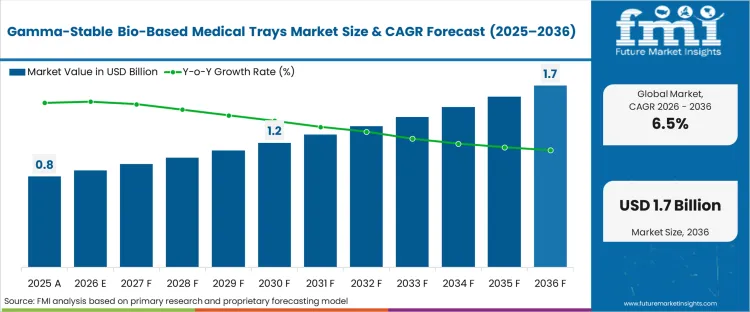
The gamma-stable bio-based medical trays market was valued at USD 0.8 billion in 2025. The sector is set to reach USD 0.9 billion in 2026 at a CAGR of 6.57% during the forecast period. Revenue expansion lifts the total opportunity to USD 1.7 billion through 2036 as medical device manufacturers integrate renewably sourced polymers that maintain polymer chain integrity during high-dose ionizing radiation cycles.
Quality assurance directors in the MedTech sector are moving beyond simple material substitution toward a fundamental recalculation of the sterile barrier system lifecycle. The decision is no longer about whether a tray is bio-based, but whether it can withstand 25 to 50 kGy of gamma radiation without losing the impact resistance required for heavy orthopedic kits. Delaying this transition creates a significant audit risk as global healthcare systems implement carbon-accounting protocols for their primary suppliers. Practitioners often find that the perceived fragility of bioplastic packaging is a myth; when formulated with specific stabilizing agents, these resins can actually exhibit superior dimensional stability compared to legacy fossil-based alternatives post-irradiation.
The primary inflection point for widespread adoption depends on the validation of five-year shelf-life stability in bio-based formats. Once a critical mass of orthopedic OEMs completes the rigorous ISO 11607 testing for bio-resins, the subsequent adoption becomes a procurement standard rather than an R&D experiment. Regulatory bodies and hospital purchasing groups trigger this shift by prioritizing vendors who provide verifiable lifecycle assessment data for their sterile packaging systems.
Summary of Gamma-Stable Bio-Based Medical Trays Market
- Gamma-Stable Bio-Based Medical Trays Market Definition
- A specialized segment of the medical packaging industry focusing on renewable, plant-derived rigid trays that sustain mechanical and sterile integrity under gamma radiation. These systems replace traditional fossil-based polymers in the terminally sterilized medical device chain.
- Demand Drivers in the Market
- Procurement mandates from global hospital groups require medical device manufacturers to reduce the carbon footprint of single-use surgical kits.
- Material science advancements allow bio-based resins to achieve performance parity with PETG in terms of clarity and impact resistance.
- The phase-out of certain fossil-based additives in high-regulation zones pushes OEMs to qualify new medical-grade polymers derived from renewable sources.
- Key Segments Analyzed in the FMI Report
- Poly Lactic Acid (PLA): This segment is expected to hold 41.2% share in 2026, as it provides the inherent visual clarity required for pre-surgical inspection of device integrity.
- Orthopedic Implants: Leading application segment garnering 34.6% share in 2026, driven by the heavy weight and sharp edges of implants requiring high-modulus bio-trays.
- Hospitals: Dominant end use expected to account for 48.2% share, as these facilities act as the primary decision-makers for sustainable procurement standards.
- India: Registering 9.4% compound growth, India’s expansion is rooted in the government-backed MedTech parks facilitating localized sustainable production.
- Analyst Opinion at FMI
- Ismail Sutaria, Principal Analyst, Packaging, at FMI, opines, "The market assumes bio-based resins are inherently more fragile under radiation, but the practitioner's paradox is that gamma exposure can actually improve tray rigidity through controlled cross-linking in specific bio-polyolefins, provided the additive package is tuned correctly. We are seeing a shift where the conversation moves from the environmental benefit of the feedstock to the mechanical performance of the irradiated polymer. The winners in this space will be the compounders who can guarantee that a bio-based tray won't embrittle or yellow, ensuring the surgical team has absolute confidence in the sterile barrier at the moment of use."
- Strategic Implications / Executive Takeaways
- MedTech R&D heads must initiate long-term shelf-life validation studies now to ensure bio-based trays are qualified before fossil-plastic surcharges take effect.
- Sourcing managers should secure supply agreements with bio-resin producers who can provide consistent molecular weight distributions to avoid radiation-induced embrittlement and subsequent tray cracking during shipping.
- Category leads at hospitals face a structural shift toward value-based procurement where the tray’s end-of-life recyclability is as important as its clinical performance.
- Methodology
- The methodology utilizes a bottom-up approach to track resin consumption by specific medical application. By interviewing practitioners in the sterilization chain, FMI identifies the adoption thresholds where bio-materials achieve performance parity with legacy polymers. This ensures that the forecast reflects actual qualification cycles rather than general sustainability sentiment.
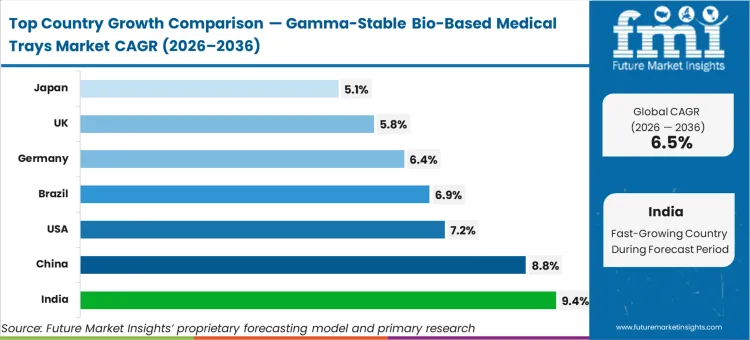
Demand for medical trays in India is set to grow at 9.4%, followed by China at 8.8% as both nations expand their domestic medical device manufacturing capacity. The United States market is anticipated to record a 7.2% CAGR, while Brazil follows at 6.9%. Germany’s sector is likely to post a CAGR of 6.4%, with the United Kingdom and Japan recording 5.8% and 5.1% respectively. This structural divergence reflects the variance between export-driven manufacturing hubs in Asia and the policy-heavy procurement environments in North America and Western Europe.
Gamma-Stable Bio-Based Medical Trays Market Key Takeaways
| Metric | Details |
|---|---|
| Industry Size (2026) | USD 0.9 Billion |
| Industry Value (2036) | USD 1.7 Billion |
| CAGR (2026-2036) | 6.57% |
Source: Future Market Insights (FMI) analysis, based on proprietary forecasting model and primary research
Gamma-Stable Bio-Based Medical Trays Market Definition
The industry comprises the production and sale of thermoformed or injection-molded primary packaging trays derived from renewable biological feedstocks specifically engineered for gamma sterilization. These trays must maintain mechanical properties, microbial barrier integrity, and visual clarity after exposure to ionizing radiation. This market is analytically distinct from general bioplastics due to the high-performance requirements of the sterile medical supply chain.
Gamma-Stable Bio-Based Medical Trays Market Inclusions
This market includes rigid trays made from PLA, bio-PE, and bio-PP designed for terminally sterilized medical devices. It covers specialized secondary components such as bio-based inserts or lids that form part of the sterile barrier system. Within scope are thermoformed medical packaging solutions that utilize plant-derived resins to support orthopedic, cardiovascular, and dental surgical kits.
Gamma-Stable Bio-Based Medical Trays Market Exclusions
Excluded from this scope are fossil-based trays like standard PETG, high-impact polystyrene (HIPS), or PVC, even if used for medical applications. Flexible medical pouches, non-sterile primary packaging, and trays intended only for steam or ethylene oxide (EtO) sterilization are also excluded. These exclusions are based on the unique material science challenges associated with gamma-induced polymer degradation which do not apply to non-irradiated or fossil-plastic categories.
Gamma-Stable Bio-Based Medical Trays Market Research Methodology
- Primary Research: FMI conducted interviews with Quality Assurance Managers at orthopedic OEMs and Materials Scientists at specialized bio-polymer compounding firms.
- Desk Research: Data was aggregated from healthcare plastics recycling registries, ISO technical committee reports, and procurement specification archives from major hospital networks.
- Market-Sizing and Forecasting: The baseline anchors to the verifiable production volume of medical-grade bio-resins and the annual volume of gamma-sterilized medical device units globally.
- Data Validation and Update Cycle: Forecasts were cross-validated using independent data streams from radiation service providers to triangulate the actual throughput of irradiated bio-based components.
Segmental Analysis
Gamma-Stable Bio-Based Medical Trays Market Analysis by Material
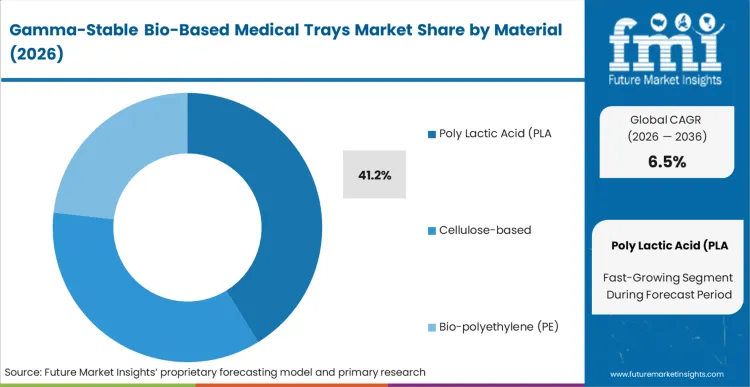
The displacement of legacy PETG and HIPS is accelerating as bio-based resins overcome the historic hurdle of radiation-induced embrittlement. Poly Lactic Acid (PLA) holds 41.2% of this market because it offers the most established pathway to USP Class VI compliance among renewable alternatives. Procurement directors at orthopedic device firms are no longer viewing PLA as an experimental material; it is the only commercially scalable option that maintains the high-stiffness profile needed for heavy surgical kits. According to FMI’s assessment, the adoption of polylactic acid is driven by its ability to undergo thermoforming on existing high-speed equipment without requiring massive capital expenditure. As hospital systems tighten their carbon accounting, the operational consequence of sticking with fossil-based trays is a loss of preferred vendor status in major procurement tenders.
- Resin yield: Bio-based feedstocks provide more consistent wall thickness during vacuum forming than recycled fossil content. This reliability reduces the rejection rate during the final sterile seal inspection.
- Sterility maintenance: The high glass transition temperature of certain bio-blends ensures the tray does not deform during the exothermic phase of gamma irradiation. This protects the integrity of the Tyvek lid seal throughout the shipping cycle.
- De-risking procurement: Diversifying into plant-based materials mitigates the risk of supply chain shocks associated with petroleum-based monomer shortages. Manufacturers who switch early secure their volume with the limited number of medical-grade bio-resin producers.
Gamma-Stable Bio-Based Medical Trays Market Analysis by Application
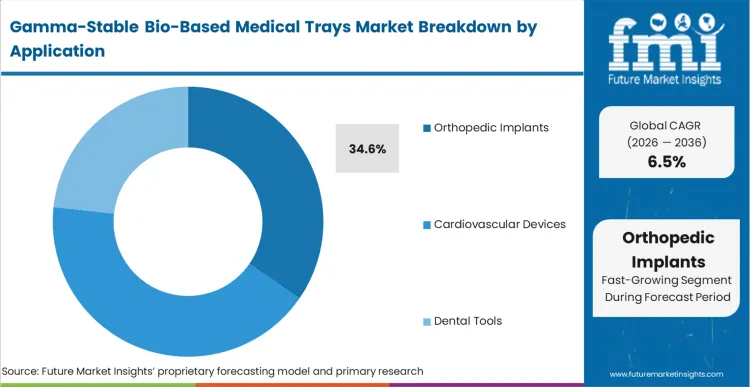
The consequence of orthopedic implant manufacturers failing to modernize their packaging is an immediate friction in high-throughput surgical environments. Orthopedic Implants represent the leading application with 34.6% share because these devices often feature complex geometries and sharp edges that stress the tray's structural integrity. FMI analysts opine that the transition to orthopedic implants packaging in bio-based formats is moving fastest because these high-value items can better absorb the initial unit-cost premium of specialized resins. Buyers are finding that the dimensional stability of gamma-stable bio-trays allows for tighter tolerances in kit design, reducing the overall footprint of the surgical setup. For surgeons, the clarity of the tray is a functional requirement for verifying the implant size before opening the sterile barrier, making high-clarity bio-polymers essential.
- Initial qualification: Tier-1 orthopedic OEMs are the first to adopt as they have the internal resources to run the multi-year shelf-life studies required for regulatory approval.
- Standardization phase: As validation data becomes public, mid-tier cardiovascular and surgical instrument providers follow, leveraging established material data to shorten their own filing timelines.
- Mass conversion: Dental and single-use tool manufacturers are the last to arrive, converting only once the price of bio-based trays reaches parity with medical-grade PETG through economies of scale.
Gamma-Stable Bio-Based Medical Trays Market Analysis by End Use
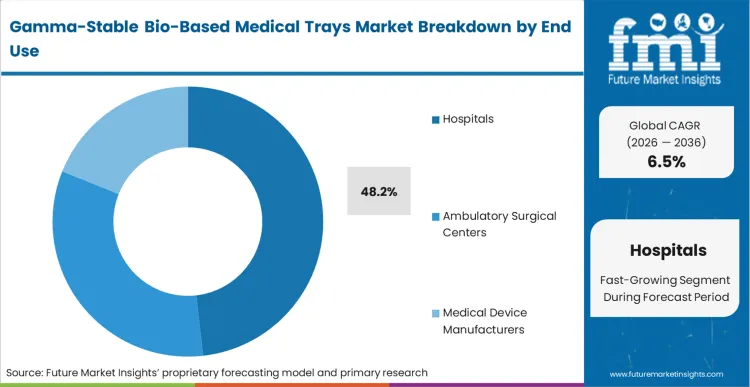
Hospital procurement groups are the primary actors forcing the shift toward sustainable sterile barrier systems. Hospitals hold a dominant 48.2% share because they act as the final decision-maker in the medical supply chain, increasingly weighting environmental impact in their RFP scoring. Based on FMI's view, the decision to mandate healthcare packaging that is both gamma-stable and bio-based is an operational response to the massive volume of plastic waste generated in surgical suites. Clinical staff are being retrained to identify bio-based trays to ensure they enter the correct waste stream for industrial composting or recycling, rather than being incinerated with hazardous waste. The commercial consequence for device manufacturers who ignore this hospital-level pressure is a slow but steady exclusion from the most lucrative integrated delivery networks.
- Clinical validation: Head nurses and surgical technicians validate the ease of aseptic opening, ensuring the bio-based material does not produce particulates or "shards" upon lid peeling.
- Sustainability auditing: Procurement departments use bio-based trays to meet their annual ESG targets, providing a measurable reduction in Scope 3 emissions that they report to board-level stakeholders.
- Volume expansion: Once a hospital system qualifies a bio-based tray for one orthopedic line, they typically expand the requirement to all rigid tray categories to simplify their inventory management.
Gamma-Stable Bio-Based Medical Trays Market Drivers, Restraints, and Opportunities
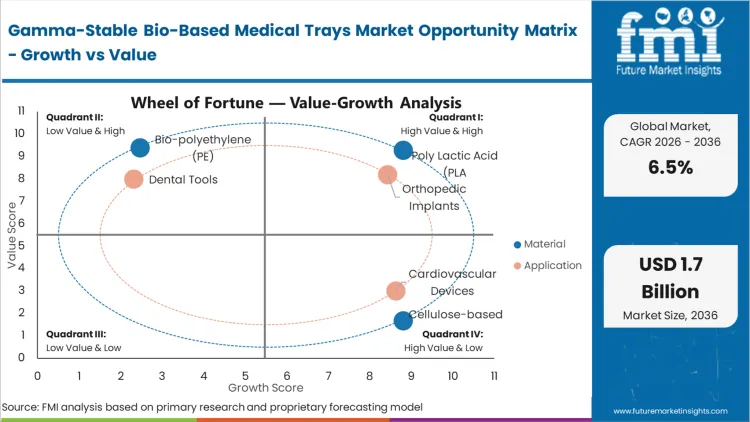
The structural forcing condition for this market is the integration of extended producer responsibility into healthcare procurement. Large brand owners in the medical device space are being compelled by their institutional investors to decouple revenue growth from fossil-plastic consumption. This creates a decision for sourcing directors: invest in the qualification of sustainable packaging now or face future carbon taxes that will erode margins on high-volume single-use kits. The driver is not a temporary trend but a permanent shift in how MedTech firms evaluate their total cost of ownership, where the end-of-life disposal cost is finally being factored into the initial purchase price.
The primary restraint remains the lack of standardized validation protocols for bio-resins post-gamma exposure. Most current ISO standards were written with fossil-plastics in mind, leaving a gap where manufacturers must perform expensive, custom testing to prove that a bio-tray won't lose its microbial barrier over a five-year shelf life. This friction is organizational; the risk-averse nature of regulatory affairs departments often blocks adoption even when the engineering team has proven performance parity. While new testing consortia are emerging to share the burden of this validation, the current landscape requires each OEM to bear the high cost of individual material qualification.
Opportunities in the Gamma-Stable Bio-Based Medical Trays Market
- Compounding innovation: Chemical formulators who develop proprietary antioxidant packages that prevent bio-resin yellowing during gamma exposure can capture exclusive supply contracts.
- Kit consolidation: Medical device manufacturers can use the high-modulus properties of bio-resins to design thinner, more compact trays, reducing shipping costs and secondary medical packaging volume.
- Recycling partnerships: Packaging converters that establish closed-loop collection programs with hospital networks can offer a "circularity-as-a-service" model, securing long-term loyalty from sustainability-focused buyers.
Regional Analysis
Based on the regional analysis, the Gamma-Stable Bio-Based Medical Trays market is segmented into North America, Europe, Asia Pacific, Latin America, Middle East, and Africa across 40 plus countries.
.webp "Top Country Growth Comparison Gamma Stable Bio Based Medical Trays Market Cagr (2026 2036)")
| Country | CAGR (2026 to 2036) |
|---|---|
| India | 9.4% |
| China | 8.8% |
| USA | 7.2% |
| Brazil | 6.9% |
| Germany | 6.4% |
| UK | 5.8% |
| Japan | 5.1% |
Source: Future Market Insights (FMI) analysis, based on proprietary forecasting model and primary research
North America Gamma-Stable Bio-Based Medical Trays Market Analysis
The North American market is shaped by the rapid consolidation of hospital procurement into massive group purchasing organizations (GPOs). These GPOs have begun to include sustainability scores as a tie-breaking factor in competitive bids for orthopedic and cardiovascular kits. As per FMI's projection, the move toward medical device packaging that uses renewable feedstock is becoming a defensive necessity for manufacturers protecting their US market share.
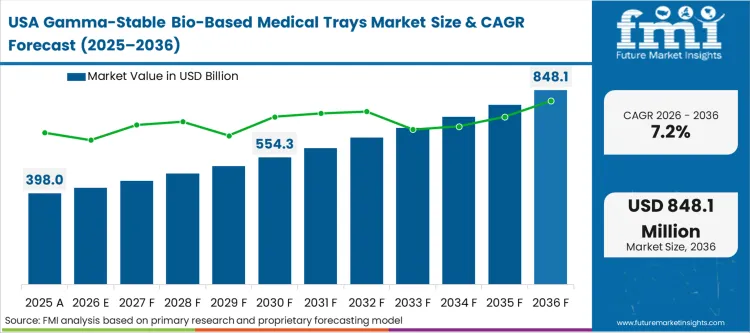
- USA: Hospital systems in the United States are increasingly demanding "packaging transparency" files that detail the carbon footprint of each tray. The market for bio-based trays here is forecast to register a CAGR of 7.2% as medical device OEMs transition their primary production lines to bio-based PLA and bio-PE. Practitioners find that the real challenge is not material performance, but the logistics of segregating bio-plastics from traditional PETG in the hospital waste stream. Manufacturers who provide clear, color-coded disposal instructions on their trays are seeing faster adoption rates in the US.
FMI’s report includes a detailed assessment of Canada and Mexico, where market dynamics are increasingly synchronized with U.S. hospital procurement standards. The structural pattern across these North American markets reveals that the move toward medical device packaging using renewable feedstock is becoming a defensive necessity for manufacturers protecting their regional market share. As large Group Purchasing Organizations (GPOs) consolidate their influence, the availability of "packaging transparency" files is shifting from a premium feature to a baseline requirement for any vendor seeking long-term contract eligibility in the region.
Europe Gamma-Stable Bio-Based Medical Trays Market Analysis
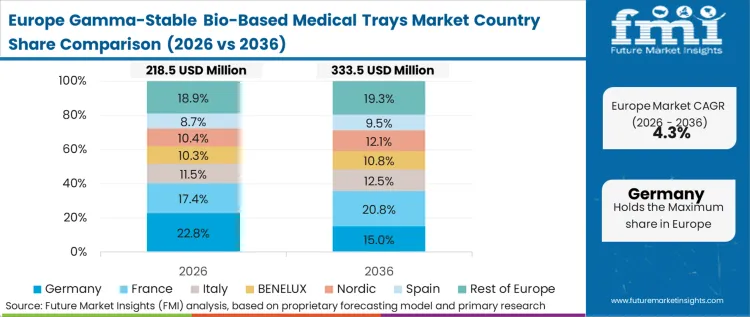
Europe's adoption is strictly policy-led, with the updated Packaging and Packaging Waste Regulation (PPWR) creating a direct financial penalty for non-recyclable or high-carbon medical plastics. European manufacturers are forced to treat the tray as a structural component of their environmental compliance strategy.
- Germany: Germany's focus on the circular economy compels orthopedic firms to qualify bio-based trays that are compatible with existing industrial composting or specialized recycling streams. The German sector is poised to expand at a 6.4% CAGR as the domestic chemical industry pivots toward bio-monomer production. This transition simplifies the administrative burden for German firms who must report on their plastic usage under national transparency laws.
- UK: The UK's NHS, through its Evergreen Sustainable Supplier Framework, has set one of the world's most aggressive net-zero targets for its suppliers, making bio-based trays a mandatory requirement for long-term contract eligibility. Demand for bio-based medical trays in the UK is set to grow at 5.8% over the forecast period. This trajectory clears a path for innovative UK-based packaging converters to displace traditional American and European incumbents by offering localized, low-carbon tray production.
- Brazil: Brazil leverages its massive sugarcane industry to produce bio-based ethylene, giving its domestic packaging sector a structural cost advantage in bio-PE trays. Sales of bio-based medical trays in Brazil are on track to record a CAGR of 6.9% as the nation expands its medical manufacturing hub in the southern regions. This localized supply chain opens up a market captured by domestic players who can offer bio-based trays without the heavy import duties associated with fossil-plastics.
FMI's analysis covers additional key markets including France, Italy, and the Benelux region, where adoption is strictly anchored to the European Union's updated Packaging and Packaging Waste Regulation (PPWR). The structural pattern across these additional European countries shows that legislative measures, such as national bans on specific single-use plastic formats, are forcing manufacturers to treat the tray as a structural component of their broader environmental compliance strategy. This transition is accelerating as domestic chemical industries pivot toward bio-monomer production, effectively lowering the administrative and financial burdens for firms reporting on plastic usage under national transparency laws.
Asia Pacific Gamma-Stable Bio-Based Medical Trays Market Analysis
Infrastructure development in Asia Pacific is creating a unique opportunity for "leapfrogging," where new medical device plants are built from the ground up to use bio-based materials. This avoids the high cost of re-validating existing legacy lines that slows down adoption in Western markets.
- India: India's MedTech parks are providing the infrastructure needed for the localized production of bioplastic packaging at a lower price point than imported PETG. India's industry is projected to witness growth at a CAGR of 9.4% as it becomes a global hub for the export of sustainably packaged surgical instruments. This trajectory leads toward India becoming the primary supplier of bio-based medical trays for the entire developing world.
- China: The Chinese government's focus on "green manufacturing" is pushing its domestic medical device giants to adopt renewable packaging to maintain their export competitiveness. A CAGR of 8.8% is expected for the Chinese market as it scales up bio-PE production to meet both domestic and international demand. This expansion allows Chinese firms to capture preferred supplier status in European and North American procurement frameworks.
- Japan: Japanese manufacturers are prioritizing material purity and high-precision molding, using bio-based resins to differentiate their premium orthopedic kits in a crowded market. The Japanese landscape is set to achieve a CAGR of 5.1%, reflecting a mature market that values competitive positioning through high-quality, sustainable materials.
FMI's report includes detailed analysis for South Korea, Japan, and Southeast Asian markets like Thailand and Indonesia, where infrastructure development is creating a unique opportunity for "leapfrogging". The structural pattern across these additional countries reveals that those with existing bio-polymer infrastructure, often supported by government mandates for "green manufacturing", are adopting bio-based trays roughly 18 months faster than those reliant on imported resins. This avoids the high cost of re-validating legacy lines, allowing new medical device plants to be built from the ground up with sustainable materials to maintain global export competitiveness.
Competitive Aligners for Market Players
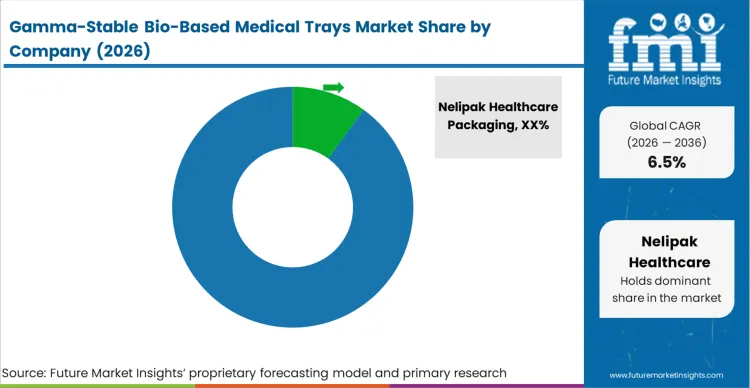
The competitive structure of this market is moderately concentrated, as the capital requirements for medical-grade thermoforming and cleanroom operations act as a significant barrier to entry. Leading players like Nelipak Healthcare Packaging and DuPont rely on their deep regulatory expertise to distinguish themselves from generalist packaging firms. Buyers in this market do not choose vendors based on price alone; they select based on the vendor’s ability to provide a "validation package" that includes data on material performance after 50 kGy of gamma exposure
Incumbents such as NatureWorks LLC and Mitsubishi Chemical hold a structural advantage because they control the proprietary additive packages that prevent bio-resins from yellowing. A challenger must build more than just a thermoforming line; they must develop a specialized compounding capability to ensure their bio-based trays can survive the ionizing radiation environment. This requires an investment in rigid medical packaging R&D that typically takes three to five years to yield a commercially viable product that passes ISO 11607.
The trajectory through 2036 shows a tension between large buyers wanting to avoid vendor lock-in and the reality that only a few suppliers can meet the rigorous purity standards for sterile trays. Large medical device OEMs are resisting lock-in by qualifying at least two different bio-resin sources for each tray design, even if it doubles their initial validation cost. This trend ensures that the market remains competitive, though the advantage persists for those who can offer a verifiable lifecycle assessment as part of their standard product data sheet.
Key Players in Gamma-Stable Bio-Based Medical Trays Market
- Nelipak Healthcare Packaging
- TEQ (Sonoco)
- Novolex
- Placon
- DuPont
- Mitsubishi Chemical
- NatureWorks LLC
- Arkema
- Oliver Healthcare Packaging
- Steripack Group
Scope of the Report
| Metric | Value |
|---|---|
| Quantitative Units | USD 0.9 Billion to USD 1.7 Billion, at a CAGR of 6.57% |
| Market Definition | Rigid primary packaging trays derived from biological feedstocks, specifically stabilized to maintain sterile barrier integrity after gamma radiation exposure. |
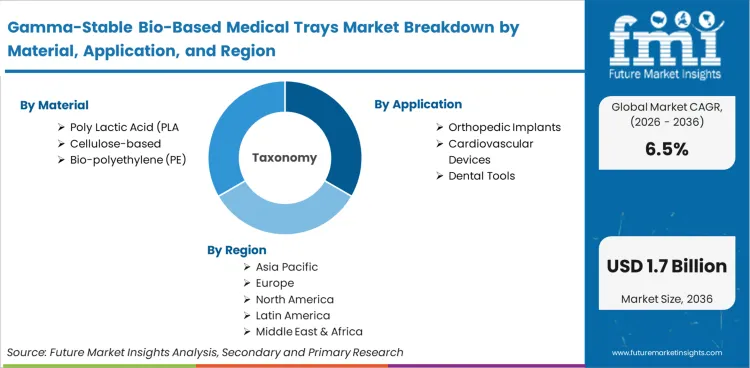
| Material Segmentation | Poly Lactic Acid (PLA), Cellulose-based, Bio-polyethylene (PE), Bio-polypropylene (PP) |
| Application Segmentation | Orthopedic Implants, Cardiovascular Devices, Surgical Instruments, Dental Tools |
| End Use Segmentation | Hospitals, Ambulatory Surgical Centers, Medical Device Manufacturers |
| Regions Covered | North America, Europe, Asia Pacific, Latin America, MEA |
| Countries Covered | USA, Germany, China, India, Japan, UK, Brazil, and 40 plus countries |
| Key Companies Profiled | Nelipak Healthcare Packaging, TEQ, Novolex, Placon, DuPont, Mitsubishi Chemical, NatureWorks, Arkema |
| Forecast Period | 2026 to 2036 |
| Approach | FMI uses a supply-side analysis of medical-grade bio-resins combined with demand-side modeling of irradiated surgical units. Forecasts are validated via interviews with sterilization service providers. |
Source: Future Market Insights (FMI) analysis, based on proprietary forecasting model and primary research
Gamma-Stable Bio-Based Medical Trays Market Analysis by Segments
-
Material:
- Poly Lactic Acid (PLA)
- Cellulose-based
- Bio-polyethylene (PE)
- Bio-polypropylene (PP)
-
Application:
- Orthopedic Implants
- Cardiovascular Devices
- Surgical Instruments
- Dental Tools
-
End Use:
- Hospitals
- Ambulatory Surgical Centers
- Medical Device Manufacturers
-
Region:
- North America
- USA
- Canada
- Europe
- Germany
- UK
- France
- Asia Pacific
- China
- India
- Japan
- Latin America
- Brazil
- Mexico
- North America
Bibliography
- NatureWorks LLC. (2024, May). Ingeo Biopolymer 2003D Technical Data Sheet for Food and Medical Packaging. NatureWorks.
- Healthcare Plastics Recycling Council. (2024, January). Hospital Plastic Waste Strategy and Circularity Guidelines. HPRC.
- European Chemicals Agency. (2024, June). Candidate List of substances of very high concern for Authorisation. ECHA.
- ASTM International. (2024, April). ASTM F1980-21 Standard Guide for Accelerated Aging of Sterile Barrier Systems for Medical Devices. ASTM.
- STERIS. (2024, May). Gamma Irradiation for Medical Devices: Material Compatibility and Validation. STERIS Applied Sterilization Technologies.
- Association for the Advancement of Medical Instrumentation. (2024, March). ANSI/AAMI/ISO 11137-1:2006/(R)2015 Sterilization of health care products - Radiation. AAMI.
This bibliography is provided for reader reference. The full FMI report contains the complete reference list with primary source documentation.
This Report Addresses
- Market intelligence to support strategic decision making across rigid bio-based trays and specialized inserts for sterile surgical environments
- Market size estimation and 10-year revenue forecasts from 2026 to 2036, supported by bottom-up resin consumption modeling and sterilization throughput analysis
- Growth opportunity mapping across orthopedic, cardiovascular, and surgical instrument applications with emphasis on the validation of 5-year shelf-life stability
- Segment and regional revenue forecasts covering bio-PE, bio-PP, and PLA materials across hospital procurement contexts and European policy environments
- Competition strategy assessment including proprietary additive package development and the ability to provide ISO 11607 validation data
- Product development tracking including gamma-stabilization catalysts and low-yellowing resin formulations discussed in this article
- Market access analysis covering GPO sustainability scoring and NHS net-zero supplier mandates
- Market report delivery in PDF, Excel, PPT, and interactive dashboard formats for executive strategy, sustainability planning, and operational benchmarking use
Frequently Asked Questions
How large is the Gamma-Stable Bio-Based Medical Trays in 2026?
The industry is expected to be valued at USD 0.9 billion in 2026. This figure signals that the market has moved beyond the "pilot" phase, where bio-based resins are now being integrated into standard production lines for high-volume orthopedic surgical kits.
What will it be valued at by 2036?
By 2036, the total opportunity is projected to reach USD 1.7 billion. This doubling of value reflects the structural transition where bio-based materials become the default standard for single-use medical trays in North America and Europe, displacing fossil-based PETG.
What CAGR is projected for the forecast period?
The market is set to grow at a CAGR of 6.57% through 2036. This rate is constrained by the multi-year validation cycles required for sterile medical products, meaning the growth reflects actual verified adoption rather than speculative interest.
Which material segment leads the market?
Poly Lactic Acid (PLA) leads with a 41.2% share because it offers the inherent visual clarity required for pre-surgical inspection. The mechanism here is functional; surgeons must see the device through the tray to ensure it is the correct size before breaking the sterile barrier, and PLA currently provides the best transparency among bio-resins.
Which application segment leads the market?
Orthopedic Implants lead because the sharp edges and heavy weight of these devices require high-modulus materials that bio-resins like PLA can provide. The adoption sequence here is driven by the fact that high-value orthopedic kits can absorb the initial cost premium of specialized bio-based materials more easily than low-cost dental tools.
Which end use segment leads the market?
Hospitals lead with 48.2% share as they are the final decision-makers implementing green procurement mandates. The mechanism is a top-down forcing condition where hospital GPOs penalize medical device manufacturers who cannot provide carbon-neutral primary packaging.
What is the primary driver for rapid growth?
The shift toward value-based procurement acts as the primary driver, where the "environmental cost" of a tray is finally being calculated alongside its purchase price. This is a structural insight because it changes the buyer's focus from immediate unit cost to total lifecycle compliance.
What is the primary restraint on market adoption?
The main restraint is the lack of universal data on long-term shelf-life stability for irradiated bio-polymers. This creates a structural friction where risk-averse regulatory departments delay adoption until they can see multi-year validation data, regardless of the material's immediate performance.
Which country is growing the fastest?
India is the fastest-growing country at 9.4% CAGR. Compared to the United States (7.2%), India’s growth is driven by the creation of new, green-field medical device manufacturing hubs that adopt bio-based standards from day one, avoiding the "re-validation lag" that slows down Western markets.
How does gamma radiation specifically affect bio-based trays compared to PETG?
While PETG is highly stable, standard bio-resins can embrittle; however, specialized medical-grade bio-blends utilize antioxidants to maintain polymer chain length. The mechanism involves tuning the resin's molecular weight distribution to ensure that the cross-linking induced by gamma radiation does not lead to a loss of impact resistance.
Can these trays be recycled in a standard hospital environment?
Structurally, these trays are often compatible with bio-based recycling streams, but the gap exists in hospital waste segregation infrastructure. To capture the full sustainability benefit, manufacturers are increasingly partnering with hospitals to create closed-loop collection programs specifically for rigid medical bioplastics.
Why are hospitals willing to pay a premium for bio-based trays?
The premium is justified by the reduction in Scope 3 emissions that hospitals must report to regulatory and financial stakeholders. This structural insight reveals that the "buyer" is not just the surgeon using the kit, but the sustainability officer who uses the packaging data to meet institutional ESG goals.
Preview the report firsthand - request a free sample
Get SampleGet the brochure for pricing and purchase details.
Get PDFTable of Content
- Executive Summary
- Global Market Outlook
- Demand-side Trends
- Supply-side Trends
- Technology Roadmap Analysis
- Analysis and Recommendations
- Market Overview
- Market Coverage / Taxonomy
- Market Definition / Scope / Limitations
- Research Methodology
- Chapter Orientation
- Analytical Lens and Working Hypotheses
- Market Structure, Signals, and Trend Drivers
- Benchmarking and Cross-market Comparability
- Market Sizing, Forecasting, and Opportunity Mapping
- Research Design and Evidence Framework
- Desk Research Programme (Secondary Evidence)
- Company Annual and Sustainability Reports
- Peer-reviewed Journals and Academic Literature
- Corporate Websites, Product Literature, and Technical Notes
- Earnings Decks and Investor Briefings
- Statutory Filings and Regulatory Disclosures
- Technical White Papers and Standards Notes
- Trade Journals, Industry Magazines, and Analyst Briefs
- Conference Proceedings, Webinars, and Seminar Materials
- Government Statistics Portals and Public Data Releases
- Press Releases and Reputable Media Coverage
- Specialist Newsletters and Curated Briefings
- Sector Databases and Reference Repositories
- FMI Internal Proprietary Databases and Historical Market Datasets
- Subscription Datasets and Paid Sources
- Social Channels, Communities, and Digital Listening Inputs
- Additional Desk Sources
- Expert Input and Fieldwork (Primary Evidence)
- Primary Modes
- Qualitative Interviews and Expert Elicitation
- Quantitative Surveys and Structured Data Capture
- Blended Approach
- Why Primary Evidence is Used
- Field Techniques
- Interviews
- Surveys
- Focus Groups
- Observational and In-context Research
- Social and Community Interactions
- Stakeholder Universe Engaged
- C-suite Leaders
- Board Members
- Presidents and Vice Presidents
- R&D and Innovation Heads
- Technical Specialists
- Domain Subject-matter Experts
- Scientists
- Physicians and Other Healthcare Professionals
- Governance, Ethics, and Data Stewardship
- Research Ethics
- Data Integrity and Handling
- Primary Modes
- Tooling, Models, and Reference Databases
- Desk Research Programme (Secondary Evidence)
- Data Engineering and Model Build
- Data Acquisition and Ingestion
- Cleaning, Normalisation, and Verification
- Synthesis, Triangulation, and Analysis
- Quality Assurance and Audit Trail
- Market Background
- Market Dynamics
- Drivers
- Restraints
- Opportunity
- Trends
- Scenario Forecast
- Demand in Optimistic Scenario
- Demand in Likely Scenario
- Demand in Conservative Scenario
- Opportunity Map Analysis
- Product Life Cycle Analysis
- Supply Chain Analysis
- Investment Feasibility Matrix
- Value Chain Analysis
- PESTLE and Porter’s Analysis
- Regulatory Landscape
- Regional Parent Market Outlook
- Production and Consumption Statistics
- Import and Export Statistics
- Market Dynamics
- Global Market Analysis 2021 to 2025 and Forecast, 2026 to 2036
- Historical Market Size Value (USD Million) Analysis, 2021 to 2025
- Current and Future Market Size Value (USD Million) Projections, 2026 to 2036
- Y-o-Y Growth Trend Analysis
- Absolute $ Opportunity Analysis
- Global Market Pricing Analysis 2021 to 2025 and Forecast 2026 to 2036
- Global Market Analysis 2021 to 2025 and Forecast 2026 to 2036, By Material
- Introduction / Key Findings
- Historical Market Size Value (USD Million) Analysis By Material , 2021 to 2025
- Current and Future Market Size Value (USD Million) Analysis and Forecast By Material , 2026 to 2036
- Poly Lactic Acid (PLA
- Cellulose-based
- Bio-polyethylene (PE)
- Poly Lactic Acid (PLA
- Y-o-Y Growth Trend Analysis By Material , 2021 to 2025
- Absolute $ Opportunity Analysis By Material , 2026 to 2036
- Global Market Analysis 2021 to 2025 and Forecast 2026 to 2036, By Application
- Introduction / Key Findings
- Historical Market Size Value (USD Million) Analysis By Application, 2021 to 2025
- Current and Future Market Size Value (USD Million) Analysis and Forecast By Application, 2026 to 2036
- Orthopedic Implants
- Cardiovascular Devices
- Dental Tools
- Orthopedic Implants
- Y-o-Y Growth Trend Analysis By Application, 2021 to 2025
- Absolute $ Opportunity Analysis By Application, 2026 to 2036
- Global Market Analysis 2021 to 2025 and Forecast 2026 to 2036, By End Use
- Introduction / Key Findings
- Historical Market Size Value (USD Million) Analysis By End Use, 2021 to 2025
- Current and Future Market Size Value (USD Million) Analysis and Forecast By End Use, 2026 to 2036
- Hospitals
- Ambulatory Surgical Centers
- Medical Device Manufacturers
- Hospitals
- Y-o-Y Growth Trend Analysis By End Use, 2021 to 2025
- Absolute $ Opportunity Analysis By End Use, 2026 to 2036
- Global Market Analysis 2021 to 2025 and Forecast 2026 to 2036, By Region
- Introduction
- Historical Market Size Value (USD Million) Analysis By Region, 2021 to 2025
- Current Market Size Value (USD Million) Analysis and Forecast By Region, 2026 to 2036
- North America
- Latin America
- Western Europe
- Eastern Europe
- East Asia
- South Asia and Pacific
- Middle East & Africa
- Market Attractiveness Analysis By Region
- North America Market Analysis 2021 to 2025 and Forecast 2026 to 2036, By Country
- Historical Market Size Value (USD Million) Trend Analysis By Market Taxonomy, 2021 to 2025
- Market Size Value (USD Million) Forecast By Market Taxonomy, 2026 to 2036
- By Country
- USA
- Canada
- Mexico
- By Material
- By Application
- By End Use
- By Country
- Market Attractiveness Analysis
- By Country
- By Material
- By Application
- By End Use
- Key Takeaways
- Latin America Market Analysis 2021 to 2025 and Forecast 2026 to 2036, By Country
- Historical Market Size Value (USD Million) Trend Analysis By Market Taxonomy, 2021 to 2025
- Market Size Value (USD Million) Forecast By Market Taxonomy, 2026 to 2036
- By Country
- Brazil
- Chile
- Rest of Latin America
- By Material
- By Application
- By End Use
- By Country
- Market Attractiveness Analysis
- By Country
- By Material
- By Application
- By End Use
- Key Takeaways
- Western Europe Market Analysis 2021 to 2025 and Forecast 2026 to 2036, By Country
- Historical Market Size Value (USD Million) Trend Analysis By Market Taxonomy, 2021 to 2025
- Market Size Value (USD Million) Forecast By Market Taxonomy, 2026 to 2036
- By Country
- Germany
- UK
- Italy
- Spain
- France
- Nordic
- BENELUX
- Rest of Western Europe
- By Material
- By Application
- By End Use
- By Country
- Market Attractiveness Analysis
- By Country
- By Material
- By Application
- By End Use
- Key Takeaways
- Eastern Europe Market Analysis 2021 to 2025 and Forecast 2026 to 2036, By Country
- Historical Market Size Value (USD Million) Trend Analysis By Market Taxonomy, 2021 to 2025
- Market Size Value (USD Million) Forecast By Market Taxonomy, 2026 to 2036
- By Country
- Russia
- Poland
- Hungary
- Balkan & Baltic
- Rest of Eastern Europe
- By Material
- By Application
- By End Use
- By Country
- Market Attractiveness Analysis
- By Country
- By Material
- By Application
- By End Use
- Key Takeaways
- East Asia Market Analysis 2021 to 2025 and Forecast 2026 to 2036, By Country
- Historical Market Size Value (USD Million) Trend Analysis By Market Taxonomy, 2021 to 2025
- Market Size Value (USD Million) Forecast By Market Taxonomy, 2026 to 2036
- By Country
- China
- Japan
- South Korea
- By Material
- By Application
- By End Use
- By Country
- Market Attractiveness Analysis
- By Country
- By Material
- By Application
- By End Use
- Key Takeaways
- South Asia and Pacific Market Analysis 2021 to 2025 and Forecast 2026 to 2036, By Country
- Historical Market Size Value (USD Million) Trend Analysis By Market Taxonomy, 2021 to 2025
- Market Size Value (USD Million) Forecast By Market Taxonomy, 2026 to 2036
- By Country
- India
- ASEAN
- Australia & New Zealand
- Rest of South Asia and Pacific
- By Material
- By Application
- By End Use
- By Country
- Market Attractiveness Analysis
- By Country
- By Material
- By Application
- By End Use
- Key Takeaways
- Middle East & Africa Market Analysis 2021 to 2025 and Forecast 2026 to 2036, By Country
- Historical Market Size Value (USD Million) Trend Analysis By Market Taxonomy, 2021 to 2025
- Market Size Value (USD Million) Forecast By Market Taxonomy, 2026 to 2036
- By Country
- Kingdom of Saudi Arabia
- Other GCC Countries
- Turkiye
- South Africa
- Other African Union
- Rest of Middle East & Africa
- By Material
- By Application
- By End Use
- By Country
- Market Attractiveness Analysis
- By Country
- By Material
- By Application
- By End Use
- Key Takeaways
- Key Countries Market Analysis
- USA
- Pricing Analysis
- Market Share Analysis, 2025
- By Material
- By Application
- By End Use
- Canada
- Pricing Analysis
- Market Share Analysis, 2025
- By Material
- By Application
- By End Use
- Mexico
- Pricing Analysis
- Market Share Analysis, 2025
- By Material
- By Application
- By End Use
- Brazil
- Pricing Analysis
- Market Share Analysis, 2025
- By Material
- By Application
- By End Use
- Chile
- Pricing Analysis
- Market Share Analysis, 2025
- By Material
- By Application
- By End Use
- Germany
- Pricing Analysis
- Market Share Analysis, 2025
- By Material
- By Application
- By End Use
- UK
- Pricing Analysis
- Market Share Analysis, 2025
- By Material
- By Application
- By End Use
- Italy
- Pricing Analysis
- Market Share Analysis, 2025
- By Material
- By Application
- By End Use
- Spain
- Pricing Analysis
- Market Share Analysis, 2025
- By Material
- By Application
- By End Use
- France
- Pricing Analysis
- Market Share Analysis, 2025
- By Material
- By Application
- By End Use
- India
- Pricing Analysis
- Market Share Analysis, 2025
- By Material
- By Application
- By End Use
- ASEAN
- Pricing Analysis
- Market Share Analysis, 2025
- By Material
- By Application
- By End Use
- Australia & New Zealand
- Pricing Analysis
- Market Share Analysis, 2025
- By Material
- By Application
- By End Use
- China
- Pricing Analysis
- Market Share Analysis, 2025
- By Material
- By Application
- By End Use
- Japan
- Pricing Analysis
- Market Share Analysis, 2025
- By Material
- By Application
- By End Use
- South Korea
- Pricing Analysis
- Market Share Analysis, 2025
- By Material
- By Application
- By End Use
- Russia
- Pricing Analysis
- Market Share Analysis, 2025
- By Material
- By Application
- By End Use
- Poland
- Pricing Analysis
- Market Share Analysis, 2025
- By Material
- By Application
- By End Use
- Hungary
- Pricing Analysis
- Market Share Analysis, 2025
- By Material
- By Application
- By End Use
- Kingdom of Saudi Arabia
- Pricing Analysis
- Market Share Analysis, 2025
- By Material
- By Application
- By End Use
- Turkiye
- Pricing Analysis
- Market Share Analysis, 2025
- By Material
- By Application
- By End Use
- South Africa
- Pricing Analysis
- Market Share Analysis, 2025
- By Material
- By Application
- By End Use
- USA
- Market Structure Analysis
- Competition Dashboard
- Competition Benchmarking
- Market Share Analysis of Top Players
- By Regional
- By Material
- By Application
- By End Use
- Competition Analysis
- Competition Deep Dive
- Nelipak Healthcare Packaging
- Overview
- Product Portfolio
- Profitability by Market Segments (Product/Age /Sales Channel/Region)
- Sales Footprint
- Strategy Overview
- Marketing Strategy
- Product Strategy
- Channel Strategy
- TEQ (Sonoco)
- Novolex
- Placon
- DuPont
- Mitsubishi Chemical
- Nelipak Healthcare Packaging
- Competition Deep Dive
- Assumptions & Acronyms Used


