

- Market Size (2026)
- USD 620.8 Mn
- Forecast (2036)
- USD 1510.6 Mn
- CAGR (2026 to 2036)
- 9.3%
How big is Global Macarons Market in 2026?
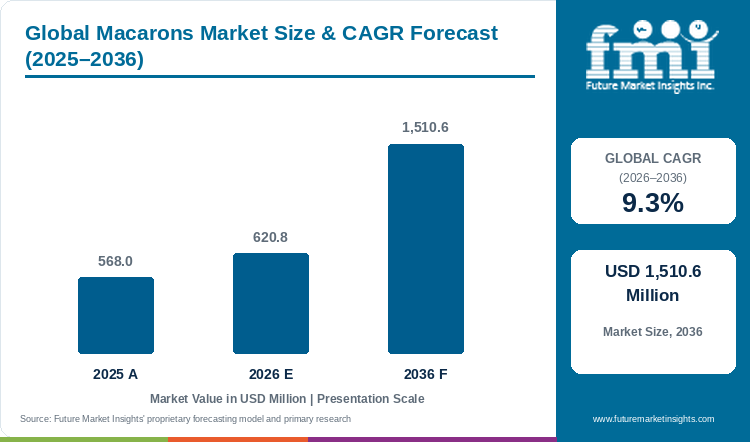
Starting from USD 568.0 million in 2025, the global macarons market valuation advanced to USD 620.8 million in 2026, with projections pointing toward USD 1,510.6 million by 2036 at a CAGR of 9.3%.
Supermarket perimeter bakeries and coffee chains are turning assorted vanilla and pistachio macaron boxes from occasional boutique gifts into everyday impulse purchases by rolling out thaw-and-serve display trays. Global macarons demand reached a 2025 value of USD 568.0 million and an estimated 2026 level of USD 620.8 million before climbing toward a 2036 projection of USD 1,510.6 million on a 9.3% CAGR, with classic / original projected to account for a 40.0% product type share in 2026. Blast-frozen trays let grocers and hotel caterers stock uniform patisserie cases without hiring store-level pastry chefs. This labor-saving merchandising shift explains why macarons expansion at 9.3% outpaces the 5.2% CAGR of broader bakery products, since shoppers pay a per-piece premium for portion-controlled almond confections instead of staple bread loaves. Handler figures released by the Almond Board of California (ABC) in September 2026 show that marketable almond supply exceeded 3,020.0 million pounds for the 2025/2026 crop year, giving industrial patisserie plants stable raw-material supply for fine blanched almond flour [1]. Even so, fragile meringue shells that crack under pallet compression and a short five-day chilled display window after thawing continue to restrict shelf space across smaller grocery stores.
Key Market Trends & Insights
- By product type: Classic / original is expected to hold a 40.0% share in 2026 because familiar shell-and-ganache flavors reduce trial hesitation across retail gift boxes.
- By claim / nature: Conventional is estimated to hold a 59.0% share in 2026 owing to predictable egg-white meringue whipping stability without reformulation surcharges.
- By format: Fresh is projected to account for a 30.0% share in 2026 attributable to counter presentation and immediate visual assessment at boutique bakeries.
- By packaging format: Multipack is forecast to register a 34.0% share in 2026 supported by thermoformed divider trays that prevent fragile shell fracture during transit.
- By sales channel: Supermarkets & hypermarkets are anticipated to record a 44.0% share in 2026 linked to scheduled chilled-aisle replenishment and holiday gifting displays.
Regional Highlights
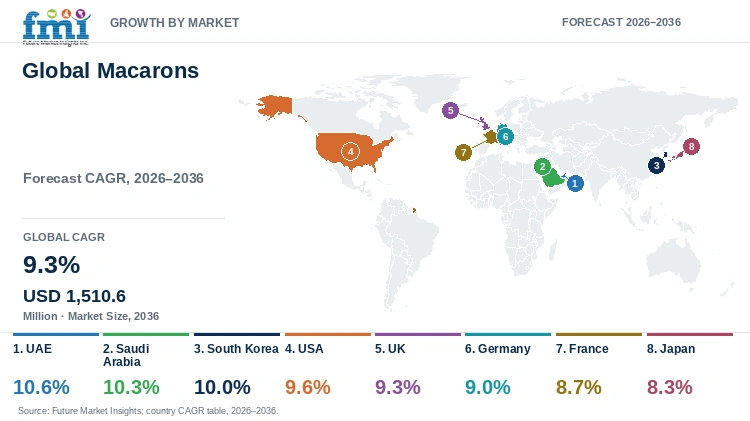
- Top national expansion: The UAE is projected to lead evaluated country markets at a 10.6% CAGR through 2036 under luxury hotel banqueting and airport duty-free gifting demand.
- Broader country progression: Saudi Arabia is expected to expand at a 10.3% CAGR ahead of South Korea at 10.0% and the USA at 9.6%, while Japan is forecast to advance at an 8.3% CAGR.
Market Size & Forecast
Table 1: Market Size and Forecast for the Global Macarons Market (USD million and CAGR percentage), 2025 to 2036
| Metric | Value |
|---|---|
| 2025 Market Size | USD 568.0 million |
| Estimated Market Size in 2026 | USD 620.8 million |
| Projected Market Size by 2036 | USD 1,510.6 million |
| CAGR, 2026 to 2036 | 9.3% |
| Added Revenue, 2026 to 2036 | USD 889.8 million |
Commercial bakery chains and hotel catering operators face rising pastry labor costs and high shell-breakage rates when producing delicate almond-meringue confections from scratch. Automated depositing lines equipped with blast-freezing tunnels allow industrial manufacturers to ship uniform shells and ganache fillings across international cold chains. In August 2025, Finsbury Food Group acquired a 70% majority stake in Lola's Cupcakes to expand its direct-to-consumer celebration cake and patisserie network in the UK [2]. Retail grocers and coffee chains are expanding thaw-and-serve patisserie programs with frozen bakery assortments so store staff can replenish display cases without on-site pastry chefs.
Retail & Foodservice Volume and Assortment Sizing
Table 2: Retail & Foodservice Volume and Assortment Sizing for the Global Macarons Market (USD million and operational ranges), 2025 to 2036
| Metric | 2025 | 2026 | 2036 |
|---|---|---|---|
| Market size (USD million) | 568.0 | 620.8 | 1,510.6 |
| Commercial production volume (million pieces) | 1,180.0 to 1,320.0 | 1,290.0 to 1,440.0 | 2,980.0 to 3,340.0 |
| Blanched almond flour consumed (thousand metric tons) | 14.2 to 16.0 | 15.5 to 17.5 | 35.8 to 40.2 |
| Average wholesale realization per 12-piece multipack (USD) | 5.40 to 6.10 | 5.50 to 6.20 | 5.80 to 6.60 |
Operational note: Piece-volume and almond-meal tonnage ranges apply an 18-gram to 22-gram finished filled macaron specification containing 28% to 34% fine blanched almond flour across retail and foodservice packs.
Consistent shell feet and smooth domed tops require tightly controlled particle-size distribution and low oil expression during almond milling across commercial bakeries. Industrial patisserie plants specify low-moisture almond flour and pasteurized liquid egg whites so automated depositors maintain batter viscosity across continuous baking shifts without shell cracking.
Per Capita & Bakery Outlet Spending Indicators
Table 3: Per Capita and Outlet Spending Indicators for the Global Macarons Market (USD), 2025 to 2036
| Metric | 2025 | 2026 | 2036 |
|---|---|---|---|
| World population (million) | 8,200.0 | 8,300.0 | 9,000.0 |
| Spend per 1,000 people (USD) | 69.3 | 74.8 | 167.8 |
| Annual procurement per stocking bakery/retail outlet (USD) | 2,650.0 to 3,050.0 | 2,880.0 to 3,320.0 | 6,450.0 to 7,420.0 |
| Chilled & thaw-and-serve retail share (%) | 54.0% to 58.0% | 56.0% to 60.0% | 65.0% to 69.0% |
Table 4: Outlet & Channel Spending Indicators for the Global Macarons Market (USD and percentages), 2026
| Metric | Value | Institutional Reference Basis |
|---|---|---|
| Market size, 2026 | USD 620.8 million | 2026 global revenue baseline |
| Stocking supermarkets, boutiques & hospitality outlets | 202,000 | Global commercial patisserie & grocery counter registry |
| Market spend per outlet | USD 3,073.3 | Annualized wholesale macaron procurement |
| Supermarkets & hypermarkets revenue, 2026 | USD 273.2 million | 44.0% sales channel allocation |
Moisture migration control from ganache or fruit-curd centers into crisp almond-meringue shells governs commercial shelf-life performance across supermarket chillers and hotel banquet kitchens. Manufacturers formulate low-water-activity confectionery fillings using white-chocolate emulsions and anhydrous nut pastes to preserve shell chewiness and prevent soggy bases through freeze-thaw distribution.
Analyst Perspective
"Retail grocery buyers no longer treat macarons as a fragile holiday-only novelty. Suppliers that combine automated co-extruded fillings with crush-proof rPET blister trays and a reliable five-day chilled shelf life after thawing are winning permanent year-round space in supermarket bakery cases."
- Nandini Roy Choudhury, Principal Analyst at Future Market Insights
How is the global macarons market segmented?
The global macarons market is segmented by product type, claim / nature, format, packaging format, and sales channel. In 2026, classic / original is projected at 40.0%, conventional at 59.0%, fresh at 30.0%, multipack at 34.0%, and supermarkets & hypermarkets at 44.0%.
By product type: Classic / original, chocolate, fruit-flavored, and specialty & floral.
By claim / nature: Conventional, gluten-free, and plant-based / vegan.
By format: Fresh, frozen / thaw-and-serve, and ambient / shelf-stable.
By packaging format: Multipack, gift box, single-serve, and bulk foodservice trays.
By sales channel: Supermarkets & hypermarkets, specialty patisseries & bakeries, online retail, foodservice & hospitality, and duty-free travel retail.
Why does Classic / Original lead Product Type demand?
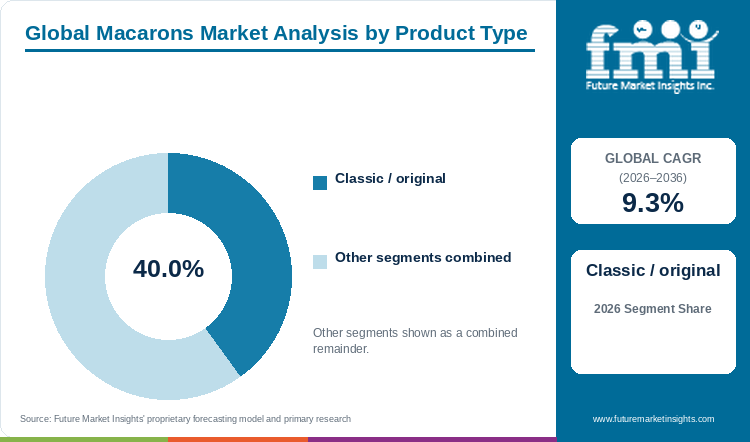
Classic / original varieties are expected to hold a 40.0% share of the product type segment in 2026, driven by core assortment turnover.
Table 5: Product Type Share for the Global Macarons Market (percentage share), 2026
| Product Type | Share (2026) |
|---|---|
| Classic / original | 40.0% |
| Other Segments Combined* | 60.0% |
| Total | 100.0% |
*Calculated as the balance remaining after deducting the leading segment's reported share from 100.0%.
Table 6: Product Type Leadership and Market Growth for the Global Macarons Market (segment and CAGR percentage), 2026 to 2036
| Metric | Value |
|---|---|
| Global CAGR (2026 to 2036) | 9.3% |
| Leading Segment | Classic / original |
Signature vanilla bean and pistachio assortment packs with salted caramel and raspberry fillings serve as the foundational SKU for supermarket in-store bakeries and hotel banquet platters. Producers enhance visual appeal on classic shells by applying chocolate inclusions and decorations or natural cocoa dusting that signals flavor identity inside transparent multipacks.
- Classic / original is expected to hold a 40.0% share of the product type segment in 2026 because multi-flavor core boxes minimize retail markdowns and satisfy broad family palates.
- In May 2025, Dessert Holdings presented its expanded retail and foodservice artisanal patisserie portfolio at IDDBA 2025 with classic multi-flavor assortments engineered for grocery bakery cases [3].
What keeps Conventional ahead within Claim / Nature?
Conventional formulations are estimated to hold a 59.0% share of the claim / nature segment in 2026, owing to egg-white foam stability.
Traditional egg-white albumen and refined caster sugar create a stable protein-sugar network that rises evenly in deck and rack ovens without collapsing. While specialty bakers test potato-protein and aquafaba egg replacement ingredient systems for vegan claims, conventional egg-white meringue remains far more forgiving across high-speed industrial depositors.
- Within the claim / nature segment, conventional is estimated to hold a 59.0% share in 2026 because standard egg-white recipes prevent hollow shells and avoid clean-label stabilizer surcharges.
- At Anuga 2025 in October 2025, patisserie producer France Macaron presented its conventional almond-meringue assortments and double-filled duo formats for international retail and foodservice buyers [4].
How does Fresh retain its position across Format choices?
Fresh formats are projected to account for a 30.0% share of the format segment in 2026, attributable to boutique counter merchandising.
Freshly matured macarons sold from refrigerated glass cases in specialty patisseries and department-store food halls command premium per-piece pricing and build brand prestige. Consumers purchasing custom wedding favors and corporate gifts with personalized bakery products favor fresh boutique counters that allow custom box selection.
- Across format options, fresh is projected to account for a 30.0% share in 2026 because urban patisserie boutiques and café chains use open chilled cases to drive impulse box upgrades.
- In January 2025, artisanal patisserie brand A'SMORE debuted its four-piece Voyage Collection of fresh gourmet macarons featuring dark chocolate ganache and yuzu-hibiscus fillings at the Winter Fancy Food Show [5].
Why is Multipack favored within Packaging Format?
Multipack configurations are forecast to register a 34.0% share of the packaging format segment in 2026, supported by cavity-tray protection.
Six-piece and twelve-piece thermoformed blister trays with twenty-four-piece party packs use individual cavities to prevent delicate almond shells from rubbing or crushing during parcel and grocery pallet transit. Modified-atmosphere overwrapping around the inner tray locks in shell moisture during frozen storage before retail thawing.
- In the packaging format breakdown, multipack is forecast to register a 34.0% share in 2026 because compartmentalized 6-count and 12-count trays fit standard supermarket chiller shelves and household freezers.
- In July 2025, Pierre Herme Paris and Kamakura Beniya launched a limited-edition 4-piece Kurumicco macaron multipack in Japan combining walnut-caramel ganache with custom collectible packaging [6].
What supports Supermarkets & Hypermarkets as the leading Sales Channel?
Supermarkets & hypermarkets are anticipated to record a 44.0% share of the sales channel segment in 2026, linked to chilled-aisle rollouts.
Modern grocery chains have broadened patisserie consumption by stocking private-label and branded thaw-and-serve macaron boxes in self-service dessert chillers. Weekly household grocery foot traffic and seasonal holiday endcaps for Valentine's Day and Easter generate high-volume repeat turnover.
- Among evaluated sales channels, supermarkets & hypermarkets are anticipated to record a 44.0% share in 2026 as grocers expand premium private-label patisserie tiers across suburban stores.
- In February 2025, Pierre Herme Paris released its White Day 2025 boutique and department-store retail assortment schedule across Japan to capture seasonal spring gifting traffic [7].
What are the drivers, restraints, and opportunities in the global macarons market?
In the global macarons market, supermarket thaw-and-serve rollouts and hospitality gifting drive demand whereas almond-meal price swings and shell fragility restrain margins and plant-based formulations create new opportunities.
- Driver: Expansion of blast-frozen thaw-and-serve assortment boxes across supermarket in-store bakeries and airline/hotel catering supports year-round everyday consumption.
- Restraint: High shell-breakage losses during cold-chain transit and volatile blanched almond flour and egg-white costs compress manufacturer margins.
- Opportunity: Aquafaba and potato-protein vegan meringues paired with reduced-sugar fruit fillings open allergen-conscious and plant-based retail shelves.
Growth Analysis and Future Potential: Qualitative Demand Catalysts
Retail grocers and foodservice operators are driving sustained volume growth by positioning macarons as an accessible bite-sized luxury beside mini frozen dessert novelties in self-service chillers. Because a 20-gram macaron delivers intense flavor in a 70-to-90-calorie portion, consumers seeking portion-controlled treats trade up from standard cookies to multi-flavor patisserie boxes. In January 2026, Premier Foods reported a 5.2% third-quarter branded revenue increase for the 13 weeks ended December 2025 due to strong festive consumer trade-up into premium sweet treats [8]. Standardized frozen distribution enables grocers to offer fine patisserie nationwide without skilled store-level labor.
Risk Assessment of the Global Macarons Market: Operational and Formulation Friction
Delicate structural physics and raw-material concentration represent the primary operational hurdles limiting mass-market price reductions. Even minor humidity spikes during shell drying or temperature fluctuations inside delivery trucks cause meringue shells to crack or become sticky, forcing manufacturers to absorb 3% to 5% packaging and waste surcharges. Bakers applying protective confectionery coating barriers inside the shell must also manage trace mineral and lipid variations across almond harvests. An October 2025 analytical study published in Food Chemistry (PubMed PMID 41075647) demonstrated that almond flour matrices contain high fat and fiber loads requiring tightly controlled quality screening across commercial batches [9]. Mandatory tree-nut and egg allergen segregation rules also prevent many general-purpose biscuit plants from adding macaron lines without dedicated cleanroom enclosures.
Commercial Opportunity Analysis: Formulation Differentiation and Value-Add Formats
Patisserie R&D teams are capturing incremental shelf space by formulating egg-free and dairy-free macarons with upcycled nut flours formulated for younger and allergen-sensitive shoppers. Substitution of liquid hen egg whites with standardized chickpea aquafaba or leguminous protein isolates allows brands to cross-merchandise products in vegan desserts sections and airline special-meal trays. An August 2025 peer-reviewed study indexed in PubMed (PMID 41210630) evaluated the technological and sensory feasibility of alternative gluten-free and plant-based pastry matrices and confirmed that hydrocolloid-stabilized botanical foams achieve commercial shell rise [10]. Natural fruit-juice colorants paired with single-origin dark chocolate ganaches also allow suppliers to win clean-label private-label tenders at premium grocery chains.
Global Macarons Market by Country (2026 to 2036)
Cold-chain pastry import capacity and luxury hospitality density with modern supermarket bakery retrofits shape national adoption patterns. Future Market Insights projects that the UAE will lead national macarons market expansion at a 10.6% CAGR through 2036, whereas Japan is forecast to progress at an 8.3% CAGR across specialized retail and foodservice channels.
Table 7: Country CAGR and Primary Growth Levers for the Global Macarons Market (CAGR percentage and operational drivers), 2026 to 2036
| Country | CAGR (2026 to 2036) | Primary Growth Lever |
|---|---|---|
| UAE | 10.6% | Five-star hotel afternoon-tea banqueting and Dubai duty-free luxury gifting boxes |
| Saudi Arabia | 10.3% | Riyadh and Jeddah specialty café expansion and Vision 2030 tourism hospitality |
| South Korea | 10.0% | Thick-filled 'fatcaron' café culture and mobile e-commerce cold-chain gifting |
| USA | 9.6% | Supermarket in-store bakery thaw-and-serve rollouts and club-store multipacks |
| UK | 9.3% | Grocery private-label premiumization and Natasha's Law PPDS allergen compliance |
| Germany | 9.0% | Discount and supermarket private-label frozen patisserie assortment expansion |
| France | 8.7% | Artisanal boutique tourism recovery and industrial frozen export hub investments |
| Japan | 8.3% | White Day and seasonal department-store gifting plus convenience-store chilled tiers |
Source: Future Market Insights analysis
UAE Global Macarons Market Outlook (2026 to 2036)
Unlike European markets built around neighborhood bakeries, the UAE channels macaron volume through luxury hotel afternoon-tea lounges and corporate gifting concierges as well as airport duty-free boutiques. Demand in the UAE is projected to expand at a leading 10.6% CAGR through 2036 across luxury foodservice and travel-retail accounts. According to the Dubai Department of Economy and Tourism, Dubai welcomed a record 19.59 million international overnight visitors in 2025 as reported in January 2026, fueling high-end pastry and hospitality consumption across the emirate [11]. High ambient temperatures require distributors in Dubai and Abu Dhabi to maintain unbroken chilled logistics and supply gold-leaf and pistachio-rose assortment boxes certified for halal compliance.
Key takeaway: In the UAE, record international tourism arrivals and luxury hotel gifting programs are projected to drive a 10.6% CAGR through 2036.
Saudi Arabia Global Macarons Market Outlook (2026 to 2036)
Saudi Arabia is transitioning from imported boutique gift boxes toward domestic central-kitchen patisserie production serving specialty coffee shops across Riyadh and Jeddah as well as Dammam. According to the Ministry of Tourism of Saudi Arabia, total domestic and international tourists reached 122.6 million in 2025 for a 6% annual increase that is accelerating hospitality and café dessert procurement across the Kingdom [12]. Market value in Saudi Arabia is expected to climb at a 10.3% CAGR from 2026 to 2036 across commercial foodservice and retail bakery channels. Young urban consumers socializing in evening coffee lounges favor 12-count and 24-count assortment platters pairing crisp almond-meringue shells with date and saffron or chocolate ganaches under SFDA labeling rules.
Key takeaway: In the Saudi Arabia market, specialty coffee-lounge expansion and hospitality tourism growth are expected to support a 10.3% CAGR through 2036.
South Korea Global Macarons Market Outlook (2026 to 2036)
Whereas European consumers prefer thin classic ganache centers, South Korea has popularized over-filled 'ttungcaron' (fat macarons) and mobile messenger gift vouchers redeemed through convenience stores and delivery apps. Sales in South Korea are forecast to advance at a 10.0% CAGR over the 2026 to 2036 period across digital and physical retail channels. In July 2025, South Korea's Ministry of Data and Statistics reported that May 2025 online shopping transactions reached KRW 22.49 trillion, with food and beverages surging 10.1% year-on-year and mobile shopping accounting for 77.2% of digital retail [13]. Domestic co-packers win convenience-store and e-commerce listings by engineering individual flow-wrapped shells that survive parcel cold-pack shipping without buttercream slumping.
Key takeaway: In South Korea, mobile e-commerce food gifting and thick-filled café formats are forecast to sustain a 10.0% CAGR through 2036.
USA Global Macarons Market Outlook (2026 to 2036)
Club-store 36-count party trays and supermarket in-store bakery thaw-and-serve clamshells are converting macarons from a coastal boutique item into a mainstream household dessert across the USA. In March 2025, the Government of Canada announced over CAD 12 million in foodtech and agri-food manufacturing scale-up funding across North America supply corridors, supporting automated bakery and frozen dessert capacity serving USA and Canada grocers [14]. Valuation in the USA is anticipated to progress at a 9.6% CAGR between 2026 and 2036 across retail grocery and foodservice channels. Multi-brand platforms such as Dessert Holdings and Rich Products supply pre-packed frozen trays that let supermarket staff merchandise seasonal pastel assortments with zero bake-off labor.
Key takeaway: In the USA, club-store party packs and supermarket thaw-and-serve bakery programs are anticipated to generate a 9.6% CAGR through 2036.
UK Global Macarons Market Outlook (2026 to 2036)
What sets the UK apart from continental Europe is the high share of supermarket private-label 'Taste the Difference' and 'Finest' chilled patisserie tiers and afternoon-tea catering across retail chains. Commercial macaron demand in the UK is estimated to rise at a 9.3% CAGR through 2036 across grocery and hospitality accounts. In August 2026, the UK Food Standards Agency updated its consumer and business food allergy guidance enforcing strict declaration of the 14 regulated allergens including tree nuts and eggs across prepacked and foodservice bakery items [15]. Because almonds and egg whites are core macaron ingredients, grocers and event caterers in the UK favor factory-sealed multipacks from BRCGS-certified plants.
Key takeaway: In the UK, premium grocery private-label tiers and strict tree-nut allergen labeling rules are estimated to support a 9.3% CAGR through 2036.
Germany Global Macarons Market Outlook (2026 to 2036)
Germany combines strong discount-supermarket seasonal private-label promotions with rising frozen patisserie procurement among café and hotel operators across metropolitan regions. Industry figures from the national bakers' confederation in Germany reported by Lebensmittel Praxis in April 2025 showed that artisan bakery enterprise numbers declined by 3.6% to 8,912 businesses while total bakery turnover rose 2% to EUR 17,920.0 million and accelerated reliance on pre-finished frozen patisserie components [16]. Commercial macaron demand in Germany is predicted to grow at a 9.0% CAGR from 2026 to 2036 across supermarket retail and foodservice buyers. Retail buyers in Germany enforce strict clean-label colorant specifications and recyclable rPET tray weights under national dual-system packaging rules.
Key takeaway: In Germany, craft-bakery consolidation and discount-retailer seasonal patisserie promotions are predicted to drive a 9.0% CAGR through 2036.
France Global Macarons Market Outlook (2026 to 2036)
France is both the cultural birthplace of the Parisian macaron and the world's largest industrial export hub for blast-frozen thaw-and-serve macaron shells and assortments shipped globally. Even with high baseline per-capita consumption, market value in France is projected to expand at an 8.7% CAGR through 2036 across boutique and grocery channels. Under EU Regulation (EC) No 1333/2008 on food additives maintained on EUR-Lex, European fine-bakery manufacturers adhere to strict maximum permitted levels and natural-colorant transitions across decorated patisserie wares [17]. Flagship houses such as Laduree and Pierre Herme capture tourist gifting in Paris, while industrial specialists like Mademoiselle Desserts and Tipiak scale automated export lines.
Key takeaway: In France, boutique culinary tourism and industrial frozen export capacity are projected to maintain an 8.7% CAGR through 2036.
Japan Global Macarons Market Outlook (2026 to 2036)
Japan drives East Asia luxury patisserie demand through department-store basement food halls (depachika) and White Day gifting rituals as well as convenience-store chilled dessert editions. In January 2025, the Japan National Tourism Organization reported that annual international visitor arrivals to Japan reached a record 36.87 million in the latest annual series, boosting luxury souvenir and hotel patisserie sales across Tokyo and Osaka [18]. Sales in Japan are likely to increase at an 8.3% CAGR from 2026 to 2036 across specialty retail and convenience channels. Domestic and international boutique brands in Japan differentiate by launching seasonal matcha and yuzu editions with sakura and walnut-caramel fillings in collectible gift tins.
Key takeaway: In Japan, seasonal White Day gifting rituals and inbound tourist patisserie spending are likely to support an 8.3% CAGR through 2036.
Full report country CAGRs cover: North America; Latin America; Western Europe; Eastern Europe; East Asia; South Asia and Pacific; Middle East and Africa.
Who are the notable companies in the global macarons market?
Mademoiselle Desserts (Emmi Group), Dessert Holdings, Finsbury Food Group, Rich Products, Sara Lee Frozen Bakery, Premier Foods, Bauli Group, and Dr. Oetker are the notable companies in the global macarons market.
FMI analysis indicates that commercial competition divides between dedicated frozen-patisserie manufacturers and multi-brand dessert platforms as well as diversified retail bakery groups. Dedicated patisserie plants in Europe operate high-speed almond-meringue depositors and blast freezers for global retail and foodservice private-label accounts. Multi-brand dessert groups and retail cake manufacturers use chilled and frozen distribution networks to place branded and store-brand assortments into supermarkets.
- Frozen Patisserie & Private-Label Specialists: Mademoiselle Desserts (part of Emmi Desserts PowerHouse) and Sara Lee Frozen Bakery manufacture thaw-and-serve macaron assortments for grocery and hospitality chains.
- Multi-Brand Retail & Celebration Bakery Platforms: Dessert Holdings and Finsbury Food Group with Bauli Group combine artisanal pastry subsidiaries with direct-to-consumer and retail grocery distribution.
- Global Foodservice & Packaged Dessert Leaders: Rich Products and Dr. Oetker (Conditorei Coppenrath & Wiese) with Premier Foods supply frozen bakery components and branded sweet treats across international retail channels.
Competitive Benchmarking: Global Macarons Market
Table 8: Competitive Benchmarking for the Global Macarons Market (qualitative capability ratings), 2026
| Company | Patisserie & Dessert Breadth | Frozen Cold-Chain Scale | Retail & Foodservice Reach | Geographic Reach |
|---|---|---|---|---|
| Mademoiselle Desserts (Emmi) | High | High | High | High |
| Dessert Holdings | High | High | High | Medium |
| Rich Products | High | High | High | High |
| Dr. Oetker | High | High | High | High |
| Finsbury Food Group | High | Medium | High | Medium |
| Sara Lee Frozen Bakery | Medium | High | High | Medium |
| Premier Foods | Medium | Medium | High | Medium |
| Bauli Group | High | Medium | High | High |
Scoring basis: Capability tiers evaluate documented patisserie and filled-dessert portfolio breadth and industrial blast-freezing scale across North America and Europe as well as Asia-Pacific.
Key Developments in the Global Macarons Market
- In November 2025, Emmi Group integrated Mademoiselle Desserts into its six-country Emmi Desserts PowerHouse to expand international premium patisserie manufacturing [19].
- In May 2025, Bauli Group acquired a majority stake in Italian artisanal pastry maker Olivieri 1882 to expand its premium patisserie and celebration bakery presence in domestic and international markets [20].
- In April 2026, Rich Products published its 2025 Responsible Business Report covering global foodservice and in-store bakery programs across more than 13,000 associates in 110 countries [21].
Key Players in the Global Macarons Market
Frozen Patisserie and Foodservice Dessert Platforms
- Mademoiselle Desserts (Emmi Group)
- Dessert Holdings
- Sara Lee Frozen Bakery
Branded Retail and Celebration Bakery Groups
- Finsbury Food Group
- Premier Foods
- Bauli Group
Global Foodservice Bakery and Finishing Platforms
- Rich Products
- Dr. Oetker
Global Macarons Market - Report Scope
Table 9: Report Scope for the Global Macarons Market (coverage fields and definitions), 2026 to 2036
| Coverage field | Report scope |
|---|---|
| Market breakdown | Product Type; Claim / Nature; Format; Packaging Format; Sales Channel |
| Quantitative Units | USD Million |
| Market Definition | Covers commercial wholesale and retail revenue from finished almond-meringue and alternative-flour filled macaron confections across fresh, frozen/thaw-and-serve, ambient, and DIY kit formats. Category Scope Note: Excludes coconut macaroons, unfilled meringue cookies, bulk raw almond meal sold separately, and general non-macaron biscuits. |
| Regions Covered | North America; Latin America; Western Europe; Eastern Europe; East Asia; South Asia and Pacific; Middle East and Africa |
| Countries Covered | UAE, Saudi Arabia, South Korea, USA, UK, Germany, France, Japan, and additional countries in the full report |
| Key Companies Covered | Mademoiselle Desserts (Emmi Group), Dessert Holdings, Finsbury Food Group, Rich Products, Sara Lee Frozen Bakery, Premier Foods, Bauli Group, Dr. Oetker |
| Forecast Period | 2026 to 2036 |
| Approach | Primary and secondary research with top-down and bottom-up market triangulation. |
Global Macarons Market - Research Methodology
Table 10: Research Methodology for the Global Macarons Market (research methods and approach), 2026 edition
| Method | Approach |
|---|---|
| Primary Research | Structured interviews with industrial patisserie production directors, supermarket in-store bakery category buyers, luxury hotel pastry chefs, and cold-chain bakery distributors across Europe, North America, the Gulf, and East Asia. |
| Secondary Research | Cross-verification of Almond Board of California shipment reports, corporate financial disclosures (Emmi Group, Premier Foods, Dr. Oetker, Rich Products, Finsbury Food Group), national tourism statistics, and PubMed food-science literature. |
| Market Sizing and Forecasting | Top-down specialty patisserie expenditure models reconciled against bottom-up piece production volumes, almond-meal consumption tonnage, and wholesale/retail pack price realizations from 2026 to 2036. |
| Country Forecasting Model | Country-level growth rates model supermarket thaw-and-serve chiller rollout, inbound tourism and hotel banqueting volume, mobile gifting adoption, and allergen/colorant regulatory rules across eight key markets. |
| Operational Benchmark Traceability | Volume, almond-flour tonnage, and outlet procurement indicators in Tables 2, 3, and 4 trace to commercial 18-to-22-gram filled macaron specifications and national retail/hospitality establishment registries. |
| Data Triangulation and Validation | Supplier patisserie revenues and private-label grocery audit data are triangulated to isolate finished macaron sales without double counting bulk almond flour or non-macaron sweet biscuits. |
Global Macarons Market by Segments
Global Macarons Market segmented by Product Type:
- Classic / original
- Chocolate
- Fruit-flavored
- Specialty & floral
Global Macarons Market segmented by Claim / Nature:
- Conventional
- Gluten-free
- Plant-based / vegan
Global Macarons Market segmented by Format:
- Fresh
- Frozen / thaw-and-serve
- Ambient / shelf-stable
Global Macarons Market segmented by Packaging Format:
- Multipack
- Gift box
- Single-serve
- Bulk foodservice trays
Global Macarons Market segmented by Sales Channel:
- Supermarkets & hypermarkets
- Specialty patisseries & bakeries
- Online retail
- Foodservice & hospitality
- Duty-free travel retail
Global Macarons Market by Region
- North America
- United States
- Canada
- Latin America
- Brazil
- Mexico
- Argentina
- Chile
- Western Europe
- Germany
- France
- United Kingdom
- Italy
- Spain
- Benelux
- Nordics
- Eastern Europe
- Poland
- Czech Republic
- Romania
- Hungary
- East Asia
- China
- Japan
- South Korea
- South Asia and Pacific
- India
- ASEAN
- Australia and New Zealand
- Middle East and Africa
- GCC Countries
- South Africa
- Türkiye
- Israel
Research Sources and Bibliography
- [1] Almond Board of California. (2026, September 10). August 2026 Almond Industry Position Report: 2025/2026 Crop Year Carry-In and Shipment Summary. Almond Board of California.
- [2] Finsbury Food Group. (2025, August 15). Finsbury Food Group Acquires Majority Stake in Lola's to Enter Direct-to-Consumer Patisserie and Cake Market. Finsbury Food Group Ltd..
- [3] Dessert Holdings. (2025, May 30). Dessert Holdings Returns to IDDBA Ahead of 10-Year Anniversary with Artisanal Retail and Foodservice Patisserie Solutions. Dessert Holdings LLC.
- [4] Koelnmesse / Anuga. (2025, October 4). France Macaron: Exhibitor Profile and Patisserie Assortments at Anuga 2025. Anuga 2025 Cologne.
- [5] Specialty Food Association. (2025, January 9). A'SMORE Debuts Artisanal Plant-Based and Gluten-Free Macarons at the 2025 Winter Fancy Food Show. Specialty Food Association News.
- [6] Pierre Herme Paris Japan. (2025, July 14). Kamakura Beniya and Pierre Herme Paris: Limited-Edition Macaron Kurumicco 4-Piece Multipack Collaboration. Pierre Herme Paris Japon.
- [7] Pierre Herme Paris Japan. (2025, February 14). White Day 2025 Boutique Assorted Macaron Gift Box Lineup and Retail Schedule. Pierre Herme Paris Japon.
- [8] Premier Foods plc. (2026, January 21). Quarter 3 Trading Update for Premier Foods for the 13 Weeks Ended December 2025. Premier Foods plc.
- [9] Santos, L. M., Ferreira, S. L. C., & Korn, M. (2025, October 5). A Fast Ultrasound-Assisted Pretreatment of Almond Flour Samples for Posterior Multielement Determination by ICP-OES. Food Chemistry, 496(Pt 1), 146657 (PubMed PMID 41075647).
- [10] Bianchi, F., Lomolino, G., & Simonato, B. (2025, November 11). An Approach on the Technological, Sensory and Nutritional Feasibility of Alternative Gluten-Free and Plant-Based Pastry Matrices. Foods (PubMed PMID 41210630).
- [11] Dubai Department of Economy and Tourism. (2026, January 7). Dubai Tourism Performance Report December 2025: Full-Year International Visitor Arrivals. Government of Dubai.
- [12] Ministry of Tourism of Saudi Arabia. (2026, June 22). Saudi Tourism Special Report: Kingdom Welcomes 122.6 Million Domestic and Inbound Tourists in 2025. Ministry of Tourism Saudi Arabia.
- [13] Ministry of Data and Statistics (KOSTAT). (2025, July 1). Online Shopping in May 2025: Mobile Shopping and Food & Beverage Transaction Growth. Republic of Korea Ministry of Data and Statistics.
- [14] Federal Economic Development Agency for Southern Ontario. (2025, March 4). Government of Canada Investment Helps Southern Ontario's Agri-Food and Bakery Companies Scale. Government of Canada.
- [15] UK Food Standards Agency. (2026, August 7). Food Allergy and Intolerance Advice for Consumers and Regulated Allergen Labelling Guidance. GOV.UK Food Standards Agency.
- [16] Lebensmittel Praxis / Zentralverband des Deutschen Baeckerhandwerks. (2025, April 14). Handwerk unter Druck: Baeckereien steigern Umsatz auf 17,92 Milliarden Euro trotz sinkender Betriebszahlen. Lebensmittel Praxis.
- [17] European Parliament and Council of the European Union. (2025, March 15). Regulation (EC) No 1333/2008 of the European Parliament and of the Council on Food Additives. Official Journal of the European Union (EUR-Lex).
- [18] Japan National Tourism Organization (JNTO). (2025, January 15). Visitor Arrivals to Japan: Annual Total Exceeds 36.86 Million Record High. Japan National Tourism Organization.
- [19] Emmi Group. (2025, November 20). Premium Desserts from Emmi: Combining Mademoiselle Desserts and International Patisserie Traditions Across Six Countries. Emmi AG.
- [20] Bauli S.p.A. (2025, May 15). Olivieri 1882 Joins Bauli Group to Expand Artisanal Italian Patisserie Internationally. Bauli Group.
- [21] Rich Products Corporation. (2026, April 20). Rich Products Launches First Responsible Business Report Reflecting Global Bakery and Foodservice Growth. Rich Products Corporation.
- [22] Dr. August Oetker KG. (2026, April 16). Business Year 2025: Dr. Oetker and Conditorei Coppenrath & Wiese Generate EUR 4.3 Billion in Food Revenue. Dr. Oetker Press.
- [23] Tipiak Foodservice UK. (2025, February 10). Tipiak Macarons and Thaw-and-Serve Patisserie Range for Hospitality and Catering. Tipiak Foodservice.
This bibliography is provided for reader reference and is not exhaustive. The full report contains the complete reference list and detailed citations.
This Report Answers
- How large is the global macarons market in 2026 and what is forecast for 2036?
- Which retail gifting and foodservice labor pressures support demand for finished macarons?
- Why does Classic / original lead the product type category?
- Why does Conventional lead the claim / nature category globally?
- How do growth rates differ across the UAE and Saudi Arabia as well as South Korea and the USA?
- Which leading companies supply frozen patisserie and retail dessert categories today?
- What limits adoption or supplier switching in the global macarons market?
- What should buyers evaluate before purchasing commercial macarons?
Frequently Asked Questions
How big is the global macarons market in 2026, and what is forecast for 2036?
The global macarons market valuation is estimated to reach USD 620.8 million in 2026, up from USD 568.0 million in 2025. Industry value is forecast to hit USD 1,510.6 million by 2036 as supermarkets expand chilled thaw-and-serve patisserie cases.
What is the CAGR for the global macarons market from 2026 to 2036?
Future Market Insights projects a 9.3% compound annual growth rate between 2026 and 2036, generating an anticipated USD 889.8 million in added annual revenue across retail and foodservice channels.
Which product type segment leads the global macarons market?
Classic / original is expected to hold a 40.0% share of the product type segment in 2026 because multi-flavor vanilla and pistachio packs drive everyday retail turnover.
Which claim / nature segment leads the global macarons market?
Conventional formulations are estimated to hold a 59.0% share of the claim / nature segment in 2026 owing to reliable egg-white meringue foam stability on high-speed baking lines.
Which country has a notable growth outlook during the assessment period?
The UAE is projected to lead evaluated country markets at a 10.6% CAGR through 2036, supported by five-star hotel afternoon-tea banqueting and airport duty-free gifting.
Who are the key players in the market?
Mademoiselle Desserts (Emmi Group), Dessert Holdings, Finsbury Food Group, Rich Products, Sara Lee Frozen Bakery, Premier Foods, Bauli Group, and Dr. Oetker lead commercial supply across retail and foodservice channels.
Preview the report firsthand - request a free sample
Get SampleGet the brochure for pricing and purchase details.
Get PDFTable of Content
- Key Takeaways
- Market Size and CAGR
- Top Growth Driver
- Fastest Growing Segment
- Leading Region
- Key Companies
- Emerging Opportunities
- Executive Summary
- Global Market Outlook
- Demand-side Trends
- Supply-side Trends
- Technology Roadmap Analysis
- Analysis and Recommendations
- Analyst Perspective (What is happening? Why now? What should investors know?)
- Key Questions Answered
- How large is the market?
- What is the CAGR?
- What are key trends?
- Which region dominates?
- Who are the leaders?
- Market Overview
- Market Coverage / Taxonomy
- Market Definition / Scope / Limitations
- Research Methodology
- Chapter Orientation
- Analytical Lens and Working Hypotheses
- Market Structure, Signals, and Trend Drivers
- Benchmarking and Cross-market Comparability
- Market Sizing, Forecasting, and Opportunity Mapping
- Research Design and Evidence Framework
- Desk Research Programme (Secondary Evidence)
- Expert Input and Fieldwork (Primary Evidence)
- Tooling, Models, and Reference Databases
- Data Engineering and Model Build
- Quality Assurance and Audit Trail
- Market Background
- Market Dynamics (Drivers, Restraints, Opportunity, Trends)
- Scenario Forecast (Optimistic, Likely, Conservative)
- Impact Analysis
- AI Impact
- Sustainability Impact
- Regulatory Impact
- Technology Impact
- Consumer / Buyer Analysis
- Purchase Drivers
- Adoption Barriers
- Buyer Journey
- Opportunity Map Analysis
- Product Life Cycle Analysis
- Supply Chain Analysis
- Investment Feasibility Matrix
- Value Chain Analysis
- PESTLE and Porter's Analysis
- Regulatory Landscape
- Regional Parent Market Outlook
- Production and Consumption Statistics
- Import and Export Statistics
- Global Market Analysis and Forecast, 2021 to 2036
- Historical Market Size Value (USD Million) Analysis, 2021 to 2025
- Current and Future Market Size Value (USD Million) Projections, 2026 to 2036
- Y-o-Y Growth Trend Analysis
- Absolute $ Opportunity Analysis
- Global Market Pricing Analysis, 2021 to 2036
- Global Market Analysis and Forecast, By Product Type, 2021 to 2036
- Introduction / Key Findings
- Historical Market Size Value (USD Million) Analysis By Product Type, 2021 to 2025
- Current and Future Market Size Value (USD Million) Analysis and Forecast By Product Type, 2026 to 2036
- Classic / original
- Chocolate
- Fruit-flavored
- Specialty & floral
- Y-o-Y Growth Trend Analysis By Product Type, 2021 to 2025
- Absolute $ Opportunity Analysis By Product Type, 2026 to 2036
- Global Market Analysis and Forecast, By Claim / Nature, 2021 to 2036
- Introduction / Key Findings
- Historical Market Size Value (USD Million) Analysis By Claim / Nature, 2021 to 2025
- Current and Future Market Size Value (USD Million) Analysis and Forecast By Claim / Nature, 2026 to 2036
- Conventional
- Gluten-free
- Plant-based / vegan
- Y-o-Y Growth Trend Analysis By Claim / Nature, 2021 to 2025
- Absolute $ Opportunity Analysis By Claim / Nature, 2026 to 2036
- Global Market Analysis and Forecast, By Format, 2021 to 2036
- Introduction / Key Findings
- Historical Market Size Value (USD Million) Analysis By Format, 2021 to 2025
- Current and Future Market Size Value (USD Million) Analysis and Forecast By Format, 2026 to 2036
- Fresh
- Frozen / thaw-and-serve
- Ambient / shelf-stable
- Y-o-Y Growth Trend Analysis By Format, 2021 to 2025
- Absolute $ Opportunity Analysis By Format, 2026 to 2036
- Global Market Analysis and Forecast, By Packaging Format, 2021 to 2036
- Introduction / Key Findings
- Historical Market Size Value (USD Million) Analysis By Packaging Format, 2021 to 2025
- Current and Future Market Size Value (USD Million) Analysis and Forecast By Packaging Format, 2026 to 2036
- Multipack
- Gift box
- Single-serve
- Bulk foodservice trays
- Y-o-Y Growth Trend Analysis By Packaging Format, 2021 to 2025
- Absolute $ Opportunity Analysis By Packaging Format, 2026 to 2036
- Global Market Analysis and Forecast, By Sales Channel, 2021 to 2036
- Introduction / Key Findings
- Historical Market Size Value (USD Million) Analysis By Sales Channel, 2021 to 2025
- Current and Future Market Size Value (USD Million) Analysis and Forecast By Sales Channel, 2026 to 2036
- Supermarkets & hypermarkets
- Specialty patisseries & bakeries
- Online retail
- Foodservice & hospitality
- Duty-free travel retail
- Y-o-Y Growth Trend Analysis By Sales Channel, 2021 to 2025
- Absolute $ Opportunity Analysis By Sales Channel, 2026 to 2036
- Global Market Analysis and Forecast, By Region, 2021 to 2036
- Introduction
- Historical Market Size Value (USD Million) Analysis By Region, 2021 to 2025
- Current Market Size Value (USD Million) Analysis and Forecast By Region, 2026 to 2036
- North America
- Latin America
- Western Europe
- Eastern Europe
- East Asia
- South Asia and Pacific
- Middle East and Africa
- Market Attractiveness Analysis By Region
- North America Market Analysis and Forecast, By Country, 2021 to 2036
- Historical Market Size Value (USD Million) Trend Analysis By Market Taxonomy, 2021 to 2025
- Market Size Value (USD Million) Forecast By Market Taxonomy, 2026 to 2036
- By Country
- United States
- Canada
- By Product Type
- By Claim / Nature
- By Format
- By Packaging Format
- By Sales Channel
- By Country
- Market Attractiveness Analysis
- By Country
- By Product Type
- By Claim / Nature
- By Format
- By Packaging Format
- By Sales Channel
- Key Takeaways
- Latin America Market Analysis and Forecast, By Country
- Historical Market Size Value (USD Million) Trend Analysis By Market Taxonomy, 2021 to 2025
- Market Size Value (USD Million) Forecast By Market Taxonomy, 2026 to 2036
- By Country
- Brazil
- Mexico
- Argentina
- Chile
- By Product Type
- By Claim / Nature
- By Format
- By Packaging Format
- By Sales Channel
- By Country
- Market Attractiveness Analysis
- By Country
- By Product Type
- By Claim / Nature
- By Format
- By Packaging Format
- By Sales Channel
- Key Takeaways
- Western Europe Market Analysis and Forecast, By Country
- Historical Market Size Value (USD Million) Trend Analysis By Market Taxonomy, 2021 to 2025
- Market Size Value (USD Million) Forecast By Market Taxonomy, 2026 to 2036
- By Country
- Germany
- France
- United Kingdom
- Italy
- Spain
- Benelux
- Nordics
- By Product Type
- By Claim / Nature
- By Format
- By Packaging Format
- By Sales Channel
- By Country
- Market Attractiveness Analysis
- By Country
- By Product Type
- By Claim / Nature
- By Format
- By Packaging Format
- By Sales Channel
- Key Takeaways
- Eastern Europe Market Analysis and Forecast, By Country
- Historical Market Size Value (USD Million) Trend Analysis By Market Taxonomy, 2021 to 2025
- Market Size Value (USD Million) Forecast By Market Taxonomy, 2026 to 2036
- By Country
- Poland
- Czech Republic
- Romania
- Hungary
- By Product Type
- By Claim / Nature
- By Format
- By Packaging Format
- By Sales Channel
- By Country
- Market Attractiveness Analysis
- By Country
- By Product Type
- By Claim / Nature
- By Format
- By Packaging Format
- By Sales Channel
- Key Takeaways
- East Asia Market Analysis and Forecast, By Country
- Historical Market Size Value (USD Million) Trend Analysis By Market Taxonomy, 2021 to 2025
- Market Size Value (USD Million) Forecast By Market Taxonomy, 2026 to 2036
- By Country
- China
- Japan
- South Korea
- By Product Type
- By Claim / Nature
- By Format
- By Packaging Format
- By Sales Channel
- By Country
- Market Attractiveness Analysis
- By Country
- By Product Type
- By Claim / Nature
- By Format
- By Packaging Format
- By Sales Channel
- Key Takeaways
- South Asia and Pacific Market Analysis and Forecast, By Country
- Historical Market Size Value (USD Million) Trend Analysis By Market Taxonomy, 2021 to 2025
- Market Size Value (USD Million) Forecast By Market Taxonomy, 2026 to 2036
- By Country
- India
- ASEAN
- Australia and New Zealand
- By Product Type
- By Claim / Nature
- By Format
- By Packaging Format
- By Sales Channel
- By Country
- Market Attractiveness Analysis
- By Country
- By Product Type
- By Claim / Nature
- By Format
- By Packaging Format
- By Sales Channel
- Key Takeaways
- Middle East and Africa Market Analysis and Forecast, By Country
- Historical Market Size Value (USD Million) Trend Analysis By Market Taxonomy, 2021 to 2025
- Market Size Value (USD Million) Forecast By Market Taxonomy, 2026 to 2036
- By Country
- GCC Countries
- South Africa
- Türkiye
- Israel
- By Product Type
- By Claim / Nature
- By Format
- By Packaging Format
- By Sales Channel
- By Country
- Market Attractiveness Analysis
- By Country
- By Product Type
- By Claim / Nature
- By Format
- By Packaging Format
- By Sales Channel
- Key Takeaways
- Key Countries Market Analysis
- United States
- Pricing Analysis
- Market Share Analysis, 2025
- By Product Type
- By Claim / Nature
- By Format
- By Packaging Format
- By Sales Channel
- Canada
- Pricing Analysis
- Market Share Analysis, 2025
- By Product Type
- By Claim / Nature
- By Format
- By Packaging Format
- By Sales Channel
- Mexico
- Pricing Analysis
- Market Share Analysis, 2025
- By Product Type
- By Claim / Nature
- By Format
- By Packaging Format
- By Sales Channel
- Brazil
- Pricing Analysis
- Market Share Analysis, 2025
- By Product Type
- By Claim / Nature
- By Format
- By Packaging Format
- By Sales Channel
- Chile
- Pricing Analysis
- Market Share Analysis, 2025
- By Product Type
- By Claim / Nature
- By Format
- By Packaging Format
- By Sales Channel
- Germany
- Pricing Analysis
- Market Share Analysis, 2025
- By Product Type
- By Claim / Nature
- By Format
- By Packaging Format
- By Sales Channel
- United Kingdom
- Pricing Analysis
- Market Share Analysis, 2025
- By Product Type
- By Claim / Nature
- By Format
- By Packaging Format
- By Sales Channel
- Italy
- Pricing Analysis
- Market Share Analysis, 2025
- By Product Type
- By Claim / Nature
- By Format
- By Packaging Format
- By Sales Channel
- Spain
- Pricing Analysis
- Market Share Analysis, 2025
- By Product Type
- By Claim / Nature
- By Format
- By Packaging Format
- By Sales Channel
- France
- Pricing Analysis
- Market Share Analysis, 2025
- By Product Type
- By Claim / Nature
- By Format
- By Packaging Format
- By Sales Channel
- India
- Pricing Analysis
- Market Share Analysis, 2025
- By Product Type
- By Claim / Nature
- By Format
- By Packaging Format
- By Sales Channel
- ASEAN
- Pricing Analysis
- Market Share Analysis, 2025
- By Product Type
- By Claim / Nature
- By Format
- By Packaging Format
- By Sales Channel
- Australia and New Zealand
- Pricing Analysis
- Market Share Analysis, 2025
- By Product Type
- By Claim / Nature
- By Format
- By Packaging Format
- By Sales Channel
- China
- Pricing Analysis
- Market Share Analysis, 2025
- By Product Type
- By Claim / Nature
- By Format
- By Packaging Format
- By Sales Channel
- Japan
- Pricing Analysis
- Market Share Analysis, 2025
- By Product Type
- By Claim / Nature
- By Format
- By Packaging Format
- By Sales Channel
- South Korea
- Pricing Analysis
- Market Share Analysis, 2025
- By Product Type
- By Claim / Nature
- By Format
- By Packaging Format
- By Sales Channel
- Poland
- Pricing Analysis
- Market Share Analysis, 2025
- By Product Type
- By Claim / Nature
- By Format
- By Packaging Format
- By Sales Channel
- Hungary
- Pricing Analysis
- Market Share Analysis, 2025
- By Product Type
- By Claim / Nature
- By Format
- By Packaging Format
- By Sales Channel
- Türkiye
- Pricing Analysis
- Market Share Analysis, 2025
- By Product Type
- By Claim / Nature
- By Format
- By Packaging Format
- By Sales Channel
- South Africa
- Pricing Analysis
- Market Share Analysis, 2025
- By Product Type
- By Claim / Nature
- By Format
- By Packaging Format
- By Sales Channel
- UAE
- Pricing Analysis
- Market Share Analysis, 2025
- By Product Type
- By Claim / Nature
- By Format
- By Packaging Format
- By Sales Channel
- Saudi Arabia
- Pricing Analysis
- Market Share Analysis, 2025
- By Product Type
- By Claim / Nature
- By Format
- By Packaging Format
- By Sales Channel
- United States
- Market Structure Analysis
- Competition Dashboard
- Competition Benchmarking
- Market Share Analysis of Top Players
- By Regional
- By Product Type
- By Claim / Nature
- By Format
- By Packaging Format
- By Sales Channel
- Emerging Startups
- Innovation Benchmarking
- Competition Analysis
- Competition Deep Dive
- Mademoiselle Desserts (Emmi)
- Overview
- Product Portfolio
- Profitability by Market Segments
- Sales Footprint
- Strategy Overview
- Marketing Strategy
- Product Strategy
- Channel Strategy
- Dessert Holdings
- Rich Products
- Dr. Oetker
- Finsbury Food Group
- Sara Lee Frozen Bakery
- Premier Foods
- Bauli Group
- Mademoiselle Desserts (Emmi Group)
- Mademoiselle Desserts (Emmi)
- Case Studies
- Success Stories
- Recent Developments
- Competition Deep Dive
- Assumptions & Acronyms Used


