

- Market Size (2026)
- USD 1067.4 Mn
- Forecast (2036)
- USD 3559.7 Mn
- CAGR (2026 to 2036)
- 12.8%
How big is Gluten-Free Sourdough Market in 2026?
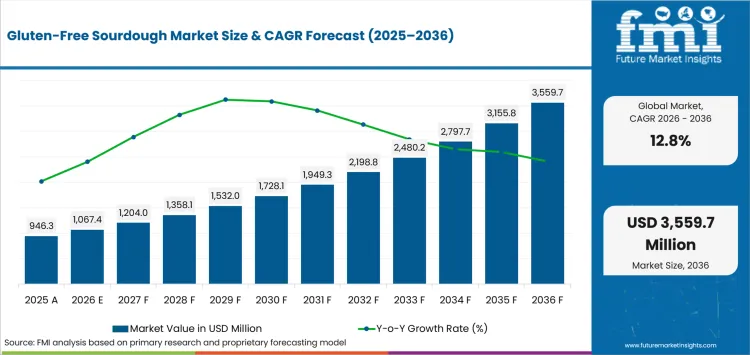
USD 1,067.4 million in 2026 and USD 3,559.7 million by 2036 at a 12.8% CAGR.
Sales of gluten-free sourdough are estimated to rise at 12.8% CAGR through 2036, increasing valuation from USD 1,067.4 million in 2026 to USD 3,559.7 million by 2036. Repeat purchase depends on credible gluten control and bread quality. In April 2025 Flowers Foods introduced Canyon Bakehouse Sourdough-Style Bread as the first nationally available gluten-free sourdough-style option. The launch raises the sensory benchmark for packaged bread.
Gulf growth depends on import registration and hospitality distribution than mature Western European demand does. Dubai Municipality stated in January 2026 that Montaji+ held more than 1.5 million registered products. The platform links registration with import and export control. Centralized records reduce filing friction for specialty imports. Cold-chain handling and claim control still raise operating cost.
Key Takeaways
- Medically necessary gluten avoidance anchors demand while repeat purchase depends on bread quality.
- By grade, standard vital gluten is estimated to hold 48.0% in 2026 owing to its standardized commercial specification.
- In 2026, conventional is expected to lead claim - nature with 62.0% share because bakers retain more ingredient flexibility.
- By format, fresh is forecast to represent 32.0% in 2026 attributable to sourdough aroma and frequent bakery replenishment.
- Cross-contact controls and finished-product verification restrict the bakery lines that can carry a credible gluten-free claim.
- Some of the key players in this market include Grupo Bimbo, Flowers Foods, Aryzta, Lantmannen Unibake, Vandemoortele, Yamazaki Baking, Warburtons, King's Hawaiian, Europastry, and St Pierre Groupe.
Analyst Perspective
"Gluten-free sourdough earns repeat shelf space only if claim control and eating quality survive the same production run. The strongest offers protect crumb softness and freshness without pushing waste or handling cost above what mainstream grocery can absorb."
- Nandini Roy Choudhury, Principal Consultant, Future Market Insights
How is the gluten-free sourdough market segmented?
The gluten-free sourdough market is segmented by grade, claim - nature, format, packaging format, sales channel and region.
Grade includes standard vital gluten, high water-absorption grade, organic and devitalized options. Claim - nature covers conventional, clean label, organic, gluten-free and high-protein - fortified positioning. Format includes fresh, frozen, ambient packaged, chilled and par-baked - thaw-and-serve. Packaging format spans multipack, single-serve, family - loaf pack and bulk foodservice. Sales channels include supermarkets & hypermarkets, artisan & specialty bakeries, convenience & forecourt, online & DTC and foodservice distributors.
What makes standard vital gluten central to the grade category?
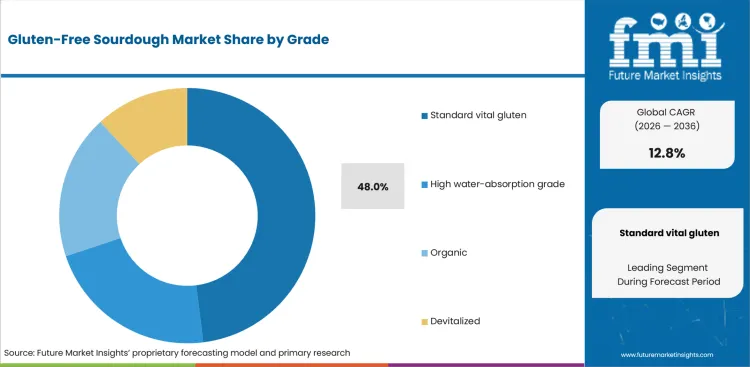
The grade axis is an upstream commercial classification. It does not mean finished gluten-free bread contains vital gluten. Bakeries comparing gluten-free bakery premixes must still qualify the finished food against its gluten threshold. Grade classification therefore stays separate from finished-product compliance.
- By grade, standard vital gluten is estimated to hold 48.0% in 2026 owing to its standardized commercial specification.
- Coeliac UK stated in its 2025 fact sheet that foods labeled gluten free may contain no more than 20 ppm of gluten.
Why does conventional lead the claim - nature category?
Conventional formulations give bakers more ingredient choices than organic or clean-label variants. The gluten-free claim still imposes the same finished-food threshold. A wider bakery ingredients set lowers formulation cost and leaves more options for texture correction. Premium claims narrow those choices.
- In 2026, conventional is expected to lead claim - nature with 62.0% share because bakers retain more ingredient flexibility.
- In January 2026 the FDA requested information on gluten disclosure and cross-contact in packaged food. The review keeps label evidence and process control relevant even without an added organic or clean-label claim.
How does fresh retain leadership in the format category?
Fresh bread carries aroma and crust directly into the purchase occasion. Gluten-free crumb can firm quickly after baking. Sourdough products gain more from short replenishment cycles than from long ambient holding. Frozen and par-baked formats solve a different inventory problem.
- By format, fresh is forecast to represent 32.0% in 2026 attributable to sourdough aroma and frequent bakery replenishment.
- Insee counted 50,122 bakery-pastry shops in France in its 2025 equipment base. The store base gives fresh bakery a broad presentation network even though gluten-free handling still requires separation.
What supports multipack leadership in packaging format?
Multipacks let households open fewer units at one time. The format extends bakery products such as rolls and buns beyond a single family loaf. Smaller packs reduce exposed bread after opening. Foodservice kitchens gain similar control during variable service periods.
- Multipack is set to lead the packaging format with 29.0% share in 2026 driven by portion control and lower opened-pack waste.
- The USA Census Bureau reported in December 2025 that 39.7 million one-person households represented 29% of all households. Smaller household structures strengthen the economic case for portioned bread packs.
Why do supermarkets & hypermarkets lead the sales channel category?
Large grocery stores place free-from bread beside mainstream bakery and frozen food during one trip. Gluten-free food brands gain routine visibility in a channel already used for weekly replenishment. Artisan bakeries offer stronger craft cues but fewer sites can maintain dedicated gluten-free controls.
- The sales channel category is forecast to be led by supermarkets & hypermarkets at 34.0% share in 2026 supported by broad free-from visibility and routine grocery replenishment.
- Insee reported in June 2026 that large general food stores represented 58.6% of French food retail value in 2025, which gives specialty bread access to high-frequency grocery traffic.
What are the drivers, restraints and opportunities in the Gluten-Free Sourdough Market?
Medically necessary gluten avoidance anchors repeat demand. Cross-contact control raises operating cost, while sourdough and format design give bakers a route to better texture and inventory economics.
- Driver: A medically anchored consumer base keeps gluten-free bread in routine household purchasing.
- Restraint: Cross-contact controls reduce scheduling flexibility on mixed bakery lines.
- Opportunity: Frozen and par-baked sourdough can extend selling time within a controlled gluten-free production system.
Gluten avoidance is non-discretionary for a defined consumer group. The Food Standards Agency reported in September 2025 that 1% of Wave 10 respondents had coeliac disease. Repeat purchase depends on sourdough flavor and texture.
Mixed bakeries bear the cost of the gluten-free claim. The Celiac Disease Foundation explained in June 2025 that FDA labeling requires less than 20 ppm of gluten. Separation and documented handling reduce scheduling flexibility for small production runs.
Frozen and par-baked formats extend the selling window beyond fresh loaves. Insee reported in June 2026 that sales volume at French small general-food and frozen-product stores rose 5.0% in 2025. Thawing or final baking must preserve crumb quality and gluten control.
Which country CAGRs are profiled in the Gluten-Free Sourdough Market?
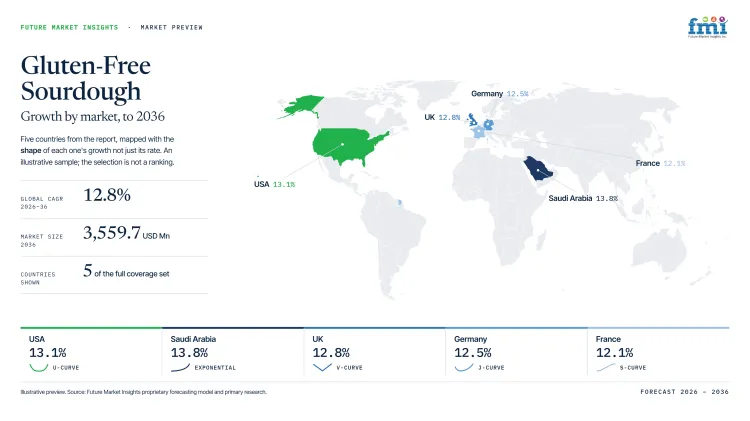
| Country | CAGR |
|---|---|
| UAE | 14.1% |
| Saudi Arabia | 13.8% |
| South Korea | 13.4% |
| USA | 13.1% |
| UK | 12.8% |
| Germany | 12.4% |
| France | 12.1% |
| Japan | 11.8% |
How do country-level CAGRs compare in the Gluten-Free Sourdough Market?
The 2.3-point spread forms three practical growth bands. UAE and Saudi Arabia lead above 13.8% as formal import systems support specialty-food channels. Germany, France and Japan form the lower band where mature bakery access shifts attention toward execution cost.
- Dubai hospitality sustains imported bakery demand through premium restaurant and hotel formats.
- Saudi modern retail widens bakery listings as supermarkets add specialist products.
- South Korean food halls refresh specialist bakery assortments at a rapid pace.
- USA bakery scale lowers distribution friction for suppliers of gluten-free sourdough.
- UK shoppers compare gluten-free loaves directly with mainstream fresh-bread options.
- Germany sets a high bread-quality bar for gluten-free sourdough products.
- French bakery density creates high trial traffic for gluten-free sourdough launches.
- Japan's mature packaged-food system moderates conversion to new gluten-free sourdough products.
Similar CAGRs do not imply similar entry economics. Channel scale and compliance cost decide retailer economics. The full report provides country-level CAGR analysis across North America, Latin America, Western Europe, Eastern Europe, East Asia, South Asia and Pacific and Middle East and Africa.
Country-wise Analysis
- Dubai requires centralized product registration before imported specialty foods enter hotel and grocery channels. Adoption of gluten-free sourdough in UAE is estimated to expand at 14.1% CAGR through 2036 driven by dense modern retail and hospitality demand. Dubai Municipality reported in February 2025 that its Unified Permit System cut food-permit service time by 75%. Frozen bakery formats give importers more time to manage customs and store replenishment. The direct enabler is faster permit handling for registered products. Cold-chain discipline and detailed claim documentation both raise operating costs for importers. Importers that pair stable thaw performance with complete product files can serve more outlets without local artisan production.
- Licensed warehouses and formal registration gate specialty-food movement into Saudi national retail. Saudi Arabia is estimated to post 13.8% CAGR over the forecast period driven by expanding regulated food infrastructure and premium bakery demand. SFDA reported in January 2026 that licensed factories and warehouses rose 18% during 2025 to 9,155 facilities. Imported bakery mixes and finished loaves still need the correct food-sector license and suitable storage. A larger licensed base gives entrants more qualified local partners. Documentation at import and warehousing stages still raises setup time. Companies with an experienced Saudi distributor can shorten launch preparation without weakening gluten-control records.
- South Korean specialty bakery imports enter a retail system that expects Korean-language information and frequent assortment changes. MFDS revised the Food Labeling Standards on April 21 2025 and allowed Korean-label stickers for certain foreign-language export foods. In South Korea, gluten-free sourdough demand is predicted to advance at 13.4% CAGR through 2036 supported by premium imported bakery and local product development. Baking enzymes can improve texture but they do not replace local label compliance. Modern grocery and department-store food halls give brands fast trial routes. Translation work and retailer-specific packaging requirements raise launch-preparation costs for imported brands. Short promotional production runs absorb these fixed compliance costs most heavily. A brand that prepares local labels early can protect launch timing and reduce relabeling waste.
- USA packaged-bread distribution gives gluten-free loaves a broad shelf base and demanding replenishment schedules. Market demand in USA is forecast to rise at 13.1% CAGR over the forecast period attributable to national grocery reach and established claim rules. USDA Economic Research Service reported in August 2026 that grocery stores captured 56.2% of USA food-at-home sales in 2025. Retailers can place allergen-free baking inputs and finished bread within familiar free-from sets. Cross-contact control remains the main operating friction for mixed-line bakery production. Products that retain softness after transport fit national replenishment better than craft loaves dependent on same-day sale. National retail chains also expect consistent production records across every approved bakery site. allergen-free baking inputs
- UK free-from bakery is concentrated in large grocery chains and specialist production sites. The UK gluten-free sourdough sector is projected to record 12.8% CAGR during the assessment period driven by strong retail visibility and dedicated free-from ranges. The Food Standards Agency found in September 2025 that 87% of respondents trusted written allergy information compared with 63% for verbal information. Clear and compliant pack copy therefore becomes a direct sales enabler for retailers. Dedicated production raises cost and makes price sensitivity the main friction. Warburtons shows that dedicated gluten-free capacity can supply national grocery. New entrants need either a clear quality premium or packaging that reduces waste without weakening the eating experience.
- German bread shoppers compare gluten-free loaves with strong expectations for crust and freshness. BZfE documented in October 2025 that oats can acquire gluten contamination during farming and processing. Gluten-free sourdough demand in Germany is forecast to rise at 12.4% CAGR over the forecast period driven by diagnosed dietary need and specialist retail. Controlled grain sourcing is a direct enabler for consistent gluten-free sourdough production. The harder problem is matching familiar bread texture after gluten removal. Brands that document raw-material control and preserve sourdough character have a clearer route into specialist and mainstream shelves. Retailers can reject a technically compliant loaf if texture falls below familiar bread standards.
- France has a dense bakery network but many outlets operate conventional wheat lines beside specialist products. Gluten-free sourdough sales in France are forecast to expand at 12.1% CAGR by 2036 attributable to strong bakery traffic and wider specialty-food availability. Insee reported in June 2026 that bakery-pastry sales volume rose 4.8% during 2025. Fresh bakery traffic gives the category a direct trial route. Mixed production raises the cost of staff training and physical separation. Centralized production can reduce that compliance burden for multi-site grocery chains significantly. Artisan bakeries need proofing and slicing procedures that protect the claim to compete on freshness. Verified handling can determine whether a good recipe scales beyond a specialist counter.
- Japanese convenience and prepared-food channels reward compact packs and detailed allergy information at the point of sale. Japan is projected to grow at 11.8% CAGR by 2036 supported by premium bakery interest and disciplined packaged-food presentation. A Consumer Affairs Agency survey published in June 2025 found that 39.9% of 654 businesses with allergy training expected more new customers. Allergen-free food offers fit a retail culture built around frequent small-format replenishment. Staff education becomes a direct enabler for safe service outside packaged retail channels. The friction is maintaining accurate dietary information in foodservice where labels are not always the main interface. Brands with concise staff guidance can reduce that gap without overloading front-line service. Allergen-free food
Who are the notable companies in the Gluten-Free Sourdough Market?
Grupo Bimbo, Flowers Foods, Aryzta, Lantmannen Unibake, Vandemoortele, Yamazaki Baking, Warburtons, King's Hawaiian, Europastry and St Pierre Groupe are the notable companies serving this market.
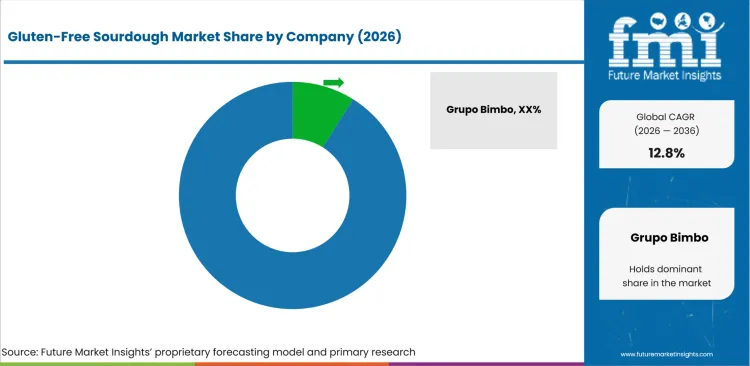
Direct gluten-free bread brands compete with frozen and packaged-bakery groups. Flowers Foods and Warburtons have direct gluten-free evidence. Aryzta and Lantmannen Unibake compete in frozen or bake-off systems. Vandemoortele and Europastry do the same. Grupo Bimbo and Yamazaki Baking enter from broader bread portfolios. King's Hawaiian and St Pierre Groupe serve specialty bread channels.
- Flowers Foods and Warburtons provide the closest fit to packaged gluten-free bread.
- Aryzta and Lantmannen Unibake supply frozen or bake-off bakery platforms. Vandemoortele and Europastry serve the same format family.
- Grupo Bimbo and Yamazaki Baking bring large bread networks. King's Hawaiian and St Pierre Groupe serve specialty bread channels.
Competitive Benchmarking: Gluten-Free Sourdough Market
| Company | Target-Product Proximity | Route-to-Market Breadth | Commercial Network Scale | Geographic Reach |
|---|---|---|---|---|
| Grupo Bimbo | Low | High | High | Global |
| Flowers Foods | High | Medium | High | United States |
| Aryzta | Medium | Medium | Medium | Europe, Asia, Australia and New Zealand |
| Lantmannen Unibake | Medium | High | High | 60+ markets |
| Vandemoortele | Medium | High | High | Europe, United States and Asia |
| Yamazaki Baking | Low | High | High | Japan with international group operations |
| Warburtons | High | Medium | Medium | United Kingdom |
| King's Hawaiian | Low | Medium | Medium | United States |
| Europastry | Medium | High | High | 90+ countries |
| St Pierre Groupe | Low | Medium | Medium | United States and Europe |
Scoring basis: High target-product proximity requires direct gluten-free bread or sourdough evidence. Medium requires frozen or bake-off bread evidence with sourdough adjacency. Low covers broader packaged or specialty bread. High route breadth requires at least three documented sales routes and Medium requires two. High network scale requires at least 20 production sites or distribution in 30+ countries. Medium covers a national or multi-country network.
Key Developments in the Gluten-Free Sourdough Market
- In January 2026, Aryzta announced a new bun bakery in Portugal to increase convenience-bakery capacity.
- In December 2025, Lantmannen Unibake signed an agreement to acquire Panificio San Francesco and extend frozen bread access in Italian retail.
- In February 2025, Vandemoortele acquired Lizzi in Italy and gained four frozen-bakery plants with bread plus focaccia production.
Key Players in the Gluten-Free Sourdough Market
Direct Gluten-Free and Sourdough Bakery Platforms
- Flowers Foods
- Warburtons
Frozen and Bake-Off Bakery Platforms
- Aryzta
- Lantmannen Unibake
- Vandemoortele
- Europastry
Packaged and Specialty Bread Platforms
- Grupo Bimbo
- Yamazaki Baking
- King's Hawaiian
- St Pierre Groupe
Gluten-Free Sourdough Market - Report Scope
| Coverage field | Report scope |
|---|---|
| Market breakdown | By grade, claim - nature, format, packaging format, sales channel and region. |
| Quantitative Units | USD million. |
| Market Definition | Commercial gluten-free sourdough bread and bakery products sold through the defined format, packaging and channel routes. |
| Regions Covered | North America, Latin America, Western Europe, Eastern Europe, East Asia, South Asia and Pacific and Middle East and Africa. |
| Countries Covered | UAE, Saudi Arabia, South Korea, USA, UK, Germany, France, Japan, and 20+ countries included in the full report. |
| Key Companies Profiled | Grupo Bimbo, Flowers Foods, Aryzta, Lantmannen Unibake, Vandemoortele, Yamazaki Baking, Warburtons, King's Hawaiian, Europastry, St Pierre Groupe. |
| Forecast Period | 2026 to 2036. |
| Approach | Primary and secondary research with market triangulation. |
Gluten-Free Sourdough Market - Research Methodology
| Method | Approach |
|---|---|
| Primary Research | FMI analysts gathered input from manufacturers, service providers, technology developers, distributors, end users, procurement teams, and subject-matter experts. Interviews examined purchasing decisions, product or service evaluation, adoption barriers, approval requirements, pricing considerations, and expectations for technical or commercial support. Respondents were also asked what evidence is required before a trial, pilot, or initial order develops into regular purchasing. |
| Desk Research | Desk research covered government statistics, regulatory publications, trade data, industry associations, technical literature, standards, company filings, product information, and official corporate announcements. Sources were reviewed for relevance, publication date, geographic coverage, and consistency with the defined market scope. Claims relating to performance, applications, approvals, capacity, investment, and commercial activity were retained only when supported by credible public evidence. |
| Market Sizing and Forecasting | The market model combined the baseline value with historical performance, segment structure, pricing and volume indicators, adoption levels, company participation, and country-level demand conditions. Forecast assumptions considered economic activity, investment trends, regulatory developments, technology adoption, purchasing cycles, supply availability, and barriers to wider market use. Segment and regional estimates were reconciled before the final market total was calculated. |
| Data Validation | Estimates were checked against multiple independent indicators, including public data, company activity, trade patterns, industry developments, and findings from primary interviews. Validation also tested whether products, services, applications, and company revenues fell within the defined market boundaries. Adjacent categories, unsupported claims, overlapping revenues, and activities without direct market relevance were excluded to reduce double counting and maintain consistency across segments and countries. |
Gluten-Free Sourdough Market by Segments
Gluten-Free Sourdough Market segmented by Grade:
- Standard vital gluten
- High water-absorption grade
- Organic
- Devitalized
Gluten-Free Sourdough Market segmented by Claim - Nature:
- Conventional
- Clean label
- Organic
- Gluten-free
- High-protein - fortified
Gluten-Free Sourdough Market segmented by Format:
- Fresh
- Frozen
- Ambient packaged
- Chilled
- Par-baked - thaw-and-serve
Gluten-Free Sourdough Market segmented by Packaging Format:
- Multipack
- Single-serve
- Family - loaf pack
- Bulk foodservice
Gluten-Free Sourdough Market segmented by Sales Channel:
- Supermarkets & hypermarkets
- Artisan & specialty bakeries
- Convenience & forecourt
- Online & DTC
- Foodservice distributors
Gluten-Free Sourdough Market by Region:
- North America
- United States
- Canada
- Latin America
- Brazil
- Mexico
- Argentina
- Chile
- Western Europe
- Germany
- France
- United Kingdom
- Italy
- Spain
- Benelux
- Nordics
- Eastern Europe
- Poland
- Czech Republic
- Romania
- Hungary
- East Asia
- China
- Japan
- South Korea
- South Asia and Pacific
- India
- ASEAN
- Australia and New Zealand
- Middle East and Africa
- GCC Countries
- South Africa
- Türkiye
- Israel
Research Sources and Bibliography
- Flowers Foods, Inc.. (2025, April 16). Flowers Foods Launches New Products and Line Expansions to Meet Consumer Needs.
- Dubai Municipality. (2026, January 26). Innovative digital food safety services at Gulfood 2026.
- Coeliac UK. (2025). Coeliac UK & coeliac disease fact sheet.
- USA Food and Drug Administration. (2026, January 21). FDA Takes Steps to Improve Gluten Ingredient Disclosure in Foods.
- Institut national de la statistique et des études économiques. (2026). Dossier complet - France entière.
- USA Census Bureau. (2025, December 2). Census Bureau Releases New Estimates on America's Families and Living Arrangements.
- Institut national de la statistique et des études économiques. (2026, June 18). Parts de marché du commerce de détail selon la forme de vente.
- Food Standards Agency. (2025, September 25). Food and You 2: Wave 10.
- Celiac Disease Foundation. (2025, June 5). Understanding the Law Behind the Gluten-Free Label.
- Institut national de la statistique et des études économiques. (2026, June 18). Le compte du commerce en 2025.
- Dubai Municipality. (2025, February 17). Latest digital food safety services showcased at Gulfood 2025.
- Saudi Food and Drug Authority. (2026, January 26). SFDA Reports 18% Growth in Licensed Factories and Warehouses During 2025.
- Ministry of Food and Drug Safety. (2025, April 21). Food Labeling Standards amendment notice (Notification No. 2025-27).
- USA Department of Agriculture, Economic Research Service. (2026, August 17). Retailing & Wholesaling - Retail Trends.
- Bundeszentrum für Ernährung. (2025, October 29). Hafer ist glutenhaltig - oder doch nicht?.
- Consumer Affairs Agency, Government of Japan. (2025, June 26). 外食・中食における食物アレルギーに関する情報提供の取組に係る実態調査報告書.
- Aryzta AG. (2026, January 22). Full year 2025 targets achieved; Revenue growth & improved performance expected in 2026; New bun bakery in Portugal.
- Lantmännen Unibake. (2025, December 23). Lantmännen Unibake signs agreement to expand in Italy.
- Vandemoortele. (2025, February 14). Vandemoortele acquires Lizzi in Italy, a specialty player in frozen Bakery.
- Grupo Bimbo. (n.d.). About us. Retrieved September 8, 2026.
- Flowers Foods, Inc.. (n.d.). Flowers Foods At-A-Glance. Retrieved September 8, 2026.
- Aryzta AG. (2026, March 2). ARYZTA AG 2025 annual results.
- Lantmännen. (2026). Annual Report with Sustainability Report 2025.
- Vandemoortele. (2026). Annual Integrated Report 2025.
- Europastry. (2025). Annual Report 2024.
- St Pierre Groupe. (n.d.). Contact. Retrieved September 8, 2026.
- Warburtons. (2026, January). Section 172 Governance Statement: Year ended 27 September 2025.
- Grupo Bimbo. (2025, September 17). GRUPO BIMBO Receives Regulatory Approval to Acquire Wickbold in Brazil.
- Aryzta AG. (2026, June 23). ARYZTA acquires French distribution business.
- Lantmännen Unibake. (2025, September 1). Lantmännen Unibake expands in savoury with acquisition of Boboli Benelux B.V..
- Vandemoortele. (2025, March 28). Vandemoortele and Délifrance intend to form a new leading player in frozen bakery.
- Aryzta AG. (2026, August 26). New Perth bakery officially opened.
- Yamazaki Baking Co., Ltd.. (2026). Non-Consolidated Results for Fiscal 2025.
- Grupo Bimbo. (2026, March 26). Inauguramos NOVABES y reforzamos nuestra apuesta por la inversión y desarrollo en El Salvador.
- Lantmännen. (2025, June 3). Lantmännen makes strategic and long-term investment in new production facility for bread.
- Vandemoortele. (2025, September 15). Mid-Year Report 2025.
This bibliography is provided for reader reference and is not exhaustive. The full report contains the complete reference list and detailed citations
This Report Answers
- How large is the gluten-free sourdough market in 2026 and what value is projected for 2036?
- What demand mechanism supports a 12.8% CAGR from 2026 to 2036?
- Why does standard vital gluten hold 48.0% of the grade classification?
- Why does conventional lead claim - nature at 62.0% in 2026?
- Why does fresh lead format at 32.0% in 2026?
- How do multipack economics and supermarket distribution shape route to market?
- Which countries show the highest forecast growth and why do their operating conditions differ?
- Which companies have direct gluten-free evidence and which compete from adjacent bakery platforms?
Frequently Asked Questions
How big is the gluten-free sourdough market in 2026?
The gluten-free sourdough market is valued at USD 1,067.4 million in 2026 and is projected to reach USD 3,559.7 million by 2036. Medically necessary gluten avoidance anchors demand while sourdough quality supports repeat purchase.
What is the CAGR of the gluten-free sourdough market from 2026 to 2036?
The gluten-free sourdough market is projected to grow at a CAGR of 12.8% between 2026 and 2036. Wider free-from distribution and better sourdough texture support repeat purchasing.
Which format leads the gluten-free sourdough market?
The fresh segment is expected to hold 32.0% of the gluten-free sourdough market in 2026 attributable to sourdough aroma and frequent bakery replenishment. Frozen and par-baked formats serve longer inventory windows.
Which countries are projected to record the highest growth in the gluten-free sourdough market?
UAE is projected to grow at 14.1% CAGR followed by Saudi Arabia at 13.8% and South Korea at 13.4% through 2036. Formal specialty-food distribution and modern retail support the faster rates.
Which companies are active in the gluten-free sourdough market?
Key companies include Grupo Bimbo and Flowers Foods alongside Aryzta and Lantmannen Unibake plus Vandemoortele and Yamazaki Baking with Warburtons and King's Hawaiian as well as Europastry and St Pierre Groupe. Direct gluten-free evidence and bakery-network reach separate their positions.
Preview the report firsthand - request a free sample
Get SampleGet the brochure for pricing and purchase details.
Get PDFTable of Content
- Key Takeaways
- Market Size and CAGR
- Top Growth Driver
- Fastest Growing Segment
- Leading Region
- Key Companies
- Emerging Opportunities
- Executive Summary
- Global Market Outlook
- Demand-side Trends
- Supply-side Trends
- Technology Roadmap Analysis
- Analysis and Recommendations
- Analyst Perspective (What is happening? Why now? What should investors know?)
- Key Questions Answered
- How large is the market?
- What is the CAGR?
- What are key trends?
- Which region dominates?
- Who are the leaders?
- Market Overview
- Market Coverage / Taxonomy
- Market Definition / Scope / Limitations
- Research Methodology
- Chapter Orientation
- Analytical Lens and Working Hypotheses
- Market Structure, Signals, and Trend Drivers
- Benchmarking and Cross-market Comparability
- Market Sizing, Forecasting, and Opportunity Mapping
- Research Design and Evidence Framework
- Desk Research Programme (Secondary Evidence)
- Expert Input and Fieldwork (Primary Evidence)
- Tooling, Models, and Reference Databases
- Data Engineering and Model Build
- Quality Assurance and Audit Trail
- Market Background
- Market Dynamics (Drivers, Restraints, Opportunity, Trends)
- Scenario Forecast (Optimistic, Likely, Conservative)
- Impact Analysis
- AI Impact
- Sustainability Impact
- Regulatory Impact
- Technology Impact
- Consumer / Buyer Analysis
- Purchase Drivers
- Adoption Barriers
- Buyer Journey
- Opportunity Map Analysis
- Product Life Cycle Analysis
- Supply Chain Analysis
- Investment Feasibility Matrix
- Value Chain Analysis
- PESTLE and Porter's Analysis
- Regulatory Landscape
- Regional Parent Market Outlook
- Production and Consumption Statistics
- Import and Export Statistics
- Global Market Analysis and Forecast, 2021 to 2036
- Historical Market Size Value (USD Million) Analysis, 2021 to 2025
- Current and Future Market Size Value (USD Million) Projections, 2026 to 2036
- Y-o-Y Growth Trend Analysis
- Absolute $ Opportunity Analysis
- Global Market Pricing Analysis, 2021 to 2036
- Global Market Analysis and Forecast, By Grade, 2021 to 2036
- Introduction / Key Findings
- Historical Market Size Value (USD Million) Analysis By Grade, 2021 to 2025
- Current and Future Market Size Value (USD Million) Analysis and Forecast By Grade, 2026 to 2036
- Standard vital gluten
- High water-absorption grade
- Organic
- Devitalized
- Standard vital gluten
- Y-o-Y Growth Trend Analysis By Grade, 2021 to 2025
- Absolute $ Opportunity Analysis By Grade, 2026 to 2036
- Global Market Analysis and Forecast, By Claim / Nature, 2021 to 2036
- Introduction / Key Findings
- Historical Market Size Value (USD Million) Analysis By Claim / Nature, 2021 to 2025
- Current and Future Market Size Value (USD Million) Analysis and Forecast By Claim / Nature, 2026 to 2036
- Conventional
- Clean label
- Organic
- Gluten-free
- High-protein / fortified
- Conventional
- Y-o-Y Growth Trend Analysis By Claim / Nature, 2021 to 2025
- Absolute $ Opportunity Analysis By Claim / Nature, 2026 to 2036
- Global Market Analysis and Forecast, By Format, 2021 to 2036
- Introduction / Key Findings
- Historical Market Size Value (USD Million) Analysis By Format, 2021 to 2025
- Current and Future Market Size Value (USD Million) Analysis and Forecast By Format, 2026 to 2036
- Fresh
- Frozen
- Ambient packaged
- Chilled
- Par-baked / thaw-and-serve
- Fresh
- Y-o-Y Growth Trend Analysis By Format, 2021 to 2025
- Absolute $ Opportunity Analysis By Format, 2026 to 2036
- Global Market Analysis and Forecast, By Packaging Format, 2021 to 2036
- Introduction / Key Findings
- Historical Market Size Value (USD Million) Analysis By Packaging Format, 2021 to 2025
- Current and Future Market Size Value (USD Million) Analysis and Forecast By Packaging Format, 2026 to 2036
- Multipack
- Single-serve
- Family / loaf pack
- Bulk foodservice
- Multipack
- Y-o-Y Growth Trend Analysis By Packaging Format, 2021 to 2025
- Absolute $ Opportunity Analysis By Packaging Format, 2026 to 2036
- Global Market Analysis and Forecast, By Sales Channel, 2021 to 2036
- Introduction / Key Findings
- Historical Market Size Value (USD Million) Analysis By Sales Channel, 2021 to 2025
- Current and Future Market Size Value (USD Million) Analysis and Forecast By Sales Channel, 2026 to 2036
- Supermarkets & hypermarkets
- Artisan & specialty bakeries
- Convenience & forecourt
- Online & DTC
- Foodservice distributors
- Supermarkets & hypermarkets
- Y-o-Y Growth Trend Analysis By Sales Channel, 2021 to 2025
- Absolute $ Opportunity Analysis By Sales Channel, 2026 to 2036
- Global Market Analysis and Forecast, By Region, 2021 to 2036
- Introduction
- Historical Market Size Value (USD Million) Analysis By Region, 2021 to 2025
- Current Market Size Value (USD Million) Analysis and Forecast By Region, 2026 to 2036
- North America
- Latin America
- Western Europe
- Eastern Europe
- East Asia
- South Asia and Pacific
- Middle East & Africa
- Market Attractiveness Analysis By Region
- North America Market Analysis and Forecast, By Country, 2021 to 2036
- Historical Market Size Value (USD Million) Trend Analysis By Market Taxonomy, 2021 to 2025
- Market Size Value (USD Million) Forecast By Market Taxonomy, 2026 to 2036
- By Country
- USA
- Canada
- By Grade
- By Claim / Nature
- By Format
- By Packaging Format
- By Sales Channel
- By Country
- Market Attractiveness Analysis
- By Country
- By Grade
- By Claim / Nature
- By Format
- By Packaging Format
- By Sales Channel
- Key Takeaways
- Latin America Market Analysis and Forecast, By Country
- Historical Market Size Value (USD Million) Trend Analysis By Market Taxonomy, 2021 to 2025
- Market Size Value (USD Million) Forecast By Market Taxonomy, 2026 to 2036
- By Country
- Brazil
- Mexico
- Chile
- Rest of Latin America
- By Grade
- By Claim / Nature
- By Format
- By Packaging Format
- By Sales Channel
- By Country
- Market Attractiveness Analysis
- By Country
- By Grade
- By Claim / Nature
- By Format
- By Packaging Format
- By Sales Channel
- Key Takeaways
- Western Europe Market Analysis and Forecast, By Country
- Historical Market Size Value (USD Million) Trend Analysis By Market Taxonomy, 2021 to 2025
- Market Size Value (USD Million) Forecast By Market Taxonomy, 2026 to 2036
- By Country
- Germany
- UK
- Italy
- Spain
- France
- Nordic
- BENELUX
- Rest of Western Europe
- By Grade
- By Claim / Nature
- By Format
- By Packaging Format
- By Sales Channel
- By Country
- Market Attractiveness Analysis
- By Country
- By Grade
- By Claim / Nature
- By Format
- By Packaging Format
- By Sales Channel
- Key Takeaways
- Eastern Europe Market Analysis and Forecast, By Country
- Historical Market Size Value (USD Million) Trend Analysis By Market Taxonomy, 2021 to 2025
- Market Size Value (USD Million) Forecast By Market Taxonomy, 2026 to 2036
- By Country
- Russia
- Poland
- Hungary
- Balkan & Baltic
- Rest of Eastern Europe
- By Grade
- By Claim / Nature
- By Format
- By Packaging Format
- By Sales Channel
- By Country
- Market Attractiveness Analysis
- By Country
- By Grade
- By Claim / Nature
- By Format
- By Packaging Format
- By Sales Channel
- Key Takeaways
- East Asia Market Analysis and Forecast, By Country
- Historical Market Size Value (USD Million) Trend Analysis By Market Taxonomy, 2021 to 2025
- Market Size Value (USD Million) Forecast By Market Taxonomy, 2026 to 2036
- By Country
- China
- Japan
- South Korea
- By Grade
- By Claim / Nature
- By Format
- By Packaging Format
- By Sales Channel
- By Country
- Market Attractiveness Analysis
- By Country
- By Grade
- By Claim / Nature
- By Format
- By Packaging Format
- By Sales Channel
- Key Takeaways
- South Asia and Pacific Market Analysis and Forecast, By Country
- Historical Market Size Value (USD Million) Trend Analysis By Market Taxonomy, 2021 to 2025
- Market Size Value (USD Million) Forecast By Market Taxonomy, 2026 to 2036
- By Country
- India
- ASEAN
- Australia & New Zealand
- Rest of South Asia and Pacific
- By Grade
- By Claim / Nature
- By Format
- By Packaging Format
- By Sales Channel
- By Country
- Market Attractiveness Analysis
- By Country
- By Grade
- By Claim / Nature
- By Format
- By Packaging Format
- By Sales Channel
- Key Takeaways
- Middle East & Africa Market Analysis and Forecast, By Country
- Historical Market Size Value (USD Million) Trend Analysis By Market Taxonomy, 2021 to 2025
- Market Size Value (USD Million) Forecast By Market Taxonomy, 2026 to 2036
- By Country
- Kingdom of Saudi Arabia
- Other GCC Countries
- Türkiye
- South Africa
- Other African Union
- Rest of Middle East & Africa
- By Grade
- By Claim / Nature
- By Format
- By Packaging Format
- By Sales Channel
- By Country
- Market Attractiveness Analysis
- By Country
- By Grade
- By Claim / Nature
- By Format
- By Packaging Format
- By Sales Channel
- Key Takeaways
- Key Countries Market Analysis
- USA
- Pricing Analysis
- Market Share Analysis, 2025
- By Grade
- By Claim / Nature
- By Format
- By Packaging Format
- By Sales Channel
- Canada
- Pricing Analysis
- Market Share Analysis, 2025
- By Grade
- By Claim / Nature
- By Format
- By Packaging Format
- By Sales Channel
- Mexico
- Pricing Analysis
- Market Share Analysis, 2025
- By Grade
- By Claim / Nature
- By Format
- By Packaging Format
- By Sales Channel
- Brazil
- Pricing Analysis
- Market Share Analysis, 2025
- By Grade
- By Claim / Nature
- By Format
- By Packaging Format
- By Sales Channel
- Chile
- Pricing Analysis
- Market Share Analysis, 2025
- By Grade
- By Claim / Nature
- By Format
- By Packaging Format
- By Sales Channel
- Germany
- Pricing Analysis
- Market Share Analysis, 2025
- By Grade
- By Claim / Nature
- By Format
- By Packaging Format
- By Sales Channel
- UK
- Pricing Analysis
- Market Share Analysis, 2025
- By Grade
- By Claim / Nature
- By Format
- By Packaging Format
- By Sales Channel
- Italy
- Pricing Analysis
- Market Share Analysis, 2025
- By Grade
- By Claim / Nature
- By Format
- By Packaging Format
- By Sales Channel
- Spain
- Pricing Analysis
- Market Share Analysis, 2025
- By Grade
- By Claim / Nature
- By Format
- By Packaging Format
- By Sales Channel
- France
- Pricing Analysis
- Market Share Analysis, 2025
- By Grade
- By Claim / Nature
- By Format
- By Packaging Format
- By Sales Channel
- India
- Pricing Analysis
- Market Share Analysis, 2025
- By Grade
- By Claim / Nature
- By Format
- By Packaging Format
- By Sales Channel
- ASEAN
- Pricing Analysis
- Market Share Analysis, 2025
- By Grade
- By Claim / Nature
- By Format
- By Packaging Format
- By Sales Channel
- Australia & New Zealand
- Pricing Analysis
- Market Share Analysis, 2025
- By Grade
- By Claim / Nature
- By Format
- By Packaging Format
- By Sales Channel
- China
- Pricing Analysis
- Market Share Analysis, 2025
- By Grade
- By Claim / Nature
- By Format
- By Packaging Format
- By Sales Channel
- Japan
- Pricing Analysis
- Market Share Analysis, 2025
- By Grade
- By Claim / Nature
- By Format
- By Packaging Format
- By Sales Channel
- South Korea
- Pricing Analysis
- Market Share Analysis, 2025
- By Grade
- By Claim / Nature
- By Format
- By Packaging Format
- By Sales Channel
- Russia
- Pricing Analysis
- Market Share Analysis, 2025
- By Grade
- By Claim / Nature
- By Format
- By Packaging Format
- By Sales Channel
- Poland
- Pricing Analysis
- Market Share Analysis, 2025
- By Grade
- By Claim / Nature
- By Format
- By Packaging Format
- By Sales Channel
- Hungary
- Pricing Analysis
- Market Share Analysis, 2025
- By Grade
- By Claim / Nature
- By Format
- By Packaging Format
- By Sales Channel
- Kingdom of Saudi Arabia
- Pricing Analysis
- Market Share Analysis, 2025
- By Grade
- By Claim / Nature
- By Format
- By Packaging Format
- By Sales Channel
- Türkiye
- Pricing Analysis
- Market Share Analysis, 2025
- By Grade
- By Claim / Nature
- By Format
- By Packaging Format
- By Sales Channel
- South Africa
- Pricing Analysis
- Market Share Analysis, 2025
- By Grade
- By Claim / Nature
- By Format
- By Packaging Format
- By Sales Channel
- USA
- Market Structure Analysis
- Competition Dashboard
- Competition Benchmarking
- Market Share Analysis of Top Players
- By Regional
- By Grade
- By Claim / Nature
- By Format
- By Packaging Format
- By Sales Channel
- Emerging Startups
- Innovation Benchmarking
- Competition Analysis
- Competition Deep Dive
- Grupo Bimbo
- Overview
- Product Portfolio
- Profitability by Market Segments
- Sales Footprint
- Strategy Overview
- Marketing Strategy
- Product Strategy
- Channel Strategy
- Flowers Foods
- Aryzta
- Lantmannen Unibake
- Vandemoortele
- Yamazaki Baking
- Warburtons
- King's Hawaiian
- Europastry
- St Pierre Groupe
- Grupo Bimbo
- Case Studies
- Success Stories
- Recent Developments
- Competition Deep Dive
- Assumptions & Acronyms Used


