

- Market Size (2026)
- USD 538.5 Mn
- Forecast (2036)
- USD 1334.5 Mn
- CAGR (2026 to 2036)
- 9.5%
How big is Hawaiian Sweet Rolls Market in 2026?
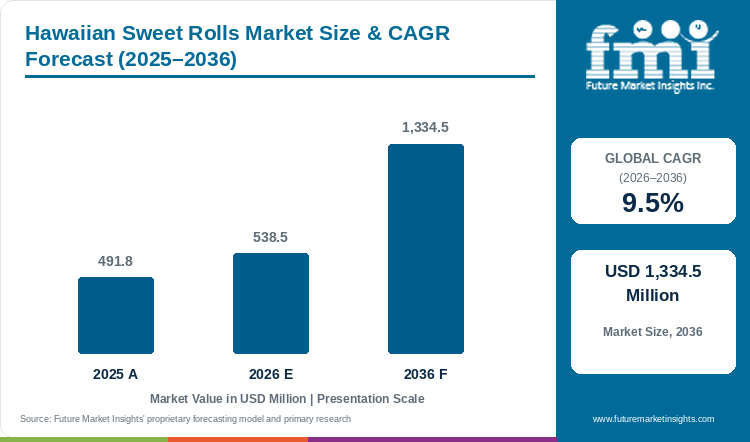
The global Hawaiian sweet rolls market establishes its foundation at USD 491.8 million in 2025, advances to USD 538.5 million in 2026, and is forecast to scale to USD 1,334.5 million by 2036 at a CAGR of 9.5%.
Consumer demand for Hawaiian sweet rolls has expanded beyond fourth-quarter holiday dinner baskets into year-round everyday meals, driven by the popularity of hot party sliders and quick breakfast sandwiches. Because one pull-apart tray serves multiple meal occasions for both families and casual-dining restaurants, the global Hawaiian sweet rolls market size grows from a 2025 baseline of USD 491.8 million to an estimated USD 538.5 million in 2026 and reaches USD 1,334.5 million by 2036 on a 9.5% CAGR, creating USD 796.0 million in net industry expansion. To serve this rising volume without supply bottlenecks, the Office of the Governor of Georgia announced in July 2025 that King's Hawaiian will invest USD 54 million to install an additional production line at its 150,000-square-foot Hall County bakery in Oakwood [1]. In 2026, Classic / Original rolls are projected to hold 33.0% of product-type demand as producers blend clean-label sweetener syrups into enriched wheat doughs, although mandatory egg-and-milk allergen rules and tray crushing during transit continue to restrain supplier margins.
Key Market Trends & Insights
- By product type: In 2026, Classic / Original is projected to hold 33.0% of product-type volume, attributable to dual usage across hot pulled-pork sliders and family holiday dinner baskets.
- By claim / nature: Conventional is anticipated to capture 51.0% across claim / nature in 2026, supported by traditional egg-and-butter sweet dough chemistry that delivers signature pull-apart tenderness.
- By format: Fresh is forecast to command 33.0% of format volume in 2026, driven by immediate table-ready softness in supermarket deli-bakery islands without consumer thawing steps.
- By packaging format: Multipack is expected to secure 34.0% across packaging formats in 2026, resulting from 12-count pull-apart paperboard trays and 4-count small-household packs.
- By sales channel: In 2026, Supermarkets & hypermarkets are estimated to generate a 34.0% channel share, reinforced by cross-merchandising beside rotisserie chickens and deli sliders.
Regional Highlights
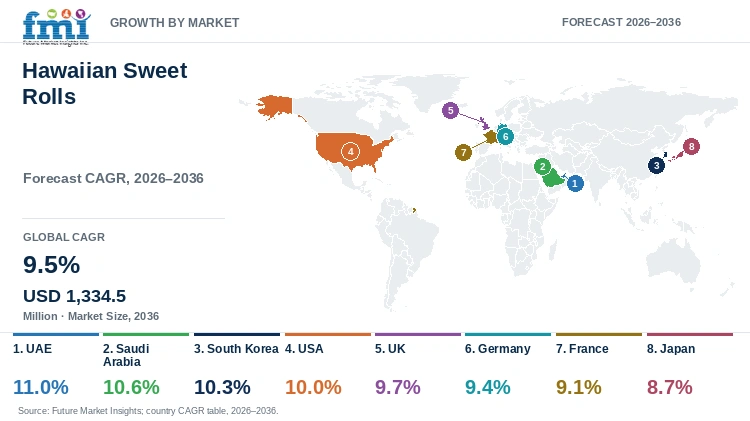
- Middle East hospitality momentum: The UAE paces profiled national markets on an 11.0% compound annual rate to 2036 while Saudi Arabia follows at 10.6%, fueled by resort brunch buffets and modern hypermarket bakery sections.
- East Asian and Western retail scaling: South Korea posts a 10.3% CAGR through 2036 above the USA at 10.0% and the UK at 9.7%, whereas Germany logs 9.4% and France records 9.1% ahead of Japan at 8.7% via specialty retail and slider foodservice.
Market Size & Forecast
Table 1: Market Size and Forecast for the Hawaiian Sweet Rolls Market (USD million and CAGR percentage), 2025 to 2036
| Metric | Value |
|---|---|
| 2025 Market Size | USD 491.8 million |
| Estimated Market Size in 2026 | USD 538.5 million |
| Projected Market Size by 2036 | USD 1,334.5 million |
| CAGR, 2026 to 2036 | 9.5% |
| Added Revenue, 2026 to 2036 | USD 796.0 million |
Casual-dining restaurant chains and banquet caterers are adopting sweet pull-apart rolls as signature slider carriers to differentiate their menus and raise check averages. To serve high dining volume without slowing down kitchen line cooks, foodservice buyers are shifting orders toward factory pre-sliced sweet roll sheets. This foodservice demand is supported by June 2026 data from the USDA Economic Research Service showing that USA away-from-home food spending reached USD 1.41 trillion out of USD 2.51 trillion in total 2025 food expenditure [2]. To capture a larger share of this restaurant spending, commercial bakeries formulate pre-sliced 24-count sweet roll trays with specialty baking ingredients that keep bottom buns from turning soggy under hot barbecue and burger fillings. As a result, suppliers that pair pre-sliced convenience with long frozen-to-ambient slack-out windows are winning national foodservice distributor contracts.
Pull-Apart Tray Volume and Bakery Capacity Sizing
Table 2: Pull-Apart Tray Volume and Enriched Bakery Production Sizing for the Hawaiian Sweet Rolls Market (USD million and operational ranges), 2025 to 2036
| Metric | 2025 | 2026 | 2036 |
|---|---|---|---|
| Market size (USD million) | 491.8 | 538.5 | 1,334.5 |
| Commercial sweet-roll tray volume (million 12-roll equivalents) | 168.0 to 182.0 | 182.5 to 198.0 | 418.0 to 454.0 |
| Enriched sweet-dough output (thousand metric tons) | 57.1 to 61.9 | 62.1 to 67.3 | 142.1 to 154.4 |
| Average wholesale price per 12-roll tray equivalent (USD) | 2.70 to 2.93 | 2.72 to 2.95 | 2.94 to 3.19 |
Operational note: Tray equivalents standardize 4-count retail packs, 12-count pull-apart paperboard trays, and 24-count club or foodservice sheets into 340-gram dozen-roll units.
A major variable governing retailer adoption of Hawaiian sweet rolls is how long a thawed tray retains its signature pillowy softness on unrefrigerated perimeter display tables. Because many sweet rolls are shipped frozen to grocery warehouses and slacked out at the store, any rapid crumb firming leads to consumer rejection and costly store markdowns. To solve this shelf-life challenge, industrial bakers are incorporating phospholipase baking enzymes that preserve soft crumb bounce across 14-day retail display windows, which directly boosts grocer reorder rates.
Per Capita & Retail-Foodservice Channel Sizing
Table 3: Per Capita and Grocery-Deli Merchandising Indicators for the Hawaiian Sweet Rolls Market (USD), 2025 to 2036
| Metric | 2025 | 2026 | 2036 |
|---|---|---|---|
| Global population (billion) | 8.2 | 8.3 | 9.0 |
| Market value per 1,000 people (USD) | 60.0 | 64.9 | 148.3 |
| Annual sweet-roll turnover per supermarket bakery table (USD) | 3,150 to 3,620 | 3,380 to 3,890 | 6,420 to 7,350 |
| Pre-sliced slider & foodservice pack share (%) | 28.5% to 31.5% | 30.0% to 33.0% | 38.5% to 42.5% |
Table 4: Supermarket & Foodservice Merchandising Indicators for the Hawaiian Sweet Rolls Market (USD and percentages), 2026
| Metric | Value | Institutional Reference Basis |
|---|---|---|
| Market size, 2026 | USD 538.5 million | 2026 global finished sweet-roll baseline |
| Supermarket deli-bakery & QSR slider accounts globally | 148,000 outlets | Modern grocery perimeter & casual-dining registry |
| Average annual sweet-roll procurement per outlet | USD 3,638.5 | Annualized wholesale tray and case expenditure |
| Supermarkets & hypermarkets allocation, 2026 | USD 183.1 million | 34.0% primary sales-channel share allocation |
Because Hawaiian sweet rolls have a delicate, high-sugar crust that bruises easily during warehouse stacking, package durability directly impacts retail sell-through. Crushed or flattened roll tops deter impulse buyers browsing supermarket deli islands. To protect visual appeal and reduce damaged-pack credits, producers bake pull-apart grids using high-protein specialty bread flours inside rigid flanged paperboard trays that withstand pallet shipping and stack cleanly on promotional end-caps.
Analyst Perspective
"Consumer recognition of soft island-style sweet bread is already established, so repeat retail and foodservice orders hinge on maintaining pillowy crumb resilience after cold-chain transit and ambient shelf display. Bakery brands that pair right-sized four-count and twelve-count trays with pre-sliced foodservice packs will capture high-margin display space without markdown shrink."
- Nandini Roy Choudhury, Principal Consultant, Future Market Insights.
How is the hawaiian sweet rolls market segmented?
The hawaiian sweet rolls market is segmented by product type, claim / nature, format, packaging format, and sales channel. In 2026, Classic / Original is projected at 33.0%, Conventional at 51.0%, Fresh at 33.0%, Multipack at 34.0%, and Supermarkets & Hypermarkets at 34.0%.
By product type: Classic / Original, Whole Grain & Seeded, Flavored & Filled, Mini & Snacking Formats, and Premium / Artisan.
By claim / nature: Conventional, Clean Label, Organic, Gluten-Free, and High-Protein / Fortified.
By format: Fresh, Frozen, Ambient Packaged, Chilled, and Par-Baked / Thaw-and-Serve.
By packaging format: Multipack, Single-Serve, Family / Loaf Pack, and Bulk Foodservice.
By sales channel: Supermarkets & Hypermarkets, Artisan & Specialty Bakeries, Convenience & Forecourt, Online & DTC, and Foodservice Distributors.
Why does Classic / original anchor Product Type demand?
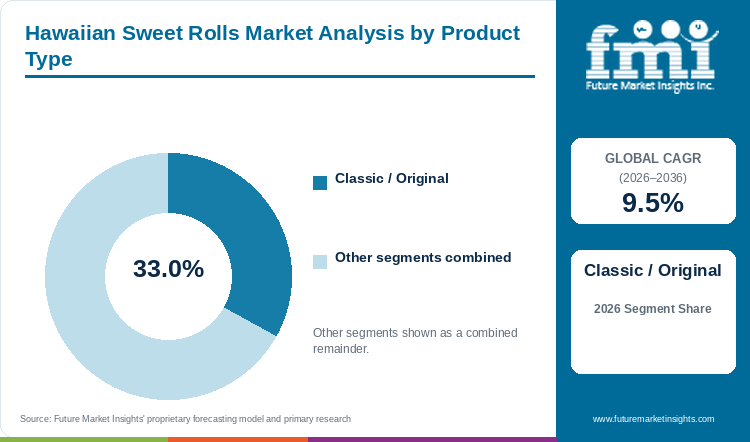
In 2026, Classic / Original is projected to hold 33.0% of product-type volume through dinner-table and slider versatility.
Table 5: Product Type Share for the Hawaiian Sweet Rolls Market (percentage share), 2026
| Product Type | Share (2026) |
|---|---|
| Classic / Original | 33.0% |
| Other Segments Combined* | 67.0% |
| Total | 100.0% |
*Calculated as the balance remaining after deducting the leading segment's reported share from 100.0%.
Table 6: Product Type Leadership and Market Growth for the Hawaiian Sweet Rolls Market (segment and CAGR percentage), 2026 to 2036
| Metric | Value |
|---|---|
| Global CAGR (2026 to 2036) | 9.5% |
| Leading Segment | Classic / Original |
Retail grocery buyers and restaurant chains concentrate their core orders in the Classic / Original segment because its balanced sweet-and-buttery flavor appeals to both children and adults across dinner and sandwich occasions. Unlike niche seasonal flavors that face steep post-holiday markdowns, the classic sweet roll maintains steady weekly scan velocity year-round. To keep repeat buyers satisfied while meeting clean-label expectations, bakeries maintain consistent golden crust color and island-style aroma using natural food flavorings and liquid whole eggs.
- USDA Economic Research Service Food Price Outlook tables published in September 2026 indicate that wholesale egg prices in the USA are forecast to fall 29.4% in 2026 as commercial laying flocks recover [3].
- At a projected 33.0% share in 2026, Classic / Original leads the product type mix, enabled by year-round household repeat purchases across dinner and party occasions.
What supports Conventional as the leading Claim / Nature?
Sweet-dough buyers keep Conventional recipes at an anticipated 51.0% share across claim / nature in 2026, supported by enriched-dough tenderness.
Conventional formulations account for the majority of category sales because achieving the signature cotton-soft pull-apart texture of Hawaiian bread requires enriched wheat flour and whole eggs combined with dairy butter and bulk nutritive sweeteners. When bakers replace these conventional inputs with organic or allergen-free substitutes, ingredient costs rise and the crumb often becomes denser. Because mainstream grocery shoppers prioritize softness and everyday affordability, major bread companies are expanding their conventional Hawaiian-style lines. In April 2025, Flowers Foods broadened its retail assortment with Nature's Own Hawaiian Small Loaf and specialty sandwich rolls to capture budget-conscious households seeking sweet-bread flavors [4].
- Lower ingredient qualification costs keep Conventional recipes at an anticipated 51.0% share within the 2026 claim / nature mix across retail and catering accounts.
- Whole-egg and dairy-butter sponge systems deliver soft crumb spring without requiring expensive hydrocolloid or allergen-free line segregation.
How does Fresh retain its advantage within Format?
Perimeter bakery shoppers give Fresh formats a forecast 33.0% share in 2026, owing to immediate table readiness.
Fresh format leadership is driven by consumer buying behavior in the supermarket bakery aisle, where shoppers routinely squeeze the package to check for pillowy softness before placing a tray in their cart. Ready-to-eat ambient rolls also allow households and deli counters to assemble sliders immediately without waiting for frozen bread to thaw. To preserve this fresh-baked softness across multi-state delivery routes, bakeries combine moisture-retaining syrups and functional quinoa seed ingredients with high-barrier flow-wrap film.
- Under Edition 5 allergen rules published by the U.S. Food and Drug Administration in January 2025, enriched bakery trays must display clear wheat and egg allergen declarations alongside milk disclosures [5].
- Fresh is forecast to command a 33.0% share within formats in 2026, supported by impulse perimeter table placement and zero home defrosting wait time.
Why does Multipack lead Packaging Format?
Twelve-count paperboard trays help Multipack secure an expected 34.0% packaging share in 2026, attributable to shared family slider servings.
Demand for Hawaiian sweet rolls is inherently tied to shared family dinners and party slider platters, making multi-roll trays the natural purchasing unit for grocery shoppers. Baking 12 or 24 dough balls together as an interconnected pull-apart grid inside a paperboard tray also locks moisture into the side walls of each roll and lowers packaging cost per unit. Tracking this household meal dynamic, September 2026 Family Food FYE 2025 statistics from UK Defra across 4,998 surveyed households highlight how families consolidate bakery purchases into multi-serving packs for home dining [6]. By offering both 12-count family trays and 4-count small-household multipacks, brands maximize shelf turnover across diverse demographics.
- Multipack is expected to secure a 34.0% share across packaging formats in 2026, reinforced by interconnected pull-apart tray baking that locks in side-wall moisture.
- Clustered tray geometry reduces per-roll overwrap film consumption while matching household dinner and party slider platter counts.
Why are Supermarkets & hypermarkets the primary Sales Channel?
Retail adoption trends place Supermarkets & hypermarkets at an estimated 34.0% channel share in 2026 via perimeter deli-island displays.
Supermarkets and hypermarkets dominate category distribution because perimeter deli-island displays allow grocers to cross-merchandise sweet roll trays directly beside rotisserie chickens and sliced deli cheeses. This meal-solution placement turns Hawaiian sweet rolls into an unplanned impulse purchase during routine weekly grocery trips, while seasonal holiday and summer barbecue end-caps drive multi-tray household stock-up.
- In June 2026, Grupo Bimbo reported that 100% of its daily consumption loaves and sandwich rolls across retail supermarket channels are free from artificial colors [7].
- Supermarkets & hypermarkets are estimated to generate a 34.0% share within sales channels in 2026, stemming from perimeter cross-merchandising and high weekly shopper frequency.
What are the drivers, restraints, and opportunities in the hawaiian sweet rolls market?
Versatile slider and family-dinner occasions fuel Hawaiian sweet roll demand, whereas short ambient softness windows and mandatory egg-and-milk allergen rules restrain expansion and localized four-count and pre-sliced foodservice packs create growth opportunities.
- Driver: Cross-occasion versatility spanning party sliders and breakfast sandwiches through holiday dinner baskets sustains high repeat purchase velocity.
- Restraint: Rapid crumb firming during cold-chain transit and strict wheat or egg and dairy allergen labeling rules elevate export qualification costs.
- Opportunity: Right-sized four-count packs for small urban households and pre-sliced 24-count foodservice trays expand international retail and restaurant placement.
Growth Analysis and Future Potential: Slider Carrier Adoption and Cross-Daypart Menu Versatility
The shift of lightly sweet pull-apart rolls from a holiday side dish to an all-day carrier for breakfast egg sliders and evening burger platters is the primary growth driver for the market. Because a single sweet-roll SKU works across multiple meal dayparts without extra kitchen prep, restaurants and grocers achieve much faster inventory turnover than with specialty seasonal breads. To capture this rising international demand for soft enriched carriers, industrial bakers are adding dedicated production lines. In March 2026, Europastry invested EUR 38 million at its Azuqueca de Henares facility to install a new brioche line as 2025 company sales climbed 8% to EUR 1.63 billion [8]. Producers that stabilize these high-speed doughs with bakery ingredient systems can supply uniform slider buns to global restaurant chains.
Risk Assessment of the Hawaiian Sweet Rolls Market: Allergen Compliance and Crumb Compression Loss
High sugar content and the presence of wheat and whole-egg or milk allergens represent major factors restraining the expansion of Hawaiian sweet rolls into health-focused and institutional channels. Because enriched sweet doughs contain elevated sugar and saturated fat from butter, suppliers face strict limits on front-of-pack nutritional marketing. Under European Commission nutrition and health claim rules, bakery products must meet strict nutrient-profile rules and authorized claim registers before displaying health statements [9]. In addition, improper thawing of frozen sweet-roll trays causes moisture condensation that collapses the soft crumb and forces retailers to write off damaged stock, prompting bakers to use integrated food stabilizer systems to protect freeze-thaw quality.
Commercial Opportunity Analysis: Small-Household Pack Architecture and Gluten-Free Enriched Variants
Tailoring pack sizes for single and two-person urban households while developing allergen-friendly sweet rolls offers a major commercial opportunity for international market expansion. While 12-count and 24-count trays perform well in suburban North America, urban shoppers in Europe and East Asia often avoid large packs that might go stale before being finished. At the same time, retailers are expanding shelf space for convenient and dietary-inclusive bakery items. In October 2026, UK grocery sector findings from USDA Foreign Agricultural Service economists put national food retail turnover at USD 343 billion in 2026 amid strong shopper demand for convenience and free-from bakery lines [10]. By launching four-count snack trays and pairing enriched-style recipes with packaged gluten-free food lines, bakeries can open urban convenience stores and free-from grocery aisles.
Hawaiian Sweet Rolls Market by Country (2026 to 2036)
International adoption patterns show the UAE pacing national Hawaiian sweet rolls growth on an 11.0% compound annual rate until 2036, while Japan posts an 8.7% yearly expansion. Commercial conversion across Gulf hypermarkets, East Asian bakery cafés, and Western grocery chains depends on bilingual allergen labeling and localized tray counts.
Table 7: Country CAGR and Primary Growth Levers for the Hawaiian Sweet Rolls Market (CAGR percentage and operational drivers), 2026 to 2036
| Country | CAGR (2026 to 2036) | Primary Growth Lever |
|---|---|---|
| UAE | 11.0% | International tourism hospitality buffets and municipality-registered gourmet grocery imports |
| Saudi Arabia | 10.6% | Modern supermarket bakery expansion and Arabic-labeled family sharing multipacks |
| South Korea | 10.3% | Urban bakery-café slider menus and convenience-store sweet bread adoption |
| USA | 10.0% | National perimeter grocery distribution, club twin-packs, and Hall County capacity expansion |
| UK | 9.7% | Supermarket brioche-adjacent slider merchandising and PPDS allergen-compliant packs |
| Germany | 9.4% | Casual-dining burger and brunch slider adoption differentiating from traditional crusty bread |
| France | 9.1% | Supermarket viennoiserie aisle placement and hospitality slider catering |
| Japan | 8.7% | Metropolitan premium supermarket import rollouts and four-count small-household packs |
Source: Future Market Insights analysis
UAE Hawaiian Sweet Rolls Market Outlook (2026 to 2036)
Unlike mature retail markets, the UAE is driven by luxury hotel brunch buffets and expatriate gourmet supermarkets that rely on imported frozen sweet-roll trays. In January 2026, the Dubai Department of Economy and Tourism reported that Dubai welcomed a record 19.59 million international overnight visitors in 2025, a 5% annual increase that directly boosts hospitality bakery orders [11]. Consequently, Hawaiian sweet roll demand in the UAE posts an 11.0% compound annual growth rate over 2026 to 2036 across major emirate resort and retail hubs. However, strict municipal food-import registration and cold-chain slack-out control remain essential gateways, rewarding suppliers that ship pre-sliced frozen trays with bilingual Arabic labels.
Key takeaway: In the UAE, record international visitor catering and gourmet supermarket listings are projected to accelerate adoption of pre-sliced Hawaiian sweet roll trays.
Saudi Arabia Hawaiian Sweet Rolls Market Outlook (2026 to 2036)
In Saudi Arabia, large multi-generational family gatherings and a young population adopting Western-style casual burger and slider dining make 12-count and 24-count pull-apart trays highly attractive. Commercial sales of Hawaiian sweet rolls in Saudi Arabia register a 10.6% annual growth rate across the decade to 2036 supported by Riyadh and Jeddah hypermarkets expanding perimeter bakery islands. Confirming this retail import momentum, August 2026 Riyadh trade reporting compiled by USDA Foreign Agricultural Service staff shows food retail sales in Saudi Arabia expanding to USD 57 billion in 2025 as USA retail food shipments hit a record USD 666.3 million [12]. However, exporters must provide halal-certified egg-and-butter documentation and primary Arabic ingredient panels to clear customs.
Key takeaway: In Saudi Arabia, modern hypermarket growth and family meal gatherings are expected to propel demand for Arabic-labeled 12-count and 24-count sweet roll packs.
South Korea Hawaiian Sweet Rolls Market Outlook (2026 to 2036)
South Korea differs from Western family-tray markets because its high proportion of single-person urban households and trend-driven bakery cafés favor compact pack sizes and warm café slider menus. Hawaiian sweet roll turnover in South Korea logs a 10.3% yearly growth rate across 2026 to 2036 owing to coffee and bakery chains introducing egg-and-bacon breakfast sliders on pillowy sweet buns. According to the October 2026 USDA Foreign Agricultural Service retail annual for South Korea, rising single-person household demand for convenient meals lifted imports of USA consumer-oriented foods to USD 6.0 billion in 2025 [13]. However, large 12-count bags face slow household turnover, so brands win retail listings with four-count trays.
Key takeaway: In South Korea, specialty café breakfast menus and urban convenience dining are forecast to accelerate adoption of compact four-count and foodservice Hawaiian sweet rolls.
USA Hawaiian Sweet Rolls Market Outlook (2026 to 2036)
Because Hawaiian sweet rolls are already a household staple across the USA, future market expansion depends on shifting consumption from seasonal holiday dinners to year-round barbecue sliders and flavor extensions. Commercial volume in the USA records a 10.0% compound annual rate until 2036 through domestic producers expanding perimeter deli-island cross-merchandising and pre-sliced foodservice cases. In February 2025, St Pierre Trade expanded its USA retail activation through the Eat Avec Respect campaign to capture perimeter bakery shoppers trading up to sweet enriched sandwich carriers [14]. While strong brand recognition supports rapid trial of new pretzel and tropical variants, intense competition for supermarket perimeter table space requires high weekly scan velocity.
Key takeaway: In the USA, perimeter grocery cross-merchandising and expanded domestic baking capacity are anticipated to sustain double-digit growth across retail and foodservice sweet-roll packs.
UK Hawaiian Sweet Rolls Market Outlook (2026 to 2036)
In the UK, widespread shopper familiarity with sweet brioche buns lowers the barrier to trial for Hawaiian sweet rolls, but strict allergen and sugar regulations challenge in-store bakery handling. Under UK Food Standards Agency allergen guidance updated in July 2026 for direct-sale bakery goods, supermarket counters and packaged roll suppliers must emphasize wheat and egg or milk allergens clearly on labels [15]. Because factory-packaged trays simplify allergen compliance for grocers, commercial volume across the UK achieves a 9.7% yearly clip through 2036 across supermarket barbecue and deli sections. Suppliers that position 12-count pull-apart trays as summer grilling and family slider buns capture steady repeat orders.
Key takeaway: In the UK, consumer affinity for enriched slider buns and supermarket perimeter merchandising are estimated to support steady retail expansion for Hawaiian sweet rolls.
Germany Hawaiian Sweet Rolls Market Outlook (2026 to 2036)
Germany presents a distinct challenge for sweet pull-apart rolls because everyday household meals are anchored in crusty rye and artisan loaves, while discount grocers enforce tight retail price ceilings. Consequently, Hawaiian sweet roll sales in Germany log a 9.4% compound annual pace until 2036 by targeting casual burger restaurants and seasonal supermarket barbecue promotions rather than daily table-bread replacement. In September 2025, USDA Foreign Agricultural Service analysts recorded annual retail grocery store sales in Germany of USD 293 billion across national discount and full-line supermarket chains [16]. To overcome retail price resistance, suppliers focus on frozen thaw-and-serve slider trays that help gastro-pubs cut kitchen prep labor.
Key takeaway: In Germany, casual-dining slider menus and seasonal supermarket barbecue promotions are predicted to drive targeted adoption of thaw-and-serve Hawaiian sweet rolls.
France Hawaiian Sweet Rolls Market Outlook (2026 to 2036)
In France, deeply ingrained daily purchasing of fresh artisan baguettes means Hawaiian sweet rolls cannot compete as standard table bread and must instead win space in the hypermarket viennoiserie and burger-bun aisle. Commercial retail and foodservice turnover for Hawaiian sweet rolls in France registers a 9.1% yearly growth rate to 2036 amid fast-casual burger chain and suburban hypermarket expansion. Reinforcing this retail channel route, September 2026 figures from the USDA Foreign Agricultural Service show that large grocery retailers in France held 58.6% of 2025 food sales compared with 20.4% for specialized food stores [17]. Positioning pull-apart sweet rolls for weekend apéritif sliders and children's snacks drives supermarket adoption.
Key takeaway: In France, hypermarket viennoiserie merchandising and fast-casual slider chains are slated to sustain demand for enriched pull-apart Hawaiian sweet rolls.
Japan Hawaiian Sweet Rolls Market Outlook (2026 to 2036)
Japan offers strong cultural affinity for Hawaiian island cuisine, yet domestic consumers already buy ultra-soft shokupan milk bread daily and live in compact urban households with limited storage space. Hawaiian sweet roll sales in Japan post an 8.7% decadal growth rate to 2036 across metropolitan Tokyo and Osaka gourmet supermarkets stocking imported and licensed pull-apart packs. In September 2026, Tokyo market figures compiled by USDA Foreign Agricultural Service researchers showed retail food and beverage receipts in Japan reaching USD 286 billion across 2025 as supermarkets expanded ready-to-eat meal lines [18]. However, ocean cold-chain freight costs and staling sensitivity mean suppliers must rely on affordable four-count trays to drive repeat purchases.
Key takeaway: In Japan, metropolitan gourmet supermarket distribution and four-count small-household tray formats are projected to convert resort brand awareness into repeat retail purchases.
Full report country CAGRs cover: North America; Latin America; Western Europe; Eastern Europe; East Asia; South Asia and Pacific; Middle East and Africa.
Who are the notable companies in the hawaiian sweet rolls market?
Grupo Bimbo, Flowers Foods, Aryzta, Lantmannen Unibake, Vandemoortele, Yamazaki Baking, Warburtons, King's Hawaiian, Europastry, and St Pierre Groupe are the notable companies in the hawaiian sweet rolls market.
Market participation separates dedicated Hawaiian sweet-roll brand owners from multinational packaged-bread groups and frozen brioche-and-soft-roll manufacturers. Category pioneer King's Hawaiian anchors branded perimeter grocery tables and pre-sliced foodservice cases, whereas large bakery groups compete through Hawaiian-flavored soft loaves and thaw-and-serve brioche slider buns.
- Direct Hawaiian Sweet-Roll Brand: King's Hawaiian operates dedicated sponge-fermentation bakeries supplying retail pull-apart trays and pre-sliced foodservice packs.
- Packaged and Specialty Soft-Bread Participants: Flowers Foods and Grupo Bimbo market Hawaiian-style and brioche soft rolls with St Pierre Groupe, while Warburtons and Yamazaki Baking anchor UK and Japan retail channels.
- Frozen and Foodservice Roll Platforms: Lantmannen Unibake and Aryzta coupled with Europastry and Vandemoortele supply blast-frozen enriched buns and dinner rolls to hospitality accounts.
Competitive Benchmarking: Hawaiian Sweet Rolls Market
Table 8: Competitive Benchmarking for the Hawaiian Sweet Rolls Market (qualitative capability ratings), 2026
| Company | Hawaiian-Style SKU Evidence | Enriched Soft-Roll Range | Retail / Foodservice Access | Geographic Reach |
|---|---|---|---|---|
| Grupo Bimbo | High | High | High | High |
| Flowers Foods | High | High | High | Medium |
| Aryzta | Medium | High | High | High |
| Lantmannen Unibake | High | High | High | High |
| Vandemoortele | Medium | High | Medium | Medium |
| Yamazaki Baking | High | High | High | Medium |
| Warburtons | Medium | Medium | Medium | Medium |
| King's Hawaiian | High | High | High | High |
| Europastry | High | High | High | High |
| St Pierre Groupe | High | High | High | High |
Scoring basis: Qualitative ratings review verified Hawaiian sweet-roll and enriched brioche/dinner-roll SKU breadth, extended ambient or freeze-thaw crumb softness engineering, and multi-count tray distribution.
Key Developments in the Hawaiian Sweet Rolls Market
- Second-quarter 2026 financial results from Flowers Foods in August 2026 showed net sales of USD 1.193 billion supported by expanded distribution for its relaunched Nature's Own portfolio [19].
- During July 2025, Grupo Bimbo pledged to phase out synthetic colorings across all global bakery brands before late 2026 while keeping 99% of daily loaves and sandwich rolls free from artificial flavors [20].
- Full-year 2025 results released by Vandemoortele in March 2026 recorded a 10% rise in Bakery Products revenue to EUR 1,500 million after acquiring Lizzi and Délifrance [21].
Key Players in the Hawaiian Sweet Rolls Market
Direct Hawaiian Sweet-Roll Brand
- King's Hawaiian
Packaged and Specialty Soft-Bread Participants
- Grupo Bimbo
- Flowers Foods
- Yamazaki Baking
- Warburtons
- St Pierre Groupe
Frozen and Foodservice Roll Platforms
- Aryzta
- Lantmannen Unibake
- Vandemoortele
- Europastry
Hawaiian Sweet Rolls Market - Report Scope
Table 9: Report Scope for the Hawaiian Sweet Rolls Market (coverage fields and definitions), 2026 to 2036
| Coverage field | Report scope |
|---|---|
| Market breakdown | Product Type; Claim / Nature; Format; Packaging Format; Sales Channel |
| Quantitative Units | USD Million |
| Market Definition | Includes commercial manufacturer revenue from finished Hawaiian-style sweet pull-apart rolls, slider rolls, and sweet dinner rolls sold across retail and foodservice channels. Category Scope Note: Excludes unflavored white pan bread, unsweetened hamburger buns, raw flour or sugar ingredients, and downstream restaurant sandwich meal prices. |
| Regions Covered | North America; Latin America; Western Europe; Eastern Europe; East Asia; South Asia and Pacific; Middle East and Africa |
| Countries Covered | UAE, Saudi Arabia, South Korea, USA, UK, Germany, France, Japan, and additional countries in the full report |
| Key Companies Covered | Grupo Bimbo, Flowers Foods, Aryzta, Lantmannen Unibake, Vandemoortele, Yamazaki Baking, Warburtons, King's Hawaiian, Europastry, St Pierre Groupe |
| Forecast Period | 2026 to 2036 |
| Approach | Primary and secondary research with top-down and bottom-up market triangulation. |
Hawaiian Sweet Rolls Market - Research Methodology
Table 10: Research Methodology for the Hawaiian Sweet Rolls Market (research methods and approach), 2026 edition
| Method | Approach |
|---|---|
| Primary Research | Structured interviews with enriched-bakery plant managers, supermarket deli-bakery buyers, casual-dining slider chain culinary directors, and international cold-chain bakery importers. |
| Secondary Research | Analysis of USDA ERS and FAS retail food reports, Georgia Department of Economic Development industrial expansion filings, Dubai DET tourism statistics, European Commission and UK FSA labeling regulations, and bakery annual reports. |
| Market Sizing and Forecasting | Top-down enriched sweet-roll bakery revenue reconciled against bottom-up 12-roll tray equivalents, supermarket perimeter table velocity, and foodservice pre-sliced case shipments from 2025 to 2036. |
| Country Forecasting Model | Country projections weight modern grocery perimeter expansion, international tourism catering demand, and urban household pack-size adoption across eight focal markets and seven global regions. |
| Operational Benchmark Traceability | Tray volume equivalents, enriched dough tonnage, and per-outlet procurement indicators in Tables 2, 3, and 4 trace to USDA ERS, USDA FAS, state economic development records, and corporate bakery catalogs. |
| Data Triangulation and Validation | Estimates are cross-checked against commercial bakery line capacity and supermarket scan performance while excluding ordinary unsweetened burger buns, sliced loaves, and wholesale-to-retail pass-through markups. |
Hawaiian Sweet Rolls Market by Segments
Hawaiian Sweet Rolls Market segmented by Product Type:
- Classic / Original
- Whole Grain & Seeded
- Flavored & Filled
- Mini & Snacking Formats
- Premium / Artisan
Hawaiian Sweet Rolls Market segmented by Claim / Nature:
- Conventional
- Clean Label
- Organic
- Gluten-Free
- High-Protein / Fortified
Hawaiian Sweet Rolls Market segmented by Format:
- Fresh
- Frozen
- Ambient Packaged
- Chilled
- Par-Baked / Thaw-and-Serve
Hawaiian Sweet Rolls Market segmented by Packaging Format:
- Multipack
- Single-Serve
- Family / Loaf Pack
- Bulk Foodservice
Hawaiian Sweet Rolls Market segmented by Sales Channel:
- Supermarkets & Hypermarkets
- Artisan & Specialty Bakeries
- Convenience & Forecourt
- Online & DTC
- Foodservice Distributors
Hawaiian Sweet Rolls Market by Region
- North America
- United States
- Canada
- Latin America
- Brazil
- Mexico
- Argentina
- Chile
- Western Europe
- Germany
- France
- United Kingdom
- Italy
- Spain
- Benelux
- Nordics
- Eastern Europe
- Poland
- Czech Republic
- Romania
- Hungary
- East Asia
- China
- Japan
- South Korea
- South Asia and Pacific
- India
- ASEAN
- Australia and New Zealand
- Middle East and Africa
- GCC Countries
- South Africa
- Türkiye
- Israel
Research Sources and Bibliography
- [1] Office of the Governor of Georgia. (2025, July 17). Gov. Kemp: King's Hawaiian to Invest $54 Million in Hall County Expansion | Governor Brian P. Kemp Office of the Governor. State of Georgia Official Press Releases.
- [2] USDA Economic Research Service. (2026, June 11). Total U.S. food spending reached $2.51 trillion in 2025 | Economic Research Service. U.S. Department of Agriculture.
- [3] USDA Economic Research Service. (2026, September 25). Food Price Outlook - Summary Findings | Economic Research Service. U.S. Department of Agriculture.
- [4] Flowers Foods, Inc. (2025, April 16). Flowers Foods Launches New Products and Line Expansions to Meet Consumer Needs - Flowers Foods. Flowers Foods Newsroom.
- [5] U.S. Food and Drug Administration. (2025, January 6). Guidance for Industry: Questions and Answers Regarding Food Allergen Labeling (Edition 5) | FDA. FDA Center for Food Safety and Applied Nutrition.
- [6] UK Department for Environment, Food & Rural Affairs. (2026, September 17). Family Food FYE 2025 - GOV.UK. Department for Environment, Food & Rural Affairs.
- [7] Grupo Bimbo, S.A.B. de C.V. (2026, June 10). Portfolio Free from Artificial Colors | Grupo Bimbo. Grupo Bimbo Corporate Newsroom.
- [8] Europastry, S.A. (2026, March 25). Europastry continues to grow and reaches €1.63 billion in revenue in 2025, an 8% increase compared to 2024 - Corporate. Europastry Corporate Newsroom.
- [9] European Commission. (2025, January 20). Nutrition and Health Claims - Food Safety - European Commission. Directorate-General for Health and Food Safety.
- [10] USDA Foreign Agricultural Service. (2026, October 1). United Kingdom: Retail Foods Annual | USDA Foreign Agricultural Service. U.S. Department of Agriculture GAIN.
- [11] Dubai Department of Economy and Tourism. (2026, January 7). Tourism Performance Report January - December 2025. Government of Dubai DET.
- [12] USDA Foreign Agricultural Service. (2026, August 31). Saudi Arabia: Retail Foods Annual | USDA Foreign Agricultural Service. U.S. Department of Agriculture GAIN.
- [13] USDA Foreign Agricultural Service. (2026, October 5). South Korea: Retail Foods Annual | USDA Foreign Agricultural Service. U.S. Department of Agriculture GAIN.
- [14] St Pierre Groupe. (2025, February 13). St Pierre Launched Eat Avec Respect Campaign - St Pierre Trade. St Pierre Trade Newsroom.
- [15] UK Food Standards Agency. (2026, July 17). Introduction to allergen labelling for PPDS food - GOV.UK. Food Standards Agency.
- [16] USDA Foreign Agricultural Service. (2025, September 24). Germany: Retail Foods Annual | USDA Foreign Agricultural Service. U.S. Department of Agriculture GAIN.
- [17] USDA Foreign Agricultural Service. (2026, September 30). France: Retail Foods Annual | USDA Foreign Agricultural Service. U.S. Department of Agriculture GAIN.
- [18] USDA Foreign Agricultural Service. (2026, September 28). Japan: Retail Foods Annual | USDA Foreign Agricultural Service. U.S. Department of Agriculture GAIN.
- [19] Flowers Foods, Inc. (2026, August 20). FLOWERS FOODS, INC. REPORTS SECOND QUARTER 2026 RESULTS - Flowers Foods. Flowers Foods Newsroom.
- [20] Grupo Bimbo, S.A.B. de C.V. (2025, July 29). We are committed to removing artificial colorants from all our products by the end of 2026 | Grupo Bimbo. Grupo Bimbo Press Releases.
- [21] Vandemoortele NV. (2026, March 30). PRESS RELEASE - Vandemoortele. Vandemoortele Corporate Newsroom.
- [22] Bimbo Bakeries USA. (2026, July 2). BIMBO BAKERIES USA ANNOUNCES SWEEPING PORTFOLIO COMMITMENTS TO ADVANCE NUTRITION AND CLEANER LABEL | Bimbo Bakeries USA. Bimbo Bakeries USA Press Releases.
- [23] Europastry, S.A. (2025, March 12). Europastry reaches sales of 1.506 billion euros, 12% more than in 2024 - Corporate. Europastry Corporate Newsroom.
This bibliography is provided for reader reference and is not exhaustive. The full report contains the complete reference list and detailed citations.
This Report Answers
- How large is the Hawaiian sweet rolls market in 2026 and what is projected for 2036?
- Which slider, party-platter, and family dinner occasions sustain Hawaiian sweet roll demand?
- Why does Classic / Original anchor the product type category?
- What keeps Conventional ahead across the claim / nature category?
- How do growth rates differ across the UAE, Saudi Arabia, South Korea, and the USA?
- Which companies manufacture dedicated Hawaiian sweet rolls versus adjacent brioche and soft buns?
- What slows export shelf qualification and cold-chain slack-out performance?
- Which crumb-softness, tray-crush, and allergen labeling checks should buyers apply before ordering?
Frequently Asked Questions
How big is the Hawaiian sweet rolls market in 2026, and what is forecast for 2036?
Starting from USD 491.8 million in 2025, global Hawaiian sweet rolls revenue reaches USD 538.5 million in 2026 before advancing to USD 1,334.5 million by 2036 across perimeter grocery and restaurant accounts.
What is the CAGR of the Hawaiian sweet rolls market from 2026 to 2036?
Commercial demand is projected to expand at a 9.5% compound annual growth rate over 2026 to 2036, creating USD 796.0 million in added annual sweet-roll turnover across ten years.
Which product type segment leads the Hawaiian sweet rolls market?
In 2026, Classic / Original is projected to hold 33.0% within product types, attributable to its signature tender sweet crumb that serves both holiday dinners and everyday sliders.
Which claim / nature segment leads the Hawaiian sweet rolls market?
In 2026, Conventional is anticipated to capture 51.0% across claim / nature, supported by traditional egg and butter formulations that maximize pull-apart softness.
Which countries show the fastest growth for Hawaiian sweet rolls?
The UAE on an 11.0% CAGR and Saudi Arabia on a 10.6% CAGR pace national expansion through 2036, fueled by international hotel catering and modern hypermarket bakery displays.
Which companies are active in the Hawaiian sweet rolls market?
Grupo Bimbo, Flowers Foods, Aryzta, Lantmannen Unibake, Vandemoortele, Yamazaki Baking, Warburtons, King's Hawaiian, Europastry, and St Pierre Groupe are the notable companies in the hawaiian sweet rolls market.
Preview the report firsthand - request a free sample
Get SampleGet the brochure for pricing and purchase details.
Get PDFTable of Content
- Key Takeaways
- Market Size and CAGR
- Top Growth Driver
- Fastest Growing Segment
- Leading Region
- Key Companies
- Emerging Opportunities
- Executive Summary
- Global Market Outlook
- Demand-side Trends
- Supply-side Trends
- Technology Roadmap Analysis
- Analysis and Recommendations
- Analyst Perspective (What is happening? Why now? What should investors know?)
- Key Questions Answered
- How large is the market?
- What is the CAGR?
- What are key trends?
- Which region dominates?
- Who are the leaders?
- Market Overview
- Market Coverage / Taxonomy
- Market Definition / Scope / Limitations
- Research Methodology
- Chapter Orientation
- Analytical Lens and Working Hypotheses
- Market Structure, Signals, and Trend Drivers
- Benchmarking and Cross-market Comparability
- Market Sizing, Forecasting, and Opportunity Mapping
- Research Design and Evidence Framework
- Desk Research Programme (Secondary Evidence)
- Expert Input and Fieldwork (Primary Evidence)
- Tooling, Models, and Reference Databases
- Data Engineering and Model Build
- Quality Assurance and Audit Trail
- Market Background
- Market Dynamics (Drivers, Restraints, Opportunity, Trends)
- Scenario Forecast (Optimistic, Likely, Conservative)
- Impact Analysis
- AI Impact
- Sustainability Impact
- Regulatory Impact
- Technology Impact
- Consumer / Buyer Analysis
- Purchase Drivers
- Adoption Barriers
- Buyer Journey
- Opportunity Map Analysis
- Product Life Cycle Analysis
- Supply Chain Analysis
- Investment Feasibility Matrix
- Value Chain Analysis
- PESTLE and Porter's Analysis
- Regulatory Landscape
- Regional Parent Market Outlook
- Production and Consumption Statistics
- Import and Export Statistics
- Global Market Analysis and Forecast, 2021 to 2036
- Historical Market Size Value (USD Million) Analysis, 2021 to 2025
- Current and Future Market Size Value (USD Million) Projections, 2026 to 2036
- Y-o-Y Growth Trend Analysis
- Absolute $ Opportunity Analysis
- Global Market Pricing Analysis, 2021 to 2036
- Global Market Analysis and Forecast, By Product Type, 2021 to 2036
- Introduction / Key Findings
- Historical Market Size Value (USD Million) Analysis By Product Type, 2021 to 2025
- Current and Future Market Size Value (USD Million) Analysis and Forecast By Product Type, 2026 to 2036
- Classic / Original
- Whole Grain & Seeded
- Flavored & Filled
- Mini & Snacking Formats
- Premium / Artisan
- Y-o-Y Growth Trend Analysis By Product Type, 2021 to 2025
- Absolute $ Opportunity Analysis By Product Type, 2026 to 2036
- Global Market Analysis and Forecast, By Claim / Nature, 2021 to 2036
- Introduction / Key Findings
- Historical Market Size Value (USD Million) Analysis By Claim / Nature, 2021 to 2025
- Current and Future Market Size Value (USD Million) Analysis and Forecast By Claim / Nature, 2026 to 2036
- Conventional
- Clean Label
- Organic
- Gluten-Free
- High-Protein / Fortified
- Y-o-Y Growth Trend Analysis By Claim / Nature, 2021 to 2025
- Absolute $ Opportunity Analysis By Claim / Nature, 2026 to 2036
- Global Market Analysis and Forecast, By Format, 2021 to 2036
- Introduction / Key Findings
- Historical Market Size Value (USD Million) Analysis By Format, 2021 to 2025
- Current and Future Market Size Value (USD Million) Analysis and Forecast By Format, 2026 to 2036
- Fresh
- Frozen
- Ambient Packaged
- Chilled
- Par-Baked / Thaw-and-Serve
- Y-o-Y Growth Trend Analysis By Format, 2021 to 2025
- Absolute $ Opportunity Analysis By Format, 2026 to 2036
- Global Market Analysis and Forecast, By Packaging Format, 2021 to 2036
- Introduction / Key Findings
- Historical Market Size Value (USD Million) Analysis By Packaging Format, 2021 to 2025
- Current and Future Market Size Value (USD Million) Analysis and Forecast By Packaging Format, 2026 to 2036
- Multipack
- Single-Serve
- Family / Loaf Pack
- Bulk Foodservice
- Y-o-Y Growth Trend Analysis By Packaging Format, 2021 to 2025
- Absolute $ Opportunity Analysis By Packaging Format, 2026 to 2036
- Global Market Analysis and Forecast, By Sales Channel, 2021 to 2036
- Introduction / Key Findings
- Historical Market Size Value (USD Million) Analysis By Sales Channel, 2021 to 2025
- Current and Future Market Size Value (USD Million) Analysis and Forecast By Sales Channel, 2026 to 2036
- Supermarkets & Hypermarkets
- Artisan & Specialty Bakeries
- Convenience & Forecourt
- Online & DTC
- Foodservice Distributors
- Y-o-Y Growth Trend Analysis By Sales Channel, 2021 to 2025
- Absolute $ Opportunity Analysis By Sales Channel, 2026 to 2036
- Global Market Analysis and Forecast, By Region, 2021 to 2036
- Introduction
- Historical Market Size Value (USD Million) Analysis By Region, 2021 to 2025
- Current Market Size Value (USD Million) Analysis and Forecast By Region, 2026 to 2036
- North America
- Latin America
- Western Europe
- Eastern Europe
- East Asia
- South Asia and Pacific
- Middle East and Africa
- Market Attractiveness Analysis By Region
- North America Market Analysis and Forecast, By Country, 2021 to 2036
- Historical Market Size Value (USD Million) Trend Analysis By Market Taxonomy, 2021 to 2025
- Market Size Value (USD Million) Forecast By Market Taxonomy, 2026 to 2036
- By Country
- United States
- Canada
- By Product Type
- By Claim / Nature
- By Format
- By Packaging Format
- By Sales Channel
- By Country
- Market Attractiveness Analysis
- By Country
- By Product Type
- By Claim / Nature
- By Format
- By Packaging Format
- By Sales Channel
- Key Takeaways
- Latin America Market Analysis and Forecast, By Country
- Historical Market Size Value (USD Million) Trend Analysis By Market Taxonomy, 2021 to 2025
- Market Size Value (USD Million) Forecast By Market Taxonomy, 2026 to 2036
- By Country
- Brazil
- Mexico
- Argentina
- Chile
- By Product Type
- By Claim / Nature
- By Format
- By Packaging Format
- By Sales Channel
- By Country
- Market Attractiveness Analysis
- By Country
- By Product Type
- By Claim / Nature
- By Format
- By Packaging Format
- By Sales Channel
- Key Takeaways
- Western Europe Market Analysis and Forecast, By Country
- Historical Market Size Value (USD Million) Trend Analysis By Market Taxonomy, 2021 to 2025
- Market Size Value (USD Million) Forecast By Market Taxonomy, 2026 to 2036
- By Country
- Germany
- France
- United Kingdom
- Italy
- Spain
- Benelux
- Nordics
- By Product Type
- By Claim / Nature
- By Format
- By Packaging Format
- By Sales Channel
- By Country
- Market Attractiveness Analysis
- By Country
- By Product Type
- By Claim / Nature
- By Format
- By Packaging Format
- By Sales Channel
- Key Takeaways
- Eastern Europe Market Analysis and Forecast, By Country
- Historical Market Size Value (USD Million) Trend Analysis By Market Taxonomy, 2021 to 2025
- Market Size Value (USD Million) Forecast By Market Taxonomy, 2026 to 2036
- By Country
- Poland
- Czech Republic
- Romania
- Hungary
- By Product Type
- By Claim / Nature
- By Format
- By Packaging Format
- By Sales Channel
- By Country
- Market Attractiveness Analysis
- By Country
- By Product Type
- By Claim / Nature
- By Format
- By Packaging Format
- By Sales Channel
- Key Takeaways
- East Asia Market Analysis and Forecast, By Country
- Historical Market Size Value (USD Million) Trend Analysis By Market Taxonomy, 2021 to 2025
- Market Size Value (USD Million) Forecast By Market Taxonomy, 2026 to 2036
- By Country
- China
- Japan
- South Korea
- By Product Type
- By Claim / Nature
- By Format
- By Packaging Format
- By Sales Channel
- By Country
- Market Attractiveness Analysis
- By Country
- By Product Type
- By Claim / Nature
- By Format
- By Packaging Format
- By Sales Channel
- Key Takeaways
- South Asia and Pacific Market Analysis and Forecast, By Country
- Historical Market Size Value (USD Million) Trend Analysis By Market Taxonomy, 2021 to 2025
- Market Size Value (USD Million) Forecast By Market Taxonomy, 2026 to 2036
- By Country
- India
- ASEAN
- Australia and New Zealand
- By Product Type
- By Claim / Nature
- By Format
- By Packaging Format
- By Sales Channel
- By Country
- Market Attractiveness Analysis
- By Country
- By Product Type
- By Claim / Nature
- By Format
- By Packaging Format
- By Sales Channel
- Key Takeaways
- Middle East and Africa Market Analysis and Forecast, By Country
- Historical Market Size Value (USD Million) Trend Analysis By Market Taxonomy, 2021 to 2025
- Market Size Value (USD Million) Forecast By Market Taxonomy, 2026 to 2036
- By Country
- GCC Countries
- South Africa
- Türkiye
- Israel
- By Product Type
- By Claim / Nature
- By Format
- By Packaging Format
- By Sales Channel
- By Country
- Market Attractiveness Analysis
- By Country
- By Product Type
- By Claim / Nature
- By Format
- By Packaging Format
- By Sales Channel
- Key Takeaways
- Key Countries Market Analysis
- United States
- Pricing Analysis
- Market Share Analysis, 2025
- By Product Type
- By Claim / Nature
- By Format
- By Packaging Format
- By Sales Channel
- Canada
- Pricing Analysis
- Market Share Analysis, 2025
- By Product Type
- By Claim / Nature
- By Format
- By Packaging Format
- By Sales Channel
- Mexico
- Pricing Analysis
- Market Share Analysis, 2025
- By Product Type
- By Claim / Nature
- By Format
- By Packaging Format
- By Sales Channel
- Brazil
- Pricing Analysis
- Market Share Analysis, 2025
- By Product Type
- By Claim / Nature
- By Format
- By Packaging Format
- By Sales Channel
- Chile
- Pricing Analysis
- Market Share Analysis, 2025
- By Product Type
- By Claim / Nature
- By Format
- By Packaging Format
- By Sales Channel
- Germany
- Pricing Analysis
- Market Share Analysis, 2025
- By Product Type
- By Claim / Nature
- By Format
- By Packaging Format
- By Sales Channel
- United Kingdom
- Pricing Analysis
- Market Share Analysis, 2025
- By Product Type
- By Claim / Nature
- By Format
- By Packaging Format
- By Sales Channel
- Italy
- Pricing Analysis
- Market Share Analysis, 2025
- By Product Type
- By Claim / Nature
- By Format
- By Packaging Format
- By Sales Channel
- Spain
- Pricing Analysis
- Market Share Analysis, 2025
- By Product Type
- By Claim / Nature
- By Format
- By Packaging Format
- By Sales Channel
- France
- Pricing Analysis
- Market Share Analysis, 2025
- By Product Type
- By Claim / Nature
- By Format
- By Packaging Format
- By Sales Channel
- India
- Pricing Analysis
- Market Share Analysis, 2025
- By Product Type
- By Claim / Nature
- By Format
- By Packaging Format
- By Sales Channel
- ASEAN
- Pricing Analysis
- Market Share Analysis, 2025
- By Product Type
- By Claim / Nature
- By Format
- By Packaging Format
- By Sales Channel
- Australia and New Zealand
- Pricing Analysis
- Market Share Analysis, 2025
- By Product Type
- By Claim / Nature
- By Format
- By Packaging Format
- By Sales Channel
- China
- Pricing Analysis
- Market Share Analysis, 2025
- By Product Type
- By Claim / Nature
- By Format
- By Packaging Format
- By Sales Channel
- Japan
- Pricing Analysis
- Market Share Analysis, 2025
- By Product Type
- By Claim / Nature
- By Format
- By Packaging Format
- By Sales Channel
- South Korea
- Pricing Analysis
- Market Share Analysis, 2025
- By Product Type
- By Claim / Nature
- By Format
- By Packaging Format
- By Sales Channel
- Poland
- Pricing Analysis
- Market Share Analysis, 2025
- By Product Type
- By Claim / Nature
- By Format
- By Packaging Format
- By Sales Channel
- Hungary
- Pricing Analysis
- Market Share Analysis, 2025
- By Product Type
- By Claim / Nature
- By Format
- By Packaging Format
- By Sales Channel
- Türkiye
- Pricing Analysis
- Market Share Analysis, 2025
- By Product Type
- By Claim / Nature
- By Format
- By Packaging Format
- By Sales Channel
- South Africa
- Pricing Analysis
- Market Share Analysis, 2025
- By Product Type
- By Claim / Nature
- By Format
- By Packaging Format
- By Sales Channel
- UAE
- Pricing Analysis
- Market Share Analysis, 2025
- By Product Type
- By Claim / Nature
- By Format
- By Packaging Format
- By Sales Channel
- Saudi Arabia
- Pricing Analysis
- Market Share Analysis, 2025
- By Product Type
- By Claim / Nature
- By Format
- By Packaging Format
- By Sales Channel
- United States
- Market Structure Analysis
- Competition Dashboard
- Competition Benchmarking
- Market Share Analysis of Top Players
- By Regional
- By Product Type
- By Claim / Nature
- By Format
- By Packaging Format
- By Sales Channel
- Emerging Startups
- Innovation Benchmarking
- Competition Analysis
- Competition Deep Dive
- Grupo Bimbo
- Overview
- Product Portfolio
- Profitability by Market Segments
- Sales Footprint
- Strategy Overview
- Marketing Strategy
- Product Strategy
- Channel Strategy
- Flowers Foods
- Aryzta
- Lantmannen Unibake
- Vandemoortele
- Yamazaki Baking
- Warburtons
- King's Hawaiian
- Europastry
- St Pierre Groupe
- Grupo Bimbo
- Case Studies
- Success Stories
- Recent Developments
- Competition Deep Dive
- Assumptions & Acronyms Used


