

- Market Size (2026)
- USD 22.8 Mn
- Forecast (2036)
- USD 66.5 Mn
- CAGR (2026 to 2036)
- 11.3%
How big is In-Situ Root Minirhizotrons Market in 2026?
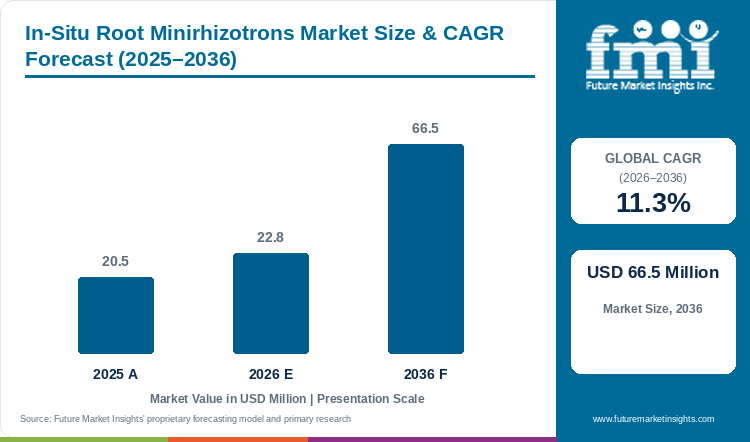
The global in-situ root minirhizotrons market evolved from a 2025 valuation of USD 20.5 million to USD 22.8 million in 2026, and is set to achieve USD 66.5 million by 2036, reflecting an 11.3% CAGR.
Crop breeding stations and seed companies are moving away from destructive soil coring because digging up roots ruins the field plot after one sampling date and stops season-long drought tracking. Repeated underground scanning across intact trial plots lifted the global in-situ root minirhizotrons market from USD 20.5 million in 2025 to USD 22.8 million in 2026, with demand projected to reach USD 66.5 million by 2036 at an 11.3% CAGR. Non-destructive root tracking now guides multi-season cultivar selection across commercial breeding farms. Rotary linear-CCD scanners hold 61.5% of the optical scanner mechanism category in 2026 because one portable scan head images 100 to 300 buried access tubes per day, helping hardware adoption outpace seed biostimulants at a 3.7% CAGR. In February 2026, a Plant and Soil study showed that a 48-plot facility operating 144 six-meter minirhizotron tubes tracked crop roots down to 4.5 meters at one scan every five seconds [1]. Regent Instruments also updated its WinRHIZO Tron software in May 2026 to speed up batch root measurement across field plots [2]. Even so, air gaps along unslurried topsoil boreholes still skew shallow root counts and slow down initial plot setup.
Key Market Trends & Insights
- By optical scanner mechanism: Rotary Linear-CCD Scanners are expected to hold a 61.5% share in 2026, driven by portable scan heads that service hundreds of buried field tubes per instrument.
- By access tube material: CAB & Acrylic Tubes are estimated to command a 72.8% share in 2026, owing to high impact resistance and low tube cost across multi-plot breeding trials.
- By AI analytics suite: Deep-Learning Root Segmentation is projected to account for a 64.0% share in 2026, attributable to neural networks that separate fine roots from soil clutter.
- By end-use sector: Drought Crop Phenotyping is predicted to record a 53.6% share in 2026, supported by seed-company breeding for subsoil water capture under dryland stress.
- By sales channel: Direct Institutional Tenders are anticipated to garner a 58.4% share in 2026, reinforced by multi-unit university and seed-company phenotyping contracts.
Regional Highlights
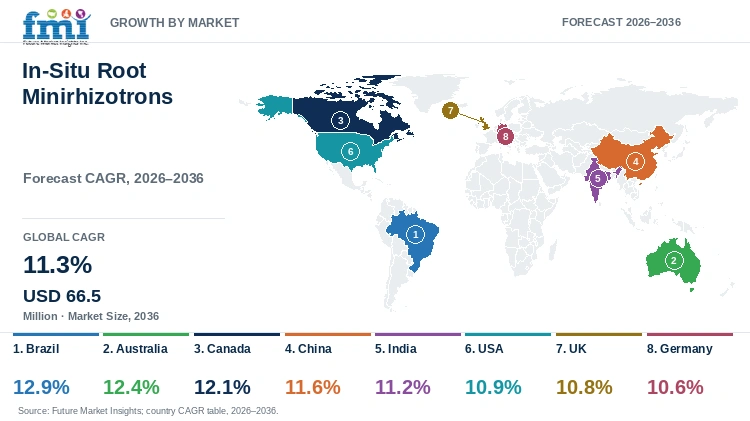
- Top national expansion: Brazil is projected to lead country growth at a 12.9% CAGR through 2036, enabled by cerrado soybean drought-breeding programs and commercial bio-inoculant field trials.
- Broader country progression: Australia is forecast to expand at a 12.4% CAGR ahead of Canada at 12.1% and China at 11.6%, while India registers 11.2% and the USA reaches 10.9%.
Market Size & Forecast
Table 1: Market Size and Forecast for the In-Situ Root Minirhizotrons Market (USD million and CAGR percentage), 2025 to 2036
| Metric | Value |
|---|---|
| 2025 Market Size | USD 20.5 million |
| Estimated Market Size in 2026 | USD 22.8 million |
| Projected Market Size by 2036 | USD 66.5 million |
| CAGR, 2026 to 2036 | 11.3% |
| Added Revenue, 2026 to 2036 | USD 43.7 million |
Destructive soil coring and manual root washing ruin experimental field plots and end fine-root tracking after a single sampling date. Because seed breeders need to measure root growth angles across the same plants from emergence to harvest across the USD 43.7 million expansion window, research farms are replacing core washing with permanent observation tubes and certified seed-health testing programs. In January 2025, agronomists in Göttingen and Kiel reported in Plant Methods that pairing 70-millimeter acrylic minirhizotron tubes with neural-network segmentation tracks winter wheat subsoil root length across two growing seasons without plot destruction [3].
Field Access-Tube Installations and Scanner Fleet Sizing
Table 2: Field Access-Tube Installations and Scanner Fleet Sizing for the In-Situ Root Minirhizotrons Market (USD million and operational ranges), 2025 to 2036
| Metric | 2025 | 2026 | 2036 |
|---|---|---|---|
| Market size (USD million) | 20.5 | 22.8 | 66.5 |
| Optical minirhizotron scanner systems shipped (units) | 1,180 to 1,340 | 1,310 to 1,490 | 3,850 to 4,380 |
| Transparent CAB, acrylic & quartz access tubes installed (thousand tubes) | 145.0 to 168.0 | 162.0 to 188.0 | 490.0 to 565.0 |
| Average system package valuation including software (USD) | 13,800 to 16,200 | 14,000 to 16,400 | 13,400 to 15,800 |
Operational note: Tube-to-scanner ratios reflect field phenotyping protocols where a single portable 360-degree linear-CCD scanner head images 100 to 300 permanently buried access tubes across multiple trial sites.
Field technicians drill angled 30-to-45-degree boreholes with tractor-mounted hydraulic probes and insert two-meter transparent tubes capped against surface light. Biological input formulators validating microbial rhizosphere nutrient boosters use time-lapse minirhizotron scans to measure root-hair branching after soil application.
Per Capita & Phenotyping Trial Facility Sizing
Table 3: Per Capita and Phenotyping Facility Spending Indicators for the In-Situ Root Minirhizotrons Market (USD), 2025 to 2036
| Metric | 2025 | 2026 | 2036 |
|---|---|---|---|
| World population (billion) | 8.2 | 8.3 | 9.0 |
| Market value per 1,000 people (USD) | 2.5 | 2.7 | 7.4 |
| Annual valuation per active root-phenotyping center (USD) | 16,400 to 19,200 | 17,800 to 20,800 | 38,500 to 44,500 |
| Automated deep-learning segmentation software attachment rate (%) | 61.5% to 63.5% | 63.0% to 65.0% | 78.0% to 82.0% |
Table 4: Active Rhizosphere Laboratory and Tube Material Spending Indicators for the In-Situ Root Minirhizotrons Market (USD and percentages), 2026
| Metric | Value | Institutional Reference Basis |
|---|---|---|
| Market size, 2026 | USD 22.8 million | 2026 global in-situ root minirhizotron baseline |
| Active crop-breeding & ecohydrology root laboratories | 1,220 centers | Global CGIAR, USDA-ARS, university & seed-company registry |
| Rotary linear-CCD scanner allocation, 2026 | USD 14.0 million | 61.5% optical scanner mechanism share |
| CAB & acrylic tube allocation, 2026 | USD 16.6 million | 72.8% access tube material share |
High-resolution optical sensors inside rotary scan heads require even LED lighting and flush tube-wall contact to resolve 50-micrometer fungal hyphae. Instrument makers adapt linear-drive assemblies from portable 3D optical metrology scanners so rotating contact bars avoid lens distortion across curved tube walls.
Analyst Perspective
"Optical engineers pairing 2,400-DPI rotary contact scanners with pre-trained neural networks have removed the manual root-tracing bottleneck that once kept minirhizotrons in small academic plots. Suppliers that bundle shatter-resistant CAB tube arrays with automated subsoil root-length software are winning multi-site seed breeding and soil-carbon verification budgets."
- Nikhil Kaitwade, Principal Consultant, Future Market Insights.
How is the in-situ root minirhizotrons market segmented?
The in-situ root minirhizotrons market is segmented across five core axes covering optical scanner mechanism and access tube material as well as AI analytics suite, end-use sector, and sales channel. In 2026, Rotary Linear-CCD Scanner is projected at 61.5% and CAB & Acrylic Tubes at 72.8%. Deep-Learning Root Segmentation holds 64.0% and Drought Crop Phenotyping records 53.6%, while Direct Institutional Tenders account for 58.4%.
By optical scanner mechanism: Rotary Linear-CCD Scanner and Buried Time-Lapse Imager as well as Indexed Micro-Video Camera and Multispectral & UV Imager.
By access tube material: CAB & Acrylic Tubes, Fused Quartz UV Tubes, and Borosilicate Glass Tubes.
By AI analytics suite: Deep-Learning Root Segmentation, Mycorrhizal & Nodule Analytics, and Time-Lapse Topology Suites.
By end-use sector: Drought Crop Phenotyping and Soil Carbon MRV as well as Biostimulant Field Validation and Forest & Orchard Ecology.
By sales channel: Direct Institutional Tenders and Agronomy Instrument Distributors as well as OEM Phenotyping Integrators, Software License Renewals, and Replacement Tube Supply.
Why do Rotary Linear-CCD Scanners lead the optical scanner mechanism category?
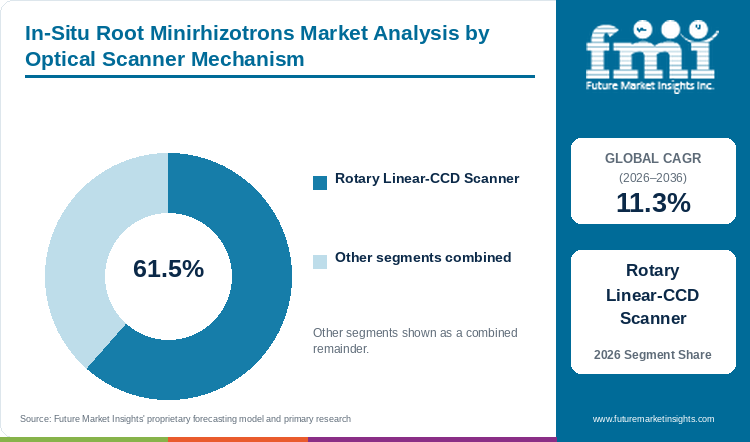
Rotary Linear-CCD Scanners are expected to hold a 61.5% share in 2026, driven by portable scan heads that service 100 to 300 buried field tubes.
Table 5: Optical Scanner Mechanism Share for the In-Situ Root Minirhizotrons Market (percentage share), 2026
| Product Type | Share (2026) |
|---|---|
| Rotary Linear-CCD Scanner | 61.5% |
| Other Segments Combined* | 38.5% |
| Total | 100.0% |
*Calculated as the balance remaining after deducting the leading segment's reported share from 100.0%.
Table 6: Optical Scanner Mechanism Leadership and Market Growth for the In-Situ Root Minirhizotrons Market (segment and CAGR percentage), 2026 to 2036
| Metric | Value |
|---|---|
| Global CAGR (2026 to 2036) | 11.3% |
| Leading Segment | Rotary Linear-CCD Scanner |
Portable rotary linear-CCD scanners sweep a contact sensor bar around the inner wall of buried access tubes at up to 2,400 dots per inch without fish-eye edge distortion. Fixed time-lapse cameras stay locked inside a single tube, whereas one portable rotary scanner head images 200 field tubes across automated plant phenotyping platforms during a single day.
- Rotary Linear-CCD Scanners are expected to hold a 61.5% share in 2026, driven by full-circumference panoramic imaging and single-operator field portability.
- In December 2025, University of Copenhagen agronomists reported in Annals of Botany that three-year minirhizotron imaging to 2.7-meter depth in the RadiMax facility linked deep winter wheat rooting to a threefold rise in deep nitrogen uptake [4].
Why do CAB & Acrylic Tubes define the largest access tube material segment?
CAB & Acrylic Tubes are estimated to hold a 72.8% share in 2026, owing to impact durability during tractor-mounted hydraulic insertion.
Extruded cellulose acetate butyrate (CAB) and acrylic tubes resist cracking when hydraulic probes push tubes into stony subsoils and across winter freeze-thaw cycles. Fused quartz tubes are needed only when ultraviolet light below 320 nanometers excites root exudates, whereas CAB and acrylic tubes give clear visible transmission under biodegradable crop-mulch biopolymers and no-till crop plots.
- CAB & Acrylic Tubes are estimated to hold a 72.8% share in 2026, owing to low unit cost across multi-hundred-tube breeding trials.
- In September 2025, desert agronomy researchers at Ben-Gurion University of the Negev reported in Frontiers in Plant Science that in-situ minirhizotron tube imaging quantified bell pepper root growth across reduced nitrogen regimes [5].
What keeps Deep-Learning Root Segmentation ahead in the AI analytics suite category?
Deep-Learning Root Segmentation is projected to account for a 64.0% share in 2026, attributable to automated neural-network root tracing.
Manual cursor tracing of one 360-degree root scan takes more than two hours of technician time when dark soil debris and worm burrows look like fine rootlets. Neural-network suites including WinRHIZO Tron and RootSnap stitch depth frames automatically and extract root length and branching angles across seed treatment polymer coatings trial plots.
- Deep-Learning Root Segmentation is projected to account for a 64.0% share in 2026, attributable to batch image stitching and automated live-versus-dead root sorting.
- In July 2026, computer-vision researchers published the WaveUNet+ network in Plant Phenomics to preserve root system continuity across 13,694 in-situ minirhizotron images [6].
Why does Drought Crop Phenotyping lead the end-use sector category?
Drought Crop Phenotyping is predicted to record a 53.6% share in 2026, supported by commercial seed breeding for subsoil water capture.
Seed companies and public crop institutes screen thousands of maize, wheat, and soybean crosses to select steep root angles that punch through compacted plough pans. Trial contractors also deploy minirhizotrons to verify root nodulation and fine-root density gains from agricultural biostimulant formulations across water-stressed field blocks.
- Drought Crop Phenotyping is predicted to record a 53.6% share in 2026, supported by seed-company budgets targeting compacted and dryland soils.
- In March 2025, a peer-reviewed synthesis in Plant, Cell & Environment detailed root phenotyping traits that overcome soil compaction and boost deep water uptake [7].
What gives Direct Institutional Tenders the leading position in sales channel?
Direct Institutional Tenders are anticipated to garner a 58.4% share in 2026, reinforced by multi-scanner university and seed-company procurement.
Agricultural universities and government research agencies buy minirhizotron scanners, hydraulic coring augers, and 200-tube bundles directly from manufacturers under competitive tenders. Direct factory contracts bundle multi-seat root segmentation software licenses and field technician training on borehole slurrying.
- Direct Institutional Tenders are anticipated to garner a 58.4% share in 2026, reinforced by multi-year grant equipment awards and custom tube-length orders.
- In July 2025, Swiss and UK plant ecologists reported in Frontiers in Plant Science that two portable CID-602 rotary scanners imaged 90 acrylic minirhizotron tubes across 45 plots to generate 10,456 scans at 1,200 DPI [8].
What are the drivers, restraints, and opportunities in the in-situ root minirhizotrons market?
Across the in-situ root minirhizotrons market, drought-tolerant seed breeding and soil-carbon MRV protocols propel scanner and tube orders, whereas topsoil air-gap artifacts restrain shallow accuracy and automated time-lapse imagers unlock recurring software upgrades.
- Driver: Commercial seed breeding for deep-rooting drought tolerance and verified soil-carbon root biomass protocols drive multi-site minirhizotron tube and scanner procurement.
- Restraint: Annular air gaps along unslurried tube walls and light piping in the upper 0 to 30 centimeter topsoil layer bias shallow root-length correlations.
- Opportunity: Automated buried time-lapse multispectral imagers paired with neural-network root-hair segmentation enable continuous rhizosphere carbon-exudate and mycorrhizal monitoring.
Growth Analysis and Future Potential: Qualitative Demand Catalysts
Erratic spring rainfall and corporate soil-carbon verification programs are pushing crop breeders to measure subsoil root architecture directly in the field. Excavation methods such as shovelomics only sample the upper root crown after digging up the plant, leaving water capture below 50 centimeters unmeasured. In August 2025, USDA Agricultural Research Service scientists at the National Peanut Research Laboratory published root-phenotyping benchmarks in Peanut Science comparing box washing against digital root-scanning methods [9]. Breeding teams pairing minirhizotrons with seed nutrient carrier coatings install permanent tube arrays to track lateral root branching from germination to harvest.
Risk Assessment of the In-Situ Root Minirhizotrons Market: Operational and Formulation Friction
Poor soil-to-tube contact after dry borehole drilling leaves air voids that cause roots to grow along the plastic tube wall instead of bulk soil. When tractor augers smear wet clay along borehole walls or leave gaps in stony horizons, shallow root counts lose accuracy during early growth stages. In August 2025, agroecologists at Aarhus University and BOKU Vienna reported in New Phytologist that separating overlapping root mixtures and correcting soil-interface artifacts require calibrated multispectral minirhizotron protocols [10]. Even when technicians apply soil slurry during installation, trial managers must still wait three to six months for soil settling before taking baseline scans.
Commercial Opportunity Analysis: Formulation Differentiation and Value-Add Formats
Optical instrument makers are lifting unit margins by building automated buried time-lapse imagers and narrow-gauge probes that remove manual scanner insertion at remote sites. Continuous automated imaging captures fine-root turnover spikes after rain events or biological input sprays that monthly manual visits miss. In August 2026, root ecologists reported in Global Change Biology that high-frequency minirhizotron tracking across warmed grassland profiles revealed clear depth shifts in seasonal root phenology [11]. Suppliers that pair narrow-gauge cameras with cloud neural networks help producers of certified organic fertilizers document subsoil root-biomass accumulation for carbon-credit registries.
In-Situ Root Minirhizotrons Market by Country (2026 to 2036)
Across major agricultural research economies, FMI projects Brazil to lead in-situ root minirhizotron demand growth at a 12.9% CAGR between 2026 and 2036, followed by Australia at 12.4% and Canada at 12.1%.
Table 7: Country CAGR and Primary Growth Levers for the In-Situ Root Minirhizotrons Market (CAGR percentage and operational drivers), 2026 to 2036
| Country | CAGR (2026 to 2036) | Primary Growth Lever |
|---|---|---|
| Brazil | 12.9% | Cerrado soybean and sugarcane deep-rooting phenotyping and bio-inoculant field validation trials |
| Australia | 12.4% | Dryland wheat and canola subsoil water-extraction breeding across CSIRO and state research farms |
| Canada | 12.1% | Prairie spring wheat and pulse root-nodule imaging and domestic WinRHIZO Tron software upgrades |
| China | 11.6% | National crop phenotyping facilities and deep-learning root segmentation for maize and wheat |
| India | 11.2% | ICAR maize and legume drought-tolerance screening and aluminum-stress root architecture trials |
| USA | 10.9% | USDA-ARS, DOE, and commercial seed-company high-throughput root phenotyping and soil-carbon MRV |
| UK | 10.8% | Rothamsted and UKRI crop root-compaction genetics and regenerative pasture root-carbon studies |
| Germany | 10.6% | Gottingen, Kiel, and Julich CNN-assisted winter wheat and sugar beet subsoil root-architecture trials |
Source: Future Market Insights analysis
Brazil In-Situ Root Minirhizotrons Market Outlook (2026 to 2036)
Tropical soybean and sugarcane research estates across Mato Grosso and Parana are expanding in-situ root minirhizotron demand in Brazil at a world-leading 12.9% CAGR from 2026 to 2036. Unlike temperate grain regions that run one summer crop cycle, commercial bio-inoculant producers and Embrapa stations in Brazil run two to three field cycles per year to verify nitrogen-fixing root nodulation in acidic Oxisols. In November 2025, tropical root researchers published a multi-site minirhizotron study in New Phytologist showing that soil drying cuts shallow 0-to-20-centimeter fine-root growth while shifting root activity below 60 centimeters [12]. Red iron-oxide clay staining on exterior tube walls still requires color-calibrated neural-network segmentation software.
Key takeaway: In Brazil, year-round bio-inoculant field validation and cerrado soybean drought-breeding programs are projected to drive a 12.9% CAGR through 2036.
Australia In-Situ Root Minirhizotrons Market Outlook (2026 to 2036)
Dryland wheat and canola breeders in Western Australia and South Australia work in coarse duplex sands where spring moisture capture below one meter decides grain yield. Because loose sandy cores crumble when pulled from the ground, breeding stations use narrow-gauge buried observation tubes to keep intact root-to-soil contact through grain filling. In April 2026, CID Bio-Science updated field deployment specifications for its narrow-gauge CI-602 rotary root imager built for tight borehole tolerances in sandy and duplex soils [13]. Long travel distances between remote state research farms push Australia in-situ root minirhizotrons demand at a 12.4% CAGR through 2036 toward portable battery-powered rotary scanners across regional cereal trial networks.
Key takeaway: In Australia, dryland cereal breeding across sandy duplex soils is forecast to sustain a 12.4% CAGR through 2036.
Canada In-Situ Root Minirhizotrons Market Outlook (2026 to 2036)
Domestic root-morphology software engineering led by Quebec City-based Regent Instruments combined with prairie wheat and pulse breeding in Saskatchewan and Alberta anchors demand in Canada. Between 2026 and 2036, the in-situ root minirhizotrons market in Canada is projected to grow at a 12.1% CAGR, supported by federal prairie soil-carbon trials and pea-lentil nodulation screening. In January 2026, Regent Instruments updated its WinRHIZO root-measurement platform documentation for multi-depth washed and in-situ root architecture analysis across breeding stations [14]. Severe winter frost heave across prairie Chernozem soils can push shallow acrylic tubes upward between seasons, prompting field crews in Canada to anchor shatter-resistant CAB tubes deep below the seasonal frost line.
Key takeaway: In Canada, Quebec City WinRHIZO Tron software upgrades and prairie pulse root-carbon trials are anticipated to deliver a 12.1% CAGR through 2036.
China In-Situ Root Minirhizotrons Market Outlook (2026 to 2036)
Provincial agricultural academies and national seed-breeding centers across the North China Plain are installing permanent minirhizotron tube arrays to breed water-saving winter wheat and maize cultivars. Commercial demand for in-situ root minirhizotrons in China is forecast to expand at an 11.6% CAGR from 2026 to 2036 as state phenotyping platforms pair 360-degree tube scanners with deep-learning segmentation pipelines. In April 2026, computer-science and agronomy investigators published a benchmark study in Plant Methods comparing 21 Transformer and ConvNet models across nine root image datasets and showing MobileSAM reached a 0.693 Dice score [15]. High tube-installation labor across terraced and heavy-clay plots encourages Chinese institutes to procure tractor-mounted hydraulic augers with multi-scanner kits.
Key takeaway: In China, national crop-phenotyping infrastructure and AI root-segmentation research are expected to propel an 11.6% CAGR through 2036.
India In-Situ Root Minirhizotrons Market Outlook (2026 to 2036)
Public agronomy institutes under the Indian Council of Agricultural Research and private hybrid-seed companies in Maharashtra and Karnataka are expanding belowground root screening for heat-stressed cereal and pulse crops. Across India, the in-situ root minirhizotrons market is anticipated to register an 11.2% CAGR between 2026 and 2036 as breeders select deeper root systems that survive erratic monsoon breaks. In January 2026, maize researchers published a root-architecture study in BMC Plant Biology profiling 250 tropical maize inbred lines for aluminum tolerance using digital WinRHIZO root imaging [16]. Import duties on specialized optical scan heads still lead Indian universities to share one portable rotary scanner across multiple field stations.
Key takeaway: In India, monsoon-resilient cereal and pulse breeding programs across ICAR and private seed farms are projected to support an 11.2% CAGR.
USA In-Situ Root Minirhizotrons Market Outlook (2026 to 2036)
Land-grant university phenotyping facilities and commercial maize and soybean breeding stations across the Midwest make the USA the largest single country buyer of minirhizotron hardware. Valuation for in-situ root minirhizotrons in the USA is projected to advance at a 10.9% CAGR through 2036, supported by domestic scanner manufacturing in Washington and California and corporate soil-carbon trials. In November 2025, Camas-based CID Bio-Science updated technical specifications for its CI-600 In-Situ Root Imager and RootSnap software used across USDA and university agronomy farms [17]. High field-technician wages across Midwest research stations speed up adoption of 30-second rotary scanners, though federal grant cycles occasionally delay multi-unit fleet replacements.
Key takeaway: In the USA, corporate corn-and-soybean drought breeding and domestic scanner production are estimated to sustain a 10.9% CAGR through 2036.
UK In-Situ Root Minirhizotrons Market Outlook (2026 to 2036)
Crop-genetics institutes in Harpenden and Nottingham and Hoddesdon-based instrument engineering at ADC BioScientific give the UK a strong focus on clay plough-pan compaction and pasture carbon auditing. In December 2025, Rothamsted Research and partner agronomists published a field minirhizotron study in Annals of Botany tracking modern versus ancient wheat root systems to 2.2-meter depth across UK trial plots [18]. Sales of in-situ root minirhizotrons in the UK are predicted to climb at a 10.8% CAGR from 2026 to 2036, supported by UKRI regenerative farming grants and winter-wheat root screening. Waterlogged winter clay soils across eastern England frequently flood unsealed tubes, forcing buyers to specify gasketed caps and anchored CAB tubes.
Key takeaway: In the UK, cereal root-compaction genetics and regenerative pasture carbon trials are projected to drive a 10.8% CAGR through 2036.
Germany In-Situ Root Minirhizotrons Market Outlook (2026 to 2036)
Agronomy faculties in Gottingen and Kiel and phenotyping centers in Bonn and Julich make Germany Europe's main testing ground for neural-network minirhizotron image analysis. Between 2026 and 2036, the in-situ root minirhizotrons market in Germany is expected to progress at a 10.6% CAGR as strict nitrogen-surplus rules compel cereal and sugar-beet breeders to select deep nitrogen-scavenging roots. In February 2025, plant ecologists at the University of Greifswald published a multi-season minirhizotron study using the convolutional neural network RootDetector to track winter fine-root growth in beech forests across Germany [19]. Soil-disturbance rules in long-term agroecological plots still restrict heavy tractor augers and require manual slurried installation of 70-millimeter acrylic tubes.
Key takeaway: In Germany, nitrogen-efficiency breeding mandates and university CNN root-imaging pipelines are anticipated to support a 10.6% CAGR through 2036.
Full report country CAGRs cover: North America; Latin America; Western Europe; Eastern Europe; East Asia; South Asia and Pacific; Middle East and Africa.
Who are the notable companies in the in-situ root minirhizotrons market?
CID Bio-Science, Inc., Regent Instruments Inc., Bartz Technology Corporation, Vienna Scientific Instruments GmbH, ADC BioScientific Ltd., RhizoSystems, Dynamax Inc., and ICT International Pty Ltd are the notable companies in the in-situ root minirhizotrons market.
Vendor competition in the in-situ root minirhizotrons sector centers on 360-degree optical contact resolution, access-tube diameter compatibility, and automated neural-network root-segmentation software. North American and European instrument builders supply portable rotary linear-CCD scan heads, indexed micro-video cameras, and multi-tube field coring kits that integrate with soil moisture sensor networks.
- Rotary Linear-CCD & Video Minirhizotron Hardware Leaders: CID Bio-Science, Inc. and Bartz Technology Corporation along with Vienna Scientific Instruments GmbH manufacture 360-degree rotary contact scanners and ultra-high-definition tube-imaging cameras.
- Root Morphology Software & Integrated Ecophysiology Platforms: Regent Instruments Inc. and ADC BioScientific Ltd. supply WinRHIZO Tron image-analysis suites and portable rhizosphere gas-exchange and root-imaging instruments.
- Custom Phenotyping Integrators & Soil-Plant Sensor Suppliers: RhizoSystems and Dynamax Inc. along with ICT International Pty Ltd deliver custom rhizotron installations, hydraulic coring augers, and paired soil-plant telemetry nodes.
Competitive Benchmarking: In-Situ Root Minirhizotrons Market
Table 8: Competitive Benchmarking for the In-Situ Root Minirhizotrons Market (qualitative capability ratings), 2026
| Company | Optical Scanner Resolution | Root Segmentation Software | Tube & Coring Ecosystem | Geographic Reach |
|---|---|---|---|---|
| CID Bio-Science, Inc. | High | High | High | High |
| Regent Instruments Inc. | Medium | High | Medium | High |
| Bartz Technology Corporation | High | Medium | High | Medium |
| Vienna Scientific Instruments GmbH | High | Medium | High | Medium |
| ADC BioScientific Ltd. | High | Medium | Medium | High |
| RhizoSystems | Medium | Medium | High | Medium |
| Dynamax Inc. | Medium | Medium | High | High |
| ICT International Pty Ltd | Medium | Medium | High | High |
Scoring basis: Capability tiers evaluate optical scan resolution up to 2,400 DPI linear-CCD or UHD micro-video and automated root-length and branching-fork segmentation software as well as compatibility across 50-to-70-millimeter CAB, acrylic, and quartz tubes.
Key Developments in the In-Situ Root Minirhizotrons Market
- Regent Instruments Inc. published updated 2026 technical specifications in October 2026 for WinRHIZO Tron and WinRHIZO Tron MF enabling touch-screen measurement of underground video and rotary scanner root images [20].
- Regent Instruments Inc. expanded its XLRHIZO Tron data post-processing utility in February 2025 to automate time-lapse root growth plotting across sequential minirhizotron imaging dates [21].
- Agronomy researchers in South Korea validated 2D WinRHIZO Pro phenotyping across 16 root system architecture traits in February 2026 to accelerate genebank cultivar screening [22].
Key Players in the In-Situ Root Minirhizotrons Market
Rotary Linear-CCD & Video Minirhizotron Hardware Leaders
- CID Bio-Science, Inc.
- Bartz Technology Corporation
- Vienna Scientific Instruments GmbH
Root Morphology Software & Ecophysiology Platforms
- Regent Instruments Inc.
- ADC BioScientific Ltd.
- RhizoSystems
Soil-Plant Telemetry & Custom Phenotyping Suppliers
- Dynamax Inc.
- ICT International Pty Ltd
In-Situ Root Minirhizotrons Market - Report Scope
Table 9: Report Scope for the In-Situ Root Minirhizotrons Market (coverage fields and definitions), 2026 to 2036
| Coverage field | Report scope |
|---|---|
| Market breakdown | Optical Scanner Mechanism; Access Tube Material; AI Analytics Suite; End-Use Sector; Sales Channel |
| Quantitative Units | USD Million |
| Market Definition | Includes commercial hardware, transparent access tubes, and bundled root-segmentation software revenue from in-situ root minirhizotron systems (360-degree rotary linear-CCD tube scanners, indexed video and multispectral/UV-fluorescence minirhizotron cameras, CAB/acrylic/quartz access tubes, and RootSnap/WinRHIZO Tron/CNN analytics suites). Excludes destructive flatbed washed-root tray scanners sold without minirhizotron tubes and laboratory agar Petri-dish imagers. |
| Regions Covered | North America; Latin America; Western Europe; Eastern Europe; East Asia; South Asia and Pacific; Middle East and Africa |
| Countries Covered | Brazil, Australia, Canada, China, India, USA, UK, Germany, and additional countries in the full report |
| Key Companies Covered | CID Bio-Science, Inc., Regent Instruments Inc., Bartz Technology Corporation, Vienna Scientific Instruments GmbH, ADC BioScientific Ltd., RhizoSystems, Dynamax Inc., ICT International Pty Ltd |
| Forecast Period | 2026 to 2036 |
| Approach | Primary and secondary research with top-down and bottom-up market triangulation. |
In-Situ Root Minirhizotrons Market - Research Methodology
Table 10: Research Methodology for the In-Situ Root Minirhizotrons Market (research methods and approach), 2026 edition
| Method | Approach |
|---|---|
| Primary Research | Structured interviews with crop-phenotyping directors at commercial seed companies and university root-ecology investigators as well as soil-carbon MRV auditors and optical scanner engineers. |
| Secondary Research | Analysis of CID Bio-Science CI-600/CI-602 technical benchmarks and Regent Instruments WinRHIZO Tron release notes in addition to peer-reviewed Plant Methods and New Phytologist field studies. |
| Market Sizing and Forecasting | Top-down public and private root-phenotyping equipment budgets reconciled against bottom-up annual rotary and video scanner shipments and access-tube replacements from 2026 to 2036. |
| Country Forecasting Model | Country growth rates weight commercial seed-breeding R&D budgets and biological crop-input validation trial counts across eight major agricultural research systems. |
| Operational Benchmark Traceability | Scanner fleet and access-tube ratios in Tables 2, 3, and 4 cross-check against Gottingen/Kiel winter wheat minirhizotron datasets and 144-tube field phenotyping benchmarks. |
| Data Triangulation and Validation | Segment shares and demand estimates are audited across all five parent axes to verify 100.0% share summation without double counting washed-root flatbed scanners. |
In-Situ Root Minirhizotrons Market by Segments
In-Situ Root Minirhizotrons Market segmented by Optical Scanner Mechanism:
- Rotary Linear-CCD Scanner
- Buried Time-Lapse Imager
- Indexed Micro-Video Camera
- Multispectral & UV Imager
In-Situ Root Minirhizotrons Market segmented by Access Tube Material:
- CAB & Acrylic Tubes
- Fused Quartz UV Tubes
- Borosilicate Glass Tubes
In-Situ Root Minirhizotrons Market segmented by AI Analytics Suite:
- Deep-Learning Root Segmentation
- Mycorrhizal & Nodule Analytics
- Time-Lapse Topology Suites
In-Situ Root Minirhizotrons Market segmented by End-Use Sector:
- Drought Crop Phenotyping
- Soil Carbon MRV
- Biostimulant Field Validation
- Forest & Orchard Ecology
In-Situ Root Minirhizotrons Market segmented by Sales Channel:
- Direct Institutional Tenders
- Agronomy Instrument Distributors
- OEM Phenotyping Integrators
- Software License Renewals
- Replacement Tube Supply
In-Situ Root Minirhizotrons Market by Region
- North America
- United States
- Canada
- Latin America
- Brazil
- Mexico
- Argentina
- Chile
- Western Europe
- Germany
- France
- United Kingdom
- Italy
- Spain
- Benelux
- Nordics
- Eastern Europe
- Poland
- Czech Republic
- Romania
- Hungary
- East Asia
- China
- Japan
- South Korea
- South Asia and Pacific
- India
- ASEAN
- Australia and New Zealand
- Middle East and Africa
- GCC Countries
- South Africa
- Türkiye
- Israel
Research Sources and Bibliography
- [1] Thorup-Kristensen, K., et al. (2026, February 10). Deep roots through time and crops: insight from five seasons at a 144-tube field minirhizotron phenotyping facility. Plant and Soil (PubMed Central PMC13103413 / PMID 41822991).
- [2] Regent Instruments Inc. (2026, May 25). RHIZO Tron, image analysis system to analyze minirhizotron images of plant roots in growth. Regent Instruments Inc.
- [3] Arnhold, J., Ispizua Yamati, F. R., Kage, H., Mahlein, A.-K., Koch, H.-J., & Grunwald, D. (2025, January 27). Minirhizotron measurements can supplement deep soil coring to evaluate root growth of winter wheat when certain pitfalls are avoided. Plant Methods, 21, 7 (PubMed Central PMC11650824).
- [4] Svane, S. F., Jensen, L. S., & Thorup-Kristensen, K. (2025, December 08). Winter wheat phenotyping for deep root growth and function, reduced water stress and increased uptake of deep N and water. Annals of Botany (PubMed PMID 40747721).
- [5] Cohen, I., et al. (2025, September 08). Root growth and yield responses to nitrogen levels in bell pepper (Capsicum annuum) cultivation: balancing nutrient efficiency and productivity. Frontiers in Plant Science, 16, 1589560 (PubMed PMID 40995009).
- [6] Chen, Y., et al. (2026, July 15). WaveUNet+: Preserving Root System Architecture Integrity in In Situ Minirhizotron Root Images. Plant Phenomics (PubMed Central PMC13364121).
- [7] Plant, Cell & Environment Editorial Office. (2025, March 06). Optimizing Root Phenotypes for Compacted Soils: Enhancing Root-Soil Interactions and Water-Nutrient Uptake. Plant, Cell & Environment, 48(6), 4656-4667 (PubMed PMID 40051026).
- [8] Mohl, P., & Hiltbrunner, E. (2025, July 30). Recurrent summer drought temporarily stimulates fine root growth but enhances winter root losses in alpine grassland. Frontiers in Plant Science, 16, 1625076 (PubMed Central PMC12344270 / PMID 40810020).
- [9] Bucior, E. R., & Sorensen, R. B. (2025, August 20). A shovel-omics facelift: exploring inexpensive and simple root phenotyping techniques in peanut. Peanut Science, 52(1), 106-114 (USDA Agricultural Research Service seqNo115=423904).
- [10] Wambsganss, J., et al. (2025, August 08). Root mixture analysis: methods and vision for multispectral minirhizotron phenotyping. New Phytologist (PubMed PMID 40781027).
- [11] Blume-Werry, G., et al. (2026, August 15). Soil Warming Shifts Seasonal and Soil Depth-Related Root Growth Phenology in Subarctic Grassland Minirhizotrons. Global Change Biology (PubMed PMID 42619173).
- [12] Cordero, I., et al. (2025, November 21). Drying suppresses fine root production to 1 m depths and alters root traits in four distinct tropical forests via minirhizotron tracking. New Phytologist, 249(4), 1992-2009 (PubMed PMID 41272380).
- [13] CID Bio-Science, Inc. (2026, April 14). CI-602 Narrow Gauge Root Imager Technical Specifications for Minirhizotron Tube Installations. CID Bio-Science Plant Science Tools.
- [14] Regent Instruments Inc. (2026, January 11). WinRHIZO is a complete plant root measurement and analysis system. Regent Instruments Inc.
- [15] Smith, A. G., Lamprinidis, S., Seethepalli, A., York, L. M., Han, E., Mohl, P., Boulata, K., Thorup-Kristensen, K., & Petersen, J. (2026, April 20). A systematic comparison of transformers and ConvNets for root segmentation across nine datasets. Plant Methods (PubMed PMID 42010626).
- [16] Kumar, R., et al. (2026, January 12). Root system architecture profiling for aluminium tolerance in maize inbred panels using digital WinRHIZO imaging. BMC Plant Biology (PubMed Central PMC12966390).
- [17] CID Bio-Science, Inc. (2025, November 18). CI-600 In-Situ Root Imager Technical Specifications and RootSnap! Field Operations. CID Bio-Science Plant Science Tools.
- [18] Hodgkinson, L., et al. (2025, December 08). Modern wheat has deeper roots than ancient wheats: field minirhizotron evaluation to 2.2 m soil depth. Annals of Botany (PubMed PMID 40374529).
- [19] Weigel, R., Kreyling, J., et al. (2025, February 07). Seasonal dynamics of fine root length in European beech unveiling unexpected winter peaks and summer declines monitored by minirhizotrons and AI RootDetector. German National Library / Tree Physiology (DNB 1364808196).
- [20] Regent Instruments Inc. (2026, October 20). WinRHIZO Tron and Tron MF Root Measurement Programs for Underground Video and Scanner Images. Regent Instruments Inc.
- [21] Regent Instruments Inc. (2025, February 27). XLRHIZO Tron Data Post-Processing and Time-Lapse Visualization Utility. Regent Instruments Inc.
- [22] Kim, S. H., et al. (2026, February 09). Quantitative analysis of root system architecture and fresh weight in radish accessions using 2D WinRHIZO Pro phenotyping. Horticulture, Environment, and Biotechnology (PubMed Central PMC12957521).
- [23] Singh, A., et al. (2025, March 01). Python algorithm package for automated estimation of major legume root traits validated against WinRHIZO. Scientific Reports (PubMed Central PMC11873191).
This bibliography is provided for reader reference and is not exhaustive. The full report contains the complete reference list and detailed citations.
This Report Answers
- How large is the in-situ root minirhizotrons market in 2026 and what is forecast for 2036?
- Which drought-breeding and soil-carbon MRV pressures support demand for root minirhizotrons?
- Why do Rotary Linear-CCD Scanners lead the optical scanner mechanism category?
- Why do CAB & Acrylic Tubes lead the access tube material category?
- How do growth rates differ between Brazil and Australia versus Canada and the USA?
- Which leading companies supply minirhizotron scanners, access tubes, and root-segmentation software today?
- What limits shallow-topsoil correlation or manual image processing in the root minirhizotrons market?
- What should crop breeders and soil scientists evaluate before purchasing a minirhizotron system?
Frequently Asked Questions
How big is the in-situ root minirhizotrons market in 2026, and what is forecast for 2036?
By 2036, global in-situ root minirhizotrons demand is forecast to reach USD 66.5 million, rising from a 2026 baseline of USD 22.8 million after recording USD 20.5 million in 2025 as seed companies expand non-destructive subsoil phenotyping.
What is the CAGR for the in-situ root minirhizotrons market from 2026 to 2036?
An 11.3% CAGR is projected across the 2026 to 2036 window, adding USD 43.7 million in incremental revenue to the global market.
Which optical scanner mechanism segment leads the in-situ root minirhizotrons market?
Rotary Linear-CCD Scanners are expected to hold a 61.5% share in 2026, driven by full-circumference contact scanning and multi-tube field portability.
Which access tube material segment leads the in-situ root minirhizotrons market?
CAB & Acrylic Tubes are estimated to hold a 72.8% share in 2026, owing to high impact resistance and low unit cost across multi-plot field trials.
Which country has a notable growth outlook during the assessment period?
Brazil leads national growth projections at a 12.9% CAGR through 2036, supported by cerrado soybean drought-tolerance breeding and commercial biological-input root validation.
Who are the key players in the market?
CID Bio-Science, Inc. and Regent Instruments Inc. along with Bartz Technology Corporation and Vienna Scientific Instruments GmbH lead global supply. ADC BioScientific Ltd. and RhizoSystems along with Dynamax Inc. and ICT International Pty Ltd also supply minirhizotron hardware and analytics software.
Preview the report firsthand - request a free sample
Get SampleGet the brochure for pricing and purchase details.
Get PDFTable of Content
- Key Takeaways
- Market Size and CAGR
- Top Growth Driver
- Fastest Growing Segment
- Leading Region
- Key Companies
- Emerging Opportunities
- Executive Summary
- Global Market Outlook
- Demand-side Trends
- Supply-side Trends
- Technology Roadmap Analysis
- Analysis and Recommendations
- Analyst Perspective (What is happening? Why now? What should investors know?)
- Key Questions Answered
- How large is the market?
- What is the CAGR?
- What are key trends?
- Which region dominates?
- Who are the leaders?
- Market Overview
- Market Coverage / Taxonomy
- Market Definition / Scope / Limitations
- Research Methodology
- Chapter Orientation
- Analytical Lens and Working Hypotheses
- Market Structure, Signals, and Trend Drivers
- Benchmarking and Cross-market Comparability
- Market Sizing, Forecasting, and Opportunity Mapping
- Research Design and Evidence Framework
- Desk Research Programme (Secondary Evidence)
- Expert Input and Fieldwork (Primary Evidence)
- Tooling, Models, and Reference Databases
- Data Engineering and Model Build
- Quality Assurance and Audit Trail
- Market Background
- Market Dynamics (Drivers, Restraints, Opportunity, Trends)
- Scenario Forecast (Optimistic, Likely, Conservative)
- Impact Analysis
- AI Impact
- Sustainability Impact
- Regulatory Impact
- Technology Impact
- Consumer / Buyer Analysis
- Purchase Drivers
- Adoption Barriers
- Buyer Journey
- Opportunity Map Analysis
- Product Life Cycle Analysis
- Supply Chain Analysis
- Investment Feasibility Matrix
- Value Chain Analysis
- PESTLE and Porter's Analysis
- Regulatory Landscape
- Regional Parent Market Outlook
- Production and Consumption Statistics
- Import and Export Statistics
- Global Market Analysis and Forecast, 2021 to 2036
- Historical Market Size Value (USD Million) Analysis, 2021 to 2025
- Current and Future Market Size Value (USD Million) Projections, 2026 to 2036
- Y-o-Y Growth Trend Analysis
- Absolute $ Opportunity Analysis
- Global Market Pricing Analysis, 2021 to 2036
- Global Market Analysis and Forecast, By Optical Scanner Mechanism, 2021 to 2036
- Introduction / Key Findings
- Historical Market Size Value (USD Million) Analysis By Optical Scanner Mechanism, 2021 to 2025
- Current and Future Market Size Value (USD Million) Analysis and Forecast By Optical Scanner Mechanism, 2026 to 2036
- Rotary Linear-CCD Scanner
- Buried Time-Lapse Imager
- Indexed Micro-Video Camera
- Multispectral & UV Imager
- Y-o-Y Growth Trend Analysis By Optical Scanner Mechanism, 2021 to 2025
- Absolute $ Opportunity Analysis By Optical Scanner Mechanism, 2026 to 2036
- Global Market Analysis and Forecast, By Access Tube Material, 2021 to 2036
- Introduction / Key Findings
- Historical Market Size Value (USD Million) Analysis By Access Tube Material, 2021 to 2025
- Current and Future Market Size Value (USD Million) Analysis and Forecast By Access Tube Material, 2026 to 2036
- CAB & Acrylic Tubes
- Fused Quartz UV Tubes
- Borosilicate Glass Tubes
- Y-o-Y Growth Trend Analysis By Access Tube Material, 2021 to 2025
- Absolute $ Opportunity Analysis By Access Tube Material, 2026 to 2036
- Global Market Analysis and Forecast, By AI Analytics Suite, 2021 to 2036
- Introduction / Key Findings
- Historical Market Size Value (USD Million) Analysis By AI Analytics Suite, 2021 to 2025
- Current and Future Market Size Value (USD Million) Analysis and Forecast By AI Analytics Suite, 2026 to 2036
- Deep-Learning Root Segmentation
- Mycorrhizal & Nodule Analytics
- Time-Lapse Topology Suites
- Y-o-Y Growth Trend Analysis By AI Analytics Suite, 2021 to 2025
- Absolute $ Opportunity Analysis By AI Analytics Suite, 2026 to 2036
- Global Market Analysis and Forecast, By End-Use Sector, 2021 to 2036
- Introduction / Key Findings
- Historical Market Size Value (USD Million) Analysis By End-Use Sector, 2021 to 2025
- Current and Future Market Size Value (USD Million) Analysis and Forecast By End-Use Sector, 2026 to 2036
- Drought Crop Phenotyping
- Soil Carbon MRV
- Biostimulant Field Validation
- Forest & Orchard Ecology
- Y-o-Y Growth Trend Analysis By End-Use Sector, 2021 to 2025
- Absolute $ Opportunity Analysis By End-Use Sector, 2026 to 2036
- Global Market Analysis and Forecast, By Sales Channel, 2021 to 2036
- Introduction / Key Findings
- Historical Market Size Value (USD Million) Analysis By Sales Channel, 2021 to 2025
- Current and Future Market Size Value (USD Million) Analysis and Forecast By Sales Channel, 2026 to 2036
- Direct Institutional Tenders
- Agronomy Instrument Distributors
- OEM Phenotyping Integrators
- Software License Renewals
- Replacement Tube Supply
- Y-o-Y Growth Trend Analysis By Sales Channel, 2021 to 2025
- Absolute $ Opportunity Analysis By Sales Channel, 2026 to 2036
- Global Market Analysis and Forecast, By Region, 2021 to 2036
- Introduction
- Historical Market Size Value (USD Million) Analysis By Region, 2021 to 2025
- Current Market Size Value (USD Million) Analysis and Forecast By Region, 2026 to 2036
- North America
- Latin America
- Western Europe
- Eastern Europe
- East Asia
- South Asia and Pacific
- Middle East and Africa
- Market Attractiveness Analysis By Region
- North America Market Analysis and Forecast, By Country, 2021 to 2036
- Historical Market Size Value (USD Million) Trend Analysis By Market Taxonomy, 2021 to 2025
- Market Size Value (USD Million) Forecast By Market Taxonomy, 2026 to 2036
- By Country
- United States
- Canada
- By Optical Scanner Mechanism
- By Access Tube Material
- By AI Analytics Suite
- By End-Use Sector
- By Sales Channel
- By Country
- Market Attractiveness Analysis
- By Country
- By Optical Scanner Mechanism
- By Access Tube Material
- By AI Analytics Suite
- By End-Use Sector
- By Sales Channel
- Key Takeaways
- Latin America Market Analysis and Forecast, By Country
- Historical Market Size Value (USD Million) Trend Analysis By Market Taxonomy, 2021 to 2025
- Market Size Value (USD Million) Forecast By Market Taxonomy, 2026 to 2036
- By Country
- Brazil
- Mexico
- Argentina
- Chile
- By Optical Scanner Mechanism
- By Access Tube Material
- By AI Analytics Suite
- By End-Use Sector
- By Sales Channel
- By Country
- Market Attractiveness Analysis
- By Country
- By Optical Scanner Mechanism
- By Access Tube Material
- By AI Analytics Suite
- By End-Use Sector
- By Sales Channel
- Key Takeaways
- Western Europe Market Analysis and Forecast, By Country
- Historical Market Size Value (USD Million) Trend Analysis By Market Taxonomy, 2021 to 2025
- Market Size Value (USD Million) Forecast By Market Taxonomy, 2026 to 2036
- By Country
- Germany
- France
- United Kingdom
- Italy
- Spain
- Benelux
- Nordics
- By Optical Scanner Mechanism
- By Access Tube Material
- By AI Analytics Suite
- By End-Use Sector
- By Sales Channel
- By Country
- Market Attractiveness Analysis
- By Country
- By Optical Scanner Mechanism
- By Access Tube Material
- By AI Analytics Suite
- By End-Use Sector
- By Sales Channel
- Key Takeaways
- Eastern Europe Market Analysis and Forecast, By Country
- Historical Market Size Value (USD Million) Trend Analysis By Market Taxonomy, 2021 to 2025
- Market Size Value (USD Million) Forecast By Market Taxonomy, 2026 to 2036
- By Country
- Poland
- Czech Republic
- Romania
- Hungary
- By Optical Scanner Mechanism
- By Access Tube Material
- By AI Analytics Suite
- By End-Use Sector
- By Sales Channel
- By Country
- Market Attractiveness Analysis
- By Country
- By Optical Scanner Mechanism
- By Access Tube Material
- By AI Analytics Suite
- By End-Use Sector
- By Sales Channel
- Key Takeaways
- East Asia Market Analysis and Forecast, By Country
- Historical Market Size Value (USD Million) Trend Analysis By Market Taxonomy, 2021 to 2025
- Market Size Value (USD Million) Forecast By Market Taxonomy, 2026 to 2036
- By Country
- China
- Japan
- South Korea
- By Optical Scanner Mechanism
- By Access Tube Material
- By AI Analytics Suite
- By End-Use Sector
- By Sales Channel
- By Country
- Market Attractiveness Analysis
- By Country
- By Optical Scanner Mechanism
- By Access Tube Material
- By AI Analytics Suite
- By End-Use Sector
- By Sales Channel
- Key Takeaways
- South Asia and Pacific Market Analysis and Forecast, By Country
- Historical Market Size Value (USD Million) Trend Analysis By Market Taxonomy, 2021 to 2025
- Market Size Value (USD Million) Forecast By Market Taxonomy, 2026 to 2036
- By Country
- India
- ASEAN
- Australia and New Zealand
- By Optical Scanner Mechanism
- By Access Tube Material
- By AI Analytics Suite
- By End-Use Sector
- By Sales Channel
- By Country
- Market Attractiveness Analysis
- By Country
- By Optical Scanner Mechanism
- By Access Tube Material
- By AI Analytics Suite
- By End-Use Sector
- By Sales Channel
- Key Takeaways
- Middle East and Africa Market Analysis and Forecast, By Country
- Historical Market Size Value (USD Million) Trend Analysis By Market Taxonomy, 2021 to 2025
- Market Size Value (USD Million) Forecast By Market Taxonomy, 2026 to 2036
- By Country
- GCC Countries
- South Africa
- Türkiye
- Israel
- By Optical Scanner Mechanism
- By Access Tube Material
- By AI Analytics Suite
- By End-Use Sector
- By Sales Channel
- By Country
- Market Attractiveness Analysis
- By Country
- By Optical Scanner Mechanism
- By Access Tube Material
- By AI Analytics Suite
- By End-Use Sector
- By Sales Channel
- Key Takeaways
- Key Countries Market Analysis
- United States
- Pricing Analysis
- Market Share Analysis, 2025
- By Optical Scanner Mechanism
- By Access Tube Material
- By AI Analytics Suite
- By End-Use Sector
- By Sales Channel
- Canada
- Pricing Analysis
- Market Share Analysis, 2025
- By Optical Scanner Mechanism
- By Access Tube Material
- By AI Analytics Suite
- By End-Use Sector
- By Sales Channel
- Mexico
- Pricing Analysis
- Market Share Analysis, 2025
- By Optical Scanner Mechanism
- By Access Tube Material
- By AI Analytics Suite
- By End-Use Sector
- By Sales Channel
- Brazil
- Pricing Analysis
- Market Share Analysis, 2025
- By Optical Scanner Mechanism
- By Access Tube Material
- By AI Analytics Suite
- By End-Use Sector
- By Sales Channel
- Chile
- Pricing Analysis
- Market Share Analysis, 2025
- By Optical Scanner Mechanism
- By Access Tube Material
- By AI Analytics Suite
- By End-Use Sector
- By Sales Channel
- Germany
- Pricing Analysis
- Market Share Analysis, 2025
- By Optical Scanner Mechanism
- By Access Tube Material
- By AI Analytics Suite
- By End-Use Sector
- By Sales Channel
- United Kingdom
- Pricing Analysis
- Market Share Analysis, 2025
- By Optical Scanner Mechanism
- By Access Tube Material
- By AI Analytics Suite
- By End-Use Sector
- By Sales Channel
- Italy
- Pricing Analysis
- Market Share Analysis, 2025
- By Optical Scanner Mechanism
- By Access Tube Material
- By AI Analytics Suite
- By End-Use Sector
- By Sales Channel
- Spain
- Pricing Analysis
- Market Share Analysis, 2025
- By Optical Scanner Mechanism
- By Access Tube Material
- By AI Analytics Suite
- By End-Use Sector
- By Sales Channel
- France
- Pricing Analysis
- Market Share Analysis, 2025
- By Optical Scanner Mechanism
- By Access Tube Material
- By AI Analytics Suite
- By End-Use Sector
- By Sales Channel
- India
- Pricing Analysis
- Market Share Analysis, 2025
- By Optical Scanner Mechanism
- By Access Tube Material
- By AI Analytics Suite
- By End-Use Sector
- By Sales Channel
- ASEAN
- Pricing Analysis
- Market Share Analysis, 2025
- By Optical Scanner Mechanism
- By Access Tube Material
- By AI Analytics Suite
- By End-Use Sector
- By Sales Channel
- Australia and New Zealand
- Pricing Analysis
- Market Share Analysis, 2025
- By Optical Scanner Mechanism
- By Access Tube Material
- By AI Analytics Suite
- By End-Use Sector
- By Sales Channel
- China
- Pricing Analysis
- Market Share Analysis, 2025
- By Optical Scanner Mechanism
- By Access Tube Material
- By AI Analytics Suite
- By End-Use Sector
- By Sales Channel
- Japan
- Pricing Analysis
- Market Share Analysis, 2025
- By Optical Scanner Mechanism
- By Access Tube Material
- By AI Analytics Suite
- By End-Use Sector
- By Sales Channel
- South Korea
- Pricing Analysis
- Market Share Analysis, 2025
- By Optical Scanner Mechanism
- By Access Tube Material
- By AI Analytics Suite
- By End-Use Sector
- By Sales Channel
- Poland
- Pricing Analysis
- Market Share Analysis, 2025
- By Optical Scanner Mechanism
- By Access Tube Material
- By AI Analytics Suite
- By End-Use Sector
- By Sales Channel
- Hungary
- Pricing Analysis
- Market Share Analysis, 2025
- By Optical Scanner Mechanism
- By Access Tube Material
- By AI Analytics Suite
- By End-Use Sector
- By Sales Channel
- Türkiye
- Pricing Analysis
- Market Share Analysis, 2025
- By Optical Scanner Mechanism
- By Access Tube Material
- By AI Analytics Suite
- By End-Use Sector
- By Sales Channel
- South Africa
- Pricing Analysis
- Market Share Analysis, 2025
- By Optical Scanner Mechanism
- By Access Tube Material
- By AI Analytics Suite
- By End-Use Sector
- By Sales Channel
- Australia
- Pricing Analysis
- Market Share Analysis, 2025
- By Optical Scanner Mechanism
- By Access Tube Material
- By AI Analytics Suite
- By End-Use Sector
- By Sales Channel
- United States
- Market Structure Analysis
- Competition Dashboard
- Competition Benchmarking
- Market Share Analysis of Top Players
- By Regional
- By Optical Scanner Mechanism
- By Access Tube Material
- By AI Analytics Suite
- By End-Use Sector
- By Sales Channel
- Emerging Startups
- Innovation Benchmarking
- Competition Analysis
- Competition Deep Dive
- CID Bio-Science, Inc.
- Overview
- Product Portfolio
- Profitability by Market Segments
- Sales Footprint
- Strategy Overview
- Marketing Strategy
- Product Strategy
- Channel Strategy
- Regent Instruments Inc.
- Bartz Technology Corporation
- Vienna Scientific Instruments GmbH
- ADC BioScientific Ltd.
- RhizoSystems
- Dynamax Inc.
- ICT International Pty Ltd
- CID Bio-Science, Inc.
- Case Studies
- Success Stories
- Recent Developments
- Competition Deep Dive
- Assumptions & Acronyms Used


