

- Industry Size (2025)
- USD 48.4 Mn
- Forecast (2035)
- USD 103.3 Mn
- CAGR (2025 to 2035)
- 7.9%
Demand for Automated Parcel Delivery Terminals in Japan Forecast and Outlook 2025 to 2035
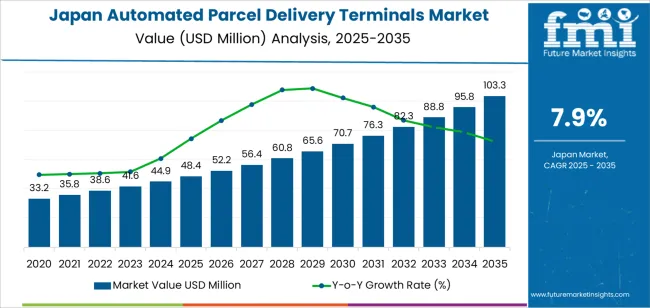
In 2025, demand for automated parcel delivery terminals in Japan is valued at USD 48.4 million and is projected to reach USD 103.3 million by 2035, reflecting a CAGR of 7.9%. The early part of the curve, from 2025 to around 2030, shows demand rising from USD 48.4 million to roughly USD 70.7 million, driven by e commerce expansion, high urban population density, and pressure on last mile delivery costs. Peak usage growth appears around the phase when large logistics groups, convenience store chains, and real estate operators roll out dense locker networks in major metropolitan areas. During this period, utilization rates increase and network coverage becomes a key competitive factor across parcel operators.
After this early peak growth phase, the curve begins to flatten as installation density in core cities approaches practical saturation. Between 2030 and 2035, demand rises from about USD 70.7 million to USD 103.3 million, with growth shifting from new greenfield deployments toward upgrades, software enhancements, and expansion into secondary cities and suburban zones. The trough periods in growth appear where macroeconomic pressures and cautious capital spending slow new terminal projects. Suppliers and logistics operators respond with modular systems, retrofit friendly designs, and data driven placement strategies, aiming to raise throughput per terminal rather than relying solely on new unit additions.
Quick Stats of Automated Parcel Delivery Terminals Industry in Japan
- Demand for Automated Parcel Delivery Terminals in Japan Value (2025): USD 48.4 million
- Demand for Automated Parcel Delivery Terminals in Japan Forecast Value (2035): USD 103.3 million
- Demand for Automated Parcel Delivery Terminals in Japan Forecast CAGR (2025 to 2035): 7.9%
- Leading Deployment Type Automated Parcel Delivery Terminals in Japan: Outdoor Terminal (58%)
- Key Growth Regions for Automated Parcel Delivery Terminals in Japan: Kyushu & Okinawa, Kanto, Kinki, Chubu, Tohoku, Rest of Japan
- Top Players in Automated Parcel Delivery Terminals Industry in Japan: Keba AG, Cleveron Ltd., Neopost Group, Smartbox Ecommerce Solutions Pvt. Ltd., Winsen Industry Co., Ltd.
What is the Growth Forecast for Automated Parcel Delivery Terminals in Japan through 2035?
From 2020 to 2025 demand for automated parcel delivery terminals in Japan rises from USD 33.2 million to 48.4 million, giving early movers room to consolidate share while the market is still forming. Network operators linked to postal groups and large parcel carriers tend to hold the highest installation density, capturing most urban and transit hub locations. Between 2025 and 2030, as demand climbs from 48.4 million to 70.7 million, second tier logistics providers, real estate owners, and convenience store chains begin deploying branded lockers, slowly eroding the dominance of the initial three or four networks. Market share shifts at this stage are gradual because hardware standards, integration requirements, and location contracts limit rapid switching for incumbent networks in transition.
From 2030 to 2035 market value grows from USD 70.7 million to 103.3 million, and the Market Share Erosion or Gain profile becomes more pronounced. Fast growing e commerce platforms, parcel aggregators, and software centric locker managers add capacity faster than legacy players focused on owned hardware. Their emphasis on open APIs, white label cabinets, and data driven route allocation enables penetration into secondary cities and residential clusters that were previously under served. Established networks still grow in absolute revenue terms but surrender relative share where contract terms are rigid or upgrade cycles are slow. The winners in this phase are operators that convert hardware scale into flexible access models for retailers and carriers across dense urban and suburban corridors.
Automated Parcel Delivery Terminals Industry in Japan Key Takeaways
| Metric | Value |
|---|---|
| Industry Value (2025) | USD 48.4 million |
| Forecast Value (2035) | USD 103.3 million |
| Forecast CAGR (2025 to 2035) | 7.9% |
What Is Driving the Demand for Automated Parcel Delivery Terminals in Japan
The rise of online shopping in Japan has increased demand for efficient parcel delivery options and helped drive interest in automated parcel delivery terminals. Growth of e-commerce has resulted in higher volumes of parcels needing delivery and pickup. This has created pressure on logistics providers to offer more flexible, secure, and time-efficient delivery solutions. Automated parcel delivery terminals offer a pickup option that avoids missed deliveries, reduces delivery times, and provides 24/7 access for customers.
Looking ahead, demand for automated parcel delivery terminals in Japan will likely increase as urbanisation continues and last-mile delivery becomes more critical. Expansion of high-density residential buildings and mixed-use complexes will favor installation of parcel lockers and smart delivery terminals. Pressure on logistics companies to reduce costs and maintain high service reliability will support deployment of indoor and outdoor automated terminals. Adoption of smart locker networks and IoT-based tracking systems will encourage investment in parcel terminal infrastructure. As e-commerce and delivery volumes grow, automated delivery terminals offer a scalable solution for parcel handling and retrieval.
What Factors Are Affecting the Demand for Automated Parcel Delivery Terminals in Japan in Terms of Deployment Type and Ownership?
The demand for automated parcel delivery terminals in Japan is determined by deployment type and ownership structure. Outdoor terminals account for 58% of total installations, reflecting their suitability for high traffic residential and transit locations. Indoor terminals serve retail buildings, offices, and controlled access facilities. By ownership, shipping and logistics companies lead with a 38% share, followed by retailers, government organizations, and other operators. Demand patterns reflect delivery volume concentration, real estate availability, security needs, and service accessibility. These segments illustrate how operator scale and placement strategy shape terminal deployment across urban, suburban, and mixed use logistics environments.
What Drives the Leading Demand for Outdoor Automated Parcel Delivery Terminals in Japan?
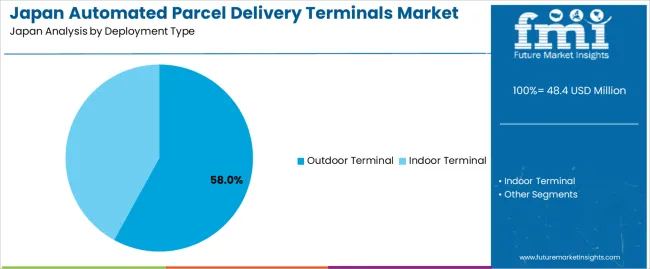
Outdoor automated parcel delivery terminals account for 58% of total demand in Japan. Their dominance is linked to their ability to operate continuously in open access environments such as residential complexes, train stations, and roadside hubs. Outdoor terminals support unattended parcel pickup, which aligns with high frequency delivery cycles in dense urban neighborhoods. Weather resistant enclosures and vandal resistant structures allow reliable operation under varied climate and traffic conditions. These installations reduce failed delivery attempts and lower repeat handling costs for carriers managing time constrained urban routes.
Municipal zoning and property access policies also support outdoor terminal placement near public transit and large housing blocks. Installation does not require integration with existing indoor floor plans, which reduces setup timelines. Maintenance activities can be scheduled without disrupting building operations. High usage rates in 24 hour public settings improve return on investment for operators. These operating advantages reinforce outdoor terminals as the primary deployment format across cities where last mile parcel volumes remain structurally elevated.
What Drives the Leading Demand from Shipping and Logistics Companies for Automated Parcel Delivery Terminals in Japan?
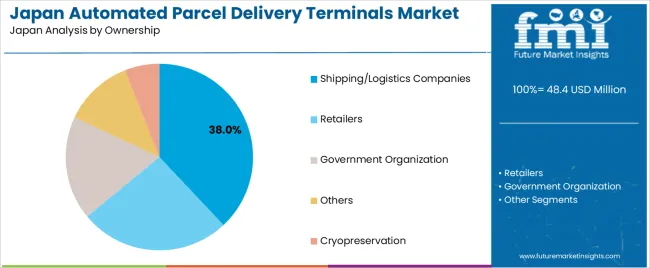
Shipping and logistics companies represent 38% of total ownership of automated parcel delivery terminals in Japan. This leadership reflects direct alignment between terminal networks and core delivery operations. Carriers use terminals to consolidate drop density, lower redelivery rates, and improve route efficiency. Terminals enable batch delivery to single locations serving hundreds of recipients. This reduces vehicle dwell time and improves utilization across urban and suburban service zones. Ownership allows logistics firms to control placement strategy based on route engineering and parcel flow analytics.
Terminal ownership also supports service differentiation through time flexible pickup options. Carriers integrate terminal access with shipment tracking systems to provide end recipients with real time collection notifications. This improves service reliability without increasing driver labor hours. Capital investment in terminals is justified by long term cost reduction across fuel, labor, and missed delivery handling. These cross functional efficiencies continue to reinforce shipping and logistics companies as the primary terminal owners within the national deployment structure.
What Are the Key Drivers Behind Demand for Automated Parcel Delivery Terminals in Japan?
Demand for automated parcel delivery terminals in Japan is driven mainly by the sharp rise in home deliveries linked to e-commerce, grocery ordering, and subscription-based retail. High rates of failed first-time deliveries in dense urban housing clusters make unattended delivery a persistent operational problem for logistics firms. Labour shortages in the courier workforce increase pressure to cut repetitive door-to-door attempts. Consumer preference for 24-hour pickup flexibility matches the lifestyle of long working hours. Railway stations, apartments, and convenience stores already function as logistics nodes, which supports steady expansion of parcel terminal installations.
How Do Urban Density and Last-Mile Cost Pressures Shape Parcel Terminal Demand in Japan?
Japanese cities combine extreme population density with limited parking, narrow streets, and strict delivery timing windows. These conditions increase per-parcel delivery cost and reduce vehicle productivity. Automated parcel terminals allow multiple deliveries in one stop rather than sequential door drops, lowering time and fuel usage per package. Property developers also install lockers as a standard amenity to increase rental appeal in urban housing. For logistics providers, parcel terminals act as fixed consolidation points that stabilize delivery planning under congestion and time constraints. These urban cost pressures make lockers structurally attractive across Japan’s metropolitan regions.
What Structural Barriers and User Constraints Limit Wider Adoption in Japan?
Despite strong fundamentals, rollout of automated parcel terminals in Japan faces location and acceptance limits. Installation requires landlord approval in dense apartment buildings and public space agreements near stations. High equipment cost and long payback periods restrict rapid deployment outside prime urban zones. Older residents and users without smartphones may find digital locker systems less accessible. Rural areas with low parcel density do not justify hardware investment on commercial terms. These physical, demographic, and cost constraints slow uniform national penetration and keep deployment concentrated in high-traffic residential and transit corridors.
What Technology and Network Design Trends Are Defining Parcel Terminals in Japan?
Parcel terminals in Japan are transitioning from single-carrier lockers to shared multi-operator networks that handle deliveries from multiple couriers. System design now prioritises compact footprints, high turnover capacity, and secure digital access through QR codes and mobile authentication. Temperature-controlled compartments for groceries and pharmaceuticals are gaining importance as cold-chain delivery expands. Retail-linked pickup points and station-adjacent lockers are increasing network reach without heavy real-estate cost. These technology and placement trends show parcel terminals becoming standardized logistics infrastructure rather than optional last-mile add-ons.
What is the Demand for Automated Parcel Delivery Terminals in USA by Region?
| Region | CAGR (%) |
|---|---|
| West | 9.8% |
| South | 9.1% |
| Northeast | 8.0% |
| Midwest | 7.0% |
| Others | 5.8% |
The demand for automated parcel delivery terminals in the USA is expected to rise significantly across all regions with the West leading at a 9.8% CAGR. This strong growth reflects expanding e-commerce volumes, rising consumer preference for convenient 24/7 parcel pickup, and increasing adoption of locker-based last-mile delivery infrastructure. The South at 9.1% and Northeast at 8.0% follow, driven by growing urban populations and logistics investments. The Midwest shows a 7.0% CAGR, reflecting more moderate but steady uptake of parcel locker networks as delivery services modernize. The “Others” segment at 5.8% signals emerging demand in less dense or rural areas as infrastructure expands nationwide. The overall growth underscores the shift toward contactless, efficient parcel distribution systems across the country.
What is Accelerating Automated Parcel Delivery Terminal Demand in Kyushu and Okinawa Regions of Japan?
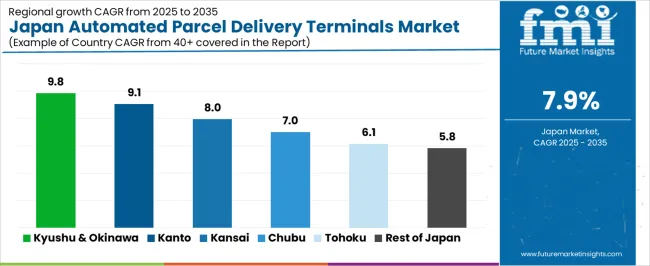
Expansion in Kyushu and Okinawa reflects a CAGR of 9.8% through 2035 for automated parcel delivery terminal demand, driven by rising e commerce penetration and growing interisland logistics activity. Urban centers such as Fukuoka generate high parcel volumes from retail and food delivery platforms. Tourism led consumption further increases last mile delivery pressure. Limited storage access in residential zones supports terminal installation near transit hubs and apartment complexes. Courier operators prioritize unattended delivery infrastructure to reduce redelivery costs and improve service reliability across island and mainland routes with consistent residential turnover.
- E commerce expansion increases last mile delivery volume
- Tourism driven consumption supports parcel flow growth
- Transit hub installations improve unattended delivery access
- Redelivery cost control strengthens terminal deployment
How is Kanto Driving National Growth for Automated Parcel Delivery Terminals in Japan?
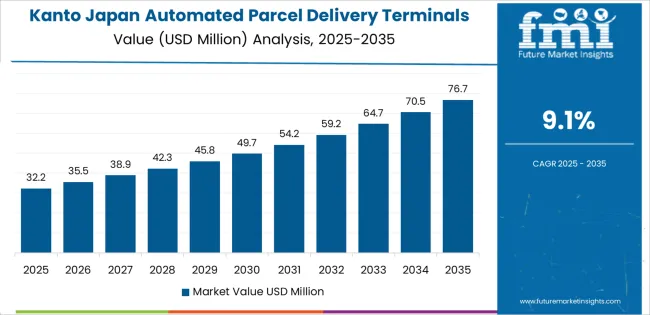
Kanto advances at a CAGR of 9.1% through 2035 for automated parcel delivery terminal demand, supported by Japans highest parcel traffic density and extensive multi channel retail networks. Tokyo metropolitan logistics generates continuous pressure on doorstep delivery capacity. High rise residential development increases dependency on shared delivery infrastructure. Retailers integrate locker based fulfillment to reduce failed delivery attempts. Courier companies prioritize networked terminal deployment near rail stations, mixed use developments, and office corridors. Demand aligns closely with same day delivery growth and urban congestion management strategies across greater Kanto.
- High parcel traffic density drives terminal network expansion
- High rise living increases reliance on shared delivery access
- Failed delivery reduction improves operational efficiency
- Rail station proximity supports high daily locker turnover
Why is Kinki Emerging as a Strong Hub for Automated Parcel Delivery Terminal Deployment?
Kinki records a CAGR of 8.0% through 2035 for automated parcel delivery terminal demand, supported by dense commercial zones and strong retail distribution activity in Osaka and surrounding cities. Warehouse automation growth links directly with last mile infrastructure investment. Residential parcel volumes rise due to food delivery and apparel ecommerce demand. Space limitations in older urban housing increase use of shared terminal systems. Courier networks expand installations across transit corridors and shopping districts. Demand remains tied to consistent urban consumer purchasing behavior rather than industrial freight movement.
- Dense retail districts generate steady parcel throughput
- Residential space limits encourage shared delivery systems
- Transit corridor placement improves customer accessibility
- Food and apparel ecommerce sustain daily locker usage
What is Supporting Automated Parcel Delivery Terminal Demand Growth in Chubu Region of Japan?
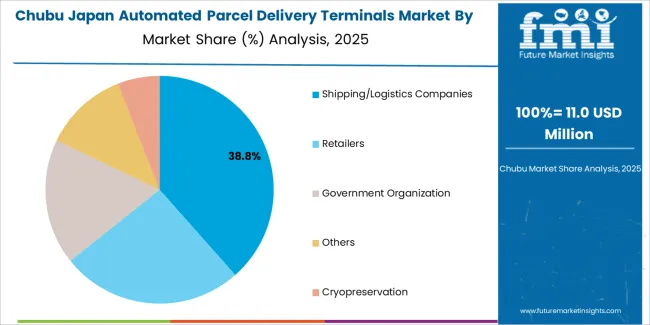
Chubu expands at a CAGR of 7.0% through 2035 for automated parcel delivery terminal demand, driven by balanced residential parcel volume and industrial ecommerce fulfillment. Manufacturing related spare parts logistics contribute to business to consumer shipments. Suburban housing demand supports steady terminal installation near local commercial centers. Automotive workforce communities rely on unattended delivery for shift based work patterns. Regional fulfillment centers integrate lockers to manage peak seasonal surges. Deployment remains moderately paced due to lower population density compared with Kanto and Kinki but benefits from stable logistics planning.
- Suburban housing supports consistent installation demand
- Spare parts ecommerce adds business oriented parcel flow
- Shift based work patterns favor unattended delivery usage
- Regional fulfillment centers manage seasonal volume peaks
How is Automated Parcel Delivery Terminal Demand Developing in Tohoku Region of Japan?
Tohoku shows a CAGR of 6.1% through 2035 for automated parcel delivery terminal demand, shaped by gradual ecommerce adoption and dispersed settlement patterns. Residential parcel volume grows steadily but remains below urban intensities. Installation centers on municipal hubs, hospital districts, and university zones. Courier operators favor cluster based placement to optimize service routes. Harsh winter conditions reinforce the need for protected unattended delivery solutions. Growth remains stable rather than rapid due to moderate population densities and longer intercity transport distances affecting same day delivery penetration rates.
- Dispersed settlements guide cluster based terminal placement
- University and hospital zones anchor local installations
- Winter conditions increase need for protected delivery access
- Moderate ecommerce penetration tempers overall expansion pace
What is Sustaining Automated Parcel Delivery Terminal Demand in the Rest of Japan?
The rest of Japan reflects a CAGR of 5.8% through 2035 for automated parcel delivery terminal demand, supported by steady growth in rural ecommerce adoption and municipal logistics services. Low population density limits large scale rollout but supports targeted installations near supermarkets, fuel stations, and town centers. Aging households increase demand for secure unattended parcel reception. Courier investment focuses on reducing redelivery travel distances rather than volume maximization. Demand stability depends on local government partnerships and community retail platforms integrating parcel services into daily rural consumption patterns.
- Rural ecommerce adoption supports incremental deployment
- Aging households favor secure unattended delivery options
- Municipal hubs guide localized installation strategies
- Courier investment prioritizes route efficiency over scale
What Is Driving the Demand for Automated Parcel Delivery Terminals in Japan and Who Are the Key Players Shaping the Industry?
Demand for automated parcel delivery terminals in Japan is rising as e commerce expands and consumers expect flexible, contactless delivery options. Urban density and limited residential space make locker based delivery attractive because it reduces failed deliveries and simplifies pickup. Parcel lockers placed in apartment buildings, retail hubs, and transit oriented complexes offer convenience for busy customers. Logistics and courier companies favour these terminals to streamline last mile delivery operations, reduce repeated delivery attempts, and manage rising parcel volumes efficiently. The shift toward parcel locker networks supports higher throughput, lowers distribution costs, and improves reliability in a market where prompt delivery and user convenience are important.
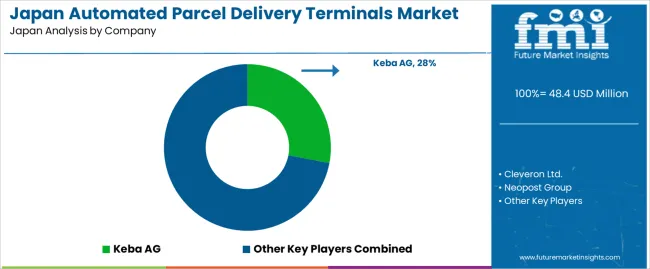
Among global terminal providers, a small number of firms lead the market. Keba AG is notable for advanced automation and locker systems; Cleveron Ltd. and Neopost Group supply modular smart locker solutions and have been cited among key global vendors. Smartbox Ecommerce Solutions Pvt. Ltd. and Winsen Industry Co., Ltd. also contribute with scalable systems suited to high volume delivery flows. In global comparison, Keba AG together with another major vendor control roughly 28% of the overall automated parcel delivery terminal market. This share indicates a moderate concentration but leaves room for regional players to capture meaningful segments in Japan.
Key Players in Demand for Automated Parcel Delivery Terminals Industry in Japan
- Keba AG
- Cleveron Ltd.
- Neopost Group
- Smartbox Ecommerce Solutions Pvt. Ltd.
- Winsen Industry Co., Ltd.
Scope of the report
| Items | Values |
|---|---|
| Quantitative Units (2025) | USD million |
| Deployment Type | Outdoor Terminal, Indoor Terminal |
| Ownership | Shipping/Logistics Companies, Retailers, Government Organization, Others |
| Region | Kyushu & Okinawa, Kanto, Kinki, Chubu, Tohoku, Rest of Japan |
| Countries Covered | Japan |
| Key Companies Profiled | Keba AG, Cleveron Ltd., Neopost Group, Smartbox Ecommerce Solutions Pvt. Ltd., Winsen Industry Co., Ltd. |
| Additional Attributes | Dollar by sales by deployment type and ownership; regional CAGR and volume growth projections; outdoor vs indoor terminal share; shipping/logistics company vs retailer vs government ownership proportion; urban vs suburban deployment trends; density saturation in core cities; software and modular upgrade adoption; integration with e-commerce platforms; multi-operator and white label locker networks; IoT tracking and cold-chain enabled compartments; influence of population density and urbanization; optimization for last-mile efficiency; cost and capital expenditure considerations; replacement vs new installations. |
Automated Parcel Delivery Terminals Industry in Japan Segmentation
Deployment Type:
- Outdoor Terminal
- Indoor Terminal
Ownership:
- Shipping/Logistics Companies
- Retailers
- Government Organization
- Others
- Cryopreservation
Region
- Kyushu & Okinawa
- Kanto
- Kinki
- Chubu
- Tohoku
- Rest of Japan
Frequently Asked Questions
How big is the demand for automated parcel delivery terminals in Japan in 2025?
The demand for automated parcel delivery terminals in Japan is estimated to be valued at USD 48.4 million in 2025.
What will be the size of automated parcel delivery terminals in Japan in 2035?
The market size for the automated parcel delivery terminals in Japan is projected to reach USD 103.3 million by 2035.
How much will be the demand for automated parcel delivery terminals in Japan growth between 2025 and 2035?
The demand for automated parcel delivery terminals in Japan is expected to grow at a 7.9% CAGR between 2025 and 2035.
What are the key product types in the automated parcel delivery terminals in Japan?
The key product types in automated parcel delivery terminals in Japan are outdoor terminal and indoor terminal.
Which ownership segment is expected to contribute significant share in the automated parcel delivery terminals in Japan in 2025?
In terms of ownership, shipping/logistics companies segment is expected to command 38.0% share in the automated parcel delivery terminals in Japan in 2025.
Preview the report firsthand - request a free sample
Get SampleGet the brochure for pricing and purchase details.
Get PDFTable of Content
- Executive Summary
- Japan Market Outlook
- Demand-side Trends
- Supply-side Trends
- Technology Roadmap Analysis
- Analysis and Recommendations
- Market Overview
- Market Coverage / Taxonomy
- Market Definition / Scope / Limitations
- Market Background
- Market Dynamics
- Drivers
- Restraints
- Opportunity
- Trends
- Scenario Forecast
- Demand in Optimistic Scenario
- Demand in Likely Scenario
- Demand in Conservative Scenario
- Opportunity Map Analysis
- Product Life Cycle Analysis
- Supply Chain Analysis
- Investment Feasibility Matrix
- Value Chain Analysis
- PESTLE and Porter’s Analysis
- Regulatory Landscape
- Regional Parent Market Outlook
- Production and Consumption Statistics
- Import and Export Statistics
- Market Dynamics
- Japan Market Analysis 2020 to 2024 and Forecast, 2025 to 2035
- Historical Market Size Value (USD Million) Analysis, 2020 to 2024
- Current and Future Market Size Value (USD Million) Projections, 2025 to 2035
- Y-o-Y Growth Trend Analysis
- Absolute $ Opportunity Analysis
- Japan Market Pricing Analysis 2020 to 2024 and Forecast 2025 to 2035
- Japan Market Analysis 2020 to 2024 and Forecast 2025 to 2035, By Deployment Type
- Introduction / Key Findings
- Historical Market Size Value (USD Million) Analysis By Deployment Type , 2020 to 2024
- Current and Future Market Size Value (USD Million) Analysis and Forecast By Deployment Type , 2025 to 2035
- Outdoor Terminal
- Indoor Terminal
- Y-o-Y Growth Trend Analysis By Deployment Type , 2020 to 2024
- Absolute $ Opportunity Analysis By Deployment Type , 2025 to 2035
- Japan Market Analysis 2020 to 2024 and Forecast 2025 to 2035, By Ownership
- Introduction / Key Findings
- Historical Market Size Value (USD Million) Analysis By Ownership, 2020 to 2024
- Current and Future Market Size Value (USD Million) Analysis and Forecast By Ownership, 2025 to 2035
- Shipping/Logistics Companies
- Retailers
- Government Organization
- Others
- Cryopreservation
- Y-o-Y Growth Trend Analysis By Ownership, 2020 to 2024
- Absolute $ Opportunity Analysis By Ownership, 2025 to 2035
- Market Structure Analysis
- Competition Dashboard
- Competition Benchmarking
- Market Share Analysis of Top Players
- By Regional
- By Deployment Type
- By Ownership
- Competition Analysis
- Competition Deep Dive
- Keba AG
- Overview
- Product Portfolio
- Profitability by Market Segments (Product/Age /Sales Channel/Region)
- Sales Footprint
- Strategy Overview
- Marketing Strategy
- Product Strategy
- Channel Strategy
- Cleveron Ltd.
- Neopost Group
- Smartbox Ecommerce Solutions Pvt. Ltd.
- Winsen Industry Co., Ltd.
- Keba AG
- Competition Deep Dive
- Assumptions & Acronyms Used
- Research Methodology


