

- Industry Size (2025)
- USD 318.8 Mn
- Forecast (2035)
- USD 824.9 Mn
- CAGR (2025 to 2035)
- 10.0%
Demand for Automated Parcel Delivery Terminals in USA Forecast and Outlook 2025 to 2035
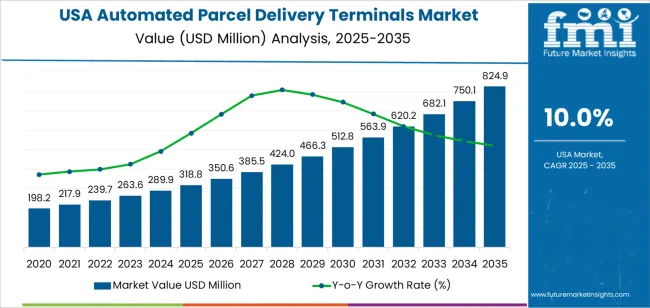
In 2025, demand for automated parcel delivery terminals in the USA is valued at USD 318.8 million and is projected to reach USD 824.9 million by 2035 at a CAGR of 10.0%. Growth in the first half of the forecast reflects the scale of e commerce penetration, last mile congestion, and rising labor costs across metropolitan delivery networks. National parcel operators, grocery chains, and multifamily property owners expand locker installations to reduce failed deliveries and streamline returns. Urban hubs and transit oriented developments account for the highest installation density. Early demand is driven less by technology novelty and more by throughput efficiency, contactless access, and round the clock parcel retrieval in high traffic residential and retail environments.
After 2030, demand expansion becomes more network driven than exploratory. Market value rises from roughly USD 512.8 million in 2030 to USD 824.9 million by 2035 as locker grids extend into suburban logistics corridors, university campuses, healthcare complexes, and employer based distribution points. Hardware unit growth continues, though a growing share of value comes from software layers, remote monitoring, and access management systems.
Quick Stats of the Demand for Automated Parcel Delivery Terminals in USA
- Demand for Automated Parcel Delivery Terminals in USA Value (2025): USD 318.8 million
- Demand for Automated Parcel Delivery Terminals in USA Forecast Value (2035): USD 824.9 million
- Demand for Automated Parcel Delivery Terminals in USA Forecast CAGR (2025 to 2035): 10.0%
- Leading Deployment Type in Automated Parcel Delivery Terminals USA: Outdoor Terminal (58%)
- Key Growth Regions for Automated Parcel Delivery Terminals in USA: West, South, Northeast, Midwest
- Top Players Shaping Automated Parcel Delivery Terminals Industry in USA: Keba AG, Cleveron Ltd., Neopost Group, Smartbox Ecommerce Solutions Pvt. Ltd., Winsen Industry Co., Ltd.
What is the Growth Forecast for Automated Parcel Delivery Terminals in USA through 2035?
National retailers integrate lockers into omnichannel order fulfillment to control reverse logistics cost. Key suppliers include global automation firms and domestic smart locker integrators with USA manufacturing and installation networks. Competitive positioning centers on deployment speed, weather resistance, cybersecurity of access systems, and service uptime across large distributed fleets.
The Growth Volatility Index for automated parcel delivery terminals in the USA between 2020 and 2025 reflects an early acceleration phase with widening year on year absolute additions. Demand rises from USD 198.2 million to USD 318.8 million across this window, with annual increments expanding from USD 19.7 million to nearly USD 28.9 million by 2025. This widening step size signals increasing volatility relative to the early base as infrastructure deployment shifts from pilot density to network scale across urban logistics hubs. The volatility during this phase is constructive rather than disruptive, reflecting rising installation pace across retail chains, residential complexes, and carrier-operated locker networks. The variability is driven by site acquisition timing and network clustering rather than cyclical demand shocks.
From 2025 to 2035, the volatility profile remains elevated but structurally controlled as demand expands from USD 318.8 million to USD 824.9 million. Annual value additions rise progressively from about USD 31.8 million to more than USD 74.8 million by the final years, marking a clear increase in volatility amplitude. This higher volatility band reflects aggressive network density expansion, suburban penetration, and platform-driven deployment contracts rather than instability. The Growth Volatility Index indicates accelerating deployment momentum after 2030 as infrastructure scale compounds. Despite rising fluctuations in yearly additions, downside volatility remains limited because demand is anchored to structural e commerce flow growth rather than discretionary investment cycles.
Automated Parcel Delivery Terminals Industry in USA Key Takeaways
| Metric | Value |
|---|---|
| Industry Value (2025) | USD 318.8 million |
| Forecast Value (2035) | USD 824.9 million |
| Forecast CAGR (2025 to 2035) | 10.0% |
What Is Driving the Demand for Automated Parcel Delivery Terminals in the USA
Demand for automated parcel delivery terminals in the USA has risen as e-commerce and online retail have grown rapidly. As consumers increasingly order goods online, parcel volumes have surged and delivery networks are strained by first-delivery failures, package theft, and missed delivery windows. Automated parcel lockers give delivery firms a way to reduce failed deliveries and returns, while offering customers secure 24/7 access to packages. Retailers and logistics providers see lockers and terminals as efficient ways to manage high parcel volumes, especially in dense urban and suburban areas. The convenience for end customers and savings on failed-delivery costs have made these systems more attractive.
Urbanisation patterns, rise in apartment living, and the growth of multi-family housing have also contributed. In many urban or condominium environments, delivering a parcel to an individual door is inefficient. Lockers placed in lobbies, parking lots, or near public transit hubs offer a centralised, secure pick-up point. For logistics companies, this consolidates last-mile deliveries and reduces driver time per parcel. For recipients, it removes the need to wait at home or coordinate with couriers.
Another driver is logistics and operational challenges in the US labour and delivery ecosystem. Labour shortages and cost pressures for drivers, plus inefficient door-to-door delivery models, push firms to look for scalable, lower-cost infrastructure. Automated terminals reduce reliance on manual handling and support high-volume throughput. They align with rising demand for rapid fulfilment and ability to handle spikes for example during holiday seasons or flash sale peaks.
What Factors Are Affecting the Demand for Automated Parcel Delivery Terminals in USA in Terms of Deployment Type and Ownership?
The demand for automated parcel delivery terminals in the USA is defined by deployment type and ownership structure. Outdoor terminals account for 58% of total installations, while indoor terminals are deployed within retail buildings, offices, and controlled facilities. By ownership, shipping and logistics companies hold a 38% share, followed by retailers, government organizations, and other operators. Deployment is influenced by delivery density, real estate access, security requirements, and consumer pickup behavior. Ownership patterns reflect capital expenditure capacity and direct alignment with delivery operations. These segments show how infrastructure placement and operational control determine terminal adoption across urban, suburban, and mixed use environments nationwide.
What Drives the Leading Demand for Outdoor Automated Parcel Delivery Terminals in USA?
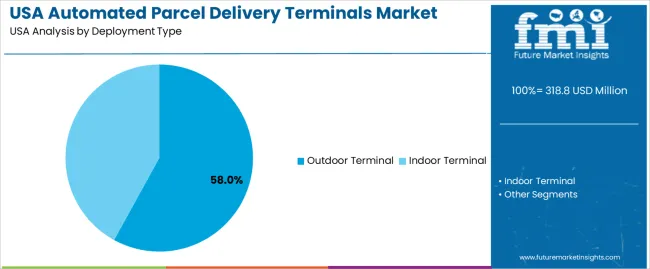
Outdoor automated parcel delivery terminals represent 58% of total demand in the USA. Their dominance reflects the need for unrestricted, round the clock access to parcel pickup in high traffic locations. Outdoor terminals are commonly placed near apartment complexes, transit hubs, roadside service zones, and commercial centers. These locations allow carriers to serve large user groups from a single delivery point. Weather resistant enclosures and reinforced structures support consistent operation under variable climate conditions.
Outdoor deployment reduces failed delivery attempts by allowing unattended drop off without reliance on building access schedules. Installation timelines remain shorter since indoor construction modification is not required. Maintenance access is also simplified without disrupting indoor foot traffic. High daily utilization improves return on investment for operators managing dense route coverage. These logistical and operational advantages sustain outdoor terminals as the dominant deployment type across the USA parcel delivery infrastructure.
What Drives the Leading Demand from Shipping and Logistics Companies for Automated Parcel Delivery Terminals in USA?
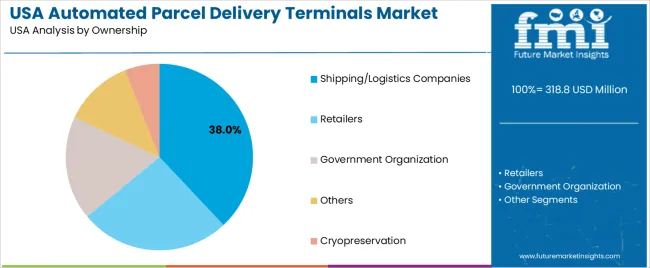
Shipping and logistics companies account for 38% of total ownership of automated parcel delivery terminals in the USA. This ownership leadership reflects the direct operating benefits terminals provide for network efficiency. Logistics firms use terminals to consolidate delivery volume, reduce door to door drop offs, and lower repeat delivery costs. Centralized terminal drops shorten route times and improve driver productivity. Ownership allows carriers to optimize terminal placement based on parcel flow density and routing data.
Terminal networks also support service reliability through time flexible pickup. Customers receive automated access notifications which improves collection success without driver re engagement. Integration with tracking systems strengthens delivery transparency. Long term cost control across labor, fuel, and vehicle utilization supports continued capital investment by logistics firms. These operational efficiencies reinforce shipping and logistics companies as the primary owners of automated parcel delivery terminals across the USA.
What Forces Are Driving the Demand for Automated Parcel Delivery Terminals in the USA?
Demand for automated parcel delivery terminals in the USA is driven by sustained growth in e-commerce, rising last-mile delivery costs, and consumer demand for flexible pickup options. Failed home deliveries, porch theft, and apartment access issues increase pressure on carriers to shift away from door-to-door drop models. Retailers seek to reduce reverse logistics cost from returns by using shared locker networks. Expansion of multi-family housing, college campuses, office parks, and mixed-use developments creates natural deployment sites for automated terminals. These operational and urban factors collectively support steady infrastructure-level demand.
How Do E-Commerce Operations and Urban Logistics Patterns Shape Terminal Demand in the USA?
High parcel density in metropolitan zones such as New York, Los Angeles, Chicago, Dallas, and Atlanta creates congestion-driven inefficiencies in traditional delivery models. Automated terminals allow carriers to consolidate multiple deliveries at a single point, reducing route time and fuel consumption per package. Gig-based delivery models benefit from faster drop-off cycles with fewer access failures. Retailers also use lockers as omnichannel fulfillment nodes for buy-online-pickup and fast-return services. These logistics patterns push parcel terminals from auxiliary devices into permanent components of urban delivery networks.
What Cost, Property Access, and User Adoption Barriers Limit Wider Terminal Expansion in the USA?
Automated parcel terminal growth in the USA faces restraints tied to hardware cost, real-estate approval, and uneven user acceptance. Installation requires agreements with property owners, municipalities, or retail operators, which slows rollout. Upfront capital costs and maintenance contracts delay deployment outside dense urban zones. Some users still prefer direct doorstep delivery for convenience. Rural and low-density suburban areas lack the parcel volume required to justify installation economics. These physical, financial, and behavioral constraints keep automated terminal deployment concentrated in high-throughput commercial and residential environments.
How Are Network Integration, Security, and Smart Access Trends Reshaping Parcel Terminal Demand in the USA?
Parcel terminal demand in the USA is shifting toward open-access, multi-carrier networks rather than single-courier systems. Terminals now integrate with mobile authentication, remote access control, and real-time delivery confirmation. Enhanced surveillance, anti-tampering design, and temperature-controlled compartments support higher-value and grocery shipments. Retail-linked locker hubs enable returns, repairs, and exchange services alongside deliveries. Data integration with route optimization software improves delivery density planning. These trends indicate automated parcel terminals evolving into smart, secure logistics nodes embedded within neighborhood infrastructure.
What is the Demand for Automated Parcel Delivery Terminals in USA by Region?
| Region | CAGR (%) |
|---|---|
| West USA | 11.5% |
| South USA | 10.3% |
| Northeast USA | 9.2% |
| Midwest USA | 8.0% |
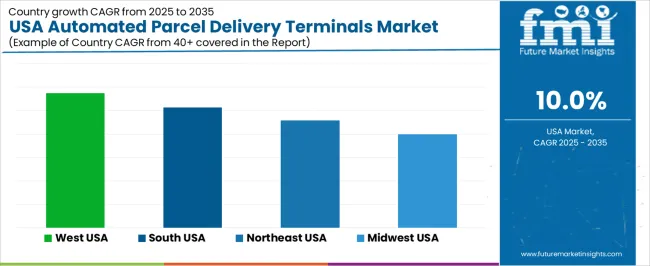
The demand for automated parcel delivery terminals in the USA is rising rapidly across all regions. The West leads with an 11.5% CAGR, reflecting strong growth in e-commerce, rising urban population density, and increasing demand for efficient, contactless last-mile delivery and secure, 24/7 parcel pickup solutions. The South region follows at 10.3%, supported by expanding logistics infrastructure, rising online retail penetration, and increased adoption of smart-locker networks by carriers and retailers.
The Northeast at 9.2% shows steady growth driven by urban centres, high population density, and demand for convenient parcel retrieval. The Midwest’s 8.0% growth reflects growing e-commerce penetration even in less densely populated areas and gradual expansion of parcel-terminal installations. Overall growth is underpinned by e-commerce expansion, need for efficient last-mile delivery, and rising consumer preference for convenience and contactless deliveries.
What is Accelerating Automated Parcel Delivery Terminal Demand in the West Region of USA?
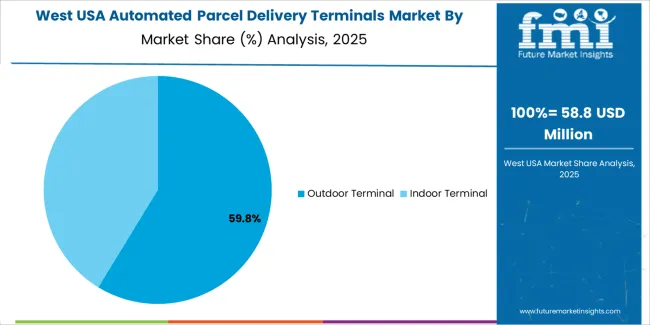
Growth in the West reflects a CAGR of 11.5% through 2035 for automated parcel delivery terminal demand, driven by high ecommerce penetration, dense urban housing, and strong consumer preference for unattended delivery solutions. Large metropolitan zones generate sustained parcel volume from retail, grocery, and meal delivery platforms. Apartment complexes and mixed use developments continue integrating shared locker systems to reduce delivery congestion. Technology oriented logistics operators prioritize locker networks to support same day fulfillment models. Demand is reinforced by labor cost control measures and last mile efficiency goals across urban delivery corridors.
- High ecommerce density sustains continuous locker utilization
- Apartment driven housing favors shared delivery access
- Same day fulfillment increases unattended delivery reliance
- Labor optimization strengthens terminal deployment strategies
How is the South Supporting Automated Parcel Delivery Terminal Demand in USA?
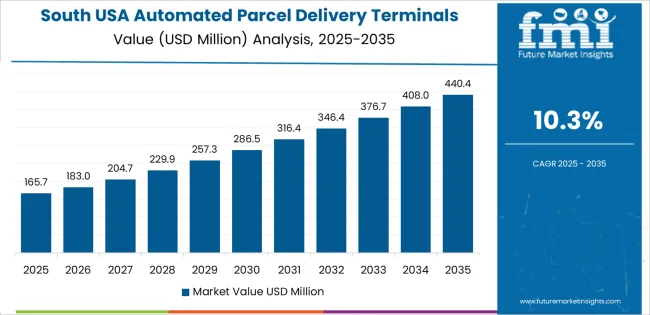
The South advances at a CAGR of 10.3% through 2035 for automated parcel delivery terminal demand, supported by rapid suburban expansion, rising online retail consumption, and growing third party logistics activity. Residential communities with gated access increase the need for secure unattended parcel solutions. Food, apparel, and household goods ecommerce sustain consistent locker turnover. Courier operators deploy terminals near retail centers and fuel stations to improve route efficiency. Demand remains balanced between last mile residential coverage and regional distribution node placement aligned with expanding suburban population patterns.
- Suburban housing growth increases secure delivery demand
- Retail ecommerce supports consistent parcel locker turnover
- Fuel station placement improves route efficiency
- Gated communities strengthen unattended delivery adoption
Why is Automated Parcel Delivery Terminal Demand Rising Steadily in the Northeast Region of USA?

The Northeast records a CAGR of 9.2% through 2035 for automated parcel delivery terminal demand, shaped by dense urban settlement, high vertical housing concentration, and strong retail fulfillment activity. Limited building access windows increase failed doorstep delivery attempts, encouraging locker deployment. Office districts and transit hubs emerge as preferred terminal locations. Cold weather logistics favor protected unattended delivery infrastructure. Demand is driven more by congestion management and service reliability than by housing expansion. Growth remains steady through continuous network infill across mature metropolitan logistics zones.
- Vertical housing density limits door to door delivery access
- Transit hub placement improves daily locker turnover
- Cold weather strengthens demand for protected delivery systems
- Congestion management supports continuous network expansion
What is Influencing Automated Parcel Delivery Terminal Demand in the Midwest Region of USA?
The Midwest expands at a CAGR of 8.0% through 2035 for automated parcel delivery terminal demand, supported by steady ecommerce adoption, regional distribution hubs, and increasing small city parcel volumes. Lower population density favors targeted installations near supermarkets, colleges, and municipal centers. Manufacturing parts deliveries and rural ecommerce contribute secondary volume flow. Courier investment focuses on reducing redelivery distances rather than high frequency urban turnover. Demand growth remains gradual, following incremental digital retail adoption rather than rapid urban densification across regional logistics networks.
- Small city ecommerce adoption supports incremental deployment
- Municipal centers anchor targeted locker installations
- Manufacturing parts delivery adds secondary parcel flow
- Redelivery distance reduction guides courier investment strategy
What Is Driving the Demand for Automated Parcel Delivery Terminals in USA and Who Are the Key Players Shaping the Industry?
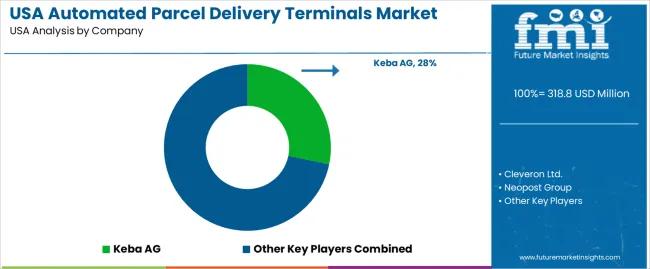
Demand for automated parcel delivery terminals in the USA is increasing as e commerce volumes rise and consumers seek convenience, flexibility, and reliability for last mile delivery. Parcel lockers and automated terminals help reduce failed deliveries, cut labour costs for couriers, and allow customers to retrieve parcels anytime. Urban congestion, busy lifestyles, and growth of multi unit housing make locker based delivery appealing. Retailers and logistics firms favour terminals that support high throughput, contactless access, and integration with delivery tracking systems. As overall parcel volume grows, terminals offer a scalable solution to manage delivery spikes and reduce delivery delays.
Among suppliers active in the USA and global terminal equipment market, Keba AG, Cleveron Ltd., Neopost Group, Smartbox Ecommerce Solutions Pvt. Ltd., and Winsen Industry Co., Ltd. shape supply dynamics. Keba AG holds approximately 18-22% of global market share and leads in smart locker deployment. Cleveron contributes a significant share (around 12-16%) through robotics based parcel terminals. Neopost Group also ranks among the main providers offering modular locker systems. Smartbox and Winsen, though less dominant globally, contribute with scalable terminal solutions suited for high volume and specialty deployments. The collective footprint of these firms supports expanding locker infrastructure across the US logistics and retail sectors.
Key Players in the Automated Parcel Delivery Terminals Industry in USA
- Keba AG
- Cleveron Ltd.
- Neopost Group
- Smartbox Ecommerce Solutions Pvt. Ltd.
- Winsen Industry Co., Ltd.
Scope of the Report
| Items | Values |
|---|---|
| Quantitative Units (2025) | USD million |
| Deployment Type | Outdoor Terminal, Indoor Terminal |
| Ownership | Shipping/Logistics Companies, Retailers, Government Organization, Others |
| Region | Northeast USA, West USA, Midwest USA, South USA |
| Countries Covered | USA |
| Key Companies Profiled | Keba AG, Cleveron Ltd., Neopost Group, Smartbox Ecommerce Solutions Pvt. Ltd., Winsen Industry Co., Ltd. |
| Additional Attributes | Dollar by sales by deployment type and ownership; regional CAGR and adoption trends; outdoor vs indoor terminal share; ownership distribution across logistics, retailers, and government; unit density in urban vs suburban installations; network integration, software layers, and remote monitoring adoption; contactless access and cybersecurity performance; integration with omnichannel fulfillment and reverse logistics; installation and maintenance timelines; climate and weather resistance of terminals; e-commerce parcel flow impact on deployment; niche vs high-throughput usage; regional urbanization influence on terminal placement; supplier strategies including long-term contracts and scalable deployments. |
Automated Parcel Delivery Terminals Industry in USA Segmentation
Deployment Type:
- Outdoor Terminal
- Indoor Terminal
Ownership:
- Shipping/Logistics Companies
- Retailers
- Government Organization
- Others
- Cryopreservation
Region
- Northeast USA
- West USA
- Midwest USA
- South USA
Frequently Asked Questions
How big is the demand for automated parcel delivery terminals in USA in 2025?
The demand for automated parcel delivery terminals in USA is estimated to be valued at USD 318.8 million in 2025.
What will be the size of automated parcel delivery terminals in USA in 2035?
The market size for the automated parcel delivery terminals in USA is projected to reach USD 824.9 million by 2035.
How much will be the demand for automated parcel delivery terminals in USA growth between 2025 and 2035?
The demand for automated parcel delivery terminals in USA is expected to grow at a 10.0% CAGR between 2025 and 2035.
What are the key product types in the automated parcel delivery terminals in USA?
The key product types in automated parcel delivery terminals in USA are outdoor terminal and indoor terminal.
Which ownership segment is expected to contribute significant share in the automated parcel delivery terminals in USA in 2025?
In terms of ownership, shipping/logistics companies segment is expected to command 38.0% share in the automated parcel delivery terminals in USA in 2025.
Preview the report firsthand - request a free sample
Get SampleGet the brochure for pricing and purchase details.
Get PDFTable of Content
- Executive Summary
- USA Market Outlook
- Demand-side Trends
- Supply-side Trends
- Technology Roadmap Analysis
- Analysis and Recommendations
- Market Overview
- Market Coverage / Taxonomy
- Market Definition / Scope / Limitations
- Market Background
- Market Dynamics
- Drivers
- Restraints
- Opportunity
- Trends
- Scenario Forecast
- Demand in Optimistic Scenario
- Demand in Likely Scenario
- Demand in Conservative Scenario
- Opportunity Map Analysis
- Product Life Cycle Analysis
- Supply Chain Analysis
- Investment Feasibility Matrix
- Value Chain Analysis
- PESTLE and Porter’s Analysis
- Regulatory Landscape
- Regional Parent Market Outlook
- Production and Consumption Statistics
- Import and Export Statistics
- Market Dynamics
- USA Market Analysis 2020 to 2024 and Forecast, 2025 to 2035
- Historical Market Size Value (USD Million) Analysis, 2020 to 2024
- Current and Future Market Size Value (USD Million) Projections, 2025 to 2035
- Y-o-Y Growth Trend Analysis
- Absolute $ Opportunity Analysis
- USA Market Pricing Analysis 2020 to 2024 and Forecast 2025 to 2035
- USA Market Analysis 2020 to 2024 and Forecast 2025 to 2035, By Deployment Type
- Introduction / Key Findings
- Historical Market Size Value (USD Million) Analysis By Deployment Type , 2020 to 2024
- Current and Future Market Size Value (USD Million) Analysis and Forecast By Deployment Type , 2025 to 2035
- Outdoor Terminal
- Indoor Terminal
- Y-o-Y Growth Trend Analysis By Deployment Type , 2020 to 2024
- Absolute $ Opportunity Analysis By Deployment Type , 2025 to 2035
- USA Market Analysis 2020 to 2024 and Forecast 2025 to 2035, By Ownership
- Introduction / Key Findings
- Historical Market Size Value (USD Million) Analysis By Ownership, 2020 to 2024
- Current and Future Market Size Value (USD Million) Analysis and Forecast By Ownership, 2025 to 2035
- Shipping/Logistics Companies
- Retailers
- Government Organization
- Others
- Cryopreservation
- Y-o-Y Growth Trend Analysis By Ownership, 2020 to 2024
- Absolute $ Opportunity Analysis By Ownership, 2025 to 2035
- Market Structure Analysis
- Competition Dashboard
- Competition Benchmarking
- Market Share Analysis of Top Players
- By Regional
- By Deployment Type
- By Ownership
- Competition Analysis
- Competition Deep Dive
- Keba AG
- Overview
- Product Portfolio
- Profitability by Market Segments (Product/Age /Sales Channel/Region)
- Sales Footprint
- Strategy Overview
- Marketing Strategy
- Product Strategy
- Channel Strategy
- Cleveron Ltd.
- Neopost Group
- Smartbox Ecommerce Solutions Pvt. Ltd.
- Winsen Industry Co., Ltd.
- Keba AG
- Competition Deep Dive
- Assumptions & Acronyms Used
- Research Methodology


