

- Industry Size (2026)
- USD 1.6 Bn
- Forecast (2036)
- USD 5.8 Bn
- CAGR (2026 to 2036)
- 13.7%
Automated Right-Size Corrugated Box Machinery Market Size, Market Forecast and Outlook By FMI
The automated right-size corrugated box machinery market was valued at USD 1.4 billion in 2025. The sector is set to reach USD 1.6 billion in 2026 at a CAGR of 13.7% during the forecast period. Demand outlook carries the valuation to USD 5.8 billion through 2036 as punitive dimensional-weight shipping algorithms penalize excess void space, forcing high-volume fulfillment centers to fabricate exact-fit cartons dynamically.
Replacing pre-formed standard stock boxes with dynamic 3D-scanning fanfold cutters shifts fulfillment economics entirely. High-volume e-commerce platforms facing severe peak season labor shortages deploy these systems to bypass manual packing constraints. Shippers who delay integration lose massive margins directly to major parcel carriers via dimensional (DIM) weight penalties. The true return on investment stems not from cardboard savings, but from eliminating secondary void-fill materials and slashing the physical trailer space required per outbound route. Integrating dynamic carton fabrication resolves this fundamental fulfillment bottleneck.
Summary of Automated Right-Size Corrugated Box Machinery Market
- Automated Right-Size Corrugated Box Machinery Market Definition
- The automated right-size corrugated box machinery market provides integrated hardware and software solutions that scan items and dynamically fabricate custom-fitted shipping cartons on demand, eliminating void space and standard box inventory.
- Demand Drivers in the Market
- European Union Packaging and Packaging Waste Regulation (PPWR) mandates force high-volume fulfillment centers to drastically eliminate void space and secondary plastic fillers.
- Punitive dimensional-weight pricing from major parcel carriers requires third-party logistics providers to fabricate exact-fit cartons to protect shipping margins.
- Chronic warehouse labor shortages drive e-commerce platforms to replace manual box-erecting stations with fully automated, high-speed fit-to-size cutting lines.
- Key Segments Analyzed in the FMI Report
- Fanfold Web-Fed: 61.5% share in 2026, dominating because continuous corrugated feeds maximize throughput and drastically reduce reloading downtime during peak shifts.
- E-commerce Fulfillment: 44.2% share in 2026, as massive multi-SKU variability renders traditional standardized box inventories mathematically inefficient for high-volume shippers.
- High-Speed/Continuous: 52.8% share in 2026, driven by top-tier distribution hubs requiring processing rates exceeding 1,000 exact-fit boxes per hour.
- China: 16.5% CAGR, fueled by the State Post Bureau Green Packaging Mandate requiring absolute reduction in secondary shipping waste.
- Analyst Opinion at FMI
- Ismail Sutaria, Principal Consultant for Packaging, opines, "The true bottleneck is not the cutting speed, but the upstream 3D scanning accuracy. Facilities attempting to run high-speed right-size operations without integrated multi-axis item scanning face high rejection rates at the packing station. Fulfillment operators who fail to address this synchronization gap will face severe downstream bottlenecks, negating the entire throughput advantage of their equipment investment."
- Strategic Implications / Executive Takeaways
- E-commerce platforms must integrate dynamic 3D scanning capability to eliminate manual void-fill operations before upcoming peak season capacity crunches.
- Third-party logistics operators should transition away from standard box inventories to win premium fulfillment contracts requiring verified sustainability metrics.
- Packaging equipment vendors must develop seamless fanfold auto-splicing mechanisms or face disqualification from high-volume intralogistics tenders.
- Market Research Methodology
- Primary Research: FMI conducted detailed technical interviews with warehouse operations directors, packaging engineers, and supply chain vice presidents across major logistics hubs.
- Desk Research: Analysts aggregated public carrier tariff changes, regional packaging waste mandates, corporate sustainability reports, and intralogistics investment filings.
- Market-Sizing and Forecasting: The model applies a bottom-up methodology starting with installed base metrics for automated packing lines and projecting the conversion rate to fit-to-size systems.
- Data Validation and Update Cycle: Segment forecasts undergo cross-validation against quarterly equipment shipment volumes reported by key mechatronics and automation suppliers.
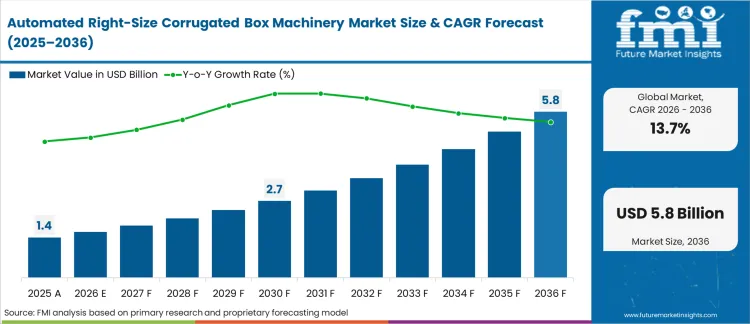
Automated Right‑Size Corrugated Box Machinery Market Key Takeaways
| Metric | Details |
|---|---|
| Industry Size (2026) | USD 1.6 billion |
| Industry Value (2036) | USD 5.8 billion |
| CAGR (2026-2036) | 13.7% |
Source: Future Market Insights (FMI) analysis, based on proprietary forecasting model and primary research.
Growth becomes self-sustaining when major parcel networks strictly enforce minimum package density ratios. High-volume shippers must install native fit-to-size box erectors before impending holiday surcharges erode remaining operational margin, permanently accelerating equipment adoption.
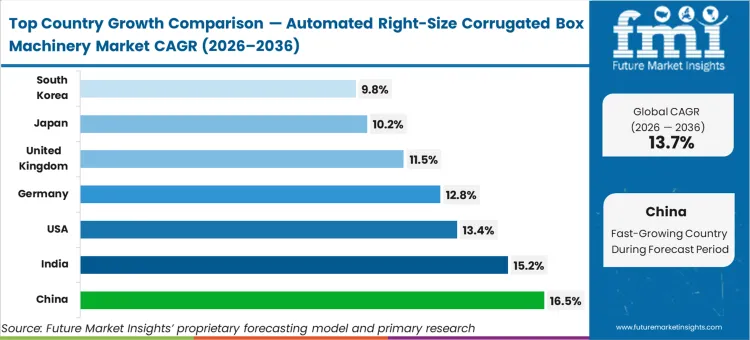
China advances at a 16.5% CAGR, tracking ahead of India at 15.2% as both nations aggressively automate their massive domestic distribution networks. The United States follows at a 13.4% expansion, driven by acute warehouse labor shortages. Germany posts a 12.8% rate, while the United Kingdom records a 11.5% growth. Japan tracks at 10.2% and South Korea reaches 9.8%, reflecting their established intralogistics maturity. This geographic spread exists structurally because national labor cost profiles dictate exactly when automated packing achieves cost-parity with manual fulfillment.
Automated Right-Size Corrugated Box Machinery Market Definition
Automated right-size corrugated box machinery encompasses advanced mechatronic systems that dynamically scan individual product geometries and instantly cut, crease, and erect custom-fitted shipping cartons from continuous fanfold board or single sheets. This equipment eliminates the need for standardized box inventories and void-fill materials by fabricating exact-fit secondary packaging on demand at the end-of-line packing station.
Automated Right-Size Corrugated Box Machinery Market Inclusions
The market scope includes in-line fanfold cutting machines, automated single-sheet box erectors, 3D product scanning arrays integrated into packing lines, and heavy-duty standalone cutting tables used for oversized goods. Proprietary software systems that optimize fanfold web utilization and intralogistics routing algorithms directly associated with the machinery are fully incorporated into the valuation.
Automated Right-Size Corrugated Box Machinery Market Exclusions
Standard pre-formed folder-gluer equipment used in traditional box manufacturing plants is explicitly excluded. Manual tape dispensers, standalone wrapping machines, void-fill air pillow extruders, and raw fanfold corrugated material supplies fall outside the defined boundaries. Standard conveyor belts lacking integrated fit-to-size processing logic are also omitted.
Automated Right-Size Corrugated Box Machinery Market Research Methodology
- Primary Research: Analysts engaged with fulfillment center engineers, intralogistics automation directors, and 3PL procurement leads to map the precise DIM weight thresholds triggering machinery upgrades.
- Desk Research: The data collection phase aggregated compliance roadmaps from the European Union Packaging and Packaging Waste Regulation (PPWR), major parcel carrier pricing updates, and logistics association capacity reports.
- Market-Sizing and Forecasting: The baseline value derives from a bottom-up aggregation of active fanfold machine installations, applying regional e-commerce volume curves to project future adoption velocity.
- Data Validation and Update Cycle: Projections are rigorously tested against publicly reported capital expenditure guidance from the leading global retail and third-party logistics conglomerates.
Segmental Analysis
Automated Right-Size Corrugated Box Machinery Market Analysis by Configuration
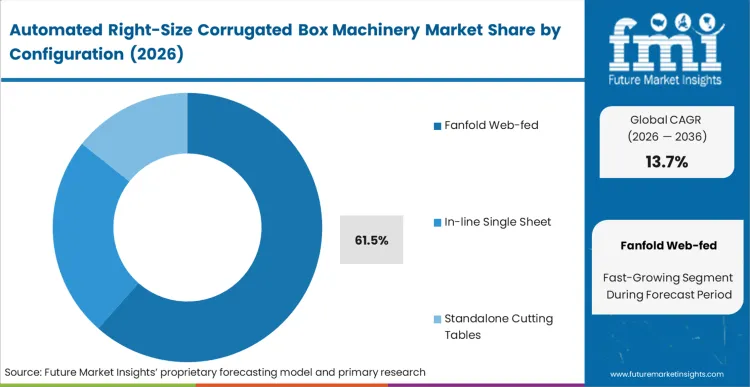
Procurement leads who attempt to manage massive SKU catalogs using traditional single-sheet erectors face severe throughput limitations during peak promotional events. Integrating continuous fanfold supply resolves the most critical bottleneck in outbound logistics. Replacing rigid standardized carton inventories with dynamic multi-axis cutting profiles entirely alters warehouse storage requirements. Fanfold Web-fed commands a dominant 61.5% share in 2026, as continuous board supply ensures sustained operation without frequent operator intervention. High-volume fulfillment centers specifying these systems completely bypass the downtime associated with manual sheet loading. According to FMI's estimates, the structural reliance on this configuration stems from its ability to process wildly varying SKU dimensions in sequential order without mechanical retooling.
- Throughput Optimization: Continuous web feeding mechanisms eliminate micro-stoppages between cuts, allowing automated lines to hit maximum rated speeds. Facility operators deploying this configuration maximize output per square foot of warehouse space.
- Inventory Consolidation: Relying on standard fanfold widths drastically reduces the distinct SKUs of blank cardboard a facility must stock. Purchasing managers consolidating their packaging supply chain realize significant working capital reductions.
- Scrap Minimization: Advanced nesting algorithms calculate the optimal cut pattern across the continuous web, producing less physical waste than fixed-dimension sheets. Sustainability directors capturing these material efficiencies accelerate their corporate zero-waste objectives.
Automated Right-Size Corrugated Box Machinery Market Analysis by End Use
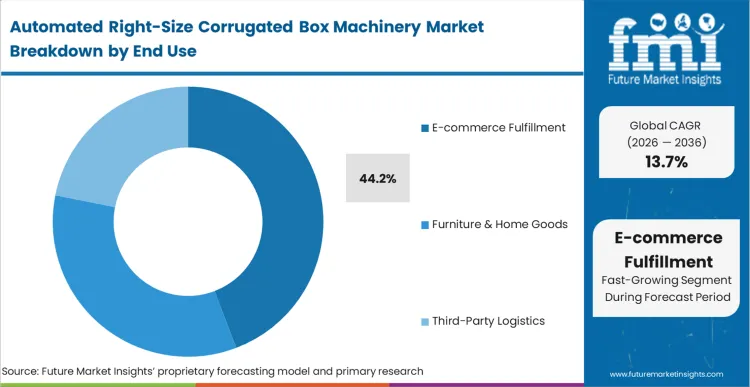
Intralogistics automation directors must validate volumetric reduction targets during equipment commissioning to secure final budget approval leading to the sheer volume and variability of direct-to-consumer shipping making E-commerce fulfillment the undisputed leader, holding a 44.2% share in 2026. Online retail platforms face intense pressure to reduce the physical volume of every shipped parcel as carriers penalize empty air space. FMI analysts opine that flattening the outbound logistics profile through exact-fit boxing directly attacks these dimensional weight charges. The necessity to process single-item orders rapidly forces this buyer tier to abandon pre-formed boxes entirely. Fulfillment centers relying on manual packing operations struggle to maintain profitability against automated competitors.
- Dimensional Weight Avoidance: Exact-fit cartons instantly shrink the billable volume of outbound shipments across major parcel networks. E-commerce logistics managers leveraging this reduction permanently lower their unit shipping economics.
- Void-fill Elimination: Producing a perfectly sized box removes the physical necessity for plastic air pillows or crumpled paper. Operations directors stripping out these secondary materials simultaneously cut costs and improve the consumer unboxing experience.
- Trailer Density Optimization: Smaller external box dimensions allow loading docks to pack significantly more individual orders into standard 53-foot trailers. Transportation planners maximizing this cube utilization reduce the total number of line-haul trucks required.
Automated Right-Size Corrugated Box Machinery Market Analysis by Output Capacity
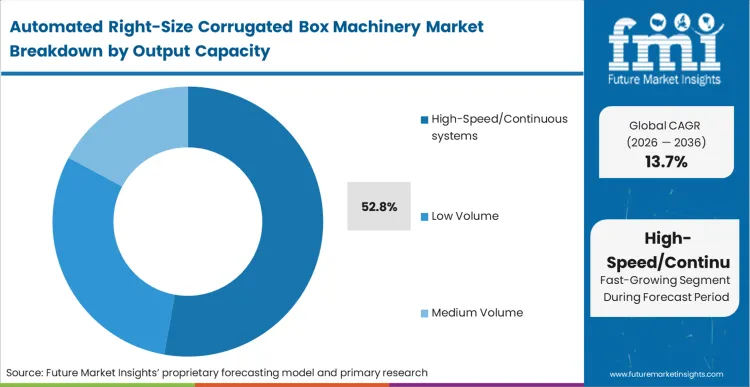
Tier-1 distribution hubs require immediate scale, forcing the adoption of High-Speed/Continuous systems which capture 52.8% share in 2026. The specific compliance threshold for these operations requires processing speeds exceeding 1,000 cartons per hour without structural failure. As per FMI's projection, facilities handling massive national volumes simply cannot deploy clusters of lower-speed machines due to constrained floor space. They require single, ultra-fast lines capable of pacing downstream sortation conveyors. Shippers opting for under-spec equipment face catastrophic parcel backups during peak holiday rushes. Engineering contractors specifying the intralogistics backbone must mandate these high-capacity ratings to prevent systemic failure.
- Peak Season Resilience: High-speed processing logic ensures the packing line does not become the choke point when order volumes triple in Q4. Fulfillment vice presidents securing this capacity guarantee their service-level agreements remain intact.
- Conveyor Synchronization: Ultra-fast cycle times match the physical speed of adjacent autonomous sortation loops. Systems integrators aligning these processing speeds prevent downstream jams and misroutes.
- Labor Displacement: Single continuous lines drastically outproduce dozens of manual packing stations, directly addressing severe warehouse worker shortages. Human resources directors operating in tight labor markets use this automation to stabilize facility output.
Automated Right-Size Corrugated Box Machinery Market Drivers, Restraints, and Opportunities
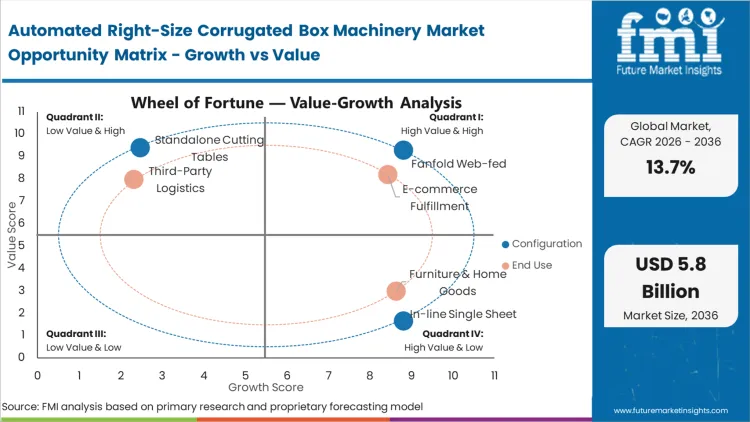
The European Union Packaging and Packaging Waste Regulation (PPWR) forces high-volume fulfillment centers to rigorously enforce void space limits on every outbound shipment. These structural imperative targets the systemic inefficiency of shipping "air," rendering traditional fixed-box inventories legally and economically unviable for large shippers. E-commerce operators overhauling their intralogistics face a strict binary choice between absorbing crippling dimensional weight penalties or deploying dynamic 3D-scanning fanfold cutters. Transitioning to these right-size architectures instantly strips out secondary void-fill costs while guaranteeing compliance with strict regional sustainability mandates. Facilities that fail to modernize their packing lines risk severe margin erosion from punitive carrier tariffs and regulatory fines.
The intricate mechanical calibration required to process varying grades of fanfold corrugated creates a steep operational learning curve for traditional warehouse maintenance teams. Managing the high-speed gluing and folding mechanisms across unpredictable SKU profiles demands specialized intralogistics expertise that most basic distribution centers lack. To mitigate this technical friction, facility operators increasingly rely on remote diagnostic contracts and predictive maintenance software from the original equipment manufacturers, though this introduces ongoing service dependencies.
Opportunities in the Automated Right-Size Corrugated Box Machinery Market
- Integrated Labeling Systems: Next-generation automated packers enable intralogistics teams to print and apply shipping manifests directly onto the dynamically sized carton in a single motion. Systems integrators deploying this combined function eliminate entirely separate scan-and-weigh stations further down the line.
- Multi-Brand Auto-Splicing: Upgraded feed mechanisms permit the machine to automatically switch between different widths of corrugated fanfold board without stopping the line. Packaging automation engineers leveraging this capability ensure uninterrupted throughput during multi-client fulfillment operations.
- Reverse Logistics Optimization: Return-processing centers require machinery that can immediately resize and re-box opened items for secondary market resale. Third-party logistics providers implementing this capability drastically accelerate the speed at which returned inventory is made available for purchase again.
Regional Analysis
Based on the regional analysis, the automated right-size corrugated box machinery market is segmented into North America, Latin America, Europe, Asia-Pacific, South Asia, Oceania, and Middle East & Africa across 40 plus countries.
.webp "Top Country Growth Comparison Automated Right Size Corrugated Box Machinery Market Cagr (2026 2036)")
| Country | CAGR (2026 to 2036) |
|---|---|
| China | 16.5% |
| India | 15.2% |
| United States | 13.4% |
| Germany | 12.8% |
| United Kingdom | 11.5% |
| Japan | 10.2% |
| South Korea | 9.8% |
Source: Future Market Insights (FMI) analysis, based on proprietary forecasting model and primary research
Asia-Pacific Automated Right-Size Corrugated Box Machinery Market Analysis
Based on FMI's assessment, this intense regulatory environment forces massive retail platforms to completely abandon legacy manual packing protocols. By establishing standardized fit-to-size automated lines, these megahubs strip out millions of tons of unnecessary cardboard and plastic filler annually. Government ministries across the region mandate aggressive reductions in secondary packaging and explicitly cap permissible void ratios for domestic parcel networks. This top-down policy approach accelerates the adoption of sustainable packaging automation far beyond organic market growth rates. Specific policy interventions targeting e-commerce waste dictate the rapid modernization of Asia-Pacific fulfillment hubs.
- China: Advancing at a 16.5% CAGR value between 2026 and 2036, the market undergoes a massive architectural pivot confirmed by widespread compliance auditing from municipal authorities. Logistics infrastructure planners who delay this automation risk losing their operating licenses in major metropolitan delivery zones. This stringent directive compels massive e-commerce conglomerates to deploy integrated 3D-sizing equipment to ensure every parcel meets the required density ratios. The State Post Bureau Green Packaging Mandate enforces absolute restrictions on secondary shipping waste across top-tier urban logistics corridors.
- India: Supply chain vice presidents specify ruggedized fit-to-size boxing equipment to lock products securely in place without relying on expensive secondary fillers. Fueling a 15.2% CAGR trajectory through 2036, this intense quality-control pressure directly addresses the need for protective automation. The rapid formalization of India's domestic e-commerce supply chain demands scalable solutions to combat massive transit damage rates.
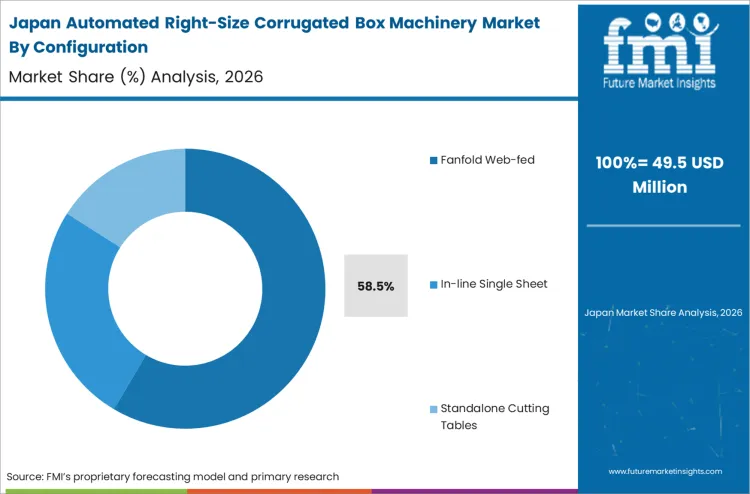
- Japan: Facility directors operating under these constraints must implement fully automated end-of-line packaging to maintain high-speed delivery promises. Japan's chronic demographic challenges severely restrict the availability of manual warehouse labor during seasonal retail peaks. The domestic intralogistics sector sustains a 10.2% CAGR through the forecast period, driven by this severe labor shortfall.
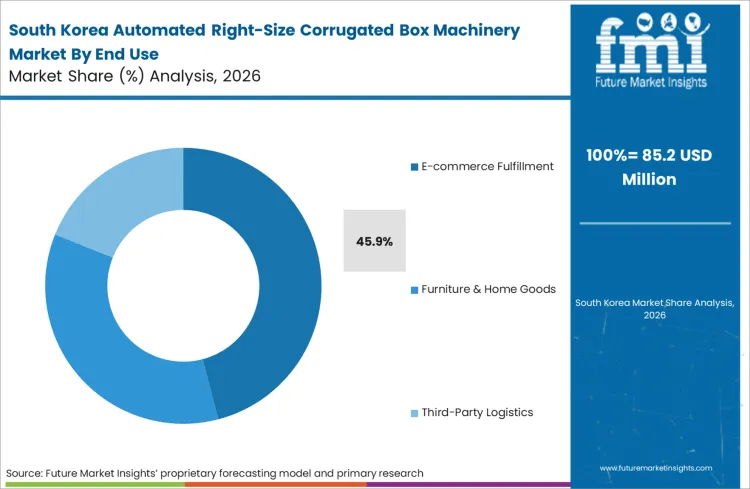
- South Korea: Anchored by spatial optimization pressure, the market is set for a 9.8% CAGR value over the forecast period. Fleet managers require intralogistics partners to provide exact-fit cartons to maximize the number of drops per route. High-density urban delivery networks in South Korea operate on razor-thin margins that penalize any excess volume loaded onto final-mile vehicles.
FMI's report includes detailed analysis of Taiwan, Indonesia, and the broader ASEAN intralogistics landscape. A prevailing structural condition across these emerging hubs is the influx of cross-border e-commerce investment, rapidly elevating the baseline requirements for automated fulfillment operations.
Europe Automated Right-Size Corrugated Box Machinery Market Analysis
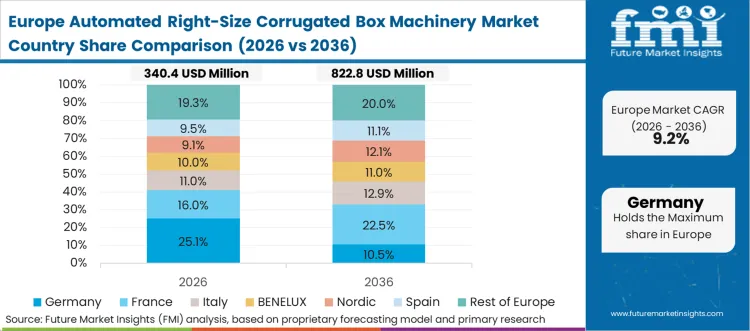
Upgrading the end-of-line infrastructure allows logistics providers to completely phase out non-recyclable void-fill materials while avoiding steep penalties for over-packaging. This regulatory ceiling forces a structural shift away from standardized box purchasing toward on-demand fabrication. The integration of these advanced cutting systems enables European retailers to maintain their high volume throughput without running afoul of escalating environmental taxes. Supply chain directors redesigning their fulfillment operations must integrate equipment that mathematically proves compliance with these aggressive density targets. Serving as the dominant catalyst for regional market expansion, the European Union Packaging and Packaging Waste Regulation (PPWR) strictly limits the empty space ratio allowed in e-commerce shipping.
- Germany: Procurement directors failing to optimize their carton dimensions absorb massive and entirely avoidable compliance costs. Driving a 12.8% CAGR across the forecast decade, the structural shift toward exact-fit logistics directly mitigates these expenses. Operations leads in major distribution centers deploy high-speed fanfold machinery specifically to neutralize these punitive extended producer responsibility fees. Germany's updated VerpackG legislation heavily taxes excess material usage, directly targeting inefficient e-commerce shipping practices.
- United Kingdom: Fulfillment operators in the UK must implement dynamic carton sizing to compress their overall freight footprint and maintain margin parity. The post-Brexit parcel delivery sector faces acute driver shortages, forcing carriers to heavily penalize inefficient dimensional weight profiles. The market is anchored to an 11.5% CAGR value through the decade, being forced to adapt to this specific operational constraint.
FMI's report includes comprehensive evaluation of France, Italy, Spain, and the Nordics. The rapid expansion of centralized pan-European fulfillment centers demands standardized automation platforms capable of handling multi-language manifesting and exact-fit packing simultaneously.
North America Automated Right-Size Corrugated Box Machinery Market Analysis
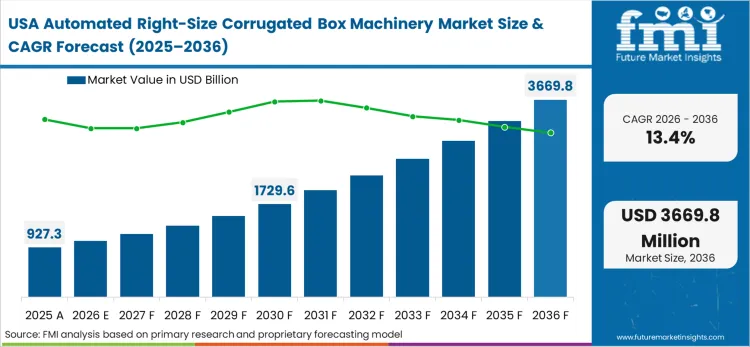
The financial viability of high-volume direct-to-consumer fulfillment now fundamentally relies on the ability to fabricate exact-fit packaging at scale. According to FMI's estimates, these operators aggressively deploy right-size technology to dramatically compress outbound parcel volumes and protect their fulfillment fees. Third-party logistics (3PL) providers operating multi-client facilities face extreme margin compression whenever they ship excess air. Implementing this dynamic architecture allows warehouses to pack 53-foot trailers with maximum efficiency, cutting total transportation spend. Severe cost structure pressures driven by carrier dimensional (DIM) weight pricing define the North American transition to automated packaging.
- United States: Powering a 13.4% CAGR through 2036, this absolute financial imperative reshapes the domestic logistics landscape. 3PL operators unable to provide optimized packaging profiles lose lucrative fulfillment contracts to modernized competitors. Intralogistics engineers fighting these spiraling freight costs install continuous fanfold sizing lines to perfectly match box dimensions to the product payload. Tier-1 parcel carriers in the United States routinely increase their dimensional weight divisors, aggressively penalizing fulfillment centers that use oversized boxes.
FMI's report includes extensive coverage of Canada and Mexico. The integration of cross-border retail supply chains forces localized fulfillment centers to adopt equivalent automation standards to maintain seamless handover protocols with major North American parcel networks.
Competitive Aligners for Market Players
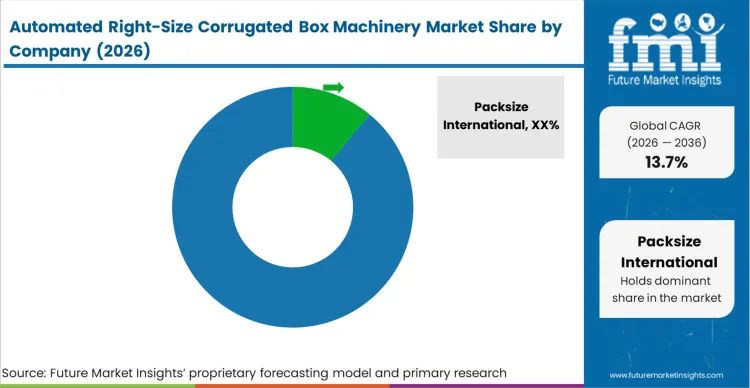
The stringent dimensional weight penalties enforced by global parcel carriers are fundamentally reshaping how fulfillment directors evaluate their intralogistics packaging investments. This acute buyer behavior shift has consolidated the automated right-size corrugated box machinery sector into a moderately concentrated arena, where the barriers to entry are defined by massive upfront capital requirements for 3D scanning algorithms and continuous web handling patents. Industry leaders such as Packsize International, CMC Machinery, WestRock Company, and Sparck Technologies have established deep, sticky relationships with tier-1 e-commerce platforms by dominating these proprietary technologies.
Procurement teams now evaluate these vendors almost exclusively on system uptime reliability and peak throughput velocity, completely deprioritizing initial capital expenditure in favor of guaranteed peak-season performance. The concentration exists because developing high-speed, jam-free corrugated handling mechanisms requires extensive mechatronic engineering that smaller niche entrants simply cannot replicate without years of physical prototype testing.
Vendors embedding advanced multi-axis scanning intelligence directly into their high-speed infeed conveyors gain a massive, defensible architectural advantage. Companies like Panotec, Lantech, and Kolbus GmbH & Co. KG natively integrate proprietary dimensioning software to instantly calculate optimal fold patterns, drastically reducing the mechanical cycle time required per exact-fit carton. To replicate this specific advantage, an emerging challenger must develop perfectly synchronized software-hardware handshake protocols capable of operating at sub-second latencies without triggering safety halts.
This level of deep mechatronic system integration acts as a severe structural moat, preventing standard folder-gluer manufacturers from easily pivoting into dynamic sizing. The practical implication for new entrants is the absolute necessity to fund long, expensive, and uncompensated pilot programs within live distribution centers, as intralogistics managers outright refuse to risk their outbound throughput on unproven, uncalibrated cutting hardware during live fulfillment shifts.
Major e-commerce platforms and multi-client logistics operators actively attempt to prevent vendor lock-in by standardizing their overarching warehouse execution software to communicate seamlessly with multiple equipment brands. This creates an ongoing structural tension between supply chain vice presidents who demand open-source interoperability and dominant machinery suppliers who push proprietary fanfold corrugated specifications tied to specific material contracts.
For that reason, while operators frequently mix equipment from EMBA Machinery AB, BPI Equipment, and EconoCorp Inc. across different regional hubs, the specialized physical footprint of continuous-feed layouts severely limits the buyers' ability to switch vendors within an existing facility. These dynamic caps the pricing power of equipment manufacturers on the initial hardware sale, forcing them to extract long-term margin through predictive maintenance service level agreements. Tracking toward 2036, this market will experience further consolidation as dominant automation providers acquire specialized robotics startups to natively incorporate downstream labeling and auto-palletizing capabilities.
Key Players in Automated Right-Size Corrugated Box Machinery Market
- Packsize International
- CMC Machinery
- WestRock Company
- Sparck Technologies
- Panotec
- Lantech
- Kolbus GmbH & Co. KG
- EMBA Machinery AB
- BPI Equipment
- EconoCorp Inc.
Scope of the Report
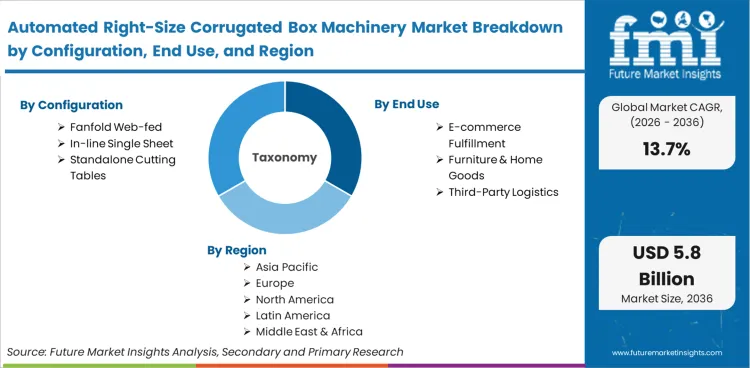
| Metric | Value |
|---|---|
| Quantitative Units | USD 1.6 billion to USD 5.8 billion, at a CAGR of 13.7% |
| Market Definition | The automated right-size corrugated box machinery market provides integrated hardware and software solutions that scan items and dynamically fabricate custom-fitted shipping cartons on demand, eliminating void space and standard box inventory. |
| Configuration Segmentation | In-line Single Sheet, Fanfold Web-fed, Standalone Cutting Tables |
| End Use Segmentation | E-commerce Fulfillment, Furniture & Home Goods, Third-Party Logistics, Industrial Parts |
| Output Capacity Segmentation | Low Volume, Medium Volume, High-Speed/Continuous |
| Regions Covered | North America, Latin America, Europe, East Asia, South Asia, Oceania, Middle East & Africa |
| Countries Covered | China, India, United States, Germany, United Kingdom, Japan, South Korea, and 40 plus countries |
| Key Companies Profiled | Packsize International, CMC Machinery, WestRock Company, Sparck Technologies, Panotec, Lantech, Kolbus GmbH & Co. KG, EMBA Machinery AB |
| Forecast Period | 2026 to 2036 |
| Approach | The baseline value derives from a bottom-up aggregation of active fanfold machine installations, applying regional e-commerce volume curves and carrier tariff shifts to project future adoption velocity. |
Source: Future Market Insights (FMI) analysis, based on proprietary forecasting model and primary research
Automated Right-Size Corrugated Box Machinery Market Segments
Configuration:
- In-line Single Sheet
- Fanfold Web-fed
- Standalone Cutting Tables
End Use:
- E-commerce Fulfillment
- Furniture & Home Goods
- Third-Party Logistics
- Industrial Parts
Output Capacity:
- Low Volume
- Medium Volume
- High-Speed/Continuous
Regions:
- North America
- United States
- Canada
- Latin America
- Brazil
- Mexico
- Europe
- Germany
- United Kingdom
- France
- Italy
- Spain
- Asia-Pacific
- China
- Japan
- South Korea
- India
- Rest of Asia-Pacific
- Australia
- Middle East & Africa
- South Africa
- GCC Countries
Bibliography
- WestRock Company. (2024, October 12). Sustainability and Automated On-Demand Packaging Integration. WestRock.
- CMC Machinery. (2025, February 10). Advanced 3D Technology for E-commerce Packaging Efficiency. CMC Machinery.
- Packsize International. (2025, January 18). Peak Season Fulfillment: X5 Nozomi System Specifications. Packsize.
- Sparck Technologies. (2025, March 2). CVP Everest Automated Packaging System Performance Metrics. Sparck Technologies.
- Lantech. (2024, December 5). Case Erecting Automation and End-of-Line Intralogistics. Lantech.
- National Institute of Standards and Technology. (2024, August 21). Integration of Smart Manufacturing Systems and 3D Scanning Topologies. NIST.
- Flexible Packaging Association. (2025, February 22). Void-Fill Reduction Strategies in D2C Logistics. FPA.
- Material Handling Industry. (2024, November 11). MHI Annual Industry Report on Intralogistics Automation. MHI.
This bibliography is provided for reader reference. The full FMI report contains the complete reference list with primary source documentation.
This Report Addresses
- Market intelligence to support strategic decision making across fanfold web-fed cutting machinery and automated 3D product scanning arrays unique to this market
- Market size estimation and 10-year revenue forecasts from 2026 to 2036, supported by intralogistics investment filings and European Union Packaging and Packaging Waste Regulation (PPWR) tracking
- Growth opportunity mapping across Configuration and Output Capacity categories with emphasis on the specific necessity to install native fit-to-size box erectors before peak holiday surcharges erode margins
- Segment and regional revenue forecasts covering high-speed continuous fanfold processing systems across top-tier urban logistics corridors in East Asia
- Competition strategy assessment including proprietary scanning algorithms, multi-axis system uptime reliability, and continuous web handling barriers
- Product and capability development tracking including multi-brand auto-splicing, dynamic carton size calculations, and ISTA 3A transit damage reduction testing
- Market access analysis covering original equipment manufacturer predictive maintenance contracts and major parcel carrier dimension-weight pricing frameworks
- Market report delivery in PDF, Excel, PPT, and interactive dashboard formats for executive strategy, automated packaging procurement, and operational benchmarking use
Frequently Asked Questions
How large is the Automated Right-Size Corrugated Box Machinery Market in 2026?
The market is poised to reach USD 1.6 billion in 2026 as punitive dimensional-weight shipping algorithms penalize excess void space across parcel networks.
What will it be valued at by 2036?
Revenue expansion carries the total valuation to USD 5.8 billion through 2036 as major parcel carriers strictly enforce minimum package density ratios.
What CAGR is projected?
The market is tracking a 13.7% CAGR because high-volume fulfillment centers must install automated erectors before peak season labor shortages paralyze output.
Which Configuration segment leads?
Fanfold Web-fed holds a dominant 61.5% share in 2026 because continuous corrugated supply ensures sustained operation without frequent manual reloading.
Which End Use segment leads?
E-commerce Fulfillment captures a 44.2% share as extreme SKU variability forces online retailers to dynamically fabricate cartons to minimize dimensional shipping weight.
Which Output Capacity segment leads?
High-Speed/Continuous systems secure a 52.8% share by guaranteeing throughput rates exceeding 1,000 exact-fit cartons per hour for massive national distribution hubs.
What drives rapid growth?
European Union PPWR mandates and punitive carrier DIM pricing compel high-volume fulfillment operators to drastically eliminate void space and secondary plastic fillers.
What is the primary restraint?
The intricate mechanical calibration required to process varying grades of fanfold corrugated at high speeds creates a steep operational learning curve for traditional maintenance teams.
Which country grows fastest?
China expands at a rapid 16.5% CAGR, driven directly by the State Post Bureau Green Packaging Mandate enforcing absolute reductions in secondary shipping waste.
What compliance standard heavily impacts this market?
The European Union Packaging and Packaging Waste Regulation (PPWR) strictly limits the allowable empty space ratio in e-commerce shipping, forcing the adoption of exact-fit technology.
What specific operational threshold forces buyers to adopt this equipment?
The crossover point occurs when ongoing carrier dimensional-weight shipping penalties and manual void-fill labor costs exceed the lease structure of automated 3D-scanning fanfold cutters.
How do the leading equipment vendors compete?
Top players compete primarily on multi-axis dynamic sizing speed and jam-free continuous web integration, requiring challengers to build flawless software-hardware synchronization to enter the market.
What drives adoption in the United States?
Tier-1 parcel carriers routinely increase dimensional weight divisors, aggressively penalizing domestic fulfillment centers that fail to deploy continuous fanfold sizing lines.
How is the market structured in Germany?
Germany's updated VerpackG legislation taxes excess material usage, compelling major distribution centers to deploy exact-fit machinery to neutralize extended producer responsibility fees.
Why is Japan an important market for this machinery?
Chronic demographic challenges and peak season labor shortages force Japanese facility directors to implement fully automated end-of-line packaging to maintain high-speed delivery networks.
How do 3PL operators utilize this technology?
Third-party logistics providers deploy right-size technology to dramatically compress outbound parcel volumes, packing more individual orders into 53-foot trailers to protect fulfillment margins.
What happens if a facility uses underspecified machinery?
Shippers opting for low-volume equipment during peak holiday rushes face catastrophic parcel backups that severely disrupt downstream sortation conveyors.
How do continuous fanfold systems reduce inventory costs?
Relying on standardized fanfold widths drastically reduces the variety of blank cardboard a facility must stock, freeing up working capital and valuable warehouse floor space.
What role do reverse logistics play in this market?
Return-processing centers require dynamic sizing machinery to immediately re-box opened items, accelerating the speed at which inventory is returned to the active sales channel.
What specific technology provides a competitive edge for vendors?
Embedding advanced multi-axis scanning intelligence directly into the infeed conveyors allows systems to instantly calculate optimal fold patterns, drastically reducing cycle times.
Are standard folder-gluer machines included in the scope?
No, traditional pre-formed folder-gluer equipment used in box manufacturing plants is explicitly excluded from this market valuation.
Does the report quantify the impact of transit damage?
The analysis evaluates how exact-fit boxing eliminates the need for plastic air pillows, firmly locking products in place to combat massive transit damage rates in emerging markets.
How is the market forecast validated?
The baseline derives from active machine installations and is cross-validated against publicly reported capital expenditure guidance from major retail and intralogistics conglomerates.
Preview the report firsthand - request a free sample
Get SampleGet the brochure for pricing and purchase details.
Get PDFTable of Content
- Executive Summary
- Global Market Outlook
- Demand-side Trends
- Supply-side Trends
- Technology Roadmap Analysis
- Analysis and Recommendations
- Market Overview
- Market Coverage / Taxonomy
- Market Definition / Scope / Limitations
- Research Methodology
- Chapter Orientation
- Analytical Lens and Working Hypotheses
- Market Structure, Signals, and Trend Drivers
- Benchmarking and Cross-market Comparability
- Market Sizing, Forecasting, and Opportunity Mapping
- Research Design and Evidence Framework
- Desk Research Programme (Secondary Evidence)
- Company Annual and Sustainability Reports
- Peer-reviewed Journals and Academic Literature
- Corporate Websites, Product Literature, and Technical Notes
- Earnings Decks and Investor Briefings
- Statutory Filings and Regulatory Disclosures
- Technical White Papers and Standards Notes
- Trade Journals, Industry Magazines, and Analyst Briefs
- Conference Proceedings, Webinars, and Seminar Materials
- Government Statistics Portals and Public Data Releases
- Press Releases and Reputable Media Coverage
- Specialist Newsletters and Curated Briefings
- Sector Databases and Reference Repositories
- FMI Internal Proprietary Databases and Historical Market Datasets
- Subscription Datasets and Paid Sources
- Social Channels, Communities, and Digital Listening Inputs
- Additional Desk Sources
- Expert Input and Fieldwork (Primary Evidence)
- Primary Modes
- Qualitative Interviews and Expert Elicitation
- Quantitative Surveys and Structured Data Capture
- Blended Approach
- Why Primary Evidence is Used
- Field Techniques
- Interviews
- Surveys
- Focus Groups
- Observational and In-context Research
- Social and Community Interactions
- Stakeholder Universe Engaged
- C-suite Leaders
- Board Members
- Presidents and Vice Presidents
- R&D and Innovation Heads
- Technical Specialists
- Domain Subject-matter Experts
- Scientists
- Physicians and Other Healthcare Professionals
- Governance, Ethics, and Data Stewardship
- Research Ethics
- Data Integrity and Handling
- Primary Modes
- Tooling, Models, and Reference Databases
- Desk Research Programme (Secondary Evidence)
- Data Engineering and Model Build
- Data Acquisition and Ingestion
- Cleaning, Normalisation, and Verification
- Synthesis, Triangulation, and Analysis
- Quality Assurance and Audit Trail
- Market Background
- Market Dynamics
- Drivers
- Restraints
- Opportunity
- Trends
- Scenario Forecast
- Demand in Optimistic Scenario
- Demand in Likely Scenario
- Demand in Conservative Scenario
- Opportunity Map Analysis
- Product Life Cycle Analysis
- Supply Chain Analysis
- Investment Feasibility Matrix
- Value Chain Analysis
- PESTLE and Porter’s Analysis
- Regulatory Landscape
- Regional Parent Market Outlook
- Production and Consumption Statistics
- Import and Export Statistics
- Market Dynamics
- Global Market Analysis 2021 to 2025 and Forecast, 2026 to 2036
- Historical Market Size Value (USD Million) Analysis, 2021 to 2025
- Current and Future Market Size Value (USD Million) Projections, 2026 to 2036
- Y-o-Y Growth Trend Analysis
- Absolute $ Opportunity Analysis
- Global Market Pricing Analysis 2021 to 2025 and Forecast 2026 to 2036
- Global Market Analysis 2021 to 2025 and Forecast 2026 to 2036, By Configuration
- Introduction / Key Findings
- Historical Market Size Value (USD Million) Analysis By Configuration , 2021 to 2025
- Current and Future Market Size Value (USD Million) Analysis and Forecast By Configuration , 2026 to 2036
- Fanfold Web-fed
- In-line Single Sheet
- Standalone Cutting Tables
- Fanfold Web-fed
- Y-o-Y Growth Trend Analysis By Configuration , 2021 to 2025
- Absolute $ Opportunity Analysis By Configuration , 2026 to 2036
- Global Market Analysis 2021 to 2025 and Forecast 2026 to 2036, By End Use
- Introduction / Key Findings
- Historical Market Size Value (USD Million) Analysis By End Use, 2021 to 2025
- Current and Future Market Size Value (USD Million) Analysis and Forecast By End Use, 2026 to 2036
- E-commerce Fulfillment
- Furniture & Home Goods
- Third-Party Logistics
- E-commerce Fulfillment
- Y-o-Y Growth Trend Analysis By End Use, 2021 to 2025
- Absolute $ Opportunity Analysis By End Use, 2026 to 2036
- Global Market Analysis 2021 to 2025 and Forecast 2026 to 2036, By Output Capacity
- Introduction / Key Findings
- Historical Market Size Value (USD Million) Analysis By Output Capacity, 2021 to 2025
- Current and Future Market Size Value (USD Million) Analysis and Forecast By Output Capacity, 2026 to 2036
- High-Speed/Continuous systems
- Low Volume
- Medium Volume
- High-Speed/Continuous systems
- Y-o-Y Growth Trend Analysis By Output Capacity, 2021 to 2025
- Absolute $ Opportunity Analysis By Output Capacity, 2026 to 2036
- Global Market Analysis 2021 to 2025 and Forecast 2026 to 2036, By Region
- Introduction
- Historical Market Size Value (USD Million) Analysis By Region, 2021 to 2025
- Current Market Size Value (USD Million) Analysis and Forecast By Region, 2026 to 2036
- North America
- Latin America
- Western Europe
- Eastern Europe
- East Asia
- South Asia and Pacific
- Middle East & Africa
- Market Attractiveness Analysis By Region
- North America Market Analysis 2021 to 2025 and Forecast 2026 to 2036, By Country
- Historical Market Size Value (USD Million) Trend Analysis By Market Taxonomy, 2021 to 2025
- Market Size Value (USD Million) Forecast By Market Taxonomy, 2026 to 2036
- By Country
- USA
- Canada
- Mexico
- By Configuration
- By End Use
- By Output Capacity
- By Country
- Market Attractiveness Analysis
- By Country
- By Configuration
- By End Use
- By Output Capacity
- Key Takeaways
- Latin America Market Analysis 2021 to 2025 and Forecast 2026 to 2036, By Country
- Historical Market Size Value (USD Million) Trend Analysis By Market Taxonomy, 2021 to 2025
- Market Size Value (USD Million) Forecast By Market Taxonomy, 2026 to 2036
- By Country
- Brazil
- Chile
- Rest of Latin America
- By Configuration
- By End Use
- By Output Capacity
- By Country
- Market Attractiveness Analysis
- By Country
- By Configuration
- By End Use
- By Output Capacity
- Key Takeaways
- Western Europe Market Analysis 2021 to 2025 and Forecast 2026 to 2036, By Country
- Historical Market Size Value (USD Million) Trend Analysis By Market Taxonomy, 2021 to 2025
- Market Size Value (USD Million) Forecast By Market Taxonomy, 2026 to 2036
- By Country
- Germany
- UK
- Italy
- Spain
- France
- Nordic
- BENELUX
- Rest of Western Europe
- By Configuration
- By End Use
- By Output Capacity
- By Country
- Market Attractiveness Analysis
- By Country
- By Configuration
- By End Use
- By Output Capacity
- Key Takeaways
- Eastern Europe Market Analysis 2021 to 2025 and Forecast 2026 to 2036, By Country
- Historical Market Size Value (USD Million) Trend Analysis By Market Taxonomy, 2021 to 2025
- Market Size Value (USD Million) Forecast By Market Taxonomy, 2026 to 2036
- By Country
- Russia
- Poland
- Hungary
- Balkan & Baltic
- Rest of Eastern Europe
- By Configuration
- By End Use
- By Output Capacity
- By Country
- Market Attractiveness Analysis
- By Country
- By Configuration
- By End Use
- By Output Capacity
- Key Takeaways
- East Asia Market Analysis 2021 to 2025 and Forecast 2026 to 2036, By Country
- Historical Market Size Value (USD Million) Trend Analysis By Market Taxonomy, 2021 to 2025
- Market Size Value (USD Million) Forecast By Market Taxonomy, 2026 to 2036
- By Country
- China
- Japan
- South Korea
- By Configuration
- By End Use
- By Output Capacity
- By Country
- Market Attractiveness Analysis
- By Country
- By Configuration
- By End Use
- By Output Capacity
- Key Takeaways
- South Asia and Pacific Market Analysis 2021 to 2025 and Forecast 2026 to 2036, By Country
- Historical Market Size Value (USD Million) Trend Analysis By Market Taxonomy, 2021 to 2025
- Market Size Value (USD Million) Forecast By Market Taxonomy, 2026 to 2036
- By Country
- India
- ASEAN
- Australia & New Zealand
- Rest of South Asia and Pacific
- By Configuration
- By End Use
- By Output Capacity
- By Country
- Market Attractiveness Analysis
- By Country
- By Configuration
- By End Use
- By Output Capacity
- Key Takeaways
- Middle East & Africa Market Analysis 2021 to 2025 and Forecast 2026 to 2036, By Country
- Historical Market Size Value (USD Million) Trend Analysis By Market Taxonomy, 2021 to 2025
- Market Size Value (USD Million) Forecast By Market Taxonomy, 2026 to 2036
- By Country
- Kingdom of Saudi Arabia
- Other GCC Countries
- Turkiye
- South Africa
- Other African Union
- Rest of Middle East & Africa
- By Configuration
- By End Use
- By Output Capacity
- By Country
- Market Attractiveness Analysis
- By Country
- By Configuration
- By End Use
- By Output Capacity
- Key Takeaways
- Key Countries Market Analysis
- USA
- Pricing Analysis
- Market Share Analysis, 2025
- By Configuration
- By End Use
- By Output Capacity
- Canada
- Pricing Analysis
- Market Share Analysis, 2025
- By Configuration
- By End Use
- By Output Capacity
- Mexico
- Pricing Analysis
- Market Share Analysis, 2025
- By Configuration
- By End Use
- By Output Capacity
- Brazil
- Pricing Analysis
- Market Share Analysis, 2025
- By Configuration
- By End Use
- By Output Capacity
- Chile
- Pricing Analysis
- Market Share Analysis, 2025
- By Configuration
- By End Use
- By Output Capacity
- Germany
- Pricing Analysis
- Market Share Analysis, 2025
- By Configuration
- By End Use
- By Output Capacity
- UK
- Pricing Analysis
- Market Share Analysis, 2025
- By Configuration
- By End Use
- By Output Capacity
- Italy
- Pricing Analysis
- Market Share Analysis, 2025
- By Configuration
- By End Use
- By Output Capacity
- Spain
- Pricing Analysis
- Market Share Analysis, 2025
- By Configuration
- By End Use
- By Output Capacity
- France
- Pricing Analysis
- Market Share Analysis, 2025
- By Configuration
- By End Use
- By Output Capacity
- India
- Pricing Analysis
- Market Share Analysis, 2025
- By Configuration
- By End Use
- By Output Capacity
- ASEAN
- Pricing Analysis
- Market Share Analysis, 2025
- By Configuration
- By End Use
- By Output Capacity
- Australia & New Zealand
- Pricing Analysis
- Market Share Analysis, 2025
- By Configuration
- By End Use
- By Output Capacity
- China
- Pricing Analysis
- Market Share Analysis, 2025
- By Configuration
- By End Use
- By Output Capacity
- Japan
- Pricing Analysis
- Market Share Analysis, 2025
- By Configuration
- By End Use
- By Output Capacity
- South Korea
- Pricing Analysis
- Market Share Analysis, 2025
- By Configuration
- By End Use
- By Output Capacity
- Russia
- Pricing Analysis
- Market Share Analysis, 2025
- By Configuration
- By End Use
- By Output Capacity
- Poland
- Pricing Analysis
- Market Share Analysis, 2025
- By Configuration
- By End Use
- By Output Capacity
- Hungary
- Pricing Analysis
- Market Share Analysis, 2025
- By Configuration
- By End Use
- By Output Capacity
- Kingdom of Saudi Arabia
- Pricing Analysis
- Market Share Analysis, 2025
- By Configuration
- By End Use
- By Output Capacity
- Turkiye
- Pricing Analysis
- Market Share Analysis, 2025
- By Configuration
- By End Use
- By Output Capacity
- South Africa
- Pricing Analysis
- Market Share Analysis, 2025
- By Configuration
- By End Use
- By Output Capacity
- USA
- Market Structure Analysis
- Competition Dashboard
- Competition Benchmarking
- Market Share Analysis of Top Players
- By Regional
- By Configuration
- By End Use
- By Output Capacity
- Competition Analysis
- Competition Deep Dive
- Packsize International
- Overview
- Product Portfolio
- Profitability by Market Segments (Product/Age /Sales Channel/Region)
- Sales Footprint
- Strategy Overview
- Marketing Strategy
- Product Strategy
- Channel Strategy
- CMC Machinery
- WestRock Company
- Sparck Technologies
- Panotec
- Lantech
- Kolbus GmbH & Co. KG
- Packsize International
- Competition Deep Dive
- Assumptions & Acronyms Used


