

- Industry Size (2026)
- USD 43.89 Bn
- Forecast (2036)
- USD 74.97 Bn
- CAGR (2026 to 2036)
- 5.5%
Demand for Beer in Japan Market Size, Market Forecast and Outlook By FMI
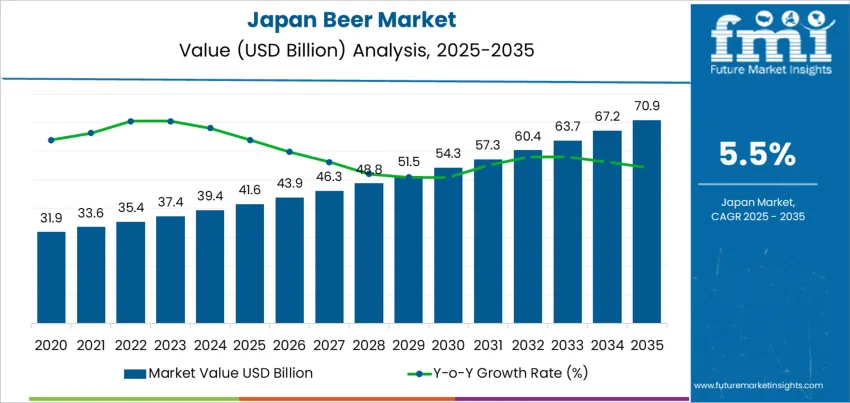
The demand for beer in japan market was valued at USD 41.60 billion in 2025, projected to reach USD 43.89 billion in 2026, and is forecast to expand to USD 74.97 billion by 2036 at a 5.5% CAGR. FMI is of the opinion that the phased liquor tax equalization reform initiated in October 2023, which narrows the excise differential between beer and happoshu categories, is structurally redirecting consumer spending toward full-malt beer products. The four major domestic breweries are recalibrating portfolio strategies to capture the margin recovery opportunity created by this regulatory shift.
Summary of Demand for Beer in Japan Market
- Market Overview
- The market is valued at USD 41.60 billion in 2025 and is projected to reach USD 74.97 billion by 2036.
- The industry is expected to grow at a 5.5% CAGR from 2026 to 2036, creating an incremental opportunity of USD 31.08 billion.
- The market is a tax-regime-sensitive, convenience-retail-driven alcoholic beverage category where volume dynamics are shaped by the liquor tax equalization reform and the premiumization shift from happoshu to full-malt beer.
- Demand and Growth Drivers
- The October 2023 liquor tax equalization reform is narrowing the price gap between beer and happoshu, redirecting consumer spending toward full-malt products.
- Craft beer penetration into convenience store and supermarket channels is opening distribution access for premium-priced specialty volumes.
- On-premise consumption recovery following post-pandemic normalization is restoring draft beer volumes in izakaya and restaurant channels.
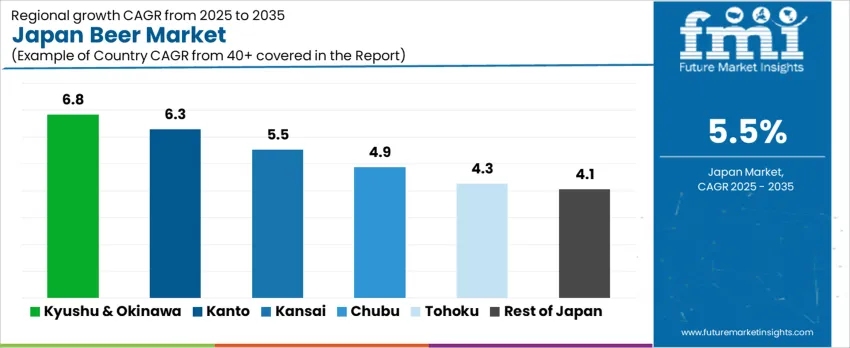
- Among key regions, Kyushu & Okinawa at 6.8% CAGR, Kanto at 6.3% CAGR, Kansai at 5.5% CAGR, Chubu at 4.9% CAGR, Tohoku at 4.3% CAGR, Rest of Japan at 4.1% CAGR.
- Product and Segment View
- The market covers lager, ale, stout, and specialty beer products across macro-brewery, craft brewery, and microbrewery production scales.
- Distribution spans hypermarkets, convenience stores, online retailers, specialty stores, and on-premise establishments.
- Lager leads by Product Type with 45.0% share in 2026.
- Bottle leads by Packaging with 42.0% share in 2026.
- The scope includes beer as defined under Japan's Liquor Tax Act, excluding happoshu, third-category beverages, and non-alcoholic beer.
- Geography and Competitive Outlook
- Kyushu & Okinawa leads at 6.8% CAGR, driven by tourism-linked on-premise consumption and Fukuoka's craft brewery scene.
- Kanto represents the largest absolute volume base through dense convenience store and on-premise networks.
- Competition is concentrated among Japan's four major brewers, with key players including Asahi Group Holdings, Kirin Brewery Company, Suntory Holdings, Sapporo Breweries.
- Analyst Opinion at FMI
- Nandini Roy Choudhury, Principal Consultant for Alcoholic Beverages, opines: 'In my analysis, I have observed that the October 2023 liquor tax revision in Japan has structurally altered the competitive equilibrium between standard beer and happoshu categories, redirecting consumer spending toward full-malt products as the tax differential narrows. Brand managers at the four major breweries who fail to recalibrate their portfolio mix toward premium lager and craft ale segments risk losing the margin recovery window that this tax realignment has opened.'
- Strategic Implications / Executive Takeaways
- Brand portfolio managers at major breweries must recalibrate volume allocation toward full-malt beer segments to capture the margin recovery created by tax equalization.
- Craft brewery operators should pursue convenience store distribution agreements to access the high-frequency purchasing channel that drives incremental volume.
- On-premise account managers should rebuild draft beer placement contracts with izakaya and restaurant chains as post-pandemic foot traffic normalizes.
Demand for Beer in Japan Market Key Takeaways
| Metric | Details |
|---|---|
| Industry Size (2026) | USD 43.89 billion |
| Industry Value (2036) | USD 74.97 billion |
| CAGR (2026-2036) | 5.5% |
Source: Future Market Insights, 2026
An absolute dollar opportunity of USD 31.08 billion over the forecast period reflects the combined effect of liquor tax equalization, premiumization of the on-premise consumption channel, and the accelerating penetration of craft beer into convenience store and supermarket distribution. FMI analysts observe that the narrowing tax differential between beer and happoshu is fundamentally reshaping the volume split within Japanese alcohol retail, as consumers redirect spending toward full-malt products that now carry a smaller price premium versus lower-malt alternatives. Craft brewery distribution agreements with major convenience store chains are opening shelf space that was previously restricted to the four dominant brewers.
Regional beer consumption across Japan reflects on-premise density, convenience store penetration, and demographic spending patterns. Kyushu & Okinawa at 6.8%, Kanto at 6.3%, Kansai at 5.5%, Chubu at 4.9%, Tohoku at 4.3%, Rest of Japan at 4.1%. Kyushu and Okinawa lead growth, driven by tourism-linked on-premise consumption in Okinawa and an active craft brewery scene in Fukuoka. Kanto, centered on the Tokyo metropolitan area, represents the largest absolute volume base through dense convenience store networks and a high concentration of on-premise establishments in Shibuya, Shinjuku, and Ginza districts. Kansai benefits from Osaka's izakaya culture and Kyoto's expanding craft beer retail presence.
Demand for Beer in Japan Market Definition
Beer is an alcoholic beverage produced through the fermentation of cereal grains, primarily malted barley, with hops, water, and yeast. In Japan, the beer category is regulated under the Liquor Tax Act, which defines distinct tax bands for beer, happoshu (low-malt beer), and third-category beverages. The market encompasses lager, ale, stout, and specialty varieties produced across macro-brewery, craft brewery, and microbrewery scales, distributed through retail, on-premise, convenience store, and direct-to-consumer channels.
Demand for Beer in Japan Market Inclusions
Market scope includes packaged lager, ale, stout, and specialty beer products for retail and on-premise consumption. The scope covers macro-brewery, craft brewery, and microbrewery production distributed through hypermarkets, convenience stores, online retailers, specialty stores, independent retailers, and direct and indirect channels.
Demand for Beer in Japan Market Exclusions
The scope excludes happoshu (low-malt beer), third-category beverages, non-alcoholic beer, chuhai, ready-to-drink cocktails, and sake. Home brewing equipment and ingredients are also excluded from the market valuation.
Demand for Beer in Japan Market Research Methodology
- Primary Research: Analysts conducted structured interviews with procurement managers, distribution executives, and category specialists to map purchasing decision criteria, contract renewal cycles, and supplier qualification processes.
- Desk Research: Data collection aggregated publicly available trade statistics, regulatory filings, industry association reports, and company financial disclosures to establish baseline market parameters.
- Market-Sizing and Forecasting: Baseline values derive from a bottom-up aggregation of trade volumes, applying category-specific growth coefficients and regional penetration rates to project forward demand trajectories.
- Data Validation and Update Cycle: Projections are cross-checked against reported company revenues, trade body statistics, and periodic primary research updates to maintain forecast accuracy.
Why is the Demand for Beer in Japan Changing?
Demand for beer in Japan shows selective growth in specific segments as drinking preferences shift across age groups. Craft breweries and premium brands gain traction because consumers seek distinctive flavors and limited seasonal offerings that appeal to smaller households and social occasions. Convenience stores and supermarkets highlight new varieties to support frequent trial purchases. Restaurants and entertainment venues continue to rely on beer as a core beverage for gatherings, especially in urban areas where after-work dining remains a common routine. Low malt and reduced calorie options maintain strong demand among health-conscious adults who still enjoy beer taste with lighter profiles.
Domestic producers invest in packaging innovations such as compact cans and recyclable materials that suit home consumption and online delivery. Tourism recovery also contributes to demand in hospitality channels, including regional brands that showcase local ingredients. Constraints include Japan’s aging population, which influences lower overall alcohol intake. Younger consumers increasingly favor cocktails, chuhai or nonalcoholic beverages, which limits volume growth for mainstream beer. Pricing pressure from raw material costs and alcohol tax structures also affects purchasing behavior.
Which Product Types, Packaging Formats, and Production Models Lead Demand for Beer in Japan?
Demand for beer in Japan is driven by established consumption culture, evolving craft preferences, and convenience-focused retail packaging. Japanese consumers balance traditional lager choices with rising interest in flavored, seasonal, and regionally sourced beer profiles. Pricing tiers vary across large brands and specialty brewers, while innovation in alcohol content and premium positioning supports product diversification. Consumption patterns remain linked to social dining, workplace leisure, and expanding home-drinking trends influenced by e-commerce availability.
By Product Type, Lager Holds the Largest Share

Lager accounts for 45.0%, reflecting longstanding consumer familiarity, smooth taste profiles, and presence across restaurants, convenience stores, and vending channels. Strong lager positioning supports mass-volume distribution and continuous promotional cycles by major Japanese breweries. Ale represents 30.0%, driven by craft styles such as IPAs and wheat ales gaining popularity among younger consumers. Stouts contribute 15.0%, supported by niche seasonal releases and dessert-leaning profiles. Other styles hold 10.0%, including fruit beers and low-alcohol variants targeting diversification. Product type selection aligns with flavor preference stability and willingness to explore regional offerings.
Key Points:
- Lager benefits from broad accessibility and established brand loyalty
- Ale growth supported by craft experimentation and younger demographics
- Niche styles reflect expanding taste exploration in metropolitan areas
By Packaging Format, Bottles Hold the Largest Share
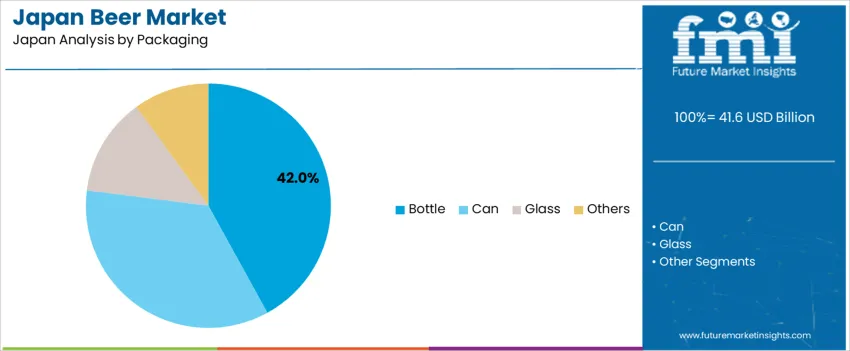
Bottled beer accounts for 42.0%, maintaining strong presence in bars, restaurants, and retail shelves where visual branding and glass packaging perception influence choice. Cans hold 35.0%, driven by outdoor consumption, portability, and lightweight distribution advantages across Japan’s dense logistics networks. Glass packaging types represent 13.0%, generally used for premium brews and limited releases. Other formats hold 10.0%, including kegs and growlers supporting dining and tap-room environments. Packaging trends reflect convenience, preservation stability, and variety in purchase occasions ranging from restaurants to at-home consumption.
Key Points:
- Glass bottles support premium branding and dining consumption
- Cans align with portability and outdoor lifestyle use
- Specialty formats used for draft-focused venues and craft sampling
By Production Model, Macro-Breweries Lead Demand
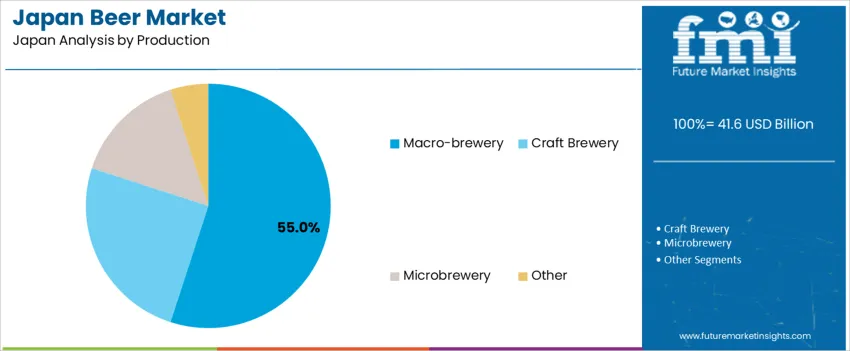
Macro-breweries hold 55.0%, supported by scale, distribution reach, and brand heritage from Japan’s established beer manufacturers. These breweries ensure pricing consistency and national product availability. Craft breweries represent 25.0%, expanding through local tourism, limited-edition launches, and specialty taprooms. Microbreweries hold 15.0%, supplying localized artisanal offerings within targeted city regions. Other production formats make up 5.0%, including contract brewing. Production mix reflects Japan’s preference for trustworthy mass brands alongside a gradually expanding craft ecosystem.
Key Points:
- Large breweries dominate through scale and national distribution
- Craft segment expands via regional identity and flavor innovation
- Microbreweries strengthen localized specialty consumption
What are the Drivers, Restraints, and Key Trends of the Demand for Beer in Japan?
Expansion of convenience retail channels, growth of premium and craft beer segments and seasonal consumption tied to social gatherings are driving demand.
In Japan, beer remains a widely consumed beverage influenced by strong convenience-store sales near train stations and business districts. Major brewers develop premium lagers that target consumers willing to trade up for richer taste profiles, supporting higher-value demand even as overall alcohol consumption softens. Craft breweries in Tokyo, Kanagawa and Hokkaido expand local offerings that attract younger drinkers seeking variety and regional flavors. Seasonal occasions such as hanami, summer festivals and end-of-year gatherings sustain retail spikes and promote multipack purchases. Hospitality sectors including izakaya pubs continue to rely on beer as a core menu item, contributing to steady baseline consumption.
Aging population, increased health-conscious behavior and beer taxation structures restrain demand.
Japan’s declining youth population reduces the core demographic of frequent beer drinkers, shifting preferences toward lower-alcohol beverages or non-alcoholic alternatives. Health-minded consumers limit drinking frequency and explore beverages perceived as lighter, including chuhai and hard seltzers available widely in convenience stores. Japan’s alcohol tax framework historically differentiated between malt content categories, creating pricing sensitivity that influences brand and format choices. These demographic and regulatory influences contribute to slow long-term volume decline despite steady demand in specific drinking occasions.
Shift toward non-alcoholic and low-malt variants, increased popularity of canned craft formats and rising demand through home consumption define key trends.
Brewers are expanding non-alcoholic and low-malt beer lines that support moderation and comply with workplace drinking norms while maintaining traditional flavor cues. Craft beer packaged in cans improves freshness and distribution efficiency, enabling broader availability through nationwide online and specialty channels. Home consumption remains strong due to urban living patterns, with chilled single-serve cans dominating sales from convenience stores. Limited-edition seasonal releases and collaborations with regional producers help differentiate products in a competitive industry. These trends support diversified demand for beer aligned with Japan’s shifting consumption habits.
Analysis of the Demand for Beer in Japan by Region
Beer demand in Japan is influenced by long-established consumption culture, retail distribution through convenience stores, and on premise sales in restaurants and izakaya venues. Growth varies by region, shaped by tourism, nightlife concentration, brewery footprints, and premium craft beer adoption. Kyushu & Okinawa leads at 6.8% CAGR, followed by Kanto (6.3%), Kansai (5.5%), Chubu (4.9%), Tohoku (4.3%), and the Rest of Japan (4.1%).
.webp "Top Country Growth Comparison Japan Beer Market Cagr (2026 2036)")
| Region | CAGR (2026-2036) |
|---|---|
| Kyushu & Okinawa | 6.8% |
| Kanto | 6.3% |
| Kansai | 5.5% |
| Chubu | 4.9% |
| Tohoku | 4.3% |
| Rest of Japan | 4.1% |
How is Kyushu & Okinawa influencing beer demand?
Kyushu & Okinawa record 6.8% CAGR driven by tourism-supported consumption, local brewery expansion, and cultural alignment with social dining environments. Okinawa maintains strong packaged beer sales across hospitality corridors serving domestic and international visitors. Regional cities including Fukuoka and Kumamoto support draft beer demand in izakaya districts, with consistent evening footfall patterns enabling steady volume movement. Convenience stores play a major role in distribution, handling single-serve and multi-can formats sized for casual purchasing. Craft breweries operate tasting venues and seasonal releases that strengthen local brand loyalty. Hot and humid weather during peak travel months reinforces demand for chilled lagers and specialty variants tailored to warm-climate consumption habits. Buyers prioritize consistent carbonation and shelf stability for inventory planning.
- Tourism corridors driving hospitality-linked consumption
- Craft brewing reinforcing regional identity
- Convenience access shaping high-frequency retail sales
- Warm-climate seasons increasing packaged use rates
How is Kanto shaping beer consumption patterns?
Kanto grows at 6.3% CAGR due to large population concentration, metropolitan nightlife, and high turnover of packaged beverages through convenience and grocery outlets. Tokyo and Kanagawa support frequent after-work consumption at bars and food stalls, generating steady keg rotation among distributors. Retailers maintain broad portfolios covering mainstream lagers, limited-edition seasonal brews, and canned craft labels produced nationwide. E-commerce and home-delivery services expand access to specialty categories, complementing store purchases. Stadium, event, and theme-park venues contribute episodic volume increases. Production facilities in neighboring prefectures ensure short-haul transport to reduce temperature-control risk. Consumers show interest in lower-malt and calorie-adjusted beer aligned with regulatory labeling requirements.
- Dense metro consumption driving on-premise and retail demand
- Distribution proximity supporting freshness management
- Growth of nutritional variant adoption
- Event venues contributing periodic spikes
How is Kansai affecting beer demand?
Kansai posts 5.5% CAGR with Osaka, Kyoto, and Kobe supporting demand through culinary culture and tourism-heavy areas. Izakaya chains and local dining venues maintain predictable keg consumption tied to evening and weekend visits. Retailers promote mixed-pack sales targeting households purchasing for home gatherings and seasonal holidays. Craft producers strengthen product assortment with region-specific styles marketed to domestic travelers. Breweries manage supply aligned with temperature-controlled logistics to ensure profile consistency. University districts contribute casual consumption patterns influencing continuous small-pack movement across convenience stores. Local buyers monitor price stability and freshness dates to retain quality expectations.
- Dining hubs sustaining keg distribution
- Mixed-pack sales supporting home-use volumes
- Seasonal tourism aiding specialty product adoption
- Short-cycle replenishment supporting freshness integrity
How is Chubu contributing to beer demand?
Chubu reports 4.9% CAGR, linked to industrial workforce consumption, retail shopping behavior, and moderate tourism in Aichi, Shizuoka, and Nagano. Restaurants serving after-work customers maintain recurrent keg purchasing aligned with shift-based dining patterns. Convenience-driven retail supports standard cans and smaller multipacks preferred for home consumption. Regional breweries develop controlled-release craft batches distributed through select convenience stores and taprooms. Cold-chain logistics are important for maintaining product stability during transport across inland areas. Procurement focuses on cost-reliable offerings while reserving shelf space for seasonal SKUs during festivals and extended holidays.
- Workforce-linked dining sustaining stable demand
- Convenience channels enabling high-frequency purchasing
- Seasonal beverage rotation influencing shelf planning
- Cold-chain routing supporting product quality
How is Tohoku shaping beer demand?
Tohoku posts 4.3% CAGR, with regional consumption influenced by tourism in Sendai and coastal areas alongside hometown brand loyalty for established breweries. Packaged beer remains preferred for home gatherings and sporting events where community-based consumption patterns are common. Sales increase during summer festivals and travel seasons, reinforcing distributor planning. Retailers prioritize consistent carbonation and packaging strength suitable for transport in colder climates. Craft adoption continues gradually, with select brewpubs drawing attention from visitors.
- Tourism months supporting periodic demand increases
- Packaged formats preferred for local social occasions
- Climate considerations affecting storage and handling
- Gradual integration of craft beer offerings
How is the Rest of Japan supporting beer demand?
The Rest of Japan records 4.1% CAGR with demand tied to local restaurants, suburban retail, and domestic tourism throughout smaller prefectures. Beer remains a common beverage for hospitality settings where casual dining drives regular turnover. Multi-can promotional offerings enable budget-aligned purchasing. Regional availability focuses on core brands with selective seasonal expansion. Distribution relies on planned deliveries maintaining suitable freshness windows across dispersed retail areas.
- Casual dining reinforcing primary consumption base
- Volume-priced packaging shaping household buying
- Distribution reach influencing sales reliability
- Seasonal demand linked to local events
What is the competitive landscape of beer demand in Japan?
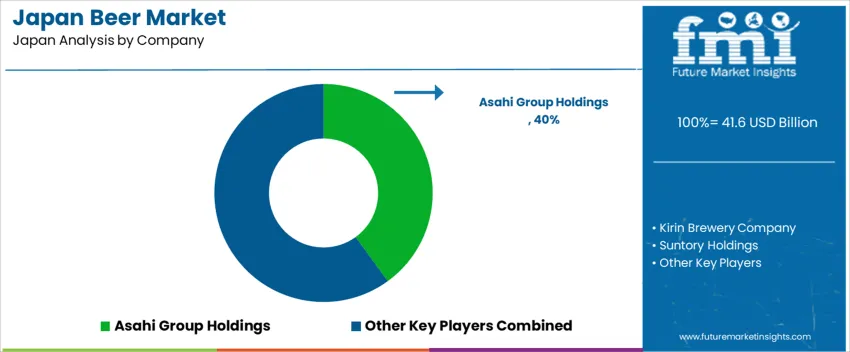
Demand for beer in Japan is shaped primarily by a small group of domestic brewers supplying mass-market lagers, premium brands, and seasonal/boutique variations through nationwide distribution, retail chains, bars, and izakaya. Asahi Group Holdings holds an estimated 40.0% share, supported by controlled brewing processes, consistent brand recognition, and broad retail and on-trade penetration. Its flagship lager and seasonal products maintain stable quality and strong consumption appeal across generations.
Kirin Brewery Company maintains significant participation through a diversified portfolio that includes its core lager brands as well as new alcoholic-beverage categories, offering reliable supply and widespread retail availability. Suntory Holdings contributes through its beer and “happoshu” portfolio, capturing demand from consumers seeking lighter taste profiles or alternative alcoholic beverages while leveraging its strong marketing and distribution network. Sapporo Breweries supports domestic demand through both mainstream and craft-style beers, offering consistent quality and leveraging legacy brand value among urban and regional drinkers.
Competition in Japan centers on brand identity, flavour consistency, seasonal product innovation, price positioning, retail distribution strength, and on-trade presence. Demand remains steady as Japanese consumers continue to prefer domestic beer products for everyday drinking, social occasions, and seasonal consumption, with loyalty reinforced by stable product availability and trusted brand heritage across generations.
Key Players in Japan Beer Demand
- Asahi Group Holdings
- Kirin Brewery Company
- Suntory Holdings
- Sapporo Breweries
Scope of the Report
| Metric | Value |
|---|---|
| Quantitative Units | USD 43.89 billion to USD 74.97 billion, at a CAGR of 5.5% |
| Market Definition | Beer encompasses fermented cereal grain beverages including lager, ale, and stout categories produced at macro, craft, and micro scales and distributed through retail and on-premise channels. |
| Segmentation | Product Type: Lager, Ale, Stouts, Others; Packaging: Bottle, Can, Glass, Others; Production: Macro-brewery, Craft Brewery, Microbrewery, Other; Distribution Channel: Hypermarkets/Supermarkets, Convenience Stores, Online Retailers, Specialty Stores, Independent Retailers, Direct, Indirect |
| Regions Covered | Kyushu & Okinawa, Kanto, Kansai, Chubu, Tohoku, Rest of Japan |
| Key Companies Profiled | Asahi Group Holdings, Kirin Brewery Company, Suntory Holdings, Sapporo Breweries |
| Forecast Period | 2026 to 2036 |
| Approach | Forecasting models apply a bottom-up methodology starting from trade volume baselines, applying category-specific growth coefficients and cross-validating against reported company financials and trade statistics. |
Japan Beer Demand by Segments
Product Type:
- Lager
- Ale
- Stouts
- Others
Packaging:
- Bottle
- Can
- Glass
- Others
Production:
- Macro-brewery
- Craft Brewery
- Microbrewery
- Other
Distribution Channel:
- Hypermarkets/Supermarkets
- Convenience Stores
- Online Retailers
- Specialty Stores
- Independent Retailers
- Direct
- Indirect
Region:
- Kyushu & Okinawa
- Kanto
- Kansai
- Chubu
- Tohoku
- Rest of Japan
Bibliography
- National Tax Agency, Japan. (2025). Liquor Tax Statistics Annual Report. NTA Japan.
- Brewers Association of Japan. (2024). Beer and Happoshu Market Data Report. Brewers Association of Japan.
- Ministry of Finance, Japan. (2024). Tax Revenue Statistics: Liquor Tax. MOF Japan.
- Japan External Trade Organization. (2024). Japan Market Report: Alcoholic Beverages. JETRO.
- Organisation for Economic Co-operation and Development. (2024). OECD Health Statistics: Alcohol Consumption Per Capita. OECD.
This bibliography is provided for reader reference. The full Future Market Insights report contains the complete reference list with primary research documentation.
Frequently Asked Questions
How large is the demand for beer in japan market in 2026?
The demand for beer in japan market is estimated to be valued at USD 43.89 billion in 2026.
What will be the market size of demand for beer in japan by 2036?
Market size for demand for beer in japan is projected to reach USD 74.97 billion by 2036.
What is the expected CAGR for demand for beer in japan between 2026 and 2036?
The demand for beer in japan market is expected to grow at a CAGR of 5.5% between 2026 and 2036.
Which product type segment is poised to lead in 2026?
Lager accounts for 45.0% share in 2026, making it the leading product type segment.
Which packaging segment holds a leading position?
Bottle holds 42.0% share in 2026, commanding the leading position by packaging.
Which region records the highest growth rate?
Kyushu & Okinawa records the highest CAGR at 6.8% during 2026 to 2036.
What is included in the scope of this report?
Market scope includes packaged lager, ale, stout, and specialty beer products for retail and on-premise consumption. The scope covers macro-brewery, craft brewery, and microbrewery production distribu.
What is excluded from the scope of this report?
The scope excludes happoshu (low-malt beer), third-category beverages, non-alcoholic beer, chuhai, ready-to-drink cocktails, and sake. Home brewing equipment and ingredients are also excluded from the.
Preview the report firsthand - request a free sample
Get SampleGet the brochure for pricing and purchase details.
Get PDFTable of Content
- Executive Summary
- Japan Market Outlook
- Demand-side Trends
- Supply-side Trends
- Technology Roadmap Analysis
- Analysis and Recommendations
- Market Overview
- Market Coverage / Taxonomy
- Market Definition / Scope / Limitations
- Research Methodology
- Chapter Orientation
- Analytical Lens and Working Hypotheses
- Market Structure, Signals, and Trend Drivers
- Benchmarking and Cross-market Comparability
- Market Sizing, Forecasting, and Opportunity Mapping
- Research Design and Evidence Framework
- Desk Research Programme (Secondary Evidence)
- Company Annual and Sustainability Reports
- Peer-reviewed Journals and Academic Literature
- Corporate Websites, Product Literature, and Technical Notes
- Earnings Decks and Investor Briefings
- Statutory Filings and Regulatory Disclosures
- Technical White Papers and Standards Notes
- Trade Journals, Industry Magazines, and Analyst Briefs
- Conference Proceedings, Webinars, and Seminar Materials
- Government Statistics Portals and Public Data Releases
- Press Releases and Reputable Media Coverage
- Specialist Newsletters and Curated Briefings
- Sector Databases and Reference Repositories
- FMI Internal Proprietary Databases and Historical Market Datasets
- Subscription Datasets and Paid Sources
- Social Channels, Communities, and Digital Listening Inputs
- Additional Desk Sources
- Expert Input and Fieldwork (Primary Evidence)
- Primary Modes
- Qualitative Interviews and Expert Elicitation
- Quantitative Surveys and Structured Data Capture
- Blended Approach
- Why Primary Evidence is Used
- Field Techniques
- Interviews
- Surveys
- Focus Groups
- Observational and In-context Research
- Social and Community Interactions
- Stakeholder Universe Engaged
- C-suite Leaders
- Board Members
- Presidents and Vice Presidents
- R&D and Innovation Heads
- Technical Specialists
- Domain Subject-matter Experts
- Scientists
- Physicians and Other Healthcare Professionals
- Governance, Ethics, and Data Stewardship
- Research Ethics
- Data Integrity and Handling
- Primary Modes
- Tooling, Models, and Reference Databases
- Desk Research Programme (Secondary Evidence)
- Data Engineering and Model Build
- Data Acquisition and Ingestion
- Cleaning, Normalisation, and Verification
- Synthesis, Triangulation, and Analysis
- Quality Assurance and Audit Trail
- Market Background
- Market Dynamics
- Drivers
- Restraints
- Opportunity
- Trends
- Scenario Forecast
- Demand in Optimistic Scenario
- Demand in Likely Scenario
- Demand in Conservative Scenario
- Opportunity Map Analysis
- Product Life Cycle Analysis
- Supply Chain Analysis
- Investment Feasibility Matrix
- Value Chain Analysis
- PESTLE and Porter’s Analysis
- Regulatory Landscape
- Regional Parent Market Outlook
- Production and Consumption Statistics
- Import and Export Statistics
- Market Dynamics
- Japan Market Analysis 2021 to 2025 and Forecast, 2026 to 2036
- Historical Market Size Value (USD Million) Analysis, 2021 to 2025
- Current and Future Market Size Value (USD Million) Projections, 2026 to 2036
- Y-o-Y Growth Trend Analysis
- Absolute $ Opportunity Analysis
- Japan Market Pricing Analysis 2021 to 2025 and Forecast 2026 to 2036
- Japan Market Analysis 2021 to 2025 and Forecast 2026 to 2036, By Product Type
- Introduction / Key Findings
- Historical Market Size Value (USD Million) Analysis By Product Type , 2021 to 2025
- Current and Future Market Size Value (USD Million) Analysis and Forecast By Product Type , 2026 to 2036
- Lager
- Ale
- Stouts
- Others
- Lager
- Y-o-Y Growth Trend Analysis By Product Type , 2021 to 2025
- Absolute $ Opportunity Analysis By Product Type , 2026 to 2036
- Japan Market Analysis 2021 to 2025 and Forecast 2026 to 2036, By Packaging
- Introduction / Key Findings
- Historical Market Size Value (USD Million) Analysis By Packaging, 2021 to 2025
- Current and Future Market Size Value (USD Million) Analysis and Forecast By Packaging, 2026 to 2036
- Bottle
- Can
- Glass
- Others
- Bottle
- Y-o-Y Growth Trend Analysis By Packaging, 2021 to 2025
- Absolute $ Opportunity Analysis By Packaging, 2026 to 2036
- Japan Market Analysis 2021 to 2025 and Forecast 2026 to 2036, By Production
- Introduction / Key Findings
- Historical Market Size Value (USD Million) Analysis By Production, 2021 to 2025
- Current and Future Market Size Value (USD Million) Analysis and Forecast By Production, 2026 to 2036
- Macro-brewery
- Craft Brewery
- Microbrewery
- Other
- Macro-brewery
- Y-o-Y Growth Trend Analysis By Production, 2021 to 2025
- Absolute $ Opportunity Analysis By Production, 2026 to 2036
- Japan Market Analysis 2021 to 2025 and Forecast 2026 to 2036, By Distribution Channel
- Introduction / Key Findings
- Historical Market Size Value (USD Million) Analysis By Distribution Channel, 2021 to 2025
- Current and Future Market Size Value (USD Million) Analysis and Forecast By Distribution Channel, 2026 to 2036
- Hypermarkets/Supermarkets
- Convenience Stores
- Online Retailers
- Specialty Stores
- Independent Retailers
- Direct
- Indirect
- Hypermarkets/Supermarkets
- Y-o-Y Growth Trend Analysis By Distribution Channel, 2021 to 2025
- Absolute $ Opportunity Analysis By Distribution Channel, 2026 to 2036
- Japan Market Analysis 2021 to 2025 and Forecast 2026 to 2036, By Region
- Introduction
- Historical Market Size Value (USD Million) Analysis By Region, 2021 to 2025
- Current Market Size Value (USD Million) Analysis and Forecast By Region, 2026 to 2036
- Kyushu & Okinawa
- Kanto
- Kinki
- Chubu
- Tohoku
- Rest of Japan
- Market Attractiveness Analysis By Region
- Kyushu & Okinawa Market Analysis 2021 to 2025 and Forecast 2026 to 2036, By Country
- Historical Market Size Value (USD Million) Trend Analysis By Market Taxonomy, 2021 to 2025
- Market Size Value (USD Million) Forecast By Market Taxonomy, 2026 to 2036
- By Country
- By Product Type
- By Packaging
- By Production
- By Distribution Channel
- By Country
- Market Attractiveness Analysis
- By Country
- By Product Type
- By Packaging
- By Production
- By Distribution Channel
- Key Takeaways
- Kanto Market Analysis 2021 to 2025 and Forecast 2026 to 2036, By Country
- Historical Market Size Value (USD Million) Trend Analysis By Market Taxonomy, 2021 to 2025
- Market Size Value (USD Million) Forecast By Market Taxonomy, 2026 to 2036
- By Country
- By Product Type
- By Packaging
- By Production
- By Distribution Channel
- By Country
- Market Attractiveness Analysis
- By Country
- By Product Type
- By Packaging
- By Production
- By Distribution Channel
- Key Takeaways
- Kinki Market Analysis 2021 to 2025 and Forecast 2026 to 2036, By Country
- Historical Market Size Value (USD Million) Trend Analysis By Market Taxonomy, 2021 to 2025
- Market Size Value (USD Million) Forecast By Market Taxonomy, 2026 to 2036
- By Country
- By Product Type
- By Packaging
- By Production
- By Distribution Channel
- By Country
- Market Attractiveness Analysis
- By Country
- By Product Type
- By Packaging
- By Production
- By Distribution Channel
- Key Takeaways
- Chubu Market Analysis 2021 to 2025 and Forecast 2026 to 2036, By Country
- Historical Market Size Value (USD Million) Trend Analysis By Market Taxonomy, 2021 to 2025
- Market Size Value (USD Million) Forecast By Market Taxonomy, 2026 to 2036
- By Country
- By Product Type
- By Packaging
- By Production
- By Distribution Channel
- By Country
- Market Attractiveness Analysis
- By Country
- By Product Type
- By Packaging
- By Production
- By Distribution Channel
- Key Takeaways
- Tohoku Market Analysis 2021 to 2025 and Forecast 2026 to 2036, By Country
- Historical Market Size Value (USD Million) Trend Analysis By Market Taxonomy, 2021 to 2025
- Market Size Value (USD Million) Forecast By Market Taxonomy, 2026 to 2036
- By Country
- By Product Type
- By Packaging
- By Production
- By Distribution Channel
- By Country
- Market Attractiveness Analysis
- By Country
- By Product Type
- By Packaging
- By Production
- By Distribution Channel
- Key Takeaways
- Rest of Japan Market Analysis 2021 to 2025 and Forecast 2026 to 2036, By Country
- Historical Market Size Value (USD Million) Trend Analysis By Market Taxonomy, 2021 to 2025
- Market Size Value (USD Million) Forecast By Market Taxonomy, 2026 to 2036
- By Country
- By Product Type
- By Packaging
- By Production
- By Distribution Channel
- By Country
- Market Attractiveness Analysis
- By Country
- By Product Type
- By Packaging
- By Production
- By Distribution Channel
- Key Takeaways
- Key Countries Market Analysis
- Kyushu & Okinawa
- Pricing Analysis
- Market Share Analysis, 2025
- By Product Type
- By Packaging
- By Production
- By Distribution Channel
- Kanto
- Pricing Analysis
- Market Share Analysis, 2025
- By Product Type
- By Packaging
- By Production
- By Distribution Channel
- Kinki
- Pricing Analysis
- Market Share Analysis, 2025
- By Product Type
- By Packaging
- By Production
- By Distribution Channel
- Chubu
- Pricing Analysis
- Market Share Analysis, 2025
- By Product Type
- By Packaging
- By Production
- By Distribution Channel
- Tohoku
- Pricing Analysis
- Market Share Analysis, 2025
- By Product Type
- By Packaging
- By Production
- By Distribution Channel
- Rest of Japan
- Pricing Analysis
- Market Share Analysis, 2025
- By Product Type
- By Packaging
- By Production
- By Distribution Channel
- Kyushu & Okinawa
- Market Structure Analysis
- Competition Dashboard
- Competition Benchmarking
- Market Share Analysis of Top Players
- By Regional
- By Product Type
- By Packaging
- By Production
- By Distribution Channel
- Competition Analysis
- Competition Deep Dive
- Asahi Group Holdings
- Overview
- Product Portfolio
- Profitability by Market Segments (Product/Age /Sales Channel/Region)
- Sales Footprint
- Strategy Overview
- Marketing Strategy
- Product Strategy
- Channel Strategy
- Kirin Brewery Company
- Suntory Holdings
- Sapporo Breweries
- Asahi Group Holdings
- Competition Deep Dive
- Assumptions & Acronyms Used


