

- Industry Size (2025)
- USD 127.1 Mn
- Forecast (2035)
- USD 193.2 Mn
- CAGR (2025 to 2035)
- 4.3%
Demand for Diamond Core Drilling in Japan Forecast and Outlook 2025 to 2035
Demand for diamond core drilling in Japan is growing steadily, reaching USD 127.1 million in 2025 and USD 193.2 million by 2035, at a CAGR of 4.3%. Demand is driven by the construction and mining industries, with the construction sector leading, accounting for 56.7% of total demand. Diamond core drilling is crucial in these industries for tasks such as foundation work, geological surveys, and infrastructure development, where precision drilling through hard materials like rock and concrete is essential. Sales of diamond core drilling in construction is fueled by ongoing urban development, seismic-resistant building projects, and infrastructure upgrades.
Quick Stats of the Demand for Diamond Core Drilling in Japan
- Demand for Diamond Core Drilling in Japan Value (2025): USD 127.1 million
- Demand for Diamond Core Drilling in Japan Forecast Value (2035): USD 193.2 million
- Demand for Diamond Core Drilling in Japan Forecast CAGR (2025-2035): 4.3%
- Demand for Diamond Core Drilling in Japan Leading Operation Type: Rig Operated
- Demand for Diamond Core Drilling in Japan Leading End-Use Industry: Construction Industry
- Demand for Diamond Core Drilling in Japan Key Growth Regions: Kyushu & Okinawa, Kanto, Kansai, Chubu, Tohoku, Rest of Japan
- Demand for Diamond Core Drilling in Japan Top Players: Hilti Corporation, Atlas Copco, WEKA Elektrowerkzeuge KG, Robert Bosch GmbH, Boart Longyear
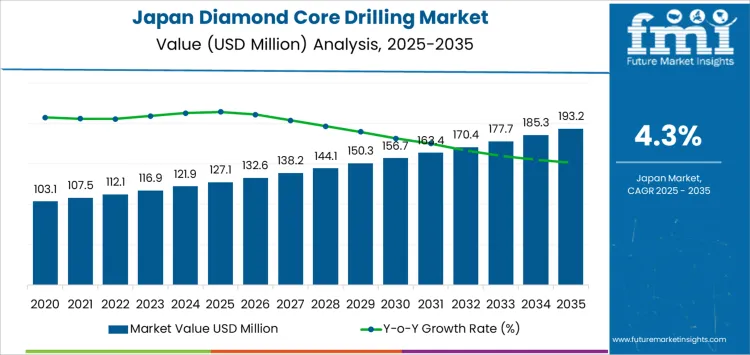
Industry is primarily segmented by operation type, with rig-operated systems dominating at 97% of the demand. These systems are favored for large-scale, high-precision drilling tasks due to their power, stability, and ability to handle deep drilling applications efficiently. Hand-held systems, while less common, are used in smaller, more accessible drilling tasks. The demand is also influenced by regional development, with Kyushu & Okinawa experiencing the highest growth rate at 5.3%, driven by construction and mining activities. Kanto follows closely with a 4.9% CAGR, supported by urban expansion and high demand for drilling solutions in both construction and geotechnical applications. As the construction industry continues to grow, the demand for diamond core drilling equipment in these sectors is set to rise.
Demand for Diamond Core Drilling in Japan Key Takeaways
| Metric | Value |
|---|---|
| Demand for Diamond Core Drilling in Japan Value (2025) | USD 127.1 million |
| Demand for Diamond Core Drilling in Japan Forecast Value (2035) | USD 193.2 million |
| Demand for Diamond Core Drilling in Japan Forecast CAGR (2025-2035) | 4.3% |
Why is the Demand for Diamond Core Drilling in Japan Growing?
The demand for diamond core drilling in Japan is growing due to the increasing need for precise and efficient drilling techniques in industries such as construction, mining, and geotechnical engineering. Diamond core drilling, known for its ability to drill through hard materials such as rock, concrete, and metal, is essential for applications that require high accuracy and minimal disturbance to surrounding areas. As Japan’s infrastructure development and resource extraction projects expand, the demand for diamond core drilling is becoming more prominent.
A key driver behind the growth of diamond core drilling is the ongoing investment in construction and infrastructure projects. With Japan’s focus on urban development, earthquake-resistant building construction, and natural resource exploration, diamond core drilling offers a reliable and accurate solution for extracting samples, installing anchors, and creating deep holes for various applications. This method is particularly valuable in geotechnical studies, which are critical for understanding soil conditions and foundation integrity before construction begins.
Advancements in drilling technology, including more efficient and durable diamond drill bits, are contributing to the growth of this sector. These innovations increase the speed, accuracy, and cost-effectiveness of drilling operations, making diamond core drilling an even more attractive option for both large-scale and smaller-scale projects. As demand for precise, high-performance drilling solutions continues to rise in Japan’s key industries, the demand for diamond core drilling equipment is expected to grow steadily through 2035.
What is the Segment-Wise Analysis of Demand for Diamond Core Drilling in Japan?
Demand for diamond core drilling in Japan is segmented by operation type, end use, and region. By operation type, demand is divided into rig operated and hand-held, with rig operated leading at 97%. The demand is also segmented by end use, including the construction industry and mining industry, with the construction industry accounting for 56.7%. Regionally, demand spans across Kyushu & Okinawa, Kanto, Kansai, Chubu, Tohoku, and the rest of Japan.
How Does Rig Operated Lead the Demand for Diamond Core Drilling in Japan?
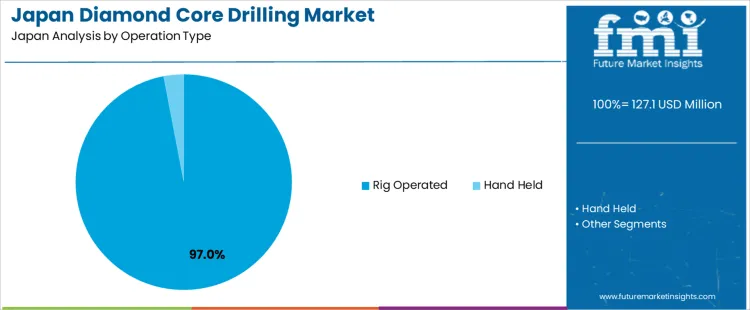
Rig operated diamond core drilling accounts for 97% of the demand in Japan, driven by its ability to handle large-scale, high-precision drilling tasks efficiently. Rig operated systems are ideal for applications requiring deep drilling, such as geological exploration, large-scale construction projects, and infrastructure development. These machines provide higher power, precision, and stability compared to hand-held units, making them essential for the rigorous demands of the construction and mining industries. The popularity of rig operated drilling is also influenced by its capacity to drill larger diameters and deeper cores, which is crucial in both construction and mineral extraction processes. As Japan continues to invest in urban development and infrastructure, the demand for rig operated diamond core drilling will remain dominant, providing the necessary equipment for complex and large-scale projects.
Why Does the Construction Industry Lead the Demand for Diamond Core Drilling in Japan?
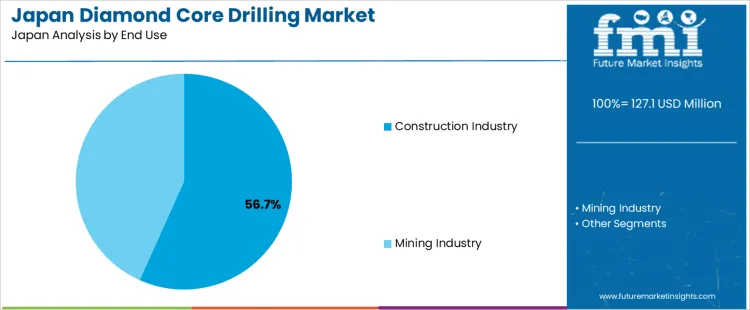
The construction industry accounts for 56.7% of the demand for diamond core drilling in Japan, driven by its need for high-precision drilling in concrete, rock, and other materials during construction projects. Diamond core drilling is widely used for creating holes in building foundations, installing utilities, and cutting through tough materials like reinforced concrete and asphalt. The growing demand for infrastructure development, urban expansion, and high-rise buildings in Japan has contributed to the increase in diamond core drilling applications in construction. As construction techniques become more advanced and the need for accurate, deep drilling grows, the demand for diamond core drilling equipment in the construction sector will continue to rise. The growing focus on sustainability and the need for precise cutting and minimal disruption in urban areas make diamond core drilling an essential part of modern construction projects in Japan.
What are the Key Trends, Drivers, and Restraints in Demand for Diamond Core Drilling in Japan?
The overall construction industry in Japan continues to grow, backed by public works, infrastructure upgrades, seismic retrofits, urban redevelopment and housing projects driving need for precise drilling, geotechnical investigation, and renovation‑related core sampling. Diamond core drilling offers accurate, clean, and efficient drilling through concrete, rock, and other hard materials essential for foundations, underground work, retrofits, and renovation jobs. At the same time, restraints remain: the equipment and operation costs for diamond‑core drilling are typically higher than conventional drills or manual methods, which may discourage adoption among smaller contractors or for low‑budget projects.
Why is Demand for Diamond Core Drilling Growing in Japan?
Japan’s expanding infrastructure pipeline including bridges, tunnels, utilities, apartment redevelopment, and seismic‑resistant construction significantly fuels demand for diamond core drilling. As old buildings age and seismic regulations tighten, many renovation and retrofitting projects require precise core drilling to inspect, reinforce or repurpose structures tasks for which diamond core drilling is well‑suited. Also, growing emphasis on safety, structural integrity, and non‑destructive testing in old urban zones makes accurate coring essential. The rising construction equipment investments and modernization of construction practices support uptake of advanced drilling methods. Increased demand for renovation over new builds further encourages core‑drilling usage over demolition, especially in urban settings with space or regulatory constraints.
How are Technological & Industry Innovations Driving Diamond Core Drilling Demand in Japan?
Advances in drill‑bit technology, rig design, and operation methods are improving the efficiency, safety, and applicability of diamond core drilling making it more attractive for Japanese construction and retrofitting projects. Modern diamond core drills allow precise cutting through reinforced concrete, rock, or mixed substrates with minimal vibration and dust valuable in densely populated urban areas. Newer handheld or compact rigs enable use even in constrained spaces, while water‑cooled and dust‑reduction mechanisms better meet environmental and safety standards. As construction firms adopt advanced drilling tools and integrate drilling work into broader renovation or underground‑utility projects, the demand for core drilling equipment continues to rise. The trend toward more renovation, retrofitting, and redevelopment rather than full rebuilds boosts reliance on precise, minimally destructive drilling techniques.
What are the Key Challenges and Risks That Could Limit Diamond Core Drilling Demand in Japan?
Despite growth potential, some factors may limit widespread adoption of diamond core drilling. The high capital cost for diamond‑core rigs and drill bits plus maintenance, water supply (for wet‑core drilling), and skill requirements make it expensive relative to simpler drilling methods or demolition + rebuild. For smaller contractors or budget‑constrained projects, these costs can be prohibitive. Also, regulatory constraints (permits, noise, dust, vibration) particularly in dense urban or residential areas may restrict usage or impose additional compliance cost. For certain tasks, less‑costly alternatives (manual drilling, anchor drilling, demolition) may remain preferred. Finally, in regions or sectors where demand for renovation or underground work is limited, the need for specialized core‑drilling may remain niche rather than broad‑based.
What is the Regional Demand Outlook for Pea Grits in Japan?
| Region | CAGR (%) |
|---|---|
| Kyushu & Okinawa | 5.3% |
| Kanto | 4.9% |
| Kansai | 4.3% |
| Chubu | 3.8% |
| Tohoku | 3.3% |
| Rest of Japan | 3.2% |
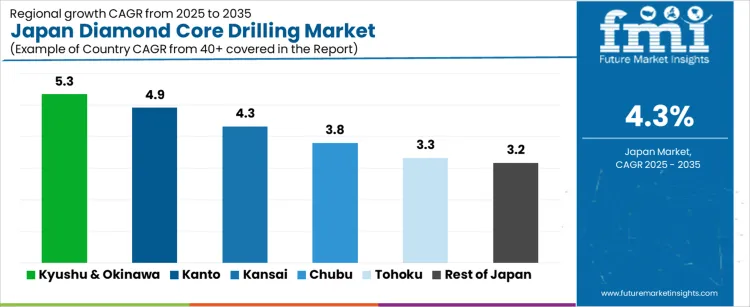
Demand for diamond core drilling in Japan is growing steadily across all regions, with Kyushu & Okinawa leading at a 5.3% CAGR, driven by increasing construction, infrastructure, and mining activities. Kanto follows with a 4.9% CAGR, supported by the region’s large urban population and the high demand for precision drilling in construction and geotechnical applications. Kansai shows a 4.3% CAGR, fueled by the region’s strong industrial base and infrastructure development. Chubu experiences a 3.8% CAGR, as demand grows in both commercial construction and natural resource exploration. Tohoku and the Rest of Japan see moderate growth at 3.3% and 3.2%, respectively.
How is Demand for Diamond Core Drilling Growing in Kyushu & Okinawa?
Kyushu & Okinawa leads the demand for diamond core drilling, growing at a 5.3% CAGR. The region’s rising construction and infrastructure projects, particularly in urban development and resource exploration, are driving the adoption of diamond core drilling technology. With the demand for high-precision drilling increasing in sectors such as civil engineering, mining, and geothermal energy, businesses in Kyushu & Okinawa are turning to diamond core drilling for its ability to provide accurate and high-quality samples for analysis. As the region’s industrial base expands, particularly in sectors like tourism, transportation, and resource extraction, the need for reliable and efficient drilling equipment is set to rise. With further growth in construction and infrastructure projects, demand for diamond core drilling solutions is expected to continue growing steadily in Kyushu & Okinawa.
Why is Demand for Diamond Core Drilling Rising in Kanto?
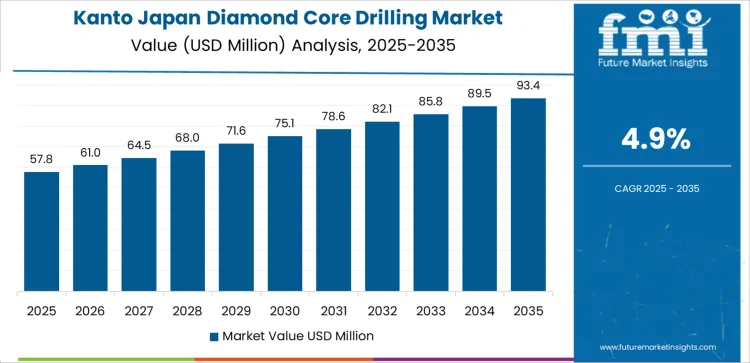
In Kanto, demand for diamond core drilling is rising at a 4.9% CAGR. The region’s large urban population and its bustling construction and real estate sectors are key drivers of this growth. Kanto’s need for precise and efficient drilling solutions for infrastructure development, geotechnical investigations, and mining activities is fueling the demand for diamond core drilling. With a focus on high-quality, reliable core samples and accurate subsurface analysis, industries in Kanto are increasingly adopting advanced drilling technologies. The growing demand for resource exploration and sustainable construction practices further boosts the need for diamond core drilling. As the region continues to expand and modernize its infrastructure, demand for diamond core drilling services is expected to remain strong in Kanto.
How is Demand for Diamond Core Drilling Expanding in Kansai?
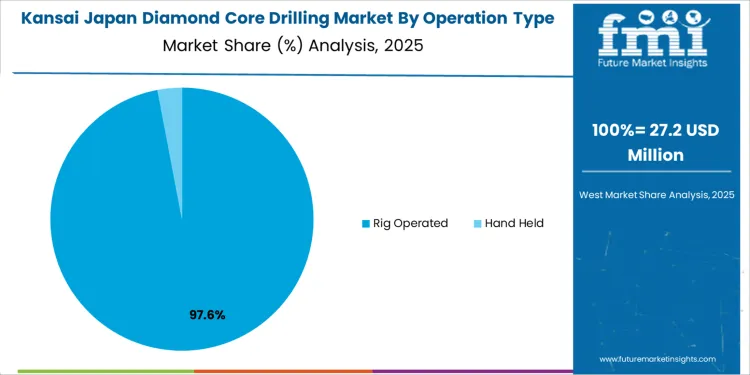
Kansai shows steady demand for diamond core drilling, with a 4.3% CAGR. The region’s strong industrial base, including manufacturing, infrastructure, and natural resource exploration, is driving this trend. Kansai’s development projects, such as road construction, railways, and urban redevelopment, are increasingly relying on diamond core drilling for precise geological analysis and efficient drilling solutions. The region’s focus on modernizing infrastructure and expanding transportation networks further supports the demand for diamond core drilling. As more industries in Kansai adopt advanced drilling technologies to improve efficiency and accuracy, demand for these services is expected to rise steadily. The region’s strategic location as an industrial hub will likely continue to contribute to the growth of diamond core drilling in the coming years.
Why is Demand for Diamond Core Drilling Growing in Chubu?
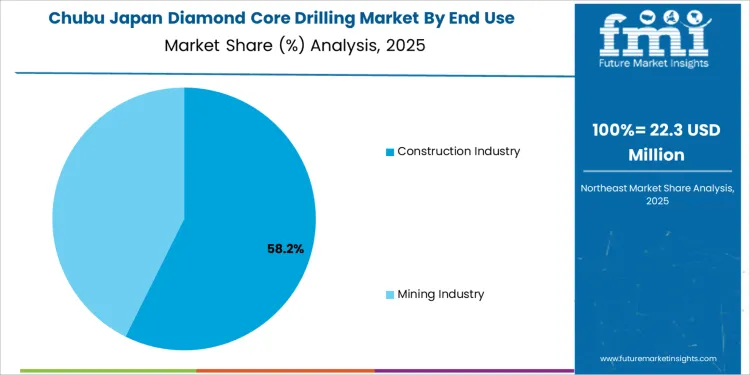
Chubu is experiencing steady demand for diamond core drilling, growing at a 3.8% CAGR. The region’s focus on manufacturing, construction, and resource exploration contributes to the rising demand for high-quality drilling solutions. Chubu’s industrial growth, particularly in urban development, infrastructure projects, and mining activities, is creating a need for reliable and precise drilling services. With sectors such as civil engineering, resource extraction, and geothermal energy requiring advanced drilling techniques for accurate subsurface sampling, the adoption of diamond core drilling is increasing. As businesses in Chubu continue to modernize and invest in infrastructure development, the need for efficient and durable drilling solutions is expected to grow steadily. The region’s expanding industrial landscape ensures that the demand for diamond core drilling services will remain strong in the coming years.
How is Demand for Diamond Core Drilling Expanding in Tohoku?
Tohoku is seeing moderate growth in diamond core drilling demand, with a 3.3% CAGR. While the region’s industrial activity is smaller compared to urban centers, there is a steady rise in demand for drilling solutions in sectors such as infrastructure, resource exploration, and construction. Tohoku’s focus on rebuilding and modernizing its infrastructure, particularly after natural disasters, has led to increased demand for precise drilling services to assess ground conditions and support construction projects. The region’s natural resource exploration efforts, particularly in the mining and geothermal energy sectors, also contribute to this trend. As Tohoku continues to expand its infrastructure and natural resource exploration activities, demand for diamond core drilling services is expected to grow steadily, driven by the need for high-quality, accurate drilling solutions.
Why is Demand for Diamond Core Drilling Steady in the Rest of Japan?
The Rest of Japan is experiencing steady demand for diamond core drilling, with a 3.2% CAGR. Although adoption in rural and smaller cities is slower compared to urban centers, there is growing interest in advanced drilling solutions, particularly for construction, infrastructure, and resource exploration projects. As businesses and local governments in these regions focus on modernization and efficiency, the need for reliable and high-precision drilling solutions is increasing. The Rest of Japan’s emphasis on improving infrastructure and exploring natural resources contributes to the demand for diamond core drilling services. As the region continues to adopt modern drilling technologies and prioritize sustainable construction practices, demand for diamond core drilling will likely rise steadily in line with broader industrial growth.
What is Driving the Demand for Diamond Core Drilling in Japan and Who Are the Key Players Shaping the Industry?
The demand for diamond core drilling in Japan is rising due to its essential role in construction, mining, and civil engineering projects that require precision drilling through hard materials like concrete, rock, and masonry. Diamond core drilling offers high accuracy, efficiency, and minimal dust, making it a preferred method for tasks such as geological surveys, infrastructure development, and the installation of utilities. With Japan's ongoing investment in infrastructure, urban development, and the need for advanced construction techniques, the demand for diamond core drilling equipment is increasing. The rise in seismic activity monitoring and underground development projects also contributes to the demand for these highly specialized drilling solutions.
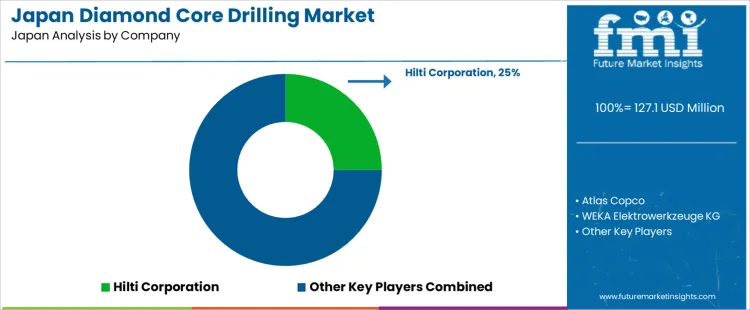
Key players shaping the diamond core drilling industry in Japan include Hilti Corporation, Atlas Copco, WEKA Elektrowerkzeuge KG, Robert Bosch GmbH, and Boart Longyear. Hilti Corporation leads the industry with a notable share of 25.0%, offering a wide range of diamond core drilling tools known for their durability, precision, and cutting-edge technology. These companies are at the forefront of providing high-performance diamond core drilling systems that cater to the diverse needs of construction and mining sectors in Japan. Their focus on innovation, product quality, and customer support helps them maintain a strong industry presence.
The growth of the diamond core drilling industry in Japan is further supported by the increasing need for more efficient, environmentally friendly drilling methods, as well as advancements in drilling technology that improve productivity and safety. As Japan continues to prioritize infrastructure expansion, urban redevelopment, and resource extraction, diamond core drilling will remain a key tool in meeting the demands of these critical industries, ensuring continued industry growth in the region.
Key Players in Japan Diamond Core Drilling Demand
- Hilti Corporation
- Atlas Copco
- WEKA Elektrowerkzeuge KG
- Robert Bosch GmbH
- Boart Longyear
Scope of Report
| Items | Values |
|---|---|
| Quantitative Units (2025) | USD million |
| Operation Type | Rig Operated, Hand Held |
| End Use | Construction Industry, Mining Industry |
| Region | Kyushu & Okinawa, Kanto, Kansai, Chubu, Tohoku, Rest of Japan |
| Countries Covered | Japan |
| Key Companies Profiled | Hilti Corporation, Atlas Copco, WEKA Elektrowerkzeuge KG, Robert Bosch GmbH, Boart Longyear |
| Additional Attributes | Dollar sales by operation type and end use; regional CAGR and growth outlook; increasing demand in construction and mining projects; technological advancements in drilling systems; rising adoption of hand-held and rig-operated equipment. |
Japan Diamond Core Drilling Demand by Key Segments
Operation Type
- Rig Operated
- Hand Held
End Use
- Construction Industry
- Mining Industry
Region
- Kyushu & Okinawa
- Kanto
- Kansai
- Chubu
- Tohoku
- Rest of Japan
Frequently Asked Questions
How big is the demand for diamond core drilling in Japan in 2025?
The demand for diamond core drilling in Japan is estimated to be valued at USD 127.1 million in 2025.
What will be the size of diamond core drilling in Japan in 2035?
The market size for the diamond core drilling in Japan is projected to reach USD 193.2 million by 2035.
How much will be the demand for diamond core drilling in Japan growth between 2025 and 2035?
The demand for diamond core drilling in Japan is expected to grow at a 4.3% CAGR between 2025 and 2035.
What are the key product types in the diamond core drilling in Japan?
The key product types in diamond core drilling in Japan are rig operated and hand held.
Which end use segment is expected to contribute significant share in the diamond core drilling in Japan in 2025?
In terms of end use, construction industry segment is expected to command 56.7% share in the diamond core drilling in Japan in 2025.
Preview the report firsthand - request a free sample
Get SampleGet the brochure for pricing and purchase details.
Get PDFTable of Content
- Executive Summary
- Japan Market Outlook
- Demand-side Trends
- Supply-side Trends
- Technology Roadmap Analysis
- Analysis and Recommendations
- Market Overview
- Market Coverage / Taxonomy
- Market Definition / Scope / Limitations
- Market Background
- Market Dynamics
- Drivers
- Restraints
- Opportunity
- Trends
- Scenario Forecast
- Demand in Optimistic Scenario
- Demand in Likely Scenario
- Demand in Conservative Scenario
- Opportunity Map Analysis
- Product Life Cycle Analysis
- Supply Chain Analysis
- Investment Feasibility Matrix
- Value Chain Analysis
- PESTLE and Porter’s Analysis
- Regulatory Landscape
- Regional Parent Market Outlook
- Production and Consumption Statistics
- Import and Export Statistics
- Market Dynamics
- Japan Market Analysis 2020 to 2024 and Forecast, 2025 to 2035
- Historical Market Size Value (USD Million) Analysis, 2020 to 2024
- Current and Future Market Size Value (USD Million) Projections, 2025 to 2035
- Y-o-Y Growth Trend Analysis
- Absolute $ Opportunity Analysis
- Japan Market Pricing Analysis 2020 to 2024 and Forecast 2025 to 2035
- Japan Market Analysis 2020 to 2024 and Forecast 2025 to 2035, By Operation Type
- Introduction / Key Findings
- Historical Market Size Value (USD Million) Analysis By Operation Type , 2020 to 2024
- Current and Future Market Size Value (USD Million) Analysis and Forecast By Operation Type , 2025 to 2035
- Rig Operated
- Hand Held
- Y-o-Y Growth Trend Analysis By Operation Type , 2020 to 2024
- Absolute $ Opportunity Analysis By Operation Type , 2025 to 2035
- Japan Market Analysis 2020 to 2024 and Forecast 2025 to 2035, By End Use
- Introduction / Key Findings
- Historical Market Size Value (USD Million) Analysis By End Use, 2020 to 2024
- Current and Future Market Size Value (USD Million) Analysis and Forecast By End Use, 2025 to 2035
- Construction Industry
- Mining Industry
- Y-o-Y Growth Trend Analysis By End Use, 2020 to 2024
- Absolute $ Opportunity Analysis By End Use, 2025 to 2035
- Market Structure Analysis
- Competition Dashboard
- Competition Benchmarking
- Market Share Analysis of Top Players
- By Regional
- By Operation Type
- By End Use
- Competition Analysis
- Competition Deep Dive
- Hilti Corporation
- Overview
- Product Portfolio
- Profitability by Market Segments (Product/Age /Sales Channel/Region)
- Sales Footprint
- Strategy Overview
- Marketing Strategy
- Product Strategy
- Channel Strategy
- Atlas Copco
- WEKA Elektrowerkzeuge KG
- Robert Bosch GmbH
- Boart Longyear
- Hilti Corporation
- Competition Deep Dive
- Assumptions & Acronyms Used
- Research Methodology


