

- Industry Size (2026)
- USD 912.2 Mn
- Forecast (2036)
- USD 1244.4 Mn
- CAGR (2026 to 2036)
- 3.2%
Demand for Draw Heat Setting Winder in Japan Forecast and Outlook 2026 to 2036
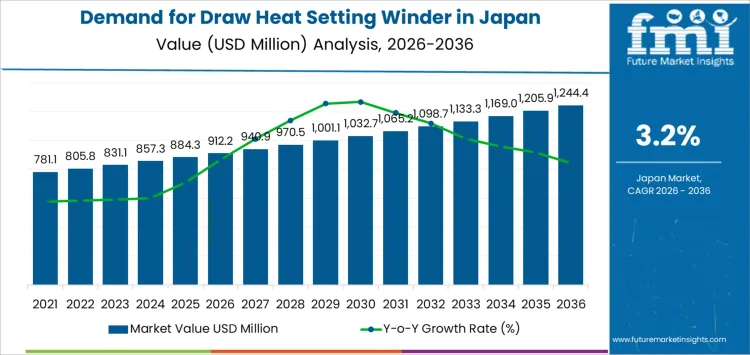
Demand for draw heat setting winder in Japan is valued at USD 912.2 million in 2026 and is projected to reach USD 1,244.4 million by 2036, reflecting a CAGR of 3.2%. Growth from USD 757.3 million in 2020 to USD 912.2 million in 2026 is supported by steady textile production and ongoing modernization of fiber processing lines. Automatic winders hold the larger share as mills prioritize consistent tension control and uniform package formation. Flat and cone types remain central across major spinning operations.
From 2027 onward, values rise from USD 940.9 million to USD 1,065.2 million by 2031, then progress to USD 1,244.4 million by 2036 through stable annual increases. Cylinder type winders maintain defined roles in specialized yarn handling. Semi-automatic units continue to serve smaller mills and mixed-capacity plants. Long-term demand reflects machinery renewal cycles, higher productivity requirements, and periodic upgrades across Japan’s synthetic fiber and blended yarn industries. Annual value movement remains steady and aligned with established textile workflows.
Quick Stats of the Demand for Draw Heat Setting Winder in Japan
- Draw Heat Setting Winder Demand in Japan Value (2026): USD 912.2 million
- Draw Heat Setting Winder Demand in Japan Forecast Value (2036): USD 1,244.4 million
- Draw Heat Setting Winder Demand in Japan Forecast CAGR (2026-2036): 3.2%
- Draw Heat Setting Winder Leading Operation: Automatic (60%)
- Draw Heat Setting Winder Key Growth Regions: Kyushu & Okinawa, Kanto, Kansai
- Draw Heat Setting Winder Top Players: Sapru Machine, QingDao HongDA Textile Machinery Co., Xindawei Textile Machinery Co., Himson Engineering, Wuxi Xindawei Textile Machinery
What is the Growth Forecast for Draw Heat Setting Winder in Japan through 2036?
Between 2026 and 2031, demand for draw heat setting winders in Japan increases from USD 912.2 million to USD 1,032.7 million, a rise of USD 120.5 million across five years. Growth during this period is shaped by steady modernization in fiber spinning lines, greater emphasis on yarn uniformity, and broader upgrades within synthetic textile operations. Earlier demand was sustained by replacement of aging winding units, while near-term progression reflects targeted improvements in draw stability, controlled heat profiles, and production consistency across mid-scale and large textile processors.
From 2031 to 2036, demand advances from USD 1,032.7 million to USD 1,244.4 million, adding USD 211.7 million and signaling a stronger expansion profile. This phase benefits from deeper integration of automated tension control, improved fault-detection capabilities, and increased production of technical yarns requiring precise thermal conditioning. Earlier gains were linked to operational refresh cycles, whereas later growth reflects more strategic equipment investments tied to higher-value textile segments, expanding export-oriented yarn production, and multi-line upgrades within Japan’s advanced fiber manufacturing clusters.
Draw Heat Setting Winder Industry in Japan Key Takeaways
| Metric | Value |
|---|---|
| Industry Value (2026) | USD 912.2 million |
| Forecast Value (2036) | USD 1,244.4 million |
| Forecast CAGR (2026-2036) | 3.2% |
What Is Driving the Demand for Draw Heat Setting Winders in Japan from 2026 to 2036?
Demand for draw heat setting winders in Japan has grown with investment in textile processing, synthetic fibre production, and advanced fabric finishing. Manufacturers use these machines to stretch and heat set fibres and films, improving dimensional stability and mechanical properties before conversion into yarns, fabrics, or technical textiles. Historical demand reflected domestic capacity in apparel, industrial textiles, and film production, where precision winding and heat setting were essential for consistent product quality. Buyers focused on machine reliability, process repeatability, and controls that matched existing line speeds. From 2026 to 2036 demand for draw heat setting winders in Japan is expected to align with quality demands in high-performance textiles and renewed investment in domestic textile manufacturing.
Growth in automotive fabrics, medical textiles, and engineered films raises need for precise thermal treatment and tension control. Advanced materials used in filtration, composites, and sportswear benefit from equipment that delivers tight tolerances and uniform heat distribution. Buyers evaluate energy efficiency, digital control interfaces, and compatibility with Industry 4.0 systems when selecting new machines. Expansion of specialty fibre production and export oriented processing supports demand, with machine specifications tied to speed ranges, thermal profiles, and winding accuracy required by emerging end markets nationwide.
What Is the Demand for Draw Heat Setting Winders in Japan by Operation and Type for 2026 to 2036?
The demand for draw heat setting winders in Japan from 2026 to 2036 is shaped by textile modernization, expanding synthetic fiber production, and the need for equipment that supports consistent yarn tension and heat stabilization. Automatic winders lead due to productivity gains and labor reduction. Flat-type winders hold the largest type share as they support uniform package formation suited to downstream weaving, knitting, and precision fiber processing.
Why do automatic winders account for 60% of the demand for draw heat setting winders in Japan by operation from 2026 to 2036?
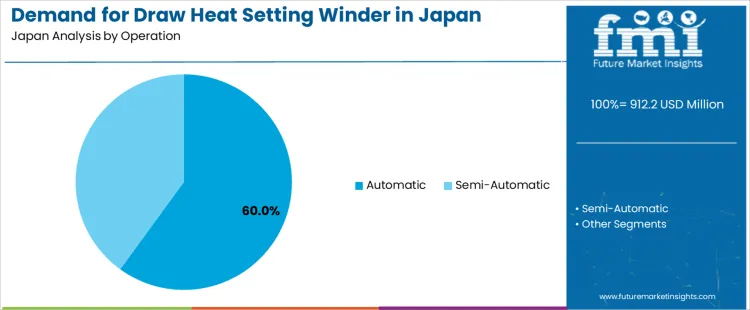
Automatic winders account for 60% of the demand in Japan because fiber producers increasingly prioritize uninterrupted runs, reduced operator handling, and tighter yarn quality control. Consumption grows in plants seeking to minimize manual intervention while maintaining stable thermal profiles during winding. Usage remains steady since automatic systems support consistent draw ratios and reduce variation between packages, which is essential for high-performance synthetic yarns. Procurement decisions are guided by placement in large, continuous production lines where uptime and precision directly influence throughput. Price sensitivity stays moderate because automation decreases long-term labor and rework costs. Specification control centers on tension accuracy, temperature uniformity, and self-correction features that maintain yarn integrity. Demand continues through 2026 to 2036 as textile facilities expand automated stations and replace aging manual units with higher-output systems.
Why do flat-type winders represent 45.0% of the demand for draw heat setting winders in Japan by type?
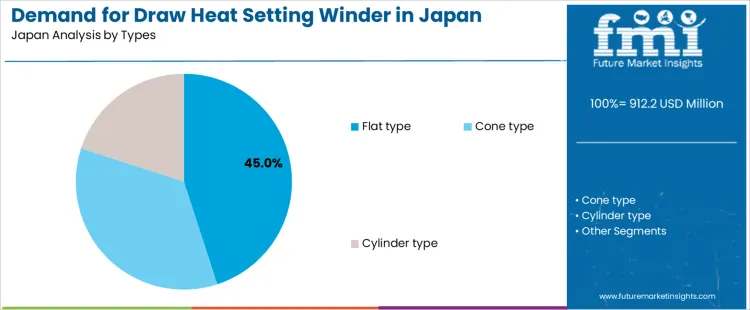
Flat-type winders represent 45.0% of the demand because their package geometry supports uniform yarn distribution and predictable unwinding behavior during further processing. Consumption is strong in operations producing fine-denier yarns, technical textiles, and consistent feedstock for weaving and knitting units. Usage remains steady since flat packages help maintain yarn alignment and reduce snarling in high-speed downstream machinery. Procurement is influenced by producers requiring stable winding surfaces for fibers sensitive to tension fluctuations during heat setting. Price sensitivity stays moderate as flat-type designs reduce material waste and machine stoppages. Specification control emphasizes layer uniformity, precise winding traverse, and reliable thermal conditioning across each package. Demand remains consistent from 2026 to 2036 as fiber manufacturers pursue stable, reproducible winding patterns to meet strict quality benchmarks in both domestic and export-oriented textile applications.
How Is Demand for Draw Heat Setting Winders in Japan Shaped by Local Textile Production Routines?
Demand develops through Japan’s textile clusters where controlled yarn stabilization supports consistent fabric quality. Mills in Fukui adjust winding settings to match local filament specifications used in regional apparel lines. Facilities in Ishikawa use heat setting units to manage shrinkage behavior during weaving preparation. Smaller producers in Wakayama employ these winders for sportswear yarns that require defined tension profiles. Technical textile plants in Gifu use them during trials linked to domestic equipment programs. These patterns reflect practical needs created by Japan’s production habits and material preferences across its established textile regions.
Which Local Production Requirements Are Driving Demand for Draw Heat Setting Winders in Japan?
Drivers arise from yarn handling routines in specialized clusters. Mills in Fukui apply heat setting winders to stabilize polyester filaments before high speed weaving. Plants in Ishikawa use them to manage tension control during preparation for narrow width fabrics. Producers in Wakayama rely on defined thermal cycles to support sportswear yarns used by local brands. Technical textile units in Gunma integrate heat setting steps during trials for filtration materials. These activities create steady local pull because factories adjust equipment choices to match region specific yarn grades and established manufacturing flows.
What Local Constraints Are Slowing Wider Adoption of Draw Heat Setting Winders in Japan?
Barriers relate to equipment costs, spatial limits, and legacy machinery. Smaller mills in rural prefectures maintain older winding lines that cannot accommodate added heat setting modules. Limited floor space in compact facilities restricts installation of extended thermal zones. Procurement teams tied to long term supplier agreements keep existing winders to avoid retraining costs. Plants with older power systems in Niigata face load capacity limits that delay upgrades. These conditions reduce broader adoption in regions where budgets, infrastructure, or long running workflows restrict changes to established winding operations.
What is the Demand for Draw Heat Setting Winder in Japan by Region?
| Region | CAGR (%) |
|---|---|
| Kyushu & Okinawa | 3.9% |
| Kanto | 3.6% |
| Kansai | 3.2% |
| Chubu | 2.8% |
| Tohoku | 2.5% |
| Rest of Japan | 2.3% |
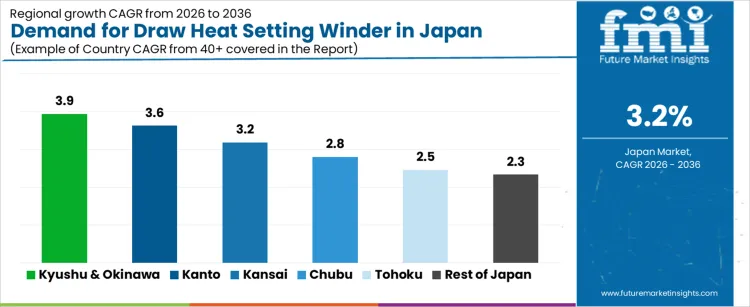
The demand for draw heat setting winders in Japan is rising gradually as textile processing operations modernize and producers upgrade winding and heat setting lines. Kyushu and Okinawa lead at a 3.9% CAGR, supported by regional textile units adopting efficient winding technologies and improving yarn processing quality. Kanto follows at 3.6%, driven by industrial clusters using advanced textile machinery for specialty fabrics and technical textiles. Kansai shows 3.2% growth, reflecting stable demand from long-established textile mills and manufacturers focusing on consistent output quality. Chubu at 2.8% records moderate adoption linked to smaller textile operations and replacement driven purchases. Tohoku and the Rest of Japan, at 2.5% and 2.3%, reflect slower growth due to limited textile manufacturing bases and lower investment in new winding and heat setting equipment.
How Are Textile Operations Shaping Draw Heat Setting Winder Demand in Kyushu and Okinawa?
Demand for draw heat setting winders in Kyushu and Okinawa is rising at a CAGR of 3.9% from 2026 to 2036 as regional textile units and filament processors use these machines for consistent yarn stabilization. Facilities rely on winders to support thermal conditioning steps that prepare material for weaving and knitting. Workshops adopt them for small batch production requiring uniform tension control. Retail industrial suppliers maintain steady stock movement shaped by predictable procurement cycles. Growth reflects continued activity among mid sized processors that depend on reliable heat setting and winding functions to support routine manufacturing needs across the region.
- Processors use winders for yarn stabilization
- Workshops apply machines for controlled winding
- Suppliers support regular equipment orders
What Drives Draw Heat Setting Winder Adoption Across Kanto?
Demand for draw heat setting winders in Kanto is progressing at a CAGR of 3.6% from 2026 to 2036 as textile manufacturers, fiber processors, and material engineering units expand controlled yarn finishing operations. Factories use winders for tension management and heat setting steps that prepare fibers for downstream processes. Laboratories adopt machines for developmental testing of filament behavior. Industrial distributors manage frequent replenishment due to dense manufacturing activity. Growth aligns with strong regional textile production that depends on stable thermal and mechanical handling during yarn preparation.
- Factories rely on winders for tension control
- Labs use machines for filament testing
- Distributors handle consistent industrial demand
How Is Yarn Processing Structure Influencing Demand in Kansai?
Demand for draw heat setting winders in Kansai is increasing at a CAGR of 3.2% from 2026 to 2036 as textile plants incorporate these machines to support reliable filament conditioning. Facilities use winders to maintain uniform yarn properties for weaving and knitting operations. Workshops adopt them for specialty threads that need controlled heat exposure. Retail industrial suppliers sustain stable inventory movement linked to regional production cycles. Growth reflects balanced textile activity across urban and suburban manufacturing clusters where consistent yarn preparation supports continuous operations.
- Plants use winders for filament conditioning
- Workshops handle specialty yarn requirements
- Suppliers manage steady stock rotation
Which Conditions Guide Winder Demand Across Chubu?
Demand for draw heat setting winders in Chubu is trending at a CAGR of 2.8% from 2026 to 2036 as textile and composite manufacturers adopt these machines for controlled fiber preparation. Facilities use winders for tasks requiring stable heating and tension alignment. Workshops integrate them for small series runs where precise finishing is needed. Retail distributors maintain measured inventory levels suited to localized demand. Growth continues as regional processors depend on predictable thermal handling during yarn finishing.
- Facilities use machines for heat controlled tasks
- Workshops adopt winders for precise finishing
- Distributors maintain measured stock levels
How Do Regional Production Routines Shape Demand in Tohoku?
Demand for draw heat setting winders in Tohoku is moving at a CAGR of 2.5% from 2026 to 2036 as textile workshops and small manufacturers use these machines for steady yarn preparation. Facilities rely on winders to align filament properties before downstream processing. Retail industrial suppliers follow predictable procurement cycles based on moderate but consistent usage. Growth reflects practical manufacturing routines across regional units where reliable winding and heat setting support stable production runs.
- Workshops use winders for yarn alignment
- Facilities maintain consistent filament preparation
- Suppliers follow steady order patterns
What Sustains Draw Heat Setting Winder Demand Across Rest of Japan?
Demand for draw heat setting winders in Rest of Japan is advancing at a CAGR of 2.3% from 2026 to 2036 as dispersed textile units rely on stable winding and heat conditioning functions. Small manufacturers use winders for tension control and uniform heating during yarn preparation. Retail distributors manage modest but regular stock rotation tied to local production rhythms. Growth reflects steady operational needs across smaller textile zones where controlled yarn finishing remains an essential step in manufacturing processes.
- Small plants use winders for routine tasks
- Facilities depend on controlled yarn finishing
- Distributors manage modest supply cycles
What Is Driving the Demand for Draw Heat Setting Winder in Japan and Which Companies Shape Textile Machinery Supply
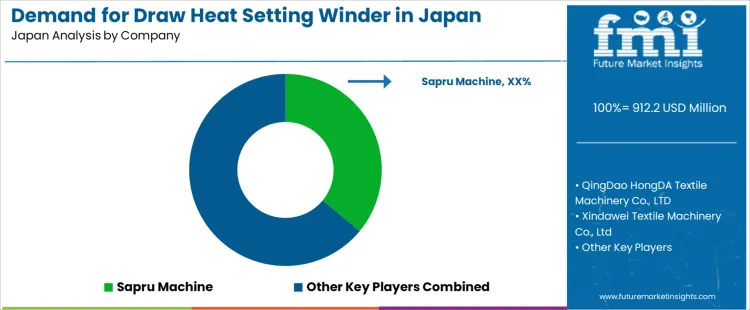
The demand for draw heat setting winder in Japan is shaped by specialty fiber production, technical textile development, and ongoing modernization of twisting and winding operations in synthetic yarn plants. Domestic producers rely on equipment that delivers stable tension control, precise heat setting, and consistent package formation for polyester and nylon lines. Sapru Machine participates through draw heat setting winders used in medium scale fiber units seeking dependable mechanical layouts. QingDao HongDA Textile Machinery Co LTD supports demand through modular winding systems adopted by factories upgrading older production lines.
Himson Engineering Pvt Ltd reaches Japan through selected suppliers serving niche synthetic yarn processors. Xindawei Textile Machinery Co Ltd and its Wuxi counterpart participate through imported winders used in cost sensitive expansion projects. Equipment selection in Japan is governed by temperature uniformity, yarn path stability, energy consumption, and compatibility with compact plant layouts. Buyers emphasize repeatable package density, low breakage rates, and easy operator access. Textile plants focus on winding systems that integrate cleanly with draw frames, texturing units, and automated handling. Procurement aligns with fiber development cycles in apparel, industrial fabrics, and high performance materials.
Key Players in the Draw Heat Setting Winder Industry in Japan
- Sapru Machine
- QingDao HongDA Textile Machinery Co., LTD
- Xindawei Textile Machinery Co., Ltd
- Himson Engineering Pvt. Ltd
- Wuxi Xindawei Textile Machinery Co., Ltd.
Scope of the Report
| Items | Values |
|---|---|
| Quantitative Units (2026) | USD million |
| Operation | Automatic; Semi-Automatic |
| Types | Flat type; Cone type; Cylinder type |
| Regions Covered | Kyushu & Okinawa; Kanto; Kansai; Chubu; Tohoku; Rest of Japan |
| Countries Covered | Japan |
| Key Companies Profiled | Sapru Machine; QingDao HongDA Textile Machinery Co., LTD; Xindawei Textile Machinery Co., Ltd; Himson Engineering Pvt. Ltd; Wuxi Xindawei Textile Machinery Co., Ltd. |
| Additional Attributes | Dollar by sales across operation and type; package formation and winding accuracy by type; energy consumption and thermal uniformity metrics; uptime and mean time between failures; integration with draw frames and texturing lines; labour requirement and automation level; regional capacity and replacement cycle timing; warranty, spare parts and service network coverage; import reliance for control electronics and heating modules. |
Draw Heat Setting Winder Industry in Japan Segmentation
Operation:
- Automatic
- Semi-Automatic
Types:
- Flat type
- Cone type
- Cylinder type
Region:
- Kyushu & Okinawa
- Kanto
- Kansai
- Chubu
- Tohoku
- Rest of Japan
Frequently Asked Questions
How big is the demand for draw heat setting winder in Japan in 2026?
The demand for draw heat setting winder in Japan is estimated to be valued at USD 912.2 million in 2026.
What will be the size of draw heat setting winder in Japan in 2036?
The market size for the draw heat setting winder in Japan is projected to reach USD 1,244.4 million by 2036.
How much will be the demand for draw heat setting winder in Japan growth between 2026 and 2036?
The demand for draw heat setting winder in Japan is expected to grow at a 3.2% CAGR between 2026 and 2036.
What are the key product types in the draw heat setting winder in Japan?
The key product types in draw heat setting winder in Japan are automatic and semi-automatic.
Which types segment is expected to contribute significant share in the draw heat setting winder in Japan in 2026?
In terms of types, flat type segment is expected to command 45.0% share in the draw heat setting winder in Japan in 2026.
Preview the report firsthand - request a free sample
Get SampleGet the brochure for pricing and purchase details.
Get PDFTable of Content
- Executive Summary
- Japan Market Outlook
- Demand-side Trends
- Supply-side Trends
- Technology Roadmap Analysis
- Analysis and Recommendations
- Market Overview
- Market Coverage / Taxonomy
- Market Definition / Scope / Limitations
- Market Background
- Market Dynamics
- Drivers
- Restraints
- Opportunity
- Trends
- Scenario Forecast
- Demand in Optimistic Scenario
- Demand in Likely Scenario
- Demand in Conservative Scenario
- Opportunity Map Analysis
- Product Life Cycle Analysis
- Supply Chain Analysis
- Investment Feasibility Matrix
- Value Chain Analysis
- PESTLE and Porter’s Analysis
- Regulatory Landscape
- Regional Parent Market Outlook
- Production and Consumption Statistics
- Import and Export Statistics
- Market Dynamics
- Japan Market Analysis 2020 to 2024 and Forecast, 2025 to 2035
- Historical Market Size Value (USD Million) Analysis, 2020 to 2024
- Current and Future Market Size Value (USD Million) Projections, 2025 to 2035
- Y-o-Y Growth Trend Analysis
- Absolute $ Opportunity Analysis
- Japan Market Pricing Analysis 2020 to 2024 and Forecast 2025 to 2035
- Japan Market Analysis 2020 to 2024 and Forecast 2025 to 2035, By Operation
- Introduction / Key Findings
- Historical Market Size Value (USD Million) Analysis By Operation , 2020 to 2024
- Current and Future Market Size Value (USD Million) Analysis and Forecast By Operation , 2025 to 2035
- Automatic
- Semi-Automatic
- Y-o-Y Growth Trend Analysis By Operation , 2020 to 2024
- Absolute $ Opportunity Analysis By Operation , 2025 to 2035
- Japan Market Analysis 2020 to 2024 and Forecast 2025 to 2035, By Types
- Introduction / Key Findings
- Historical Market Size Value (USD Million) Analysis By Types, 2020 to 2024
- Current and Future Market Size Value (USD Million) Analysis and Forecast By Types, 2025 to 2035
- Flat type
- Cone type
- Cylinder type
- Y-o-Y Growth Trend Analysis By Types, 2020 to 2024
- Absolute $ Opportunity Analysis By Types, 2025 to 2035
- Market Structure Analysis
- Competition Dashboard
- Competition Benchmarking
- Market Share Analysis of Top Players
- By Regional
- By Operation
- By Types
- Competition Analysis
- Competition Deep Dive
- Sapru Machine
- Overview
- Product Portfolio
- Profitability by Market Segments (Product/Age /Sales Channel/Region)
- Sales Footprint
- Strategy Overview
- Marketing Strategy
- Product Strategy
- Channel Strategy
- QingDao HongDA Textile Machinery Co., LTD
- Xindawei Textile Machinery Co., Ltd
- Himson Engineering Pvt. Ltd
- Wuxi Xindawei Textile Machinery Co., Ltd.
- Sapru Machine
- Competition Deep Dive
- Assumptions & Acronyms Used
- Research Methodology


