

- Industry Size (2025)
- USD 6.0 Bn
- Forecast (2035)
- USD 8.9 Bn
- CAGR (2025 to 2035)
- 4.0%
Demand for Draw Heat Setting Winder in USA 2025 to 2035
The USA draw heat setting winder demand is valued at USD 6.0 billion in 2025 and is forecasted to reach USD 8.9 billion by 2035, reflecting a CAGR of 4.0%. Growth is driven by increased production of synthetic fibers, expanding textile manufacturing capacity, and stronger demand for precisely wound, heat-set yarns used in apparel, home textiles, and industrial fabrics. Automation in fiber processing continues to advance productivity and quality consistency.
Automatic units lead adoption because they deliver improved tension control, higher winding speeds, and reduced manual handling. Their ability to ensure uniform yarn structure and consistent heat-setting performance supports downstream weaving and knitting efficiency. Manufacturers enhance monitoring systems, energy efficiency, and programmable settings to optimize output for diverse fiber types.
The West, South, and Northeast regions reflect strong demand tied to textile clusters, technical fiber production, and ongoing modernization of spinning operations. Key suppliers include Sapru Machine, QingDao HongDA Textile Machinery Co., LTD, Xindawei Textile Machinery Co., Ltd, Himson Engineering Pvt. Ltd, and Wuxi Xindawei Textile Machinery Co., Ltd. Their strategies prioritize advanced automation, durable machine components, and process customization capabilities that improve yarn uniformity and operational throughput across high-volume textile environments.
Quick Stats for USA Draw Heat Setting Winder Demand
- USA Draw Heat Setting Winder Sales Value (2025): USD 6.0 billion
- USA Draw Heat Setting Winder Forecast Value (2035): USD 8.9 billion
- USA Draw Heat Setting Winder Forecast CAGR (2025–2035): 4.0%
- Leading Operation Type in USA Draw Heat Setting Winder Demand: Automatic Units
- Key Growth Regions in USA Draw Heat Setting Winder Demand: West USA, South USA, Northeast USA
- Top Players in USA Draw Heat Setting Winder Demand: Sapru Machine, QingDao HongDA Textile Machinery Co., LTD, Xindawei Textile Machinery Co., Ltd, Himson Engineering Pvt. Ltd, Wuxi Xindawei Textile Machinery Co., Ltd.
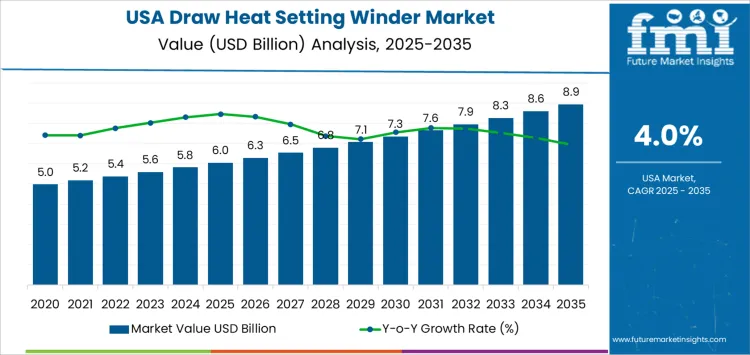
What is the Growth Forecast for Draw Heat Setting Winder Industry in USA through 2035?
The growth contribution index for draw heat setting winders in the United States reflects distinct inputs from fiber production efficiency, process stability requirements, and modernization programs in synthetic yarn operations. Core contribution comes from the need to maintain uniform thermal treatment during draw and winding stages because consistent tension and temperature control support product quality in polyester and nylon processing. This factor supplies a stable share of overall growth because precision machinery remains essential for continuous filament production.
Automation contributes a rising share as producers integrate digital controls, real-time monitoring, and coordinated drive systems to reduce variability in filament handling. This component influences the index through incremental upgrades that align with plant optimization strategies. Energy management contributes another measurable share because heat setting systems influence operating loads in high-volume facilities. Manufacturers evaluate equipment that maintains thermal consistency with lower energy input, creating steady contribution from efficiency objectives.
Specialty filament production contributes a targeted share because technical textiles require controlled draw ratios and stable winding characteristics during heat setting. These requirements elevate reliance on modern winders within niche segments. Replacement cycles contribute an additional portion of growth because aging equipment introduces inconsistency that affects downstream processing stability. The index reflects distributed contributions shaped by operational, technical, and modernization needs across domestic fiber processing environments.
USA Draw Heat Setting Winder Key Takeaways
| Metric | Value |
|---|---|
| USA Draw Heat Setting Winder Sales Value (2025) | USD 6.0 billion |
| USA Draw Heat Setting Winder Forecast Value (2035) | USD 8.9 billion |
| USA Draw Heat Setting Winder Forecast CAGR (2025-2035) | 4.0% |
Why is the Demand for Draw Heat Setting Winder in USA Growing?
Demand for draw heat setting winders in the United States rises due to expanding synthetic fiber production and ongoing upgrades within textile processing facilities. Producers of polyester and nylon filaments rely on equipment that stabilizes yarn structure, improves tensile properties, and delivers uniform winding quality. Growth in high performance apparel, filtration fabrics, and industrial textiles strengthens adoption of machinery capable of precise drawing and thermal setting. Domestic manufacturers invest in automated winding systems to improve consistency in denier control and reduce variability across large production runs.
Packaging, automotive interiors, and home furnishing applications use filaments that require controlled draw ratios and thermal stabilization, which increases reliance on specialized winding technology. Small and mid-sized extrusion units expand output for niche technical textiles that demand reliable yarn conditioning. Replacement of aging machinery supports procurement of energy efficient designs with advanced tension control, monitored heating zones, and integrated quality checks. Import reduction strategies across certain fiber segments encourage facilities to enhance in house processing capabilities. Workforce optimization programs within manufacturing sites promote equipment that supports continuous operation with reduced manual intervention.
Which Operation and Types Segments Lead Demand for Draw Heat Setting Winders in USA?
Demand for draw heat setting winders in the USA is shaped by the need for consistent yarn stabilization, automated tension control, and production efficiency across textile and filament-processing facilities. Buyers evaluate winding precision, heat-setting uniformity, and compatibility with varied filament specifications. Adoption patterns reflect automation levels, product handling requirements, and large-scale manufacturing workflows focused on output consistency and reduced manual intervention.
By Operation, Automatic Units Account for the Largest Share of Demand
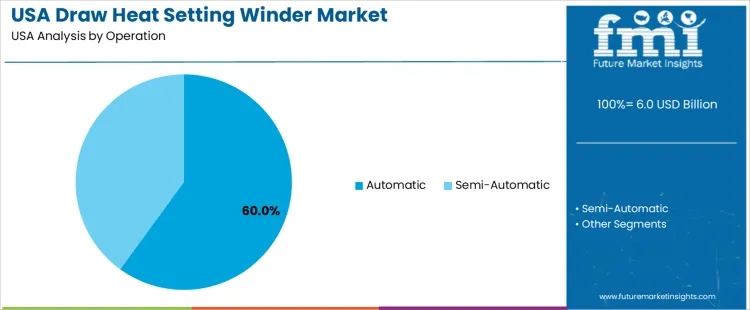
Automatic units hold 60.0%, making them the leading operation segment in USA draw heat setting winder usage. Facilities use automatic systems to achieve uniform draw ratios, controlled heat application, and stable high-volume winding without operator interference. These units support extended production cycles and minimize variability in yarn properties. Semi-automatic units hold 40.0%, serving facilities with mixed workloads or environments requiring partial manual oversight. They provide cost efficiency and flexibility for small-batch production, development lines, and operations transitioning toward higher automation. Distribution reflects productivity goals, labor availability, and consistency requirements across filament processing.
Key Points:
- Automatic systems support uniform heat-setting and tension control.
- Semi-automatic units enable flexible production with partial oversight.
- Distribution aligns with throughput needs and automation strategies.
- Selection depends on precision demands and workforce structure.
By Types, Flat Type Winders Represent the Largest Segment
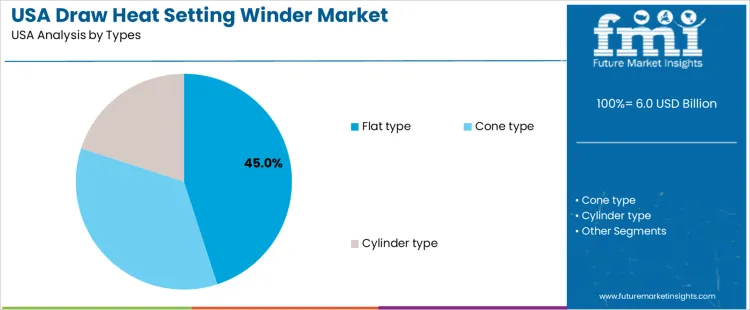
Flat type winders hold 45.0%, making them the largest segment in USA demand. These units support stable package formation, controlled yarn layering, and uniform heat-setting conditions required in filament and technical textile applications. Cone type winders hold 35.0%, serving yarn spinning, knitting, and weaving environments where cone packages enhance downstream compatibility. Cylinder type winders hold 20.0%, used in specialized or legacy operations where cylindrical packages meet specific machine-feed requirements. Type distribution reflects yarn-handling preferences, downstream process compatibility, and structural stability needs across textile facilities.
Key Points:
- Flat type units support stable package formation and uniform heat-setting.
- Cone type winders align with spinning and weaving workflows.
- Cylinder type units serve specialized packaging needs.
- Type selection depends on package geometry and downstream processing.
What are the Key Dynamics in the Draw Heat Setting Winder Industry?
Synthetic fiber production, textile process stability, and quality requirements are driving adoption.
Demand increases as US producers of polyester and nylon rely on draw heat setting winders to maintain uniform filament tension and dimensional stability during yarn processing. Facilities use these systems to improve crystallinity and thermal resistance in fibers applied to automotive textiles, industrial fabrics, and performance apparel. Regional mills require equipment that supports continuous operation with low defect rates. Contract textile processors adopt winders that deliver consistent denier control across varied production runs. Investments in domestic fiber extrusion strengthen demand for machinery that integrates draw, heat setting, and winding in a single controlled workflow. Buyers prioritize systems that maintain throughput while protecting yarn integrity.
Capital intensity, operational costs, and technical complexity restrain wider deployment.
Procurement teams face high upfront investment for winders that combine advanced heating, tension control, and automated winding modules. Several US facilities experience difficulty allocating funds for equipment replacement during periods of fluctuating textile order volume. Maintenance schedules require skilled technicians capable of calibrating heating zones, drive systems, and winding heads. Energy expenditure rises when older systems operate at extended thermal loads, which influences adoption among cost-sensitive mills. Smaller plants struggle with space limitations that restrict placement of large integrated winders. Supply variability for specialized components increases downtime risk during repair cycles.
Automation upgrades, energy-efficient engineering, and specialized fiber applications shape current trends.
US textile producers evaluate winders equipped with digital tension mapping and closed-loop temperature regulation to enhance process consistency. Manufacturers introduce energy-efficient heating modules designed to reduce operational load during continuous draw setting. Facilities producing microfilament yarns adopt winders tailored for low-denier stability. Automotive textile suppliers request equipment that supports high-modulus fibers used in airbags and interior components. Producers of industrial fabrics adopt modular winding heads that simplify changeovers. Data-driven maintenance tools gain interest as mills integrate condition monitoring into plant operations. Domestic reshoring of selective textile processes influences procurement of advanced winding systems engineered for long production cycles.
Analysis of the Demand for Draw Heat Setting Winders in the USA by Region
Demand for draw heat setting winders in the USA is rising due to increased synthetic fiber processing, higher output in textile manufacturing clusters, and wider use of controlled heat-setting systems for yarn stabilization. West USA records a CAGR of 4.6% supported by specialized fiber processing and advanced materials activity. South USA shows a 4.1% CAGR driven by concentrated textile operations and steady machinery upgrades. Northeast USA posts a 3.7% CAGR supported by technical textile production and small-scale fiber processing units. Midwest USA holds a 3.2% CAGR due to stable industrial yarn usage across manufacturing environments requiring uniform winding performance.
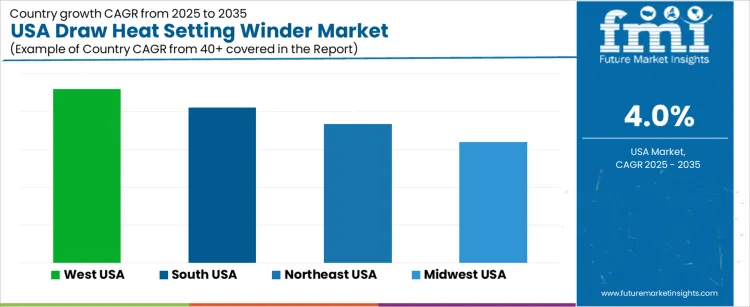
| Region | CAGR (2025-2035) |
|---|---|
| West USA | 4.6% |
| South USA | 4.1% |
| Northeast USA | 3.7% |
| Midwest USA | 3.2% |
How is the West USA driving demand for Draw Heat Setting Winders?
West USA drives demand through its presence of advanced materials manufacturers, synthetic fiber processors, and specialized industrial textile operations. The region’s CAGR of 4.6% reflects consistent procurement of winding systems used for producing stabilized yarns that support technical textiles and high-performance material applications. Facilities rely on draw heat setting winders to maintain uniform thermal treatment and optimized yarn properties required in precision-driven segments. Research-oriented production units use these systems for controlled processing of engineered fibers. Industrial users adopt winding systems aligned with stable output requirements and structured quality protocols that define material performance.
- Active advanced materials and technical fiber facilities
- Consistent use of stabilized yarns in industrial applications
- Structured quality protocols supporting machinery adoption
- Steady procurement by research-oriented production units
How is the South USA driving demand for Draw Heat Setting Winders?
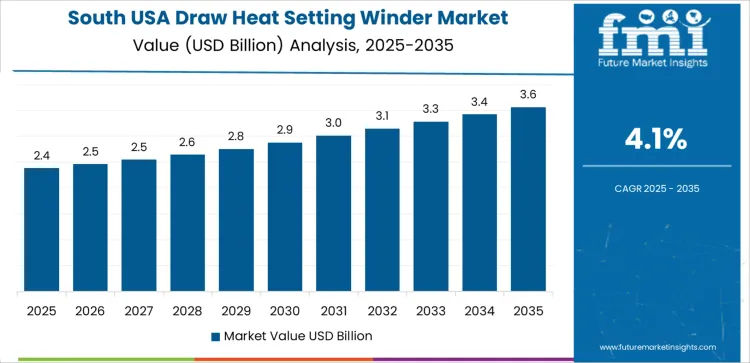
South USA contributes to rising demand due to its strong textile and fiber manufacturing base, which relies on heat-setting processes for yarn durability and structural consistency. The region’s CAGR of 4.1% reflects steady integration of winders in facilities producing polyester, nylon, and blended fibers. Industrial clusters maintain continuous operations requiring precise winding and heat-treatment control. Machinery upgrades occur frequently as producers aim to maintain stable fiber output and meet performance specifications across multiple downstream applications. The region supports reliable consumption patterns due to its concentration of large-scale textile plants.
- Strong presence of fiber and textile production units
- Routine use of heat-setting systems for synthetic yarns
- Continuous machinery upgrades in large manufacturing clusters
- Stable fiber output requirements across industrial applications
How is the Northeast USA driving demand for Draw Heat Setting Winders?
Northeast USA supports demand through its technical textile producers, research facilities, and small to mid-scale fiber-processing units that depend on precise yarn stabilization systems. The region’s CAGR of 3.7% reflects continuous usage of controlled heat-setting processes to ensure uniformity in specialty yarns. Facilities handling engineered fibers rely on draw heat setting winders to achieve consistent mechanical and thermal properties. Research centers maintain procurement cycles for equipment supporting development work in innovative fiber compositions. Industrial users operate structured workflows that utilize stable winding performance for downstream textile and material applications.
- Concentration of technical textile and specialty fiber units
- Use of controlled heat-setting for engineered yarns
- Research centers requiring precision winding equipment
- Stable demand across specialty materials production
How is the Midwest USA driving demand for Draw Heat Setting Winders?
Midwest USA maintains stable demand due to its broad industrial manufacturing landscape that uses synthetic yarns and engineered fibers in diverse applications. The region’s CAGR of 3.2% reflects consistent utilization of winding systems in facilities producing industrial textiles, filtration materials, and reinforcement fibers. Manufacturers depend on heat-set yarns for uniformity and durability across production lines. Small and mid-scale processors maintain regular procurement for winding systems that support controlled thermal treatment. Industrial clusters rely on repeatable quality standards, which reinforces steady adoption of draw heat setting winders.
- Wide industrial use of synthetic and engineered fibers
- Routine production of industrial and reinforcement textiles
- Dependable procurement by mid-scale fiber processors
- Stable machinery demand across manufacturing environments
What is the competitive landscape of the demand for draw heat setting winders in the USA?
Demand for draw heat setting winders in the USA aligns with requirements for yarn uniformity, thermal stability, tension accuracy, and compatibility with polyester and nylon processing lines. Textile producers evaluate winding precision, heater efficiency, spindle reliability, and automation capability supporting continuous filament operations. Procurement teams focus on installation support, component durability, and maintenance predictability across facilities producing industrial yarns, apparel fibers, and technical textiles. Buyers prioritize equipment capable of stable thermal profiles, controlled draw ratios, and consistent package formation suited for downstream weaving and knitting processes.
Xindawei Textile Machinery Co., Ltd provides winding solutions aligned with polyester fness and standardized assembly designs. QingDao HongDA Textile Machinery Co., ilament processing lines used by regional manufacturers. Himson Engineering Pvt. Ltd participates through draw winding technologies incorporated into modernization programs within older textile facilities. Wuxi Xindawei Textile Machinery Co., Ltd supports demand through adaptable winding platforms suited for multi-denier production environments. Competitive positioning in the USA reflects machine reliability, spare part availability, energy performance, and technical service capability influencing long-term equipment adoption.
Key Players in USA Draw Heat Setting Winder Demand
- Sapru Machine
- QingDao HongDA Textile Machinery Co., LTD
- Xindawei Textile Machinery Co., Ltd
- Himson Engineering Pvt. Ltd.
Scope of the Report
| Items | Values |
|---|---|
| Quantitative Units | USD billion |
| Operation | Automatic, Semi-Automatic |
| Types | Flat Type, Cone Type, Cylinder Type |
| Regions Covered | West USA, South USA, Northeast USA, Midwest USA |
| Key Companies Profiled | Sapru Machine, QingDao HongDA Textile Machinery Co., LTD, Xindawei Textile Machinery Co., Ltd, Himson Engineering Pvt. Ltd, Wuxi Xindawei Textile Machinery Co., Ltd. |
| Additional Attributes | Dollar sales by operation mode and winder type; regional demand trends across West, South, Northeast, and Midwest USA; competitive landscape of draw heat setting winder manufacturers; integration of heat-setting, drawing, and precision winding technologies; adoption shifts in textile manufacturing, synthetic fiber processing, and automated yarn conditioning systems. |
USA Draw Heat Setting Winder Demand by Segments
Operation:
- Automatic
- Semi-Automatic
Types:
- Flat type
- Cone type
- Cylinder type
Region:
- West USA
- South USA
- Northeast USA
- Midwest USA
Frequently Asked Questions
How big is the demand for draw heat setting winder in USA in 2025?
The demand for draw heat setting winder in USA is estimated to be valued at USD 6.0 billion in 2025.
What will be the size of draw heat setting winder in USA in 2035?
The market size for the draw heat setting winder in USA is projected to reach USD 8.9 billion by 2035.
How much will be the demand for draw heat setting winder in USA growth between 2025 and 2035?
The demand for draw heat setting winder in USA is expected to grow at a 4.0% CAGR between 2025 and 2035.
What are the key product types in the draw heat setting winder in USA?
The key product types in draw heat setting winder in USA are automatic and semi-automatic.
Which types segment is expected to contribute significant share in the draw heat setting winder in USA in 2025?
In terms of types, flat type segment is expected to command 45.0% share in the draw heat setting winder in USA in 2025.
Preview the report firsthand - request a free sample
Get SampleGet the brochure for pricing and purchase details.
Get PDFTable of Content
- Executive Summary
- USA Market Outlook
- Demand-side Trends
- Supply-side Trends
- Technology Roadmap Analysis
- Analysis and Recommendations
- Market Overview
- Market Coverage / Taxonomy
- Market Definition / Scope / Limitations
- Market Background
- Market Dynamics
- Drivers
- Restraints
- Opportunity
- Trends
- Scenario Forecast
- Demand in Optimistic Scenario
- Demand in Likely Scenario
- Demand in Conservative Scenario
- Opportunity Map Analysis
- Product Life Cycle Analysis
- Supply Chain Analysis
- Investment Feasibility Matrix
- Value Chain Analysis
- PESTLE and Porter’s Analysis
- Regulatory Landscape
- Regional Parent Market Outlook
- Production and Consumption Statistics
- Import and Export Statistics
- Market Dynamics
- USA Market Analysis 2020 to 2024 and Forecast, 2025 to 2035
- Historical Market Size Value (USD Million) Analysis, 2020 to 2024
- Current and Future Market Size Value (USD Million) Projections, 2025 to 2035
- Y-o-Y Growth Trend Analysis
- Absolute $ Opportunity Analysis
- USA Market Pricing Analysis 2020 to 2024 and Forecast 2025 to 2035
- USA Market Analysis 2020 to 2024 and Forecast 2025 to 2035, By Operation
- Introduction / Key Findings
- Historical Market Size Value (USD Million) Analysis By Operation , 2020 to 2024
- Current and Future Market Size Value (USD Million) Analysis and Forecast By Operation , 2025 to 2035
- Automatic
- Semi-Automatic
- Y-o-Y Growth Trend Analysis By Operation , 2020 to 2024
- Absolute $ Opportunity Analysis By Operation , 2025 to 2035
- USA Market Analysis 2020 to 2024 and Forecast 2025 to 2035, By Types
- Introduction / Key Findings
- Historical Market Size Value (USD Million) Analysis By Types, 2020 to 2024
- Current and Future Market Size Value (USD Million) Analysis and Forecast By Types, 2025 to 2035
- Flat type
- Cone type
- Cylinder type
- Y-o-Y Growth Trend Analysis By Types, 2020 to 2024
- Absolute $ Opportunity Analysis By Types, 2025 to 2035
- Market Structure Analysis
- Competition Dashboard
- Competition Benchmarking
- Market Share Analysis of Top Players
- By Regional
- By Operation
- By Types
- Competition Analysis
- Competition Deep Dive
- Sapru Machine
- Overview
- Product Portfolio
- Profitability by Market Segments (Product/Age /Sales Channel/Region)
- Sales Footprint
- Strategy Overview
- Marketing Strategy
- Product Strategy
- Channel Strategy
- QingDao HongDA Textile Machinery Co., LTD
- Xindawei Textile Machinery Co., Ltd
- Himson Engineering Pvt. Ltd
- Wuxi Xindawei Textile Machinery Co., Ltd.
- Sapru Machine
- Competition Deep Dive
- Assumptions & Acronyms Used
- Research Methodology


