

- Industry Size (2026)
- USD 0.5 Bn
- Forecast (2036)
- USD 1.1 Bn
- CAGR
- 8.7 (2026 to 2036)
Heat-Resistant Inks for EV Motor Nameplates and Labels Market Size, Market Forecast and Outlook By FMI
The heat-resistant inks for EV motor nameplates and labels market was valued at USD 0.4 billion in 2025. Demand is poised to cross USD 0.5 billion in 2026 at a CAGR of 8.7% during the forecast period. Revenue expansion is supporting cumulative valuation to be USD 1.1 billion through 2036 as continuous 800V motor architectures impose severe thermal stress on internal identification tags.
Powertrain engineers building next-generation hairpin stator motors face severe warranty risks from unreadable component identification. Operating temperatures routinely spike above 180°C during heavy acceleration, instantly degrading standard functional inks. Purchasing directors cannot risk multi-million dollar recall liability stemming from failed traceability markers. Sourcing departments consequently mandate specialized high temperature inks automotive assemblies require, capable of surviving ten years of continuous thermal cycling without losing barcode contrast. Transitioning requires extensive re-qualification across multiple tier-one suppliers. Any delay in securing certified EV motor label inks directly stalls assembly line output.
When OEMs mandate continuous immersion cooling for high-performance stators, baseline material requirements shift permanently. Fluid resistance suddenly matters exactly as much as thermal tolerance. Suppliers who formulate eco-friendly inks surviving both boiling transmission fluid and 200°C dry heat capture exclusive long-term supply agreements. Evaluating heat resistant inks EV platforms demand requires balancing absolute thermal endurance against strict chemical resistance profiles.
Summary of Heat-Resistant Inks for EV Motor Nameplates and Labels Market
- Heat-Resistant Inks for EV Motor Nameplates and Labels Market Definition
- High-performance fluids engineered to print scannable identification markers on electric vehicle powertrain components. Such chemistries must survive 150°C+ operating environments, synthetic cooling oil exposure, and intense mechanical vibration over vehicle lifespans.
- Demand Drivers in the Market
- Thermal cycling profiles inside 800V architectures compel powertrain engineers to specify military-grade adhesion standards.
- Regulatory traceability mandates force compliance officers to reject materials that fade during accelerated aging tests, driving adoption of specialized EV labeling compliance materials.
- Automated assembly lines push robotics directors to require instantaneous curing properties for high-speed component scanning.
- Key Segments Analyzed in the FMI Report
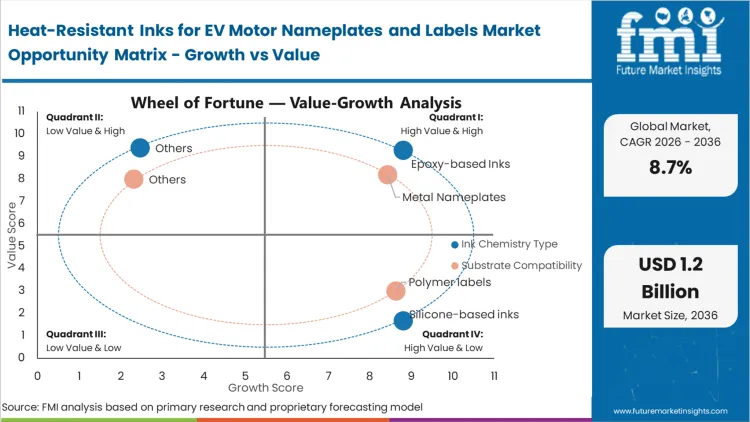
- Epoxy-based inks: is projected to hold 38.5% share in 2026, driven by superior cross-linking density against hot synthetic oils.
- Metal nameplates: is anticipated to account for 46.2% share in 2026, anchored by legacy grounding requirements on stator housings.
- Motor nameplates: is expected to garner 52.4% share in 2026, mandated by federal serial number visibility regulations.
- Screen printing: is set to record 41.7% share in 2026, preferred for delivering thick protective coating layers.
- Passenger EVs: is poised to grab 57.8% share in 2026, reflecting pure manufacturing volume dominance.
- India: India is set to register a CAGR of 11.4%, accelerated by localized supply chain requirements for light electric mobility platforms.
- Analyst Opinion at FMI
- Nikhil Kaitwade, Principal Analyst, Chemicals, at FMI, states that, "Purchasing managers consistently benchmark specialty fluids against ambient-temperature alternatives, assuming cost optimization drives final selection. In reality, assembly plant line-stoppage penalties dwarf any per-liter chemical savings. When a robotic vision system fails to read a blistered barcode on a finished drive unit, operations directors do not blame scanner sensitivity; they blame procurement for authorizing substandard adhesion profiles. True vendor power resides with formulators who can guarantee zero-defect optical contrast after 1,000 hours of thermal shock testing."
- Strategic Implications / Executive Takeaways
- Formulation chemists face immense pressure to develop zero-VOC solutions without sacrificing 200°C continuous operating ratings.
- Quality assurance managers must upgrade testing chambers to simulate simultaneous heat and synthetic fluid immersion.
- Tier-one suppliers risk losing OEM contracts if their chosen traceability methodology degrades before drivetrain warranties expire.
- Methodology
- Primary Research: Sourcing directors at tier-one automotive suppliers and formulation chemists at specialty chemical manufacturers.
- Desk Research: ISO 16750 compliance registries, OEM material specification databases, and automotive recall archives.
- Market-Sizing and Forecasting: Global electric vehicle production volume baselines mapped against average identifier footprint per motor.
- Data Validation and Update Cycle: UN Comtrade specialty chemical pricing data cross-referenced with quarterly chemical supplier revenue disclosures.
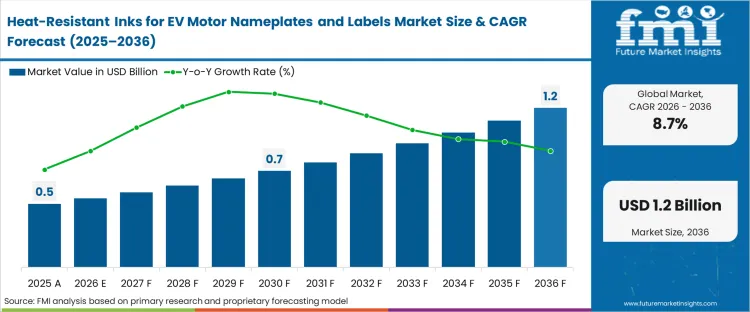
| Metric | Details |
|---|---|
| Industry Size (2026) | USD 0.46 Billion |
| Industry Value (2036) | USD 1.05 Billion |
| CAGR (2026 to 2036) | 8.7% |
Source: Future Market Insights (FMI) analysis, based on proprietary forecasting model and primary research
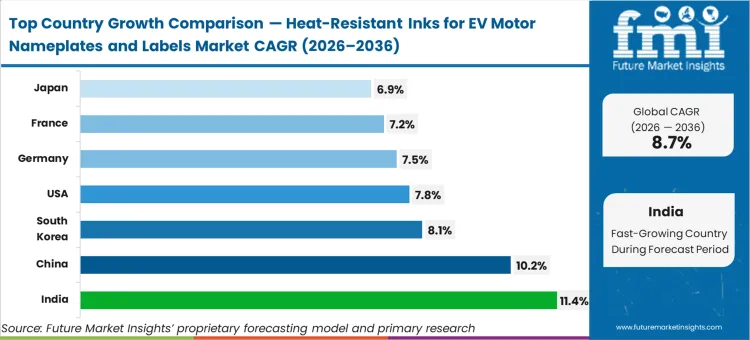
India leads at 11.4% CAGR as rapid localization of two-wheeler electric drivetrains forces domestic material qualification. China tracks closely at 10.2% driven by volume manufacturers optimizing internal traceability protocols. South Korea expands at 8.1% on aggressive battery ecosystem integration. USA procurement teams drive 7.8% growth through stringent federal warranty compliance standards. Germany registers 7.5% as legacy manufacturers overhaul component tracking infrastructure. France advances at 7.2% through sustained luxury electric vehicle output. Japan exhibits 6.9% expansion as conservative engineering departments slowly validate new identification methodologies
Definition
Traceability markers formulated specifically to withstand sustained high-temperature environments inside electric vehicle powertrains define this sector. These automotive high temp coatings inks bind to metallic or polymeric substrates while resisting degradation from thermal cycling, chemical exposure, and mechanical vibration. Functional performance demands maintaining optical contrast for barcode scanners and human readers across a fifteen-year vehicle lifespan.
Inclusions
Scope covers formulations applied directly to motor housings, battery enclosures, and high-voltage inverters. Epoxy, silicone, polyimide, and acrylic chemistries engineered for extreme environments fall within analytical boundaries. Solutions supporting thermal inkjet inks are evaluated specifically for their thermal resilience rather than pure printing speed metrics. Identifying appropriate EV labeling materials focuses strictly on high-voltage and drivetrain component applications.
Exclusions
Standard decorative automotive paints fall outside analytical parameters because they lack requisite barcode contrast stability under extreme heat. General-purpose commercial marking fluids fail baseline OEM fluid resistance testing protocols. Temporary manufacturing assembly markers do not survive required lifecycle thermal aging benchmarks.
Heat-Resistant Inks for EV Motor Nameplates and Labels Market Research Methodology
- Primary Research: Sourcing directors at tier-one automotive suppliers and formulation chemists at specialty chemical manufacturers.
- Desk Research: ISO 16750 compliance registries, OEM material specification databases, and automotive recall archives.
- Market-Sizing and Forecasting: Global electric vehicle production volume baselines mapped against average identifier footprint per motor.
- Data Validation and Update Cycle: UN Comtrade specialty chemical pricing data cross-referenced with quarterly chemical supplier revenue disclosures.
Segmental Analysis
Heat-Resistant Inks for EV Motor Nameplates and Labels Market Analysis by Ink Chemistry Type
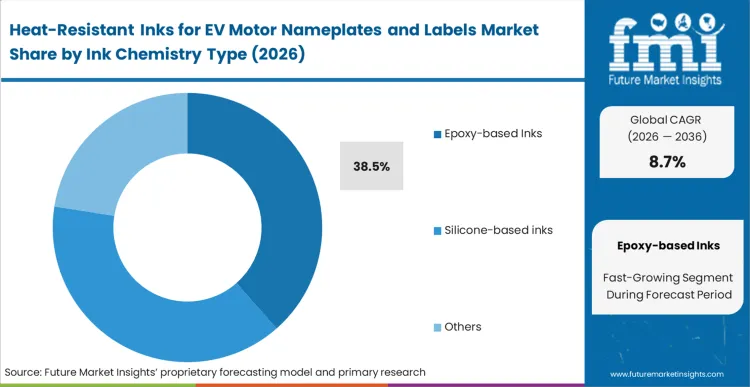
Cross-linking density determines survival inside boiling dielectric fluids. Epoxy-based inks segment captures 38.5% share in 2026 because formulation chemists rely on its impenetrable cured matrix. Procurement managers at major OEMs specifically mandate these epoxy inks EV applications require for any component subjected to direct oil cooling. FMI's assessment indicates cost considerations vanish when warranty exposure reaches into tens of millions. What procurement teams rarely understand is how epoxy behaves under sustained high-frequency vibration, slowly turning rigid protective layers into micro-fractured surfaces. Formulation engineers must constantly balance absolute thermal resistance against necessary flexural strength, occasionally evaluating polyimide ink EV applications for flexible substrates. Selecting incorrect label adhesive systems results in total marker delamination within thirty months.
- Initial screening metrics: Formulation chemists evaluate fundamental thermal degradation temperatures before conducting adhesion tests. Quality assurance teams reject any compound showing discoloration at 180°C.
- Validation constraints: Accelerated aging chambers expose coated substrates to continuous 200°C heat. Reliability engineers demand zero loss of barcode scan accuracy following 1,000 test hours.
- Renewal catalysts: Supply chain directors authorize long-term contracts once an epoxy variant proves stable across multiple motor architectures. Re-qualifying new suppliers takes eighteen months.
Heat-Resistant Inks for EV Motor Nameplates and Labels Market Analysis by Substrate Compatibility
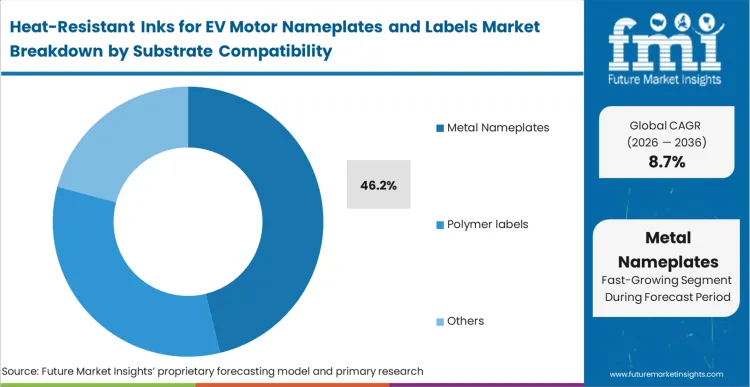
Matching thermal expansion coefficients prevents catastrophic peeling during winter operation. Assembly technicians rivet these plates directly onto hot cast-iron housings. Based on FMI's analysis, conductive inks face intense scrutiny from quality inspectors attempting to merge polymeric flexibility with metallic durability. Metal nameplates segment holds 46.2% share in 2026 as legacy manufacturing processes heavily favor stamped aluminum tags. Most industry observers assume laser etching will replace printed metal completely, yet metallic stamping remains dominant because deep physical impressions provide fail-safe manual readability even if ink entirely burns away. Defining appropriate EV motor nameplate materials dictates downstream operational efficiency. Attempting to adhere standard pressure sensitive tapes to raw stator casings guarantees catastrophic warranty failures.
- Procurement savings: Sourcing managers achieve immediate cost reductions by purchasing pre-treated aluminum rolls. Tooling engineers minimize waste by stamping tags on-site.
- Hidden operational costs: Plant managers must maintain hazardous chemical baths for cleaning raw metal prior to coating application. Environmental compliance officers monitor volatile emissions daily.
- Lifecycle comparison: Fleet operators discover printed metal outlasts polymer variants in heavy commercial applications. Maintenance supervisors depend on intact metallic tags during salvage operations.
Heat-Resistant Inks for EV Motor Nameplates and Labels Market Analysis by Application Type
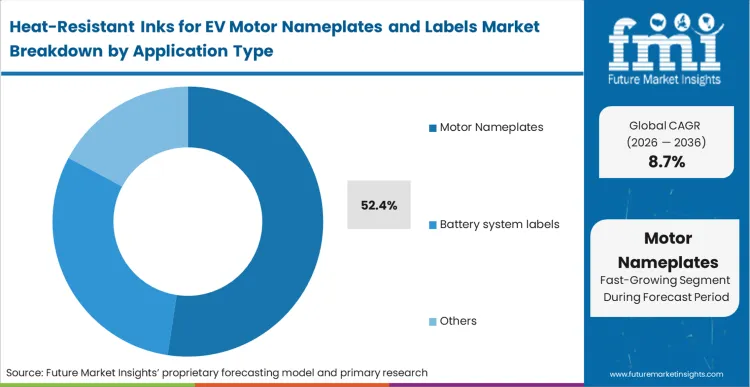
Mandated federal traceability laws dictate exact placement and durability parameters. Compliance directors personally sign off on material specifications for these specific identifiers. According to FMI's estimates, utilizing standard electrical labels fails miserably when applied near intense magnetic fields. Motor nameplates segment accounts for 52.4% share in 2026 because every single drive unit requires permanent identification. While safety regulations heavily scrutinize EV battery labeling inks, motor tags actually endure significantly higher sustained thermal loads during continuous highway driving. Manufacturers failing to secure proper adhesion face immediate production halts from on-site government inspectors.
- Primary prevention: Permanent adhesion stops catastrophic traceability loss during vehicle disassembly. Recycling coordinators must scan original serial numbers before processing scrap materials.
- Residual exposure: Extreme chemical solvents used during aftermarket repairs easily strip poorly cured coatings. Service technicians struggle to order replacement parts without readable identification codes.
- Value capture: Production managers who implement UV-cured solutions eliminate lengthy oven-baking bottlenecks. Process engineers regain valuable factory floor space previously dedicated to cooling racks.
Heat-Resistant Inks for EV Motor Nameplates and Labels Market Analysis by Printing Technology
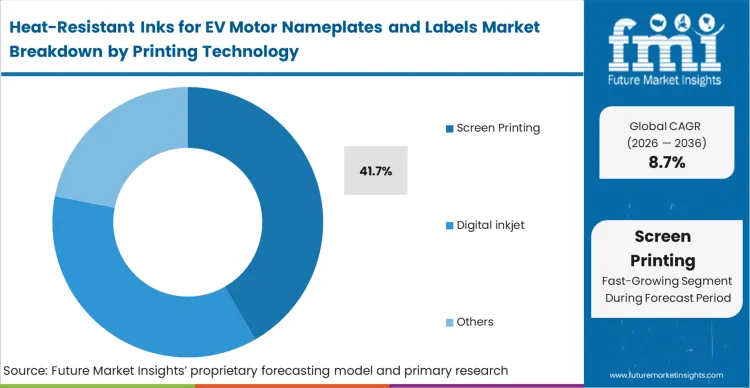
Deposit thickness directly correlates with physical abrasion resistance. Screen printing segment captures 41.7% share in 2026 by delivering massive laydown volumes impossible with other methods. Tooling engineers prefer this legacy approach for heavily textured cast metal housings. In FMI's view, conductive ink formulations require deep pigment saturation, unlike standard flexographic printing inks, to remain visible under layers of road grime. Digital equipment vendors constantly promise equivalent durability, but micro-droplet technology simply cannot deposit enough solid mass to survive aggressive pressure washing. Transitioning toward digital systems for industrial printing EV labels without sacrificing opacity remains a profound engineering constraint for tier-one suppliers. Testing high temp inkjet EV labels reveals persistent gaps in abrasive resistance.
- Edge condition performance: Heavy deposit layers survive direct gravel impact underneath vehicle chassis. Quality inspectors verify coating thickness using ultrasonic measurement tools.
- Qualification thresholds: Automotive standards require specific contrast ratios under multiple lighting conditions. Optical engineers calibrate vision systems based on these exact screen-printed baselines.
- Performance gaps: Complex variable data printing severely slows manual screen operations. IT directors push for digital alternatives whenever serial numbers change sequentially.
Heat-Resistant Inks for EV Motor Nameplates and Labels Market Analysis by End Use
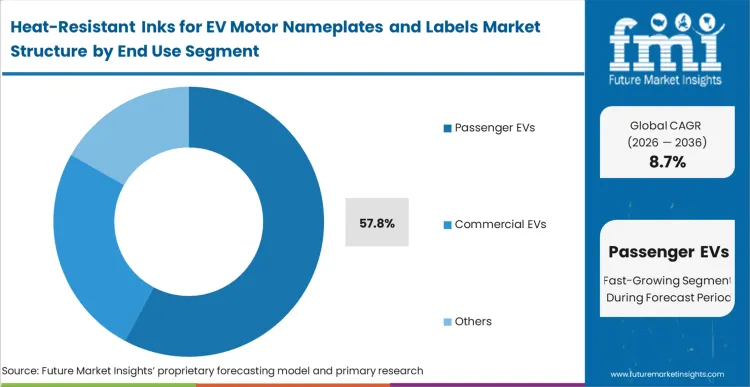
Volume economics dictate initial material qualification pathways. Supply chain executives focus entirely on securing uninterrupted global allocation from major chemical conglomerates. FMI observes through detailed label industry analysis that thermochromic labels gain traction primarily through these high-volume platforms before trickling down to commercial applications. Interestingly, heavy-duty commercial truck drivetrains actually require far more resilient chemistries, yet passenger vehicle testing protocols define baseline industry standards due to sheer scale. Passenger EVs segment commands 57.8% share in 2026 as gigafactories consume millions of liters annually. Evaluating functional inks EV operations consume reveals start-up manufacturers attempting to source specialized small-batch formulations face extreme pricing premiums from unwilling suppliers.
- Initial adopters: Luxury vehicle engineers specify ultra-durable compounds regardless of unit cost. Brand managers demand flawless aesthetics even on hidden powertrain components.
- Secondary followers: Mass-market volume producers adopt mature formulations once tier-one suppliers amortize initial R&D expenses. Cost estimators model precise milliliter consumption rates.
- Final converters: Two-wheeler manufacturers resist expensive upgrades until export regulations force compliance. Sourcing teams in emerging economies actively search for localized chemical alternatives.
Heat-Resistant Inks for EV Motor Nameplates and Labels Market Drivers, Restraints, and Opportunities
Warranty claims stemming from unreadable component identification codes force quality directors to rewrite purchasing specifications immediately. When maintenance technicians cannot scan a failed inverter's serial number, OEMs absorb total replacement costs rather than charging tier-one suppliers. This direct financial liability pushes engineering departments to specify extreme-temperature coatings regardless of per-liter pricing. Implementing robust continuous inkjet ink systems capable of depositing automotive durable labeling inks becomes an operational imperative rather than an optional upgrade. Delaying material qualification exposes vehicle manufacturers to massive recall expenses and severe brand damage.
Lengthy qualification cycles stall immediate factory floor implementation. Materials engineering teams must subject new formulations to 1,000-hour environmental chamber testing before authorizing production changes. This structural friction persists because accelerated aging algorithms cannot perfectly simulate actual 150°C synthetic oil immersion over ten years. While digital simulation software attempts to predict cross-linking degradation, automotive standards boards still mandate physical stress testing.
Opportunities in the Heat-Resistant Inks for EV Motor Nameplates and Labels Market
- Direct-to-cast printing: Eliminating physical label substrates entirely reduces BOM complexity. Process engineers achieve significant cost savings by implementing industrial marking EV systems directly onto rough aluminum housings.
- UV-curable high-temp variants: Formulating fluids that cure instantly under ultraviolet light removes massive thermal ovens from assembly lines. Facility directors recapture premium factory floor space.
- Dielectric fluid compatibility: Engineering water based inks capable of surviving continuous immersion in modern EV cooling oils secures exclusive supplier status. R&D directors target this specific chemical resistance profile.
Regional Analysis
.webp "Top Country Growth Comparison Heat Resistant Inks For Ev Motor Nameplates And Labels Market Cagr (2026 2036)")
Based on regional analysis, heat-resistant inks for EV motor nameplates and labels market is segmented into North America, Latin America, Europe, Asia Pacific, and Middle East & Africa across 40 plus countries.
| Country | CAGR (2026 to 2036) |
|---|---|
| India | 11.4% |
| China | 10.2% |
| South Korea | 8.1% |
| USA | 7.8% |
| Germany | 7.5% |
| France | 7.2% |
| Japan | 6.9% |
Source: Future Market Insights (FMI) analysis, based on proprietary forecasting model and primary research
Asia Pacific Heat-Resistant Inks for EV Motor Nameplates and Labels Market Analysis
Aggressive manufacturing localization mandates fundamentally reshape procurement strategies across Asia automotive hubs. Supply chain directors scramble to qualify domestic chemical producers to avoid import tariffs and secure uninterrupted supply lines. FMI analysts note that engineering teams prioritize extreme humidity resistance alongside thermal tolerance due to regional operating conditions. High-volume production lines demand EV manufacturing labeling solutions capable of instant curing to maintain aggressive output quotas. Purchasing departments actively evaluate low migration inks as local environmental regulations tighten.
- India: Massive two-wheeler electrification drives exponential demand for cost-effective thermal markers. Sourcing managers at domestic OEMs prioritize rapid curing times over extreme multi-decade durability. Regional formulators capture significant segment share by developing EV industrial coatings inks specifically tuned for air-cooled hub motors. Revenue expands at 11.4% as localized chemical suppliers rapidly scale production capacity.
- China: Volume manufacturers optimize internal traceability protocols to manage millions of outgoing drive units. Quality directors mandate automated optical inspection compatibility for every printed label. Sales advance at 10.2% driven by relentless gigafactory expansion. Export-focused OEMs must adopt global material standards to penetrate strict European compliance regimes.
- South Korea: Aggressive battery ecosystem integration forces intense collaboration between chemical suppliers and electronics manufacturers. Materials engineers specify formulations capable of surviving catastrophic thermal runaway events. Demand tracks at 8.1% as domestic conglomerates control both cell production and final vehicle assembly. Strict vertical integration allows rapid deployment of proprietary high-temperature coatings.
- Japan: Market growth registers 6.9% as legacy automakers carefully transition toward pure electric architectures.Conservative engineering departments slowly validate new identification methodologies against decades of historical hybrid vehicle data. Reliability engineers demand exhaustive real-world testing before authorizing chemical substitutions. Extreme quality expectations create massive barriers to entry for unproven chemical suppliers.
FMI's report includes Thailand, Indonesia, and Malaysia. Southeast Asian assembly hubs increasingly demand tropicalized formulations capable of resisting both extreme heat and intense biological degradation.
North America Heat-Resistant Inks for EV Motor Nameplates and Labels Market Analysis
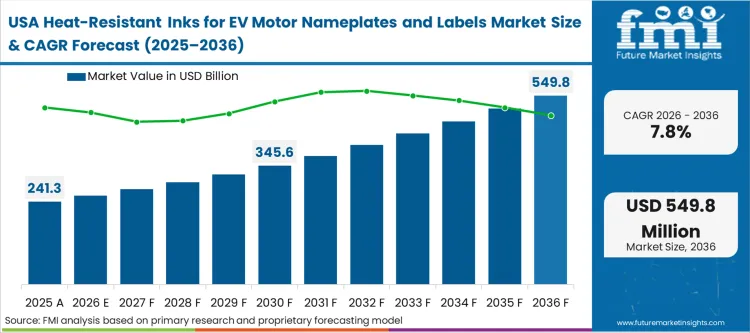
Stringent federal warranty compliance standards dictate material selection across North America assembly plants. Compliance officers scrutinize every chemical component applied to high-voltage systems to ensure fifteen-year readability. Engineering departments prioritize resistance to aggressive de-icing salts alongside primary thermal requirements. FMI's analysis indicates local procurement teams heavily favor established domestic chemical conglomerates providing printed labels over cheaper imported alternatives to minimize supply chain risk.
- USA: Procurement teams drive adoption through strict adherence to federal tracking mandates. Plant managers actively seek solutions that integrate seamlessly with existing robotic application hardware. Cumulative valuation is projected to expand at 7.8% as legacy automakers execute massive electrification transitions. Domestic suppliers providing EV supply chain labeling materials who successfully navigate stringent EPA manufacturing regulations secure dominant commercial positioning.
FMI's report includes Canada and Mexico. Cross-border supply chains require identification tags to survive extreme temperature fluctuations during rail transport before final assembly occurs.
Europe Heat-Resistant Inks for EV Motor Nameplates and Labels Market Analysis
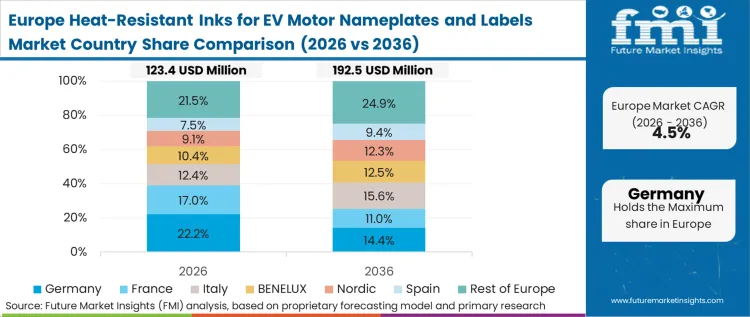
Sustainability directives combined with high-performance engineering define Europe material specifications. Formulation chemists face intense pressure to eliminate hazardous solvents without compromising 200°C continuous operating ratings. Quality assurance teams routinely reject otherwise functional coatings if they contain restricted chemical precursors. FMI observes that luxury automakers push boundaries by demanding aesthetically perfect direct thermal inks on prominent powertrain components. Examining the total automotive ink volume size reveals steady transition toward advanced synthetics.
- Germany: Legacy manufacturers overhaul component tracking infrastructure to support next-generation 800V architectures. Tooling engineers require formulations that perform flawlessly on heavily textured cast housings. Demand increases at 7.5% as premium brands push operating temperatures higher to maximize motor efficiency. Securing approval from Germany engineering boards guarantees immediate credibility globally.
- France: Sustained luxury electric vehicle output drives demand for high-contrast, durable identification solutions. Brand managers insist powertrain labels reflect overall vehicle build quality. Revenue is estimated to grow at 7.2% as domestic producers prioritize aesthetic longevity alongside functional survival. Suppliers must demonstrate absolute color stability after intense UV and thermal exposure.
FMI's report includes Italy, Spain, and the United Kingdom. Regional engineering centers actively collaborate on standardized testing protocols to streamline chemical qualification across continental supply chains.
Competitive Aligners for Market Players
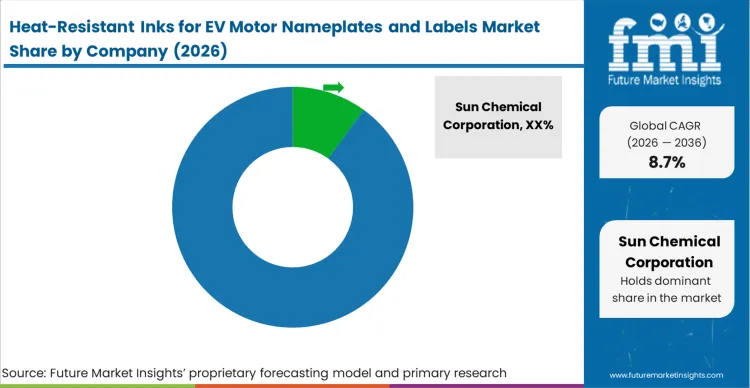
Qualification moats dictate competitive reality inside automotive labeling supply chains. Chemical conglomerates like Sun Chemical Corporation and Siegwerk Druckfarben AG & Co. KGaA utilize decades of deep relationships with tier-one component manufacturers to lock in specifications before vehicle platforms even reach prototype stages. Formulators who successfully embed their specific product codes into an OEM's master engineering drawing effectively eliminate price-based competition. Sourcing directors rarely risk line-stoppages to save marginal pennies on unproven automotive labels. Evaluating industrial ink suppliers automotive buyers trust reveals intense supplier consolidation.
Incumbents command immense power through extensive proprietary libraries of real-world environmental testing data. When an engineering team at a major automaker needs an epoxy variant or specialized offset inks guaranteed to survive ten years immersed in hot synthetic oil, Flint Group or Toyo Ink SC Holdings Co., Ltd. can immediately provide certified lab results. Challengers lack this accumulated validation history. Building equivalent reliability databases requires thousands of hours in expensive accelerated aging chambers, creating a massive temporal barrier that capital expenditure alone cannot overcome. FMI's assessment indicates this validation gap secures incumbent margins for premier heat resistant ink suppliers.
Large tier-one suppliers actively fight single-source lock-in by demanding dual-validation pathways during initial design phases. Procurement directors force engineering teams to qualify at least two chemically equivalent EV component marking inks from different manufacturers before authorizing mass production. Structural tension constantly exists between quality managers wanting absolute consistency and purchasing agents needing commercial leverage. Moving forward, chemical suppliers who offer foil labels or equivalent global formulations across localized production facilities will dominate contract negotiations.
Key Players in Heat-Resistant Inks for EV Motor Nameplates and Labels Market
- Sun Chemical Corporation
- INX International Ink Co.
- Siegwerk Druckfarben AG & Co. KGaA
- Flint Group
- Toyo Ink SC Holdings Co., Ltd.
- Nazdar Ink Technologies
- Huber Group
Scope of the Report

| Metric | Value |
|---|---|
| Quantitative Units | USD 0.46 Billion to USD 1.05 Billion, at a CAGR of 8.7% |
| Market Definition | Traceability markers formulated specifically to withstand sustained high-temperature environments inside electric vehicle powertrains define this sector. |
| Segmentation | Ink Chemistry Type, Substrate Compatibility, Application Type, Printing Technology, End Use, Region |
| Regions Covered | North America, Latin America, Western Europe, Eastern Europe, Asia Pacific, Middle East and Africa |
| Countries Covered | USA, Canada, Mexico, Germany, UK, France, Italy, Spain, Russia, China, Japan, India, South Korea, Australia, Brazil, Argentina, GCC Countries, South Africa |
| Key Companies Profiled | Sun Chemical Corporation, INX International Ink Co., Siegwerk Druckfarben AG & Co. KGaA, Flint Group, Toyo Ink SC Holdings Co., Ltd., Nazdar Ink Technologies, Huber Group |
| Forecast Period | 2026 to 2036 |
| Approach | Global electric vehicle production volume baselines mapped against average identifier footprint per motor. |
Source: Future Market Insights (FMI) analysis, based on proprietary forecasting model and primary research
Heat Resistant Inks for EV Motor Nameplates and Labels Market Segmentation
Ink Chemistry Type
- Epoxy-based inks
- Silicone-based inks
- Polyimide inks
- Acrylic high-temp inks
Substrate Compatibility
- Metal nameplates
- Polymer labels
- Ceramic substrates
- Composite laminates
Application Type
- Motor nameplates
- Battery system labels
- Power electronics labels
- Thermal warning/safety labels
Printing Technology
- Screen printing
- Digital inkjet
- Pad printing
- Laser marking-compatible coatings
End Use
- Passenger EVs
- Commercial EVs
- Industrial electric drives
- Two/three-wheeler EVs
Region
- North America
- USA
- Canada
- Latin America
- Brazil
- Mexico
- Argentina
- Western Europe
- Germany
- France
- United Kingdom
- Spain
- Italy
- Eastern Europe
- Russia
- Poland
- Asia Pacific
- China
- India
- Japan
- South Korea
- Australia
- ASEAN
- Middle East & Africa
- GCC
- South Africa
- Israel
- Rest of Middle East & Africa
Bibliography
- Dutta, S., & Bhandari, S. (2024, November). A comprehensive review of conductive ink printing for advanced industrial applications. Research Journal of Textile and Apparel (Emerald Publishing).
- Tian, X., Zhang, Y., & Liu, H. (2024, April). Recent advancements in water-based and high-temperature resistant polymer binders for coating and ink applications. Progress in Organic Coatings.
- Zhang, X., Li, H., & Wang, Y. (2024, July). Electrically insulating yet highly efficient EMI shielding coatings for advanced electronics. Advanced Functional Materials (Wiley).
- European Commission, Joint Research Centre. (2024). Imaging equipment and consumables: Preparatory study for ecodesign (JRC134590).
- Durairaj, L., et al. (2025, June). Recent innovations in EMI shielding materials and coatings for next-generation electronic systems. Composites Science and Technology (Elsevier).
This bibliography is provided for reader reference. The full FMI report contains the complete reference list with primary source documentation.
This Report Addresses
- Powertrain engineers seeking compliant chemical formulations capable of surviving continuous 800V operating conditions.
- Procurement directors requiring dual-validation strategies for high-temperature identification markers across global production facilities.
- Quality assurance managers attempting to standardize accelerated thermal aging protocols for new stator components.
- Formulation chemists evaluating cross-linking density trade-offs between epoxy and silicone variants.
- Sourcing departments navigating stringent local tracking mandates within emerging Asian manufacturing hubs.
- Plant managers analyzing transition costs from legacy screen printing toward sequential digital inkjet solutions.
- Supply chain executives modeling long-term cost implications of raw material dependencies for specialized coatings.
- Tooling engineers optimizing direct-to-cast printing applications on heavily textured aluminum motor housings.
Frequently Asked Questions
What inks are used in EV motor labels?
Epoxy-based inks is projected to hold 38.5% share in 2026. Cross-linking density determines survival inside boiling dielectric fluids. Procurement managers specifically mandate this chemistry for components subjected to direct oil cooling because its impenetrable cured matrix prevents catastrophic delamination under high vibration. Silicone inks EV labels demand also increases for flexible substrate applications.
Why do EV labels need heat resistant inks?
Thermal cycling profiles inside modern 800V architectures compel powertrain engineers to specify military-grade adhesion standards. Regulatory traceability mandates force compliance officers to reject materials that fade during accelerated aging tests, driving adoption of highly specialized EV thermal resistant inks.
Which materials withstand EV motor temperatures?
Metal nameplates is anticipated to account for 46.2% share in 2026. Matching thermal expansion coefficients prevents peeling during winter operation. Legacy manufacturing processes favor stamped aluminum tags because deep physical impressions provide fail-safe manual readability even if external pigments burn away completely.
What is the EV ink volume forecast?
Demand is poised to cross USD 0.5 billion in 2026 at a CAGR of 8.7% during the forecast period. Revenue expansion lifts cumulative valuation to USD 1.1 billion through 2036 as continuous 800V motor architectures impose severe thermal stress on internal identification tags.
Who are leading EV ink suppliers?
Chemical conglomerates like Sun Chemical Corporation, INX International, Siegwerk, Flint Group, and Toyo Ink utilize decades of deep relationships with tier-one component manufacturers. These incumbents lock in specifications before vehicle platforms reach prototype stages, commanding immense power through extensive proprietary testing libraries.
What is the best ink for high temperature labels?
The optimal chemistry depends strictly on operational exposure. While epoxy variants dominate oil-cooled motor housings due to extreme chemical resistance, engineers actively evaluate alternative flexible chemistries for high-voltage inverter applications where physical vibration differs fundamentally from stator environments.
How are EV labels printed?
Screen printing is set to record 41.7% share in 2026. Deposit thickness directly correlates with physical abrasion resistance. Digital equipment vendors struggle to deposit enough solid pigment mass to survive aggressive pressure washing and undercarriage gravel impact, forcing reliance on traditional high-volume deposition methods.
Are epoxy inks better than silicone inks?
Epoxy formulations provide superior rigid cross-linking density critical for surviving boiling dielectric fluid immersion. However, structural tension exists when quality managers require coating flexibility to match aggressive thermal expansion rates of certain polymer substrates, creating specialized niches for alternative synthetic compounds.
Why do motor labels require higher specifications than battery tags?
Motor nameplates is expected to garner 52.4% share in 2026. While battery systems receive more fire safety attention, electric drive units actually endure significantly higher sustained thermal loads during continuous highway driving. Federal traceability laws dictate exact placement and durability parameters for these identifiers.
Why do passenger vehicles dictate material standards for commercial trucks?
Passenger EVs is poised to grab 57.8% share in 2026. Volume economics dictate initial material qualification pathways. Heavy-duty commercial drivetrains actually require far more resilient chemistries, yet passenger vehicle testing protocols define baseline industry standards due to sheer manufacturing gravity and chemical consumption volume.
What structural difference explains regional growth disparities?
India leads at 11.4% compound growth, accelerated by localized supply chain requirements for light electric mobility platforms. South Korea expands at 8.1% due to aggressive battery ecosystem integration where domestic conglomerates control both cell production and final vehicle assembly.
Why do sourcing directors resist single-source chemical agreements?
Large tier-one suppliers actively fight lock-in by demanding dual-validation pathways during initial design phases. Procurement directors force engineering teams to qualify at least two chemically equivalent formulations from different manufacturers to maintain commercial leverage during long-term contract negotiations.
What advantage does direct-to-cast printing offer assembly plants?
Eliminating physical label substrates entirely reduces bill-of-material complexity. Process engineers achieve significant cost savings by printing barcodes directly onto rough aluminum housings, bypassing intermediate application steps and eliminating secondary adhesive failure points entirely.
How do UV-curable variants improve factory floor operations?
Formulating fluids that cure instantly under ultraviolet light removes massive thermal baking ovens from assembly lines. Facility directors recapture premium factory floor space and eliminate lengthy cooling bottlenecks, dramatically increasing overall production throughput per shift.
Why is fluid resistance becoming equally critical to thermal tolerance?
When OEMs mandate continuous immersion cooling for high-performance stators, baseline material requirements shift permanently. Formulations must survive boiling transmission fluid without losing barcode contrast. Suppliers engineering these exact chemical profiles secure exclusive long-term supply agreements.
What specific metric determines chemical approval during testing?
Formulation chemists evaluate fundamental thermal degradation temperatures before conducting adhesion tests. Quality assurance teams reject any compound showing discoloration at 180°C, demanding zero loss of barcode scan accuracy following intense environmental chamber exposure.
How do local environmental regulations impact product development?
Formulation chemists face immense pressure to develop zero-VOC solutions without sacrificing continuous operating ratings. Quality assurance teams routinely reject otherwise functional coatings if they contain restricted chemical precursors, forcing constant redevelopment of proven legacy recipes.
Why do aftermarket repair realities influence original manufacturing choices?
Extreme chemical solvents used during aftermarket repairs easily strip poorly cured coatings. Service technicians struggle to order replacement parts without readable identification codes. OEMs absorb total replacement costs when components cannot be accurately identified in the field.
What role do visual aesthetics play in powertrain component marking?
Luxury vehicle engineers specify ultra-durable compounds regardless of unit cost. Brand managers demand flawless aesthetics even on hidden powertrain components, pushing chemical suppliers to demonstrate absolute color stability after intense UV and thermal exposure.
How do export mandates affect emerging market manufacturers?
Two-wheeler manufacturers resist expensive upgrades until export regulations force compliance. Export-focused OEMs must adopt global material standards to penetrate strict Europe compliance regimes, forcing localized supply chains to rapidly upgrade their chemical capabilities.
What happens when a formulation fails accelerated aging tests?
Delaying material qualification exposes vehicle manufacturers to massive recall expenses. Supply chain directors authorize long-term contracts only after a variant proves stable across multiple architectures. Re-qualifying new suppliers takes eighteen months, stalling assembly line output significantly.
How do automated inspection systems influence coating formulation?
Volume manufacturers optimize internal traceability protocols to manage millions of outgoing drive units. Quality directors mandate automated optical inspection compatibility. Formulations must deliver perfect optical contrast instantly to prevent costly robotic vision errors during high-speed assembly.
Why do engineering centers collaborate on testing protocols?
Regional engineering centers actively collaborate on standardized testing protocols to streamline chemical qualification across continental supply chains. Unified compliance frameworks allow tier-one suppliers to deploy identical global formulations across localized production facilities without repeating exhaustive localized testing.
What dictates initial purchasing decisions for new EV platforms?
Purchasing directors cannot risk multi-million dollar recall liability stemming from failed traceability markers. Sourcing departments consequently mandate specialized high-temperature formulations capable of surviving ten years of continuous thermal cycling, prioritizing absolute reliability over raw chemical pricing.
Preview the report firsthand - request a free sample
Get SampleGet the brochure for pricing and purchase details.
Get PDFTable of Content
- Executive Summary
- Global Market Outlook
- Demand-side Trends
- Supply-side Trends
- Technology Roadmap Analysis
- Analysis and Recommendations
- Market Overview
- Market Coverage / Taxonomy
- Market Definition / Scope / Limitations
- Research Methodology
- Chapter Orientation
- Analytical Lens and Working Hypotheses
- Market Structure, Signals, and Trend Drivers
- Benchmarking and Cross-market Comparability
- Market Sizing, Forecasting, and Opportunity Mapping
- Research Design and Evidence Framework
- Desk Research Programme (Secondary Evidence)
- Company Annual and Sustainability Reports
- Peer-reviewed Journals and Academic Literature
- Corporate Websites, Product Literature, and Technical Notes
- Earnings Decks and Investor Briefings
- Statutory Filings and Regulatory Disclosures
- Technical White Papers and Standards Notes
- Trade Journals, Industry Magazines, and Analyst Briefs
- Conference Proceedings, Webinars, and Seminar Materials
- Government Statistics Portals and Public Data Releases
- Press Releases and Reputable Media Coverage
- Specialist Newsletters and Curated Briefings
- Sector Databases and Reference Repositories
- FMI Internal Proprietary Databases and Historical Market Datasets
- Subscription Datasets and Paid Sources
- Social Channels, Communities, and Digital Listening Inputs
- Additional Desk Sources
- Expert Input and Fieldwork (Primary Evidence)
- Primary Modes
- Qualitative Interviews and Expert Elicitation
- Quantitative Surveys and Structured Data Capture
- Blended Approach
- Why Primary Evidence is Used
- Field Techniques
- Interviews
- Surveys
- Focus Groups
- Observational and In-context Research
- Social and Community Interactions
- Stakeholder Universe Engaged
- C-suite Leaders
- Board Members
- Presidents and Vice Presidents
- R&D and Innovation Heads
- Technical Specialists
- Domain Subject-matter Experts
- Scientists
- Physicians and Other Healthcare Professionals
- Governance, Ethics, and Data Stewardship
- Research Ethics
- Data Integrity and Handling
- Primary Modes
- Tooling, Models, and Reference Databases
- Desk Research Programme (Secondary Evidence)
- Data Engineering and Model Build
- Data Acquisition and Ingestion
- Cleaning, Normalisation, and Verification
- Synthesis, Triangulation, and Analysis
- Quality Assurance and Audit Trail
- Market Background
- Market Dynamics
- Drivers
- Restraints
- Opportunity
- Trends
- Scenario Forecast
- Demand in Optimistic Scenario
- Demand in Likely Scenario
- Demand in Conservative Scenario
- Opportunity Map Analysis
- Product Life Cycle Analysis
- Supply Chain Analysis
- Investment Feasibility Matrix
- Value Chain Analysis
- PESTLE and Porter’s Analysis
- Regulatory Landscape
- Regional Parent Market Outlook
- Production and Consumption Statistics
- Import and Export Statistics
- Market Dynamics
- Global Market Analysis 2021 to 2025 and Forecast, 2026 to 2036
- Historical Market Size Value (USD Million) Analysis, 2021 to 2025
- Current and Future Market Size Value (USD Million) Projections, 2026 to 2036
- Y-o-Y Growth Trend Analysis
- Absolute $ Opportunity Analysis
- Global Market Pricing Analysis 2021 to 2025 and Forecast 2026 to 2036
- Global Market Analysis 2021 to 2025 and Forecast 2026 to 2036, By Ink Chemistry Type
- Introduction / Key Findings
- Historical Market Size Value (USD Million) Analysis By Ink Chemistry Type , 2021 to 2025
- Current and Future Market Size Value (USD Million) Analysis and Forecast By Ink Chemistry Type , 2026 to 2036
- Epoxy-based Inks
- Silicone-based inks
- Others
- Epoxy-based Inks
- Y-o-Y Growth Trend Analysis By Ink Chemistry Type , 2021 to 2025
- Absolute $ Opportunity Analysis By Ink Chemistry Type , 2026 to 2036
- Global Market Analysis 2021 to 2025 and Forecast 2026 to 2036, By Substrate Compatibility
- Introduction / Key Findings
- Historical Market Size Value (USD Million) Analysis By Substrate Compatibility, 2021 to 2025
- Current and Future Market Size Value (USD Million) Analysis and Forecast By Substrate Compatibility, 2026 to 2036
- Metal Nameplates
- Polymer labels
- Others
- Metal Nameplates
- Y-o-Y Growth Trend Analysis By Substrate Compatibility, 2021 to 2025
- Absolute $ Opportunity Analysis By Substrate Compatibility, 2026 to 2036
- Global Market Analysis 2021 to 2025 and Forecast 2026 to 2036, By Application Type
- Introduction / Key Findings
- Historical Market Size Value (USD Million) Analysis By Application Type, 2021 to 2025
- Current and Future Market Size Value (USD Million) Analysis and Forecast By Application Type, 2026 to 2036
- Motor Nameplates
- Battery system labels
- Others
- Motor Nameplates
- Y-o-Y Growth Trend Analysis By Application Type, 2021 to 2025
- Absolute $ Opportunity Analysis By Application Type, 2026 to 2036
- Global Market Analysis 2021 to 2025 and Forecast 2026 to 2036, By Printing Technology
- Introduction / Key Findings
- Historical Market Size Value (USD Million) Analysis By Printing Technology, 2021 to 2025
- Current and Future Market Size Value (USD Million) Analysis and Forecast By Printing Technology, 2026 to 2036
- Screen Printing
- Digital inkjet
- Others
- Screen Printing
- Y-o-Y Growth Trend Analysis By Printing Technology, 2021 to 2025
- Absolute $ Opportunity Analysis By Printing Technology, 2026 to 2036
- Global Market Analysis 2021 to 2025 and Forecast 2026 to 2036, By End Use
- Introduction / Key Findings
- Historical Market Size Value (USD Million) Analysis By End Use, 2021 to 2025
- Current and Future Market Size Value (USD Million) Analysis and Forecast By End Use, 2026 to 2036
- Passenger EVs
- Commercial EVs
- Others
- Passenger EVs
- Y-o-Y Growth Trend Analysis By End Use, 2021 to 2025
- Absolute $ Opportunity Analysis By End Use, 2026 to 2036
- Global Market Analysis 2021 to 2025 and Forecast 2026 to 2036, By Region
- Introduction
- Historical Market Size Value (USD Million) Analysis By Region, 2021 to 2025
- Current Market Size Value (USD Million) Analysis and Forecast By Region, 2026 to 2036
- North America
- Latin America
- Western Europe
- Eastern Europe
- East Asia
- South Asia and Pacific
- Middle East & Africa
- Market Attractiveness Analysis By Region
- North America Market Analysis 2021 to 2025 and Forecast 2026 to 2036, By Country
- Historical Market Size Value (USD Million) Trend Analysis By Market Taxonomy, 2021 to 2025
- Market Size Value (USD Million) Forecast By Market Taxonomy, 2026 to 2036
- By Country
- USA
- Canada
- Mexico
- By Ink Chemistry Type
- By Substrate Compatibility
- By Application Type
- By Printing Technology
- By End Use
- By Country
- Market Attractiveness Analysis
- By Country
- By Ink Chemistry Type
- By Substrate Compatibility
- By Application Type
- By Printing Technology
- By End Use
- Key Takeaways
- Latin America Market Analysis 2021 to 2025 and Forecast 2026 to 2036, By Country
- Historical Market Size Value (USD Million) Trend Analysis By Market Taxonomy, 2021 to 2025
- Market Size Value (USD Million) Forecast By Market Taxonomy, 2026 to 2036
- By Country
- Brazil
- Chile
- Rest of Latin America
- By Ink Chemistry Type
- By Substrate Compatibility
- By Application Type
- By Printing Technology
- By End Use
- By Country
- Market Attractiveness Analysis
- By Country
- By Ink Chemistry Type
- By Substrate Compatibility
- By Application Type
- By Printing Technology
- By End Use
- Key Takeaways
- Western Europe Market Analysis 2021 to 2025 and Forecast 2026 to 2036, By Country
- Historical Market Size Value (USD Million) Trend Analysis By Market Taxonomy, 2021 to 2025
- Market Size Value (USD Million) Forecast By Market Taxonomy, 2026 to 2036
- By Country
- Germany
- UK
- Italy
- Spain
- France
- Nordic
- BENELUX
- Rest of Western Europe
- By Ink Chemistry Type
- By Substrate Compatibility
- By Application Type
- By Printing Technology
- By End Use
- By Country
- Market Attractiveness Analysis
- By Country
- By Ink Chemistry Type
- By Substrate Compatibility
- By Application Type
- By Printing Technology
- By End Use
- Key Takeaways
- Eastern Europe Market Analysis 2021 to 2025 and Forecast 2026 to 2036, By Country
- Historical Market Size Value (USD Million) Trend Analysis By Market Taxonomy, 2021 to 2025
- Market Size Value (USD Million) Forecast By Market Taxonomy, 2026 to 2036
- By Country
- Russia
- Poland
- Hungary
- Balkan & Baltic
- Rest of Eastern Europe
- By Ink Chemistry Type
- By Substrate Compatibility
- By Application Type
- By Printing Technology
- By End Use
- By Country
- Market Attractiveness Analysis
- By Country
- By Ink Chemistry Type
- By Substrate Compatibility
- By Application Type
- By Printing Technology
- By End Use
- Key Takeaways
- East Asia Market Analysis 2021 to 2025 and Forecast 2026 to 2036, By Country
- Historical Market Size Value (USD Million) Trend Analysis By Market Taxonomy, 2021 to 2025
- Market Size Value (USD Million) Forecast By Market Taxonomy, 2026 to 2036
- By Country
- China
- Japan
- South Korea
- By Ink Chemistry Type
- By Substrate Compatibility
- By Application Type
- By Printing Technology
- By End Use
- By Country
- Market Attractiveness Analysis
- By Country
- By Ink Chemistry Type
- By Substrate Compatibility
- By Application Type
- By Printing Technology
- By End Use
- Key Takeaways
- South Asia and Pacific Market Analysis 2021 to 2025 and Forecast 2026 to 2036, By Country
- Historical Market Size Value (USD Million) Trend Analysis By Market Taxonomy, 2021 to 2025
- Market Size Value (USD Million) Forecast By Market Taxonomy, 2026 to 2036
- By Country
- India
- ASEAN
- Australia & New Zealand
- Rest of South Asia and Pacific
- By Ink Chemistry Type
- By Substrate Compatibility
- By Application Type
- By Printing Technology
- By End Use
- By Country
- Market Attractiveness Analysis
- By Country
- By Ink Chemistry Type
- By Substrate Compatibility
- By Application Type
- By Printing Technology
- By End Use
- Key Takeaways
- Middle East & Africa Market Analysis 2021 to 2025 and Forecast 2026 to 2036, By Country
- Historical Market Size Value (USD Million) Trend Analysis By Market Taxonomy, 2021 to 2025
- Market Size Value (USD Million) Forecast By Market Taxonomy, 2026 to 2036
- By Country
- Kingdom of Saudi Arabia
- Other GCC Countries
- Turkiye
- South Africa
- Other African Union
- Rest of Middle East & Africa
- By Ink Chemistry Type
- By Substrate Compatibility
- By Application Type
- By Printing Technology
- By End Use
- By Country
- Market Attractiveness Analysis
- By Country
- By Ink Chemistry Type
- By Substrate Compatibility
- By Application Type
- By Printing Technology
- By End Use
- Key Takeaways
- Key Countries Market Analysis
- USA
- Pricing Analysis
- Market Share Analysis, 2025
- By Ink Chemistry Type
- By Substrate Compatibility
- By Application Type
- By Printing Technology
- By End Use
- Canada
- Pricing Analysis
- Market Share Analysis, 2025
- By Ink Chemistry Type
- By Substrate Compatibility
- By Application Type
- By Printing Technology
- By End Use
- Mexico
- Pricing Analysis
- Market Share Analysis, 2025
- By Ink Chemistry Type
- By Substrate Compatibility
- By Application Type
- By Printing Technology
- By End Use
- Brazil
- Pricing Analysis
- Market Share Analysis, 2025
- By Ink Chemistry Type
- By Substrate Compatibility
- By Application Type
- By Printing Technology
- By End Use
- Chile
- Pricing Analysis
- Market Share Analysis, 2025
- By Ink Chemistry Type
- By Substrate Compatibility
- By Application Type
- By Printing Technology
- By End Use
- Germany
- Pricing Analysis
- Market Share Analysis, 2025
- By Ink Chemistry Type
- By Substrate Compatibility
- By Application Type
- By Printing Technology
- By End Use
- UK
- Pricing Analysis
- Market Share Analysis, 2025
- By Ink Chemistry Type
- By Substrate Compatibility
- By Application Type
- By Printing Technology
- By End Use
- Italy
- Pricing Analysis
- Market Share Analysis, 2025
- By Ink Chemistry Type
- By Substrate Compatibility
- By Application Type
- By Printing Technology
- By End Use
- Spain
- Pricing Analysis
- Market Share Analysis, 2025
- By Ink Chemistry Type
- By Substrate Compatibility
- By Application Type
- By Printing Technology
- By End Use
- France
- Pricing Analysis
- Market Share Analysis, 2025
- By Ink Chemistry Type
- By Substrate Compatibility
- By Application Type
- By Printing Technology
- By End Use
- India
- Pricing Analysis
- Market Share Analysis, 2025
- By Ink Chemistry Type
- By Substrate Compatibility
- By Application Type
- By Printing Technology
- By End Use
- ASEAN
- Pricing Analysis
- Market Share Analysis, 2025
- By Ink Chemistry Type
- By Substrate Compatibility
- By Application Type
- By Printing Technology
- By End Use
- Australia & New Zealand
- Pricing Analysis
- Market Share Analysis, 2025
- By Ink Chemistry Type
- By Substrate Compatibility
- By Application Type
- By Printing Technology
- By End Use
- China
- Pricing Analysis
- Market Share Analysis, 2025
- By Ink Chemistry Type
- By Substrate Compatibility
- By Application Type
- By Printing Technology
- By End Use
- Japan
- Pricing Analysis
- Market Share Analysis, 2025
- By Ink Chemistry Type
- By Substrate Compatibility
- By Application Type
- By Printing Technology
- By End Use
- South Korea
- Pricing Analysis
- Market Share Analysis, 2025
- By Ink Chemistry Type
- By Substrate Compatibility
- By Application Type
- By Printing Technology
- By End Use
- Russia
- Pricing Analysis
- Market Share Analysis, 2025
- By Ink Chemistry Type
- By Substrate Compatibility
- By Application Type
- By Printing Technology
- By End Use
- Poland
- Pricing Analysis
- Market Share Analysis, 2025
- By Ink Chemistry Type
- By Substrate Compatibility
- By Application Type
- By Printing Technology
- By End Use
- Hungary
- Pricing Analysis
- Market Share Analysis, 2025
- By Ink Chemistry Type
- By Substrate Compatibility
- By Application Type
- By Printing Technology
- By End Use
- Kingdom of Saudi Arabia
- Pricing Analysis
- Market Share Analysis, 2025
- By Ink Chemistry Type
- By Substrate Compatibility
- By Application Type
- By Printing Technology
- By End Use
- Turkiye
- Pricing Analysis
- Market Share Analysis, 2025
- By Ink Chemistry Type
- By Substrate Compatibility
- By Application Type
- By Printing Technology
- By End Use
- South Africa
- Pricing Analysis
- Market Share Analysis, 2025
- By Ink Chemistry Type
- By Substrate Compatibility
- By Application Type
- By Printing Technology
- By End Use
- USA
- Market Structure Analysis
- Competition Dashboard
- Competition Benchmarking
- Market Share Analysis of Top Players
- By Regional
- By Ink Chemistry Type
- By Substrate Compatibility
- By Application Type
- By Printing Technology
- By End Use
- Competition Analysis
- Competition Deep Dive
- Sun Chemical Corporation
- Overview
- Product Portfolio
- Profitability by Market Segments (Product/Age /Sales Channel/Region)
- Sales Footprint
- Strategy Overview
- Marketing Strategy
- Product Strategy
- Channel Strategy
- INX International Ink Co.
- Siegwerk Druckfarben AG & Co. KGaA
- Flint Group
- Toyo Ink SC Holdings Co., Ltd.
- Nazdar Ink Technologies
- Huber Group
- Sun Chemical Corporation
- Competition Deep Dive
- Assumptions & Acronyms Used


