

- Industry Size (2026)
- USD 1.2 Bn
- Forecast (2036)
- USD 1.8 Bn
- CAGR (2026 to 2036)
- 4.3%
Demand for Aquarium Heaters and Chillers in USA 2026 to 2036
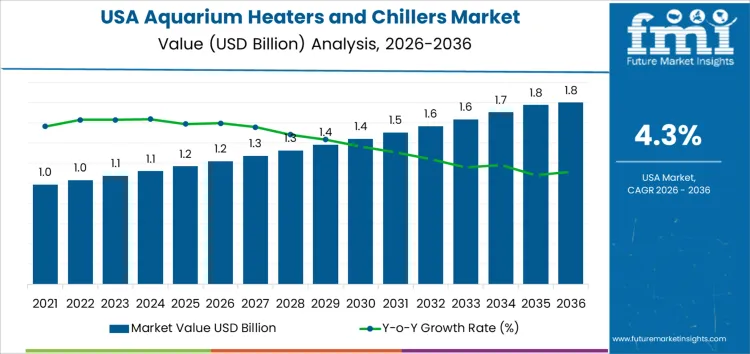
Demand for aquarium heaters and chillers in USA is valued at USD 1.2 billion in 2026 and is expected to reach USD 1.8 billion by 2036, reflecting a CAGR of 4.3%. Demand is supported by sustained aquarium hobby participation, growth in marine and reef tank installations, and emphasis on precise thermal control for aquatic health. Expansion of premium home aquariums and commercial display tanks reinforces equipment replacement and upgrade cycles.
Quick Stats for Demand for Aquarium Heaters and Chillers in USA
- USA Aquarium Heaters and Chillers Sales Value (2026): USD 1.2 billion
- USA Aquarium Heaters and Chillers Forecast Value (2036): USD 1.8 billion
- USA Aquarium Heaters and Chillers Forecast CAGR (2026 to 2036): 4.3%
- Leading Product Type in USA: Submersible Heaters
- Key Growth Regions in USA: West USA, South USA, Northeast USA, Midwest USA
- Top Players in USA: Hydor, Eheim, Coralife, Aqueon, JBJ
Submersible heaters lead product-type usage because direct water immersion enables efficient heat transfer, compact installation, and stable temperature regulation across small and medium tanks. Users prefer submersible designs for ease of setup, integrated thermostats, and compatibility with automated controllers. Improvements in safety shut-off mechanisms, energy efficiency, and corrosion-resistant materials strengthen adoption.
West USA, South USA, Northeast USA, and Midwest USA represent key growth regions driven by urban hobbyist density, specialty pet retail presence, and online-to-offline distribution models. Hydor, Eheim, Coralife, Aqueon, and JBJ anchor competitive activity through diversified product portfolios, reliability-focused engineering, and distribution networks aligned with U.S. aquarium care standards and consumer expectations.
USA Aquarium Heaters and Chillers Key Takeaways
| Metric | Value |
|---|---|
| USA Aquarium Heaters and Chillers Sales Value (2026) | USD 1.2 billion |
| USA Aquarium Heaters and Chillers Forecast Value (2036) | USD 1.8 billion |
| USA Aquarium Heaters and Chillers Forecast CAGR (2026-2036) | 4.3% |
Why is the Demand for Aquarium Heaters and Chillers in USA Growing?
Demand for aquarium heaters and chillers in the United States grows due to expanding participation in home aquariums, professional aquascaping, and controlled aquatic environments. Hobbyists maintain tropical and marine species that require precise temperature regulation to support metabolism, immunity, and breeding stability. Wide regional climate variation across the country increases reliance on heating and cooling equipment to offset seasonal temperature fluctuations within indoor and outdoor tanks. Growth in saltwater and reef aquariums strengthens demand for chillers that manage heat generated by lighting and filtration systems.
Public aquariums, zoos, and research facilities invest in advanced temperature control to protect sensitive species and support long term habitat management. Commercial aquaculture operations use heaters and chillers to stabilize conditions during hatchery and grow out stages. Product innovation introduces energy efficient, digitally controlled units that appeal to cost conscious users. E commerce platforms improve access to specialized equipment across urban and suburban areas. Rising interest in animal welfare standards reinforces adoption of reliable thermal management tools. Replacement demand remains steady as users’ upgrade systems to improve efficiency, noise control, and monitoring accuracy.
How Are the Segments Classified in the Demand for Aquarium Heaters and Chillers in USA?
Demand for aquarium heaters and chillers in USA is shaped by temperature stability requirements, species-specific aquatic care, and steady growth in home aquarium ownership. Buyers evaluate thermal accuracy, energy efficiency, durability, and compatibility with different tank sizes. Adoption patterns reflect dominant residential usage alongside consistent commercial demand from aquariums, pet retailers, and hospitality installations requiring controlled aquatic environments.
Which Product Type Contributes the Largest Share to Aquarium Heater and Chiller Demand in USA?
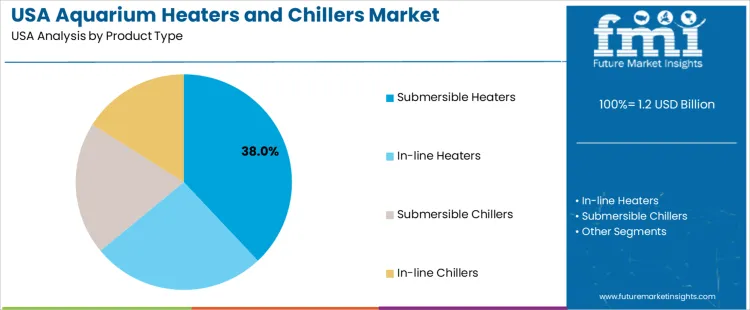
Submersible heaters hold 38.0%, contributing the largest share to USA demand. These units provide direct immersion heating, efficient heat transfer, and compact installation suited for small and mid-sized aquariums. Ease of setup and affordability support widespread residential adoption. In-line heaters hold 26.0%, supporting external filtration systems requiring precise temperature regulation. Submersible chillers account for 20.0%, used for cold-water species and seasonal cooling. In-line chillers hold 16.0%, serving larger or multi-tank systems. Product-type distribution reflects preference for simple heating solutions complemented by specialized cooling equipment.
Key Points
- Submersible heaters lead due to simplicity and efficiency.
- In-line heaters support advanced filtration configurations.
- Chillers address temperature-sensitive aquatic species.
Which Material Type Accounts for the Highest Usage in Aquarium Heaters and Chillers in USA?
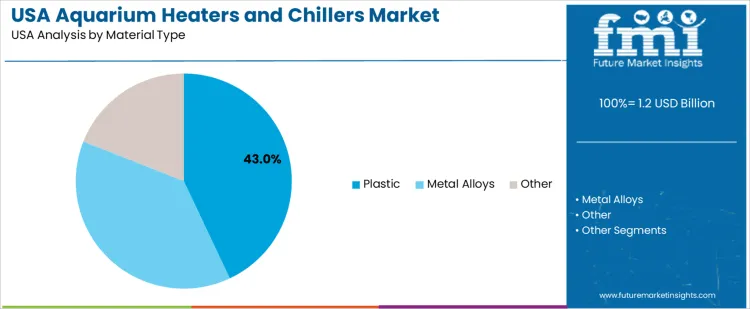
Plastic materials hold 43.0%, accounting for the highest usage in USA demand. Plastic housings provide electrical insulation, corrosion resistance, and lightweight construction suitable for submersible equipment. These properties enhance safety and durability in freshwater and marine environments. Metal alloys hold 38.0%, offering higher thermal conductivity and structural strength for premium heaters and chillers. Other materials hold 19.0%, covering composites and specialized coatings used in niche products. Material-type distribution reflects balance between safety-focused plastic designs and performance-oriented metal components.
Key Points
- Plastic leads due to insulation and corrosion resistance.
- Metal alloys enhance heat transfer and durability.
- Other materials support specialized equipment designs.
Which End-User Group Drives Aquarium Heater and Chiller Demand in USA?
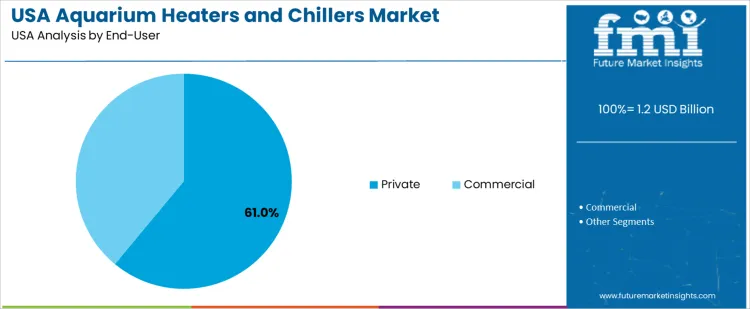
Private users hold 61.0%, driving aquarium heater and chiller demand in USA. Home aquarium ownership supports demand for compact, quiet, and easy-to-maintain temperature control equipment. Private users prioritize stable conditions to support ornamental fish and aquatic plants. Commercial users hold 39.0%, including public aquariums, pet stores, and hospitality venues requiring continuous operation and higher-capacity systems. End-user distribution reflects strong household participation supported by hobbyist culture and retail accessibility across USA.
Key Points
- Private users dominate due to widespread home aquarium ownership.
- Residential demand favors compact and low-noise equipment.
- Commercial users require higher-capacity continuous systems.
What are the Key Dynamics in the Aquarium Heaters and Chillers Industry?
Demand rises as hobbyist interest in freshwater, marine, and specialty aquariums grows across USA households, public aquariums, and research facilities. Aquarium heaters and chillers support precise temperature regulation essential for species-specific health, breeding, and display longevity. Adoption aligns with strong consumer leisure spending, preference for controlled aquatic environments, and expansion of specialty pet retail channels. Usage concentrates in regions with distinct seasonal temperature variations where indoor climate control does not fully stabilize aquarium water.
How do species-specific care requirements and seasonal climate patterns drive demand in USA?
USA aquarium hobbyists seek stable thermal environments to support tropical, reef, and cold-water fish species requiring narrow temperature bands. Heaters are essential in colder regions during winter months to maintain appropriate metabolic conditions. Chillers gain adoption in southern and humid states to prevent heat stress during summer peaks. Public aquariums and research labs use precision chillers and heaters to sustain diverse exhibits and experimental setups. Retailers in metropolitan and suburban markets supply compact, energy-efficient units suited to home aquarium sizes. Online specialty stores expand access to advanced units with digital controls and remote monitoring, supporting informed consumer purchase decisions.
How do energy costs, product reliability, and maintenance needs influence demand stability in USA?
Electricity pricing affects operating cost considerations for aquarium heating and cooling, particularly for larger tanks and continuous operation. Consumers prioritize energy-efficient models that deliver consistent temperature control with minimal noise. Maintenance requirements and risk of component failure influence replacement cycles and upgrade decisions. Chillers involve higher upfront investment, limiting adoption to serious hobbyists or institutional users. Warranty coverage and service availability from domestic and imported brands shape purchase confidence. Demand remains stable due to replacement needs and species care priorities, while expansion depends on advancements in efficiency, quiet operation, and broader consumer education within USA aquarium communities.
How Is Demand for Aquarium Heaters and Chillers in the USA Evolving by Region?
Demand for aquarium heaters and chillers in the USA is rising due to ornamental fish ownership, controlled aquaculture systems, and emphasis on stable thermal management. West USA leads with a 4.9% CAGR, supported by marine aquarium adoption and climate-driven cooling needs. South USA follows at 4.4%, reflecting warm temperatures, hobbyist density, and year-round aquarium operation. Northeast USA records a 3.9% CAGR, shaped by indoor aquariums and seasonal heating requirements. Midwest USA posts 3.4%, reflecting maintenance-led replacement and energy efficiency considerations. Regional differences reflect climate variation, housing patterns, aquarium hobby penetration, and replacement cycles across the USA.
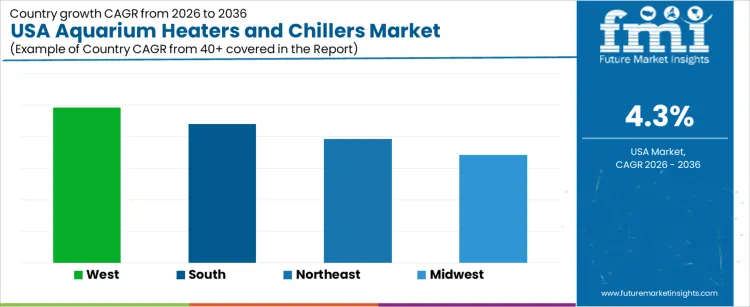
| Region | CAGR (2026 to 2036) |
|---|---|
| West USA | 4.9% |
| South USA | 4.4% |
| Northeast USA | 3.9% |
| Midwest USA | 3.4% |
What factors are accelerating adoption of aquarium heaters and chillers in West USA?
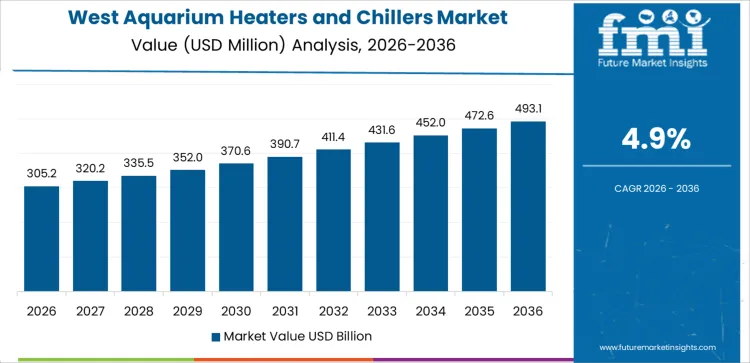
West USA drives demand through high marine aquarium adoption, specialty aquarium retail density, and climate variability across coastal and inland zones. Region’s CAGR of 4.9% reflects extensive use of chillers for reef tanks and heaters for seasonal temperature stabilization. Hobbyists maintain coral and tropical species requiring narrow thermal tolerances. Higher discretionary spending supports premium equipment purchases with digital thermostats and safety features. Retailers emphasize low-noise, energy-efficient systems suitable for apartments and dedicated hobby rooms. Continuous operation increases wear, supporting frequent replacement cycles. Demand growth remains upgrade-driven and climate-influenced, aligned with marine hobby expansion and equipment performance expectations.
- Strong marine and reef aquarium penetration
- Climate-driven chiller and heater usage
- Preference for premium, digitally controlled units
- Frequent upgrade and replacement cycles
Why does South USA show sustained growth in aquarium heater and chiller demand?
South USA demand is shaped by warm ambient temperatures, high humidity, and year-round aquarium operation. Region’s CAGR of 4.4% reflects strong reliance on chillers to manage elevated indoor water temperatures. Freshwater and saltwater aquariums operate continuously, increasing equipment runtime and maintenance requirements. Hobbyists prioritize durability, energy efficiency, and automatic shutoff features to manage operating costs. Retail distribution supports steady availability of mid-range systems. Replacement demand remains consistent due to prolonged summer stress on equipment. Growth remains climate-led and maintenance-oriented, supported by stable hobby participation across residential settings.
- Warm climate and continuous operation needs
- High chiller utilization rates
- Emphasis on durability and efficiency
- Maintenance-driven replacement demand
How do housing and climate patterns influence demand in Northeast USA?
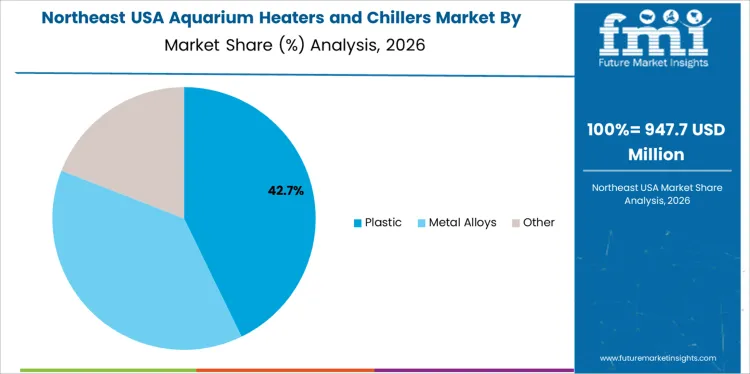
Northeast USA demand reflects indoor aquarium ownership, apartment living, and pronounced seasonal temperature shifts. Region’s CAGR of 3.9% is supported primarily by heater demand during extended winter periods. Chiller adoption remains limited and seasonal. Hobbyists favor compact heaters with integrated safety shutoff and consistent temperature control. Energy cost awareness influences purchasing decisions, favoring efficient models. Specialty retailers and online channels support replacement-focused sales. Demand growth remains steady, aligned with sustaining existing aquariums rather than expansion of marine or large-tank setups.
- Winter-driven heater demand
- Compact equipment suited for apartments
- Energy efficiency considerations
- Replacement-focused purchasing behavior
What drives replacement-focused demand for aquarium thermal equipment in Midwest USA?
Midwest USA demand is anchored in household aquariums, colder winters, and value-oriented consumer behavior. Region’s CAGR of 3.4% reflects dependence on heaters for stable water temperatures and limited chiller usage. Hobbyists prioritize affordability, reliability, and compatibility with standard tank configurations. Purchases frequently align with seasonal heater failure and routine maintenance cycles. Retail availability supports moderate but predictable sales volumes. Growth remains necessity-driven and maintenance-focused, aligned with preserving existing aquarium setups rather than hobby expansion.
- Cold-climate reliance on aquarium heaters
- Value-driven purchasing priorities
- Seasonal maintenance and replacement cycles
- Stable household aquarium ownership
What is the competitive landscape of demand for aquarium heaters and chillers in the USA?
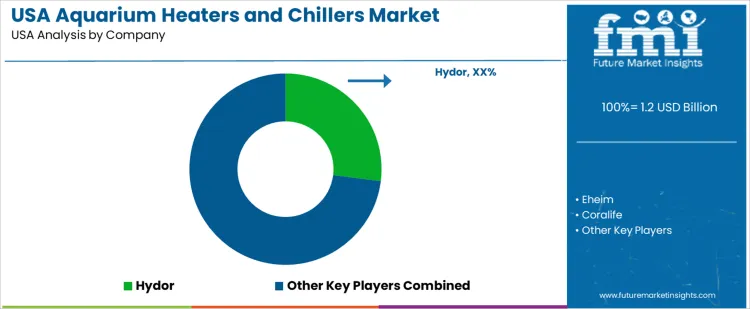
Demand for aquarium heaters and chillers in the USA is driven by hobbyist engagement, growth of public and private aquaria, and use in research and laboratory aquatic systems. Usage spans tropical freshwater tanks, reef and marine environments, and controlled scientific aquaculture requiring precise temperature regulation. Buyers evaluate temperature accuracy, energy efficiency, reliability for continuous operation, and compatibility with U.S. electrical standards. Procurement teams prioritize suppliers with strong domestic service networks, customer support, and wide retail and online availability. Trend in the USA market reflects interest in advanced digital controls, compact designs suited for varied tank sizes, and features that support both novice and experienced aquarists.
Hydor USA holds a strong presence through temperature control products widely distributed across aquarium specialty retailers and online channels, supported by domestic technical support and warranty service. Eheim USA participates with energy-efficient chillers and heaters adapted to hobbyist and professional aquaria. Coralife operates with a range of heater and chiller systems marketed through pet store chains and specialty aquatic outlets nationwide. Aqueon, widely available in the USA, supplies aquarium heaters and temperature control accessories designed for ease of use and reliability. JBJ USA contributes premium chillers and temperature systems used in reef and high-performance marine applications. Competitive positioning in the USA reflects product reliability, energy efficiency, service support, and distribution reach across retail and specialized aquarium channels.
Key Players in USA Aquarium Heaters and Chillers Demand
- Hydor
- Eheim
- Coralife
- Aqueon
- JBJ
Scope of the Report
| Items | Details |
|---|---|
| Quantitative Units | USD billion |
| Product Type | Submersible Heaters; In-line Heaters; Submersible Chillers; In-line Chillers |
| Material Type | Plastic; Metal Alloys; Other |
| End-User | Private; Commercial |
| Sales Channel | Online Stores; Wholesalers/Retailers; Specialty Stores; Hypermarket/Supermarket; Direct Sales; Other Sales Channels |
| Regions Covered | West USA; South USA; Northeast USA; Midwest USA |
| Key Companies Profiled | Hydor; Eheim; Coralife; Aqueon; JBJ |
| Additional Attributes | Demand is driven by growth in home aquariums, reef tanks, and commercial aquascaping installations. Submersible heaters dominate private use, while chillers see higher uptake in commercial and reef applications. Product reliability, temperature precision, energy efficiency, and online retail penetration influence purchasing patterns. |
USA Aquarium Heaters and Chillers Demand by Segments
Product Type:
- Submersible Heaters
- In-line Heaters
- Submersible Chillers
- In-line Chillers
Material Type:
- Plastic
- Metal Alloys
- Other
End-User:
- Private
- Commercial
Sales Channel:
- Online stores
- Wholesalers/Retailers
- Specialty Stores
- Hypermarket/Supermarket
- Direct Sales
- Others Sales Channel
Region:
- West USA
- South USA
- Northeast USA
- Midwest USA
Frequently Asked Questions
How big is the demand for aquarium heaters and chillers in USA in 2026?
The demand for aquarium heaters and chillers in USA is estimated to be valued at USD 1.2 billion in 2026.
What will be the size of aquarium heaters and chillers in USA in 2036?
The market size for the aquarium heaters and chillers in USA is projected to reach USD 1.8 billion by 2036.
How much will be the demand for aquarium heaters and chillers in USA growth between 2026 and 2036?
The demand for aquarium heaters and chillers in USA is expected to grow at a 4.3% CAGR between 2026 and 2036.
What are the key product types in the aquarium heaters and chillers in USA?
The key product types in aquarium heaters and chillers in USA are submersible heaters, in-line heaters, submersible chillers and in-line chillers.
Which material type segment is expected to contribute significant share in the aquarium heaters and chillers in USA in 2026?
In terms of material type, plastic segment is expected to command 43.0% share in the aquarium heaters and chillers in USA in 2026.
Preview the report firsthand - request a free sample
Get SampleGet the brochure for pricing and purchase details.
Get PDFTable of Content
- Executive Summary
- USA Market Outlook
- Demand-side Trends
- Supply-side Trends
- Technology Roadmap Analysis
- Analysis and Recommendations
- Market Overview
- Market Coverage / Taxonomy
- Market Definition / Scope / Limitations
- Market Background
- Market Dynamics
- Drivers
- Restraints
- Opportunity
- Trends
- Scenario Forecast
- Demand in Optimistic Scenario
- Demand in Likely Scenario
- Demand in Conservative Scenario
- Opportunity Map Analysis
- Product Life Cycle Analysis
- Supply Chain Analysis
- Investment Feasibility Matrix
- Value Chain Analysis
- PESTLE and Porter’s Analysis
- Regulatory Landscape
- Regional Parent Market Outlook
- Production and Consumption Statistics
- Import and Export Statistics
- Market Dynamics
- USA Market Analysis 2021 to 2025 and Forecast, 2026 to 2036
- Historical Market Size Value (USD Million) Analysis, 2021 to 2025
- Current and Future Market Size Value (USD Million) Projections, 2026 to 2036
- Y-o-Y Growth Trend Analysis
- Absolute $ Opportunity Analysis
- USA Market Pricing Analysis 2021 to 2025 and Forecast 2026 to 2036
- USA Market Analysis 2021 to 2025 and Forecast 2026 to 2036, By Product Type
- Introduction / Key Findings
- Historical Market Size Value (USD Million) Analysis By Product Type , 2021 to 2025
- Current and Future Market Size Value (USD Million) Analysis and Forecast By Product Type , 2026 to 2036
- Submersible Heaters
- In-line Heaters
- Submersible Chillers
- In-line Chillers
- Submersible Heaters
- Y-o-Y Growth Trend Analysis By Product Type , 2021 to 2025
- Absolute $ Opportunity Analysis By Product Type , 2026 to 2036
- USA Market Analysis 2021 to 2025 and Forecast 2026 to 2036, By Material Type
- Introduction / Key Findings
- Historical Market Size Value (USD Million) Analysis By Material Type, 2021 to 2025
- Current and Future Market Size Value (USD Million) Analysis and Forecast By Material Type, 2026 to 2036
- Plastic
- Metal Alloys
- Other
- Plastic
- Y-o-Y Growth Trend Analysis By Material Type, 2021 to 2025
- Absolute $ Opportunity Analysis By Material Type, 2026 to 2036
- USA Market Analysis 2021 to 2025 and Forecast 2026 to 2036, By End-User
- Introduction / Key Findings
- Historical Market Size Value (USD Million) Analysis By End-User, 2021 to 2025
- Current and Future Market Size Value (USD Million) Analysis and Forecast By End-User, 2026 to 2036
- Private
- Commercial
- Private
- Y-o-Y Growth Trend Analysis By End-User, 2021 to 2025
- Absolute $ Opportunity Analysis By End-User, 2026 to 2036
- USA Market Analysis 2021 to 2025 and Forecast 2026 to 2036, By Sales Channel
- Introduction / Key Findings
- Historical Market Size Value (USD Million) Analysis By Sales Channel, 2021 to 2025
- Current and Future Market Size Value (USD Million) Analysis and Forecast By Sales Channel, 2026 to 2036
- Online stores
- Wholesalers/Retailers
- Specialty Stores
- Hypermarket/Supermarket
- Direct Sales
- Others Sales Channel
- Online stores
- Y-o-Y Growth Trend Analysis By Sales Channel, 2021 to 2025
- Absolute $ Opportunity Analysis By Sales Channel, 2026 to 2036
- Market Structure Analysis
- Competition Dashboard
- Competition Benchmarking
- Market Share Analysis of Top Players
- By Regional
- By Product Type
- By Material Type
- By End-User
- By Sales Channel
- Competition Analysis
- Competition Deep Dive
- Hydor
- Overview
- Product Portfolio
- Profitability by Market Segments (Product/Age /Sales Channel/Region)
- Sales Footprint
- Strategy Overview
- Marketing Strategy
- Product Strategy
- Channel Strategy
- Eheim
- Coralife
- Aqueon
- JBJ
- Hydor
- Competition Deep Dive
- Assumptions & Acronyms Used
- Research Methodology


